
Market Minds Advisory
Yeast Nucleotides Market

Yeast Nucleotides Market: Yeast Nucleotides: A Nutrient That Only Matters At Particular Moments

The body makes its own nucleotides and cannot make enough when cells divide fastest, which is why every application here involves newborns, larvae, weaning animals or damaged guts recovering from injury.

Lead Analyst

Published

September 2026

Make Smarter Decisions with Customized Research Insights

Request a free sample report and evaluate market opportunities, growth trends, and competitive dynamics relevant to your business needs.

2025 MARKET VALUE$0.4BMarket Size 2025
2036 FORECAST VALUE$0.8BBase Case , 2026 to 2036
CAGR 2026 TO 20367.4 %Bull 8.6% / Bear 6.2%
INCREMENTAL OPPORTUNITY$0.4BNet 10- year value creation
EXPANSION MULTIPLE2.05x2036 value over 2026 base
Strategic Levers
M&A Pipeline
Regional Outlook
Country Rankings
Competitive Intelligence
Segmental Deep-dive
Call-Us : 91 93563 13602

Executive Snapshot and Market Trajectory.

Nucleotides are described as conditionally essential, which means that an organism makes its own until it cannot make enough. That happens when cells divide fastest or the gut is damaged, and every meaningful application here involves exactly those conditions. Newborns, fish larvae, weaning animals and patients are the entire market.
Aquaculture grows fastest at 11.1%, half again the market rate, through a mechanism nobody planned. Replacing fishmeal with plant protein, now around 68% of aquafeed protein, removed a nutrient nobody was measuring, and adding it back created a supplement business out of a substitution made for entirely different reasons in a different ingredient. Nobody in either industry actually designed that particular outcome.
Infant formula anchors the category because composition is regulated rather than chosen. That requires purity, heavy metal and traceability documentation flavour grade material never faces, and around 44% of output is produced to those conditions. East Asia holds 34% of demand on aquaculture and formula together, and Vietnam grows fastest at 11.8%. Extraction capacity rather than demand is what limits how much anybody can supply. Recovery runs at about 9% of dried yeast mass.
Market Definition
Nucleotide preparations derived from yeast ribonucleic acid through extraction and enzymatic hydrolysis, supplied for infant formula fortification, aquaculture nutrition, companion animal nutrition, savoury flavour enhancement, livestock feed, and clinical nutrition and cell culture. Measured at ingredient selling value. Yeast extract sold without nucleotide specification, synthetically produced nucleotides, whole yeast cell wall products and nucleotide free yeast derivatives are excluded from scope.
Base Year Value
$0.4B in 2025 (MMA Primary Research Dataset, August 2026)
Forecast Period
2026 to 2036, eleven discrete annual values
CAGR
7.4% base case. Bull 8.6%. Bear 6.2%.
Fastest Growth Segment
Aquaculture Nutrition: 11.1% CAGR
Fastest Growth Country
Vietnam: 11.8% CAGR
Fastest Growth Region
South Asia and Pacific: 9.6% CAGR
Largest Region
East Asia: 34% of 2025 global value
Market Leaders
Angel Yeast, Lallemand, Ohly, Lesaffre, Kohjin Life Sciences. Source: MMA Primary Research Dataset, July 2026.
Primary Survey
n=3,800 procurement and R&D decision-makers, Q4 2025, six countries
Methodology
Demand-side build-up, cross-validated against public data, 47 expert interviews

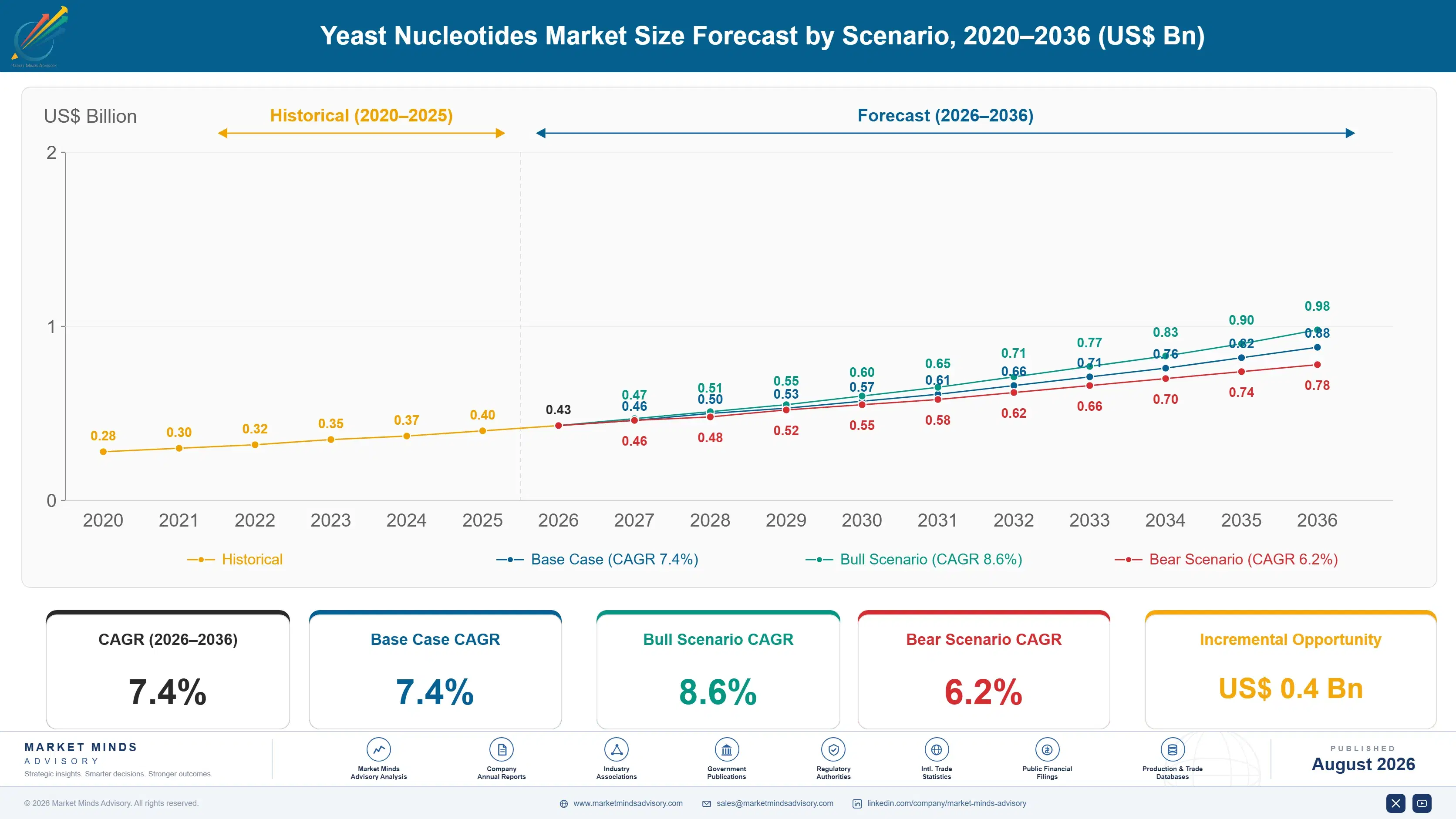
Yeast Nucleotides Market Forecast Scenarios

yeast-nucleotides-market-trends-size-forecast-scenario-1787665243146
The five years to 2025 were driven by aquaculture and pet food while infant formula grew slowly against falling birth rates in several major markets. Fishmeal replacement continued across aquafeed formulation, which created nucleotide demand as a consequence rather than as an objective. The 6.2% historical rate blends a regulated anchor application growing with demographics against newer applications growing on formulation change.
The 7.4% base case rests on three mechanisms. Aquaculture grows at 11.1% as plant protein replacement removes natural nucleotide content that fishmeal previously supplied. Companion animal nutrition grows at 9.6% on premiumisation and functional positioning. And Vietnamese shrimp and pangasius production grows at 11.8%, faster than any market covered, with disease pressure making immune supporting nutrition a funded priority rather than optional. Protein substitution, premiumisation and disease pressure, all together.
The 8.6% bull case turns on aquaculture disease pressure and antibiotic restriction together making nutritional immune support standard practice in hatchery and nursery stages, which would convert an optional additive into a formulation requirement. The 6.2% bear case is demographic: infant formula anchors the category and birth rates are falling across several of the largest formula markets simultaneously.

The Nutrient Only Some Cells Need

Conditionally essential is an unglamorous description that explains the entire commercial logic of this ingredient. An organism synthesises its own nucleotides adequately under normal conditions and falls short when cells are dividing at pace or when the intestinal lining is regenerating after damage. Every application worth anything here involves a population in exactly that state, which is a narrow but genuinely defensible position.
TOP FIVE CONCENTRATION62%Combined production capacity held by the leading suppliers
INFANT FORMULA SPECIFICATION LEVEL72 mgNucleotide content required per litre of prepared formula
FISHMEAL REPLACEMENT RATE68%Aquafeed protein now sourced from plant based material
LARVAL STAGE CELL TURNOVER12xDivision rate against adult tissue in the same species
PHARMACEUTICAL GRADE VOLUME SHARE44%Output produced under strict infant nutrition purity requirements
RNA EXTRACTION YIELD9%Nucleotide recovered from the starting dry yeast mass
Infant formula is the anchor and the reason the category has a purity problem rather than a marketing one. Composition is specified in regulation rather than chosen by a brand, typically around 72 milligrams per litre of prepared formula, and supply must carry heavy metal, nucleic acid purity and traceability documentation that flavour grade yeast extract never encounters. Roughly 44% of output is produced under those conditions.
Aquaculture growth arrived through a mechanism nobody designed. Aquafeed formulators replaced fishmeal with plant protein for cost and sustainability reasons, and plant protein now supplies around 68% of aquafeed protein. Fishmeal had been contributing nucleotides nobody was measuring, and adding them back deliberately created a supplement business out of a substitution made in an entirely different ingredient for entirely different reasons.
"This whole category exists in the gaps where an organism cannot keep up with itself. Nobody sells a nucleotide to a healthy adult animal, because a healthy adult animal makes its own perfectly well."
Director, Specialty Nutrition and Feed Ingredients Practice · MMA Specialty Nutrition Ingredients Practice · August 2026

Market Trends

Fishmeal Replacement Removed A Nutrient Nobody Measured

Aquafeed formulators replaced fishmeal with plant protein for cost and sustainability reasons, and plant material now supplies around 68% of aquafeed protein across the industry. Fishmeal had been contributing nucleotides that nobody was tracking, since nutritional specifications focused on protein, amino acids and lipids. Restoring them deliberately created a supplement business from a substitution made in a completely different ingredient. Aquaculture nucleotide demand grows at 11.1% against a market rate of 7.4% as a direct consequence of that formulation change. Nobody in feed formulation was tracking a nutrient nobody had specified.
Market Impact: Vietnam grows at 11.8% annually
Disease Pressure Funds Nutritional Immune Support Properly

Shrimp and fish farming carry disease burdens that periodically destroy entire crops, and antibiotic use faces tightening restriction across producing and importing markets alike. That combination makes nutritional immune support a funded priority rather than a marginal formulation choice, particularly in hatchery and nursery stages where cell division rates run around twelve times adult tissue. Producers who have lost a crop evaluate these arguments considerably more seriously than those who have not, which shapes adoption geographically in ways nutrition alone would not. Nutrition alone would never have funded this argument anywhere.
Market Impact: Companion animal grows at 9.6%

Market Opportunities and Growth Drivers

Vietnamese Shrimp And Pangasius Production Expands Steadily

Vietnamese shrimp and pangasius production has grown across both export and domestic demand, and Vietnam grows at 11.8%, faster than any market covered. Disease pressure in shrimp farming is severe enough that immune supporting nutrition is funded rather than debated, and export market restrictions on antibiotic residues reinforce that from a different direction entirely. Regional feed producers formulate to international customer requirements, which pulls specification upward beyond what domestic demand alone would require of anybody. Regional shrimp production sits at a scale that makes small inclusion rates commercially significant. Volume does the rest.
Market Impact: Specification requires 72 milligrams

Companion Animal Premiumisation Funds Functional Ingredients

Pet food premiumisation continues across developed and increasingly emerging markets, and functional positioning around gut health, immunity and life stage nutrition supports ingredient costs that commodity pet food never would. Companion animal nutrition grows at 9.6%, second fastest in the category. Puppy and kitten formulations use the same physiological argument that infant formula does, since cell division rates in growing animals are exactly the condition under which nucleotide synthesis falls short of requirement. Purity requirements here sit below infant formula grade and above feed grade, which suits producers holding capability across both.
Market Impact: Yield recovers only 9% of mass

Market Restraints and Challenges

Infant Formula Anchor Faces Falling Birth Rates

Infant formula is the largest and most defensible application because composition is regulated rather than chosen, and birth rates are declining across several of the largest formula markets at once. The root cause is demographic and entirely outside anybody's influence in this industry. Commercially this puts a floor under demand while removing growth from the application that carries the highest specification and the best margins. Suppliers respond by pursuing premium formula positioning and emerging market volume, which offsets rather than reverses the trend. Nothing anybody does in this industry changes it at all.
Market Impact: Plant protein supplies 68% of aquafeed

Extraction Yield Limits Output From Available Biomass

Nucleotide recovery from dried yeast runs around 9% of starting mass, which means production scale is constrained by yeast biomass availability and by the extraction capacity that processes it. The root cause is biological, since ribonucleic acid content in yeast cells is what it is regardless of process improvement. Commercially this makes capacity expansion capital intensive and slow relative to demand growth in aquaculture. Producers respond by optimising extraction and by securing biomass supply, neither of which changes the underlying yield. Aquaculture demand has been growing faster than capacity has been added.
Market Impact: Larval turnover runs 12 times adult
3 additional market trends, 4 additional growth drivers, and 2 additional restraints and challenges are covered in the full report. Contact sales@marketmindsadvisory.com to access the complete intelligence.

Segment CAGR and Growth Architecture

Segmentation follows application, since the application determines the purity grade required, whether composition is regulated, which physiological argument applies and who specifies the inclusion. Six applications cover the category as supplied. Growth concentrates where a formulation change created a gap rather than where any nutritional understanding actually changed. Physiology rather than fashion decides which populations matter.
yeast-nucleotides-market-trends-market-share-analysis-1787665243776

Aquaculture Nutrition

Nucleotide supplementation in hatchery, nursery and grow-out aquafeed, addressing immune function, gut development and stress resilience in fish and shrimp production. At 11.1% this is the fastest growing application, half again the market rate of 7.4%, and a formulation change rather than nutritional discovery created it. Plant protein now supplies around 68% of aquafeed protein, and the fishmeal it replaced had been contributing nucleotides nobody was measuring. Larval and post-larval stages divide cells at roughly twelve times adult rates, which is exactly where endogenous synthesis falls short of biological requirement. Suppliers who understand that the demand came from a protein decision rather than a nutrition one position themselves considerably better.
CAGR 11.1%

Companion Animal Nutrition

Nucleotide inclusion in premium pet food, particularly puppy, kitten and recovery formulations where growth rates and gut development justify functional ingredient cost. Growth of 9.6% is second fastest in the category, supported by premiumisation that funds ingredients commodity pet food could never carry. The physiological argument is identical to infant nutrition, since rapid cell division in growing animals is precisely the condition under which synthesis falls short. Purity requirements sit below infant formula grade and above feed grade, which suits producers holding capability across both ends. Premium positioning funds ingredient cost that commodity pet food could never carry, which makes the application unusually receptive to functional arguments. Growth follows premiumisation directly.
CAGR 9.6%
Full segment breakdown across 6 segments available in the complete report.

Regional Architecture and Country Demand Map

East Asia holds 34%, above the standard band, because China leads world aquaculture production and infant formula consumption while hosting most nucleotide manufacturing. North America and Western Europe sit below band at 20% and 19%. Vietnam grows fastest at 11.8%. Aquaculture geography rather than economics decides.

North America

A 20% share sits below the standard regional band, justified because aquaculture production here is small relative to Asia and this category follows aquaculture and infant nutrition rather than general economic weight. Companion animal nutrition is the strongest application, with premium pet food penetration higher than anywhere and functional ingredient inclusion routine. Infant formula manufacturing is substantial and operates under strict compositional regulation. Clinical nutrition applications are better developed here than in most regions. Growth of 6.4% reflects pet food premiumisation rather than any aquaculture expansion. Application mix rather than production volume is what defines this regional position entirely. Pet food and infant nutrition carry it between them. Aquaculture barely registers.
Share: 20% | CAGR: 6.4% (2026 to 2036)

Western Europe

A 19% share sits below the standard regional band under the same logic, since aquaculture here is concentrated in Norwegian and Scottish salmon rather than the shrimp and warmwater species driving volume growth elsewhere. Salmon feed formulation is technically sophisticated and has moved furthest on fishmeal replacement, which makes the nucleotide argument well understood among formulators. Infant formula manufacturing is significant and export oriented, particularly from Ireland and the Netherlands. Regulatory documentation requirements are the strictest anywhere. Growth of 5.8% is the lowest of the seven regions. Species mix rather than aquaculture scale is what shapes demand across this region. Salmon feed formulators understand this argument better than almost anybody.
Share: 19% | CAGR: 5.8% (2026 to 2036)
Regional intelligence for 5 additional markets available in the complete report: East Asia, South Asia and Pacific, Latin America, Middle East and Africa, Eastern Europe. Contact sales@marketmindsadvisory.com.
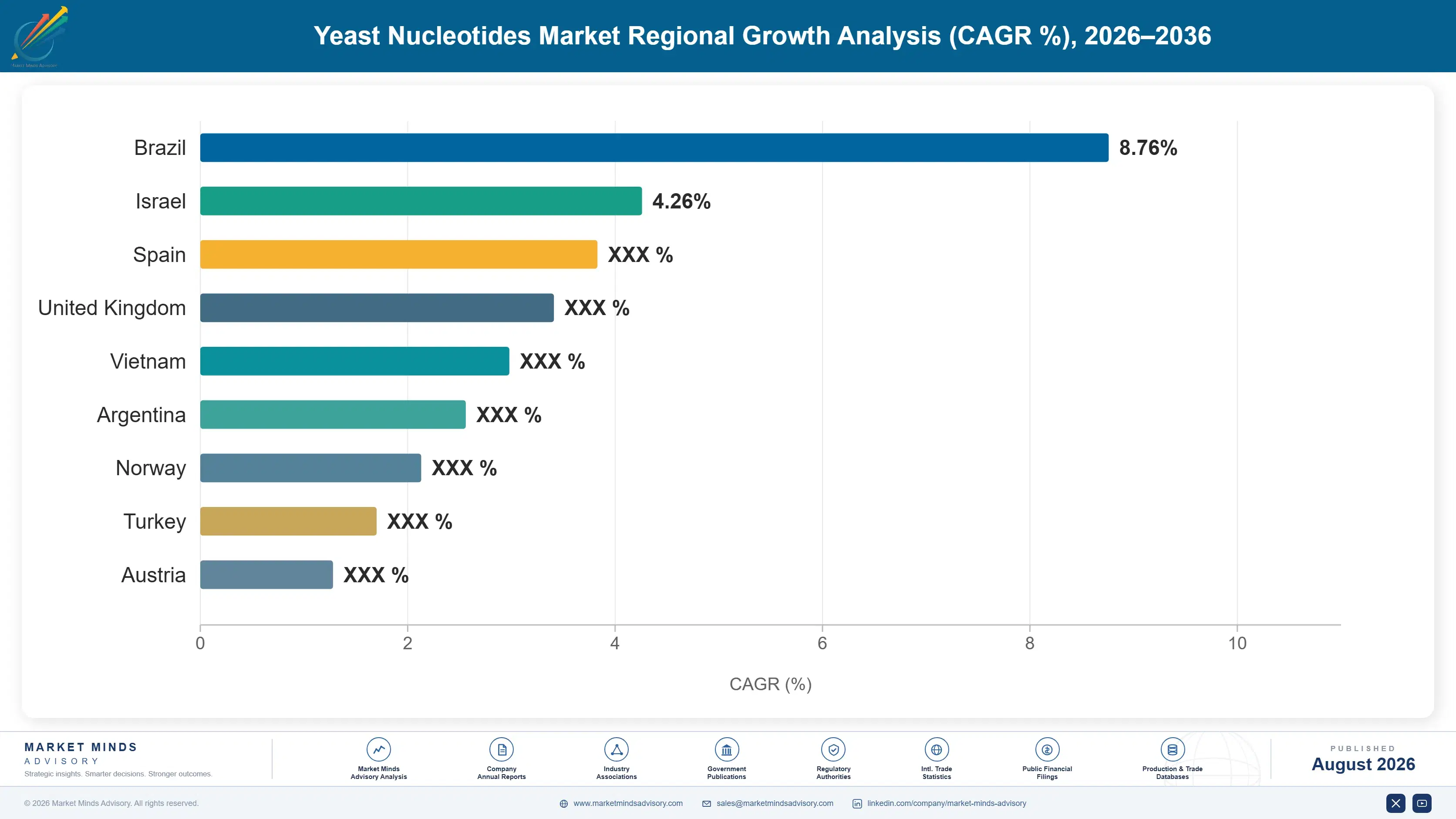
yeast-nucleotides-market-trends-country-cagr-analysis-1787665244293

Where This Ingredient Actually Earns

Nothing here is won on nucleotide content alone, because the molecules are identical whoever makes them and buyers can verify that easily. Value accrues to whoever follows the substitution gap, whoever holds purity grade, whoever targets the right life stage, and whoever reaches aquaculture production. Four routes carry weight and none is a chemistry argument.

Follow The Nutrient The Substitution Removed

Aquafeed formulators replaced fishmeal with plant protein for cost and sustainability reasons, and plant material now supplies around 68% of aquafeed protein across the industry. Fishmeal had been contributing nucleotides nobody was tracking, because specifications focused on protein, amino acids and lipids instead. Aquaculture demand grows at 11.1% against a market rate of 7.4% because of a decision taken about a completely different ingredient, which is worth understanding before assuming nutritional argument drove it. Around 11.1% growth arriving from a protein sourcing decision is worth understanding properly. Nutritional argument followed rather than led.
Market Impact: Plant protein now supplies 68% of aquafeed protein

Hold The Purity Grade Others Cannot Reach

Infant formula composition is regulated rather than chosen, at around 72 milligrams per litre of prepared formula, and supply must carry heavy metal, nucleic acid purity and traceability documentation flavour grade material never encounters. Roughly 44% of output meets those conditions and the capability takes years and capital to establish properly. That grade also serves premium companion animal and clinical nutrition, which means the investment reaches three applications rather than only the one that demanded it. Around 44% of output reaching that standard is a barrier rather than merely a specification.
Market Impact: Only 44% of output actually meets that grade

Sell Into The Stages Where Cells Divide Fastest

Nucleotides are conditionally essential, meaning an organism synthesises enough until cell division outpaces its capacity to do so. Larval and post-larval aquatic stages divide at roughly twelve times adult rates, weaning animals face gut regeneration and dietary transition together, and newborns are the original case. Selling into adult maintenance diets wastes effort on populations that make their own perfectly well, which is a targeting decision rather than a formulation one and frequently gets confused. Around 12 times adult division rate is the physiological reason the argument works at all. Targeting decides the outcome.
Market Impact: Larval division runs 12 times the adult rate

Follow Shrimp And Pangasius Into Southeast Asia

Vietnam grows at 11.8%, faster than any market covered, and South Asia and Pacific holds 14% of category demand on aquaculture volumes that dwarf regional economic weight. Disease pressure in shrimp farming is severe enough to fund immune supporting nutrition properly, and export antibiotic residue restrictions reinforce it from another direction. Regional feed producers formulate to international customer specifications, which pulls quality requirements upward beyond what domestic demand alone would ever have required. Around 11.8% growth in one country reflects a production base concentrated far beyond economic weight. That concentration is the opportunity.
Market Impact: The region carries 14% of all category demand

Who Controls the Margin Pool

Concentration is high because extraction capacity is the constraint. The top five hold 62% of production capacity, the basis applied consistently throughout this section, since nucleotide recovery runs around 9% of dried yeast mass and building extraction capability requires capital and process capability that limits participation. Angel Yeast leads on capacity and integration from yeast production through to purified nucleotide, and the gap reflects scale rather than any technical distinction.
Competition runs on three fronts. Integrated yeast producers compete on cost position and biomass security, since availability governs how much anybody can make. Purity grade suppliers compete for infant formula and clinical positions where documentation rather than price decides selection. And feed ingredient companies compete on application knowledge in aquaculture, where the argument concerns fish and shrimp physiology rather than the molecule itself.

Rankings will move with extraction capacity investment rather than with product development, since yield is biologically fixed and demand in aquaculture is growing faster than capacity has been added. The other pressure point is purity grade capability, which determines access to infant formula and premium applications and takes years to establish rather than being available to anybody with capital.
yeast-nucleotides-market-trends-company-positioning-matrix-1787665244830

Competitive Moat and Risk Dimensions

ANGEL YEAST

Moat: Integrated Yeast Production Scale

Integration from yeast fermentation through extraction to purified nucleotide gives biomass security and cost position that competitors buying yeast on the open market cannot match, in a category where recovery runs around 9% of starting mass. Scale also funds extraction capacity expansion at a pace smaller participants cannot approach commercially.
ANGEL YEAST

Risk: Purity Grade Documentation Requirements

Infant formula supply requires heavy metal, nucleic acid purity and traceability documentation that customers audit rigorously, and any question about that grade affects the whole customer relationship rather than one shipment. Scale advantages count for very little in an application where documentation and audit history decide qualification entirely.
LALLEMAND

Moat: Application Knowledge In Animal Nutrition

Deep application knowledge across aquaculture, livestock and companion animal nutrition connects the ingredient to physiological arguments about life stage, gut development and immune function that a commodity supplier cannot make credibly. That capability is built through trial work across species and takes years rather than capital to accumulate properly.
LALLEMAND

Risk: Extraction Capacity Constraint

Application capability does not manufacture nucleotide, and recovery running around 9% of dried yeast mass means capacity rather than demand generation is what limits growth. Competitors with integrated yeast production and larger extraction capacity can supply volume that application knowledge alone will not create for anybody.

Players Tracked

Prominent Players

Angel Yeast
Lallemand
Ohly
Lesaffre
Kohjin Life Sciences

Other Key Players

Ajinomoto
DSM-Firmenich
Novonesis
Biorigin
Leiber
Alltech
Symrise
Titan Biotech
Yakult Pharmaceutical Industry
Chengdu Wagott Bio-Tech
Hangzhou Bioking
Prosol
Sensient Technologies
Kerry Group
Bio Springer

Recent Developments

FEBRUARY 2025

Aquafeed producer adds nucleotide specification to hatchery formulations

An aquafeed producer added a nucleotide specification to hatchery and nursery formulations, addressing the content that plant protein substitution had removed from the diet. Plant material now supplies around 68% of aquafeed protein, and the fishmeal it replaced had been contributing nucleotides nobody had been tracking.
Signal: A decision about protein source created demand for something else entirely which nobody in either industry planned
MAY 2025

Shrimp disease outbreak accelerates immune nutrition adoption regionally

A shrimp disease outbreak across a producing region accelerated adoption of immune supporting nutrition, as producers who had lost crops reassessed formulation priorities. Larval and post-larval stages divide cells at roughly twelve times adult rates, which is where nucleotide requirement exceeds what the animal can synthesise.
Signal: Producers who have lost a crop evaluate these arguments very differently afterwards and buy quite differently as a result
SEPTEMBER 2025

Extraction capacity expansion commissioned against aquaculture demand growth

A producer commissioned additional nucleotide extraction capacity in response to aquaculture demand growth that had been outpacing available supply. Recovery runs around 9% of dried yeast mass, which makes capacity expansion capital intensive and considerably slower than demand growth in the fastest application. Yield is not a variable.
Signal: Biological yield is fixed, so capacity is the only variable anybody controls in this particular category

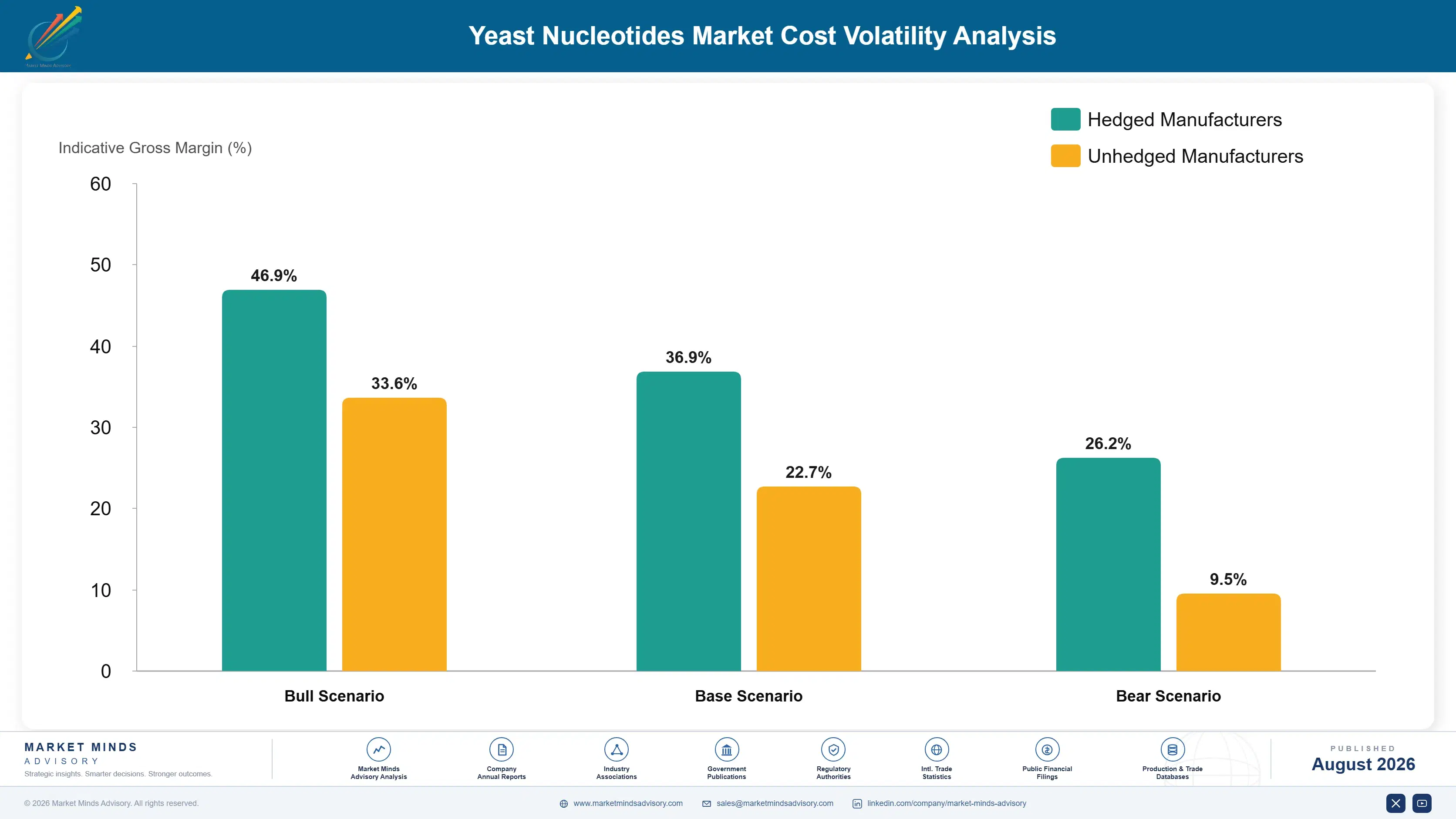
What Extracted Nucleotide Costs

Yeast biomass accounts for 33% of production cost and energy for 26%, with extraction chemicals, enzymatic hydrolysis, purification, drying and quality control carrying the remainder. Recovery runs around 9% of dried yeast mass, which means biomass volume requirements are larger than output suggests. Spent brewing yeast and purpose grown yeast both feed the process, and brewing volumes therefore influence availability without anybody here having control over them.
European energy pricing demonstrated how directly drying and extraction costs transmit. IEA data recorded gas prices reaching several times historical norms, and ingredient producer annual reports documented margin compression and production reallocation toward facilities with more favourable energy positions. Chinese producers with domestic biomass and energy advantages gained share during the same period, which accelerated a cost position shift already underway across the category. Nobody escaped it.

Exposure divides by integration and by production location rather than by scale. Producers growing their own yeast control biomass availability and cost, while those buying spent brewing yeast depend on an industry with entirely unrelated output decisions. Purity grade production carries additional cost that only the applications requiring it can support, which makes grade mix more consequential than most participants treat it.
yeast-nucleotides-market-trends-cost-volatility-analysis-1787665245026

Secure biomass supply rather than depending on brewing output

Recovery runs around 9% of dried yeast mass, so biomass volume requirements are far larger than finished output suggests, and spent brewing yeast availability follows decisions made in an entirely unrelated industry. Purpose grown yeast costs more and removes that dependency completely. The trade is input cost against supply certainty, and demand growth in aquaculture makes certainty progressively more valuable.

Build purity grade capability before applications demand it

Infant formula requires heavy metal, nucleic acid purity and traceability documentation that takes years and capital to establish and that customers audit rigorously before qualification. Around 44% of output meets those conditions today. The same capability serves premium companion animal and clinical nutrition, which spreads the investment across three applications rather than only the regulated one that required it.

Locate extraction where energy cost supports the process

Energy is 26% of production cost and drying and extraction cannot be made significantly less energy intensive within existing process technology. European facilities absorbed the last disruption while producers elsewhere gained share on cost position. Location is therefore a competitive decision rather than a logistics one, and it takes years to change once extraction capacity has been committed anywhere.

Portfolio Architecture for Margin Defence

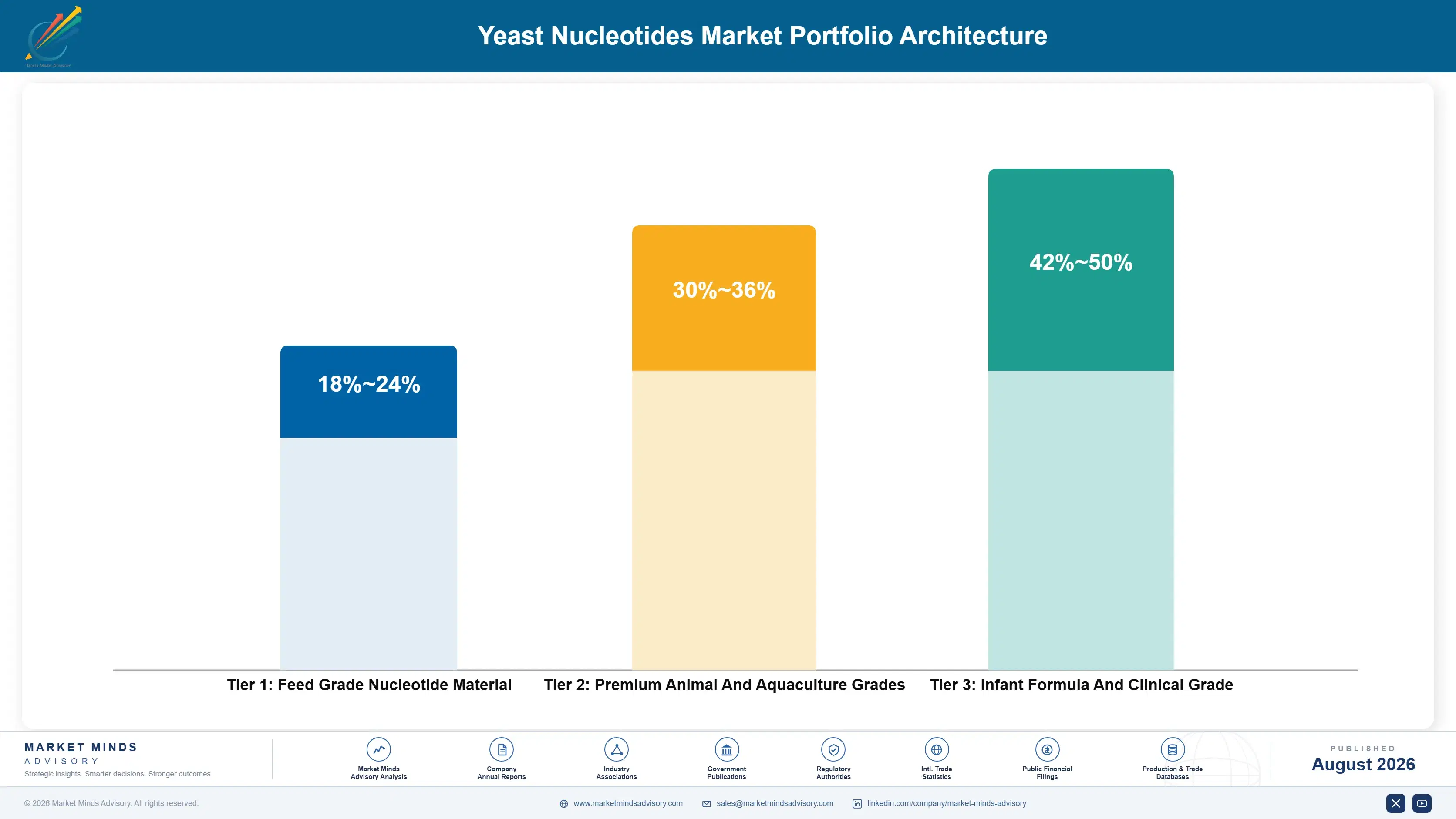
Margin architecture divides on purity grade rather than on nucleotide content. Feed grade material earns least, supplied into livestock and general aquafeed applications where price per kilogram decides selection and Chinese producers hold cost advantages. Premium animal nutrition grades earn considerably better, since documentation and application support carry value beyond the molecule. Infant formula grade earns best, because qualification depends on audit history that takes years to build.
The tension runs between capacity allocation and grade mix. Extraction capacity is the binding constraint on everything, and every tonne produced to infant formula specification costs more and cannot be reallocated freely to a feed customer paying less. Aquaculture demand is growing fastest and pays less than infant nutrition, which means the fastest growing application competes for capacity against the most profitable one continuously.

High value pools concentrate in purity grade capability and in aquaculture application knowledge, neither of which is a fermentation position. Everything supplied as feed grade competes on price against producers with biomass and energy advantages. The businesses worth building are those where documentation, audit history or species specific trial data makes a customer's alternative genuinely difficult rather than merely more expensive to obtain.

Feed Grade Nucleotide Material

Standard grade material supplied into livestock and general aquafeed applications where price per kilogram decides selection entirely. Chinese producers with biomass and energy cost advantages set pricing across this whole tier.
Gross Margin: 18-24%

Premium Animal And Aquaculture Grades

Higher specification material supplied with species specific application support into hatchery, nursery and premium companion animal formulations. Trial data across species carries value that the molecule itself never could alone.
Gross Margin: 30-36%

Infant Formula And Clinical Grade

Material produced under heavy metal, purity and traceability requirements with audit history supporting infant nutrition qualification. The range is wide because qualification depth and customer audit requirements vary substantially between manufacturers.
Gross Margin: 42-50%
yeast-nucleotides-market-trends-portfolio-architecture-1787665245548

High-value Sub-segments and Strategic Watch-out

Aquaculture Nutrition

Fastest growing application at 11.1% through a formulation change nobody made for nutritional reasons, since plant protein replaced fishmeal and removed nucleotides with it. Disease pressure funds the argument in ways general nutrition never would. Nutritional argument followed the formulation change rather than leading it.
Gross Margin: 30-36%

Companion Animal Nutrition

Second fastest at 9.6% on premiumisation funding functional ingredients commodity pet food could never carry at all. The physiological argument is identical to infant nutrition, since growing animals divide cells at rates outpacing synthesis. Premiumisation rather than any nutritional evidence funds this whole inclusion decision.
Gross Margin: 32-38%

Infant Formula Fortification

Growing at 5.8% against falling birth rates while carrying the highest specification and the best margins in the category. Regulation rather than marketing choice determines inclusion, which puts a genuine floor under the demand. Falling birth numbers are the constraint on an otherwise ideal application.
Gross Margin: 42-50%

Savoury Flavour Enhancement

Growing at 6.4% in an application where nucleotides function as umami enhancers rather than as nutrients at all. Purity requirements are lower and price competition against synthetic alternatives is direct and continuous. The nucleotides function here as flavour enhancers rather than as nutrients at all.
Gross Margin: 16-22%

How Specification Creates Repeat Demand

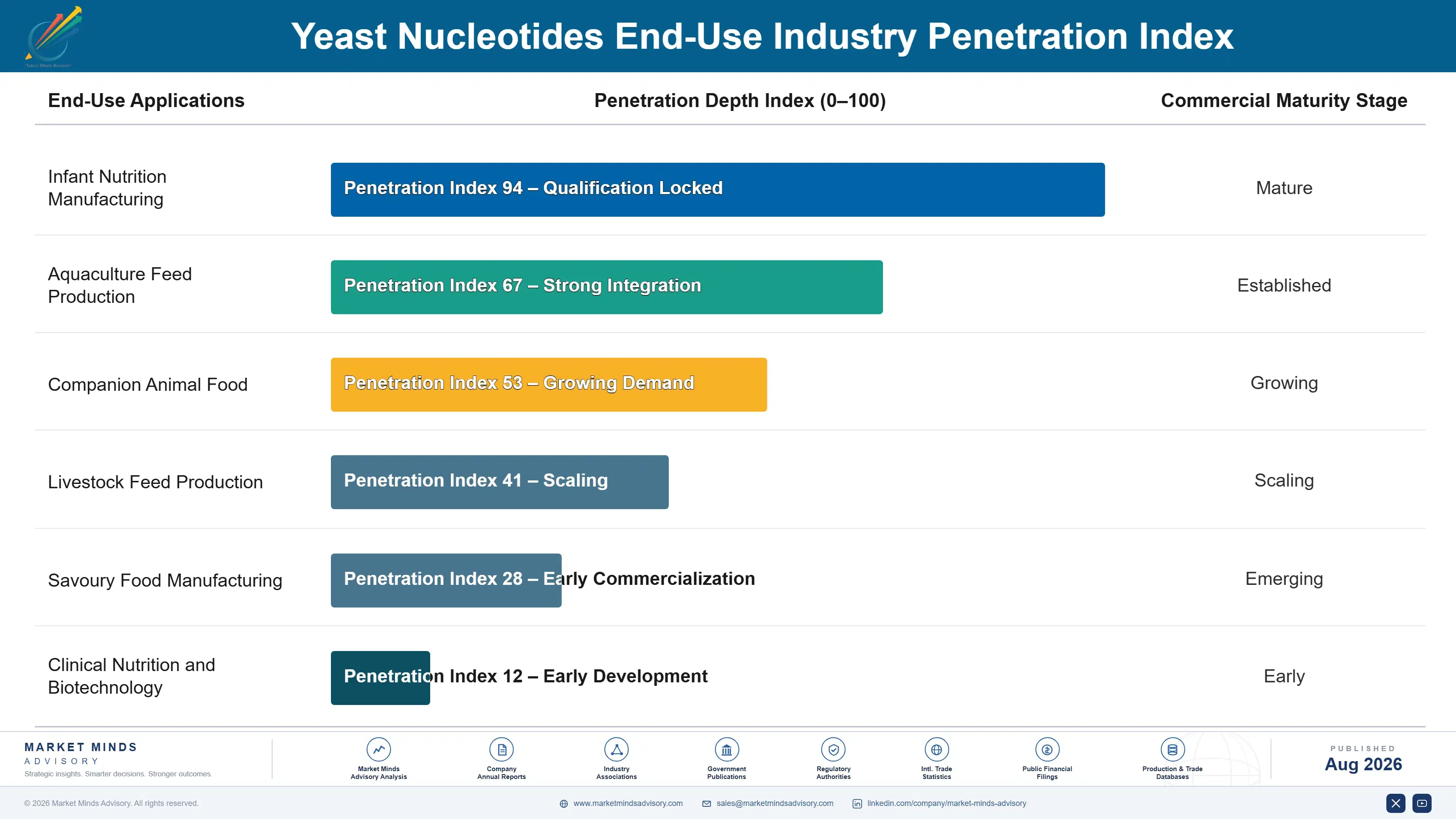
Demand attaches to a written formulation specification, which is what makes this category more stable than its size suggests. An infant formula manufacturer qualifies a supplier through audit and then buys against that specification for years, while an aquafeed producer writing nucleotides into a hatchery formulation consumes them on every batch until the formulation changes. Qualification is the commercial event and everything afterwards is repeat supply against a document.
Stickiness varies enormously with the qualification burden. Infant formula positions are the most durable by a wide margin, since requalifying a supplier means repeating audits and documentation review nobody undertakes without cause. Aquaculture and premium pet food sit in the middle, held by species specific trial data and application relationships. Feed grade supply is barely sticky at all, since material is interchangeable and buyers retender on price per kilogram.

The decision maker differs completely between applications, which suppliers frequently underestimate. Infant formula qualification runs through quality and regulatory functions evaluating documentation. Aquafeed inclusion runs through nutritionists evaluating species trial data. Savoury flavour runs through food technologists evaluating taste panel outcomes. One commercial approach across all three consistently underperforms against specialists addressing each on its own terms.
yeast-nucleotides-market-trends-end-use-penetration-index-1787665246036

Where This Ingredient Rewards Focus

These are among the four positions where our research anticipates prominent divergence between winners and laggards over the coming forecast period. Each is grounded in the demand model, the regulatory perimeter, and the announced capacity pipeline.
01 / SUBSTITUTION GAP CAPTURE

Somebody else's decision created this market

Aquafeed formulators replaced fishmeal with plant protein for cost and sustainability reasons, and plant material now supplies around 68% of aquafeed protein across the whole industry. Fishmeal had been contributing nucleotides that nobody was tracking, because feed specifications focused on protein, amino acids and lipids rather than on anything else. Aquaculture demand grows at 11.1% against a market rate of 7.4% because of a decision taken about an entirely different ingredient, which is worth understanding properly before assuming anything else about it.
02 / PURITY GRADE DEFENCE

Documentation decides the best application

Infant formula composition is regulated rather than chosen, at around 72 milligrams per litre of prepared formula, and supply must carry heavy metal, nucleic acid purity and traceability documentation that flavour grade material never encounters at all. Roughly 44% of category output meets those conditions, and the capability takes years and capital to establish before any customer audit is even attempted. That same grade serves premium companion animal and clinical nutrition, spreading the investment across three separate applications rather than one.
03 / LIFE STAGE TARGETING

Healthy adults make their own perfectly well

Nucleotides are conditionally essential, which means an organism synthesises enough until cell division outpaces its capacity or the gut lining is regenerating after damage. Larval and post-larval aquatic stages divide at roughly twelve times adult rates, weaning animals face gut regeneration and dietary transition simultaneously, and newborns were the original case for all of it. Selling into adult maintenance diets wastes commercial effort on populations that have no requirement that the animal can meet perfectly well for itself already anyway.
04 / AQUACULTURE GEOGRAPHY ACCESS

The growth is where the shrimp are

Vietnam grows at 11.8%, faster than any market covered in this report, and South Asia and Pacific holds 14% of category demand on aquaculture volumes that dwarf what regional economic weight would ever suggest. Disease pressure across shrimp farming is severe enough that immune supporting nutrition is funded rather than debated, and export market antibiotic residue restrictions reinforce the same conclusion from another direction. Regional feed producers formulate to international customer specifications throughout, which pulls quality requirements upward almost everywhere.

Engagement Snapshot From the Field

A live engagement with an industry participant carrying material or product regulatory and market exposure ahead of a defining policy shift, showing how our research translates into a defensible multi-year portfolio strategy.
MARKET MINDS ADVISORY · CLIENT ENGAGEMENT SUMMARY
Yeast Nucleotides Producer Strategic Portfolio Review and Transition Roadmap 2026·Investment Scenario on Yeast Nucleotides Exposure Evaluation 2025-26
CLIENT PROFILE
A specialty ingredient producer extracting yeast nucleotides for feed, pet food and savoury flavour customers across Western Europe and Latin America. Annual revenue from this product line was approximately 62 million dollars (client-reported, unverified by MMA), predominantly feed and flavour grade. No infant formula qualification existed, and extraction capacity had been fully utilised for two consecutive years.
STRATEGIC CHALLENGE
Capacity was constraining growth while aquaculture demand rose faster than the client could supply, and management was weighing extraction expansion against improving yield that biology largely fixes. Separately, feed grade pricing was under pressure from Chinese producers with cost advantages the client could not match. Nobody had modelled what grade mix the constrained capacity should actually produce.
MMA APPROACH
MMA modelled margin per tonne of extraction capacity across every grade and application the client served or could serve. Infant formula qualification was costed including audit preparation and documentation systems. Forty-seven expert interviews with aquafeed nutritionists, pet food formulators, formula quality managers and flavour technologists established how each application qualifies suppliers, alongside survey work across six countries.
KEY FINDINGS
  1. Infant formula grade returned roughly 2.4 times the margin per tonne of extraction capacity that feed grade did, on capacity the client was already running fully.
  2. Qualification for infant formula supply was costed at around 3 years including audit history accumulation, which management had assumed was considerably longer.
  3. Aquaculture customers valued species specific trial data above price in 7 of every 10 evaluations, and the client held trial data for only 2 species.
  4. Feed grade volumes represented 46% of capacity and around 19% of gross profit, occupying extraction time that higher grades could have used instead.
CLIENT PROFILE
A specialty ingredient producer extracting yeast nucleotides for feed, pet food and savoury flavour customers across Western Europe and Latin America. Annual revenue from this product line was approximately 62 million dollars (client-reported, unverified by MMA), predominantly feed and flavour grade. No infant formula qualification existed, and extraction capacity had been fully utilised for two consecutive years.
STRATEGIC CHALLENGE
Capacity was constraining growth while aquaculture demand rose faster than the client could supply, and management was weighing extraction expansion against improving yield that biology largely fixes. Separately, feed grade pricing was under pressure from Chinese producers with cost advantages the client could not match. Nobody had modelled what grade mix the constrained capacity should actually produce.
MMA APPROACH
MMA modelled margin per tonne of extraction capacity across every grade and application the client served or could serve. Infant formula qualification was costed including audit preparation and documentation systems. Forty-seven expert interviews with aquafeed nutritionists, pet food formulators, formula quality managers and flavour technologists established how each application qualifies suppliers, alongside survey work across six countries.
KEY FINDINGS
  1. Infant formula grade returned roughly 2.4 times the margin per tonne of extraction capacity that feed grade did, on capacity the client was already running fully.
  2. Qualification for infant formula supply was costed at around 3 years including audit history accumulation, which management had assumed was considerably longer.
  3. Aquaculture customers valued species specific trial data above price in 7 of every 10 evaluations, and the client held trial data for only 2 species.
  4. Feed grade volumes represented 46% of capacity and around 19% of gross profit, occupying extraction time that higher grades could have used instead.
RECOMMENDED STRATEGY
Phase 1: Phase one: begin infant formula qualification over roughly 3 years, returning about 2.4 times feed grade margin per tonne of capacity. Phase 2: Phase two: reduce feed grade volume, currently 46% of capacity against 19% of gross profit, releasing extraction time for better grades. Phase 3: Phase three: build out species specific aquaculture trial data, valued above price in 7 of every 10 customer evaluations reviewed.
OUTCOME
The client began infant formula qualification and reduced feed grade volumes deliberately, which lowered revenue and raised gross profit within a year. Aquaculture trial work across additional species improved win rates in evaluations where the client had previously competed on price alone, and capacity was reallocated toward grades that justified it (client-reported, unverified by MMA).

Frequently Asked Questions

Foundational context covering the market sizes, CAGR, scope, country, region and competition that inform every finding below. This section is provided to cover basics and most often pre-purchase conversations, answered from the MMA Primary Research Dataset.

What is the current size of the Yeast Nucleotides Market?

The market was valued at 0.38 billion dollars in 2025, covering nucleotide preparations derived from yeast ribonucleic acid across nutrition and flavour applications worldwide. It reaches an estimated 0.41 billion dollars during 2026.

How large will the Yeast Nucleotides Market be by 2036?

MMA forecasts 0.84 billion dollars by 2036, an increase of 0.43 billion dollars over the 2026 base. That represents an expansion multiple of 2.05 times across the forecast period.

What is the CAGR for the Yeast Nucleotides Market 2026 to 2036?

The base case compound annual growth rate is 7.4%, with a bull case of 8.6% and a bear case of 6.2%. Aquaculture disease pressure and birth rate decline separate those two scenarios.

Which segment is growing fastest?

Aquaculture nutrition grows at 11.1%, half again the market rate of 7.4%, because plant protein replacing fishmeal removed nucleotides from the diet. Companion animal follows at 9.6%.

Who are the major companies in the Yeast Nucleotides Market?

Angel Yeast, Lallemand, Ohly, Lesaffre and Kohjin Life Sciences lead on production capacity across nutrition and flavour grades. Together they account for 62% of the global market.

Which country is growing fastest?

Vietnam grows fastest at 11.8%, because shrimp and pangasius production face disease pressure severe enough to fund immune supporting nutrition rather than merely debate it.

Report Segmentation Architecture

The full report scope spans multiple orthogonal segmentation dimensions, with cross-tabulated demand data provided for each dimension pair. Coverage extends further to regional breakdowns, trend trajectories, and the competitive detail needed to support segment-level decision-making.

By Application

  • Infant Formula Fortification
  • Aquaculture Nutrition
  • Companion Animal Nutrition
  • Savoury Flavour Enhancement
  • Livestock Feed
  • Clinical Nutrition and Cell Culture

By End-Use Industry

  • Infant Nutrition Manufacturing
  • Aquaculture Feed Production
  • Companion Animal Food
  • Livestock Feed Production
  • Savoury Food Manufacturing
  • Clinical Nutrition and Biotechnology

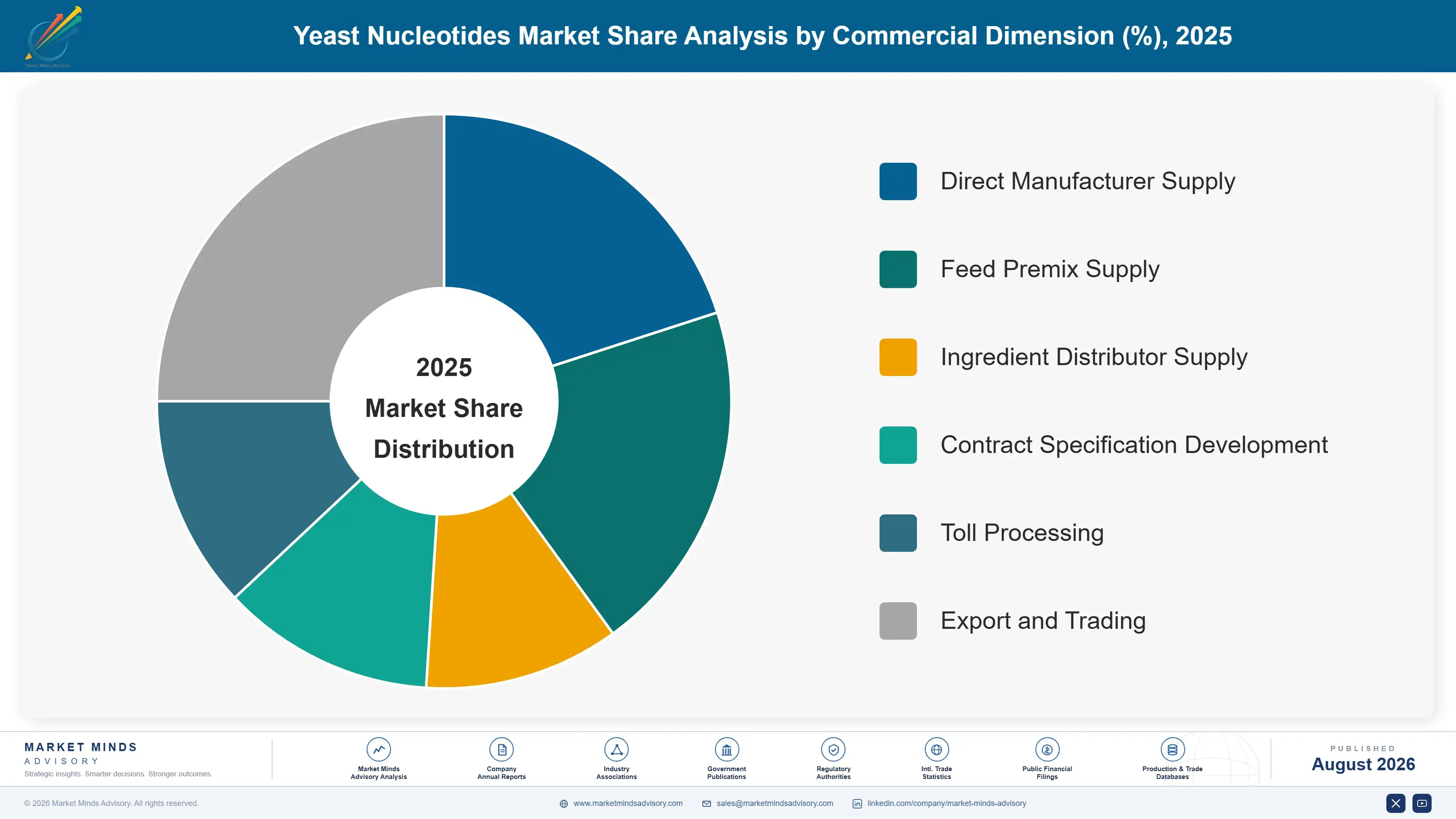
By Commercial Dimension

  • Direct Manufacturer Supply
  • Feed Premix Supply
  • Ingredient Distributor Supply
  • Contract Specification Development
  • Toll Processing
  • Export and Trading

By Region

  • North America
  • Western Europe
  • East Asia
  • South Asia and Pacific
  • Latin America
  • Middle East and Africa
  • Eastern Europe

Scope, Methodology, and Coverage

Every figure in this report is reproducible from documented input assumptions. The scope below maps the historical period, the forecast horizon, the segmentation dimensions, and the countries covered, alongside the underlying primary and qualitative methodology.
Historical Period
2020 to 2025
Forecast Period
2026 to 2036
Base Year
2025 (USD billions; MMA Primary Research Dataset, August 2026)
Market Definition
Nucleotide preparations derived from yeast ribonucleic acid through extraction and enzymatic hydrolysis worldwide, covering supply into infant formula fortification, aquaculture nutrition, companion animal nutrition, savoury flavour enhancement, livestock feed, and clinical nutrition and cell culture applications, across feed, premium animal and pharmaceutical purity grades, measured at ingredient selling value. Yeast extract sold without a nucleotide specification, synthetically or fermentation produced nucleotides not derived from yeast ribonucleic acid, whole yeast cell wall products and beta-glucan preparations are excluded from scope.
Quantitative Units
USD billions (ingredient selling value); tonnes; USD per tonne by grade and application
Segmentation Dimensions
Application; end-use industry; commercial dimension; region
Regions Covered
North America, Western Europe, East Asia, South Asia and Pacific, Latin America, Middle East and Africa, Eastern Europe
Countries Covered
United States, Canada, Germany, France, Netherlands, Ireland, United Kingdom, Denmark, Norway, Spain, China, Japan, South Korea, Vietnam, Thailand, Indonesia, India, Australia, Ecuador, Chile, Brazil, Egypt
Key Companies Profiled
Angel Yeast, Lallemand, Ohly, Lesaffre, Kohjin Life Sciences, Ajinomoto, DSM-Firmenich, Novonesis, Biorigin, Leiber, Alltech, Symrise, Titan Biotech, Yakult Pharmaceutical Industry, Chengdu Wagott Bio-Tech, Hangzhou Bioking, Prosol, Sensient Technologies, Kerry Group, Bio Springer
Quantitative Methodology
Primary survey, n=3,800 respondents, Q4 2025, six countries; demand-side model with trade association cross-validation
Qualitative Methodology
47 expert interviews, Q4 2025; applied to validate demand model assumptions, identify emerging dynamics, and assess competitive positioning
Report Format
PDF and XLSX data workbook (Word format preview document)
Publisher
Market Minds Advisory
Report Code
MMA-2026-AGR-208
Published
August 2026
Contact
sales@marketmindsadvisory.com | www.marketmindsadvisory.com

Purchase the full Yeast Nucleotides Market Report (2026 to 2036).

The full report explains why every application in this category involves an organism that cannot keep pace with itself, and how a decision about aquafeed protein source created the fastest growing application without anybody intending it. It sizes all six applications independently through 2036, models extraction capacity against grade mix economics, and quantifies the purity requirements separating infant formula supply from feed grade material. Regional chapters cover all seven regions, with aquaculture production geography assessed separately from economic weight. Competitive profiling covers 20 participants on one consistent capacity measure.
Six applications sized independently through 2036
Extraction capacity modelled against grade mix economics
Purity requirements separated across infant, premium and feed grades
Fishmeal replacement quantified against aquaculture nucleotide demand
Life stage physiology mapped against application requirement by species
Twenty participants profiled on one consistent capacity measure

Built For The People Who Decide

From boardroom strategy to bench-side execution, this report is read cover-to-cover by leaders shaping the next decade of their industry, turning demand scenarios, market dynamics and valuation benchmarks into decisions.
CXOs/ Presidents/ VPs/ Managers
M&A and Corporate Development
Strategy Teams and R&D Heads
Procurement and Product Directors
Regulatory and Compliance Leaders
Investor Relations and Equity Analysts