
Market Minds Advisory
Wrinkle Release Spray Market

Wrinkle Release Spray Market: Wrinkle Release Spray: Steamer Substitution, Carry-On Limits And The Occasion Nobody Can Pack An Appliance For

Cheap garment steamers took the entire middle of this category, and what remains is defended by the simple fact that nobody can put an appliance into a carry-on bag at all.

Lead Analyst

Published

September 2026

Make Smarter Decisions with Customized Research Insights

Request a free sample report and evaluate market opportunities, growth trends, and competitive dynamics relevant to your business needs.

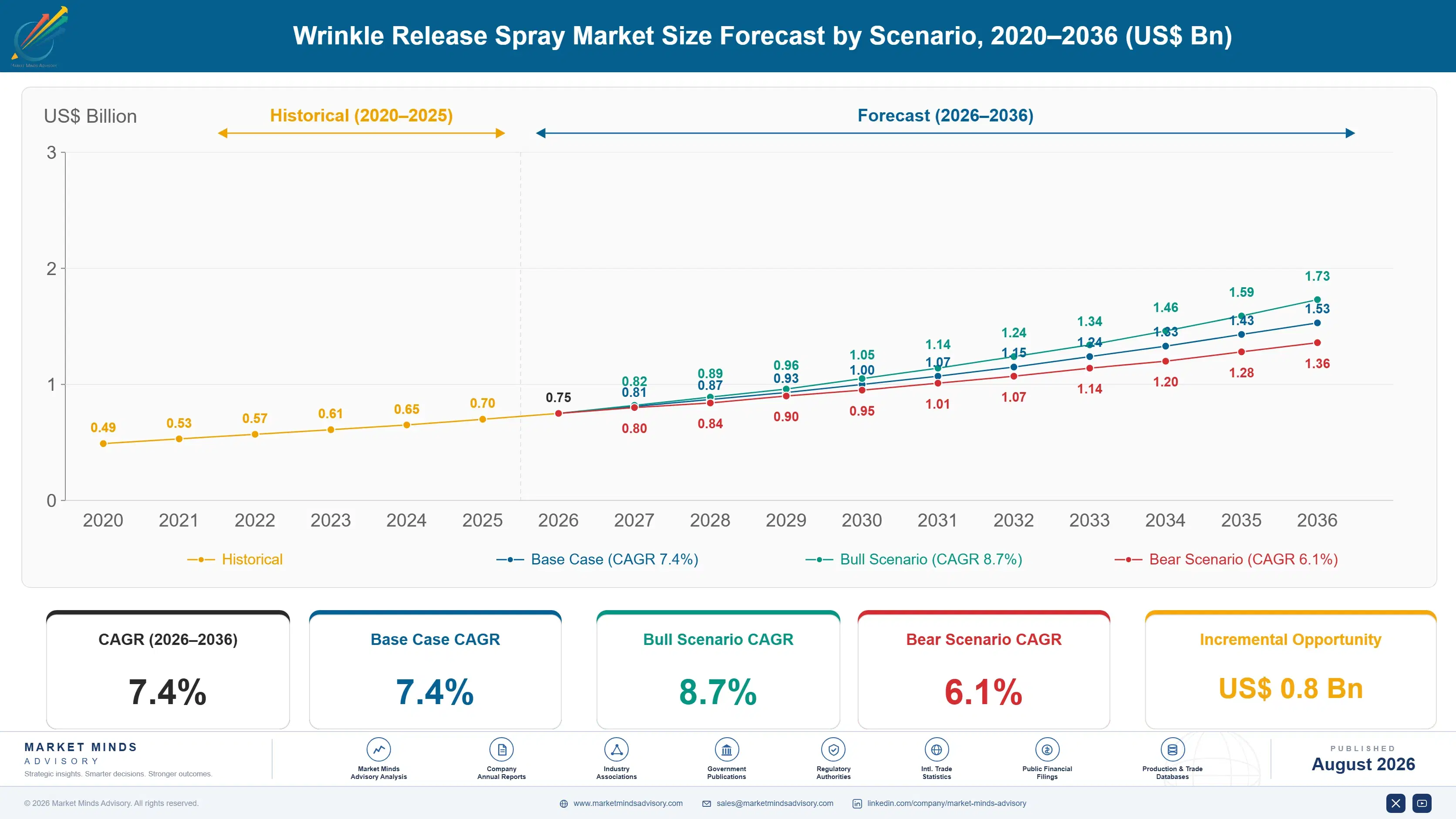
2025 MARKET VALUE$0.7BMarket Size 2025
2036 FORECAST VALUE$1.5BBase Case , 2026 to 2036
CAGR 2026 TO 20367.4 %Bull 8.7% / Bear 6.1%
INCREMENTAL OPPORTUNITY$0.8BNet 10- year value creation
EXPANSION MULTIPLE2.04x2036 value over 2026 base
Strategic Levers
M&A Pipeline
Regional Outlook
Country Rankings
Competitive Intelligence
Segmental Deep-dive
Call-Us : 91 93563 13602

Executive Snapshot and Market Trajectory.

The competitor was never another spray. Garment steamers became cheap and genuinely effective, 37% of households now own one, and they took the ordinary at-home occasion this category was built around. That occasion was most of the category and it has now largely gone entirely.
Travel and portable formats grow fastest at 11.1%, because carry-on liquid limits make a small bottle the only garment care anybody can actually take with them. A steamer does not fit in hand luggage and hotel rooms have been quietly removing irons for years. That is the one occasion where the spray has no appliance competing against it at all. Nothing else in this market enjoys anything like a comparable protection anywhere at all.
Concentration sits at 54% and the formulation protects nobody. Water, a surfactant and a relaxing agent is not difficult chemistry, and private label arrives whenever a retailer decides to bother. What separates participants is whether they reach the traveller and the institutional buyer rather than the household who now owns a steamer. Reaching a buyer who does not own a steamer is now the entire commercial question here.
Market Definition
Revenue from liquid products applied to fabric to relax creasing without ironing, covering travel and portable format sprays, professional bulk and institutional formats, concentrate and refill formats, combination refresher and release sprays, standard household trigger sprays, and dryer-added and in-wash release products. Excludes garment steaming appliances and irons, laundry detergents and fabric conditioners, starch and sizing products intended to stiffen fabric, and professional dry cleaning services.
Base Year Value
$0.7B in 2025 (MMA Primary Research Dataset, August 2026)
Forecast Period
2026 to 2036, eleven discrete annual values
CAGR
7.4% base case. Bull 8.7%. Bear 6.1%.
Fastest Growth Segment
Travel and Portable Format Sprays: 11.1% CAGR
Fastest Growth Country
India: 9.4% CAGR
Fastest Growth Region
South Asia and Pacific: 9.4% CAGR
Largest Region
North America: 31% of 2025 global value
Market Leaders
Procter and Gamble, Unilever, Faultless Brands, Church and Dwight and Reckitt lead on wrinkle release product revenue across retail and institutional channels. Source: company annual reports and MMA Primary Research Dataset, July 2026.
Primary Survey
n=3,800 procurement and R&D decision-makers, Q4 2025, six countries
Methodology
Demand-side build-up, cross-validated against public data, 47 expert interviews

Wrinkle Release Spray Market Forecast Scenarios

wrinkle-release-spray-market-size-forecast-scenario-1788167908936
The 2020 to 2025 period saw an appliance quietly eat the category's home ground. Garment steamer prices fell to a point where ownership became ordinary rather than aspirational, and households that bought one stopped buying spray for anything except travel. Business travel recovery then rebuilt the portable occasion. Revenue compounded near 6.0%, with home volume declining while travel and institutional formats grew steadily underneath it.
Three mechanisms carry the base case. Carry-on liquid restrictions keep small format sprays as the only garment care a traveller can pack, which is a permanent regulatory advantage nobody engineered. Hotels continue removing irons and boards on liability and space grounds. And institutional buyers in hospitality, retail and wardrobe departments purchase on schedules rather than when they happen to remember. None of the three depends on households ever returning to this category at all.
The bull catalyst is hotel groups adopting in-room spray provision as standard amenity, which would convert an occasional traveller purchase into contracted institutional volume across enormous room counts. The bear risk is carry-on liquid rules being relaxed as scanning technology improves, which would remove the one durable protection this category currently holds. Nobody would replace it.

The Steamer Took The Middle

The honest account of this category starts with an appliance. Garment steamers fell in price to the point where 37% of households own one, they work better than a spray on anything substantial, and every household that bought one stopped buying spray for ordinary use. Penetration at 19% and frequency of 2.6 times a year reflect a product pushed out of its own home ground.
MARKET CONCENTRATION CR554%Share of category revenue held by the leading manufacturers
HOUSEHOLD PENETRATION19%Share of households buying any wrinkle release product annually
ANNUAL PURCHASE FREQUENCY2.6 timesAverage purchases per buying household across a full year
TRAVEL FORMAT SHARE28%Portion of volume sold in carry-on compliant pack sizes
STEAMER OWNERSHIP37%Share of households owning a garment steaming appliance instead
PROFESSIONAL REPEAT RATE8.4 timesPurchases per institutional account compared with a household buyer
What survived is the occasion where an appliance cannot go. Carry-on liquid limits mean a small bottle is the only garment care a traveller can pack, hotels have removed irons and boards on liability and space grounds, and a crumpled shirt in a hotel room at seven has no other remedy. Travel formats now carry 28% of volume and grow considerably faster than anything else here.
The institutional buyer is the other survivor and the one nobody markets to properly. Hospitality housekeeping, retail floor staff, wardrobe departments and uniform services use the product daily rather than occasionally, purchasing 8.4 times as often per account as a household does. That is contracted, scheduled demand in a category otherwise governed entirely by whether somebody happens to remember it exists.
"This category was killed at home by a forty dollar appliance and saved in the air by a liquid restriction nobody in the industry lobbied for. Neither of those had anything to do with the product itself."
Director, Fabric Care Practice · MMA Household Care and Fabric Products Practice · August 2026

Market Trends

Cheap Steamers Removed The Ordinary Household Occasion

Garment steamer prices fell until ownership reached 37% of households, and a steamer works considerably better than a spray on anything heavier than a shirt collar. Households acquiring one stopped buying spray except for travel, which shows plainly in penetration at 19% and frequency at 2.6 times annually. The category did not lose to a competing spray or to changing habits. It lost to an appliance that arrived at a price point nobody in fabric care anticipated. Nobody working in fabric care saw a cheap appliance coming at that price.
Market Impact: Grows at 11.1% against 7.4%
Carry-On Liquid Limits Became An Accidental Protection

Aviation security restrictions on liquid volumes mean a small bottle is the only garment care a traveller can carry, and no appliance competes in that space at any price. Travel formats now hold 28% of volume and grow fastest in the category. The protection was created by regulators addressing an entirely unrelated concern, and it is the single most valuable commercial condition this product enjoys anywhere. Nobody in the industry asked for it or paid anything to obtain it. Regulation created a moat that no competitor can cross at all.
Market Impact: Buys 8.4 times household frequency

Market Opportunities and Growth Drivers

Hotels Removing Irons Creates Demand With No Alternative

Hotel groups have been withdrawing irons and boards from rooms on liability, space and housekeeping grounds for years, which leaves a guest with a creased shirt and no remedy that the room provides. That is the purest demand occasion this category has, because there is genuinely nothing else available in the moment. Travel formats grow at 11.1% against a market rate of 7.4% substantially on that basis. The guest has no alternative and knows it. Nobody travels with an iron and nobody is going to start doing so now either.
Market Impact: Loses to steamers in 37% homes

Institutional Users Purchase On Schedule Rather Than Memory

Hospitality housekeeping, retail floor teams, wardrobe departments and uniform services use this product as a daily working tool and reorder against consumption rather than recollection. An institutional account purchases 8.4 times as often as a household buyer, and the relationship persists across years rather than ending when somebody forgets. It is contracted demand in a category where household purchasing is governed almost entirely by whether the bottle happens to be visible. Selling to somebody who reorders on consumption is a fundamentally different business from selling to somebody who has to remember.
Market Impact: Invites private label at 0 barrier

Market Restraints and Challenges

The Appliance Simply Performs Better At Home

A garment steamer removes creasing a spray cannot touch, costs little, and is now in 37% of households, which means the category loses the comparison whenever the buyer has both available. The root cause is that relaxing fibres with a fine mist has genuine physical limits that steam does not share. Commercially it confines the spray to occasions where no appliance is present. Mitigation runs through travel format focus, institutional channels, in-bag positioning and combination products addressing odour alongside creasing. Nobody wins a comparison against something that genuinely works better.
Market Impact: Owns steamers in 37% of homes

Formulation Offers Nothing Anybody Can Defend

Water, a surfactant and a fibre relaxing agent is straightforward chemistry that any contract manufacturer can produce, and a consumer cannot evaluate the result beyond whether the shirt looked acceptable. The root cause is that the product genuinely works and has been easy to make for decades. Commercially it invites private label whenever a retailer chooses to enter. Mitigation runs through travel distribution positions, institutional relationships, pack format engineering and brand recognition built well outside the formulation itself. Nothing inside the bottle has ever protected anybody in this category at all.
Market Impact: Holds 28% of category volume
4 additional market trends, 3 additional growth drivers, and 2 additional restraints and challenges are covered in the full report. Contact sales@marketmindsadvisory.com to access the complete intelligence.

Segment CAGR and Growth Architecture

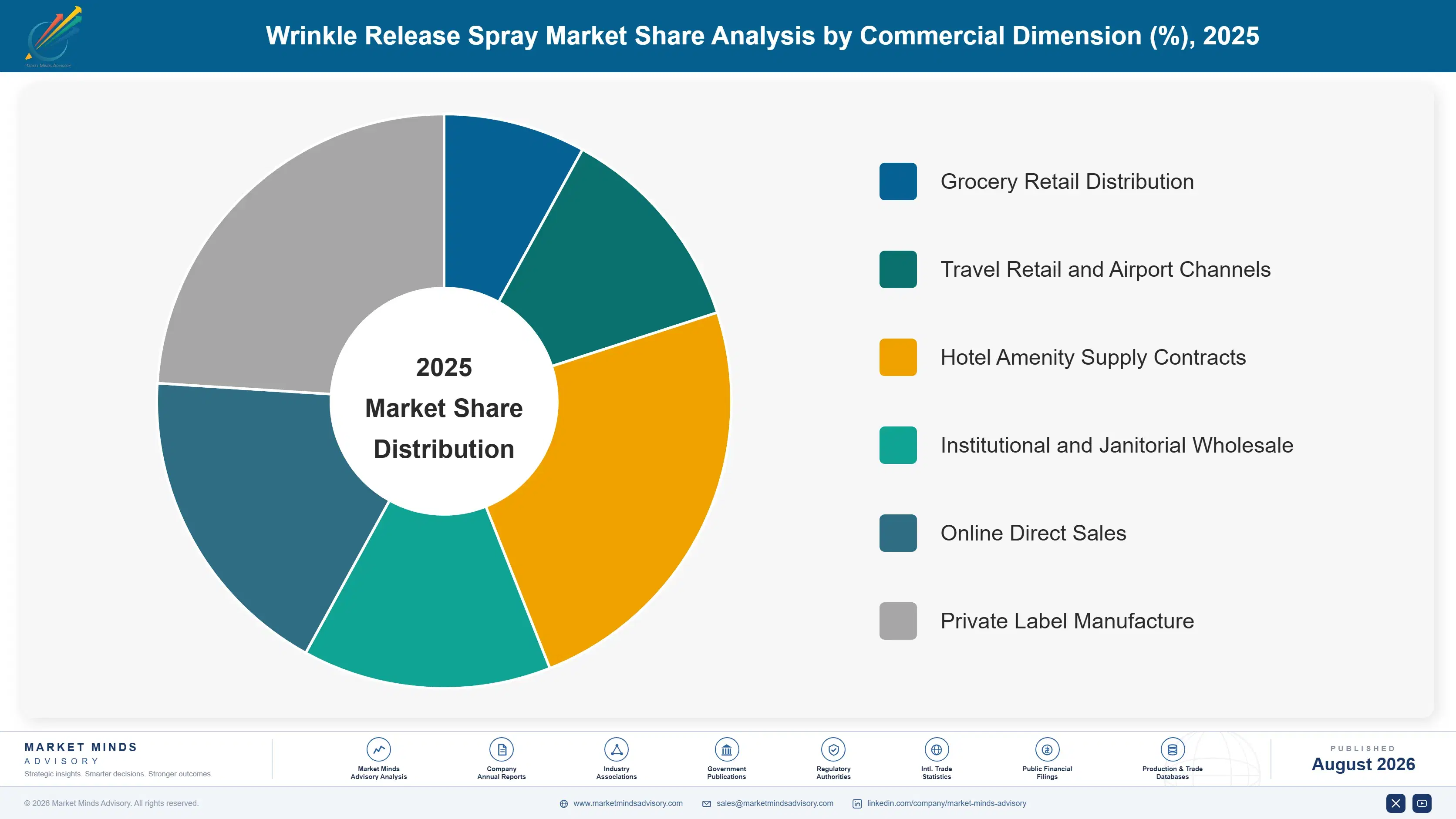
Segmentation follows product format here, because pack size and delivery method decide where the product can be used and who therefore buys it. Six formats describe the market completely, from in-wash products competing directly against fabric conditioner through to travel sprays occupying the one occasion where no appliance can follow the user at all.
wrinkle-release-spray-market-market-share-analysis-1788167909495

Travel and Portable Format Sprays

The fastest format grows at 11.1%, half again the market rate of 7.4%, and aviation security rather than product development explains most of it. Carry-on liquid restrictions make a small bottle the only garment care a traveller can physically bring, and no appliance competes in a space measured in millilitres. Hotels withdrawing irons and boards on liability grounds compound the effect, leaving a guest with a creased shirt and genuinely nothing else available. Travel formats now hold 28% of category volume. The protection came from regulators addressing an unrelated concern, and nobody in this industry paid anything at all to obtain it. That protection is entirely accidental and completely real.
CAGR 11.1%

Professional Bulk and Institutional Formats

Institutional formats grow at 9.6% on a buyer who behaves nothing like a household. Hospitality housekeeping, retail floor teams, wardrobe departments and uniform services treat this as a daily working tool, reorder against measured consumption rather than recollection, and purchase 8.4 times as often per account as a domestic buyer does. The relationship persists across years and survives the forgetting that governs everything else in this category. Pricing is lower per litre and volume is considerably higher, and remarkably few participants have organised any sales capability around a customer who actually wants to buy regularly. A customer who wants to buy regularly is unusual enough here to be worth organising around.
CAGR 9.6%
Full segment breakdown across 6 segments available in the complete report.

Regional Architecture and Country Demand Map

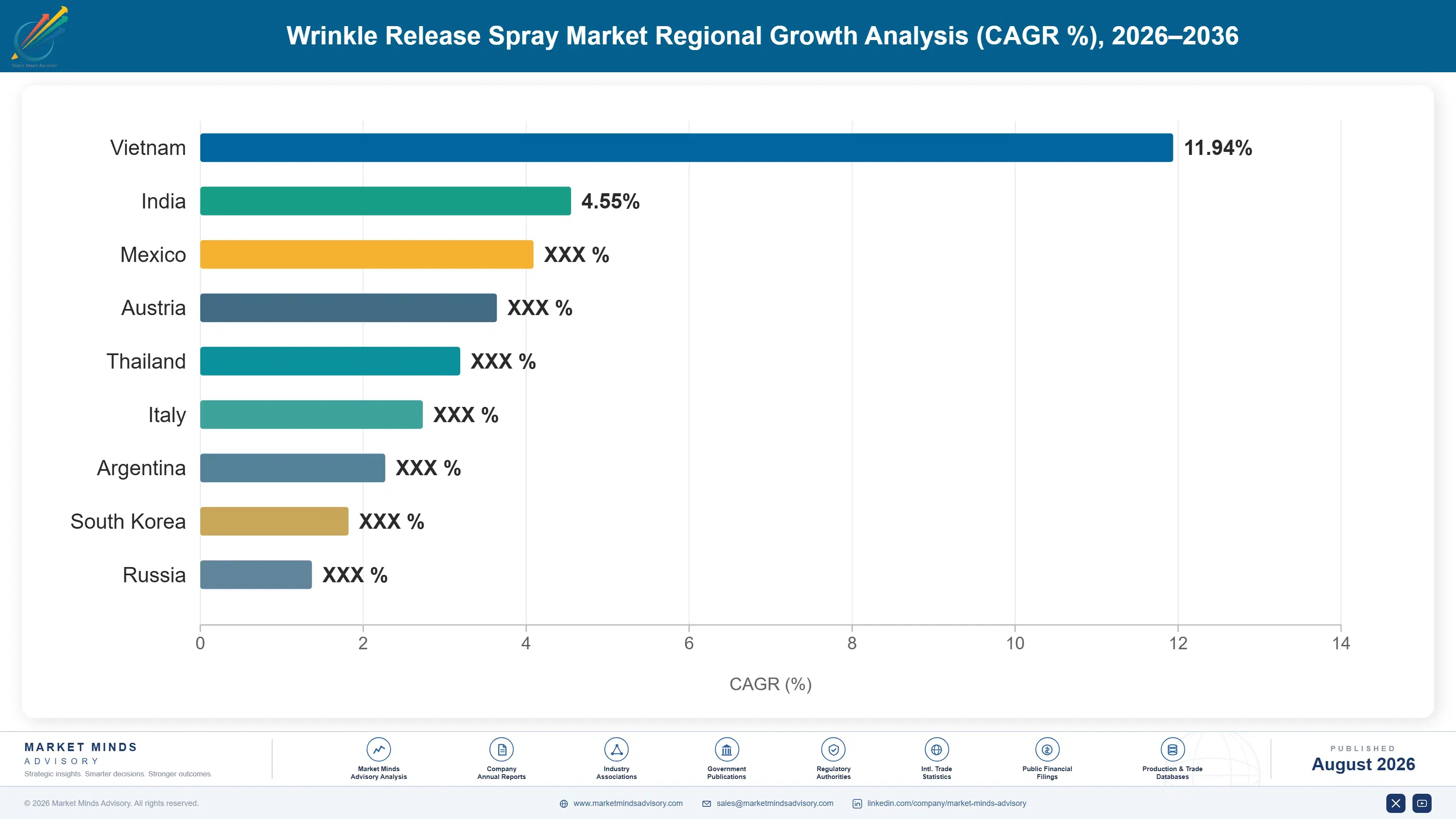
Demand follows garment care habit, travel volume and hospitality standards rather than income alone. North America leads on household category development, with East Asia close behind on professional and hospitality use and South Asia growing fastest overall. Travel volume matters considerably more than household income.

North America

The largest share at 31% reflects a category that was effectively invented here and reached household awareness no other market has matched. It is also where steamer substitution has advanced furthest, so household penetration is high and declining while travel formats carry an increasing share of what remains. Business travel volumes support the portable occasion strongly. Hotel groups here led the withdrawal of irons from rooms, which created the demand condition that now sustains the category more than any marketing has. Household strength here is an asset that is quietly depreciating, since the population that knows the category best is also the population most likely to have bought a steamer already.
Share: 31% | CAGR: 6.8% (2026 to 2036)

East Asia

A 26% share rests on garment care standards that are considerably higher than in Western markets and on hospitality sectors that use these products professionally at scale. Japanese and Korean households treat fabric refreshing as routine rather than occasional, which supports combination products addressing odour alongside creasing. Steamer ownership is also high, which limits the household occasion in the same way it does elsewhere. Professional and institutional use here is the most developed anywhere and is the reason this share sits so close to the leader. Professional depth of that kind is genuinely exportable, since the practices hotel and retail operators use here travel with them into every market they open.
Share: 26% | CAGR: 8.4% (2026 to 2036)
Regional intelligence for 5 additional markets available in the complete report: Western Europe, South Asia and Pacific, Latin America, Middle East and Africa, Eastern Europe. Contact sales@marketmindsadvisory.com.
wrinkle-release-spray-market-country-cagr-analysis-1788167910019

Where Release Spray Margin Sits

Four levers work on occasion ownership, channel access and pack format rather than on formulation, which any contract manufacturer replicates within a month. Travel retail position, hotel supply, institutional selling and pack visibility each address the occasions an appliance cannot reach. None of the four requires a better formulation than anybody else already makes today.

Own The Airport And Travel Retail Shelf

Carry-on liquid limits make a small bottle the only garment care a traveller can bring, and airport retail is where that need becomes visible at exactly the moment it matters. Travel formats hold 28% of volume and grow fastest in the category. Securing airport and travel retail distribution costs listing fees measured in tens of thousands rather than the millions grocery demands. Very few participants treat travel retail as a primary channel rather than an afterthought bought late. Travel retail is the cheapest useful shelf in this entire category today.
Market Impact: Captures the whole 28% travel format volume share

Supply Hotel Groups As In-Room Amenity

Hotels removed irons and created a guest problem they currently do not solve, and an in-room spray costs the operator very little while addressing a complaint housekeeping otherwise fields directly. A single hotel group decision covers tens of thousands of rooms at once. Amenity supply typically runs 3 to 5 year contracts with scheduled replenishment. It converts the most reliable occasion in this category from an individual purchase into contracted institutional volume nobody has to remember. Nobody at all here has to remember anything for that revenue to keep arriving.
Market Impact: Contracts amenity supply across full 5 year terms

Build Selling Capability For Institutional Buyers

An institutional account purchases 8.4 times as often as a household and reorders against consumption rather than memory, which is the only genuinely reliable demand in this category. Hospitality, retail uniform, wardrobe and facilities buyers all purchase this way and almost nobody sells to them properly. Building that capability requires a sales function consumer brands rarely maintain. The customers are already buying from somebody, and mostly from whoever their general cleaning supplier happens to be. Their current supplier simply sells cleaning chemicals and thinks nothing at all about garment care.
Market Impact: Buys at roughly 8.4 times household purchase frequency

Engineer Packs To Live In A Bag

A bottle that stays in a suitcase, a desk drawer or a locker is a bottle that gets used, while one stored in a laundry cupboard competes against a steamer and loses every time. Leak-resistant closures, durable bodies and formats that survive being packed cost very little in design terms. Buyers keeping the product in a bag repurchase 60 to 80 percent more often. Almost every participant still designs for a supermarket shelf instead. Where a bottle actually lives ends up deciding considerably more than whatever is inside it ever will.
Market Impact: Raises repurchase rates by roughly 70% among travellers

Who Controls the Margin Pool

Concentration sits around 54% across the five largest participants measured on wrinkle release product revenue, and it rests on brand recognition and retail distribution rather than on anything about the formulation. Water, a surfactant and a fibre relaxing agent is chemistry any contract manufacturer produces, which means nothing in the bottle protects anybody at all. Nothing in the bottle was ever a barrier.
Competition runs on occasion ownership, channel access and pack format. Occasion ownership decides whether the product is reached for at all, given that an appliance now handles the ordinary home use. Channel access decides whether a participant reaches the traveller and the institutional buyer. Pack format decides where the bottle lives, which turns out to determine repurchase more reliably than anything else.

Pressure is arriving from appliance manufacturers and from private label simultaneously. Steamers took the home occasion and continue to fall in price. Retailers introduce own label whenever they decide the category is worth a facing. Rankings will shift toward participants holding travel retail and institutional positions, since both reach the occasions where no appliance competes and where the buyer does not have to remember anything.
wrinkle-release-spray-market-company-positioning-matrix-1788167910542

Competitive Moat and Risk Dimensions

PROCTER AND GAMBLE

Moat: Brand recognition and retail scale

Procter and Gamble holds the brand recognition consumers reach for when they remember this category exists, supported by fabric care distribution that reaches grocery shelves nobody else can secure at comparable terms. Category management capability provides adjacency to detergent and conditioner. Marketing across the wider fabric care portfolio funds awareness no specialist could justify alone.
PROCTER AND GAMBLE

Risk: Household occasion under appliance pressure

Brand strength is concentrated in exactly the household occasion that garment steamers have taken, and no amount of recognition persuades a consumer to use a spray when a better appliance is in the cupboard. Travel and institutional channels require different capabilities entirely. Grocery-led distribution reaches the shopper least likely to need the product now.
UNILEVER

Moat: Premium positioning and specialist brands

Unilever holds specialist fabric care brands with premium positioning that reaches consumers who care about garment care as a category rather than as a chore, which supports pricing mainstream products cannot sustain. Those brands carry credibility in travel and gifting occasions where the purchase is discretionary. Distribution reaches specialist and department store channels alongside grocery.
UNILEVER

Risk: Small volumes against category economics

Premium specialist positioning delivers attractive margins on volumes too small to matter against the scale of the wider fabric care business, which makes internal investment competition difficult. Institutional channels require volume pricing that conflicts directly with premium positioning. Private label reaches the same shelf at a fraction of the price.

Players Tracked

Prominent Players

Procter and Gamble
Unilever
Faultless Brands
Church and Dwight
Reckitt

Other Key Players

The Laundress
Grove Collaborative
Method Products
Mrs Meyers Clean Day
Puracy
Common Good
Dryel
Static Guard
Niagara National
Magic Sizing
Caldrea
Ecover
Kao Corporation
Lion Corporation
Henkel

Recent Developments

JUNE 2024

Hotel group standardised in-room garment care provision across properties

An international hotel group standardised in-room garment care provision across its property portfolio, addressing guest complaints created by the earlier withdrawal of irons and boards from rooms on liability and housekeeping grounds. This was an operating standard decision rather than any commercial arrangement between product manufacturers.
Signal: A single group decision converts an individual traveller purchase into contracted volume across very many rooms.
NOVEMBER 2024

Retailer introduced private label across fabric refreshing products

A grocery retailer introduced an own label range across fabric refreshing and wrinkle release products, taking shelf space in a category where the formulation is straightforward and consumers cannot readily distinguish one product from another. This was a retailer merchandising decision rather than any transaction between manufacturers.
Signal: Private label arriving confirms that nothing in the formulation was ever protecting anybody in this category.
FEBRUARY 2025

Manufacturer launched carry-on compliant travel format range

A fabric care manufacturer launched a range engineered specifically for carry-on liquid limits and suitcase durability, targeting the travel occasion where no garment steaming appliance can physically compete with a small bottle. This was a product launch rather than any acquisition or joint venture between participants.
Signal: Designing for the bag rather than the shelf addresses where this product is actually being used.

What A Spray Bottle Costs

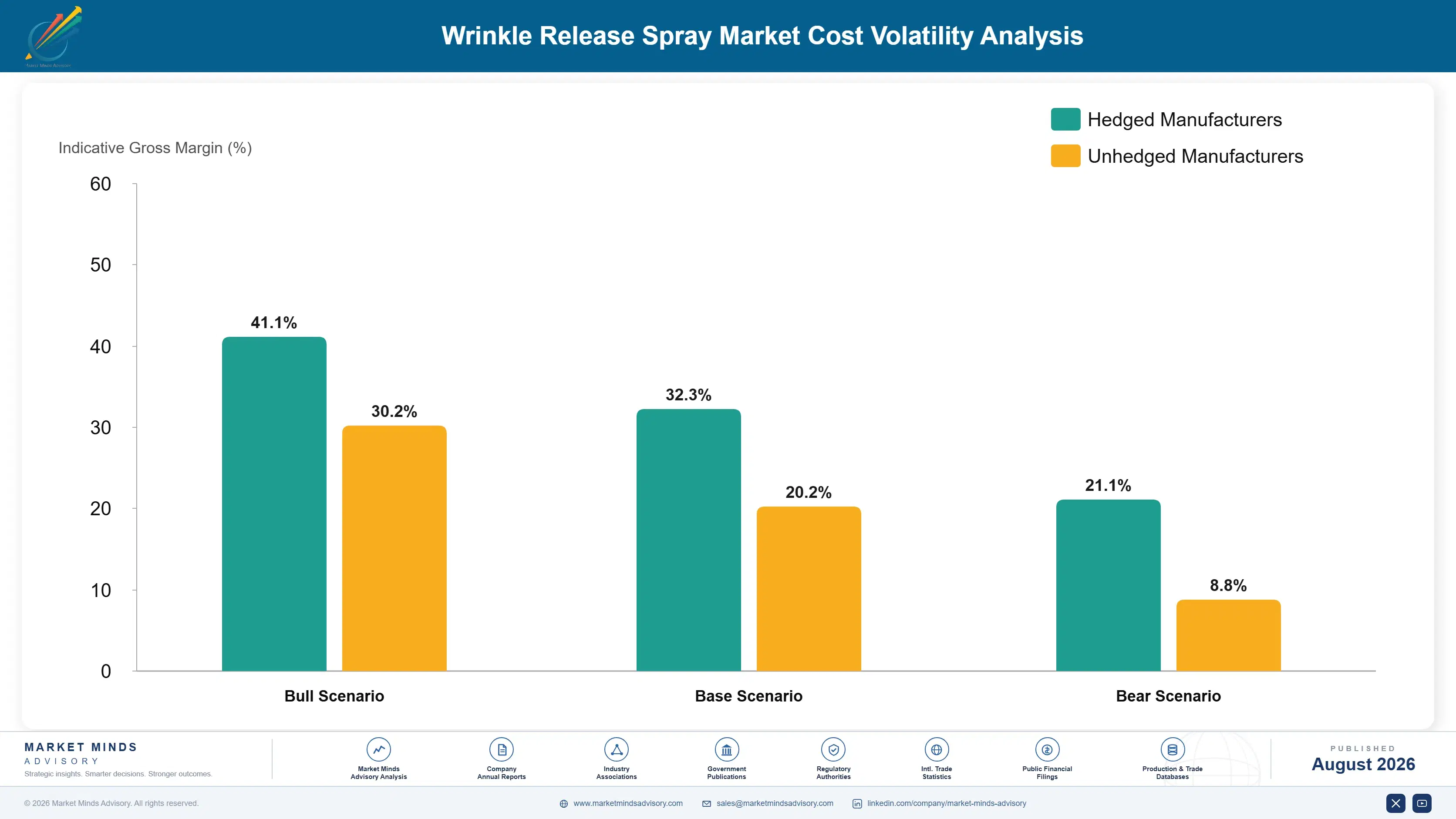
Cost divides four ways and the liquid is the smallest part by a wide margin. Retail margin and distribution absorb roughly 39% of shelf price, packaging, trigger assembly and filling near 27%, marketing and category support near 21%, and the formulation itself the remaining 13%. A water-based product with a surfactant and relaxing agent costs very little, which is why a retailer can introduce private label whenever it chooses.
Packaging resin and trigger assembly pricing moved across recent years and mattered more than any formulation input, since the bottle and its mechanism cost several times what goes inside them. Procter and Gamble and Church and Dwight have both discussed packaging and input cost across recent reporting periods. Retail margin has moved more damagingly still, as grocers reallocated shelf space in a category they correctly identified as easy to substitute.

Exposure varies by channel rather than by geography. Grocery-dependent participants carry full listing and margin cost against a shelf the retailer controls. Travel retail participants pay considerably lower listing fees against higher realised prices. Institutional suppliers carry low marketing cost against contracted volume, which is comfortably the most attractive structure available and the one fewest participants have organised themselves to capture.
wrinkle-release-spray-market-cost-volatility-analysis-1788167910738

Travel retail listing at a fraction of grocery cost

Airport and travel retail listing fees run in tens of thousands where grocery demands millions, and realised prices are considerably higher against a shopper buying at the moment of need. Very few participants treat the channel as primary. Those who do reach exactly the buyer for whom no appliance alternative exists, at a cost grocery would never approach.

Trigger and closure specification against packed use

Packaging and trigger assembly cost several times the formulation inside, and specifications written for a supermarket shelf perform poorly in a suitcase where leaking ruins the contents. Leak-resistant closures cost very little more and prevent the single failure that stops a buyer repurchasing. Most participants specify triggers on price alone without considering where the bottle will actually live.

Institutional contracting reducing marketing dependence

Marketing absorbs roughly a fifth of shelf price and exists to solve a recall problem that a scheduled institutional reorder does not have. Contracted supply removes that spending from the cost base entirely in exchange for lower unit pricing. The arithmetic favours institutional volume more often than consumer brand organisations are willing to acknowledge.

Portfolio Architecture for Margin Defence

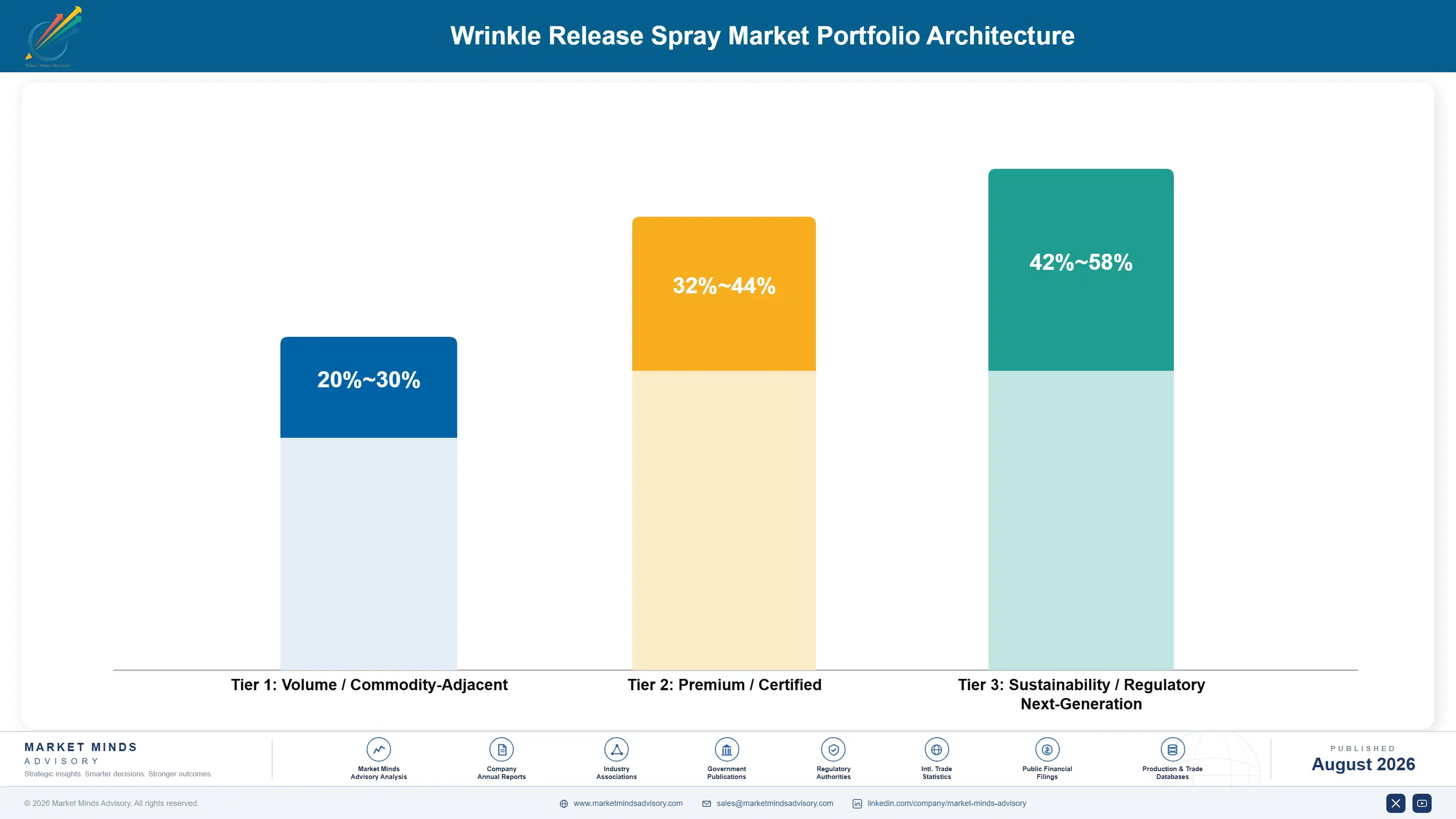
The portfolio separates by whether an appliance can reach the occasion. Standard household trigger sprays are the volume core and the losing position: sold on a grocery shelf, competing directly against a steamer already in the cupboard, and exposed to private label whenever a retailer decides the facing is worth taking. Large by volume and shrinking underneath everybody. Everybody competes there and nobody should.
Margin concentrates where no appliance can follow. Travel formats hold 28% of volume, grow at 11.1% and are protected by carry-on liquid limits nobody in this industry lobbied for. Institutional supply reaches buyers purchasing 8.4 times as often as households on scheduled reorders. Both address occasions where the steamer is simply not present at all. Both survive because the appliance cannot arrive.

The overlooked pool is hotel amenity supply. Hotels removed irons and created a guest problem they do not currently solve, an in-room spray costs the operator very little, and one group decision covers tens of thousands of rooms simultaneously. It is contracted, scheduled and almost entirely unclaimed by anybody in this category so far. Nobody has moved on it yet at all.

Volume / Commodity-Adjacent

Standard household trigger sprays, private label supply and in-wash release products sold through grocery. Range spans ten points because retail listing terms and scale decide outcomes far more than formulation ever does.
Gross Margin: 20-30%

Premium / Certified

Premium specialist brands, combination refresher products and concentrate and refill formats with positioning. Range spans twelve points because brand strength and channel access vary considerably between participants in this tier.
Gross Margin: 32-44%

Sustainability / Regulatory / Next-Generation

Travel and portable formats, hotel amenity supply and professional institutional contracting. Range spans sixteen points because travel retail pricing and institutional volume economics are barely comparable inside one tier. Channel access decides it.
Gross Margin: 42-58%
wrinkle-release-spray-market-portfolio-architecture-1788167911244

High-value Sub-segments and Strategic Watch-out

Travel and Portable Format Sprays

High value and high growth at 11.1%, protected by carry-on liquid limits that no appliance can possibly work around. The twelve point range separates participants holding travel retail distribution from those selling travel sizes through ordinary grocery channels instead. No appliance fits in hand luggage.
Gross Margin: 46-58%

Professional Bulk and Institutional Formats

High value with moderate growth at 9.6%, sold to buyers reordering on consumption rather than on memory. The twelve point range reflects contract structure, since scheduled amenity supply prices very differently from occasional wholesale purchasing arrangements. Reordering here happens on consumption rather than on memory.
Gross Margin: 38-50%

Standard Household Trigger Sprays

The volume core and the position an appliance has already taken. Competing against a steamer sitting in the same cupboard, exposed to private label whenever a retailer chooses, and bought roughly twice a year by a household that keeps forgetting. Nothing about this position is defensible.
Gross Margin: 20-30%

Carry-On Restriction Dependence

The strategic watch-out rather than a growth pool. The fastest growing part of this category is protected by an aviation liquid rule nobody here asked for, and improving scanning technology could remove it without warning. Nobody in this industry asked for that rule or pays for it.
Gross Margin: Variable

Why Travellers Keep Buying

Repeat purchase in this category depends entirely on where the bottle lives. A product in a laundry cupboard competes against a steamer and loses, then sits unused until forgotten. A product in a suitcase or a desk drawer is encountered at exactly the moment of need and gets used, which is why travel buyers repurchase far more often and why pack format decides more than formulation.
Stickiness varies by buyer rather than by product. Institutional accounts are genuinely retained, since reordering happens against measured consumption and switching means changing a supply arrangement nobody has any reason to disturb. Travel buyers return because the occasion recurs and the alternative does not exist. Household buyers have almost no stickiness at all, purchasing whatever is on the shelf when something finally reminds them the category is there.

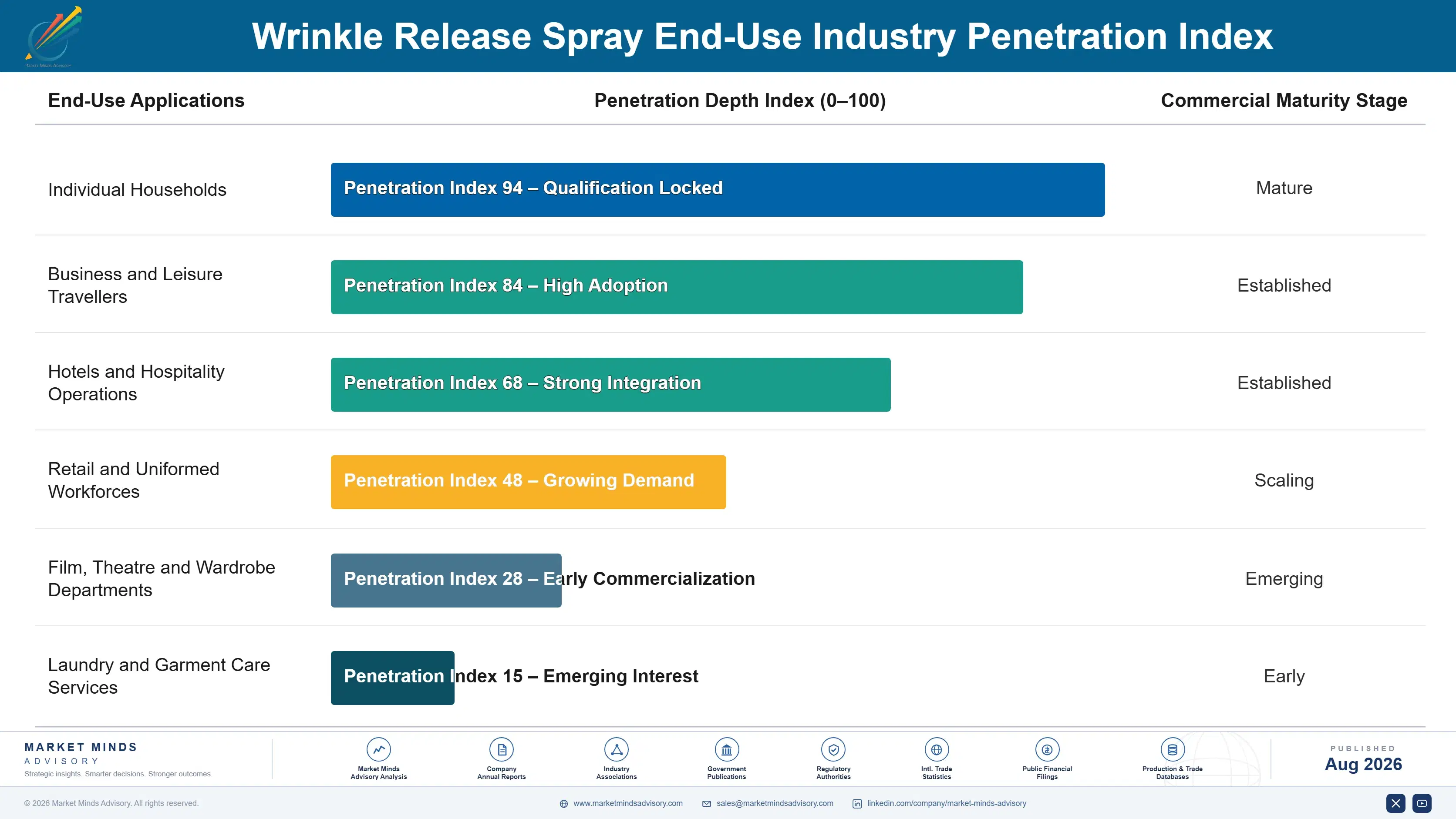
The buyer has narrowed rather than changed. Ordinary households increasingly own a steamer and have left the category, taking the largest population with them. What remains is a traveller, a professional user and a hospitality operator, all of whom need it for reasons no appliance addresses. That is a smaller and considerably better market, and most participants still sell to the population that left.
wrinkle-release-spray-market-end-use-penetration-index-1788167911735

Where Brands Should Commit Now

These are among the four positions where our research anticipates prominent divergence between winners and laggards over the coming forecast period. Each is grounded in the demand model, the regulatory perimeter, and the announced capacity pipeline.
01 / TRAVEL RETAIL PRIORITY

Sell where the appliance cannot follow the customer

Carry-on liquid limits make a small bottle the only garment care that a traveller can physically bring, and airport retail is precisely where that need becomes visible at exactly the moment it actually matters to somebody at all. Travel formats already hold 28% of volume and grow fastest in the whole of this category. Securing travel retail distribution costs listing fees measured in tens of thousands rather than the millions that grocery routinely demands from anybody wanting a single facing.
02 / HOTEL AMENITY SUPPLY

One group decision covers thousands of rooms

Hotels withdrew irons and boards on liability grounds and created a guest problem that they currently do not solve in any way at all, while an in-room spray costs the operator very little and removes a complaint housekeeping otherwise has to field directly. A single group decision covers tens of thousands of rooms simultaneously on three to five year supply contracts. It converts the most reliable occasion in this category into contracted volume that nobody has to remember at all.
03 / INSTITUTIONAL SELLING CAPABILITY

Somebody is already supplying these buyers badly

An institutional account purchases roughly 8.4 times as often as a household buyer and reorders against measured consumption rather than recollection, which makes it easily the only genuinely reliable demand anywhere in this entire category. Hospitality, retail uniform, wardrobe and facilities buyers all purchase in exactly that same way and almost nobody sells to any of them properly at all these days. They are already buying this from whoever their general cleaning supplier happens to be at the present moment.
04 / PACK FORMAT ENGINEERING

A laundry cupboard is where this bottle dies

A bottle that stays in a suitcase, a desk drawer or a locker gets used, while one stored in a laundry cupboard competes directly against a steamer and loses that comparison every single time that it happens. Leak-resistant closures, durable bodies and pack formats that survive being packed cost very little at all in design terms. Buyers who keep the product in a bag repurchase sixty to eighty percent more often than those who store it away in a cupboard.

Engagement Snapshot From the Field

A live engagement with an industry participant carrying material or product regulatory and market exposure ahead of a defining policy shift, showing how our research translates into a defensible multi-year portfolio strategy.
MARKET MINDS ADVISORY · CLIENT ENGAGEMENT SUMMARY
Wrinkle Release Spray Producer Strategic Portfolio Review and Transition Roadmap 2026·Investment Scenario on Wrinkle Release Spray Exposure Evaluation 2025-26
CLIENT PROFILE
A fabric care manufacturer selling wrinkle release spray through grocery retail across three markets, with a small travel size sold on the same shelf and no institutional or hospitality business of any kind. Volume had declined for three consecutive years while the company had responded with promotional pricing, and management described the decline as private label pressure rather than as appliance substitution.
STRATEGIC CHALLENGE
The board needed to establish whether the volume decline came from private label or from steamer ownership, and whether pursuing travel retail and hotel amenity channels justified building capability the grocery organisation did not possess. It also faced a decision on institutional selling, which the commercial team regarded as a low-price distraction from its branded consumer business.
MMA APPROACH
MMA measured volume decline against steamer ownership and private label distribution separately across all three markets, testing which explained the pattern. It modelled travel retail and hotel amenity channel development against continued grocery promotion. Expert interviews with hotel operators, travel retailers, institutional buyers and appliance manufacturers established where this product is genuinely still used.
KEY FINDINGS
  1. Steamer ownership explained roughly three quarters of the household volume decline, and private label distribution correlated with almost none of it in any market examined.
  2. The client's travel size was sold only through grocery, where a traveller has no reason to look for it, and it had never been listed in any airport retail location.
  3. Two hotel groups had actively sought in-room garment care suppliers and had approached competitors, while the client had no capability to respond to either enquiry.
  4. Promotional pricing had lowered realised value across three years without arresting the volume decline it was intended to address in any measurable way.
CLIENT PROFILE
A fabric care manufacturer selling wrinkle release spray through grocery retail across three markets, with a small travel size sold on the same shelf and no institutional or hospitality business of any kind. Volume had declined for three consecutive years while the company had responded with promotional pricing, and management described the decline as private label pressure rather than as appliance substitution.
STRATEGIC CHALLENGE
The board needed to establish whether the volume decline came from private label or from steamer ownership, and whether pursuing travel retail and hotel amenity channels justified building capability the grocery organisation did not possess. It also faced a decision on institutional selling, which the commercial team regarded as a low-price distraction from its branded consumer business.
MMA APPROACH
MMA measured volume decline against steamer ownership and private label distribution separately across all three markets, testing which explained the pattern. It modelled travel retail and hotel amenity channel development against continued grocery promotion. Expert interviews with hotel operators, travel retailers, institutional buyers and appliance manufacturers established where this product is genuinely still used.
KEY FINDINGS
  1. Steamer ownership explained roughly three quarters of the household volume decline, and private label distribution correlated with almost none of it in any market examined.
  2. The client's travel size was sold only through grocery, where a traveller has no reason to look for it, and it had never been listed in any airport retail location.
  3. Two hotel groups had actively sought in-room garment care suppliers and had approached competitors, while the client had no capability to respond to either enquiry.
  4. Promotional pricing had lowered realised value across three years without arresting the volume decline it was intended to address in any measurable way.
RECOMMENDED STRATEGY
Phase 1: Phase one: stop promotional discounting against appliance substitution and redirect that spending toward securing airport and travel retail listings instead. Phase 2: Phase two: build hotel amenity supply capability and respond to the two group enquiries that competitors are currently answering unopposed. Phase 3: Phase three: engineer packs for suitcase and drawer use rather than shelf presence, prioritising closure integrity above any shelf appearance at all.
OUTCOME
The client reported realised value recovering within four quarters as promotional depth was withdrawn (client-reported, unverified by MMA). Travel retail listings were secured in two airport groups. One hotel amenity contract was signed, and grocery volume continued declining as expected without any further intervention at all.

Frequently Asked Questions

Foundational context covering the market sizes, CAGR, scope, country, region and competition that inform every finding below. This section is provided to cover basics and most often pre-purchase conversations, answered from the MMA Primary Research Dataset.

What is the current size of the Wrinkle Release Spray Market?

The market is valued at USD 0.7 billion in 2025, measured as revenue from liquid products applied to fabric to relax creasing without any ironing.

How large will the Wrinkle Release Spray Market be by 2036?

MMA forecasts USD 1.54 billion by 2036, up from USD 0.75 billion in 2026. That represents incremental revenue of USD 0.78 billion and an expansion multiple of 2.04 times.

What is the CAGR for the Wrinkle Release Spray Market 2026 to 2036?

The base case CAGR is 7.4%, with a bull case of 8.7% and a bear case of 6.1%. Travel formats and institutional supply provide most of that growth.

Which segment is growing fastest?

Travel and portable format sprays grow at 11.1%, half again the market rate of 7.4%, because carry-on liquid limits leave no appliance able to compete there.

Who are the major companies in the Wrinkle Release Spray Market?

Procter and Gamble, Unilever, Faultless Brands, Church and Dwight and Reckitt lead on category revenue, holding around 54% between them across retail and institutional channels.

Which country is growing fastest?

India grows fastest at 9.4%, driven by hospitality expansion and rising business travel volumes creating exactly the occasion this category serves best of all anywhere.

Report Segmentation Architecture

The full report scope spans multiple orthogonal segmentation dimensions, with cross-tabulated demand data provided for each dimension pair. Coverage extends further to regional breakdowns, trend trajectories, and the competitive detail needed to support segment-level decision-making.

By Product Format

  • Travel and Portable Format Sprays
  • Professional Bulk and Institutional Formats
  • Concentrate and Refill Formats
  • Combination Refresher and Release Sprays
  • Standard Household Trigger Sprays
  • Dryer-Added and In-Wash Release Products

By End-Use Industry

  • Individual Households
  • Business and Leisure Travellers
  • Hotels and Hospitality Operations
  • Retail and Uniformed Workforces
  • Film, Theatre and Wardrobe Departments
  • Laundry and Garment Care Services

By Commercial Dimension

  • Grocery Retail Distribution
  • Travel Retail and Airport Channels
  • Hotel Amenity Supply Contracts
  • Institutional and Janitorial Wholesale
  • Online Direct Sales
  • Private Label Manufacture

By Region

  • North America
  • East Asia
  • Western Europe
  • South Asia and Pacific
  • Latin America
  • Middle East and Africa
  • Eastern Europe

Scope, Methodology, and Coverage

Every figure in this report is reproducible from documented input assumptions. The scope below maps the historical period, the forecast horizon, the segmentation dimensions, and the countries covered, alongside the underlying primary and qualitative methodology.
Historical Period
2020 to 2025
Forecast Period
2026 to 2036
Base Year
2025 (USD billions; MMA Primary Research Dataset, August 2026)
Market Definition
Revenue from liquid products applied to fabric to relax creasing without ironing, spanning travel and portable format sprays, professional bulk and institutional formats, concentrate and refill formats, combination refresher and release sprays, standard household trigger sprays, and dryer-added and in-wash release products. Grocery retail distribution, travel retail and airport channels, hotel amenity supply contracts, institutional and janitorial wholesale, online direct sales and private label manufacture are all included. Garment steaming appliances and irons, laundry detergents and fabric conditioners, starch and sizing products intended to stiffen fabric, and professional dry cleaning services are excluded.
Quantitative Units
USD billions, wrinkle release product revenue at manufacturer level
Segmentation Dimensions
Product format, user setting, distribution channel, region
Regions Covered
North America, East Asia, Western Europe, South Asia and Pacific, Latin America, Middle East and Africa, Eastern Europe
Countries Covered
United States, Canada, Japan, South Korea, China, United Kingdom, Germany, France, India, Australia, Brazil, Mexico, United Arab Emirates, Poland
Key Companies Profiled
Procter and Gamble, Unilever, Faultless Brands, Church and Dwight, Reckitt, The Laundress, Kao Corporation, Lion Corporation, Method Products, Henkel
Quantitative Methodology
Primary survey, n=3,800 respondents, Q4 2025, six countries; demand-side model with trade association cross-validation
Qualitative Methodology
47 expert interviews, Q4 2025; applied to validate demand model assumptions, identify emerging dynamics, and assess competitive positioning
Report Format
PDF and XLSX data workbook (Word format preview document)
Publisher
Market Minds Advisory
Report Code
MMA-2026-CHM-171
Published
August 2026
Contact
sales@marketmindsadvisory.com | www.marketmindsadvisory.com

Purchase the full Wrinkle Release Spray Market Report (2026 to 2036).

The full report explains what actually happened to this category, which is that an appliance took its home ground and an aviation rule saved what remained. It measures household decline against steamer ownership rather than against private label, quantifies travel format volume protected by carry-on liquid limits, and assesses hotel amenity supply as the contracted opportunity nobody has yet claimed. Segment analysis covers all six product formats, with particular attention to travel and institutional formats where the occasions an appliance cannot reach actually sit. Competitive assessment ranks twenty participants on wrinkle release product revenue.
Six product format segmentation with growth rates
Household decline measured against steamer ownership directly
Twenty participant assessment on wrinkle release revenue
Travel format volume mapped against carry-on liquid limits
Hotel amenity supply opportunity quantified across room counts
Institutional purchase frequency compared with household buyers

Built For The People Who Decide

From boardroom strategy to bench-side execution, this report is read cover-to-cover by leaders shaping the next decade of their industry, turning demand scenarios, market dynamics and valuation benchmarks into decisions.
CXOs/ Presidents/ VPs/ Managers
M&A and Corporate Development
Strategy Teams and R&D Heads
Procurement and Product Directors
Regulatory and Compliance Leaders
Investor Relations and Equity Analysts