
Market Minds Advisory
Windscreen Adhesive Market

Windscreen Adhesive Market: A Load Bearing Component Sold Through A Consumables Channel

The bonded screen carries roof load in a rollover and the passenger airbag deploys against it, which makes this one of very few consumables whose failure kills people rather than merely annoying them.

Lead Analyst

Published

September 2026

Make Smarter Decisions with Customized Research Insights

Request a free sample report and evaluate market opportunities, growth trends, and competitive dynamics relevant to your business needs.

2025 MARKET VALUE$2.8BMarket Size 2025
2036 FORECAST VALUE$5.0BBase Case , 2026 to 2036
CAGR 2026 TO 20365.4 %Bull 6.6% / Bear 4.2%
INCREMENTAL OPPORTUNITY$2.0BNet 10- year value creation
EXPANSION MULTIPLE1.69x2036 value over 2026 base
Strategic Levers
M&A Pipeline
Regional Outlook
Country Rankings
Competitive Intelligence
Segmental Deep-dive
Call-Us : 91 93563 13602

Executive Snapshot and Market Trajectory

A bonded windscreen carries around 34% of roof load in a rollover and provides the surface the passenger airbag deploys against. That makes this adhesive a load bearing component of the vehicle sold, in half the market, through a consumables channel to whoever quotes cheapest on a replacement job.
Fast cure chemistry grows fastest at 8.1%, half again the market rate, because safe drive-away time decides aftermarket economics entirely. A one hour product against a three hour one changes how many jobs a mobile technician completes in a day, and the adhesive itself is only about 6% of what the job is worth. Productivity rather than bond chemistry is what sells it.
Driver assistance changed who does the work. Roughly 72% of replacements now require sensor recalibration afterwards, which has pushed jobs from informal fitters toward accredited networks buying to approved specification. Platform approval takes about three years and holds for the model life. East Asia carries 34% of demand and India grows fastest at 8.8%. Two halves of one market with entirely different purchasing logic sit behind all of that. Only one is professionalising.
Market Definition
Adhesive systems used to bond automotive glazing into vehicle bodies, covering standard and fast cure polyurethane adhesives, non-conductive polyurethane grades, silane modified polymer adhesives, high modulus bonding adhesives, and the primers and activators supplied as part of the bonding system. Measured at manufacturer selling value. Automotive glass, laminate interlayers, body assembly adhesives, sealants for non-glazing applications and calibration equipment are excluded from scope.
Base Year Value
$2.8B in 2025 (MMA Primary Research Dataset, August 2026)
Forecast Period
2026 to 2036, eleven discrete annual values
CAGR
5.4% base case. Bull 6.6%. Bear 4.2%.
Fastest Growth Segment
Fast Cure Polyurethane Adhesives: 8.1% CAGR
Fastest Growth Country
India: 8.8% CAGR
Fastest Growth Region
South Asia and Pacific: 7.6% CAGR
Largest Region
East Asia: 34% of 2025 global value
Market Leaders
Sika, Henkel, Dow, H.B. Fuller, Arkema. Source: MMA Primary Research Dataset, July 2026.
Primary Survey
n=3,800 procurement and R&D decision-makers, Q4 2025, six countries
Methodology
Demand-side build-up, cross-validated against public data, 47 expert interviews

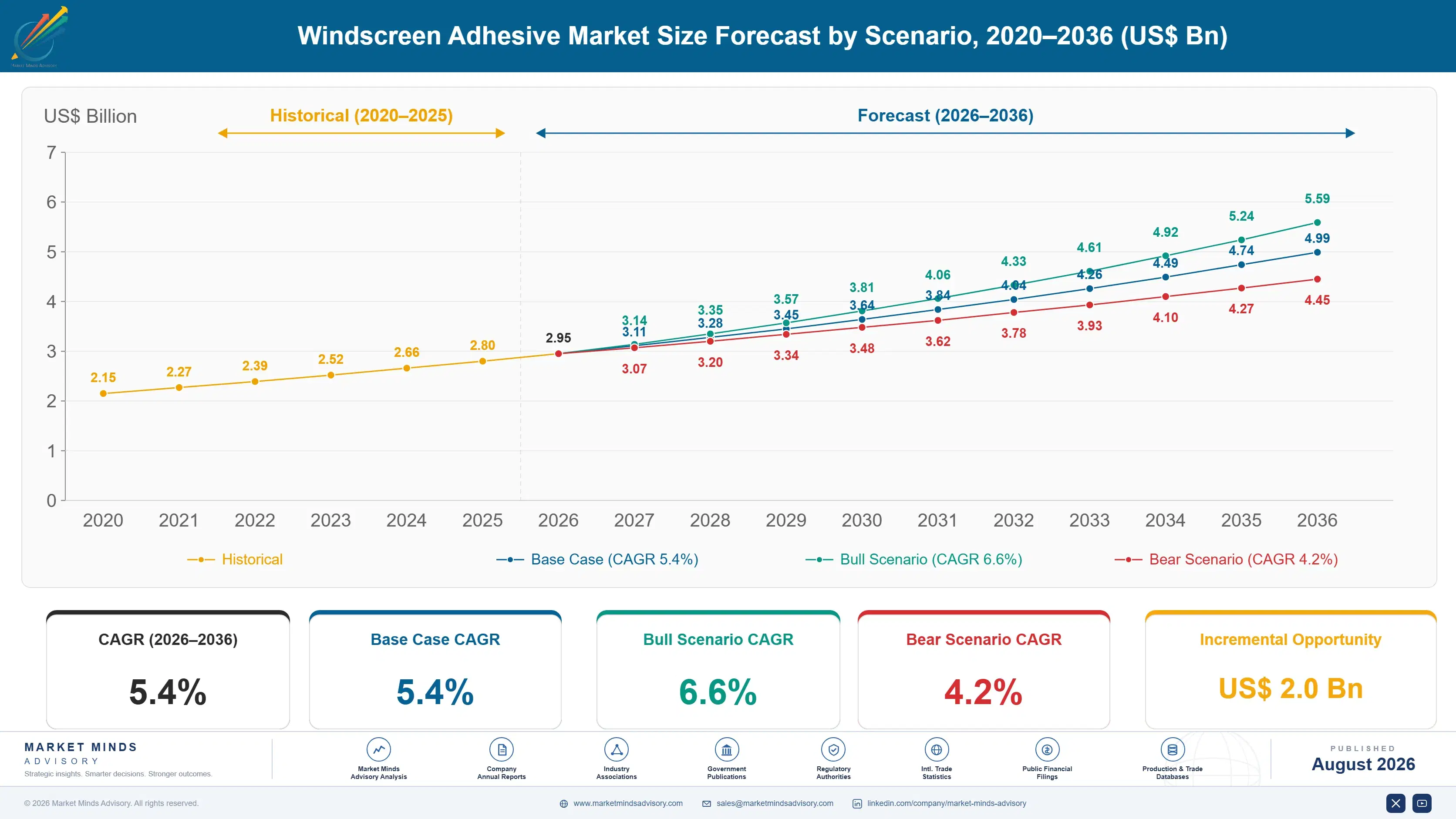
Windscreen Adhesive Market Forecast Scenarios

windscreen-adhesive-market-size-forecast-scenario-1787665079530
The five years to 2025 combined steady vehicle production with a change in what a replacement job involves. Driver assistance cameras behind the screen made recalibration routine, which raised job value and moved work toward accredited fitters, while raw material pricing moved sharply. The 4.2% historical rate blends production volume with job value increases and a period of cost driven pricing that later corrected.
The 5.4% base case rests on three mechanisms. Fast cure chemistry grows at 8.1% because safe drive-away time governs aftermarket productivity directly. Non-conductive grades grow at 7.2% as heated screens, in-glass antennas and sensor housings spread across mainstream vehicles. And Indian vehicle production and replacement volumes grow at 8.8%, faster than any market covered, on both assembly and an expanding parc requiring service. Volume, glazing electronics and geography all together.
The 6.6% bull case turns on glazing area per vehicle continuing to rise across electric platforms, since panoramic screens and larger backlights consume more adhesive per unit and demand higher modulus chemistry. The 4.2% bear case is vehicle production: this market tracks build volumes and replacement rates closely, and a sustained production decline flows through to adhesive demand within a single quarter.

The Part That Holds The Roof Up

The bonded windscreen is a load path rather than a window. It carries roughly 34% of roof load in a rollover and provides the reaction surface the passenger airbag deploys against, which means a bond that fails does so at the moment it matters. Very few consumables carry that consequence, and fewer still are sold through a channel where the purchaser is frequently a fitter choosing on price.
TOP FIVE CONCENTRATION68%Combined production capacity held by the leading suppliers
SAFE DRIVE-AWAY TIME1 hourWaiting period before a replaced screen carries load
PLATFORM APPROVAL DURATION3 yearsTesting period before a chemistry reaches a production line
CALIBRATION REQUIRED SHARE72%Replacements now needing sensor recalibration after the fitting
ADHESIVE COST SHARE6%Bonding system against total windscreen replacement job value
ROOF LOAD CONTRIBUTION34%Load share carried by bonded glazing during a rollover
Original equipment and aftermarket are therefore two different businesses wearing one product name. On an assembly line the adhesive is approved onto a platform after around three years of testing and stays for the model life, purchased against a specification nobody negotiates. In the aftermarket it is bought by fitting networks, independent workshops and mobile technicians, where the bonding system represents about 6% of job value and approval standards vary.
Driver assistance has been quietly professionalising that second half. Around 72% of replacements now require camera or sensor recalibration afterwards, which needs equipment, training and time that informal operators cannot provide. Work has moved toward accredited networks and insurer approved programmes that buy to specification, and the adhesive supplier reaching those networks is selling into a more demanding and more durable relationship.
"Half this market treats the product as a safety critical component approved over three years, and the other half treats it as a tube of glue bought on price. It is the same chemistry doing the same job in both."
Director, Automotive Materials and Aftermarket Practice · MMA Automotive Chemicals and Materials Practice · August 2026

Market Trends

Safe Drive-Away Time Governs Aftermarket Productivity Directly

A replacement job is not finished when the screen is fitted but when the vehicle can safely be driven, and that waiting period decides how many jobs a mobile technician or workshop bay completes in a day. Fast cure chemistry reaching one hour rather than three changes the daily job count materially, which is worth far more than the adhesive costs at roughly 6% of job value. Fast cure grades grow at 8.1% against a market rate of 5.4%, the fastest chemistry in the category. Productivity rather than performance sells this product.
Market Impact: India grows at 8.8% annually
Recalibration Requirements Professionalise The Replacement Channel

Around 72% of replacements now require camera or sensor recalibration after fitting, which demands equipment, training and controlled conditions that informal operators cannot provide at all. Work has shifted toward accredited fitting networks and insurer approved programmes, which buy to specification rather than on price per cartridge. That changes the customer for aftermarket adhesive from an individual fitter into a procurement function applying approval standards. Suppliers who built relationships with those networks early hold positions that are considerably harder to contest on price alone. Price alone no longer reaches that buyer.
Market Impact: Non-conductive grades grow at 7.2%

Market Opportunities and Growth Drivers

Indian Vehicle Production And Parc Expand Together

Indian passenger and commercial vehicle assembly has grown alongside a vehicle parc large enough to generate substantial replacement demand, so both halves of this market expand at once. India grows at 8.8%, faster than any market covered. Domestic suppliers compete strongly in the aftermarket while international suppliers hold original equipment approvals on platforms built for export and premium domestic segments. Recalibration requirements are spreading through the fleet more slowly than in Western markets, which keeps the informal replacement channel commercially relevant longer here. Both halves growing at once is genuinely unusual here.
Market Impact: Adhesive is 6% of job value

Glazing Electronics Demand Non-Conductive Adhesive Grades

Heated windscreens, in-glass antennas, rain and light sensors and camera housings all place electrical function in or against the bonded area, and conventional carbon black filled urethanes conduct enough to interfere with it. Non-conductive grades address that directly and grow at 7.2%, second fastest in the category. Adoption follows vehicle electronics content rather than any change in bonding requirement, which means it spreads from premium platforms downward on a schedule set by carmakers rather than by adhesive suppliers. Formulating without carbon black while holding modulus and weathering performance is genuinely harder.
Market Impact: Approval consumes about 3 years

Market Restraints and Challenges

Aftermarket Price Competition Ignores Safety Consequence Entirely

The bonding system is about 6% of what a replacement job is worth, and in the informal channel it is still bought on price per cartridge by fitters whose customers cannot evaluate the difference. The root cause is that a poor bond fails in a rollover rather than on the drive home, so the market signal never reaches the purchaser. Commercially this sustains cheap product against approved chemistry. Suppliers respond by working through accredited networks and insurers, which reaches the professionalising half and not the rest. The signal never reaches the buyer.
Market Impact: Fastest chemistry growing at 8.1%

Approval Cycles Lock Platforms For A Model Generation

Original equipment approval takes around three years of testing across adhesion, durability, crash performance and process compatibility, and once a chemistry is written into a platform it stays for the model life. The root cause is that changing a bonded joint specification means repeating validation nobody will fund without cause. Commercially this rewards incumbency heavily and makes original equipment share extremely slow to move. New entrants respond by targeting new platforms and new plants, which is the only realistic route available. Incumbency here is worth considerably more than any price position ever is.
Market Impact: Recalibration affects 72% of replacements
3 additional market trends, 4 additional growth drivers, and 2 additional restraints and challenges are covered in the full report. Contact sales@marketmindsadvisory.com to access the complete intelligence.

Segment CAGR and Growth Architecture

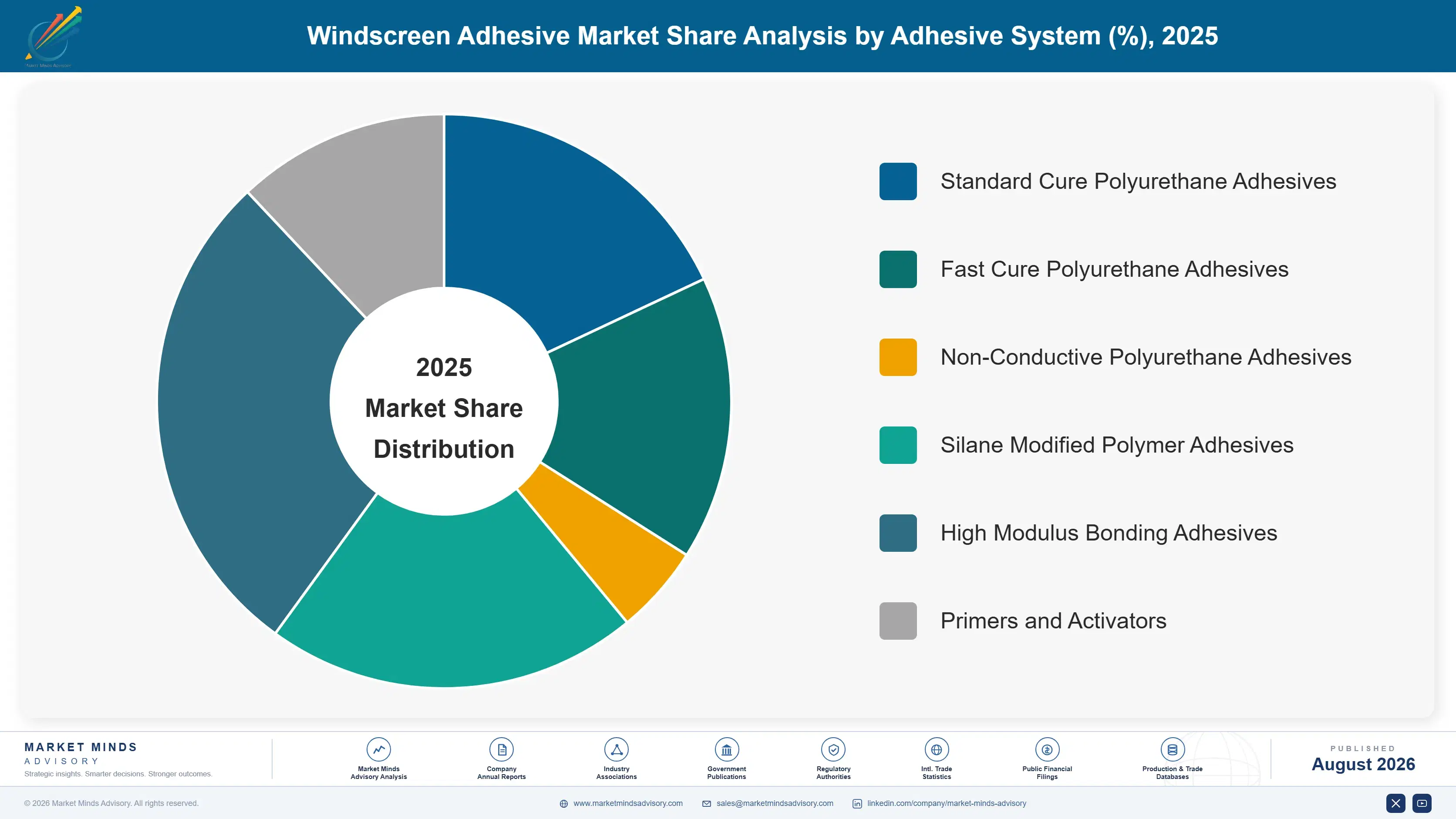
Segmentation follows adhesive system, since chemistry determines cure speed, electrical behaviour, modulus and which approval applies. Six systems cover the category as supplied to assembly lines and replacement channels alike. Growth tracks vehicle electronics content and fitter productivity rather than any change in what the bond has to achieve mechanically. Productivity and electronics drive it.
windscreen-adhesive-market-market-share-analysis-1787665080115

Fast Cure Polyurethane Adhesives

Moisture cure and accelerated polyurethane systems formulated to reach safe drive-away strength within about an hour rather than several, used across both assembly lines and replacement work. At 8.1% this is the fastest growing system, half again the market rate of 5.4%, and productivity rather than bond performance explains it. A technician completing more jobs per day earns far more than the price difference between chemistries, since the bonding system is roughly 6% of job value. On assembly lines the same property removes a constraint on line speed, which is worth considerably more again. Nothing about the mechanical requirement changes between the two, which is why productivity carries this segment.
CAGR 8.1%

Non-Conductive Polyurethane Adhesives

Grades formulated without conductive carbon black filler so they do not interfere with heated screens, in-glass antennas, sensors and camera housings placed in or against the bonded area. Growth of 7.2% is second fastest in the category and follows vehicle electronics content rather than any change in bonding requirement. Adoption therefore spreads from premium platforms downward on a schedule carmakers set, not adhesive suppliers. Formulating without carbon black while maintaining ultraviolet resistance and modulus is genuinely more demanding, which limits how many suppliers offer credible grades. Suppliers without a credible non-conductive grade are locked out of platforms that specify it, regardless of how well their standard chemistry performs elsewhere entirely.
CAGR 7.2%
Full segment breakdown across 6 segments available in the complete report.

Regional Architecture and Country Demand Map

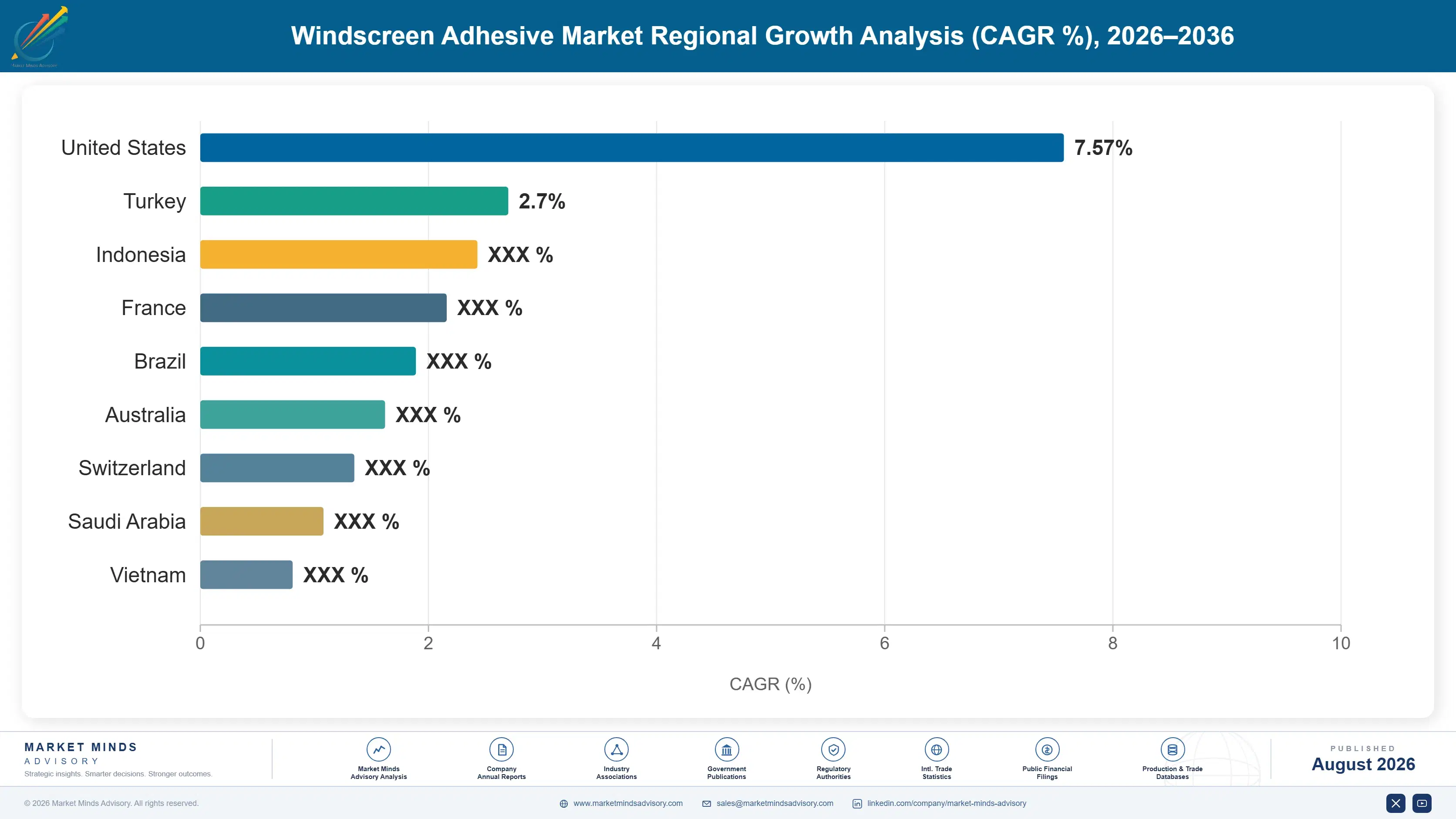
East Asia holds 34%, above the standard band, because China alone assembles more vehicles than any other region and hosts the largest automotive glazing production base. North America follows at 22% and Western Europe at 18%. India grows fastest at 8.8%. Assembly volume decides these shares.

North America

Replacement volume rather than assembly carries much of this 22% share, since the vehicle parc is large, older on average than in Europe and driven far more miles per year. Insurer approved fitting networks are well established and buy to specification, which professionalised this market earlier than most. Recalibration requirements now cover the majority of replacements and have consolidated work toward operators with the equipment to perform it. Assembly demand follows North American build volumes closely. Growth of 4.4% reflects job value increases more than any expansion in replacement numbers. Parc size and miles driven rather than assembly volume are what carry this share. Professionalisation happened earlier here than anywhere.
Share: 22% | CAGR: 4.4% (2026 to 2036)

Western Europe

Original equipment approvals anchor this 18% share, with German, French and Italian platform work concentrating specification decisions among a small group of suppliers holding three year validation histories. Vehicle parc replacement volumes are steady and the fitting channel is highly professionalised, with insurer networks and accreditation schemes covering most work. Assembly volumes have been flat to declining, which caps the original equipment half regardless of specification position. Regulatory attention to repair quality is greater here than elsewhere. Growth of 3.8% is the lowest of the seven regions and reflects mature production and parc conditions. Specification position rather than build volume is what protects suppliers across this whole region now. Volume is the constraint.
Share: 18% | CAGR: 3.8% (2026 to 2036)
Regional intelligence for 5 additional markets available in the complete report: East Asia, South Asia and Pacific, Latin America, Middle East and Africa, Eastern Europe. Contact sales@marketmindsadvisory.com.
windscreen-adhesive-market-country-cagr-analysis-1787665080664

Where This Adhesive Actually Earns

Nothing here is won on bond strength, since every credible product meets the mechanical requirement and the failure that matters happens in a crash nobody tests commercially. Value accrues to whoever wins platform approvals, whoever sells drive-away time, whoever reaches accredited networks, and whoever formulates for glazing electronics. Four routes carry weight. Approval and productivity decide it.

Win The Platform Approval And Hold It

Original equipment approval takes around 3 years of testing across adhesion, durability, crash performance and line process compatibility, and once written into a platform the chemistry stays for the model life. That makes approval an annuity and makes original equipment share extremely slow to move in either direction. New entrants can realistically target only new platforms and new plants, since changing a specification mid-life means repeating validation nobody will fund. Incumbency here is worth more than price position ever is. Roughly 3 years of validation buys a whole model generation of volume.
Market Impact: Approval holds across full 3 year validation cycles

Sell Safe Drive-Away Time To The Fitter

A replacement job ends when the vehicle can be driven safely rather than when the screen is fitted, and cutting that wait from three hours to one changes how many jobs a technician completes daily. The bonding system is roughly 6% of job value, so a productivity gain of that scale dwarfs any price difference between chemistries. Suppliers presenting jobs per day rather than price per cartridge reach the workshop owner who counts revenue, instead of the fitter comparing invoices. Roughly 6% of job value against a third more jobs is not a close calculation.
Market Impact: Cuts drive-away waiting from 3 hours to 1

Follow Calibration Into Accredited Fitting Networks

Around 72% of replacements now need camera or sensor recalibration afterwards, requiring equipment and training that informal operators cannot provide, which has moved work toward accredited networks and insurer approved programmes. Those buyers apply approval standards and purchase centrally rather than comparing cartridge prices at a counter. That converts the aftermarket customer from an individual fitter into a procurement function, and suppliers who built those relationships early hold positions considerably harder to contest on price. Around 72% of replacements now sit inside that requirement, and the share keeps rising steadily.
Market Impact: Serves the 72% of replacements now needing recalibration

Build Non-Conductive Chemistry Ahead Of Glazing Electronics

Heated screens, in-glass antennas, sensors and camera housings place electrical function in or against the bonded area, and conventional carbon black filled urethanes conduct enough to interfere. Non-conductive grades grow at 7.2% and spread from premium platforms downward on a schedule carmakers set. Formulating without carbon black while holding ultraviolet resistance and modulus is genuinely harder, which limits credible suppliers and creates a technical position that price competition does not reach at all. Roughly 7.2% growth is spreading downward from premium platforms into mainstream vehicles steadily. Suppliers without a grade simply are not asked.
Market Impact: Non-conductive grade demand now grows at 7.2% annually

Who Controls the Margin Pool

Concentration is high on the original equipment side and considerably lower behind it. The top five hold 68% of production capacity, the basis applied consistently throughout this section, with platform approvals concentrating assembly line supply among a handful of suppliers while the aftermarket carries regional and domestic producers competing on price alone in a separate contest entirely. Sika leads on approval breadth across platforms and geographies, and the gap reflects validation history rather than any difference in chemistry between them.
Competition runs on three fronts. Approved suppliers compete for new platform specifications, which are contested once and then held for a model generation. Aftermarket suppliers compete for accredited network and insurer programme listings, where specification matters. And domestic producers compete on price in informal replacement channels that no approval standard actually governs in practice at all.

Rankings will move with new platform allocation rather than with commercial effort, since existing specifications hold firmly until a model generation actually comes to an end. The other pressure point is aftermarket professionalisation, which converts price led purchasing into specification led purchasing and steadily reduces the channel where unapproved product competes successfully at all.
windscreen-adhesive-market-company-positioning-matrix-1787665081191

Competitive Moat and Risk Dimensions

SIKA

Moat: Platform Approval Portfolio Breadth

Approvals held across many vehicle platforms and manufacturers represent validation histories running years per platform that no competitor can compress with capital or commercial effort. Each approval holds for a model generation, which makes the portfolio a set of annuities rather than a set of contracts subject to annual renegotiation.
SIKA

Risk: Vehicle Production Exposure

Original equipment demand tracks build volumes directly and flows through within a quarter when production falls, with no mechanism to offset it. Approval strength provides no protection against a manufacturer building fewer vehicles, and the aftermarket half carries a different customer base that approval position does not automatically reach.
HENKEL

Moat: Assembly Line Process Integration

Supplying adhesives alongside application equipment, process support and surface preparation systems creates integration on assembly lines that a product only competitor cannot match, since changing the adhesive would mean revisiting the whole application process. That integration also produces the process data manufacturers rely on for quality documentation.
HENKEL

Risk: Aftermarket Channel Fragmentation

The replacement channel divides between accredited networks buying to specification and informal operators buying on price, and serving both requires different products, packaging and commercial approaches simultaneously. Domestic producers compete effectively in the price led half, where approval history and process integration carry no weight with the purchaser.

Players Tracked

Prominent Players

Sika
Henkel
Dow
H.B. Fuller
Arkema

Other Key Players

3M
Wacker Chemie
ThreeBond
Yokohama Rubber
Sunstar Engineering
Zhengzhou Zhongyuan Applied Technology
Guangzhou Baiyun Chemical
Chengdu Guibao Science and Technology
Illinois Tool Works
Soudal
Kommerling Chemische Fabrik
DELO Industrial Adhesives
KCC Corporation
Nitto Denko
Momentive Performance Materials

Recent Developments

FEBRUARY 2025

Insurer network standardises adhesive specification across approved fitters

An insurer approved fitting network standardised adhesive specification across its accredited workshops, replacing individual purchasing decisions with a single approved product list. Around 72% of replacements now require sensor recalibration, which had already concentrated work within that accredited network rather than informal operators. Purchasing moved to a single list.
Signal: Recalibration requirements turned a fitter buying cartridges into a procurement function applying an approved product list centrally
JUNE 2025

Supplier launches one hour drive-away chemistry for mobile fitting

A supplier launched a fast cure chemistry reaching safe drive-away strength in about an hour for mobile replacement work, targeting technicians whose daily job count is limited by waiting time. The bonding system represents roughly 6% of job value, so productivity gains outweigh any price difference substantially.
Signal: Selling jobs per day reaches the workshop owner rather than the fitter comparing invoices at a trade counter
SEPTEMBER 2025

Electric platform specifies non-conductive adhesive for antenna integration

An electric vehicle platform specified non-conductive glazing adhesive to accommodate in-glass antenna and heating element integration across the model range. Non-conductive grades grow at 7.2%, second fastest in the category, and adoption follows vehicle electronics content rather than any bonding requirement. Premium platforms adopt it first everywhere.
Signal: Carmakers rather than adhesive suppliers set the schedule on which this chemistry spreads through the mainstream fleet

What Glazing Adhesive Costs

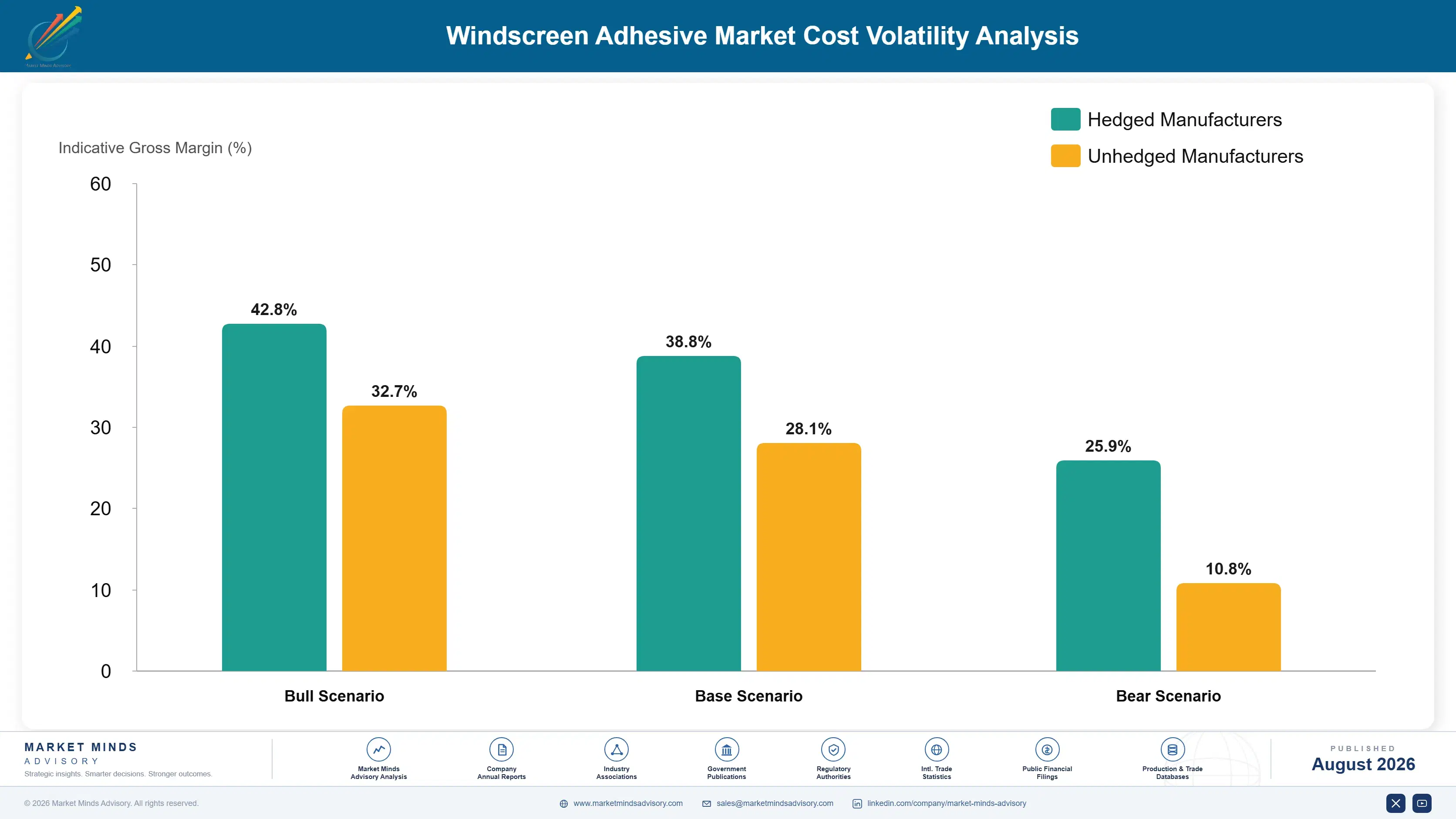
Isocyanate and polyol account for 52% of formulation cost, with carbon black, plasticiser, silane adhesion promoters, packaging and filling carrying the remainder. Isocyanate production is concentrated among a small group of producers and its pricing follows benzene and energy costs rather than any automotive demand signal. Cartridge and foil pack packaging is a larger cost line than most participants expect, particularly on aftermarket product sold in single job quantities.
The last isocyanate disruption transmitted directly into formulated pricing. European energy costs recorded by IEA and feedstock movements recorded by EIA pushed isocyanate to levels that adhesive producer annual reports documented as margin compression, contract renegotiation and in several cases allocation. Original equipment contracts priced annually absorbed the movement while aftermarket product repriced faster, which inverted the usual relationship between the two halves of the business.

Exposure divides by contract structure rather than by scale. Original equipment supply is typically priced on annual agreements with limited adjustment mechanisms, while aftermarket product moves through distribution that reprices within weeks. A producer weighted toward original equipment during a feedstock spike carries the exposure and cannot reopen the contract, which is the opposite of the position most people assume the approved supplier occupies.
windscreen-adhesive-market-cost-volatility-analysis-1787665081391

Index original equipment agreements to isocyanate movement

Isocyanate and polyol are 52% of formulation cost and original equipment contracts are typically priced annually with limited adjustment, which transferred the whole last movement onto suppliers. Aftermarket product repriced within weeks by comparison. Proposing indexation at contract negotiation costs nothing and is effectively impossible to introduce once a platform supply agreement has been signed.

Target new platforms rather than contesting existing specifications

Approval takes around three years and holds for the model life, so contesting an existing specification means asking a manufacturer to fund validation it has no reason to repeat. New platforms and new plants are the only realistic entry points available to anybody. Suppliers spending commercial effort on incumbent platforms are competing for a decision that has already been taken.

Build packaging formats for the accredited network channel

Accredited fitting networks and insurer programmes buy centrally to specification while informal operators buy single cartridges on price, and the two require different formats, quantities and commercial terms entirely. Packaging is a larger cost line in the aftermarket than most suppliers expect. Serving the professionalising channel properly means designing for it rather than repackaging original equipment product.

Portfolio Architecture for Margin Defence

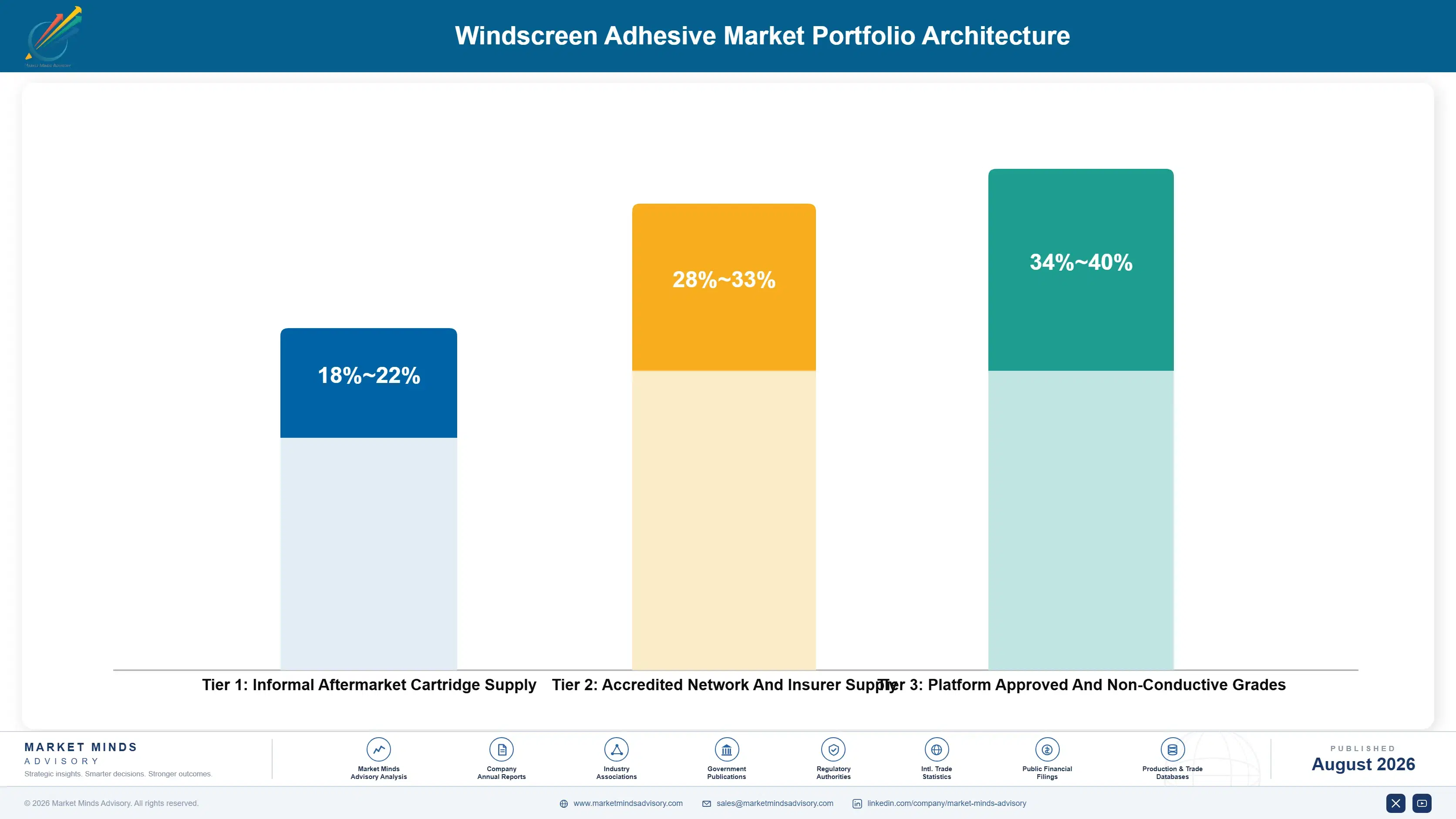
Margin architecture divides on whether an approval governs the purchase. Informal aftermarket product earns least, sold on price per cartridge to fitters whose customers cannot evaluate a bond they will never see. Approved aftermarket supply into accredited networks earns better, because specification rather than price decides the listing. Original equipment platform supply earns best in stability if not in headline margin, since a three year approval holds for a model generation.
The tension runs between annuity and exposure. Platform approvals produce predictable multi-year volume and price on annual agreements that absorb feedstock movement without adjustment. Aftermarket product carries thinner margin, reprices quickly and reaches a channel where the professionalising half is growing while the informal half is not. Holding both is the standard position and neither half protects the other during a feedstock spike.

High value pools concentrate in platform approvals and in accredited network listings, neither of which is a chemistry position. Everything sold on price per cartridge competes against domestic producers in a channel that recalibration requirements are steadily shrinking. The businesses worth building are those where a validation history or a network specification means the buyer cannot substitute without repeating work somebody has already paid for.

Informal Aftermarket Cartridge Supply

Standard cure product sold on price per cartridge into independent workshops and mobile fitters through general distribution. Domestic producers compete effectively here and no approval standard governs the purchase in practice.
Gross Margin: 18-22%

Accredited Network And Insurer Supply

Approved product supplied to accredited fitting networks and insurer programmes that specify centrally and audit compliance. Recalibration requirements have grown this channel at the expense of informal replacement work considerably.
Gross Margin: 28-33%

Platform Approved And Non-Conductive Grades

Original equipment approved chemistries and non-conductive grades formulated for glazing electronics integration. The range is wide because platform contract terms and non-conductive premium positions realise materially different margins. Both positions require sustained technical investment.
Gross Margin: 34-40%
windscreen-adhesive-market-portfolio-architecture-1787665082071

High-value Sub-segments and Strategic Watch-out

Fast Cure Polyurethane Adhesives

Fastest growing system at 8.1% because safe drive-away time decides how many jobs a technician completes daily, and the adhesive is only 6% of job value. Productivity rather than bond performance is what actually sells this chemistry. Line speed matters just as much on assembly.
Gross Margin: 30-35%

Non-Conductive Polyurethane Adhesives

Second fastest at 7.2% as heated screens, antennas and sensor housings spread through mainstream platforms from premium ones. Formulating without carbon black while holding modulus and ultraviolet resistance limits how many suppliers compete credibly. Carmakers rather than adhesive suppliers set the whole adoption schedule here.
Gross Margin: 34-40%

Standard Cure Polyurethane Adhesives

Growing at only 3.2% and carrying the largest volume in the category, which makes it the declining core rather than the growth story. Price per cartridge decides most of this business and domestic producers compete effectively throughout. Recalibration requirements are steadily shrinking that whole channel.
Gross Margin: 18-22%

Primers and Activators

Growing at 4.6% and sold almost entirely as part of a bonding system rather than independently, since substrate preparation determines whether the adhesive performs. Volumes track the adhesive they accompany and carry no separate commercial dynamic. Nothing here moves independently of the adhesive it accompanies.
Gross Margin: 24-28%

How Approvals And Habits Repeat

Original equipment demand attaches to a written specification and stays there. A chemistry approved onto a platform after around three years of validation is consumed for the model life, at volumes set by build rates the supplier does not influence. That makes each approval an annuity and makes the original equipment half of this market almost immobile between platform generations, which is comfortable for incumbents and difficult otherwise.
Aftermarket demand attaches to habit in the informal channel and to specification in the accredited one. A mobile fitter uses what the van is stocked with and switches when a distributor offers a better price, while an accredited network applies a product list its workshops cannot deviate from. Those are entirely different buying behaviours, and recalibration requirements are steadily moving volume from the first into the second.

The purchaser is professionalising rather than changing hands. Around 72% of replacements now require recalibration equipment and training, which excludes operators who cannot invest and consolidates work into networks with procurement functions. The adhesive supplier that used to sell cartridges to a workshop now sells a specification to a network buyer who audits compliance, which is a slower sale into a more durable relationship.
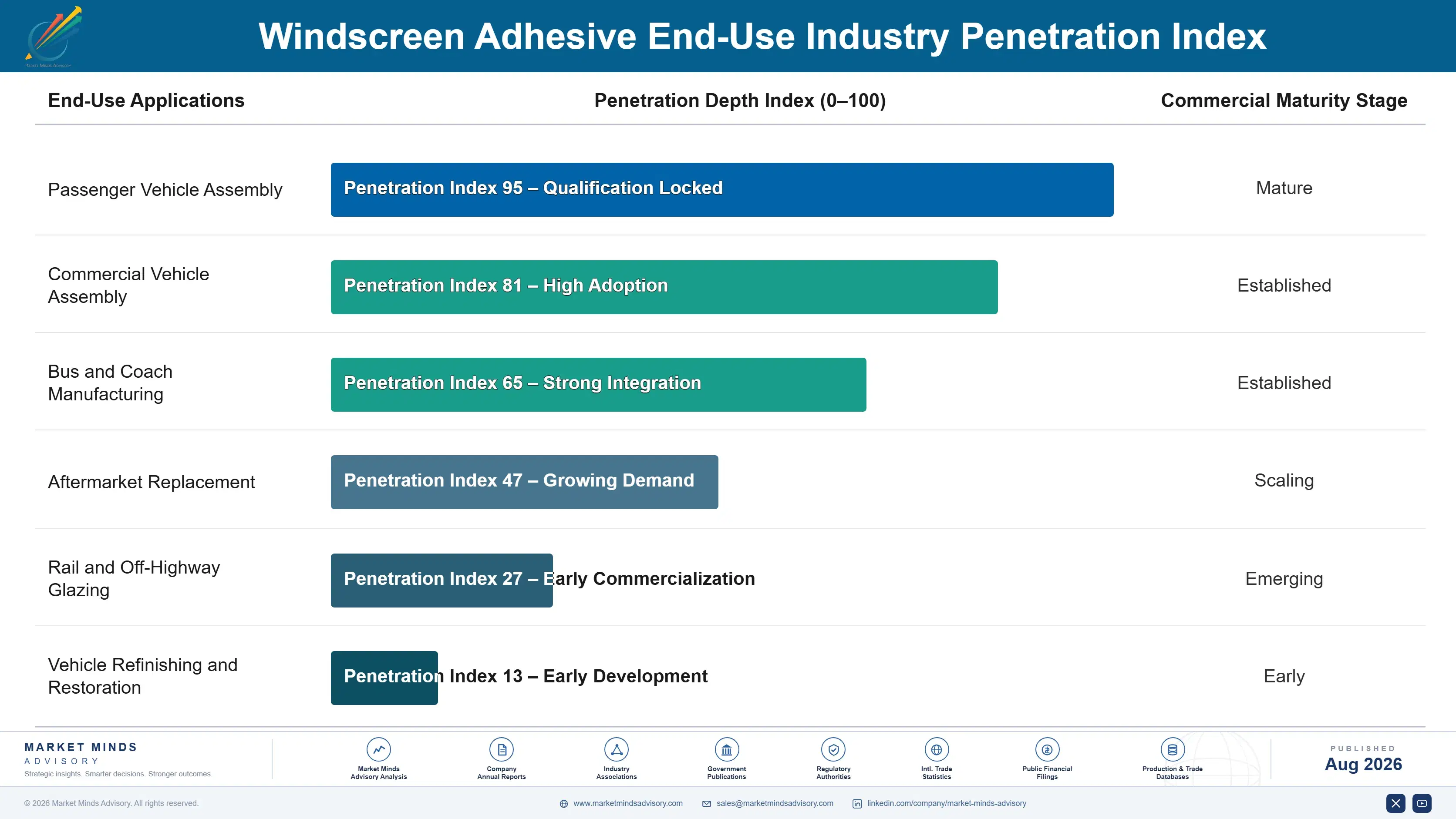
windscreen-adhesive-market-end-use-penetration-index-1787665082720

Where This Category Rewards Focus

These are among the four positions where our research anticipates prominent divergence between winners and laggards over the coming forecast period. Each is grounded in the demand model, the regulatory perimeter, and the announced capacity pipeline.
01 / PLATFORM APPROVAL CAPTURE

Three years of testing buys a model generation

Original equipment approval takes around three years of validation across adhesion, durability, crash performance and line process compatibility, and once written into a platform the chemistry stays for the whole model life. That makes each approval an annuity rather than a contract subject to annual renegotiation, and makes original equipment share almost immobile between platform generations. New entrants can realistically target only new platforms and new plants, since changing a specification mid-life means repeating validation nobody will fund without a reason.
02 / DRIVE-AWAY TIME ECONOMICS

Sell jobs per day, not price per cartridge

A replacement job ends when the vehicle can safely be driven rather than when the screen is fitted, and cutting that wait from three hours to one changes how many jobs a technician completes in a working day. The bonding system is roughly 6% of what the job is worth, so a productivity gain of that scale dwarfs any price difference between competing chemistries. Suppliers presenting daily job counts reach the workshop owner counting revenue instead of the fitter comparing invoices.
03 / ACCREDITED NETWORK ACCESS

Recalibration turned fitters into procurement functions

Around 72% of replacements now require camera or sensor recalibration afterwards, demanding equipment, training and controlled conditions that informal operators simply cannot provide at any scale. Work has moved toward accredited fitting networks and insurer approved programmes that specify centrally and audit compliance rather than comparing cartridge prices at a trade counter. Suppliers who built those relationships early hold positions considerably harder to contest on price, and that channel keeps growing at the informal channel's expense with every passing year.
04 / GLAZING ELECTRONICS READINESS

Carbon black is becoming a design problem

Heated screens, in-glass antennas, rain sensors and camera housings all place electrical function in or against the bonded area, and conventional carbon black filled urethanes conduct enough to interfere with them. Non-conductive grades grow at 7.2%, spreading from premium platforms downward on a schedule that carmakers rather than adhesive suppliers control entirely. Formulating without carbon black while holding ultraviolet resistance and modulus is genuinely harder, which limits credible suppliers and keeps price competition out of that conversation almost entirely today.

Engagement Snapshot From the Field

A live engagement with an industry participant carrying material or product regulatory and market exposure ahead of a defining policy shift, showing how our research translates into a defensible multi-year portfolio strategy.
MARKET MINDS ADVISORY · CLIENT ENGAGEMENT SUMMARY
Windscreen Adhesive Producer Strategic Portfolio Review and Transition Roadmap 2026·Investment Scenario on Windscreen Adhesive Exposure Evaluation 2025-26
CLIENT PROFILE
An automotive adhesive producer supplying glazing adhesives to vehicle assembly plants and aftermarket distribution across Western Europe and North America. Annual revenue was approximately 260 million dollars (client-reported, unverified by MMA), split roughly two thirds original equipment and one third aftermarket. All original equipment contracts were priced annually without any feedstock adjustment mechanism of any kind.
STRATEGIC CHALLENGE
The last isocyanate movement had been absorbed almost entirely into original equipment margin while aftermarket product repriced within weeks, inverting the relationship management had assumed. Separately, aftermarket volume was drifting toward accredited networks the client served through general distribution rather than directly. Nobody had assessed what the informal channel would look like in five years.
MMA APPROACH
MMA reconstructed margin by contract type through the feedstock movement and modelled indexation scenarios against platform contract terms. Aftermarket channel migration was projected against recalibration requirement spread by vehicle age. Forty-seven expert interviews with platform engineers, network procurement leads, insurers and independent fitters established how purchasing actually works, alongside survey work across six countries.
KEY FINDINGS
  1. Original equipment contracts absorbed roughly 85% of the feedstock movement while representing two thirds of volume, which inverted management's assumption about where exposure sat.
  2. Accredited network share of replacement volume was projected to reach about 4 in 5 jobs within five years, from a little over half at the time of the review.
  3. The client reached only 2 of the 9 major accredited networks directly, serving the rest through distribution that captured margin and controlled the specification relationship.
  4. Fast cure product carried around 3 times the gross margin per litre of standard cure in aftermarket channels, and represented a small share of the client's aftermarket mix.
CLIENT PROFILE
An automotive adhesive producer supplying glazing adhesives to vehicle assembly plants and aftermarket distribution across Western Europe and North America. Annual revenue was approximately 260 million dollars (client-reported, unverified by MMA), split roughly two thirds original equipment and one third aftermarket. All original equipment contracts were priced annually without any feedstock adjustment mechanism of any kind.
STRATEGIC CHALLENGE
The last isocyanate movement had been absorbed almost entirely into original equipment margin while aftermarket product repriced within weeks, inverting the relationship management had assumed. Separately, aftermarket volume was drifting toward accredited networks the client served through general distribution rather than directly. Nobody had assessed what the informal channel would look like in five years.
MMA APPROACH
MMA reconstructed margin by contract type through the feedstock movement and modelled indexation scenarios against platform contract terms. Aftermarket channel migration was projected against recalibration requirement spread by vehicle age. Forty-seven expert interviews with platform engineers, network procurement leads, insurers and independent fitters established how purchasing actually works, alongside survey work across six countries.
KEY FINDINGS
  1. Original equipment contracts absorbed roughly 85% of the feedstock movement while representing two thirds of volume, which inverted management's assumption about where exposure sat.
  2. Accredited network share of replacement volume was projected to reach about 4 in 5 jobs within five years, from a little over half at the time of the review.
  3. The client reached only 2 of the 9 major accredited networks directly, serving the rest through distribution that captured margin and controlled the specification relationship.
  4. Fast cure product carried around 3 times the gross margin per litre of standard cure in aftermarket channels, and represented a small share of the client's aftermarket mix.
RECOMMENDED STRATEGY
Phase 1: Phase one: propose feedstock indexation at every platform contract renewal, since original equipment absorbed roughly 85% of the last movement. Phase 2: Phase two: build direct relationships with accredited networks, currently 2 of 9 served directly while the channel heads toward 4 in 5 jobs. Phase 3: Phase three: shift aftermarket mix toward fast cure, carrying about 3 times the gross margin per litre of standard cure.
OUTCOME
Indexation was accepted at two platform renewals where the client had assumed refusal, and margin held through the following feedstock movement. Direct network relationships were established with three further accredited groups, and fast cure share of aftermarket volume rose materially as workshops responded to the daily job count argument (client-reported, unverified by MMA).

Frequently Asked Questions

Foundational context covering the market sizes, CAGR, scope, country, region and competition that inform every finding below. This section is provided to cover basics and most often pre-purchase conversations, answered from the MMA Primary Research Dataset.

What is the current size of the Windscreen Adhesive Market?

The market was valued at 2.8 billion dollars in 2025, covering adhesive systems used to bond automotive glazing in assembly and replacement worldwide. It reaches an estimated 2.95 billion dollars during 2026.

How large will the Windscreen Adhesive Market be by 2036?

MMA forecasts 4.99 billion dollars by 2036, an increase of 2.04 billion dollars over the 2026 base. That represents an expansion multiple of 1.69 times across the forecast period.

What is the CAGR for the Windscreen Adhesive Market 2026 to 2036?

The base case compound annual growth rate is 5.4%, with a bull case of 6.6% and a bear case of 4.2%. Glazing area per vehicle and production volumes separate those two scenarios.

Which segment is growing fastest?

Fast cure polyurethane adhesives grow at 8.1%, half again the market rate of 5.4%, because drive-away time decides fitter productivity. Non-conductive grades follow at 7.2%.

Who are the major companies in the Windscreen Adhesive Market?

Sika, Henkel, Dow, HB Fuller and Arkema lead on production capacity across original equipment and aftermarket supply. Together they account for 68% of the global market.

Which country is growing fastest?

India grows fastest at 8.8%, because vehicle assembly and the vehicle parc have expanded together, so original equipment and replacement demand are growing at the same time.

Report Segmentation Architecture

The full report scope spans multiple orthogonal segmentation dimensions, with cross-tabulated demand data provided for each dimension pair. Coverage extends further to regional breakdowns, trend trajectories, and the competitive detail needed to support segment-level decision-making.

By Adhesive System

  • Standard Cure Polyurethane Adhesives
  • Fast Cure Polyurethane Adhesives
  • Non-Conductive Polyurethane Adhesives
  • Silane Modified Polymer Adhesives
  • High Modulus Bonding Adhesives
  • Primers and Activators

By End-Use Industry

  • Passenger Vehicle Assembly
  • Commercial Vehicle Assembly
  • Bus and Coach Manufacturing
  • Aftermarket Replacement
  • Rail and Off-Highway Glazing
  • Vehicle Refinishing and Restoration

By Commercial Dimension

  • Original Equipment Direct Supply
  • Aftermarket Distributor Supply
  • Accredited Fitting Network Contract
  • Insurance Approved Supply Programmes
  • Private Label Manufacturing
  • Export and Trading

By Region

  • North America
  • Western Europe
  • East Asia
  • South Asia and Pacific
  • Latin America
  • Middle East and Africa
  • Eastern Europe

Scope, Methodology, and Coverage

Every figure in this report is reproducible from documented input assumptions. The scope below maps the historical period, the forecast horizon, the segmentation dimensions, and the countries covered, alongside the underlying primary and qualitative methodology.
Historical Period
2020 to 2025
Forecast Period
2026 to 2036
Base Year
2025 (USD billions; MMA Primary Research Dataset, August 2026)
Market Definition
Adhesive systems used to bond automotive glazing into vehicle bodies worldwide, covering standard cure and fast cure polyurethane adhesives, non-conductive polyurethane grades, silane modified polymer adhesives, high modulus bonding adhesives, and the primers, activators and surface preparation products supplied as part of the bonding system, across original equipment assembly and aftermarket replacement, measured at manufacturer selling value. Automotive glass itself, laminate interlayers, body assembly and panel bonding adhesives, non-glazing sealants and calibration equipment are excluded from scope.
Quantitative Units
USD billions (manufacturer selling value); litres and cartridges; USD per litre by system
Segmentation Dimensions
Adhesive system; end-use industry; commercial dimension; region
Regions Covered
North America, Western Europe, East Asia, South Asia and Pacific, Latin America, Middle East and Africa, Eastern Europe
Countries Covered
United States, Canada, Mexico, Germany, France, United Kingdom, Italy, Spain, Sweden, China, Japan, South Korea, Taiwan, India, Thailand, Indonesia, Australia, Brazil, Argentina, Saudi Arabia, South Africa, Poland
Key Companies Profiled
Sika, Henkel, Dow, H.B. Fuller, Arkema, 3M, Wacker Chemie, ThreeBond, Yokohama Rubber, Sunstar Engineering, Zhengzhou Zhongyuan Applied Technology, Guangzhou Baiyun Chemical, Chengdu Guibao Science and Technology, Illinois Tool Works, Soudal, Kommerling Chemische Fabrik, DELO Industrial Adhesives, KCC Corporation, Nitto Denko, Momentive Performance Materials
Quantitative Methodology
Primary survey, n=3,800 respondents, Q4 2025, six countries; demand-side model with trade association cross-validation
Qualitative Methodology
47 expert interviews, Q4 2025; applied to validate demand model assumptions, identify emerging dynamics, and assess competitive positioning
Report Format
PDF and XLSX data workbook (Word format preview document)
Publisher
Market Minds Advisory
Report Code
MMA-2026-AUT-104
Published
August 2026
Contact
sales@marketmindsadvisory.com | www.marketmindsadvisory.com

Purchase the full Windscreen Adhesive Market Report (2026 to 2036).

The full report treats windscreen adhesive as a load bearing vehicle component sold through two channels with completely different purchasing logic, and follows what driver assistance is doing to the weaker of them. It sizes all six adhesive systems independently through 2036, models platform approval cycles against original equipment share mobility, and quantifies how recalibration requirements are moving replacement work toward accredited networks. Regional chapters cover all seven regions, with East Asian assembly volume assessed separately from Western replacement demand. Competitive profiling covers 20 participants on one consistent capacity measure.
Six adhesive systems sized independently through 2036
Platform approval cycles modelled against original equipment share mobility
Recalibration requirements tracked against accredited network channel growth
Safe drive-away time quantified against fitter daily job counts
Feedstock exposure assessed by contract structure and channel
Twenty participants profiled on one consistent capacity measure

Built For The People Who Decide

From boardroom strategy to bench-side execution, this report is read cover-to-cover by leaders shaping the next decade of their industry, turning demand scenarios, market dynamics and valuation benchmarks into decisions.
CXOs/ Presidents/ VPs/ Managers
M&A and Corporate Development
Strategy Teams and R&D Heads
Procurement and Product Directors
Regulatory and Compliance Leaders
Investor Relations and Equity Analysts