
Market Minds Advisory
Wearable Pregnancy Devices Market

Wearable Pregnancy Devices Market: Wearable Pregnancy Devices: Built For Reassurance, Where The Risk Was Never Fetal

The category was built to let parents hear a heartbeat, while the deaths that actually happen are maternal, cardiovascular and concentrated in the weeks after everybody has already gone home again.

Lead Analyst

Published

September 2026

Make Smarter Decisions with Customized Research Insights

Request a free sample report and evaluate market opportunities, growth trends, and competitive dynamics relevant to your business needs.

2025 MARKET VALUE$0.4BMarket Size 2025
2036 FORECAST VALUE$1.7BBase Case , 2026 to 2036
CAGR 2026 TO 203614.6 %Bull 15.8% / Bear 13.2%
INCREMENTAL OPPORTUNITY$1.3BNet 10- year value creation
EXPANSION MULTIPLE3.91x2036 value over 2026 base
Strategic Levers
M&A Pipeline
Regional Outlook
Country Rankings
Competitive Intelligence
Segmental Deep-dive
Call-Us : 91 93563 13602

Executive Snapshot and Market Trajectory.

This category was designed around a sound. Consumer wearables that let parents hear a fetal heartbeat sell reassurance to low risk pregnancies, carry no reimbursement pathway and retain only about 34% of users to delivery week. The clinical opportunity was never in that product at all. Nobody built for risk.
Maternal deaths in high income settings are mostly cardiovascular rather than obstetric, driven by hypertensive disorders and cardiomyopathy, and roughly 65% occur after discharge from the delivery admission. Standard care answers that with a single scheduled review at six weeks. Maternal cardiovascular monitoring grows fastest at 21.9%, half again the market rate, and postpartum devices follow at 20.4%. Timing rather than technology explains all of that.
Regulatory classification divides the field commercially. Only about 22% of category volume carries device clearance rather than wellness labelling, and the two halves face entirely different evidence, liability and payment conditions. Around 18% of payers reimburse remote hypertensive monitoring after discharge, which is the only meaningful payment route in the category. Competition is fragmented at 29% for the top five. Payment rather than evidence is what actually limits this category now.
Market Definition
Body worn devices used during pregnancy and the postpartum period for physiological monitoring, covering fetal heart rate and movement monitors, uterine activity monitors, maternal cardiovascular monitoring, pregnancy specific sleep and activity tracking, postpartum monitoring devices and integrated multi-parameter platforms. Measured at supplier revenue. Hospital cardiotocography equipment, handheld dopplers, ultrasound systems, fertility and ovulation tracking, and breast pumps are excluded from scope.
Base Year Value
$0.4B in 2025 (MMA Primary Research Dataset, August 2026)
Forecast Period
2026 to 2036, eleven discrete annual values
CAGR
14.6% base case. Bull 15.8%. Bear 13.2%.
Fastest Growth Segment
Maternal Cardiovascular Monitoring: 21.9% CAGR
Fastest Growth Country
India: 19.4% CAGR
Fastest Growth Region
South Asia and Pacific: 16.8% CAGR
Largest Region
North America: 31% of 2025 global value
Market Leaders
Philips, Nuvo Group, Bloomlife, Owlet Baby Care, Baymatob. Source: MMA Primary Research Dataset, July 2026.
Primary Survey
n=3,800 procurement and R&D decision-makers, Q4 2025, six countries
Methodology
Demand-side build-up, cross-validated against public data, 47 expert interviews

Wearable Pregnancy Devices Market Forecast Scenarios

wearable-pregnancy-devices-market-size-forecast-scenario-1787664881877
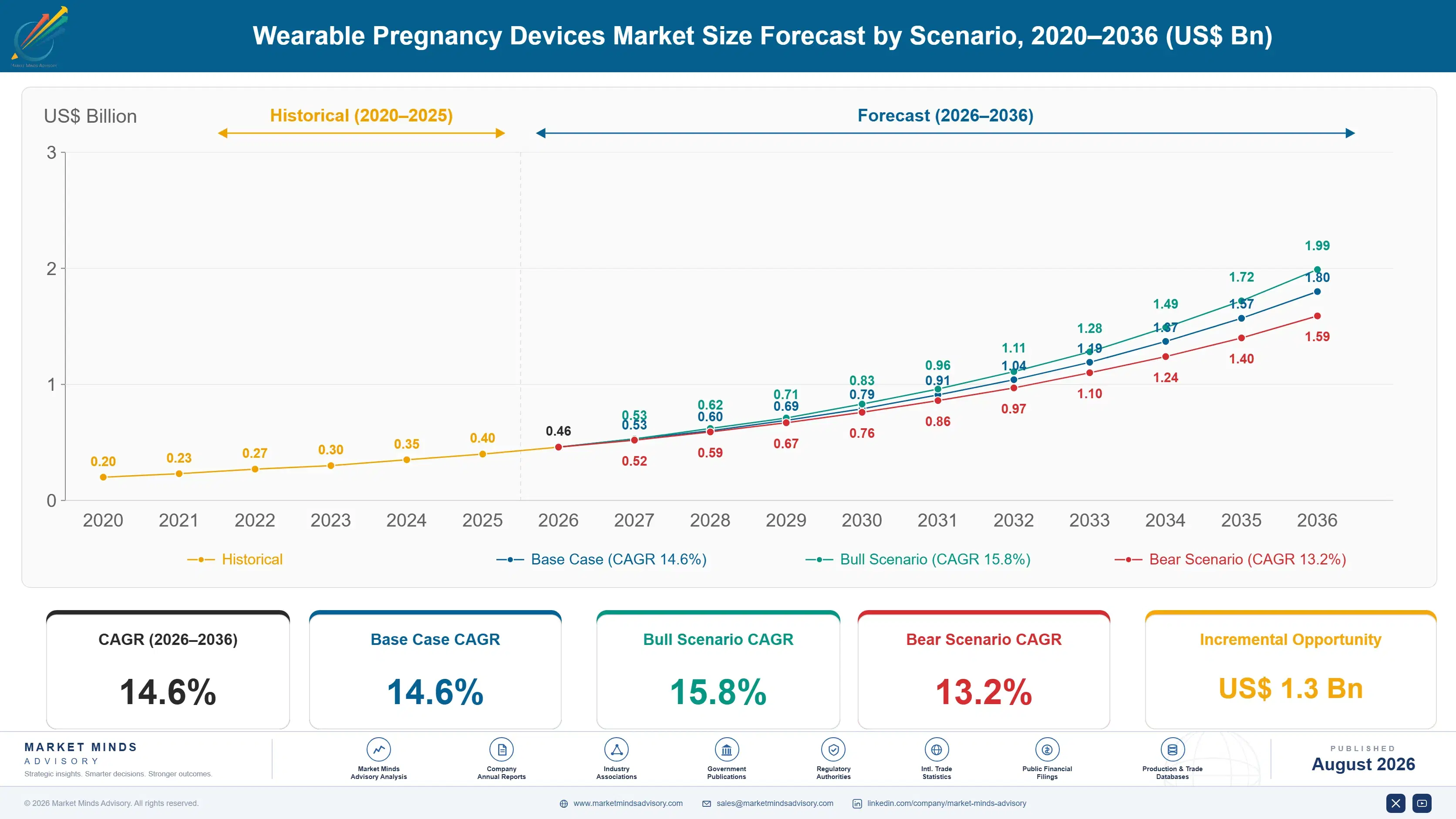
The five years to 2025 were consumer led and clinically thin. Direct to consumer fetal monitoring wearables raised substantial capital, achieved wide awareness and struggled with retention, evidence and in several cases with regulators who took a different view of what the products were claiming. The 13.0% historical rate reflects consumer volume expansion rather than any clinical adoption, and a portion of it has proved unrepeatable.
The 14.6% base case rests on three mechanisms. Maternal cardiovascular monitoring grows at 21.9% as attention moves from fetal reassurance to the hypertensive and cardiac risks that account for most maternal deaths in high income settings. Postpartum monitoring grows at 20.4% covering the gap between discharge and a single six week review. And remote monitoring reimbursement expands slowly from the roughly 18% of payers currently covering it. Coverage expands slowly.
The 15.8% bull case turns on a national obstetric guideline recommending home blood pressure monitoring after hypertensive pregnancy, which would convert a payer option into a standard of care obligation. The 13.2% bear case is enforcement: only about 22% of volume carries device clearance, and regulatory action against wellness labelled products making clinical claims would remove a substantial part of the consumer base quickly.

Listening To The Wrong Heartbeat

The commercial premise the category was built on is emotional rather than clinical. A wearable that lets expectant parents hear a heartbeat at home addresses anxiety, which is real and widespread, and it addresses it in a low risk population where nothing much was going to happen anyway. Retention tells the story plainly: only around 34% of consumer device users are still wearing it by delivery week.
TOP FIVE CONCENTRATION29%Combined installed base held by the leading suppliers
POSTPARTUM DEATH SHARE65%Maternal deaths occurring after discharge from delivery admission
STANDARD POSTPARTUM CONTACT1 visitScheduled clinical review between discharge and six weeks
REMOTE MONITORING REIMBURSEMENT18%Payers covering hypertensive disorder monitoring after hospital discharge
CONSUMER DEVICE RETENTION34%Users still wearing the device at delivery week
CLEARED DEVICE SHARE22%Category volume carrying regulatory clearance rather than wellness labelling
The clinical picture points somewhere else entirely. Maternal deaths in high income settings are predominantly cardiovascular, driven by hypertensive disorders and peripartum cardiomyopathy, and roughly 65% of them occur after discharge from the delivery admission rather than during it. Standard care answers that period with one scheduled review at six weeks, which is a long time to leave the highest risk window unobserved.
There is also a safety argument the category discusses reluctantly. Home fetal monitoring in a low risk pregnancy can produce false reassurance that delays presentation when fetal movements reduce, which is exactly the situation where prompt attention matters most. That concern is what regulators have focused on, and it is why device clearance rather than wellness labelling now covers only about 22% of volume by choice.
"An entire industry grew up around letting people listen to a heartbeat that was almost always going to be fine. The blood pressure reading that would have mattered was never taken, because nobody sold a device for it."
Director, Maternal Health and Connected Devices Practice · MMA Medical Devices and Digital Health Practice · August 2026

Market Trends

Attention Shifts From Fetal Reassurance To Maternal Risk

Maternal deaths across high income settings are predominantly cardiovascular rather than obstetric, driven by hypertensive disorders of pregnancy and peripartum cardiomyopathy, and neither is detected by listening to a fetal heartbeat at home. Blood pressure is the signal that matters and it is trivially measurable with technology that already exists at consumer price points. Maternal cardiovascular monitoring grows at 21.9% against a market rate of 14.6%, the fastest segment in the category. Clinical guidelines and payer coverage are both moving in the same direction, which consumer fetal monitoring never achieved.
Market Impact: Covers the 65% postpartum death share
Regulatory Classification Splits The Category Into Two Businesses

Only around 22% of category volume carries device clearance, with the remainder sold under wellness labelling that permits no clinical claim of any kind. Those two halves face entirely different evidence requirements, liability exposure, distribution routes and payment conditions, and the boundary between them is where enforcement action has repeatedly landed. Cleared products reach clinicians, payers and health systems, while wellness products reach consumers directly and cannot be prescribed. Companies attempting to straddle the line have generally discovered that regulators read marketing copy considerably more carefully than investors do. The line is not blurry.
Market Impact: India grows at 19.4% annually

Market Opportunities and Growth Drivers

Postpartum Coverage Gap Creates Genuine Clinical Demand

Roughly 65% of maternal deaths in high income settings occur after discharge from the delivery admission, and standard care offers a single scheduled review at six weeks to cover that entire window. Nobody designed that pathway around where the risk actually sits; it accumulated historically. Postpartum monitoring devices grow at 20.4%, second fastest in the category, because the clinical case writes itself once the timing is laid out. Health systems adopting remote blood pressure follow up after hypertensive pregnancy report readmission reductions that fund the programme directly. Savings pay for the monitoring.
Market Impact: Affects the 78% without clearance

Indian Private Obstetric Care Adopts Remote Monitoring Quickly

India records more births than any other country and its private obstetric sector serves an urban population increasingly willing to pay for monitoring that public services do not provide. Growth runs at 19.4%, faster than any market covered. Smartphone penetration and established digital payment infrastructure remove the friction that slowed adoption in other emerging markets considerably. Domestic device developers price well below imported systems while international suppliers hold premium positions in corporate hospital chains. Maternal mortality remains high enough that the clinical argument requires no elaboration at all. Volume is not the constraint.
Market Impact: Only 18% of payers reimburse

Market Restraints and Challenges

False Reassurance Creates Liability Consumer Products Cannot Carry

Home fetal monitoring in a low risk pregnancy can delay presentation when fetal movements reduce, because a detected heartbeat feels like an answer when reduced movement is the signal that actually requires attention. The root cause is that the measurement consumers can take is not the measurement that matters clinically. Commercially this caps what a wellness labelled product can claim and creates liability exposure investors frequently underestimate. Participants are responding with explicit guidance against reassurance use and by moving toward maternal parameters instead, which is a considerably safer position. That shift is overdue.
Market Impact: Fastest segment growing at 21.9%

Reimbursement Reaches Fewer Than One Payer In Five

Around 18% of payers reimburse remote monitoring for hypertensive disorders after discharge, which leaves most clinically valuable use unfunded and pushes it toward consumer purchase or health system absorption. The root cause is that payers reimburse episodes of care rather than continuous monitoring, and postpartum sits awkwardly between obstetric and general medical coverage in most systems. Commercially this limits the addressable clinical market severely. Suppliers are funding readmission cost studies and pursuing guideline recognition, which has moved coverage in a handful of jurisdictions. Coverage moves slowly and jurisdiction by jurisdiction.
Market Impact: Only 22% of volume holds clearance
3 additional market trends, 4 additional growth drivers, and 2 additional restraints and challenges are covered in the full report. Contact sales@marketmindsadvisory.com to access the complete intelligence.

Segment CAGR and Growth Architecture

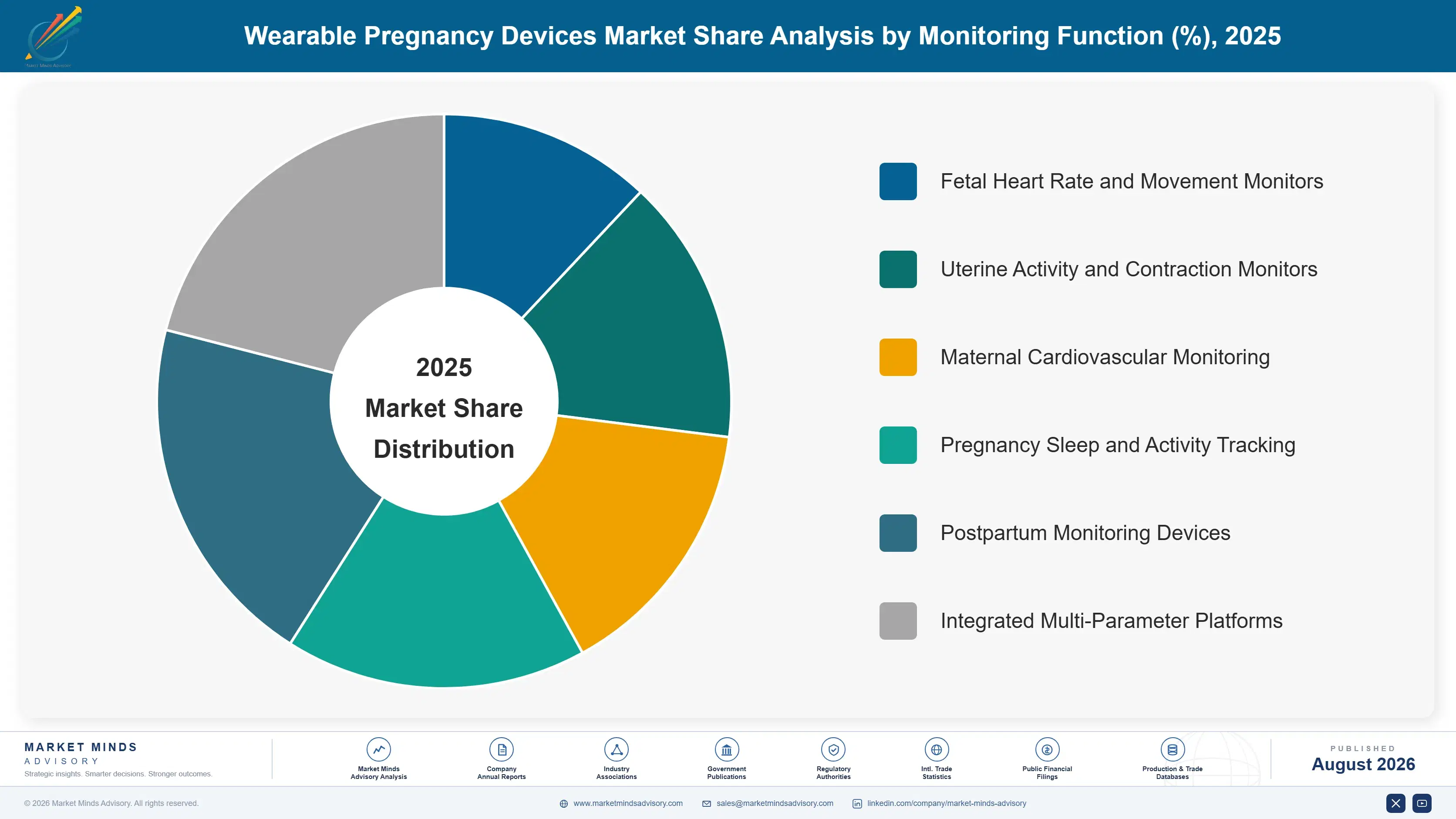
Segmentation follows monitoring function, since what is measured determines regulatory classification, evidence requirement, who prescribes or buys it and whether any payer will fund it. Six functions cover the category across pregnancy and the postpartum period. Growth tracks where clinical risk actually concentrates rather than where consumer anxiety does. Anxiety and risk are different maps.
wearable-pregnancy-devices-market-market-share-analysis-1787664882408

Maternal Cardiovascular Monitoring

Blood pressure, heart rate and rhythm monitoring worn by the pregnant or recently delivered person, addressing hypertensive disorders of pregnancy and peripartum cardiomyopathy. At 21.9% this is the fastest growing function, half again the market rate of 14.6%, and the reason is that maternal deaths in high income settings are predominantly cardiovascular rather than obstetric. None of that risk is detectable by listening to a fetal heartbeat at home. Blood pressure is measurable with technology already available at consumer prices, carries established clinical thresholds, and is the only parameter in this category with meaningful payer coverage anywhere. Guidelines and payer coverage both point the same way, which fetal reassurance never achieved.
CAGR 21.9%

Postpartum Monitoring Devices

Devices worn after discharge covering blood pressure, cardiac rhythm, temperature and haemorrhage related parameters through the weeks when risk is highest and clinical contact is lowest. Growth of 20.4% is second fastest in the category, driven by timing rather than technology. Roughly 65% of maternal deaths occur after discharge and standard care offers a single review at six weeks to cover that entire window. Health systems running remote follow up after hypertensive pregnancy report readmission reductions that fund the programme, which is why this segment reaches health system procurement where consumer products never did. Institutional procurement rather than consumer purchase is what makes the economics work properly in this segment.
CAGR 20.4%
Full segment breakdown across 6 segments available in the complete report.

Regional Architecture and Country Demand Map

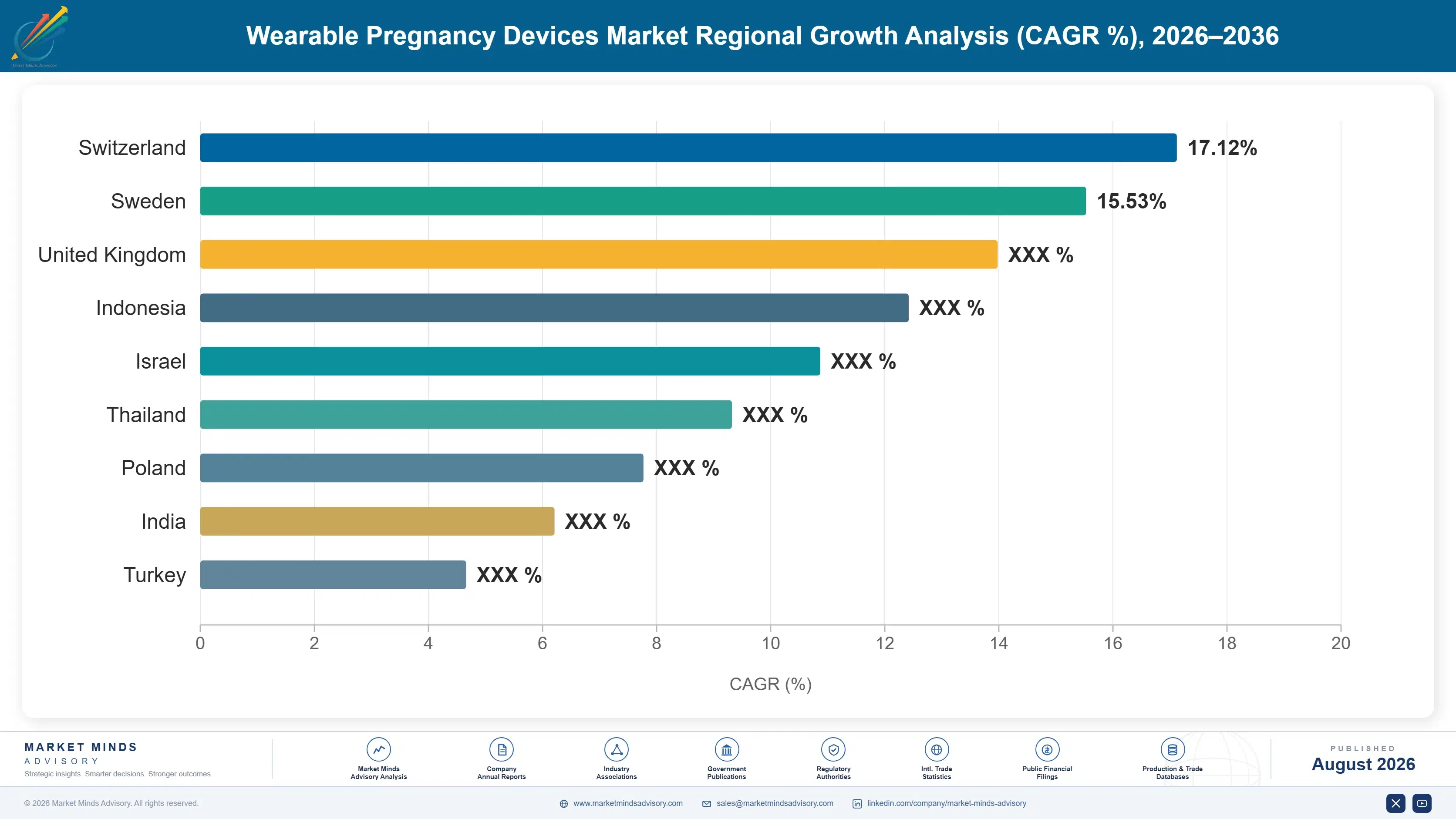
North America holds 31%, on maternal mortality several times other high income countries and the only meaningful remote monitoring reimbursement anywhere. East Asia follows at 24% and Western Europe at 22%. India grows fastest at 19.4%. Reimbursement availability rather than adoption speed explains that ranking entirely.

North America

Two things carry this 31% share and neither is enthusiasm for technology. American maternal mortality runs several times that of comparable high income countries, with cardiovascular causes and postpartum timing dominating, which makes the clinical case unavoidable rather than aspirational. Remote patient monitoring reimbursement codes also exist here in a way they do not elsewhere, giving the category its only established payment route. Consumer purchasing is substantial and concentrated in the same demographic that already buys wearables. Growth of 13.6% reflects a large existing base rather than the fastest adoption anywhere. Payment infrastructure rather than clinical enthusiasm is what makes this the largest market in the category. Nowhere else has both conditions.
Share: 31% | CAGR: 13.6% (2026 to 2036)

Western Europe

National health systems shape this 22% share, with adoption running through obstetric services rather than through consumer purchase, which produces slower decisions and far wider deployment once made. British, Dutch and Nordic maternity services have run remote blood pressure follow up programmes after hypertensive pregnancy with published outcomes. Regulatory classification is enforced more consistently here than in consumer led markets, which suppresses the wellness labelled segment considerably. Data protection requirements around continuous physiological monitoring add compliance cost. Growth of 13.0% is the lowest of the seven regions and reflects procurement timelines rather than clinical hesitation. System wide deployment rather than individual purchase is how adoption happens across this region entirely.
Share: 22% | CAGR: 13.0% (2026 to 2036)
Regional intelligence for 5 additional markets available in the complete report: East Asia, South Asia and Pacific, Latin America, Middle East and Africa, Eastern Europe. Contact sales@marketmindsadvisory.com.
wearable-pregnancy-devices-market-country-cagr-analysis-1787664882935

Where This Category Actually Earns

Nothing here is won on sensor quality, because the measurements involved are well established and cheap to take. Value accrues to whoever monitors the parameter that carries the risk, whoever covers the window nobody watches, whoever chooses regulatory classification deliberately, and whoever reaches the payers that fund it. Four routes carry weight. Sensing is not the variable.

Monitor The Mother Not Just The Fetus

Maternal deaths in high income settings are predominantly cardiovascular, driven by hypertensive disorders and peripartum cardiomyopathy, and none of that risk is detectable by listening to a fetal heartbeat at home. Blood pressure is measurable with technology already at consumer price points, carries established clinical thresholds and is the only parameter with meaningful payer coverage anywhere. Maternal cardiovascular monitoring grows at 21.9% against a market rate of 14.6% as a direct result. The measurement consumers wanted and the measurement that matters were never the same one. That distinction is the whole thesis.
Market Impact: Captures the fastest segment growing at 21.9% annually

Cover The Gap Between Discharge And Six Weeks

Roughly 65% of maternal deaths occur after discharge from the delivery admission, and standard care answers that entire window with one scheduled review at six weeks. That pathway accumulated historically rather than being designed around where risk sits. Postpartum monitoring grows at 20.4% because the clinical case needs no argument once the timing is stated. Health systems running remote blood pressure follow up after hypertensive pregnancy report readmission reductions that fund the programme, which is what moves a device from consumer purchase into institutional procurement. Savings rather than budgets fund these programmes.
Market Impact: Addresses the 65% of maternal deaths after discharge

Choose Clearance Over Wellness Labelling Early

Only around 22% of category volume carries device clearance, and the two halves of this market face entirely different evidence, liability, distribution and payment conditions. Cleared products reach clinicians, payers and health systems; wellness products reach consumers and can never be prescribed by anybody. Companies straddling the boundary have discovered that regulators read marketing copy far more carefully than investors do, and enforcement has already ended products. Choosing the clinical route costs time and money upfront and is the only path to institutional revenue. It is also the only route to reimbursement.
Market Impact: Joins the 22% of category volume holding clearance

Follow Remote Monitoring Reimbursement Where It Exists

Around 18% of payers reimburse remote monitoring for hypertensive disorders after discharge, which is a small share and the only established payment route this category has anywhere. North American reimbursement codes are the reason that region holds 31% of the market despite not being the fastest growing. Suppliers funding readmission cost studies and pursuing guideline recognition are working on the constraint that actually limits the clinical market. Everything else competes for consumer discretionary spending against a retention rate of about 34%. Coverage rather than product capability is what limits this market today.
Market Impact: Reaches the 18% of payers currently reimbursing monitoring

Who Controls the Margin Pool

Concentration is very low in a market that has not settled. The top five hold 29% of installed base and associated subscription revenue, the basis applied consistently throughout this section, across a field mixing consumer wearable brands, venture funded clinical specialists and established medical device manufacturers extending obstetric ranges. Philips leads on clinical footprint and hospital relationships, and the gap reflects regulatory and institutional access rather than sensing capability.
Competition runs on three fronts. Clinical specialists compete for guideline recognition and payer coverage, which is slow, expensive and produces the only defensible position available here. Consumer brands compete on distribution and brand awareness for discretionary spending. And general wearable manufacturers compete by adding pregnancy features to platforms already on millions of wrists, which is a genuine threat to dedicated consumer devices.

Rankings will move with clinical evidence and payer coverage rather than with product launches, since a guideline recommending postpartum home blood pressure monitoring would separate cleared suppliers from wellness labelled ones permanently. The other pressure point is general purpose wearables, which can add maternal parameters at effectively no incremental hardware cost and reach consumers who already own the device.
wearable-pregnancy-devices-market-company-positioning-matrix-1787664883458

Competitive Moat and Risk Dimensions

PHILIPS

Moat: Hospital Obstetric Relationships

Established presence across hospital obstetric departments through existing monitoring equipment gives direct access to the clinicians and procurement teams that decide institutional adoption, which a consumer brand cannot assemble at any speed. Regulatory experience across multiple jurisdictions shortens clearance timelines considerably compared with companies approaching it for the first time.
PHILIPS

Risk: Consumer Channel Weakness

Strength sits in institutional channels while a substantial share of current category volume moves through direct consumer purchase, where brand positioning and marketing economics differ entirely from hospital sales. Building that capability competes internally against considerably larger imaging and monitoring businesses with clearer near term returns.
NUVO GROUP

Moat: Cleared Remote Monitoring Platform

Regulatory clearance for remote fetal and maternal monitoring places the product in the roughly 22% of category volume that can be prescribed, reimbursed and deployed by health systems. That classification took years and substantial evidence work, and it is the boundary consumer competitors cannot cross without repeating the same investment entirely.
NUVO GROUP

Risk: Reimbursement Coverage Dependency

Commercial progress depends on payer coverage that currently reaches around 18% of payers for remote monitoring after hypertensive pregnancy, which places the business on a timeline set by coverage decisions rather than by product development. Sustaining evidence generation until coverage broadens requires funding that market conditions do not always supply.

Players Tracked

Prominent Players

Philips
Nuvo Group
Bloomlife
Owlet Baby Care
Baymatob

Other Key Players

GE HealthCare
Masimo
iRhythm Technologies
VitalConnect
BioIntelliSense
Withings
Garmin
Oura Health
Whoop
HeraMED
Melody International
Bonzun
Sibel Health
Biobeat
Preglife

Recent Developments

FEBRUARY 2025

Health system extends remote blood pressure follow up after discharge

A health system extended remote blood pressure monitoring to all patients discharged after hypertensive pregnancy, replacing the single six week review for that group. Roughly 65% of maternal deaths occur after discharge, and readmission reductions reported by comparable programmes fund the monitoring directly. Coverage follows demonstrated savings.
Signal: Programmes that pay for themselves through readmission reduction move from pilot to policy quickly without much internal argument
MAY 2025

Regulator warns consumer fetal monitoring products over clinical claims

A regulator issued warnings to consumer fetal monitoring products whose marketing implied clinical detection capability without corresponding clearance. Only about 22% of category volume carries clearance, and the boundary between wellness labelling and device claims is where enforcement action has repeatedly landed. Classification decides what may be claimed.
Signal: Regulators read marketing copy considerably more carefully than investors reading the same pitch deck before a launch happens
SEPTEMBER 2025

General purpose wearable adds pregnancy and postpartum parameters

A general purpose wearable manufacturer added pregnancy and postpartum physiological features to an existing platform, reaching users who already own the hardware at no incremental device cost. Dedicated consumer pregnancy wearables retain only around 34% of users through to delivery week. Dedicated devices face an unwinnable comparison here.
Signal: A device already on the wrist has an advantage no dedicated consumer product can overcome on cost alone

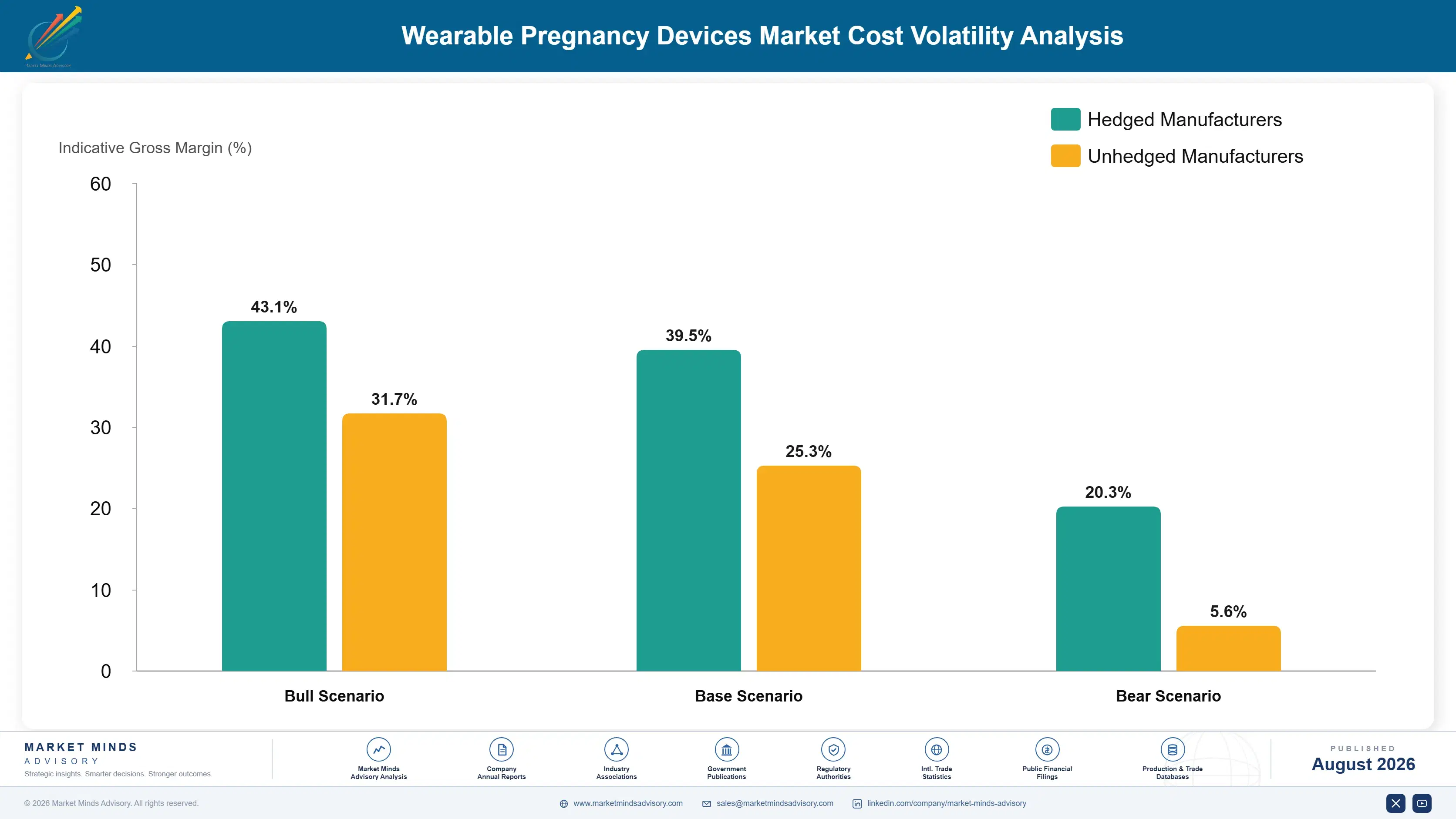
What A Monitoring Wearable Costs

Clinical validation, regulatory work and software development dominate for cleared products, absorbing 44% of cost of goods once amortised across volumes measured in tens of thousands rather than millions. Sensor components and microcontrollers account for about 21%, skin contact adhesives and biocompatible materials for another 12%, with connectivity and cloud services carrying the remainder. Sensor silicon traces to East Asian production and adhesives to specialist converters.
Component allocation rather than component price is what actually bites at these volumes. Semiconductor shortages placed manufacturers ordering tens of thousands of units behind automotive and consumer electronics customers ordering millions, and company annual reports across the medical device sector documented lead times extending well beyond a year alongside display and sensor supply tightening recorded in China MIIT output data. Medical grade adhesive qualification added further delay for anybody forced to substitute.

Exposure divides by regulatory route rather than by scale. Cleared products carry validation and regulatory cost that wellness labelled competitors avoid entirely, which makes them more expensive to build and more valuable to sell. Wellness products carry lower fixed cost and compete against general purpose wearables that already sit on the customer's wrist. Neither is comfortable and the cleared one reaches payers.
wearable-pregnancy-devices-market-cost-volatility-analysis-1787664883654

Qualify a second adhesive and sensor source before volumes rise

Medical grade skin contact adhesives come from a small group of specialist converters and requalification requires biocompatibility testing that takes months to complete properly. A single source interruption stops production of a device that cannot ship without it. Doing that qualification while volumes are still modest costs far less than doing it under commercial pressure with orders already committed.

Amortise regulatory investment across more than one indication

Clinical validation and regulatory work absorb the largest single share of cost for cleared products, spread across volumes in the tens of thousands. Building a platform where additional parameters or indications reuse the same regulatory foundation spreads that cost further. Companies clearing one device for one use are carrying the full fixed cost on the narrowest revenue base.

Price subscription revenue to carry the hardware cost

Hardware margin in this category is thin against general purpose wearables that reach the same customer at no incremental device cost to them. Monitoring subscriptions, clinician dashboards and payer billed services generate revenue that recurs across a pregnancy and postpartum period rather than ending at purchase. That structure also suits reimbursement models, which pay for monitoring periods rather than devices.

Portfolio Architecture for Margin Defence

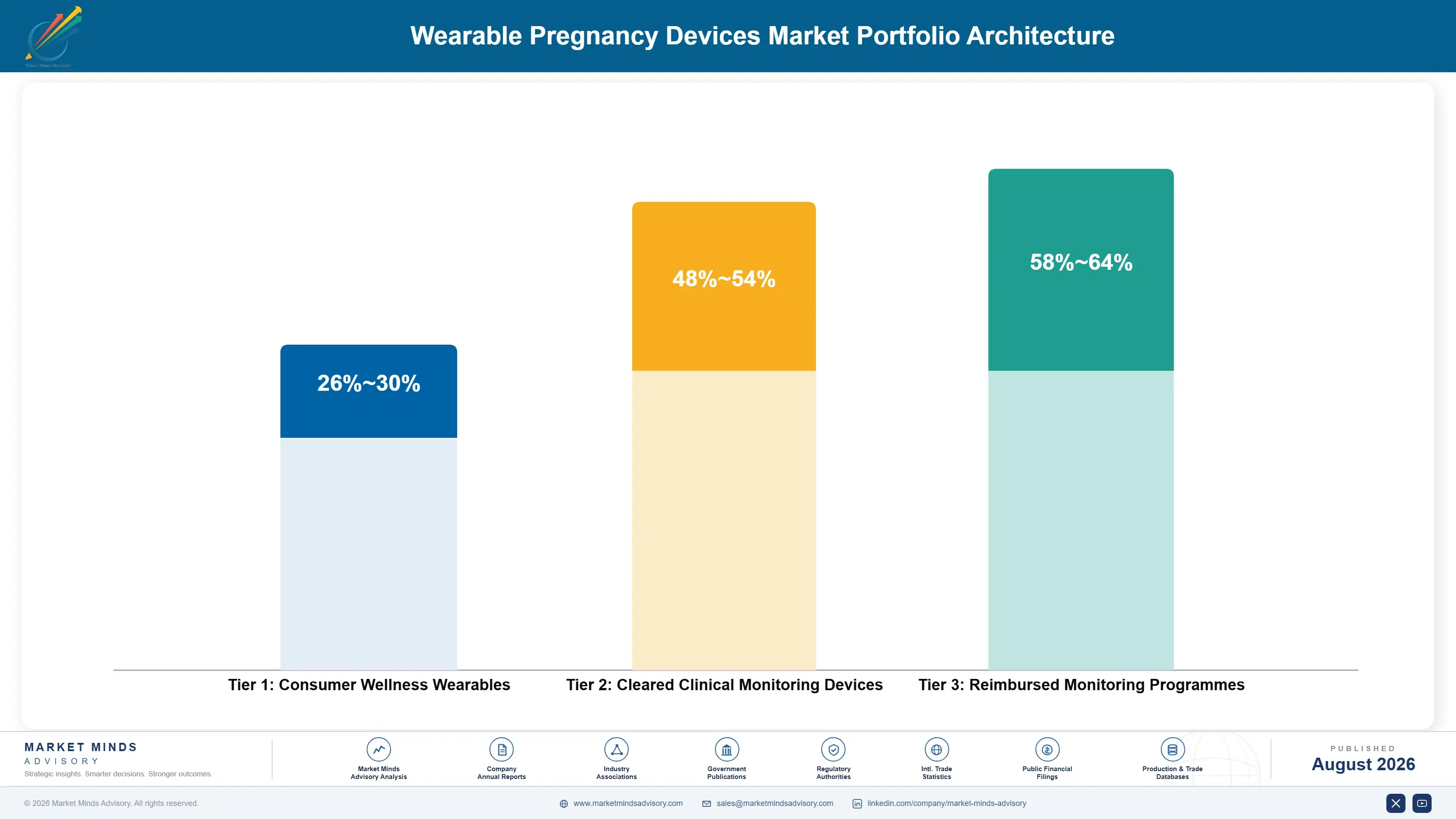
Margin architecture divides on regulatory classification more than on technology. Wellness labelled consumer devices earn least, competing against general purpose wearables that reach the same customer at no incremental hardware cost and retaining only about a third of users to delivery. Cleared clinical devices earn considerably better because they can be prescribed and deployed institutionally. Payer reimbursed monitoring programmes earn best, since coverage is scarce and whoever holds it faces limited direct competition.
The tension runs between reach and revenue quality. Consumer distribution reaches enormous numbers of pregnancies cheaply and converts poorly, while clinical channels reach far fewer people and generate revenue that recurs and reimburses. A company holding both is running two businesses with different evidence requirements, different liability profiles and different regulators watching them, which is harder than it looks from outside.

High value pools concentrate in maternal cardiovascular monitoring at 21.9% and in payer reimbursed postpartum programmes, neither of which is a consumer position. Everything selling reassurance competes against wearables already on the customer's wrist. The businesses worth building are those measuring a parameter with clinical thresholds, guideline relevance and a payer somewhere willing to fund the monitoring period.

Consumer Wellness Wearables

Wellness labelled devices sold directly to expectant parents on reassurance and engagement, competing against general purpose wearables already owned by the same customer. Retention through to delivery week remains the persistent commercial problem here.
Gross Margin: 26-30%

Cleared Clinical Monitoring Devices

Regulatory cleared devices prescribed by clinicians and procured by health systems for defined clinical indications. The range is wide because institutional procurement and direct prescription realise materially different pricing on identical hardware.
Gross Margin: 48-54%

Reimbursed Monitoring Programmes

Payer reimbursed remote monitoring programmes covering hypertensive disorders and postpartum follow up, billed as monitoring periods rather than devices. Margin is highest because coverage is scarce and direct competition within a covered pathway remains limited.
Gross Margin: 58-64%
wearable-pregnancy-devices-market-portfolio-architecture-1787664884160

High-value Sub-segments and Strategic Watch-out

Maternal Cardiovascular Monitoring

Fastest growing function at 21.9% because maternal deaths in high income settings are predominantly cardiovascular and none of that risk is fetal. Blood pressure carries established clinical thresholds and is the only parameter in this category with meaningful payer coverage anywhere. Coverage rather than performance drives that lead.
Gross Margin: 54-60%

Postpartum Monitoring Devices

Second fastest at 20.4% on timing rather than technology, since roughly 65% of maternal deaths occur after discharge and standard care offers one review at six weeks. Readmission reductions fund these programmes, which is why they reach institutional procurement. Timing rather than technology creates this demand.
Gross Margin: 50-56%

Fetal Heart Rate and Movement Monitors

Growing at 16.4% and carrying the largest consumer volume, which makes it the volume core rather than the growth story. False reassurance concerns and general purpose wearable competition both weigh on a segment built around emotional rather than clinical demand. Emotional demand converts poorly into revenue.
Gross Margin: 28-32%

Sleep and Activity Tracking

Growing at only 9.8% and effectively already lost to general purpose wearables that measure the same parameters for users who own them anyway. Pregnancy specific framing adds little that a software update to an existing platform cannot replicate. There is no defensible position left in it.
Gross Margin: 20-24%

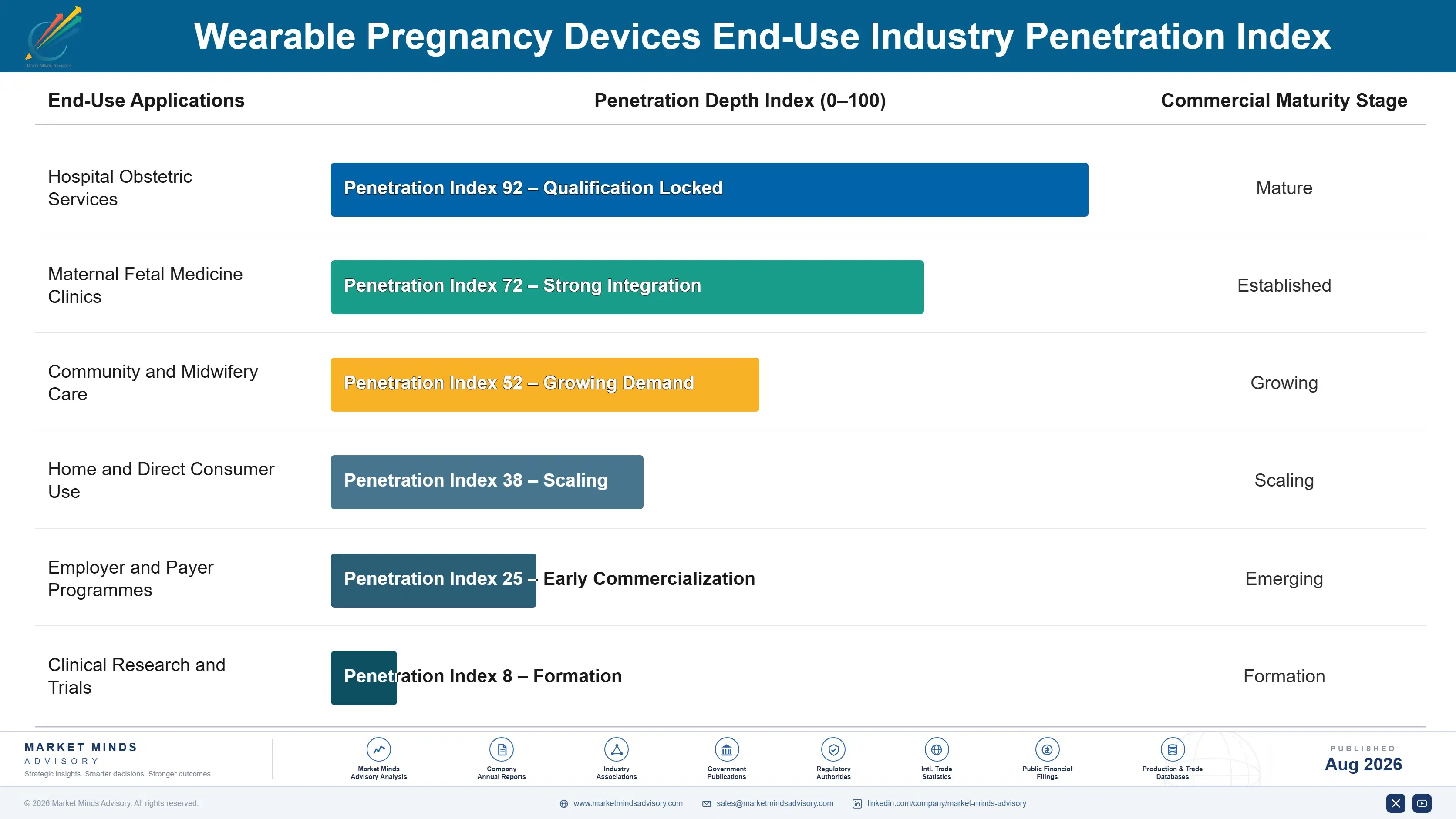
How A Nine Month Market Repeats

This category faces a problem almost no other wearable market has: the customer relationship has a scheduled end date. A pregnancy lasts nine months, the postpartum period adds a few more, and then the reason to wear the device disappears entirely. That makes acquisition cost brutal against a short revenue window, and it is why consumer businesses here struggle even when awareness and trial are strong.
Depth of use varies sharply by why the device was bought. A person monitoring a diagnosed hypertensive disorder wears the device because a clinician asked and the readings go somewhere, which produces near complete adherence across the monitoring period. A person seeking reassurance in a low risk pregnancy wears it until the novelty fades, which is why only around 34% are still using it at delivery week. Clinical purpose beats engagement design every time.

The buyer is moving from the pregnant person to the health system and the payer. Consumer purchase dominated the category's first decade and produced businesses with short customer lifetimes and no recurring revenue. Clinician prescription and payer reimbursed programmes generate revenue per monitoring period, repeat across every eligible patient a service treats, and do not end when one pregnancy does.
wearable-pregnancy-devices-market-end-use-penetration-index-1787664884651

Where This Category Rewards Focus

These are among the four positions where our research anticipates prominent divergence between winners and laggards over the coming forecast period. Each is grounded in the demand model, the regulatory perimeter, and the announced capacity pipeline.
01 / MATERNAL RISK FOCUS

The heartbeat that mattered was never fetal

Maternal deaths across high income settings are predominantly cardiovascular, driven by hypertensive disorders of pregnancy and peripartum cardiomyopathy, and none of that risk is detectable by listening to a fetal heartbeat at home. Blood pressure is measurable with technology already available at consumer price points, carries established clinical thresholds and holds the only meaningful payer coverage in the category. Maternal cardiovascular monitoring grows at 21.9% against a market rate of 14.6% for exactly those reasons rather than because of any technological advance.
02 / POSTPARTUM COVERAGE DESIGN

Six weeks is a long time to wait

Roughly 65% of maternal deaths occur after discharge from the delivery admission, and standard care answers that entire window with a single scheduled review at six weeks. Nobody designed that pathway around where risk actually sits, since it accumulated historically rather than deliberately. Postpartum monitoring grows at 20.4% because the clinical argument needs no elaboration once the timing is laid out, and readmission reductions let health systems fund the programme from savings rather than from any new budget allocation at all.
03 / REGULATORY CLASSIFICATION CHOICE

Pick a side of the line deliberately

Only around 22% of category volume carries device clearance, and the two halves of this market face entirely different evidence requirements, liability exposure, distribution routes and payment conditions from each other. Cleared products reach clinicians, payers and health systems while wellness products reach consumers and can never be prescribed by anybody. Companies straddling the boundary have found that regulators read marketing copy far more carefully than investors reading the same claims in a pitch deck, which has already ended products.
04 / REIMBURSEMENT PATHWAY ACCESS

Coverage is scarce and worth more than scale

Around 18% of payers reimburse remote monitoring for hypertensive disorders after discharge, which is the only established payment route this entire category has anywhere in the world. North American reimbursement codes explain why that region holds 31% of the market while growing more slowly than several others. Everything outside a covered pathway competes for consumer discretionary spending against a retention rate of about 34% through to delivery week, which is not an economic base that anybody should be scaling into further.

Engagement Snapshot From the Field

A live engagement with an industry participant carrying material or product regulatory and market exposure ahead of a defining policy shift, showing how our research translates into a defensible multi-year portfolio strategy.
MARKET MINDS ADVISORY · CLIENT ENGAGEMENT SUMMARY
Wearable Pregnancy Devices Producer Strategic Portfolio Review and Transition Roadmap 2026·Investment Scenario on Wearable Pregnancy Devices Exposure Evaluation 2025-26
CLIENT PROFILE
A venture backed consumer pregnancy wearable company selling a fetal movement and heart rate device directly to expectant parents across North America and Western Europe. Annual revenue was approximately 26 million dollars (client-reported, unverified by MMA), entirely from hardware sales and a small subscription attachment. The product carried wellness labelling rather than any regulatory clearance at that stage.
STRATEGIC CHALLENGE
Acquisition cost had risen for six consecutive quarters against a customer relationship that ends at delivery, and general purpose wearables had begun adding pregnancy features at no incremental cost to users who already owned them. Management was considering a clinical pivot but had not established whether the existing product could carry one. Nobody had modelled the classification decision.
MMA APPROACH
MMA modelled customer lifetime value against acquisition cost by cohort, isolating the effect of a fixed relationship end date. Clinical clearance and maternal parameter expansion were costed against reimbursement timelines by jurisdiction. Forty-seven expert interviews with obstetricians, midwives, payer medical directors and regulatory consultants established what a clinical route actually requires, alongside survey work across six countries.
KEY FINDINGS
  1. Customer lifetime value fell below acquisition cost in 5 of the 6 most recent cohorts, because the relationship ends at delivery regardless of how well the product performs during it.
  2. Obstetricians in 41 of 47 interviews said they would not recommend a fetal reassurance device to low risk patients, citing delayed presentation when movements reduce.
  3. Adding maternal blood pressure with clearance was costed at roughly 20 months and reached a segment growing at 21.9% with payer coverage the existing product could never access.
  4. General purpose wearable competition already reached an estimated 3 times the client's addressable users at no incremental hardware cost to those consumers.
CLIENT PROFILE
A venture backed consumer pregnancy wearable company selling a fetal movement and heart rate device directly to expectant parents across North America and Western Europe. Annual revenue was approximately 26 million dollars (client-reported, unverified by MMA), entirely from hardware sales and a small subscription attachment. The product carried wellness labelling rather than any regulatory clearance at that stage.
STRATEGIC CHALLENGE
Acquisition cost had risen for six consecutive quarters against a customer relationship that ends at delivery, and general purpose wearables had begun adding pregnancy features at no incremental cost to users who already owned them. Management was considering a clinical pivot but had not established whether the existing product could carry one. Nobody had modelled the classification decision.
MMA APPROACH
MMA modelled customer lifetime value against acquisition cost by cohort, isolating the effect of a fixed relationship end date. Clinical clearance and maternal parameter expansion were costed against reimbursement timelines by jurisdiction. Forty-seven expert interviews with obstetricians, midwives, payer medical directors and regulatory consultants established what a clinical route actually requires, alongside survey work across six countries.
KEY FINDINGS
  1. Customer lifetime value fell below acquisition cost in 5 of the 6 most recent cohorts, because the relationship ends at delivery regardless of how well the product performs during it.
  2. Obstetricians in 41 of 47 interviews said they would not recommend a fetal reassurance device to low risk patients, citing delayed presentation when movements reduce.
  3. Adding maternal blood pressure with clearance was costed at roughly 20 months and reached a segment growing at 21.9% with payer coverage the existing product could never access.
  4. General purpose wearable competition already reached an estimated 3 times the client's addressable users at no incremental hardware cost to those consumers.
RECOMMENDED STRATEGY
Phase 1: Phase one: stop scaling consumer acquisition, since lifetime value fell below acquisition cost in 5 of the 6 most recent cohorts measured. Phase 2: Phase two: add maternal blood pressure with regulatory clearance over roughly 20 months, reaching a segment growing at 21.9% annually. Phase 3: Phase three: pursue payer coverage for postpartum monitoring, where 65% of maternal deaths occur and readmission savings already fund these programmes.
OUTCOME
The client froze consumer acquisition spending and redirected it into clearance work for maternal blood pressure monitoring, which reached submission within the projected timeline. Revenue fell in the following year and gross margin improved materially, and the first health system contract replaced roughly a quarter of lost consumer revenue at far better economics (client-reported, unverified by MMA).

Frequently Asked Questions

Foundational context covering the market sizes, CAGR, scope, country, region and competition that inform every finding below. This section is provided to cover basics and most often pre-purchase conversations, answered from the MMA Primary Research Dataset.

What is the current size of the Wearable Pregnancy Devices Market?

The market was valued at 0.38 billion dollars in 2025, covering body worn monitoring devices used during pregnancy and the postpartum period worldwide. It reaches an estimated 0.44 billion dollars during 2026.

How large will the Wearable Pregnancy Devices Market be by 2036?

MMA forecasts 1.72 billion dollars by 2036, an increase of 1.28 billion dollars over the 2026 base. That represents an expansion multiple of 3.91 times across the forecast period.

What is the CAGR for the Wearable Pregnancy Devices Market 2026 to 2036?

The base case compound annual growth rate is 14.6%, with a bull case of 15.8% and a bear case of 13.2%. Guideline recognition and regulatory enforcement separate those two scenarios.

Which segment is growing fastest?

Maternal cardiovascular monitoring grows at 21.9%, half again the market rate of 14.6%, because maternal deaths are predominantly cardiovascular rather than obstetric. Postpartum devices follow at 20.4%.

Who are the major companies in the Wearable Pregnancy Devices Market?

Philips, Nuvo Group, Bloomlife, Owlet Baby Care and Baymatob lead on installed base and associated subscription revenue. Together they account for 29% of the global market.

Which country is growing fastest?

India grows fastest at 19.4%, because it records more births than anywhere else and its private obstetric sector serves urban patients paying directly for monitoring public services do not provide.

Report Segmentation Architecture

The full report scope spans multiple orthogonal segmentation dimensions, with cross-tabulated demand data provided for each dimension pair. Coverage extends further to regional breakdowns, trend trajectories, and the competitive detail needed to support segment-level decision-making.

By Monitoring Function

  • Fetal Heart Rate and Movement Monitors
  • Uterine Activity and Contraction Monitors
  • Maternal Cardiovascular Monitoring
  • Pregnancy Sleep and Activity Tracking
  • Postpartum Monitoring Devices
  • Integrated Multi-Parameter Platforms

By End-Use Industry

  • Hospital Obstetric Services
  • Maternal Fetal Medicine Clinics
  • Community and Midwifery Care
  • Home and Direct Consumer Use
  • Employer and Payer Programmes
  • Clinical Research and Trials

By Commercial Dimension

  • Direct to Consumer Retail
  • Clinician Prescribed Supply
  • Payer Reimbursed Programmes
  • Health System Procurement
  • Subscription and Service Plans
  • Employer Benefit Distribution

By Region

  • North America
  • Western Europe
  • East Asia
  • South Asia and Pacific
  • Latin America
  • Middle East and Africa
  • Eastern Europe

Scope, Methodology, and Coverage

Every figure in this report is reproducible from documented input assumptions. The scope below maps the historical period, the forecast horizon, the segmentation dimensions, and the countries covered, alongside the underlying primary and qualitative methodology.
Historical Period
2020 to 2025
Forecast Period
2026 to 2036
Base Year
2025 (USD billions; MMA Primary Research Dataset, August 2026)
Market Definition
Body worn devices used during pregnancy and the postpartum period for physiological monitoring worldwide, covering fetal heart rate and movement monitors, uterine activity and contraction monitors, maternal cardiovascular monitoring, pregnancy specific sleep and activity tracking, postpartum monitoring devices and integrated multi-parameter platforms, together with associated subscription and monitoring services. Measured at supplier revenue. Hospital cardiotocography equipment, handheld dopplers, ultrasound systems, fertility and ovulation tracking devices, and breast pumps are excluded from scope entirely.
Quantitative Units
USD billions (supplier revenue); devices shipped; USD per device and per monitoring period
Segmentation Dimensions
Monitoring function; end-use industry; commercial dimension; region
Regions Covered
North America, Western Europe, East Asia, South Asia and Pacific, Latin America, Middle East and Africa, Eastern Europe
Countries Covered
United States, Canada, United Kingdom, Germany, France, Netherlands, Sweden, Italy, Spain, China, Japan, South Korea, Taiwan, India, Australia, Singapore, Brazil, Mexico, Saudi Arabia, United Arab Emirates, South Africa, Poland
Key Companies Profiled
Philips, Nuvo Group, Bloomlife, Owlet Baby Care, Baymatob, GE HealthCare, Masimo, iRhythm Technologies, VitalConnect, BioIntelliSense, Withings, Garmin, Oura Health, Whoop, HeraMED, Melody International, Bonzun, Sibel Health, Biobeat, Preglife
Quantitative Methodology
Primary survey, n=3,800 respondents, Q4 2025, six countries; demand-side model with trade association cross-validation
Qualitative Methodology
47 expert interviews, Q4 2025; applied to validate demand model assumptions, identify emerging dynamics, and assess competitive positioning
Report Format
PDF and XLSX data workbook (Word format preview document)
Publisher
Market Minds Advisory
Report Code
MMA-2026-MED-135
Published
August 2026
Contact
sales@marketmindsadvisory.com | www.marketmindsadvisory.com

Purchase the full Wearable Pregnancy Devices Market Report (2026 to 2036).

The full report argues that this category was built around fetal reassurance while the clinical risk it should have addressed is maternal, cardiovascular and concentrated after discharge. It sizes all six monitoring functions independently through 2036, separates cleared devices from wellness labelled products in every region, and quantifies the postpartum coverage gap against reimbursement availability by payer. Regional chapters cover all seven regions, with North American reimbursement assessed separately from consumer purchasing behaviour. Competitive profiling covers 20 participants on one single consistent installed base measure throughout.
Six monitoring functions sized independently through 2036
Cleared devices separated from wellness labelled products regionally
Postpartum coverage gap quantified against reimbursement availability
Consumer retention modelled against fixed relationship end dates
General purpose wearable competition assessed by parameter overlap
Twenty participants profiled on one consistent installed measure

Built For The People Who Decide

From boardroom strategy to bench-side execution, this report is read cover-to-cover by leaders shaping the next decade of their industry, turning demand scenarios, market dynamics and valuation benchmarks into decisions.
CXOs/ Presidents/ VPs/ Managers
M&A and Corporate Development
Strategy Teams and R&D Heads
Procurement and Product Directors
Regulatory and Compliance Leaders
Investor Relations and Equity Analysts