
Market Minds Advisory
Power Liftgate Market

Power Liftgate Market: Cycle Life, Kick Sensors and a Second Opening at the Front

Electric platforms put a powered compartment at the front as well as the back, which quietly doubles the actuation points on a system already among the most warranted features on any modern vehicle.

Lead Analyst

David Horsley

Published

September 2026

Make Smarter Decisions with Customized Research Insights

Request a free sample report and evaluate market opportunities, growth trends, and competitive dynamics relevant to your business needs.

2025 MARKET VALUE$4.6BMarket Size 2025
2036 FORECAST VALUE$9.9BBase Case , 2026 to 2036
CAGR 2026 TO 20367.2 %Bull 8.4% / Bear 6.0%
INCREMENTAL OPPORTUNITY$5.0BNet 10- year value creation
EXPANSION MULTIPLE2.00x2036 value over 2026 base
Strategic Levers
M&A Pipeline
Regional Outlook
Country Rankings
Competitive Intelligence
Segmental Deep-dive
Call-Us : 91 93563 13602

Executive Snapshot and Market Trajectory

Powered liftgates moved from luxury option to near-standard fitment on sport utility vehicles, and roughly 58% of new ones now leave the factory with one. Growth from here is mix rather than penetration, and mix is going somewhere the industry did not plan for.
Electric platforms free the space where an engine used to sit, and manufacturers are powering that front compartment too. A vehicle with both a powered liftgate and a powered front lid carries two actuation systems where a combustion equivalent carried one. Powered front compartment systems grow at 9.6% on that alone, and the content per vehicle rises with it. Content per vehicle rises with it, and the supplier base positioned for that work is narrow.
Hands-free activation grows fastest at 10.8%, half again the market rate of 7.2%, as capacitive kick sensors give way to radar. Capacitive units false-trigger in rain and snow, which drove warranty claims that pushed manufacturers toward a different sensing approach entirely. East Asia holds 35% of value, above the usual band. Chinese electric brands adopted it fastest, reading a powered front lid as a differentiator rather than convenience content.
Market Definition
Powered closure systems for vehicle rear liftgates and front compartments, spanning spindle drives, gas spring and strut assemblies, control modules and anti-pinch sensing, hands-free activation sensors, powered front compartment systems and aftermarket retrofit kits, measured at supplier selling price. Excludes manual liftgate hardware, powered side doors and sliding doors, latches sold separately, and the liftgate panel itself.
Base Year Value
$4.6B in 2025 (MMA Primary Research Dataset, August 2026)
Forecast Period
2026 to 2036, eleven discrete annual values
CAGR
7.2% base case. Bull 8.4%. Bear 6.0%.
Fastest Growth Segment
Hands-Free Activation Sensors: 10.8% CAGR
Fastest Growth Country
India: 11.4% CAGR
Fastest Growth Region
South Asia and Pacific: 9.5% CAGR
Largest Region
East Asia: 35% of 2025 global value
Market Leaders
Brose, Magna International, Stabilus, Aisin Corporation, HI-LEX Corporation. Source: MMA Primary Research Dataset, July 2026.
Primary Survey
n=3,800 procurement and R&D decision-makers, Q4 2025, six countries
Methodology
Demand-side build-up, cross-validated against public data, 47 expert interviews

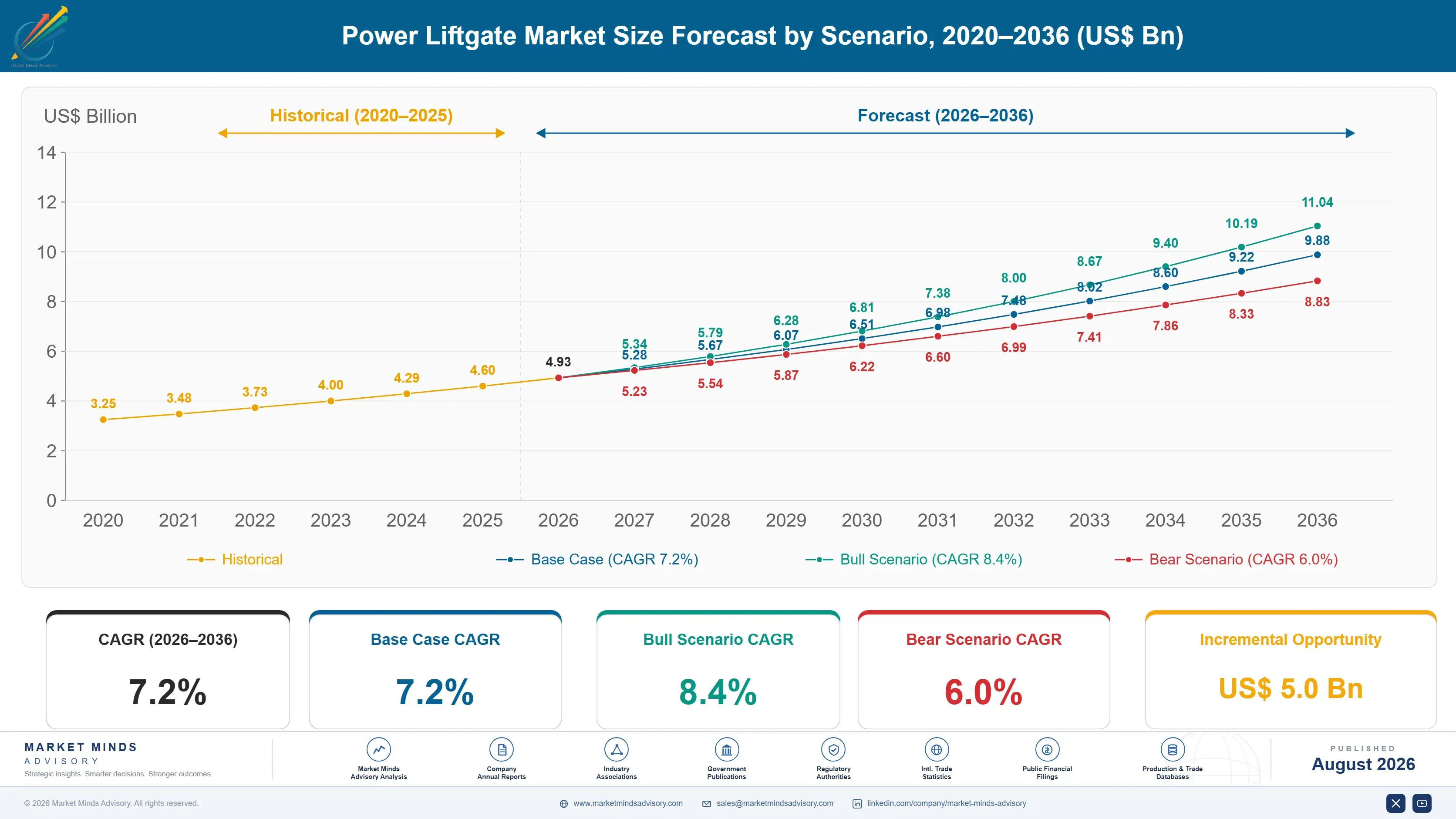
Power Liftgate Market Forecast Scenarios

power-liftgate-market-size-forecast-scenario-1787580779261
Growth ran near 6.1% between 2020 and 2025 on sport utility mix rising steadily while the semiconductor shortage cut vehicle build and delayed feature-rich trim availability. Fitment rates climbed through the period as the system moved down trim ladders from premium into mid-market. Chinese manufacturers adopted it faster than Western ones on equivalent price points, which reshaped where supplier volume actually sat.
Base case 7.2% rests on three mechanisms. Electric platforms are adding powered front compartments, which puts a second actuation system on vehicles that previously carried one. Hands-free activation is migrating from capacitive to radar sensing after false-trigger warranty experience, and radar units carry higher content. And Indian and Southeast Asian sport utility mix is rising quickly with powered liftgates appearing on mid-market trims for the first time. None of the three depends on penetration rising further.
The bull case at 8.4% assumes powered front compartments become standard rather than optional across electric platforms, roughly doubling actuation content on those vehicles. The bear case at 6.0% is manufacturers decontenting under electric vehicle cost pressure, since a powered liftgate is exactly the sort of feature a programme cuts when battery cost forces a difficult trim review.

Two Openings Where There Was One

A powered liftgate has to open and close roughly 30,000 times across a vehicle's life, at temperatures from Arctic winter to desert summer, holding position on a slope and stopping instantly if a hand gets in the way. That is a demanding specification for a component costing around 185 dollars, and it explains why powered closure claims run near 1.9% within warranty.
TOP FIVE CONCENTRATION61%Closure specialists dominate a qualification heavy supplier field
SPORT UTILITY FITMENT RATE58%Share of new sport utility vehicles fitted at build
SYSTEM COST PER VEHICLE$185Typical supplier price for a complete powered liftgate
CYCLE LIFE REQUIREMENT30,000Opening cycles demanded across the full temperature range
WARRANTY CLAIM RATE1.9%Powered closure claims within the standard vehicle warranty
HANDS-FREE SENSOR PENETRATION41%Portion of powered liftgates including a hands-free activation
Warranty experience has shaped supplier selection more than price has. Spindle drive failures and anti-pinch calibration drift both generate dealer visits, and manufacturers have moved toward suppliers who can demonstrate cycle life through temperature extremes rather than toward the lowest quotation. That qualification barrier is why five suppliers hold 61% of a market that looks mechanically straightforward from outside. Five suppliers hold the field for that reason alone.
The interesting change is where the openings are. Electric platforms have no engine at the front, and manufacturers are putting a compartment there and powering it. A vehicle carrying both a rear liftgate and a front lid has two actuation systems, two control strategies and two anti-pinch calibrations. Content per vehicle rises accordingly, and the supplier base positioned for it is narrow.
"Everyone models this on sport utility mix and stops there. The thing that actually moves content is a second powered opening at the front of every electric vehicle, and the suppliers who worked that out three years ago are quoting on programmes the rest are only now hearing about."
Principal, Automotive Systems and Closures Practice · MMA Automotive and Industrial Components Practice · August 2026

Market Trends

Electric platforms adding powered front compartment systems

Removing the engine frees space at the front of an electric vehicle, and manufacturers have been putting a storage compartment there and increasingly powering it. That places two actuation systems on a vehicle where a combustion equivalent carried one, each with its own drive, control strategy and anti-pinch calibration. The front lid is lighter than a liftgate but demands the same cycle life and safety behaviour. Suppliers already qualified on rear systems are best placed, though the packaging constraints at the front differ enough to require genuine development work. Content per vehicle rises accordingly.
Market Impact: Adds systems at $185 per vehicle
Hands-free activation migrating from capacitive to radar sensing

Capacitive kick sensors detect a foot by proximity, and they also detect rain, snow and road spray, which produced false activations that reached warranty data quickly enough to matter. Radar sensing distinguishes a deliberate gesture from weather far more reliably and tolerates dirt on the bumper that defeats a capacitive unit. Radar modules carry higher content and require different calibration, and penetration of hands-free activation across powered liftgates sits near 41%. Manufacturers replacing capacitive systems mid-programme is unusual and it has happened. Mid-programme sensing changes are rare in automotive, which indicates how poorly capacitive units performed in the field.
Market Impact: Addresses a 1.9% claim rate

Market Opportunities and Growth Drivers

Sport utility mix rising across emerging market vehicle sales

India grows fastest anywhere at 11.4%, on sport utility share of domestic sales rising sharply while powered liftgates appear on mid-market trims that previously carried manual hardware. The feature moved down trim ladders because system cost fell to around 185 dollars, which brought it within reach of vehicles priced well below premium. Southeast Asian and Latin American markets follow similar paths. Each conversion adds a complete system where none existed, which is a different kind of growth from replacing one supplier with another. Local content requirements are pulling supplier capacity into those markets rather than leaving systems imported.
Market Impact: Puts $185 content under review

Warranty experience pushing selection toward demonstrated cycle life

Powered closure claims run near 1.9% within the standard vehicle warranty, which is high for a convenience feature and visible in manufacturer quality data. Spindle drive failure and anti-pinch calibration drift are the recurring causes, both of which produce dealer visits rather than silent degradation. Manufacturers have responded by weighting demonstrated cycle life through temperature extremes above quoted price in supplier selection. That shift favours established suppliers with test histories and works against new entrants regardless of what they quote. Test history rather than quotation is what wins the nomination now, which protects incumbents considerably.
Market Impact: Requires 30,000 validation cycles

Market Restraints and Challenges

Electric vehicle cost pressure putting convenience content at risk

Battery cost dominates electric vehicle bills of material, and programme teams under margin pressure review convenience features first because removing one is invisible in a specification comparison against a competitor. A powered liftgate at around 185 dollars is exactly the sort of line item that survives a first review and not always a second. The root cause is battery economics rather than anything about the closure system. Suppliers are responding by bundling front and rear actuation to improve the combined cost position and by offering lighter drive architectures. Bundling front and rear content is the available answer.
Market Impact: Doubles to 2 actuation points

Qualification cycles locking programmes for years at a time

Demonstrating cycle life through temperature extremes takes months of testing before a supplier can be nominated, and the system then stays on the vehicle for its programme life. The root cause is that closure safety behaviour cannot be validated by analysis alone and requires physical cycling. Commercially it slows every supplier's growth regardless of product merit, and it protects incumbents disproportionately. New entrants qualify fastest during a platform launch or a mid-cycle refresh, when the manufacturer is revalidating anyway and the incremental burden is smaller. Arriving between windows achieves very little.
Market Impact: Covers 41% of powered liftgates
3 additional market trends, 4 additional growth drivers, and 2 additional restraints and challenges are covered in the full report. Contact sales@marketmindsadvisory.com to access the complete intelligence.

Segment CAGR and Growth Architecture

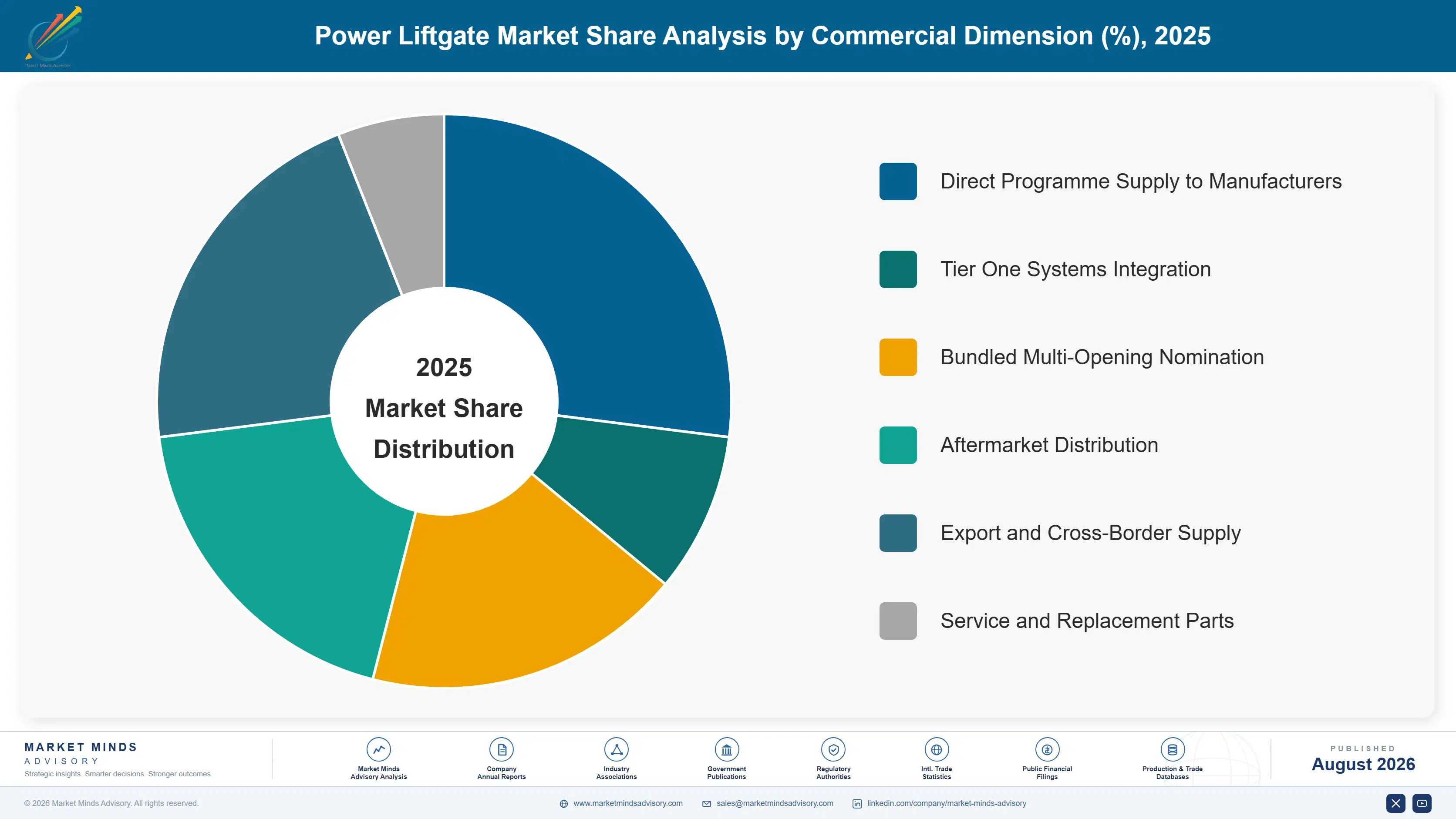
Six segments split by system component, because each carries a different qualification burden, a different supplier field and a different growth driver. A spindle drive and a radar activation sensor share a vehicle and almost nothing else commercially. Vehicle segment and channel splits are handled in the framework rather than folded in here. Growth drivers differ entirely.
power-liftgate-market-market-share-analysis-1787580779796

Hands-Free Activation Sensors

Growing at 10.8%, half again the market rate of 7.2%, hands-free activation is migrating from capacitive kick sensors to radar modules after false-trigger experience in rain, snow and road spray reached warranty data. Radar distinguishes a deliberate gesture from weather far more reliably and tolerates bumper contamination that defeats capacitive sensing entirely. Content per unit is higher and calibration differs, which suits suppliers with sensing capability rather than pure mechanical closure specialists. Penetration across powered liftgates sits near 41% and rises with every trim ladder move. Manufacturers have replaced capacitive systems mid-programme, which is rare and tells you how badly they performed. Suppliers with sensing capability rather than pure mechanical closure engineering are taking this content.
CAGR 10.8%

Powered Front Compartment Systems

At 9.6% powered front compartments are a segment that did not exist before electric platforms removed the engine from that space. The lid is lighter than a liftgate and the packaging is considerably tighter, which means a rear system cannot simply be scaled down and reused. Cycle life and anti-pinch requirements are identical, so the qualification burden transfers even where the hardware does not. Suppliers already validated on rear systems hold the advantage in nomination, though the development work is genuine. Content per vehicle roughly doubles wherever both openings are powered on the same platform. Suppliers already validated on rear systems hold the advantage in nomination, though the development work involved is entirely genuine.
CAGR 9.6%
Full segment breakdown across 6 segments available in the complete report.

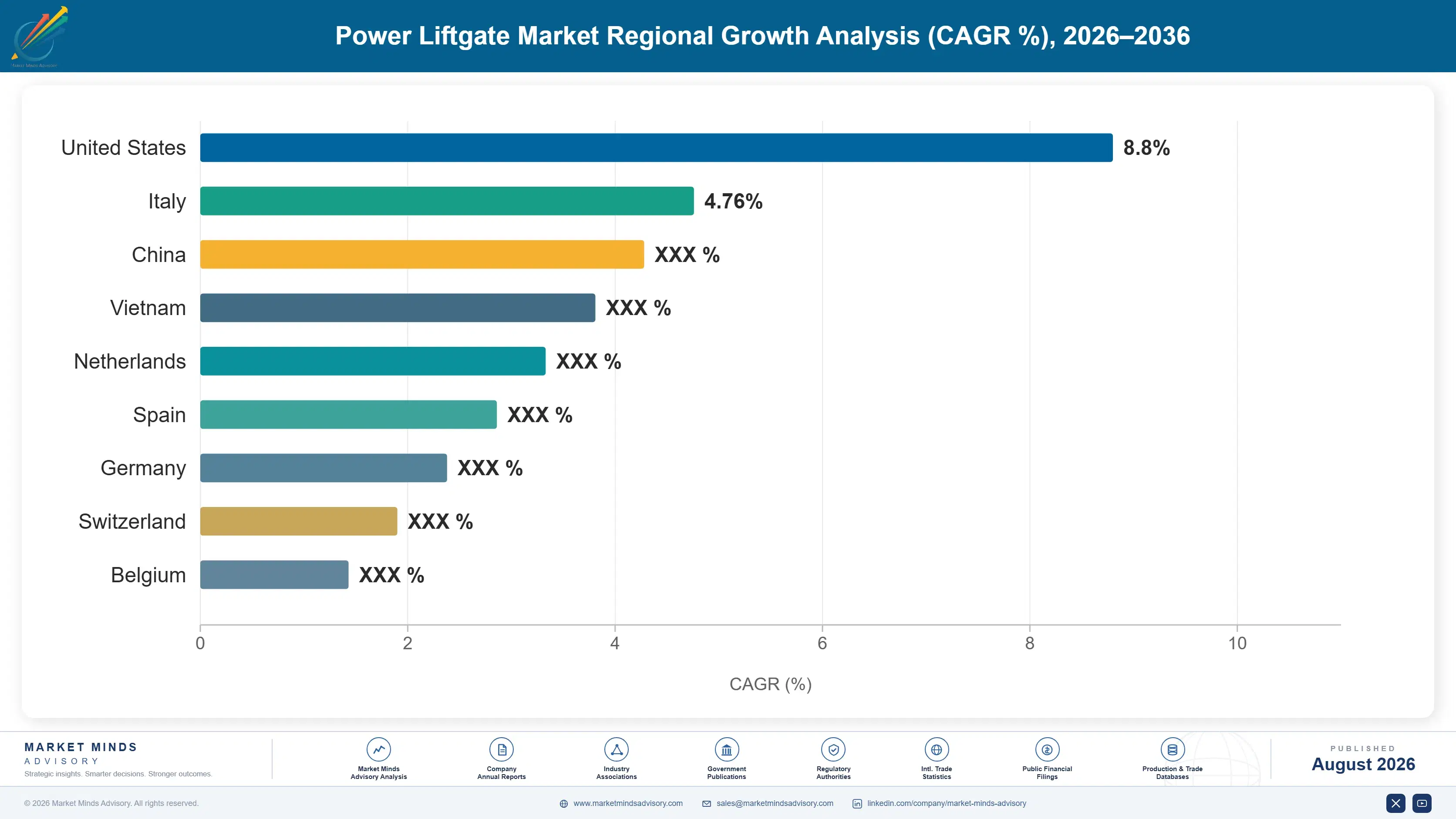
Regional Architecture and Country Demand Map

East Asia holds 35% of value, above its usual band, because Chinese vehicle build volume and rapid feature adoption at mid-market price points together dominate the picture. North America follows at 26% on sport utility mix, with Western Europe at 20% leading on premium content.

North America

Sport utility and pickup mix is higher here than in any other region, and powered liftgate fitment follows it directly, with tailgates on full size pickups adding a related but distinct application. Detroit programmes have adopted powered front compartments on electric pickups and sport utilities, which raises content meaningfully on those platforms. Warranty visibility is unusually high because American consumers report closure faults at dealers readily, which has pushed selection toward demonstrated cycle life. Mexican assembly serves North American programmes with suppliers operating local capacity to meet content and logistics requirements together. Pickup tailgates add a related application that no other region carries at comparable volume. Warranty visibility here is unusually high.
Share: 26% | CAGR: 6.3% (2026 to 2036)

Western Europe

European manufacturers led on powered liftgate introduction and on the sensing sophistication around it, with German premium programmes setting the specifications that others followed. The 20% share understates that influence considerably, since European specifications propagate into global platforms. Brose and Stabilus hold strong positions built on decades of closure system work. Electric platform front compartments have been adopted more cautiously here than in North America or China, partly because European vehicle packaging leaves less usable space at the front. Regional growth runs below the base case on flat vehicle build volumes. European specifications propagate into global platforms, which makes the regional influence larger than the share suggests. Front compartment adoption has been cautious.
Share: 20% | CAGR: 5.7% (2026 to 2036)
Regional intelligence for 5 additional markets available in the complete report: East Asia, South Asia and Pacific, Latin America, Middle East and Africa, Eastern Europe. Contact sales@marketmindsadvisory.com.
power-liftgate-market-country-cagr-analysis-1787580780336

Four Moves for a Closure Supplier

Nomination in this business follows demonstrated cycle life rather than quoted price, and programme positions then hold for years. The content growth is at the front of electric vehicles and in the sensing that activates the system. Competing on the rear spindle drive alone is competing for the slowest part of the market. The rear drive is the slow part.

Quote front and rear actuation as one system

Electric platforms carry two powered openings where combustion vehicles carried one, and quoting both together improves the combined cost position against a programme team reviewing convenience content under battery cost pressure. A bundled nomination also standardises control strategy and anti-pinch calibration across both openings, which reduces the manufacturer's own validation burden materially. Suppliers quoting the rear alone leave the front to a competitor and then share a vehicle. Combined content roughly doubles the value at around 185 dollars per opening. Leaving the front to a competitor means sharing a vehicle.
Market Impact: Doubles the content beyond $185 per opening fitted

Build radar sensing capability before capacitive is displaced

Capacitive kick sensors false-trigger in rain and snow badly enough that manufacturers have replaced them mid-programme, which almost never happens in automotive. Radar modules resolve it and carry higher content, at 10.8% annual growth in the segment. Developing radar sensing costs perhaps 18 million dollars in engineering and validation and requires capability that mechanical closure specialists do not hold. Partnering with a sensing supplier is the faster route, and it concedes part of the content. Building it internally takes longer and keeps the value. Building it internally keeps the value.
Market Impact: Costs $18 million to build radar sensing capability

Time qualification to platform launch or refresh

Cycle life validation across temperature extremes takes months and a system then holds for the programme life, which protects incumbents heavily. A manufacturer launching a platform or running a mid-cycle refresh is revalidating closure behaviour anyway, so the incremental burden of evaluating a new supplier falls sharply at exactly that moment. Suppliers tracking programme calendars target those windows rather than approaching continuously. Arriving between windows means a conversation that goes nowhere regardless of how good the quotation looks. Repeating a validation programme costs roughly 700 thousand dollars. Manufacturers avoid opening one without a reason.
Market Impact: Cuts through a full 30,000 cycle validation burden

Localise capacity inside growth assembly markets

India grows at 11.4% with local content requirements pulling supplier capacity into the country rather than leaving systems imported, and a powered liftgate assembly is bulky enough that freight erodes any offshore cost advantage quickly. Establishing local assembly costs considerably less than a full plant and can be justified against a single platform award. Suppliers who localised early hold positions that competitors serving from Europe or Japan now struggle to contest on landed cost or on lead time. Lead time matters as much as landed cost. Early movers already hold the positions worth having.
Market Impact: Serves 11.4% annual Indian growth from local capacity

Who Controls the Margin Pool

Participation is measured on annual unit shipment volume of powered closure systems, and the top five hold 61%. Concentration is high for a mechanical assembly because cycle life qualification takes months and manufacturers weight demonstrated test history above quotation. Brose and Magna lead on closure system breadth across several vehicle applications. The gap to challengers is validation history and programme nomination rather than manufacturing capability.
Competition runs on three fronts. Demonstrated cycle life decides nomination most directly, since warranty claims near 1.9% keep closure reliability visible in manufacturer quality data. Sensing capability is the second, as radar activation displaces capacitive and mechanical specialists find themselves needing electronics they never built. Front compartment development is the third, and it is where content growth is concentrating rather than where current revenue sits.

The pressure ahead comes from Chinese suppliers qualifying onto export platforms. Domestic Chinese closure specialists have taken substantial local share on cost and tooling speed, and the barrier to Western programmes has been validation history rather than capability. Expect development partnerships on sensing and front compartment systems rather than acquisitions. Rankings shift as electric platforms standardise powered front lids and as radar activation displaces capacitive across trim ladders.
power-liftgate-market-company-positioning-matrix-1787580780852

Competitive Moat and Risk Dimensions

BROSE

Moat: Closure validation history depth

Brose holds cycle life test histories across decades of closure programmes, and manufacturers weight that record above quotation when warranty exposure is the concern. Nomination on one programme leads readily to the next, since the validation burden on a known supplier is smaller. That accumulated evidence is not something a competitor assembles quickly at any level of investment.
BROSE

Risk: Sensing electronics capability gap

The business is built on mechanical closure engineering, and hands-free activation is migrating toward radar sensing that requires electronics development of a different kind entirely. Partnering concedes content to a sensing supplier while building internally takes years, and the segment growing fastest is precisely the one where the historical strength does not apply.
MAGNA INTERNATIONAL

Moat: Systems breadth and assembly reach

Magna supplies closures alongside body, seating and electronics, which lets it quote powered liftgate content within a larger programme conversation that specialists cannot enter. Manufacturing presence in every major assembly region also removes the freight and local content obstacles that constrain suppliers operating from a single continent.
MAGNA INTERNATIONAL

Risk: Programme concentration with incumbents

Volume concentrates with established North American and European manufacturers whose electric vehicle programmes have been slower and less numerous than Chinese equivalents. Chinese domestic brands adopting powered front compartments aggressively represent the fastest content growth available, and they source from local suppliers on cost and tooling speed criteria where scale advantages count for less.

Players Tracked

Prominent Players

Brose
Magna International
Stabilus
Aisin Corporation
HI-LEX Corporation

Other Key Players

Huf Hulsbeck and Furst
Continental
Valeo
Mitsuba Corporation
Johnan Manufacturing
Ningbo Joyson Electronic
Wuhu Bethel
U-Shin
Mitsui Kinzoku ACT
Kiekert
Inteva Products
Shiroki Corporation
Edscha
Aptiv
Hyundai Mobis

Recent Developments

FEBRUARY 2026

European manufacturer standardises powered front compartment across an electric platform

A European manufacturer made a powered front compartment standard rather than optional across a new electric platform, adding a second actuation system alongside the rear liftgate. The nomination was awarded to the incumbent rear system supplier, standardising control strategy and anti-pinch calibration across both openings.
Signal: Bundled front and rear nomination is becoming the pattern, which favours incumbents on the rear system
SEPTEMBER 2025

Manufacturer replaces capacitive kick sensors with radar mid-programme

A vehicle manufacturer replaced capacitive hands-free kick sensors with radar modules during a production run following false activation reports in wet and snowy conditions. Mid-programme sensing changes are unusual in automotive and required revalidation of the activation strategy across affected variants. Field reports drove the decision entirely.
Signal: Capacitive false triggering was serious enough to justify a change that manufacturers almost never make mid-programme
JUNE 2026

Indian supplier commissions local powered liftgate assembly capacity

An Indian component supplier commissioned local powered liftgate assembly capacity serving domestic sport utility programmes, citing local content requirements and freight economics on a bulky assembly. The investment is an organic capacity addition rather than any joint venture with an international closure specialist. Two platform awards are already attached.
Signal: Local content and freight together now make imported powered liftgate supply uncompetitive across growth assembly markets

What the System Actually Costs

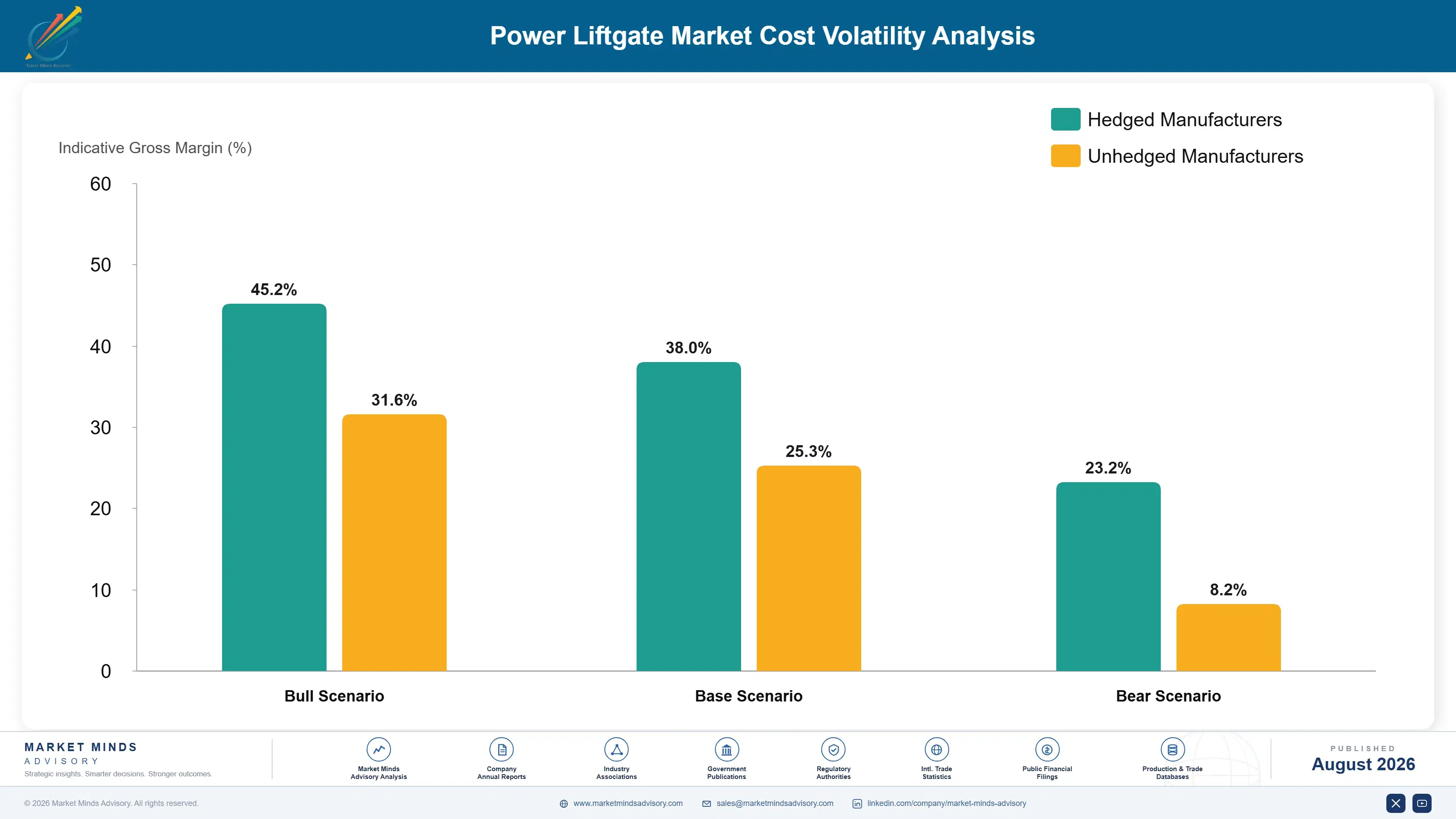
Electric motors and gearing account for roughly 31% of system cost, with rare earth magnets, copper winding and steel gearing carried inside that. Electronic control modules add about 22%, rising sharply where radar sensing replaces capacitive activation. Gas spring assemblies, spindle housings and mounting hardware take a further 26%, and validation testing amortised across programme volume adds a meaningful further share that suppliers rarely quote separately.
Rare earth magnet pricing moved sharply during 2021 and 2022 as Chinese export administration tightened and neodymium demand rose across electrified drivetrains, per published critical raw material assessments for that period. Closure suppliers holding fixed programme pricing absorbed the increase directly, since automotive piece prices are agreed annually and rarely reopened. Several disclosed margin compression on closure businesses in reporting for those years, and magnet-free motor designs moved up development agendas afterwards.

Exposure varies with motor design and contract structure. A supplier holding qualified ferrite or magnet-reduced motor options can substitute across a programme boundary, while one locked to a single neodymium design carries everything. Magnet supply is concentrated in China regardless of where a motor is wound, per critical raw material assessments, which leaves every supplier outside carrying the same exposure.
power-liftgate-market-cost-volatility-analysis-1787580781050

Qualify magnet-reduced or ferrite motor alternatives

Holding an approved motor design using ferrite or reduced neodymium content gives a supplier a substitution route when magnet pricing moves, which it has done twice this decade. Qualification requires cycle life revalidation with the manufacturer, costing perhaps 700 thousand dollars per motor family, and it recovers within a single magnet price cycle in most cases.

Index programme pricing to published magnet references

Automotive piece prices are agreed annually and rarely reopened, while magnet pricing moves on export administration decisions outside anyone's control. Indexing the magnet component to a published reference passes movement through with a defined lag. Manufacturers resist until a supplier struggles, and several accepted indexing after the last magnet cycle demonstrated the exposure clearly.

Bundle validation cost across front and rear systems

Cycle life validation is expensive and amortised across programme volume, and running separate programmes for front and rear systems duplicates a substantial part of it. Bundling both openings under one validation programme reduces the testing burden materially and improves the combined quotation. Manufacturers also prefer one control strategy across both openings, so both arguments point the same way.

Portfolio Architecture for Margin Defence

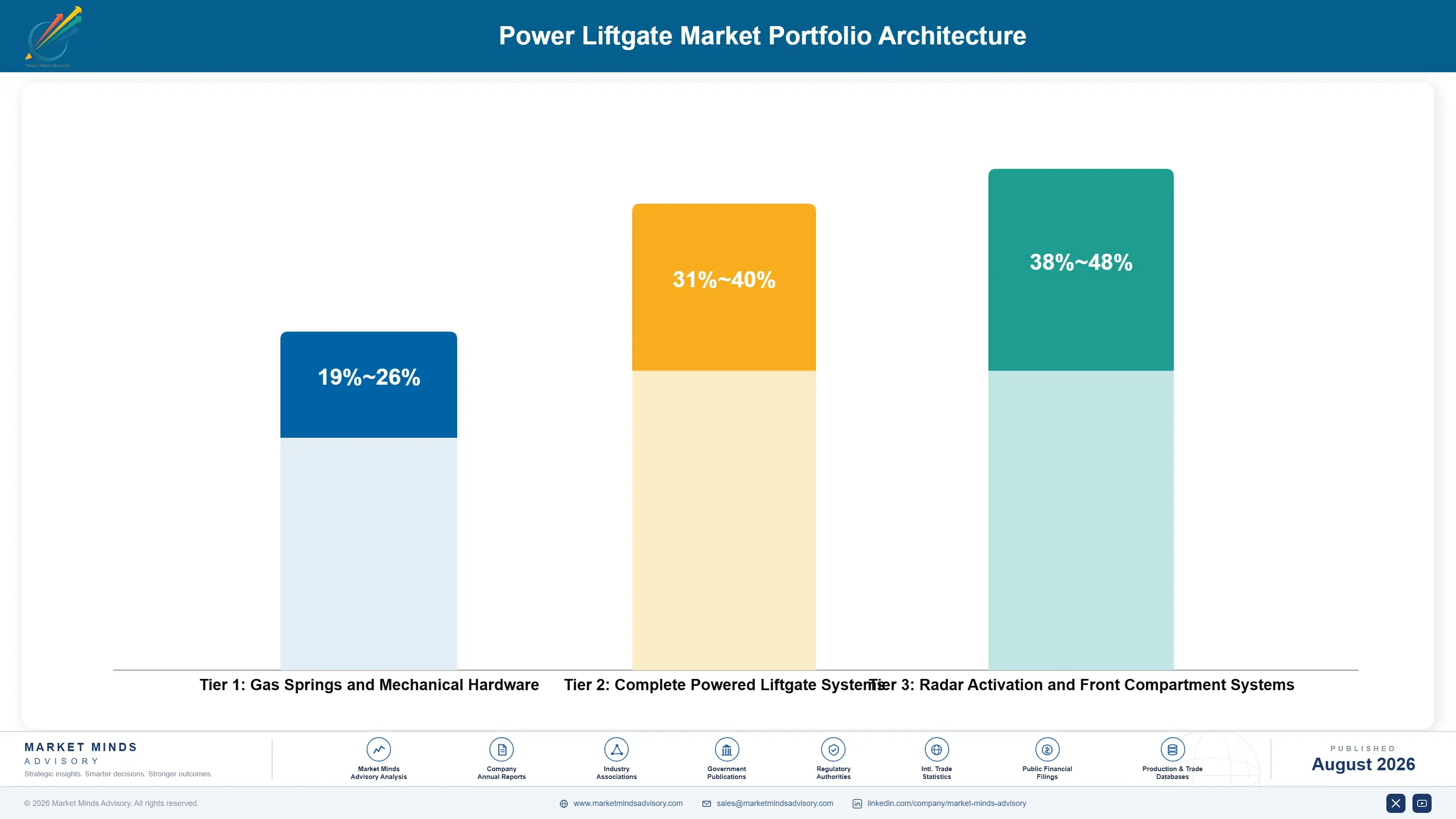
Margin here tracks qualification difficulty and content sophistication rather than volume. Gas spring assemblies and mechanical hardware earn margins in the low twenties, because several suppliers can make them to a drawing and manufacturers second source them without much difficulty. Volume is substantial in this tier and pricing power is limited, which is where most of the industry's tonnage sits.
Complete powered liftgate systems do considerably better at margins in the low to high thirties, because cycle life validation and programme nomination limit the field to suppliers with test histories. The range is wide because it depends on whether the supplier participated in packaging design during platform development or quoted against a finished specification, and those are quite different commercial positions. Packaging participation separates the two ends of that range.

Radar activation and front compartment systems hold the strongest economics, running into the mid forties, where sensing capability or packaging development excludes most of the closure supplier field. Those margins reflect a capability gap rather than any market grant, and they compress as mechanical specialists build or partner their way into sensing over the next several years. The window closes as mechanical specialists build or partner into sensing.

Gas Springs and Mechanical Hardware

Gas spring assemblies, spindle housings and mounting hardware supplied against manufacturer drawings. The seven point range reflects volume scale and manufacturing location rather than any technical position worth defending against second sourcing.
Gross Margin: 19-26%

Complete Powered Liftgate Systems

Full rear liftgate systems including drive, control module and anti-pinch sensing, nominated on demonstrated cycle life. The nine point range depends on whether the supplier shaped packaging during platform development or quoted a finished specification.
Gross Margin: 31-40%

Radar Activation and Front Compartment Systems

Radar hands-free activation modules and powered front compartment systems for electric platforms. The ten point range reflects how few suppliers hold sensing capability or front packaging development experience at present.
Gross Margin: 38-48%
power-liftgate-market-portfolio-architecture-1787580781570

High-value Sub-segments and Strategic Watch-out

Radar Hands-Free Activation Modules

High value and the fastest growth at 10.8% as capacitive sensing is displaced on false-trigger warranty experience. Sensing capability excludes most mechanical closure specialists, and manufacturers have replaced capacitive systems mid-programme to obtain it. Sensing capability rather than closure engineering decides who competes for it.
Gross Margin: 40-48%

Powered Front Compartment Systems

High value and growing at 9.6% from a base that did not exist before electric platforms. Packaging at the front is tighter than the rear, so a scaled-down liftgate system does not work and genuine development is required. Content per vehicle roughly doubles wherever both openings are powered.
Gross Margin: 38-46%

Complete Rear Liftgate Systems

The volume core and still the most profitable large-scale position available. Cycle life validation protects incumbents heavily, though growth follows sport utility mix rather than any content increase per vehicle fitted. Validation history protects incumbents heavily, and new entrants qualify only at launch or refresh.
Gross Margin: 31-40%

Content Facing Electric Cost Decontenting

The strategic watch-out. Battery cost pressure puts convenience features under programme review, and a system at around 185 dollars is exactly the line item that survives one review and not always the next one. Bundling front and rear content is the only real defence available.
Gross Margin: 18-32%

How Programme Volume Repeats

A powered liftgate nomination behaves like an annuity with a fixed term. Once a system is validated on a platform, volume follows build rates for the programme life, typically six to eight years, and nobody changes a validated closure system mid-programme without a quality reason. Cycle life revalidation would have to be repeated across temperature extremes, which costs far more than any piece price saving that could be negotiated on a system priced near 185 dollars.
Stickiness varies with how the position was won. Suppliers who shaped packaging during platform development are effectively locked in, since the body structure assumes their geometry. Those quoting against a finished specification are replaceable at the next platform. Aftermarket retrofit kits switch freely on price with no qualification standing behind them, and that segment behaves like consumer electronics rather than automotive supply in almost every respect.

The specifying decision has moved earlier into platform engineering. Powered liftgate selection was a purchasing exercise conducted after body design freeze. Warranty exposure and front compartment packaging both pulled it into the development phase, where suppliers now sit with body engineers years before any part is ordered and where the commercial outcome is effectively settled.
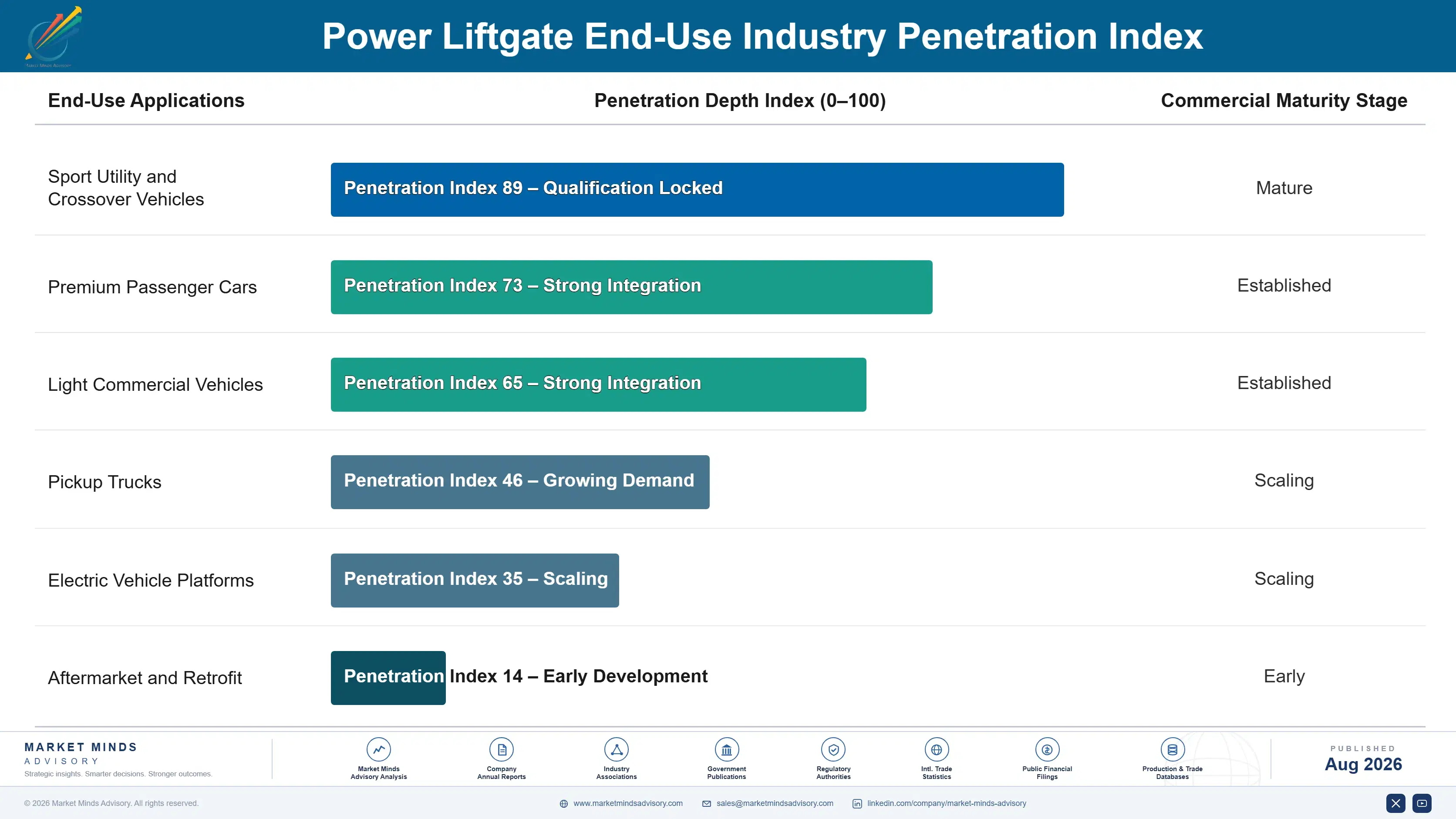
power-liftgate-market-end-use-penetration-index-1787580782192

Where We Would Invest

These are among the four positions where our research anticipates prominent divergence between winners and laggards over the coming forecast period. Each is grounded in the demand model, the regulatory perimeter, and the announced capacity pipeline.
01 / BUNDLED SYSTEM NOMINATION

Quote both openings together on electric platform programmes

Electric platforms carry two powered openings where combustion vehicles carried one, and quoting front and rear together improves the combined cost position in front of a programme team reviewing convenience content under battery cost pressure. A bundled nomination standardises control strategy and anti-pinch calibration across both openings, which reduces the manufacturer's own validation burden materially. Suppliers quoting only the rear leave the front to a competitor and then find themselves sharing a vehicle they could have held on their own entirely.
02 / RADAR SENSING CAPABILITY

Build or partner on radar before capacitive finishes disappearing

Capacitive kick sensors false-trigger in rain and snow badly enough that manufacturers have replaced them mid-programme, which almost never happens in automotive supply of any kind. Radar resolves the problem, carries higher content per unit and grows at 10.8% annually against a market rate of 7.2%. Developing the capability costs perhaps 18 million dollars in engineering and validation and requires electronics that mechanical closure specialists do not hold, so partnering reaches nomination windows sooner while building internally keeps the content.
03 / QUALIFICATION WINDOW TIMING

Approach at platform launch, not between programme cycles

Cycle life validation across temperature extremes takes months and a validated system then holds for the whole programme life, which protects incumbents very heavily indeed. A manufacturer launching a new platform or running a mid-cycle refresh is revalidating closure behaviour regardless of supplier, so the incremental cost of evaluating an additional supplier falls sharply at precisely that moment. Suppliers who track programme calendars closely capture those windows while competitors approaching continuously get polite conversations that lead absolutely nowhere at all.
04 / GROWTH MARKET LOCALISATION

Assemble locally where sport utility mix is rising fastest

India grows at 11.4% and local content requirements are pulling supplier capacity into the country rather than leaving complete systems imported from elsewhere. A powered liftgate assembly is bulky enough that freight erodes any offshore cost advantage quickly, which makes local assembly a requirement rather than an optimisation. The investment costs considerably less than a full plant and is justifiable against a single platform award, and early movers already hold positions that competitors cannot realistically contest on landed cost or lead time.

Engagement Snapshot From the Field

A live engagement with an industry participant carrying material or product regulatory and market exposure ahead of a defining policy shift, showing how our research translates into a defensible multi-year portfolio strategy.
MARKET MINDS ADVISORY · CLIENT ENGAGEMENT SUMMARY
Power Liftgate Producer Strategic Portfolio Review and Transition Roadmap 2026·Investment Scenario on Power Liftgate Exposure Evaluation 2025-26
CLIENT PROFILE
A European closure systems supplier producing powered liftgate systems for German and French vehicle manufacturers, with closure division revenue near 640 million euros across four plants (client-reported, unverified by MMA). Capability was entirely mechanical and electromechanical, with hands-free activation sensing bought in from a third party and integrated rather than developed internally. No radar capability existed internally.
STRATEGIC CHALLENGE
Two customers had signalled powered front compartments on forthcoming electric platforms, and a third had replaced capacitive kick sensors with radar mid-programme using a competitor's module. Management needed to decide whether to develop radar sensing internally, partner, or continue integrating bought-in modules, and whether to pursue front compartment nominations at all.
MMA APPROACH
MMA costed internal radar development against partnership structures with three sensing suppliers, assessed front compartment packaging requirements across four electric platform architectures, and benchmarked the client's cycle life test history against five competitors. Programme nomination calendars were mapped across both customers. Interviews with 47 experts covered closure engineering, automotive radar sensing and platform development practice.
KEY FINDINGS
  1. Internal radar development would cost roughly 18 million dollars over three years, against partnership terms conceding around 40% of the sensing content but reaching market two years sooner.
  2. Front compartment packaging differed enough across the four platforms examined that no single design could be scaled from the client's existing rear systems without genuine redevelopment work.
  3. The client's cycle life test history was competitive with three of five benchmarked competitors and behind the two holding most premium German nominations at present.
  4. Bundled front and rear quotations were being requested by both customers, and the client could not respond to either without front compartment development already under way.
CLIENT PROFILE
A European closure systems supplier producing powered liftgate systems for German and French vehicle manufacturers, with closure division revenue near 640 million euros across four plants (client-reported, unverified by MMA). Capability was entirely mechanical and electromechanical, with hands-free activation sensing bought in from a third party and integrated rather than developed internally. No radar capability existed internally.
STRATEGIC CHALLENGE
Two customers had signalled powered front compartments on forthcoming electric platforms, and a third had replaced capacitive kick sensors with radar mid-programme using a competitor's module. Management needed to decide whether to develop radar sensing internally, partner, or continue integrating bought-in modules, and whether to pursue front compartment nominations at all.
MMA APPROACH
MMA costed internal radar development against partnership structures with three sensing suppliers, assessed front compartment packaging requirements across four electric platform architectures, and benchmarked the client's cycle life test history against five competitors. Programme nomination calendars were mapped across both customers. Interviews with 47 experts covered closure engineering, automotive radar sensing and platform development practice.
KEY FINDINGS
  1. Internal radar development would cost roughly 18 million dollars over three years, against partnership terms conceding around 40% of the sensing content but reaching market two years sooner.
  2. Front compartment packaging differed enough across the four platforms examined that no single design could be scaled from the client's existing rear systems without genuine redevelopment work.
  3. The client's cycle life test history was competitive with three of five benchmarked competitors and behind the two holding most premium German nominations at present.
  4. Bundled front and rear quotations were being requested by both customers, and the client could not respond to either without front compartment development already under way.
RECOMMENDED STRATEGY
Phase 1: Phase one: enter a radar sensing development partnership immediately, accepting the content concession in exchange for reaching nomination windows two years sooner than internal development allows. Phase 2: Phase two: begin front compartment development against the two announced platforms, since bundled quotations are already being requested and cannot otherwise be answered. Phase 3: Phase three: invest in extending cycle life test history through accelerated programmes, closing the gap against the two competitors holding premium German nominations.
OUTCOME
The supplier entered a sensing partnership in late 2025 and began front compartment development immediately, winning a bundled nomination on one electric platform within a year (client-reported, unverified by MMA). Radar activation content reached roughly 12% of divisional revenue during 2026, and the second customer's bundled quotation remains outstanding at the time of writing.

Frequently Asked Questions

Foundational context covering the market sizes, CAGR, scope, country, region and competition that inform every finding below. This section is provided to cover basics and most often pre-purchase conversations, answered from the MMA Primary Research Dataset.

What is the current size of the Power Liftgate Market?

MMA sizes it at USD 4.6 billion in 2025, rising to USD 4.93 billion in 2026. The figure covers powered closure systems for rear liftgates and front compartments at supplier selling price.

How large will the Power Liftgate Market be by 2036?

USD 9.88 billion by 2036, an incremental USD 4.95 billion over the 2026 base and an expansion multiple of 2.00 times. Front compartment systems account for a disproportionate share.

What is the CAGR for the Power Liftgate Market 2026 to 2036?

7.2% in the base case, with a bull case at 8.4% and a bear case at 6.0%. The spread turns on front compartment standardisation and on electric vehicle cost decontenting.

Which segment is growing fastest?

Hands-free activation sensors at 10.8%, half again the market rate of 7.2%. Capacitive kick sensors are being displaced by radar after false triggering in rain and snow.

Who are the major companies in the Power Liftgate Market?

Brose, Magna International, Stabilus, Aisin Corporation and HI-LEX Corporation lead on annual unit shipment volume, holding 61% between them. Fifteen further participants are profiled in the full report on that basis.

Which country is growing fastest?

India at 11.4%, as sport utility share of domestic sales rises and powered liftgates appear on mid-market trims. System cost near 185 dollars brought the feature within reach.

Report Segmentation Architecture

The full report scope spans multiple orthogonal segmentation dimensions, with cross-tabulated demand data provided for each dimension pair. Coverage extends further to regional breakdowns, trend trajectories, and the competitive detail needed to support segment-level decision-making.

By System Component

  • Spindle Drive Systems
  • Gas Spring and Strut Assemblies
  • Control Modules and Anti-Pinch Sensing
  • Hands-Free Activation Sensors
  • Powered Front Compartment Systems
  • Aftermarket Retrofit Kits

By End-Use Industry

  • Sport Utility and Crossover Vehicles
  • Premium Passenger Cars
  • Light Commercial Vehicles
  • Pickup Trucks
  • Electric Vehicle Platforms
  • Aftermarket and Retrofit

By Commercial Dimension

  • Direct Programme Supply to Manufacturers
  • Tier One Systems Integration
  • Bundled Multi-Opening Nomination
  • Aftermarket Distribution
  • Export and Cross-Border Supply
  • Service and Replacement Parts

By Region

  • North America
  • Western Europe
  • East Asia
  • South Asia and Pacific
  • Latin America
  • Middle East and Africa
  • Eastern Europe

Scope, Methodology, and Coverage

Every figure in this report is reproducible from documented input assumptions. The scope below maps the historical period, the forecast horizon, the segmentation dimensions, and the countries covered, alongside the underlying primary and qualitative methodology.
Historical Period
2020 to 2025
Forecast Period
2026 to 2036
Base Year
2025 (USD billions; MMA Primary Research Dataset, August 2026)
Market Definition
Powered closure systems for vehicle rear liftgates and front compartments, spanning spindle drives, gas spring and strut assemblies, control modules and anti-pinch sensing, hands-free activation sensors, powered front compartment systems and aftermarket retrofit kits, measured at supplier selling price. Manual liftgate hardware, powered side and sliding doors, latches sold separately, and the liftgate panel or body structure itself are excluded from scope entirely.
Quantitative Units
USD billions (current prices); million systems shipped annually; USD per system by component type and region
Segmentation Dimensions
System component; end-use industry; commercial dimension; region
Regions Covered
North America, Western Europe, East Asia, South Asia and Pacific, Latin America, Middle East and Africa, Eastern Europe
Countries Covered
United States, Canada, Mexico, Germany, France, United Kingdom, Spain, Italy, China, Japan, South Korea, India, Thailand, Indonesia, Australia, Brazil, Saudi Arabia, South Africa, Poland, Czech Republic
Key Companies Profiled
Brose, Magna International, Stabilus, Aisin Corporation, HI-LEX Corporation, Huf Hulsbeck and Furst, Continental, Valeo, Mitsuba Corporation, Johnan Manufacturing, Ningbo Joyson Electronic, Wuhu Bethel, U-Shin, Mitsui Kinzoku ACT, Kiekert, Inteva Products, Shiroki Corporation, Edscha, Aptiv, Hyundai Mobis
Quantitative Methodology
Primary survey, n=3,800 respondents, Q4 2025, six countries; demand-side model with trade association cross-validation
Qualitative Methodology
47 expert interviews, Q4 2025; applied to validate demand model assumptions, identify emerging dynamics, and assess competitive positioning
Report Format
PDF and XLSX data workbook (Word format preview document)
Publisher
Market Minds Advisory
Report Code
MMA-2026-AUT-122
Published
August 2026
Contact
sales@marketmindsadvisory.com | www.marketmindsadvisory.com

Purchase the full Power Liftgate Market Report (2026 to 2036).

The full report sizes each system component separately through 2036 and quantifies content per vehicle across combustion, hybrid and electric architectures where a second powered opening changes the arithmetic. It tracks capacitive to radar sensing migration by manufacturer, models cycle life qualification timelines against programme calendars, and maps front compartment adoption across announced electric platforms. Regional chapters cover all seven regions with assembly plant detail where disclosure permits. Competitive profiling covers 20 participants on a single unit shipment basis, with warranty claim patterns compared by system component.
Content per vehicle modelled across three powertrain architectures
Capacitive to radar migration tracked by vehicle manufacturer
Cycle life qualification timelines mapped against programme calendars
Front compartment adoption assessed across announced electric platforms
Twenty participants profiled on one consistent basis
Warranty claim patterns compared by system component

Built For The People Who Decide

From boardroom strategy to bench-side execution, this report is read cover-to-cover by leaders shaping the next decade of their industry, turning demand scenarios, market dynamics and valuation benchmarks into decisions.
CXOs/ Presidents/ VPs/ Managers
M&A and Corporate Development
Strategy Teams and R&D Heads
Procurement and Product Directors
Regulatory and Compliance Leaders
Investor Relations and Equity Analysts