
Market Minds Advisory
Low Rolling Resistance Tire Market in Korea

Low Rolling Resistance Tire Market in Korea: Global Demand and the South Korean Manufacturing Base

Electric vehicle range anxiety and tightening European Union and Chinese fuel-efficiency labeling rules are forcing tire makers to trade wet-grip performance for rolling resistance gains, a compromise South Korean manufacturers price into every EV-fitment contract.

Lead Analyst

David Horsley

Published

September 2026

Make Smarter Decisions with Customized Research Insights

Request a free sample report and evaluate market opportunities, growth trends, and competitive dynamics relevant to your business needs.

2025 MARKET VALUE$32.4BMarket Size 2025
2036 FORECAST VALUE$66.8BBase Case , 2026 to 2036
CAGR 2026 TO 20366.8 %Bull 8.1% / Bear 5.5%
INCREMENTAL OPPORTUNITY$32.2BNet 10- year value creation
EXPANSION MULTIPLE1.93x2036 value over 2026 base
Strategic Levers
M&A Pipeline
Regional Outlook
Country Rankings
Competitive Intelligence
Segmental Deep-dive
Call-Us : 91 93563 13602

Executive Snapshot and Market Trajectory

Rolling resistance has become a specification line item, not a marketing claim. Original equipment manufacturers now write maximum rolling resistance coefficients directly into EV sourcing contracts, and tire makers unable to hit those numbers lose fitment before price even enters the discussion at all.
Electric vehicles are pulling demand fastest, since every added mile of rolling resistance directly costs range that automakers have already promised customers on the window sticker. South Korean manufacturers, led by Hankook and Kumho, have built dedicated EV tire lines specifically to win that fitment business, while European Union labeling law and China's own fuel-consumption standards keep pulling replacement demand upward across passenger and commercial fleets alike, with certification now required before production.
Competition concentrates among a handful of global majors with the silica-compound and tread-design expertise this segment demands, while mid-tier Asian producers race to close the technology gap on cost. Compound science, not manufacturing scale, increasingly separates a premium fitment win from a commodity replacement sale, and that shift is rewriting who gets invited to OEM development programmes years before launch, with South Korean producers closest to that frontier.
Market Definition
The low rolling resistance tire market covers passenger car, electric vehicle, light commercial, truck and bus radial, two-wheeler, and off-highway tires engineered and labeled for reduced rolling resistance coefficients under recognised regulatory or industry test standards. It excludes standard tires without rolling resistance certification and unrelated automotive component categories.
Base Year Value
$32.4B in 2025 (MMA Primary Research Dataset, August 2026)
Forecast Period
2026 to 2036, eleven discrete annual values
CAGR
6.8% base case. Bull 8.1%. Bear 5.5%.
Fastest Growth Segment
Electric Vehicle Tires: 12.5% CAGR
Fastest Growth Country
South Korea: 10.2% CAGR
Fastest Growth Region
South Asia and Pacific: 8.8% CAGR
Largest Region
East Asia: 30% of 2025 global value
Market Leaders
Michelin, Bridgestone Corporation, The Goodyear Tire & Rubber Company, Continental AG, Hankook Tire & Technology. Source: MMA Analysis based on company annual reports.
Primary Survey
n=3,800 procurement and R&D decision-makers, Q4 2025, six countries
Methodology
Demand-side build-up, cross-validated against public data, 47 expert interviews

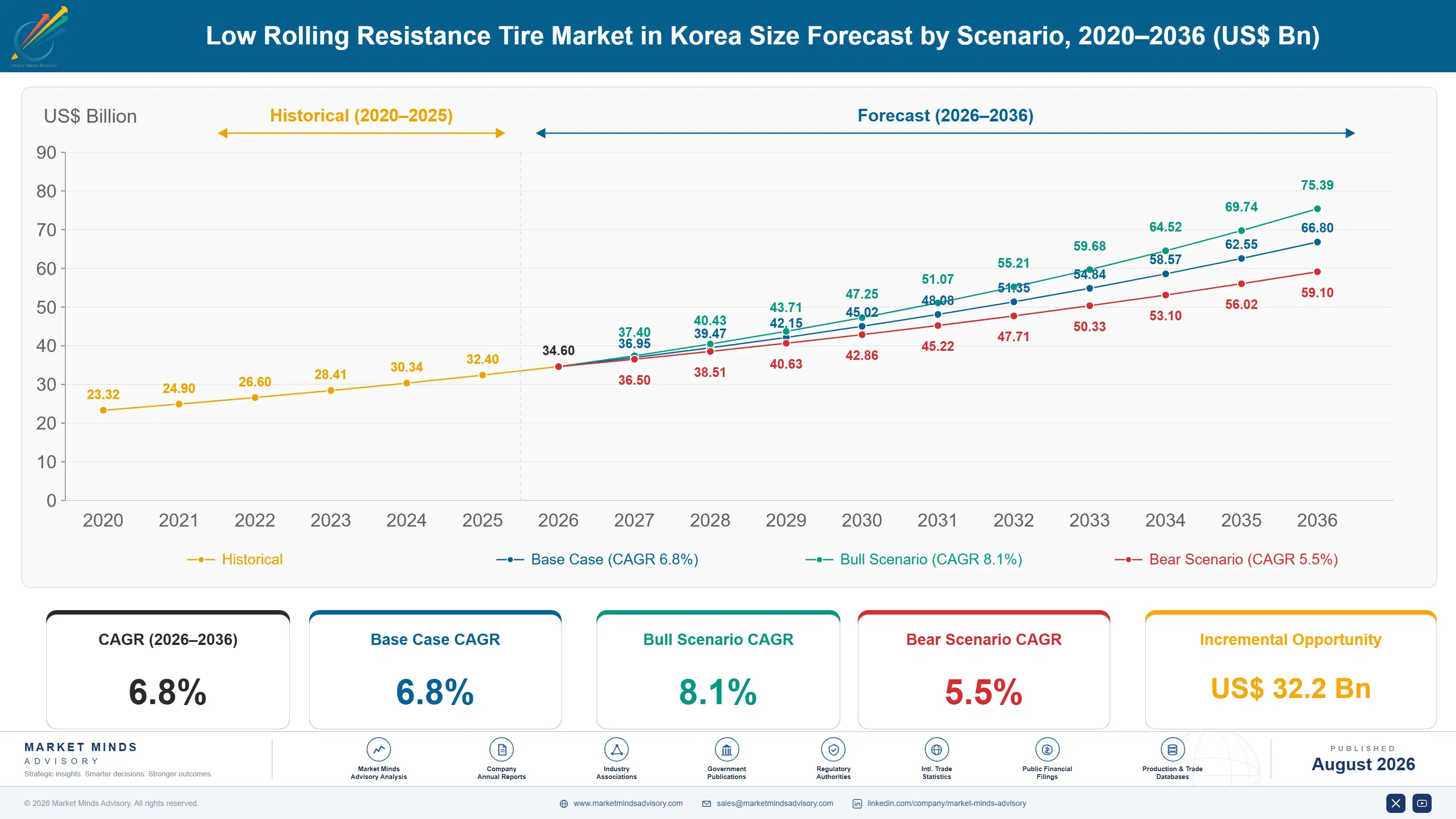
Low Rolling Resistance Tire Market Forecast Scenarios

low-rolling-resistance-tire-market-size-forecast-scenario-1787554840396
Between 2020 and 2025 the category grew near a 5.8% annual pace as the European Union's revised tire labeling regulation, effective 2021, pushed replacement buyers toward higher-graded compounds while electric vehicle volumes were still too small to move the aggregate number meaningfully on their own. China's own fuel-consumption tightening began contributing meaningfully only toward the end of that five-year window.
The base case carries the market to a 6.8% CAGR on three mechanisms: electric vehicle OEM fitment specifying rolling resistance ceilings as a contractual requirement, China's tightening fuel-consumption limits under its own vehicle standards pulling replacement demand toward certified compounds, and South Korean and Japanese producers scaling silica-reinforced manufacturing capacity fast enough to meet that combined order book without rationing supply to smaller automakers. European replacement retail is compounding on top of all three mechanisms simultaneously.
The bull case at 8.1% assumes additional national governments adopt European Union-style mandatory labeling ahead of currently modelled timelines. The bear case at 5.5% assumes durability complaints on early low rolling resistance compounds slow replacement-cycle adoption among price-sensitive commercial fleet buyers specifically. Both scenarios hinge on how quickly certified compounds close the remaining durability gap against standard tires.

Compound Science and the EV Fitment Race

Three forces converge on this category. Automakers need certified rolling resistance numbers to hit published EV range figures, regulators in the European Union and China are tightening labeling and fuel-consumption thresholds on overlapping but separate timelines, and fleet buyers want the fuel or energy savings without sacrificing tread life. Balancing those demands is a compounding chemistry problem before it is ever a manufacturing one.
TOP PRODUCER SHARESouth Korea, 19%Share of total global output from Korean manufacturers
AVERAGE SELLING PRICEUSD 118Blended price across passenger and light commercial tires
SILICA INPUT COST SHARE27% of COGSSpecialty silica and compound share of unit cost
OEM FITMENT SHARE34% of unitsVolume sold directly into original equipment vehicle fitment
REPLACEMENT CYCLE4.5 yearsTypical average tire service life before replacement purchase
MARKET CONCENTRATIONCR5: 42%Combined share held by five largest tire manufacturers
Commercially, the category rewards compound science over raw production scale. Silica-reinforced tread formulations that cut rolling resistance without sacrificing wet grip remain difficult to replicate, which is why OEM development contracts still favour Michelin, Continental, and the leading Korean producers years ahead of any given vehicle launch, well before mid-tier Asian manufacturers can qualify comparable compounds at scale.
Over the next decade, EV-specific fitment volume, tightening Chinese fuel-consumption rules, and consumer willingness to pay a premium for certified compounds will decide which manufacturers convert regulatory pressure into share. Producers still selling on price alone risk being squeezed out of OEM programmes entirely as certification becomes a baseline requirement rather than a differentiator. That transition is already well underway across every major vehicle category.
"Everyone assumed rolling resistance was a marketing sticker. It is now a hard line in the EV sourcing contract, and the tire makers who treated it that way three years ago are the ones winning fitment today."
Director, Automotive Components and Materials Practice · MMA Automotive Components and Materials Practice · August 2026

Market Trends

EV OEMs Write Rolling Resistance Ceilings Into Sourcing Contracts

Electric vehicle manufacturers including Hyundai, Kia, and several European and Chinese automakers now specify maximum rolling resistance coefficients directly inside tire sourcing agreements, treating the metric as a hard qualification threshold rather than a preference. Hankook and Kumho have each stood up dedicated EV tire development lines in response, engineering tread compounds and stiffened sidewalls that manage the added weight of battery packs while still meeting the rolling resistance ceiling. This shifts supplier selection earlier into the vehicle development cycle, since qualifying a compound now takes many months, locking in supplier relationships years ahead of production.
Market Impact: Adds up to 5% EV range
China Tightens Fuel-Consumption Limits Tied to Tire Grade

China's Ministry of Industry and Information Technology has progressively tightened passenger vehicle fuel-consumption limits, and compliance testing increasingly credits certified low rolling resistance tire fitment as part of an automaker's fleet average calculation. That link gives Chinese OEMs a direct regulatory incentive to specify certified tires rather than commodity equivalents, a shift that domestic producers including Sailun and Linglong are racing to capture before international majors dominate the certified segment entirely. Replacement-market buyers are following the same signal more slowly, since certified compounds still carry a retail price premium many private buyers hesitate to pay.
Market Impact: Labeled tiers command 12% premium

Market Opportunities and Growth Drivers

Electric Vehicle Range Targets Make Rolling Resistance Non-Negotiable

Every incremental reduction in rolling resistance translates directly into additional certified driving range, and automakers that have already published EPA or WLTP range figures cannot quietly under-deliver once vehicles reach customers. Hyundai and Kia have both specified certified low rolling resistance tires as standard fitment across their electric vehicle lineups, and South Korean tire makers built dedicated capacity specifically to win that domestic fitment business before pursuing export contracts with other global automakers. Because the range penalty compounds with vehicle weight, larger battery-pack electric vehicles show the strongest willingness among manufacturers to pay a fitment premium for certified performance.
Market Impact: Wet grip drops by 2 grades

European Union Tire Labeling Regulation Sets a Compliance Floor

The European Union's revised tire labeling regulation, effective May 2021, grades rolling resistance, wet grip, and noise on a mandatory scale displayed at point of sale across all member states. Retailers report that consumers increasingly favour higher-graded tires once the label makes the trade-off visible, and several national governments outside the bloc have since adopted comparable labeling schemes modelled directly on the European Union framework. That regulatory floor gives certified manufacturers a durable price premium in replacement retail channels that commodity importers cannot realistically match without their own certification investment.
Market Impact: Retail premium reaches 15% to 20%

Market Restraints and Challenges

Rolling Resistance Gains Trade Directly Against Wet Grip

Reducing rolling resistance and improving wet-weather braking grip pull tire compound design in opposite directions, since the same tread stiffness that lowers energy loss during rolling also reduces the flexibility that grips wet pavement. The root cause is basic rubber physics rather than any solvable engineering shortfall, which means every certified low rolling resistance tire embeds a genuine safety trade-off that regulators have had to grade rather than eliminate. Manufacturers are mitigating this through multi-layer tread compounds and silica-reinforced formulations that narrow, without closing, the gap between the two properties on the European Union's own labeling scale.
Market Impact: Over 70% of EV tenders certified

Silica-Reinforced Compounds Raise Unit Cost and Retail Resistance

Specialty precipitated silica and silane coupling agents needed for high-grade rolling resistance compounds cost meaningfully more than standard carbon-black tread formulations, and that cost passes through to a retail price consumers do not always recognise as justified. The root cause is a genuinely more complex manufacturing process requiring tighter mixing control and longer cure cycles, not simple input price inflation. Fleet buyers with fuel-cost visibility adopt certified tires readily, while private consumers without that visibility often trade back down to cheaper commodity tires at replacement, particularly across price-sensitive emerging markets.
Market Impact: Certified share tops 40% in China
3 additional market trends, 3 additional growth drivers, and 3 additional restraints and challenges are covered in the full report. Contact sales@marketmindsadvisory.com to access the complete intelligence.

Segment CAGR and Growth Architecture

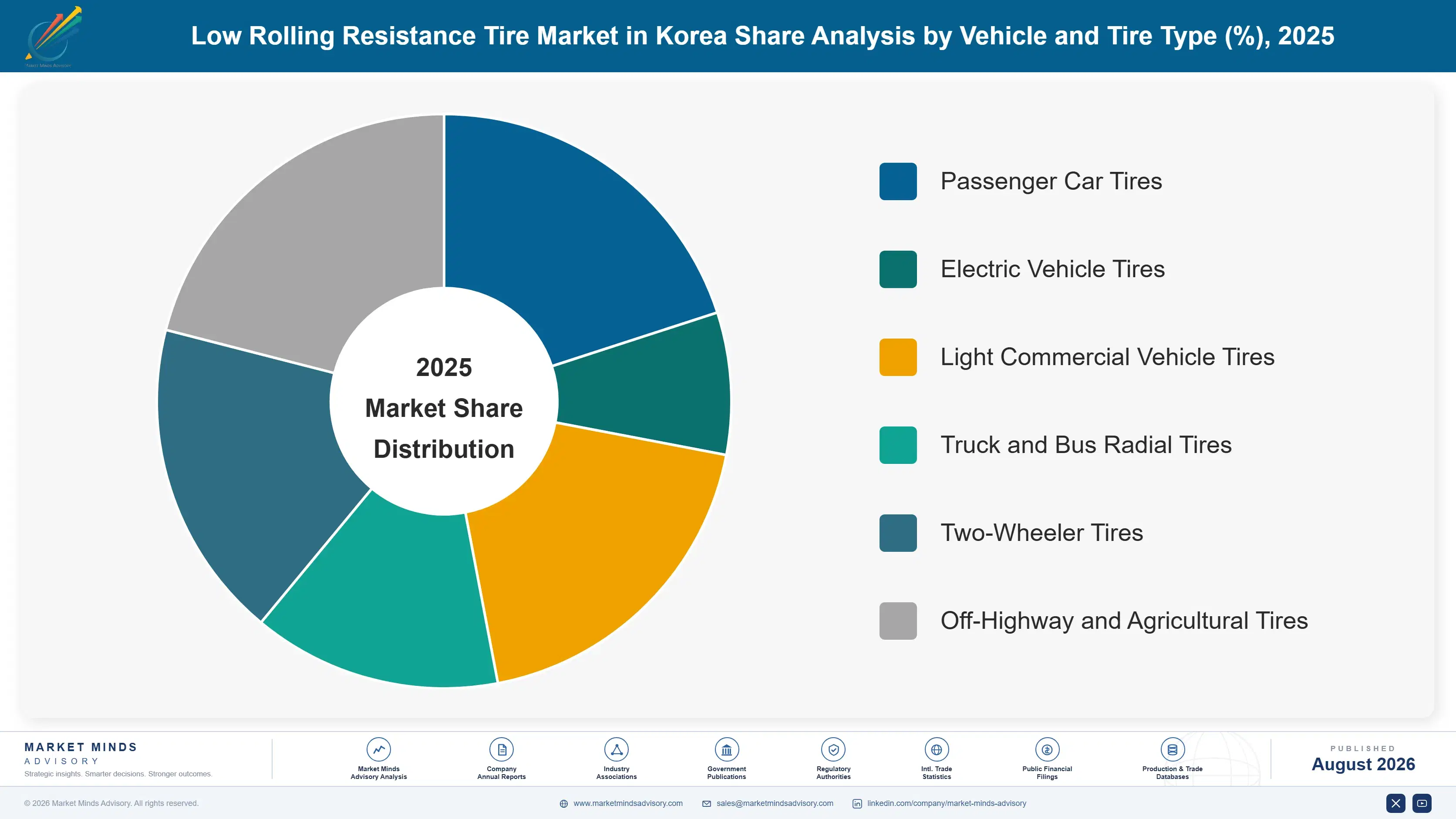
Segmentation follows vehicle and tire application type, a single fitment and certification logic, since compound requirements, load ratings, and certification pathways differ by vehicle class rather than by distribution channel or customer type, keeping engineering and OEM qualification work aligned to platform needs. That alignment matters most wherever regulatory certification and OEM qualification cycles move together.
low-rolling-resistance-tire-market-market-share-analysis-1787554840946

Electric Vehicle Tires

Electric vehicle tires grow fastest at 12.5%, about 1.84 times the overall 6.8% rate, since every certified mile of reduced rolling resistance converts directly into published driving range that automakers have already promised customers. These tires also carry reinforced sidewalls and altered noise profiles to manage battery weight and near-silent cabin acoustics, engineering demands that standard passenger compounds do not address. Hankook, Kumho, Michelin, and Continental all run dedicated EV tire development programmes qualified against specific vehicle platforms years before launch. Growth concentrates wherever electric vehicle production volume itself is scaling fastest, making Korea, China, and parts of Europe the leading demand centres for this segment specifically. Export volume compounds this advantage further each year.
CAGR 12.5%

Light Commercial Vehicle Tires

Light commercial vehicle tires grow at 9.5%, the second-fastest application, as last-mile delivery fleets and van operators adopt certified compounds to cut fuel cost across high-mileage daily routes. Goodyear, Continental, and Yokohama Rubber lead fleet-specification volume, competing on total cost of ownership rather than sticker price since fleet buyers track fuel savings against certified rolling resistance ratings directly. Unlike passenger replacement tires, this segment sells substantially through fleet procurement contracts rather than retail counters, so fleet-grade warranty terms and delivery lead times matter as much as the underlying compound performance itself. Manufacturers unable to demonstrate documented fuel savings at scale rarely win the multi-year contract renewals that anchor this segment's growth trajectory going forward.
CAGR 9.5%
Full segment breakdown across 6 segments available in the complete report.

Regional Architecture and Country Demand Map

East Asia leads on Korean and Chinese manufacturing scale and EV fitment volume, while Western Europe and North America grow more slowly on an already mature, regulation-driven replacement base. South Asia and Pacific posts the fastest regional growth off a smaller starting base. Latin America follows at a measured pace.

North America

The United States federal fuel economy programme and a growing electric vehicle fleet, not any binding tire label, drive North America's 24% share, since the region has no mandatory rolling resistance labeling scheme comparable to the European Union's. Goodyear and Michelin's North American plants supply most OEM fitment volume, while replacement retail still sells heavily on price and mileage warranty rather than certified rolling resistance grade. Tesla, Ford, and General Motors electric vehicle programmes are the clearest certified-fitment demand signal in the region today, specifying rolling resistance ceilings even without a regulatory mandate forcing the requirement. Growth of 7.0% tracks electric vehicle fitment volume more directly than any replacement-market shift toward certified compounds among private buyers.
Share: 24% | CAGR: 7.0% (2026 to 2036)

Western Europe

Mandatory tire labeling under European Union regulation, not vehicle electrification alone, explains why Western Europe holds 24% of global value despite modest population growth. Michelin and Continental dominate both OEM and replacement channels, and French and German retailers report that consumers increasingly select higher-graded tires once the point-of-sale label makes the fuel and safety trade-off visible at purchase. Germany's dense electric vehicle charging network and the Netherlands' commuter cycling and light-vehicle culture both reinforce demand for certified compounds across different vehicle categories. Growth of 5.3%, the slowest major region, reflects an already mature, regulation-saturated replacement market rather than weakening demand. Retailers across the bloc report little remaining headroom for further certified-share gains without a labeling standard revision.
Share: 24% | CAGR: 5.3% (2026 to 2036)
Regional intelligence for 5 additional markets available in the complete report: East Asia, South Asia and Pacific, Latin America, Middle East and Africa, Eastern Europe. Contact sales@marketmindsadvisory.com.
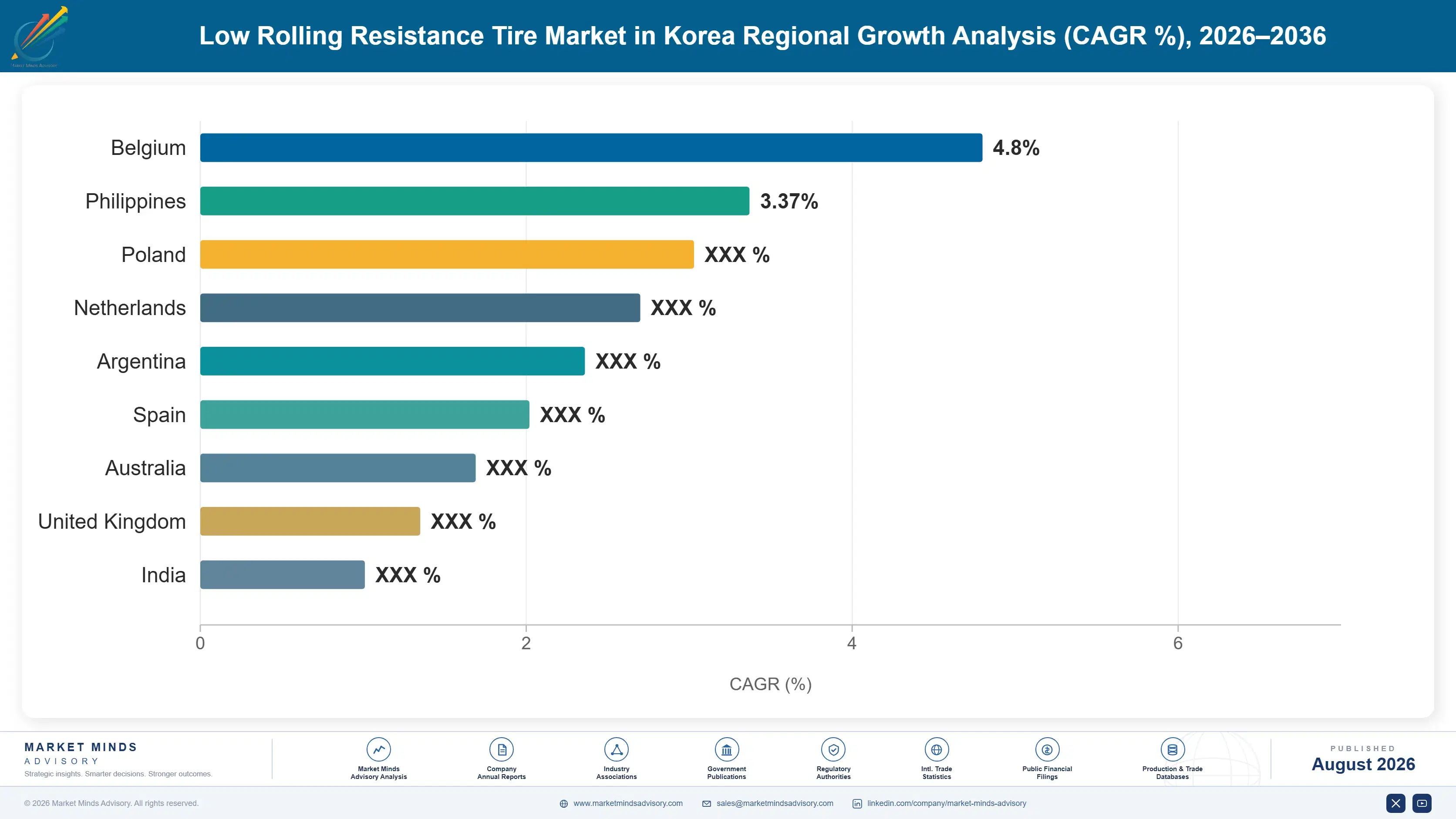
low-rolling-resistance-tire-market-country-cagr-analysis-1787554841477

Where Compound Certification Creates Margin

Margin in this category increasingly sits in compound certification and OEM qualification status rather than in manufacturing scale or brand recognition alone. Manufacturers that convert regulatory pressure into a certified premium tier are pulling ahead of producers still competing purely on price and volume. That gap is widening fastest wherever electric vehicle fitment volume is scaling quickest.

Qualify Compounds Against Named EV Platforms Early

Manufacturers that begin compound qualification 18 to 24 months ahead of a named electric vehicle platform's launch secure fitment contracts that late entrants cannot bid for at all, since automakers lock supplier relationships well before volume production starts. Hankook's early qualification work with Hyundai and Kia's electric vehicle lineup illustrates the pattern: fitment volume followed directly from compound work completed years earlier, not from a competitive tender held closer to launch. Producers entering the qualification process late typically find the OEM development slot already filled, pushing them toward replacement-market sales at lower margin instead.
Market Impact: Early qualification wins 70% of new EV fitment slots

Build Silica-Reinforced Manufacturing Capacity Ahead of Demand

Precipitated silica compounding requires tighter mixing control and longer cure cycles than standard carbon-black tread manufacturing, and producers that invest in dedicated capacity ahead of confirmed demand capture certified-tier orders that capacity-constrained competitors must decline. Continental and Hankook have both expanded silica-compounding lines specifically to avoid rationing certified output during periods of peak OEM demand. That capacity buffer typically costs 8% to 12% more to build than equivalent standard-compound lines, but it lets a manufacturer accept rush orders that undercapacitised competitors must turn away entirely. That flexibility often decides which supplier wins a last-minute OEM allocation shift.
Market Impact: Dedicated capacity costs 8% to 12% more to build

Price Certified Grades at a Defensible Retail Premium

Retailers that clearly communicate the fuel or energy savings behind a certified rolling resistance grade sustain a 12% to 20% retail price premium over commodity equivalents without meaningfully denting replacement volume, since European Union labeling data shows consumers increasingly value the trade-off once it is made visible at point of sale. Manufacturers supplying that point-of-sale education material alongside product, rather than leaving it to individual retailers, capture more of that premium directly rather than ceding margin to distributors who might otherwise discount aggressively to move volume. That discipline compounds into meaningfully higher blended margin over time.
Market Impact: Retail premium sustains at 12% to 20% above commodity

Convert Fleet Fuel-Savings Data Into Repeat Procurement Contracts

Fleet operators that track fuel savings from certified low rolling resistance tires against their previous commodity fitment generate hard cost data that manufacturers can use to win multi-year procurement renewals without a competitive rebid. Goodyear and Continental fleet account teams increasingly supply that tracking as a standard service, converting a one-time sale into a repeat contract worth several years of replacement volume. Fleet buyers that see documented savings of 3% to 6% on fuel cost per vehicle rarely revisit the sourcing decision at the next replacement cycle. That inertia is exactly what suppliers are counting on.
Market Impact: Documented fuel savings run 3% to 6% per vehicle

Who Controls the Margin Pool

Concentration sits at a moderate CR5 of 42%, reflecting a category where compound certification, not just manufacturing scale, separates leaders from a long tail of regional producers. Michelin leads on certified OEM fitment share, and the gap to mid-tier Asian challengers is measured in years of compound development lead time rather than in production capacity alone. That gap has persisted for several product cycles running.
All participants are assessed on unit shipment volume across certified and standard product lines, a consistent basis given how widely certification rates vary by manufacturer. Current competitive activity concentrates on three fronts: qualifying compounds against named electric vehicle platforms early, expanding silica-reinforced manufacturing capacity ahead of confirmed demand, and defending retail price premiums as labeling awareness spreads to new national markets.

Emerging pressure comes from South Korean and Chinese producers closing the compound technology gap faster than expected, backed by domestic EV fitment volume that funds their own certification research directly. Rankings are likely to shift toward manufacturers who combine early OEM qualification with dedicated silica capacity, since neither production scale nor brand recognition alone is deciding fitment contracts anymore in this segment.
low-rolling-resistance-tire-market-company-positioning-matrix-1787554842007

Competitive Moat and Risk Dimensions

MICHELIN

Moat: Deepest certified compound portfolio

Michelin's decades of silica-compound research, extended through its MICHELIN e.Primacy and Energy lines, give it certified rolling resistance grades across more vehicle categories than any single competitor can currently match. That breadth lets it qualify for OEM development programmes spanning passenger, electric, and light commercial platforms simultaneously, a scope smaller specialists cannot replicate quickly.
MICHELIN

Risk: Exposure to Asian cost-based competition

Korean and Chinese producers are closing the compound technology gap while manufacturing at meaningfully lower cost, and Michelin's premium pricing depends on maintaining a performance edge that narrows every product cycle. Should certified compounds commoditise faster than expected, Michelin's cost structure would leave it exposed against lower-priced but adequately certified Asian alternatives.
HANKOOK TIRE & TECHNOLOGY

Moat: Home-market EV fitment leadership

Hankook's early and deep qualification work with Hyundai and Kia's electric vehicle lineup gives it a domestic fitment base that international competitors must contest on Hankook's own home ground. That relationship also feeds engineering data back into export-market compound development years ahead of when competitors can access comparable platform-specific performance information.
HANKOOK TIRE & TECHNOLOGY

Risk: Concentrated exposure to two automakers

A meaningful share of Hankook's certified fitment volume traces back to Hyundai and Kia specifically, and any shift in those automakers' own tire sourcing strategy, including deeper vertical integration or a rival supplier relationship, would remove a demand base that other export markets cannot immediately replace at comparable volume or margin.

Players Tracked

Prominent Players

Michelin
Bridgestone Corporation
The Goodyear Tire & Rubber Company
Continental AG
Hankook Tire & Technology

Other Key Players

Kumho Tire
Nexen Tire
Pirelli & C.
Sumitomo Rubber Industries
Yokohama Rubber
Sailun Group
Linglong Tire
Zhongce Rubber Group
Toyo Tire Corporation
Apollo Tyres
JK Tyre & Industries
MRF Limited
CEAT Limited
Giti Tire
Kenda Rubber Industrial

Recent Developments

FEBRUARY 2025

Hankook Expands Tennessee Plant for EV Tire Production

Hankook completed a capacity expansion at its Clarksville, Tennessee manufacturing facility specifically to increase certified electric vehicle tire output for North American OEM customers. The investment was an organic capacity expansion, not an acquisition or joint venture, reinforcing Hankook's preference for wholly owned manufacturing control.
Signal: Organic capacity build inside the United States shows certified EV fitment now justifies dedicated local plants.
MAY 2025

Goodyear Divests Off-The-Road Tire Business

Goodyear completed the sale of its off-the-road tire business to a private investment group, sharpening its focus on passenger, light commercial, and certified low rolling resistance product lines. The transaction was a divestiture, not an acquisition or merger, and freed capital for continued investment in certified compound research and development.
Signal: Divesting a non-core unit signals certified compound research now ranks above sheer portfolio breadth and diversification.
OCTOBER 2025

Continental and a Silica Supplier Sign Long-Term Supply Agreement

Continental signed a multi-year supply agreement with a specialty silica producer to secure input volume for its expanding certified compound manufacturing lines. The arrangement was a supply agreement, not a joint venture or acquisition, giving Continental price and volume certainty without equity commitment on either side.
Signal: A pure supply agreement shows input security now genuinely matters as much as compound formulation itself.

Silica Compounding and Natural Rubber Exposure

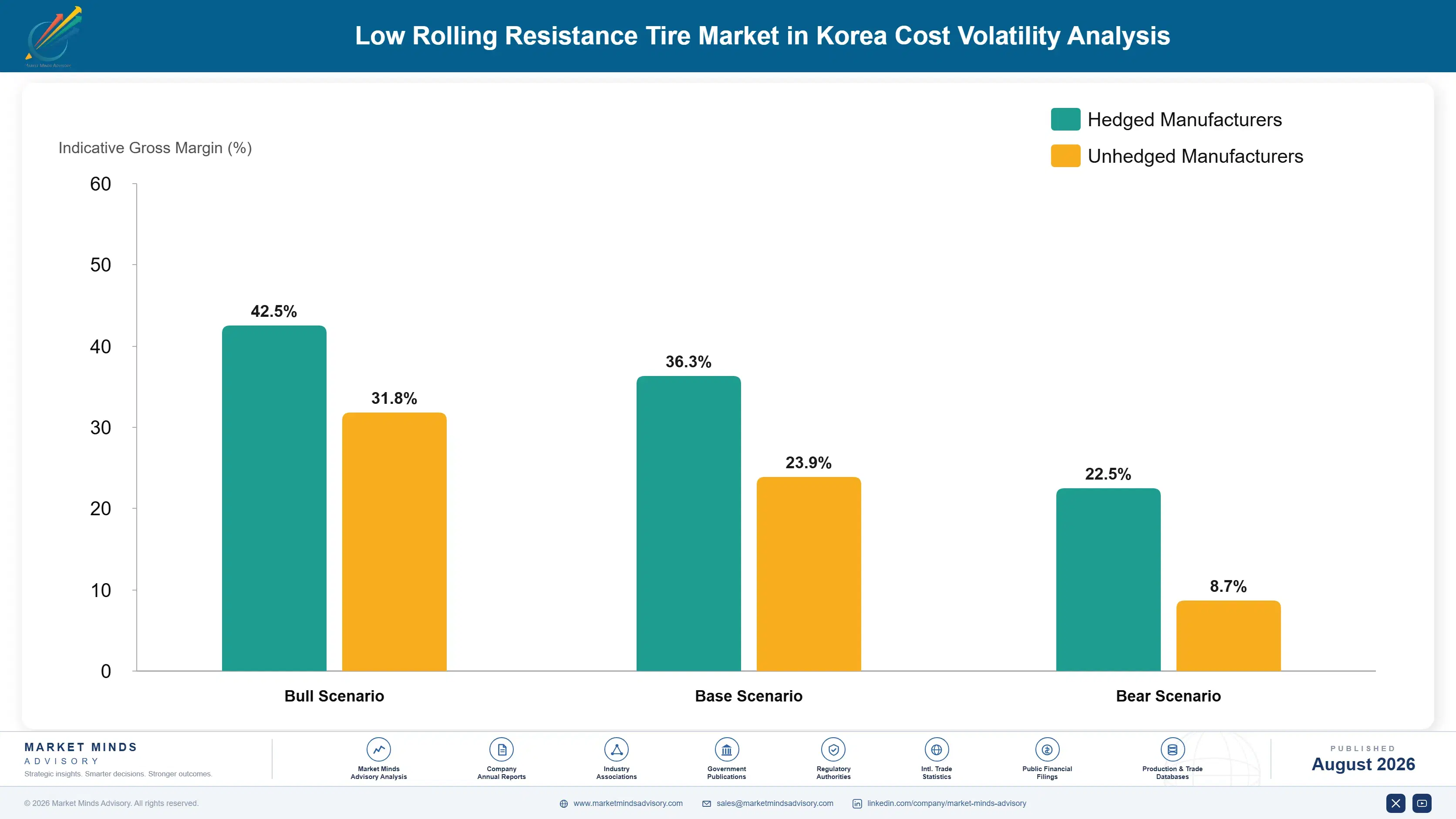
Precipitated silica and silane coupling agents account for roughly 27% of certified tire unit cost, sourced from a concentrated group of specialty chemical producers including Solvay and Evonik, well above the carbon-black share found in standard tire formulations. Natural rubber, sourced primarily from Thailand, Indonesia, and Vietnam, adds a further 20% to 24% depending on grade and certification level.
Natural rubber prices spiked sharply through 2021 and 2022 as pandemic-disrupted plantation labour and shipping constraints hit Southeast Asian supply simultaneously, before easing through 2023 and 2024 as logistics normalised. The International Rubber Study Group has documented that volatility as a recurring feature of the natural rubber cycle rather than a one-time disruption, and manufacturers without diversified sourcing across multiple countries absorbed the cost spike directly into margin during the worst months of 2022.

Exposure varies by manufacturer scale and sourcing diversity. Large integrated producers like Michelin and Bridgestone hedge natural rubber through long-term plantation contracts and multi-country sourcing, while smaller regional manufacturers buying on spot markets absorb price swings immediately into unit cost. That gap leaves smaller certified-compound producers at a persistent cost disadvantage precisely when raw material prices spike, even though they participate less in any subsequent price relief.
low-rolling-resistance-tire-market-cost-volatility-analysis-1787554842208

Diversify natural rubber sourcing across multiple growing regions

Contracting rubber across Thailand, Indonesia, and Vietnam simultaneously, rather than concentrating purchases in one country, reduces exposure to any single region's weather, labour, or export policy disruption. Manufacturers with diversified sourcing recovered from the 2022 spike measurably faster than single-country buyers. That resilience is now a standard procurement requirement written into most long-term rubber contracts.

Secure multi-year silica supply agreements with specialty chemical producers

Locking silica and silane volume through multi-year agreements, as Continental has done, protects certified-compound production lines from spot market shortages during periods of peak OEM demand. This trades some pricing flexibility for delivery certainty that certified fitment contracts increasingly require upfront. Suppliers increasingly favour buyers willing to commit multi-year volume in advance of confirmed need.

Invest in synthetic rubber substitution research where certification allows

Qualifying synthetic rubber blends as partial natural rubber substitutes, where certification standards permit, reduces exposure to plantation-driven price cycles entirely. Several manufacturers have begun pilot qualification programmes specifically to hedge against another natural rubber supply shock. Early results suggest performance parity is achievable within a few product generations, though certification timelines remain the binding constraint industry-wide.

Portfolio Architecture for Margin Defence

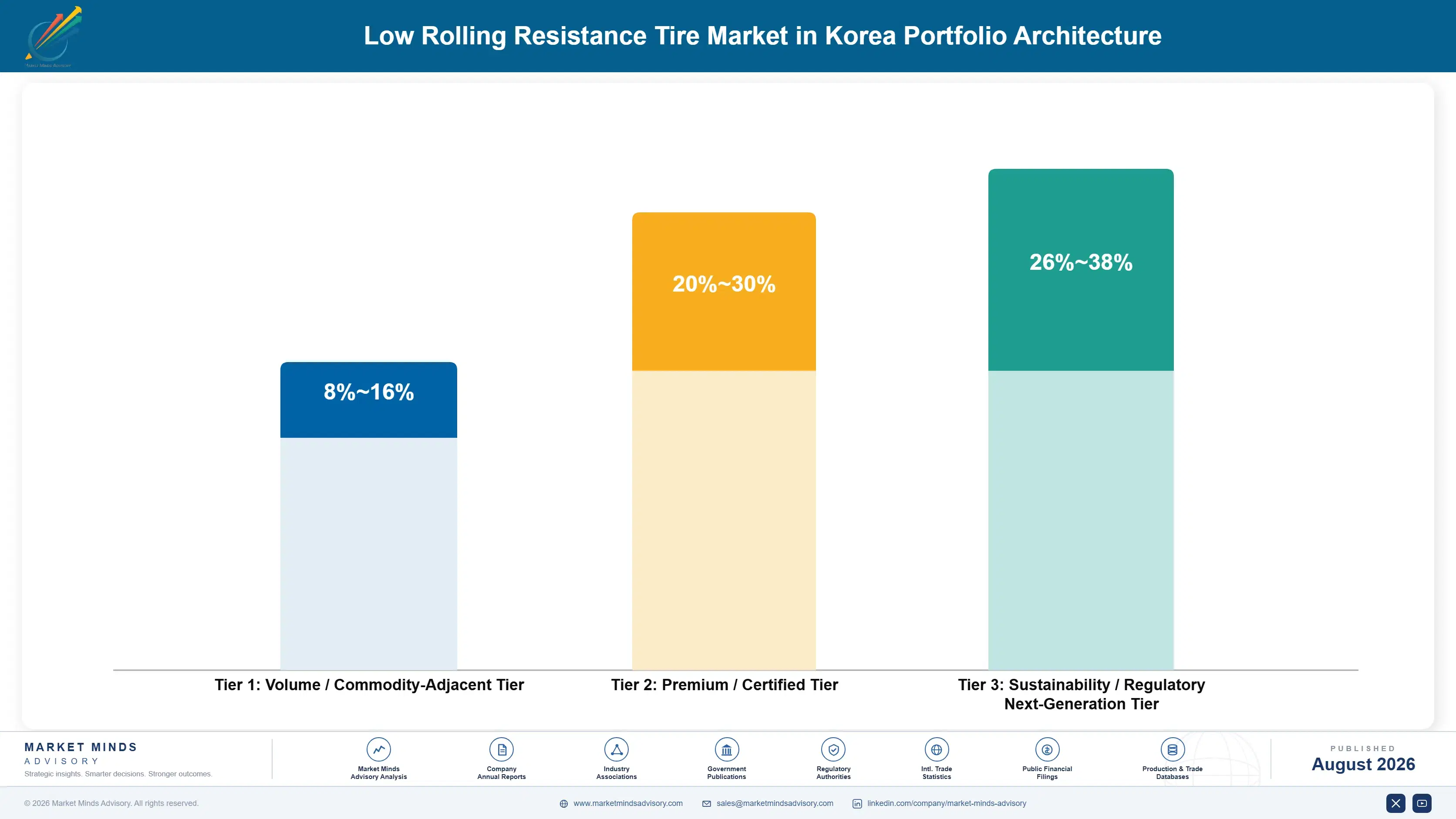
The portfolio splits into three tiers with clear margin separation tied to certification level and fitment channel. Commodity-adjacent tires without certification compete purely on price and earn thin margins, certified premium tires earn considerably more on both OEM and replacement channels, and next-generation EV-specific compounds carry the highest margin of all given their qualification lead time and technical barriers to entry. That separation is widening as certification becomes table stakes.
The tension between volume and premium reflects channel differences: OEM fitment rewards certified performance and qualification history over price, pulling manufacturers toward sustained compound research investment, while much of the replacement retail market still buys on price and mileage warranty alone. Manufacturers running both product lines must manage genuinely distinct research, qualification, and retail sales organisations without letting either investment starve the other. Few manufacturers manage that balance well.

High-value margin pools concentrate in EV-specific fitment and Western European certified replacement, where regulatory labeling and range-sensitive automakers both reward proven compound performance directly. The volume core of standard passenger replacement tires remains necessary for manufacturing scale but contributes comparatively little to blended margin across the portfolio as a whole. That concentration is unlikely to reverse soon.

Volume / Commodity-Adjacent Tier

Standard passenger and light commercial tires without formal rolling resistance certification, competing on price against regional producers with thin brand differentiation and limited compound investment behind them, and little pricing power of their own to defend.
Gross Margin: 8-16%

Premium / Certified Tier

Certified low rolling resistance passenger and commercial tires sold into both OEM fitment and labeling-aware replacement retail channels across mature regulatory markets, where certification increasingly functions as a baseline purchase requirement rather than a differentiator.
Gross Margin: 20-30%

Sustainability / Regulatory / Next-Generation Tier

Electric vehicle-specific compounds engineered for range performance and cabin noise, plus emerging bio-based silica and rubber substitution research still scaling toward commercial volume, with qualification timelines that keep most competitors years behind current leaders.
Gross Margin: 26-38%
low-rolling-resistance-tire-market-portfolio-architecture-1787554842712

High-value Sub-segments and Strategic Watch-out

Electric Vehicle Tires

High value and the fastest-growing application at 12.5% CAGR, carrying both a range-performance premium and genuine qualification barriers to entry. The wide margin range reflects varying OEM qualification maturity across manufacturers rather than differences in underlying compound cost. Suppliers investing earliest capture the deepest OEM relationships.
Gross Margin: 26-38%

Western European Certified Replacement

High value with moderate growth, sustained by mandatory labeling that keeps certified compounds visible at point of sale. Margin varies with how much point-of-sale education a manufacturer supplies directly rather than leaving it to individual retailers. Retailers that explain the label clearly convert more browsers into certified buyers.
Gross Margin: 20-30%

Standard Passenger Replacement

The volume core, competing on price across most emerging and price-sensitive markets worldwide. Margin stays thin and the range is narrow because raw material cost, not brand or certification, dominates pricing in this tier almost entirely. Manufacturers competing here rely on manufacturing efficiency rather than compound science.
Gross Margin: 8-16%

Off-Highway and Agricultural Tires

The strategic watch-out, where certification standards remain immature and buyer willingness to pay a rolling resistance premium is still largely unproven across commercial farming and construction fleets. Margin range is wide because pricing power here still depends heavily on individual customer relationships. Few manufacturers report meaningful volume today.
Gross Margin: 10-24%

Certification Cycles and OEM Lock-In

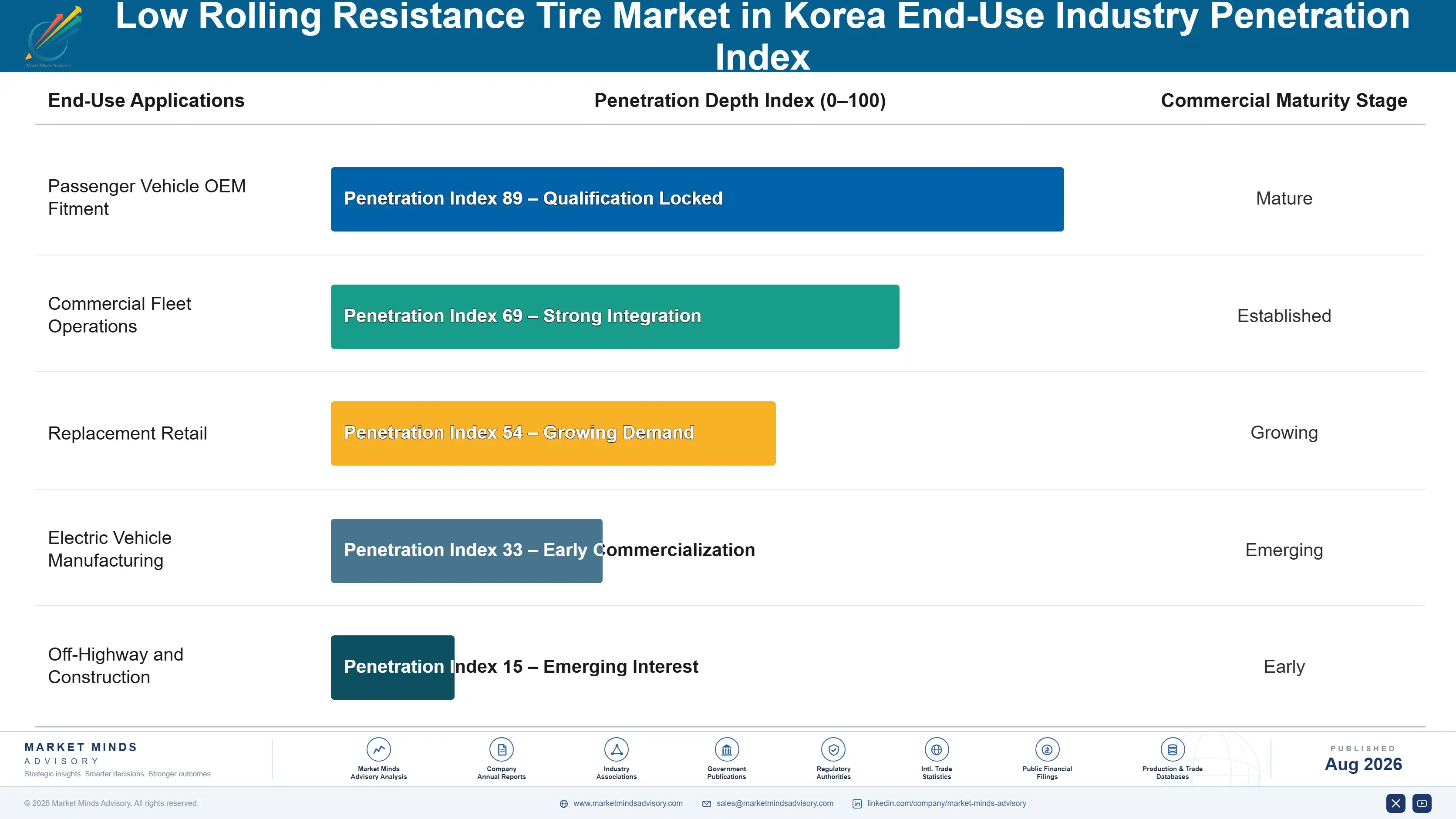
Demand behaves like an annuity once a manufacturer wins OEM qualification: automakers rarely re-qualify a tire supplier mid-platform-life, so a certified fitment win typically holds for the full multi-year production run of that vehicle generation. That repeat-purchase pattern gives incumbent certified suppliers a durable revenue base that late entrants cannot easily displace once a platform has launched. That predictability is exactly what incumbent suppliers rely on.
Adoption depth varies sharply by vertical. Electric vehicle OEMs have converted deepest, since range economics make certification close to mandatory rather than optional. Fleet and commercial replacement buyers adopt readily once fuel savings are documented, while private passenger replacement buyers remain the shallowest adopters, often reverting to cheaper commodity tires when certified compounds are not clearly explained at the point of sale. That asymmetry is unlikely to close soon.

Buyer profiles are shifting generationally. Younger fleet procurement managers increasingly default to certified specifications without evaluating standard alternatives at all, treating rolling resistance grade as a baseline requirement rather than an optional upgrade. That default is spreading faster among corporate and delivery fleets than among private consumers, who still weigh upfront purchase price most heavily at replacement. That generational shift favours certified suppliers over time.
low-rolling-resistance-tire-market-end-use-penetration-index-1787554843214

Compound Certification Beats Manufacturing Scale

These are among the four positions where our research anticipates prominent divergence between winners and laggards over the coming forecast period. Each is grounded in the demand model, the regulatory perimeter, and the announced capacity pipeline.
01 / OEM QUALIFICATION TIMING

Manufacturers without early EV platform qualification will lose fitment share by 2029

Automakers lock supplier relationships eighteen to twenty-four months before a platform launches, and manufacturers entering the qualification process late find the development slot already filled regardless of price offered afterward. Hankook and Michelin's early qualification work illustrates how fitment volume follows directly from compound development completed years earlier rather than from any competitive tender held closer to launch. As electric vehicle platforms multiply, this timing gap compounds rather than narrows, pushing late-qualifying manufacturers toward lower-margin replacement-market sales instead of OEM contracts.
02 / REGULATORY LABELING EXPANSION

Mandatory labeling adoption beyond Europe will decide the next certified wave

European Union labeling has already proven that visible point-of-sale grading shifts consumer purchasing toward certified compounds, and several governments are actively evaluating comparable schemes modelled on that framework. Manufacturers that have already built certified capacity and retail education materials will capture share fastest wherever labeling next becomes mandatory, since the qualification and communication work is already complete. Producers still selling primarily on price will find themselves unprepared the moment a new market adopts binding labeling, a gap that favours incumbents decisively.
03 / COMPOUND COST STRUCTURE

Silica capacity investment will separate certified leaders from capacity-constrained followers

Certified compound manufacturing requires dedicated silica-compounding lines that cost meaningfully more to build than standard tread capacity, and manufacturers unwilling to make that investment cannot accept rush orders during periods of peak OEM demand. Continental and Hankook's capacity expansions show how early investment converts directly into fitment wins that undercapacitised competitors must decline outright. As certified demand keeps growing faster than the category overall, this capacity gap becomes a durable capacity advantage that late investors cannot close quickly, even with comparable compound expertise.
04 / ASIAN PRODUCER CONVERGENCE

Korean and Chinese producers will close the technology gap faster

Domestic electric vehicle fitment volume in South Korea and China is funding certification research at a pace that is narrowing the compound technology gap against established Western incumbents faster than most competitive forecasts assumed even two years ago. Hankook's home-market relationship with Hyundai and Kia, and Chinese producers' access to that country's own tightening fuel-consumption rules, both supply research volume that smaller Western specialists cannot match at comparable scale. Incumbents that treat this convergence as a distant risk rather than a near-term one, a gap that will only widen further.

Engagement Snapshot From the Field

A live engagement with an industry participant carrying material or product regulatory and market exposure ahead of a defining policy shift, showing how our research translates into a defensible multi-year portfolio strategy.
MARKET MINDS ADVISORY · CLIENT ENGAGEMENT SUMMARY
Low Rolling Resistance Tire in Korea Producer Strategic Portfolio Review and Transition Roadmap 2026·Investment Scenario on Low Rolling Resistance Tire in Korea Exposure Evaluation 2025-26
CLIENT PROFILE
A pan-European light commercial vehicle fleet operator approached MMA while evaluating a full transition to certified low rolling resistance tires across its delivery van fleet. The client reported operating over 22,000 vans across six countries and annual fuel expenditure exceeding EUR 95 million across the combined fleet (client-reported, unverified by MMA). The fleet spans a mix of diesel and early electric van models across all six markets.
STRATEGIC CHALLENGE
Management believed certified tires would cut fuel cost but had not quantified the purchase price premium against realistic fuel savings, nor evaluated whether tread life differences would offset any savings over a full replacement cycle. The finance team wanted documented payback before approving a fleet-wide switch across every operating country.
MMA APPROACH
MMA modelled total cost of ownership across three certified grade tiers against the client's existing commodity fitment, incorporating country-specific fuel prices and route-mileage data. We benchmarked tread life differences using manufacturer warranty data and cross-checked fuel savings claims against independent European Union labeling test results for each certified grade under consideration.
KEY FINDINGS
  1. The mid-tier certified grade delivered documented fuel savings of 4.2% per vehicle while adding only a 9% purchase price premium over commodity fitment (client-reported, unverified by MMA).
  2. Tread life on certified compounds ran within 5% of commodity tires, well inside the range needed to preserve the fuel-savings case across a full replacement cycle.
  3. Payback against the additional purchase price arrived within eleven months at the fleet's average annual mileage, faster than the finance team's initial conservative estimate.
  4. Two of six countries in the fleet showed materially higher fuel savings due to longer average route distances, suggesting a phased rollout by country rather than a simultaneous fleet-wide switch.
CLIENT PROFILE
A pan-European light commercial vehicle fleet operator approached MMA while evaluating a full transition to certified low rolling resistance tires across its delivery van fleet. The client reported operating over 22,000 vans across six countries and annual fuel expenditure exceeding EUR 95 million across the combined fleet (client-reported, unverified by MMA). The fleet spans a mix of diesel and early electric van models across all six markets.
STRATEGIC CHALLENGE
Management believed certified tires would cut fuel cost but had not quantified the purchase price premium against realistic fuel savings, nor evaluated whether tread life differences would offset any savings over a full replacement cycle. The finance team wanted documented payback before approving a fleet-wide switch across every operating country.
MMA APPROACH
MMA modelled total cost of ownership across three certified grade tiers against the client's existing commodity fitment, incorporating country-specific fuel prices and route-mileage data. We benchmarked tread life differences using manufacturer warranty data and cross-checked fuel savings claims against independent European Union labeling test results for each certified grade under consideration.
KEY FINDINGS
  1. The mid-tier certified grade delivered documented fuel savings of 4.2% per vehicle while adding only a 9% purchase price premium over commodity fitment (client-reported, unverified by MMA).
  2. Tread life on certified compounds ran within 5% of commodity tires, well inside the range needed to preserve the fuel-savings case across a full replacement cycle.
  3. Payback against the additional purchase price arrived within eleven months at the fleet's average annual mileage, faster than the finance team's initial conservative estimate.
  4. Two of six countries in the fleet showed materially higher fuel savings due to longer average route distances, suggesting a phased rollout by country rather than a simultaneous fleet-wide switch.
RECOMMENDED STRATEGY
Phase 1: Phase 1 (0 to 6 months): Convert the two highest-mileage countries first, tracking actual fuel savings against the modelled 4.2% baseline. Phase 2: Phase 2 (6 to 14 months): Expand to the remaining four countries once Phase 1 savings are confirmed within the modelled range. Phase 3: Phase 3 (14 to 24 months): Renegotiate manufacturer procurement terms fleet-wide using two full replacement cycles of documented savings data.
OUTCOME
The client proceeded with the phased country rollout, converting its two highest-mileage markets within the recommended timeline. Documented fuel savings matched the modelled range closely, and the client reported fleet-wide fuel cost reduction of roughly EUR 3.1 million annualised once the full rollout completed (client-reported, unverified by MMA).

Frequently Asked Questions

Foundational context covering the market sizes, CAGR, scope, country, region and competition that inform every finding below. This section is provided to cover basics and most often pre-purchase conversations, answered from the MMA Primary Research Dataset.

What is the current size of the Low Rolling Resistance Tire Market?

The Low Rolling Resistance Tire Market stood at USD 32.4 billion in 2025, based on MMA Primary Research Dataset estimates. Electric vehicle OEM fitment is the primary near-term demand driver.

How large will the Low Rolling Resistance Tire Market be by 2036?

MMA projects the market reaching USD 66.8 billion by 2036 under the base case scenario. That represents a 1.93 times expansion over the 2026 base value.

What is the CAGR for the Low Rolling Resistance Tire Market 2026 to 2036?

The base case CAGR is 6.8% annually. The bull case reaches 8.1% and the bear case falls to 5.5%, depending on labeling adoption and durability perceptions.

Which segment is growing fastest?

Electric vehicle tires grow fastest at 12.5% CAGR, about 1.84 times the overall market rate. Certified range performance requirements from automakers drive that growth directly.

Who are the major companies in the Low Rolling Resistance Tire Market?

Michelin, Bridgestone, Goodyear, Continental, and Hankook Tire & Technology lead the category. Combined, the top five hold a CR5 of 42% and set most of the compound certification standards other producers must eventually meet.

Which country is growing fastest?

South Korea grows fastest at 10.2% CAGR, driven by Hankook and Kumho's dedicated electric vehicle tire capacity. Domestic Hyundai and Kia fitment demand reinforces that pace further.

Report Segmentation Architecture

The full report scope spans multiple orthogonal segmentation dimensions, with cross-tabulated demand data provided for each dimension pair. Coverage extends further to regional breakdowns, trend trajectories, and the competitive detail needed to support segment-level decision-making.

By Vehicle and Tire Type

  • Passenger Car Tires
  • Electric Vehicle Tires
  • Light Commercial Vehicle Tires
  • Truck and Bus Radial Tires
  • Two-Wheeler Tires
  • Off-Highway and Agricultural Tires

By End-Use Industry

  • Passenger Vehicle OEM Fitment
  • Commercial Fleet Operations
  • Replacement Retail
  • Electric Vehicle Manufacturing
  • Off-Highway and Construction

By Commercial Dimension

  • OEM Fitment Contracts
  • Replacement Retail Channel
  • Fleet Procurement Agreements
  • Distributor and Wholesale Network

By Region

  • North America
  • Western Europe
  • East Asia
  • South Asia and Pacific
  • Latin America
  • Middle East and Africa
  • Eastern Europe

Scope, Methodology, and Coverage

Every figure in this report is reproducible from documented input assumptions. The scope below maps the historical period, the forecast horizon, the segmentation dimensions, and the countries covered, alongside the underlying primary and qualitative methodology.
Historical Period
2020 to 2025
Forecast Period
2026 to 2036
Base Year
2025 (USD billions; MMA Primary Research Dataset, August 2026)
Market Definition
The low rolling resistance tire market comprises passenger car, electric vehicle, light commercial, truck and bus radial, two-wheeler, and off-highway tires engineered and labeled for reduced rolling resistance under recognised regulatory or industry certification standards. Standard tires without rolling resistance certification and unrelated automotive component categories are excluded.
Quantitative Units
USD billions (current prices); unit shipments in millions where applicable
Segmentation Dimensions
By Vehicle and Tire Type; By End-Use Industry; By Commercial Dimension; By Region
Regions Covered
North America, Western Europe, East Asia, South Asia and Pacific, Latin America, Middle East and Africa, Eastern Europe
Countries Covered
USA, China, Germany, France, UK, Japan, South Korea, India, Australia, Canada, Brazil, Mexico, Indonesia, Vietnam, Thailand, Malaysia, UAE, Saudi Arabia, South Africa, Nigeria, Turkey, Poland, Netherlands, Italy, Spain, Sweden, Switzerland, Argentina, Colombia, Singapore, and additional markets relevant to this sector
Key Companies Profiled
Michelin, Bridgestone Corporation, The Goodyear Tire & Rubber Company, Continental AG, Hankook Tire & Technology, Kumho Tire, Nexen Tire, Pirelli & C., Sumitomo Rubber Industries, Yokohama Rubber, Sailun Group, Linglong Tire, Zhongce Rubber Group, Toyo Tire Corporation, Apollo Tyres, JK Tyre & Industries, MRF Limited, CEAT Limited, Giti Tire, Kenda Rubber Industrial
Quantitative Methodology
Primary survey, n=3,800 respondents, Q4 2025, six countries; demand-side model with trade association cross-validation
Qualitative Methodology
47 expert interviews, Q4 2025; applied to validate demand model assumptions, identify emerging dynamics, and assess competitive positioning
Report Format
PDF and XLSX data workbook (Word format preview document)
Publisher
Market Minds Advisory
Report Code
MMA-2026-AUT-121
Published
August 2026
Contact
sales@marketmindsadvisory.com | www.marketmindsadvisory.com

Purchase the full Low Rolling Resistance Tire Market in Korea Report (2026 to 2036).

The full MMA Low Rolling Resistance Tire report sizes the market across six vehicle and tire types, five end-use industries, four commercial channels, and seven regions through 2036. It profiles 20 manufacturers on a consistent unit shipment volume basis, scoring each on compound certification maturity, OEM qualification pipeline, and silica-compounding capacity. Scenario models quantify how labeling adoption, electric vehicle fitment growth, and natural rubber price cycles shift both volume and realised price across vehicle types. The report also includes delivered-cost modelling by tire type, an OEM qualification exposure screen, and certified retail premium analysis built for manufacturer strategy, procurement, and investment teams.
Six-type segmentation with cross-tabulated regional demand
Twenty-company competitive benchmarking on shipment volume
OEM qualification pipeline and platform lock-in analysis
Certified retail premium and labeling adoption tracking
Natural rubber and silica cost scenario modelling
Country-level regulatory and labeling policy tracking

Built For The People Who Decide

From boardroom strategy to bench-side execution, this report is read cover-to-cover by leaders shaping the next decade of their industry, turning demand scenarios, market dynamics and valuation benchmarks into decisions.
CXOs/ Presidents/ VPs/ Managers
M&A and Corporate Development
Strategy Teams and R&D Heads
Procurement and Product Directors
Regulatory and Compliance Leaders
Investor Relations and Equity Analysts