
Market Minds Advisory
Lightweight Automotive Body Panels Market

Lightweight Automotive Body Panels Market: Battery Mass Offset, Repair Economics and Substrate Competition to 2036

Battery packs added four hundred kilogrammes to the average electric vehicle, which made every gramme in the body worth paying for again, and then insurers noticed what aluminium costs to repair.

Lead Analyst

David Horsley

Published

September 2026

Make Smarter Decisions with Customized Research Insights

Request a free sample report and evaluate market opportunities, growth trends, and competitive dynamics relevant to your business needs.

2025 MARKET VALUE$38.6BMarket Size 2025
2036 FORECAST VALUE$84.7BBase Case , 2026 to 2036
CAGR 2026 TO 20367.4 %Bull 8.6% / Bear 6.2%
INCREMENTAL OPPORTUNITY$43.2BNet 10- year value creation
EXPANSION MULTIPLE2.04x2036 value over 2026 base
Strategic Levers
M&A Pipeline
Regional Outlook
Country Rankings
Competitive Intelligence
Segmental Deep-dive
Call-Us : 91 93563 13602

Executive Snapshot and Market Trajectory

A battery pack adds around 420 kilogrammes, and every kilogramme taken out of the body buys range back more cheaply than adding cells does. That arithmetic revived lightweighting after a decade of polite interest. What nobody modelled was the repair bill. Nobody did.
Thermoplastic composite panels grow at 11.1%, half again the market rate of 7.4%, because they cycle faster than thermoset compounds, recycle in ways thermosets do not and shrug off the parking-lot damage that makes aluminium expensive. East Asia holds 30% of value on Chinese vehicle production and its electric vehicle programmes together. Aluminium closures now appear on 34% of new vehicles, which is where the repair question bites hardest.
Five suppliers hold just 29% of panel value and the fragmentation is genuine, because stamping and moulding capacity sits close to assembly plants and regional suppliers serve them. Steel has mounted a serious defence that most lightweighting commentary ignores: third-generation advanced high-strength grades deliver much of the mass benefit at a fraction of the cost and almost none of the repair penalty. Lightweight and aluminium stopped being synonyms. Very few purchasing teams caught that.
Market Definition
This report covers exterior and structural body panels supplied for passenger and light commercial vehicles where mass reduction is a design objective, spanning aluminium sheet, advanced and press-hardened steel, sheet moulding compound, thermoplastic composite, carbon fibre reinforced and magnesium alloy construction. Value is measured at tier one supply level. Excluded are chassis and frame structures, battery enclosures, interior trim, glazing, bumper systems, and complete body-in-white assemblies sold as a unit.
Base Year Value
$38.6B in 2025 (MMA Primary Research Dataset, August 2026)
Forecast Period
2026 to 2036, eleven discrete annual values
CAGR
7.4% base case. Bull 8.6%. Bear 6.2%.
Fastest Growth Segment
Thermoplastic Composite Panels: 11.1% CAGR
Fastest Growth Country
India: 10.4% CAGR
Fastest Growth Region
South Asia and Pacific: 9.6% CAGR
Largest Region
East Asia: 30% of 2025 global value
Market Leaders
Novelis, Magna International, Gestamp Automocion, Constellium and Benteler Automotive lead the market. Source: MMA Primary Research Dataset, July 2026.
Primary Survey
n=3,800 procurement and R&D decision-makers, Q4 2025, six countries
Methodology
Demand-side build-up, cross-validated against public data, 47 expert interviews

Lightweight Automotive Body Panels Market Forecast Scenarios

lightweight-automotive-body-panels-market-size-forecast-scenario-1787555265144
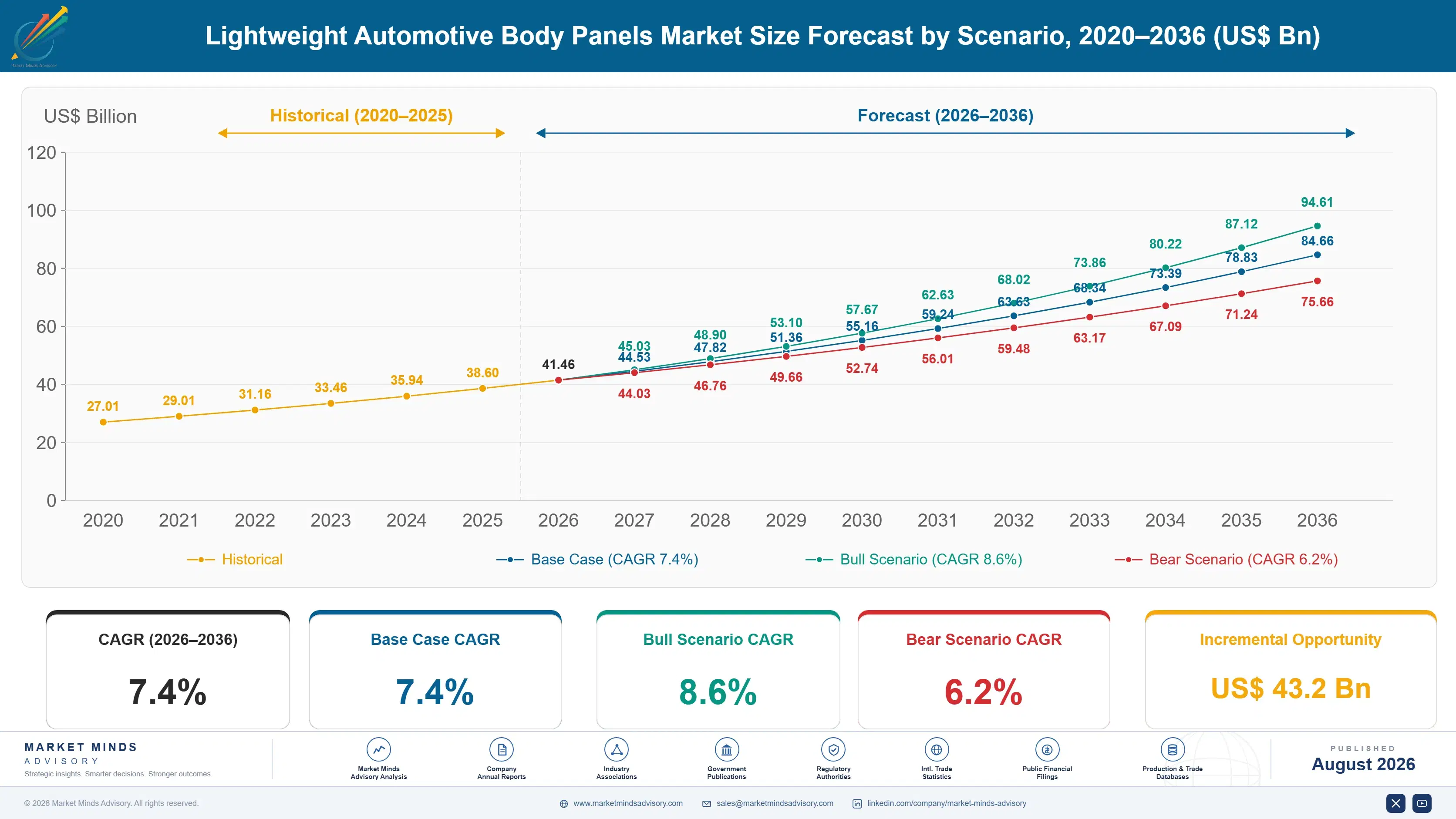
Growth ran at 6.2% between 2020 and 2025 and electric vehicle programmes drove almost all of it. Aluminium closure adoption spread from premium models into mainstream volume as manufacturers hunted range, and composite tailgates took hold across European platforms. Conventional vehicle programmes contributed little, since the mass case never justified the cost premium without a battery to offset. The period was an electrification story wearing a materials label.
The 7.4% base case rests on three mechanisms. Electric vehicle production keeps expanding across every major market, and every one of those programmes carries a mass penalty that body panels are the cheapest place to answer. Thermoplastic composites keep taking closure applications at 11.1% on cycle time and repairability rather than on mass alone. And European recycled content requirements push aluminium sheet suppliers into closed-loop scrap arrangements that raise value per tonne.
The 8.6% bull case is carbon fibre reaching cost parity on closures through faster cure chemistry, which would open volume applications that have stayed niche for twenty years. The 6.2% bear case is insurance: an aluminium panel costs roughly 2.6 times more to repair, and insurers pricing that into premiums have already begun changing what fleet buyers specify.

Why Mass Suddenly Mattered Again

Lightweighting has been an industry talking point for thirty years and a genuine engineering priority for about six. What changed was the battery. A pack adds roughly 420 kilogrammes to a vehicle, and every kilogramme removed elsewhere buys range back at a cost per kilogramme far below adding cells. That converted body mass from a marketing claim into a line item somebody defends in a programme review, which is a completely different commercial situation for anybody selling panels.
TOP-FIVE CONCENTRATION29%Combined position across body panel supply held by leaders
BATTERY MASS PENALTY420 kgAdditional vehicle weight a typical battery pack introduces
ALUMINIUM CLOSURE PENETRATION34%Share of new vehicles using aluminium for closure panels
PANEL REPAIR COST MULTIPLE2.6xHow much more an aluminium panel costs to repair
MATERIAL COST SHARE58%Portion of panel cost attributable to the raw substrate
RECYCLED ALUMINIUM CONTENT42%Average secondary metal content across automotive sheet supply
Then the repair bills arrived. An aluminium panel costs roughly 2.6 times more to fix than a steel one, because it work-hardens, needs isolated tooling and separate bays, and cannot be pulled and filled the way steel can. Insurers have priced that into premiums, fleet buyers have noticed it in total cost of ownership and residual values on aluminium-intensive models reflect it. Nobody modelled this at the design stage and it is now a purchasing conversation.
Steel answered better than anybody expected. Third-generation advanced high-strength grades deliver much of the available mass reduction at a fraction of the material cost and none of the repair penalty, which has quietly kept steel in applications everybody assumed aluminium would take.
"Everybody in this industry can tell you the cost per kilogramme saved and almost nobody can tell you the repair cost per panel. Insurers worked out the second number years ago and have been repricing quietly ever since."
Director, Automotive Materials and Body Engineering Practice · MMA Automotive Practice · August 2026

Market Trends

Repair economics have entered the panel material decision

An aluminium panel costs roughly 2.6 times more to repair than a comparable steel one, because aluminium work-hardens under panel beating, requires isolated tooling and separate repair bays to avoid galvanic contamination, and does not accept the pull-and-fill methods every body shop already knows. Insurers priced that into premiums some years ago and fleet operators reading total cost of ownership have started specifying against it. The commercial effect reaches back into programme decisions, since a purchasing team now weighs an insurance classification alongside a mass target, which nobody was doing five years ago.
Market Impact: Offsets 420 kg battery mass

Thermoplastic composites take closures on cycle time

Sheet moulding compound has served composite closures for decades and it cures slowly, which caps output per tool and makes high-volume programmes awkward. Thermoplastic composites mould in a fraction of the cycle, which changes the volume arithmetic entirely, and they remelt and reprocess in ways thermosets never will. They also absorb minor impact and return to shape, which answers the parking-lot damage that makes aluminium expensive to own. Growth at 11.1% follows all three advantages together rather than any single one, and closure applications are where it is happening first.
Market Impact: Drives 42% recycled sheet content

Market Opportunities and Growth Drivers

Battery mass makes body weight reduction economically compelling

An electric vehicle carries roughly 420 kilogrammes of battery it did not carry before, and that mass costs range, tyre wear, brake capacity and suspension specification simultaneously. Removing weight from the body recovers range at a cost per kilogramme well below adding cells to compensate, which is the arithmetic that finally made lightweighting a funded engineering objective rather than a slide in a technology presentation. Closures are where it happens first, because a bonnet or tailgate can change material without redesigning the structure around it. Every electric programme now carries a body mass target somebody is accountable for.
Market Impact: Holds 6.2% steel panel growth

European recycled content rules reshape aluminium sheet supply

European manufacturers now carry carbon reporting obligations that reach into every material they buy, and primary aluminium is among the worst offenders on embedded energy. Secondary metal carries a small fraction of that footprint, which has pushed automotive sheet toward 42% recycled content on average and driven closed-loop scrap arrangements where stamping offcuts return to the supplier who rolled them. Those arrangements lock a supplier into a programme in ways a simple supply contract never did. The commercial consequence is a shift toward value per tonne rather than volume, and suppliers without closed-loop capability find themselves excluded from European programmes.
Market Impact: Sets 58% of panel cost

Market Restraints and Challenges

Steel counterattacked and most lightweighting forecasts missed it

Third-generation advanced high-strength and press-hardened steel grades deliver a substantial share of the available mass reduction at a fraction of aluminium's material cost, using stamping lines and joining processes a plant already runs. The root cause of the miss is that lightweighting commentary treated the objective as a material choice rather than a mass target, so aluminium adoption got forecast as inevitable. Commercially this has kept steel in closure and structural applications everybody assumed were lost. Aluminium suppliers responding to it now compete on total mass delivered and on formability for complex shapes rather than on the material argument alone.
Market Impact: Raises repair cost 2.6 times

Material cost dominates panel economics and moves constantly

The raw substrate is around 58% of panel cost, which is unusually high for a converted product and leaves little conversion margin to absorb movement. Aluminium prices on exchange plus regional premium, steel on regional benchmark, and resin on petrochemical feedstock, and all three have moved sharply since 2021 for reasons unconnected to vehicles. Commercially this makes programme-length pricing hazardous, since a supplier commits for years against inputs repricing continuously. Indexation to published benchmarks has become standard among larger suppliers, and smaller ones still quoting fixed prices are absorbing movement their margins were never sized for.
Market Impact: Segment compounds at 11.1% annually
3 additional market trends, 4 additional growth drivers, and 2 additional restraints and challenges are covered in the full report. Contact sales@marketmindsadvisory.com to access the complete intelligence.

Segment CAGR and Growth Architecture

Panels are classified here by substrate material, since that determines the mass delivered, the tooling required, the joining method and what a repair costs. Vehicle class, panel position and supply arrangement are handled separately in the framework, because one material serves bonnets, doors and tailgates without changing how it is made. Material decides everything downstream.
lightweight-automotive-body-panels-market-market-share-analysis-1787555265678

Thermoplastic Composite Panels

Growing at 11.1%, half again the market rate, this segment wins on three arguments rather than the single mass one that dominates the category. Cycle time first: thermoplastics mould in a fraction of what sheet moulding compound requires, which makes high-volume closure programmes viable where thermosets never were. Recyclability second, since the material remelts and reprocesses while a cured thermoset does not. And impact behaviour third, because a thermoplastic panel absorbs minor damage and returns to shape rather than requiring the specialist repair that makes aluminium expensive to own. Tailgates and door skins are where adoption is running fastest. That combination of three arguments is unusually hard for a purchasing team to argue against.
CAGR 11.1%

Carbon Fibre Reinforced Panels

Carbon fibre has been five years from volume adoption for about twenty years, and growth at 9.8% reflects genuine progress rather than another announcement. Cure chemistry has got faster, preform automation has cut labour content and recycled fibre has appeared in secondary applications, all of which move the cost curve without reaching parity. The material still delivers mass reduction nothing else approaches, which keeps it in performance vehicles, in limited-run electric programmes chasing headline range figures and in roof panels where the mass sits highest and matters most. Repair remains effectively impossible, so the panel gets replaced. Buyers specifying it know that and accept it. Nobody in this segment pretends otherwise anymore.
CAGR 9.8%
Full segment breakdown across 6 segments available in the complete report.

Regional Architecture and Country Demand Map

East Asia holds 30% of value on Chinese vehicle production and the electric programmes concentrated there. North America follows at 25%, where aluminium closures reached mainstream volume first. Where electric vehicles get built decides this map almost entirely. Conventional vehicle production explains very little of it.

North America

Aluminium closures reached mainstream volume here before anywhere else, and the pickup truck programmes that did it proved the manufacturing case at volumes nobody had attempted. That head start also produced the earliest repair cost data, which is why American insurers were first to reprice aluminium-intensive vehicles and why fleet buyers here question the specification harder than elsewhere. Electric vehicle programmes across the region continue expanding, each carrying the mass penalty that keeps this market growing. Domestic aluminium rolling capacity is substantial and closed-loop scrap arrangements are well established. Growth at 6.8% sits below the market average because the easiest adoption already happened here. Later gains come harder and cost more.
Share: 25% | CAGR: 6.8% (2026 to 2036)

Western Europe

Carbon reporting obligations rather than mass targets are what drives material decisions here, and that makes this region different from every other on the table. European manufacturers carry supply chain emissions accounting that reaches into aluminium sheet, which is why recycled content has climbed toward 42% and closed-loop scrap arrangements originated in this market. Composite tailgates took hold across European platforms earlier than elsewhere. German and French suppliers hold genuine capability in both aluminium forming and composite moulding. Growth at 5.8% is the weakest of the seven regions and reflects vehicle production volumes that have not recovered rather than any lack of material ambition. Ambition here has never been the constraint.
Share: 22% | CAGR: 5.8% (2026 to 2036)
Regional intelligence for 5 additional markets available in the complete report: East Asia, South Asia and Pacific, Latin America, Middle East and Africa, Eastern Europe. Contact sales@marketmindsadvisory.com.
lightweight-automotive-body-panels-market-country-cagr-analysis-1787555266196

Where Panel Margin Actually Sits

Four moves matter for a supplier in a market where the substrate is 58% of cost and everybody assumed the material question was settled. Two are about the arguments nobody is making to purchasing teams, and two are about the cost exposure that eats conversion margin. Competing on price per panel is not among them.

Sell total cost of ownership, not mass

An aluminium panel costs roughly 2.6 times more to repair than steel, and insurers have priced that into premiums while fleet buyers read it in total cost of ownership. Suppliers presenting a mass number to an engineering team reach a comparison against every competing material on cost per kilogramme saved. Suppliers presenting repair classification, insurance grouping and residual value impact reach a purchasing conversation instead, and that conversation now happens on every programme. Thermoplastic composite suppliers are winning closure applications on exactly this argument while aluminium suppliers keep talking about weight.
Market Impact: Addresses a 2.6 times aluminium panel repair penalty

Build closed-loop scrap before European programmes require it

European manufacturers now carry emissions accounting that reaches into aluminium sheet, and secondary metal carries a fraction of primary's embedded energy, which has driven automotive sheet toward 42% recycled content. Closed-loop arrangements returning stamping offcuts to the rolling supplier lock a position in ways an ordinary supply contract cannot, because unwinding it means finding somewhere else for the scrap. Suppliers without that capability are being excluded from European programmes rather than merely disadvantaged on price. The investment is in logistics and sorting rather than in metallurgy, which makes it faster to build than most suppliers assume.
Market Impact: Meets a rising 42% recycled aluminium content requirement

Move closure applications to thermoplastic composite tooling

Thermoplastic composites compound at 11.1% because they answer three problems at once: cycle times a fraction of sheet moulding compound, genuine recyclability that thermosets cannot offer, and impact behaviour that absorbs minor damage instead of requiring specialist repair. Closure applications are where all three matter most, and tailgates and door skins are converting now. Tooling investment is substantial and the press capacity differs from both stamping and thermoset moulding. Suppliers who committed early are taking programmes from aluminium and thermoset incumbents who assumed the material question had already been decided in their favour.
Market Impact: Enters a segment compounding at 11.1% each year

Index programme pricing against the substrate benchmark

The raw substrate is 58% of panel cost, which is unusually high for a converted product and leaves almost no conversion margin to absorb input movement. Aluminium, steel and resin have each moved sharply since 2021 for reasons entirely unconnected to vehicle demand. A supplier committing programme-length pricing against that is running a commodity position rather than a manufacturing business. Indexation to published benchmarks with quarterly reset is standard among larger suppliers already, and manufacturers accept it because every material they buy carries the same exposure. Smaller suppliers still quoting fixed prices are absorbing movement nobody sized their margins for.
Market Impact: Removes a full 58% substrate cost exposure entirely

Who Controls the Margin Pool

Five suppliers hold just 29% of body panel value, measured on panel supply revenue at tier one level, the basis used throughout this section. That fragmentation follows from logistics: a stamped or moulded panel is bulky, damages easily and travels badly, so capacity sits close to assembly plants and regional suppliers serve them. The gap between leaders and everybody else is material breadth rather than any single-process advantage.
Competition runs on three dimensions. Material breadth, since a manufacturer weighing aluminium against advanced steel against composite prefers one supplier who can quote all three honestly. Geographic footprint next to assembly, because panels do not travel economically. And closed-loop and recycled content capability, which European programmes now treat as a qualification rather than a preference. Price competes hardest in high-volume steel stampings.

Rankings shift where thermoplastic composite capability arrives, since that displaces both aluminium and thermoset incumbents on closure programmes. Chinese suppliers serving domestic electric production have scaled faster than anyone outside the region expected. Steel suppliers who invested in third-generation grades have held applications everybody assumed were already lost, which changed several competitive positions without anybody announcing it.
lightweight-automotive-body-panels-market-company-positioning-matrix-1787555266713

Competitive Moat and Risk Dimensions

NOVELIS

Moat: Closed-loop recycling scale

Novelis built recycling capacity and closed-loop scrap arrangements with vehicle manufacturers before European carbon accounting made them a qualification requirement, which now excludes competitors rather than merely disadvantaging them. Unwinding one of those arrangements means the manufacturer finding somewhere else for its stamping offcuts, which nobody wants to organise twice.
NOVELIS

Risk: Single material exposure

The business is aluminium and the material question is no longer settled, since third-generation advanced high-strength steel has held applications everybody assumed were lost and thermoplastic composites are taking closures on repairability. A supplier holding one material cannot follow a manufacturer who changes its mind, and several have changed it recently.
MAGNA INTERNATIONAL

Moat: Material and process breadth

Magna stamps steel, forms aluminium and moulds composites, which means a manufacturer weighing three materials against each other can get an honest comparison from one supplier rather than three advocates. That position also means Magna follows the decision wherever it lands instead of losing the programme when a material changes, which single-material competitors cannot do at all.
MAGNA INTERNATIONAL

Risk: Depth traded for breadth

Serving every material means matching specialists in none of them, and the specialists are where genuine process advances originate. Thermoplastic composite moulding in particular rewards concentrated development that a broad portfolio spreads thin. Competitors who bet on one material and got it right hold better positions in that material than a generalist ever manages.

Players Tracked

Prominent Players

Novelis
Magna International
Gestamp Automocion
Constellium
Benteler Automotive

Other Key Players

Aisin Corporation
Toyoda Gosei
Hyundai Steel
Kirchhoff Automotive
Shiloh Industries
Martinrea International
Tower International
Voestalpine
ArcelorMittal
Thyssenkrupp Automotive
Nippon Steel
POSCO
Continental Structural Plastics
Teijin Automotive Technologies
SGL Carbon

Recent Developments

APRIL 2025

Novelis expanded closed-loop automotive scrap capacity in Europe

Novelis increased closed-loop recycling capacity serving European vehicle manufacturers, processing stamping offcuts back into automotive sheet against carbon accounting requirements those manufacturers now carry. The investment was organic and internally funded rather than any acquisition, and it responds to recycled content becoming a qualification rather than a preference.
Signal: Recycled content has moved from a marketing claim to a programme qualification, which changes who can bid at all
SEPTEMBER 2025

A European manufacturer specified thermoplastic tailgates across a platform

A European vehicle manufacturer specified thermoplastic composite tailgates across an entire platform rather than on a single model, citing cycle time, recyclability and repair behaviour together. This was a programme sourcing decision rather than any transaction, and it displaced both aluminium and thermoset compound incumbents at once.
Signal: Platform-level rather than model-level adoption suggests the material argument has been settled internally rather than trialled
JANUARY 2026

A steel producer qualified third-generation grades for closure applications

A major steel producer completed qualification of third-generation advanced high-strength grades for closure panel applications previously assumed to be moving toward aluminium. This was an organic development programme rather than any partnership or acquisition, and it delivers substantial mass reduction without the repair cost penalty aluminium carries.
Signal: Steel is defending applications everybody wrote off, which means lightweighting forecasts built on assumed aluminium adoption run high

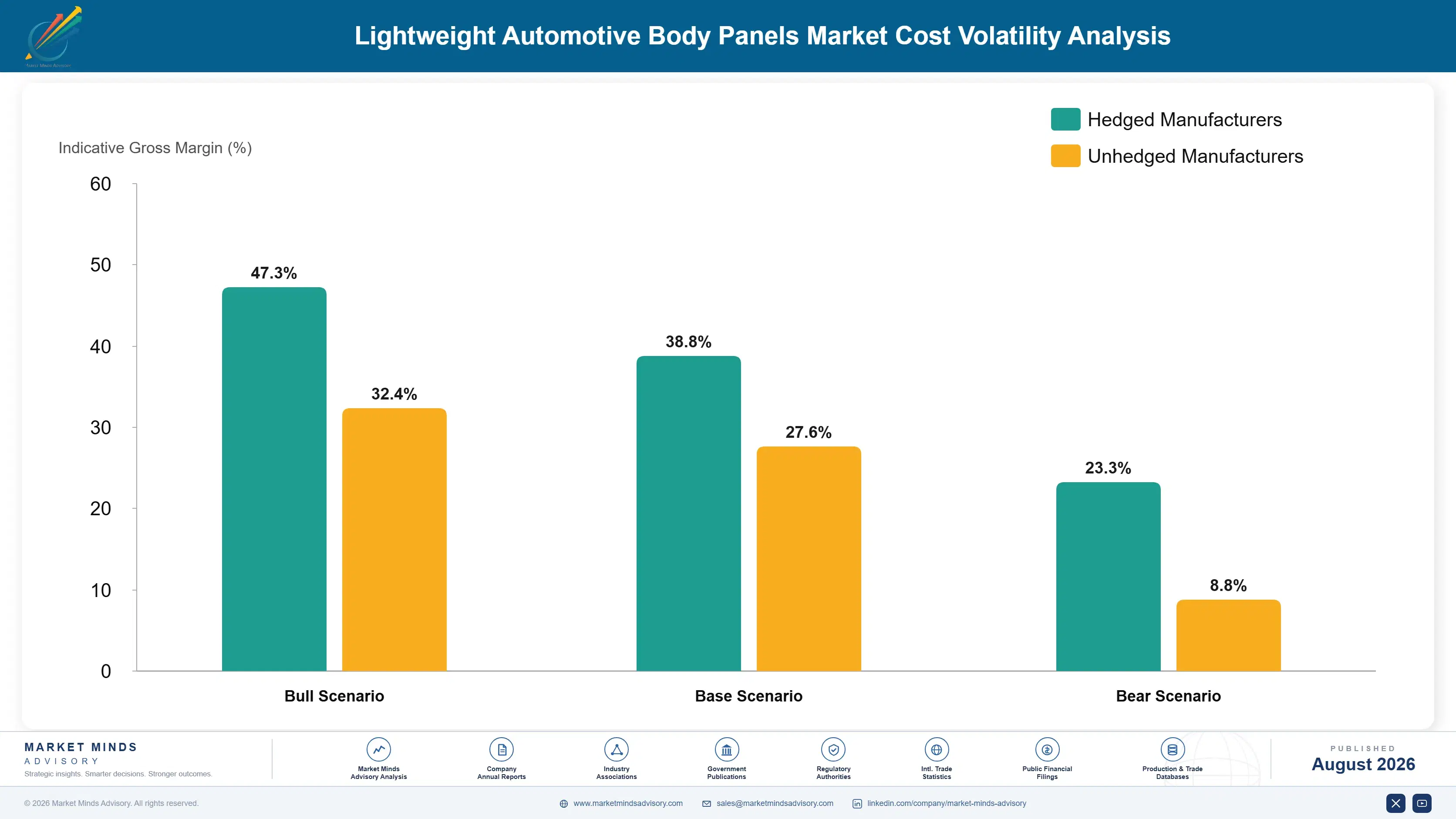
What Moves Panel Cost

The raw substrate accounts for around 58% of panel cost, which is unusually high for a converted product. Aluminium sheet prices on exchange metal plus a regional premium. Steel prices on regional benchmark. Composite prepreg and thermoplastic sheet price on resin and reinforcement, both petrochemical-linked. Tooling amortisation, press energy and scrap handling make up most of the remainder.
All three substrates moved sharply through 2021 and 2022. Aluminium premiums spiked as European energy costs curtailed smelters, and resin followed petrochemical feedstock upward. IEA data show European industrial gas prices far above American levels. Constellium recorded metal price and energy cost pressure across its automotive operations in its Annual Report 2022. Suppliers on programme-length fixed pricing absorbed most of it, because a vehicle programme does not reopen component prices mid-life.

A 58% substrate share with programme-length pricing is what makes this exposure severe. Conversion margin is too thin to absorb a material move, so an unindexed supplier is effectively trading commodities. Larger suppliers index as standard and carry none of the risk. Smaller stampers without the negotiating position quote fixed and absorb everything, which is why consolidation pressure in this market comes from balance sheets rather than from technology.
lightweight-automotive-body-panels-market-cost-volatility-analysis-1787555266909

Index programme pricing to published substrate benchmarks

A substrate at 58% of cost with programme-length fixed pricing leaves conversion margin far too thin to absorb a material move. Indexing to exchange aluminium or regional steel benchmarks with quarterly reset removes the exposure completely. Manufacturers accept it because every material component they buy carries identical exposure, and the ones who resist have simply not been asked properly yet.

Close the scrap loop and capture the offcut value

Stamping an aluminium panel generates offcut, and returning it to the rolling supplier under a closed-loop arrangement converts a disposal cost into a metal credit while meeting the recycled content European programmes now require. The logistics are the real work rather than the metallurgy. Suppliers still selling offcut into general scrap markets are giving away value and a qualification simultaneously.

Quote material options rather than advocating one substrate

A manufacturer weighing aluminium against advanced steel against thermoplastic composite wants an honest comparison. Suppliers able to quote every option keep the programme regardless of which material wins, while single-material suppliers lose it when the decision goes elsewhere. Building for that breadth costs less than losing one platform, and material decisions are reversing more often than they used to.

Portfolio Architecture for Margin Defence

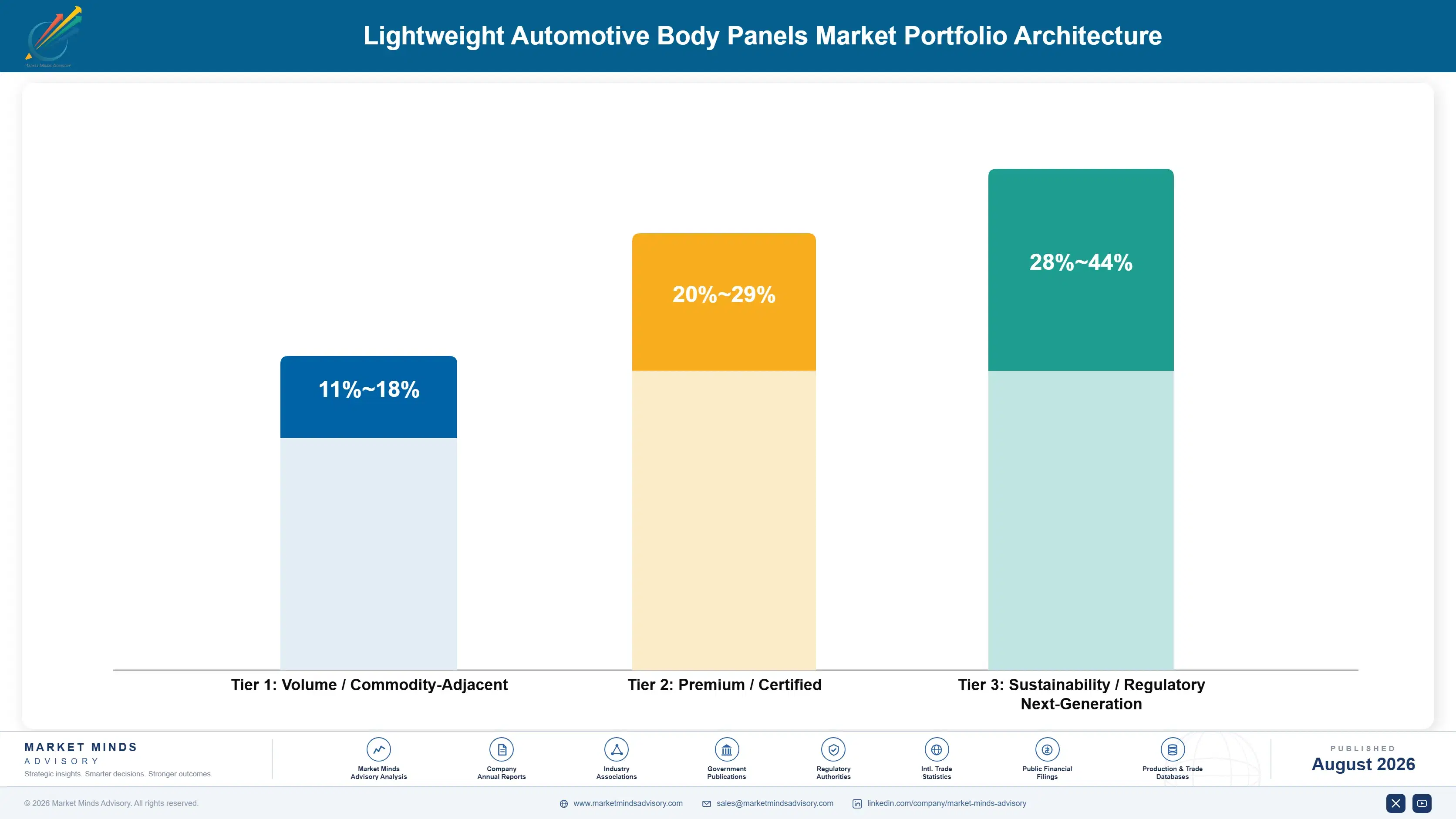
Margin in body panels tracks material capability rather than press tonnage, because stamping steel is well understood and hundreds of suppliers do it adequately. High-volume steel stampings run at gross margins in the low teens against every regional stamper inside the freight radius. Aluminium forming runs better, since springback control and joining discipline narrow the field meaningfully. Thermoplastic and carbon composite work runs higher again, because the tooling, press capacity and process knowledge exclude most competitors entirely.
The tension is that steel volume fills the presses and composite work earns the returns, and the two need different capital in different buildings. A stamping plant cannot mould thermoplastics, and the press capacity, cycle discipline and material handling have almost nothing in common. Suppliers attempting both from one footprint have generally found the volume schedule consuming the engineering attention that composite programme launches required, which shows up as delayed qualification on exactly the work carrying the margin.

High-value pools sit in thermoplastic composite closures, carbon fibre applications and closed-loop aluminium supply. None of the three is where the press tonnage is. Stamping capacity by itself defends nothing at all in a market this fragmented.

Volume / Commodity-Adjacent

High-volume steel stampings and conventional aluminium closures competed by every regional supplier inside the freight radius, since panels do not travel economically. The seven-point range separates suppliers with indexed material contracts from those absorbing substrate movement on fixed programme pricing.
Gross Margin: 11%-18%

Premium / Certified

Formed aluminium closures, sheet moulding compound panels and advanced high-strength stampings where springback control, cure discipline or forming limits narrow the supplier field. The nine-point spread reflects process maturity, since scrap and rework rates separate competent operations from struggling ones.
Gross Margin: 20%-29%

Sustainability / Regulatory / Next-Generation

Thermoplastic composite closures, carbon fibre panels and closed-loop recycled aluminium supply qualified against European carbon accounting. The sixteen-point range is wide because carbon fibre prices against scarcity while closed-loop supply prices against a qualification competitors cannot obtain.
Gross Margin: 28%-44%
lightweight-automotive-body-panels-market-portfolio-architecture-1787555267399

High-value Sub-segments and Strategic Watch-out

Thermoplastic Composite Closures

Compounding at 11.1% on cycle time, recyclability and impact behaviour together rather than on mass alone. Tailgates and door skins are converting now, and the tooling and press capacity differ from both stamping and thermoset moulding, which excludes most incumbents entirely. That exclusion is the commercial point.
Gross Margin: 30%-42%

Closed-Loop Aluminium Supply

Recycled content at 42% has become a European programme qualification rather than a preference, and closed-loop scrap arrangements lock a position an ordinary supply contract never could. Unwinding one means finding somewhere else for the offcuts. Nobody organises that particular arrangement twice, which is rather the point.
Gross Margin: 26%-38%

High-Volume Steel Stampings

The tonnage that fills presses, growing at 6.2% and defended better than anybody forecast by third-generation advanced high-strength grades. Every regional stamper competes for it on price. Manage it for press utilisation rather than for margin. Margin has never genuinely been available here at all anyway.
Gross Margin: 11%-18%

Repair-Aware Material Positioning

An aluminium panel costs 2.6 times more to repair, and insurers priced that in years ago while suppliers kept selling mass. Whoever brings insurance classification and residual value into the programme conversation first takes closure applications from incumbents. Almost nobody in this industry is doing that yet.
Gross Margin: 24%-40%

How Panel Demand Renews

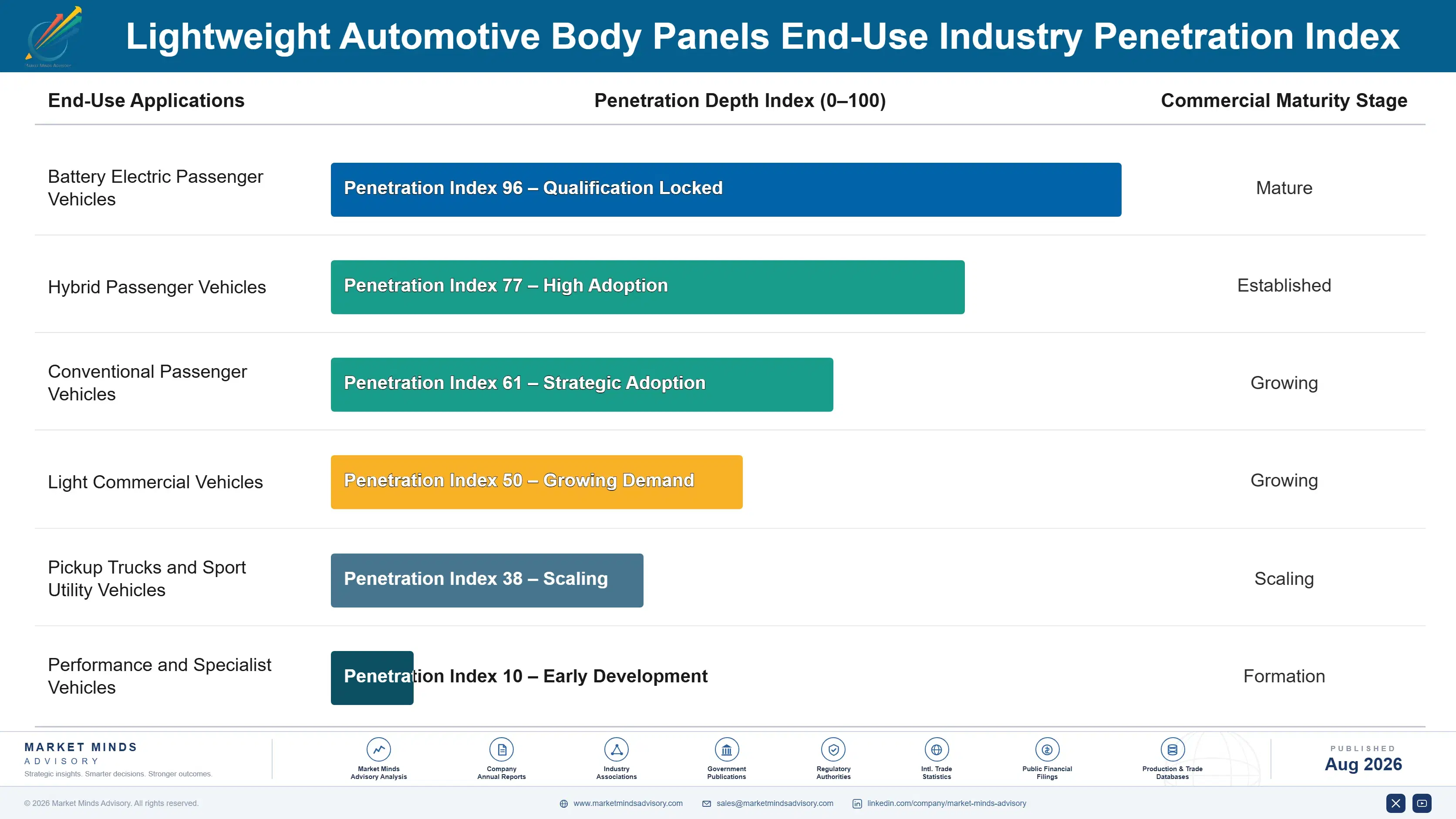
Panel demand renews on the programme cycle and nothing else. A sourcing decision commits a supplier for the platform's production life, typically six to eight years, with no repurchasing conversation in between and volumes set by whatever the vehicle sells. That makes the win enormous and the loss total, since there is no gradual share shift to soften either outcome. Between programmes the supplier has no mechanism to grow the account at all.
Stickiness varies by material rather than by customer. Composite and carbon programmes are stickiest, because tooling is application-specific and moving it means paying for it twice. Aluminium forming positions hold reasonably well, since springback compensation is tool-specific knowledge. High-volume steel stampings change supplier at every programme renewal, because many suppliers meet the specification identically and the buyer knows it perfectly well.

The decision-maker has widened and most suppliers still call on the old one. Panel material sat with body engineering weighing mass, formability and cost per part. It now includes sustainability functions checking recycled content, aftersales functions checking repair classification and finance functions checking residual value, and none of those three reads a formability chart.
lightweight-automotive-body-panels-market-end-use-penetration-index-1787555267889

Where To Place The Bet

These are among the four positions where our research anticipates prominent divergence between winners and laggards over the coming forecast period. Each is grounded in the demand model, the regulatory perimeter, and the announced capacity pipeline.
01 / REPAIR COST ARGUMENT

Sell ownership cost, not kilogrammes saved

An aluminium panel costs roughly 2.6 times more to repair than a comparable steel one, and insurers priced that into premiums years before anybody in materials supply noticed that the conversation was even happening. Fleet buyers reading total cost of ownership have started specifying against aluminium-intensive bodies, and residual values on those models already reflect it. Suppliers presenting mass numbers to engineering teams reach a commodity comparison, while suppliers presenting insurance classification and residual impact reach a real purchasing decision instead.
02 / THERMOPLASTIC CLOSURE CONVERSION

Move closures to thermoplastic before incumbents react

Thermoplastic composites compound at 11.1% because they answer three separate problems at once: cycle times a fraction of sheet moulding compound, genuine recyclability that a cured thermoset can never offer, and impact behaviour that absorbs minor damage rather than demanding specialist repair. Closure applications are where all three arguments matter most, and tailgates and door skins are converting across European platforms now. The tooling and press capacity differ from both stamping and thermoset moulding, which excludes most incumbents from following quickly.
03 / CLOSED-LOOP SCRAP QUALIFICATION

Build the scrap loop before Europe requires it

European manufacturers carry supply chain emissions accounting that reaches directly into aluminium sheet, and secondary metal carries a small fraction of primary's embedded energy, which has driven automotive sheet content toward 42% recycled. Closed-loop arrangements returning stamping offcuts to the rolling supplier lock a position that no ordinary supply contract can match, because unwinding one means the manufacturer finding somewhere else for its scrap. Suppliers without that capability are being excluded from European programmes outright rather than merely disadvantaged on price.
04 / MATERIAL OPTION BREADTH

Quote every substrate rather than advocating one

Third-generation advanced high-strength steel held closure applications everybody assumed aluminium would take, thermoplastic composites are now taking others on repairability, and carbon fibre keeps creeping downward as its cure chemistry keeps improving. A manufacturer weighing those options wants an honest comparison and usually receives three advocates instead of one honest adviser at all. Suppliers able to quote every substrate keep the programme regardless of which material wins, while single-material suppliers lose it outright the moment a decision moves somewhere else.

Engagement Snapshot From the Field

A live engagement with an industry participant carrying material or product regulatory and market exposure ahead of a defining policy shift, showing how our research translates into a defensible multi-year portfolio strategy.
MARKET MINDS ADVISORY · CLIENT ENGAGEMENT SUMMARY
Lightweight Automotive Body Panels Producer Strategic Portfolio Review and Transition Roadmap 2026·Investment Scenario on Lightweight Automotive Body Panels Exposure Evaluation 2025-26
CLIENT PROFILE
A North American body panel supplier with annual revenue around USD 640 million (client-reported, unverified by MMA), stamping steel and forming aluminium closures across four plants serving domestic assembly. The business held no composite moulding capability and no closed-loop scrap arrangement. Roughly 60% of revenue came from three platforms, two of which were approaching resourcing decisions.
STRATEGIC CHALLENGE
The client had lost two closure programmes to composite suppliers in eighteen months (client-reported, unverified by MMA) and management assumed the cause was price. Both losses were on tailgates. Nobody had asked why the customer moved material rather than supplier, which meant the proposed response of cutting quoted prices addressed a problem that did not exist.
MMA APPROACH
MMA reconstructed both sourcing decisions through the expert interview programme rather than accepting the internal price explanation, establishing what the customer actually weighed. Repair cost and insurance classification data were assembled across the client's aluminium closure applications. Composite tooling investment economics were modelled against the two upcoming platform decisions, and closed-loop scrap arrangements were benchmarked against what European suppliers already operate.
KEY FINDINGS
  1. Neither closure loss turned on price at all, and both customers cited repair cost and cycle time in the sourcing rationale, which the client had never been told directly.
  2. Both upcoming platform decisions were expected to specify composite closures, which put roughly a fifth of total revenue at risk within three years.
  3. The client was selling aluminium stamping offcut into general scrap markets at a substantial discount to what a closed-loop arrangement would have returned per tonne.
  4. No competitor serving the client's customers was presenting insurance classification or residual value data in programme quotations, which left that argument entirely unclaimed.
CLIENT PROFILE
A North American body panel supplier with annual revenue around USD 640 million (client-reported, unverified by MMA), stamping steel and forming aluminium closures across four plants serving domestic assembly. The business held no composite moulding capability and no closed-loop scrap arrangement. Roughly 60% of revenue came from three platforms, two of which were approaching resourcing decisions.
STRATEGIC CHALLENGE
The client had lost two closure programmes to composite suppliers in eighteen months (client-reported, unverified by MMA) and management assumed the cause was price. Both losses were on tailgates. Nobody had asked why the customer moved material rather than supplier, which meant the proposed response of cutting quoted prices addressed a problem that did not exist.
MMA APPROACH
MMA reconstructed both sourcing decisions through the expert interview programme rather than accepting the internal price explanation, establishing what the customer actually weighed. Repair cost and insurance classification data were assembled across the client's aluminium closure applications. Composite tooling investment economics were modelled against the two upcoming platform decisions, and closed-loop scrap arrangements were benchmarked against what European suppliers already operate.
KEY FINDINGS
  1. Neither closure loss turned on price at all, and both customers cited repair cost and cycle time in the sourcing rationale, which the client had never been told directly.
  2. Both upcoming platform decisions were expected to specify composite closures, which put roughly a fifth of total revenue at risk within three years.
  3. The client was selling aluminium stamping offcut into general scrap markets at a substantial discount to what a closed-loop arrangement would have returned per tonne.
  4. No competitor serving the client's customers was presenting insurance classification or residual value data in programme quotations, which left that argument entirely unclaimed.
RECOMMENDED STRATEGY
Phase 1: Phase one: stop cutting prices and rebuild both upcoming quotations around repair classification, insurance grouping and residual value rather than cost per part. Phase 2: Phase two: negotiate a closed-loop scrap arrangement with the aluminium supplier, capturing offcut value and a recycled content position simultaneously. Phase 3: Phase three: commit thermoplastic moulding capacity at one plant, accepting two years before any composite closure programme becomes genuinely winnable anywhere.
OUTCOME
One of the two platform quotations was won on a repair and residual argument the client had never previously made. A closed-loop scrap arrangement operates from early 2026. Thermoplastic capacity is approved at one plant, and the client reports the price-cutting programme abandoned entirely (client-reported, unverified by MMA).

Frequently Asked Questions

Foundational context covering the market sizes, CAGR, scope, country, region and competition that inform every finding below. This section is provided to cover basics and most often pre-purchase conversations, answered from the MMA Primary Research Dataset.

What is the current size of the Lightweight Automotive Body Panels Market?

The market was valued at USD 38.6 billion in 2025, rising to an estimated USD 41.46 billion in 2026. East Asia holds the largest regional share at 30% of value.

How large will the Lightweight Automotive Body Panels Market be by 2036?

MMA forecasts USD 84.65 billion by 2036 under the base case, an expansion multiple of 2.04 times the 2026 value. That represents USD 43.19 billion of incremental value.

What is the CAGR for the Lightweight Automotive Body Panels Market 2026 to 2036?

The base case runs at 7.4% compound annual growth between 2026 and 2036, with a bull case at 8.6% and a bear case at 6.2%. Historical growth from 2020 to 2025 was 6.2%.

Which segment is growing fastest?

Thermoplastic composite panels lead at 11.1%, half again the market rate, on cycle time, recyclability and impact behaviour together. Carbon fibre panels follow at 9.8%.

Who are the major companies in the Lightweight Automotive Body Panels Market?

Novelis, Magna International, Gestamp, Constellium and Benteler Automotive hold 29% between them. Material breadth and proximity to assembly rather than press capacity sustain those positions.

Which country is growing fastest?

India leads at 10.4%, driven by vehicle production growth and new electric programmes specifying lightweight closures from the outset. Domestic rolling capacity has expanded alongside.

Report Segmentation Architecture

The full report scope spans multiple orthogonal segmentation dimensions, with cross-tabulated demand data provided for each dimension pair. Coverage extends further to regional breakdowns, trend trajectories, and the competitive detail needed to support segment-level decision-making.

By Panel Substrate

  • Aluminium Sheet Panels
  • Advanced and Press-Hardened Steel Panels
  • Sheet Moulding Compound and Thermoset Composite Panels
  • Thermoplastic Composite Panels
  • Carbon Fibre Reinforced Panels
  • Magnesium Alloy Panels

By End-Use Industry

  • Battery Electric Passenger Vehicles
  • Hybrid Passenger Vehicles
  • Conventional Passenger Vehicles
  • Light Commercial Vehicles
  • Pickup Trucks and Sport Utility Vehicles
  • Performance and Specialist Vehicles

By Supply Arrangement

  • Tier One Direct Programme Supply
  • Tier Two Component Supply
  • Toll Forming and Stamping
  • Aftermarket Panel Distribution
  • Collision Repair Channel

By Region

  • North America
  • Western Europe
  • East Asia
  • South Asia and Pacific
  • Latin America
  • Middle East and Africa
  • Eastern Europe

Scope, Methodology, and Coverage

Every figure in this report is reproducible from documented input assumptions. The scope below maps the historical period, the forecast horizon, the segmentation dimensions, and the countries covered, alongside the underlying primary and qualitative methodology.
Historical Period
2020 to 2025
Forecast Period
2026 to 2036
Base Year
2025 (USD billions; MMA Primary Research Dataset, August 2026)
Market Definition
The market comprises exterior and structural body panels supplied for passenger and light commercial vehicles where mass reduction is an explicit design objective, covering aluminium sheet, advanced and press-hardened steel, sheet moulding compound and thermoset composite, thermoplastic composite, carbon fibre reinforced and magnesium alloy construction. Value is measured on panel supply revenue at tier one level across programme and aftermarket channels. Chassis and frame structures, battery enclosures, interior trim, glazing, bumper and fascia systems, and complete body-in-white assemblies sold as a unit fall outside scope.
Quantitative Units
USD billions (current prices); million panels supplied annually; USD per panel by substrate material
Segmentation Dimensions
By Panel Substrate; By End-Use Industry; By Supply Arrangement; By Region
Regions Covered
North America, Western Europe, East Asia, South Asia and Pacific, Latin America, Middle East and Africa, Eastern Europe
Countries Covered
China, Japan, South Korea, Taiwan, India, Thailand, Indonesia, Vietnam, Australia, United States, Canada, Mexico, Germany, France, Italy, Spain, United Kingdom, Sweden, Austria, Poland, Czechia, Slovakia, Hungary, Romania, Brazil, Argentina, Colombia, Turkey, Morocco, South Africa
Key Companies Profiled
Novelis, Magna International, Gestamp Automocion, Constellium, Benteler Automotive, Aisin Corporation, Toyoda Gosei, Hyundai Steel, Kirchhoff Automotive, Shiloh Industries, Martinrea International, Tower International, Voestalpine, ArcelorMittal, Thyssenkrupp Automotive, Nippon Steel, POSCO, Continental Structural Plastics, Teijin Automotive Technologies, SGL Carbon
Quantitative Methodology
Primary survey, n=3,800 respondents, Q4 2025, six countries; demand-side model with trade association cross-validation
Qualitative Methodology
47 expert interviews, Q4 2025; applied to validate demand model assumptions, identify emerging dynamics, and assess competitive positioning
Report Format
PDF and XLSX data workbook (Word format preview document)
Publisher
Market Minds Advisory
Report Code
MMA-2026-AUT-325
Published
August 2026
Contact
sales@marketmindsadvisory.com | www.marketmindsadvisory.com

Purchase the full Lightweight Automotive Body Panels Market Report (2026 to 2036).

The full report sizes the global lightweight automotive body panel market to 2036 across six substrate materials and seven regions, measured on panel supply revenue at tier one level. It treats repair cost and insurance classification as a material selection factor alongside mass, which most lightweighting analysis omits entirely. Competitive analysis covers 20 participants evaluated on panel supply revenue, with moat and risk assessment for the two leaders. Third-generation steel's defence of applications forecast to move toward aluminium is quantified by panel position. Four quantified revenue levers close the analysis.
Six-substrate segment sizing with segment-level growth rates
Seven-region share and growth breakdown to 2036
Twenty-participant competitive map on one revenue basis
Repair cost and insurance classification by substrate material
Closed-loop recycled content requirements traced through European programmes
Four quantified revenue levers with commercial impact ranges

Built For The People Who Decide

From boardroom strategy to bench-side execution, this report is read cover-to-cover by leaders shaping the next decade of their industry, turning demand scenarios, market dynamics and valuation benchmarks into decisions.
CXOs/ Presidents/ VPs/ Managers
M&A and Corporate Development
Strategy Teams and R&D Heads
Procurement and Product Directors
Regulatory and Compliance Leaders
Investor Relations and Equity Analysts