
Market Minds Advisory
Lightweight Aluminium Pistons Market

Lightweight Aluminium Pistons Market: Steel Displacement, Surviving Engine Populations and Forged Construction to 2036

Everybody in this industry has spent a decade watching electric vehicles and the actual displacement came from steel, which has quietly taken most of heavy-duty diesel while nobody was watching the right threat.

Lead Analyst

David Horsley

Published

September 2026

Make Smarter Decisions with Customized Research Insights

Request a free sample report and evaluate market opportunities, growth trends, and competitive dynamics relevant to your business needs.

2025 MARKET VALUE$4.8BMarket Size 2025
2036 FORECAST VALUE$6.9BBase Case , 2026 to 2036
CAGR 2026 TO 20363.4 %Bull 4.6% / Bear 2.2%
INCREMENTAL OPPORTUNITY$2.0BNet 10- year value creation
EXPANSION MULTIPLE1.40x2036 value over 2026 base
Strategic Levers
M&A Pipeline
Regional Outlook
Country Rankings
Competitive Intelligence
Segmental Deep-dive
Call-Us : 91 93563 13602

Executive Snapshot and Market Trajectory

Steel pistons now hold roughly 62% of heavy-duty on-highway diesel, and they took that position because aluminium cannot survive peak cylinder pressures above 200 bar. The industry spent the same decade worrying about batteries. One of those threats has already arrived and the other has not.
Forged aluminium pistons grow at 5.1%, half again the market rate of 3.4%, because rising loads in hybrid and high-output engines exceed what casting delivers. East Asia holds 30% of value on Chinese engine production and Japanese manufacture together, and South Asia adds 12% almost entirely on motorcycles. Two and three wheelers take 34% of unit volume, and electrification reaches them slowly at Indian price points.
Five suppliers hold 58% of piston volume and the concentration is real, since piston manufacture demands metallurgy, machining tolerance and validation capability that few companies possess. The aftermarket takes 28% of units and behaves nothing like original equipment, because engine populations in off-highway, marine and power generation outlive the vehicles that carried them by decades. That replacement business is where the volume survives whatever happens to new engine production. Very few suppliers manage it deliberately.
Market Definition
This report covers aluminium alloy pistons supplied for reciprocating internal combustion engines across automotive, motorcycle, off-highway, marine and power generation applications, spanning cast eutectic, cast hypereutectic, forged, cooling gallery, fibre-reinforced and ring-carrier insert constructions. Value is measured at supplier level across original equipment and aftermarket channels. Excluded are steel and cast iron pistons, piston rings, piston pins, connecting rods, cylinder liners, and complete engine assemblies.
Base Year Value
$4.8B in 2025 (MMA Primary Research Dataset, August 2026)
Forecast Period
2026 to 2036, eleven discrete annual values
CAGR
3.4% base case. Bull 4.6%. Bear 2.2%.
Fastest Growth Segment
Forged Aluminium Pistons: 5.1% CAGR
Fastest Growth Country
India: 6.4% CAGR
Fastest Growth Region
South Asia and Pacific: 5.6% CAGR
Largest Region
East Asia: 30% of 2025 global value
Market Leaders
Mahle GmbH, Tenneco, Rheinmetall Automotive, Aisin Corporation and Art Metal Mfg lead the market. Source: MMA Primary Research Dataset, July 2026.
Primary Survey
n=3,800 procurement and R&D decision-makers, Q4 2025, six countries
Methodology
Demand-side build-up, cross-validated against public data, 47 expert interviews

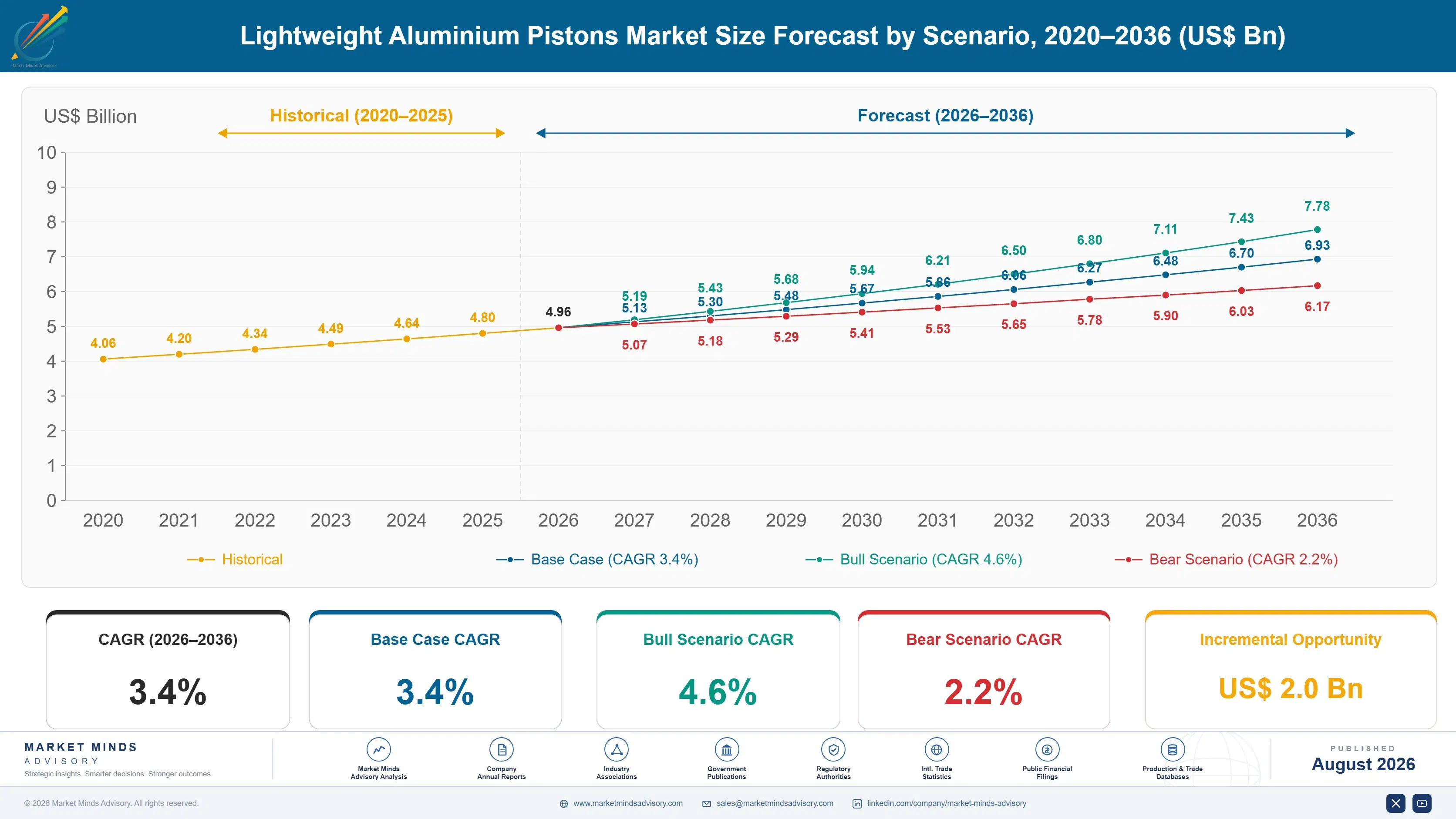
Lightweight Aluminium Pistons Market Forecast Scenarios

lightweight-aluminium-pistons-market-size-forecast-scenario-1787555246641
Growth ran at 2.4% between 2020 and 2025 and two opposing forces produced that number. Passenger car engine production fell across Europe and North America as electrification took share. Motorcycle and three-wheeler production across India and Southeast Asia rose steadily throughout, and off-highway and power generation demand held firm. The weak average conceals a geographic reallocation rather than a decline.
The 3.4% base case rests on three mechanisms. Asian two and three wheeler production keeps rising with household income across India and Southeast Asia, and electrification reaches those price points slowly. Hybrid powertrains keep internal combustion in passenger cars far longer than pure battery forecasts assumed, and a hybrid engine runs at higher expansion ratios that demand better pistons rather than fewer. And the aftermarket at 28% of units grows on engine populations already built, which no new vehicle decision affects.
The 4.6% bull case is hydrogen and synthetic fuel engines reaching commercial deployment in heavy applications, which would extend combustion demand well beyond current assumptions. The 2.2% bear case is steel continuing its displacement below heavy-duty into medium commercial and off-highway diesel, where peak cylinder pressures are rising toward the same limit that cost aluminium the heavy segment.

The Threat Nobody Was Watching

The story everybody tells about this market is electrification, and it is the wrong story. Steel pistons now occupy roughly 62% of heavy-duty on-highway diesel, a position they built while the industry directed its anxiety at batteries. The mechanism was pressure: peak cylinder pressures in modern diesel passed 200 bar, and aluminium reaches a fatigue limit there that no alloy development has moved. Steel does not. That displacement is done and it happened without much comment.
TOP-FIVE CONCENTRATION58%Combined position across global piston supply held by leaders
PEAK CYLINDER PRESSURE200 barCombustion loading modern diesel pistons must survive without cracking
MOTORCYCLE APPLICATION SHARE34%Portion of unit volume consumed by two and three wheelers
ALUMINIUM COST SHARE41%Portion of piston cost attributable to the base alloy
AFTERMARKET VOLUME SHARE28%Portion of units supplied for replacement rather than original equipment
STEEL DISPLACEMENT SHARE62%Share of heavy on-highway diesel now using steel instead
What survives is larger than most forecasts allow. Two and three wheelers take 34% of unit volume and are built overwhelmingly across India, Indonesia and China at price points electrification has not reached. Off-highway, marine and power generation engines run for decades and generate an aftermarket worth 28% of units. Hybrid passenger cars still need pistons, and they need better ones, because an Atkinson-cycle engine runs at expansion ratios that load the crown harder than a conventional engine does.
Forged construction grows fastest at 5.1% for exactly that reason. Higher loads exceed what casting delivers, and forging produces the grain structure and fatigue strength that a heavily loaded crown requires. It costs considerably more and the applications that need it can pay.
"The piston industry has been so focused on whether engines survive that it missed aluminium losing its best segment to a different metal. Steel took heavy-duty diesel on pressure alone, and medium-duty is heading toward the same limit."
Director, Powertrain Components and Engine Systems Practice · MMA Automotive Practice · August 2026

Market Trends

Steel displaces aluminium wherever cylinder pressure keeps rising

Peak cylinder pressures in heavy-duty diesel passed 200 bar as emissions regulation pushed manufacturers toward higher injection pressures and later combustion phasing. Aluminium reaches a fatigue limit at those loads that no alloy or reinforcement development has meaningfully moved, and crown cracking follows. Steel pistons carry the load, run hotter without losing strength and allow a shorter compression height that offsets some of the weight penalty. That displacement now covers roughly 62% of heavy on-highway diesel and it is working its way down into medium commercial applications where pressures are climbing toward the same threshold.
Market Impact: Holds 34% of unit volume
Hybrid powertrains demand better pistons rather than fewer

A hybrid passenger car still has an engine, and the engine it has is usually running an Atkinson or Miller cycle at expansion ratios a conventional design never attempted. That loads the crown harder, raises thermal stress and narrows the tolerance for skirt distortion. Manufacturers responding to it specify cooling gallery construction, better skirt coatings and in the highest-output applications forged material rather than cast. The commercial consequence is that unit volume falls in passenger cars while value per piston rises, and suppliers who only counted units missed the second half of that entirely.
Market Impact: Supplies 28% of annual units

Market Opportunities and Growth Drivers

Asian two and three wheeler production keeps expanding

Two and three wheelers take 34% of piston unit volume and are built overwhelmingly across India, Indonesia, Vietnam and China, where a motorcycle is transport rather than recreation. Household income growth converts directly into first-vehicle purchase at price points nothing electric currently reaches, and Indian production alone runs into the millions of units annually. Electrification is arriving in that market and it arrives slowly, because battery cost against a vehicle selling for a few hundred dollars is a different arithmetic entirely. This is the volume base that keeps aluminium piston demand growing while Western passenger car production falls.
Market Impact: Cuts 20% of Western volume

Long-lived engine populations generate steady replacement demand

The aftermarket takes 28% of piston units and it operates on a different clock entirely from original equipment. An off-highway machine, a marine auxiliary or a standby generator runs for decades and gets rebuilt several times, which means every engine already built is a future piston order regardless of what happens to new vehicle production. Power generation demand in particular has risen with data centre backup requirements and with grid instability across several markets. Suppliers who treat the aftermarket as a residue of original equipment miss that it is the more predictable half of the business.
Market Impact: Sets 41% of piston cost

Market Restraints and Challenges

Passenger car electrification removes the largest historical volume

European and North American passenger car engine production is falling as battery vehicles take share, and that removes the segment which historically carried the highest piston volumes per plant. The root cause is regulatory: European carbon dioxide fleet targets and comparable American rules make combustion increasingly expensive to sell rather than technically inferior. Commercially this strands capacity in Western plants sized for a volume that will not return. Suppliers are responding by shifting output toward motorcycles, off-highway and power generation, and by moving Western capacity toward higher-value forged and cooling gallery work rather than volume casting.
Market Impact: Covers 62% of heavy diesel

Aluminium price volatility reaches contract margin directly

The base alloy accounts for around 41% of piston cost and prices on London Metal Exchange aluminium plus a regional premium that has moved violently since 2021. The root cause is that primary aluminium is an energy-intensive commodity whose cost tracks power prices and smelter availability rather than anything happening in engines. Commercially this makes annual original equipment contracts difficult, since a manufacturer fixes piston price for a model year against a metal cost that will not sit still. Most suppliers now index contracts to published metal benchmarks, and the ones who have not are absorbing movement nobody budgeted for.
Market Impact: Lifts forged growth to 5.1%
4 additional market trends, 3 additional growth drivers, and 2 additional restraints and challenges are covered in the full report. Contact sales@marketmindsadvisory.com to access the complete intelligence.

Segment CAGR and Growth Architecture

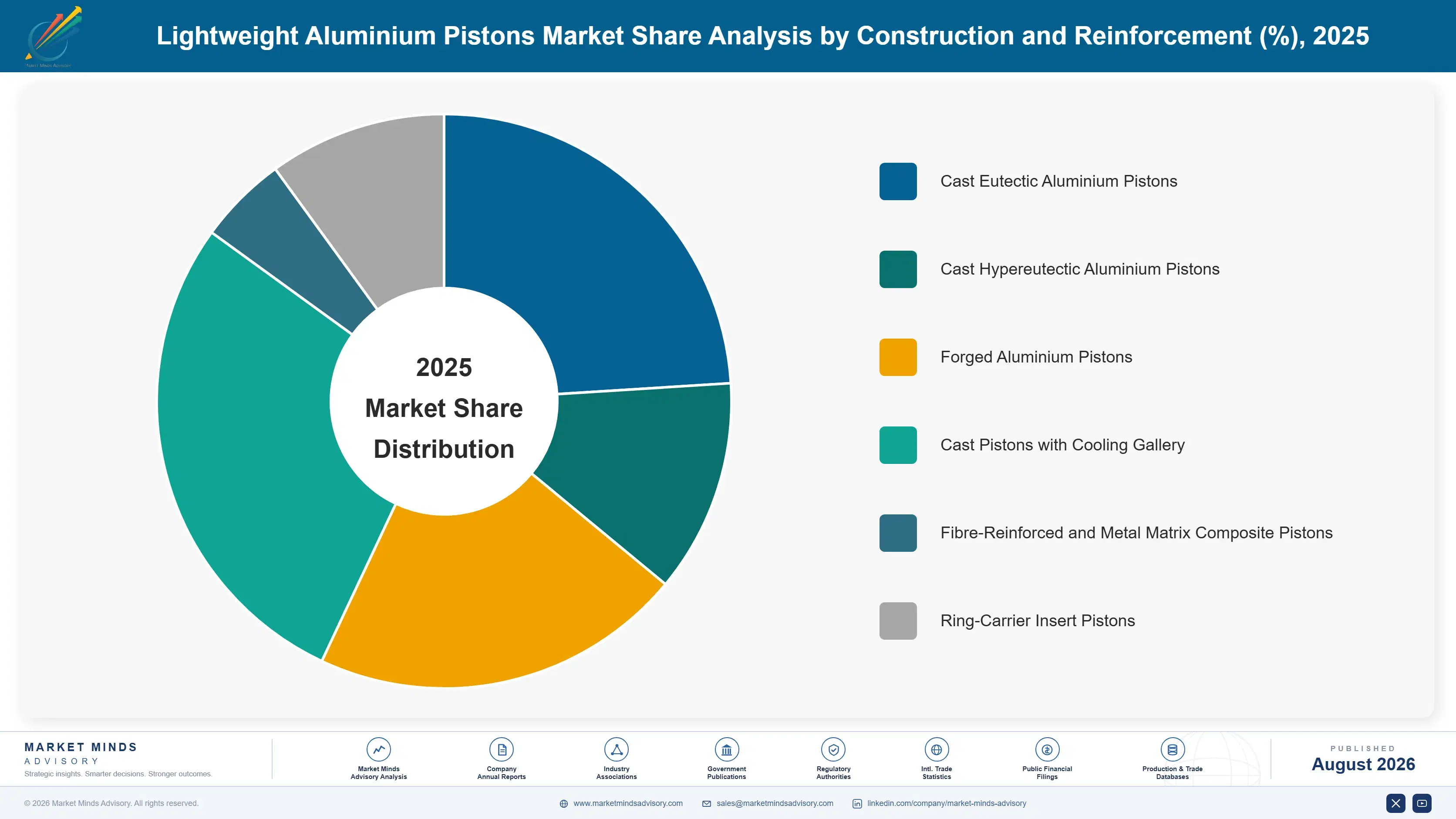
Pistons are classified here by construction method and reinforcement, since that determines the load a piston survives and what it costs to make. Engine application, vehicle class and supply channel are handled separately in the framework, because a single construction serves several engine types without any change to how it is manufactured. That distinction governs pricing.
lightweight-aluminium-pistons-market-market-share-analysis-1787555247217

Forged Aluminium Pistons

Growing at 5.1%, half again the market rate, forging is what a designer specifies when casting will not survive the load. The grain structure produced by forging delivers fatigue strength a cast piston cannot approach, which matters in hybrid engines running high expansion ratios, in turbocharged high-output petrol applications and in performance and racing work where the crown sees pressures nothing else does. It costs considerably more per unit and the applications specifying it can pay, because a failed piston destroys an engine. Suppliers with forging capability compete in a much narrower field than those casting to volume, and they price accordingly. That narrowness is the entire commercial point here.
CAGR 5.1%

Cast Pistons with Cooling Gallery

A cooling gallery is a cast oil passage behind the ring belt that carries heat away from the crown, and it exists because thermal load rather than mechanical load limits many modern pistons. Growth at 4.6% follows every application where combustion temperature has risen: turbocharged downsized petrol, hybrid Atkinson-cycle engines and medium-duty diesel below the threshold where steel has taken over. Manufacturing it requires salt core or cast-in tube technique that adds cost and scrap risk, which narrows the supplier field usefully. The commercial position sits between volume casting and forging, delivering most of the thermal benefit at a fraction of the forged price. That middle ground is unusually defensible.
CAGR 4.6%
Full segment breakdown across 6 segments available in the complete report.

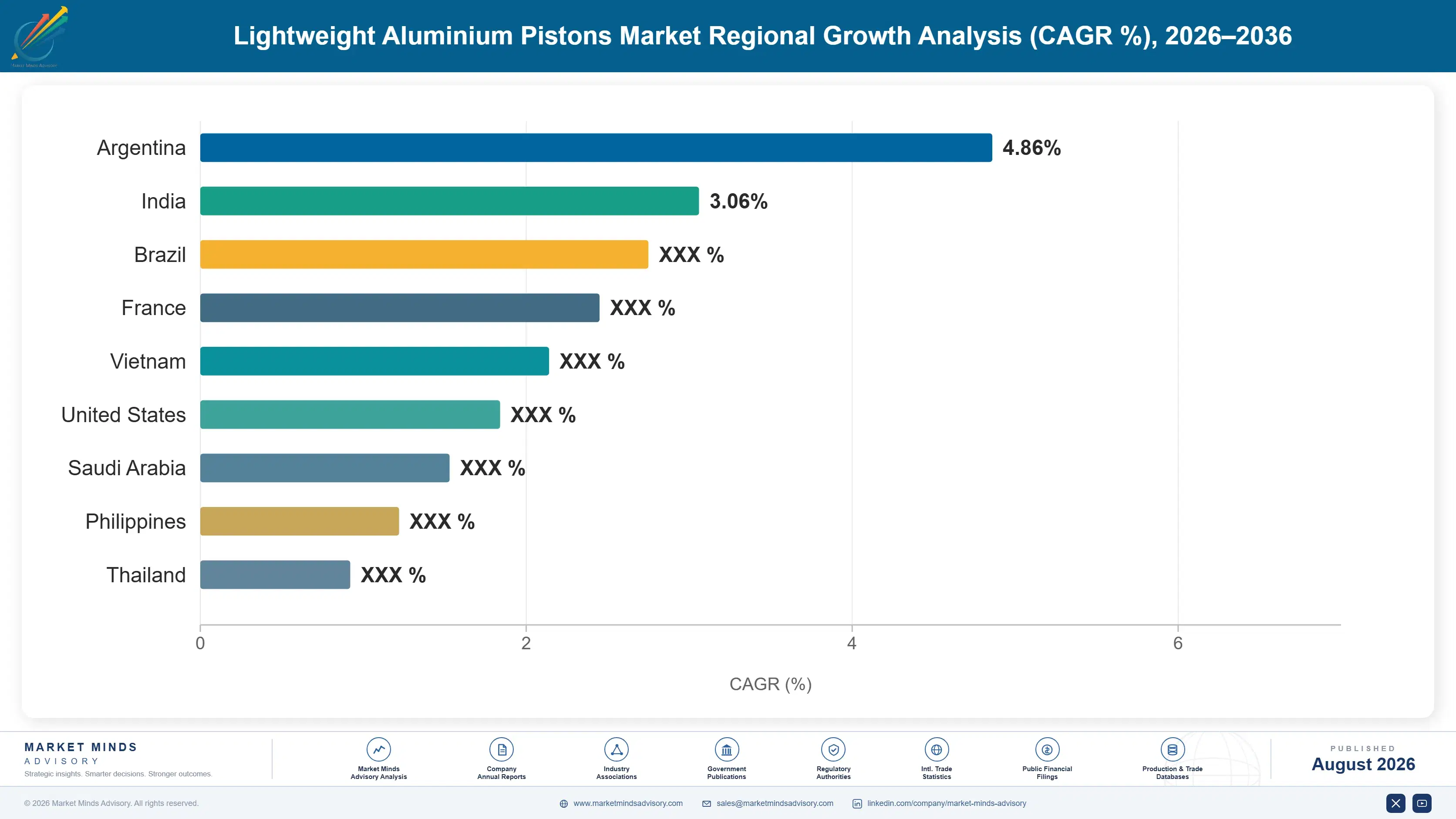
Regional Architecture and Country Demand Map

East Asia holds 30% of value on Chinese engine output and Japanese manufacture together, with South Asia adding 12% almost entirely on motorcycles. Where engines get built decides this map, and engine building has moved east faster than most Western suppliers restructured. That gap is still open.

North America

Heavy-duty commercial vehicle production is where this region's piston value concentrated and it is exactly where steel took over, which explains growth at 2.4% better than any electrification argument does. Passenger car engine production continues falling as battery vehicles take share, stranding capacity in plants sized for a volume that will not come back. What holds up is off-highway equipment, marine engines and a power generation market expanding sharply with data centre backup requirements. Performance and racing piston manufacture is concentrated here and it is small in units and substantial in value per unit. The aftermarket is large, mature and considerably more stable than original equipment. Suppliers rely on it more each year.
Share: 24% | CAGR: 2.4% (2026 to 2036)

Western Europe

Growth at 1.8% is the weakest of the seven regions and the reasons are entirely regulatory, since European carbon dioxide fleet targets have made combustion expensive to sell rather than technically deficient. Passenger car engine production has fallen furthest here and the plants built for it cannot be refilled. What remains is genuine capability rather than volume: German and Italian suppliers hold the metallurgy, forging and validation depth that heavily loaded applications require, and they export it widely. Commercial vehicle production continues at reduced volumes with steel taking the heavy end. The region increasingly supplies engineering and high-specification product rather than tonnage, which is a smaller business at better margins.
Share: 20% | CAGR: 1.8% (2026 to 2036)
Regional intelligence for 5 additional markets available in the complete report: East Asia, South Asia and Pacific, Latin America, Middle East and Africa, Eastern Europe. Contact sales@marketmindsadvisory.com.
lightweight-aluminium-pistons-market-country-cagr-analysis-1787555247735

Where Piston Margin Actually Sits

Four moves matter for a supplier watching one metal take its best segment while everybody discusses a different threat entirely. Two are about following the volume that survives, and two are about the value that rises even as unit counts fall. Defending volume casting capacity is not among them. That capacity was never the asset.

Follow the engines that are not electrifying

Two and three wheelers hold 34% of piston unit volume, off-highway and power generation add substantially more, and none of it faces the electrification timetable that dominates passenger car forecasting. A motorcycle selling for a few hundred dollars across India and Southeast Asia does not carry battery cost, and a standby generator serving an unreliable grid is bought for reliability rather than emissions. Suppliers with capacity sized for Western passenger car volume are defending the one segment that genuinely disappears. Repointing that capacity toward Asian motorcycle and global power generation demand reaches growth of 5.6% rather than decline.
Market Impact: Reaches surviving engine segments growing at 5.6% annually

Build forging capability before the cast business erodes

Forged pistons compound at 5.1% while volume castings grow at barely 2%, and the reason is load: hybrid Atkinson-cycle engines, turbocharged high-output petrol and performance applications all exceed what casting survives. Forging requires press capacity, die investment and metallurgical control that a casting operation does not have and cannot improvise. The suppliers who built it are competing in a much narrower field at considerably better margin, and the ones who did not are watching their addressable applications shrink each model year. This capability takes years to establish, which is precisely why it defends anything at all.
Market Impact: Enters a segment compounding at 5.1% each year

Treat the aftermarket as the primary business

Replacement supply is 28% of units and it runs on engine populations already built, which no vehicle manufacturer decision can take away. An off-highway machine or a marine auxiliary gets rebuilt several times across a life measured in decades, and every one of those rebuilds is an order that arrives regardless of what happens to new engine production. Most suppliers organise around original equipment and treat aftermarket as residue, which gets the priority exactly backwards for a market facing declining new-build volume. The aftermarket also prices considerably better, because a rebuild is urgent and the buyer is not tendering.
Market Impact: Covers a full 28% of annual unit volume

Index metal cost or stop absorbing it

The base alloy is around 41% of piston cost and prices on exchange aluminium plus a regional premium that has moved violently since 2021, which makes a fixed model-year contract a bet on energy markets. Suppliers still quoting annual fixed prices are running that bet without having chosen to. Indexation to published metal benchmarks with quarterly reset removes it entirely, and vehicle manufacturers accept the mechanism because they face identical exposure on every aluminium component they buy. Resistance to asking is internal rather than commercial, which is the most expensive kind.
Market Impact: Removes a 41% cost exposure from annual contracts

Who Controls the Margin Pool

Five suppliers hold 58% of piston unit volume, measured on units shipped annually across original equipment and aftermarket, the basis used throughout this section. That concentration is genuine and follows from capability: piston manufacture demands alloy metallurgy, machining tolerance and validation testing that few companies possess and none acquires quickly. The gap between leaders and everybody else is forging and cooling gallery capability rather than casting capacity.
Competition runs on three dimensions. Validation depth, since an engine manufacturer qualifying a piston commits for a programme life and will not repeat the testing. Manufacturing capability at the demanding end, meaning forging, cooling galleries and reinforcement. And geographic position, because pistons are heavy relative to value and freight matters. Price competes hardest in volume castings and least everywhere else.

Rankings shift as Chinese and Indian suppliers move from volume castings into cooling gallery and forged work, which several have now qualified for after two decades of improvement. Western positions in heavy diesel were lost to steel rather than to any competitor. Performance, racing and specialist rebuild positions hold longest, because the volumes are too small to attract anybody organised for scale.
lightweight-aluminium-pistons-market-company-positioning-matrix-1787555248257

Competitive Moat and Risk Dimensions

MAHLE GMBH

Moat: Piston and steel capability

Mahle developed steel pistons alongside its aluminium business rather than defending aluminium against them, which means the displacement in heavy-duty diesel moved volume within the company instead of away from it. Competitors holding only aluminium watched that segment leave. Owning both materials also makes the technical argument to an engine manufacturer credible in a way a single-material supplier cannot match.
MAHLE GMBH

Risk: Western passenger car exposure

A large share of the manufacturing footprint sits in Western Europe serving passenger car engine production that regulation is actively removing, and those plants were sized for volumes that will not return. Restructuring European capacity is slow and expensive under local labour arrangements. Competitors built in Asia carry none of that burden and are growing into the volume instead.
TENNECO

Moat: Aftermarket brand and reach

Tenneco holds aftermarket distribution and brand recognition through Federal-Mogul that reaches rebuilders and workshops directly, which matters more than usual in a market where replacement supply is 28% of units and growing in relative importance. Original equipment suppliers without that channel depend entirely on new engine production decisions they cannot influence.
TENNECO

Risk: Broad portfolio dilutes focus

Pistons sit inside a component portfolio spanning ride control, emissions systems and much else, which means piston-specific investment competes internally against businesses facing their own transitions. Specialist competitors put every development decision into pistons alone. In a market where forging and cooling gallery capability decides who holds the growing segments, that concentration of attention is worth something real.

Players Tracked

Prominent Players

Mahle GmbH
Tenneco
Rheinmetall Automotive
Aisin Corporation
Art Metal Mfg

Other Key Players

Riken Corporation
Nippon Piston Ring
Teikoku Piston Ring
Hitachi Astemo
Shriram Pistons and Rings
Menon Pistons
India Pistons
Binzhou Bohai Piston
Zynp Corporation
Dongfeng Motor Parts
Wiseco Performance Products
JE Pistons
CP-Carrillo
Cosworth
Arias Pistons

Recent Developments

FEBRUARY 2025

Mahle expanded forged piston capacity for hybrid engine applications

Mahle increased forged piston production capacity aimed at hybrid petrol engines running high expansion ratios, where cast construction reaches its fatigue limit. The investment was organic and internally funded rather than any acquisition or partnership, and it follows load requirements rising faster than most powertrain forecasts anticipated.
Signal: Capacity is being added for hybrids rather than defended for pure combustion, which reads the transition correctly
JULY 2025

An Indian supplier qualified cooling gallery pistons for export programmes

An Indian piston manufacturer completed qualification of cooling gallery construction for export commercial vehicle programmes, moving beyond the volume castings that have historically defined domestic supply. This was an organic capability programme rather than any transaction, and it reflects two decades of metallurgical improvement reaching a commercial threshold.
Signal: Asian suppliers are moving up the capability ladder into the segments Western suppliers retreated toward, which compresses that refuge
NOVEMBER 2025

A European supplier closed passenger car piston capacity

A European piston supplier announced closure of passenger car piston production at one site, citing engine volumes that will not recover to the levels the plant was built for. This was an internal restructuring rather than any sale or transfer, and it acknowledges a capacity problem the industry has deferred.
Signal: Western capacity is finally being taken out rather than held open, which suggests suppliers have stopped expecting volumes back

What Moves Supplier Cost

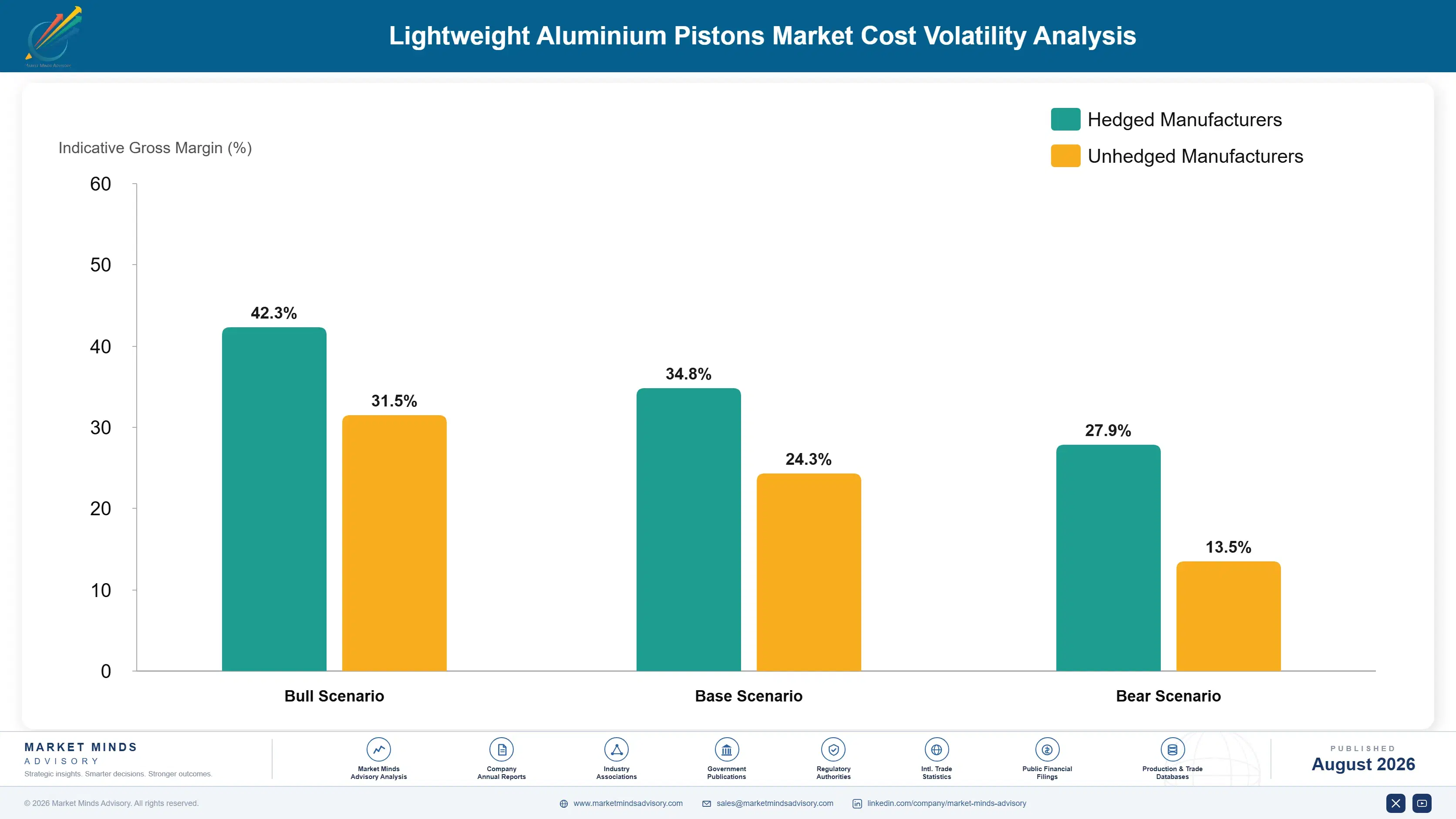
The aluminium alloy accounts for around 41% of piston cost, purchased as primary or secondary metal against exchange pricing plus a regional premium. Machining consumes most of the remaining conversion cost, with coating, ring carrier inserts and validation testing making up the balance. Energy for casting and heat treatment is significant in forged production particularly.
Aluminium prices and regional premiums moved violently through 2021 and 2022 as European energy costs forced smelter curtailments, and IEA data show industrial gas prices there far above American levels. Rheinmetall recorded raw material and energy cost pressure across its automotive operations in its Annual Report 2022. Suppliers on fixed model-year contracts absorbed most of the movement, because a vehicle manufacturer sets component prices before a programme year and does not reopen them.

The programme-length contract against an exchange-traded metal is what makes this awkward. A supplier commits price across a model year while the metal reprices daily. Suppliers with indexation carry none of that risk and those quoting fixed prices carry all of it. Asian producers gain further from regional metal availability and energy costs that European operations cannot approach, which compounds a disadvantage that has nothing to do with manufacturing efficiency.
lightweight-aluminium-pistons-market-cost-volatility-analysis-1787555248451

Index component contracts to published aluminium benchmarks

A model-year price fixed against a metal that is 41% of cost and reprices daily is a trading position rather than a supply agreement. Indexing to exchange aluminium plus regional premium with quarterly reset removes it, and vehicle manufacturers accept the mechanism readily because every aluminium component they buy carries the same exposure. The obstacle is asking rather than agreeing.

Raise secondary alloy content where specification permits

Secondary aluminium costs less than primary and carries a fraction of the embedded energy, which matters commercially and against customer carbon reporting requirements. Many piston applications tolerate secondary content that specifications written decades ago never contemplated. Requalifying an alloy takes time and pays back across every unit afterwards. Suppliers still buying primary by default have not tested the assumption recently.

Site conversion capacity where energy costs are competitive

Casting, heat treatment and forging are energy-intensive, and European industrial power costs have sat far above American and Asian levels since 2021 with no sign of converging. That is a conversion cost disadvantage no amount of manufacturing improvement closes. Suppliers moving conversion toward competitive energy geographies while keeping engineering and validation in Europe get both halves of the arrangement right.

Portfolio Architecture for Margin Defence

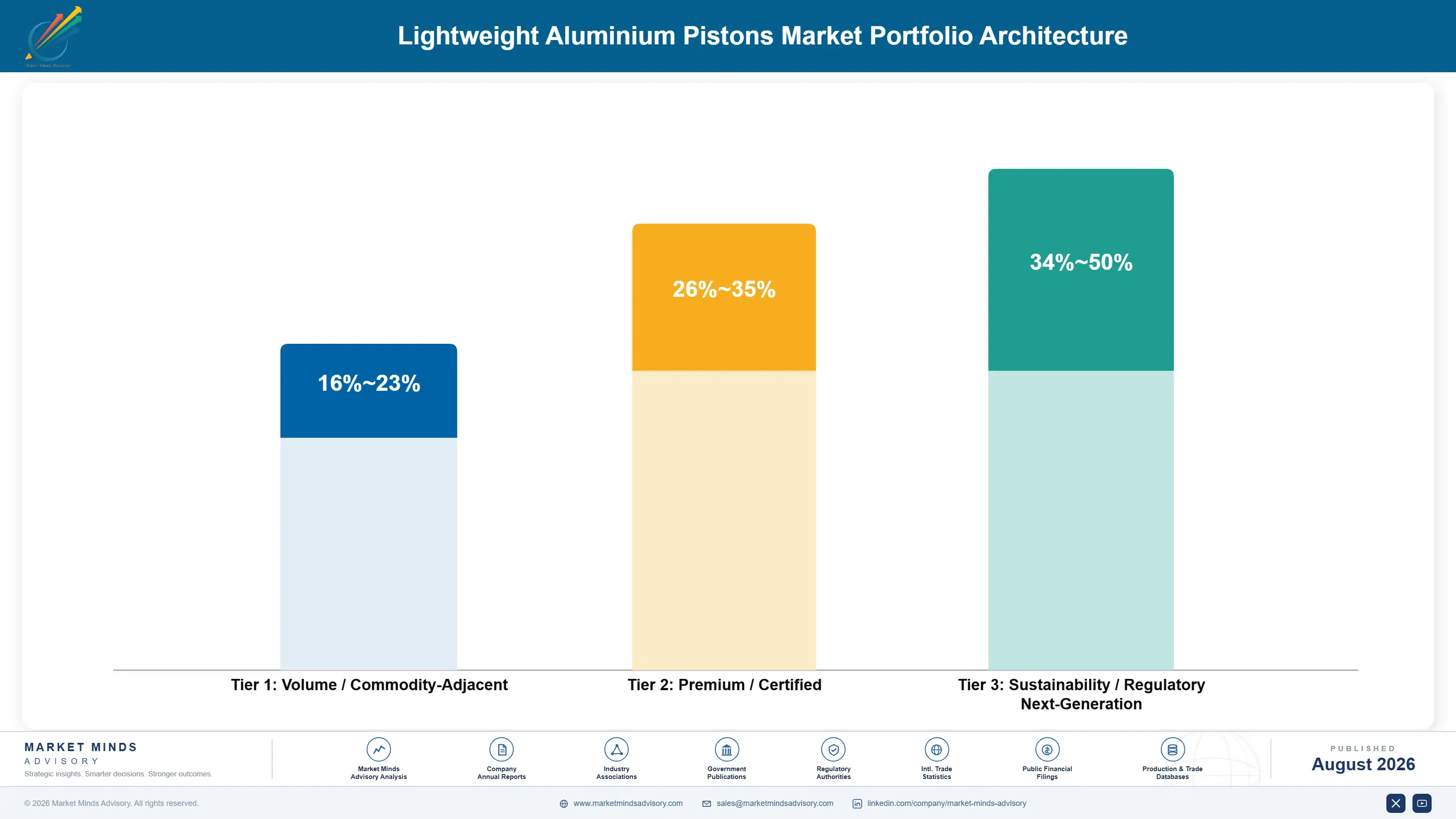
Margin in pistons tracks construction complexity rather than volume, because casting a eutectic piston is well understood and dozens of suppliers do it competently. Volume cast pistons for motorcycles and light applications run at gross margins in the mid teens. Cooling gallery and reinforced constructions run considerably better, since salt core technique and insert casting carry scrap risk that narrows the supplier field. Forged and performance pistons run higher again, because the applications cannot substitute and a failure destroys an engine.
The tension is that volume castings fill the machining lines and complex constructions earn the returns, and they need different capital and different process control. A plant tuned for high-volume gravity casting handles salt core work badly, and scrap rates on cooling galleries punish an operation that has not built the discipline. Several suppliers have found volume schedules consuming the process attention that complex work required, which shows up as scrap and missed delivery on exactly the products carrying the margin.

High-value pools sit in forged construction, cooling gallery work and aftermarket replacement supply. None of the three is where the unit volume is. Casting capacity by itself defends nothing at all in a market this competitive.

Volume / Commodity-Adjacent

Cast eutectic and ring-carrier pistons for motorcycles, light passenger applications and volume aftermarket, competed against Asian suppliers on price per unit. The seven-point range separates operations with competitive energy and metal costs from Western plants carrying both disadvantages simultaneously.
Gross Margin: 16%-23%

Premium / Certified

Cooling gallery, hypereutectic and reinforced constructions where salt core technique, insert casting and scrap discipline narrow the supplier field considerably. The nine-point spread reflects process maturity, since scrap rate on complex castings separates competent operations from struggling ones.
Gross Margin: 26%-35%

Sustainability / Regulatory / Next-Generation

Forged pistons, performance and racing construction, and material development for hydrogen and synthetic fuel engines. The sixteen-point range is wide because performance and racing supply prices against consequence of failure rather than against manufacturing cost anywhere.
Gross Margin: 34%-50%
lightweight-aluminium-pistons-market-portfolio-architecture-1787555248956

High-value Sub-segments and Strategic Watch-out

Forged Piston Construction

Compounding at 5.1% and defended by press capacity, die investment and metallurgical control a casting operation cannot improvise. Hybrid Atkinson-cycle engines and turbocharged high-output petrol both exceed what casting survives, which is the whole commercial argument here. Nobody builds that capability quickly or cheaply anywhere.
Gross Margin: 36%-50%

Aftermarket Replacement Supply

Twenty-eight percent of units, running on engine populations already built that no manufacturer decision can remove. An off-highway machine gets rebuilt several times across decades, and rebuild buyers are urgent rather than tendering, which shows up directly in price. Most suppliers still treat it as residue.
Gross Margin: 30%-42%

Volume Cast Motorcycle Pistons

Thirty-four percent of unit volume and the base that keeps this market growing, competed hard by Asian suppliers on price per unit. Manage it for machining line utilisation rather than for margin, because margin is not available here. Nobody based in Europe wins that on cost.
Gross Margin: 16%-23%

Hydrogen And Synthetic Fuel Engines

A genuine option rather than a business yet, since hydrogen combustion loads a piston differently and demands materials work nobody has finished. If heavy applications adopt it, combustion demand extends well past the 3.4% base case assumes. Watch it closely rather than funding it heavily yet.
Gross Margin: 34%-50%

How Piston Demand Renews

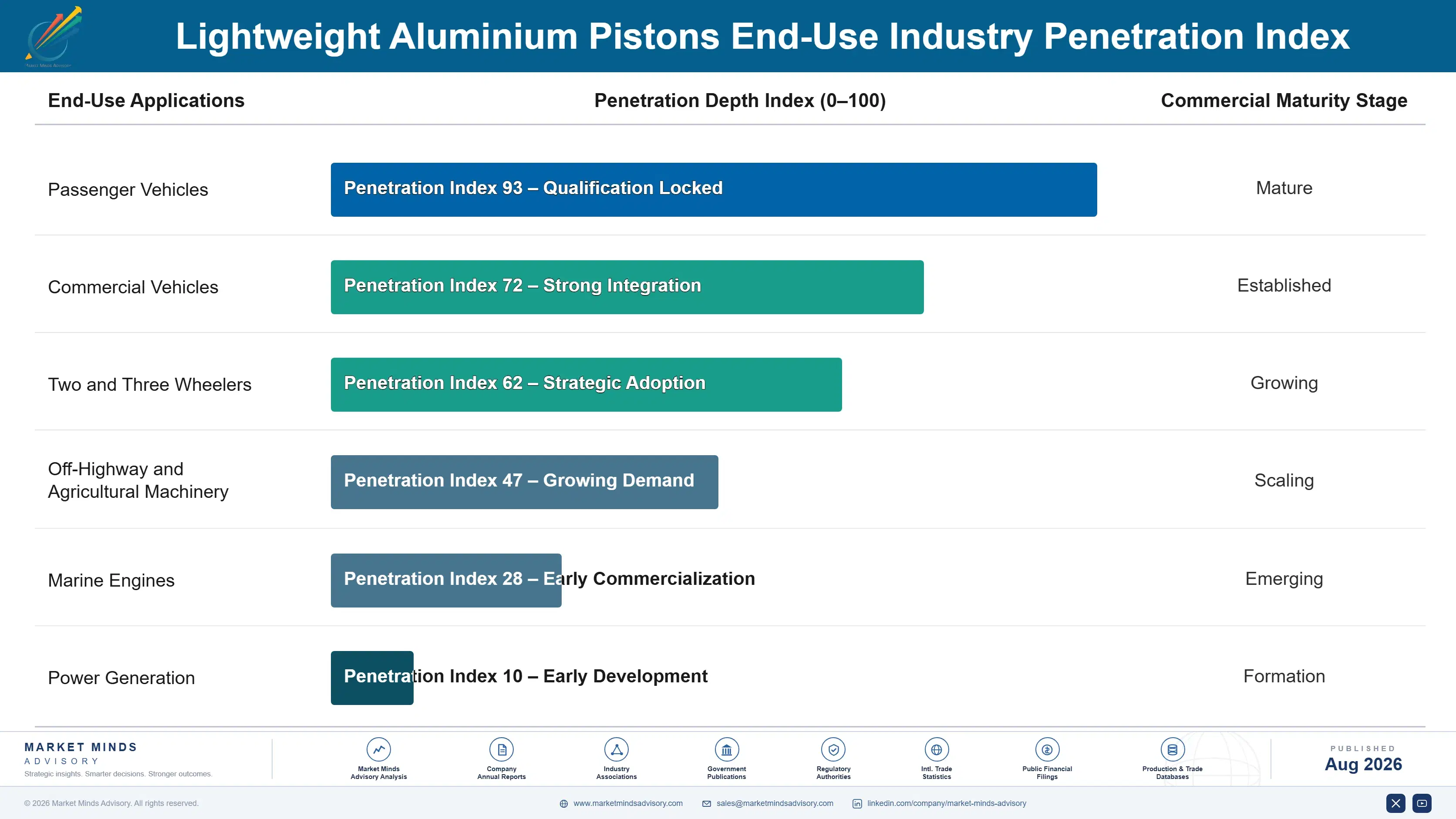
Piston demand renews on two entirely separate clocks. Original equipment runs on programme cycles, where a qualification decision commits a supplier for the engine's production life and no annual repurchase occurs at all. Replacement runs on engine wear, where every unit already in service generates orders across a life measured in decades. The second clock is the one that keeps running when new engine production falls, and it covers 28% of units.
Stickiness varies enormously by application. Original equipment positions are the stickiest thing in this market, because requalifying a piston means repeating durability testing an engine manufacturer will not fund twice. Off-highway and marine rebuild supply is nearly as sticky, since a rebuilder specifies what worked last time. Volume motorcycle supply changes hands on price at every contract renewal, because many suppliers meet the specification identically and the buyer knows it.

The buyer has shifted upward and most suppliers still call on the old one. Piston selection sat with engine design engineers weighing weight, friction and durability. It increasingly sits alongside powertrain strategy functions deciding which engine programmes get funded at all, and that conversation is about whether the engine exists rather than what goes inside it.
lightweight-aluminium-pistons-market-end-use-penetration-index-1787555249443

Where To Place The Bet

These are among the four positions where our research anticipates prominent divergence between winners and laggards over the coming forecast period. Each is grounded in the demand model, the regulatory perimeter, and the announced capacity pipeline.
01 / MATERIAL THREAT RESPONSE

The threat is steel, not the battery

Steel pistons now hold roughly 62% of heavy-duty on-highway diesel and they took that position because peak cylinder pressures passed 200 bar, which is a fatigue limit no aluminium alloy development has managed to move. The industry spent the same decade organising its anxiety around electrification while a different metal removed its single most valuable segment entirely. Medium-duty diesel pressures are now climbing toward the same threshold, and suppliers who have not modelled that displacement are repeating the same error deliberately.
02 / SURVIVING VOLUME FOCUS

Follow engines electrification will not reach soon

Two and three wheelers hold 34% of piston unit volume and are built across India and Southeast Asia at price points where battery cost against a vehicle selling for a few hundred dollars simply does not work yet. Off-highway equipment, marine auxiliaries and power generation add substantially more, and none of those buyers is choosing on emissions regulation. Suppliers with capacity sized for Western passenger car production are defending the single segment that genuinely disappears while ignoring everything that does not.
03 / FORGING CAPABILITY INVESTMENT

Build forging before the cast business erodes

Forged pistons compound at 5.1% while volume castings grow at barely 2%, and the divergence comes from load rather than from fashion, since hybrid Atkinson-cycle engines and turbocharged high-output petrol both exceed what a cast crown survives. Forging requires press capacity, die investment and metallurgical control that a casting operation neither has nor improvises in a hurry. That is exactly why the capability defends a position: suppliers who started building it years ago are competing in a narrow field at considerably better margin.
04 / AFTERMARKET PRIORITY SHIFT

Run replacement supply as the primary business

Replacement supply is 28% of piston units and it runs on engine populations already built, which means no vehicle manufacturer powertrain decision can take that volume away from anybody. An off-highway machine or a marine auxiliary gets rebuilt several times across a working life measured in decades, and every rebuild arrives as an order regardless of new engine production. Most suppliers still organise around original equipment and treat replacement as residue, which gets the priority exactly backwards for a market facing declining new-build volume.

Engagement Snapshot From the Field

A live engagement with an industry participant carrying material or product regulatory and market exposure ahead of a defining policy shift, showing how our research translates into a defensible multi-year portfolio strategy.
MARKET MINDS ADVISORY · CLIENT ENGAGEMENT SUMMARY
Lightweight Aluminium Pistons Producer Strategic Portfolio Review and Transition Roadmap 2026·Investment Scenario on Lightweight Aluminium Pistons Exposure Evaluation 2025-26
CLIENT PROFILE
A European piston supplier with annual revenue around EUR 310 million (client-reported, unverified by MMA), producing cast aluminium pistons across three plants for passenger car and commercial vehicle programmes. Roughly 70% of output served Western European engine assembly. The business held no forging capability and limited cooling gallery capacity. Aftermarket supply was under a tenth of volume and managed as an afterthought.
STRATEGIC CHALLENGE
Volume had fallen for four consecutive years (client-reported, unverified by MMA) and management attributed all of it to electrification. Two commercial vehicle programmes had been lost without any competitor winning them. Nobody had established that steel rather than batteries took those programmes, which meant the proposed response of waiting for hybrid volumes addressed the wrong problem entirely.
MMA APPROACH
MMA reconstructed the client's programme losses by cause rather than accepting the electrification explanation, tracing each to either powertrain cancellation or material substitution. Peak cylinder pressure trajectories were mapped across the remaining customer programmes to identify which would cross the aluminium threshold and when. Forging investment economics were modelled against that timetable, and aftermarket channel economics were benchmarked through the expert interview programme.
KEY FINDINGS
  1. Both lost commercial vehicle programmes went to steel rather than disappearing to electrification, which meant the client had misdiagnosed the cause of four years of decline.
  2. Three further customer programmes were projected to cross the aluminium pressure threshold within six years, putting considerably more volume at risk than management had assumed.
  3. Hybrid petrol programmes in the client's existing customer base required forged or cooling gallery construction the client could not supply, so the hybrid recovery would have arrived without them.
  4. Aftermarket margins ran materially above original equipment on comparable products, and the client's under-a-tenth share reflected neglect rather than any competitive barrier.
CLIENT PROFILE
A European piston supplier with annual revenue around EUR 310 million (client-reported, unverified by MMA), producing cast aluminium pistons across three plants for passenger car and commercial vehicle programmes. Roughly 70% of output served Western European engine assembly. The business held no forging capability and limited cooling gallery capacity. Aftermarket supply was under a tenth of volume and managed as an afterthought.
STRATEGIC CHALLENGE
Volume had fallen for four consecutive years (client-reported, unverified by MMA) and management attributed all of it to electrification. Two commercial vehicle programmes had been lost without any competitor winning them. Nobody had established that steel rather than batteries took those programmes, which meant the proposed response of waiting for hybrid volumes addressed the wrong problem entirely.
MMA APPROACH
MMA reconstructed the client's programme losses by cause rather than accepting the electrification explanation, tracing each to either powertrain cancellation or material substitution. Peak cylinder pressure trajectories were mapped across the remaining customer programmes to identify which would cross the aluminium threshold and when. Forging investment economics were modelled against that timetable, and aftermarket channel economics were benchmarked through the expert interview programme.
KEY FINDINGS
  1. Both lost commercial vehicle programmes went to steel rather than disappearing to electrification, which meant the client had misdiagnosed the cause of four years of decline.
  2. Three further customer programmes were projected to cross the aluminium pressure threshold within six years, putting considerably more volume at risk than management had assumed.
  3. Hybrid petrol programmes in the client's existing customer base required forged or cooling gallery construction the client could not supply, so the hybrid recovery would have arrived without them.
  4. Aftermarket margins ran materially above original equipment on comparable products, and the client's under-a-tenth share reflected neglect rather than any competitive barrier.
RECOMMENDED STRATEGY
Phase 1: Phase one: stop waiting for hybrid volume and requalify the three at-risk programmes on cooling gallery construction before pressures cross the threshold. Phase 2: Phase two: build forging capacity at one site, accepting three years before qualification volume arrives from any hybrid petrol programme. Phase 3: Phase three: staff and fund aftermarket supply as a separate business with its own targets rather than as spare original equipment capacity.
OUTCOME
Two of the three at-risk programmes are requalified on cooling gallery construction and retained. Forging investment is approved at one site with first qualification expected in 2028. Aftermarket now operates as a separate unit, and the client reports replacement volume roughly doubling within eighteen months (client-reported, unverified by MMA).

Frequently Asked Questions

Foundational context covering the market sizes, CAGR, scope, country, region and competition that inform every finding below. This section is provided to cover basics and most often pre-purchase conversations, answered from the MMA Primary Research Dataset.

What is the current size of the Lightweight Aluminium Pistons Market?

The market was valued at USD 4.8 billion in 2025, rising to an estimated USD 4.96 billion in 2026. East Asia holds the largest regional share at 30% of value.

How large will the Lightweight Aluminium Pistons Market be by 2036?

MMA forecasts USD 6.93 billion by 2036 under the base case, an expansion multiple of 1.40 times the 2026 value. That represents USD 1.97 billion of incremental value.

What is the CAGR for the Lightweight Aluminium Pistons Market 2026 to 2036?

The base case runs at 3.4% compound annual growth between 2026 and 2036, with a bull case at 4.6% and a bear case at 2.2%. Historical growth from 2020 to 2025 was 2.4%.

Which segment is growing fastest?

Forged aluminium pistons lead at 5.1%, half again the market rate, because hybrid and high-output engines exceed what casting survives. Cooling gallery constructions follow at 4.6%.

Who are the major companies in the Lightweight Aluminium Pistons Market?

Mahle, Tenneco, Rheinmetall Automotive, Aisin and Art Metal Mfg hold 58% between them. Validation depth and forging capability rather than casting capacity sustain those positions.

Which country is growing fastest?

India leads at 6.4%, driven by motorcycle and three-wheeler manufacture at price points electrification has not reached. Domestic suppliers serve most of that volume themselves.

Report Segmentation Architecture

The full report scope spans multiple orthogonal segmentation dimensions, with cross-tabulated demand data provided for each dimension pair. Coverage extends further to regional breakdowns, trend trajectories, and the competitive detail needed to support segment-level decision-making.

By Construction and Reinforcement

  • Cast Eutectic Aluminium Pistons
  • Cast Hypereutectic Aluminium Pistons
  • Forged Aluminium Pistons
  • Cast Pistons with Cooling Gallery
  • Fibre-Reinforced and Metal Matrix Composite Pistons
  • Ring-Carrier Insert Pistons

By End-Use Industry

  • Passenger Vehicles
  • Commercial Vehicles
  • Two and Three Wheelers
  • Off-Highway and Agricultural Machinery
  • Marine Engines
  • Power Generation

By Supply Channel

  • Original Equipment Direct
  • Engine Builder Supply
  • Independent Aftermarket
  • Authorised Service Network
  • Performance and Racing Distribution

By Region

  • North America
  • Western Europe
  • East Asia
  • South Asia and Pacific
  • Latin America
  • Middle East and Africa
  • Eastern Europe

Scope, Methodology, and Coverage

Every figure in this report is reproducible from documented input assumptions. The scope below maps the historical period, the forecast horizon, the segmentation dimensions, and the countries covered, alongside the underlying primary and qualitative methodology.
Historical Period
2020 to 2025
Forecast Period
2026 to 2036
Base Year
2025 (USD billions; MMA Primary Research Dataset, August 2026)
Market Definition
The market comprises aluminium alloy pistons supplied for reciprocating internal combustion engines across passenger vehicles, commercial vehicles, two and three wheelers, off-highway machinery, marine engines and power generation, covering cast eutectic, cast hypereutectic, forged, cooling gallery, fibre-reinforced and ring-carrier insert constructions. Value is measured at supplier level on units shipped to original equipment and aftermarket channels. Steel and cast iron pistons, piston rings, piston pins, gudgeon assemblies, connecting rods, cylinder liners and complete engine assemblies fall outside scope.
Quantitative Units
USD billions (current prices); million piston units shipped annually; USD per unit by construction and reinforcement type
Segmentation Dimensions
By Construction and Reinforcement; By End-Use Industry; By Supply Channel; By Region
Regions Covered
North America, Western Europe, East Asia, South Asia and Pacific, Latin America, Middle East and Africa, Eastern Europe
Countries Covered
China, Japan, South Korea, Taiwan, India, Indonesia, Vietnam, Thailand, Australia, United States, Canada, Mexico, Germany, Italy, France, United Kingdom, Spain, Austria, Poland, Czechia, Slovakia, Hungary, Romania, Brazil, Argentina, Colombia, Turkey, Saudi Arabia, Egypt, South Africa
Key Companies Profiled
Mahle GmbH, Tenneco, Rheinmetall Automotive, Aisin Corporation, Art Metal Mfg, Riken Corporation, Nippon Piston Ring, Teikoku Piston Ring, Hitachi Astemo, Shriram Pistons and Rings, Menon Pistons, India Pistons, Binzhou Bohai Piston, Zynp Corporation, Dongfeng Motor Parts, Wiseco Performance Products, JE Pistons, CP-Carrillo, Cosworth, Arias Pistons
Quantitative Methodology
Primary survey, n=3,800 respondents, Q4 2025, six countries; demand-side model with trade association cross-validation
Qualitative Methodology
47 expert interviews, Q4 2025; applied to validate demand model assumptions, identify emerging dynamics, and assess competitive positioning
Report Format
PDF and XLSX data workbook (Word format preview document)
Publisher
Market Minds Advisory
Report Code
MMA-2026-AUT-318
Published
August 2026
Contact
sales@marketmindsadvisory.com | www.marketmindsadvisory.com

Purchase the full Lightweight Aluminium Pistons Market Report (2026 to 2036).

The full report sizes the global aluminium piston market to 2036 across six construction configurations and seven regions, measured on units shipped annually to original equipment and aftermarket. It treats steel substitution rather than electrification as the primary threat and quantifies displacement by application and peak cylinder pressure. Competitive analysis covers 20 participants evaluated on unit volume, with moat and risk assessment for the two leaders. Surviving demand in two and three wheelers, off-highway equipment and power generation is sized separately from passenger car exposure. Four quantified revenue levers close the analysis.
Six-construction segment sizing with segment-level growth rates
Seven-region share and growth breakdown to 2036
Twenty-participant competitive map on one unit basis
Steel displacement quantified by application and cylinder pressure
Input cost exposure traced to exchange aluminium pricing
Four quantified revenue levers with commercial impact ranges

Built For The People Who Decide

From boardroom strategy to bench-side execution, this report is read cover-to-cover by leaders shaping the next decade of their industry, turning demand scenarios, market dynamics and valuation benchmarks into decisions.
CXOs/ Presidents/ VPs/ Managers
M&A and Corporate Development
Strategy Teams and R&D Heads
Procurement and Product Directors
Regulatory and Compliance Leaders
Investor Relations and Equity Analysts