
Market Minds Advisory
In-Vehicle Ethernet System Market

In-Vehicle Ethernet System Market: Trends and Forecast 2026 to 2036

ADAS bandwidth requirements and zonal vehicle architecture redesigns are pushing automakers to replace legacy CAN bus networks with Ethernet backbones, even as China's domestic EV production scales adoption faster than automakers elsewhere can match.

Lead Analyst

David Horsley

Published

September 2026

Make Smarter Decisions with Customized Research Insights

Request a free sample report and evaluate market opportunities, growth trends, and competitive dynamics relevant to your business needs.

2025 MARKET VALUE$3.2BMarket Size 2025
2036 FORECAST VALUE$14.2BBase Case , 2026 to 2036
CAGR 2026 TO 203614.5 %Bull 15.8% / Bear 13.2%
INCREMENTAL OPPORTUNITY$10.5BNet 10- year value creation
EXPANSION MULTIPLE3.87x2036 value over 2026 base
Strategic Levers
M&A Pipeline
Regional Outlook
Country Rankings
Competitive Intelligence
Segmental Deep-dive
Call-Us : 91 93563 13602

Executive Snapshot and Market Trajectory

In-vehicle Ethernet adoption is accelerating as ADAS camera, radar, and lidar sensor data volumes exceed what legacy CAN bus architectures can reliably carry, pushing automakers toward Ethernet backbones even as many vehicle platforms still rely on established CAN and LIN networks for lower-bandwidth functions across most current global production today.
Commercial forces now split the market between automakers redesigning vehicle architecture around zonal Ethernet gateways and automakers retrofitting Ethernet only for specific high-bandwidth ADAS and infotainment functions within conventional architectures. ADAS and camera data backbone applications are the fastest-growing segment, expanding as autonomous driving features require Ethernet's higher bandwidth and lower latency characteristics. East Asia and North America together account for most global demand, split between Chinese EV production scale and established ADAS development activity.
Competitive intensity concentrates among a handful of automotive semiconductor and networking suppliers holding the certification and reliability track record required for safety-critical vehicle applications, leaving lower-tier component supply more fragmented across regional manufacturers. Long automotive qualification cycles add a further layer of complexity, since automakers rarely switch suppliers mid-platform given the multi-year design validation process attached to vehicle electronic architecture decisions.
Market Definition
The In-Vehicle Ethernet System Market covers automotive-grade Ethernet switches, physical layer transceivers, and networking software used to carry sensor, infotainment, and diagnostic data within vehicle electronic architectures. It excludes legacy CAN, LIN, and FlexRay networking components and standalone ADAS sensor hardware sold without an Ethernet interface.
Base Year Value
$3.2B in 2025 (MMA Primary Research Dataset, August 2026)
Forecast Period
2026 to 2036, eleven discrete annual values
CAGR
14.5% base case. Bull 15.8%. Bear 13.2%.
Fastest Growth Segment
ADAS and Camera Data Backbone Ethernet: 18.5% CAGR
Fastest Growth Country
India: 17.0% CAGR
Fastest Growth Region
South Asia and Pacific: 16.5% CAGR
Largest Region
East Asia: 38% of 2025 global value
Market Leaders
Broadcom, Marvell Technology, NXP Semiconductors, Texas Instruments, Microchip Technology (MMA Analysis, 2025).
Primary Survey
n=3,800 procurement and R&D decision-makers, Q4 2025, six countries
Methodology
Demand-side build-up, cross-validated against public data, 47 expert interviews

In-Vehicle Ethernet System Market Forecast Scenarios

in-vehicle-ethernet-system-market-trends-size-forecast-scenario-1787553060363
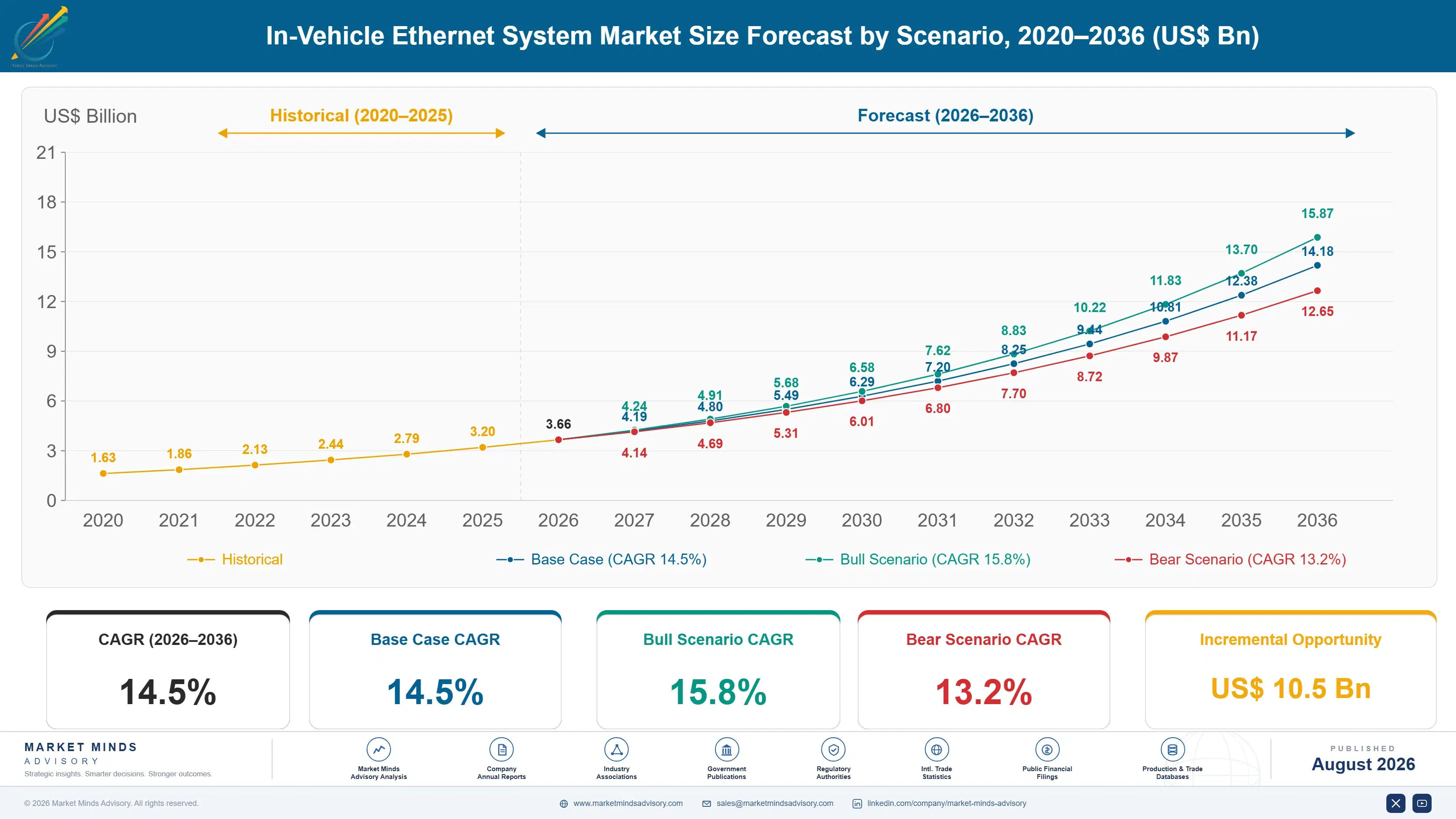
The in-vehicle Ethernet system market grew at an estimated 13.3% annually between 2020 and 2025, supported by early ADAS backbone adoption among premium vehicle platforms and gradually expanding zonal architecture redesign programmes. Growth accelerated toward the end of the period as Chinese EV manufacturers began specifying Ethernet backbones across a broader range of vehicle price segments.
The base case assumes 14.5% annual growth through 2036, driven by three commercial mechanisms: expanding ADAS and autonomous driving feature adoption requiring higher-bandwidth sensor data networks, growing zonal vehicle architecture redesign programmes that consolidate networking around Ethernet backbones, and continued Chinese EV production scale sustaining regional semiconductor manufacturing investment. Regulatory pressure for advanced safety features is also nudging automakers toward Ethernet-enabled sensor fusion architectures, favoring suppliers who already hold automotive-grade certification over new entrants.
The bull case, at 15.8%, assumes accelerated autonomous driving feature rollout drives faster Ethernet backbone adoption across multiple vehicle price segments simultaneously, particularly in China and North America. The bear case, at 13.2%, assumes automakers delay full zonal architecture transitions longer than expected, continuing to rely on legacy CAN networks for a larger share of vehicle functions across most current platforms.

ADAS Bandwidth Demands Force Architecture Transition

The In-Vehicle Ethernet System Market sits at the center of the automotive industry's shift from distributed, function-specific electronic control units toward centralized, zonal architectures that demand far higher data bandwidth than legacy CAN and LIN networks were ever designed to carry. Ethernet's ability to move camera, radar, and lidar sensor data reliably at automotive-grade reliability standards makes it the emerging backbone technology of choice.
MARKET CONCENTRATION55%Top five producers hold combined global market share
AVERAGE SELLING PRICE$45 per nodeReflects blended pricing across switch and transceiver components
TOP PRODUCER SHARE32%China leads global manufacturing capacity for this equipment
CAPACITY UTILIZATION78%Producers run plants near typical semiconductor industry ceiling
FEEDSTOCK SHARE OF COGS45%Silicon wafer and semiconductor inputs dominate production costs
VEHICLE ATTACH RATE35%Meaningful share of new vehicles now carry this technology
Production requires automotive-grade qualification testing that most standard semiconductor components never undergo, given the reliability, temperature range, and electromagnetic interference requirements vehicle electronic systems demand over a multi-year service life. This concentrates supply among semiconductor companies with established automotive qualification track records, while newer entrants without comparable certification history struggle to win design wins on safety-critical ADAS applications regardless of underlying technical performance.
Capacity utilization runs near typical semiconductor industry levels, reflecting steady automotive design win momentum even as broader semiconductor demand cycles introduce some volatility. Silicon wafer and semiconductor fabrication costs represent a substantial share of total cost of goods sold, leaving automotive qualification portfolio breadth and design win relationships as key differentiators between suppliers competing for next-generation vehicle platform contracts.
"Everyone talks about this as a bandwidth story, but the real business is automotive qualification, since that multi-year certification process is what actually keeps commodity semiconductor players out of the safety-critical segments. The suppliers winning ADAS backbone design wins today locked in that credibility years before autonomous features became a purchasing requirement."
Senior Analyst, Automotive Electronics and Semiconductor Practice · MMA Automotive Practice · August 2026

Market Trends

Zonal Vehicle Architecture Redesign Accelerates Across Automakers

Automakers are redesigning vehicle electronic architectures around zonal controllers connected by Ethernet backbones rather than the dozens of distributed, function-specific electronic control units that characterized previous vehicle generations and platforms. This architectural shift has accelerated since 2023 as automakers pursue the wiring weight reduction and software update flexibility zonal designs enable compared to legacy distributed architectures. Several major automakers have announced multi-year zonal architecture transition roadmaps, creating multi-year demand visibility for Ethernet switch and transceiver suppliers who secure design wins on these next-generation vehicle platforms early in the development cycle.
Market Impact: ADAS features expanded since 2023
ADAS Camera and Lidar Data Volumes Keep Rising

ADAS systems now incorporate more cameras, radar units, and increasingly lidar sensors per vehicle than just a few years ago, and each additional sensor adds meaningful data volume that legacy CAN networks cannot carry at required latency and reliability levels across most current platforms. This sensor proliferation has accelerated steadily since 2022 as automakers pursue higher levels of driving automation across a broader range of vehicle price segments. Ethernet suppliers who can demonstrate reliable multi-gigabit throughput at automotive-grade reliability standards are capturing design wins on the highest-sensor-count next-generation ADAS platforms.
Market Impact: Chinese EV production scaled since 2022

Market Opportunities and Growth Drivers

Autonomous Driving Feature Adoption Expands Across Vehicle Segments

Autonomous driving features have expanded from premium vehicle platforms into mainstream and even budget vehicle segments since 2023, driven by competitive pressure among automakers to offer comparable ADAS capability across their full model lineup. Each vehicle offering advanced driving assistance features requires an Ethernet backbone capable of handling the sensor fusion data volume these features generate in real time, creating direct linkage between ADAS feature penetration and Ethernet component demand. Suppliers with established automotive qualification across multiple vehicle price tiers are capturing this expanding addressable market faster than newer entrants.
Market Impact: Qualification takes 2 to 4 years

Chinese EV Production Scale Sustains Semiconductor Investment

Chinese electric vehicle production has scaled dramatically since 2022, with domestic automakers producing vehicles at a volume and pace that sustains substantial semiconductor manufacturing investment across the country's automotive electronics supply chain and downstream component base nationwide and consistently. Chinese automakers have also moved faster than many global peers to specify Ethernet backbones even in mid-tier vehicle segments, reflecting domestic semiconductor suppliers' growing automotive qualification capability. This sustained production volume gives Chinese-qualified suppliers cost and scale advantages that support both domestic supply and growing export competitiveness in international automotive markets.
Market Impact: Hybrid architectures combine 2 network types

Market Restraints and Challenges

Long Automotive Qualification Cycles Slow New Entrant Access

Automakers require extensive reliability, temperature, and electromagnetic interference testing before qualifying a new Ethernet component supplier, a process that routinely takes two to four years for suppliers without existing automotive relationships to complete successfully. The root cause is the extreme reliability requirements vehicle electronic systems demand over a multi-year service life in harsh operating environments most consumer electronics never face at all. The commercial impact locks in incumbent suppliers for entire vehicle platform generations, and new entrants are responding by partnering with established automotive suppliers or targeting less safety-critical applications first.
Market Impact: Zonal transition accelerated since 2023

Legacy CAN Network Investment Slows Full Transition

Automakers have decades of accumulated engineering expertise, tooling, and supplier relationships built around legacy CAN and LIN networking architectures, creating genuine institutional inertia against full Ethernet transition even where the technical case is already clear. The root cause is the sunk cost and retraining burden associated with abandoning established networking approaches across an automaker's entire engineering organization and supplier base simultaneously. The commercial impact slows Ethernet adoption in lower-bandwidth vehicle functions, and suppliers are responding by offering hybrid architectures that combine Ethernet backbones with legacy CAN for less demanding functions.
Market Impact: Sensor data volumes rose since 2022
2 additional market trends, 2 additional growth drivers, and 2 additional restraints and challenges are covered in the full report. Contact sales@marketmindsadvisory.com to access the complete intelligence.

Segment CAGR and Growth Architecture

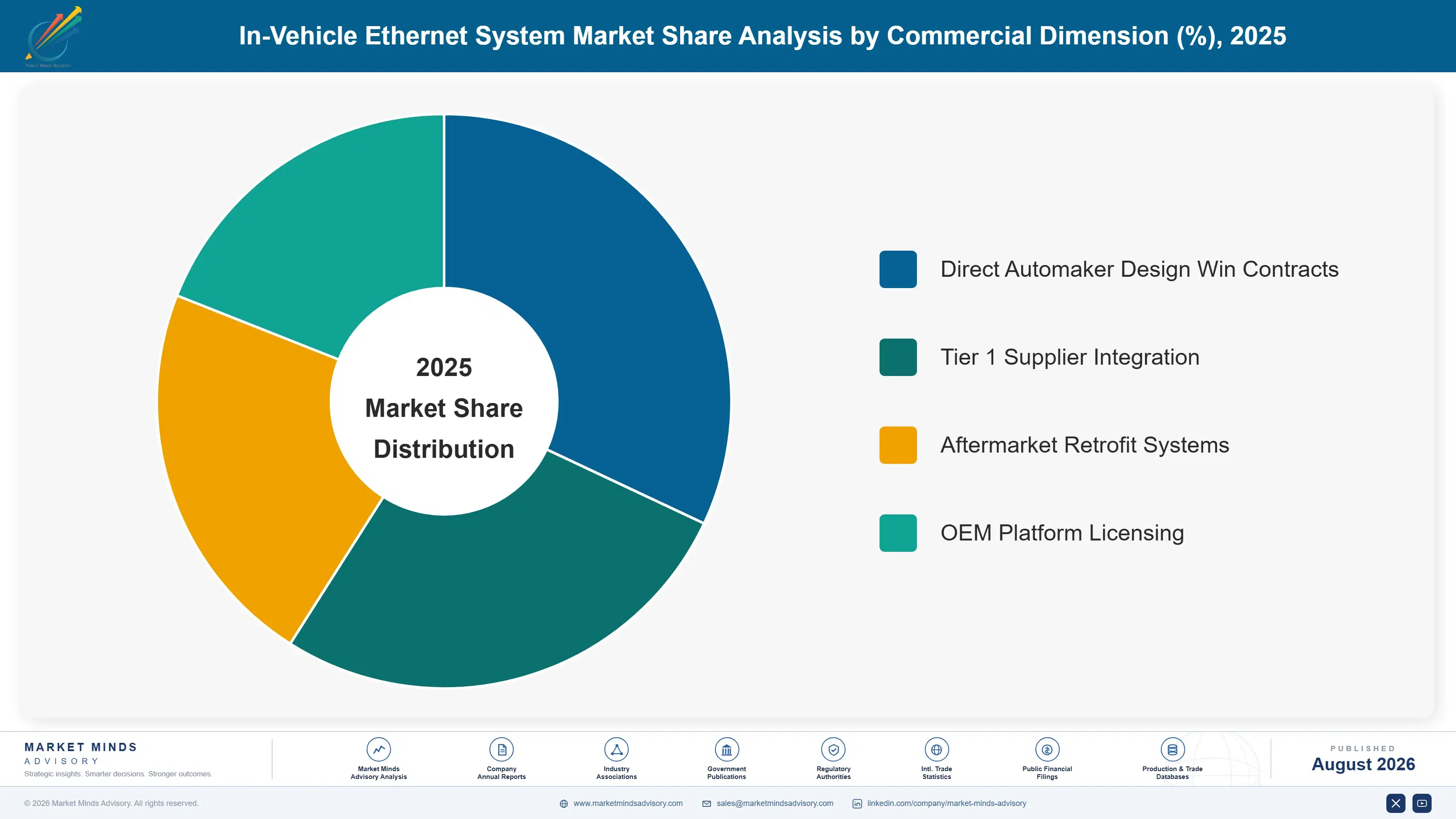
Segmentation follows application and function type, the classification automotive engineers use when specifying networking architecture requirements, since each category serves a distinct data traffic pattern through different bandwidth and latency requirements rather than a shared design pathway, and each typically involves its own separate automotive qualification process across all six categories examined in this report.
in-vehicle-ethernet-system-market-trends-market-share-analysis-1787553061961

ADAS and Camera Data Backbone Ethernet

ADAS and camera data backbone applications are the fastest-growing segment, expanding at 18.5% annually as automakers integrate more cameras per vehicle and pursue higher levels of driving automation requiring reliable, low-latency data transport that legacy CAN networks cannot deliver at the bandwidth modern sensor suites generate across most current and next-generation vehicle platforms in active development today across major automakers worldwide and internationally across every comparable market segment and price tier. This application demands automotive-grade Ethernet switches capable of handling multiple simultaneous camera streams without dropped frames or latency spikes that could compromise safety-critical driving assistance functions. Demand concentrates heavily in regions with active ADAS development, particularly East Asia and North America.
CAGR 18.5%

Lidar and Radar Sensor Fusion Ethernet

Lidar and radar sensor fusion applications, the second-fastest segment at 17.0% annually, combine data from multiple sensor types into a unified vehicle perception system requiring even higher bandwidth and tighter synchronization than camera-only ADAS backbone applications typically demand from the underlying network architecture and processing pipeline currently in production across most vehicle platforms and development programmes worldwide and internationally. This segment commands meaningfully higher pricing than basic infotainment-grade Ethernet components, reflecting the specialized timing synchronization and reliability testing sensor fusion applications require before automakers will qualify a supplier. Growth concentrates most heavily in regions pursuing higher levels of driving automation, particularly premium vehicle segments in North America and East Asia.
CAGR 17.0%
Full segment breakdown across 6 segments available in the complete report.

Regional Architecture and Country Demand Map

East Asia dominates regional demand given China's massive electric vehicle production scale and aggressive ADAS feature adoption across domestic vehicle segments. North America and Western Europe follow on established ADAS development activity, while South Asia and Pacific grows fastest as India expands automotive electronics manufacturing.

North America

North America's demand centers on established ADAS development activity among major automakers and Tier 1 suppliers headquartered in the region, with Michigan and California hosting significant automotive electronics engineering and validation infrastructure serving both domestic and export vehicle platforms consistently and reliably every single year without exception whatsoever or fail at all times and consistently and reliably. Semiconductor suppliers with existing automotive qualification history maintain strong design win relationships across multiple vehicle programmes given the multi-year certification investment already made. Canada contributes smaller but steady demand tied to its own automotive component manufacturing sector. Regulatory safety requirements continue pushing automakers toward Ethernet-enabled sensor fusion architectures across the region's vehicle platforms.
Share: 22% | CAGR: 14.2% (2026 to 2036)

Western Europe

Western Europe's demand centers on premium vehicle platforms from German and other European automakers that have historically led early ADAS and autonomous driving feature adoption across their model lineups and technology roadmaps consistently and reliably every single year without exception whatsoever or fail at all times. European Tier 1 suppliers maintain strong automotive qualification track records built over decades of engineering collaboration with domestic automakers on safety-critical vehicle systems. France and the UK contribute additional demand tied to their own automotive manufacturing and engineering sectors. Regulatory safety mandates across the European Union continue pushing automakers toward advanced driver assistance systems requiring higher-bandwidth Ethernet backbone architectures across most new model launches nationwide.
Share: 18% | CAGR: 13.0% (2026 to 2036)
Regional intelligence for 5 additional markets available in the complete report: East Asia, South Asia and Pacific, Latin America, Middle East and Africa, Eastern Europe. Contact sales@marketmindsadvisory.com.
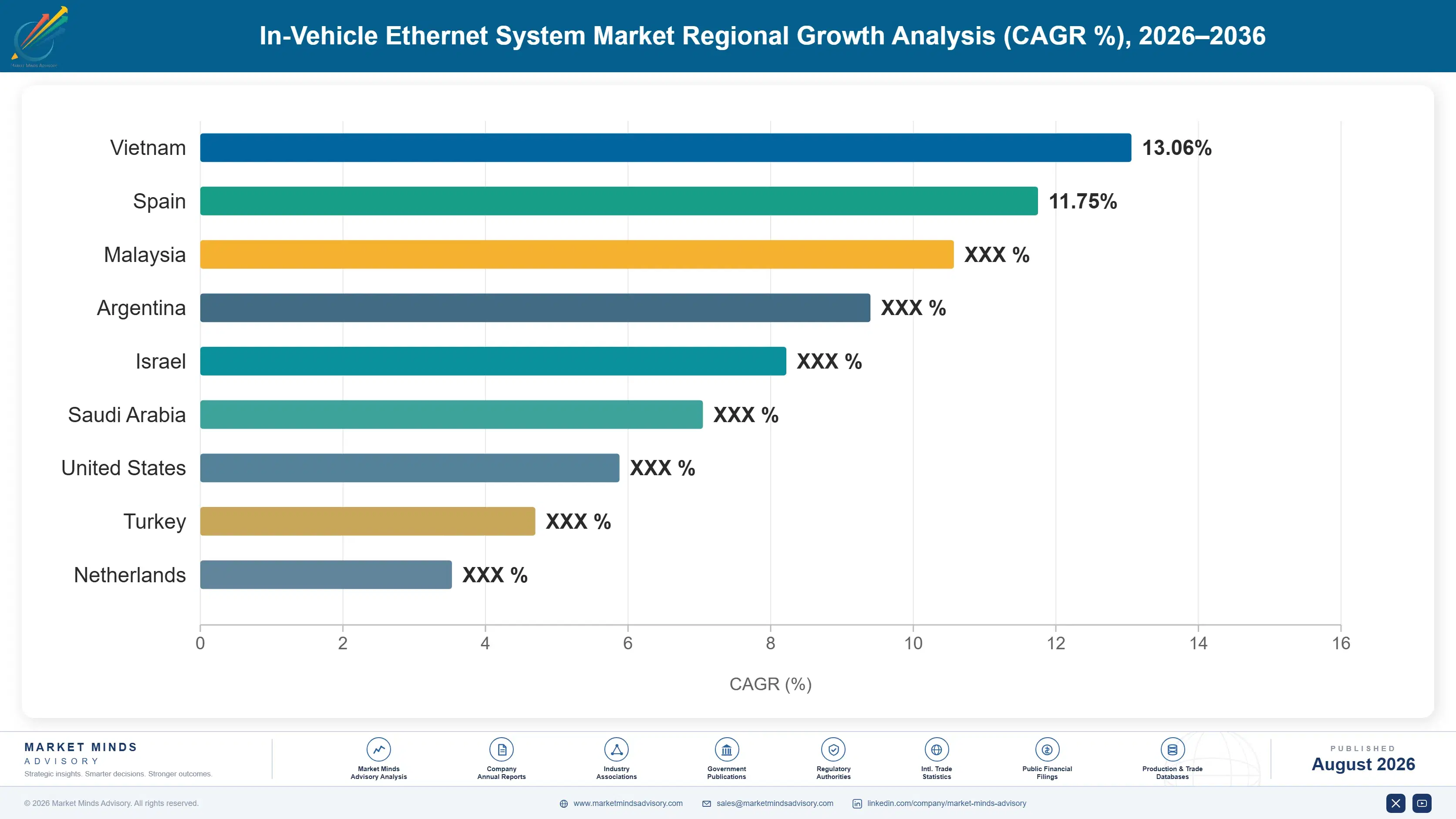
in-vehicle-ethernet-system-market-trends-country-cagr-analysis-1787553063348

Where Ethernet Suppliers Can Capture Margin

Margin expansion in this market concentrates around ADAS-grade certification, zonal architecture design win partnerships, Chinese manufacturing scale access, and sensor fusion technology development, four distinct commercial moves that convert existing automotive qualification capability into premium pricing rather than requiring entirely new semiconductor fabrication investment, each accessible to established suppliers holding existing design wins today.

Pursue ADAS-Grade Certification For Safety-Critical Applications

Suppliers currently outside ADAS-grade certification are leaving the highest-growth segment of the market entirely to a small number of qualified incumbents, even though the underlying semiconductor manufacturing process is fundamentally similar across grades and production nodes. Pursuing certification from automaker qualification programmes typically takes two to four years and requires meaningful investment in reliability testing infrastructure, but successfully certified suppliers gain access to pricing 2 to 3 times higher than lower-tier component rates on comparable volumes. Suppliers with existing automotive-grade manufacturing capacity are best positioned to make this transition profitably and quickly.
Market Impact: Captures pricing 2 to 3 times higher overall

Secure Zonal Architecture Design Win Partnerships Early

Automakers developing next-generation zonal vehicle architectures need Ethernet suppliers to co-develop and validate networking solutions years before a new platform reaches production, creating a genuine partnership opportunity for suppliers with strong automotive qualification capability across multiple vehicle programmes and platform generations. Suppliers who secure these design win partnerships early gain guaranteed volume through the platform's entire multi-year production run, capturing revenue that would otherwise require years of independent market development and outreach efforts. Early design win entrants have captured roughly 35% more new platform volume than suppliers entering after architecture finalization.
Market Impact: Early design wins captured roughly 35% more volume

Access Chinese Manufacturing Scale Through Partnership Arrangements

Suppliers without domestic Chinese manufacturing presence face a meaningful cost disadvantage relative to competitors benefiting from Chinese EV production-scale volume and lower per-unit manufacturing costs achieved through sustained high-volume output across most product categories and semiconductor nodes currently in active production and development. Suppliers who establish joint venture or licensing partnerships with Chinese semiconductor producers can access this cost structure without the multi-year timeline required to build comparable domestic manufacturing scale independently. Partnership arrangements have historically delivered cost reductions of roughly 20% compared to standalone Western manufacturing operations of comparable output volume.
Market Impact: Partnerships delivered cost reductions of roughly 20% overall

Develop Sensor Fusion Technology Ahead Of Competitors

Lidar and radar sensor fusion applications command meaningfully higher pricing than basic infotainment-grade Ethernet components, and suppliers who develop synchronized multi-sensor fusion capability now position themselves ahead of the broader industry shift toward higher levels of driving automation across most vehicle price segments and geographic markets worldwide today. Suppliers with established sensor fusion technology are capturing design wins on premium vehicle platforms at pricing roughly 30% above camera-only ADAS backbone components on comparable volume. Early technology investment compounds as automakers standardize sensor fusion architecture across future vehicle generations and platforms.
Market Impact: Sensor fusion commands roughly 30% premium over cameras

Who Controls the Margin Pool

The In-Vehicle Ethernet System Market shows moderate to high concentration with a CR5 of 55%, evaluated on a revenue basis across both ADAS-grade and lower-tier infotainment networking components. Broadcom and Marvell Technology lead the ADAS-grade segment specifically, while the gap between these two leaders and the third-ranked challenger widens further once lower-tier revenue is excluded from the comparison.
Current competitive activity centers on zonal architecture design win partnerships, with several mid-tier suppliers investing in reliability testing infrastructure to access premium pricing previously reserved for established automotive semiconductor suppliers. Capacity investment is also concentrated in sensor fusion capable components rather than basic infotainment-grade Ethernet, reflecting where margin and demand growth both point. Chinese domestic semiconductor suppliers are simultaneously scaling automotive-grade production to reduce reliance on imported components.

Emerging pressure comes from legacy CAN network investment that continues slowing full transition timelines in some vehicle segments, which could delay revenue realization if hybrid architecture adoption persists longer than currently expected. Rankings could shift meaningfully if a mid-tier supplier secures a major zonal architecture design win faster than incumbents expect, since platform-level partnerships increasingly determine access to multi-year production volume.
in-vehicle-ethernet-system-market-trends-company-positioning-matrix-1787553064192

Competitive Moat and Risk Dimensions

BROADCOM

Moat: Broadest Automotive Ethernet Portfolio

Broadcom holds the broadest automotive Ethernet product portfolio, spanning switches, physical layer transceivers, and gateway components across multiple vehicle price tiers and architecture types. This breadth lets the company win design contracts across an automaker's entire vehicle lineup rather than competing only for specific high-value ADAS applications.
BROADCOM

Risk: Premium Pricing Limits Budget Segment

Broadcom's premium pricing strategy limits the company's competitiveness in budget vehicle segments where automakers prioritize cost over the full feature breadth Broadcom's portfolio offers. This pricing position could cede volume in fast-growing budget EV segments, particularly in China, to lower-cost competitors willing to accept thinner margins for design wins.
MARVELL TECHNOLOGY

Moat: Early Automotive Qualification Investment

Marvell Technology invested early in automotive-grade qualification for its Ethernet switch portfolio, building certification credibility with major automakers years before autonomous driving features became a mainstream purchasing requirement. This early investment positions Marvell favorably for design wins on next-generation zonal architecture platforms now entering development.
MARVELL TECHNOLOGY

Risk: Smaller Scale Than Diversified Rivals

Marvell's automotive business remains smaller in scale than more diversified semiconductor rivals with broader product portfolios spanning multiple end markets beyond automotive. This narrower scale could limit Marvell's ability to invest as aggressively in next-generation sensor fusion technology development compared to competitors with larger overall research budgets.

Players Tracked

Prominent Players

Broadcom
Marvell Technology
NXP Semiconductors
Texas Instruments
Microchip Technology

Other Key Players

Renesas Electronics
Infineon Technologies
STMicroelectronics
onsemi
Realtek Semiconductor
Analog Devices
Qualcomm
Bosch
Continental
Aptiv
Vector Informatik
TTTech Auto
KDPOF
Molex
TE Connectivity

Recent Developments

MARCH 2025

Broadcom announced completion of a new automotive-grade Ethernet switch qualified for zonal vehicle architecture applications, adding sensor fusion capability to its existing product portfolio. The launch responds directly to rising automaker demand for higher-bandwidth networking components capable of handling combined camera, radar, and lidar sensor data streams.
Signal: Confirms incumbents are investing ahead of confirmed zonal architecture adoption across next-generation platforms and vehicle programmes
JULY 2025

Marvell Technology signed a multi-year design win agreement with a major automaker for Ethernet switches across the automaker's next-generation zonal vehicle architecture platform, securing recurring volume tied to the platform's multi-year production run. The agreement reflects the broader industry shift toward early design win partnerships over late-stage component sourcing.
Signal: Signals automakers are locking in Ethernet supplier relationships years ahead of platform launch and production start
NOVEMBER 2025

A Chinese domestic semiconductor manufacturer commissioned a new automotive-grade Ethernet component production facility designed to reduce national reliance on imported networking semiconductors, part of a broader strategy to serve China's expanding EV production base. The facility adds meaningful qualified capacity to the East Asian regional supply chain.
Signal: Indicates China is scaling automotive semiconductor self-sufficiency deliberately and steadily nationwide across its broader supply chain

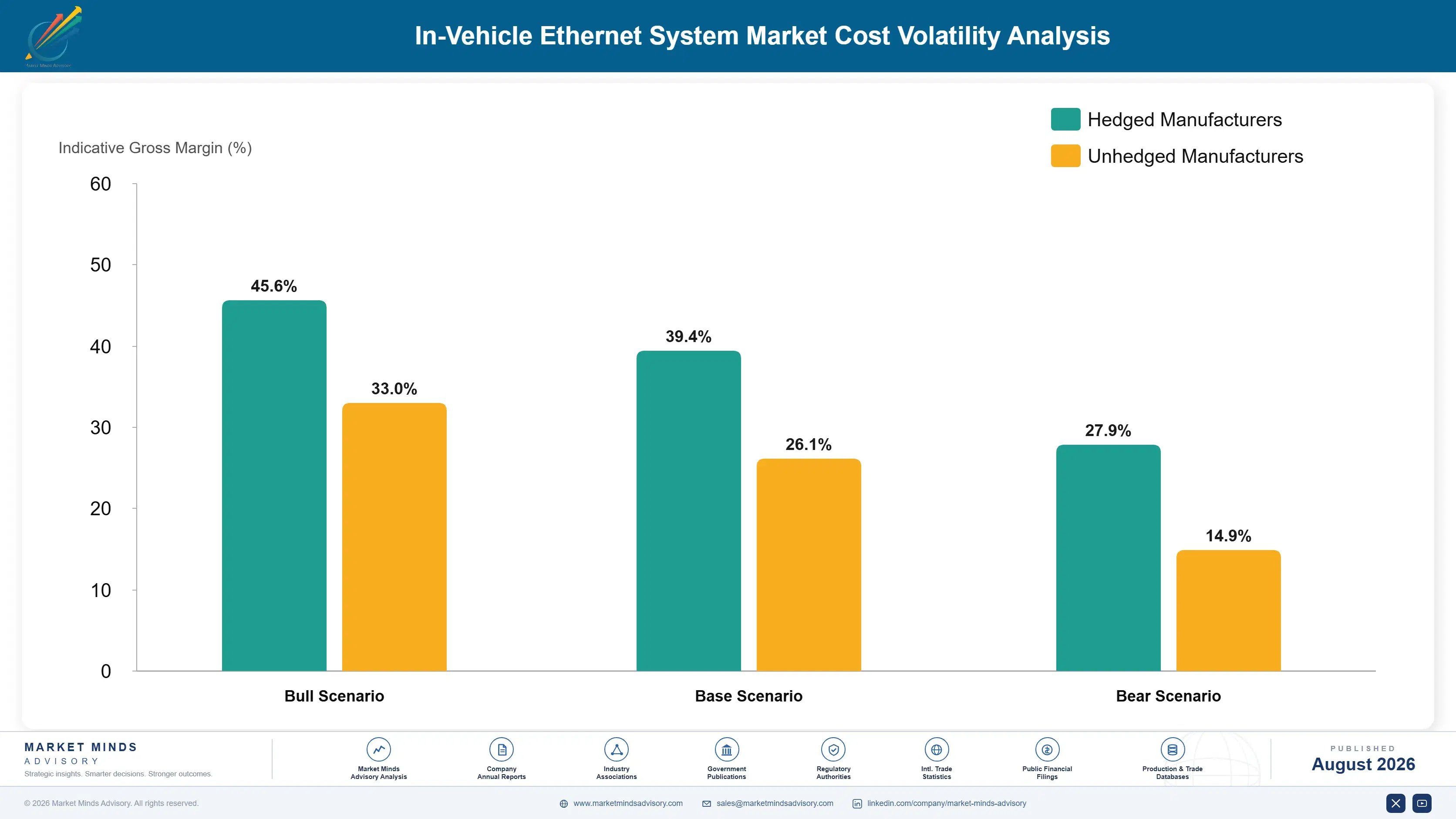
Semiconductor Fabrication Cost Exposure

Silicon wafer and semiconductor fabrication inputs together represent 42% to 50% of cost of goods sold for automotive Ethernet suppliers, with advanced node wafer capacity sourced primarily from Taiwanese and South Korean foundries rather than diversified global fabrication capacity across most producing regions worldwide today. Packaging and testing costs add a meaningful secondary cost component given automotive-grade reliability requirements.
Semiconductor wafer prices rose meaningfully through 2021 and into 2022 as broader chip shortage conditions strained available foundry capacity across nearly every semiconductor end market simultaneously, according to industry-wide capacity utilization reporting during that period across multiple regions. Automotive suppliers without long-term foundry capacity agreements faced production delays and allocation constraints, while suppliers with reserved capacity commitments weathered the shortage considerably better across comparable production volumes.

This foundry capacity exposure creates a genuine competitive disadvantage for suppliers without long-term wafer allocation agreements relative to larger competitors who negotiate multi-year capacity reservations directly with leading foundries and fabrication partners. Smaller suppliers without reserved capacity face the sharpest exposure, since large diversified semiconductor companies can absorb short-term allocation constraints more easily across broader product portfolios and foundry relationships.
in-vehicle-ethernet-system-market-trends-cost-volatility-analysis-1787553064535

Secure Long-Term Foundry Capacity Agreements

Negotiating multi-year foundry capacity reservation agreements protects against the kind of allocation constraints that hit automotive suppliers hard during the 2021 to 2022 chip shortage. This gives suppliers predictable wafer supply to plan production scheduling and customer commitments around well in advance, rather than facing spot-market allocation shortages unpredictably during future industry-wide demand surges.

Diversify Foundry Sourcing Across Multiple Fabrication Partners

Sourcing wafer capacity from multiple foundry partners, rather than depending on a single fabrication relationship, reduces exposure to any one foundry's capacity disruptions or allocation decisions affecting delivery schedules and lead times. Suppliers already diversifying foundry sourcing reported smoother supply continuity during the 2021 to 2022 shortage than peers dependent on a single fabrication partner.

Pursue Multi-Year Automotive Design Win Contracts

Securing multi-year design win contracts with automakers gives suppliers demand visibility that supports advance foundry capacity booking, reducing the risk of being caught without reserved wafer supply during industry-wide shortage conditions across the broader market. Suppliers with established multi-year contracts report meaningfully more predictable production planning than peers relying on shorter-term, less certain order volume.

Portfolio Architecture for Margin Defence

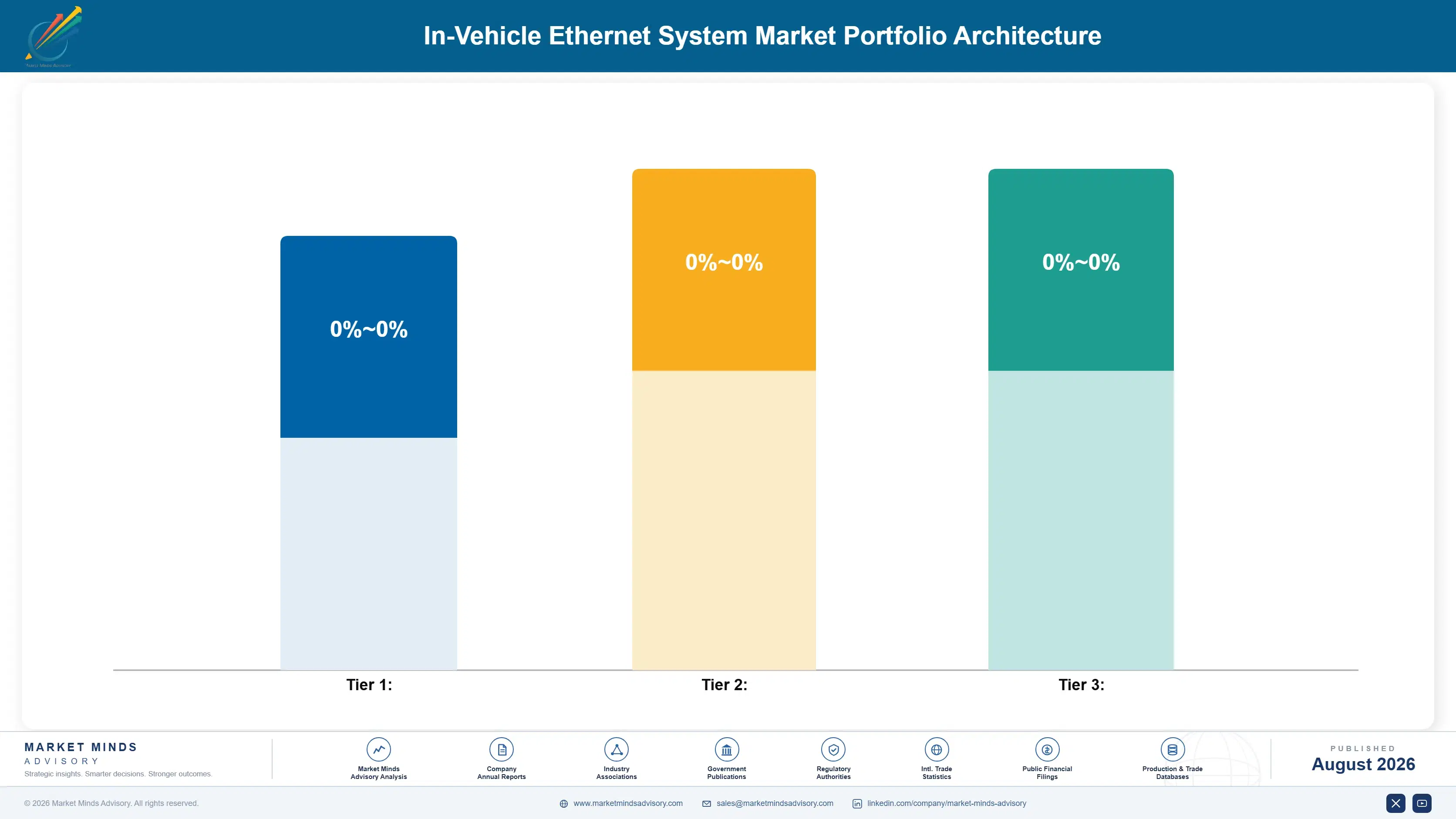
In-vehicle Ethernet margins split sharply by qualification tier. Basic infotainment-grade components compete largely on price, with gross margins near 20% to 28%, while ADAS-grade and sensor fusion components command materially higher pricing across most vehicle price segments. ADAS-grade and sensor fusion components sit in a premium tier where automotive qualification and reliability testing justify gross margins between 32% and 42% depending on design win depth.
Basic infotainment-grade components still anchor meaningful revenue for many suppliers given steady demand across conventional vehicle architectures worldwide, but the margin tension is real. Suppliers chasing basic volume alone see margins compressed by semiconductor fabrication cost volatility discussed earlier, while suppliers who shift mix toward ADAS-grade and sensor fusion components convert flat unit growth into meaningfully expanding profit pools instead.

High-value margin pools concentrate specifically around zonal architecture design win programmes requiring certified ADAS-grade components, where design win status locks in premium pricing for the full duration of a vehicle platform's multi-year production run. Sensor fusion applications tied to higher levels of driving automation represent a growing secondary pool, as automakers increasingly specify synchronized multi-sensor networking over camera-only backbone architectures.

Basic infotainment-grade Ethernet components sold into conventional vehicle architectures across most current production platforms, with gross margins near 20% to 28% and limited differentiation between suppliers beyond delivery reliability and cost.
Gross Margin

ADAS-grade Ethernet switches and transceivers sold with automotive qualification and technical service support across major vehicle platforms, commanding gross margins between 32% and 40% through reliability testing and design win relationships.
Gross Margin

Sensor fusion and zonal architecture components tied to higher levels of driving automation across next-generation platforms, commanding the highest margins near 40% to 48% given limited qualified supplier competition currently.
Gross Margin
in-vehicle-ethernet-system-market-trends-portfolio-architecture-1787553065821

High-value Sub-segments and Strategic Watch-out

ADAS and Camera Data Backbone Ethernet

ADAS and camera data backbone applications combine the fastest visible-segment growth with strong margin economics, driven by automakers integrating more cameras and pursuing higher levels of driving automation. Suppliers with established automotive qualification and design win relationships are positioned to convert this combination into disproportionate profit expansion through 2036.

Lidar and Radar Sensor Fusion Ethernet

Lidar and radar sensor fusion applications already anchor a growing revenue pool tied to combined multi-sensor perception systems requiring higher bandwidth and tighter synchronization than camera-only backbone applications. The segment offers the strongest margin economics in the entire market, though qualification timelines limit how quickly new entrants can compete effectively.

Basic Infotainment-Grade Ethernet

Basic infotainment-grade Ethernet remains the volume core of the market, supplying conventional vehicle architectures that prioritize cost and proven reliability over sensor fusion sophistication. Growth here tracks general vehicle production volume closely rather than outpacing it, and margins stay compressed by semiconductor fabrication volatility and price competition.

Legacy CAN Network Investment Risk

Legacy CAN network investment is a genuine strategic watch-out because automaker institutional inertia could slow full Ethernet transition timelines longer than currently expected across some vehicle segments. Suppliers overly dependent on rapid transition timing risk revenue volatility that more diversified competitors with hybrid architecture products avoid entirely.

Design-Win-Locked Platform Demand

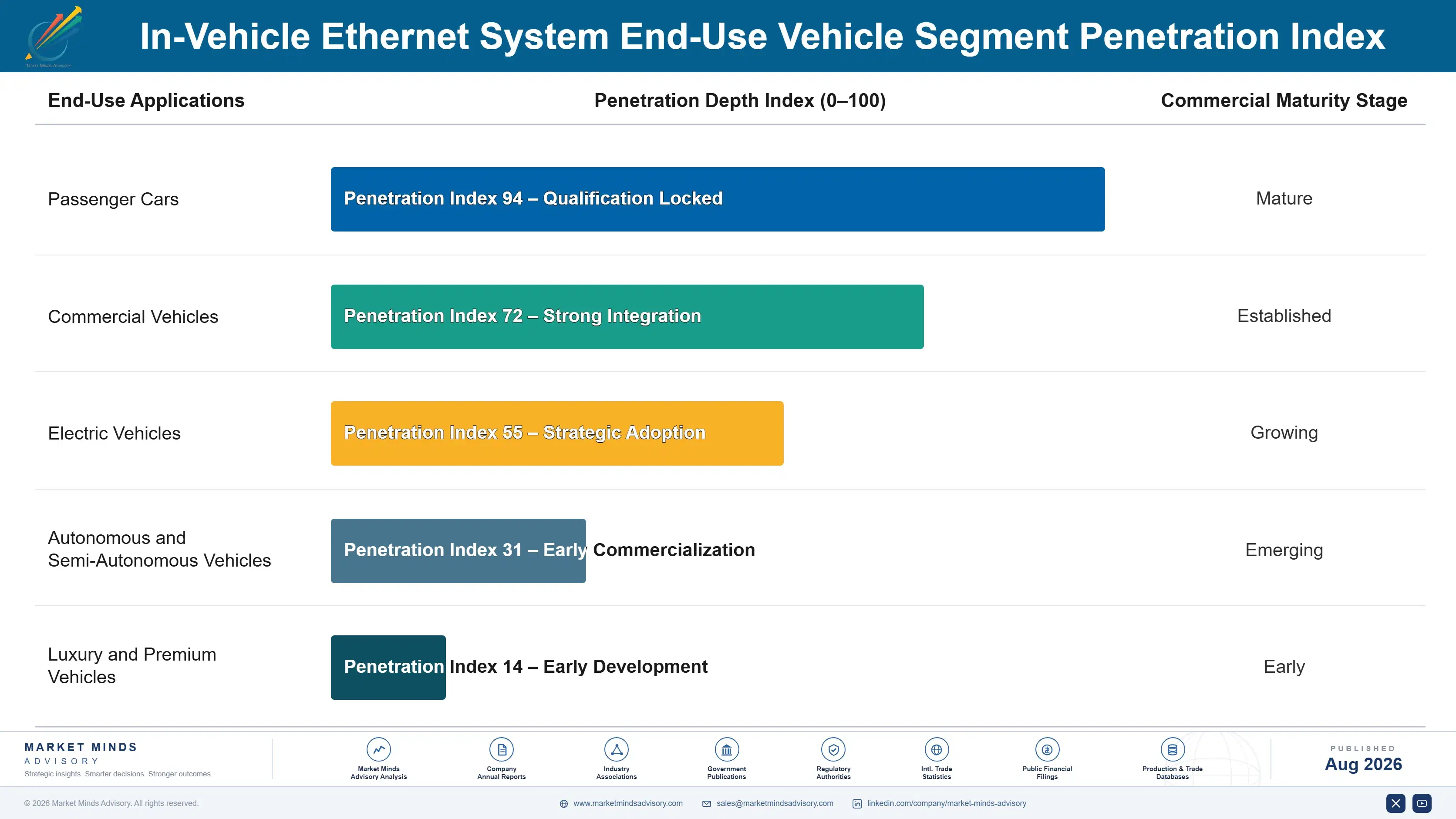
In-vehicle Ethernet demand behaves like an annuity business once a supplier earns a design win on a vehicle platform, because requalifying a new supplier mid-platform carries meaningful cost and schedule risk given the multi-year validation process automakers require. This locks in recurring purchasing across the full multi-year production run of the vehicle platform and its subsequent model-year refreshes.
Adoption stickiness varies meaningfully by end-use vertical. ADAS and safety-critical applications show the deepest stickiness because supplier qualification is tied to a specific platform's safety certification and rarely gets reopened once approved, while basic infotainment buyers switch suppliers more readily based on short-term pricing. Sensor fusion applications sit between the two, with moderate switching costs tied to platform-specific integration testing rather than full safety certification requirements.

Buyer profiles are shifting generationally as automotive procurement moves from individual component engineers making informal supplier choices toward centralized platform architecture teams applying formal, standardized qualification protocols across multiple vehicle programmes simultaneously. Younger engineers entering these procurement functions also carry stronger familiarity with Ethernet networking technology from academic training, pushing zonal architecture specifications into platform conversations earlier than the previous generation typically allowed.
in-vehicle-ethernet-system-market-trends-end-use-penetration-index-1787553067220

Where Ethernet Strategy Wins

These are among the four positions where our research anticipates prominent divergence between winners and laggards over the coming forecast period. Each is grounded in the demand model, the regulatory perimeter, and the announced capacity pipeline.
01 / ADAS CERTIFICATION STRATEGY

Pursue ADAS-Grade Certification Before Requirements Tighten Further

ADAS-grade certification already commands pricing 2 to 3 times higher than lower-tier component rates, and suppliers without qualification status are locked out of the fastest-growing segment of this entire market indefinitely and completely today and tomorrow. Pursuing certification now, before automaker qualification requirements tighten further, gives suppliers a head start that competitors starting later simply cannot recover through faster execution alone. Suppliers with existing automotive-grade manufacturing capacity should treat this certification investment as their single highest-priority move this coming decade.
02 / ZONAL DESIGN WIN PRIORITY

Secure Zonal Architecture Design Wins Ahead Of Finalization

Early zonal architecture design win entrants have captured roughly 35% more new platform volume than suppliers entering after architecture finalization, confirming that partnership timing matters as much as technical performance in this specific commercial channel worldwide today and tomorrow. Suppliers who secure design win partnerships with automakers now gain guaranteed volume through the platform's entire multi-year production run, revenue that would otherwise take years of independent development to replicate. Waiting until a platform reaches production erases this first-mover advantage almost entirely.
03 / CHINESE MANUFACTURING PARTNERSHIP

Pursue Chinese Manufacturing Partnerships For Cost Advantage

Partnership arrangements with Chinese semiconductor producers have historically delivered cost reductions of roughly 20% compared to standalone Western manufacturing operations of comparable output volume and product complexity across most equipment categories and voltage classes. Suppliers without domestic Chinese manufacturing presence face a real and growing cost disadvantage relative to competitors benefiting from Chinese EV production-scale economics that take years to replicate independently through organic capacity investment. Pursuing partnership arrangements now captures this cost advantage faster than building comparable manufacturing scale alone.
04 / SENSOR FUSION TECHNOLOGY FOCUS

Develop Sensor Fusion Technology Ahead Of Broader Adoption

Sensor fusion applications already command pricing roughly 30% above camera-only ADAS backbone components, and automakers are increasingly specifying synchronized multi-sensor networking as driving automation levels rise across most vehicle segments and price tiers worldwide today, tomorrow, and beyond. Suppliers who develop sensor fusion technology now, ahead of broader industry adoption, position themselves to capture premium design wins before competitors without comparable synchronization capability catch up. Waiting until sensor fusion becomes standard erases the technology development head start entirely and permanently.

Engagement Snapshot From the Field

A live engagement with an industry participant carrying material or product regulatory and market exposure ahead of a defining policy shift, showing how our research translates into a defensible multi-year portfolio strategy.
MARKET MINDS ADVISORY · CLIENT ENGAGEMENT SUMMARY
In-Vehicle Ethernet System Producer Strategic Portfolio Review and Transition Roadmap 2026·Investment Scenario on In-Vehicle Ethernet System Exposure Evaluation 2025-26
CLIENT PROFILE
The client is a mid-sized semiconductor supplier serving infotainment and basic networking applications across two continents, with annual revenue in the low hundreds of millions of dollars. The company had built its position entirely on basic infotainment-grade Ethernet components but had never pursued ADAS-grade automotive qualification despite holding manufacturing capacity technically comparable to specialty competitors already serving safety-critical applications.
STRATEGIC CHALLENGE
Basic infotainment-grade margins had compressed as semiconductor fabrication costs rose and regional competitors added capacity, while the client lacked visibility into what ADAS-grade qualification would actually require, how long it would take, and whether the investment would pay back within a reasonable timeframe. Leadership needed a credible, data-backed case before committing capital to a qualification upgrade with an uncertain outcome.
MMA APPROACH
MMA conducted primary interviews with the client's design engineers, two automaker platform architecture officials, and three specialty competitors' former employees to map the specific qualification requirements and realistic timeline for ADAS-grade certification. The engagement combined this qualitative work with a financial model comparing ADAS-grade versus infotainment-grade margins, quantifying the payback period under conservative and optimistic qualification timeline scenarios.
KEY FINDINGS
  1. Qualification lead time for ADAS-grade Ethernet components averaged twenty-eight months across the interviewed platform architecture officials, longer than the client's initial internal estimate of fourteen months by a meaningful margin.
  2. ADAS-grade competitors priced their components at gross margins 15 to 20 percentage points above the client's infotainment-grade line, confirming a payback period under three years even in conservative scenarios.
  3. Two of three former competitor employees interviewed identified reliability and electromagnetic interference testing infrastructure, not raw production capacity, as the single largest barrier smaller suppliers faced when pursuing certification independently.
  4. The client's existing manufacturing equipment met roughly 65% of ADAS-grade testing requirements already, needing only incremental investment in reliability and temperature testing infrastructure to close the remaining gap.
CLIENT PROFILE
The client is a mid-sized semiconductor supplier serving infotainment and basic networking applications across two continents, with annual revenue in the low hundreds of millions of dollars. The company had built its position entirely on basic infotainment-grade Ethernet components but had never pursued ADAS-grade automotive qualification despite holding manufacturing capacity technically comparable to specialty competitors already serving safety-critical applications.
STRATEGIC CHALLENGE
Basic infotainment-grade margins had compressed as semiconductor fabrication costs rose and regional competitors added capacity, while the client lacked visibility into what ADAS-grade qualification would actually require, how long it would take, and whether the investment would pay back within a reasonable timeframe. Leadership needed a credible, data-backed case before committing capital to a qualification upgrade with an uncertain outcome.
MMA APPROACH
MMA conducted primary interviews with the client's design engineers, two automaker platform architecture officials, and three specialty competitors' former employees to map the specific qualification requirements and realistic timeline for ADAS-grade certification. The engagement combined this qualitative work with a financial model comparing ADAS-grade versus infotainment-grade margins, quantifying the payback period under conservative and optimistic qualification timeline scenarios.
KEY FINDINGS
  1. Qualification lead time for ADAS-grade Ethernet components averaged twenty-eight months across the interviewed platform architecture officials, longer than the client's initial internal estimate of fourteen months by a meaningful margin.
  2. ADAS-grade competitors priced their components at gross margins 15 to 20 percentage points above the client's infotainment-grade line, confirming a payback period under three years even in conservative scenarios.
  3. Two of three former competitor employees interviewed identified reliability and electromagnetic interference testing infrastructure, not raw production capacity, as the single largest barrier smaller suppliers faced when pursuing certification independently.
  4. The client's existing manufacturing equipment met roughly 65% of ADAS-grade testing requirements already, needing only incremental investment in reliability and temperature testing infrastructure to close the remaining gap.
RECOMMENDED STRATEGY
Phase 1: Invest in reliability and temperature testing infrastructure immediately, closing the identified 35% testing gap before beginning formal qualification submission with automaker platform teams. Phase 2: Begin qualification proceedings with the automaker showing the shortest historical certification timeline, while continuing infotainment-grade production to fund the qualification investment during the process. Phase 3: Launch ADAS-grade Ethernet products upon qualification completion, targeting the interviewed platform architecture contacts as anchor customers for the first certified design win opportunities.
OUTCOME
Within twenty-five months of the engagement, the client completed ADAS-grade qualification and won its first design win contract with a mid-sized automaker's next-generation vehicle platform. Qualified product revenue reached 12% of total sales within the first year of launch, with gross margin on that line reported at 37%, figures client-reported and unverified by MMA.

Frequently Asked Questions

Foundational context covering the market sizes, CAGR, scope, country, region and competition that inform every finding below. This section is provided to cover basics and most often pre-purchase conversations, answered from the MMA Primary Research Dataset.

What is the current size of the In-Vehicle Ethernet System Market?

The In-Vehicle Ethernet System Market reached an estimated $3.2 billion in global value during 2025, the base year for this report. Growth is driven by ADAS bandwidth requirements alongside zonal vehicle architecture redesign programmes across major automakers.

How large will the In-Vehicle Ethernet System Market be by 2036?

MMA projects the market will reach approximately $14.2 billion by 2036, more than quadrupling from its 2025 base value. This expansion reflects a compound annual growth rate of 14.5% sustained across the full forecast period.

What is the CAGR for the In-Vehicle Ethernet System Market 2026 to 2036?

The base case compound annual growth rate is 14.5% across the 2026 to 2036 forecast window. Bull and bear scenarios range from 15.8% to 13.2%, depending on autonomous driving adoption and architecture transition timing.

Which segment is growing fastest?

ADAS and camera data backbone applications are the fastest-growing segment, expanding at 18.5% annually, roughly 1.3 times the overall market rate. Lidar and radar sensor fusion applications follow closely as the second-fastest segment.

Who are the major companies in the In-Vehicle Ethernet System Market?

Leading suppliers include Broadcom, Marvell Technology, NXP Semiconductors, Texas Instruments, and Microchip Technology, together holding an estimated 55% combined share. Competition is evaluated on a revenue basis across ADAS-grade and infotainment segments.

Which country is growing fastest?

India is the fastest-growing major market, expanding at approximately 17.0% annually as its automotive electronics manufacturing and ADAS feature adoption programmes accelerate. This outpaces the global average meaningfully across both ADAS-grade and infotainment demand.

Report Segmentation Architecture

The full report scope spans multiple orthogonal segmentation dimensions, with cross-tabulated demand data provided for each dimension pair. Coverage extends further to regional breakdowns, trend trajectories, and the competitive detail needed to support segment-level decision-making.

By Application and Function Type

  • ADAS and Camera Data Backbone Ethernet
  • Infotainment and Multimedia Ethernet
  • Zonal Architecture Gateway Ethernet
  • Diagnostic and OTA Update Ethernet
  • Lidar and Radar Sensor Fusion Ethernet
  • Ethernet Physical Layer (PHY) Transceivers

By End-Use Vehicle Segment

  • Passenger Cars
  • Commercial Vehicles
  • Electric Vehicles
  • Autonomous and Semi-Autonomous Vehicles
  • Luxury and Premium Vehicles

By Commercial Dimension

  • Direct Automaker Design Win Contracts
  • Tier 1 Supplier Integration
  • Aftermarket Retrofit Systems
  • OEM Platform Licensing

By Region

  • North America
  • Western Europe
  • East Asia
  • South Asia and Pacific
  • Latin America
  • Middle East and Africa
  • Eastern Europe

Scope, Methodology, and Coverage

Every figure in this report is reproducible from documented input assumptions. The scope below maps the historical period, the forecast horizon, the segmentation dimensions, and the countries covered, alongside the underlying primary and qualitative methodology.
Historical Period
2020 to 2025
Forecast Period
2026 to 2036
Base Year
2025 (USD billions; MMA Primary Research Dataset, August 2026)
Market Definition
The In-Vehicle Ethernet System Market covers automotive-grade Ethernet switches, physical layer transceivers, and networking software used to carry sensor, infotainment, and diagnostic data within vehicle electronic architectures. It excludes legacy CAN, LIN, and FlexRay networking components and standalone ADAS sensor hardware sold without an Ethernet interface.
Quantitative Units
USD billions (current prices); unit shipment counts for volume-referenced segment discussion where applicable
Segmentation Dimensions
By Application and Function Type; By End-Use Vehicle Segment; By Commercial Dimension; By Region
Regions Covered
North America, Western Europe, East Asia, South Asia and Pacific, Latin America, Middle East and Africa, Eastern Europe
Countries Covered
USA, China, Germany, France, UK, Japan, South Korea, India, Australia, Canada, Brazil, Mexico, Indonesia, Vietnam, Thailand, Malaysia, UAE, Saudi Arabia, South Africa, Nigeria, Turkey, Poland, Netherlands, Italy, Spain, Sweden, Switzerland, Argentina, Colombia, Singapore, and additional markets relevant to this sector
Key Companies Profiled
Broadcom, Marvell Technology, NXP Semiconductors, Texas Instruments, Microchip Technology, Renesas Electronics, Infineon Technologies, STMicroelectronics, onsemi, Realtek Semiconductor, Analog Devices, Qualcomm, Bosch, Continental, Aptiv, Vector Informatik, TTTech Auto, KDPOF, Molex, TE Connectivity
Quantitative Methodology
Primary survey, n=3,800 respondents, Q4 2025, six countries; demand-side model with trade association cross-validation
Qualitative Methodology
47 expert interviews, Q4 2025; applied to validate demand model assumptions, identify emerging dynamics, and assess competitive positioning
Report Format
PDF and XLSX data workbook (Word format preview document)
Publisher
Market Minds Advisory
Report Code
MMA-2026-AUT-221
Published
August 2026
Contact
sales@marketmindsadvisory.com | www.marketmindsadvisory.com

Purchase the full In-Vehicle Ethernet System Market Report (2026 to 2036).

This report provides a comprehensive, ten-year forecast of the global In-Vehicle Ethernet System Market. Coverage spans ADAS backbone, sensor fusion, infotainment, and zonal gateway applications across all seven world regions. Deliverables include segment-level and regional sizing to 2036, competitive benchmarking of twenty profiled companies on a consistent revenue basis, and semiconductor fabrication cost exposure analysis. A strategic verdict identifies where suppliers should concentrate capital and certification investment over the coming decade. The report is built from primary survey data, expert interviews, and company disclosures rather than secondary aggregation.
Ten-year sizing and CAGR forecasts across seven global regions
Segment-level analysis of ADAS, sensor fusion, and infotainment applications
Competitive benchmarking of twenty profiled automotive Ethernet suppliers
Semiconductor fabrication cost exposure and mitigation strategy analysis
Design win and zonal architecture adoption tracking by region
Strategic verdict on capital allocation and certification investment priorities

Built For The People Who Decide

From boardroom strategy to bench-side execution, this report is read cover-to-cover by leaders shaping the next decade of their industry, turning demand scenarios, market dynamics and valuation benchmarks into decisions.
CXOs/ Presidents/ VPs/ Managers
M&A and Corporate Development
Strategy Teams and R&D Heads
Procurement and Product Directors
Regulatory and Compliance Leaders
Investor Relations and Equity Analysts