
Market Minds Advisory
Hydrostatic Transmission Market

Hydrostatic Transmission Market: Electrification Boundaries, Control Layer Value and Platform Award Economics to 2036    

An electric drive motor is more efficient than any hydrostatic transmission ever built, which matters enormously in a turf mower and hardly at all in a track drive taking shock loads all day.

Lead Analyst

David Horsley

Published

September 2026

Make Smarter Decisions with Customized Research Insights

Request a free sample report and evaluate market opportunities, growth trends, and competitive dynamics relevant to your business needs.

2025 MARKET VALUE$8.6BMarket Size 2025
2036 FORECAST VALUE$14.1BBase Case , 2026 to 2036
CAGR 2026 TO 20364.6 %Bull 5.8% / Bear 3.4%
INCREMENTAL OPPORTUNITY$5.1BNet 10- year value creation
EXPANSION MULTIPLE1.57x2036 value over 2026 base
Strategic Levers
M&A Pipeline
Regional Outlook
Country Rankings
Competitive Intelligence
Segmental Deep-dive
Call-Us : 91 93563 13602

Executive Snapshot and Market Trajectory

Electric drive has taken 9% of compact equipment platforms and the industry is arguing about the wrong number. What matters is which applications it takes: light duty cycles and quiet operation go, shock loading and torque density stay, and almost nobody is modelling that split properly.
Electronically controlled displacement systems grow at 6.9%, half again the market rate of 4.6%, because autonomous and precision agriculture need speed control that mechanical linkage cannot deliver. North America holds 30% of value on compact construction equipment and turf machinery, two categories that exist at this scale nowhere else. Open-circuit drives, the oldest configuration here, grow at under 3%. The spread is the whole story here.
Five manufacturers hold 58% of supply, which is high concentration and reflects how difficult a closed-circuit pump and motor set actually is to build to tolerance. The competitive question is no longer who makes the best transmission. It is who has an answer for the platforms going electric, because a transmission award runs 8 years and losing one means losing a decade rather than a quarter. Very few of them have that answer ready yet.
Market Definition
This report covers hydrostatic transmissions providing stepless drive through a closed or open hydraulic circuit, spanning variable displacement pump and motor sets, integrated transaxles, electronically controlled systems, hydromechanical power-split transmissions and compact drive units. Value is measured at transmission manufacturer level across equipment build and aftermarket supply. Excluded are hydraulic implement and work function circuits, mechanical and powershift transmissions, electric drive motors, hydraulic fluids, and complete vehicles.
Base Year Value
$8.6B in 2025 (MMA Primary Research Dataset, August 2026)
Forecast Period
2026 to 2036, eleven discrete annual values
CAGR
4.6% base case. Bull 5.8%. Bear 3.4%.
Fastest Growth Segment
Electronically Controlled Displacement Systems: 6.9% CAGR
Fastest Growth Country
India: 7.3% CAGR
Fastest Growth Region
South Asia and Pacific: 6.7% CAGR
Largest Region
North America: 30% of 2025 global value
Market Leaders
Bosch Rexroth, Danfoss Power Solutions, Parker Hannifin, Kawasaki Heavy Industries and Hydro-Gear lead the market. Source: MMA Primary Research Dataset, July 2026.
Primary Survey
n=3,800 procurement and R&D decision-makers, Q4 2025, six countries
Methodology
Demand-side build-up, cross-validated against public data, 47 expert interviews

Hydrostatic Transmission Market Forecast Scenarios

hydrostatic-transmission-market-trends-size-forecast-scenario-1787553315620
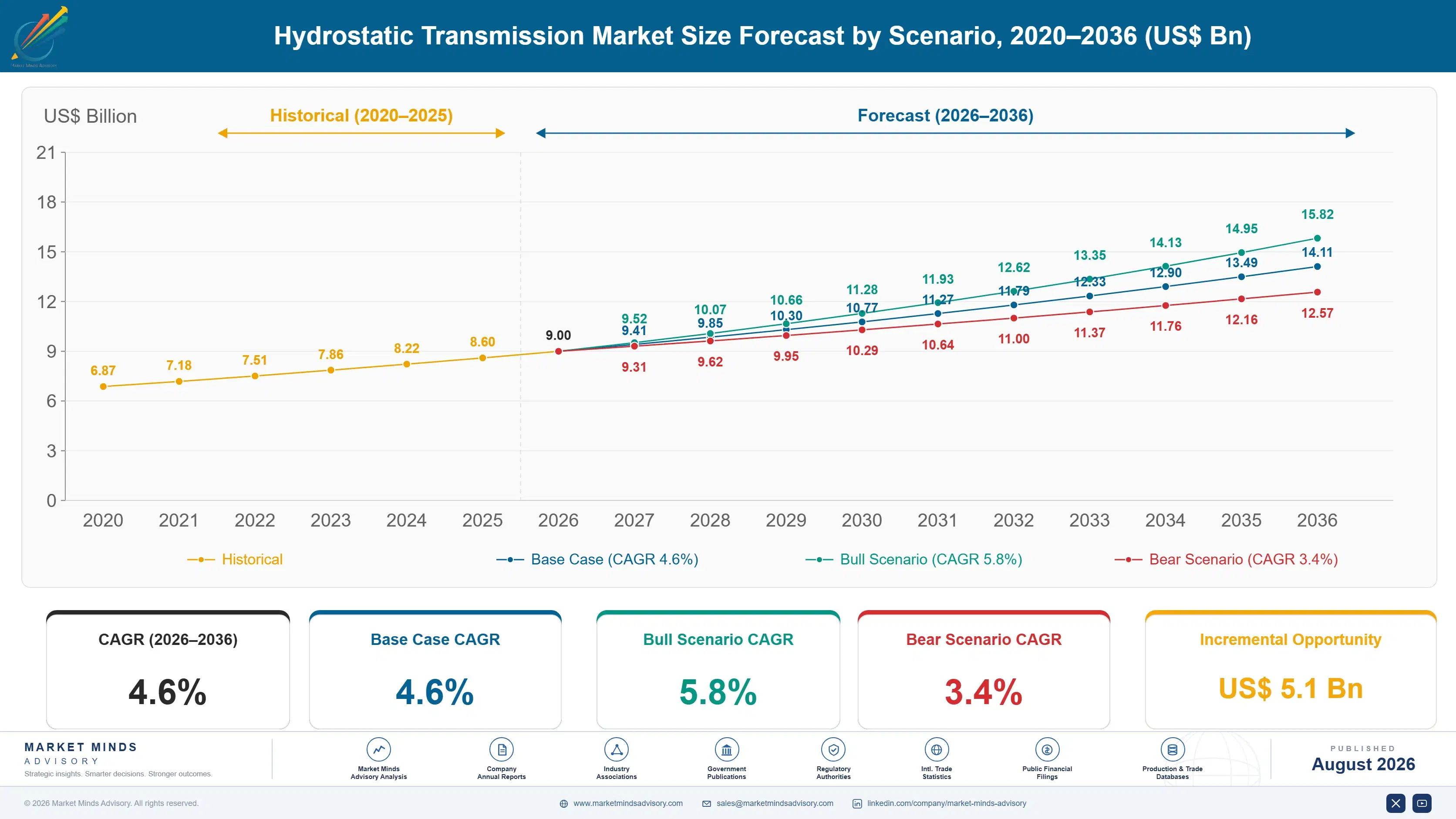
Growth ran at 3.6% between 2020 and 2025 and two things happened underneath it that mostly cancelled out. Compact construction equipment volumes rose strongly in North America across the whole period, which lifted transaxle and drive unit demand. And electric drive began taking platforms at the light end from around 2022, starting with turf and indoor material handling where the case is easiest.
The 4.6% base case rests on three mechanisms. Autonomous and precision agriculture keeps pulling electronically controlled displacement onto tractors and harvesters at 6.9%, because a mechanical linkage cannot deliver the speed control an autonomous machine needs. Hydromechanical power-split transmissions keep taking share in high-horsepower agriculture on fuel efficiency. And compact construction equipment volumes keep growing in India and Southeast Asia on infrastructure activity that has years left in it. None of the three depends on the others.
The 5.8% bull case is electric drive stalling at the light end on battery cost and thermal management, which would leave hydrostatics holding everything above compact class indefinitely. The 3.4% bear case is the opposite: electric motors improving fast enough to take mid-size construction equipment, where 82% peak transmission efficiency starts looking difficult to defend against anything.

Where Hydrostatics Still Win

A hydrostatic transmission peaks around 82% efficiency and an electric drive motor does considerably better, which is the entire argument against this technology and it is a good one. What the efficiency comparison misses is that a hydraulic circuit absorbs shock loading in a way a gearbox and motor do not, delivers full torque from zero without thermal limits, and packages into a machine footprint that leaves room for the work functions. Those advantages hold in some applications and disappear in others.
TOP-FIVE CONCENTRATION58%Combined position across hydrostatic transmission supply held by leaders
TRANSMISSION EFFICIENCY82%Peak efficiency across a typical closed-circuit drive system
ELECTRIC DRIVE PENETRATION9%Compact equipment platforms now specifying motors instead of hydrostatics
FACTORY FILL SHARE78%Portion of unit volume supplied at original equipment build
PROGRAMME AWARD DURATION8 yearsTypical platform life over which an award runs
AFTERMARKET REBUILD INTERVAL6,000 hoursTypical operating period before a major drive unit rebuild
The commercial structure matters as much as the technology. Around 78% of unit volume is supplied at equipment build, and a transmission award runs roughly 8 years across a platform life. That makes this a programme business rather than a component one: winning is infrequent, losing is expensive, and the aftermarket that follows a rebuild interval near 6,000 hours belongs to whoever won the original award.
Electric drive has reached 9% of compact platforms and the number tells you less than the pattern does. Turf, indoor handling and light utility have gone or are going. Track drives, high-load agriculture and anything with shock cycling have not moved at all.
"The efficiency argument is unanswerable and it is also beside the point in half these applications. What decides whether hydrostatics survive on a platform is whether the machine takes shock loads, and that is an engineering question nobody in the electrification debate seems interested in asking."
Principal, Mobile Machinery and Drivetrain Practice · MMA Industrial Equipment Practice · August 2026

Market Trends

Autonomous agriculture demands speed control mechanical linkage cannot give

An autonomous tractor holding ground speed to within a few centimetres per second across varying draught load needs a transmission it can command electronically and trust to respond. A mechanical displacement linkage cannot do that. Electronically controlled hydrostatic displacement can, and it also enables anti-stall, load-dependent speed limiting and machine-level energy management that a machine controller can coordinate. Growth at 6.9% follows autonomy and precision agriculture programmes rather than tractor volume. This is also the strongest argument for hydrostatics surviving in agriculture, because an electric drive would need equivalent control electronics anyway and would still cost more to package.
Market Impact: Covers 78% of unit volume
Power-split transmissions close most of the efficiency gap

A hydromechanical power-split transmission routes the majority of power through a mechanical path and uses the hydrostatic circuit only for the variable portion, which recovers most of what a pure hydrostatic drive loses. High-horsepower agriculture adopted this years ago and the technology keeps working down through the power range as cost falls. Growth at 6.2% reflects that migration. The commercial significance is that it answers the efficiency objection without abandoning hydrostatics, which matters because a manufacturer with power-split capability keeps platforms that a pure hydrostatic supplier would lose to electric drive entirely.
Market Impact: Holds electric drive at 9%

Market Opportunities and Growth Drivers

Compact construction equipment volumes hold hydrostatic demand steady

Skid steer loaders, compact track loaders and mini excavators are hydrostatic almost without exception, because the machines are small, the duty cycles are brutal and the packaging leaves no room for a mechanical drivetrain. North American volumes in these categories have grown for a decade and show no sign of reversing. Around 78% of transmission volume goes to equipment build, so demand tracks machine production directly rather than through any replacement cycle. Indian and Southeast Asian compact equipment markets are expanding from a small base, which adds growth the mature markets no longer provide.
Market Impact: Removes 9% of platforms already

Shock load handling keeps hydrostatics on demanding platforms

A track drive hitting a rock, a loader ramming a pile or a harvester meeting a dense crop section all deliver instantaneous load spikes that a hydraulic circuit absorbs through relief and fluid compliance. An electric motor and gearbox meets the same spike through gear teeth and winding current, and designing for that costs weight, cost and thermal capacity. This is why electric drive penetration stalls at 9% rather than continuing through the equipment range. The engineering reality is better understood inside equipment companies than in the public conversation about electrification, and it is unlikely to change quickly.
Market Impact: Locks platforms for 8 years

Market Restraints and Challenges

Electric drive takes the light end and keeps moving upward

Around 9% of compact equipment platforms now specify electric drive motors instead of hydrostatics, and the conversion is complete in turf, indoor material handling and light utility where duty cycles are gentle and noise matters. The root cause is efficiency: a hydrostatic drive peaks near 82% and an electric drive does better, which on a battery machine translates directly into runtime. Commercially this removes platforms permanently, since nobody reverses an electric architecture. Manufacturers have responded by developing electronically controlled and power-split configurations that defend the applications electric cannot reach, and by supplying drive components into electric architectures instead.
Market Impact: Segment growing at 6.9%

Platform award cycles make competitive recovery extremely slow

A transmission award runs roughly 8 years across a platform life, and 78% of volume is decided at that moment rather than through any ongoing purchasing. The root problem is that equipment manufacturers integrate a transmission deeply into machine architecture, controls and service documentation, which makes mid-programme change effectively impossible. Commercially this means a supplier losing an award waits most of a decade for another chance and watches a competitor collect the aftermarket meanwhile. Some suppliers now fund application engineering during a customer's concept phase rather than bidding at specification, which costs money years before any revenue appears.
Market Impact: Power-split growing at 6.2%
3 additional market trends, 4 additional growth drivers, and 2 additional restraints and challenges are covered in the full report. Contact sales@marketmindsadvisory.com to access the complete intelligence.

Segment CAGR and Growth Architecture

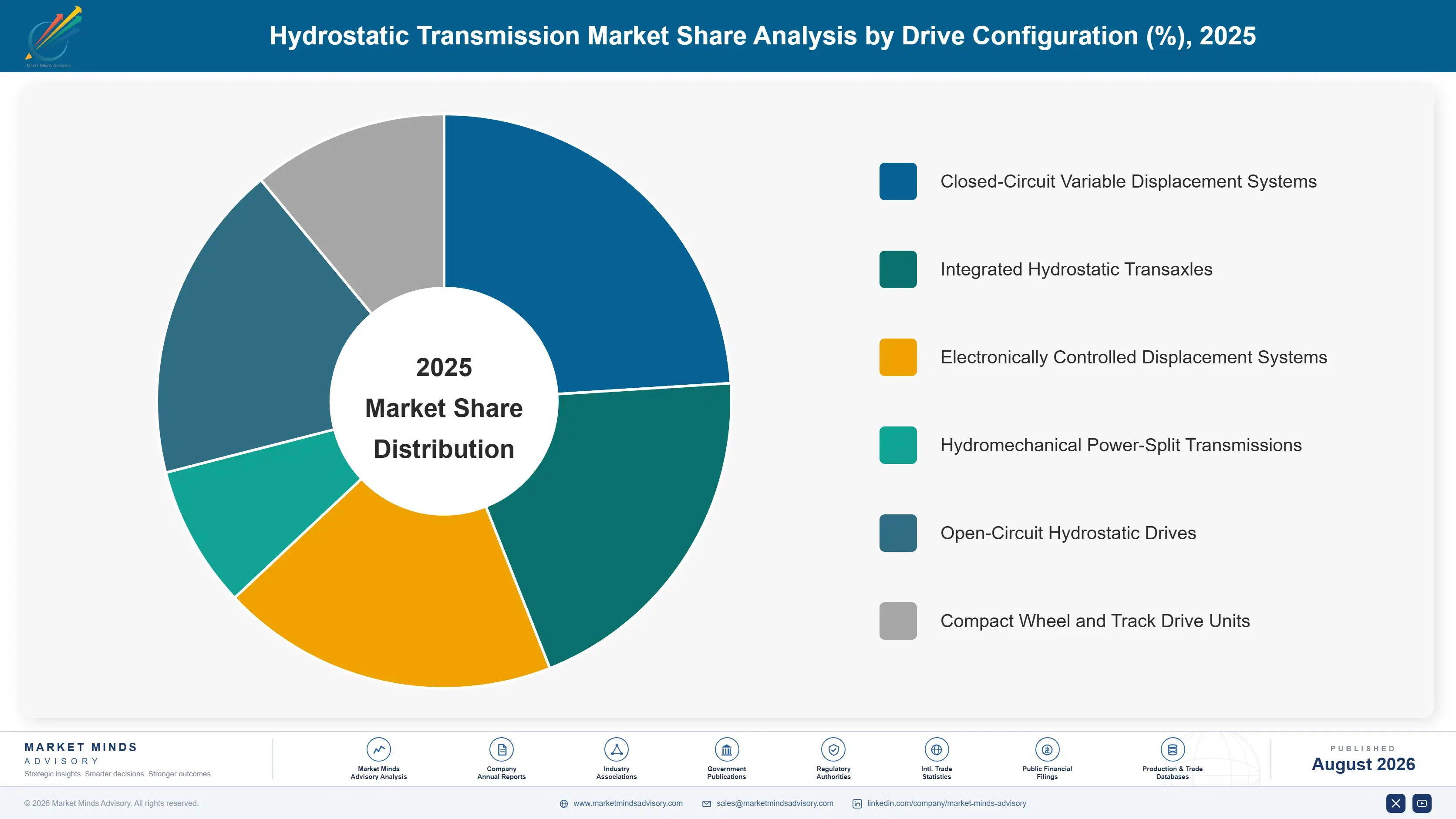
Transmissions are classified here by drive configuration, because that determines efficiency, control capability and which machine classes a unit can serve. Machine type, power band and sales channel are handled separately in the framework, since a single configuration serves agriculture, construction and turf equipment with different displacements and mounting arrangements fitted. Configuration decides everything downstream.
hydrostatic-transmission-market-trends-market-share-analysis-1787553316157

Electronically Controlled Displacement Systems

Growing at 6.9%, half again the market rate, this is where hydrostatics defend themselves against electrification rather than retreat from it. Replacing a mechanical displacement linkage with electronic control turns the transmission into something a machine controller can command precisely, which is what autonomous agriculture, precision speed control and anti-stall functions all require. The technical work is control software and sensor integration rather than hydraulics, which sits awkwardly in companies built around pump machining. Growth follows autonomy programmes rather than machine volume. The important commercial point is that an electric drive needs the same control electronics anyway, so this removes one of the arguments against hydrostatics entirely. Very few suppliers make that argument well.
CAGR 6.9%

Hydromechanical Power-Split Transmissions

This is the honest answer to the efficiency objection and it has been available for twenty years. Routing most of the power mechanically and using the hydrostatic circuit only for the variable portion recovers the majority of what a pure hydrostatic drive loses, which brings the comparison against electric drive back into contention on machines where hydraulics still make sense. High-horsepower agriculture adopted it first and it keeps working down the power range as control complexity and cost fall. Growth at 6.2% reflects that migration rather than any new application. The manufacturing barrier is real: a power-split transmission demands gear cutting capability alongside hydraulic machining, and rather few suppliers hold both.
CAGR 6.2%
Full segment breakdown across 6 segments available in the complete report.

Regional Architecture and Country Demand Map

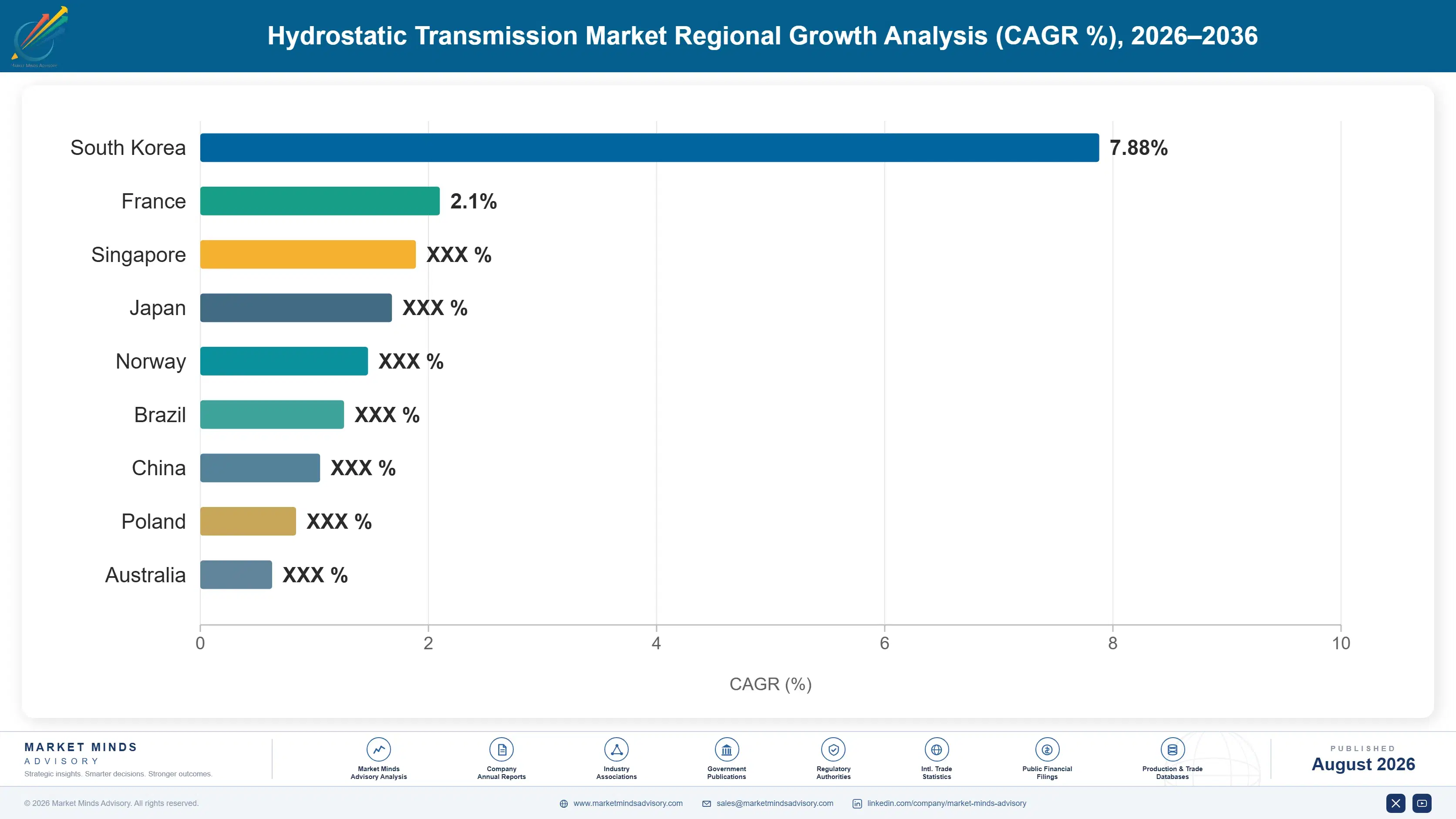
North America holds 30% of value on compact construction equipment and turf machinery, two categories that exist at this scale nowhere else. East Asia follows at 25% on machine manufacture rather than consumption. Machine population explains this map better than anything technical. Electrification will change it unevenly.

North America

Compact track loaders and skid steers are effectively a North American invention and the installed population here has no equivalent anywhere, which puts 30% of global transmission value into one region on two machine categories. Zero-turn turf equipment adds an enormous unit count at low value per unit, and that is precisely the category electric drive is taking first. Agricultural transmissions for high-horsepower tractors sit alongside. Growth at 4.2% is modest and conceals a genuine split: compact construction demand is solid and turf demand is being removed by electrification faster than most suppliers had planned for. Separating those two matters enormously here. Very few published forecasts even attempt it properly.
Share: 30% | CAGR: 4.2% (2026 to 2036)

Western Europe

Agricultural machinery is what sustains this region and the transmissions involved are the most sophisticated anywhere. German and Italian manufacturers pioneered hydromechanical power-split transmissions and continue to lead on them, which is why high-horsepower agriculture worldwide runs on European technology regardless of where the tractor is assembled. Construction equipment demand is mature and flat. Stage V emissions requirements pushed efficiency onto the agenda earlier here than anywhere, which accelerated power-split adoption. Growth at 3.1% is the weakest of the seven regions and understates how much of the world's transmission engineering still happens across a few German and Italian towns. Engineering and volume parted company here quite some time ago. Nobody has managed to move it either.
Share: 24% | CAGR: 3.1% (2026 to 2036)
Regional intelligence for 5 additional markets available in the complete report: East Asia, South Asia and Pacific, Latin America, Middle East and Africa, Eastern Europe. Contact sales@marketmindsadvisory.com.
hydrostatic-transmission-market-trends-country-cagr-analysis-1787553316678

Where Transmission Margin Actually Sits

Four moves matter in an industry where the sale happens once every eight years and the technology is under genuine attack from a better one. Two of them are about defending applications electric drive cannot reach, and two are about the revenue that follows an award rather than the award itself. Arguing about efficiency is not among them.

Fund application engineering during the customer's concept phase

A transmission award runs roughly 8 years and 78% of volume is decided at that single moment, which makes bidding at specification the wrong point to arrive. Suppliers funding application engineering during a customer's concept work influence the specification itself rather than responding to it, and the engineering hours involved are trivial against eight years of programme revenue. The obstacle is internal: that spending sits years ahead of any booked revenue and looks like cost on a quarterly view. Suppliers who accepted that trade are winning platform awards their competitors never had a real chance at.
Market Impact: Influences platform awards each running 8 full years

Build power-split capability before losing the efficiency argument

A hydrostatic drive peaks near 82% efficiency and that number loses arguments the technology could otherwise win. Hydromechanical power-split configurations recover most of the loss by routing power mechanically, which brings hydrostatics back into contention on platforms that would otherwise go electric. Growth at 6.2% in that segment is already running. The barrier is manufacturing rather than concept: gear cutting capability alongside hydraulic machining is not something a pump manufacturer has lying around, and acquiring it takes capital or an acquisition. Suppliers without it are defending an efficiency position that cannot be defended indefinitely.
Market Impact: Answers the 82% efficiency ceiling directly and permanently

Sell control software alongside the displacement hardware

Electronically controlled displacement grows at 6.9% because autonomous and precision agriculture need commandable speed control, and the value in that sits in software and sensor integration rather than in the pump. A supplier shipping hardware and leaving the control layer to the machine builder captures the smaller half of the value and creates no switching cost whatsoever. Owning the control layer makes the transmission part of a machine's software architecture, which is considerably harder to replace than a pump. It also puts the supplier in conversations about machine autonomy that the hydraulics team would never otherwise attend.
Market Impact: Captures software value across a 6.9% growth segment

Own the rebuild channel the original award created

A drive unit comes back for major rebuild around every 6,000 operating hours, and 78% of units were supplied at equipment build by somebody who then largely ignored what happens afterwards. Independent rebuilders take much of that work and the original manufacturer sees none of it. Supplying rebuild kits, procedures and training into the dealer and independent channel converts a one-time component sale into recurring revenue across a machine life measured in decades. The margin on a rebuild kit is considerably better than on the original unit, which is the usual arrangement and remains widely ignored here.
Market Impact: Captures the rebuild recurring every 6,000 operating hours

Who Controls the Margin Pool

Five manufacturers hold 58% of hydrostatic transmission supply, measured on unit revenue at manufacturer level across equipment build and aftermarket, the basis used throughout this section. Concentration is high and it reflects genuine manufacturing difficulty: a closed-circuit pump and motor set demands machining tolerance and swashplate control that few companies achieve reliably at volume. The gap between leaders and the next tier is that capability plus platform incumbency, which compounds across eight-year award cycles.
Competition runs on three dimensions. Control electronics and software capability, which decides who serves autonomous and precision applications. Power-split manufacturing capability, which decides who defends the efficiency argument. And application engineering reach into customer concept phases, which decides who influences a specification rather than bidding against one. Unit price argues least of the three and always has.

Rankings shift where electric drive removes platforms rather than where competitors take them, which is a different threat and it is being underestimated. Suppliers weighted toward turf and light utility lose volume they cannot recover. Chinese manufacturers hold cost positions that Western builders cannot match and are qualifying into applications closed to them a decade ago. Agriculture and heavy construction hold longest on shock loading and torque density.
hydrostatic-transmission-market-trends-company-positioning-matrix-1787553317202

Competitive Moat and Risk Dimensions

BOSCH REXROTH

Moat: Control electronics integration

Bosch Rexroth develops hydraulic hardware and the control electronics around it inside one company, drawing on automotive electronics capability that a pure hydraulics manufacturer does not have. That matters more every year as transmissions become commandable components inside machine software architectures rather than mechanical assemblies, and competitors are buying that capability rather than holding it.
BOSCH REXROTH

Risk: Broad industrial exposure

Mobile hydraulics is one of several businesses inside a much larger industrial group, which means transmission investment competes internally against factory automation and industrial hydraulics for capital and attention. Specialist competitors focused entirely on mobile drive systems can move faster on narrow application requirements when a customer needs an answer quickly.
DANFOSS POWER SOLUTIONS

Moat: Mobile application specialisation

Danfoss Power Solutions serves mobile machinery almost exclusively, which concentrates engineering attention and customer relationships where a diversified competitor spreads them. The Eaton hydraulics acquisition added product breadth and installed base that would have taken a decade to build organically, and the combined platform incumbency across agriculture and construction is difficult to displace on any single award.
DANFOSS POWER SOLUTIONS

Risk: Electrification exposure concentration

Specialising in mobile hydraulics means the electric drive transition reaches this business more directly than it reaches diversified competitors with other places to put capital. The company has invested in electrification products, and doing so means competing against motor manufacturers with decades of head start rather than against familiar hydraulics rivals.

Players Tracked

Prominent Players

Bosch Rexroth
Danfoss Power Solutions
Parker Hannifin
Kawasaki Heavy Industries
Hydro-Gear

Other Key Players

Poclain Hydraulics
Linde Hydraulics
Comer Industries
Liebherr
Nachi-Fujikoshi
Yuken Kogyo
Kanzaki Kokyukoki
Casappa
Hydac International
Sunfab Hydraulics
Sumitomo Heavy Industries
HAWE Hydraulik
Bondioli & Pavesi
Interpump Group
Zhejiang Zhenhua Machinery

Recent Developments

APRIL 2025

Bosch Rexroth expanded electronically controlled transmission production in Germany

Bosch Rexroth commissioned additional production capacity for electronically controlled hydrostatic transmission units at a German site, converting existing floor space rather than building new. The investment was organic and funded internally, with no partner involved, and it followed platform awards on autonomous agricultural machinery programmes already under development.
Signal: Capacity is being added for the controlled configurations rather than the conventional ones, which shows where awards are going
SEPTEMBER 2025

Danfoss Power Solutions signed a multi-year transmission supply agreement with a European agricultural manufacturer

Danfoss Power Solutions entered a multi-year supply agreement covering electronically controlled hydrostatic transmissions for a European agricultural machinery manufacturer's tractor platform range. The arrangement was a supply agreement rather than a joint venture, with no equity participation, and it runs across the full platform life.
Signal: Platform life contracting rather than annual volume is how transmission suppliers lock position against both competitors and electrification
JANUARY 2026

Kawasaki Heavy Industries expanded compact drive unit capacity in Japan

Kawasaki Heavy Industries brought additional compact track and wheel drive unit capacity into service at a Japanese facility, targeting excavator and compact loader manufacturers across Asia. This was an organic capacity expansion funded internally rather than an acquisition or partnership of any kind. Track drives remain untouched by electrification.
Signal: Investment is concentrating in the applications shock loading protects, which suggests suppliers have mapped the electrification boundary already

What Moves Transmission Cost

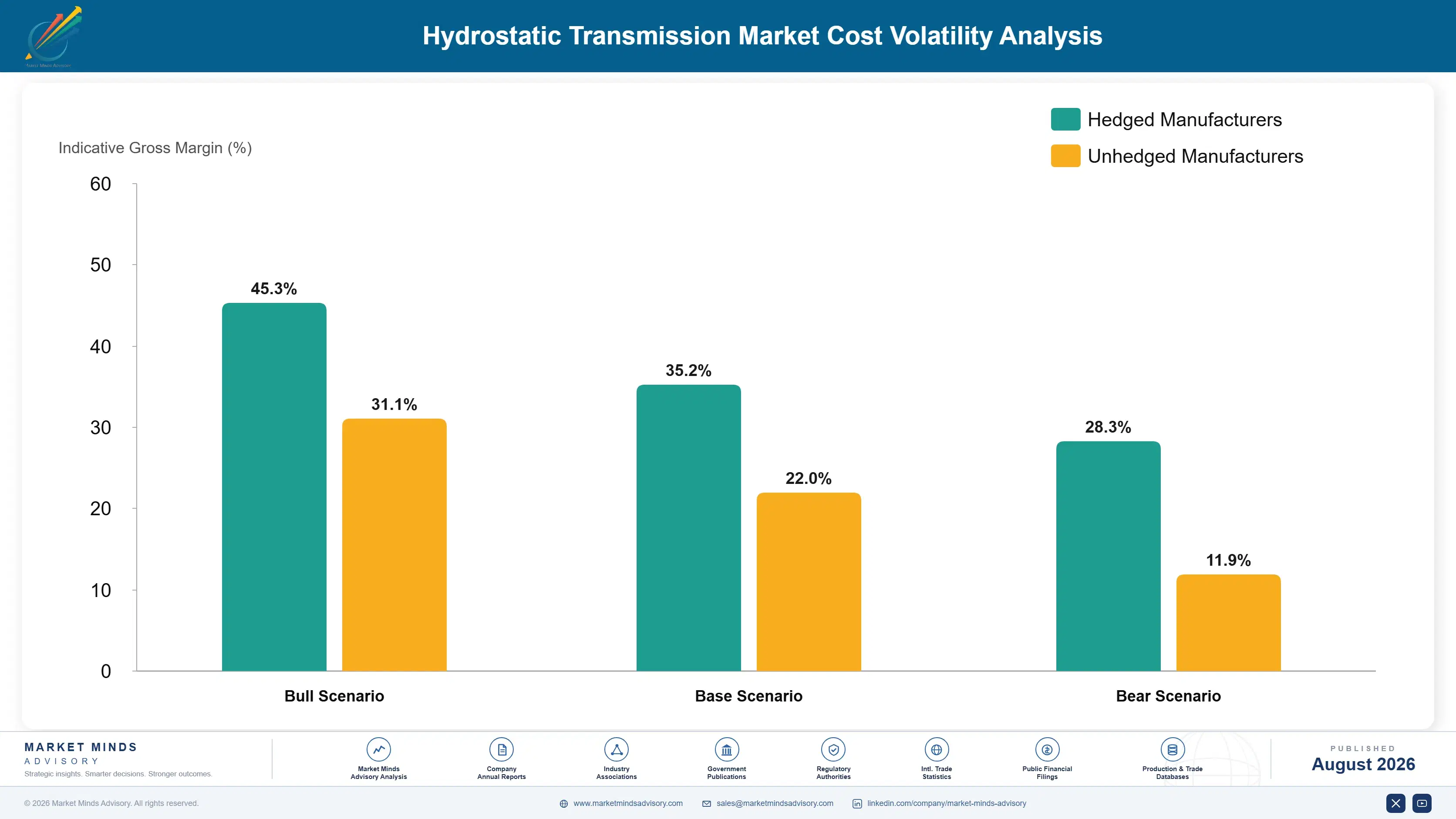
Precision machined steel components account for around 44% of transmission cost of goods, with castings, bearings, seals, electronics and assembly labour making up the balance. Bar steel and forgings come from European and Asian mills on annual contracts. Control electronics carry semiconductor exposure that the mechanical side of this industry had never previously had to think about.
European steel and energy costs rose sharply through 2021 and 2022, and IEA data show European industrial energy running well above American levels. Bosch reported input cost and supply chain pressure across its industrial technology operations in its Annual Report 2022. Transmission manufacturers on platform pricing agreed years earlier absorbed most of the movement, because an award priced for an eight-year programme cannot be repriced when steel moves.

The eight-year pricing horizon is what makes this exposure unusual. A manufacturer holding platform awards priced in 2019 carried the full 2022 movement with no recourse. Aftermarket and rebuild pricing moves freely, which is one more reason that channel is worth having. Manufacturers with captive machining and casting capacity carry smaller exposure than those buying components. Asian producers gain further from energy and labour costs European operations cannot approach.
hydrostatic-transmission-market-trends-cost-volatility-analysis-1787553317396

Index platform pricing to published steel benchmarks

Pricing an eight-year platform award against a fixed cost assumption transfers a decade of input volatility to the manufacturer over a period nobody can forecast, and 2022 demonstrated what that costs. Indexing to published European and Asian steel benchmarks with annual reset removes the exposure, and equipment makers accept it readily now. Resistance comes from purchasing rather than engineering.

Qualify a second bearing source before the award closes

Bearings concentrate in few specialists and a transmission qualified with one supplier's bearing cannot substitute another without validation. Qualifying two sources during platform development costs time and removes an exposure that becomes unfixable once the award is signed. Very few manufacturers do this, because development budgets are set to reach first production rather than to manage supply risk.

Bring machining capacity in-house where volume justifies it

Precision machined components set 44% of transmission cost and buying them exposes a manufacturer to supplier pricing over an eight-year award it cannot reprice. Captive machining converts that into a fixed asset with known cost, which is the correct arrangement when platform volume is committed. It is the wrong arrangement when volume is uncertain. Distinguishing between them is the judgement.

Portfolio Architecture for Margin Defence

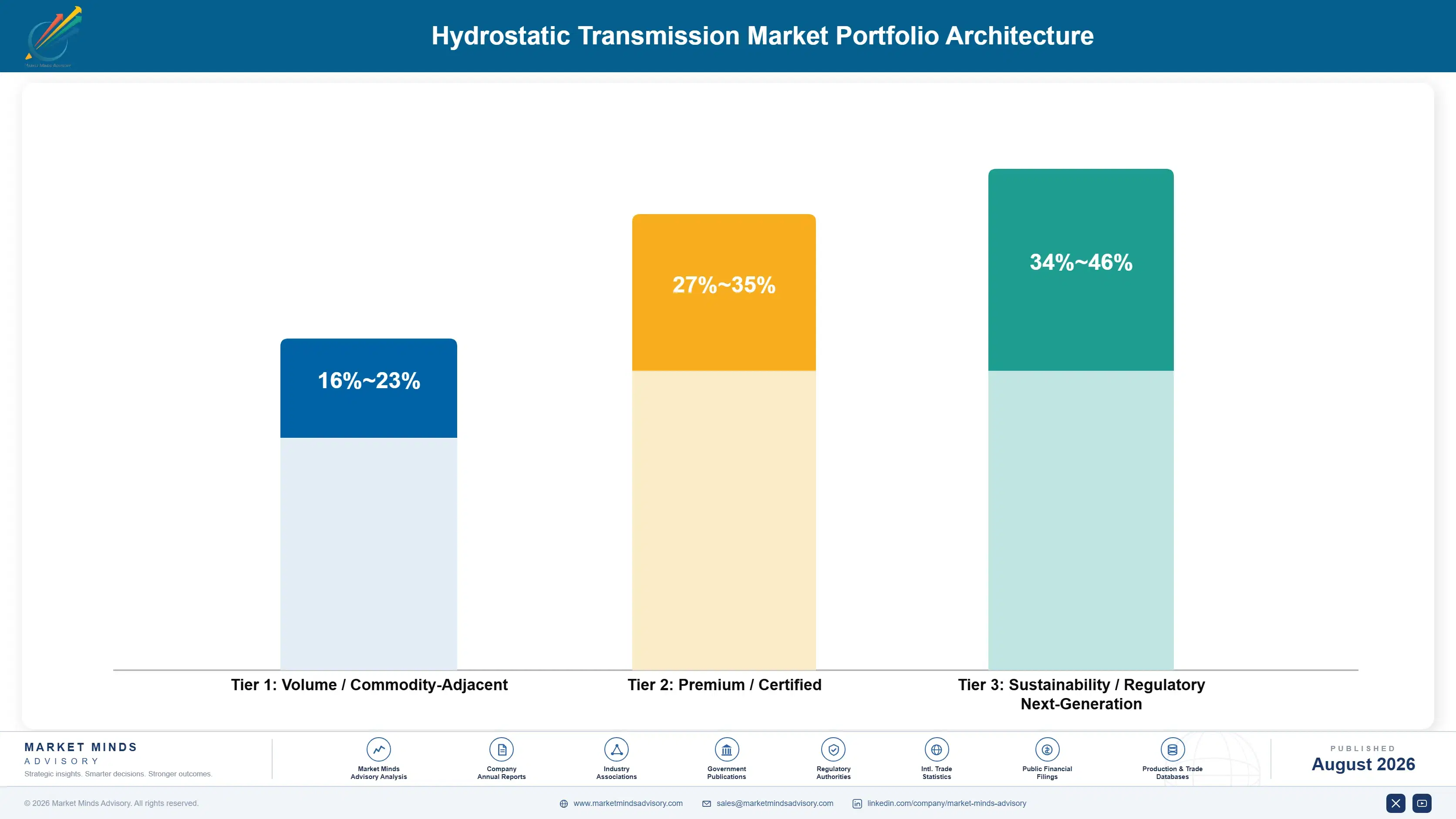
Margin in transmissions tracks how much of the value sits in software and how locked the platform is, rather than how hard the hardware is to make. Conventional closed-circuit units run at gross margins in the high teens to low twenties, competing against capable rivals on a component the customer specifies precisely. Electronically controlled and power-split configurations run considerably higher, because the control layer creates switching cost and few competitors hold both capabilities. Rebuild kits and aftermarket parts run higher again.
The tension is that unit volume fills the machining capacity and the software and aftermarket earn the returns, and the two need entirely different organisations. A precision machining operation optimised for volume handles software development badly, and the engineering disciplines share almost nothing. Several manufacturers running both from one structure have found the hardware business consistently starved the control software one of investment, which is a resource allocation problem that compounds over eight-year award cycles.

High-value pools sit in control software, power-split configurations and the rebuild channel that the original award created and most manufacturers then abandoned. None of the three is where the unit volume is. Machining capacity by itself defends nothing at all now.

Volume / Commodity-Adjacent

Conventional closed-circuit units and integrated transaxles supplied against precise customer specifications where several capable manufacturers compete on price and delivery. The seven-point range separates manufacturers with captive machining capacity from those buying precision components on the open market.
Gross Margin: 16%-23%

Premium / Certified

Electronically controlled displacement systems and compact drive units engineered into specific machine architectures. The eight-point spread reflects how much control software the manufacturer supplies against how much the equipment builder writes for itself.
Gross Margin: 27%-35%

Sustainability / Regulatory / Next-Generation

Hydromechanical power-split transmissions, autonomous-capable control packages and aftermarket rebuild programmes. The twelve-point range is wide because pricing reflects scarce manufacturing capability and control software content rather than any component cost basis anybody benchmarks.
Gross Margin: 34%-46%
hydrostatic-transmission-market-trends-portfolio-architecture-1787553317898

High-value Sub-segments and Strategic Watch-out

Electronically Controlled Displacement

Compounding at 6.9% on autonomous and precision agriculture requirements that mechanical linkage cannot meet, and the value sits in software rather than hardware. Owning the control layer makes the transmission part of a machine's software architecture, which is far harder to replace than a pump.
Gross Margin: 30%-40%

Power-Split Transmission Capability

Growing at 6.2% and the only honest answer to an 82% efficiency ceiling that loses arguments hydrostatics could otherwise win. The barrier is gear cutting capability alongside hydraulic machining, which few suppliers hold and none can acquire quickly. Acquisition is the only realistic route available.
Gross Margin: 34%-46%

Conventional Closed-Circuit Units

The volume that fills machining capacity and builds the installed base, growing slowly and specified precisely by customers who compare quotations closely. Chinese manufacturers qualifying into applications closed to them a decade ago are the immediate threat. Manage it for utilisation and aftermarket capture. Nothing else defends it.
Gross Margin: 16%-23%

Aftermarket Rebuild Channel

Drive units return for major rebuild around every 6,000 hours and independent rebuilders take most of that work while original manufacturers watch. Rebuild kits, procedures and training convert a single component sale into decades of recurring revenue at better margins. Almost nobody pursues it seriously.
Gross Margin: 38%-50%

How Transmission Demand Renews

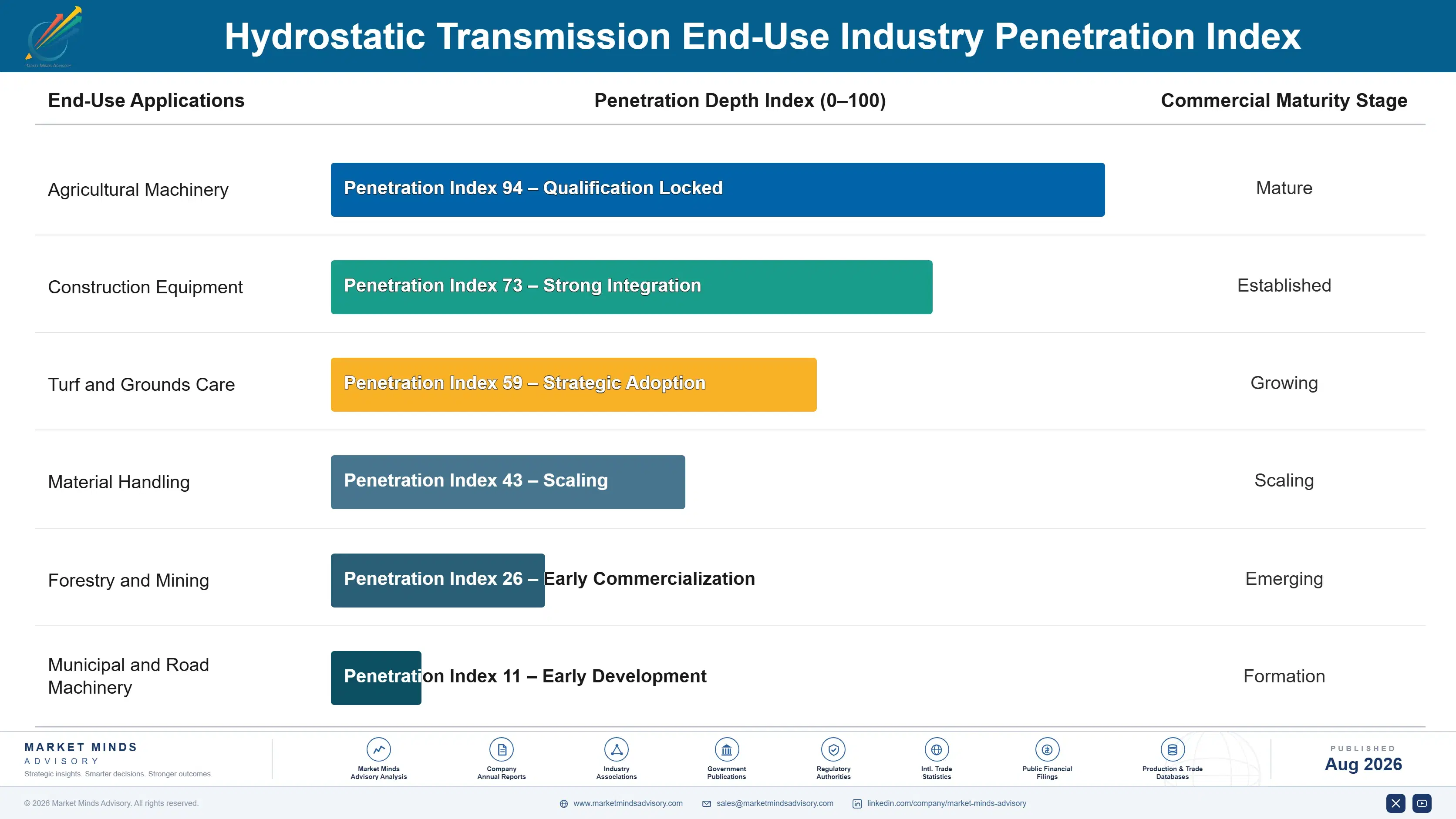
Transmission demand is programme annuity revenue. An award covers a machine platform running roughly 8 years, and volume tracks build rate continuously across that with no repurchasing decision in between. Around 78% of units go to equipment build. What follows is the rebuild cycle, running every 6,000 operating hours across a machine life that can exceed twenty years, and the award winner has first claim on it.
Stickiness varies by vertical. Agricultural platforms are close to permanent, since the transmission integrates into machine control architecture and revalidation would reopen the whole system. Construction equipment changes at platform boundaries readily enough, because the packaging constraints are looser and several suppliers can meet them. Turf and light utility change fastest and are leaving hydraulics entirely. Depth follows the same pattern: agricultural customers consolidate across configurations while construction builders spread awards.

The buyer has moved and most transmission sales organisations have followed slowly. Selection once sat with drivetrain engineers weighing displacement, torque and packaging. It increasingly sits with machine architecture and controls teams weighing whether a transmission can be commanded by machine software, and with programme managers weighing whether the platform should be electric at all. Neither of those conversations is about hydraulics.
hydrostatic-transmission-market-trends-end-use-penetration-index-1787553318383

Where To Place The Bet

These are among the four positions where our research anticipates prominent divergence between winners and laggards over the coming forecast period. Each is grounded in the demand model, the regulatory perimeter, and the announced capacity pipeline.
01 / CONCEPT PHASE ENGINEERING

Arrive before the specification is written

A transmission award runs roughly 8 years and 78% of volume is decided at that single moment, which makes bidding against a finished specification the most expensive way to compete in this industry. Funding application engineering during a customer's concept work shapes the specification instead of answering it, and the hours involved are trivial against eight years of programme revenue plus the rebuild tail behind it. The obstacle is entirely internal, because that spending sits years ahead of any booking at all.
02 / POWER-SPLIT CAPABILITY BUILD

Answer the efficiency argument or lose the platforms

A hydrostatic drive peaks near 82% efficiency and an electric drive does better, which is an argument this technology cannot win on its own terms and keeps losing on compact platforms already. Hydromechanical power-split configurations recover most of the loss by routing power mechanically, and that segment is already compounding at 6.2% without much help at all. The barrier is gear cutting capability alongside hydraulic machining, which almost nobody holds and which realistically arrives through acquisition rather than through organic investment.
03 / CONTROL LAYER OWNERSHIP

Sell the software, not just the pump

Electronically controlled displacement compounds at 6.9% because autonomous and precision agriculture need speed control that mechanical linkage cannot deliver, and most of that value sits in software and sensor integration rather than in hydraulics. A supplier shipping hardware and leaving the control layer to the machine builder takes the smaller half and creates no switching cost whatsoever afterwards. Owning it makes the transmission part of a machine's software architecture, which is considerably harder to displace than any pump ever was.
04 / REBUILD CHANNEL CAPTURE

Take back the aftermarket the award created

Drive units return for major rebuild around every 6,000 operating hours across machine lives exceeding twenty years, and 78% of those units were supplied at equipment build by manufacturers who then let independent rebuilders take the work. Rebuild kits, procedures and dealer training convert a single component sale into decades of recurring revenue at margins the original unit never approaches at all. It requires a channel organisation most transmission manufacturers have never built and could assemble within about two years if they chose.

Engagement Snapshot From the Field

A live engagement with an industry participant carrying material or product regulatory and market exposure ahead of a defining policy shift, showing how our research translates into a defensible multi-year portfolio strategy.
MARKET MINDS ADVISORY · CLIENT ENGAGEMENT SUMMARY
Hydrostatic Transmission Producer Strategic Portfolio Review and Transition Roadmap 2026·Investment Scenario on Hydrostatic Transmission Exposure Evaluation 2025-26
CLIENT PROFILE
A European mobile hydraulics manufacturer with annual revenue around EUR 890 million (client-reported, unverified by MMA), of which hydrostatic transmissions accounted for roughly 55%. The business held strong platform positions in turf equipment and light utility machinery and thinner positions in agriculture. Control electronics were supplied by the equipment builders rather than by the client. No power-split capability existed anywhere in the group.
STRATEGIC CHALLENGE
Two turf platform customers had announced electric drive conversion for their next generation, removing roughly 18% of the client's transmission volume by 2029 (client-reported, unverified by MMA). The board had approved no replacement strategy. Engineering wanted to develop an electric drive product and compete against motor manufacturers. Nobody had asked which platforms were actually at risk.
MMA APPROACH
MMA classified every platform in the client's order book by shock loading, duty cycle and packaging constraint to establish which were exposed to electric drive and which were not. Customer concept programmes were mapped through the expert interview programme against realistic award timing. Available power-split manufacturers in Europe were screened on capability rather than revenue, and rebuild channel capture practice was benchmarked against comparable competitors.
KEY FINDINGS
  1. Around 31% of the order book sat on platforms genuinely exposed to electric drive, considerably more than the 18% already announced and concentrated in the same customer accounts.
  2. The remaining volume sat on shock-loaded and packaging-constrained applications where electric drive is not a realistic option within the forecast period at all.
  3. Developing an electric drive product would place the client against motor manufacturers with decades of head start, in a category where it held no advantage of any kind.
  4. Independent rebuilders were servicing an installed base the client had built and abandoned, representing recurring revenue larger than the volume electrification threatened to remove.
CLIENT PROFILE
A European mobile hydraulics manufacturer with annual revenue around EUR 890 million (client-reported, unverified by MMA), of which hydrostatic transmissions accounted for roughly 55%. The business held strong platform positions in turf equipment and light utility machinery and thinner positions in agriculture. Control electronics were supplied by the equipment builders rather than by the client. No power-split capability existed anywhere in the group.
STRATEGIC CHALLENGE
Two turf platform customers had announced electric drive conversion for their next generation, removing roughly 18% of the client's transmission volume by 2029 (client-reported, unverified by MMA). The board had approved no replacement strategy. Engineering wanted to develop an electric drive product and compete against motor manufacturers. Nobody had asked which platforms were actually at risk.
MMA APPROACH
MMA classified every platform in the client's order book by shock loading, duty cycle and packaging constraint to establish which were exposed to electric drive and which were not. Customer concept programmes were mapped through the expert interview programme against realistic award timing. Available power-split manufacturers in Europe were screened on capability rather than revenue, and rebuild channel capture practice was benchmarked against comparable competitors.
KEY FINDINGS
  1. Around 31% of the order book sat on platforms genuinely exposed to electric drive, considerably more than the 18% already announced and concentrated in the same customer accounts.
  2. The remaining volume sat on shock-loaded and packaging-constrained applications where electric drive is not a realistic option within the forecast period at all.
  3. Developing an electric drive product would place the client against motor manufacturers with decades of head start, in a category where it held no advantage of any kind.
  4. Independent rebuilders were servicing an installed base the client had built and abandoned, representing recurring revenue larger than the volume electrification threatened to remove.
RECOMMENDED STRATEGY
Phase 1: Phase one: abandon the electric drive product proposal and redirect that engineering budget toward control electronics capability the client currently buys from customers. Phase 2: Phase two: acquire power-split manufacturing capability rather than building it, prioritising targets already supplying the client's agricultural customer base directly. Phase 3: Phase three: build a rebuild kit and dealer training programme against the existing installed base, which recovers revenue independent of any platform award.
OUTCOME
The electric drive programme was cancelled and control electronics development is under way with a dedicated team hired. A power-split acquisition completed in 2025 at a price the client reported as roughly EUR 112 million (client-reported, unverified by MMA). The rebuild programme launched and the client reports aftermarket revenue running ahead of plan.

Frequently Asked Questions

Foundational context covering the market sizes, CAGR, scope, country, region and competition that inform every finding below. This section is provided to cover basics and most often pre-purchase conversations, answered from the MMA Primary Research Dataset.

What is the current size of the Hydrostatic Transmission Market?

The market was valued at USD 8.6 billion in 2025, rising to an estimated USD 9.0 billion in 2026. North America holds the largest regional share at 30% of value.

How large will the Hydrostatic Transmission Market be by 2036?

MMA forecasts USD 14.10 billion by 2036 under the base case, an expansion multiple of 1.57 times the 2026 value. That represents USD 5.10 billion of incremental value.

What is the CAGR for the Hydrostatic Transmission Market 2026 to 2036?

The base case runs at 4.6% compound annual growth between 2026 and 2036, with a bull case at 5.8% and a bear case at 3.4%. Historical growth from 2020 to 2025 was 3.6%.

Which segment is growing fastest?

Electronically controlled displacement systems lead at 6.9%, half again the market rate, driven by autonomous and precision agriculture requirements. Hydromechanical power-split transmissions follow at 6.2%.

Who are the major companies in the Hydrostatic Transmission Market?

Bosch Rexroth, Danfoss Power Solutions, Parker Hannifin, Kawasaki Heavy Industries and Hydro-Gear hold 58% between them. Control electronics integration and platform incumbency sustain those positions rather than manufacturing scale.

Which country is growing fastest?

India leads at 7.3%, driven by construction equipment expansion and by conversion from mechanical to hydrostatic drive across a tractor population nobody has converted yet.

Report Segmentation Architecture

The full report scope spans multiple orthogonal segmentation dimensions, with cross-tabulated demand data provided for each dimension pair. Coverage extends further to regional breakdowns, trend trajectories, and the competitive detail needed to support segment-level decision-making.

By Drive Configuration

  • Closed-Circuit Variable Displacement Systems
  • Integrated Hydrostatic Transaxles
  • Electronically Controlled Displacement Systems
  • Hydromechanical Power-Split Transmissions
  • Open-Circuit Hydrostatic Drives
  • Compact Wheel and Track Drive Units

By End-Use Industry

  • Agricultural Machinery
  • Construction Equipment
  • Turf and Grounds Care
  • Material Handling
  • Forestry and Mining
  • Municipal and Road Machinery

By Sales Channel

  • Original Equipment Build Supply
  • Equipment Dealer Channel
  • Independent Rebuild Channel
  • Direct Fleet Supply
  • Licensed Manufacture

By Region

  • North America
  • Western Europe
  • East Asia
  • South Asia and Pacific
  • Latin America
  • Middle East and Africa
  • Eastern Europe

Scope, Methodology, and Coverage

Every figure in this report is reproducible from documented input assumptions. The scope below maps the historical period, the forecast horizon, the segmentation dimensions, and the countries covered, alongside the underlying primary and qualitative methodology.
Historical Period
2020 to 2025
Forecast Period
2026 to 2036
Base Year
2025 (USD billions; MMA Primary Research Dataset, August 2026)
Market Definition
The market comprises hydrostatic transmissions providing stepless drive through closed or open hydraulic circuits, covering variable displacement pump and motor sets, integrated transaxles, electronically controlled displacement systems, hydromechanical power-split transmissions, open-circuit drives and compact wheel and track drive units. Value is measured at transmission manufacturer level across original equipment build and aftermarket supply, including control software supplied with the unit. Hydraulic implement and work function circuits, mechanical and powershift transmissions, electric drive motors and inverters, hydraulic fluids, filtration, and complete machines fall outside scope.
Quantitative Units
USD billions (current prices); thousand transmission units shipped annually; USD per unit by drive configuration
Segmentation Dimensions
By Drive Configuration; By End-Use Industry; By Sales Channel; By Region
Regions Covered
North America, Western Europe, East Asia, South Asia and Pacific, Latin America, Middle East and Africa, Eastern Europe
Countries Covered
United States, Canada, Mexico, Germany, Italy, France, United Kingdom, Netherlands, Sweden, Finland, Austria, Poland, Czechia, Romania, Hungary, China, Japan, South Korea, India, Thailand, Indonesia, Vietnam, Australia, Brazil, Argentina, Chile, Peru, Saudi Arabia, United Arab Emirates, South Africa
Key Companies Profiled
Bosch Rexroth, Danfoss Power Solutions, Parker Hannifin, Kawasaki Heavy Industries, Hydro-Gear, Poclain Hydraulics, Linde Hydraulics, Comer Industries, Liebherr, Nachi-Fujikoshi, Yuken Kogyo, Kanzaki Kokyukoki, Casappa, Hydac International, Sunfab Hydraulics, Sumitomo Heavy Industries, HAWE Hydraulik, Bondioli & Pavesi, Interpump Group, Zhejiang Zhenhua Machinery
Quantitative Methodology
Primary survey, n=3,800 respondents, Q4 2025, six countries; demand-side model with trade association cross-validation
Qualitative Methodology
47 expert interviews, Q4 2025; applied to validate demand model assumptions, identify emerging dynamics, and assess competitive positioning
Report Format
PDF and XLSX data workbook (Word format preview document)
Publisher
Market Minds Advisory
Report Code
MMA-2026-CON-244
Published
August 2026
Contact
sales@marketmindsadvisory.com | www.marketmindsadvisory.com

Purchase the full Hydrostatic Transmission Market Report (2026 to 2036).

The full report sizes the global hydrostatic transmission market to 2036 across six drive configurations and seven regions, measured at manufacturer level across equipment build and aftermarket supply. It classifies platform exposure to electric drive by shock loading, duty cycle and packaging constraint rather than treating electrification as a single threat. Competitive analysis covers 20 participants evaluated on unit revenue at manufacturer level, with moat and risk assessment for the two leaders. Aftermarket economics are traced from rebuild intervals through to channel capture, and input cost exposure runs from precision machining to eight-year platform pricing. Four quantified revenue levers close the analysis.
Six-configuration segment sizing with segment-level growth rates
Seven-region share and growth breakdown to 2036
Twenty-participant competitive map on one revenue basis
Electrification exposure classified by shock loading and packaging
Input cost exposure traced to precision machining and steel
Four quantified revenue levers with commercial impact ranges

Built For The People Who Decide

From boardroom strategy to bench-side execution, this report is read cover-to-cover by leaders shaping the next decade of their industry, turning demand scenarios, market dynamics and valuation benchmarks into decisions.
CXOs/ Presidents/ VPs/ Managers
M&A and Corporate Development
Strategy Teams and R&D Heads
Procurement and Product Directors
Regulatory and Compliance Leaders
Investor Relations and Equity Analysts