
Market Minds Advisory
Hemostasis Products Market

Hemostasis Products Market: Flowable Sealants Challenge the Mechanical Suture Standard

Advanced flowable and topical sealants are displacing mechanical suturing in high-risk vascular and hepatic procedures just as biologic-derived hemostats face mounting scrutiny over animal-sourced components, forcing every major manufacturer to defend a decades-old product architecture.

Lead Analyst

Alice Ballenger

Published

September 2026

Make Smarter Decisions with Customized Research Insights

Request a free sample report and evaluate market opportunities, growth trends, and competitive dynamics relevant to your business needs.

2025 MARKET VALUE$5.4BMarket Size 2025
2036 FORECAST VALUE$11.8BBase Case , 2026 to 2036
CAGR 2026 TO 20367.4 %Bull 8.6% / Bear 6.2%
INCREMENTAL OPPORTUNITY$6.0BNet 10- year value creation
EXPANSION MULTIPLE2.04x2036 value over 2026 base
Strategic Levers
M&A Pipeline
Regional Outlook
Country Rankings
Competitive Intelligence
Segmental Deep-dive
Call-Us : 91 93563 13602

Executive Snapshot and Market Trajectory

Baxter's Floseal and CryoLife's BioGlue built the modern hemostat category on animal-derived collagen and gelatin, and synthetic polyethylene glycol sealants are now the fastest-growing answer to surgeons who want equivalent sealing performance without any bovine or porcine sourcing at all in the operating room today.
CSL Behring and Baxter still command the largest combined share of the category through decades-old surgical relationships and hospital purchasing contracts, while rising minimally invasive and robotic-assisted procedure volume keeps expanding the addressable case count feeding every manufacturer's pipeline year after year without pause or interruption of any kind. Growing surgeon preference for combination sealant-and-mesh products has pulled an entirely new commercial category into mainstream operating room stocking decisions across major hospital systems nationwide today.
Five companies account for roughly two-thirds of category revenue, a moderately concentrated structure that leaves meaningful room for challengers, and the order shifts gradually because hospital purchasing committees standardise around one manufacturer's portfolio first, well before considering rivals seriously. Regulatory scrutiny of animal-derived sourcing, still evolving across several major markets, will determine how quickly synthetic alternatives capture lasting share from biologic incumbents nationwide and abroad.
Market Definition
This market covers surgical hemostatic products used to control bleeding during procedures, including topical thrombin agents, gelatin and collagen matrices, flowable and fibrin sealants, and synthetic polymer sealants. It excludes mechanical hemostasis devices such as clips, clamps, and electrocautery equipment, and non-surgical wound care dressings used outside the operating room.
Base Year Value
$5.4B in 2025 (MMA Primary Research Dataset, August 2026)
Forecast Period
2026 to 2036, eleven discrete annual values
CAGR
7.4% base case. Bull 8.6%. Bear 6.2%.
Fastest Growth Segment
Synthetic Polyethylene Glycol Sealants: 12.8% CAGR
Fastest Growth Country
China: 10.4% CAGR
Fastest Growth Region
South Asia and Pacific: 9.4% CAGR
Largest Region
North America: 32% of 2025 global value
Market Leaders
Baxter International Inc, CSL Behring, Johnson & Johnson, Becton Dickinson, Integra LifeSciences. Source: MMA Analysis based on company annual reports.
Primary Survey
n=3,800 procurement and R&D decision-makers, Q4 2025, six countries
Methodology
Demand-side build-up, cross-validated against public data, 47 expert interviews

Hemostasis Products Market Forecast Scenarios

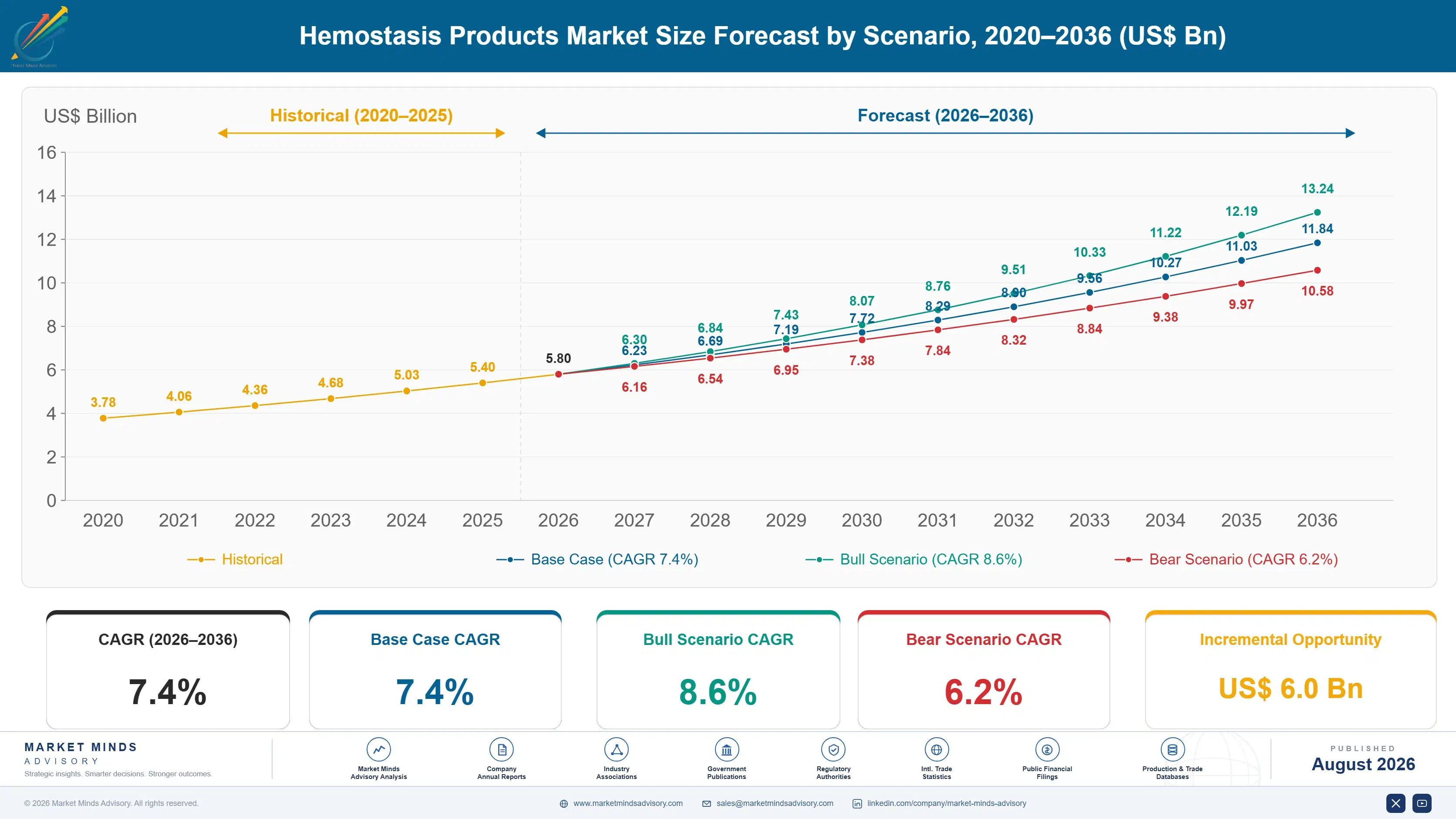
hemostasis-products-market-size-forecast-scenario-1787332449722
Between 2020 and 2025, the market grew at a historical rate near 6.6 percent, carried by steadily rising surgical procedure volume recovering from pandemic-era postponements and expanding minimally invasive surgery adoption, even as synthetic sealants remained a comparatively small share of overall category revenue relative to established biologic products across most hospital systems throughout this five-year period.
The base case assumes 7.4 percent annual growth through 2036, built on three mechanisms: rising minimally invasive and robotic-assisted procedure volume that demands more precise, lower-profile hemostatic application than traditional gauze packing allows, growing surgeon preference for synthetic sealants free of animal-derived sourcing concerns among increasingly cautious hospital purchasing committees, and expanding hepatic and cardiovascular surgery volume across ageing populations in major developed and middle-income health systems alike worldwide today.
A bull case near 8.6 percent depends on synthetic sealant manufacturers achieving cost parity with biologic products faster than currently expected by most hospital purchasing analysts. The bear case near 6.2 percent reflects continued price sensitivity among hospital systems facing broader reimbursement pressure, since many still default to lower-cost gelatin-based products despite documented clinical advantages from newer sealant technology in higher-risk procedures.

Biologic Standard Meets the Synthetic Sealant Shift

Hemostasis products have quietly split into a sourcing debate as much as a technology one. The core clinical function, stopping bleeding fast enough to keep a procedure on schedule, has not changed, but hospital purchasing committees increasingly weigh animal-derived sourcing risk alongside raw clinical performance when comparing competing product lines for formulary approval each budget cycle across every affected surgical department.
TOP 5 CONCENTRATION66% CR5revenue share held by five largest manufacturers globally
AVERAGE PROCEDURE PRODUCT COST$180 per casetypical hemostat spend, per applicable surgical procedure performed
LEADING PRODUCING COUNTRYUSA, 38%share of global hemostat revenue, by manufacturer home country
MINIMALLY INVASIVE PROCEDURE SHARE54% of volumeshare of applicable procedures using minimally invasive technique
SYNTHETIC SEALANT PENETRATION19% of revenueshare of category revenue from synthetic polymer products sold
BOVINE AND PORCINE INPUTS24% of COGSinput cost weight from animal-derived raw materials sourced
Commercial behaviour splits by procedure risk and surgeon specialty. General surgery and orthopedic procedures still rely heavily on lower-cost gelatin and collagen matrices that have performed reliably for decades, while cardiovascular, hepatic, and neurosurgical procedures increasingly specify premium flowable and synthetic sealants where bleeding control failure carries meaningfully higher clinical and financial consequence for both patient and hospital across every affected case.
The next decade turns on whether synthetic sealants can close the remaining cost gap with biologic products while matching their handling characteristics closely enough to win over surgeons trained on established techniques over many years of practice. Manufacturers that solve both problems stand to capture share from an installed biologic base that has dominated operating room stocking decisions for more than two decades across nearly every major hospital system worldwide.
"Surgeons don't switch hemostats because a rep asks nicely. They switch when the product saves them ninety seconds during the one moment in the case that actually scares them."
Director, Surgical and Interventional Devices Practice · MMA Medical Devices Pra

Market Trends

Synthetic Sealants Gain Share in Cardiovascular Procedures

Synthetic polyethylene glycol sealants have moved from niche adjunct products into mainstream specification for cardiovascular and vascular graft procedures, where surgeons value their transparent handling characteristics and freedom from animal-derived sourcing concerns entirely. Baxter's CoSeal and comparable products from Gatt Technologies have both reported expanded hospital formulary approvals in recent years, driven by cardiac surgery departments specifically seeking alternatives to fibrin-based sealants carrying blood-product-derived components with documented supply constraints. Clinical studies presented at major surgical society meetings have documented meaningfully faster hemostasis achievement time versus comparable biologic alternatives across several procedure types.
Market Impact: Reaches 54% of applicable procedure
Robotic-Assisted Surgery Expands Precision Application Demand

Robotic-assisted surgical procedure volume has grown considerably across urology, gynecology, and general surgery specialties, creating demand for hemostatic products specifically formulated for precise, low-volume application through narrow robotic instrument channels rather than traditional open-field application methods used in conventional surgery. Ethicon and Baxter have both launched robotic-compatible sealant delivery systems designed around this narrower application requirement, targeting the more than 2 million robotic-assisted procedures now performed annually worldwide according to manufacturer platform disclosures reviewed by MMA analysts covering major robotic surgery platform adoption trends across multiple specialties and geographies today.
Market Impact: Grows the over-65 patient base 35%

Market Opportunities and Growth Drivers

Rising Minimally Invasive Procedure Volume Demands Precision Hemostasis

Minimally invasive surgical procedures now account for a majority of applicable general and specialty surgery volume across major developed health systems, a shift that has fundamentally changed hemostat product requirements since traditional gauze packing and manual pressure techniques do not translate well to laparoscopic and robotic-assisted surgical fields. Manufacturers have responded with flowable and spray-applied products specifically engineered for these narrower surgical approaches. An estimated 54 percent of applicable procedures now use minimally invasive technique across major developed markets, up considerably from a meaningfully smaller share just a decade earlier.
Market Impact: Excludes 15% of hospital formularie

Ageing Population Drives Cardiovascular and Hepatic Surgery Volume

Population ageing across major developed and middle-income health systems is driving rising cardiovascular and hepatic surgery volume, procedure categories where bleeding control complications carry disproportionately high clinical risk and correspondingly premium hemostat product specification. Hospital systems performing higher volumes of these complex procedures increasingly standardise on premium flowable and synthetic sealant products specifically to reduce reoperation rates tied to inadequate hemostasis in this vulnerable patient group. Cardiovascular procedure volume alone is projected to grow considerably across major markets as the population over age 65 continues expanding through the coming decade of sustained demographic change.
Market Impact: Limits premium adoption to 28%

Market Restraints and Challenges

Animal-Derived Sourcing Scrutiny Pressures Biologic Product Lines

Hospital purchasing committees and regulators in several major markets have intensified scrutiny of bovine and porcine-derived raw materials used in gelatin and collagen hemostat products, citing both disease transmission risk precedent and growing institutional preference for animal-free surgical supply chains. The root cause traces back to historical bovine spongiform encephalopathy concerns that never fully receded from regulatory memory in several jurisdictions. This restricts biologic product manufacturers' ability to expand into hospital systems with strict animal-derived sourcing policies. Manufacturers have responded by publishing expanded sourcing traceability documentation and investing in recombinant and synthetic alternative product lines.
Market Impact: Cuts hemostasis time by 90 seconds

Price Sensitivity Slows Premium Sealant Adoption

Many hospital systems facing broader reimbursement and budget pressure continue defaulting to lower-cost gelatin-based hemostat products even where clinical evidence supports better outcomes from premium flowable and synthetic sealants in higher-risk procedures. This restricts premium product adoption primarily to hospital systems with the budget flexibility and clinical champions willing to advocate for the incremental cost internally to procurement committees. Manufacturers have responded by developing bundled pricing arrangements and outcomes-based contracting models specifically designed to demonstrate total cost of care savings from reduced reoperation and complication rates across the full episode of care.
Market Impact: Serves 2M-plus robotic procedures
3 additional market trends, 4 additional growth drivers, and 3 additional restraints and challenges are covered in the full report. Contact sales@marketmindsadvisory.com to access the complete intelligence.

Segment CAGR and Growth Architecture

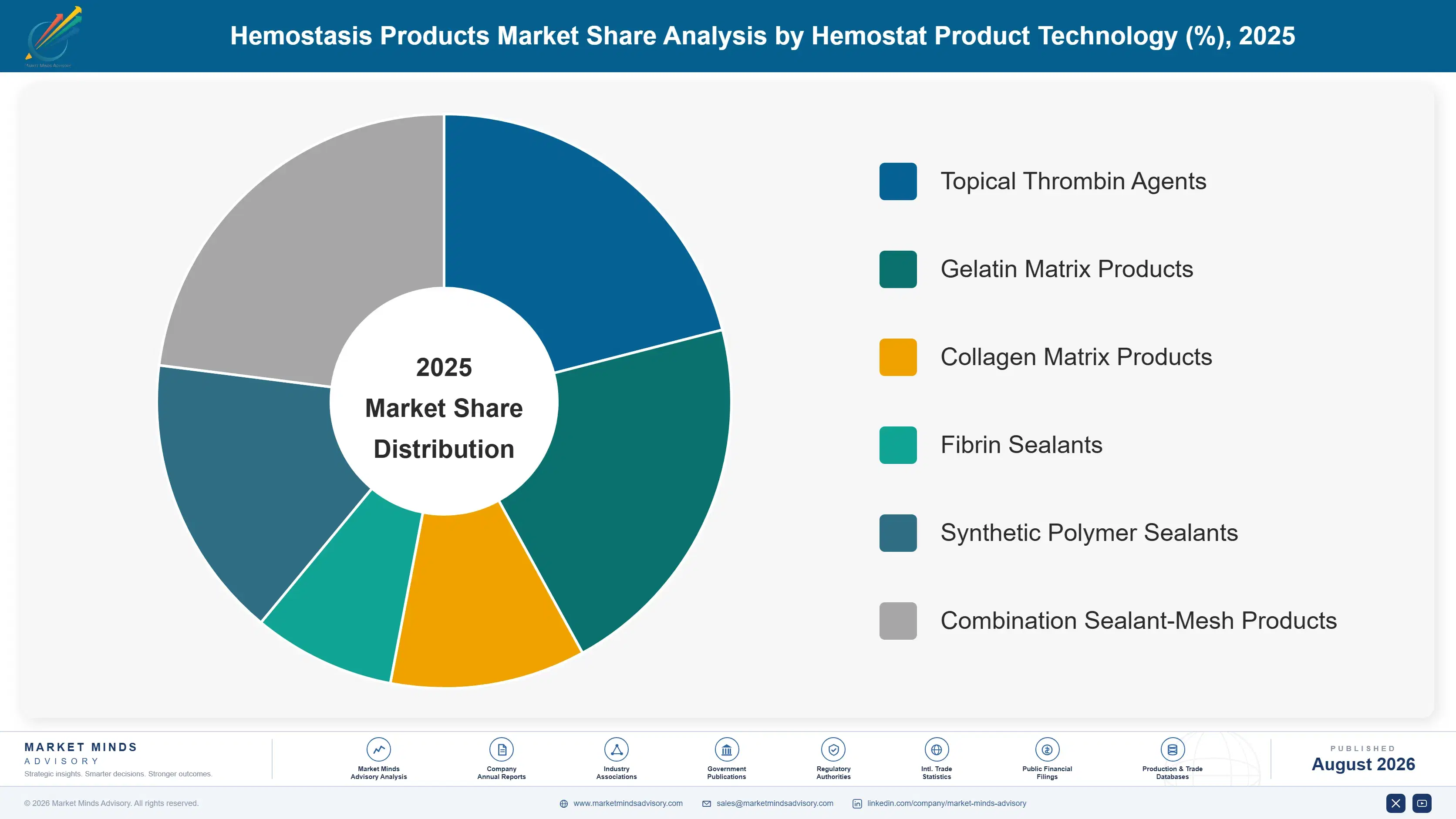
Segmentation follows hemostat product technology, the classification surgeons and hospital purchasing committees already use to distinguish topical thrombin, gelatin and collagen matrix, fibrin sealant, and synthetic polymer products across every surgical specialty this report covers, from general surgery through cardiovascular and neurosurgical applications in hospitals worldwide and every affiliated surgical facility and specialist referral network today.
hemostasis-products-market-market-share-analysis-1787332450286

Synthetic Polyethylene Glycol Sealants

Synthetic polyethylene glycol sealants are the fastest-growing category as cardiovascular and vascular graft surgeons increasingly specify products free of animal-derived sourcing concerns. The technology forms a flexible hydrogel barrier directly at the bleeding site without relying on the body's own clotting cascade, delivering more predictable performance in patients with coagulation disorders that limit fibrin-based sealant effectiveness. Baxter and Gatt Technologies both compete directly in this segment, each pursuing expanded hospital formulary approvals and clinical evidence generation targeting cardiac and vascular surgery departments specifically. Growth concentrates among hospital systems with strict animal-sourcing policies and surgeons managing complex coagulation-compromised patients, though broader mainstream adoption still depends on closing the remaining cost gap with established biologic alternatives.
CAGR 12.8%

Fibrin Sealant Products

Fibrin sealants grow fastest among established biologic hemostat categories as surgeons increasingly specify them for higher-risk hepatic, cardiovascular, and neurosurgical procedures where their proven clotting-cascade-mimicking mechanism delivers reliable performance under difficult surgical conditions. Johnson & Johnson's Evicel and CSL Behring's Tisseel both hold significant positions in this segment, backed by decades of clinical evidence and established hospital purchasing relationships across major surgical specialties and academic medical centres. Growth concentrates in developed markets where surgeons already trust the technology's clinical track record, though manufacturers face rising competitive pressure from synthetic alternatives specifically in cardiovascular applications where animal-derived sourcing concerns weigh most heavily on purchasing committee formulary decisions each budget cycle across the affected hospital network.
CAGR 9.6%
Full segment breakdown across 6 segments available in the complete report.

Regional Architecture and Country Demand Map

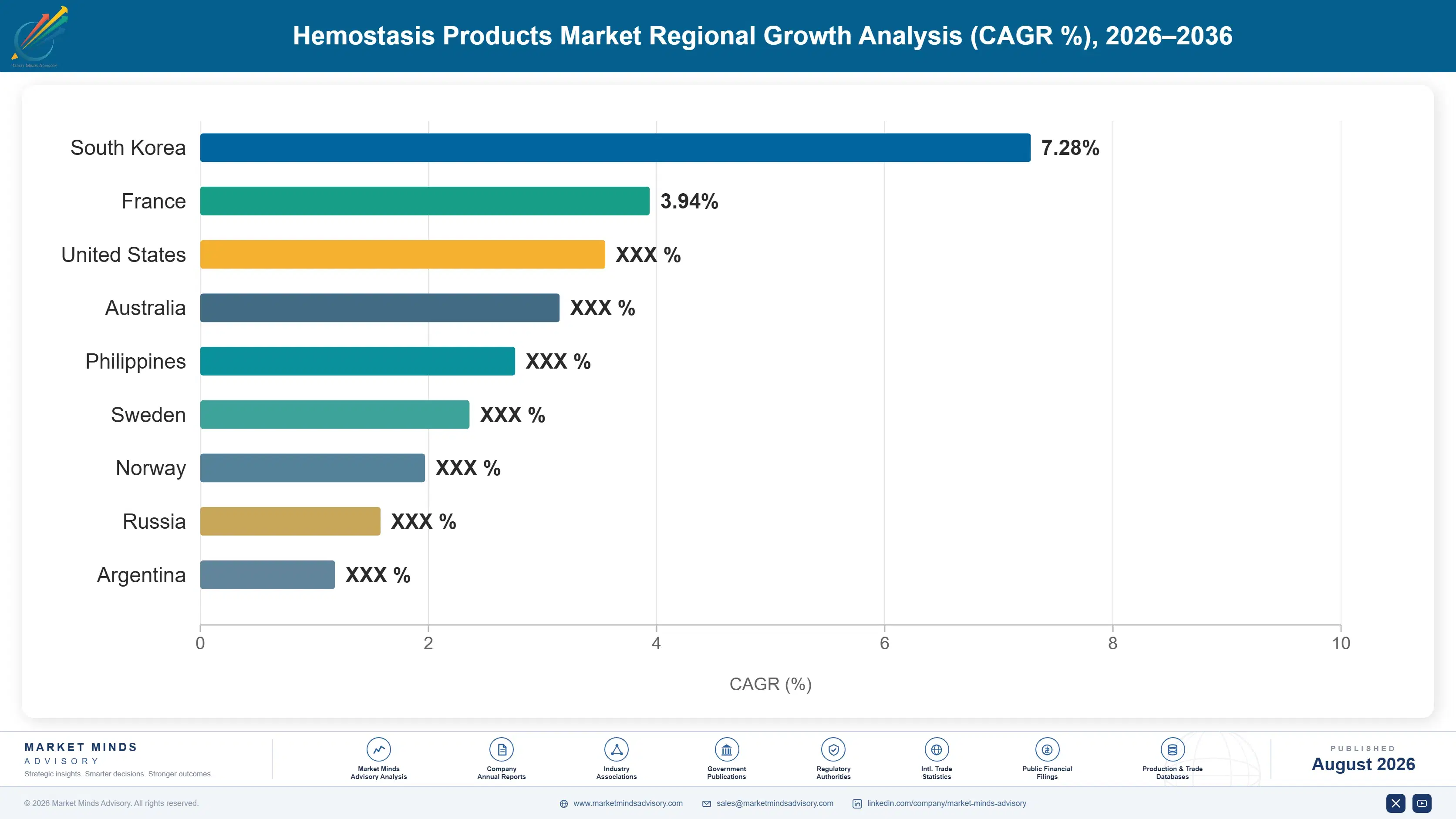
North America and Western Europe together account for more than half of global hemostat product revenue, while East Asia posts the fastest regional growth on expanding surgical procedure volume and rising minimally invasive adoption across several large developing hospital systems nationwide and across the wider region.

North America

The United States drives the overwhelming majority of regional demand through its high-volume cardiovascular and general surgery caseload, combined with well-established hospital purchasing relationships that favour premium biologic and increasingly synthetic hemostat products across major health systems. Rising robotic-assisted surgical procedure volume has meaningfully expanded demand for precision-application sealant products across urology and gynecology specialties in particular. Canada contributes a smaller but stable share, with provincial health systems gradually expanding coverage for premium hemostat products following patterns already established in leading American academic medical centres. Manufacturing and clinical research infrastructure concentrates around major device company regional headquarters serving the broader North American surgical community and its many affiliated teaching hospitals and research institutions nationwide.
Share: 32% | CAGR: 7.9% (2026 to 2036)

Western Europe

Germany anchors regional demand through its well-established hospital procurement system and CSL Behring's domestic manufacturing and clinical research presence built over decades of continuous hemostat product development. The United Kingdom follows closely, with the National Health Service increasingly favouring synthetic sealant products in trusts with explicit animal-derived sourcing exclusion policies for surgical supplies. France and the Netherlands contribute meaningful shares tied to established public hospital procurement frameworks and long-standing cardiovascular surgery programme volume. Regional growth trails North America and East Asia because most Western European public health systems apply more conservative procurement criteria to premium product categories than comparable private-pay hospital systems elsewhere in the world, particularly across smaller national markets with tighter public budgets.
Share: 22% | CAGR: 6.0% (2026 to 2036)
Regional intelligence for 5 additional markets available in the complete report: East Asia, South Asia and Pacific, Latin America, Middle East and Africa, Eastern Europe. Contact sales@marketmindsadvisory.com.
hemostasis-products-market-country-cagr-analysis-1787332450813

Where Hemostat Product Margin Concentrates

Margin follows procedure risk tier and hospital contracting depth, not case volume alone. Manufacturers who win full-portfolio hospital standardisation capture durable, recurring revenue that single-product competitors cannot replicate without years of comparable clinical and commercial relationship investment across every applicable surgical department and specialty this report covers in careful, sustained detail throughout every chapter.

Winning Full-Portfolio Hospital Standardisation Deals Early

Manufacturers who secure full-portfolio standardisation agreements, covering topical, matrix, and sealant product tiers under one hospital system contract, capture predictable, recurring revenue that single-product competitors struggle to match once a hospital's supply chain and clinical protocols lock in around one manufacturer's complete product line. Baxter and CSL Behring both prioritise these full-portfolio agreements specifically to defend against single-product price competition from smaller challengers entering the category each year. Standardised hospital accounts typically deliver gross margins 12 to 18 percentage points above comparable single-product purchasing arrangements documented in supplier disclosures reviewed.
Market Impact: Adds 12 to 18 margin points overall

Premium Cardiovascular and Hepatic Surgery Specification

Manufacturers who win specification into high-risk cardiovascular and hepatic surgery protocols capture disproportionate value relative to case count, since these procedures carry meaningfully higher premium product price points and correspondingly higher margins than routine general surgery applications performed at comparable scale. CSL Behring and Johnson & Johnson both maintain dedicated cardiovascular surgery sales and clinical education teams specifically targeting this higher-value specification opportunity. Cardiovascular and hepatic surgery specification wins have historically carried per-case revenue 3 to 4 times higher than comparable general surgery product placements, based on manufacturer investor disclosures reviewed by MMA analysts.
Market Impact: Multiplies per-case revenue 3 to 4

Structuring Outcomes-Based Bundled Pricing Deals Early

Manufacturers who offer outcomes-based bundled pricing, tying product cost partly to documented reduction in reoperation and complication rates, capture premium contract value from hospital systems otherwise reluctant to pay full price for higher-cost sealant products without proof of benefit up front and in writing. Baxter has piloted several outcomes-based contracting arrangements specifically targeting large academic medical centres with sophisticated internal cost-tracking capability already in place. Early outcomes-based contracts have captured 8 to 14 percent higher effective pricing than comparable standard purchasing arrangements, according to MMA Primary Research interviews with hospital procurement directors.
Market Impact: Captures 8 to 14% higher pricing ye

Developing Robotic-Compatible Delivery Systems Ahead of Rivals

Manufacturers who develop hemostat delivery systems specifically compatible with robotic surgical platform instrument channels capture early positioning in a rapidly growing procedure category before competitors introduce comparable compatible products of their own. Ethicon and Baxter have both invested in robotic-compatible applicator development specifically to serve the more than 2 million robotic-assisted procedures performed annually worldwide across major surgical specialties. Early robotic-compatible product launches have historically captured 20 to 30 percent of a new robotic platform's applicable procedure volume within the first two years of compatible product availability, based on comparable prior launch patterns MMA has tracked.
Market Impact: Captures 20 to 30% of new platform

Who Controls the Margin Pool

CR5 sits at 66 percent, moderately concentrated for a surgical device category this size, reflecting a mix of established biologic incumbents and growing synthetic sealant challengers still building comparable hospital contracting scale nationwide. Baxter International and CSL Behring hold the largest positions, with a meaningful gap to Johnson & Johnson and Becton Dickinson in the next tier of established challengers.
Current competitive activity centres on three fronts: established biologic manufacturers defending hospital standardisation agreements while launching their own synthetic sealant product lines, smaller synthetic sealant specialists racing to expand hospital formulary approvals ahead of incumbent responses, and all major players investing in robotic-compatible delivery systems targeting rapidly growing procedure volume across multiple surgical specialties worldwide.

Emerging pressure comes from smaller synthetic sealant developers, who have moved from single-product clinical validation toward broader portfolio ambitions as animal-derived sourcing scrutiny creates a genuine opening against established biologic incumbents defending their core franchise. Rankings shift most at the procedure-specialty level rather than globally: a manufacturer's dominant position in general surgery carries limited weight in cardiovascular and hepatic applications, where synthetic sealant performance credentials increasingly determine formulary specification outcomes each budget cycle.
hemostasis-products-market-company-positioning-matrix-1787332451327

Competitive Moat and Risk Dimensions

BAXTER INTERNATIONAL INC

Moat: Full-Portfolio Hospital Contracting

Baxter's full-portfolio hemostat product line, spanning gelatin matrix through synthetic sealant, lets it win comprehensive hospital standardisation agreements that single-product competitors cannot match, giving it a durable revenue base across nearly every applicable surgical specialty and procedure risk tier, from routine general surgery through complex cardiovascular and hepatic cases.
BAXTER INTERNATIONAL INC

Risk: Synthetic Cannibalisation Pressure

Baxter's own synthetic sealant growth partly cannibalises its established gelatin and collagen matrix revenue, creating an internal margin tension that competitors without comparable legacy biologic exposure do not face to the same degree across their newer, purpose-built product portfolios designed without any comparable legacy revenue to defend.
CSL BEHRING

Moat: Fibrin Sealant Clinical Credibility

CSL Behring's Tisseel holds the industry's longest clinical track record in fibrin sealants, giving it credibility with cardiovascular and hepatic surgeons that newer synthetic entrants have not yet fully matched across comparable high-risk procedure applications and specialty surgical departments built on decades of accumulated clinical trust.
CSL BEHRING

Risk: Blood-Product Sourcing Dependency

CSL Behring's fibrin sealant products depend on blood-plasma-derived components, exposing the company to the same animal and human-derived sourcing scrutiny pressuring biologic incumbents broadly, a lasting product characteristic synthetic competitors do not carry into purchasing committee formulary reviews each budget cycle across every affected hospital account.

Players Tracked

Prominent Players

Baxter International Inc
CSL Behring
Johnson & Johnson
Becton Dickinson
Integra LifeSciences

Other Key Players

Gatt Technologies
Pfizer Inc
B. Braun Melsungen AG
Teleflex Incorporated
Stryker Corporation
Medtronic plc
Z-Medica LLC
Hemostasis LLC
CryoLife Inc
Cohera Medical Inc
Advanced Medical Solutions Group
Vascular Solutions LLC
Marine Polymer Technologies
Starch Medical Inc
Sealantis Ltd

Recent Developments

FEBRUARY 2026

Baxter Expands CoSeal Hospital Formulary Approvals

Baxter announced expanded hospital formulary approval for its CoSeal synthetic sealant across an estimated 120 additional United States cardiovascular surgery programmes. The expansion followed updated clinical evidence presented at a major cardiac surgery society meeting demonstrating faster hemostasis achievement versus fibrin sealant comparators in matched patient cohorts.
Signal: Synthetic sealant manufacturers are steadi
OCTOBER 2025

Gatt Technologies Signs European Distribution Agreement

Gatt Technologies signed a multi-year European distribution agreement covering its synthetic hemostatic sealant portfolio across several major markets. The agreement gives the company meaningfully expanded commercial reach against larger, established biologic incumbents already present in those same hospital systems and procurement networks across the region.
Signal: Smaller synthetic sealant specialists are
JUNE 2025

Johnson & Johnson Acquires Robotic-Compatible Applicator Developer

Johnson & Johnson completed an acquisition of a specialised robotic-compatible hemostat applicator developer, strengthening its Ethicon portfolio ahead of rising robotic-assisted procedure volume. The deal covers exclusive access to specific delivery mechanism designs developed by the acquired company, alongside shared rights to future joint improvements.
Signal: Established manufacturers are acquiring sp

Bovine, Porcine, and Plasma-Derived Inputs

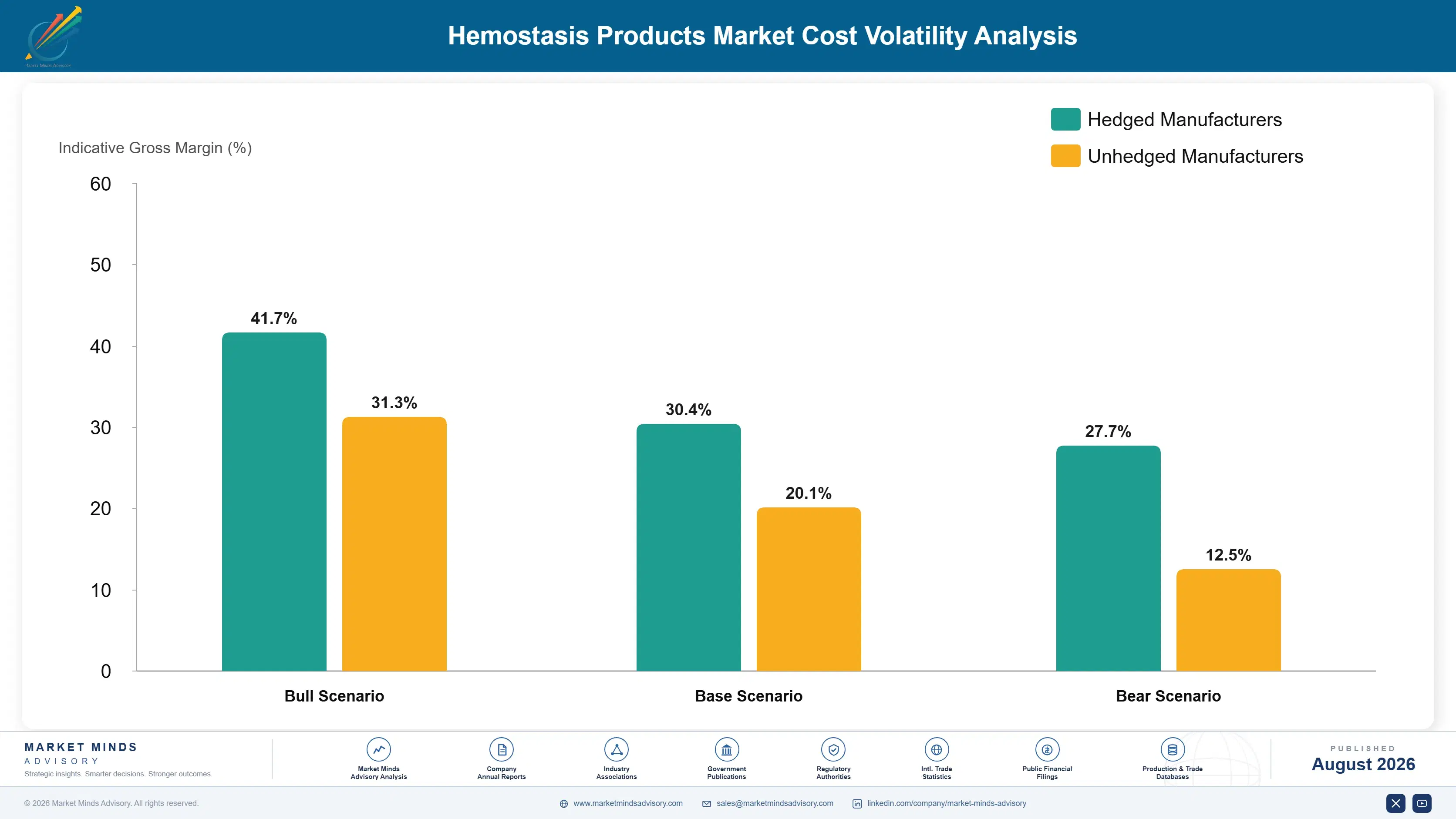
Bovine and porcine-derived collagen and gelatin raw materials, along with human plasma-derived clotting factors, together represent roughly 24 percent of hemostat product manufacturing COGS, sourced from a concentrated base of specialised biologic raw material suppliers and plasma fractionation facilities serving the broader biopharmaceutical industry simultaneously worldwide across dozens of downstream clinical product lines and research applications alike.
Plasma-derived raw material pricing has shown periodic tightness in recent years as plasma collection volume growth has not always kept pace with rising demand across multiple end markets competing for the same fractionation capacity, a dynamic documented in CSL Behring's own annual report disclosures covering plasma supply chain economics. Bovine and porcine collagen pricing has remained comparatively more stable given a broader, more diversified agricultural supplier base less exposed to the specialised capacity constraints affecting plasma fractionation specifically.

Exposure varies by product type. Fibrin sealant manufacturers remain most exposed to plasma-derived input cost and supply availability given their reliance on fractionation capacity shared with broader biopharmaceutical production, while gelatin and collagen matrix manufacturers face comparatively more stable input costs tied to an established agricultural supply chain that has changed relatively little over recent decades of commercial production at meaningful scale.
hemostasis-products-market-cost-volatility-analysis-1787332451523

Long-Term Plasma Fractionation Capacity Agreements

Larger fibrin sealant manufacturers now lock in multi-year plasma fractionation capacity agreements with fixed volume commitments, insulating hemostat production costs from short-term supply tightness that previously delayed manufacturing schedules considerably across multiple concurrent biopharmaceutical production programmes competing for capacity industry-wide each and every fiscal quarter observed closely by finance and procurement teams across the organisation.

Synthetic Product Line Diversification Investment

Several leading manufacturers have accelerated synthetic sealant product development specifically to reduce dependence on animal and plasma-derived raw materials entirely, trading higher upfront research investment for a supply chain insulated from agricultural and biopharmaceutical capacity constraints affecting biologic competitors across the industry and its many established suppliers and their downstream customers worldwide today and every fiscal quarter ahead.

Dual-Sourcing Collagen and Gelatin Suppliers

Manufacturers increasingly qualify two collagen and gelatin suppliers per product line rather than one, adding validation cost upfront but avoiding single-supplier exposure during periods of raw material tightness affecting the broader biologic device supply chain simultaneously across multiple concurrent production and testing programmes nationwide and abroad each fiscal year of continued operation and growth.

Portfolio Architecture for Margin Defence

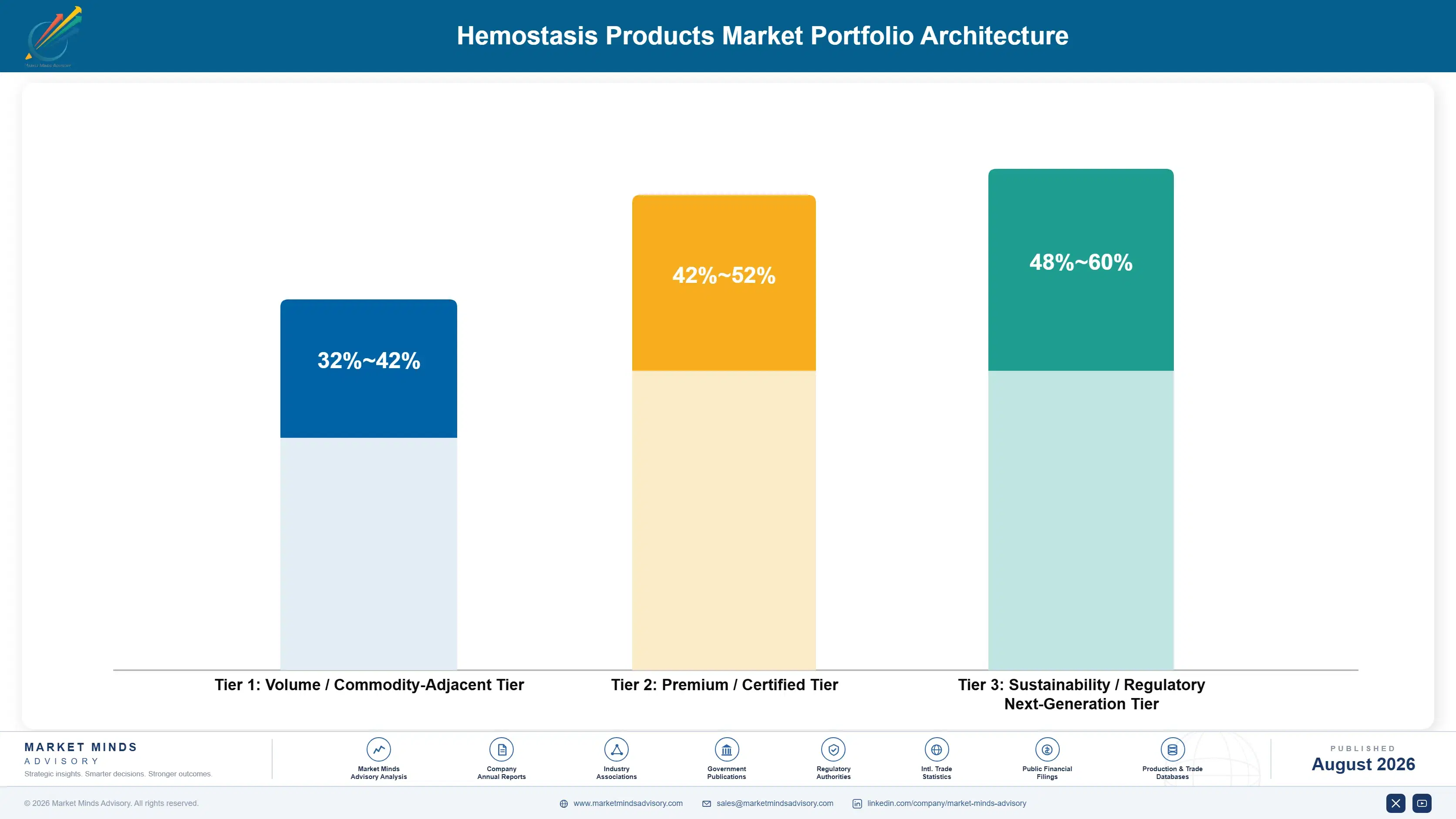
Portfolio economics split across three tiers. Established gelatin and collagen matrix products compete mainly on hospital contracting relationships and price in a mature, predictable-margin business built over decades, while emerging synthetic and combination sealant products command the highest theoretical margins, reflecting the premium surgeons and hospitals pay for technology solving both clinical performance and sourcing concerns simultaneously across every major specialty and procedure cat
The tension between volume and premium plays out starkly across the category's two halves. Established biologic products generate predictable, high-volume revenue at moderate margins built on years of hospital contracting, while synthetic sealant developers invest considerable capital pursuing formulary approval and clinical evidence that may take years longer to materialise than current investor expectations assume across the sector, its many participants, and their respective boards and finance committees.

High-value margin pools concentrate in cardiovascular and hepatic surgery specification and early synthetic sealant adoption during this transitional phase, where limited competing supply keeps pricing power intact well past what established, price-negotiated general surgery products retain after decades of established hospital contracting across the broader industry, its suppliers, and their respective distribution partners nationwide.

Volume / Commodity-Adjacent Tier

Established gelatin and collagen matrix products for general and orthopedic surgery, competing primarily on hospital contracting relationships and price across broad procedure volume built over decades of sustained category presence and clinical trust.
Gross Margin: 32%-42%

Premium / Certified Tier

Fibrin sealants and combination products carrying established clinical evidence and premium specification across cardiovascular, hepatic, and neurosurgical procedure categories at academic medical centres nationwide and internationally each year of sustained operation.
Gross Margin: 42%-52%

Sustainability / Regulatory / Next-Generation Tier

Synthetic polyethylene glycol sealants free of animal-derived sourcing, capturing premium pricing during this formulary expansion phase across hospital systems with strict sourcing policies now under active clinical and financial review.
Gross Margin: 48%-60%
hemostasis-products-market-portfolio-architecture-1787332452026

High-value Sub-segments and Strategic Watch-out

Cardiovascular Synthetic Sealant Formulary Expansion

Synthetic sealants awaiting broader cardiovascular surgery formulary approval combine high theoretical value with the fastest specification growth in the category, as clinical trials steadily accumulate evidence ahead of anticipated approval decisions expected across several additional major hospital systems and covered patient populations in the coming several years.
Gross Margin: 48%-58%

Robotic-Compatible Applicator Early Adoption

Robotic-compatible hemostat applicators carry solid margins with a growth curve still accelerating rapidly following expanded robotic platform adoption, as manufacturers scale delivery system production to meet rapidly building demand across urology and gynecology surgical departments nationwide and abroad each year of continued platform expansion and clinical adoption.
Gross Margin: 40%-50%

Established General Surgery Gelatin Matrix Base

Long-established, broadly stocked gelatin matrix products generate steady, predictable volume across a mature general surgery procedure base but carry moderate margins after decades of hospital contracting negotiations among a relatively small group of qualified, well-established suppliers competing mainly on price and service quality nationwide and abroad.
Gross Margin: 32%-40%

Next-Generation Combination Sealant-Mesh Products

Combination sealant-and-mesh products targeting complex hernia and reconstructive procedures represent a strategic watch-out: it remains unclear how quickly surgeon adoption will scale given the additional handling complexity versus standalone sealant or mesh products used separately in comparable procedures today across most surgical departments and specialties.
Gross Margin: N/A pre-launch

Procedure-Linked Recurring Consumption

Hemostat product demand behaves like a per-procedure consumable annuity rather than a durable equipment purchase, since every applicable surgical case consumes a fresh unit regardless of how many times that hospital has previously purchased the same product, generating predictable recurring revenue tied directly to underlying surgical procedure volume rather than a one-time capital sale negotiated once and forgotten.
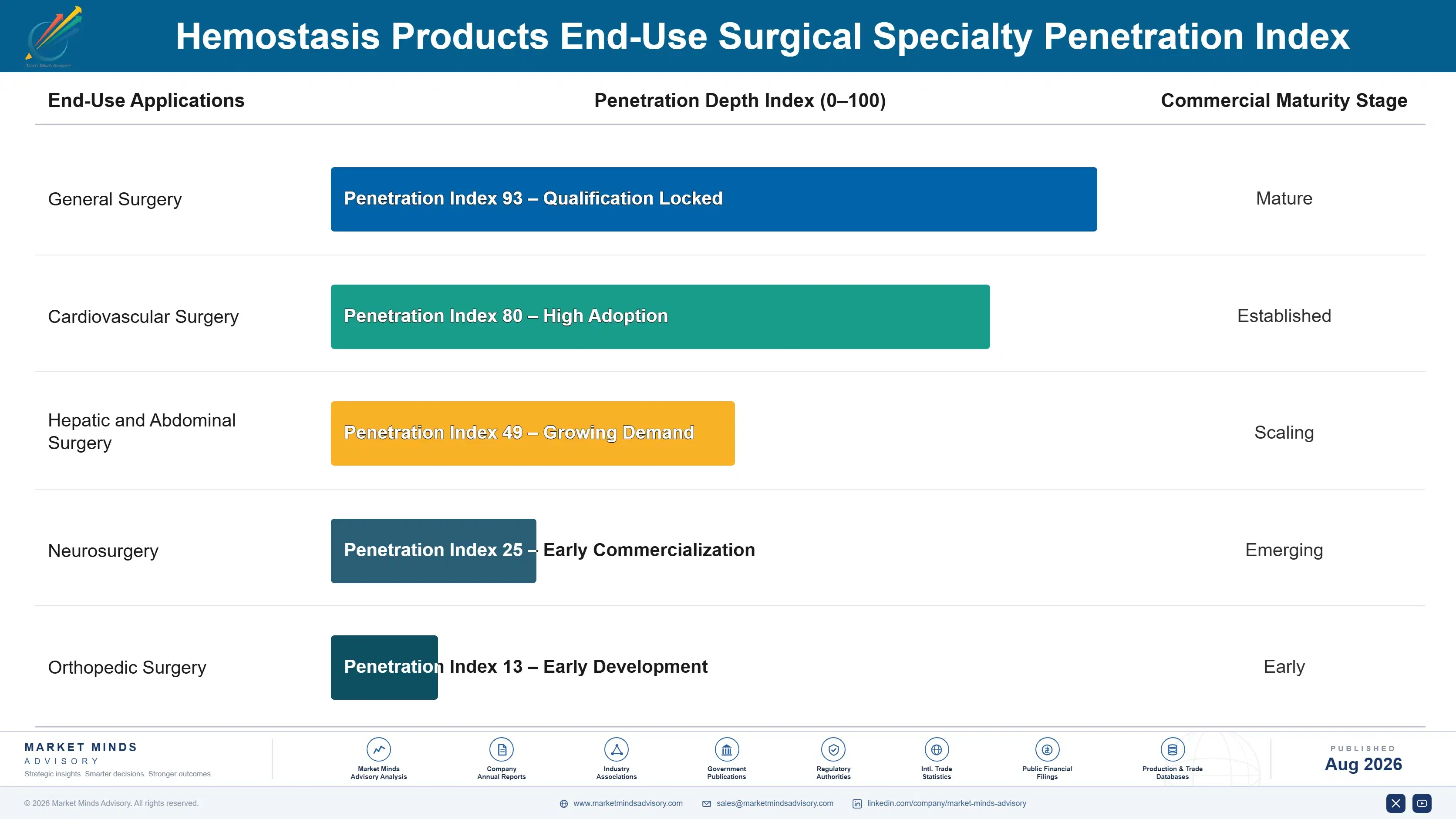
Adoption depth varies considerably by surgical specialty and procedure risk. Cardiovascular and hepatic surgery departments adopt premium flowable and synthetic sealants fastest, since bleeding control failure in these procedures carries meaningfully higher clinical and financial consequence than in routine general surgery. General and orthopedic surgery departments show far more price-sensitive adoption, defaulting to established lower-cost gelatin products unless a specific clinical champion advocates internally for premium alternatives.

A generational shift is underway in surgeon product preference. Surgeons trained after 2015 show meaningfully more comfort specifying synthetic sealants than predecessors trained purely on traditional biologic hemostat technique, a shift that should widen synthetic adoption further as this cohort gains seniority within surgical departments over the next decade of continued clinical evidence accumulation, hospital formulary expansion, and medical school curriculum change.
hemostasis-products-market-end-use-penetration-index-1787332452521

Positioning for the Synthetic Sealant Transition

These are among the four positions where our research anticipates prominent divergence between winners and laggards over the coming forecast period. Each is grounded in the demand model, the regulatory perimeter, and the announced capacity pipeline.
01 / SYNTHETIC FORMULARY EXPANSION RACE

Win cardiovascular formulary approval before biologic incumbents respond

Synthetic sealant developers racing to expand cardiovascular and hepatic surgery formulary approval face a genuine timing risk if established biologic incumbents respond with their own competing synthetic product lines before smaller challengers build comparable hospital contracting scale and clinical credibility. Baxter's own CoSeal investment reflects a bet that owning both biologic and synthetic portfolios protects against exactly this competitive dynamic across every applicable surgical specialty. Companies that under-invest in formulary expansion now risk ceding the sourcing-sensitive hospital segment to faster-moving competitors permanently, with little realistic path back.
02 / FULL-PORTFOLIO DEFENCE STRATEGY

Protect biologic hospital contracts while building synthetic capability

Established biologic manufacturers holding broad hospital standardisation agreements face a different strategic challenge than synthetic specialists: defending existing gelatin and collagen matrix contracts while simultaneously investing in synthetic sealant capability that could eventually cannibalise their own core franchise across major surgical specialties. Baxter illustrates this tension directly, balancing continued legacy product investment against meaningful synthetic spending across several concurrent development programmes underway today. Companies that neglect either side of this balance risk losing ground to focused single-strategy competitors over time.
03 / OUTCOMES-BASED CONTRACTING SEQUENCING

Build bundled pricing capability ahead of broader reimbursement pressure

Manufacturers who build outcomes-based bundled pricing capability ahead of broader hospital reimbursement pressure capture premium contract value from academic medical centres with sophisticated cost-tracking capability before competitors respond with comparable offerings of their own design. Baxter's early outcomes-based contracting pilots illustrate the value of this sequencing, and comparable opportunities are opening across other large hospital systems facing similar budget pressure in the coming years ahead. Manufacturers without this capability increasingly lose premium contracts to better-prepared, faster-moving competitors already well positioned.
04 / INPUT COST RESILIENCE PLANNING

Secure plasma fractionation capacity ahead of the next demand surge

Plasma fractionation capacity tightness during periods of surging biopharmaceutical demand has previously delayed fibrin sealant manufacturing schedules for developers relying entirely on spot-market procurement rather than committed long-term capacity agreements with suppliers. Developers still buying capacity without multi-year commitments remain exposed to the same risk as multiple concurrent biopharmaceutical programmes compete for limited specialised fractionation capacity industry-wide each year. Long-term agreements have already proven their value for developers who adopted them ahead of recent tightness cycles industry-wide and across every affected manufacturing region.

Engagement Snapshot From the Field

A live engagement with an industry participant carrying material or product regulatory and market exposure ahead of a defining policy shift, showing how our research translates into a defensible multi-year portfolio strategy.
MARKET MINDS ADVISORY · CLIENT ENGAGEMENT SUMMARY
Hemostasis Products Producer Strategic Portfolio Review and Transition Roadmap 2026·Investment Scenario on Hemostasis Products Exposure Evaluation 2025-26
CLIENT PROFILE
The client is a regional hospital system operating eight surgical facilities, with annual applicable surgical procedure volume reported in the 35,000 to 50,000 case range (client-reported, unverified by MMA), evaluating whether to standardise its hemostat formulary around a single manufacturer's full product portfolio rather than continuing multi-vendor purchasing across its network of affiliated surgical facilities and specialist departments.
STRATEGIC CHALLENGE
The hospital system's surgical leadership was divided between standardising immediately to capture contracting savings or maintaining multi-vendor flexibility given concerns about losing access to specific synthetic sealant products individual surgeons had specifically requested for higher-risk cardiovascular cases already scheduled across multiple facilities in the coming quarter of continued clinical operations.
MMA APPROACH
MMA benchmarked comparable hospital system formulary standardisation decisions made over the prior two years, analysing contracting savings, surgeon satisfaction, and clinical outcomes across both standardised and multi-vendor purchasing approaches. The team conducted primary interviews with surgical department chairs and procurement directors at three comparable regional hospital systems that had already completed similar formulary decisions.
KEY FINDINGS
  1. Two of three benchmarked hospital systems that standardised captured contracting savings exceeding fifteen percent versus their prior multi-vendor purchasing arrangements within the first year.
  2. Surgeon satisfaction concerns proved manageable when standardisation agreements included a documented exception pathway for specific high-risk case requests submitted well in advance of scheduling.
  3. Clinical outcomes showed no measurable difference between standardised and multi-vendor systems across the benchmarked comparable hospital systems reviewed closely by the team.
  4. Systems offering surgeon education alongside standardisation reported meaningfully fewer formulary exception requests than systems without structured, ongoing education efforts already firmly in place.
CLIENT PROFILE
The client is a regional hospital system operating eight surgical facilities, with annual applicable surgical procedure volume reported in the 35,000 to 50,000 case range (client-reported, unverified by MMA), evaluating whether to standardise its hemostat formulary around a single manufacturer's full product portfolio rather than continuing multi-vendor purchasing across its network of affiliated surgical facilities and specialist departments.
STRATEGIC CHALLENGE
The hospital system's surgical leadership was divided between standardising immediately to capture contracting savings or maintaining multi-vendor flexibility given concerns about losing access to specific synthetic sealant products individual surgeons had specifically requested for higher-risk cardiovascular cases already scheduled across multiple facilities in the coming quarter of continued clinical operations.
MMA APPROACH
MMA benchmarked comparable hospital system formulary standardisation decisions made over the prior two years, analysing contracting savings, surgeon satisfaction, and clinical outcomes across both standardised and multi-vendor purchasing approaches. The team conducted primary interviews with surgical department chairs and procurement directors at three comparable regional hospital systems that had already completed similar formulary decisions.
KEY FINDINGS
  1. Two of three benchmarked hospital systems that standardised captured contracting savings exceeding fifteen percent versus their prior multi-vendor purchasing arrangements within the first year.
  2. Surgeon satisfaction concerns proved manageable when standardisation agreements included a documented exception pathway for specific high-risk case requests submitted well in advance of scheduling.
  3. Clinical outcomes showed no measurable difference between standardised and multi-vendor systems across the benchmarked comparable hospital systems reviewed closely by the team.
  4. Systems offering surgeon education alongside standardisation reported meaningfully fewer formulary exception requests than systems without structured, ongoing education efforts already firmly in place.
RECOMMENDED STRATEGY
Phase 1: Phase 1 (Months 1 to 4): Negotiate a full-portfolio standardisation agreement including a documented clinical exception pathway for all surgeons. Phase 2: Phase 2 (Months 5 to 9): Launch surgeon education sessions across all eight facilities to build lasting support for the new formulary. Phase 3: Phase 3 (Months 10 to 18): Monitor exception request volume closely and refine the formulary based on documented clinical need.
OUTCOME
The hospital system implemented standardisation across all eight facilities, achieving contracting savings of an estimated 17 percent in the first year (client-reported, unverified by MMA). Exception requests remained well within the range benchmarked comparable systems reported, and surgeon satisfaction scores held steady versus the prior multi-vendor arrangement.

Frequently Asked Questions

Foundational context covering the market sizes, CAGR, scope, country, region and competition that inform every finding below. This section is provided to cover basics and most often pre-purchase conversations, answered from the MMA Primary Research Dataset.

What is the current size of the Hemostasis Products Market?

The global market reached an estimated 5.4 billion dollars in 2025, anchored by established biologic hemostat products. Growth is concentrated in synthetic sealants and combination products.

How large will the Hemostasis Products Market be by 2036?

MMA projects the market will reach approximately 11.84 billion dollars by 2036 under the base-case forecast scenario. This reflects rising minimally invasive procedure volume and synthetic sealant adoption.

What is the CAGR for the Hemostasis Products Market 2026 to 2036?

The base-case compound annual growth rate is 7.4 percent across the full ten-year forecast period. Bull and bear scenarios range from 6.2 to 8.6 percent.

Which segment is growing fastest?

Synthetic polyethylene glycol sealants lead at a 12.8 percent CAGR, roughly 1.73 times the overall market rate. Fibrin sealant products follow as the second-fastest segment.

Who are the major companies in the Hemostasis Products Market?

Baxter International, CSL Behring, Johnson & Johnson, Becton Dickinson, and Integra LifeSciences hold the top five positions by revenue. Full-portfolio hospital contracting increasingly separates category leaders.

Which country is growing fastest?

China leads at an estimated 10.4 percent CAGR, driven by expanding hospital infrastructure and rising surgical procedure volume. Growing domestic manufacturing capability supports continued adoption.

Report Segmentation Architecture

The full report scope spans multiple orthogonal segmentation dimensions, with cross-tabulated demand data provided for each dimension pair. Coverage extends further to regional breakdowns, trend trajectories, and the competitive detail needed to support segment-level decision-making.

By Hemostat Product Technology

  • Topical Thrombin Agents
  • Gelatin Matrix Products
  • Collagen Matrix Products
  • Fibrin Sealants
  • Synthetic Polymer Sealants
  • Combination Sealant-Mesh Products

By End-Use Surgical Specialty

  • General Surgery
  • Cardiovascular Surgery
  • Hepatic and Abdominal Surgery
  • Neurosurgery
  • Orthopedic Surgery

By Commercial Dimension

  • Hospital Standardisation Contracts
  • Single-Product Purchasing
  • Ambulatory Surgical Centre Sales
  • Outcomes-Based Bundled Contracts

By Region

  • North America
  • Western Europe
  • East Asia
  • South Asia and Pacific
  • Latin America
  • Middle East and Africa
  • Eastern Europe

Scope, Methodology, and Coverage

Every figure in this report is reproducible from documented input assumptions. The scope below maps the historical period, the forecast horizon, the segmentation dimensions, and the countries covered, alongside the underlying primary and qualitative methodology.
Historical Period
2020 to 2025
Forecast Period
2026 to 2036
Base Year
2025 (USD billions; MMA Primary Research Dataset, August 2026)
Market Definition
This market covers surgical hemostatic products used to control bleeding during procedures, including topical thrombin agents, gelatin and collagen matrices, flowable and fibrin sealants, and synthetic polymer sealants. It excludes mechanical hemostasis devices such as clips, clamps, and electrocautery equipment, and non-surgical wound care dressings used outside the operating room.
Quantitative Units
USD billions (current prices); applicable surgical procedure volume where relevant
Segmentation Dimensions
By Hemostat Product Technology; By End-Use Surgical Specialty; By Commercial Dimension; By Region
Regions Covered
North America, Western Europe, East Asia, South Asia and Pacific, Latin America, Middle East and Africa, Eastern Europe
Countries Covered
USA, China, Germany, France, UK, Japan, South Korea, India, Australia, Canada, Brazil, Mexico, Indonesia, Vietnam, Thailand, Malaysia, UAE, Saudi Arabia, South Africa, Nigeria, Turkey, Poland, Netherlands, Italy, Spain, Sweden, Switzerland, Argentina, Colombia, Singapore, and additional markets relevant to this sector
Key Companies Profiled
Baxter International Inc, CSL Behring, Johnson & Johnson, Becton Dickinson, Integra LifeSciences, Gatt Technologies, Pfizer Inc, B. Braun Melsungen AG, Teleflex Incorporated, Stryker Corporation, Medtronic plc, Z-Medica LLC, Hemostasis LLC, CryoLife Inc, Cohera Medical Inc, Advanced Medical Solutions Group, Vascular Solutions LLC, Marine Polymer Technologies, Starch Medical Inc, Sealantis Ltd
Quantitative Methodology
Primary survey, n=3,800 respondents, Q4 2025, six countries; demand-side model with trade association cross-validation
Qualitative Methodology
47 expert interviews, Q4 2025; applied to validate demand model assumptions, identify emerging dynamics, and assess competitive positioning
Report Format
PDF and XLSX data workbook (Word format preview document)
Publisher
Market Minds Advisory
Report Code
MMA-2026-MED-441
Published
August 2026
Contact
sales@marketmindsadvisory.com | www.marketmindsadvisory.com

Purchase the full Hemostasis Products Market Report (2026 to 2036).

The full report delivers a company-by-company product pipeline tracker covering every major synthetic and biologic hemostat developer through 2030 with disclosed formulary expansion timelines and anticipated regulatory milestones. It includes a hospital standardisation contract database mapping full-portfolio and single-product purchasing agreements across every profiled manufacturer and region. Surgeon adoption survey data is provided from MMA's primary research programme, alongside procedure-volume benchmarking across major surgical specialties worldwide and their affiliated hospital networks. Buyers also receive a company-level financial and product-milestone model updated quarterly throughout the subscription period each year.
Company-by-company product pipeline and formulary tracker
Hospital standardisation contract database and access
Surgeon adoption survey data and benchmark reports
Quarterly competitor financial and milestone model updates
Procedure-volume benchmark data set by specialty
Custom formulary strategy and contracting workshops

Built For The People Who Decide

From boardroom strategy to bench-side execution, this report is read cover-to-cover by leaders shaping the next decade of their industry, turning demand scenarios, market dynamics and valuation benchmarks into decisions.
CXOs/ Presidents/ VPs/ Managers
M&A and Corporate Development
Strategy Teams and R&D Heads
Procurement and Product Directors
Regulatory and Compliance Leaders
Investor Relations and Equity Analysts