
Market Minds Advisory
Helicobacter Pylori Non-Invasive Testing Market

Helicobacter Pylori Non-Invasive Testing Market: Resistance Made The Cheap Test Insufficient

A commercial reading of non-invasive gastric infection testing, where a two-dollar antibody test still dominates volume while rising antibiotic resistance quietly makes knowing the strain matter more than knowing the infection.

Lead Analyst

Alice Ballenger

Published

September 2026

Make Smarter Decisions with Customized Research Insights

Request a free sample report and evaluate market opportunities, growth trends, and competitive dynamics relevant to your business needs.

2025 MARKET VALUE$0.7BMarket Size 2025
2036 FORECAST VALUE$1.4BBase Case , 2026 to 2036
CAGR 2026 TO 20366.1 %Bull 7.3% / Bear 4.9%
INCREMENTAL OPPORTUNITY$0.6BNet 10- year value creation
EXPANSION MULTIPLE1.71x2036 value over 2026 base
Strategic Levers
M&A Pipeline
Regional Outlook
Country Rankings
Competitive Intelligence
Segmental Deep-dive
Call-Us : 91 93563 13602

Executive Snapshot and Market Trajectory

A serology test costs about two dollars and tells you somebody has met this organism at some point. Clarithromycin resistance now exceeds the threshold where empirical treatment is recommended across much of the world, which means the cheap answer is increasingly the wrong question to have asked.
The market stands at USD 0.74 billion in 2025 and reaches USD 1.35 billion by 2036 at a 6.1% CAGR. Molecular stool testing with resistance detection grows fastest at 14.8%, about 2.43 times the overall rate, because it identifies the organism and its antibiotic susceptibility from one sample without endoscopy. East Asia holds 30% of value on gastric cancer screening programmes, while India posts the quickest national growth at 10.4%.
Fragmentation is moderate, with the top five holding roughly 38% of non-invasive testing revenue across diagnostics majors, urea breath test specialists, and a long tail of rapid test manufacturers. Two forces pull against each other. Gastric cancer screening and eradication guidelines keep expanding tested volume, while reimbursement that pays a few dollars per test makes it genuinely hard to fund the molecular methods clinicians increasingly want. Reimbursement has not yet moved with the science.
Market Definition
The Helicobacter pylori non-invasive testing market covers diagnostic tests for gastric Helicobacter pylori infection performed without endoscopy, spanning urea breath tests, stool antigen tests, serology and antibody tests, molecular stool testing with antibiotic resistance detection, and rapid point-of-care formats. Endoscopic biopsy, histology, rapid urease testing on biopsy material, bacterial culture and susceptibility testing from biopsy, eradication therapy medicines, gastroscopy equipment and services, and gastric cancer imaging are excluded.
Base Year Value
$0.7B in 2025 (MMA Primary Research Dataset, August 2026)
Forecast Period
2026 to 2036, eleven discrete annual values
CAGR
6.1% base case. Bull 7.3%. Bear 4.9%.
Fastest Growth Segment
Molecular Stool Testing with Resistance Detection: 14.8% CAGR
Fastest Growth Country
India: 10.4% CAGR
Fastest Growth Region
South Asia and Pacific: 8.2% CAGR
Largest Region
East Asia: 30% of 2025 global value
Market Leaders
Meridian Bioscience, Otsuka Pharmaceutical, Abbott, bioMerieux, Halyard Health. Source: MMA Analysis based on company annual reports.
Primary Survey
n=3,800 procurement and R&D decision-makers, Q4 2025, six countries
Methodology
Demand-side build-up, cross-validated against public data, 47 expert interviews

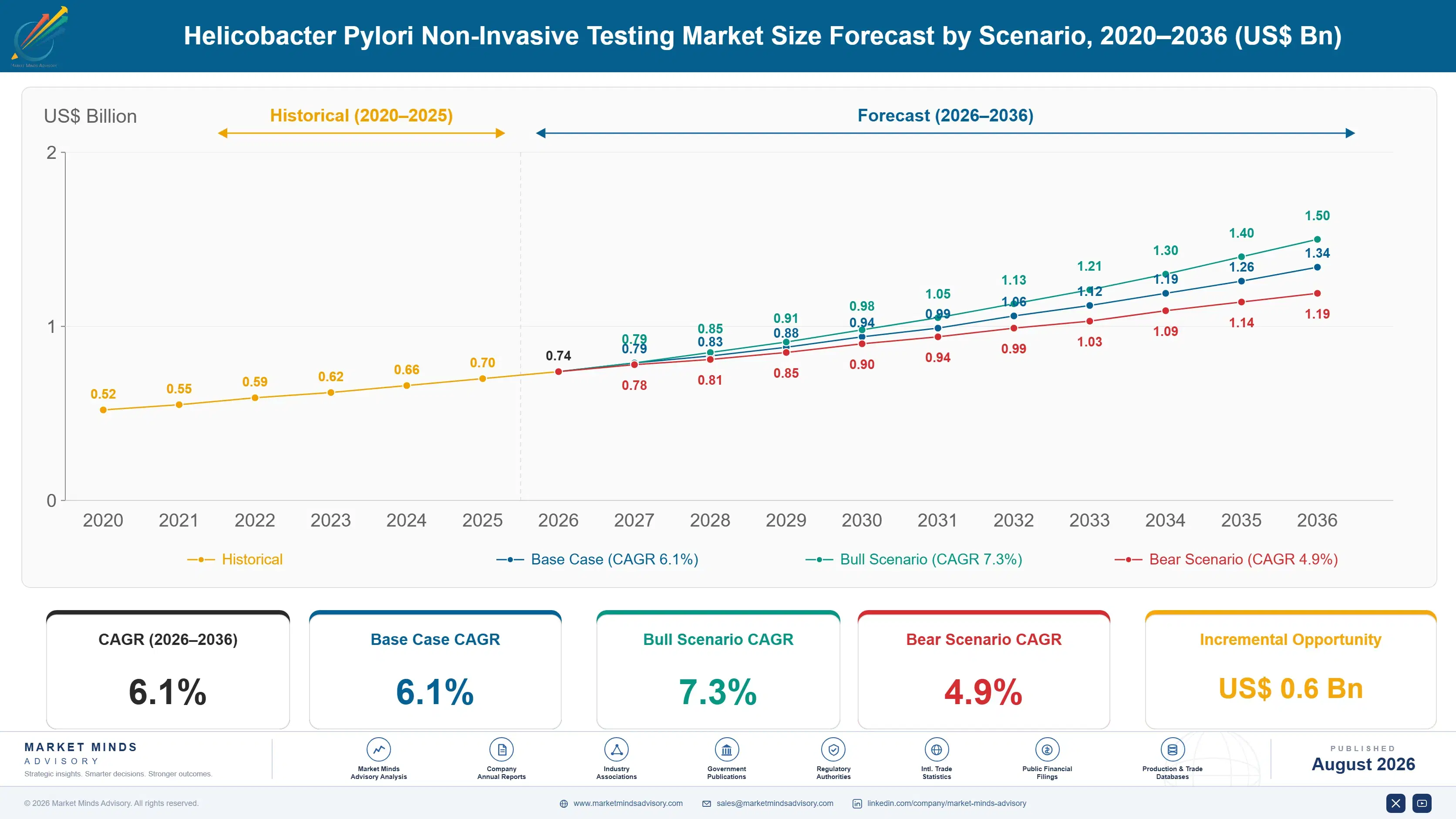
Helicobacter Pylori Non-Invasive Testing Market Forecast Scenarios

helicobacter-pylori-non-invasive-testing-market-size-forecast-scenario-1787332562350
Growth from 2020 to 2025 compounded near 5.0%, and deferred endoscopy rather than any diagnostic change drove most of it. Gastroscopy capacity collapsed through 2020 and 2021, which pushed clinicians toward non-invasive testing for cases that would previously have gone straight to biopsy. Some of that shift persisted because it was cheaper and faster. Resistance data meanwhile accumulated quietly until guidelines began recommending susceptibility-guided therapy.
Three mechanisms carry the base case to 6.1%. First, gastric cancer screening programmes, where East Asian countries test and eradicate at population scale and other health systems are examining the evidence. Second, antibiotic resistance, which is turning a yes or no infection question into a which-therapy question that only molecular methods answer. Third, test-and-treat guidelines in primary care, which move diagnosis away from specialist gastroenterology into general practice where non-invasive testing is the only option.
The bull case at 7.3% assumes molecular resistance testing reaches reimbursement parity and screening programmes extend beyond East Asia. The bear case at 4.9% assumes payers keep reimbursing at serology prices, empirical quadruple therapy remains the default despite resistance, and eradication success gradually shrinks the prevalent population that needs testing at all in the markets where programmes have run longest.

Cheap Test, Wrong Question, Rising Resistance

Demand rests on three foundations. Prevalence provides the base, since roughly 43% of the world population carries the organism and testing follows presentation and screening policy rather than incidence. Guidelines provide the direction, because test-and-treat recommendations in primary care move diagnosis out of endoscopy suites entirely. And resistance provides the value shift, since clarithromycin resistance above 15% means presence alone no longer determines the therapy.
MARKET CONCENTRATIONCR5: 38%Moderately fragmented across breath, stool, and rapid formats
CLARITHROMYCIN RESISTANCEAbove 15 percentThreshold beyond which empirical therapy is no longer recommended
TEST PRICE RANGEUSD 2 to 60Reimbursed price from serology through to molecular methods
GLOBAL PREVALENCEAbout 43 percentShare of the world population carrying the organism
BREATH TEST TURNAROUND20 to 40 minutesTime from sample collection to a reportable result
ERADICATION FAILURE RATEAbout 22 percentFirst-line therapy courses that do not clear infection
Commercially the striking feature is the price range inside one clinical question. A serology test reimburses at about two dollars and a molecular stool test at up to sixty, for a diagnosis that in one case is barely actionable and in the other determines the antibiotic. Payers have been slow to reflect that, which leaves the better test funded near the price of the worse one.
The next decade turns on whether resistance changes reimbursement. Eradication failure runs near 22% on first-line therapy, and each failure means a second course, a second consultation, and frequently a referral. Molecular testing at 14.8% growth addresses that directly and costs more upfront than payers currently allow. Screening programmes in East Asia meanwhile demonstrate what population testing does to gastric cancer incidence over time.
"The economics here are perverse and everybody knows it. A two-dollar test that sends a patient to a therapy that fails one time in five costs the health system far more than a sixty-dollar test that picks the right antibiotic, and almost no payer has done that arithmetic yet."
Director, Infectious Disease Diagnostics and Screening Practice · MMA Medical De

Market Trends

Resistance Turns Detection Into A Susceptibility Question

Clarithromycin resistance now exceeds 15% across much of the world, which is the threshold at which guidelines stop recommending empirical triple therapy and start asking clinicians to know what they are treating. A test confirming the organism is present no longer answers the clinical question on its own. Molecular stool methods detect the organism and its resistance markers from one sample without endoscopy, which is why that segment grows at 14.8% against a market at 6.1%. Payers have not yet reflected the difference in reimbursement. Nobody has revisited the fee schedule since.
Market Impact: Prevalence reaches 43 percent globa
Test And Treat Moves Diagnosis Into Primary Care

Guidelines in most developed health systems now recommend testing and treating uninvestigated dyspepsia in primary care rather than referring for endoscopy first, which relocates the diagnosis away from gastroenterology entirely. A general practice cannot perform a biopsy, so non-invasive testing becomes the only available route rather than the preferred one. Stool antigen and urea breath tests fit that setting, while molecular methods currently do not because turnaround and cost both sit wrong. Volume follows referral policy rather than disease incidence. Referral policy rather than disease incidence is what drives this volume.
Market Impact: About 22% of courses fail

Market Opportunities and Growth Drivers

Gastric Cancer Screening Creates Population Scale Testing

Japan and Korea test and eradicate at population scale because Helicobacter pylori is the dominant modifiable risk factor for gastric cancer, and the incidence data supporting those programmes has become difficult for other health systems to ignore. Screening converts testing from a symptomatic response into a scheduled activity across whole birth cohorts, which is a completely different volume proposition. China has begun examining the same evidence at a scale that would dwarf every other market. Programme policy rather than clinical demand decides this entirely. Nothing clinical decides any of this at all.
Market Impact: Tariffs range USD 2 to 60

Eradication Failure Drives Repeat Testing Volume

Roughly 22% of first-line eradication courses fail, and guidelines require confirmation of cure after treatment, which means each failure generates a further test, a further consultation, and frequently a second failed course before anybody considers susceptibility. That repeat cycle is genuine testing volume created entirely by therapy performance rather than by new infection. Urea breath testing is the recommended confirmation method in most guidelines because serology stays positive long after eradication. Better first-line selection would reduce this volume, which is an uncomfortable commercial fact. Nobody in the industry says that out loud.
Market Impact: Serology costs about 2 dollars

Market Restraints and Challenges

Reimbursement Prices Every Test Like The Cheapest One

Serology reimburses at roughly two dollars and molecular stool testing with resistance detection at up to sixty, and many payers apply a single tariff that sits far closer to the former. The root cause is that fee schedules were written when the clinical question was binary and have not been revisited as resistance made it conditional. Commercially this starves the better method of the volume it needs. Manufacturers mitigate through health economic evidence on avoided failed therapy, guideline engagement, and targeting systems where resistance rates make the argument obvious. Fee schedules predate the resistance problem entirely.
Market Impact: Resistance exceeds 15 percent widel

Serology Persists Despite Being Clinically Inadequate

Antibody testing cannot distinguish current from past infection and stays positive for years after successful eradication, yet it remains widely used because it is cheap, fast, and requires no patient preparation. The root cause is that a test which is convenient and reimbursed tends to be ordered regardless of what guidelines say. Commercially this holds down the average selling price across the whole category. Participants mitigate through clinician education, guideline advocacy, laboratory formulary work, and bundling better methods into pathways where serology is explicitly excluded. Convenience beats guidance more often than anybody admits.
Market Impact: Guidelines cover 4 dyspepsia pathwa
4 additional market trends, 3 additional growth drivers, and 2 additional restraints and challenges are covered in the full report. Contact sales@marketmindsadvisory.com to access the complete intelligence.

Segment CAGR and Growth Architecture

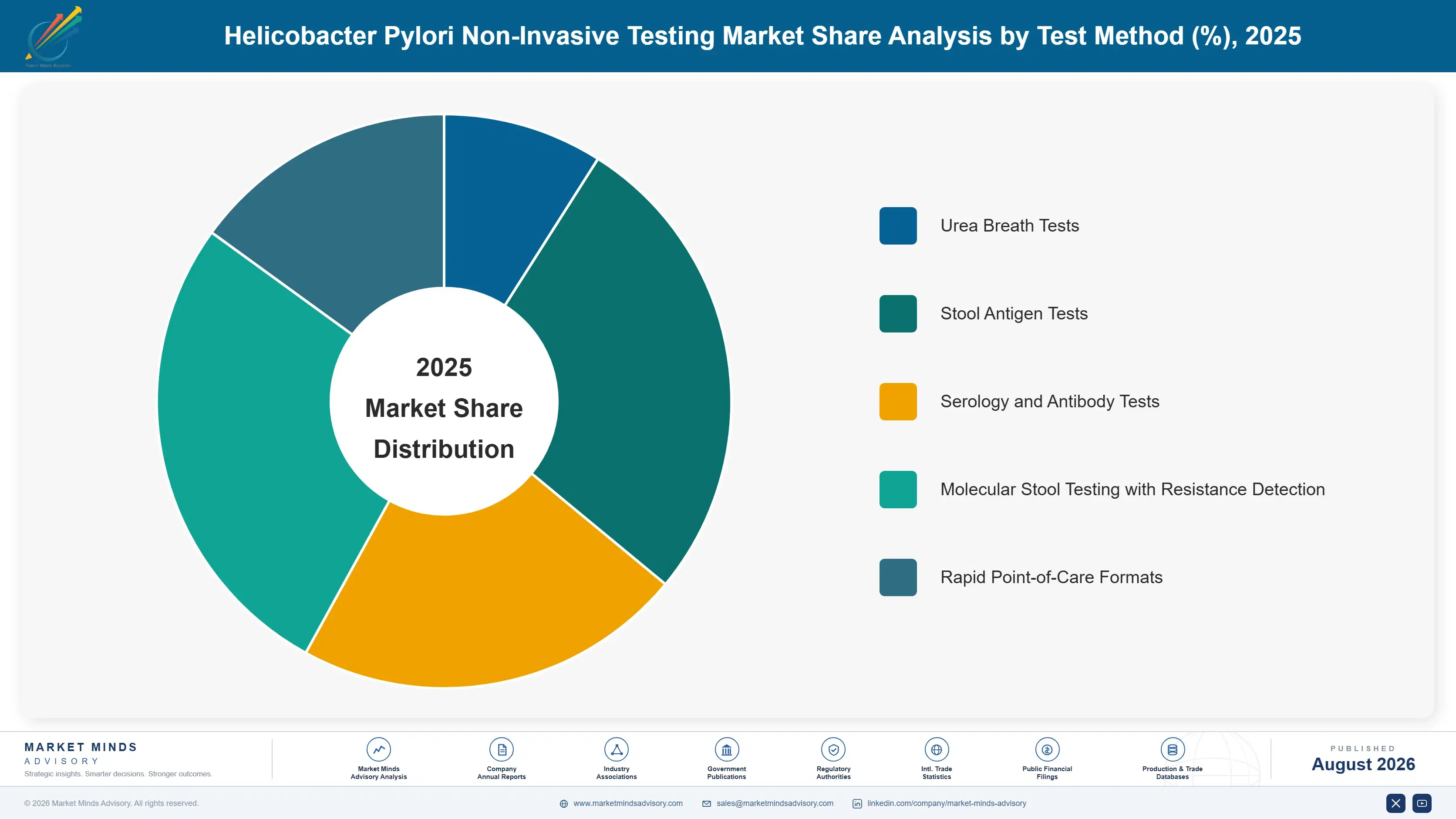
Segmentation follows test method, a single classification describing how the organism or its evidence is detected. Each method carries its own sample type, clinical accuracy, patient preparation, and reimbursement position, so commercial economics track the method rather than the setting ordering it. End-use setting and purchasing channel appear separately within the framework as their own distinct dimensions.
helicobacter-pylori-non-invasive-testing-market-market-share-analysis-1787332562887

Molecular Stool Testing with Resistance Detection

Molecular stool testing with resistance detection grows fastest at 14.8%, about 2.43 times the overall 6.1% rate, and antibiotic resistance rather than any accuracy advantage explains it. Amplifying bacterial nucleic acid from stool identifies the organism and its clarithromycin resistance markers together, which answers the question guidelines now ask instead of the one they used to. No endoscopy is required, which is the whole point. Reimbursement remains the binding constraint since tariffs written for serology do not fund a sixty-dollar method. Laboratories with existing molecular platforms can add the assay without new capital, which helps considerably. Guidelines have moved considerably further than reimbursement has, which is the whole commercial problem here.
CAGR 14.8%

Urea Breath Tests

Urea breath tests grow at 7.4%, the second-fastest method, and confirmation of cure rather than initial diagnosis drives most of that. Guidelines recommend breath testing after eradication therapy because serology stays positive for years and cannot confirm anything, and roughly 22% of first-line courses fail, so the confirmation volume is substantial. Accuracy is genuinely high and the method is well established across primary and secondary care. Patient preparation including fasting and stopping proton pump inhibitors is the practical friction, and turnaround of twenty to forty minutes suits a clinic visit reasonably well. Confirmation volume grows with therapy failure rather than with any new infection, which is a commercially uncomfortable fact.
CAGR 7.4%
Full segment breakdown across 5 segments available in the complete report.

Regional Architecture and Country Demand Map

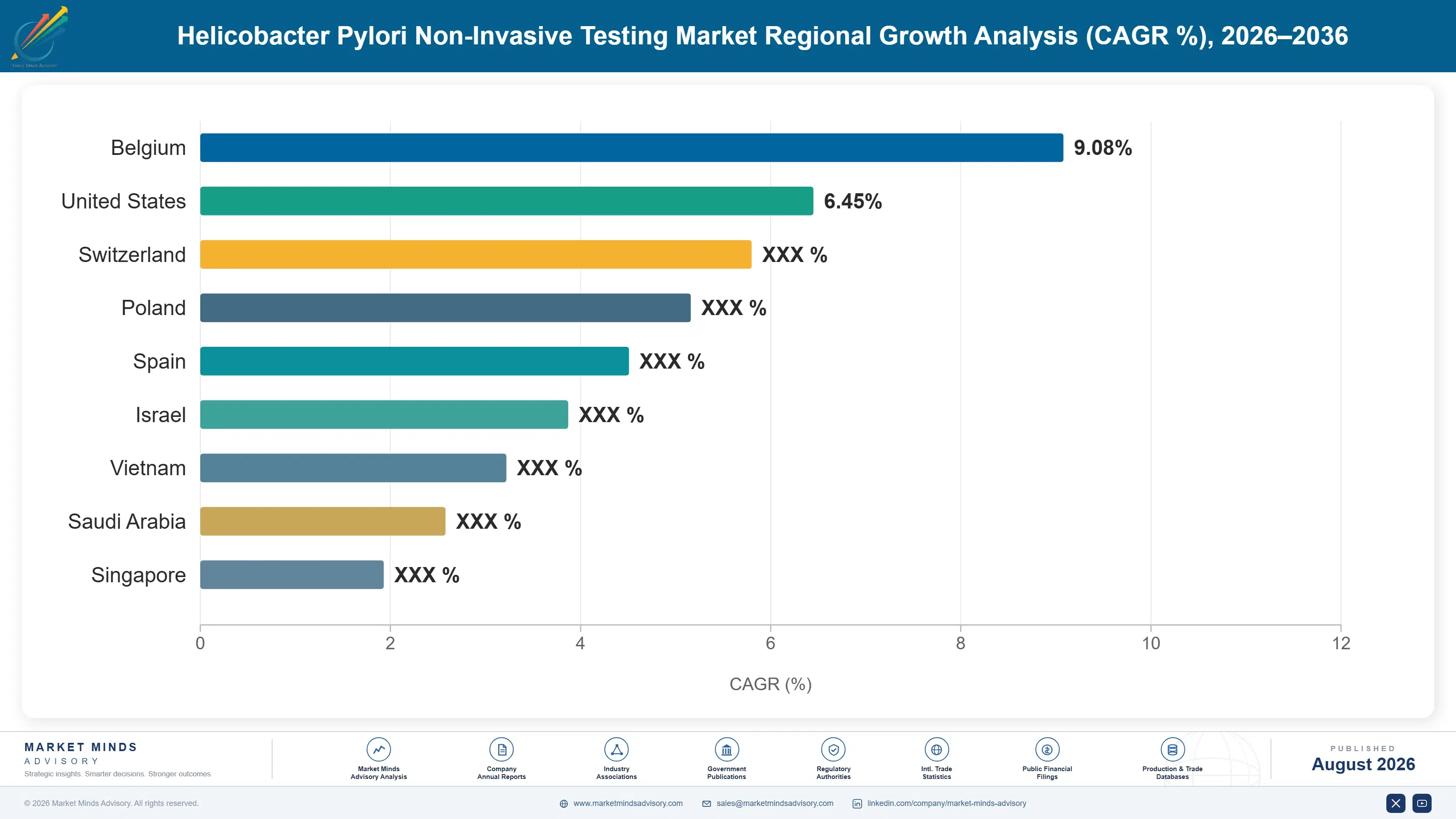
Screening policy and prevalence together set this distribution rather than population or income. East Asia leads on gastric cancer screening programmes that test whole birth cohorts, while South Asia and Pacific grows quickest as diagnostic access widens against very high prevalence. Policy decides volume more than symptoms do.

North America

North America holds 22% of value, and test-and-treat guidelines in primary care rather than screening explain most of it. Uninvestigated dyspepsia is managed with non-invasive testing before any referral, which moved substantial volume out of gastroenterology and into general practice over the past decade. Reimbursement per test is higher than most regions while still not distinguishing serology from molecular methods adequately. Clarithromycin resistance has risen past the guideline threshold in most surveyed areas. Growth of 5.5% reflects steady primary care volume against a prevalence base considerably lower than Asian equivalents. Payers here have the most headroom to fund better methods and so far have shown the least urgency about doing it.
Share: 22% | CAGR: 5.5% (2026 to 2036)

Western Europe

Guideline discipline rather than programme policy defines this market. Western Europe holds 20% of value, with European consensus recommendations on eradication and confirmation of cure followed closely enough that urea breath testing is genuinely standard practice after therapy. Resistance surveillance is better here than almost anywhere, which has made susceptibility-guided therapy a live clinical discussion rather than a theoretical one. Prevalence has fallen with improved sanitation across successive birth cohorts, which shrinks the tested population slowly. Growth of 4.5% is the slowest of the seven regions, reflecting declining prevalence against disciplined but static testing practice. Susceptibility-guided therapy is a live clinical discussion here rather than the theoretical one it remains elsewhere.
Share: 20% | CAGR: 4.5% (2026 to 2036)
Regional intelligence for 5 additional markets available in the complete report: East Asia, South Asia and Pacific, Latin America, Middle East and Africa, Eastern Europe. Contact sales@marketmindsadvisory.com.
helicobacter-pylori-non-invasive-testing-market-country-cagr-analysis-1787332563401

Where Testing Suppliers Actually Earn Return

A category where the cheapest method is clinically weakest and reimbursed almost identically is one where evidence rather than product decides outcomes. The four moves below reach that: resistance-linked health economics, guideline position, confirmation-of-cure volume, and screening programme participation where policy creates demand outright. None of the four is a price argument, and all take years.

Cost The Failed Therapy, Not The Test

Roughly 22% of first-line eradication courses fail, and each failure means a repeat test, a repeat consultation, a second antibiotic course, and frequently a referral, all of which costs a health system far more than the price difference between a two-dollar serology and a sixty-dollar molecular test. Payers have not done that arithmetic because nobody has presented it properly. Manufacturers who build and publish that economic case change a reimbursement conversation that product performance data alone has never moved. Assay performance data on its own has never once moved a tariff.
Market Impact: Roughly 22% of all first-line thera

Get The Method Named In Treatment Guidelines

Guidelines decide which method a clinician orders far more reliably than any sales call, and they already exclude serology from confirmation of cure because it stays positive for years after eradication. Getting a method named for susceptibility-guided therapy is worth more than any promotional programme, and it requires clinical evidence, surveillance data, and years of committee engagement. Resistance above 15% is the argument that opens that door. Manufacturers treating guideline bodies as a communications audience rather than an evidence one get nowhere. Committee engagement takes years and nothing substitutes for it.
Market Impact: Resistance above 15 percent changes

Own The Confirmation Of Cure Volume Deliberately

Guidelines require confirmation after eradication therapy and serology cannot provide it, which makes post-treatment testing a protected volume that grows with every failed course rather than with new infection. Urea breath testing holds that position in most guidelines and stool antigen competes for it. Roughly 22% failure rates mean this is substantial recurring volume attached to a clinical requirement rather than a clinician preference. Suppliers focused entirely on initial diagnosis are competing for the half of the market that serology contests hardest. That is a clinical requirement rather than a preference.
Market Impact: Failure rates near 22% drive all th

Participate Where Screening Policy Creates The Demand

Japanese and Korean screening programmes test and eradicate across whole birth cohorts, which is a volume proposition no symptomatic pathway matches, and Chinese examination of the same evidence would exceed every other market combined. Programme participation requires local approval, cost per test that population screening can sustain, and logistics for very high sample volumes. Those are different capabilities from selling into hospital laboratories. Suppliers organised only around clinical diagnostics rarely have any of them ready when a programme starts. One national programme decision can add 40 million tests to annual volume.
Market Impact: Prevalence near 43 percent sets the

Who Controls the Margin Pool

Fragmentation is moderate: the top five hold roughly 38% of non-invasive testing revenue, across diagnostics majors, urea breath test specialists, and a long tail of rapid serology manufacturers with variable clinical evidence. The gap between leaders and challengers is guideline position and clinical evidence rather than assay chemistry, which is well established. All participants here are assessed on one basis, revenue from non-invasive Helicobacter pylori diagnostic tests, excluding endoscopi
Competition runs along four lines. First, guideline position, since recommendations decide method selection more reliably than promotion. Second, resistance detection capability, which is where the clinical question has moved. Third, reimbursement engagement, because a better method funded at serology prices does not reach volume. Fourth, screening programme readiness, as population testing needs cost and logistics that clinical diagnostics rarely have.

Pressure is building from two directions. Rapid serology manufacturers with minimal evidence hold volume that guidelines advise against, which suppresses category pricing and clinical practice together. Meanwhile molecular methods answer the resistance question that empirical therapy no longer handles. Rankings should favour suppliers with resistance capability and published health economics over those defending serology volume on price and convenience alone.
helicobacter-pylori-non-invasive-testing-market-company-positioning-matrix-1787332563926

Competitive Moat and Risk Dimensions

MERIDIAN BIOSCIENCE

Moat: Stool antigen guideline position

Meridian holds established stool antigen positions with the clinical evidence and guideline recognition that decide method selection in practice rather than in promotion. Stool antigen suits both initial diagnosis and confirmation of cure, which covers more of the pathway than any single-purpose method reaches. Laboratory relationships built over decades carry a new assay faster than a new entrant manages.
MERIDIAN BIOSCIENCE

Risk: Serology pricing and molecular substitution

Category pricing is held down by rapid serology that guidelines advise against but clinicians continue ordering because it is cheap and convenient. Molecular stool methods answer the resistance question that antigen testing cannot, which threatens the segment as guidelines shift toward susceptibility-guided therapy. Reimbursement that treats all non-invasive methods similarly also caps what better evidence can realistically earn.
OTSUKA PHARMACEUTICAL

Moat: Breath testing and screening depth

Otsuka holds a long-established urea breath testing position with deep participation in Japanese eradication and screening practice, which is the largest organised programme of its kind anywhere. Breath testing is the guideline-recommended confirmation method in most systems, giving it protected volume attached to a clinical requirement. Programme logistics experience at population scale is a capability few competitors hold.
OTSUKA PHARMACEUTICAL

Risk: Preparation friction and single method

Urea breath testing requires fasting and withdrawal of proton pump inhibitors, which introduces patient preparation friction that stool methods avoid entirely and which causes real non-compliance. Concentration in one method means any guideline shift toward molecular susceptibility testing reaches the whole position. Japanese programme maturity also means the domestic prevalent population is shrinking as eradication succeeds across cohorts.

Players Tracked

Prominent Players

Meridian Bioscience
Otsuka Pharmaceutical
Abbott
bioMerieux
Halyard Health

Other Key Players

Quidel
DiaSorin
Bio-Rad Laboratories
Thermo Fisher Scientific
Certest Biotec
Biohit Oyj
Cerba Research
Beckman Coulter
Kibion
Exalenz Bioscience
Mobidiag
Seegene
Fujirebio
Sekisui Diagnostics
Wondfo Biotech

Recent Developments

FEBRUARY 2025

Guidelines extend susceptibility-guided therapy recommendations further

Gastroenterology consensus updates in several regions strengthened recommendations for susceptibility-guided eradication therapy where clarithromycin resistance exceeds local thresholds, moving beyond the empirical regimens that had been standard for decades. These were clinical guideline changes rather than commercial transactions, and they altered which diagnostic methods answer the question being asked.
Signal: A single guideline change moves method sel
AUGUST 2024

Molecular stool assays with resistance markers reach wider laboratory adoption

Assays detecting Helicobacter pylori and clarithromycin resistance markers directly from stool were adopted by additional laboratory networks, running on molecular platforms those laboratories already operated for other targets. These were assay adoptions rather than transactions, and they required no new capital because the instrument base already existed.
Signal: Running on already installed molecular pla
APRIL 2024

Population screening evidence prompts review outside East Asia

Long-run gastric cancer incidence data from Japanese and Korean eradication programmes prompted formal review of population screening approaches in several other health systems. These were policy reviews rather than programme commitments, and none has yet converted into organised screening at national scale outside East Asia.
Signal: Screening policy would change testing volu

Antibodies, Enzymes, Isotopes, Plastic Devices

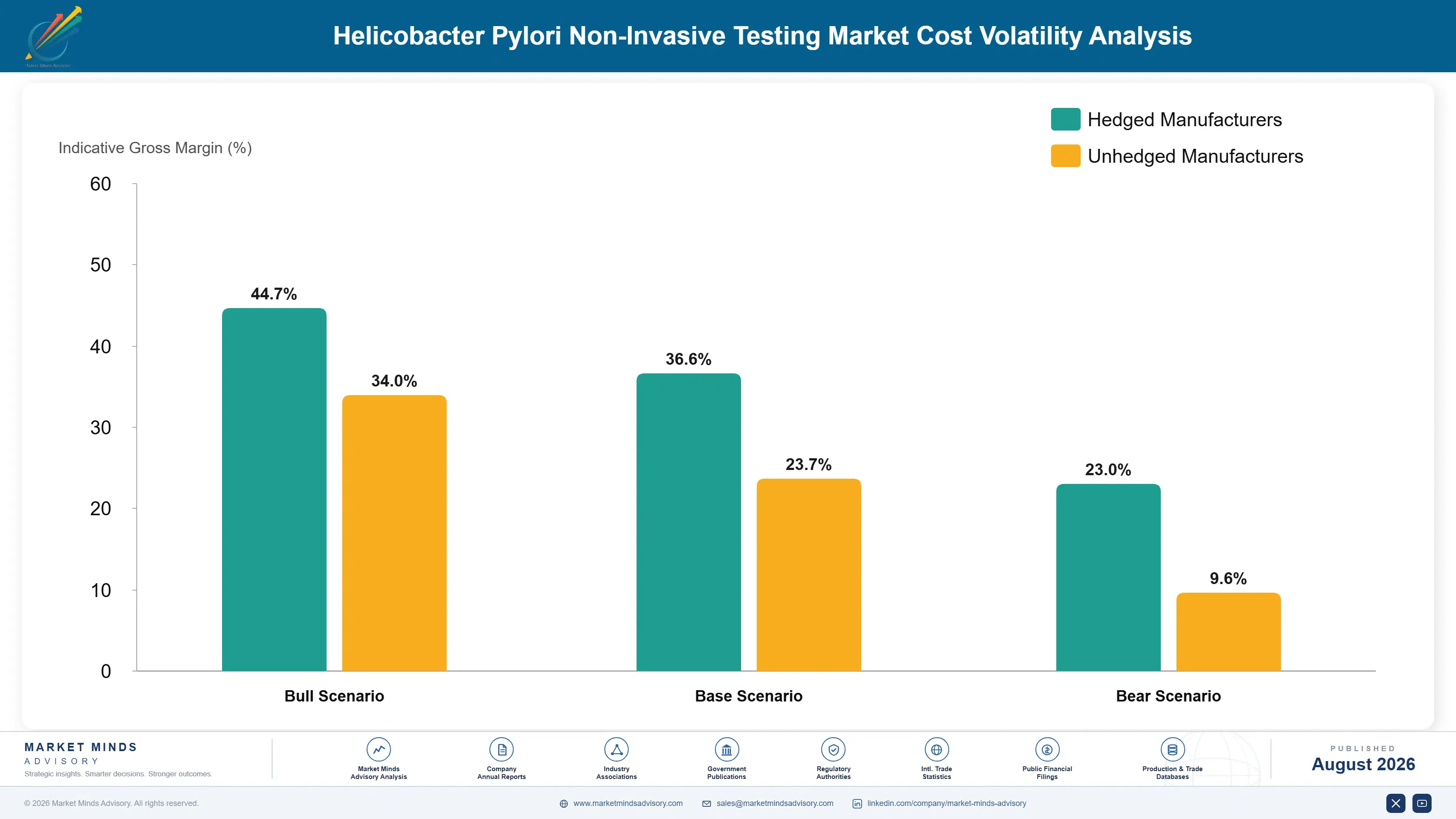
Cost structure differs sharply between the methods inside this category. Antibodies and enzymes run 28% to 38% of stool antigen and serology cost, from a narrow set of specialist suppliers. Carbon-13 labelled urea carries a different supply chain at 22% to 32% of that method's cost. Moulded devices and cassettes add 14% to 22%, and molecular reagents dominate resistance assay cost separately at 40% to 55%.
Specialist antibody and enzyme pricing rose through 2022 on energy and precursor costs while carbon-13 isotope supply stayed tight for separate reasons entirely, so both halves of the category faced input pressure at once. Meridian Bioscience and DiaSorin both disclosed input cost pressure across that reporting period. Reimbursement at two to sixty dollars per test left very little room to absorb any of it without touching margin directly.

Exposure separates by method rather than by scale. A serology manufacturer carries antibody supply risk on a product reimbursed at two dollars, where one supplier price move eliminates the margin. A breath test supplier carries isotope availability risk instead, which is a much narrower supply base with no substitute chemistry. Molecular assay suppliers carry reagent exposure on a product with enough reimbursement headroom to absorb it.
helicobacter-pylori-non-invasive-testing-market-cost-volatility-analysis-1787332564121

Qualify second antibody sources for every rapid format

Antibody supply for stool antigen and serology comes from few specialist producers, and qualification takes months with assay revalidation attached. On a product reimbursed at two dollars a single supplier price move removes the margin outright rather than compressing it. Qualifying an alternative costs testing time once and is the only protection available, since no pricing headroom exists.

Contract carbon-13 isotope supply on multi-year terms

Labelled urea for breath testing depends on a narrow isotope supply base with no substitute chemistry available at all, which makes availability rather than price the binding risk. Multi-year contracts cost commitment and occasionally leave volume unused in a soft year. They also mean production continues when competitors cannot obtain material, which decides who supplies at all.

Run resistance assays on installed molecular platforms

Laboratories already operate molecular instruments for respiratory and gastrointestinal panels, and an assay running on that installed base needs no capital approval from anybody. That removes the objection which usually delays adoption of a more expensive method by years. Designing for the platforms laboratories already hold matters considerably more than designing for the best available chemistry nobody has bought.

Portfolio Architecture for Margin Defence

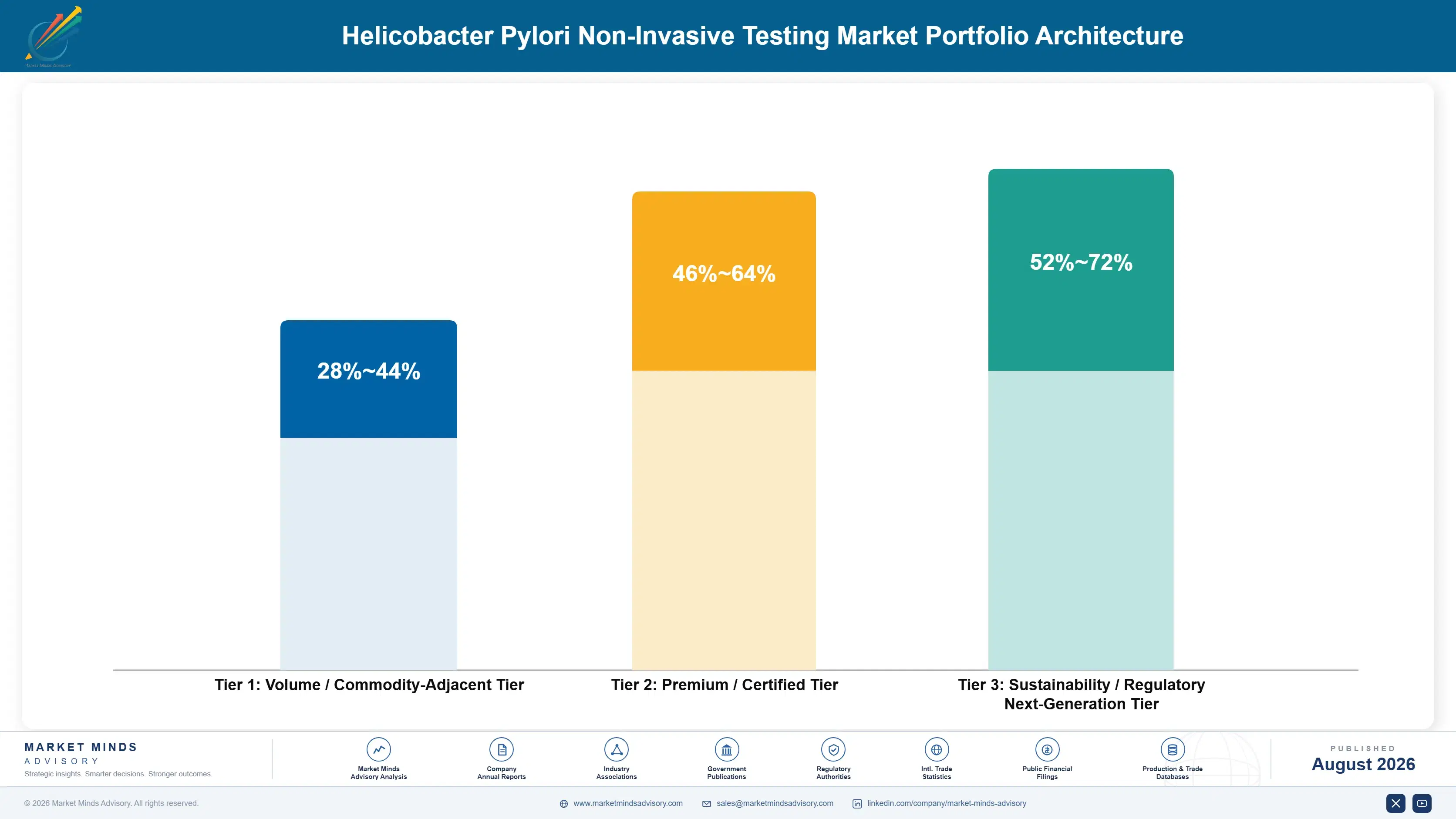
The portfolio splits into three tiers with different economics. Rapid serology forms the volume tier, where the test costs about two dollars, dozens of manufacturers meet the specification, and guidelines advise against it anyway. Stool antigen and urea breath testing earn more because clinical evidence and guideline position narrow the field considerably. Molecular resistance assays price against a question the cheaper methods cannot answer.
The tension runs between serology volume that fills capacity and better methods that answer the current question. Rapid serology holds laboratory listings, covers manufacturing overhead, and reaches settings where no other method is practical. Yet it competes on price against everybody and depresses what the category can charge. Suppliers handling this well accept thin serology margin while building the evidence and reimbursement case for methods clinicians increasingly need.

High-value pools concentrate where evidence or clinical necessity limits competition: molecular assays detecting resistance markers, urea breath testing named for confirmation of cure, stool antigen with guideline recognition across both diagnosis and confirmation, and any method qualified into a screening programme. All four escape the two-dollar comparison. Rapid serology sits at the other end, where the specification is trivial and price is the only variable.

Volume / Commodity-Adjacent Tier

Rapid serology and antibody cassettes sold on price into settings with limited laboratory access. The range is wide because antibody sourcing and manufacturing location separate producers considerably at identical reimbursed prices.
Gross Margin: 28-44%

Premium / Certified Tier

Stool antigen assays and urea breath testing carrying guideline recognition and published clinical accuracy. The range is wide because guideline position protects some products far better than others and isotope cost differs sharply between methods.
Gross Margin: 46-64%

Sustainability / Regulatory / Next-Generation Tier

Molecular stool assays with resistance detection and screening programme formats. The range is wide because reimbursement lags the clinical value while assays running on installed platforms carry very little incremental cost.
Gross Margin: 52-72%
helicobacter-pylori-non-invasive-testing-market-portfolio-architecture-1787332564621

High-value Sub-segments and Strategic Watch-out

Molecular Stool Testing with Resistance Detection

High value and high growth at 14.8%, the fastest method, because it answers the susceptibility question that empirical therapy no longer handles. Reimbursement written for serology is the binding constraint, and running on installed molecular platforms removes the capital objection entirely. Platform fit removes the capital objection.
Gross Margin: 52-72%

Urea Breath Tests

High value with strong growth at 7.4%, holding the guideline-recommended position for confirmation of cure that serology cannot fill. Patient preparation including fasting and stopping acid suppression is the practical friction that causes genuine non-compliance. Guidelines name it directly and serology simply cannot substitute at all.
Gross Margin: 48-64%

Stool Antigen Tests

The volume core by revenue, growing at 6.6% and covering both initial diagnosis and confirmation without patient preparation. Guideline recognition protects it reasonably, though molecular methods answer a question it cannot address at all. No patient preparation is needed at all, which matters more than it sounds.
Gross Margin: 44-60%

Serology and Antibody Tests

The strategic watch-out, growing at 2.8% while guidelines advise against it because a positive result cannot distinguish current from past infection. Convenience and a two-dollar price keep it ordered regardless of what any recommendation says. Convenience and a two-dollar price keep it being ordered regardless anyway.
Gross Margin: 28-44%

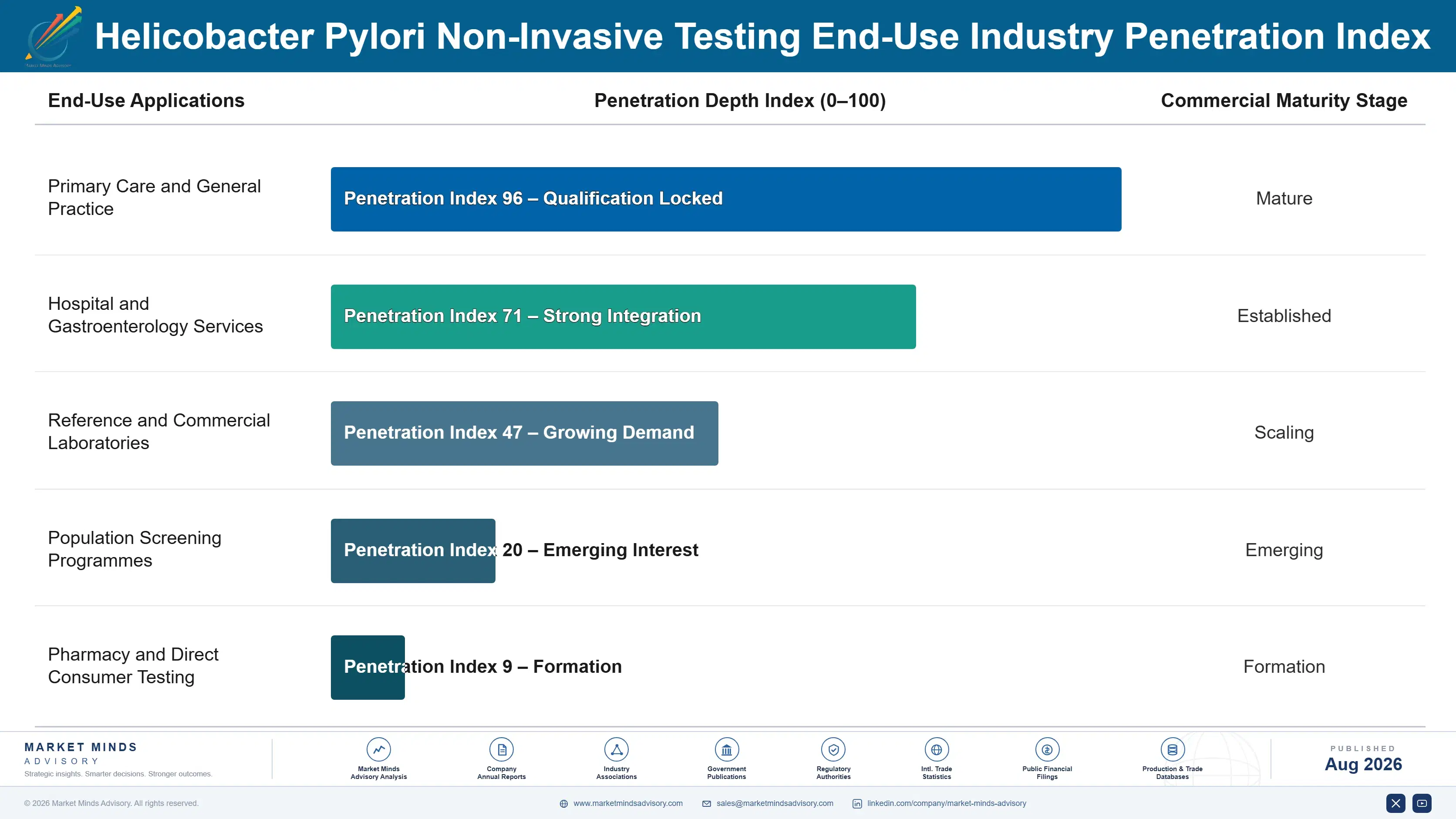
How Testing Method Choices Actually Hold

Demand commits at guideline adoption and laboratory formulary decision, then repeats as ordering behaviour for years. A method named in a consensus recommendation and stocked by the laboratory becomes the default a clinician orders without reconsidering, and changing that needs a guideline revision or a formulary review nobody initiates casually. That protects incumbent methods strongly. The genuine competitive moments are a guideline update, a laboratory platform change, and any screening progr
Stickiness varies by guideline specificity and platform fit. Urea breath testing sticks hardest for confirmation of cure, since guidelines name it and serology explicitly cannot substitute. Molecular assays stick through platform integration once a laboratory has validated them. Stool antigen sticks through breadth across the pathway. Rapid serology sticks least in principle and most in practice, because convenience and price keep it ordered where guidance has limited reach.

Buyer profiles have moved from laboratory managers selecting assays toward guideline committees, payer clinical policy teams, and increasingly public health programme designers. Resistance surveillance data now enters the conversation directly. That change rewards suppliers bringing clinical evidence, resistance capability, and health economic modelling, and penalises those still selling unit cost into a decision reimbursement policy and clinical guidance now dominate.
helicobacter-pylori-non-invasive-testing-market-end-use-penetration-index-1787332565112

Our Call On Pylori Testing

These are among the four positions where our research anticipates prominent divergence between winners and laggards over the coming forecast period. Each is grounded in the demand model, the regulatory perimeter, and the announced capacity pipeline.
01 / FAILED THERAPY ECONOMICS

Cost the second course, not the first test

Roughly 22% of first-line eradication courses fail, and every failure produces a repeat test, a repeat consultation, a second antibiotic course, and frequently a specialist referral, which together cost a health system far more than the gap between a two-dollar serology and a sixty-dollar molecular assay. Payers have never done that arithmetic because no manufacturer has presented it properly. Building and publishing that case moves a reimbursement conversation that assay performance data alone has never once managed to shift by itself.
02 / GUIDELINE POSITION PRIORITY

Recommendations decide orders, promotion does not

Clinicians order what guidelines name and laboratories stock, which is exactly why serology persists despite consensus recommendations advising against it and why urea breath testing holds confirmation of cure almost unchallenged. Getting a method named for susceptibility-guided therapy is worth more than any promotional programme could ever deliver, and it requires clinical evidence, resistance surveillance data, and several years of committee engagement. Manufacturers treating guideline bodies as a communications audience rather than an evidence one achieve nothing at all in practice.
03 / CONFIRMATION VOLUME OWNERSHIP

Post-treatment testing is protected recurring demand

Guidelines require confirmation of cure after eradication therapy and serology simply cannot provide it because antibodies persist for years, which makes post-treatment testing a protected volume attached to a clinical requirement rather than to a clinician preference at all. Failure rates near 22% mean that volume grows with therapy performance rather than with any new infection. Suppliers concentrating entirely on initial diagnosis end up competing for exactly the half of this market that cheap serology contests hardest and most effectively.
04 / SCREENING PROGRAMME READINESS

Policy decisions dwarf every clinical demand driver

Japanese and Korean programmes test and eradicate right across whole birth cohorts, and Chinese examination of the same gastric cancer evidence would create volume exceeding every other market in this category put together. Programme participation requires local regulatory approval, a cost per test that population screening can actually sustain, and logistics for very high sample throughput. Those are entirely different capabilities from selling into hospital laboratories, and suppliers organised only around clinical diagnostics have none of them ready when a programme actually starts.

Engagement Snapshot From the Field

A live engagement with an industry participant carrying material or product regulatory and market exposure ahead of a defining policy shift, showing how our research translates into a defensible multi-year portfolio strategy.
MARKET MINDS ADVISORY · CLIENT ENGAGEMENT SUMMARY
Helicobacter Pylori Non-Invasive Testing Producer Strategic Portfolio Review and Transition Roadmap 2026·Investment Scenario on Helicobacter Pylori Non-Invasive Testing Exposure Evaluation 2025-26
CLIENT PROFILE
A regional health service covering four million people engaged MMA after eradication failure rates on its dyspepsia pathway drew clinical audit attention. The client reported roughly 61,000 Helicobacter pylori tests annually, serology accounting for about 44% of them, and no local clarithromycin resistance surveillance data at all (client-reported, unverified by MMA). Nobody had costed a failed eradication.
STRATEGIC CHALLENGE
Clinical leads wanted susceptibility-guided therapy while commissioners saw only a proposal to replace a two-dollar test with a sixty-dollar one across a very large volume. Nobody had measured what failed eradication actually cost the system. The board needed the whole-pathway economics before the next commissioning round rather than a diagnostics business case.
MMA APPROACH
MMA costed the full episode including repeat testing, repeat consultation, second-line therapy, and referral rather than comparing test prices, which is what the internal proposal had done. We commissioned local resistance surveillance since none existed, because the guideline threshold question could not be answered without it. We then modelled targeted rather than universal molecular testing, since replacing every test was never going to be affordable.
KEY FINDINGS
  1. Local clarithromycin resistance measured above the guideline threshold, which meant empirical triple therapy was no longer recommended for this population at all (client-reported, unverified by MMA).
  2. Failed eradication cost roughly nine times the price difference between serology and molecular testing once repeat consultation and second-line therapy were included.
  3. Serology results were being used for confirmation of cure in about 12% of cases despite guidelines explicitly excluding that use, which generated avoidable repeat activity.
  4. Targeting molecular testing at previously treated patients captured most of the benefit at under a third of the cost of universal replacement.
CLIENT PROFILE
A regional health service covering four million people engaged MMA after eradication failure rates on its dyspepsia pathway drew clinical audit attention. The client reported roughly 61,000 Helicobacter pylori tests annually, serology accounting for about 44% of them, and no local clarithromycin resistance surveillance data at all (client-reported, unverified by MMA). Nobody had costed a failed eradication.
STRATEGIC CHALLENGE
Clinical leads wanted susceptibility-guided therapy while commissioners saw only a proposal to replace a two-dollar test with a sixty-dollar one across a very large volume. Nobody had measured what failed eradication actually cost the system. The board needed the whole-pathway economics before the next commissioning round rather than a diagnostics business case.
MMA APPROACH
MMA costed the full episode including repeat testing, repeat consultation, second-line therapy, and referral rather than comparing test prices, which is what the internal proposal had done. We commissioned local resistance surveillance since none existed, because the guideline threshold question could not be answered without it. We then modelled targeted rather than universal molecular testing, since replacing every test was never going to be affordable.
KEY FINDINGS
  1. Local clarithromycin resistance measured above the guideline threshold, which meant empirical triple therapy was no longer recommended for this population at all (client-reported, unverified by MMA).
  2. Failed eradication cost roughly nine times the price difference between serology and molecular testing once repeat consultation and second-line therapy were included.
  3. Serology results were being used for confirmation of cure in about 12% of cases despite guidelines explicitly excluding that use, which generated avoidable repeat activity.
  4. Targeting molecular testing at previously treated patients captured most of the benefit at under a third of the cost of universal replacement.
RECOMMENDED STRATEGY
Phase 1: Phase 1 (0 to 5 months): Withdraw serology from confirmation of cure entirely and move that volume to breath or antigen testing. Phase 2: Phase 2 (5 to 16 months): Introduce molecular resistance testing for previously treated patients rather than for everybody presenting. rather than universally. Phase 3: Phase 3 (16 to 28 months): Establish standing local resistance surveillance so the pathway can be revised on evidence. each year.
OUTCOME
The client cut eradication failure on the targeted cohort substantially and reported whole-pathway cost falling despite a higher average test price, because avoided second courses and referrals exceeded the diagnostic increase. Withdrawing serology from confirmation removed avoidable repeat activity immediately, and standing surveillance now informs annual pathway review (client-reported, unverified by MMA).

Frequently Asked Questions

Foundational context covering the market sizes, CAGR, scope, country, region and competition that inform every finding below. This section is provided to cover basics and most often pre-purchase conversations, answered from the MMA Primary Research Dataset.

What is the current size of the Helicobacter Pylori Non-Invasive Testing Market?

The global market is valued at USD 0.74 billion in 2025, covering urea breath tests, stool antigen, serology, molecular stool testing, and rapid formats. Endoscopic biopsy methods and eradication medicines are excluded.

How large will the Helicobacter Pylori Non-Invasive Testing Market be by 2036?

The market is forecast to reach USD 1.35 billion by 2036 in the base case, about 1.71 times the 2026 level. That represents incremental value of roughly USD 0.56 billion across the decade.

What is the CAGR for the Helicobacter Pylori Non-Invasive Testing Market 2026 to 2036?

The market grows at a 6.1% CAGR in the base case, with bull and bear scenarios at 7.3% and 4.9%. The spread turns mainly on reimbursement for molecular methods and screening policy.

Which segment is growing fastest?

Molecular stool testing with resistance detection grows fastest at 14.8%, about 2.43 times the overall rate, because it answers the susceptibility question. Urea breath tests follow at 7.4%.

Who are the major companies in the Helicobacter Pylori Non-Invasive Testing Market?

Leading suppliers include Meridian Bioscience, Otsuka Pharmaceutical, Abbott, bioMerieux, and Halyard Health. Fragmentation is moderate, with the top five holding roughly 38% of non-invasive testing revenue.

Which country is growing fastest?

India grows fastest at a 10.4% CAGR, as diagnostic laboratory networks reach smaller cities against very high prevalence. China and Indonesia follow on access and screening interest.

Report Segmentation Architecture

The full report scope spans multiple orthogonal segmentation dimensions, with cross-tabulated demand data provided for each dimension pair. Coverage extends further to regional breakdowns, trend trajectories, and the competitive detail needed to support segment-level decision-making.

By Test Method

  • Urea Breath Tests
  • Stool Antigen Tests
  • Serology and Antibody Tests
  • Molecular Stool Testing with Resistance Detection
  • Rapid Point-of-Care Formats

By End-Use Industry

  • Primary Care and General Practice
  • Hospital and Gastroenterology Services
  • Reference and Commercial Laboratories
  • Population Screening Programmes
  • Pharmacy and Direct Consumer Testing

By Purchasing Channel

  • Laboratory Formulary Contract
  • Public Tender and Programme Procurement
  • Distributor and Dealer Supply
  • Direct Contract To Provider Network

By Region

  • North America
  • Western Europe
  • East Asia
  • South Asia and Pacific
  • Latin America
  • Middle East and Africa
  • Eastern Europe

Scope, Methodology, and Coverage

Every figure in this report is reproducible from documented input assumptions. The scope below maps the historical period, the forecast horizon, the segmentation dimensions, and the countries covered, alongside the underlying primary and qualitative methodology.
Historical Period
2020 to 2025
Forecast Period
2026 to 2036
Base Year
2025 (USD billions; MMA Primary Research Dataset, August 2026)
Market Definition
The Helicobacter pylori non-invasive testing market comprises the manufacture and sale of diagnostic tests that detect gastric Helicobacter pylori infection without endoscopy, valued at manufacturer selling prices to laboratories, provider networks, distributors, and screening programmes. It spans urea breath tests including carbon-13 and carbon-14 formats, stool antigen immunoassays, serology and antibody tests, molecular stool assays detecting the organism and clarithromycin resistance markers, and rapid point-of-care formats, together with the collection devices, analysers, and clinical documentation supplied with them. Endoscopic biopsy sampling, histopathology, rapid urease testing performed on biopsy material, bacterial culture and phenotypic susceptibility testing from biopsy specimens, eradication therapy medicines and combination packs, gastroscopy equipment, endoscopy services, gastric cancer imaging and staging, and general gastrointestinal panel testing not specific to this organism are excluded.
Quantitative Units
USD billions (current prices); volume in millions of tests performed
Segmentation Dimensions
By Test Method; By End-Use Industry; By Purchasing Channel; By Region
Regions Covered
North America, Western Europe, East Asia, South Asia and Pacific, Latin America, Middle East and Africa, Eastern Europe
Countries Covered
Japan, South Korea, China, Taiwan, USA, Germany, Italy, Spain, France, UK, Netherlands, Portugal, India, Indonesia, Vietnam, Thailand, Philippines, Australia, Brazil, Mexico, Colombia, Peru, Chile, Turkey, Egypt, Saudi Arabia, Nigeria, South Africa, Poland, Romania, and additional markets relevant to this sector
Key Companies Profiled
Meridian Bioscience, Otsuka Pharmaceutical, Abbott, bioMerieux, Halyard Health, Quidel, DiaSorin, Bio-Rad Laboratories, Thermo Fisher Scientific, Certest Biotec, Biohit Oyj, Cerba Research, Beckman Coulter, Kibion, Exalenz Bioscience, Mobidiag, Seegene, Fujirebio, Sekisui Diagnostics, Wondfo Biotech
Quantitative Methodology
Primary survey, n=3,800 respondents, Q4 2025, six countries; demand-side model with trade association cross-validation
Qualitative Methodology
47 expert interviews, Q4 2025; applied to validate demand model assumptions, identify emerging dynamics, and assess competitive positioning
Report Format
PDF and XLSX data workbook (Word format preview document)
Publisher
Market Minds Advisory
Report Code
MMA-2026-MED-407
Published
August 2026
Contact
sales@marketmindsadvisory.com | www.marketmindsadvisory.com

Purchase the full Helicobacter Pylori Non-Invasive Testing Market Report (2026 to 2036).

The full MMA Helicobacter Pylori Non-Invasive Testing report sizes the market across five test methods, five end-use settings, four purchasing channels, and seven regions through 2036. It profiles 20 suppliers on a consistent basis of non-invasive testing revenue, scoring each on guideline position, resistance detection capability, reimbursement engagement, and screening programme readiness. Scenario models quantify how resistance rates, reimbursement policy, and screening programme decisions move both volume and achievable margin by method. The report also includes whole-pathway cost modelling against eradication failure, clarithromycin resistance mapping by country, guideline method recommendation tracking, and reimbursement tariff comparison across health systems.
Five-method and four-channel market sizing to 2036
Twenty-supplier benchmark on non-invasive testing revenue
Whole-pathway cost modelling against eradication failure rates
Clarithromycin resistance mapping by country and surveillance quality
Guideline method recommendation tracking across major consensus bodies
Reimbursement tariff comparison across health systems by method

Built For The People Who Decide

From boardroom strategy to bench-side execution, this report is read cover-to-cover by leaders shaping the next decade of their industry, turning demand scenarios, market dynamics and valuation benchmarks into decisions.
CXOs/ Presidents/ VPs/ Managers
M&A and Corporate Development
Strategy Teams and R&D Heads
Procurement and Product Directors
Regulatory and Compliance Leaders
Investor Relations and Equity Analysts