
Market Minds Advisory
Heartbeat Irregularity Detection Device Market

Heartbeat Irregularity Detection Device Market: When The Alert Outpaces The Diagnosis

A commercial reading of heartbeat irregularity detection devices, where consumer smartwatch AFib alerts are pulling patients into a diagnostic pathway clinical-grade wearables and implantables were never originally built to absorb.

Lead Analyst

Alice Ballenger

Published

September 2026

Make Smarter Decisions with Customized Research Insights

Request a free sample report and evaluate market opportunities, growth trends, and competitive dynamics relevant to your business needs.

2025 MARKET VALUE$1.9BMarket Size 2025
2036 FORECAST VALUE$4.8BBase Case , 2026 to 2036
CAGR 2026 TO 20368.8 %Bull 9.9% / Bear 7.7%
INCREMENTAL OPPORTUNITY$2.7BNet 10- year value creation
EXPANSION MULTIPLE2.32x2036 value over 2026 base
Strategic Levers
M&A Pipeline
Regional Outlook
Country Rankings
Competitive Intelligence
Segmental Deep-dive
Call-Us : 91 93563 13602

Executive Snapshot and Market Trajectory

Consumer smartwatches detecting irregular heartbeats have quietly become the industry's largest referral funnel, pushing more patients toward clinical-grade cardiac monitoring than primary care screening programmes ever managed to achieve alone at scale. Device makers now compete mainly on what happens after that first alert fires.
The market stands at USD 1.9 billion in 2025 and reaches USD 4.8 billion by 2036 at an 8.8% CAGR. Consumer wrist-worn arrhythmia detection devices grow fastest at 15.8%, roughly 1.8 times the overall rate, as smartwatch AFib alerts convert casual users into diagnostic-pathway patients faster than any clinical referral channel manages alone. North America holds 30% of value on reimbursement depth and referral density, while South Korea posts the quickest growth at 12.5%.
Concentration sits near 52%, dominated by established cardiac device manufacturers holding both implantable and wearable monitoring platforms across a broad clinical portfolio simultaneously across most care settings and specialties. Two forces dominate ahead. Consumer electronics makers are pushing further into clinical-grade detection territory once reserved for medical device incumbents, and payers are tightening confirmatory testing requirements that separate genuine AFib diagnoses from smartwatch false positives increasingly.
Market Definition
The heartbeat irregularity detection device market covers implantable, wearable, and consumer devices that detect and record cardiac arrhythmias for clinical or diagnostic purposes, including software supporting alert triage. General-purpose fitness trackers without arrhythmia detection are excluded.
Base Year Value
$1.9B in 2025 (MMA Primary Research Dataset, August 2026)
Forecast Period
2026 to 2036, eleven discrete annual values
CAGR
8.8% base case. Bull 9.9%. Bear 7.7%.
Fastest Growth Segment
Consumer Wrist-Worn Arrhythmia Detection Devices: 15.8% CAGR
Fastest Growth Country
South Korea: 12.5% CAGR
Fastest Growth Region
South Asia and Pacific: 10.6% CAGR
Largest Region
North America: 30% of 2025 global value
Market Leaders
Medtronic, Abbott, Boston Scientific, Apple, Philips. Source: MMA Analysis based on company annual reports.
Primary Survey
n=3,800 procurement and R&D decision-makers, Q4 2025, six countries
Methodology
Demand-side build-up, cross-validated against public data, 47 expert interviews

Heartbeat Irregularity Detection Device Market Forecast Scenarios

heartbeat-irregularity-detection-device-market-size-forecast-scenario-1787332828123
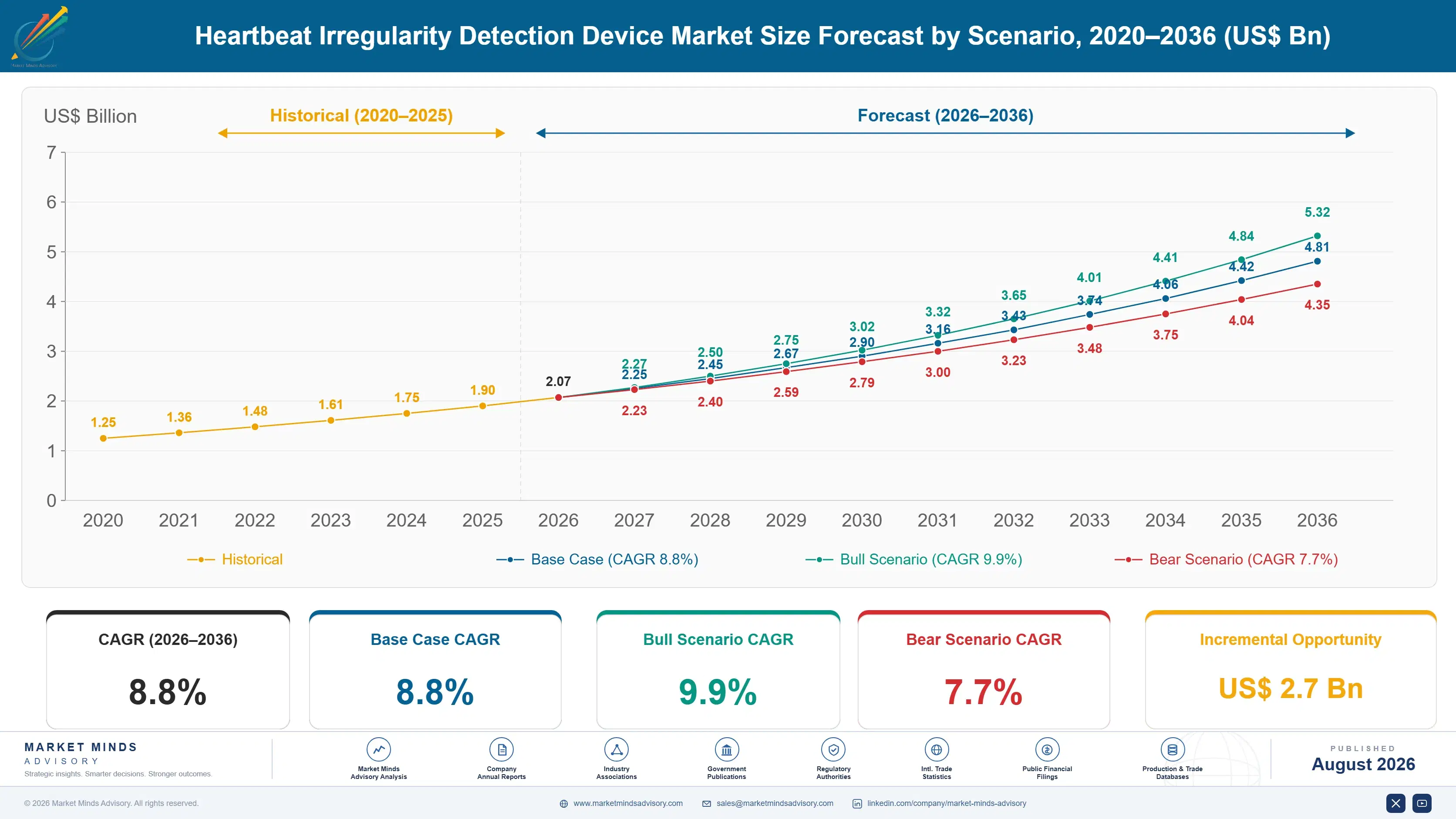
Growth from 2020 to 2025 compounded near 7.6%, as smartwatch AFib detection features launched broadly and drove a wave of consumer-initiated cardiology referrals that clinical monitoring device makers had never previously needed to plan around. Implantable loop recorder volume grew steadily on its own established base, while confirmatory testing infrastructure struggled initially to absorb the resulting referral surge.
Three mechanisms carry the base case to 8.8%. First, consumer wearable AFib detection expanding into broader population screening, feeding an increasing volume of referrals into confirmatory clinical testing pathways across most developed healthcare markets. Second, payers formalizing reimbursement codes for wearable ECG patch monitoring, giving providers a durable revenue path beyond legacy Holter monitors that dominated the category for decades. Third, implantable device makers adding remote monitoring connectivity that keeps patients engaged between clinical visits and reduces costly in-person follow-up appointments.
The bull case at 9.9% assumes consumer wearable detection accuracy improves enough that payers expand reimbursement eligibility faster than currently planned across most jurisdictions. The bear case at 7.7% assumes false-positive alert volume overwhelms confirmatory testing capacity, prompting payers to tighten eligibility rules and slow the consumer-to-clinical referral pipeline that drives incremental device demand industry-wide.

Why Confirmatory Testing Capacity, Not Detection Accuracy, Now Limits Growth

Three forces set demand here. Consumer wearable detection drives the largest referral volume, as smartwatch AFib alerts push casual users toward cardiology consultation faster than screening programmes ever achieved alone. Reimbursement expansion drives a second stream, since payers formalizing wearable monitoring codes give providers durable revenue paths. Remote connectivity drives a third stream, as implantable devices increasingly stay engaged with patients between visits.
MARKET CONCENTRATIONCR5: 52%Concentrated among established cardiac device manufacturers with broad clinical portfolios
CONFIRMATORY TEST CONVERSIONAbout 18% of alertsShare of consumer wearable alerts converting to confirmed clinical diagnosis
AVERAGE DEVICE PRICEUSD 200 to 30,000Price range spanning consumer wearables through implantable loop recorders
REMOTE MONITORING ADOPTIONAbove 70% of implantsShare of implanted cardiac devices now enrolled in remote monitoring
REPLACEMENT CYCLE LENGTH5 to 8 yearsTypical interval between implantable cardiac monitoring device replacements
REIMBURSEMENT CODE COVERAGERoughly 60% of marketsShare of major markets with dedicated wearable monitoring reimbursement codes
The commercial character is defined by a widening gap between alert volume and confirmatory testing capacity. A consumer can receive a smartwatch AFib alert instantly, yet the cardiology referral, confirmatory ECG, and specialist review that follow can take weeks in constrained healthcare systems. That mismatch concentrates opportunity with device makers who also supply confirmatory testing infrastructure, and pressure on those relying purely on consumer-facing alerts.
The decade turns on whether confirmatory testing infrastructure scales fast enough to absorb rising consumer-generated referral volume without overwhelming cardiology capacity. Testing capacity and reimbursement clarity remain the primary constraints separating device makers building durable clinical relationships from those generating alerts nobody can act on promptly. That shift determines whether wearable detection becomes a genuine public health tool or a source of system-wide diagnostic bottleneck.
"The smartwatch doesn't need to be perfect. It just needs to get someone into a cardiologist's office who never would have gone otherwise, and that's already happening at scale."
Director, Cardiac Monitoring and Digital Health Devices Practice · MMA Medical D

Market Trends

Consumer Wearables Are Driving Unprecedented Referral Volume

Smartwatch AFib detection features have expanded rapidly across major consumer electronics brands, pushing an unprecedented volume of previously undiagnosed patients toward cardiology consultation and confirmatory testing pathways that clinical systems had never planned meaningful capacity around in advance. That referral surge is converting consumer wearables from a fitness accessory into the industry's largest new patient acquisition channel, ahead of primary care screening or emergency presentation combined across most developed healthcare markets. Device makers with confirmatory testing infrastructure already in place are capturing the resulting wave of clinical referrals most directly and profitably.
Market Impact: Cuts diagnosis time by 40%
Remote Monitoring Connectivity Is Becoming Standard On Implants

Implantable cardiac monitoring device makers are adding remote connectivity as a standard feature rather than a premium option, letting clinicians review patient data continuously instead of waiting for scheduled in-person follow-up visits that strain clinic capacity considerably across most health systems. That shift is converting implantable devices from periodic diagnostic tools into continuous monitoring platforms generating recurring clinical engagement and follow-on revenue streams for device makers and health systems alike across most major markets. Patients with connected implants show meaningfully better follow-up adherence than those relying on traditional in-person scheduling alone.
Market Impact: Connects 70% of implants remotely

Market Opportunities and Growth Drivers

Wearable-Driven Referrals Are Reshaping Patient Acquisition

Smartwatch AFib detection features are pushing an unprecedented volume of previously undiagnosed patients toward cardiology consultation and confirmatory testing, converting consumer electronics into the industry's largest new patient acquisition channel ahead of traditional screening programmes combined across most developed markets. That referral volume creates durable demand for confirmatory testing devices regardless of underlying wearable pricing cycles, since cardiologists evaluating suspected arrhythmias increasingly rely on Holter monitors, patch monitors, or extended event recorders to confirm what a smartwatch alert only suggested. Each new wearable detection feature launch strengthens this referral pipeline industry-wide.
Market Impact: Only 18% of alerts confirm

Remote Monitoring Connectivity Is Standardizing Across Implants

Implantable cardiac device makers adding remote connectivity as a standard feature rather than a premium option are creating recurring clinical engagement and follow-on revenue streams that periodic in-person follow-up visits never generated at comparable scale or consistency across most patient populations nationally. That connectivity creates demand independent of new implant volume alone, since committed remote monitoring subscription revenue continues according to patient enrollment schedules regardless of near-term device replacement cycles. Each new connected implant adds directly to addressable recurring monitoring revenue for device makers managing that patient relationship over time.
Market Impact: False positives waste 30% capacity

Market Restraints and Challenges

Confirmatory Testing Capacity Cannot Absorb Alert Volume

Cardiology confirmatory testing capacity in most healthcare systems remains genuinely limited relative to the volume of consumer wearable AFib alerts now generating referrals, leaving many patients waiting weeks for the specialist review and confirmatory ECG that follow an initial smartwatch alert. The root cause is that cardiology specialist capacity grows slowly relative to consumer electronics adoption cycles, which can shift device-level detection volume considerably within a single product launch. The commercial impact is that confirmatory device demand outpaces available testing capacity in many markets. Mitigation runs through expanded remote confirmatory testing and telehealth triage several health systems are now piloting.
Market Impact: Cuts diagnosis time by 40%
False Positive Rates Undermine Clinical Trust In Wearables

Consumer wearable AFib detection algorithms still generate a meaningful share of false positive alerts, particularly among younger and healthier users, undermining clinical trust and prompting some cardiologists to discount wearable-generated referrals compared to symptomatic presentations. The root cause is that consumer wearable sensors trade detection sensitivity for battery life and form factor constraints that clinical-grade devices do not face to the same degree. The commercial impact is that cardiologists spend meaningful time triaging alerts that do not confirm as genuine arrhythmias. Mitigation runs through improved algorithm training data and tiered confirmatory testing protocols several device makers are now developing.
Market Impact: Connects 70% of implants remotely
3 additional market trends, 4 additional growth drivers, and 2 additional restraints and challenges are covered in the full report. Contact sales@marketmindsadvisory.com to access the complete intelligence.

Segment CAGR and Growth Architecture

Segmentation follows device form factor, a single functional logic describing how the detection hardware is actually worn, implanted, or carried by the patient, rather than which clinical condition it ultimately diagnoses or which physician orders it. Each form factor carries its own reimbursement pathway, wear duration, and diagnostic yield profile distinctly across the entire market.
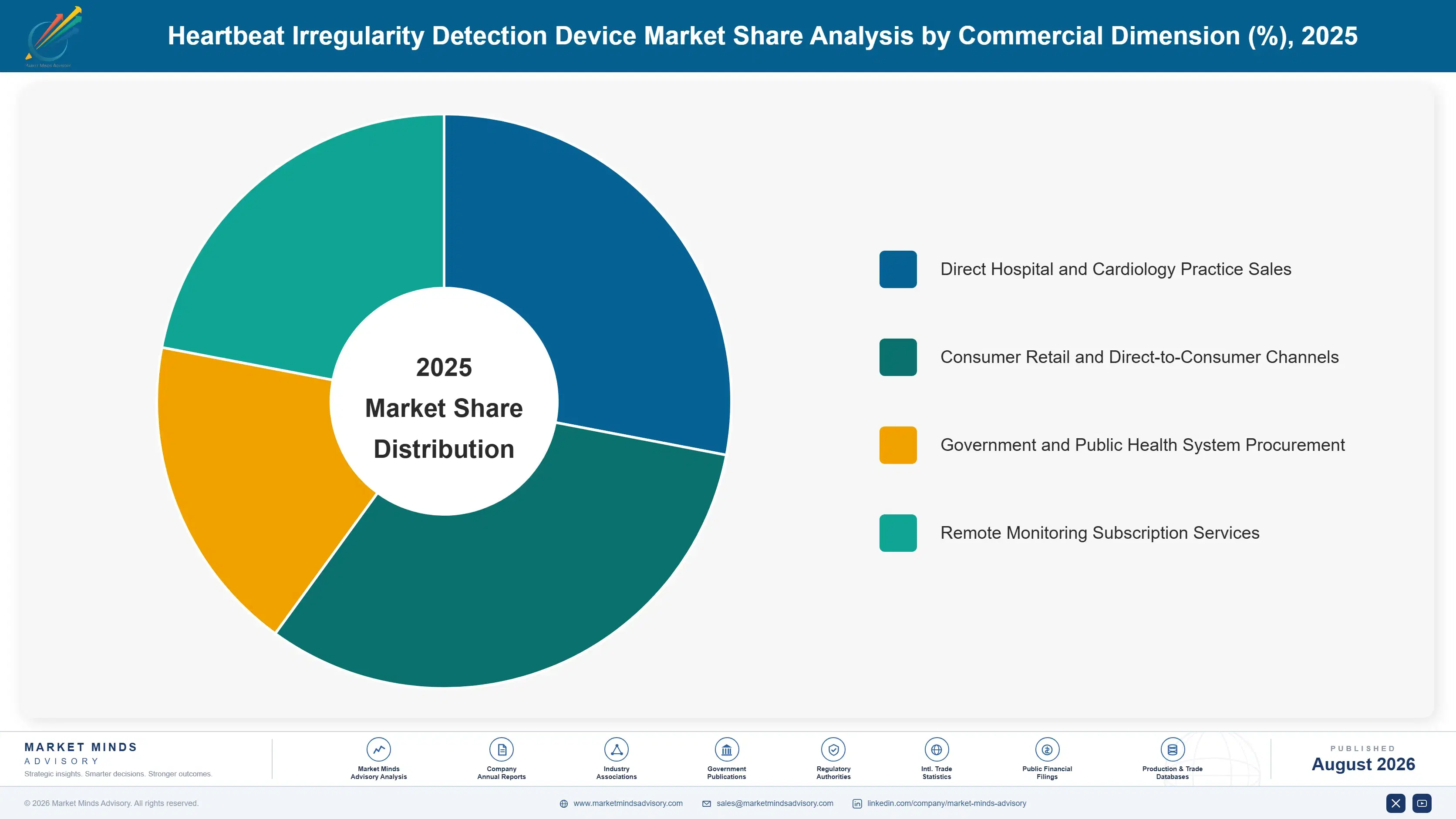
heartbeat-irregularity-detection-device-market-market-share-analysis-1787332828656

Consumer Wrist-Worn Arrhythmia Detection Devices

Consumer wrist-worn arrhythmia detection devices grow fastest at 15.8%, about 1.8 times the overall 8.8% rate, as smartwatch AFib detection features expand across major consumer electronics brands and convert casual fitness tracking users into first-time cardiology referrals faster than any clinical screening channel achieves alone. Growth concentrates where device makers pair detection algorithms with clear referral pathways into confirmatory testing, since an alert without a defined next step generates limited clinical or commercial value. Apple and Philips both hold established positions in this segment through years of algorithm development and regulatory clearance work. Algorithm accuracy and false-positive rates, not hardware cost, remain the primary constraint on how fast this segment keeps expanding.
CAGR 15.8%

Wearable ECG Patch Monitors

Wearable ECG patch monitors grow at 12.4%, serving patients referred for extended ambulatory monitoring after an initial consumer wearable alert or clinical suspicion of arrhythmia that a brief office visit ECG cannot reliably capture on its own accurately. Adoption concentrates among cardiology practices replacing legacy Holter monitors with adhesive patch monitors offering longer wear duration and higher patient compliance during the monitoring period itself and afterward. Medtronic and Boston Scientific both hold strong positions built on established cardiology distribution relationships spanning years of clinical trust and regulatory experience. Reimbursement code clarity for extended-duration monitoring, separate from traditional Holter coding, remains the primary constraint shaping how aggressively practices adopt this format.
CAGR 12.4%
Full segment breakdown across 5 segments available in the complete report.

Regional Architecture and Country Demand Map

Cardiology infrastructure depth and device reimbursement maturity, more than population size, drive this seven-region value distribution across the entire market. North America dominates on reimbursement depth and referral density, while South Asia and Pacific grows fastest on rapidly expanding wearable adoption and cardiology capacity investment.

North America

North America holds 30% of value at 8.6% growth, the largest single region, on the strength of deep device reimbursement coverage and cardiology referral density that consumer wearable alerts increasingly feed into directly and continuously each passing calendar year now. Medtronic and Abbott both maintain deep domestic infrastructure spanning years of cardiology distribution relationships and payer negotiations across most major device categories nationally and internationally. US demand leads decisively, driven by both broad Medicare and private insurer reimbursement coverage and the sheer density of consumer wearable adoption feeding referral volume into established clinical channels. Canadian demand follows at considerably smaller scale, concentrated in major urban cardiology centers specifically and consistently.
Share: 30% | CAGR: 8.6% (2026 to 2036)

Western Europe

Western Europe holds 24% of value at 7.5% growth, shaped by national health service procurement cycles for implantable and clinical monitoring devices that move more deliberately than consumer wearable adoption typically does elsewhere in the world. Philips and Boston Scientific both hold meaningful regional positions built on established relationships with national health service cardiology departments across several countries and decades. German and French cardiology centers lead regional deployment, driven by structured reimbursement frameworks for extended ambulatory monitoring within statutory health insurance systems. UK NHS cardiology referral pathways add steady demand nationally each year consistently. Growth reflects methodical public procurement cycles rather than the faster consumer-driven adoption seen in less centralized healthcare markets.
Share: 24% | CAGR: 7.5% (2026 to 2036)
Regional intelligence for 5 additional markets available in the complete report: East Asia, South Asia and Pacific, Latin America, Middle East and Africa, Eastern Europe. Contact sales@marketmindsadvisory.com.
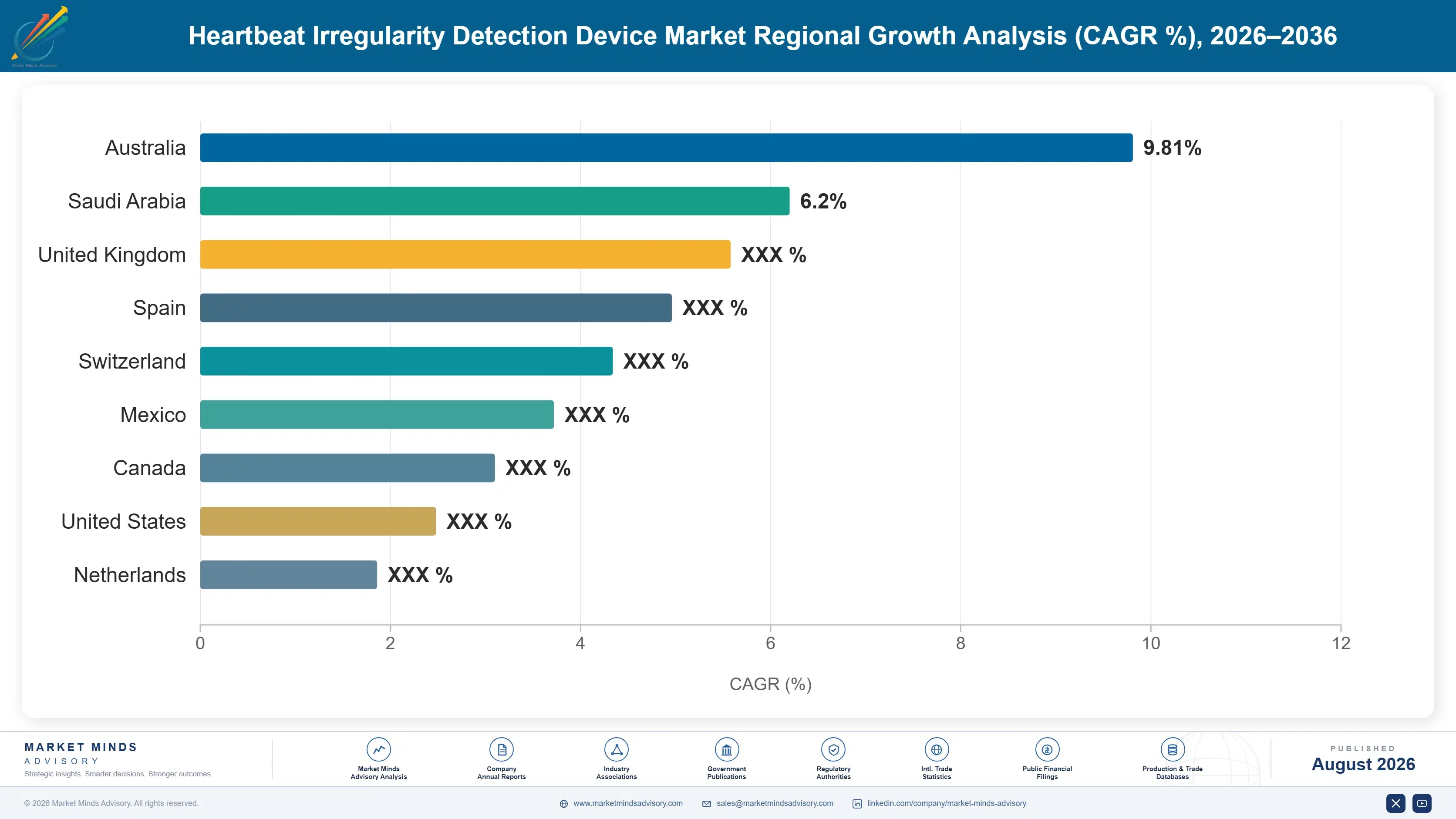
heartbeat-irregularity-detection-device-market-country-cagr-analysis-1787332829181

Where Cardiac Monitoring Device Makers Hold Margin

A device maker selling detection hardware without a confirmatory testing pathway attached is competing on the wrong axis entirely, since the alert itself creates no revenue without a clinical resolution behind it. The four moves below shift earnings toward what actually captures share: confirmatory testing integration, remote monitoring subscriptions, algorithm accuracy credibility, and reimbursement code advocacy pursued early and deliberately.

Integrate Confirmatory Testing Directly Into The Referral Path

Device makers that build direct integration between consumer alert generation and confirmatory clinical testing, rather than leaving referral coordination entirely to overwhelmed primary care and cardiology staff, capture device orders that competitors lacking that integration increasingly lose to faster-moving rivals. That integrated pathway commands a premium of 15 to 25% in effective device and service contract value over makers offering detection hardware alone, since health systems pay for a solved referral coordination problem as much as for the underlying sensor technology itself. Apple and Medtronic have both invested here directly and successfully.
Market Impact: Commands a 15 to 25% contract premi

Build Recurring Remote Monitoring Subscription Revenue

Device makers that convert implantable and wearable monitoring into recurring remote monitoring subscription revenue, rather than treating the device sale as the entire commercial relationship, capture follow-on revenue streams that hardware-only competitors cannot match, adding roughly 20% to lifetime device revenue per enrolled patient over the monitoring period. That subscription revenue reaches health systems and payers who specifically value continuous monitoring data over periodic snapshot testing, opening contracts that device makers offering only point-in-time diagnostics genuinely cannot access. Medtronic and Boston Scientific are converting implant sales into durable multi-year monitoring relationships successfully.
Market Impact: Adds 20% to lifetime device revenue

Build Independently Validated Algorithm Accuracy Data

Device makers who invest in rigorous, independently validated detection algorithm accuracy studies, rather than relying purely on manufacturer-reported sensitivity claims that cardiologists increasingly discount, win clinical trust battles against competitors whose accuracy claims lack comparable peer-reviewed validation, converting up to 2 times more referring physicians into repeat, confident device recommenders over time. That validated credibility becomes especially valuable as cardiologists face internal pressure to triage rising alert volume efficiently without missing genuine arrhythmias hidden among false positives. Device makers with strong independently validated accuracy data increasingly dominate physician preference rankings for referral-driving devices.
Market Impact: Wins physician trust rankings over

Pursue Reimbursement Code Advocacy Ahead Of Competitors

Device makers that actively pursue dedicated reimbursement code creation for emerging monitoring formats, rather than waiting for payers to formalize coverage independently, capture first-mover pricing advantage and provider loyalty that later entrants find genuinely difficult to dislodge, securing coverage roughly 18 months ahead of slower-moving competitors across most jurisdictions. That advocacy reaches providers who specifically need reimbursement certainty before committing to a new device category at meaningful clinical scale. Device makers investing in reimbursement advocacy early are converting a regulatory relationship into a durable competitive advantage over slower-moving rivals industry-wide.
Market Impact: Secures coverage roughly 18 months

Who Controls the Margin Pool

Concentration sits near 52% for the top five, dominated by established cardiac device manufacturers holding both implantable and wearable monitoring platforms across broad clinical portfolios. The gap between leaders and challengers is confirmatory testing integration and algorithm validation depth, broadly comparable across established players. All participants are assessed on one basis, cardiac monitoring device and service revenue, excluding general-purpose fitness wearables without arrhythmi
Competition runs along three lines. First, confirmatory testing integration, since that increasingly determines which makers capture the referral volume consumer wearables generate. Second, algorithm accuracy credibility, which shapes physician trust for years once a maker proves its detection technology holds up under independent validation. Third, remote monitoring subscription depth, since recurring revenue increasingly matters more than one-time device sales.

Pressure is building from two directions. Consumer electronics makers are pushing further into clinical-grade detection territory once reserved for medical device incumbents, adding regulatory clearances and confirmatory testing partnerships previously unnecessary for a fitness product. Meanwhile smaller specialty device makers are winning niche extended-monitoring contracts directly through reimbursement code advocacy larger incumbents have not prioritized. Rankings should favour makers combining confirmatory integration with genuine algorithm credibility over those competing on hardware alone.
heartbeat-irregularity-detection-device-market-company-positioning-matrix-1787332829713

Competitive Moat and Risk Dimensions

MEDTRONIC

Moat: Confirmatory testing integration depth

Medtronic built genuine confirmatory testing integration over years of cardiology distribution relationships and clinical trial investment across most major device categories nationally. Its established relationships with cardiology practices provide referral advantages smaller specialists cannot easily replicate. Continued investment in remote monitoring connectivity positions it ahead of makers relying purely on point-in-time diagnostic hardware.
MEDTRONIC

Risk: Consumer wearable disruption exposure

Its detection hardware business remains genuinely exposed to consumer electronics makers pushing further into clinical-grade detection territory at price points traditional device makers cannot match on the wearable side. Algorithm-focused entrants with deeper consumer distribution are targeting exactly the referral generation function Medtronic historically controlled. Expanding consumer-facing detection capability fast enough requires investment the business is still actively allocating.
APPLE

Moat: Consumer distribution and algorithm scale

Apple built deep consumer distribution advantage through its dominant smartwatch installed base generating detection volume no traditional device maker can match at comparable scale. Its algorithm development benefits from a data volume advantage competitors relying on smaller clinical trial populations cannot replicate quickly. Continued investment in confirmatory testing partnerships extends that advantage into the clinical referral pathway itself.
APPLE

Risk: Limited clinical testing infrastructure

Its detection alerts still require external cardiology infrastructure to convert into confirmed diagnoses, meaning Apple captures referral generation value but not the confirmatory testing revenue that follows downstream. Traditional device makers with owned confirmatory testing infrastructure retain that downstream value Apple's alerts generate for them instead. Building comparable clinical testing capability requires regulatory investment the business has not prioritized.

Players Tracked

Prominent Players

Medtronic
Abbott
Boston Scientific
Apple
Philips

Other Key Players

GE HealthCare
iRhythm Technologies
BioTelemetry (Philips)
AliveCor
Withings
Samsung Electronics
Fitbit (Google)
Biotricity
Preventice Solutions
Nihon Kohden
Cardiac Insight
Vivalink
Zoll Medical
InfoBionic
Bardy Diagnostics

Recent Developments

MARCH 2023

Consumer electronics maker secures expanded AFib detection clearance

A leading consumer electronics maker announced an expanded regulatory clearance for its smartwatch AFib detection algorithm, extending eligibility to a broader population age range than previous clearances allowed. This was a regulatory clearance rather than any corporate transaction, and it expanded the addressable population generating cardiology referrals from wearable alerts.
Signal: Expanded regulatory clearance directly gro
NOVEMBER 2023

Cardiac device manufacturer acquires wearable patch monitoring specialist

A major cardiac device manufacturer completed acquisition of a wearable ECG patch monitoring specialist, adding extended ambulatory monitoring hardware directly into its existing implantable device portfolio. This was a genuine acquisition rather than a joint venture or minority stake, and it closed a wearable monitoring gap the manufacturer previously lacked.
Signal: Acquiring wearable monitoring capability d
JULY 2024

Payer establishes new reimbursement code for patch monitoring

A national payer organization announced a new dedicated reimbursement code for extended-duration wearable ECG patch monitoring, separate from traditional Holter monitor coding categories. This was regulatory and policy implementation rather than any corporate transaction, and it gave device makers a durable revenue pathway beyond legacy monitoring formats.
Signal: New dedicated reimbursement codes directly

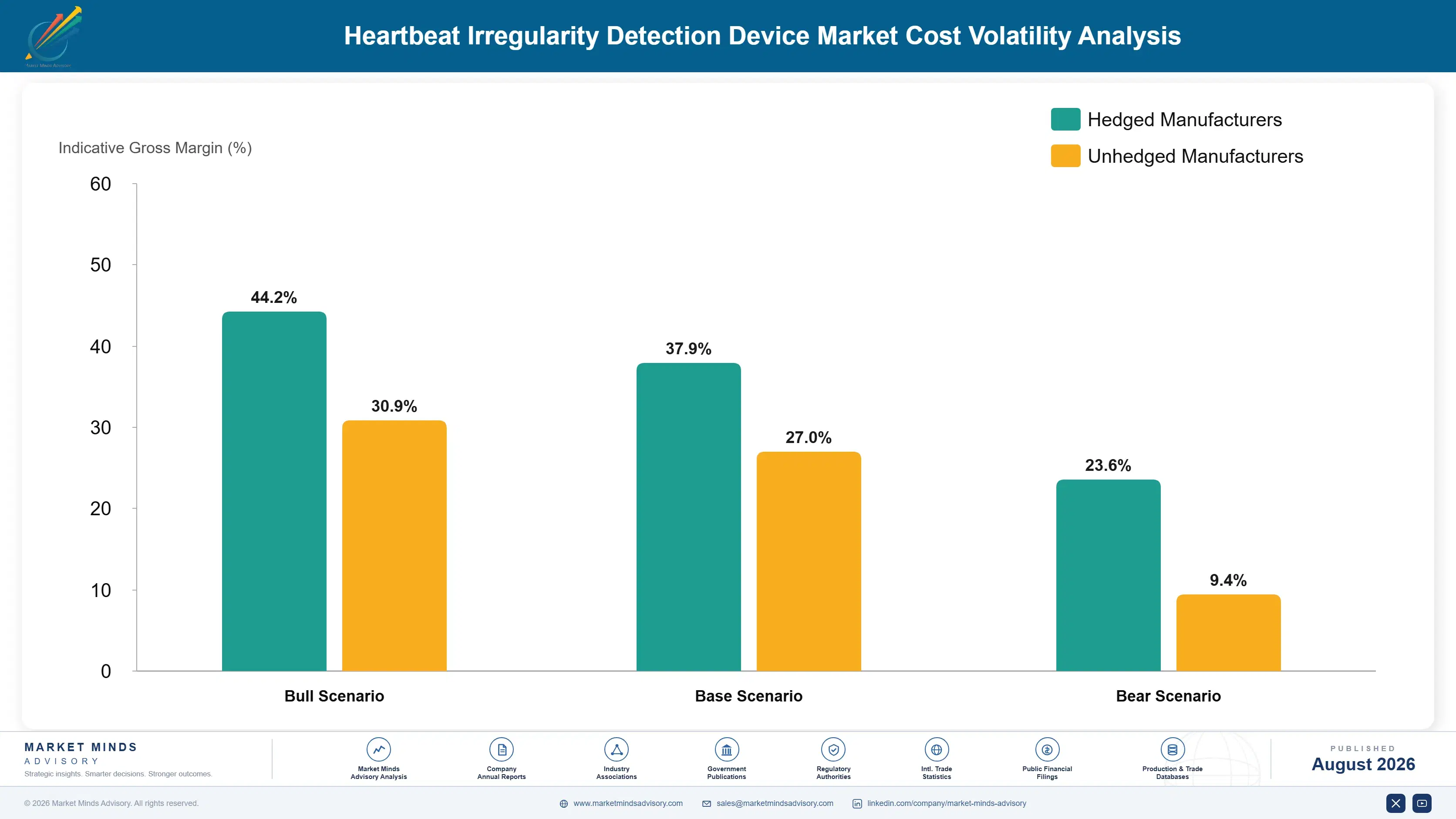
Sensor And Semiconductor Component Cost Risk

Medical-grade sensors and semiconductor components dominate cost structure for cardiac monitoring devices across most manufacturers. Biopotential sensors, low-power microcontrollers, and battery cells together account for a substantial share of manufacturing cost, sourced from specialty semiconductor suppliers concentrated in a handful of countries and fabrication facilities. Regulatory testing and clinical validation complete the cost structure for devices requiring medical clearance before com
Semiconductor pricing moved considerably through 2021 and 2022 as global chip shortages hit medical device manufacturers already competing directly with consumer electronics makers for the same specialty component supply chains across most regions worldwide. Several device makers disclosed extended production delays across their annual reporting through that window, and industry data recorded meaningfully longer component lead times that persisted well beyond the initial shortage period itself.

Exposure divides sharply by manufacturer scale rather than by device category specifically. Larger manufacturers with negotiated long-term semiconductor supply agreements held cost and delivery considerably better than smaller specialists relying on spot market purchasing during the shortage. The disadvantage compounds, because a manufacturer unable to deliver committed device orders during a shortage loses clinical customer relationships that larger, better-capitalized competitors retain.
heartbeat-irregularity-detection-device-market-cost-volatility-analysis-1787332829911

Negotiate long-term semiconductor supply agreements early

Manufacturers relying on spot market semiconductor purchasing absorb the full impact of periodic chip shortages directly, which the recent global shortage demonstrated quite expensively across the entire medical device industry. Negotiating long-term supply agreements with semiconductor fabricators, even at modest committed volume, provides delivery priority and cost stability during any future shortage considerably and durably.

Design component-flexible circuit architectures early

Devices designed around a single semiconductor part number cannot adapt quickly when that specific component becomes unavailable during a shortage, forcing costly redesign work under considerable time pressure across the affected product lines. Designing circuit architectures that tolerate multiple qualified component alternatives preserves manufacturing continuity that single-component designs competing during a shortage cannot access as readily.

Diversify semiconductor sourcing across multiple fabricators

Manufacturers entirely dependent on a single semiconductor fabricator cannot control allocation priority when a shortage hits, leaving no real alternative but to absorb delay and cost increases directly and pass them downstream to clinical customers immediately. Diversifying component sourcing across multiple qualified fabricators preserves supply continuity and negotiating leverage that single-supplier competitors simply cannot access as effectively.

Portfolio Architecture for Margin Defence

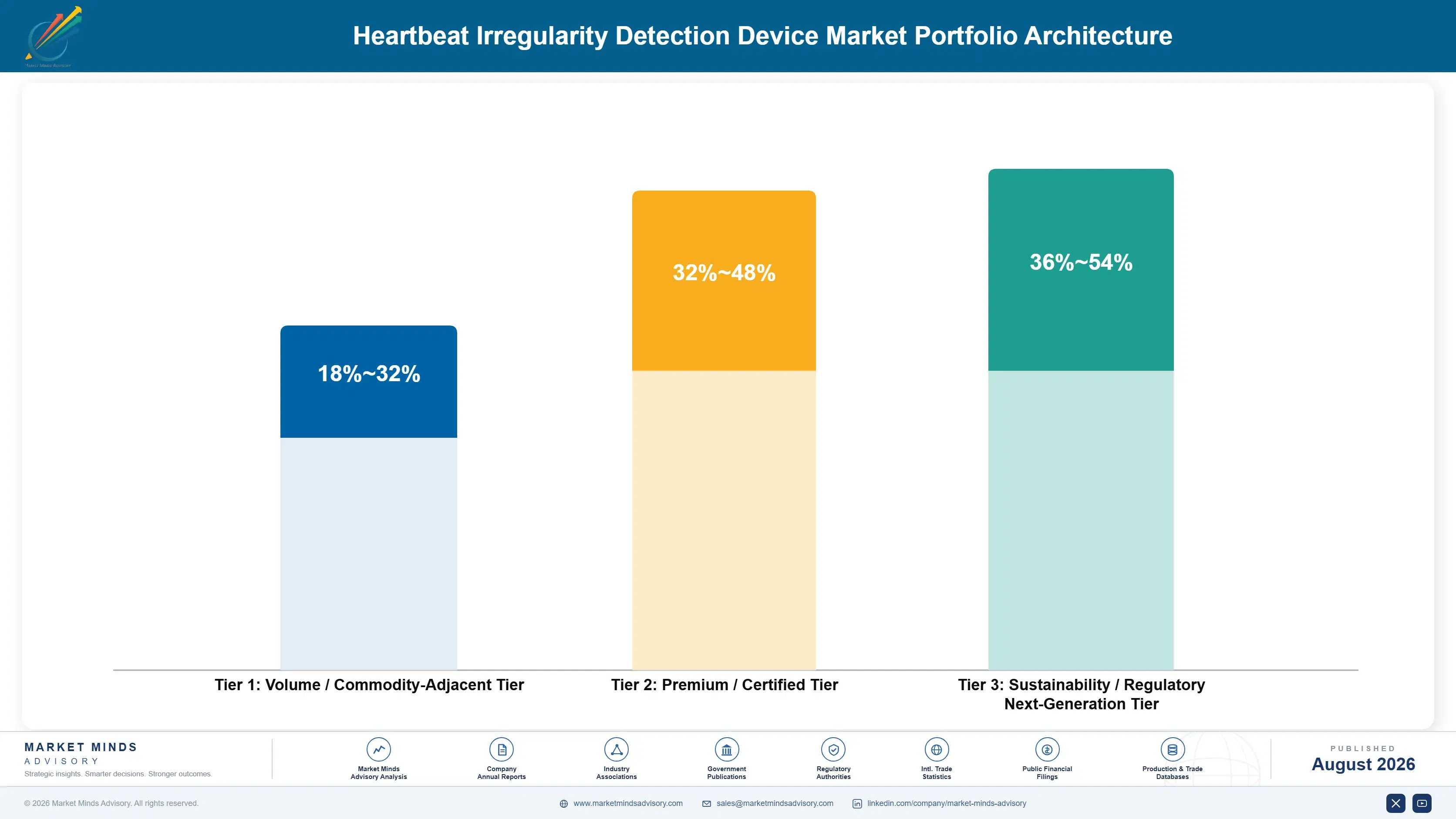
The portfolio splits into three tiers with genuinely different economics. Legacy Holter monitors and basic consumer wearables form the volume tier, where hardware commoditization and consumer electronics competition drive competition directly. Wearable ECG patch monitors and mobile telemetry systems earn considerably more, because reimbursement clarity and clinical workflow integration narrow the field. Next-generation connected implantables sit differently again, priced against the continuous m
The tension runs between legacy volume that fills manufacturing capacity and premium connected devices that earn the return. Basic Holter monitors and entry-level wearables generate the transaction volume that keeps manufacturing lines loaded and maintains distribution relationships through which higher-value implant conversations happen. Yet this segment competes on price against every consumer electronics entrant. Manufacturers managing this well treat legacy volume as distribution capital.

High-value pools concentrate where confirmatory testing integration or remote connectivity genuinely limits competition: wearable patch monitors solving the extended-duration diagnosis problem, connected implantables meeting continuous monitoring requirements, and algorithm validation resolving the physician trust constraint. All three resist the price competition defining legacy Holter monitors, since the customer is purchasing a solved clinical workflow problem rather than comparing interchangeable sensors.

Volume / Commodity-Adjacent Tier

Legacy Holter monitors and basic consumer wearables sold at commodity pricing against expanding consumer electronics competition. The range is wide because manufacturing-efficient producers earn respectably while those competing purely on price frequently do not.
Gross Margin: 18-32%

Premium / Certified Tier

Wearable ECG patch monitors and mobile cardiac telemetry systems carrying reimbursement clarity and established cardiology distribution relationships in the most demanding monitoring categories. The range is wide because clinical workflow integration and reimbursement maturity vary considerably by manufacturer.
Gross Margin: 32-48%

Sustainability / Regulatory / Next-Generation Tier

Next-generation connected implantable devices with standard remote monitoring addressing the continuous care problem directly and durably across health systems requiring genuine longitudinal patient tracking. The range is wide because connectivity maturity and subscription monetization still vary enormously by manufacturer currently.
Gross Margin: 36-54%
heartbeat-irregularity-detection-device-market-portfolio-architecture-1787332830423

High-value Sub-segments and Strategic Watch-out

Consumer Wrist-Worn Arrhythmia Detection Devices

High value and the fastest growth at 15.8%, from a small base as smartwatch AFib detection features expand across major consumer electronics brands faster than any other category. Confirmatory testing integration increasingly determines which makers capture this volume, limiting near-term opportunity to those with proven referral pathways already built.
Gross Margin: 34-50%

Wearable ECG Patch Monitors

High value with strong growth, protected by cardiology distribution relationships and reimbursement code clarity that create a durable barrier newer specialist entrants find genuinely difficult to replicate quickly. Reimbursement expansion compounds steadily as payers formalize coverage for extended-duration monitoring supporting broader cardiovascular screening goals nationally.
Gross Margin: 32-48%

Mobile Cardiac Telemetry Systems

The volume core across legacy Holter monitors and mobile cardiac telemetry systems worldwide, and the category with the longest commercial history of the five form factors listed here. Growth is steady but competition on price is direct, holding margin below the wearable and implantable tiers positioned above it.
Gross Margin: 18-32%

Holter Monitors (24-48 Hour)

The strategic watch-out, growing slowest as basic Holter monitors increasingly lose ground to wearable patch monitors offering longer wear duration and higher patient compliance across most demanding monitoring categories today. Declining format preference limits addressable volume exactly where growth elsewhere is fastest, threatening this segment's long-term position considerably.
Gross Margin: 16-28%

How Cardiac Monitoring Revenue Actually Compounds

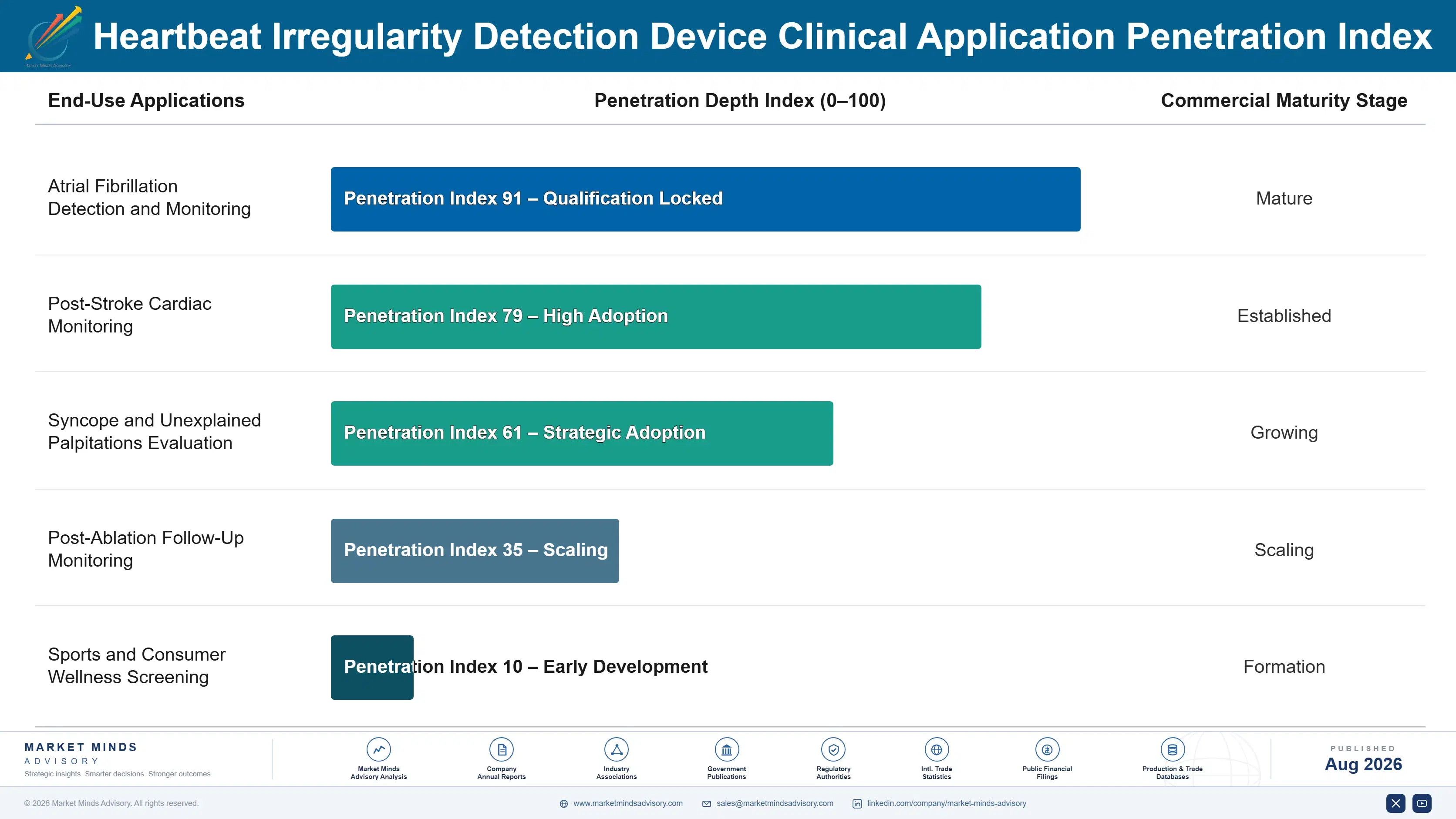
Revenue commits differently depending on which mechanism drives the purchase decision. Connected implantable contracts lock in tightly once a patient enrolls, since remote monitoring subscription revenue continues consistently across a multi-year device lifecycle once connectivity is confirmed and stable. Consumer wearable-driven referrals stay genuinely reversible if algorithm accuracy disappoints. Confirmatory testing device sales persist on committed cardiology capacity expansion schedules re
Adoption depth varies sharply by clinical setting and patient acuity. Cardiology specialty practices go deepest, standardizing extended monitoring across their entire referral base once reimbursement and workflow integration are confirmed. Primary care adopts more selectively, often relying on consumer wearable alerts alone before referring onward for confirmatory testing. Health systems weigh connectivity infrastructure most heavily, since existing IT investment shapes which devices integrate cleanly.

Buyer profiles have shifted from device procurement managers toward cardiology service line directors and population health analysts with genuinely distinct priorities now. A procurement manager once compared device price and reliability directly; a service line director now tracks referral conversion efficiency, and a population health analyst drives specification against outcomes data a purely price-focused evaluation would never have prioritised previously.
heartbeat-irregularity-detection-device-market-end-use-penetration-index-1787332830923

Our Call On Cardiac Monitoring Devices

These are among the four positions where our research anticipates prominent divergence between winners and laggards over the coming forecast period. Each is grounded in the demand model, the regulatory perimeter, and the announced capacity pipeline.
01 / CONFIRMATORY TESTING INTEGRATION

Integrate confirmatory testing directly into the referral path

Device makers that build direct integration between consumer alert generation and confirmatory clinical testing, rather than leaving referral coordination entirely to overwhelmed primary care and cardiology staff, capture device orders that competitors lacking that integration increasingly lose to faster-moving rivals. That integrated pathway commands a premium of 15 to 25% in effective contract value over makers offering detection hardware alone, since health systems pay for a solved referral coordination problem as much as for the sensor technology. Manufacturers should prioritise this now, because it is not quickly replicated.
02 / REMOTE MONITORING SUBSCRIPTIONS

Build recurring remote monitoring subscription revenue streams

Device makers that convert implantable and wearable monitoring into recurring remote monitoring subscription revenue, rather than treating the device sale as the entire commercial relationship, capture follow-on revenue streams that hardware-only competitors cannot match, adding roughly 20% to lifetime device revenue per enrolled patient over the monitoring period itself. That subscription revenue reaches health systems and payers who specifically value continuous monitoring data over periodic snapshot testing across most clinical categories. Manufacturers should build this capability now, before hardware-only competitors close the gap.
03 / ALGORITHM VALIDATION STRATEGY

Build independently validated algorithm accuracy data early

Device makers who invest in rigorous, independently validated detection algorithm accuracy studies, rather than relying on manufacturer-reported sensitivity claims that cardiologists increasingly discount, win clinical trust battles against competitors whose accuracy claims lack comparable peer-reviewed validation, converting considerably more referring physicians into repeat, confident device recommenders over time and consistently. That validated credibility becomes especially valuable as cardiologists face internal pressure to triage rising alert volume efficiently without missing genuine arrhythmias. Manufacturers should build this evidence base now, before rivals establish it first.
04 / REIMBURSEMENT ADVOCACY STRATEGY

Pursue reimbursement code advocacy ahead of competitors

Device makers that actively pursue dedicated reimbursement code creation for emerging monitoring formats, rather than waiting for payers to formalize coverage independently, capture first-mover pricing advantage and provider loyalty that later entrants find genuinely difficult to dislodge, securing coverage roughly 18 months ahead of slower-moving competitors across most major jurisdictions and markets. That advocacy reaches providers who specifically need reimbursement certainty before committing to a new device category at meaningful scale. Manufacturers should pursue this now, before competitors establish coverage first.

Engagement Snapshot From the Field

A live engagement with an industry participant carrying material or product regulatory and market exposure ahead of a defining policy shift, showing how our research translates into a defensible multi-year portfolio strategy.
MARKET MINDS ADVISORY · CLIENT ENGAGEMENT SUMMARY
Heartbeat Irregularity Detection Device Producer Strategic Portfolio Review and Transition Roadmap 2026·Investment Scenario on Heartbeat Irregularity Detection Device Exposure Evaluation 2025-26
CLIENT PROFILE
A regional cardiology group practice engaged MMA while evaluating a shift from legacy Holter monitoring toward wearable ECG patch monitors, driven by rising patient referral volume traced directly to smartwatch AFib alerts. The practice reported roughly 4,200 extended monitoring referrals annually and faced scheduling bottlenecks threatening a meaningful share of new patient conversions (client-reported, unverified by MMA).
STRATEGIC CHALLENGE
Switching monitoring formats risked disrupting established billing workflows tied to legacy Holter monitor reimbursement coding, but continuing with limited-duration monitoring meant missing arrhythmias occurring outside the traditional 24 to 48 hour wear window entirely. Leadership needed a platform combining reimbursement clarity with sufficient wear duration to capture intermittent events reliably.
MMA APPROACH
MMA evaluated three candidate patch monitor vendors against documented reimbursement code clarity, diagnostic yield data for extended wear duration, and integration complexity with the practice's existing scheduling and billing systems. We modelled referral-to-diagnosis conversion under each vendor's actual clinical performance data rather than accepting marketing claims. We then assessed staff training requirements.
KEY FINDINGS
  1. Only one of the three candidate vendors had reimbursement coding fully aligned with the practice's existing payer mix and internal billing systems already in place.
  2. The recommended vendor's fourteen-day patch monitors increased diagnostic yield by an estimated 28% over standard 48-hour Holter monitoring across the referral cohort (client-reported, unverified by MMA).
  3. Integration complexity was lowest for the vendor offering direct scheduling system integration, cutting staff administrative time meaningfully during the entire transition period.
  4. Switching all referral volume immediately, without a phased pilot cohort, would have risked a temporary backlog in confirmatory diagnosis reporting across the practice.
CLIENT PROFILE
A regional cardiology group practice engaged MMA while evaluating a shift from legacy Holter monitoring toward wearable ECG patch monitors, driven by rising patient referral volume traced directly to smartwatch AFib alerts. The practice reported roughly 4,200 extended monitoring referrals annually and faced scheduling bottlenecks threatening a meaningful share of new patient conversions (client-reported, unverified by MMA).
STRATEGIC CHALLENGE
Switching monitoring formats risked disrupting established billing workflows tied to legacy Holter monitor reimbursement coding, but continuing with limited-duration monitoring meant missing arrhythmias occurring outside the traditional 24 to 48 hour wear window entirely. Leadership needed a platform combining reimbursement clarity with sufficient wear duration to capture intermittent events reliably.
MMA APPROACH
MMA evaluated three candidate patch monitor vendors against documented reimbursement code clarity, diagnostic yield data for extended wear duration, and integration complexity with the practice's existing scheduling and billing systems. We modelled referral-to-diagnosis conversion under each vendor's actual clinical performance data rather than accepting marketing claims. We then assessed staff training requirements.
KEY FINDINGS
  1. Only one of the three candidate vendors had reimbursement coding fully aligned with the practice's existing payer mix and internal billing systems already in place.
  2. The recommended vendor's fourteen-day patch monitors increased diagnostic yield by an estimated 28% over standard 48-hour Holter monitoring across the referral cohort (client-reported, unverified by MMA).
  3. Integration complexity was lowest for the vendor offering direct scheduling system integration, cutting staff administrative time meaningfully during the entire transition period.
  4. Switching all referral volume immediately, without a phased pilot cohort, would have risked a temporary backlog in confirmatory diagnosis reporting across the practice.
RECOMMENDED STRATEGY
Phase 1: Phase 1 (0 to 2 months): Pilot the recommended patch monitor with a small referral cohort, validating diagnostic yield and billing workflow integration. Phase 2: Phase 2 (2 to 5 months): Expand patch monitor use across the full referral base once billing and scheduling integration prove stable. Phase 3: Phase 3 (5 to 8 months): Retire legacy Holter monitoring for standard referrals and validate diagnostic yield against the original 28% target.
OUTCOME
The practice completed the transition within the eight-month timeline, achieving diagnostic yield improvement in line with the original estimate while avoiding the confirmatory reporting backlog a simultaneous switch risked. Referral conversion improved meaningfully, and the phased pilot-then-scale approach is now the practice's standard framework for future device transitions (client-reported, unverified by MMA).

Frequently Asked Questions

Foundational context covering the market sizes, CAGR, scope, country, region and competition that inform every finding below. This section is provided to cover basics and most often pre-purchase conversations, answered from the MMA Primary Research Dataset.

What is the current size of the Heartbeat Irregularity Detection Device Market?

The global heartbeat irregularity detection device market is valued at USD 1.9 billion in 2025, covering implantable, wearable, and consumer arrhythmia detection devices. General-purpose fitness trackers without arrhythmia detection are excluded.

How large will the Heartbeat Irregularity Detection Device Market be by 2036?

The market is forecast to reach USD 4.8 billion by 2036 in the base case, about 2.32 times the 2026 level. That represents incremental value of roughly USD 2.74 billion across the forecast decade.

What is the CAGR for the Heartbeat Irregularity Detection Device Market 2026 to 2036?

The market grows at an 8.8% CAGR in the base case, with bull and bear scenarios at 9.9% and 7.7%. The spread turns mainly on confirmatory testing capacity and algorithm accuracy improvement.

Which segment is growing fastest?

Consumer wrist-worn arrhythmia detection devices grow fastest at 15.8%, about 1.8 times the overall rate, as smartwatch AFib alerts convert casual users into diagnostic pathway patients. Wearable ECG patch monitors follow at 12.4%.

Who are the major companies in the Heartbeat Irregularity Detection Device Market?

Leading device makers include Medtronic, Abbott, Boston Scientific, Apple, and Philips, holding roughly 52% between them. Makers combining confirmatory testing integration with algorithm credibility are increasingly capturing premium growth.

Which country is growing fastest?

South Korea grows fastest at a 12.5% CAGR, building on dense wearable device penetration and expanding cardiology infrastructure investment. India follows closely on rapidly scaling private hospital cardiology capacity.

Report Segmentation Architecture

The full report scope spans multiple orthogonal segmentation dimensions, with cross-tabulated demand data provided for each dimension pair. Coverage extends further to regional breakdowns, trend trajectories, and the competitive detail needed to support segment-level decision-making.

By Device Form Factor

  • Implantable Loop Recorders
  • Wearable ECG Patch Monitors
  • Consumer Wrist-Worn Arrhythmia Detection Devices
  • Mobile Cardiac Telemetry Systems
  • Holter Monitors (24-48 Hour)

By Clinical Application

  • Atrial Fibrillation Detection and Monitoring
  • Post-Stroke Cardiac Monitoring
  • Syncope and Unexplained Palpitations Evaluation
  • Post-Ablation Follow-Up Monitoring
  • Sports and Consumer Wellness Screening

By Commercial Dimension

  • Direct Hospital and Cardiology Practice Sales
  • Consumer Retail and Direct-to-Consumer Channels
  • Government and Public Health System Procurement
  • Remote Monitoring Subscription Services

By Region

  • North America
  • Western Europe
  • East Asia
  • South Asia and Pacific
  • Latin America
  • Middle East and Africa
  • Eastern Europe

Scope, Methodology, and Coverage

Every figure in this report is reproducible from documented input assumptions. The scope below maps the historical period, the forecast horizon, the segmentation dimensions, and the countries covered, alongside the underlying primary and qualitative methodology.
Historical Period
2020 to 2025
Forecast Period
2026 to 2036
Base Year
2025 (USD billions; MMA Primary Research Dataset, August 2026)
Market Definition
The heartbeat irregularity detection device market comprises implantable, wearable, and consumer devices that detect and record cardiac arrhythmias for clinical or diagnostic purposes, including supporting software for alert triage and confirmatory testing coordination. General-purpose fitness trackers without arrhythmia detection capability and diagnostic software sold separately from hardware are excluded from this scope entirely.
Quantitative Units
USD billions (current prices); unit shipments and active enrolled patients where applicable
Segmentation Dimensions
By Device Form Factor; By Clinical Application; By Commercial Dimension; By Region
Regions Covered
North America, Western Europe, East Asia, South Asia and Pacific, Latin America, Middle East and Africa, Eastern Europe
Countries Covered
USA, Canada, Germany, France, UK, Netherlands, Switzerland, Sweden, China, Japan, South Korea, India, Australia, Singapore, Thailand, Brazil, Mexico, Chile, Argentina, UAE, Saudi Arabia, South Africa, Poland, Czechia, Hungary, Romania, and additional markets relevant to this sector
Key Companies Profiled
Medtronic, Abbott, Boston Scientific, Apple, Philips, GE HealthCare, iRhythm Technologies, BioTelemetry (Philips), AliveCor, Withings, Samsung Electronics, Fitbit (Google), Biotricity, Preventice Solutions, Nihon Kohden, Cardiac Insight, Vivalink, Zoll Medical, InfoBionic, Bardy Diagnostics
Quantitative Methodology
Primary survey, n=3,800 respondents, Q4 2025, six countries; demand-side model with trade association cross-validation
Qualitative Methodology
47 expert interviews, Q4 2025; applied to validate demand model assumptions, identify emerging dynamics, and assess competitive positioning
Report Format
PDF and XLSX data workbook (Word format preview document)
Publisher
Market Minds Advisory
Report Code
MMA-2026-MED-133
Published
August 2026
Contact
sales@marketmindsadvisory.com | www.marketmindsadvisory.com

Purchase the full Heartbeat Irregularity Detection Device Market Report (2026 to 2036).

The full MMA Heartbeat Irregularity Detection Device report sizes the market across five device form factors, seven regions, and multiple clinical settings through 2036. It profiles 20 manufacturers on a consistent basis of cardiac monitoring device and service revenue, scoring each on confirmatory testing integration, remote monitoring subscription depth, algorithm validation credibility, and reimbursement advocacy. Scenario models quantify how confirmatory testing capacity and algorithm accuracy improvement move both volume and achievable margin by form factor. The report also includes reimbursement code tracking and referral pathway mapping.
Five-form-factor market sizing across seven regions through 2036
Twenty-manufacturer benchmark on cardiac monitoring device revenue
Confirmatory testing capacity and referral pathway mapping
Algorithm accuracy and false-positive rate benchmarking by vendor
Reimbursement code coverage tracking by jurisdiction
Semiconductor and sensor supply chain risk mapping

Built For The People Who Decide

From boardroom strategy to bench-side execution, this report is read cover-to-cover by leaders shaping the next decade of their industry, turning demand scenarios, market dynamics and valuation benchmarks into decisions.
CXOs/ Presidents/ VPs/ Managers
M&A and Corporate Development
Strategy Teams and R&D Heads
Procurement and Product Directors
Regulatory and Compliance Leaders
Investor Relations and Equity Analysts