
Market Minds Advisory
Healthcare Natural Language Processing Market

Healthcare Natural Language Processing Market: The Ambient Scribe Made Physician Time The Business Case

A commercial reading of clinical language AI, where ambient documentation tools convert physician burnout into a measurable procurement metric, and large language model accuracy gains pull adoption out of pilot programmes into standing contracts.

Lead Analyst

Alice Ballenger

Published

September 2026

Make Smarter Decisions with Customized Research Insights

Request a free sample report and evaluate market opportunities, growth trends, and competitive dynamics relevant to your business needs.

2025 MARKET VALUE$4.6BMarket Size 2025
2036 FORECAST VALUE$15.1BBase Case , 2026 to 2036
CAGR 2026 TO 203611.4 %Bull 12.8% / Bear 9.9%
INCREMENTAL OPPORTUNITY$9.9BNet 10- year value creation
EXPANSION MULTIPLE2.94x2036 value over 2026 base
Strategic Levers
M&A Pipeline
Regional Outlook
Country Rankings
Competitive Intelligence
Segmental Deep-dive
Call-Us : 91 93563 13602

Executive Snapshot and Market Trajectory

A physician who spends two extra hours a night finishing notes is now a budget line item, not a workforce complaint. Ambient documentation tools that give that time back have moved from pilot curiosity to standing contract inside two years, purchased the way hospitals once bought imaging equipment.
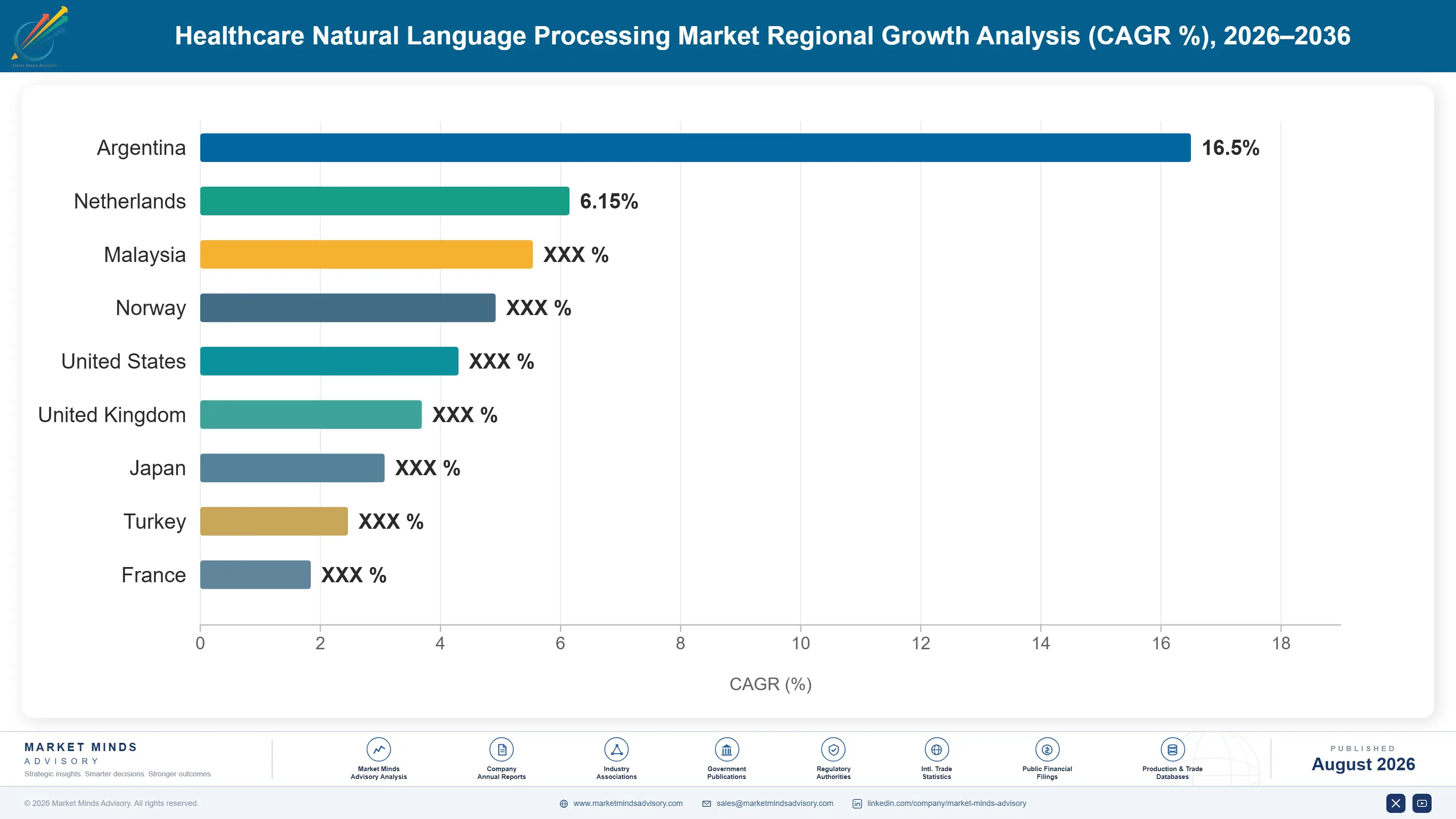
The market stands at USD 4.6 billion in 2025 and reaches USD 15.07 billion by 2036 at an 11.4% CAGR. Ambient clinical documentation and scribes grow fastest at 16.5%, about 1.45 times the overall rate, as large language model accuracy gains finally make fully automated note generation trustworthy. India posts the quickest national growth at 14.2% as hospital digitisation and a deep domestic AI talent pool pull adoption forward rapidly.
Concentration is moderate at 36% for the top five, split between platform incumbents bundling NLP into existing documentation software and specialist AI scribe companies selling accuracy depth those platforms cannot easily replicate. Two forces are reshaping the category now. Large language model accuracy has crossed the threshold where health systems trust automated output with light physician review, and reimbursement coding accuracy pressure is converting NLP from a productivity tool into a revenue integrity requirement.
Market Definition
The healthcare natural language processing market covers software that extracts, generates, or interprets clinical language, including ambient documentation and scribes, computer-assisted coding, clinical decision support text mining, and patient-facing conversational AI. General-purpose language models sold without healthcare-specific tuning, electronic health record core licensing, and medical transcription services performed manually are excluded.
Base Year Value
$4.6B in 2025 (MMA Primary Research Dataset, August 2026)
Forecast Period
2026 to 2036, eleven discrete annual values
CAGR
11.4% base case. Bull 12.8%. Bear 9.9%.
Fastest Growth Segment
Ambient Clinical Documentation and Scribes: 16.5% CAGR
Fastest Growth Country
India: 14.2% CAGR
Fastest Growth Region
South Asia and Pacific: 13.5% CAGR
Largest Region
North America: 31% of 2025 global value
Market Leaders
Microsoft (Nuance), 3M Health Information Systems, Optum, Suki AI, Abridge. Source: MMA Analysis based on company disclosures.
Primary Survey
n=3,800 procurement and R&D decision-makers, Q4 2025, six countries
Methodology
Demand-side build-up, cross-validated against public data, 47 expert interviews

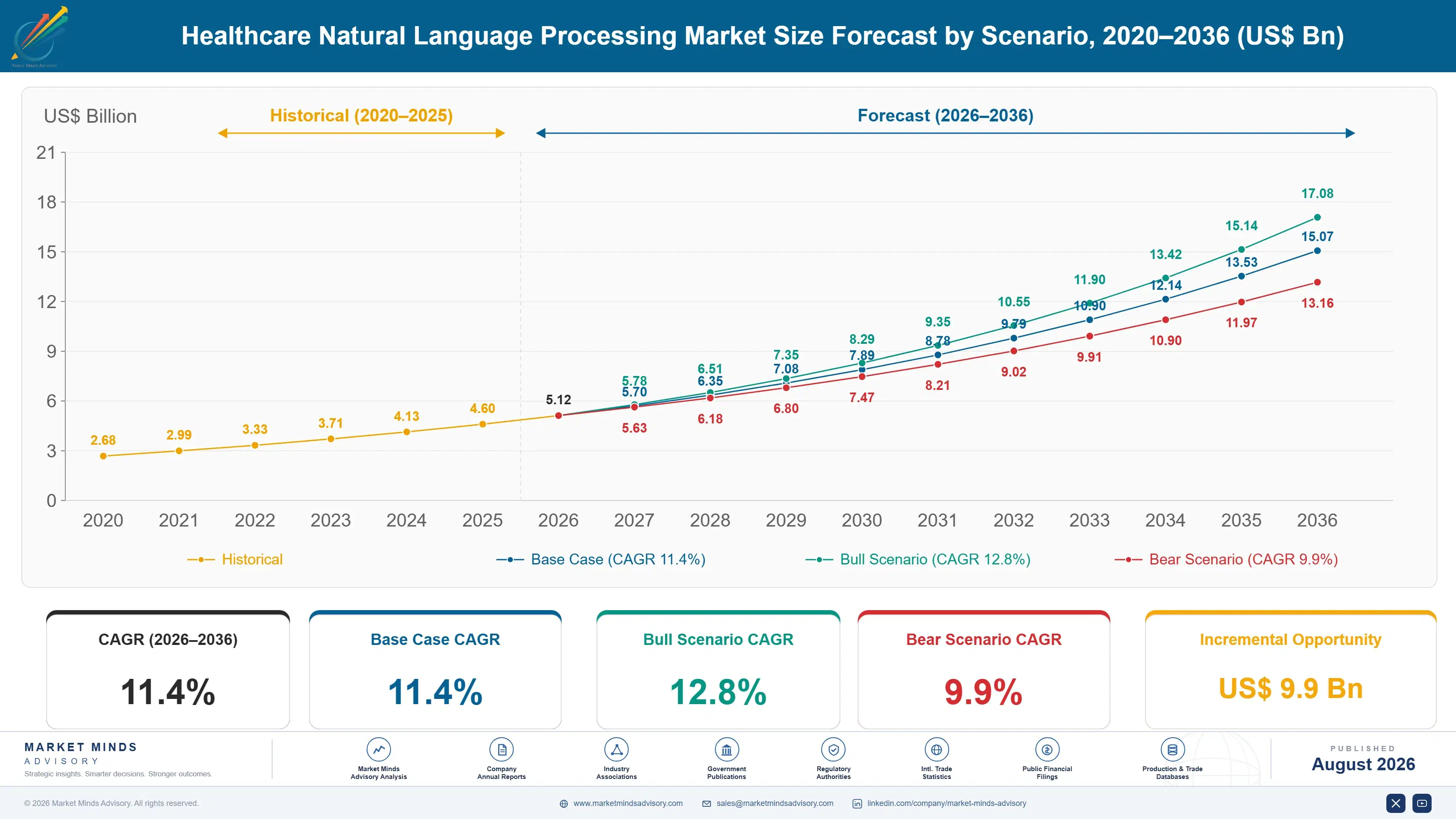
Healthcare Natural Language Processing Market Forecast Scenarios

healthcare-natural-language-processing-market-size-forecast-scenario-1787332690286
Growth from 2020 to 2025 compounded near 9.8%, held back early by clinician scepticism toward AI-generated documentation accuracy and accelerated sharply once large language model quality improvements from 2023 onward made ambient note generation genuinely trustworthy enough for routine clinical use rather than a closely supervised experiment requiring constant physician oversight and correction throughout every encounter.
Three mechanisms carry the base case to 11.4%. First, ambient documentation adoption, as accuracy gains convert pilot programmes into enterprise-wide standing contracts across large health systems nationwide. Second, coding and revenue integrity pressure, as payers scrutinise documentation more closely and hospitals need NLP-assisted coding accuracy to protect reimbursement revenue. Third, emerging market digitisation, particularly across India, where hospital systems are adopting clinical software at a pace that barely existed five years ago.
The bull case at 12.8% assumes large language model accuracy continues improving and payer scrutiny accelerates coding-focused NLP adoption faster than currently projected across most major markets globally. The bear case at 9.9% assumes clinician trust erodes following a high-profile accuracy failure and health systems slow procurement pending stronger regulatory guidance on clinical AI documentation tools specifically across jurisdictions.

Why Physician Time Became A Line Item Buyers Track

Three forces set demand. Physician burnout provides the emotional case, but documentation time reduction of 40% to 70% is what actually gets budget approved, since hospital finance committees fund retention economics rather than wellness language on its own. Coding and revenue integrity pressure provides a second, increasingly binding layer, as payers scrutinise documentation more closely. And emerging market digitisation adds a third, steadily expanding volume base entirely.
MARKET CONCENTRATIONCR5: 36%Moderately concentrated among platform incumbents and specialist AI scribes
AVERAGE CONTRACT VALUEUSD 15,000 to 2.2 millionAnnual license spend spanning single clinics to large health systems
TOP PRODUCING COUNTRY SHAREUnited States: about 44%Share of global healthcare NLP software revenue generated domestically
DOCUMENTATION TIME REDUCTIONAbout 40% to 70%Typical reduction in physician note-writing time reported after adoption
MODEL TRAINING COST SHAREAbout 24% of COGSPortion of production cost from compute and clinical data annotation
CODING ACCURACY IMPROVEMENTAbout 12 to 20 pointsTypical accuracy gain reported by hospitals using NLP-assisted coding
The commercial character is set by accuracy and integration depth more than by raw language model sophistication. Compute and clinical data annotation account for roughly 24% of cost of goods sold, and that share is exactly why vendors with deep electronic health record integration and clinically validated accuracy hold pricing power that generic language model wrappers cannot match on enterprise contracts.
The next decade turns on two things. Whether large language model accuracy keeps improving fast enough to displace human review steps entirely, since that displacement is what ultimately justifies the largest pricing tier vendors are trying to build toward. And whether payer coding scrutiny keeps tightening across additional reimbursement categories, since that scrutiny is what converts NLP from a nice productivity tool into a genuinely mandatory revenue protection investment.
"Every hospital CFO used to ask what an AI scribe costs. Now they ask what it costs not to have one, once you count physician attrition and the coding revenue leaking out of undocumented visits. That's the question that actually closes enterprise deals in this category."
Director, Healthcare AI and Clinical Software Practice · MMA Healthcare / Clinic

Market Trends

Ambient Scribes Are Converting Pilots Into Enterprise Contracts

Large language model accuracy improvements since 2023 have made ambient note generation reliable enough for routine clinical use, and health systems that ran cautious single-department pilots two years ago are now signing enterprise-wide contracts covering thousands of physicians simultaneously. Microsoft's Nuance division and Abridge have both disclosed major health system expansions through 2024 and 2025 converting pilot programmes into standing deployment. That shift changes the sales motion entirely, since a vendor now needs enterprise integration and change management capability rather than just a compelling pilot demonstration. Deployment scale is becoming as commercially important as model accuracy itself.
Market Impact: Documentation time falls 40% to 70%
Coding Accuracy Pressure Is Pulling NLP Into Revenue Integrity

Payers are scrutinising clinical documentation more closely before approving reimbursement, and hospitals report coding accuracy improvements of roughly 12 to 20 points after deploying NLP-assisted coding tools that flag documentation gaps before claims submission rather than after denial. That shift moves NLP procurement out of the clinical informatics budget and into revenue cycle management, where spending approval works differently and moves faster once a clear return calculation exists. 3M Health Information Systems and Optum have both expanded coding-focused NLP capability specifically to capture this budget shift toward revenue cycle ownership.
Market Impact: Accuracy climbs up to 20 points

Market Opportunities and Growth Drivers

Documentation Time Savings Now Anchor The Procurement Case

Hospitals report physician documentation time reductions of 40% to 70% after deploying ambient scribe technology, and that measurable return has moved procurement conversations from clinician satisfaction surveys into hard retention and productivity economics finance committees actually approve quickly. Physician attrition tied to documentation burden carries substantial replacement cost that a documentation tool directly offsets, a calculation health system CFOs increasingly run explicitly before signing any multi-year vendor agreement. Abridge and Suki AI have both built sales materials directly around this specific retention and productivity calculation for prospective buyers evaluating the category.
Market Impact: 1 failure can stall entire rollouts

Payer Scrutiny Is Making Coding Accuracy A Revenue Question

Payers increasingly deny or delay claims lacking sufficiently detailed clinical documentation, and hospitals deploying NLP-assisted coding tools that flag gaps before submission report accuracy improvements of roughly 12 to 20 points translating directly into protected reimbursement revenue that would otherwise leak away through denied or underpaid claims. That direct revenue link gives NLP procurement a business case considerably harder for competing software categories to match on comparable budget terms available to most competing software categories. 3M Health Information Systems has structured recent product investment explicitly around this coding accuracy value proposition specifically.
Market Impact: Annotation reaches 24% of cost

Market Restraints and Challenges

Clinician Trust Remains Fragile After Any Accuracy Failure

Physicians who catch an ambient scribe hallucinating clinical detail, even once, often revert to manual documentation entirely or demand exhaustive review of every generated note afterward, and that trust fragility is the root cause of adoption plateaus that persist well after a vendor has fixed the underlying accuracy issue technically. Commercially this means a single high-profile accuracy failure can stall an entire health system rollout regardless of aggregate accuracy statistics the vendor can demonstrate. Vendors respond with confidence scoring and mandatory physician review workflows that slow full automation but rebuild trust incrementally over time.
Market Impact: Deals now span 1,000+ physicians

Clinical Data Annotation Cost Limits Smaller Vendor Scale

Training clinically accurate language models requires extensive annotated clinical data that costs considerably more to produce than general-purpose text annotation, and that cost structure is the root cause of a scale advantage larger vendors hold that smaller specialists struggle to close without comparable capital. Commercially this concentrates genuine accuracy leadership among well-funded vendors while smaller entrants compete on narrower clinical specialties where annotation cost is more manageable. Vendors respond by partnering with health systems directly for annotated data access, trading early access pricing for the clinical data partnership provides on more favourable terms.
Market Impact: Gains reach up to 20 points
3 additional market trends, 4 additional growth drivers, and 2 additional restraints and challenges are covered in the full report. Contact sales@marketmindsadvisory.com to access the complete intelligence.

Segment CAGR and Growth Architecture

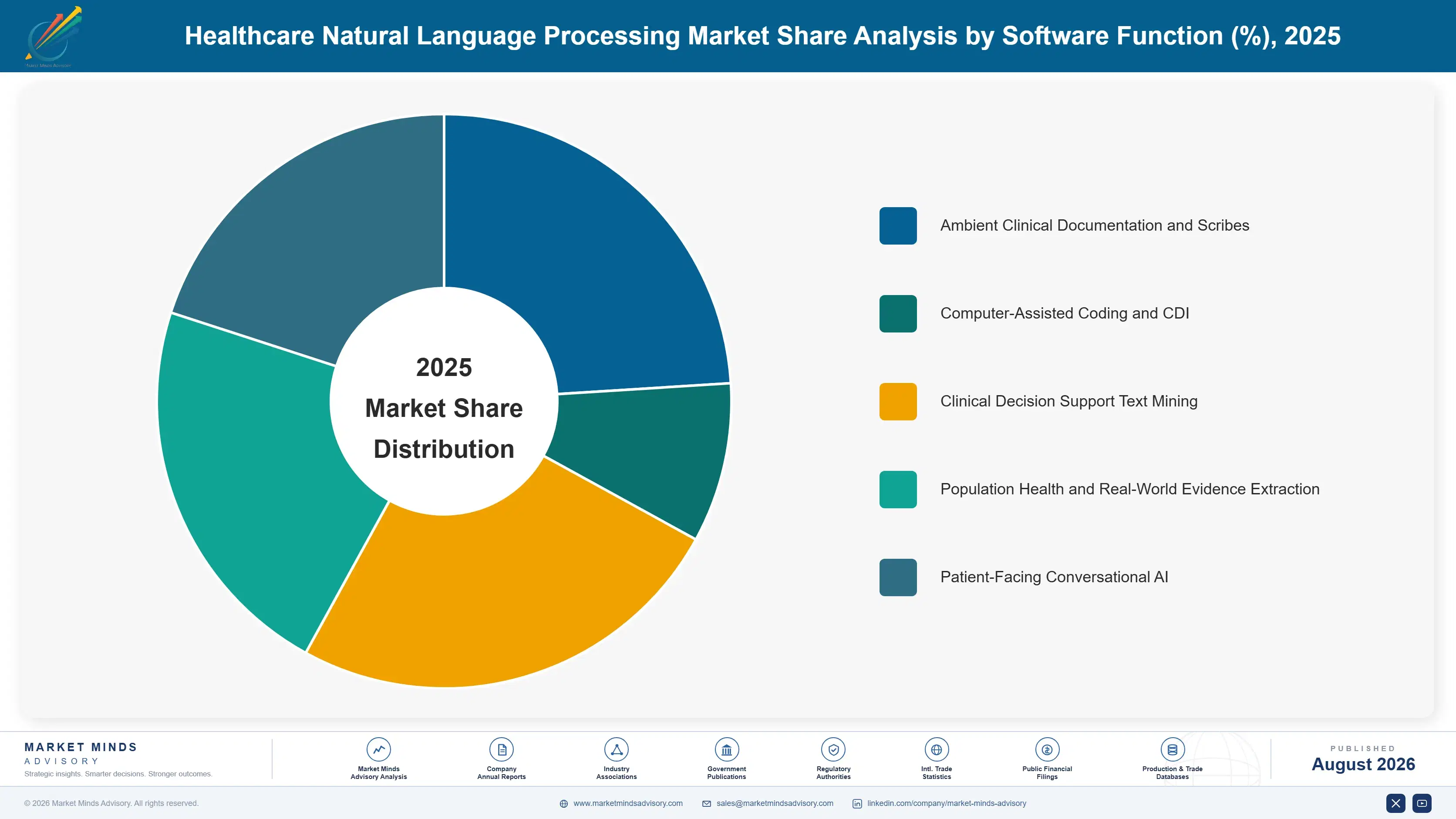
Segmentation follows software function, a single logic describing what the NLP system actually does with clinical language rather than which department deploys it. Each function carries its own accuracy requirement, integration depth, and buyer relationship, so commercial position tracks the underlying capability rather than the end customer segment served across the wider organisation overall.
healthcare-natural-language-processing-market-market-share-analysis-1787332690832

Ambient Clinical Documentation and Scribes

Ambient clinical documentation and scribes grow fastest at 16.5%, about 1.45 times the overall 11.4% rate, covering software that listens to patient encounters and generates clinical notes automatically, reducing physician documentation time by 40% to 70% according to hospital reporting. This segment benefits directly from large language model accuracy improvements that have made fully automated note generation clinically trustworthy since 2023, converting cautious pilots into enterprise-wide standing contracts. Microsoft's Nuance division, Abridge, and Suki AI all compete strongly here across different health system size segments. Adoption still concentrates among larger, better-resourced health systems with the change management capacity to roll out enterprise-wide deployment, which limits near-term penetration among smaller independent practices.
CAGR 16.5%

Computer-Assisted Coding and CDI

Computer-assisted coding and clinical documentation improvement software grows at 13.2%, the second-fastest function, covering NLP systems that extract billing codes and flag documentation gaps before claims submission to protect reimbursement revenue directly. Payer scrutiny tightening across major reimbursement categories has pulled this function's budget ownership from clinical informatics into revenue cycle management, where spending approval moves faster once a clear return calculation exists for finance leadership. 3M Health Information Systems and Optum both hold strong positions here across hospital and health system customers. Pricing scales directly with hospital claim volume and documentation complexity, rewarding vendors with genuine coding accuracy track records over generic extraction tools lacking healthcare-specific tuning entirely across specialties.
CAGR 13.2%
Full segment breakdown across 6 segments available in the complete report.

Regional Architecture and Country Demand Map

Health system digital maturity and reimbursement complexity together set this distribution more than raw healthcare spending does across most markets. North America leads on both dimensions simultaneously, while share elsewhere tracks how far each system has moved past paper and manual documentation toward genuine clinical AI adoption.

North America

Reimbursement complexity and physician burnout together anchor North America's 31% share, as American health systems face both the most complex coding and payer scrutiny environment globally and the most acute documented physician attrition tied to administrative burden specifically. Microsoft's Nuance division and Abridge both maintain their largest enterprise customer bases domestically, serving hospital systems ranging from single-site clinics to national networks. Canadian adoption follows a similar trajectory on a smaller scale, concentrated in major urban academic medical centres. Revenue cycle management budget ownership for coding-focused NLP has become genuinely standard practice across large domestic health systems. Growth of 12.5% tracks ambient documentation adoption and coding accuracy pressure together across the country.
Share: 31% | CAGR: 12.5% (2026 to 2036)

Western Europe

National health system procurement processes shape demand across Western Europe's 21% share more than competitive vendor selection does, with the National Health Service and German statutory insurers running centralised evaluation processes that slow initial adoption but produce durable, large-scale contracts once approved. German and French hospitals maintain growing interest in ambient documentation specifically to address comparable physician burnout pressure seen domestically. British NHS trusts have run several ambient scribe pilots, though procurement complexity has slowed conversion to full deployment considerably. Data residency and patient privacy requirements add integration complexity vendors must navigate carefully. Growth of 9.8%, the slowest of the seven, reflects centralised procurement cycles that move more slowly than commercial sales timelines elsewhere.
Share: 21% | CAGR: 9.8% (2026 to 2036)
Regional intelligence for 5 additional markets available in the complete report: East Asia, South Asia and Pacific, Latin America, Middle East and Africa, Eastern Europe. Contact sales@marketmindsadvisory.com.
healthcare-natural-language-processing-market-country-cagr-analysis-1787332691352

Where Healthcare NLP Vendors Actually Win Renewals

Winning the first pilot on a compelling demo does not survive a renewal cycle once a health system starts measuring actual outcomes against the original business case presented. The four moves below shift revenue toward positions a competitor's better-looking demo cannot easily displace: documented time savings, coding accuracy proof, enterprise integration depth, and clinician trust infrastructure.

Document Time Savings With Health System Case Studies

Hospitals report physician documentation time reductions of 40% to 70% after deploying ambient scribe technology, and vendors who document that specific, measured return directly convert a productivity pitch into a retention and cost avoidance calculation finance committees actually approve quickly and without extensive internal debate. Abridge and Suki AI have both built sales materials explicitly around this documented time savings calculation for prospective health system buyers evaluating competing vendors. That evidence base also strengthens renewal negotiations considerably, since a vendor can point to measured outcomes rather than repeat the original pitch each cycle.
Market Impact: Documented time savings reach 40% t

Prove Coding Accuracy Gains To Capture Revenue Cycle Budget

Hospitals deploying NLP-assisted coding tools report accuracy improvements of roughly 12 to 20 points, translating directly into protected reimbursement revenue that would otherwise leak away through denied or underpaid claims processed without sufficient documentation detail. Vendors who quantify that specific revenue protection capture budget from revenue cycle management rather than competing only for a smaller clinical informatics allocation constrained by different priorities and approval thresholds entirely. 3M Health Information Systems has structured recent product investment explicitly around this coding accuracy value proposition, targeting revenue cycle leadership directly in its sales process.
Market Impact: Coding accuracy gains run 12 to 20

Build Enterprise Integration Ahead Of Large Health System Deals

Large health systems increasingly require deep electronic health record integration and enterprise-wide change management support before committing to a system-wide rollout, and vendors who build this integration capability ahead of the largest deals close them faster than competitors still treating integration as a post-sale professional services afterthought handled reactively after signing. Microsoft's Nuance division has drawn on deep existing electronic health record partnerships covering over 1,000 hospital sites specifically to accelerate this integration advantage across major health system accounts nationwide. Integration depth is becoming as commercially decisive as raw model accuracy in competitive enterprise evaluations.
Market Impact: Enterprise deals can span 1,000 or

Build Clinician Trust Infrastructure Before Scaling Deployment

A single high-profile accuracy failure can stall a 1,000-physician health system rollout regardless of aggregate accuracy statistics a vendor can otherwise demonstrate convincingly across its full customer base, and vendors investing in confidence scoring and mandatory physician review workflows before scaling deployment avoid the trust collapse that has stalled several well-funded competitors previously across the industry. That trust infrastructure also generates the clinician usage data needed to demonstrate accuracy improvement over successive product releases and updates. Building this capability early protects deployment momentum against a single damaging incident later on.
Market Impact: 1 failure can stall 1,000 or more p

Who Controls the Margin Pool

Concentration is moderate: the top five hold roughly 36% of revenue, split between platform incumbents bundling NLP into existing documentation software and specialist AI scribe companies selling accuracy depth platforms cannot easily replicate. The gap between leaders and challengers is accuracy track record and integration depth rather than raw model sophistication, which is widely distributed. All participants are assessed on one basis, annual recurring revenue from healthcare NLP platforms,
Competition runs along three lines. First, documented accuracy and time savings, since vendors who can prove measured outcomes out-compete those relying on demo performance alone. Second, integration depth, as large health systems require deep electronic health record connectivity before committing to system-wide rollout. Third, coding and revenue cycle capability, particularly for vendors capturing budget from revenue cycle management rather than clinical informatics.

Pressure is building from two directions. Platform incumbents including Microsoft and Optum are acquiring specialist AI scribe and coding companies rather than building accuracy organically, compressing the timeline independent vendors have to scale before being absorbed. Meanwhile new large language model entrants are lowering the barrier to entry, intensifying competition at the lower end. Rankings should favour vendors combining documented accuracy with genuine integration depth.
healthcare-natural-language-processing-market-company-positioning-matrix-1787332691883

Competitive Moat and Risk Dimensions

MICROSOFT (NUANCE)

Moat: EHR integration and enterprise scale

Microsoft's Nuance division holds deep, longstanding integration relationships across major EHR platforms, giving its documentation product deployment speed advantages specialist competitors must build from a standing start. Its broader Azure cloud and AI infrastructure provides compute cost advantages pure-play competitors cannot match. Deep enterprise sales relationships shorten sales cycles considerably.
MICROSOFT (NUANCE)

Risk: Scale slows specialist responsiveness

Nuance's integration into Microsoft's broader enterprise sales organisation sometimes slows product iteration speed compared with nimble specialist competitors including Abridge, built natively around the latest large language model capability. Smaller health systems sometimes find its enterprise-oriented pricing and implementation model poorly suited to their scale. Competitive pressure from newer entrants is genuine and intensifying.
ABRIDGE

Moat: Clinical accuracy and clinician trust

Abridge has built strong clinician trust through documented accuracy performance and transparent confidence scoring, converting several major health system pilots into enterprise-wide deployment faster than larger, more established competitors managed. Its focus purely on ambient documentation lets it iterate model accuracy faster than diversified platform competitors typically can. Strong academic medical centre partnerships accelerate new health system sales conversations.
ABRIDGE

Risk: Narrow portfolio limits cross-sell

Abridge's concentration in ambient documentation alone limits its ability to capture adjacent coding and revenue cycle budget the way more diversified competitors including 3M can pursue directly. Its reliance on continued large language model improvement exposes it to third-party model provider pricing decisions outside its own control. Competition from well-funded incumbents entering its segment is intensifying.

Players Tracked

Prominent Players

Microsoft (Nuance)
3M Health Information Systems
Optum
Suki AI
Abridge

Other Key Players

Ambience Healthcare
DeepScribe
Nabla
Corti
Regard
IKS Health
Solventum
Oracle Health
Amazon Web Services
Google Cloud Healthcare
Merative
IQVIA
ScienceSoft
Talkdesk Healthcare
Notable Health

Recent Developments

MARCH 2025

Abridge signs enterprise-wide deployment with major health system

Abridge announced an enterprise-wide deployment agreement with a major American health system covering thousands of physicians across multiple facilities, converting a prior single-department pilot into a full-scale rollout program. This was a confirmed commercial contract rather than an acquisition, extending its enterprise deployment track record considerably.
Signal: Pilot-to-enterprise conversion timelines a
SEPTEMBER 2024

Microsoft acquires specialist clinical coding NLP developer

Microsoft completed an acquisition of a smaller specialist developer of clinical coding and revenue integrity NLP technology, integrating the capability directly into its Nuance documentation platform. This was a confirmed acquisition rather than a licensing arrangement, adding coding depth Nuance's existing portfolio had lacked relative to specialist competitors.
Signal: Platform incumbents are increasingly buyin
JANUARY 2025

Optum expands NLP-assisted coding capability across hospital network

Optum announced expanded deployment of its NLP-assisted coding and clinical documentation improvement capability across a large affiliated hospital network, targeting measurable reimbursement accuracy gains. This was an organic product expansion rather than an acquisition, strengthening its position among health systems focused on revenue cycle performance specifically.
Signal: Payer-affiliated vendors are extending cod

Compute, Clinical Data Annotation, Model Training

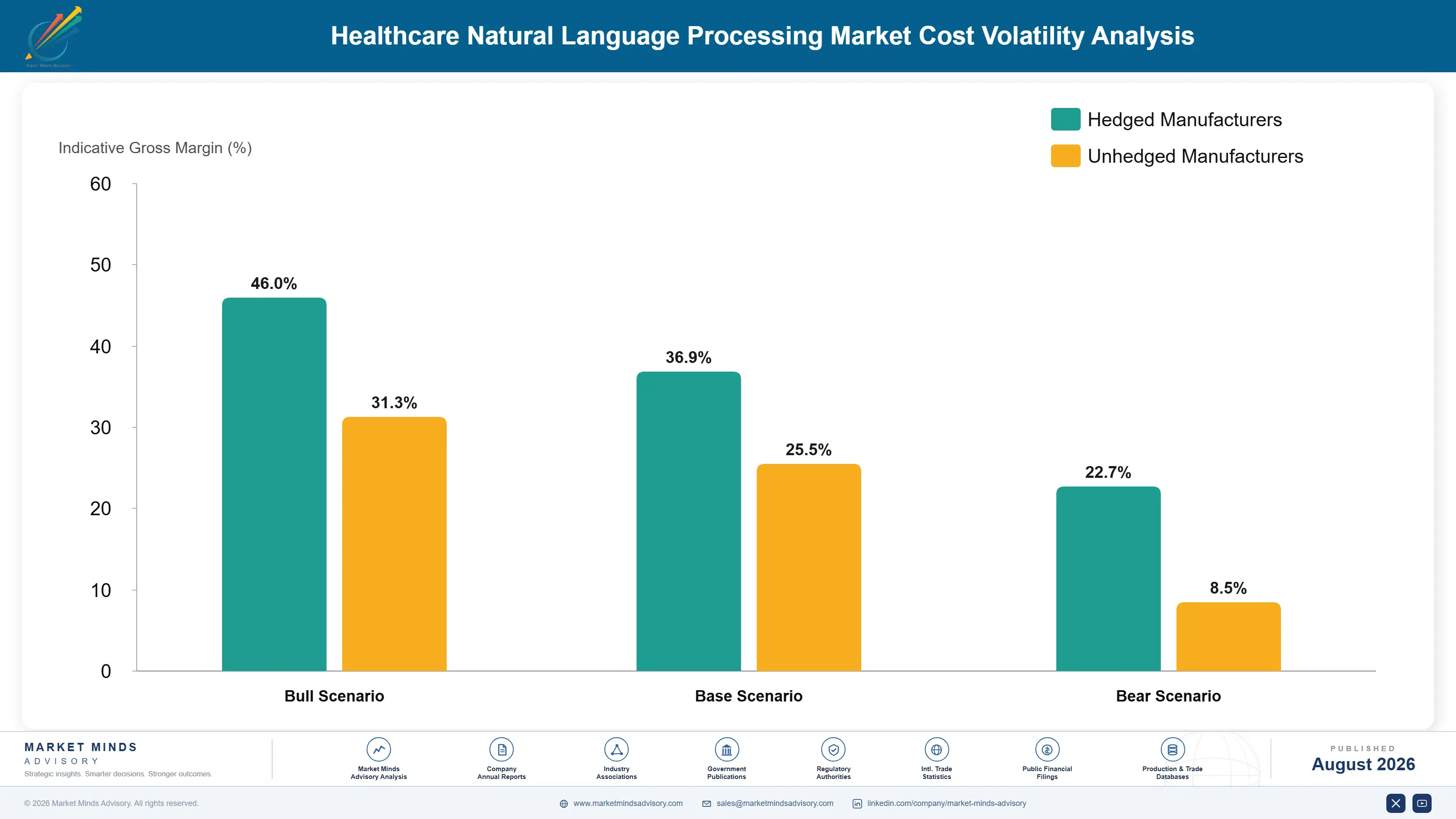
Compute and clinical data annotation together account for roughly 24% of cost of goods sold, sourced from cloud infrastructure providers and specialist medical annotation firms whose pricing reflects both computing demand and the clinical expertise annotation requires. Engineering and model development contribute a further 30% to 36%. Customer success and clinical implementation support take 14% to 18%, with the remainder covering sales and general overhead across the business.
Cloud compute pricing rose materially through 2023 and 2024 as generative AI workloads across every industry competed for the same graphics processing capacity, and healthcare NLP vendors running large language models absorbed meaningfully higher infrastructure bills during that period. Microsoft's annual report disclosed capacity constraints affecting cloud customers broadly across that window, and several smaller vendors delayed model upgrades citing compute availability specifically as the limiting factor rather than model readiness itself.

Exposure varies by model architecture and vendor scale. Vendors operating their own model infrastructure control cost more directly than those dependent on third-party large language model providers whose pricing and availability decisions sit entirely outside their control. Vendors with committed cloud capacity agreements protect against compute price volatility considerably better than those purchasing capacity reactively during demand spikes.
healthcare-natural-language-processing-market-cost-volatility-analysis-1787332692077

Negotiate committed-use cloud compute agreements

Vendors locking in committed-use discounts with major cloud providers ahead of demand spikes protect margin against the kind of compute price volatility that affected the industry through 2023 and 2024, though it requires accurate multi-year capacity forecasting that smaller vendors often lack the scale or confidence to commit to properly upfront before demand actually materialises.

Build proprietary clinical data annotation pipelines

Vendors developing in-house clinical annotation capability, often through direct health system data partnerships, reduce dependence on external annotation vendors whose pricing and availability vary considerably, while also building a defensible clinical data asset competitors relying purely on external annotation cannot easily replicate at comparable quality, cost, or speed at all, regardless of how much they invest in catching up.

Diversify large language model provider relationships

Vendors building products that can run across multiple underlying large language model providers reduce concentrated exposure to any single provider's pricing or availability decisions, a diversification strategy that protected several vendors during recent provider capacity constraints more effectively than single-provider competitors managed at the time this hit hardest across the wider industry and its many smaller participants.

Portfolio Architecture for Margin Defence

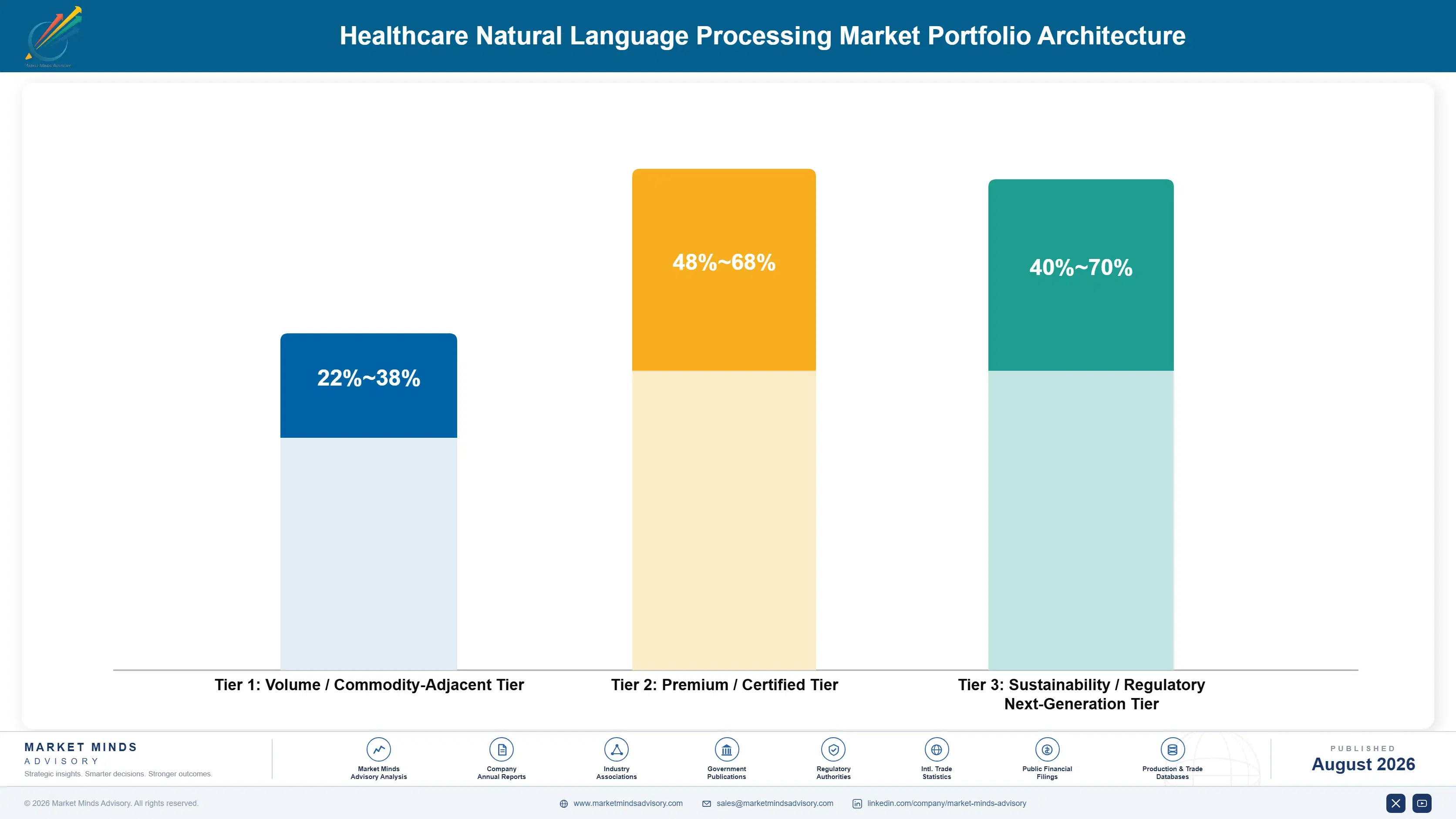
The portfolio splits into three tiers with sharply different economics. Basic transcription and dictation software forms the volume tier, competing largely on price with margin set by compute cost and scale. Ambient documentation and coding-focused NLP earn considerably more because documented accuracy and enterprise integration both resist the commoditisation pressure hitting basic transcription. Revenue-cycle-integrated coding platforms sit differently again, priced against protected reimburse
The tension runs between winning easy pilot volume and building the enterprise integration and trust infrastructure that actually protects margin at scale. A vendor chasing every small-practice pilot available eventually gets squeezed as larger platforms bundle comparable capability for less, yet building enterprise integration requires investment thin-margin pilot revenue rarely funds adequately on its own. Vendors handling this well treat pilots as the acquisition motion and enterprise contracts as the margin engine.

High-value pools concentrate where documented accuracy, integration depth, or coding revenue protection limit competition: enterprise ambient documentation contracts with proven time savings, coding platforms with measurable reimbursement protection, and revenue-cycle-integrated deployments spanning large hospital networks. Basic transcription sits at the other end, competing almost entirely on price against every generic speech-to-text provider available.

Volume / Commodity-Adjacent Tier

Basic transcription and dictation software competing largely on price against generic speech-to-text alternatives across most clinical settings. Margin is thin and set almost entirely by compute cost and manufacturing scale achieved.
Gross Margin: 22-38%

Premium / Certified Tier

Ambient documentation and computer-assisted coding platforms with documented accuracy and deep electronic health record integration across major systems nationwide. Margin reflects clinical validation investment and enterprise switching cost built over time.
Gross Margin: 48-68%

Sustainability / Regulatory / Next-Generation Tier

Revenue-cycle-integrated coding platforms and next-generation multimodal clinical AI addressing both documentation and reimbursement protection together for large systems nationwide. The wide range reflects early-stage pricing still settling across the industry broadly.
Gross Margin: 40-70%
healthcare-natural-language-processing-market-portfolio-architecture-1787332692578

High-value Sub-segments and Strategic Watch-out

Ambient Clinical Documentation and Scribes

High value and high growth at 16.5%, the fastest function, as large language model accuracy gains convert cautious pilots into enterprise-wide standing contracts across nearly every major health system now evaluating the category seriously and consistently across departments, service lines, physician specialties, and outpatient clinics alike.
Gross Margin: 48-68%

Computer-Assisted Coding and CDI

High value with strong growth at 13.2%, driven by payer scrutiny tightening that converts compliance obligation directly into protected reimbursement revenue vendors can quantify precisely for finance and revenue cycle leadership evaluating vendors closely each renewal cycle and every single annual budget review process undertaken.
Gross Margin: 44-64%

Clinical Decision Support Text Mining

The volume core by installed base, growing at 9.6% as baseline text mining for quality reporting and population health becomes table stakes bundled with broader clinical software platforms rather than standalone purchases requiring separate budget approval each fiscal cycle nationwide and increasingly internationally too each year.
Gross Margin: 30-48%

Basic Transcription and Dictation Software

The strategic watch-out, growing at just 3.4% and steadily displaced as ambient documentation and generic speech-to-text tools both erode the narrow value proposition basic dictation software once held firmly across most clinical settings and physician specialties nationwide and increasingly well abroad too each passing year.
Gross Margin: 20-34%

How Healthcare NLP Revenue Actually Compounds

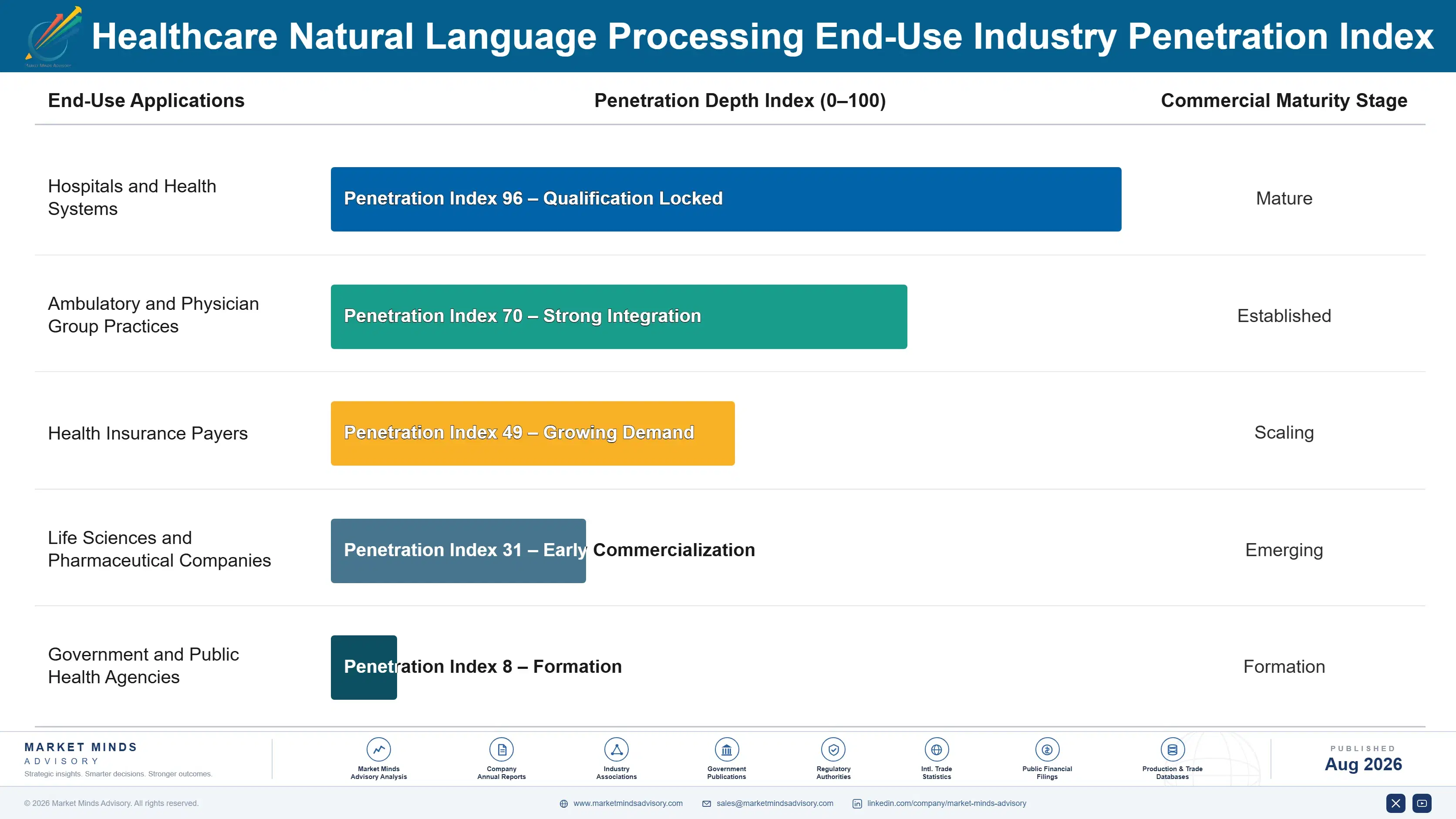
Revenue depends on a health system's enterprise-wide deployment relationship, not on winning a single department pilot. An ambient documentation contract that scales across an entire health system generates revenue across every physician onboarded for the full contract term, so annuity value sits in that enterprise relationship rather than in the original pilot sale. Coding-focused NLP behaves similarly, generating revenue tied directly to claim volume that grows as the deployment expands across
Stickiness varies sharply by function and integration depth. Ambient documentation and coding platforms stick hardest once physicians build workflow habits around them, since retraining an entire medical staff carries disruption cost health system leadership avoids unless genuinely forced. Clinical decision support tools stick moderately, protected mainly by integration investment rather than genuine differentiation. Basic transcription switches most readily, since any comparable provider satisfies the requirement.

Buyer profiles have shifted generationally. Chief medical information officers who once drove NLP procurement on clinical criteria increasingly share that decision with chief financial officers focused on documented time savings and revenue cycle leadership tracking coding accuracy gains. Physician wellness and retention leadership increasingly sit alongside clinical informatics in vendor evaluation, a shift burnout data has made necessary rather than optional.
healthcare-natural-language-processing-market-end-use-penetration-index-1787332693066

Our Call On Healthcare NLP

These are among the four positions where our research anticipates prominent divergence between winners and laggards over the coming forecast period. Each is grounded in the demand model, the regulatory perimeter, and the announced capacity pipeline.
01 / DOCUMENTED TIME SAVINGS WINS

Measured productivity beats a compelling demo

Hospitals report physician documentation time reductions of 40% to 70% after deploying ambient scribe technology, and vendors who document that specific, measured return directly convert a productivity pitch into a retention and cost avoidance calculation finance committees actually approve quickly. That evidence base also strengthens renewal negotiations considerably, since a vendor can point to measured outcomes rather than repeat the original pitch each cycle with every new prospect. Vendors should treat case study documentation as a core commercial investment, not a marketing afterthought handled late.
02 / CODING ACCURACY CAPTURES BUDGET

Revenue cycle ownership beats informatics alone

Hospitals deploying NLP-assisted coding tools report accuracy improvements of roughly 12 to 20 points, translating directly into protected reimbursement revenue that would otherwise leak away through denied or underpaid claims processed without sufficient documentation detail attached to the original encounter. Vendors who quantify that specific revenue protection capture budget from revenue cycle management rather than competing only for a smaller clinical informatics allocation constrained by different priorities entirely. Building this quantification capability should rank above chasing every available pilot opportunity that arises.
03 / INTEGRATION DEPTH DECIDES SCALE

Enterprise readiness wins the largest deals

Large health systems increasingly require deep electronic health record integration and enterprise-wide change management support before committing to a system-wide rollout, and vendors who build this integration capability ahead of the largest deals close them faster than competitors treating integration as a post-sale afterthought handled reactively after signing the initial contract. Integration depth is becoming as commercially decisive as raw model accuracy in competitive enterprise evaluations nationwide. Vendors should invest in integration capability as seriously as they invest in core model development.
04 / TRUST INFRASTRUCTURE PROTECTS SCALE

One failure can undo years of adoption momentum

A single high-profile accuracy failure can stall an entire health system rollout regardless of aggregate accuracy statistics a vendor can otherwise demonstrate convincingly, and vendors investing in confidence scoring and mandatory physician review workflows before scaling deployment avoid the trust collapse that has stalled several well-funded competitors previously across the industry. That trust infrastructure also generates usage data that genuinely improves the next product generation over time. Building it early protects deployment momentum against a single damaging incident later on.

Engagement Snapshot From the Field

A live engagement with an industry participant carrying material or product regulatory and market exposure ahead of a defining policy shift, showing how our research translates into a defensible multi-year portfolio strategy.
MARKET MINDS ADVISORY · CLIENT ENGAGEMENT SUMMARY
Healthcare Natural Language Processing Producer Strategic Portfolio Review and Transition Roadmap 2026·Investment Scenario on Healthcare Natural Language Processing Exposure Evaluation 2025-26
CLIENT PROFILE
A regional health system operating eight hospitals and 45 outpatient clinics engaged MMA while evaluating ambient documentation vendors to address rising physician attrition tied to administrative burden. The client reported physician turnover costs near USD 14 million annually, with documentation burden cited as a leading factor in exit interviews conducted over the prior two years (client-reported, unverified by MMA).
STRATEGIC CHALLENGE
Leadership needed to select a vendor capable of scaling across the entire physician network within eighteen months, but internal informatics staff lacked the bandwidth to evaluate more than a handful of vendors properly, and a previous limited pilot had produced inconsistent physician feedback that made the board hesitant to commit further budget.
MMA APPROACH
MMA benchmarked five shortlisted vendors against the client's electronic health record environment, weighting integration timeline and documented accuracy heavily given the client's limited internal staffing capacity. We modelled avoided attrition value against each vendor's proposed pricing to build the board's business case directly. We then assessed clinician trust infrastructure and confidence scoring capability across each finalist.
KEY FINDINGS
  1. Two of five shortlisted vendors lacked validated integration for the client's specific electronic health record version, adding significant deployment risk and timeline uncertainty overall.
  2. Modelled avoided attrition value exceeded the leading vendor's annual subscription cost by roughly 70% within the first full year of deployment alone.
  3. The previous limited pilot had lacked confidence scoring entirely, which explained much of the inconsistent physician feedback the board had seen previously and repeatedly.
  4. A phased eighteen-month rollout by department reduced change management risk considerably compared with the all-at-once approach originally proposed internally by informatics staff.
CLIENT PROFILE
A regional health system operating eight hospitals and 45 outpatient clinics engaged MMA while evaluating ambient documentation vendors to address rising physician attrition tied to administrative burden. The client reported physician turnover costs near USD 14 million annually, with documentation burden cited as a leading factor in exit interviews conducted over the prior two years (client-reported, unverified by MMA).
STRATEGIC CHALLENGE
Leadership needed to select a vendor capable of scaling across the entire physician network within eighteen months, but internal informatics staff lacked the bandwidth to evaluate more than a handful of vendors properly, and a previous limited pilot had produced inconsistent physician feedback that made the board hesitant to commit further budget.
MMA APPROACH
MMA benchmarked five shortlisted vendors against the client's electronic health record environment, weighting integration timeline and documented accuracy heavily given the client's limited internal staffing capacity. We modelled avoided attrition value against each vendor's proposed pricing to build the board's business case directly. We then assessed clinician trust infrastructure and confidence scoring capability across each finalist.
KEY FINDINGS
  1. Two of five shortlisted vendors lacked validated integration for the client's specific electronic health record version, adding significant deployment risk and timeline uncertainty overall.
  2. Modelled avoided attrition value exceeded the leading vendor's annual subscription cost by roughly 70% within the first full year of deployment alone.
  3. The previous limited pilot had lacked confidence scoring entirely, which explained much of the inconsistent physician feedback the board had seen previously and repeatedly.
  4. A phased eighteen-month rollout by department reduced change management risk considerably compared with the all-at-once approach originally proposed internally by informatics staff.
RECOMMENDED STRATEGY
Phase 1: Phase 1 (0 to 5 months): Select the vendor with validated integration and strongest confidence scoring, then pilot in two departments. Phase 2: Phase 2 (5 to 13 months): Expand deployment department by department, incorporating physician feedback from each successive rollout phase carefully. Phase 3: Phase 3 (13 to 18 months): Complete network-wide deployment and establish ongoing accuracy monitoring against the original board business case.
OUTCOME
The client selected the recommended vendor and completed network-wide deployment within the eighteen-month target, with physician satisfaction scores improving meaningfully over the previous limited pilot across every department. Early attrition data suggested the avoided cost estimate was tracking close to the modelled projection (client-reported, unverified by MMA).

Frequently Asked Questions

Foundational context covering the market sizes, CAGR, scope, country, region and competition that inform every finding below. This section is provided to cover basics and most often pre-purchase conversations, answered from the MMA Primary Research Dataset.

What is the current size of the Healthcare Natural Language Processing Market?

The global healthcare NLP market is valued at USD 4.6 billion in 2025, covering ambient documentation, computer-assisted coding, and clinical text mining software. Electronic health record core licensing is excluded.

How large will the Healthcare Natural Language Processing Market be by 2036?

The market is forecast to reach USD 15.07 billion by 2036 in the base case, about 2.94 times the 2026 level. That represents incremental value of roughly USD 9.95 billion across the decade.

What is the CAGR for the Healthcare Natural Language Processing Market 2026 to 2036?

The market grows at an 11.4% CAGR in the base case, with bull and bear scenarios at 12.8% and 9.9%. The spread turns mainly on large language model accuracy gains and payer coding scrutiny pace.

Which segment is growing fastest?

Ambient clinical documentation and scribes grow fastest at 16.5%, about 1.45 times the overall rate, as large language model accuracy gains make automated note generation trustworthy. Computer-assisted coding follows at 13.2%.

Who are the major companies in the Healthcare Natural Language Processing Market?

Leading companies include Microsoft (Nuance), 3M Health Information Systems, Optum, Suki AI, and Abridge. Concentration is moderate, with the top five holding roughly 36% of category revenue.

Which country is growing fastest?

India grows fastest at a 14.2% CAGR, as hospital digitisation and a deep domestic AI talent pool pull adoption forward rapidly. China follows on hospital grading mandates and digitisation policy.

Report Segmentation Architecture

The full report scope spans multiple orthogonal segmentation dimensions, with cross-tabulated demand data provided for each dimension pair. Coverage extends further to regional breakdowns, trend trajectories, and the competitive detail needed to support segment-level decision-making.

By Software Function

  • Ambient Clinical Documentation and Scribes
  • Computer-Assisted Coding and CDI
  • Clinical Decision Support Text Mining
  • Population Health and Real-World Evidence Extraction
  • Patient-Facing Conversational AI

By End-Use Industry

  • Hospitals and Health Systems
  • Ambulatory and Physician Group Practices
  • Health Insurance Payers
  • Life Sciences and Pharmaceutical Companies
  • Government and Public Health Agencies

By Commercial Dimension

  • Direct Enterprise Licensing
  • Per-Physician Subscription Contracts
  • Revenue Cycle Managed Services
  • Implementation and Integration Services

By Region

  • North America
  • Western Europe
  • East Asia
  • South Asia and Pacific
  • Latin America
  • Middle East and Africa
  • Eastern Europe

Scope, Methodology, and Coverage

Every figure in this report is reproducible from documented input assumptions. The scope below maps the historical period, the forecast horizon, the segmentation dimensions, and the countries covered, alongside the underlying primary and qualitative methodology.
Historical Period
2020 to 2025
Forecast Period
2026 to 2036
Base Year
2025 (USD billions; MMA Primary Research Dataset, August 2026)
Market Definition
The healthcare natural language processing market comprises software that extracts, generates, or interprets clinical language, valued at annual recurring software and service revenue. It spans ambient clinical documentation and scribes, computer-assisted coding and clinical documentation improvement, clinical decision support text mining, population health and real-world evidence extraction, and patient-facing conversational AI sold to hospitals, physician practices, payers, and life sciences companies. General-purpose language models sold without healthcare-specific tuning, electronic health record core licensing, and medical transcription services performed manually are excluded.
Quantitative Units
USD billions (current prices); enterprise contract counts where applicable
Segmentation Dimensions
By Software Function; By End-Use Industry; By Commercial Dimension; By Region
Regions Covered
North America, Western Europe, East Asia, South Asia and Pacific, Latin America, Middle East and Africa, Eastern Europe
Countries Covered
USA, China, Germany, UK, France, Japan, South Korea, India, Canada, Australia, Israel, UAE, Saudi Arabia, Brazil, Mexico, Poland, Czech Republic, Hungary, Romania, Sweden, Netherlands, Italy, Spain, Singapore, and additional markets relevant to this sector
Key Companies Profiled
Microsoft (Nuance), 3M Health Information Systems, Optum, Suki AI, Abridge, Ambience Healthcare, DeepScribe, Nabla, Corti, Regard, IKS Health, Solventum, Oracle Health, Amazon Web Services, Google Cloud Healthcare, Merative, IQVIA, ScienceSoft, Talkdesk Healthcare, Notable Health
Quantitative Methodology
Primary survey, n=3,800 respondents, Q4 2025, six countries; demand-side model with trade association cross-validation
Qualitative Methodology
47 expert interviews, Q4 2025; applied to validate demand model assumptions, identify emerging dynamics, and assess competitive positioning
Report Format
PDF and XLSX data workbook (Word format preview document)
Publisher
Market Minds Advisory
Report Code
MMA-2026-HLT-119
Published
August 2026
Contact
sales@marketmindsadvisory.com | www.marketmindsadvisory.com

Purchase the full Healthcare Natural Language Processing Market Report (2026 to 2036).

The full MMA Healthcare Natural Language Processing report sizes the market across five software functions, five end-use industries, four commercial dimensions, and seven regions through 2036. It profiles 20 companies on a consistent annual recurring revenue basis, scoring each on documented accuracy, enterprise integration depth, and coding capability. Scenario models quantify how large language model accuracy, payer coding scrutiny, and compute cost volatility move both revenue and margin by function. The report also includes documentation time savings benchmarking, coding accuracy improvement tracking, and enterprise deployment timeline analysis for commercial and clinical leadership teams.
Five-function and four-dimension market sizing to 2036
Twenty-company benchmark on recurring revenue basis
Documentation time savings and physician retention benchmarking
Coding accuracy improvement and revenue protection modelling
Enterprise deployment timeline and integration depth tracking
Large language model provider dependency and cost analysis

Built For The People Who Decide

From boardroom strategy to bench-side execution, this report is read cover-to-cover by leaders shaping the next decade of their industry, turning demand scenarios, market dynamics and valuation benchmarks into decisions.
CXOs/ Presidents/ VPs/ Managers
M&A and Corporate Development
Strategy Teams and R&D Heads
Procurement and Product Directors
Regulatory and Compliance Leaders
Investor Relations and Equity Analysts