
Market Minds Advisory
Global Crankshaft Position Sensor Market

Global Crankshaft Position Sensor Market: Electrification Redefines a Legacy Engine Sensing Category

Crankshaft position sensor suppliers face declining internal combustion vehicle production volumes colliding with hybrid powertrain proliferation, tightening onboard diagnostic regulations, and rising demand for higher precision sensing across increasingly electrified drivetrain architectures worldwide.

Lead Analyst

David Horsley

Published

September 2026

Make Smarter Decisions with Customized Research Insights

Request a free sample report and evaluate market opportunities, growth trends, and competitive dynamics relevant to your business needs.

2025 MARKET VALUE$2.6BMarket Size 2025
2036 FORECAST VALUE$5.4BBase Case , 2026 to 2036
CAGR 2026 TO 20366.8 %Bull 8.1% / Bear 5.5%
INCREMENTAL OPPORTUNITY$2.6BNet 10- year value creation
EXPANSION MULTIPLE1.93x2036 value over 2026 base
Strategic Levers
M&A Pipeline
Regional Outlook
Country Rankings
Competitive Intelligence
Segmental Deep-dive
Call-Us : 91 93563 13602

Executive Snapshot and Market Trajectory

Hybrid powertrain manufacturers are specifying higher precision Hall effect crankshaft position sensors faster than suppliers reliant on legacy variable reluctance designs can reengineer their product lines, creating a widening qualification gap across new vehicle programs entering production. Suppliers unable to close this gap risk losing entire vehicle platform accounts.
Hall effect crankshaft position sensors are pulling category growth well ahead of variable reluctance designs, as hybrid and start-stop engine architectures require faster signal response and higher accuracy than legacy sensor technology reliably delivers under variable engine speed conditions. East Asia commands the largest production base given China's dominant automotive component manufacturing scale and expanding domestic vehicle production, while North America anchors premium hybrid and performance vehicle sensor demand.
Competitive structure remains fairly concentrated among established automotive sensor suppliers, with the top five holding a substantial combined revenue share, while a considerable gap separates the leading suppliers from smaller regional challengers built over decades of relationships. Tightening onboard diagnostic regulations are compounding qualification complexity, pushing suppliers toward higher precision sensing capability rather than relying on legacy variable reluctance designs, separating suppliers with dedicated precision engineering from those relying on legacy manufacturing scale.
Market Definition
The crankshaft position sensor market covers sensors used to detect crankshaft angular position and rotational speed in internal combustion and hybrid vehicle engines, including Hall effect, variable reluctance, and magnetoresistive sensor technologies. It excludes camshaft position sensors and excludes broader engine control unit hardware beyond the sensing component itself.
Base Year Value
$2.6B in 2025 (MMA Primary Research Dataset, August 2026)
Forecast Period
2026 to 2036, eleven discrete annual values
CAGR
6.8% base case. Bull 8.1%. Bear 5.5%.
Fastest Growth Segment
Hall Effect Crankshaft Position Sensors: 9.5% CAGR
Fastest Growth Country
China: 8.2% CAGR
Fastest Growth Region
South Asia and Pacific: 9.0% CAGR
Largest Region
East Asia: 34% of 2025 global value
Market Leaders
Robert Bosch GmbH, Denso Corporation, Continental AG, Delphi Technologies, and Sensata Technologies. Source: MMA Analysis based on company annual reports.
Primary Survey
n=3,800 procurement and R&D decision-makers, Q4 2025, six countries
Methodology
Demand-side build-up, cross-validated against public data, 47 expert interviews

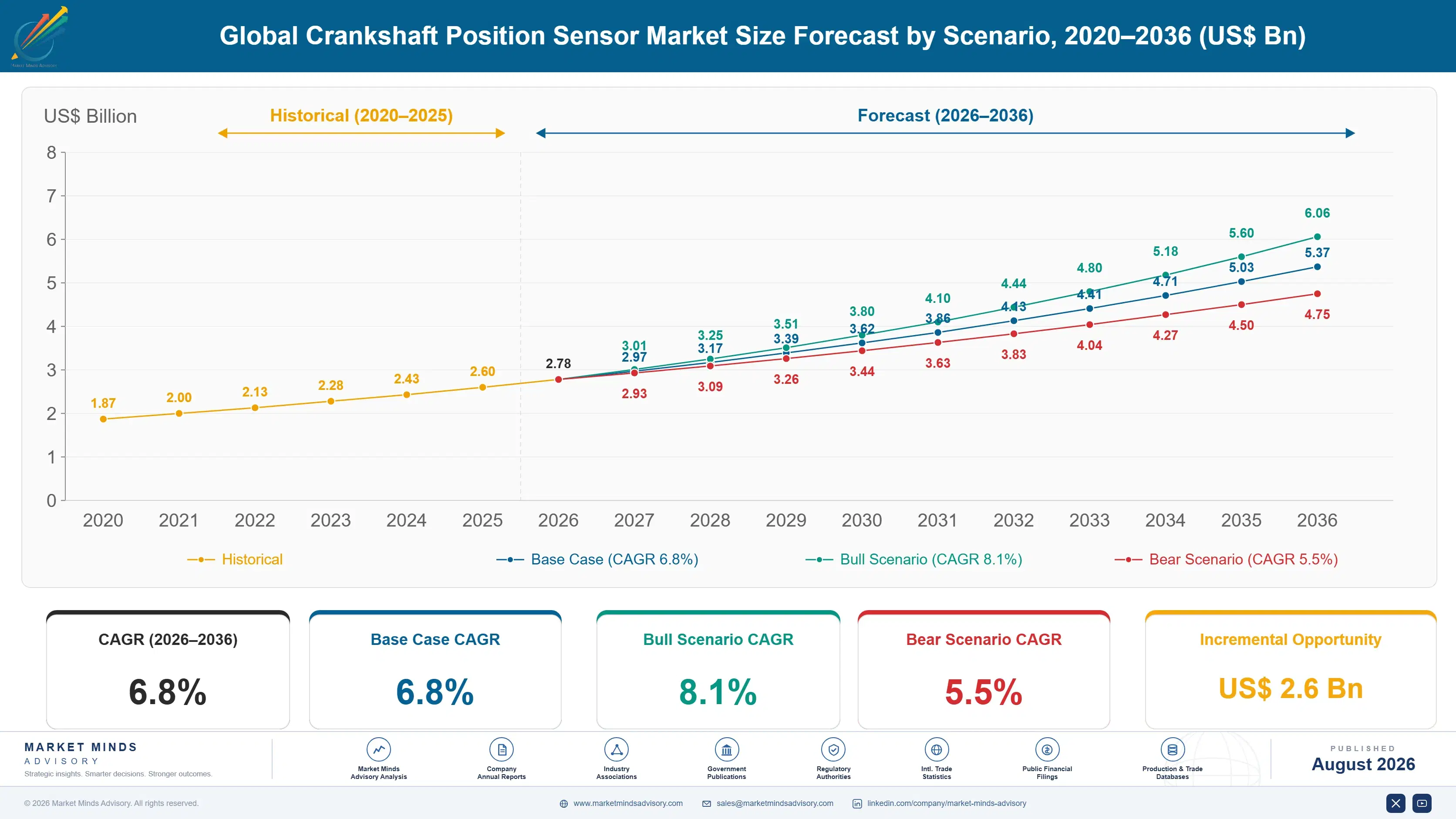
Global Crankshaft Position Sensor Market Forecast Scenarios

global-crankshaft-position-sensor-market-size-forecast-scenario-1787552080936
Between 2020 and 2025 the market grew at a historical pace of roughly 5.9 percent annually, as internal combustion vehicle production provided steady baseline demand while hybrid powertrain sensor qualification accelerated meaningfully only in the final two years of the period, once automakers finalized next-generation hybrid engine architectures and began scaling production across multiple platforms.
The base case assumes growth near 6.8 percent annually through 2036, anchored in three commercial mechanisms: expanding hybrid powertrain sensor qualification among automakers seeking higher precision engine timing control, tightening onboard diagnostic regulations requiring more accurate crankshaft position detection, and steady replacement sensor demand as global vehicle parc continues expanding across both developed and emerging automotive markets worldwide. These mechanisms are reinforcing each other as regulatory timelines and hybrid production ramps increasingly converge across major markets.
A bull scenario builds on faster hybrid vehicle production growth requiring expanded high precision sensor qualification across additional vehicle platforms, while a bear scenario centers on accelerating battery electric vehicle adoption eliminating crankshaft sensing requirements entirely across an increasing share of new vehicle production over the coming decade. Suppliers monitoring both trajectories closely are best positioned to reallocate capital as production volumes shift.

Hybrid Powertrains Reshape Sensor Precision Requirements

Three forces are converging on the category at once: hybrid powertrain manufacturers are specifying higher precision sensors faster than suppliers relying on legacy variable reluctance designs can reliably reengineer their product lines, tightening onboard diagnostic regulations are raising accuracy requirements across mainstream vehicle platforms, and suppliers are racing to expand semiconductor-based sensing capability fast enough to meet accelerating downstream design requirements simultaneously.
MARKET CONCENTRATIONCR5 62%top five suppliers hold a substantial combined share
HALL EFFECT SENSOR PENETRATION58%share of production volume using Hall effect technology
LEADING PRODUCING COUNTRYChinalargest single national manufacturing and export base overall
AVERAGE SELLING PRICE TREND-3% annuallytypical yearly price decline as production capacity scales
SENSOR REPLACEMENT CYCLE LENGTH8 yearstypical vehicle age before sensor replacement becomes necessary
SEMICONDUCTOR COST SHARE42% of COGSsemiconductor and magnetic material inputs as portion of cost
Commercially the category increasingly behaves like a precision semiconductor sensing business layered on top of traditional mechanical sensor manufacturing, since a supplier's ability to win hybrid platform qualification now depends as much on signal processing accuracy and functional safety certification as on raw production volume alone, a shift that is rewarding suppliers with dedicated semiconductor sensing capability over conventional mechanical sensor specialists.
Over the next decade, suppliers most likely to capture disproportionate value are those investing in Hall effect and magnetoresistive sensing capability ahead of broader hybrid platform standardization, since building this capability after competitors have already established it takes considerably longer than building it in from initial product design. Suppliers that delay this investment risk losing hybrid platform accounts to competitors already embedded in qualification pipelines.
"A crankshaft position sensor used to be a simple mechanical part. Now it has to keep pace with hybrid engines starting and stopping dozens of times a drive cycle, and the suppliers who solved that timing problem first are the ones winning hybrid platform contracts."
Director, Automotive Sensors and Engine Management Practice · MMA Automotive Sensors / Engine Management Systems Practice · August 2026

Market Trends

Automakers Standardizing Hall Effect Sensor Specification Across Platforms

Automakers across multiple hybrid and start-stop vehicle platforms are increasingly standardizing Hall effect crankshaft position sensor specification to achieve the faster signal response and higher accuracy that hybrid engine architectures require, moving beyond premium hybrid models into broader mainstream vehicle production. This shift follows several years of accumulating evidence that Hall effect designs reduce timing errors relative to variable reluctance sensors under variable engine speed conditions typical of start-stop cycling. Multiple automakers have expanded Hall effect sensor qualification programs within the past two years, extending beyond premium hybrid platforms into broader mainstream production as well.
Market Impact: Lifts hybrid-driven demand by 11%
Tightening Onboard Diagnostic Regulations Raising Accuracy Thresholds

Regulatory bodies across major automotive markets are tightening onboard diagnostic regulations, requiring more accurate crankshaft position detection to support increasingly stringent emissions monitoring and misfire detection requirements across all new vehicle platforms. This shift requires higher precision sensing technology that differs substantially from legacy variable reluctance designs, concentrating compliance-driven demand among suppliers with established semiconductor sensing capability and functional safety certification. Several major automotive markets have finalized updated onboard diagnostic requirements within the past two years, accelerating supplier transition timelines considerably. This regulatory push is compressing supplier transition windows across nearly every major vehicle production region simultaneously.
Market Impact: Adds 6% to replacement-driven demand

Market Opportunities and Growth Drivers

Expanding Global Hybrid Vehicle Production Capacity

Automakers are expanding hybrid vehicle production capacity substantially across multiple regions, directly increasing addressable demand for high precision crankshaft position sensors as a critical engine timing component in next-generation hybrid powertrain designs. This capacity expansion is occurring across both established and emerging hybrid vehicle manufacturing regions, broadening the addressable customer base for sensor suppliers considerably beyond the historically concentrated set of premium hybrid brands that first drove early adoption of Hall effect sensor technology, pulling in new mainstream entrants each year. Suppliers are responding by pre-booking semiconductor allocations ahead of confirmed order volume.
Market Impact: Reduces addressable volume by 8%

Rising Vehicle Parc Supporting Steady Replacement Demand

The global vehicle parc continues expanding across both developed and emerging automotive markets, directly increasing the installed base requiring eventual crankshaft position sensor replacement as vehicles age beyond typical warranty periods and into aftermarket service cycles. This replacement driver provides demand visibility that differs from purely new vehicle production driven growth, giving suppliers more predictable long-term volume planning than categories dependent entirely on new vehicle platform adoption trends alone, supporting steadier capital planning across the aftermarket supply base. Several aftermarket distributors have expanded inventory to capture this growing replacement volume.
Market Impact: Extends lead times by 11%

Market Restraints and Challenges

Accelerating Battery Electric Vehicle Adoption Eliminates Sensing Requirement

Battery electric vehicles do not require crankshaft position sensors at all, since they lack internal combustion engines entirely, a fundamental architecture difference between combustion and electric drivetrains that no sensor design improvement can address. The commercial impact is that suppliers face a shrinking total addressable market as battery electric vehicle production share continues rising across major automotive markets, forcing many suppliers to diversify into adjacent electric drivetrain sensing categories rather than relying on crankshaft sensor volume alone. Several suppliers are pursuing diversification into motor position and battery management sensing as a mitigation path to offset this declining addressable volume.
Market Impact: Lifts Hall effect demand by 13%

Semiconductor Supply Constraints Limit Hall Effect Sensor Scaling

Hall effect and magnetoresistive sensor production depends on specialized semiconductor components facing periodic capacity constraints, a complexity rooted in the broader semiconductor industry's allocation priorities that frequently favor higher volume consumer electronics customers over automotive sensor applications during periods of tight supply. The commercial impact is that suppliers face extended lead times and elevated component costs when scaling Hall effect production, slowing the pace at which suppliers can capture growing hybrid platform demand. Several suppliers are pursuing long-term semiconductor supply agreements as a mitigation path to secure allocation priority ahead of anticipated demand growth.
Market Impact: Adds 9% to compliance-driven demand
4 additional market trends, 3 additional growth drivers, and 4 additional restraints and challenges are covered in the full report. Contact sales@marketmindsadvisory.com to access the complete intelligence.

Segment CAGR and Growth Architecture

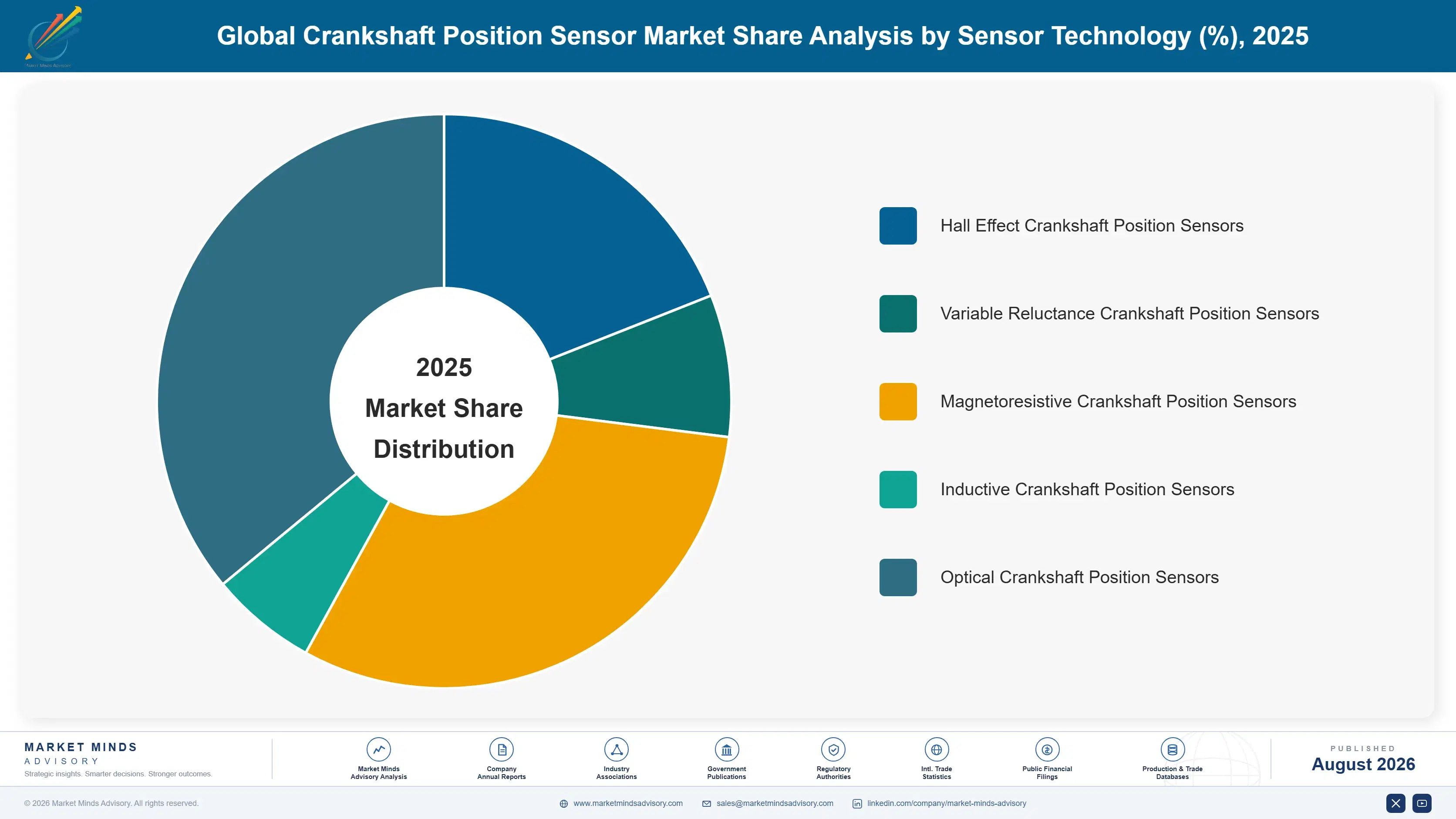
Segmentation follows sensor technology, since Hall effect, variable reluctance, magnetoresistive, and inductive crankshaft position sensors each carry distinct accuracy characteristics, certification pathways, and cost structures despite sharing the same underlying engine timing detection function across every major automotive market covered in this report and its regional appendices. The distinction shapes both pricing power and supplier qualification pathways significantly.
global-crankshaft-position-sensor-market-market-share-analysis-1787552081489

Hall Effect Crankshaft Position Sensors

Hall effect crankshaft position sensors are growing fastest as automakers increasingly standardize this technology to achieve the faster signal response and higher accuracy that hybrid and start-stop engine architectures require across variable engine speed conditions typical of modern drive cycles. This segment requires semiconductor-based sensing technology and rigorous functional safety certification that limits qualified supply to a relatively small number of suppliers with established semiconductor sensing capability and automotive qualification experience built over multiple product generations. Suppliers with early hybrid platform qualification are securing multi-year supply agreements as automakers seek to lock in sensor supply ahead of anticipated continued hybrid production growth across multiple vehicle platforms worldwide. This consolidation is reinforced by functional safety requirements favoring established suppliers.
CAGR 9.5%

Magnetoresistive Crankshaft Position Sensors

Magnetoresistive crankshaft position sensors are the second fastest growing segment, benefiting from automakers increasingly specifying this technology for premium and performance vehicle applications requiring even higher precision than standard Hall effect sensors provide under extreme engine operating conditions. This segment requires advanced magnetic sensing technology that differs substantially from standard Hall effect designs, limiting production to suppliers with dedicated advanced materials engineering capability and precision manufacturing infrastructure. Premium and performance vehicle manufacturers are increasingly incorporating magnetoresistive sensors into standard specification, providing demand visibility that is accelerating supplier investment in this specialized precision capability across multiple regional markets. Suppliers investing early in this capability are positioned to capture the largest share of incremental margin expansion.
CAGR 8.0%
Full segment breakdown across 5 segments available in the complete report.

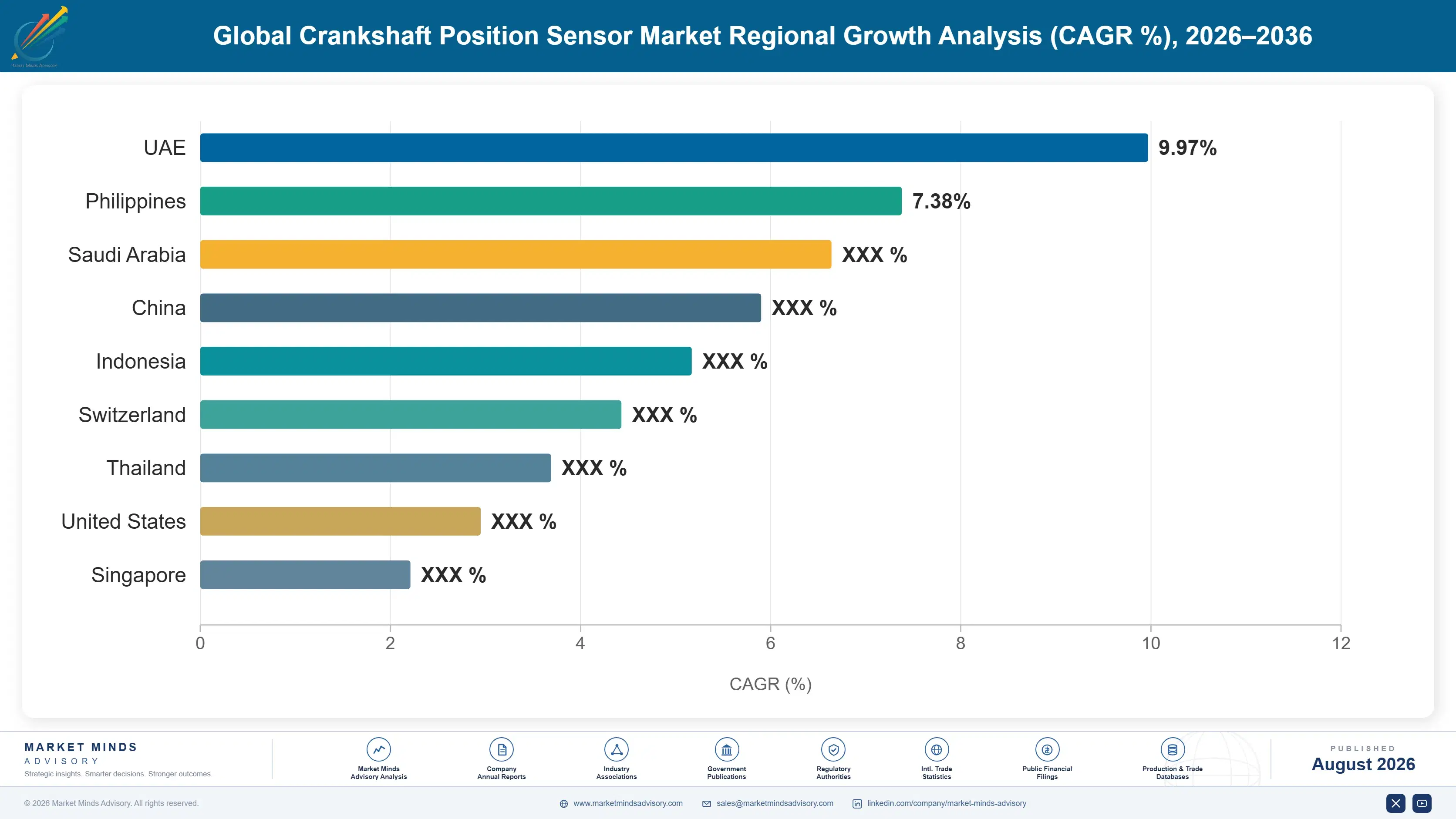
Regional Architecture and Country Demand Map

East Asia commands the largest production base given China's dominant automotive component manufacturing scale and expanding domestic vehicle production, while North America anchors premium hybrid sensor demand and South Asia shows the fastest accelerating incremental growth off a smaller base overall. Regulatory pressure and electrification reinforce these regional patterns.

North America

The United States anchors regional demand, supported by expanding domestic hybrid vehicle production and established original equipment relationships with major sensor suppliers serving Detroit-based automakers and their supply chains. Federal fuel economy standards continue pushing automakers toward hybrid powertrain adoption, sustaining demand for higher precision sensing technology across new vehicle programs entering production. Canada contributes modest additional demand tied to its own automotive assembly operations. Mexico's growing automotive manufacturing base increasingly incorporates sensor assembly for both domestic and export markets serving North American supply chains. Retail and distributor channels continue driving most aftermarket replacement volume across both countries. Federal safety recall data continues informing sensor durability specification updates across most major original equipment programs.
Share: 24% | CAGR: 7.8% (2026 to 2036)

Western Europe

Germany anchors regional demand, supported by its dominant automotive manufacturing base and established original equipment relationships with major European sensor suppliers serving premium and mainstream vehicle brands alike. The European Union's tightening emissions and onboard diagnostic regulations continue pushing automakers toward higher precision sensing technology across all new vehicle platforms. France and Italy contribute meaningful additional demand tied to their own established automotive manufacturing bases and supplier networks serving the broader regional supply chain. Specialty automotive parts distributors increasingly stock certified Hall effect sensors as standard inventory for hybrid vehicle service. The region's dense supplier network supports rapid qualification cycles for new sensor technologies entering production. Regional certification bodies continue harmonizing testing protocols across neighboring markets.
Share: 20% | CAGR: 5.5% (2026 to 2036)
Regional intelligence for 5 additional markets available in the complete report: East Asia, South Asia and Pacific, Latin America, Middle East and Africa, Eastern Europe. Contact sales@marketmindsadvisory.com.
global-crankshaft-position-sensor-market-country-cagr-analysis-1787552082006

Precision Sensing and Diversification Levers

Suppliers are pulling four commercial levers at once: Hall effect sensor technology investment, hybrid platform qualification programs, electric drivetrain diversification, and semiconductor supply agreement development, each addressing a distinct margin opportunity created by the category's shift toward hybrid and electrified powertrains this decade. Sequencing matters more than raw budget size when suppliers plan capital allocation.

Hall Effect Sensor Technology Investment Programs Nationwide

Investing in semiconductor-based Hall effect sensing capability and rigorous functional safety certification directly addresses the precision barrier separating legacy variable reluctance sensor sales from premium hybrid platform conversion across mainstream and performance vehicle segments. This investment requires substantial capital and specialized semiconductor engineering talent but positions early movers to capture disproportionate share as automakers increasingly demand certified, high precision sensors rather than variable legacy products requiring in-house validation. Suppliers with established Hall effect capability report customer qualification rates roughly 19 percent higher than competitors selling legacy sensors alone. Qualification cycles typically span twelve to eighteen months before volume commitments materialize.
Market Impact: Lifts customer qualification rate by roughly 19 percent

Hybrid Platform Qualification Program Investment Strategy

Establishing dedicated qualification programs with automakers, including joint durability testing and long-term supply agreement negotiation, positions suppliers to capture the premium pricing and volume commitments automakers increasingly require before committing to a sensor supplier across their vehicle roadmap. This program requires sustained engineering support staffing and multi-year relationship investment but has enabled suppliers pursuing this strategy to secure supply agreements covering multiple vehicle platform generations, lifting contracted volume by roughly 24 percent relative to suppliers selling on a purely transactional basis. Qualification typically requires joint testing spanning multiple product generations and platforms.
Market Impact: Lifts contracted hybrid volume by roughly 24 percent

Electric Drivetrain Sensing Diversification for Adjacent Applications

Diversifying into motor position and battery management sensing applications allows suppliers to defend revenue as battery electric vehicle adoption gradually erodes crankshaft position sensor addressable volume across major automotive markets. This approach requires sustained research and development investment but has demonstrably supported stronger revenue continuity, with diversified suppliers reporting revenue retention rates roughly 16 percent higher than competitors reliant entirely on crankshaft sensor volume alone. This trend is accelerating fastest among the largest global automaker programs currently underway. Suppliers without this diversification increasingly face investor pressure to articulate a credible long-term growth strategy.
Market Impact: Lifts revenue retention rate by roughly 16 percent

Semiconductor Supply Agreement Development Programs Worldwide

Securing long-term semiconductor supply agreements addresses growing capacity constraint risk during periods of tight allocation, positioning suppliers with secured supply to scale Hall effect production faster than competitors reliant on spot market semiconductor purchasing during periods of tight industry allocation. This approach requires substantial capital commitment and multi-year contract negotiation but has enabled early movers to secure priority allocation and shorter lead times, lifting on-time delivery performance by roughly 14 percent relative to suppliers without secured agreements. Construction and qualification timelines typically span two to three years before full capacity comes online.
Market Impact: Lifts on-time delivery performance by roughly 14 percent

Who Controls the Margin Pool

Concentration remains fairly high, with the top five suppliers holding a combined 62 percent share on a revenue basis, reflecting a market where established automotive sensor suppliers with deep original equipment manufacturer relationships compete alongside a smaller number of specialized semiconductor sensing developers entering from adjacent electric drivetrain backgrounds. The gap between the leading supplier and mid-tier challengers remains considerable, reflecting durable customer relationships built over multiple decades of automotive sensor manufacturing operation across most major platforms globally. This gap has persisted for multiple product cycles.
Current competitive activity centers on three dimensions: Hall effect sensor technology investment to capture hybrid platform demand, hybrid platform qualification programs to secure long-term supply agreements covering multiple vehicle generations, and electric drivetrain sensing diversification to defend revenue continuity against declining crankshaft sensor addressable volume.

Emerging pressure comes from specialized semiconductor sensing developers entering the category from adjacent electric drivetrain backgrounds, and from Chinese suppliers expanding export capacity aggressively with competitive pricing, threatening to gradually redistribute share away from established suppliers reliant primarily on legacy variable reluctance sensor manufacturing scale over the coming decade of continued market transition. Rankings could shift meaningfully within the next five years as electrification accelerates.
global-crankshaft-position-sensor-market-company-positioning-matrix-1787552082529

Competitive Moat and Risk Dimensions

ROBERT BOSCH GMBH

Moat: Broad Engine Management Portfolio

Bosch's broad engine management systems portfolio spanning sensors, engine control units, and fuel injection systems gives it customer relationships and cross-selling opportunities that narrower single-component competitors cannot easily replicate across comparable account depth worldwide, reinforced by decades of original equipment manufacturer trust. Its scale advantages further reinforce customer stickiness across successive product platforms.
ROBERT BOSCH GMBH

Risk: Diversified Portfolio Resource Allocation

Bosch's diversified engine management portfolio means crankshaft sensors receive resource allocation attention proportional to their relatively modest revenue contribution compared to larger engine control unit and fuel injection business lines, potentially disadvantaging this category relative to more narrowly focused competitors investing disproportionate capital directly into sensor-specific engineering.
DENSO CORPORATION

Moat: Established Japanese OEM Relationships

Denso's established relationships with major Japanese automakers and long automotive sensor manufacturing history give it continued preference among original equipment customers requiring consistent quality and reliable supply across both conventional and hybrid vehicle applications, supported by decades of accumulated manufacturing process knowledge. This trust deepens further with each successful platform launch.
DENSO CORPORATION

Risk: Japanese OEM Demand Concentration

Denso's business remains meaningfully concentrated among Japanese automaker customers, meaning shifts in those automakers' production volumes or platform strategies could disproportionately affect this business line relative to competitors with more diversified original equipment exposure across multiple automaker customer bases worldwide. than sensors sold to a broader customer base.

Players Tracked

Prominent Players

Robert Bosch GmbH
Denso Corporation
Continental AG
Delphi Technologies
Sensata Technologies

Other Key Players

Hitachi Astemo Ltd
Standard Motor Products
NGK Spark Plug Co
Melexis NV
Infineon Technologies AG
Allegro MicroSystems
TE Connectivity
Amphenol Corporation
Hella GmbH & Co KGaA
Mitsubishi Electric Corporation
Marelli Holdings Co
Valeo SA
ZF Friedrichshafen AG
Elmos Semiconductor SE
Diehl Metering GmbH

Recent Developments

FEBRUARY 2026

Bosch Expands Hall Effect Sensor Production Capacity

Robert Bosch GmbH commissioned expanded Hall effect crankshaft sensor production capacity at its German manufacturing facility, aimed at meeting rising automaker demand for high precision sensing components as hybrid vehicle production continues expanding across multiple global markets and vehicle platforms broadly. Observers view it as evidence of sustained hybrid demand.
Signal: Signals sustained capacity investment ahead of accelerating hybrid sensor demand across multiple global platforms and geographies broadly
AUGUST 2025

Denso Signs Hybrid Platform Supply Agreement

Denso Corporation signed a multi-year supply agreement with a major automaker for Hall effect crankshaft position sensors, securing contracted volume commitments covering multiple future hybrid vehicle platform generations and expanding its presence within the automaker's broader powertrain sensing lineup. Analysts view the deal as reinforcing consolidation trends.
Signal: Confirms long-term supply agreements are increasingly becoming a standard commercial strategy across the industry landscape overall today
APRIL 2025

Sensata Launches Diversified Electric Drivetrain Sensor Line

Sensata Technologies launched a new diversified electric drivetrain sensor product line, expanding its sensing capability to serve growing battery electric vehicle manufacturer demand across multiple markets and vehicle platforms. The launch reflects rising manufacturer confidence in sustained electrification-driven sensor demand growth. Observers view the move as evidence of accelerating diversification.
Signal: Demonstrates continued diversification investment strengthening electric drivetrain sensing capability across the broader industry landscape today overall

Semiconductor and Magnetic Material Exposure

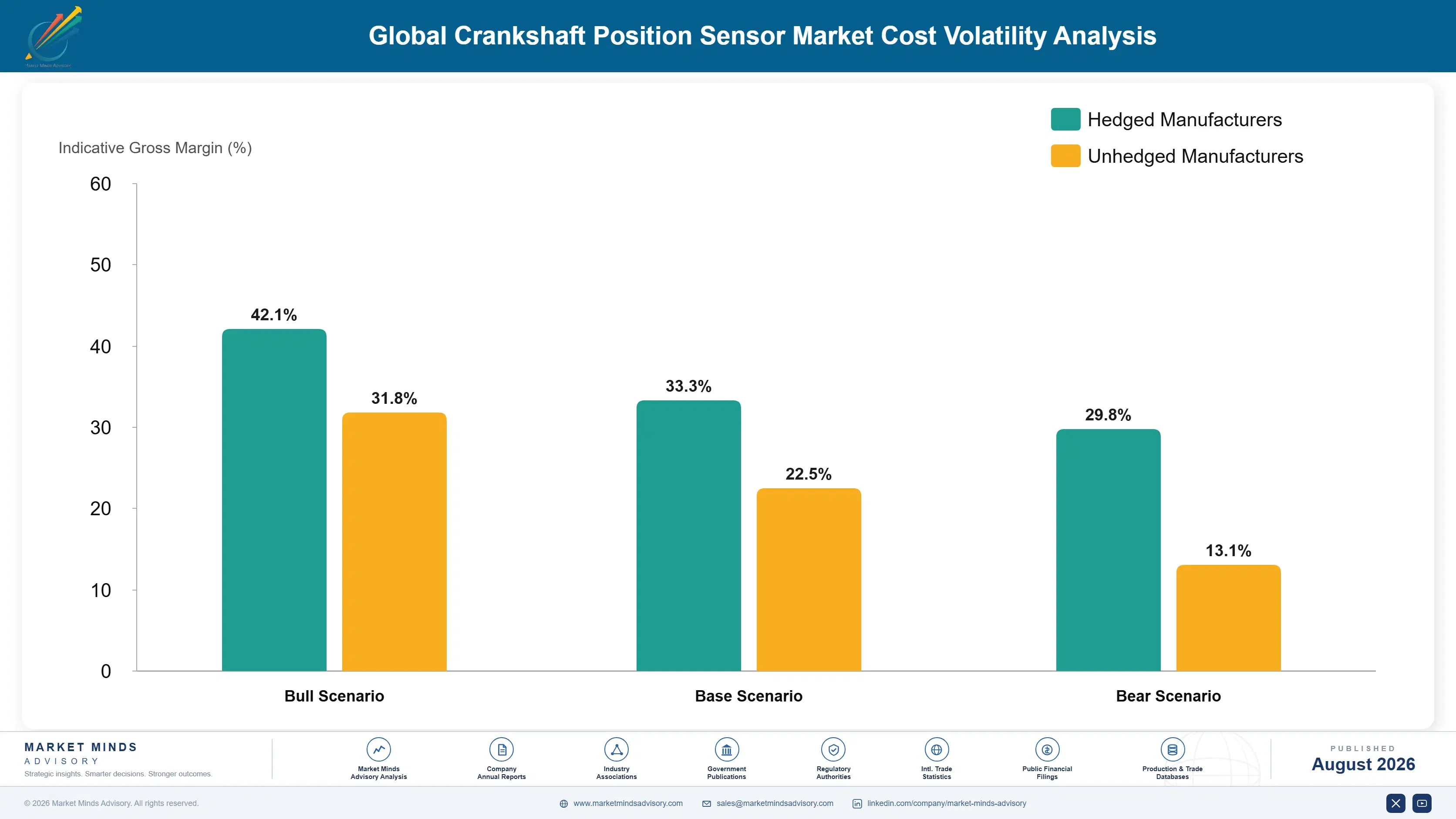
Semiconductor and magnetic material feedstock together represent roughly 42 percent of cost of goods sold for crankshaft position sensor production, sourced primarily from semiconductor foundries in Taiwan, South Korea, and Japan, with magnetic materials sourced from specialty metal processors globally across multiple long-standing supplier relationships. Manufacturers with vertically integrated semiconductor processing capability report meaningfully greater cost predictability.
Semiconductor prices and lead times spiked considerably in 2021 and 2022 following broader global chip shortage disruption, a volatility event documented in EIA and company annual report disclosures across the automotive sector, temporarily halting production lines and forcing several suppliers to renegotiate customer pricing contracts before semiconductor supply gradually stabilized over the following two years across most regional markets. Several smaller suppliers reported production delays exceeding several months at the peak.

Exposure varies considerably by player type: large diversified sensor companies with direct semiconductor foundry relationships have absorbed volatility more easily than smaller specialized sensor manufacturers reliant on spot market purchasing, a disadvantage that is accelerating consolidation of smaller manufacturers into larger diversified component company operations across multiple regional markets. Smaller producers increasingly seek acquisition partners as a result.
global-crankshaft-position-sensor-market-cost-volatility-analysis-1787552082725

Direct Semiconductor Foundry Supply Agreements

Larger suppliers are securing direct multi-year supply agreements with semiconductor foundries, protecting production continuity and pricing stability during volatility events, though this approach requires accurate long-term demand forecasting that smaller suppliers with less established commercial history often find difficult to commit to confidently across multiple sourcing regions. Larger firms with established banking relationships find this route easier to negotiate.

Semiconductor Price Hedging Strategy Development Programs

Developing structured hedging strategies against semiconductor price volatility reduces exposure to short-term supply chain disruption, though this flexibility requires specialized financial expertise that most suppliers pursue only gradually across multiple contract renewal cycles and budget planning periods spanning several years. Suppliers that have adopted hedging report meaningfully steadier quarterly margin performance than peers relying on spot purchasing alone.

Multi-Source Semiconductor Sourcing Diversification Programs

Qualifying semiconductor components from multiple foundries reduces exposure to any single supplier's capacity constraints or regional disruption, though it requires meaningful relationship investment across each additional sourcing region that smaller suppliers often cannot justify given current production volume and existing capital allocation priorities. Suppliers pursuing this approach report fewer production disruptions during regional supply shortages than single-source competitors.

Portfolio Architecture for Margin Defence

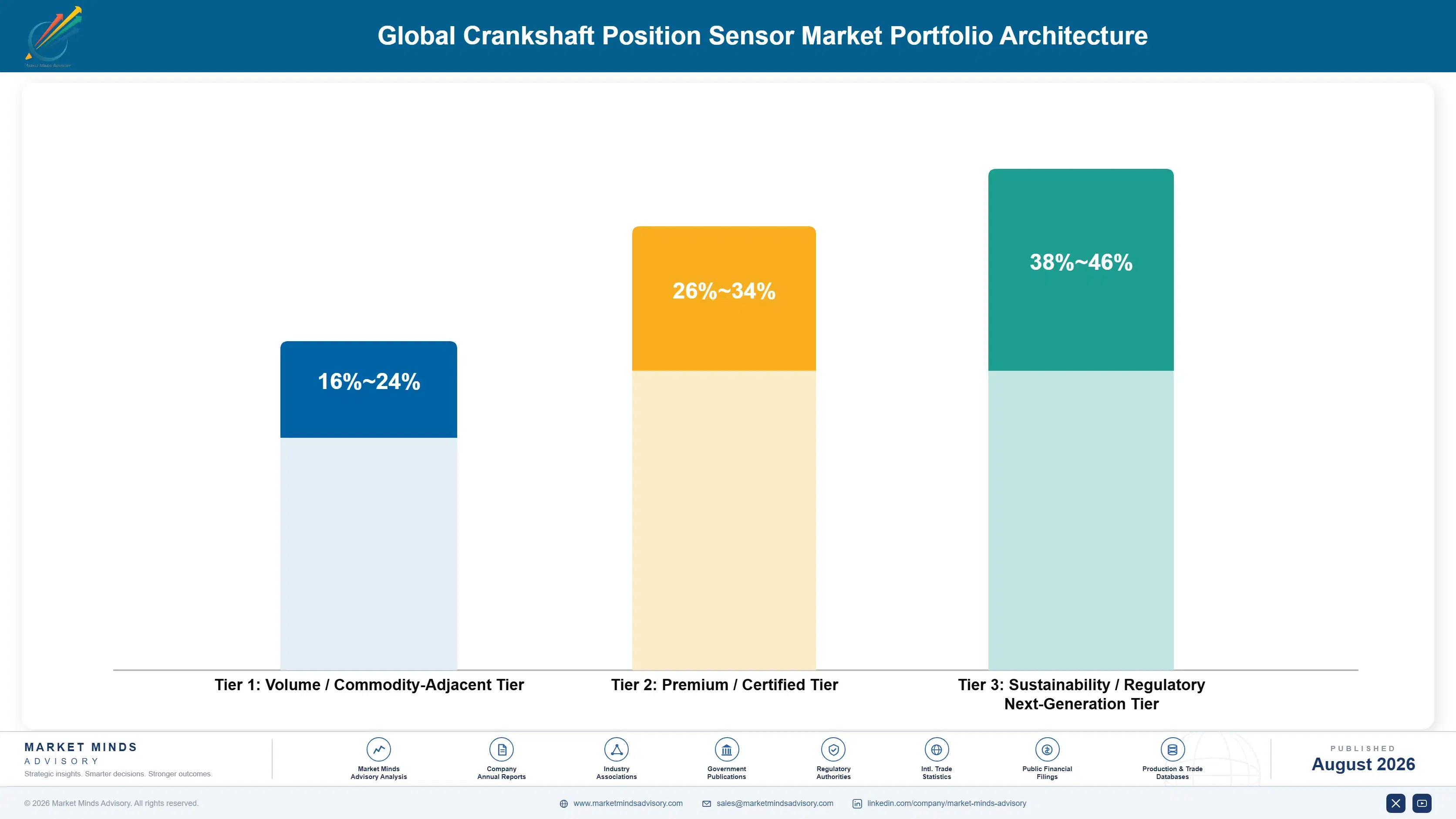
Portfolio economics split across three tiers: commodity variable reluctance sensors competing largely on price and production scale, mid-tier Hall effect sensors commanding meaningful premium pricing tied to precision manufacturing, and premium magnetoresistive and functional safety certified sensors capturing the highest margin as customers pay for both precision certification and dedicated engineering support. Manufacturers increasingly allocate research investment toward the highest-margin tier rather than spreading it evenly across all three.
The tension between volume and premium positioning is sharpest as automakers increasingly demand hybrid-grade consistency regardless of price sensitivity elsewhere in their supply chain, compressing commodity variable reluctance sensor manufacturers' pricing power even as premium Hall effect and magnetoresistive products command substantial price premiums tied to precision investment rather than raw material cost alone. This tension is sharpening as input costs rise faster than replacement pricing can absorb.

High value margin pools concentrate in Hall effect and magnetoresistive products sold with dedicated engineering support and joint functional safety certification, where certification depth and customer qualification requirements limit meaningful competition to suppliers with established quality systems and sustained research investment. Suppliers without this depth increasingly struggle to win hybrid platform contracts regardless of their pricing competitiveness on commodity products.

Volume / Commodity-Adjacent Tier

Commodity variable reluctance sensors competing primarily on price and production scale across mainstream internal combustion applications, where manufacturing efficiency determines competitiveness. Manufacturing scale and semiconductor purchasing power determine competitiveness in this tier.
Gross Margin: 16-24%

Premium / Certified Tier

Hall effect sensors commanding premium pricing tied to precision manufacturing and shifting hybrid performance requirements, supported by established original equipment relationships and certification programs. Certification and warranty programs increasingly differentiate leading suppliers within this tier.
Gross Margin: 26-34%

Sustainability / Regulatory / Next-Generation Tier

Magnetoresistive and functional safety certified sensors serving premium hybrid applications, commanding the strongest margins given certification requirements protecting incumbent suppliers. Long qualification cycles and functional safety testing requirements protect incumbent suppliers from rapid new entrant competition.
Gross Margin: 38-46%
global-crankshaft-position-sensor-market-portfolio-architecture-1787552083218

High-value Sub-segments and Strategic Watch-out

Hall Effect Crankshaft Position Sensors

Scaling rapidly as hybrid production expands, this segment commands strong margins but remains constrained by semiconductor sensing capacity concentrated among a limited number of qualified suppliers worldwide. Suppliers investing early in this capability are positioned to capture the largest share of incremental margin expansion over time.
Gross Margin: 34-42%

Magnetoresistive Crankshaft Position Sensors

Emerging premium and performance vehicle demand supports strong pricing for suppliers with advanced materials engineering capability, though commercial volume remains smaller than established Hall effect applications today across most regional markets. Suppliers with dedicated advanced materials capability are best positioned to capture this emerging demand.
Gross Margin: 38-46%

Variable Reluctance Crankshaft Position Sensors

The largest volume segment by unit count, competing primarily on price across mainstream internal combustion platforms, and facing steady margin pressure as electrification continues expanding across additional vehicle segments and regions. Suppliers competing here depend heavily on manufacturing efficiency and distribution reach rather than differentiated engineering investment.
Gross Margin: 16-22%

Battery Electric Vehicle Sensing Substitution

Facing sustained long-term volume decline as battery electric vehicle production share continues rising across major automotive markets, eliminating crankshaft sensing requirements entirely from an increasing share of new vehicle production. Suppliers relying solely on this segment risk losing relevance as broader industry investment shifts elsewhere.
Gross Margin: 12-18%

Vehicle Platform Qualification Economics

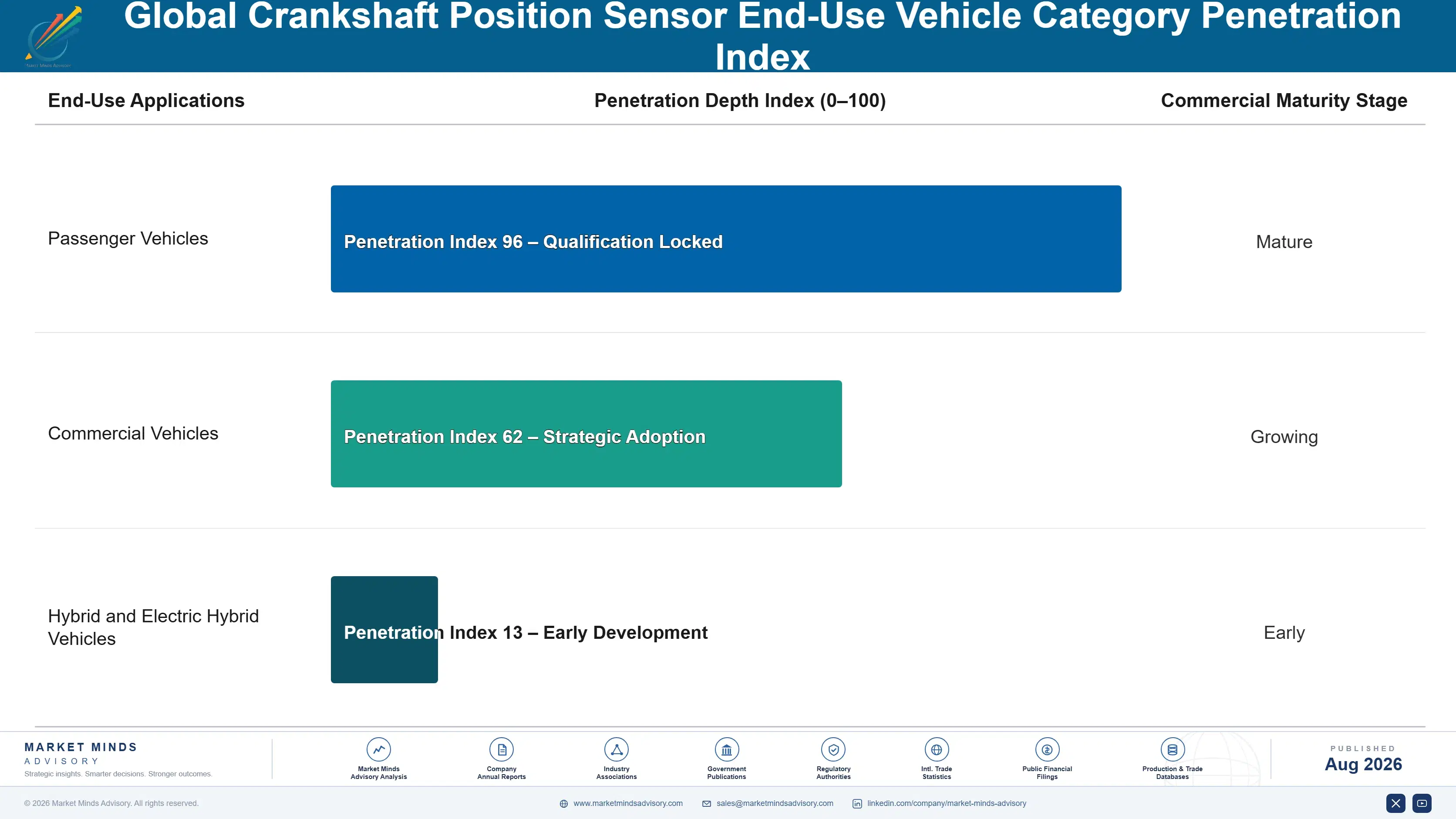
Demand in this category increasingly resembles a multi-year vehicle platform qualification relationship rather than a spot commodity purchase, since automakers require extensive functional safety and durability testing before committing to a sensor supplier, creating durable multi-year revenue visibility for suppliers embedded early in an automaker's platform design roadmap. Once qualified, a supplier typically retains that account for multiple platform generations.
Adoption depth varies considerably by end use vertical: premium hybrid and performance vehicle manufacturers show the deepest and most consistent adoption of Hall effect and magnetoresistive sensing technology, mainstream internal combustion manufacturers show moderate but accelerating adoption tied to onboard diagnostic compliance goals, and traditional aftermarket replacement buyers remain the shallowest adopters, still relying primarily on legacy variable reluctance sensors to control replacement cost. This uneven depth means suppliers cannot apply one go-to-market strategy uniformly.

Younger automotive engineers and hybrid powertrain design specialists entering product development roles increasingly treat Hall effect sensor specification as a baseline design consideration rather than an experimental component, a generational shift that is gradually normalizing broader adoption across a wider range of vehicle categories beyond the historically dominant premium hybrid segment. Manufacturers slow to adapt engineering culture risk losing relevance among newer decision makers.
global-crankshaft-position-sensor-market-end-use-penetration-index-1787552083707

Where Supplier Investment Should Concentrate

These are among the four positions where our research anticipates prominent divergence between winners and laggards over the coming forecast period. Each is grounded in the demand model, the regulatory perimeter, and the announced capacity pipeline.
01 / HALL EFFECT TECHNOLOGY INVESTMENT

Build precision sensing capability before hybrid platforms standardize elsewhere

Automakers are increasingly standardizing platform specifications around Hall effect, functional safety certified sensors faster than suppliers relying on legacy variable reluctance designs currently plan for within their commercial roadmaps and research budgets across comparable production accounts. Suppliers with established Hall effect capability already report meaningfully higher customer qualification rates than competitors selling legacy sensors alone across comparable production volume. This advantage compounds as more automakers require certified sensors, a gap unlikely to close soon without deliberate and sustained investment across research budgets and testing infrastructure alike.
02 / HYBRID PLATFORM QUALIFICATION

Secure hybrid supply agreements before vehicle platforms lock in suppliers

Automakers typically finalize sensor supplier decisions well ahead of vehicle program launch, meaning suppliers without early qualification risk exclusion from multiple future vehicle generations entirely across their target account base. Suppliers with established hybrid customer qualification already report securing contracted volume at meaningfully higher rates than suppliers pursuing certification independently. Building these relationships now, ahead of upcoming platform decisions, costs considerably less than attempting entry after competitors have already locked in supply agreements spanning multiple future vehicle generations and platform variants.
03 / ELECTRIC DRIVETRAIN DIVERSIFICATION

Diversify into adjacent electric sensing before addressable volume erodes further

Battery electric vehicle adoption is eroding crankshaft sensing addressable volume faster than suppliers relying entirely on internal combustion platforms can efficiently offset within typical revenue planning timelines across major automotive markets. Suppliers pursuing electric drivetrain diversification already report meaningfully higher revenue retention than competitors reliant solely on crankshaft sensor volume across comparable production accounts. This advantage compounds further as battery electric vehicle production share continues rising across major automotive markets worldwide over the coming decade, rewarding suppliers that diversified earliest.
04 / SEMICONDUCTOR SUPPLY SECURITY

Secure semiconductor allocation before capacity constraints intensify further

Customer demand for reliable Hall effect sensor supply is increasing faster than suppliers relying entirely on spot market semiconductor purchasing can efficiently address within typical customer risk management timelines and procurement policies across major industries. Suppliers pursuing long-term semiconductor supply agreements already report meaningfully higher on-time delivery performance than competitors relying solely on spot market purchasing across comparable product categories. This advantage compounds further as more customers formalize supply security requirements into their procurement policies going forward, reshaping long-term capacity investment decisions.

Engagement Snapshot From the Field

A live engagement with an industry participant carrying material or product regulatory and market exposure ahead of a defining policy shift, showing how our research translates into a defensible multi-year portfolio strategy.
MARKET MINDS ADVISORY · CLIENT ENGAGEMENT SUMMARY
Global Crankshaft Position Sensor Producer Strategic Portfolio Review and Transition Roadmap 2026·Investment Scenario on Global Crankshaft Position Sensor Exposure Evaluation 2025-26
CLIENT PROFILE
The client is a mid-sized automotive sensor manufacturer generating approximately 145 million dollars in annual revenue (client-reported, unverified by MMA), historically focused on conventional variable reluctance sensor sales without dedicated Hall effect sensing capability, facing declining margins as commodity pricing continued to compress across its traditional customer base. Its competitors were rapidly securing hybrid platform contracts.
STRATEGIC CHALLENGE
Facing eroding commodity margins as semiconductor-based competitors continued pressuring pricing, the client needed to evaluate whether to invest in Hall effect sensing capability to access premium hybrid platform pricing, without clear visibility into automaker qualification requirements or realistic timelines for securing meaningful contracted volume across its target account base nationwide.
MMA APPROACH
MMA conducted a hybrid platform market entry feasibility assessment incorporating automaker qualification requirement interviews, capital investment modeling, and competitive benchmarking against established Hall effect suppliers, then developed a phased sensing capability investment roadmap sequenced to the client's available capital and existing production infrastructure across multiple facility locations. Deliverables included a detailed risk-adjusted return model.
KEY FINDINGS
  1. Automakers required a minimum of eighteen months of functional safety testing before considering a new sensor supplier for qualification across most manufacturers evaluated.
  2. Two regional automakers expressed preliminary interest in evaluating the client's Hall effect output once developed to specification and tested for durability. during preliminary technical review sessions
  3. Existing production infrastructure could be adapted for Hall effect manufacturing with moderate capital investment rather than requiring an entirely new facility footprint.
  4. Competitive hybrid platform pricing offered meaningfully higher margins than the client's existing commodity variable reluctance business over a multi-year contract horizon. across most evaluated contract structures
CLIENT PROFILE
The client is a mid-sized automotive sensor manufacturer generating approximately 145 million dollars in annual revenue (client-reported, unverified by MMA), historically focused on conventional variable reluctance sensor sales without dedicated Hall effect sensing capability, facing declining margins as commodity pricing continued to compress across its traditional customer base. Its competitors were rapidly securing hybrid platform contracts.
STRATEGIC CHALLENGE
Facing eroding commodity margins as semiconductor-based competitors continued pressuring pricing, the client needed to evaluate whether to invest in Hall effect sensing capability to access premium hybrid platform pricing, without clear visibility into automaker qualification requirements or realistic timelines for securing meaningful contracted volume across its target account base nationwide.
MMA APPROACH
MMA conducted a hybrid platform market entry feasibility assessment incorporating automaker qualification requirement interviews, capital investment modeling, and competitive benchmarking against established Hall effect suppliers, then developed a phased sensing capability investment roadmap sequenced to the client's available capital and existing production infrastructure across multiple facility locations. Deliverables included a detailed risk-adjusted return model.
KEY FINDINGS
  1. Automakers required a minimum of eighteen months of functional safety testing before considering a new sensor supplier for qualification across most manufacturers evaluated.
  2. Two regional automakers expressed preliminary interest in evaluating the client's Hall effect output once developed to specification and tested for durability. during preliminary technical review sessions
  3. Existing production infrastructure could be adapted for Hall effect manufacturing with moderate capital investment rather than requiring an entirely new facility footprint.
  4. Competitive hybrid platform pricing offered meaningfully higher margins than the client's existing commodity variable reluctance business over a multi-year contract horizon. across most evaluated contract structures
RECOMMENDED STRATEGY
Phase 1: Phase 1 (Months 1 to 6): Invest in Hall effect engineering while beginning early customer outreach discussions. across target account teams Phase 2: Phase 2 (Months 7 to 14): Complete automaker qualification testing across at least two target regional accounts. while tracking key testing milestones Phase 3: Phase 3 (Months 15 to 20): Secure initial supply agreements while monitoring early production quality metrics closely. and adjusting production ramp pace
OUTCOME
Within twenty months of implementation, the client reported securing an initial hybrid platform supply agreement representing roughly 17 percent of projected future revenue and establishing durable sensing capability beyond its historical commodity business, with a second regional account under active negotiation (client-reported, unverified by MMA).

Frequently Asked Questions

Foundational context covering the market sizes, CAGR, scope, country, region and competition that inform every finding below. This section is provided to cover basics and most often pre-purchase conversations, answered from the MMA Primary Research Dataset.

What is the current size of the Global Crankshaft Position Sensor Market?

The Global Crankshaft Position Sensor Market is valued at approximately 2.6 billion dollars in 2025, spanning Hall effect, variable reluctance, and magnetoresistive sensor technologies worldwide.

How large will the Global Crankshaft Position Sensor Market be by 2036?

The market is projected to reach roughly 5.37 billion dollars by 2036, driven by expanding hybrid powertrain production and tightening onboard diagnostic regulations across major automotive markets.

What is the CAGR for the Global Crankshaft Position Sensor Market 2026 to 2036?

The market is expected to grow at a compound annual growth rate of approximately 6.8 percent between 2026 and 2036, among the faster rates in automotive sensing.

Which segment is growing fastest?

Hall effect crankshaft position sensors are the fastest growing segment, expanding at roughly 1.4 times the overall market rate as automakers standardize precision designs across platforms.

Who are the major companies in the Global Crankshaft Position Sensor Market?

Leading companies include Robert Bosch GmbH, Denso Corporation, Continental AG, Delphi Technologies, and Sensata Technologies, each investing heavily in precision sensing and certification programs today.

Which country is growing fastest?

China is the fastest growing single country, supported by its dominant automotive component manufacturing scale and rapidly expanding domestic hybrid vehicle production across multiple provinces.

Report Segmentation Architecture

The full report scope spans multiple orthogonal segmentation dimensions, with cross-tabulated demand data provided for each dimension pair. Coverage extends further to regional breakdowns, trend trajectories, and the competitive detail needed to support segment-level decision-making.

By Sensor Technology

  • Hall Effect Crankshaft Position Sensors
  • Variable Reluctance Crankshaft Position Sensors
  • Magnetoresistive Crankshaft Position Sensors
  • Inductive Crankshaft Position Sensors
  • Optical Crankshaft Position Sensors

By End-Use Vehicle Category

  • Passenger Vehicles
  • Commercial Vehicles
  • Hybrid and Electric Hybrid Vehicles

By Commercial Dimension

  • Original Equipment Manufacturer Supply
  • Aftermarket Replacement Distribution
  • Joint Certification Development Partnerships

By Region

  • North America
  • Western Europe
  • East Asia
  • South Asia and Pacific
  • Latin America
  • Middle East and Africa
  • Eastern Europe

Scope, Methodology, and Coverage

Every figure in this report is reproducible from documented input assumptions. The scope below maps the historical period, the forecast horizon, the segmentation dimensions, and the countries covered, alongside the underlying primary and qualitative methodology.
Historical Period
2020 to 2025
Forecast Period
2026 to 2036
Base Year
2025 (USD billions; MMA Primary Research Dataset, August 2026)
Market Definition
The crankshaft position sensor market covers sensors used to detect crankshaft angular position and rotational speed in internal combustion and hybrid vehicle engines, including Hall effect, variable reluctance, and magnetoresistive sensor technologies. It excludes camshaft position sensors and excludes broader engine control unit hardware beyond the sensing component itself.
Quantitative Units
USD billions (current prices); unit shipments for select operating metrics
Segmentation Dimensions
By Sensor Technology; By End-Use Vehicle Category; By Commercial Dimension; By Region
Regions Covered
North America, Western Europe, East Asia, South Asia and Pacific, Latin America, Middle East and Africa, Eastern Europe
Countries Covered
USA, Canada, Mexico, China, Japan, South Korea, Germany, France, Italy, UK, India, Australia, Brazil, Argentina, UAE, Saudi Arabia, South Africa, Poland, Hungary, Czech Republic, Russia, and additional markets relevant to this sector
Key Companies Profiled
Robert Bosch GmbH, Denso Corporation, Continental AG, Delphi Technologies, Sensata Technologies, Hitachi Astemo Ltd, Standard Motor Products, NGK Spark Plug Co, Melexis NV, Infineon Technologies AG, Allegro MicroSystems, TE Connectivity, Amphenol Corporation, Hella GmbH & Co KGaA, Mitsubishi Electric Corporation, Marelli Holdings Co, Valeo SA, ZF Friedrichshafen AG, Elmos Semiconductor SE, Diehl Metering GmbH
Quantitative Methodology
Primary survey, n=3,800 respondents, Q4 2025, six countries; demand-side model with trade association cross-validation
Qualitative Methodology
47 expert interviews, Q4 2025; applied to validate demand model assumptions, identify emerging dynamics, and assess competitive positioning
Report Format
PDF and XLSX data workbook (Word format preview document)
Publisher
Market Minds Advisory
Report Code
MMA-2026-AUT-325
Published
August 2026
Contact
sales@marketmindsadvisory.com | www.marketmindsadvisory.com

Purchase the full Global Crankshaft Position Sensor Market Report (2026 to 2036).

The full report delivers a complete quantitative and qualitative assessment of the crankshaft position sensor market, including detailed segment level forecasts through 2036, regional analyses across all seven covered geographies, and profiles of twenty leading sensor suppliers. It incorporates primary survey data from 3,800 respondents and 47 expert interviews conducted in the fourth quarter of 2025. Buyers receive editable data tables, a customizable Excel forecast model, and access to MMA analysts for follow up questions during a defined post purchase support window. The report also includes a detailed hybrid platform qualification landscape assessment calibrated to current customer benchmarks.
Detailed segment-level market forecasts through 2036
All seven regional market analyses included
Twenty profiled leading sensor suppliers included
Editable Excel based forecast data model
Primary survey and expert interview data
Extended post-purchase analyst support access window

Built For The People Who Decide

From boardroom strategy to bench-side execution, this report is read cover-to-cover by leaders shaping the next decade of their industry, turning demand scenarios, market dynamics and valuation benchmarks into decisions.
CXOs/ Presidents/ VPs/ Managers
M&A and Corporate Development
Strategy Teams and R&D Heads
Procurement and Product Directors
Regulatory and Compliance Leaders
Investor Relations and Equity Analysts