
Market Minds Advisory
Bioactive Coating Devices Market

Bioactive Coating Devices Market: Surface Chemistry as a Clinical and Commercial Differentiator

Hospital procurement mandates cutting surgical site infections push implant makers toward antimicrobial and drug-eluting coatings, while aging populations and rising joint replacement volume demand surfaces that improve bone integration and device longevity.

Lead Analyst

Alice Ballenger

Published

September 2026

Make Smarter Decisions with Customized Research Insights

Request a free sample report and evaluate market opportunities, growth trends, and competitive dynamics relevant to your business needs.

2025 MARKET VALUE$4.2BMarket Size 2025
2036 FORECAST VALUE$11.8BBase Case , 2026 to 2036
CAGR 2026 TO 20369.8 %Bull 11.0% / Bear 8.6%
INCREMENTAL OPPORTUNITY$7.1BNet 10- year value creation
EXPANSION MULTIPLE2.55x2036 value over 2026 base
Strategic Levers
M&A Pipeline
Regional Outlook
Country Rankings
Competitive Intelligence
Segmental Deep-dive
Call-Us : 91 93563 13602

Executive Snapshot and Market Trajectory

Surgical site infection penalties are reshaping procurement decisions across major hospital systems. Hospitals now weigh antimicrobial and drug-eluting surface chemistry against acquisition price when selecting implants and catheters, a clear reversal from the cost-only purchasing logic that dominated procurement through much of the prior decade.
Drug-eluting coatings are pulling ahead of every other coating category as cardiology applications mature and manufacturers extend eluting chemistry into peripheral vascular and orthopedic devices previously served only by uncoated hardware. North America and East Asia concentrate the bulk of commercial volume, reflecting where implant manufacturing, reimbursement infrastructure, and specialty chemistry development all sit today, while South Asia scales manufacturing capacity fastest of any tracked region in this forecast.
Competition splits between specialty chemistry licensors and vertically integrated device makers building coating capability in-house to protect margin and reduce dependence on outside suppliers. Regulatory scrutiny following past drug-coated device safety signals has made combination-product approval pathways slower and considerably costlier, favoring manufacturers with deep regulatory affairs experience and established post-market surveillance programmes already running across major markets worldwide, a bar smaller entrants increasingly struggle to clear without meaningful outside investment of time and capital.
Market Definition
The bioactive coating devices market covers surface treatments and functional coatings applied to implantable and interventional medical devices, including antimicrobial, drug-eluting, hydrophilic, osseointegration, and anti-thrombogenic chemistries. It excludes the underlying device substrates, coating deposition equipment, and coatings applied outside clinical or surgical contexts.
Base Year Value
$4.2B in 2025 (MMA Primary Research Dataset, August 2026)
Forecast Period
2026 to 2036, eleven discrete annual values
CAGR
9.8% base case. Bull 11.0%. Bear 8.6%.
Fastest Growth Segment
Drug-Eluting Coatings: 13.2% CAGR
Fastest Growth Country
India: 12.4% CAGR
Fastest Growth Region
South Asia and Pacific: 11.8% CAGR
Largest Region
North America: 30% of 2025 global value
Market Leaders
DSM Biomedical, Surmodics Inc., Hydromer Inc., Biocoat Incorporated, AST Products Inc. Source: MMA Analysis based on company annual reports and investor filings.
Primary Survey
n=3,800 procurement and R&D decision-makers, Q4 2025, six countries
Methodology
Demand-side build-up, cross-validated against public data, 47 expert interviews

Bioactive Coating Devices Market Forecast Scenarios

global-bioactive-coating-devices-market-size-forecast-scenario-1787332649797
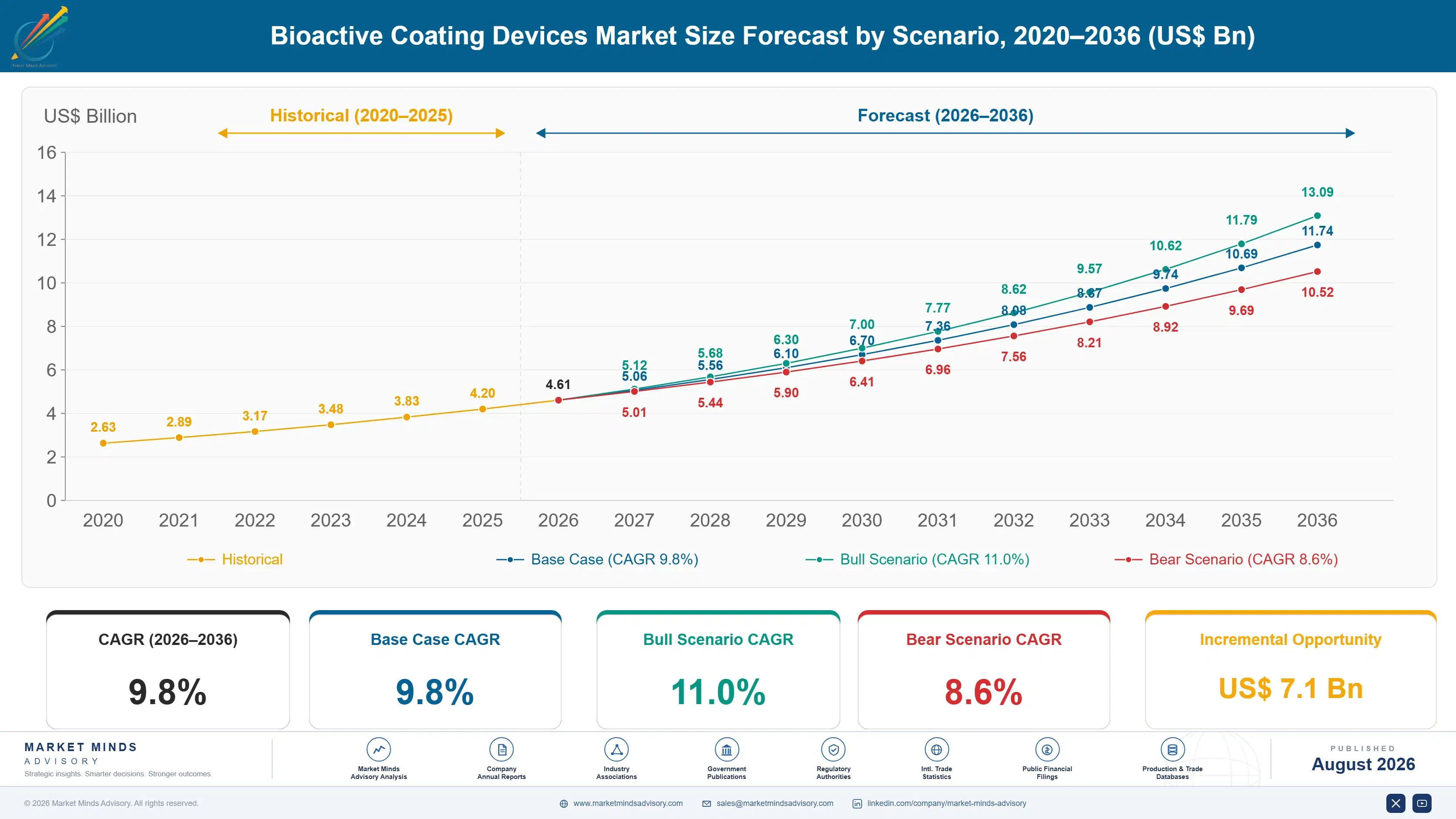
Growth from 2020 to 2025 compounded near 8.5%, slowed early by pandemic-driven elective surgery deferrals that pushed implant and catheter procedures out by months across major hospital systems worldwide, then accelerated meaningfully as deferred backlog volume cleared and infection control budgets expanded across most developed healthcare systems entering the back half of the five-year period.
Three mechanisms carry the base case to 9.8%. First, antimicrobial coating mandates tied to hospital reimbursement penalties, which push infection-resistant surfaces into standard specification across procurement teams previously indifferent to coating chemistry. Second, drug-eluting chemistry expansion beyond cardiology into peripheral vascular and orthopedic devices, extending proven platforms into new indications. Third, rising joint replacement volume in aging populations, which lifts demand for coatings that improve bone integration and implant longevity across every major healthcare market tracked.
The bull case at 11.0% assumes antimicrobial adoption accelerates faster than current hospital procurement cycles suggest and emerging market implant manufacturing scales more quickly than currently projected. The bear case at 8.6% assumes regulatory scrutiny on combination products slows new approvals further and reimbursement budgets tighten under broader healthcare cost pressure across most major markets tracked in this forecast.

Surface Chemistry Becomes a Purchasing Criterion

Three forces converge on this market simultaneously. Hospital reimbursement structures now penalise preventable infections directly, pushing procurement teams toward antimicrobial surfaces regardless of upfront cost differences. Aging populations keep expanding joint replacement and cardiovascular procedure volume across nearly every developed healthcare system. Regulatory agencies increasingly treat coated devices as combination products, raising approval complexity but also raising the barrier
MARKET CONCENTRATIONCR5 46%Top five coating specialists hold moderate combined share
AVERAGE SELLING PRICEUSD 180-420 per unitVaries by coating complexity and device substrate type
TOP PRODUCING COUNTRY SHAREUnited States 24%Leads global coating production and chemistry formulation development work
CAPACITY UTILISATION76%Reflects steady demand against expanding cleanroom coating lines
TRADE INTENSITY38%Share of coated devices crossing borders before final assembly
INPUT COST SHARE44%Specialty polymers and active pharmaceutical ingredients combined together
Commercially, the market splits between specialty chemistry licensors selling proprietary coating technology to device original equipment manufacturers, and vertically integrated players who coat in-house to protect margin and control quality directly. Licensing economics favor smaller specialists with deep polymer chemistry expertise, while integrated players capture more value per device sold but carry heavier manufacturing capital commitments in return, a tradeoff each player resolves differently depending on scale.
Looking ahead, antimicrobial peptide chemistry, next-generation drug-eluting platforms extending beyond cardiology, and tighter infection-control regulation across major healthcare systems will shape which manufacturers capture the fastest-growing demand pools over the coming decade, rewarding those who invested in regulatory depth and chemistry breadth early rather than waiting for procurement standards to force the issue later.
"The coating is no longer an afterthought bolted onto a finished device. For a growing share of hospital buyers, it is the reason one implant gets specified over another."
Director, Medical Devices and Surface Technology Practice · MMA Medical Devices

Market Trends

Antimicrobial Coating Adoption Accelerates Under Infection Penalties

The CMS Hospital-Acquired Condition Reduction Program cuts Medicare payments to the lowest-performing quartile of hospitals on infection metrics, pushing procurement teams to specify antimicrobial-coated catheters, orthopedic implants, and surgical hardware well ahead of mandatory compliance deadlines. Hospitals facing repeated penalty exposure increasingly rewrite purchasing standards to require coating documentation before a device reaches the operating room at all. Manufacturers responding fastest are capturing preferred-vendor status across large hospital networks, locking in multi-year supply relationships that competitors without comparable coating portfolios cannot easily displace once established firmly across a large enough base of accounts.
Market Impact: Procedure volume grows near 6% year
Drug-Eluting Chemistry Expands Beyond Cardiology Applications

Drug-eluting technology proven across two decades of coronary stent use is now migrating into peripheral vascular balloons, orthopedic fixation devices, and select neurovascular implants, opening addressable volume well beyond the original cardiology base entirely. Manufacturers with established eluting chemistry platforms are filing expanded indications rather than developing entirely new coating systems, which shortens their path to market relative to newer entrants lacking comparable regulatory history. This migration is reshaping which specialty chemistry licensors capture the fastest growing revenue pools, favoring those already validated in cardiology over newcomers without an established regulatory track record to draw on.
Market Impact: Covers over 60 national health syst

Market Opportunities and Growth Drivers

Joint Replacement Volume Climbs With Aging Populations

Annual hip and knee replacement procedures across major developed markets continue climbing as populations age and surgeons extend eligibility to younger, more active patients who expect implants to last two decades or longer rather than the single decade earlier designs targeted. Osseointegration coatings that improve bone attachment directly address that longevity expectation, reducing revision surgery rates that burden both patients and hospital budgets considerably. Orthopedic device makers increasingly treat coating chemistry as a competitive specification point in tender processes rather than a secondary manufacturing detail, pushing coating specialists further into the product design conversation earlier.
Market Impact: Adds 12-18 months to approval

Antimicrobial Resistance Policy Tightens Device Standards

National antimicrobial resistance action plans, informed by World Health Organization guidance, are pushing health ministries to tighten procurement standards for implantable and indwelling devices used in high-infection-risk settings including intensive care and orthopedic surgery wards. Several national health systems now require antimicrobial efficacy data as part of device tender submissions, a requirement that barely existed five years ago in most jurisdictions. Coating manufacturers with validated antimicrobial chemistry and existing regulatory dossiers are winning tenders that newer entrants without comparable clinical evidence simply cannot bid on competitively at any price point.
Market Impact: Added 5 years of extra scrutiny

Market Restraints and Challenges

Combination Product Approval Pathways Slow Time to Market

Coated devices carrying an active pharmaceutical ingredient fall under combination product review, which requires coordinated evaluation from both device and drug review divisions and routinely adds twelve to eighteen months to approval timelines compared with an uncoated device equivalent. The root cause traces back decades: regulatory agencies built separate device and drug review frameworks independently, and combination products still fall awkwardly between them. The commercial impact falls hardest on smaller specialists lacking dedicated regulatory affairs teams. Several manufacturers now pre-engage regulators through early feasibility meetings and pursue modular filing strategies that separate device and chemistry approvals where the pathway allows.
Market Impact: Adds 4.2% to demand growth

Past Safety Signals Raise Ongoing Litigation Exposure

A 2019 FDA safety communication flagging a possible late mortality signal associated with paclitaxel-coated peripheral devices triggered years of heightened scrutiny, additional post-market study requirements, and litigation exposure that persists across the drug-eluting category broadly. The root cause traces to thin long-term outcome data at the time of initial approval, which left manufacturers unable to rebut the signal quickly with existing evidence. The commercial impact includes slower hospital adoption and elevated insurance cost for affected manufacturers. Leading players now fund larger, longer post-market surveillance studies upfront to pre-empt similar signals before they can spread across a chemistry class.
Market Impact: Expands addressable devices by over
3 additional market trends, 3 additional growth drivers, and 2 additional restraints and challenges are covered in the full report. Contact sales@marketmindsadvisory.com to access the complete intelligence.

Segment CAGR and Growth Architecture

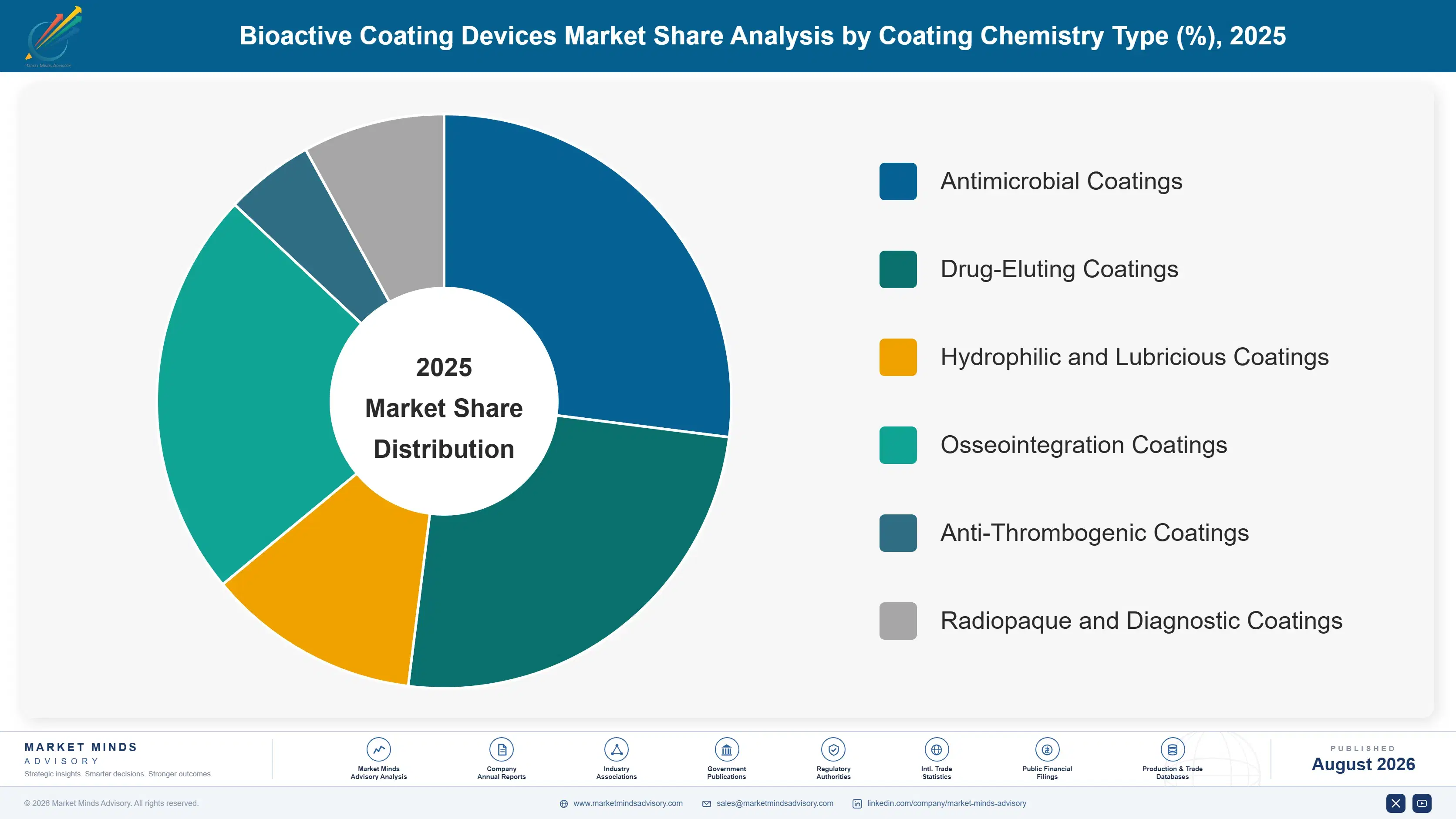
Segmentation follows coating chemistry and function rather than the device substrate it is applied to, since a single antimicrobial or eluting chemistry often serves multiple device categories simultaneously across cardiology, orthopedics, and general surgery. This reflects how manufacturers actually organise coating research, regulatory filing, and commercial licensing internally across their own product development teams.
global-bioactive-coating-devices-market-market-share-analysis-1787332650364

Drug-Eluting Coatings

Drug-eluting coatings deliver a therapeutic agent directly from a device surface, most established in coronary stents but expanding rapidly into peripheral vascular balloons, select orthopedic fixation hardware, and neurovascular implants. Growth outpaces every other coating category as manufacturers with validated eluting platforms extend proven chemistry into new indications faster than competitors can develop alternatives from scratch. Regulatory scrutiny following past safety signals has raised the evidence bar considerably, favoring manufacturers with deep post-market surveillance capability and existing regulatory relationships. Pricing reflects that complexity: eluting coatings command the highest per-unit value across the entire segmentation framework, and licensing economics reward chemistry originators over device assemblers that merely apply third-party formulations under contract.
CAGR 13.2%

Antimicrobial Coatings

Antimicrobial coatings reduce bacterial colonisation on catheters, orthopedic implants, and surgical hardware, directly addressing hospital-acquired infection penalties that now hit reimbursement directly and materially. Growth is second-fastest across the segmentation, driven by procurement standards that increasingly require documented antimicrobial efficacy before a device reaches tender shortlists at all. Silver-ion and antibiotic-eluting chemistries dominate current volume, while newer antimicrobial peptide platforms are gaining hospital pilot programmes on the strength of narrower resistance risk profiles documented in early trials. Manufacturers here compete on breadth of clinical evidence and speed to tender qualification more than on raw chemistry novelty, since hospital procurement teams weigh documented outcomes heavily against comparable but unproven alternatives still awaiting broader trial confirmation.
CAGR 11.6%
Full segment breakdown across 6 segments available in the complete report.

Regional Architecture and Country Demand Map

North America and East Asia together hold roughly half of global demand, reflecting where implant manufacturing, hospital reimbursement infrastructure, and coating chemistry development all concentrate most heavily today. South Asia and Pacific is expanding fastest as regional implant manufacturing scales rapidly and domestic device makers adopt coating chemistry.

North America

US hospital systems lead antimicrobial coating adoption because CMS reimbursement penalties tied to hospital-acquired infections hit revenue directly, giving procurement teams a quantified financial reason to specify coated devices over uncoated equivalents at scale. Orthopedic implant volume keeps rising as an aging population extends joint replacement eligibility to younger, more active patients seeking two-decade implant life rather than one decade. Canada follows a similar reimbursement-driven logic, though procurement moves more slowly through provincial health authorities and smaller hospital networks. Drug-eluting peripheral vascular devices are gaining share fastest here as manufacturers extend cardiology-proven chemistry into new vascular indications, supported by a dense concentration of specialty coating licensors headquartered across the region and its research universities.
Share: 30% | CAGR: 10.8% (2026 to 2036)

Western Europe

Germany and the United Kingdom anchor regional demand through well-established orthopedic and cardiovascular device manufacturing bases, with national health systems increasingly requiring antimicrobial efficacy documentation in procurement tenders across most surgical categories. France and the Nordic countries follow comparable reimbursement-linked procurement logic, favoring coated devices where infection reduction data supports the premium over uncoated alternatives clearly. Regulatory harmonisation under the EU Medical Device Regulation has raised approval complexity for combination products across the region, slowing new product launches relative to the prior regulatory framework considerably. Growth trails the global average because much of the region's device replacement cycle already runs on modern coated platforms installed during the previous decade of investment.
Share: 22% | CAGR: 8.3% (2026 to 2036)
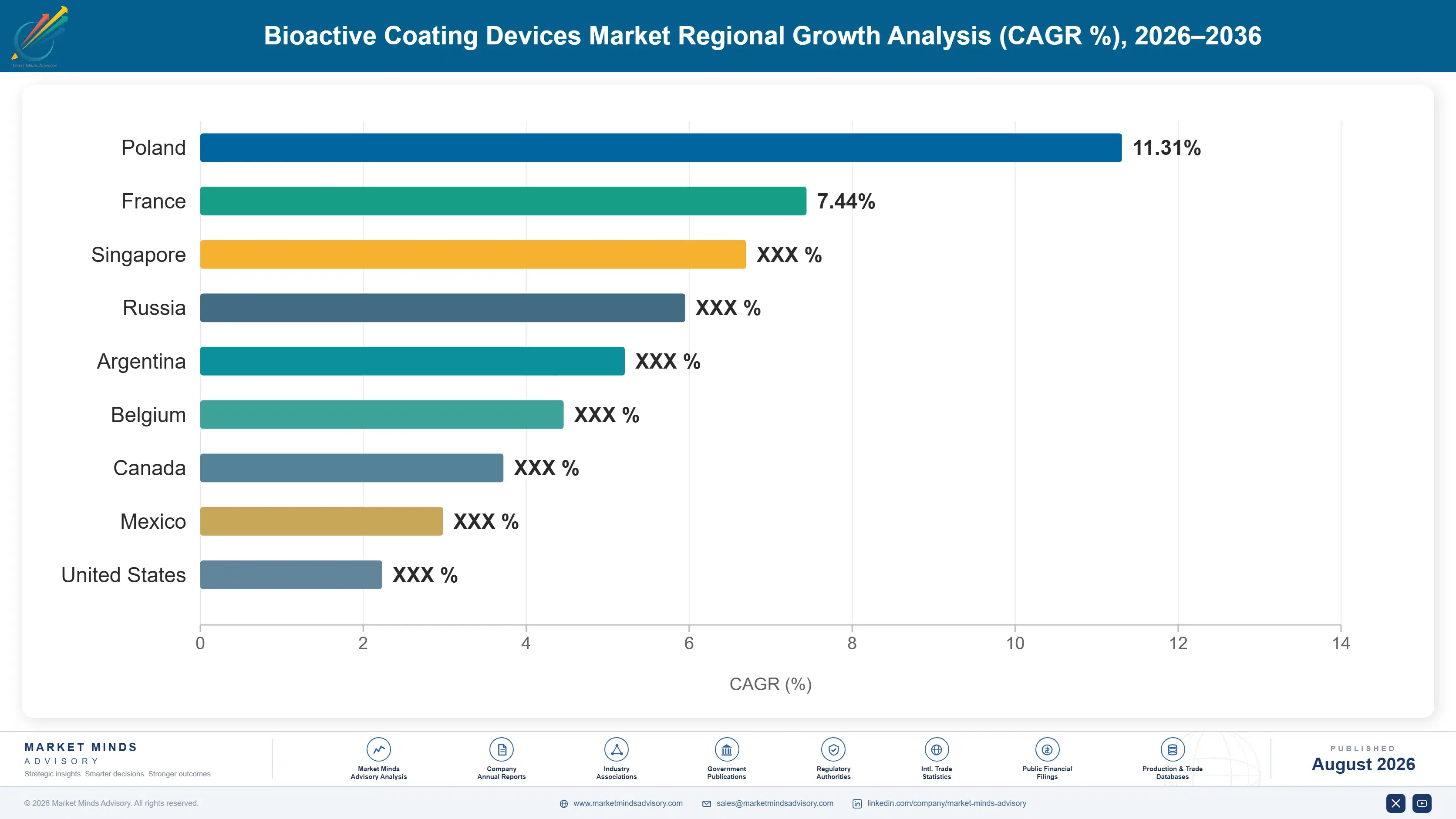
Regional intelligence for 5 additional markets available in the complete report: East Asia, South Asia and Pacific, Latin America, Middle East and Africa, Eastern Europe. Contact sales@marketmindsadvisory.com.
global-bioactive-coating-devices-market-country-cagr-analysis-1787332650887

Where Coating Specialists Can Capture More Value

Coating specialists sit between chemistry origination and device assembly, a position that offers several distinct paths to capture more value than a standard per-unit licensing fee provides, particularly as hospital procurement increasingly rewards documented clinical outcomes over raw specification detail. The four levers below reflect where margin is actually shifting across the industry today.

License Proprietary Chemistry to Multiple Device Makers

Specialty chemistry originators who license antimicrobial or eluting formulations to several device original equipment manufacturers simultaneously, rather than selling coated components to a single customer, capture royalty revenue across a broader device population without carrying manufacturing capital risk themselves. Surmodics generates a substantial share of its revenue through exactly this licensing model, extending hydrophilic and drug-delivery chemistry across more than 40 partner device platforms simultaneously. That structure scales considerably faster than direct manufacturing since licensing revenue grows with partner device volume rather than the licensor's own production capacity, which remains fixed regardless of demand.
Market Impact: Licensing now reaches over 40 partn

Bundle Coating Services With Regulatory Filing Support

Smaller device manufacturers lacking dedicated regulatory affairs teams increasingly prefer coating suppliers who bundle chemistry with combination-product filing support, since that pairing shortens approval timelines by roughly 6 months on average compared with sourcing chemistry and regulatory expertise separately from different vendors entirely. Coating specialists offering this bundle capture considerably higher per-project revenue, often 20% above chemistry-only contracts, and build stickier customer relationships that survive beyond a single device generation, since switching suppliers mid-filing would force a smaller manufacturer to restart much of its regulatory documentation from scratch entirely and delay its planned launch date.
Market Impact: Shortens approval timelines by roug

Expand Into Emerging Market Implant Manufacturing

Domestic implant manufacturing capacity is scaling quickly across India and China as governments favor local medical device production over imports, creating an emerging customer base of manufacturers who need validated coating chemistry but lack in-house development capability of their own to draw on. Coating specialists establishing local technical support and regulatory liaison presence early are winning multi-year supply agreements before domestic competitors can develop comparable chemistry independently. That early-mover position across two of the fastest-growing device manufacturing bases, where output is expanding near 12% annually, compounds considerably as regional implant volume keeps climbing over the coming decade.
Market Impact: Regional implant manufacturing outp

Develop Next-Generation Antimicrobial Peptide Coating Platforms Early

Silver-ion and antibiotic-eluting chemistries dominate current antimicrobial coating volume, but growing antimicrobial resistance concern is pushing hospital procurement toward peptide-based alternatives that carry narrower resistance risk profiles documented across early clinical pilot programmes. Manufacturers investing in peptide platform development now, ahead of broader hospital adoption, are positioning to capture premium pricing once procurement standards catch up with the underlying resistance science. Early clinical pilots already show infection rates roughly 30% lower than standard silver-ion alternatives in comparable surgical settings, a differential large enough to justify premium pricing once broader trial data confirms it.
Market Impact: Pilot data shows 30% lower infectio

Who Controls the Margin Pool

Concentration sits at a moderate 46% for the top five, reflecting a market split between specialty chemistry licensors and vertically integrated device makers who coat in-house. The gap between leaders and challengers comes down to regulatory dossier depth and breadth of validated chemistry platforms rather than raw manufacturing scale. All participants here are assessed on one basis, annual coating and licensing revenue from medical device applications, excluding uncoated device sales.
Competition runs along three lines. First, chemistry breadth, since manufacturers with validated platforms across multiple coating categories win broader device original equipment manufacturer relationships. Second, regulatory affairs depth, as combination-product filing experience shortens approval timelines materially. Third, geographic manufacturing presence, particularly across the fastest-growing Asian implant manufacturing hubs.

Pressure is building from two directions. Vertically integrated device makers including Boston Scientific and Medtronic keep expanding in-house coating capability, squeezing licensing volume that specialty chemistry firms previously captured exclusively. Meanwhile Asian coating manufacturers are scaling capacity to serve domestic device makers directly, eroding Western specialists' historical export advantage steadily. Rankings should favor manufacturers combining chemistry breadth with genuine regulatory affairs depth over the coming years, not simply raw production scale.
global-bioactive-coating-devices-market-company-positioning-matrix-1787332651403

Competitive Moat and Risk Dimensions

DSM BIOMEDICAL

Moat: Polymer chemistry and OEM ties

DSM Biomedical holds deep proprietary polymer chemistry expertise developed over decades, giving its coating platforms a durable technical advantage that competitors struggle to replicate quickly. Longstanding relationships with major device original equipment manufacturers provide a stable revenue base and early visibility into next-generation device design requirements before competitors gain comparable access.
DSM BIOMEDICAL

Risk: Customer concentration exposure

A meaningful share of DSM Biomedical's coating revenue flows through a relatively small number of large device manufacturer relationships, leaving it exposed if any single major customer shifts toward in-house coating capability or switches suppliers following a contract renewal cycle, a concentration risk competitors with broader customer bases do not carry to the same degree.
SURMODICS INC.

Moat: Broad licensing IP portfolio

Surmodics holds an extensive hydrophilic and drug-delivery coating patent portfolio licensed across dozens of device original equipment manufacturer partners simultaneously, generating royalty revenue that scales with partner device volume rather than its own manufacturing capacity. That licensing breadth is difficult for newer entrants to replicate without a comparable patent estate built over many years.
SURMODICS INC.

Risk: Drug-eluting litigation exposure

Surmodics' drug-eluting device coating business carries ongoing litigation and regulatory scrutiny risk tied to the broader paclitaxel-coated peripheral device safety signal, which continues to generate post-market study obligations and periodic legal exposure across the category regardless of any individual product's specific safety record, a drag that weighs on investor sentiment periodically.

Players Tracked

Prominent Players

DSM Biomedical
Surmodics Inc.
Hydromer Inc.
Biocoat Incorporated
AST Products Inc.

Other Key Players

Covalon Technologies Corp.
Harland Medical Systems
Precision Coating Company
Specialty Coating Systems
BioInteractions Ltd
Aculon Inc.
Vergason Technology Inc.
Implant Sciences Corporation
Freudenberg Medical
Camstent Ltd
Biocompatibles UK Ltd
Abbott Vascular
Boston Scientific Corporation
Medtronic plc
PPG Industries Inc.

Recent Developments

MARCH 2025

Surmodics expands hydrophilic coating licensing to new peripheral device partner

Surmodics signed a new licensing agreement extending its hydrophilic coating chemistry to an additional peripheral vascular device manufacturer, broadening its partner platform base beyond existing cardiology and neurovascular relationships built over the prior decade. This was a licensing agreement rather than an acquisition, extending reach without added manufacturing capital commitment.
Signal: Licensing specialists keep widening partne
NOVEMBER 2024

DSM Biomedical opens expanded coating facility to serve Asian device makers

DSM Biomedical opened an expanded coating production facility specifically to serve growing Asian device manufacturer demand closer to their own production bases and supply chains. This was an organic capacity expansion rather than an acquisition, extending regional presence ahead of rising Asian implant manufacturing volume.
Signal: Western coating specialists are building A
JUNE 2025

Boston Scientific acquires specialty antimicrobial coating developer

Boston Scientific acquired a specialty antimicrobial coating developer to bring proprietary chemistry in-house rather than continue licensing externally for select catheter product lines across its broader device portfolio. This was a confirmed acquisition, extending vertical integration into coating chemistry development directly and permanently going forward.
Signal: Large device makers are acquiring specialt

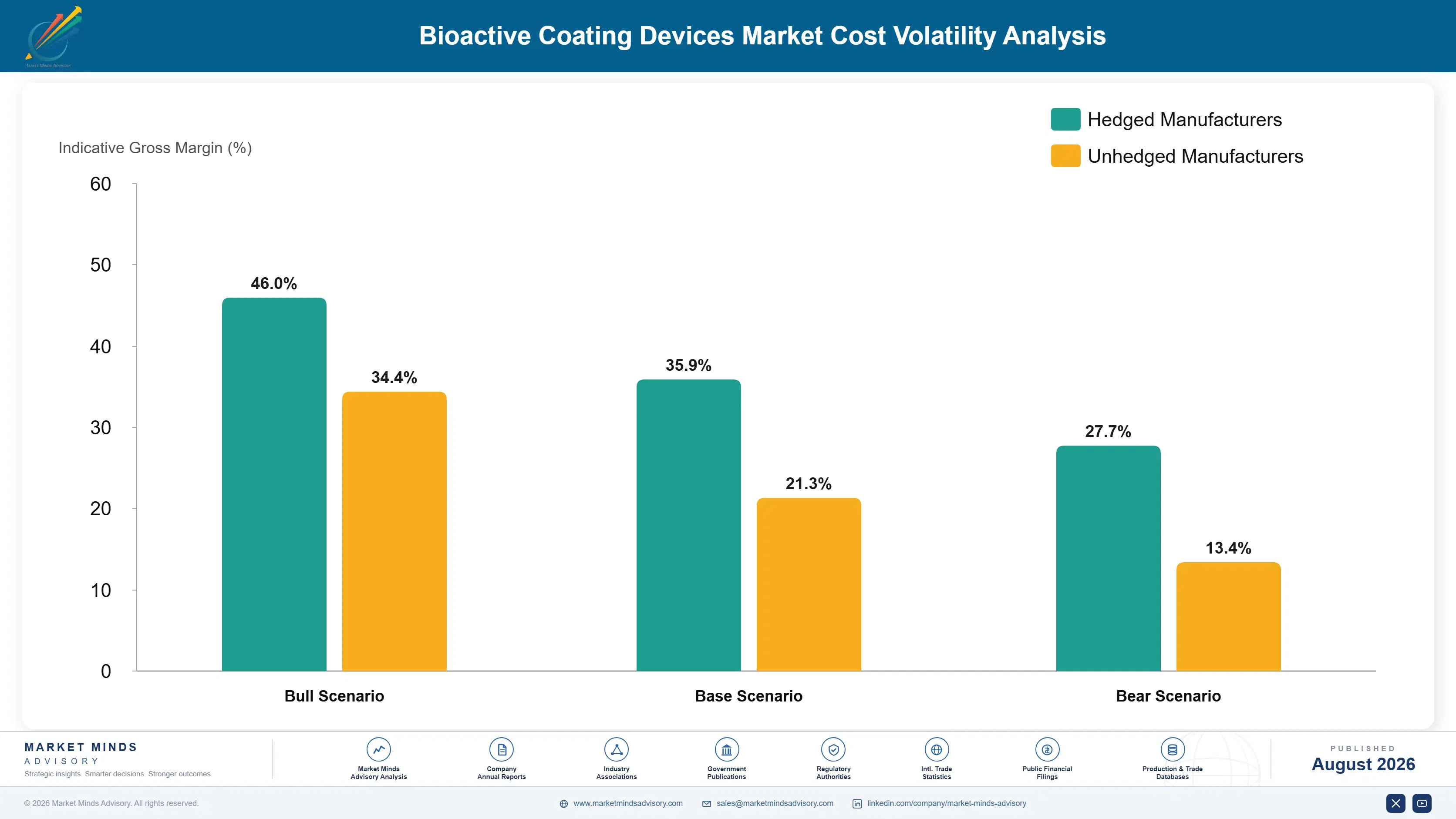
Polymer and API Cost Exposure

Specialty polymers and active pharmaceutical ingredients together make up roughly 44% of coating cost of goods sold, with polymers sourced primarily from European and North American specialty chemical producers and active ingredients sourced through a smaller number of qualified pharmaceutical-grade suppliers subject to strict regulatory qualification requirements that limit how quickly a manufacturer can switch vendors mid-contract without triggering renewed approval review.
Naphtha and propylene feedstock volatility flowed directly into specialty polymer pricing through 2024, with EIA data showing petrochemical feedstock prices swinging considerably across the year and squeezing coating manufacturer margin on fixed-price supply contracts signed before the volatility began. Several coating specialists absorbed the cost rather than risk losing device manufacturer accounts to competitors during contract renewal negotiations, a decision that compressed margin meaningfully across the affected product lines that quarter.

Vertically integrated device makers with larger purchasing scale negotiate more favorable polymer and active ingredient pricing than smaller specialty chemistry licensors, who typically lack comparable volume leverage with upstream suppliers. That gap widens further for licensors dependent on a single qualified active ingredient supplier, since switching pharmaceutical-grade suppliers requires renewed regulatory qualification that can take a year or more to complete.
global-bioactive-coating-devices-market-cost-volatility-analysis-1787332651600

Qualify Multiple Suppliers for Critical Inputs

Manufacturers qualifying two or more suppliers for critical polymers and active pharmaceutical ingredients reduce single-source dependency risk considerably, though the qualification process itself requires meaningful upfront regulatory investment and lead time before a second source becomes usable in production. DSM Biomedical and larger competitors have pursued dual qualification specifically to protect margin during feedstock price swings.

Lock In Multi-Year Feedstock-Linked Contracts

Manufacturers negotiating multi-year supply contracts with feedstock-indexed pricing formulas protect margin predictability better than those repricing annually, a structure that requires accepting somewhat higher baseline pricing in exchange for reduced volatility exposure across the contract term. This approach suits larger manufacturers with the purchasing scale to negotiate favorable indexed terms upfront, though smaller specialists often lack comparable negotiating position.

Shift Toward In-House Polymer Formulation

Larger manufacturers developing in-house polymer formulation capability reduce dependence on external specialty chemical suppliers over time, a structure requiring substantial upfront research investment that smaller specialty chemistry licensors typically cannot justify given their comparatively lower production volume and thinner balance sheets available for such commitments, leaving them dependent on external suppliers for the foreseeable future.

Portfolio Architecture for Margin Defence

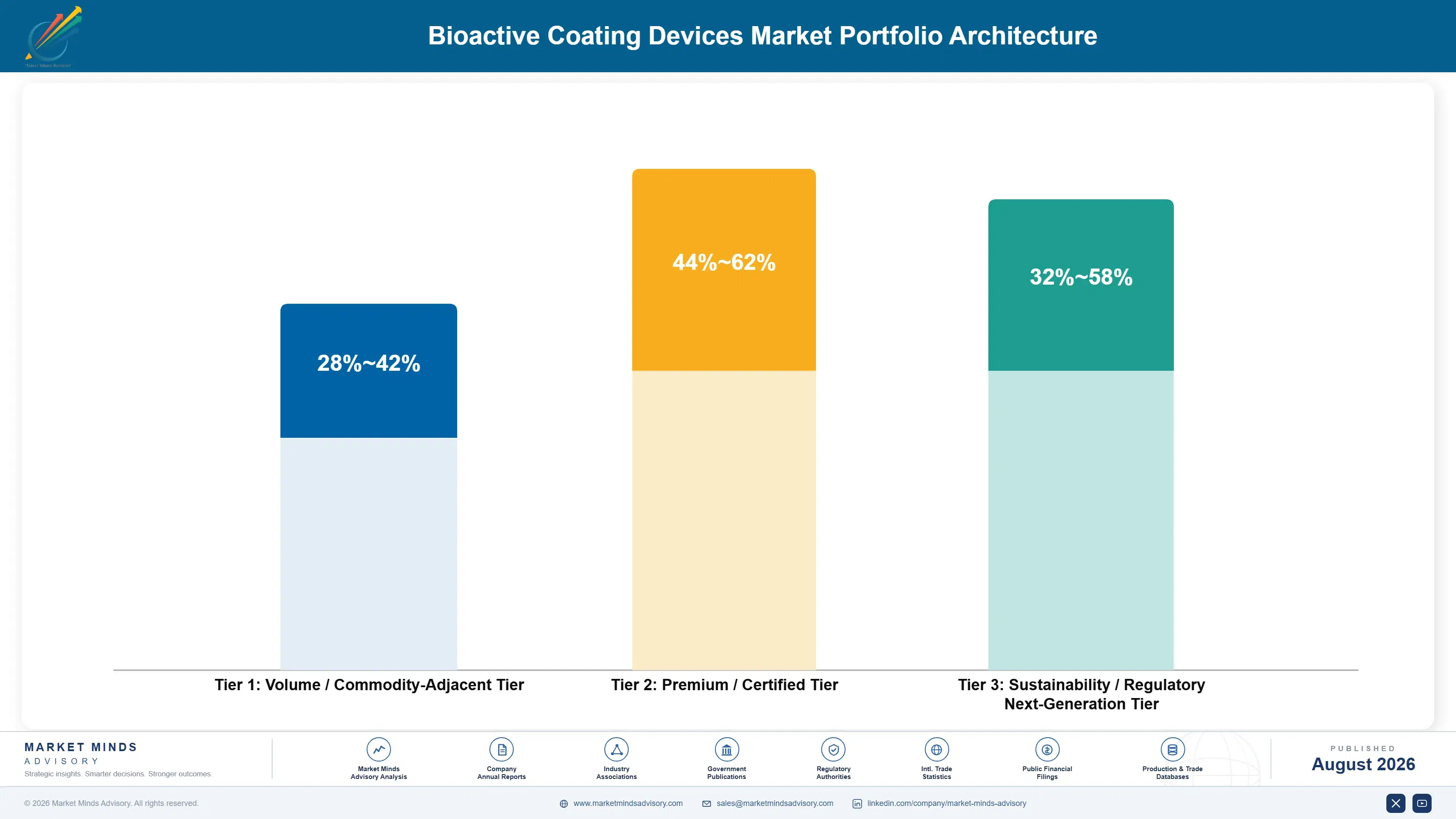
The portfolio splits into three tiers with distinct economics. Standard antimicrobial and hydrophilic coatings form the volume tier, competing on price and proven clinical track record with margin set by polymer cost and production scale. Drug-eluting and advanced osseointegration coatings earn considerably more because chemistry complexity and regulatory barriers both resist commoditisation. Next-generation antimicrobial peptide platforms sit differently, priced on early clinical differentiatio
The tension runs between winning standard coating volume on price and proven safety data, and building drug-eluting or peptide capability that protects margin over the long run. A manufacturer chasing every standard antimicrobial tender eventually gets squeezed as competitors undercut on price, yet developing eluting or peptide chemistry requires research investment thin-margin standard coating sales rarely fund adequately on their own.

High-value pools concentrate where chemistry complexity and regulatory dossier depth limit competition: drug-eluting platforms extending into new device categories, antimicrobial peptide chemistry still awaiting broad clinical validation, and licensing relationships spanning multiple device original equipment manufacturer partners across several device categories. Standard antimicrobial coatings sit at the other end, competing almost entirely on price and proven track record.

Volume / Commodity-Adjacent Tier

Standard antimicrobial and hydrophilic coatings for mainstream catheters and surgical hardware, competing on price and established clinical track record with thin, scale-dependent margin across most regional markets and hospital tender categories worldwide.
Gross Margin: 28-42%

Premium / Certified Tier

Drug-eluting and osseointegration coatings with regulatory-cleared chemistry serving cardiology, peripheral vascular, and orthopedic implants, priced for complexity, clinical differentiation, and dossier depth accumulated over years of post-market surveillance and regulatory engagement.
Gross Margin: 44-62%

Sustainability / Regulatory / Next-Generation Tier

Antimicrobial peptide platforms and next-generation eluting chemistry still building clinical evidence, priced on early differentiation with wide margin variance reflecting unsettled adoption and evolving procurement standards across hospital systems and national regulators.
Gross Margin: 32-58%
global-bioactive-coating-devices-market-portfolio-architecture-1787332652102

High-value Sub-segments and Strategic Watch-out

Drug-Eluting Coatings

High value and high growth at 13.2%, the fastest category, as manufacturers extend cardiology-proven eluting chemistry into peripheral vascular and orthopedic devices across nearly every major device manufacturer's product development pipeline right now, reshaping competitive priorities and forcing smaller specialists to pick a lane deliberately.
Gross Margin: 44-62%

Antimicrobial Peptide Platforms

High value with strong emerging growth, driven by hospital resistance concern and early clinical pilots showing meaningfully lower infection rates than established silver-ion alternatives currently in widespread hospital use today across most surgical departments and intensive care units globally, with adoption accelerating noticeably each successive quarter of new data.
Gross Margin: 38-58%

Standard Antimicrobial Coatings

The volume core by device count, growing near 8% as infection-reduction procurement standards spread from tertiary hospitals into mid-tier and regional facilities across most developed and emerging healthcare markets alike this decade and well into the next, anchoring most manufacturer revenue quite broadly today and for years to come.
Gross Margin: 28-42%

Radiopaque and Diagnostic Coatings

The strategic watch-out, growing slowest at roughly 7% and facing steady commoditisation as radiopaque marking becomes a bundled standard feature rather than a differentiated purchase decision across most device categories tracked here in this report and its accompanying forecast period covered ahead in full detail.
Gross Margin: 24-36%

Recurring Revenue Through Device Replacement

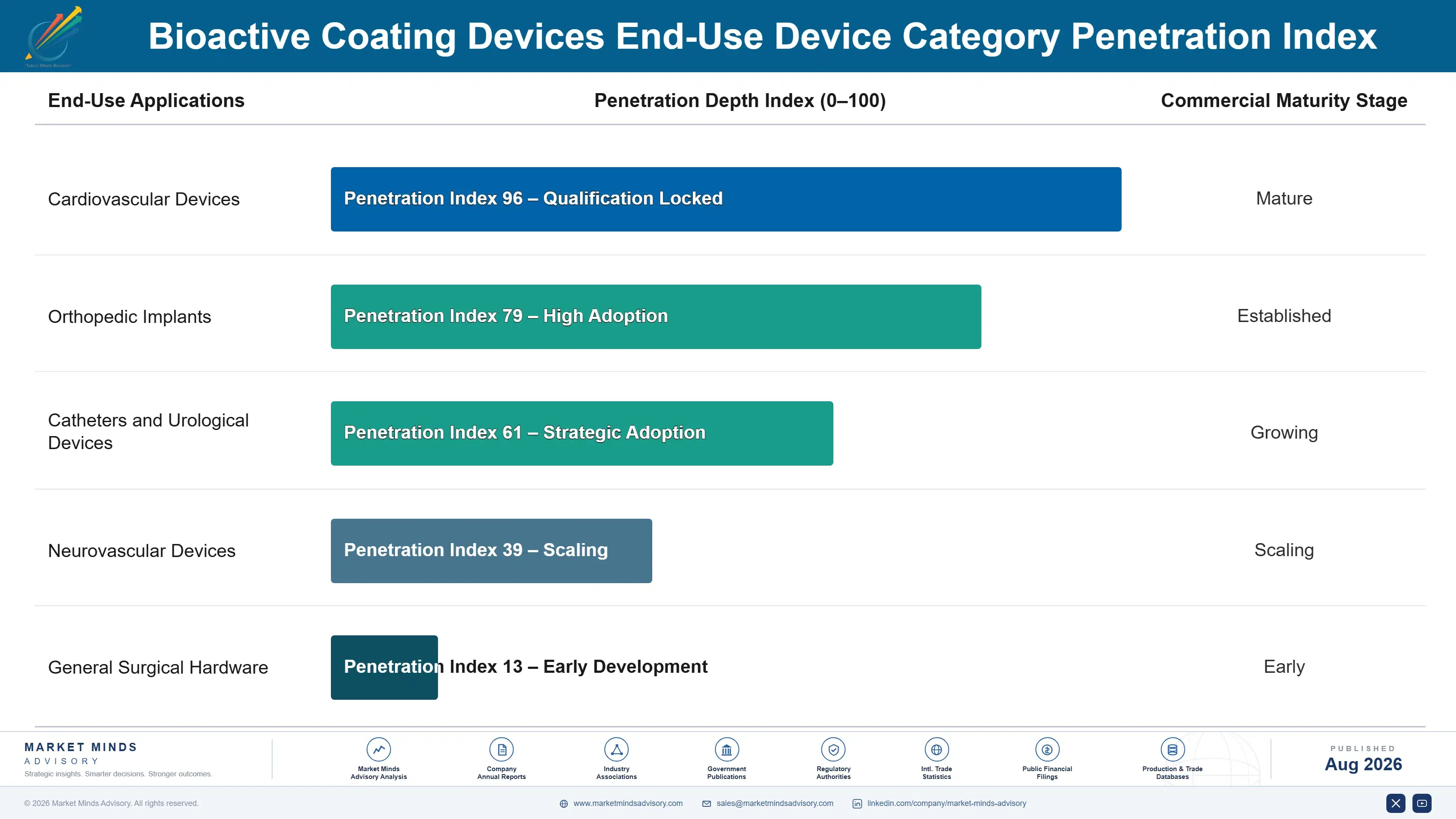
Coating revenue behaves like an annuity layered on top of device replacement cycles rather than a one-time sale. Every implant revision, catheter replacement, or new device generation requires re-specifying coating chemistry, and manufacturers with validated regulatory dossiers capture repeat business with lower friction than switching to an unproven alternative supplier would require.
Adoption depth varies considerably by end-use vertical. Cardiology has the deepest, most established coating adoption given decades of drug-eluting stent history, while orthopedic surgery is earlier in its coating adoption curve and still building the clinical evidence base that will eventually normalise coated implants as the default rather than a premium option. Wound care and general surgical hardware sit furthest behind, adopting coating chemistry more slowly as cost sensitivity remains higher there than in implantable device categories.

A generational shift is underway in hospital buying committees across most developed healthcare systems. Younger procurement and infection-control leadership increasingly treat coating documentation as a baseline requirement rather than a differentiator, a shift that is compressing the commercial advantage early-adopting hospitals once held over peers still running largely uncoated device inventories and slower procurement processes overall.
global-bioactive-coating-devices-market-end-use-penetration-index-1787332652590

Where Coating Specialists Should Focus Next

These are among the four positions where our research anticipates prominent divergence between winners and laggards over the coming forecast period. Each is grounded in the demand model, the regulatory perimeter, and the announced capacity pipeline.
01 / CHEMISTRY LICENSING DEPTH

Broad licensing beats single-customer coating supply

Specialty chemistry originators who license antimicrobial or eluting formulations across several device original equipment manufacturer partners simultaneously capture royalty revenue scaling with partner device volume rather than their own limited manufacturing capacity. That structure grows considerably faster than direct manufacturing once a chemistry platform proves out clinically and earns broad regulatory acceptance across multiple device categories. Manufacturers relying on a single large customer relationship remain exposed if that customer shifts toward in-house coating capability during any future contract renewal cycle, a risk broader licensing spreads meaningfully.
02 / REGULATORY AFFAIRS INVESTMENT

Filing expertise increasingly separates leaders from challengers

Combination-product approval pathways have grown materially more complex following past drug-eluting safety signals, and manufacturers with dedicated regulatory affairs teams now clear approval meaningfully faster than smaller competitors lacking comparable expertise. That gap is widening rather than closing as agencies raise evidence requirements further with each new filing cycle they oversee. Coating specialists bundling regulatory filing support alongside chemistry are capturing customers who previously handled filings independently but increasingly cannot justify the internal cost of maintaining that expertise in-house given tightening budgets.
03 / EMERGING MARKET MANUFACTURING

Early presence in Asian implant hubs compounds over time

Domestic implant manufacturing capacity is scaling quickly across India and China as governments favor local production over imports, creating demand for validated coating chemistry among manufacturers lacking in-house development capability of their own. Coating specialists establishing local technical support early are winning multi-year agreements before domestic competitors develop comparable chemistry independently at scale. That early position compounds considerably as regional implant volume keeps climbing through the decade, rewarding manufacturers who committed resources ahead of confirmed demand materialising fully across both countries' expanding device sectors.
04 / NEXT-GENERATION CHEMISTRY BETS

Peptide platforms warrant early investment despite thin evidence

Antimicrobial peptide chemistry remains early in its clinical validation relative to established silver-ion alternatives, but growing resistance concern is pushing hospital procurement toward exactly this kind of narrower-risk alternative over time. Early pilot data already shows meaningfully lower infection rates in comparable surgical settings across several trial sites. Manufacturers investing now, ahead of broader hospital adoption, position to capture premium pricing once procurement standards catch up with the underlying resistance science already emerging steadily across pilot programmes worldwide and gaining regulatory attention.

Engagement Snapshot From the Field

A live engagement with an industry participant carrying material or product regulatory and market exposure ahead of a defining policy shift, showing how our research translates into a defensible multi-year portfolio strategy.
MARKET MINDS ADVISORY · CLIENT ENGAGEMENT SUMMARY
Bioactive Coating Devices Producer Strategic Portfolio Review and Transition Roadmap 2026·Investment Scenario on Bioactive Coating Devices Exposure Evaluation 2025-26
CLIENT PROFILE
A mid-size orthopedic device manufacturer producing hip and knee implant systems across three manufacturing sites engaged MMA while evaluating whether to license antimicrobial coating chemistry externally or build in-house development capability. The client reported annual implant shipment volume near 210,000 units, with no existing antimicrobial coating offering in its current portfolio (client-reported, unverified by MMA).
STRATEGIC CHALLENGE
Leadership needed to decide whether licensing proven antimicrobial chemistry externally would meet upcoming tender requirements faster than building internal coating development capability from scratch, while also weighing which approach preserved better long-term margin control as procurement standards continued tightening across major hospital markets the client currently served and hoped to expand into over the following several years.
MMA APPROACH
MMA benchmarked five qualified coating licensors on chemistry validation status, regulatory dossier maturity, and licensing economics against the client's tender pipeline and manufacturing footprint across its three facilities. We modelled the cost and timeline difference between licensing and in-house development under several scenarios. We then assessed each licensor's exclusivity terms and long-term supply reliability specifically before the final recommendation.
KEY FINDINGS
  1. Licensing proven antimicrobial chemistry would meet tender deadlines roughly fourteen months faster than developing comparable chemistry internally from scratch, a decisive timing advantage.
  2. Three of five candidate licensors could not offer exclusivity terms protecting the client from direct competitor access to identical chemistry within the same product category.
  3. In-house development would cost an estimated 40% more over five years than licensing once regulatory filing and staffing costs were fully accounted for.
  4. The leading licensor's existing regulatory dossier would reduce the client's own combination-product filing timeline by several months, easing tender pressure considerably heading into the next fiscal year.
CLIENT PROFILE
A mid-size orthopedic device manufacturer producing hip and knee implant systems across three manufacturing sites engaged MMA while evaluating whether to license antimicrobial coating chemistry externally or build in-house development capability. The client reported annual implant shipment volume near 210,000 units, with no existing antimicrobial coating offering in its current portfolio (client-reported, unverified by MMA).
STRATEGIC CHALLENGE
Leadership needed to decide whether licensing proven antimicrobial chemistry externally would meet upcoming tender requirements faster than building internal coating development capability from scratch, while also weighing which approach preserved better long-term margin control as procurement standards continued tightening across major hospital markets the client currently served and hoped to expand into over the following several years.
MMA APPROACH
MMA benchmarked five qualified coating licensors on chemistry validation status, regulatory dossier maturity, and licensing economics against the client's tender pipeline and manufacturing footprint across its three facilities. We modelled the cost and timeline difference between licensing and in-house development under several scenarios. We then assessed each licensor's exclusivity terms and long-term supply reliability specifically before the final recommendation.
KEY FINDINGS
  1. Licensing proven antimicrobial chemistry would meet tender deadlines roughly fourteen months faster than developing comparable chemistry internally from scratch, a decisive timing advantage.
  2. Three of five candidate licensors could not offer exclusivity terms protecting the client from direct competitor access to identical chemistry within the same product category.
  3. In-house development would cost an estimated 40% more over five years than licensing once regulatory filing and staffing costs were fully accounted for.
  4. The leading licensor's existing regulatory dossier would reduce the client's own combination-product filing timeline by several months, easing tender pressure considerably heading into the next fiscal year.
RECOMMENDED STRATEGY
Phase 1: Phase 1 (0 to 3 months): Finalise licensor selection and negotiate exclusivity terms covering the client's core orthopedic device categories fully. Phase 2: Phase 2 (3 to 10 months): Complete combination-product regulatory filing using the licensor's existing dossier as supporting clinical evidence throughout. Phase 3: Phase 3 (10 to 16 months): Launch coated implant line and begin bidding on tenders requiring documented antimicrobial efficacy data.
OUTCOME
The client launched its antimicrobial-coated implant line within the sixteen-month target and began winning tenders previously closed to its uncoated product line, with early tender win rates reported as meaningfully improved against the prior year, though full annual figures were not yet available at the time of reporting (client-reported, unverified by MMA).

Frequently Asked Questions

Foundational context covering the market sizes, CAGR, scope, country, region and competition that inform every finding below. This section is provided to cover basics and most often pre-purchase conversations, answered from the MMA Primary Research Dataset.

What is the current size of the Bioactive Coating Devices Market?

The global bioactive coating devices market is valued at USD 4.2 billion in 2025, covering antimicrobial, drug-eluting, hydrophilic, osseointegration, and anti-thrombogenic coatings applied to implantable and interventional devices.

How large will the Bioactive Coating Devices Market be by 2036?

The market is projected to reach USD 11.75 billion by 2036, roughly 2.55 times its 2026 value of USD 4.61 billion, driven by expanding drug-eluting and antimicrobial coating adoption.

What is the CAGR for the Bioactive Coating Devices Market 2026 to 2036?

The base case CAGR is 9.8%, with a bull case of 11.0% if antimicrobial adoption accelerates faster than expected, and a bear case of 8.6% under tighter regulatory and reimbursement conditions.

Which segment is growing fastest?

Drug-Eluting Coatings lead at a 13.2% CAGR, roughly 1.35 times the overall market rate, as manufacturers extend cardiology-proven chemistry into peripheral vascular and orthopedic devices.

Who are the major companies in the Bioactive Coating Devices Market?

DSM Biomedical, Surmodics Inc., Hydromer Inc., Biocoat Incorporated, and AST Products Inc. lead the market, together holding roughly 46% of coating and licensing revenue across major device categories.

Which country is growing fastest?

India leads at a 12.4% CAGR as domestic implant manufacturing expands rapidly, reducing historical dependence on imported coated devices and catheter components significantly across most hospital networks.

Report Segmentation Architecture

The full report scope spans multiple orthogonal segmentation dimensions, with cross-tabulated demand data provided for each dimension pair. Coverage extends further to regional breakdowns, trend trajectories, and the competitive detail needed to support segment-level decision-making.

By Coating Chemistry Type

  • Antimicrobial Coatings
  • Drug-Eluting Coatings
  • Hydrophilic and Lubricious Coatings
  • Osseointegration Coatings
  • Anti-Thrombogenic Coatings
  • Radiopaque and Diagnostic Coatings

By End-Use Device Category

  • Cardiovascular Devices
  • Orthopedic Implants
  • Catheters and Urological Devices
  • Neurovascular Devices
  • General Surgical Hardware

By Commercial Dimension

  • Chemistry Licensing
  • In-House Coating Services
  • Contract Coating Manufacturing
  • Combination-Product Regulatory Support

By Region

  • North America
  • Western Europe
  • East Asia
  • South Asia and Pacific
  • Latin America
  • Middle East and Africa
  • Eastern Europe

Scope, Methodology, and Coverage

Every figure in this report is reproducible from documented input assumptions. The scope below maps the historical period, the forecast horizon, the segmentation dimensions, and the countries covered, alongside the underlying primary and qualitative methodology.
Historical Period
2020 to 2025
Forecast Period
2026 to 2036
Base Year
2025 (USD billions; MMA Primary Research Dataset, August 2026)
Market Definition
The bioactive coating devices market covers surface treatments and functional coatings applied to implantable and interventional medical devices, including antimicrobial, drug-eluting, hydrophilic, osseointegration, and anti-thrombogenic chemistries. It excludes underlying device substrates, coating deposition equipment, and non-medical industrial coatings.
Quantitative Units
USD billions (current prices); coated device unit volume where applicable
Segmentation Dimensions
By Coating Chemistry Type; By End-Use Device Category; By Commercial Dimension; By Region
Regions Covered
North America, Western Europe, East Asia, South Asia and Pacific, Latin America, Middle East and Africa, Eastern Europe
Countries Covered
USA, China, Germany, France, UK, Japan, South Korea, India, Australia, Canada, Brazil, Mexico, Indonesia, Vietnam, Thailand, Malaysia, UAE, Saudi Arabia, South Africa, Nigeria, Turkey, Poland, Netherlands, Italy, Spain, Sweden, Switzerland, Argentina, Colombia, Singapore, and additional markets relevant to this sector
Key Companies Profiled
DSM Biomedical, Surmodics Inc., Hydromer Inc., Biocoat Incorporated, AST Products Inc., Covalon Technologies Corp., Harland Medical Systems, Precision Coating Company, Specialty Coating Systems, BioInteractions Ltd, Aculon Inc., Vergason Technology Inc., Implant Sciences Corporation, Freudenberg Medical, Camstent Ltd, Biocompatibles UK Ltd, Abbott Vascular, Boston Scientific Corporation, Medtronic plc, PPG Industries Inc.
Quantitative Methodology
Primary survey, n=3,800 respondents, Q4 2025, six countries; demand-side model with trade association cross-validation
Qualitative Methodology
47 expert interviews, Q4 2025; applied to validate demand model assumptions, identify emerging dynamics, and assess competitive positioning
Report Format
PDF and XLSX data workbook (Word format preview document)
Publisher
Market Minds Advisory
Report Code
MMA-2026-MED-121
Published
August 2026
Contact
sales@marketmindsadvisory.com | www.marketmindsadvisory.com

Purchase the full Bioactive Coating Devices Market Report (2026 to 2036).

The full report delivers granular sizing and forecasts across all six coating chemistry segments and seven global regions through 2036. It profiles twenty companies across chemistry licensors and vertically integrated device makers, benchmarking regulatory dossier depth, licensing economics, and manufacturing footprint in considerable detail. Analysts detail input cost exposure, portfolio margin tiers, and demand architecture by end-use device vertical across major healthcare systems worldwide. Buyers receive both the standalone report and full access to underlying data tables supporting every figure and forecast presented throughout the analysis, updated periodically as new data becomes available.
Six-segment coating chemistry sizing and full forecasts
Seven-region global market share breakdown detail
Twenty-company detailed competitive profile benchmarking analysis
Input cost exposure and supplier mitigation analysis
Portfolio margin tier benchmarking economics framework
Anonymised client engagement outcome case study

Built For The People Who Decide

From boardroom strategy to bench-side execution, this report is read cover-to-cover by leaders shaping the next decade of their industry, turning demand scenarios, market dynamics and valuation benchmarks into decisions.
CXOs/ Presidents/ VPs/ Managers
M&A and Corporate Development
Strategy Teams and R&D Heads
Procurement and Product Directors
Regulatory and Compliance Leaders
Investor Relations and Equity Analysts