
Market Minds Advisory
Automotive Lighting Market

Automotive Lighting Market: Adaptive Beam Divergence, the Replacement Bulb Business That Died, and Repair Cost Inflation

LED headlamps last as long as the car, which quietly killed a replacement bulb business worth real money. What replaced it is a collision part costing thousands that insurers are increasingly unwilling to fit.

Lead Analyst

David Horsley

Published

September 2026

Make Smarter Decisions with Customized Research Insights

Request a free sample report and evaluate market opportunities, growth trends, and competitive dynamics relevant to your business needs.

2025 MARKET VALUE$35.4BMarket Size 2025
2036 FORECAST VALUE$70.0BBase Case , 2026 to 2036
CAGR 2026 TO 20366.4 %Bull 7.6% / Bear 5.2%
INCREMENTAL OPPORTUNITY$32.4BNet 10- year value creation
EXPANSION MULTIPLE1.86x2036 value over 2026 base
Strategic Levers
M&A Pipeline
Regional Outlook
Country Rankings
Competitive Intelligence
Segmental Deep-dive
Call-Us : 91 93563 13602

Executive Snapshot and Market Trajectory

LED fitment reached 89% of new vehicles and the industry is still working out quite what that means. A light source lasting the whole vehicle life removed a recurring bulb business, and replaced it with a collision assembly costing around 1,840 dollars that insurers now argue about.
Commercial advantage belongs to manufacturers who can add functions rather than replace light sources, because the conversion from halogen to LED is essentially finished in developed markets and cannot be sold twice. OLED and surface emission lighting grows fastest at 16.8%, roughly 2.63 times the market. East Asia holds the largest position at 33% of value, above the standard band, on vehicle production concentrated there.
Concentration is high at roughly 58% for the top five, sustained by tooling, photometric homologation, and 34-month award cycles. Adaptive driving beam sits at only 17% fitment because American and European regulatory requirements diverged, and the American version is harder to meet than most manufacturers expected it to be. Systems homologated for one regime frequently fail the other outright, which has split development across two engineering programmes for what is a single function.
Market Definition
The market comprises lighting systems supplied for light vehicles at original equipment and replacement level, covering halogen lighting, xenon high-intensity discharge lighting, LED lighting, adaptive driving beam and matrix LED systems, laser and high-intensity auxiliary lighting, and OLED or surface emission lighting. Value is measured at supplier level across combustion, hybrid, and electric vehicles. Instrument clusters and head-up displays, infotainment screens, interior ambient systems sold separately, heavy commercial vehicle lighting, and aftermarket accessory lighting fall outside scope.
Base Year Value
$35.4B in 2025 (MMA Primary Research Dataset, August 2026)
Forecast Period
2026 to 2036, eleven discrete annual values
CAGR
6.4% base case. Bull 7.6%. Bear 5.2%.
Fastest Growth Segment
OLED and Surface Emission Lighting: 16.8% CAGR
Fastest Growth Country
India: 9.8% CAGR
Fastest Growth Region
South Asia and Pacific: 8.6% CAGR
Largest Region
East Asia: 33% of 2025 global value
Market Leaders
Koito Manufacturing, Marelli, Valeo, Forvia HELLA, and Stanley Electric lead on automotive lighting supply revenue. Source: company annual reports and MMA Analysis, July 2026.
Primary Survey
n=3,800 procurement and R&D decision-makers, Q4 2025, six countries
Methodology
Demand-side build-up, cross-validated against public data, 47 expert interviews

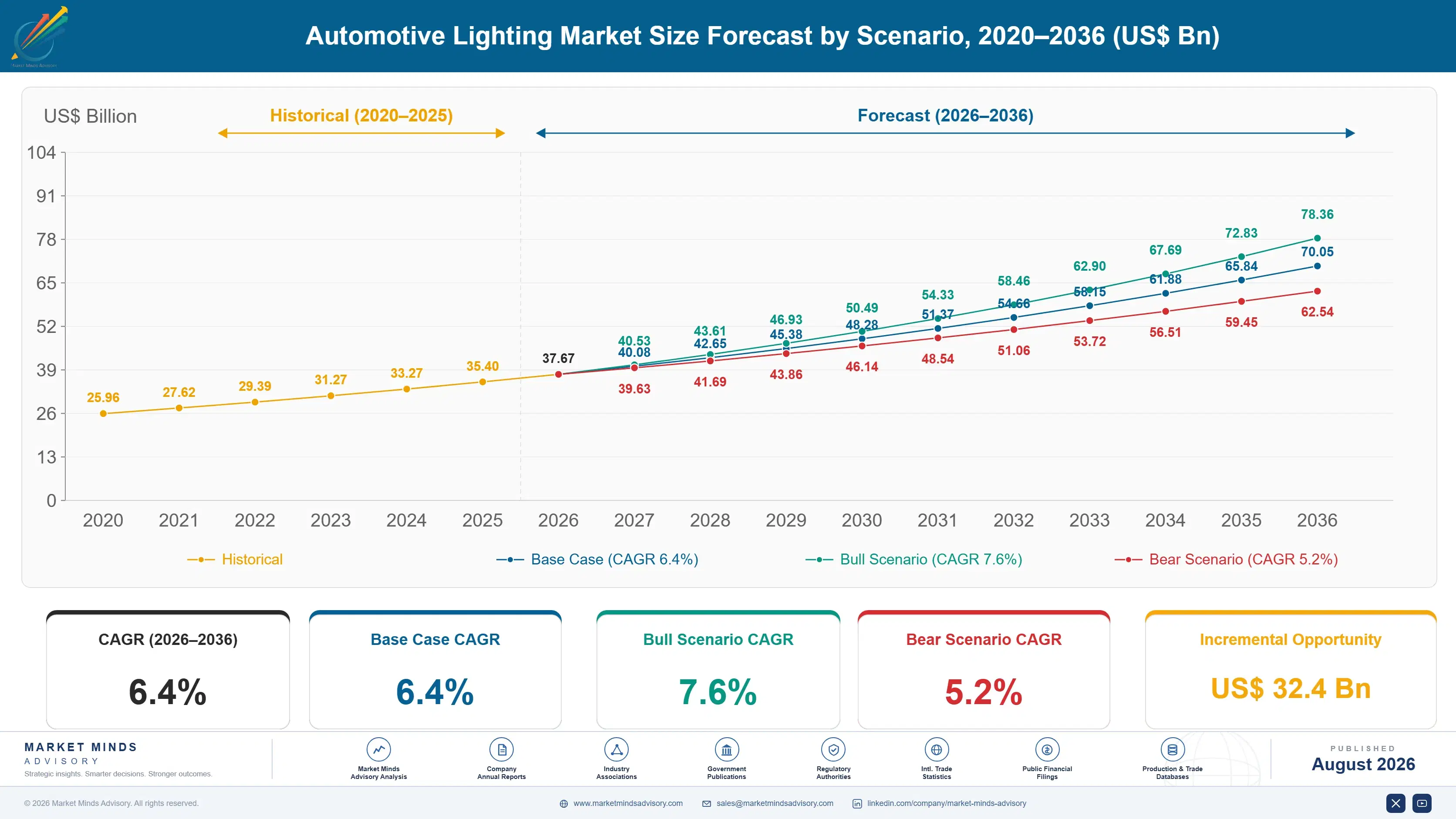
Automotive Lighting Market Forecast Scenarios

global-automotive-lighting-market-trends-size-forecast-scenario-1787551110721
Between 2020 and 2025 the LED conversion finished in developed markets and the industry discovered what it had traded away. Replacement bulb revenue, a steady annuity for decades, effectively disappeared as light sources began outlasting the vehicles carrying them. Content value per vehicle rose considerably at the same time. The 5.1% historical rate combines rising content with an aftermarket business shrinking underneath it.
The 6.4% base case rests on three mechanisms. Adaptive driving beam fitment keeps rising from a low base as regulatory requirements settle and manufacturers work out how to meet the American version. Collision replacement value keeps climbing as assemblies get more complex and expensive. And function addition continues, with communication lighting, animated signatures, and surface emission all adding content the previous vehicle generation never carried. None of the three requires vehicle production volumes to rise.
The 7.6% bull case assumes adaptive beam fitment accelerates as American requirements are clarified and costs fall. The 5.2% bear case reflects vehicle production weakness across major markets, insurers pushing back harder on assembly replacement costs and driving repair rather than replacement, and Chinese suppliers compressing pricing on mass-market programmes they increasingly win outright. Insurance pressure sits under both cases regardless.

What the LED Conversion Cost

The industry converted from halogen to LED and celebrated the content increase without much discussion of what went with it. A halogen bulb failed and got replaced several times across a vehicle's life, which supported a genuine consumable annuity. LED sources outlast the car. Fitment at 89% of new vehicles means that annuity has essentially gone, and it is not coming back.
TOP-FIVE CONCENTRATION58%Combined supply share held by the leading lighting manufacturers
LED NEW VEHICLE FITMENT89%Share of new vehicles leaving factories with LED headlamps
HEADLAMP ASSEMBLY REPLACEMENT COSTUSD 1,840Typical parts cost for one modern front lighting assembly
ADAPTIVE BEAM FITMENT RATE17%Portion of new vehicles equipped with adaptive driving beam
AFTERMARKET REVENUE SHARE21%Portion of manufacturer revenue from replacement and collision supply
PROGRAMME AWARD LEAD TIME34 monthsTypical gap between design award and start of production
What replaced it is a very different aftermarket. A modern front assembly with matrix optics, levelling, sensors, and control electronics costs around 1,840 dollars in parts, and on an older vehicle a single damaged headlamp can push a collision claim toward total loss. Insurers have noticed. Repair rather than replace approaches, aftermarket equivalents, and salvage supply are all growing pressure on that revenue.
Adaptive driving beam should have been the next content wave and has stalled at 17% fitment. European and Japanese rules permitted it years before American regulation did, and when the American amendment finally arrived its technical requirements proved harder to meet than manufacturers had assumed. Systems homologated for Europe frequently do not comply, which fragments development across two engineering programmes.
"Everyone measured the LED transition in content per vehicle and nobody put a number on the bulb business they were retiring. It was a good trade and it was still a trade, and the replacement revenue now sits with insurers who would rather not pay it."
Practice Director, Automotive Systems and Vehicle Electrification · MMA Automotive Systems and Components Practice · August 2026

Market Trends

Adaptive Beam Requirements Diverged Across Two Regulatory Regimes

European and Japanese rules permitted adaptive driving beam years before American regulation did, and when the American amendment arrived its technical requirements were written differently and proved harder to satisfy in practice. Systems homologated for one regime frequently fail the other, which splits development across two engineering programmes for the same function. Fitment sits at 17% partly for that reason. Manufacturers who solved both requirements in one hardware platform hold an advantage competitors are still funding. Vehicle manufacturers building on global architectures increasingly request one platform satisfying both regimes rather than two.
Market Impact: LED fitment already reaches 89%
Collision Assembly Cost Becomes an Insurance Problem

A modern front lighting assembly with matrix optics, levelling motors, sensors, and control electronics runs around 1,840 dollars in parts alone, and on a vehicle several years old a single damaged unit can push a claim toward total loss. Insurers have responded with repair-rather-than-replace approaches, aftermarket equivalents, and salvage sourcing. That pressure falls directly on the 21% of manufacturer revenue coming from replacement and collision supply. Modular designs allowing a damaged lens, module, or driver to be replaced individually keep the work inside the original equipment channel and reduce the claim cost provoking the pushback.
Market Impact: East Asia holds 33% of value

Market Opportunities and Growth Drivers

Function Addition Replaces Source Conversion as Growth Engine

With LED fitment at 89% in developed markets, the conversion that drove content growth for a decade is finished and cannot be sold a second time to anybody. Growth now has to come from functions the previous vehicle generation did not carry: animated signatures, communication lighting, surface emission panels, and adaptive systems. Each addition requires its own engineering and homologation rather than simply substituting a light source. Manufacturers organised around conversion economics are discovering a very different business. Content per vehicle is plateauing in developed markets for the first time in fifteen years.
Market Impact: Aftermarket fell to 21% of revenue

Chinese Vehicle Production Concentrates Programme Volume

China builds a larger share of the world's light vehicles than any other country and the gap keeps widening, which places programme awards there in volumes no other market approaches. Domestic suppliers win much of that work at price points international incumbents cannot match on a comparable cost base. East Asia holds 33% of value, above the standard regional band, on production concentration alone. Those suppliers are now qualifying into export programmes rather than serving only domestic assembly. Relationship depth has made no measurable difference to any of those award decisions.
Market Impact: Replacement threatens 21% revenue share

Market Restraints and Challenges

Replacement Bulb Annuity Has Permanently Disappeared

Halogen bulbs failed and were replaced several times across a vehicle's life, supporting a consumable business with predictable volumes and reasonable margins for decades. LED sources outlast the vehicle. The root cause is simply that the new technology works better, which is not a problem anybody can solve. Manufacturers mitigate by building collision and replacement assembly supply, by defending that channel against aftermarket equivalents, and by accepting that original equipment content growth now has to carry the whole business. Nobody put a number on the annuity before retiring it, which is telling.
Market Impact: Fitment stalled at 17% of vehicles

Insurers Push Back on Assembly Replacement Pricing

Front lighting assemblies at around 1,840 dollars in parts have become a total-loss trigger on older vehicles, and insurers are responding with repair approaches, aftermarket parts, and salvage sourcing rather than accepting original equipment replacement. The root cause is complexity concentrated into a single non-serviceable unit. Manufacturers mitigate through modular designs allowing component-level repair, through certified refurbishment programmes, and by supplying insurers directly on terms that keep the work inside the original equipment channel. Engaging insurers and approved repairer networks directly on design is a conversation almost no lighting supplier has ever attempted.
Market Impact: Assemblies cost USD 1,840 in parts
4 additional market trends, 3 additional growth drivers, and 2 additional restraints and challenges are covered in the full report. Contact sales@marketmindsadvisory.com to access the complete intelligence.

Segment CAGR and Growth Architecture

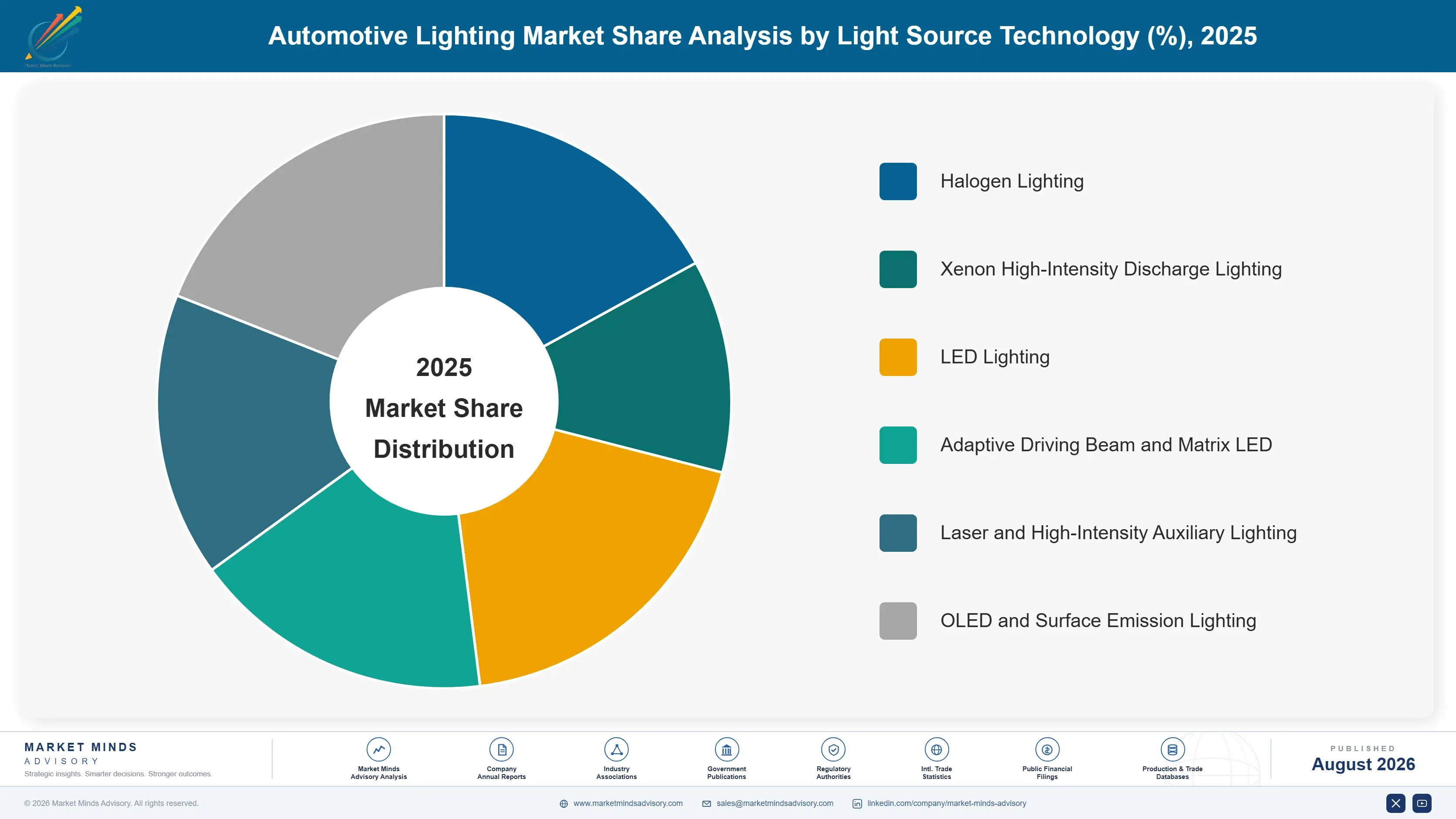
Segmentation follows light source and system technology, because each carries a distinct cost position, homologation route, and stage in a transition that has already completed for some and barely started for others. Six technologies cover commercial supply, and the divide between sources in run-off and functions still being added matters far more commercially than any performance comparison between them.
global-automotive-lighting-market-trends-market-share-analysis-1787551111276

OLED and Surface Emission Lighting

The fastest technology at 16.8%, roughly 2.63 times the market, from a base that remains genuinely small in unit terms. Organic and surface emission panels produce even illumination across an area rather than a point source, which lets designers create shapes and animations that discrete LEDs cannot approach. Rear combination lamps and signature elements on premium vehicles carry almost all current fitment. Cost, luminance limits, and lifetime under thermal cycling all remain real constraints. Chinese and Korean panel supply has improved availability considerably over the past three years. Automotive qualification for temperature cycling, humidity, and vibration is considerably harder than any consumer display application, which is why panel availability improving has not translated straight into fitment.
CAGR 16.8%

Adaptive Driving Beam and Matrix LED

Second fastest at 14.2%, and the function that should already have converted far more of the market than the 17% it currently reaches. Individually controlled LED segments shadow oncoming vehicles while keeping full beam elsewhere, which is a genuine safety improvement rather than a styling feature. European and Japanese regulation permitted it years earlier than American rules, and the American technical requirements proved harder to meet than manufacturers expected. Systems built for one regime frequently fail the other, which has split development and slowed fitment considerably everywhere. Vehicle manufacturers building one car for several markets need a single platform satisfying both requirement sets, and the supplier who delivers that avoids funding two parallel development programmes.
CAGR 14.2%
Full segment breakdown across 6 segments available in the complete report.

Regional Architecture and Country Demand Map

Regional shares follow light vehicle production location rather than sales, since lighting is supplied to the assembly plant. East Asia sits above the standard band for the reason stated below, and every other region falls inside its range. Sales figures mislead quite badly in this particular market.

North America

Adaptive driving beam regulation arrived here years after Europe and Japan permitted it, and the technical requirements as written proved harder to satisfy, which has held fitment well below European levels despite obvious demand. Pickup and large sport utility programmes carry high content, since assemblies scale with vehicle width. Insurance pressure on collision replacement cost is more organised here than anywhere, with aftermarket and salvage supply well established. Valeo, Forvia HELLA, and Marelli hold positions alongside Asian suppliers with domestic plants. Growth of 6.0% depends on adaptive beam fitment finally accelerating. Replacement bulb volume disappeared faster here than anywhere, since LED fitment reached high levels early across mass-market vehicle segments too.
Share: 22% | CAGR: 6.0% (2026 to 2036)

Western Europe

Regulatory permission for adaptive beam came early and premium German programmes drove matrix LED adoption well ahead of any other region, which makes fitment rates here the highest anywhere by a considerable margin. Design studios set the signature conventions that other regions copy several model cycles later. Content value per vehicle is the highest globally. Forvia HELLA, Valeo, ZKW, and Marelli hold deep studio relationships. Growth of 4.8% is the slowest anywhere, reflecting mature adoption of the functions that drove growth elsewhere and serious cost pressure on mass-market programmes. Insurance pressure on assembly replacement is building here as well, though repairer network structures differ enough between countries that no single approach reaches the whole region.
Share: 21% | CAGR: 4.8% (2026 to 2036)
Regional intelligence for 5 additional markets available in the complete report: East Asia, South Asia and Pacific, Latin America, Middle East and Africa, Eastern Europe. Contact sales@marketmindsadvisory.com.
global-automotive-lighting-market-trends-country-cagr-analysis-1787551111792

Four Moves Worth Real Capital

Advantage here comes from adding functions rather than converting sources, from solving two regulatory regimes with one platform, and from defending an aftermarket that has changed shape completely. Four moves justify capital across the forecast period, and the first confronts the transition this industry has already finished. None of them is a cost reduction programme.

Build function content, not source conversion

LED fitment at 89% means the conversion that drove a decade of content growth is finished in developed markets and cannot be sold again to anybody. Animated signatures, communication lighting, surface emission panels, and adaptive systems each add content the previous generation never carried, and each requires its own engineering and homologation rather than a source substitution. Manufacturers still organised around conversion economics are running a growth model that has already expired underneath them. Each addition requires its own homologation and tooling rather than a simple substitution, which is a considerably slower business than conversion ever was.
Market Impact: Replaces growth now exhausted at 89% LED fitment

Engineer one platform for both beam regimes

European and American adaptive driving beam requirements diverged enough that systems homologated for one frequently fail the other, which has split development across two programmes and held fitment at 17%. Manufacturers who solve both in a single hardware platform serve global vehicle programmes without duplicating engineering, which is exactly what a vehicle manufacturer building on a global architecture actually needs. Competitors funding two development paths are paying twice for one function. Consolidation also releases engineering capacity that duplication has been consuming for years, which matters more than the cost saving in a business where development resource is the binding constraint.
Market Impact: Addresses adaptive beam fitment currently stuck at 17%

Design assemblies for component-level repair instead

Front assemblies at around 1,840 dollars in parts are triggering total-loss decisions on older vehicles, and insurers are responding with aftermarket parts, salvage sourcing, and repair approaches that bypass original equipment supply entirely. Modular designs allowing a damaged lens, module, or driver to be replaced individually keep the work inside the channel and reduce the claim cost that provokes the pushback. That protects the 21% of revenue coming from replacement and collision. Engaging insurers and approved repairer networks directly on design is a conversation almost nobody in this industry has attempted, which makes it available to whoever moves first.
Market Impact: Defends the entire 21% of replacement revenue share

Establish manufacturing inside Chinese programme volume

China builds more light vehicles than any other country and the gap keeps widening, with domestic suppliers winning much of that work at prices an imported cost base cannot approach. Those suppliers are now qualifying into export programmes as well. International manufacturers without genuine local engineering and tooling are excluded from the largest single pool of programme awards anywhere, and establishing it takes years that competitors are already spending. Establishing local tooling and engineering typically takes 3 to 4 years, which is time competitors have already been spending while incumbents debated whether the volume mattered.
Market Impact: Reaches the full 33% of value located there

Who Controls the Margin Pool

Concentration is high at roughly 58% for the top five on supply revenue, sustained by tooling investment, photometric homologation across multiple regimes, and 34-month award cycles that reward incumbency heavily. Koito leads on global volume with deep Japanese and North American positions. Marelli, Valeo, and Forvia HELLA hold the European design studio relationships that decide signature and matrix work, and Stanley maintains strong Japanese and Chinese positions.
Competition runs on three dimensions. Function development capability is the first, since source conversion has finished and growth now depends on adding what the previous vehicle did not have. Multi-regime homologation is the second, given how far adaptive beam requirements have diverged. Cost base is the third, particularly on mass-market work where Chinese suppliers set the reference price. None of the three is helped by manufacturing scale alone.

Pressure is building from Chinese suppliers moving beyond domestic programmes into export awards, and from insurers attacking the replacement channel that partly offsets original equipment pricing. Rankings will shift toward manufacturers holding function development capability and genuine Chinese manufacturing scale together, because either alone now leaves too much of the industry unreachable. Content growth from conversion is finished and will not return.
global-automotive-lighting-market-trends-company-positioning-matrix-1787551112314

Competitive Moat and Risk Dimensions

KOITO MANUFACTURING

Moat: Homologation breadth and global scale

Volume across Japanese, North American, and Chinese programmes gives Koito manufacturing scale and photometric engineering depth that smaller suppliers cannot amortise across their own output. Homologation capability across every major regulatory regime is built over decades rather than purchased. That breadth matters more than ever now that adaptive beam requirements have diverged between the major markets.
KOITO MANUFACTURING

Risk: European signature relationships

Signature and matrix design work is decided in European studios where Forvia HELLA, Valeo, and Marelli hold relationships built across many model cycles, and Koito's position there remains weaker than its global volume implies. Those decisions are taken during styling rather than at request for quotation. Engineering excellence alone does not reach a conversation happening in a design studio.
VALEO

Moat: Adaptive beam development depth

Valeo invested early in matrix and adaptive beam systems and holds homologation experience across both European and American requirements, which matters considerably now that the two regimes have diverged and split most competitors' development effort. Vehicle manufacturers building on global architectures need one platform satisfying both. That capability reaches programmes where regulatory complexity rather than cost decides the award.
VALEO

Risk: Mass-market cost exposure

Chinese suppliers set the reference price on mass-market lighting and Valeo's cost base cannot match them on comparable content, which concedes volume that helps absorb development spending. Adaptive beam expertise commands a premium on a function fitted to only 17% of vehicles. Building Chinese scale to defend that volume competes for the capital funding function development.

Players Tracked

Prominent Players

Koito Manufacturing
Marelli
Valeo
Forvia HELLA
Stanley Electric

Other Key Players

Hyundai Mobis
Varroc Lighting Systems
ZKW Group
ams-OSRAM
Lumileds
Nichia
HASCO Vision
Xingyu Automotive Lighting
TYC Brother Industrial
Lumax Industries
Samvardhana Motherson
Depo Auto Parts
Texas Instruments
Grupo Antolin
SL Corporation

Recent Developments

FEBRUARY 2025

Supplier consolidates adaptive beam onto single global platform

A lighting manufacturer completed development of an adaptive driving beam platform satisfying both European and American technical requirements from one hardware design, after several years of running parallel programmes for each regime separately. Vehicle manufacturers on global architectures had requested exactly that consolidation. Nobody asked for two.
Signal: Single-platform homologation across the diverged regimes is now becoming a requirement rather than any development preference
JUNE 2025

Insurer programme mandates repair over assembly replacement

A major motor insurer introduced a repair-first requirement for damaged lighting assemblies across its approved repairer network, citing parts costs that were driving total-loss decisions on vehicles with substantial remaining value. Aftermarket and salvage sourcing were both expanded alongside the change. Original equipment volume fell immediately.
Signal: Insurers are now actively engineering original equipment lighting out of the collision repair supply chain entirely
OCTOBER 2025

Chinese lighting supplier wins European mass-market programme

A domestic Chinese lighting manufacturer secured a European mass-market vehicle programme following full photometric homologation and supplier qualification, pricing well below incumbent European quotations for comparable content. The award covered a full model cycle rather than a single variant. Existing relationship history changed nothing at all here.
Signal: Chinese cost bases have now reached export programme awards rather than remaining confined to domestic vehicle production

What Sets the Cost Base

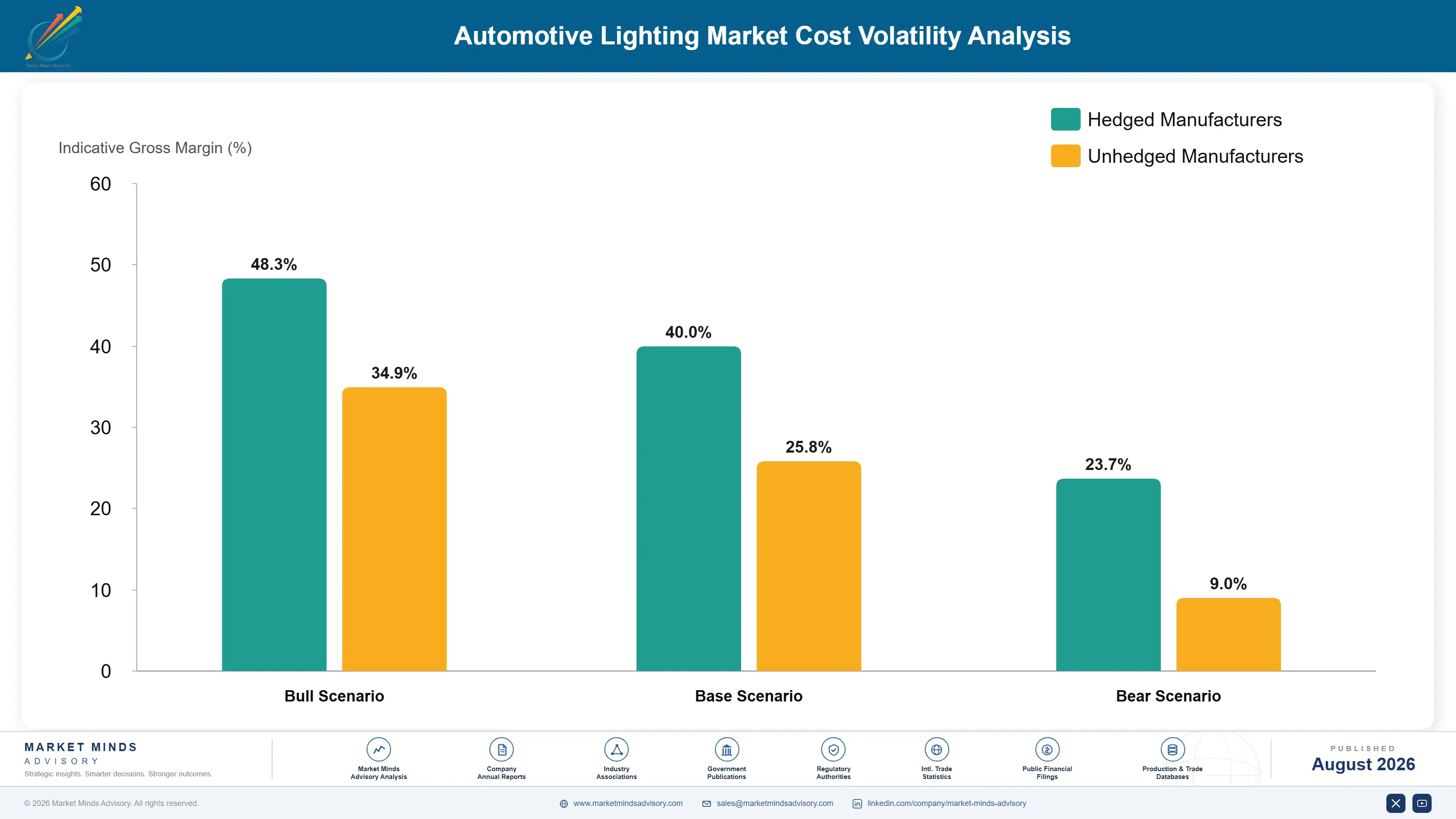
LED emitters represent roughly 23% of cost of goods sold, sourced from Nichia, ams-OSRAM, Lumileds, and Seoul Semiconductor across Japan, Germany, and Malaysia. Optical-grade polycarbonate for lenses and housings takes a further 18%, supplied by Covestro, SABIC, and Mitsubishi Chemical. Drivers, control electronics, and levelling actuators absorb 19% and rise sharply on matrix systems. Tooling amortisation across programme life sits beneath all of it.
Semiconductor availability constrained lighting driver supply through 2021 and into 2023, and suppliers allocated output across programmes rather than meeting full demand anywhere. Koito and Valeo both discussed component availability and its production effects in their reporting for those years. Optical polycarbonate pricing moved with European energy costs at the same time, since the polymerisation involved is genuinely energy intensive. Suppliers with regional resin sourcing absorbed considerably less of that movement.

Exposure divides on programme mix and content level rather than on scale. Suppliers weighted toward mass-market awards face annual cost-down commitments assuming emitter deflation, so input increases land entirely on margin. Matrix and adaptive systems carry higher electronics content with pricing that resists cost-down pressure considerably better. Suppliers with Chinese manufacturing hold a materials and tooling advantage on volume work that procurement alone cannot replicate.
global-automotive-lighting-market-trends-cost-volatility-analysis-1787551112508

Shift content mix toward electronics and control

Emitter deflation at 23% of cost of goods sold is priced into annual negotiations every year without exception. Control electronics, adaptive beam algorithms, and animation software carry value that hardware cost-down conversations have no established precedent for reducing. Suppliers restructuring content this way protect margin that piece price negotiation would otherwise remove steadily across a programme.

Qualify second sources for driver semiconductors

Driver availability constrained lighting output through the recent shortage and the affected components are rarely specialised enough to justify single sourcing. Qualifying alternates costs engineering time and photometric revalidation rather than capital. Suppliers who completed that work during the last tightness shipped programmes while competitors were allocating output across customers who all needed it.

Regionalise optical polycarbonate sourcing

Optical-grade polycarbonate at 18% of cost of goods sold is energy intensive to produce, which ties it to regional power prices in a way most components are not. Sourcing aligned to manufacturing location removes both freight and single-market energy exposure. Qualification of optical grades takes time and then holds for the life of the programme.

Portfolio Architecture for Margin Defence

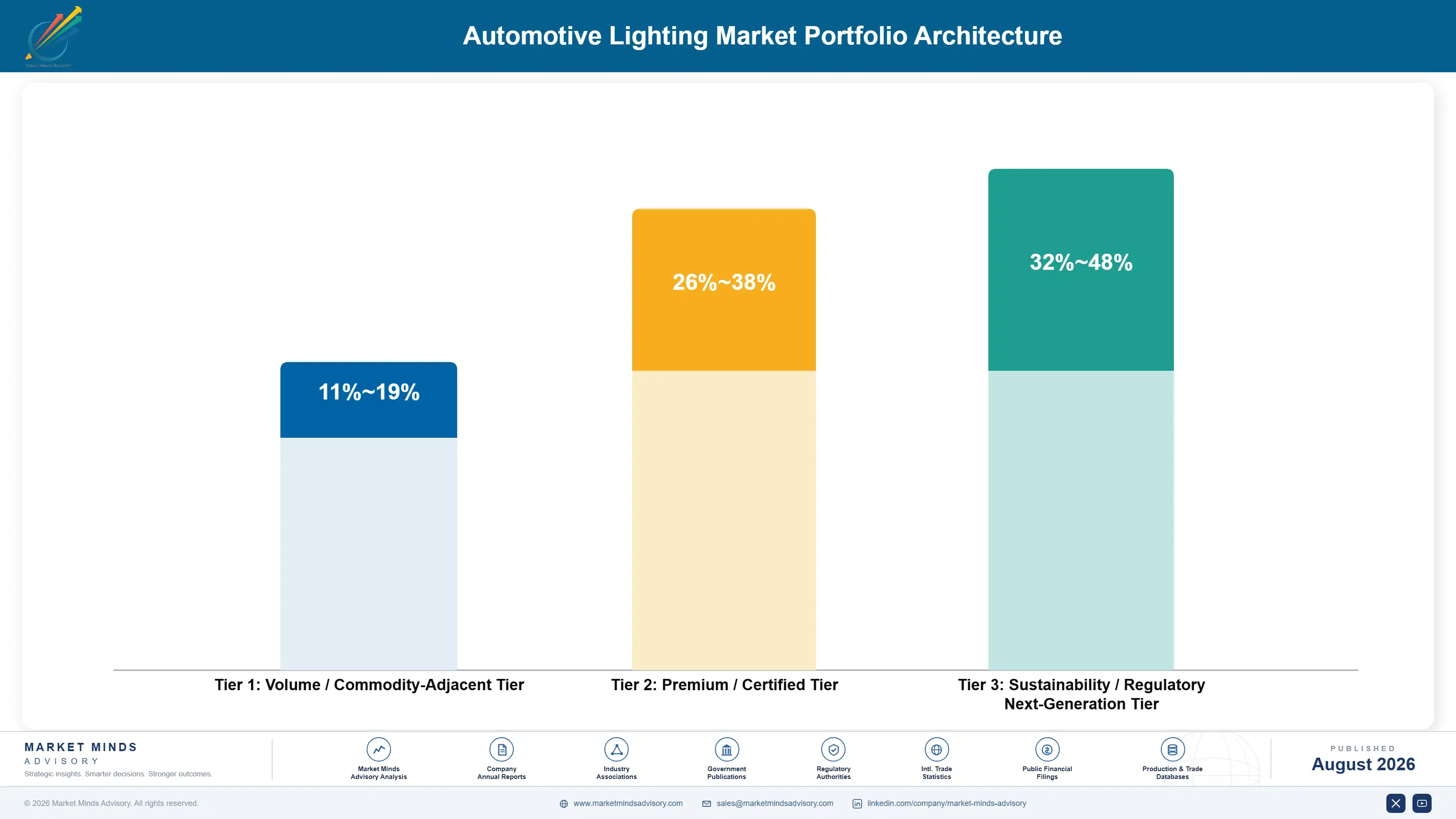
Margin architecture follows what a vehicle manufacturer cannot easily source elsewhere. Halogen and basic LED lighting on mass-market programmes competes on emitter and resin cost against Chinese suppliers with permanently lower bases, and earns very little. Matrix and adaptive systems earn considerably more on homologation complexity. Surface emission and communication lighting earn most, because so few suppliers can deliver them at automotive quality.
The volume and premium tension has shifted since the LED conversion completed. Mass-market volume once carried content growth alongside it and now carries only cost-down pressure, while the functions that grow are fitted to a minority of vehicles. Suppliers weighted toward volume find their content per vehicle plateauing and their margins compressing at the same time, which is a considerably worse position than it was five years ago. Very few suppliers have adjusted their planning to that reality.

High-value pools concentrate in dual-regime adaptive beam capability, surface emission and communication functions, and repair-designed assemblies that keep collision work inside the channel. Each is defended by homologation, engineering scarcity, or design decision rather than by manufacturing cost, which Chinese suppliers hold decisively and permanently. Manufacturing cost is the one advantage that cannot be recovered later.

Volume / Commodity-Adjacent Tier

Halogen and basic LED headlamps and rear lamps on mass-market programmes built to a customer drawing. Emitter and resin cost decide outcomes. Chinese suppliers set the reference price wherever they can homologate.
Gross Margin: 11%-19%

Premium / Certified Tier

Matrix LED and adaptive driving beam systems where homologation complexity across diverged regimes limits credible competition. Regulatory capability rather than styling supports pricing. The range reflects wide differences between European and American programme economics.
Gross Margin: 26%-38%

Sustainability / Regulatory / Next-Generation Tier

Surface emission and OLED lighting, pedestrian communication functions, and repair-designed assemblies protecting the collision channel. Engineering scarcity and design decisions defend all three. The range is wide because these applications differ substantially in maturity.
Gross Margin: 32%-48%
global-automotive-lighting-market-trends-portfolio-architecture-1787551113007

High-value Sub-segments and Strategic Watch-out

Dual-Regime Adaptive Beam Systems

Fitment stalled at 17% because European and American requirements diverged, and vehicle manufacturers on global architectures need one platform satisfying both rather than two separate engineering programmes running in parallel. Solving both requirement sets from one platform avoids funding two separate parallel development programmes entirely.
Gross Margin: 30%-40%

Surface Emission and OLED

Growing at 16.8% from a small base, with panel availability improved considerably by Chinese and Korean supply. Very few manufacturers can deliver these at automotive quality and thermal durability requirements. Automotive temperature and vibration qualification remains considerably harder than it is for any consumer display use case.
Gross Margin: 34%-48%

Repair-Designed Collision Assemblies

Assemblies at roughly 1,840 dollars are triggering total-loss decisions, and modular designs allowing component replacement keep the work inside a channel insurers are actively trying to route around entirely. Engaging insurers directly on assembly design is a conversation that almost nobody has yet seriously attempted.
Gross Margin: 28%-38%

Mass-Market Build-to-Print Lighting

The strategic watch-out. Chinese suppliers set pricing, LED conversion content growth has finished, and annual cost-down commitments assume emitter deflation that keeps arriving regardless of anything else. Content growth in this tier has finished entirely, and only the annual cost-down pressure now remains against it.
Gross Margin: 11%-19%

How Programmes Get Placed

Demand reaches suppliers through a cycle beginning years before revenue does. Design studios select signature and lighting form during styling, engineering translates that into a specification, and award follows roughly 34 months before start of production. A supplier engaged during styling shapes what gets specified, while one receiving the request for quotation is bidding on somebody else's decision. That difference explains most of the margin variation across this industry and appears in no tender document. Very few suppliers are organised to be in the room during styling.
Stickiness follows what would have to change. Signature tooling holds for the vehicle's full production life. Matrix and adaptive systems hold on homologation cost. Mass-market build-to-print work re-competes at every annual negotiation on price alone. Nothing about the hardware itself holds a build-to-print award.

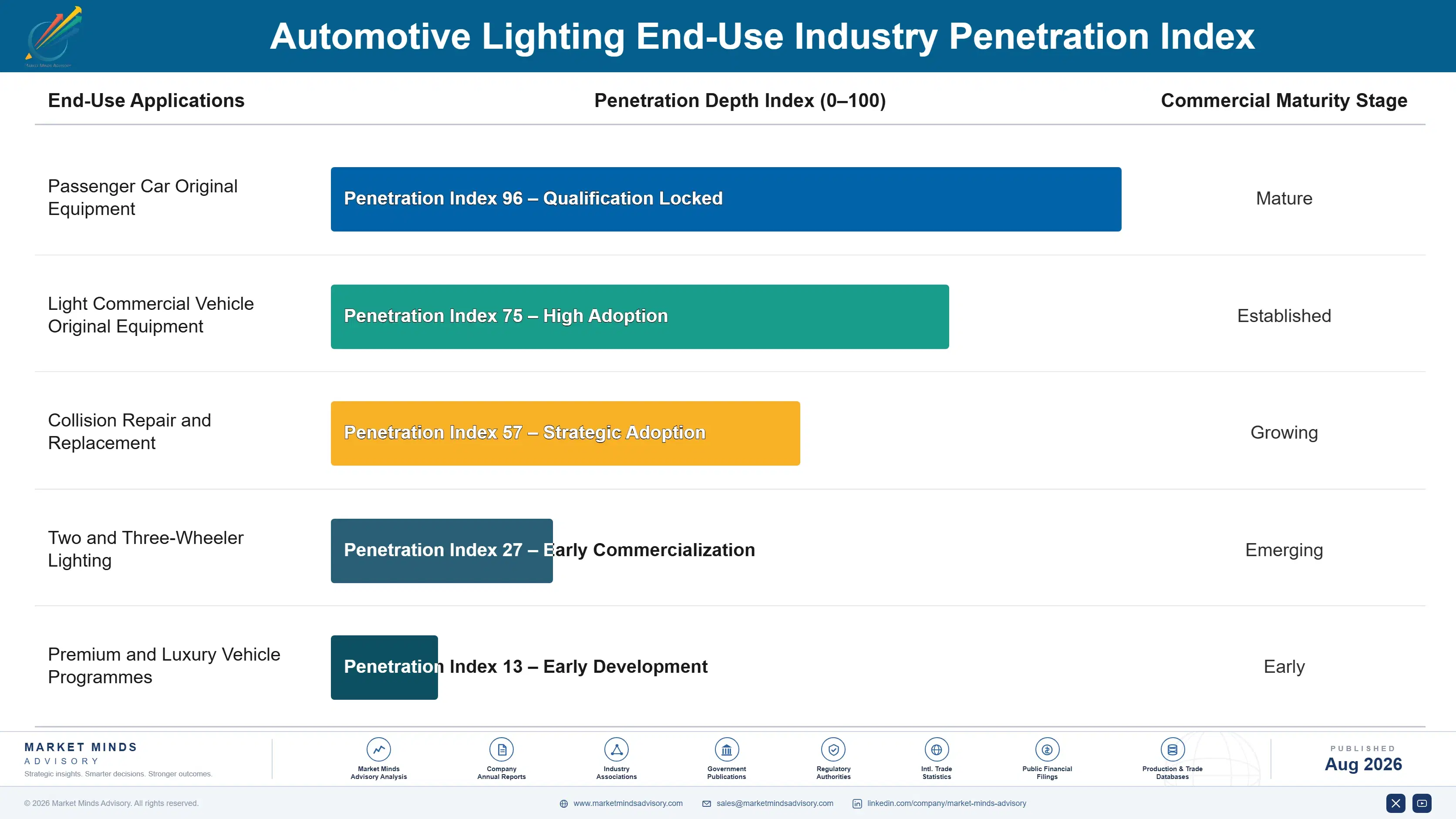
Collision and replacement demand behaves completely differently again. It arrives through insurers, approved repairer networks, and parts distributors rather than through vehicle manufacturers, and those buyers evaluate cost against claim economics rather than against any lighting requirement. Suppliers treating the aftermarket as an extension of original equipment supply misread the customer entirely. Those two channels need completely separate commercial organisations to serve properly.
global-automotive-lighting-market-trends-end-use-penetration-index-1787551113492

After the Conversion Finished

These are among the four positions where our research anticipates prominent divergence between winners and laggards over the coming forecast period. Each is grounded in the demand model, the regulatory perimeter, and the announced capacity pipeline.
01 / FUNCTION CONTENT DEVELOPMENT

The source conversion is finished, so add functions

LED fitment reaching 89% of new vehicles means the transition that carried a decade of content growth in developed markets is complete and cannot be sold to anybody at all a second time. Growth now depends entirely on functions the previous vehicle generation never carried: animated signatures, communication lighting, surface emission panels, and adaptive systems that each require separate engineering and homologation. Manufacturers still organised around conversion economics are running a growth model that quietly expired underneath them several years ago now.
02 / DUAL-REGIME HOMOLOGATION CAPABILITY

Solve both beam rules with one hardware platform

European and American adaptive driving beam requirements diverged sufficiently that systems homologated for one regime frequently fail the other outright, which split development across two programmes and helped hold fitment at only 17% of new vehicles. Manufacturers who satisfy both from a single hardware platform serve global vehicle architectures without duplicating engineering effort, which is precisely what a manufacturer building one car for several markets actually requires. Competitors funding two parallel development paths are paying twice over for a single function.
03 / REPAIRABLE ASSEMBLY DESIGN

Build for component repair before insurers force it

Front lighting assemblies costing around 1,840 dollars in parts are triggering total-loss decisions on vehicles with substantial remaining value, and insurers have responded with repair-first requirements, aftermarket parts, and salvage sourcing that bypass original equipment supply almost completely. Modular designs allowing a damaged lens, module, or driver to be replaced individually keep the work inside the channel while reducing the claim cost that is provoking the pushback. That protects the 21% of manufacturer revenue currently coming from replacement and collision repair work.
04 / CHINESE MANUFACTURING POSITION

Build there or concede the largest award pool

China assembles more light vehicles than any other country and the gap continues widening, with domestic suppliers winning much of that programme volume at prices an imported cost base cannot approach under any procurement scenario currently available. Those same suppliers are now qualifying into European and other export programmes rather than remaining confined to domestic assembly work. International manufacturers without genuine local engineering and tooling capability are excluded from the single largest pool of programme awards anywhere in this whole industry.

Engagement Snapshot From the Field

A live engagement with an industry participant carrying material or product regulatory and market exposure ahead of a defining policy shift, showing how our research translates into a defensible multi-year portfolio strategy.
MARKET MINDS ADVISORY · CLIENT ENGAGEMENT SUMMARY
Automotive Lighting Producer Strategic Portfolio Review and Transition Roadmap 2026·Investment Scenario on Automotive Lighting Exposure Evaluation 2025-26
CLIENT PROFILE
A European automotive lighting supplier with revenue near EUR 1.4 billion (client-reported, unverified by MMA), holding programme positions across mass-market and premium vehicles with strong matrix LED capability. Adaptive beam development ran separate European and American programmes, Chinese manufacturing was limited, and aftermarket revenue had declined for five consecutive years. Insurer engagement had never been attempted.
STRATEGIC CHALLENGE
Duplicated adaptive beam development was consuming engineering capacity while fitment stalled at low levels across both regimes. Insurers had begun routing collision work away from original equipment assemblies. Chinese suppliers had won two mass-market programmes the business had considered secure on relationship grounds alone. Nobody had separated the aftermarket decline into its causes.
MMA APPROACH
MMA analysed development spending against fitment outcomes by regulatory regime, modelled repairable assembly design against insurer claim economics, and assessed Chinese manufacturing investment against the domestic award pool. Forty-seven expert interviews with vehicle manufacturers, insurers, approved repairer networks, and homologation authorities established how each decision is genuinely taken. Five years of development spending were mapped against fitment outcomes.
KEY FINDINGS
  1. Running separate European and American adaptive beam programmes cost roughly twice a single dual-regime platform would have, and three vehicle manufacturers had explicitly asked for consolidation.
  2. Insurer repair-first requirements had removed a measurable share of collision assembly volume, and the client had never engaged an insurer or repairer network directly about design.
  3. Both lost Chinese programmes had been decided on price against a domestic cost base, and relationship depth had made no difference to either outcome at any stage.
  4. Aftermarket decline traced almost entirely to the disappearance of replacement bulb volume rather than to any loss of share, which nobody in the business had separated properly.
CLIENT PROFILE
A European automotive lighting supplier with revenue near EUR 1.4 billion (client-reported, unverified by MMA), holding programme positions across mass-market and premium vehicles with strong matrix LED capability. Adaptive beam development ran separate European and American programmes, Chinese manufacturing was limited, and aftermarket revenue had declined for five consecutive years. Insurer engagement had never been attempted.
STRATEGIC CHALLENGE
Duplicated adaptive beam development was consuming engineering capacity while fitment stalled at low levels across both regimes. Insurers had begun routing collision work away from original equipment assemblies. Chinese suppliers had won two mass-market programmes the business had considered secure on relationship grounds alone. Nobody had separated the aftermarket decline into its causes.
MMA APPROACH
MMA analysed development spending against fitment outcomes by regulatory regime, modelled repairable assembly design against insurer claim economics, and assessed Chinese manufacturing investment against the domestic award pool. Forty-seven expert interviews with vehicle manufacturers, insurers, approved repairer networks, and homologation authorities established how each decision is genuinely taken. Five years of development spending were mapped against fitment outcomes.
KEY FINDINGS
  1. Running separate European and American adaptive beam programmes cost roughly twice a single dual-regime platform would have, and three vehicle manufacturers had explicitly asked for consolidation.
  2. Insurer repair-first requirements had removed a measurable share of collision assembly volume, and the client had never engaged an insurer or repairer network directly about design.
  3. Both lost Chinese programmes had been decided on price against a domestic cost base, and relationship depth had made no difference to either outcome at any stage.
  4. Aftermarket decline traced almost entirely to the disappearance of replacement bulb volume rather than to any loss of share, which nobody in the business had separated properly.
RECOMMENDED STRATEGY
Phase 1: Phase one: consolidate adaptive beam development onto a single dual-regime hardware platform, releasing engineering capacity that duplication has been consuming for years. Phase 2: Phase two: engage insurers and approved repairer networks directly on modular assembly design, protecting collision volume the pushback is currently routing elsewhere. Phase 3: Phase three: build genuine Chinese tooling and engineering capability rather than assembly alone, targeting the domestic awards that price decides entirely.
OUTCOME
The client consolidated adaptive beam development within a year and won two global architecture programmes on that basis. Insurer engagement produced a modular design agreement, Chinese engineering investment was approved, and blended programme margin improved 5.2 percentage points (client-reported, unverified by MMA). A modular rear lamp design entered development.

Frequently Asked Questions

Foundational context covering the market sizes, CAGR, scope, country, region and competition that inform every finding below. This section is provided to cover basics and most often pre-purchase conversations, answered from the MMA Primary Research Dataset.

What is the current size of the Automotive Lighting Market?

The market was valued at USD 35.4 billion in 2025, rising to an estimated USD 37.67 billion in 2026. East Asia holds the largest regional share at 33% of value.

How large will the Automotive Lighting Market be by 2036?

MMA forecasts USD 70.04 billion by 2036 under the base case, an expansion multiple of 1.86 times the 2026 value. That represents USD 32.37 billion of incremental value.

What is the CAGR for the Automotive Lighting Market 2026 to 2036?

The base case CAGR is 6.4%, with a bull case of 7.6% and a bear case of 5.2%. The spread reflects uncertainty over adaptive beam fitment and insurance pressure.

Which segment is growing fastest?

OLED and surface emission lighting grows fastest at 16.8%, roughly 2.63 times the market rate, from a small base. Adaptive driving beam follows at 14.2%.

Who are the major companies in the Automotive Lighting Market?

Koito Manufacturing, Marelli, Valeo, Forvia HELLA, and Stanley Electric lead, holding roughly 58% between them. Tooling, homologation, and award cycles sustain that concentration rather than manufacturing capability.

Which country is growing fastest?

India grows fastest at 9.8%, as vehicle production expands under incentive programmes and lighting content per vehicle rises from a comparatively low starting base. Halogen fitment also remains higher there than anywhere.

Report Segmentation Architecture

The full report scope spans multiple orthogonal segmentation dimensions, with cross-tabulated demand data provided for each dimension pair. Coverage extends further to regional breakdowns, trend trajectories, and the competitive detail needed to support segment-level decision-making.

By Light Source Technology

  • Halogen Lighting
  • Xenon High-Intensity Discharge Lighting
  • LED Lighting
  • Adaptive Driving Beam and Matrix LED
  • Laser and High-Intensity Auxiliary Lighting
  • OLED and Surface Emission Lighting

By End-Use Industry

  • Passenger Car Original Equipment
  • Light Commercial Vehicle Original Equipment
  • Collision Repair and Replacement
  • Two and Three-Wheeler Lighting
  • Premium and Luxury Vehicle Programmes

By Sales Model

  • Design-Specified Programme Awards
  • Build-to-Print Tender Supply
  • Collision Parts Distribution
  • Insurer and Repairer Network Supply
  • Aftermarket Replacement Channels

By Region

  • North America
  • Western Europe
  • East Asia
  • South Asia and Pacific
  • Latin America
  • Middle East and Africa
  • Eastern Europe

Scope, Methodology, and Coverage

Every figure in this report is reproducible from documented input assumptions. The scope below maps the historical period, the forecast horizon, the segmentation dimensions, and the countries covered, alongside the underlying primary and qualitative methodology.
Historical Period
2020 to 2025
Forecast Period
2026 to 2036
Base Year
2025 (USD billions; MMA Primary Research Dataset, August 2026)
Market Definition
The market comprises lighting systems supplied for light vehicles at original equipment and replacement level, covering halogen lighting, xenon high-intensity discharge lighting, LED lighting, adaptive driving beam and matrix LED systems, laser and high-intensity auxiliary lighting, and OLED or surface emission lighting. Value is measured at supplier level across combustion, hybrid, and electric vehicles, including collision and replacement supply. Instrument clusters and head-up displays, infotainment screens, interior ambient systems sold separately, heavy commercial vehicle lighting, and aftermarket accessory lighting fall outside scope.
Quantitative Units
USD billions (current prices); million lighting systems shipped annually; USD content value per vehicle by technology
Segmentation Dimensions
By Light Source Technology; By End-Use Industry; By Sales Model; By Region
Regions Covered
North America, Western Europe, East Asia, South Asia and Pacific, Latin America, Middle East and Africa, Eastern Europe
Countries Covered
China, Japan, South Korea, Taiwan, India, Thailand, Indonesia, Vietnam, Australia, United States, Canada, Mexico, Germany, France, United Kingdom, Spain, Italy, Sweden, Belgium, Netherlands, Poland, Czechia, Slovakia, Hungary, Romania, Brazil, Argentina, Turkey, Morocco, South Africa
Key Companies Profiled
Koito Manufacturing, Marelli, Valeo, Forvia HELLA, Stanley Electric, Hyundai Mobis, Varroc Lighting Systems, ZKW Group, ams-OSRAM, Lumileds, Nichia, HASCO Vision, Xingyu Automotive Lighting, TYC Brother Industrial, Lumax Industries, Samvardhana Motherson, Depo Auto Parts, Texas Instruments, Grupo Antolin, SL Corporation
Quantitative Methodology
Primary survey, n=3,800 respondents, Q4 2025, six countries; demand-side model with trade association cross-validation
Qualitative Methodology
47 expert interviews, Q4 2025; applied to validate demand model assumptions, identify emerging dynamics, and assess competitive positioning
Report Format
PDF and XLSX data workbook (Word format preview document)
Publisher
Market Minds Advisory
Report Code
MMA-2026-AUT-268
Published
August 2026
Contact
sales@marketmindsadvisory.com | www.marketmindsadvisory.com

Purchase the full Automotive Lighting Market Report (2026 to 2036).

The full report sizes automotive lighting demand across six source technologies, five vehicle categories, and seven regions with 2026 to 2036 forecasts under base, bull, and bear cases. It treats the completed LED conversion as a decisive break rather than a continuing trend, separating the content growth that has finished from the function additions that must replace it. Competitive profiles cover twenty suppliers assessed consistently on supply revenue, homologation breadth, and manufacturing footprint. Cost analysis traces emitter, polycarbonate, and electronics exposure against annual cost-down commitments. Commercial guidance addresses function development, dual-regime homologation, repairable design, and Chinese manufacturing position.
Six source technologies sized separately by region
Completed LED conversion separated from continuing function growth
Adaptive beam regulatory divergence mapped across major jurisdictions
Collision replacement cost modelled against insurer claim economics
Replacement bulb annuity decline quantified against aftermarket revenue
Chinese supplier cost position assessed against incumbent bases

Built For The People Who Decide

From boardroom strategy to bench-side execution, this report is read cover-to-cover by leaders shaping the next decade of their industry, turning demand scenarios, market dynamics and valuation benchmarks into decisions.
CXOs/ Presidents/ VPs/ Managers
M&A and Corporate Development
Strategy Teams and R&D Heads
Procurement and Product Directors
Regulatory and Compliance Leaders
Investor Relations and Equity Analysts