
Market Minds Advisory
Glass Bottles Market

Glass Bottles Market: A Mature Category Where Premium And Recycled Content Both Now Win

A commercial reading of rigid glass container manufacturing, where premium spirits and wine defend glass against plastic on brand equity, energy cost volatility squeezes furnace economics, and recycled content targets are reshaping procurement.

Lead Analyst

Bilal Shaikh

Published

September 2026

Make Smarter Decisions with Customized Research Insights

Request a free sample report and evaluate market opportunities, growth trends, and competitive dynamics relevant to your business needs.

2025 MARKET VALUE$68.4BMarket Size 2025
2036 FORECAST VALUE$104.2BBase Case , 2026 to 2036
CAGR 2026 TO 20363.9 %Bull 4.9% / Bear 2.7%
INCREMENTAL OPPORTUNITY$33.1BNet 10- year value creation
EXPANSION MULTIPLE1.47x2036 value over 2026 base
Strategic Levers
M&A Pipeline
Regional Outlook
Country Rankings
Competitive Intelligence
Segmental Deep-dive
Call-Us : 91 93563 13602

Executive Snapshot and Market Trajectory

Glass never won on cost against plastic, and it stopped trying to. Premium spirits and wine brands pay for the weight and the sound of a glass bottle closing, and that willingness to pay is now the category's entire commercial logic across most developed markets.
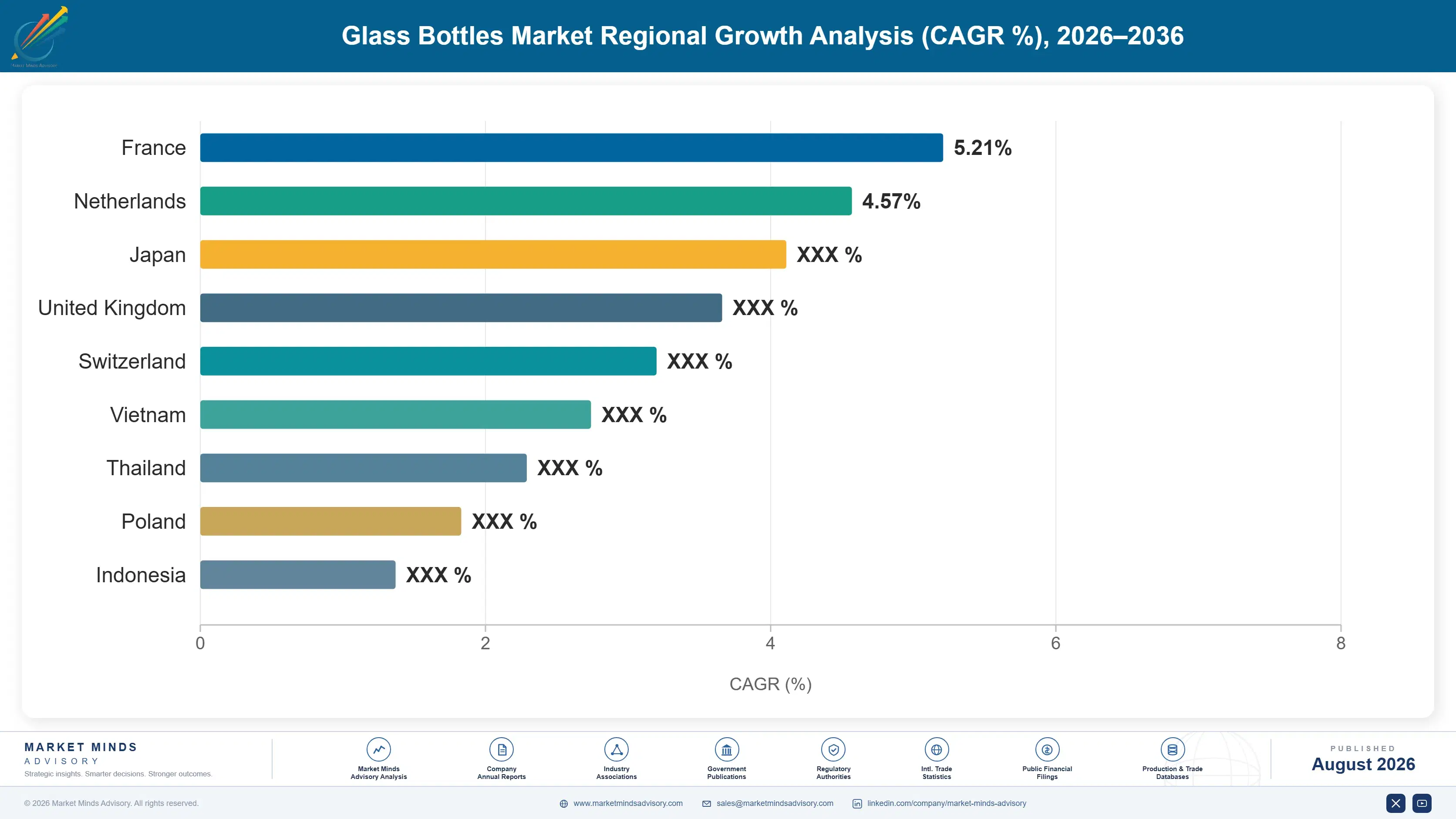
The market stands at USD 68.4 billion in 2025 and reaches USD 104.19 billion by 2036 at a 3.9% CAGR. Premium spirits and wine bottles grow fastest at 6.1%, about 1.56 times the overall rate, as brand owners trade up to heavier, custom-moulded glass to signal quality on a crowded, highly competitive shelf. India posts the quickest national growth at 6.8% as rising spirits and beer consumption pulls new capacity investment into the country steadily.
Concentration is moderately high at 47% for the top five, reflecting an industry with genuine capital barriers to entry given furnace construction cost. Two forces are reshaping it right now, and quickly, in ways worth watching closely. Energy cost volatility is squeezing furnace economics harder than at any point in recent memory, and recycled cullet content targets set by regulation are steadily rewriting procurement and furnace design decisions across the industry.
Market Definition
The glass bottles market covers rigid glass containers manufactured for beverage, food, pharmaceutical, and personal care packaging, spanning virgin and recycled cullet-based production across all colour and closure formats. Glass jars sold for non-bottle applications, glass packaging components such as caps and closures sold separately, and float or flat glass for construction are excluded.
Base Year Value
$68.4B in 2025 (MMA Primary Research Dataset, August 2026)
Forecast Period
2026 to 2036, eleven discrete annual values
CAGR
3.9% base case. Bull 4.9%. Bear 2.7%.
Fastest Growth Segment
Premium Spirits and Wine Bottles: 6.1% CAGR
Fastest Growth Country
India: 6.8% CAGR
Fastest Growth Region
South Asia and Pacific: 5.9% CAGR
Largest Region
East Asia: 25% of 2025 global value
Market Leaders
Owens-Illinois, Ardagh Group, Verallia, Vidrala, Vitro. Source: MMA Analysis based on company disclosures.
Primary Survey
n=3,800 procurement and R&D decision-makers, Q4 2025, six countries
Methodology
Demand-side build-up, cross-validated against public data, 47 expert interviews

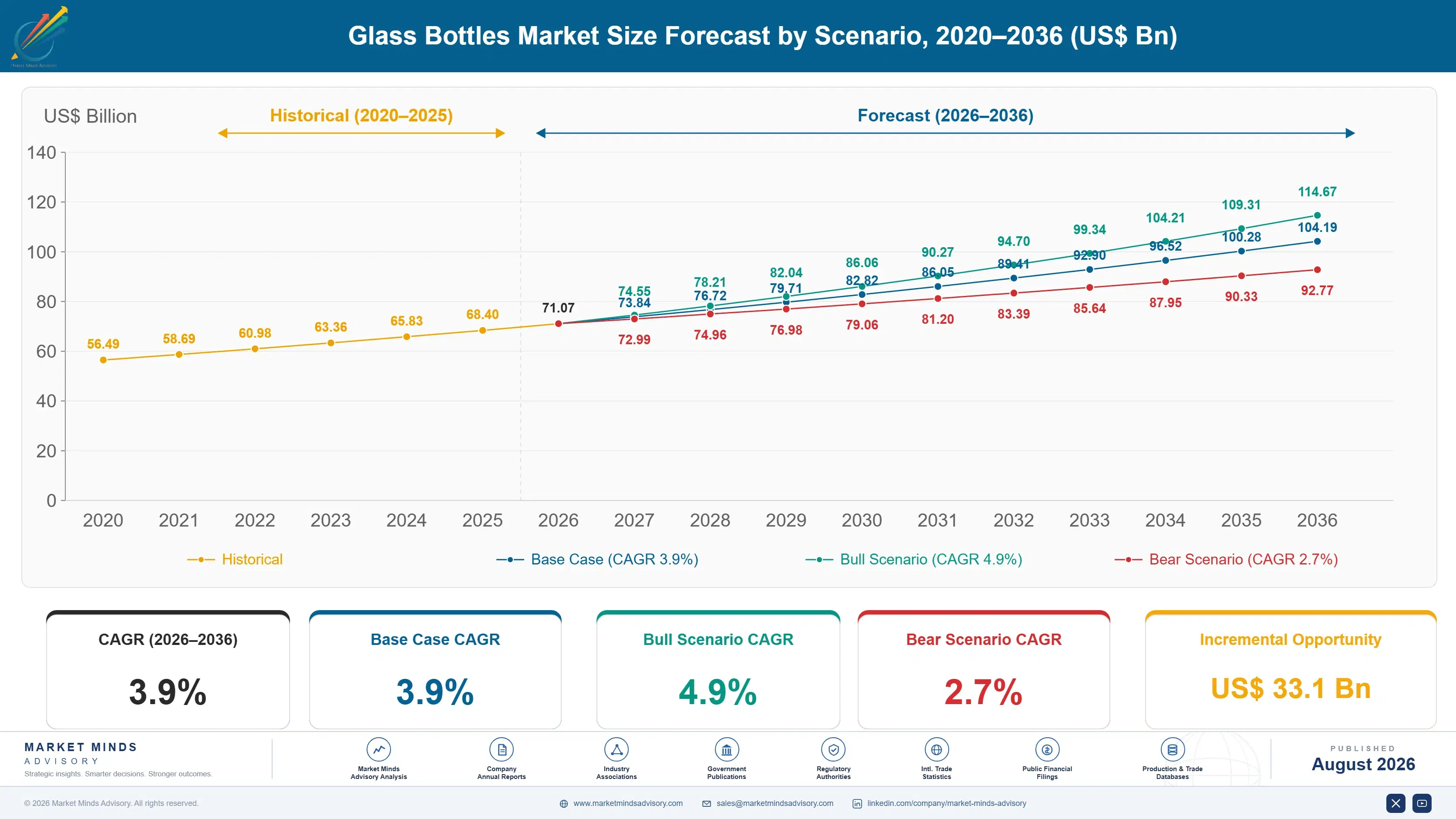
Glass Bottles Market Forecast Scenarios

glass-bottles-market-size-forecast-scenario-1787332137201
Growth from 2020 to 2025 compounded near 3.3%, weighed down by pandemic-era on-premise closures that hit premium spirits and wine consumption directly at bars and restaurants across most major beverage markets. That weakness then recovered steadily as venues reopened and premiumisation resumed, with brand owners returning to heavier, custom glass formats once consumer confidence and on-premise volume both stabilised.
Three mechanisms carry the base case to 3.9%. First, premiumisation, since brand owners in spirits and wine continue trading up to heavier, custom glass plastic and aluminium alternatives cannot credibly replicate on shelf presence. Second, recycled content regulation, as mandated cullet minimums across the European Union and several American states force furnace investment that also lowers long-run energy cost. Third, emerging market beverage consumption growth, particularly in South Asia, where rising incomes are expanding the beer and spirits category from a low base.
The bull case at 4.9% assumes premiumisation accelerates further across more beverage categories and emerging market consumption growth outpaces current forecasts meaningfully across several major economies. The bear case at 2.7% assumes plastic and aluminium packaging continue gaining share in mainstream beer and non-alcoholic beverage categories where glass's premium positioning carries less weight with cost-conscious consumers worldwide.

Why Furnace Economics Now Decide Who Wins This Category

Three forces set demand. Premiumisation provides the value layer, as spirits and wine brands pay considerably more for heavier, custom-moulded glass that signals quality on a crowded shelf. Recycled content regulation provides a second, increasingly binding constraint, forcing furnace design and cullet sourcing decisions regardless of what a brand owner would otherwise choose. And emerging market beverage consumption growth adds a third, steadily expanding volume base.
MARKET CONCENTRATIONCR5: 47%Moderately concentrated among global glass container manufacturing groups
AVERAGE SELLING PRICEUSD 0.12 to 2.80 per unitUnit price spread across standard beer to premium spirits formats
TOP PRODUCING COUNTRY SHAREChina: about 19%Share of global glass container manufacturing output produced domestically
FURNACE CAPACITY UTILISATIONAbout 84%Average utilisation rate across operating glass container furnaces today
ENERGY COST SHAREAbout 24% of COGSPortion of production cost from furnace natural gas and power
FURNACE ASSET LIFE12 to 15 yearsTypical operating campaign length before a furnace requires rebuilding
The commercial character is set by furnace economics more than by mould design sophistication. Energy costs account for roughly 24% of cost of goods sold, and a furnace once lit runs continuously for its entire 12 to 15 year campaign life, which means energy price volatility hits margin directly with almost no ability to pause production and wait out a spike the way a batch-manufacturing industry could.
The next decade turns on two things. Whether recycled cullet availability keeps pace with tightening content mandates, since cullet supply constraints could force manufacturers to import material or accept higher virgin sand and soda ash costs instead. And whether premiumisation continues offsetting the steady share loss glass faces in mainstream categories where plastic and aluminium compete purely on weight and cost.
"Glass makers spent a decade being told they'd lose to plastic everywhere, and instead they found the one argument plastic can't make: a bottle that feels expensive in your hand actually is worth more. Everything else in this industry, energy hedging, cullet sourcing, follows from that one insight."
Director, Packaging and Materials Practice · MMA Packaging / Rigid Glass Contain

Market Trends

Recycled Cullet Mandates Are Redesigning Furnace Investment

European Union packaging regulation and several American state laws now mandate minimum recycled content in glass containers, and manufacturers are redesigning furnace batch composition and investing in cullet sorting infrastructure to comply rather than treating recycling as voluntary. Higher cullet content also lowers energy consumption per tonne of glass melted, since cullet requires less heat than virgin raw material, which means compliance investment and cost reduction now point in the same direction. Owens-Illinois and Verallia have both disclosed cullet infrastructure investment tied to regulatory targets through 2024 and 2025. Cullet availability, not furnace capacity, is becoming the binding constraint.
Market Impact: Premium glass grows well past 6%
Premium Spirits Brands Are Driving Custom Mould Investment

Spirits and premium wine brands increasingly commission custom bottle moulds with distinctive shapes, embossing, and weight specifications that function as a core part of brand identity rather than a commodity container decision made late in development. That shift has pushed glass manufacturers to expand mould engineering and design services well beyond simple contract filling, capturing design fees and longer-term exclusive supply relationships commodity production never generated. Vidrala and Vitro have both expanded premium design capability to serve this demand across North American and European spirits customers. Design exclusivity is becoming as valuable as the glass itself.
Market Impact: Capex is rising across 2024-2025

Market Opportunities and Growth Drivers

Premiumisation Keeps Pulling Spirits And Wine Toward Heavier Glass

Consumer willingness to pay more for spirits and wine packaged in heavier, more elaborate glass has proven remarkably durable even during periods of broader consumer spending caution, since premium alcohol purchases function partly as an affordable luxury signal that shoppers protect even when trimming spending elsewhere. Manufacturers including Vidrala have reported premium segment growth consistently outpacing standard glass volume across recent reporting periods. This dynamic gives glass an advantage plastic and aluminium cannot replicate at any price point, since weight and tactile quality are inherent to the material rather than an engineering choice.
Market Impact: Energy runs near 24% of cost

Recycled Content Regulation Is Forcing Furnace Modernisation Spending

Mandated cullet minimums across the European Union and expanding American state requirements are forcing manufacturers to invest in furnace modernisation and cullet sorting infrastructure regardless of whether the underlying business case would otherwise justify the capital spend on its own merits. That regulatory forcing function accelerates a transition manufacturers were pursuing anyway for cost reasons, since cullet reduces energy consumption per tonne meaningfully. Owens-Illinois has disclosed capital spending explicitly tied to European recycled content compliance timelines through the current decade. Regulation is compressing an investment cycle that would otherwise have stretched across many more years.
Market Impact: Standard share erodes 1-2 points ye

Market Restraints and Challenges

Energy Cost Volatility Hits Furnace Economics Directly And Fast

Glass furnaces run continuously for their entire 12 to 15 year campaign life once lit, and that operational reality is the root cause of margin exposure that energy price spikes translate directly into cost with almost no ability to pause production and wait for prices to normalise. Commercially this hit hardest during the 2022 European energy crisis, when natural gas prices spiked sharply and several manufacturers idled furnace capacity rather than absorb unsustainable losses. Operators respond with long-term energy hedging and furnace efficiency investment to reduce exposure. Energy strategy is now a board-level decision at every major glass manufacturer.
Market Impact: EU mandates require 50%+ recycled c

Plastic And Aluminium Keep Winning Mainstream Beverage Categories

Glass costs meaningfully more to ship given its weight, and that physical reality is the root cause of plastic and aluminium steadily displacing glass in mainstream beer and non-alcoholic beverage categories where consumers do not pay a premium for tactile quality the way spirits and wine buyers reliably do. Commercially this confines glass's genuine growth to premium categories while volume in commodity segments erodes gradually but persistently. Manufacturers respond by lightweighting standard bottle designs to narrow the freight gap and by concentrating investment on premium capacity where glass retains a durable advantage.
Market Impact: Custom moulds command 30%+ price pr
3 additional market trends, 4 additional growth drivers, and 2 additional restraints and challenges are covered in the full report. Contact sales@marketmindsadvisory.com to access the complete intelligence.

Segment CAGR and Growth Architecture

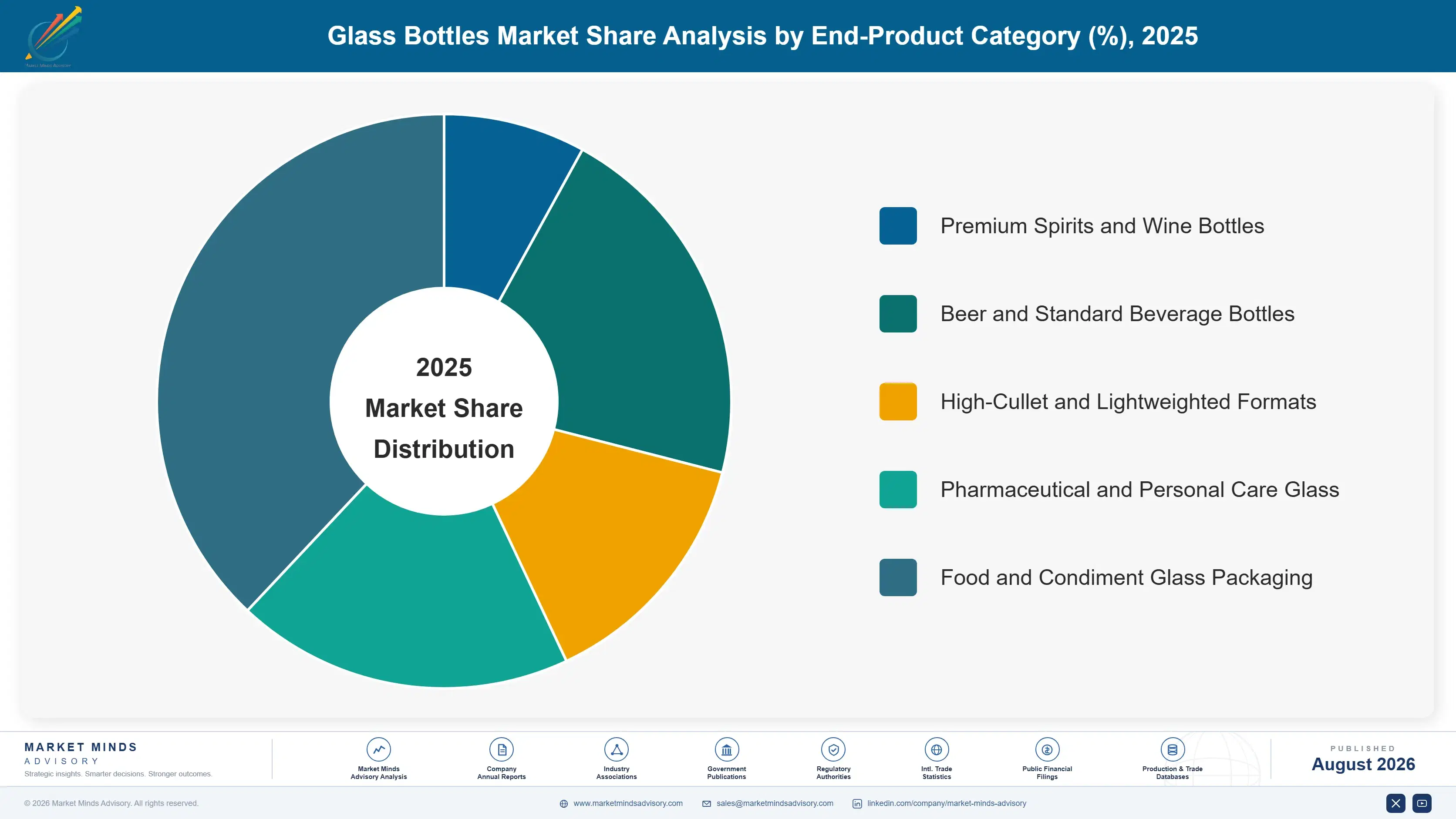
Segmentation follows end-product category, a single logic describing what the glass bottle is filled with rather than its colour, closure type, or manufacturing process. Each category carries its own pricing structure, customer relationship, and design intensity, so commercial position tracks the filled product category rather than any manufacturing or material distinction alone across the industry.
glass-bottles-market-market-share-analysis-1787332137737

Premium Spirits and Wine Bottles

Premium spirits and wine bottles grow fastest at 6.1%, about 1.56 times the overall 3.9% rate, covering custom-moulded, typically heavier glass containers for whisky, premium vodka, wine, and sparkling wine categories where the container itself functions as brand packaging rather than a commodity vessel. Design exclusivity and long-term supply agreements increasingly define this segment's commercial relationships, since brand owners investing in a custom mould want assurance a competitor cannot commission the same design. Vidrala and Vitro both compete strongly here alongside Verallia's premium design division serving European spirits customers specifically. Pricing runs meaningfully above standard bottle production, reflecting both the mould investment and the smaller, less standardised production runs premium accounts typically require from their glass supplier.
CAGR 6.1%

Beer and Standard Beverage Bottles

Beer and standard beverage bottles grow at 2.8%, the largest segment by volume though the slowest growing, covering standard-weight glass for beer, soft drinks, and mainstream non-alcoholic beverages where price and reliable high-volume supply matter more than distinctive design. Growth has slowed as aluminium cans and PET plastic bottles continue capturing share in exactly this segment, where consumers generally do not pay a premium for glass over lighter, cheaper alternatives. Manufacturers increasingly lightweight standard beer bottle designs to narrow the freight cost disadvantage against aluminium specifically. This segment remains the volume foundation underneath the category even as growth and margin both concentrate in premium formats elsewhere across the broader portfolio.
CAGR 2.8%
Full segment breakdown across 5 segments available in the complete report.

Regional Architecture and Country Demand Map

Beverage consumption patterns and energy cost exposure together set this distribution more than raw manufacturing scale does. East Asia and Europe lead on different logics, one on beverage volume and manufacturing density, the other on premium wine and spirits heritage, while share elsewhere tracks beverage consumption growth.

North America

Premium spirits consumption anchors North America's 24% share, as American whisky, tequila, and craft spirits brands continue commissioning custom glass that commands meaningfully higher pricing than standard bottle production across the rest of the category. Owens-Illinois maintains its largest manufacturing footprint domestically, serving both premium and standard beverage customers from facilities built close to major bottling operations. Canadian demand follows similar premiumisation patterns on a smaller scale, concentrated around whisky and wine production regionally. Energy cost volatility affects domestic furnace economics meaningfully given natural gas price swings tied to broader commodity market movements nationally. Growth of 3.6% reflects steady premiumisation offsetting continued share loss in mainstream beer packaging to aluminium alternatives.
Share: 24% | CAGR: 3.6% (2026 to 2036)

Western Europe

Wine and spirits heritage shapes demand across Western Europe's 23% share more than any other regional factor, with French, Italian, and Scottish producers maintaining deep, often multi-generational relationships with domestic glass manufacturers supplying their premium packaging needs. Verallia and Vidrala both maintain extensive European manufacturing networks serving these established wine and spirits supply chains directly. Recycled content regulation is most advanced here, with European Union mandates pushing cullet infrastructure investment faster than in any other region globally. German and British demand centres on beer packaging, facing steadier competitive pressure from aluminium cans regionally. Growth of 2.6%, among the slowest of the seven, reflects a mature, well-penetrated market against comparatively modest overall beverage volume growth.
Share: 23% | CAGR: 2.6% (2026 to 2036)
Regional intelligence for 5 additional markets available in the complete report: East Asia, South Asia and Pacific, Latin America, Middle East and Africa, Eastern Europe. Contact sales@marketmindsadvisory.com.
glass-bottles-market-country-cagr-analysis-1787332138253

Where Glass Manufacturers Actually Build Margin

Competing on standard bottle price alone means competing against aluminium and plastic on the one dimension glass simply cannot win outright. The four moves below shift revenue toward positions lighter alternative materials cannot easily match: premium design exclusivity, cullet infrastructure investment, energy hedging discipline, and lightweighting that narrows the standard-segment cost gap over time.

Build Exclusive Design Relationships With Premium Brands

Spirits and wine brands increasingly commission custom bottle moulds as a core part of brand identity, and manufacturers who secure exclusive design and supply agreements capture pricing 30% or more above standard production along with a switching cost that protects the relationship across multiple product cycles rather than just one order. That exclusivity also generates design fee revenue and deeper customer relationships than commodity filling work ever produces on its own. Vidrala has built meaningful competitive position around premium design serving European and American spirits customers. Design exclusivity is becoming as valuable as the glass itself.
Market Impact: Exclusive design deals earn 30%+ hi

Invest In Cullet Infrastructure Ahead Of Regulatory Deadlines

Mandated recycled content minimums across the European Union and expanding American state requirements are forcing furnace and cullet sorting investment industry-wide, and manufacturers who build that capacity ahead of binding deadlines secure both compliance certainty and energy cost per tonne of glass melted that runs 15% or more below virgin-batch production, since cullet requires less heat to process. Owens-Illinois has structured recent capital spending explicitly around anticipated regulatory timelines rather than waiting for mandates to take effect. Early cullet investment turns a compliance cost into a genuine, durable cost advantage over slower-moving competitors.
Market Impact: Cullet can cut furnace energy use b

Lock In Long-Term Energy Hedges To Protect Furnace Margin

Glass furnaces run continuously for their entire 12 to 15 year campaign life once lit, and energy price spikes translate directly into margin loss with almost no ability to pause production the way batch-manufacturing industries can when input costs turn unfavourable. Manufacturers securing long-term energy hedging contracts ahead of volatility, rather than buying on the spot market reactively, protected margin meaningfully better than competitors during the 2022 European energy crisis specifically. That hedging discipline is becoming standard practice across every major glass manufacturer with meaningful furnace exposure to volatile regional energy markets.
Market Impact: Energy is 24% of cost, hedging prot

Lightweight Standard Bottles To Narrow The Freight Cost Gap

Glass costs meaningfully more to ship than aluminium or plastic given its weight, and that freight disadvantage is what drives continued share loss in mainstream beer and beverage categories where consumers do not pay a premium for tactile quality the way spirits and wine buyers reliably do. Manufacturers reducing standard bottle weight by 10% or more through improved glass distribution and mould engineering narrow that freight gap directly without sacrificing the structural integrity a bottle needs to survive filling lines. Ardagh Group has invested specifically in lightweighting programmes for standard beer and beverage formats across its network.
Market Impact: Lightweighting can cut freight cost

Who Controls the Margin Pool

Concentration is moderately high: the top five hold roughly 47% of revenue, reflecting genuine capital barriers to entry given furnace construction cost and long asset lives that reward scale over new entry. The gap between leaders and challengers is energy cost management and design capability rather than raw manufacturing scale, since even large operators compete regionally given glass's freight sensitivity. All participants are assessed on one basis, manufacturing revenue from bottle producti
Competition runs along three lines. First, energy cost management, since furnaces run continuously and hedging discipline directly protects margin unhedged competitors lose during volatility. Second, premium design capability, as spirits and wine brands increasingly demand custom mould engineering commodity producers cannot offer. Third, cullet infrastructure investment, particularly in Europe where regulatory content mandates are becoming a genuine differentiator.

Pressure is building from two directions. Regional manufacturers in India and Southeast Asia are expanding capacity to serve fast-growing domestic beverage consumption established Western manufacturers serve less efficiently given freight cost. Meanwhile aluminium and plastic keep eroding glass's position in mainstream categories, concentrating competitive intensity into the premium segment where design and exclusivity decide outcomes. Rankings should favour manufacturers combining energy discipline with design depth.
glass-bottles-market-company-positioning-matrix-1787332138765

Competitive Moat and Risk Dimensions

OWENS-ILLINOIS

Moat: Scale and cullet infrastructure lead

Owens-Illinois operates one of the largest global manufacturing footprints, giving it scale advantages in energy procurement and cullet sourcing smaller regional competitors cannot easily match. Its early cullet infrastructure investment ahead of European regulatory deadlines positions it favourably as content mandates tighten. Deep, longstanding relationships across both premium and standard customers provide revenue diversification.
OWENS-ILLINOIS

Risk: Legacy asset base ages unevenly

A global furnace network built over decades means some assets are older and less energy-efficient than newer regional competitors' facilities, creating cost disadvantages at specific sites. Regional manufacturers in fast-growing markets including India can undercut on freight cost for domestic customers. Continued capital intensity to modernise competes with shareholder return priorities the company must balance.
VERALLIA

Moat: European wine and spirits heritage

Verallia maintains deep, often multi-generational relationships with French, Italian, and Spanish wine and spirits producers newer entrants cannot replicate quickly regardless of manufacturing capability. Its premium design division serves these customers directly, capturing design fee revenue and exclusive supply agreements commodity competitors never access. European recycled content leadership positions it favourably as mandates tighten.
VERALLIA

Risk: European energy exposure runs deep

Concentrated European manufacturing exposes Verallia disproportionately to the region's energy price volatility, which hit the industry hard during the 2022 crisis specifically. Geographic concentration also limits its ability to capture fast-growing demand in Asian and South Asian markets the way more globally diversified competitors can. Wine and spirits customer concentration creates exposure to any downturn in premium alcohol consumption specifically.

Players Tracked

Prominent Players

Owens-Illinois
Ardagh Group
Verallia
Vidrala
Vitro

Other Key Players

Piramal Glass
Hindusthan National Glass
Consol Glass
BA Glass
Wiegand-Glas
Zignago Vetro
Nihon Yamamura Glass
Toyo Glass
Hokkan Holdings
Beatson Clark
Vitro Packaging
Anchor Glass Container
Gerresheimer
Sisecam
HNGIL

Recent Developments

MAY 2025

Owens-Illinois expands cullet sorting capacity across three plants

Owens-Illinois announced cullet sorting infrastructure expansion across three European manufacturing facilities to meet tightening recycled content requirements ahead of upcoming regulatory deadlines. This was an organic capacity expansion rather than an acquisition, extending capability the company had piloted at a single site the previous year.
Signal: Capacity investment ahead of binding deadl
SEPTEMBER 2024

Vidrala acquires premium design studio serving spirits customers

Vidrala completed an acquisition of a smaller design studio specialising in premium bottle mould engineering for spirits and wine brands, integrating the capability directly into its existing manufacturing operations. This was a confirmed acquisition rather than a licensing arrangement, strengthening its premium design position against larger, more diversified competitors.
Signal: Manufacturers are increasingly buying prem
FEBRUARY 2025

Verallia signs long-term energy hedging agreement across European operations

Verallia signed a multi-year energy supply and hedging agreement covering a substantial share of its European furnace operations, locking in pricing ahead of anticipated volatility. This was a supply agreement rather than an acquisition, protecting margin against the kind of energy shock that hit the industry in 2022.
Signal: Long-term hedging is becoming standard pra

Furnace Energy, Silica Sand, Soda Ash

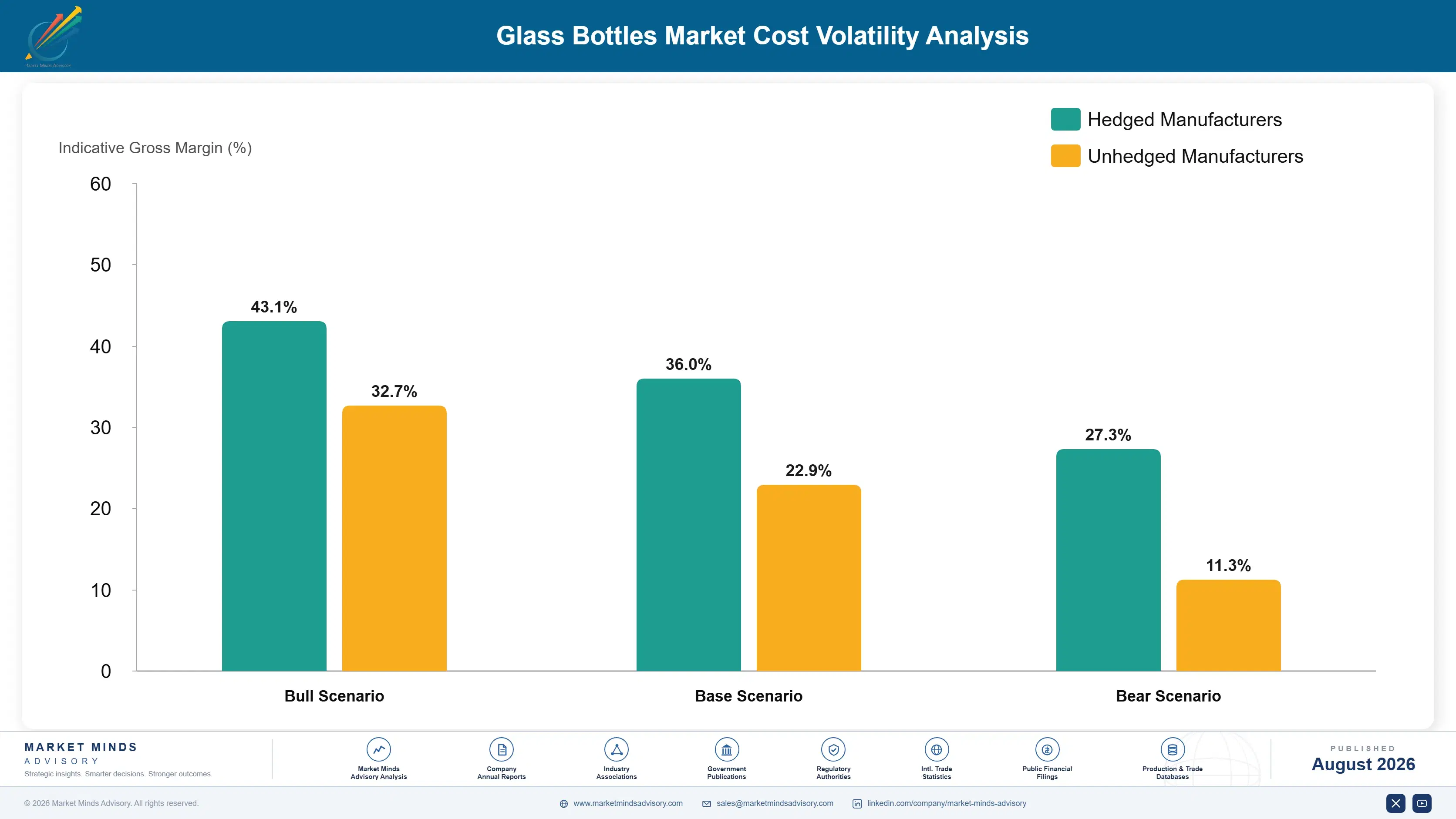
Energy, primarily natural gas and electricity for furnace operation, accounts for roughly 24% of cost of goods sold, sourced from regional utility markets whose pricing varies by geography. Raw materials including silica sand, soda ash, and limestone contribute a further 26% to 32%, with cullet reducing this share as recycled content rises. Labour and mould tooling take 14% to 18%, with the remainder covering freight.
European natural gas prices spiked dramatically through 2022 following supply disruption tied to the Russia-Ukraine conflict, and several glass manufacturers idled furnace capacity entirely rather than absorb unsustainable losses at prevailing spot prices that made continued operation uneconomical. The IEA's gas market reporting documented price increases exceeding several multiples of pre-crisis levels across that period, and Verallia and other European manufacturers disclosed material margin impact tied to that shock.

Exposure varies by geographic footprint and hedging discipline. Manufacturers concentrated in Europe carry more direct exposure to the region's gas price volatility than diversified competitors with meaningful Asian or American manufacturing capacity. Operators with long-term hedging contracts in place before a price spike protect margin considerably better than those buying reactively on the spot market.
glass-bottles-market-cost-volatility-analysis-1787332138960

Lock in multi-year energy hedging contracts ahead of volatility

Manufacturers securing long-term energy supply agreements before prices spike protect margin far more effectively than those buying reactively on the spot market once volatility has already begun, a lesson the industry absorbed hard during the 2022 European gas crisis and has since built into standard treasury practice across nearly every major manufacturing group globally.

Increase cullet content to reduce virgin raw material dependence

Higher recycled cullet content lowers both raw material cost and energy consumption per tonne of glass melted, since cullet requires less heat to process than virgin sand and soda ash, making cullet infrastructure investment a genuine cost mitigation rather than a purely regulatory compliance expense for manufacturers who invest early rather than waiting for mandates.

Diversify manufacturing footprint across multiple energy markets

Operators with furnace capacity spread across Europe, Asia, and the Americas reduce concentrated exposure to any single region's energy price volatility, a diversification strategy that limited the 2022 European crisis's impact on globally spread manufacturers considerably more than on Europe-concentrated competitors facing that shock without any geographic offset to fall back on when prices spiked.

Portfolio Architecture for Margin Defence

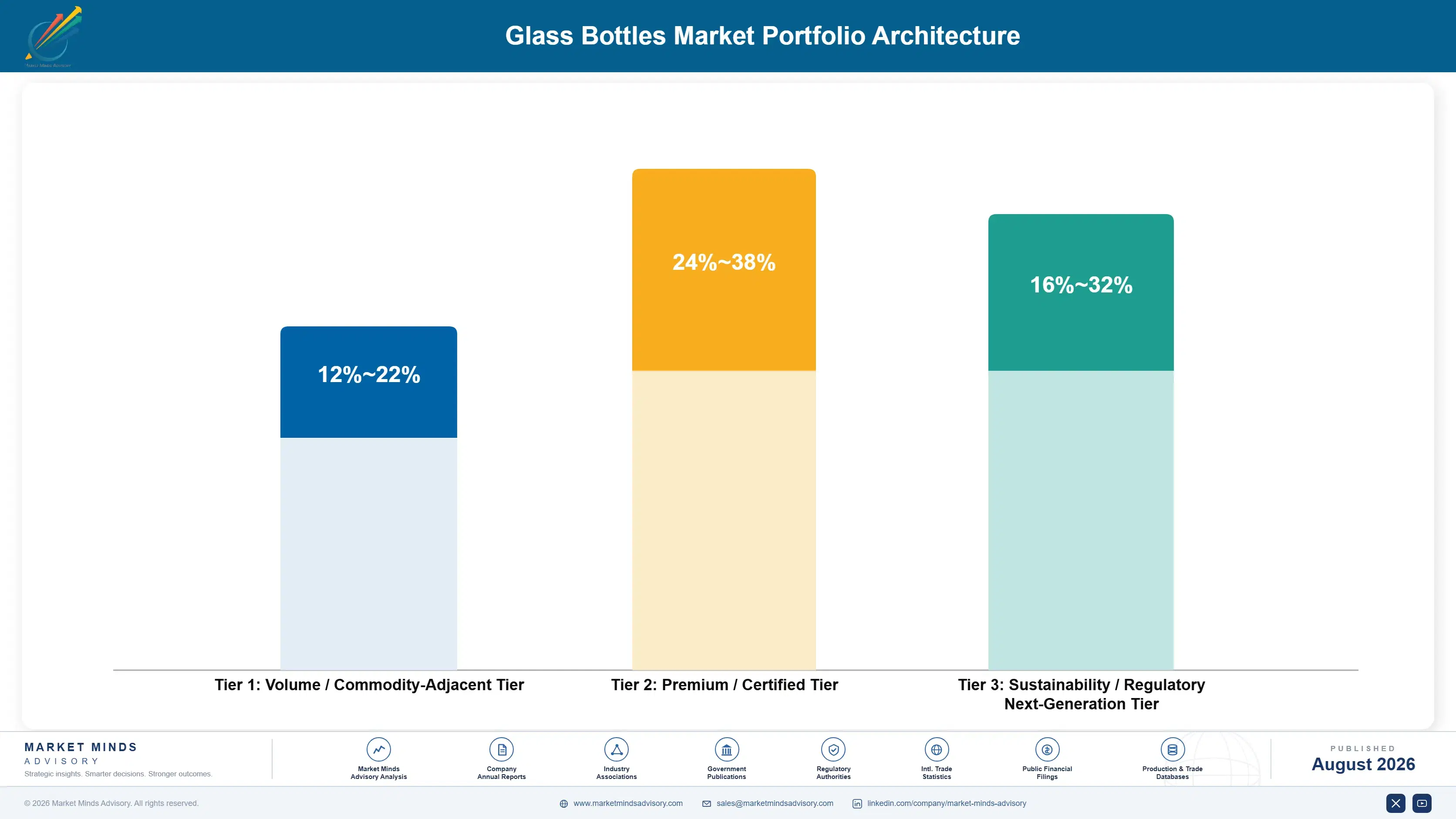
The portfolio splits into three tiers with sharply different economics. Standard beer bottles form the volume tier, competing largely on price against aluminium and plastic with margin set by energy cost and manufacturing scale. Premium spirits and wine glass earns more because design exclusivity and brand relationship both resist the commoditisation pressure hitting standard formats. Recycled and lightweight formats sit differently, priced against compliance value and freight savings rather tha
The tension runs between defending volume in categories glass is slowly losing and investing in premium capability that protects margin over the long run. A manufacturer chasing every standard beer contract eventually gets squeezed as aluminium keeps gaining share, yet building premium capability requires investment thin-margin standard production rarely funds adequately. Manufacturers handling this well treat standard glass as the volume foundation and premium design as the margin engine.

High-value pools concentrate where design exclusivity, energy discipline, or cullet infrastructure limit competition: premium spirits programmes with long-term supply agreements, cullet-advantaged production meeting mandates ahead of deadlines, and lightweighted formats narrowing the freight gap against aluminium. Standard beer bottles sit at the other end, competing almost entirely on price against every regional producer with comparable furnace capacity.

Volume / Commodity-Adjacent Tier

Standard beer and mainstream beverage bottles competing largely on price against aluminium and plastic alternatives across most retail categories. Margin is thin and set almost entirely by energy cost and manufacturing scale achieved.
Gross Margin: 12-22%

Premium / Certified Tier

Premium spirits, wine, and sparkling wine glass with custom mould design and exclusive long-term supply agreements built over successive product cycles. Margin reflects design investment and switching cost once a brand commits to a mould.
Gross Margin: 24-38%

Sustainability / Regulatory / Next-Generation Tier

High-cullet-content and lightweighted formats meeting recycled content mandates while narrowing the freight gap against lighter materials industry-wide. The wide range reflects early-stage compliance pricing still settling across the wider industry.
Gross Margin: 16-32%
glass-bottles-market-portfolio-architecture-1787332139453

High-value Sub-segments and Strategic Watch-out

Premium Spirits and Wine Bottles

High value and high growth at 6.1%, the fastest category, as brand owners trade up to heavier, custom-moulded glass that signals quality on a crowded shelf across nearly every major beverage market worldwide today and increasingly across emerging export destinations, brand and packaging teams both report consistently.
Gross Margin: 24-38%

High-Cullet and Lightweighted Formats

High value with strong growth at 5.4%, driven by recycled content mandates and freight cost pressure pushing manufacturers toward formats that satisfy regulation while cutting shipping weight meaningfully across most standard product lines and growing export programmes reaching new customers steadily every single quarter this year.
Gross Margin: 16-32%

Beer and Standard Beverage Bottles

The volume core by unit count, growing at 2.8% as aluminium and plastic continue capturing share in categories where consumers do not pay a premium for glass over lighter, cheaper packaging alternatives generally available on most retail shelves nationwide and increasingly through online grocery too.
Gross Margin: 12-22%

Pharmaceutical and Personal Care Glass

The strategic watch-out, growing at just 2.1% and constrained by plastic and specialised polymer alternatives increasingly meeting pharmaceutical packaging requirements at meaningfully lower cost across most regulated categories without sacrificing compliance, safety, or the shelf stability standards regulators require of every single production batch shipped.
Gross Margin: 18-30%

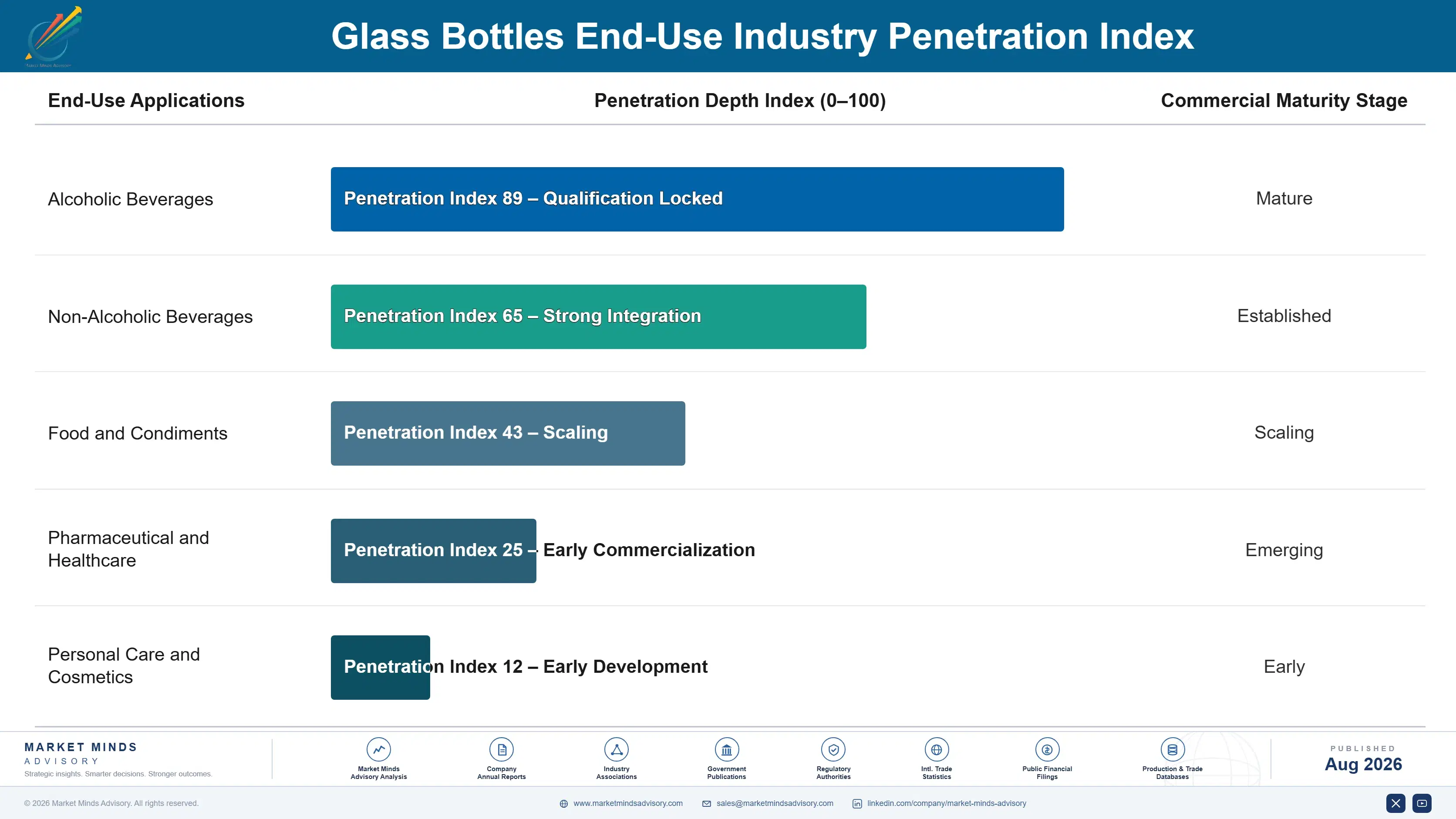
How Glass Bottle Revenue Actually Persists

Revenue depends on a furnace running continuously against contracted volume, not on winning any single order. A premium spirits programme tied to an exclusive mould design generates revenue across the full multi-year life of that product line, so annuity value sits in the exclusivity agreement rather than any individual shipment. Standard beverage programmes behave differently, generating steady but thinner volume that depends more on furnace utilisation than any single customer relationship.
Stickiness varies sharply by end-use category. Premium spirits and wine programmes stick hardest, since a brand that has invested in a distinctive custom mould rarely switches suppliers without a compelling reason given the design investment already sunk. Standard beverage programmes stick moderately, protected mainly by qualification time and freight proximity rather than genuine differentiation. Pharmaceutical and personal care glass switches most readily wherever plastic meets regulatory requirements at lower cost.

Buyer profiles have shifted generationally. Brand packaging teams that once selected glass suppliers primarily on unit price increasingly weigh design capability and sustainability credentials, particularly recycled content, given how much regulatory attention both now receive. Procurement and sustainability leadership increasingly sit alongside brand marketing in supplier selection, a shift that would have seemed unusual a decade ago.
glass-bottles-market-end-use-penetration-index-1787332139942

Our Call On Glass Bottles

These are among the four positions where our research anticipates prominent divergence between winners and laggards over the coming forecast period. Each is grounded in the demand model, the regulatory perimeter, and the announced capacity pipeline.
01 / PREMIUM DESIGN WINS

Exclusivity is worth more than the glass itself

Spirits and wine brands increasingly commission custom bottle moulds as core brand identity, and manufacturers securing exclusive design and supply agreements capture pricing considerably above standard production along with a switching cost that protects the relationship across multiple product cycles. That exclusivity also generates design fee revenue and deeper customer relationships than commodity filling work ever produces on its own. Manufacturers should treat premium design capability as the primary growth investment rather than a secondary service line attached to standard production.
02 / ENERGY DISCIPLINE PROTECTS MARGIN

Hedging is now a board-level furnace decision

Glass furnaces run continuously for their entire 12 to 15 year campaign life once lit, and energy price spikes translate directly into margin loss with almost no ability to pause production the way batch industries can. Manufacturers securing long-term energy hedging contracts ahead of volatility protected margin meaningfully better than competitors during the 2022 European energy crisis specifically, avoiding the idled capacity several rivals faced. That hedging discipline should now be treated as a standing operational requirement rather than an opportunistic treasury decision.
03 / CULLET INVESTMENT COMPOUNDS

Compliance capex is quietly becoming a cost edge

Mandated recycled content minimums are forcing furnace and cullet sorting investment industry-wide, and manufacturers building that capacity ahead of binding deadlines secure both compliance certainty and meaningfully lower energy cost per tonne of glass melted, since cullet needs meaningfully less heat than virgin material. Owens-Illinois has structured capital spending explicitly around anticipated regulatory timelines rather than reacting once mandates take effect. Early cullet investment turns a compliance obligation into a genuine, durable cost advantage over slower-moving competitors across the industry.
04 / STANDARD GLASS KEEPS SHRINKING

Lightweighting is defence, not offence, and that is fine

Aluminium and plastic will continue gaining share in mainstream beer and beverage categories where consumers do not pay a premium for tactile quality. No amount of lightweighting investment will fully reverse that persistent freight and cost disadvantage against lighter materials competing purely on price. Manufacturers should treat lightweighting as margin defence in a shrinking segment rather than a growth strategy, reallocating capital toward premium design and cullet infrastructure where genuine competitive advantage and durable pricing power both still exist today.

Engagement Snapshot From the Field

A live engagement with an industry participant carrying material or product regulatory and market exposure ahead of a defining policy shift, showing how our research translates into a defensible multi-year portfolio strategy.
MARKET MINDS ADVISORY · CLIENT ENGAGEMENT SUMMARY
Glass Bottles Producer Strategic Portfolio Review and Transition Roadmap 2026·Investment Scenario on Glass Bottles Exposure Evaluation 2025-26
CLIENT PROFILE
An expanding craft whisky distillery preparing to launch a premium flagship expression engaged MMA while evaluating glass suppliers for a custom bottle design intended to anchor the brand's positioning against established competitors. The client reported projected first-year volume near 400,000 units and a packaging budget it considered aggressive for a company of its size (client-reported, unverified by MMA).
STRATEGIC CHALLENGE
Leadership wanted a distinctive custom mould that would differentiate the brand on shelf, but lacked the volume history to command the design exclusivity terms larger distillers typically negotiate with major glass manufacturers. Balancing design ambition against a limited budget and uncertain future volume created genuine tension across the leadership team throughout the sourcing process.
MMA APPROACH
MMA benchmarked three shortlisted manufacturers on design capability, minimum order quantities, and exclusivity terms relative to the client's projected volume trajectory over three years. We modelled the cost premium of full mould exclusivity against a shared-mould alternative with limited differentiation. We then assessed each manufacturer's willingness to structure volume-scaling pricing terms.
KEY FINDINGS
  1. Full mould exclusivity would have added roughly 22% to unit packaging cost at the client's projected first-year volume, straining the stated budget significantly.
  2. A modified-exclusivity structure, unique embossing on a shared base mould, cut that premium to approximately 9% while still preserving meaningful shelf differentiation for the brand.
  3. Two of three manufacturers offered volume-scaling pricing that would reduce unit cost by roughly 15% once the client crossed a defined annual volume threshold.
  4. Minimum order quantities varied significantly across manufacturers, with the smallest requiring less than half the volume commitment of the largest bidder in the process.
CLIENT PROFILE
An expanding craft whisky distillery preparing to launch a premium flagship expression engaged MMA while evaluating glass suppliers for a custom bottle design intended to anchor the brand's positioning against established competitors. The client reported projected first-year volume near 400,000 units and a packaging budget it considered aggressive for a company of its size (client-reported, unverified by MMA).
STRATEGIC CHALLENGE
Leadership wanted a distinctive custom mould that would differentiate the brand on shelf, but lacked the volume history to command the design exclusivity terms larger distillers typically negotiate with major glass manufacturers. Balancing design ambition against a limited budget and uncertain future volume created genuine tension across the leadership team throughout the sourcing process.
MMA APPROACH
MMA benchmarked three shortlisted manufacturers on design capability, minimum order quantities, and exclusivity terms relative to the client's projected volume trajectory over three years. We modelled the cost premium of full mould exclusivity against a shared-mould alternative with limited differentiation. We then assessed each manufacturer's willingness to structure volume-scaling pricing terms.
KEY FINDINGS
  1. Full mould exclusivity would have added roughly 22% to unit packaging cost at the client's projected first-year volume, straining the stated budget significantly.
  2. A modified-exclusivity structure, unique embossing on a shared base mould, cut that premium to approximately 9% while still preserving meaningful shelf differentiation for the brand.
  3. Two of three manufacturers offered volume-scaling pricing that would reduce unit cost by roughly 15% once the client crossed a defined annual volume threshold.
  4. Minimum order quantities varied significantly across manufacturers, with the smallest requiring less than half the volume commitment of the largest bidder in the process.
RECOMMENDED STRATEGY
Phase 1: Phase 1 (0 to 4 months): Negotiate the modified-exclusivity embossing structure with the manufacturer offering the most favourable volume-scaling terms. Phase 2: Phase 2 (4 to 12 months): Launch the flagship expression and track actual volume against the projected scaling threshold closely. Phase 3: Phase 3 (12 to 24 months): Revisit full mould exclusivity once volume justifies the premium, using actual sales data to negotiate terms.
OUTCOME
The client launched with the modified-exclusivity design and achieved volume ahead of the initial projection within the first year, crossing the pricing threshold sooner than modelled. Leadership credited the phased approach with preserving cash for marketing spend the full exclusivity option would have consumed entirely (client-reported, unverified by MMA).

Frequently Asked Questions

Foundational context covering the market sizes, CAGR, scope, country, region and competition that inform every finding below. This section is provided to cover basics and most often pre-purchase conversations, answered from the MMA Primary Research Dataset.

What is the current size of the Glass Bottles Market?

The global glass bottles market is valued at USD 68.4 billion in 2025, covering rigid glass containers for beverage, food, pharmaceutical, and personal care packaging. Glass jars and flat glass for construction are excluded.

How large will the Glass Bottles Market be by 2036?

The market is forecast to reach USD 104.19 billion by 2036 in the base case, about 1.47 times the 2026 level. That represents incremental value of roughly USD 33.12 billion across the decade.

What is the CAGR for the Glass Bottles Market 2026 to 2036?

The market grows at a 3.9% CAGR in the base case, with bull and bear scenarios at 4.9% and 2.7%. The spread turns mainly on premiumisation pace and plastic and aluminium substitution in mainstream categories.

Which segment is growing fastest?

Premium spirits and wine bottles grow fastest at 6.1%, about 1.56 times the overall rate, as brand owners trade up to heavier, custom-moulded glass. High-cullet and lightweighted formats follow at 5.4%.

Who are the major companies in the Glass Bottles Market?

Leading companies include Owens-Illinois, Ardagh Group, Verallia, Vidrala, and Vitro. Concentration is moderately high, with the top five holding roughly 47% of total category revenue combined.

Which country is growing fastest?

India grows fastest at a 6.8% CAGR, as rising spirits and beer consumption pulls new furnace capacity investment into the country. China follows on manufacturing scale and export demand.

Report Segmentation Architecture

The full report scope spans multiple orthogonal segmentation dimensions, with cross-tabulated demand data provided for each dimension pair. Coverage extends further to regional breakdowns, trend trajectories, and the competitive detail needed to support segment-level decision-making.

By End-Product Category

  • Premium Spirits and Wine Bottles
  • Beer and Standard Beverage Bottles
  • High-Cullet and Lightweighted Formats
  • Pharmaceutical and Personal Care Glass
  • Food and Condiment Glass Packaging

By End-Use Industry

  • Alcoholic Beverages
  • Non-Alcoholic Beverages
  • Food and Condiments
  • Pharmaceutical and Healthcare
  • Personal Care and Cosmetics

By Commercial Dimension

  • Direct Manufacturer Supply Contracts
  • Custom Design and Mould Services
  • Distributor and Wholesale Channels
  • Recycled Content Compliance Programmes

By Region

  • North America
  • Western Europe
  • East Asia
  • South Asia and Pacific
  • Latin America
  • Middle East and Africa
  • Eastern Europe

Scope, Methodology, and Coverage

Every figure in this report is reproducible from documented input assumptions. The scope below maps the historical period, the forecast horizon, the segmentation dimensions, and the countries covered, alongside the underlying primary and qualitative methodology.
Historical Period
2020 to 2025
Forecast Period
2026 to 2036
Base Year
2025 (USD billions; MMA Primary Research Dataset, August 2026)
Market Definition
The glass bottles market comprises rigid glass containers manufactured for beverage, food, pharmaceutical, and personal care packaging, valued at manufacturer revenue from bottle production and associated design services. It spans premium spirits and wine bottles, beer and standard beverage bottles, high-cullet and lightweighted formats, pharmaceutical and personal care glass, and food and condiment glass packaging across virgin and recycled cullet-based production. Glass jars sold for non-bottle applications, glass packaging components such as caps and closures sold separately, and float or flat glass for construction are excluded.
Quantitative Units
USD billions (current prices); unit shipments in billions where applicable
Segmentation Dimensions
By End-Product Category; By End-Use Industry; By Commercial Dimension; By Region
Regions Covered
North America, Western Europe, East Asia, South Asia and Pacific, Latin America, Middle East and Africa, Eastern Europe
Countries Covered
USA, China, Germany, France, Italy, UK, Japan, South Korea, India, Mexico, Brazil, Canada, Australia, Spain, Poland, Czech Republic, Hungary, Romania, South Africa, UAE, Saudi Arabia, Vietnam, Philippines, Netherlands, and additional markets relevant to this sector
Key Companies Profiled
Owens-Illinois, Ardagh Group, Verallia, Vidrala, Vitro, Piramal Glass, Hindusthan National Glass, Consol Glass, BA Glass, Wiegand-Glas, Zignago Vetro, Nihon Yamamura Glass, Toyo Glass, Hokkan Holdings, Beatson Clark, Vitro Packaging, Anchor Glass Container, Gerresheimer, Sisecam, HNGIL
Quantitative Methodology
Primary survey, n=3,800 respondents, Q4 2025, six countries; demand-side model with trade association cross-validation
Qualitative Methodology
47 expert interviews, Q4 2025; applied to validate demand model assumptions, identify emerging dynamics, and assess competitive positioning
Report Format
PDF and XLSX data workbook (Word format preview document)
Publisher
Market Minds Advisory
Report Code
MMA-2026-PAC-114
Published
August 2026
Contact
sales@marketmindsadvisory.com | www.marketmindsadvisory.com

Purchase the full Glass Bottles Market Report (2026 to 2036).

The full MMA Glass Bottles report sizes the market across five end-product categories, five end-use industries, four commercial dimensions, and seven regions through 2036. It profiles 20 companies on a consistent manufacturing revenue basis, scoring each on energy cost management, premium design capability, and cullet infrastructure investment. Scenario models quantify how premiumisation, recycled content regulation, and energy price volatility move both revenue and margin by category. The report also includes furnace energy cost benchmarking, cullet supply chain mapping, and premium design exclusivity tracking for commercial and procurement leadership teams.
Five-category and four-dimension market sizing to 2036
Twenty-company benchmark on manufacturing revenue basis
Furnace energy cost and hedging strategy benchmarking
Cullet supply chain and recycled content compliance mapping
Premium design exclusivity and mould investment tracking
Lightweighting and freight cost gap analysis by format

Built For The People Who Decide

From boardroom strategy to bench-side execution, this report is read cover-to-cover by leaders shaping the next decade of their industry, turning demand scenarios, market dynamics and valuation benchmarks into decisions.
CXOs/ Presidents/ VPs/ Managers
M&A and Corporate Development
Strategy Teams and R&D Heads
Procurement and Product Directors
Regulatory and Compliance Leaders
Investor Relations and Equity Analysts