
Market Minds Advisory
Garage Equipment Market

Garage Equipment Market: Calibration Floor Space, Subscription Diagnostics, and Work Independents Keep Handing Away

Static calibration needs around 48 square metres of level, clear floor. Most independent workshops simply do not have it, which is why 38% of that work goes straight to a franchised dealer instead.

Lead Analyst

David Horsley

Published

September 2026

Make Smarter Decisions with Customized Research Insights

Request a free sample report and evaluate market opportunities, growth trends, and competitive dynamics relevant to your business needs.

2025 MARKET VALUE$8.8BMarket Size 2025
2036 FORECAST VALUE$16.0BBase Case , 2026 to 2036
CAGR 2026 TO 20365.6 %Bull 6.8% / Bear 4.4%
INCREMENTAL OPPORTUNITY$6.7BNet 10- year value creation
EXPANSION MULTIPLE1.72x2036 value over 2026 base
Strategic Levers
M&A Pipeline
Regional Outlook
Country Rankings
Competitive Intelligence
Segmental Deep-dive
Call-Us : 91 93563 13602

Executive Snapshot and Market Trajectory

A camera behind a windscreen turned a routine glass replacement into a job requiring a calibration rig, targets, controlled lighting, and around 48 square metres of clear level floor. Most independent workshops have the money and not the space, which is a different problem entirely. Nobody planned for that.
Commercial advantage belongs to manufacturers solving the floor space constraint rather than those selling better calibration accuracy, because independents already refer 38% of that work to franchised dealers and lose the surrounding job with it. ADAS calibration systems grow fastest at 16.4%, roughly 2.93 times the market. East Asia holds the largest position at 28% of value on vehicle parc growth outpacing every other region.
Concentration sits at roughly 32% for the top five, held by dealer network approvals and software rather than by hardware anybody could not build. Diagnostic revenue is shifting toward subscription, already at 23%. Electric vehicles reduce workshop revenue per car while raising the equipment and training a workshop must fund. Workshops are being asked to invest more against a smaller service opportunity per car, which is not an argument any equipment brochure makes well.
Market Definition
The market comprises equipment supplied to vehicle service, repair, and inspection workshops, covering vehicle lifts and hoists, wheel service equipment, diagnostic equipment and scan tools, ADAS calibration systems, air conditioning service equipment, and body repair and refinishing equipment. Value is measured at manufacturer level including attached software and service. Hand tools and consumables, replacement vehicle parts, workshop management software sold standalone, fuel dispensing and car wash equipment, and vehicle manufacturer proprietary tooling supplied directly to franchised networks fall outside scope.
Base Year Value
$8.8B in 2025 (MMA Primary Research Dataset, August 2026)
Forecast Period
2026 to 2036, eleven discrete annual values
CAGR
5.6% base case. Bull 6.8%. Bear 4.4%.
Fastest Growth Segment
ADAS Calibration Systems: 16.4% CAGR
Fastest Growth Country
India: 9.2% CAGR
Fastest Growth Region
South Asia and Pacific: 7.8% CAGR
Largest Region
East Asia: 28% of 2025 global value
Market Leaders
Snap-on, Vehicle Service Group, Bosch, Hunter Engineering, and Nexion Group lead on garage equipment shipment revenue. Source: company annual reports and MMA Analysis, July 2026.
Primary Survey
n=3,800 procurement and R&D decision-makers, Q4 2025, six countries
Methodology
Demand-side build-up, cross-validated against public data, 47 expert interviews

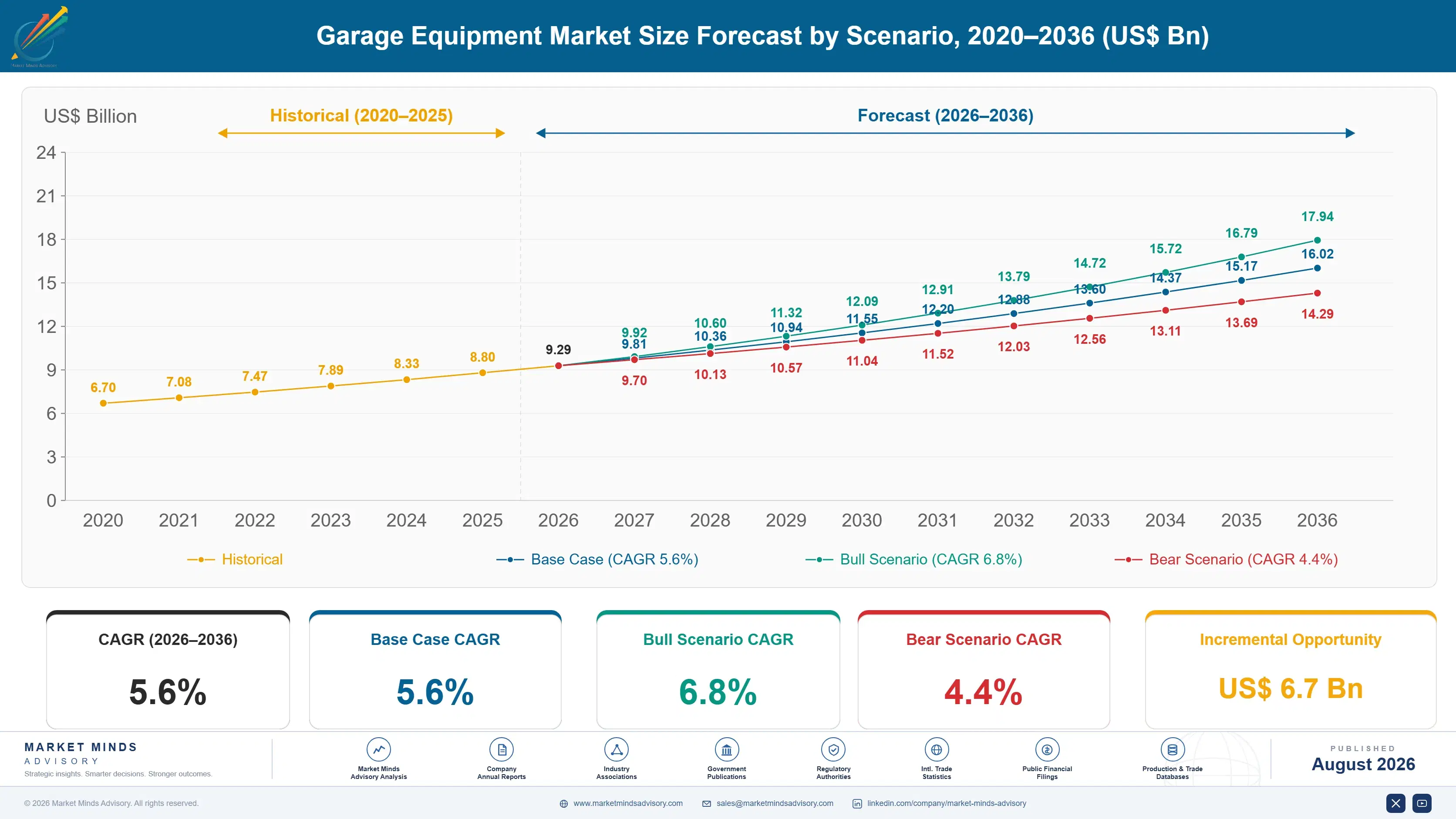
Garage Equipment Market Forecast Scenarios

garage-equipment-market-size-forecast-scenario-1787551505831
Between 2020 and 2025 the equipment a workshop needed changed faster than most workshops could fund. Driver assistance systems spread across mass market vehicles, which made calibration a routine requirement rather than a specialist service. Electric vehicles began reducing revenue per car on the jobs workshops depend on. The 4.6% historical rate reflects steady replacement demand plus calibration investment concentrated among the minority of workshops able to accommodate it.
The 5.6% base case rests on three mechanisms. Driver assistance fitment keeps rising across the vehicle parc, and every camera or radar creates recurring calibration demand after glass, suspension, or bumper work. Periodic technical inspection regimes mandate specific test equipment on fixed replacement cycles regardless of market conditions. And electric vehicle service requires high-voltage safety equipment and insulated tooling workshops currently do not hold. None of the three depends on workshop numbers growing anywhere.
The 6.8% bull case assumes right-to-repair rules widen independent access to diagnostic data while mobile calibration solves the floor space problem. The 4.4% bear case reflects independent workshop consolidation reducing the buyer count, electric vehicles cutting service revenue faster than equipment demand rises, and calibration work continuing to concentrate in franchised networks that already own the space.

The Constraint Is Floor Space

Calibration equipment sales are limited by premises rather than by budget, which almost nobody selling it models correctly. A static procedure needs a level floor, controlled lighting, and roughly 48 square metres of clear space ahead of the vehicle. A workshop in a converted railway arch cannot create that at any price, so it refers the job out and loses the alignment, the glass, and the customer relationship attached to it.
TOP-FIVE CONCENTRATION32%Combined share of equipment shipments held by leading manufacturers
ADAS CALIBRATION FLOOR REQUIREMENT48 square metresClear space needed for static calibration procedures to run
AVERAGE WORKSHOP EQUIPMENT SPENDUSD 84,000Typical installed equipment value across an independent service bay
SOFTWARE SUBSCRIPTION SHARE23%Portion of diagnostic revenue from recurring licence and update
EQUIPMENT REPLACEMENT CYCLE16 yearsTypical service life before a vehicle lift is replaced
CALIBRATION JOB LOSS RATE38%Share of calibration work independents refer to franchised dealers
Diagnostics is quietly becoming a software business inside a hardware wrapper. Subscription and update licences already represent 23% of diagnostic revenue and the share keeps rising, because vehicle coverage rather than the scan tool itself is what a workshop is buying. Access to manufacturer diagnostic data is the battleground, and right-to-repair legislation determines how much independents can reach at all.
Electric vehicles create an uncomfortable equation for the workshop. Oil changes, exhaust work, and engine repair disappear, while tyres, suspension, glass, and electronics remain. Revenue per vehicle falls, and at the same time high-voltage safety equipment, insulated tooling, and technician certification become mandatory. Workshops are being asked to invest more against a smaller service opportunity per car on the road.
"Equipment manufacturers keep improving calibration accuracy and the workshop's problem is that it cannot park a car eight metres from a wall. Solve the space and you have a market. Improve the target board resolution and you have a better product nobody can install."
Practice Director, Automotive Aftermarket and Service Equipment · MMA Automotive Service Equipment Practice · August 2026

Market Trends

Calibration Requirements Concentrate Work in Franchised Networks

Any vehicle with a forward-facing camera or bumper radar needs recalibration after glass replacement, wheel alignment, suspension work, or bumper repair, and the static procedure requires roughly 48 square metres of clear level floor with controlled lighting. Franchised dealers have that space and independents frequently do not. Around 38% of calibration work is referred out as a result, and the referring workshop loses the surrounding job too. Mobile and dynamic calibration approaches address part of it without solving the problem completely. Shared calibration centres serving several independents are emerging as the practical workaround.
Market Impact: Lifts replace on 16-year cycles
Diagnostic Revenue Shifts Toward Recurring Subscription

A scan tool is worth what it can talk to, and vehicle coverage arrives through software updates rather than through hardware, which has moved 23% of diagnostic revenue onto recurring licences. Manufacturers of the equipment increasingly earn more from the subscription than from the original sale. Access to vehicle manufacturer diagnostic data determines coverage depth, which makes right-to-repair legislation a direct commercial variable. Workshops resent the model and renew anyway, because an out-of-date tool is close to useless. Chinese entrants understood this earlier than most European incumbents did and built coverage accordingly.
Market Impact: East Asia holds 28% of value

Market Opportunities and Growth Drivers

Inspection Regimes Mandate Equipment on Fixed Cycles

Periodic technical inspection in Europe and equivalent regimes elsewhere require roller brake testers, emissions analysers, headlamp aligners, and play detectors to specified standards, with calibration and replacement schedules written into the rules. That demand arrives regardless of economic conditions and regardless of whether a workshop wants to spend. Equipment approval by the national inspection authority is a genuine barrier to entry for manufacturers. Regulatory change to inspection standards then converts an entire installed base on a published timetable. Manufacturers holding approvals across many jurisdictions capture that demand predictably while newcomers work through the paperwork.
Market Impact: Static calibration needs 48 square metres

Asian Vehicle Parc Growth Adds Workshops Continuously

Vehicle numbers in China, India, and Southeast Asia keep rising while the service network expands to match, which creates new workshop equipment demand rather than replacement demand. India grows fastest of any country at 9.2% as organised service chains displace informal repair. East Asia holds 28% of value on parc growth outpacing every other region. Equipment specification in these markets sits well below European levels, though it is rising as vehicle complexity arrives with newer parc. Multi-brand service chains standardising equipment across sites are the buyers worth reaching, since a single specification decision equips dozens of workshops at once.
Market Impact: Service revenue falls 27% per vehicle

Market Restraints and Challenges

Premises Constrain Calibration Investment More Than Budget

Workshops that would happily fund a calibration system cannot create 48 square metres of clear level floor inside premises they lease and did not design. The root cause is property rather than commercial reluctance, which means no financing package or pricing concession addresses it. Manufacturers mitigate through mobile and dynamic calibration approaches requiring less space, through shared calibration centres serving several independents, and by designing rigs that fold and store rather than occupying a bay permanently. Manufacturers competing on calibration accuracy are improving a product their target customer physically cannot install anywhere on the premises.
Market Impact: Independents refer 38% of calibration

Electric Vehicles Cut Service Revenue Per Car

Removing oil changes, exhaust work, and engine repair takes a meaningful share of workshop revenue while tyres, suspension, glass, and electronics remain, so revenue per vehicle falls even as the parc grows. The root cause is powertrain simplification. Workshops mitigate by adding calibration, glass, and high-voltage capability, and equipment manufacturers mitigate by selling the high-voltage safety equipment, insulated tooling, and battery handling systems that electric service actually requires instead. Financing and bundled packaging matter far more here than any individual product argument, because the workshop is being asked to fund mandatory equipment against declining revenue.
Market Impact: Subscriptions reach 23% of revenue
4 additional market trends, 3 additional growth drivers, and 2 additional restraints and challenges are covered in the full report. Contact sales@marketmindsadvisory.com to access the complete intelligence.

Segment CAGR and Growth Architecture

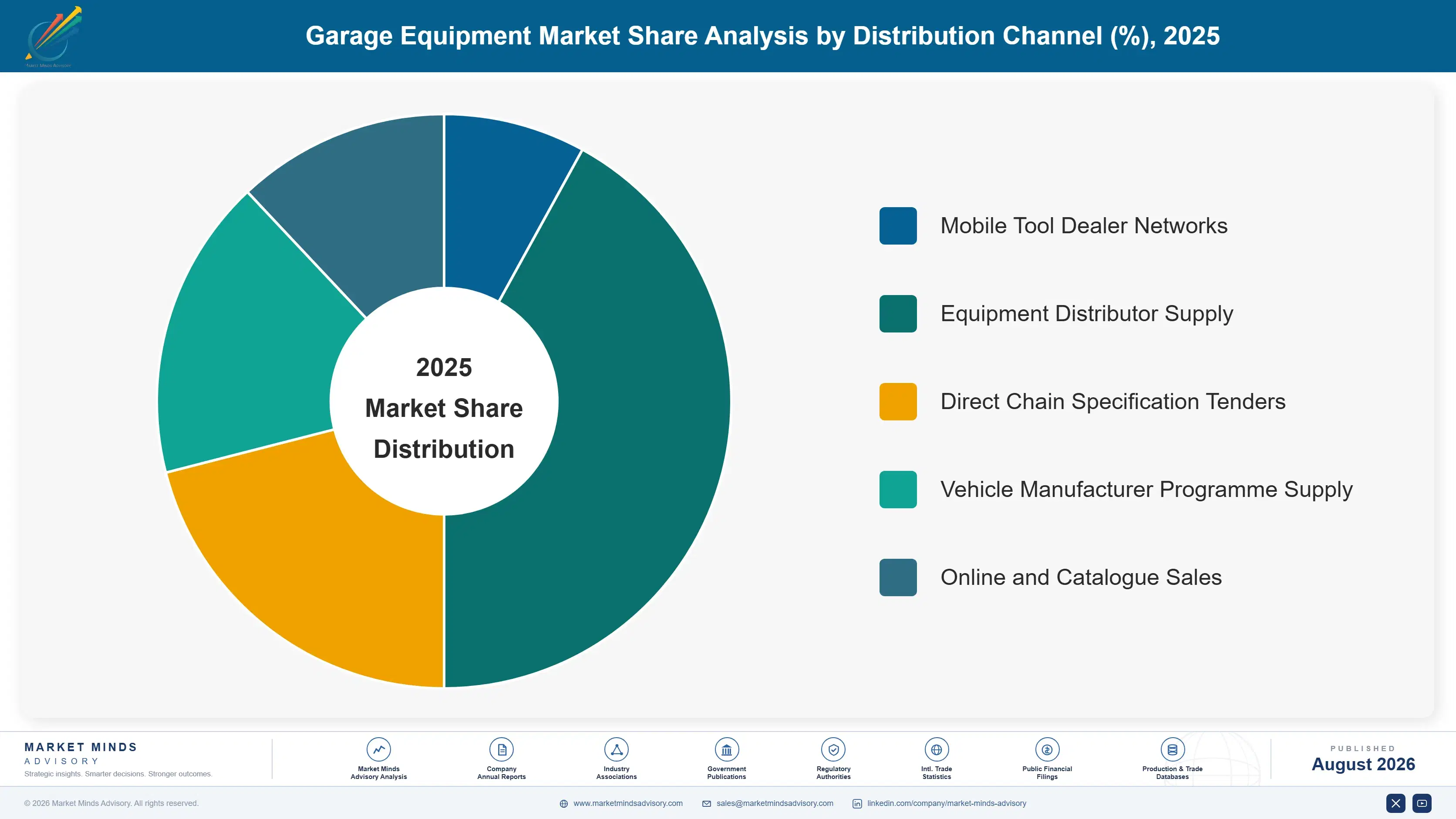
Segmentation follows equipment category, because each product carries a distinct replacement cycle, approval requirement, and installation constraint inside the workshop. Six categories cover commercial supply, and the divide between mature capital equipment replaced every decade or two and software-led systems bought against changing vehicle technology matters more than any difference in unit price. Unit price predicts very little.
garage-equipment-market-market-share-analysis-1787551506396

ADAS Calibration Systems

The fastest category at 16.4%, roughly 2.93 times the market, and the one whose growth is limited by premises rather than by demand. Static calibration requires a level floor, controlled lighting, and around 48 square metres of clear space ahead of the vehicle, which many independent workshops cannot provide inside leased premises. Around 38% of the work is therefore referred to franchised networks that have the space. Mobile rigs, dynamic road-based procedures, and folding target systems all address part of the constraint. None removes it entirely for a workshop in a converted arch. Manufacturers who qualify an enquiry on floor area before quoting convert at several times the rate of those who lead with product specification instead.
CAGR 16.4%

Diagnostic Equipment and Scan Tools

Second fastest at 7.6%, and increasingly a software business wearing hardware. Vehicle coverage arrives through update subscriptions rather than through the tool itself, and 23% of diagnostic revenue is now recurring licence income that manufacturers value more highly than the original sale. Depth of access depends on what vehicle manufacturers release, which makes right-to-repair legislation a direct determinant of product capability. Workshops dislike the subscription model and renew regardless, because a tool without current coverage cannot service recent vehicles at all. Chinese entrants including Launch Tech and Autel built coverage depth deliberately and now compete with European incumbents on capability rather than only on price. That shift caught several established manufacturers unprepared.
CAGR 7.6%
Full segment breakdown across 6 segments available in the complete report.

Regional Architecture and Country Demand Map

Regional shares follow vehicle parc, workshop count, and how much equipment inspection regimes actually mandate. All seven regions sit inside the standard bands, with East Asia leading on parc growth rather than on equipment specification levels. Equipment specification differs enormously between regions with similar vehicle numbers.

North America

Workshop premises here are generally larger than European equivalents, which makes the calibration floor space constraint less binding and has supported faster independent adoption than anywhere else. Snap-on, Vehicle Service Group, Hunter, and BendPak hold deep distribution through mobile tool dealers and equipment distributors. Right-to-repair legislation at state level has widened diagnostic data access unevenly. Collision repair consolidation into multi-site operators has concentrated equipment purchasing considerably. Growth of 5.4% reflects replacement demand and calibration investment rather than any expansion in workshop numbers. Mobile tool dealers visiting weekly and financing purchases directly remain the channel that decides most independent workshop equipment decisions, which no other region replicates at comparable scale anywhere.
Share: 25% | CAGR: 5.4% (2026 to 2036)

Western Europe

Periodic technical inspection regimes mandate roller brake testers, emissions analysers, and headlamp aligners to national standards, which creates regulated equipment demand independent of economic conditions entirely. Workshop premises are frequently small and urban, which makes calibration floor space the binding constraint across much of the region. Bosch, Nexion, MAHA, Ravaglioli, and Hella Gutmann hold strong positions with approval status under national inspection rules. Growth of 4.2% is the slowest anywhere, limited by a mature parc and a workshop base that is consolidating rather than expanding. Chain consolidation is shifting purchasing from individual sites toward technical directors writing specifications that distributor field representatives never see, which is reshaping how manufacturers must sell here.
Share: 23% | CAGR: 4.2% (2026 to 2036)
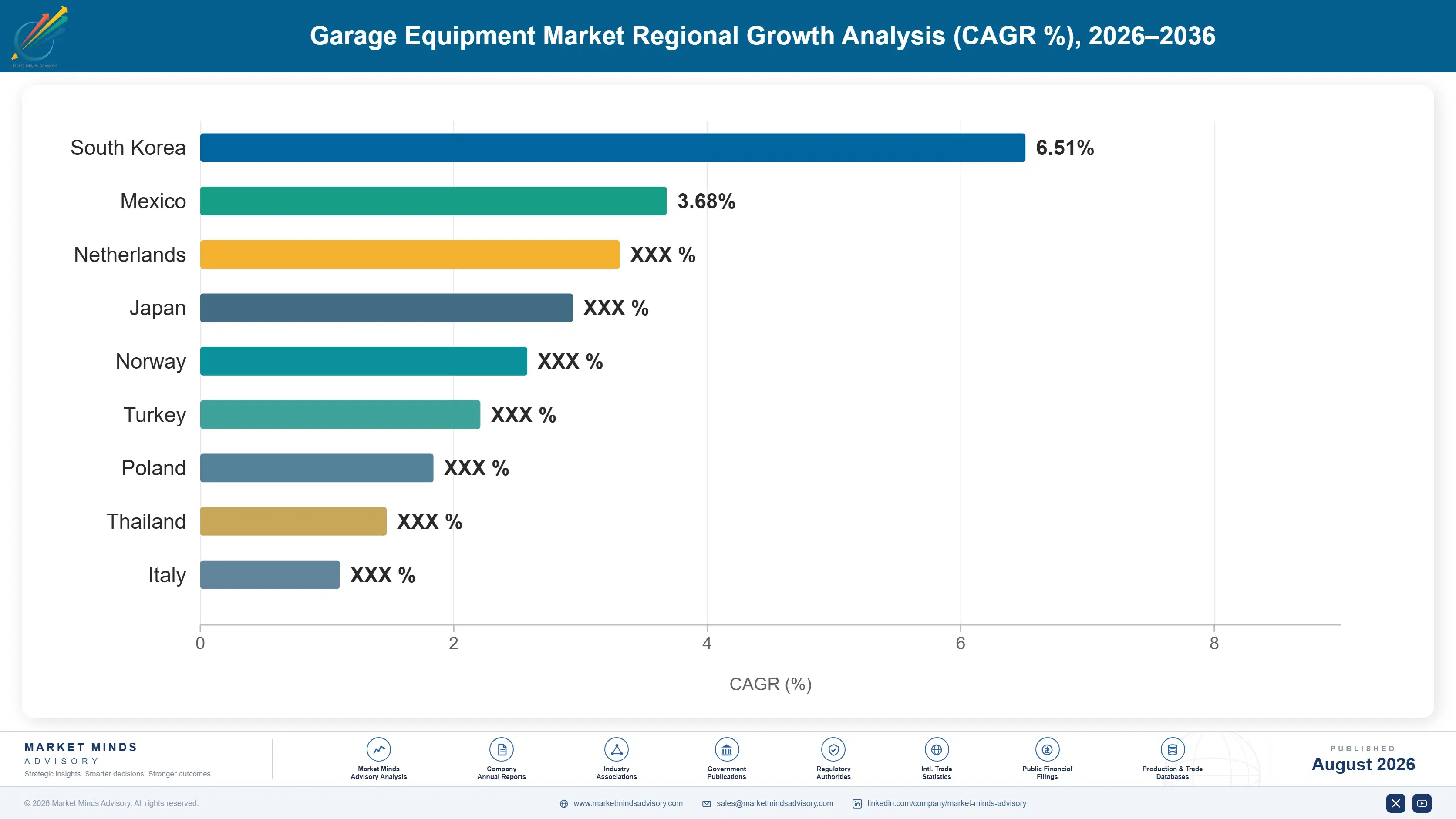
Regional intelligence for 5 additional markets available in the complete report: East Asia, South Asia and Pacific, Latin America, Middle East and Africa, Eastern Europe. Contact sales@marketmindsadvisory.com.
garage-equipment-market-country-cagr-analysis-1787551506925

Four Moves Worth Real Capital

Advantage here comes from removing installation constraints, owning the recurring software relationship, and holding approvals that regulation requires. Four moves justify capital across the forecast period, and the first addresses a barrier that no amount of product improvement or financing has ever touched. Product improvement on its own is not among the four at all.

Engineer around the floor space constraint

Independents refer 38% of calibration work out because they cannot create 48 square metres of clear level floor, not because the equipment costs too much. Mobile rigs, dynamic road-based procedures, folding target systems, and shared calibration centres each address part of it. Manufacturers competing on calibration accuracy are improving a product their target customer physically cannot install. The addressable market expands the moment somebody makes the procedure work in a smaller bay. Qualifying an enquiry on floor area before quoting converts at several times the rate of leading with product specification, and almost nobody collects that data.
Market Impact: Recovers the 38% of calibration work referred out

Build the coverage subscription relationship deliberately instead

Vehicle coverage arrives through software updates rather than hardware, and 23% of diagnostic revenue already sits in recurring licences that manufacturers value above the original sale. Workshops dislike the model and renew anyway, because a tool without current coverage cannot service recent vehicles. Depth of manufacturer data access determines coverage and therefore renewal rates directly. Equipment makers treating software as an afterthought are giving away the only recurring revenue in a business built on sixteen-year replacement cycles. Chinese entrants understood this earlier than most European incumbents and built coverage depth accordingly.
Market Impact: Grows a recurring revenue share already at 23%

Hold inspection authority approvals across jurisdictions

Roller brake testers, emissions analysers, and headlamp aligners must be approved by national inspection authorities before a workshop can use them for statutory testing, which is a genuine barrier competitors take years to clear. That demand arrives on published replacement schedules regardless of economic conditions. Regulatory changes to inspection standards convert entire installed bases on a known timetable. Manufacturers holding approvals across many jurisdictions capture that predictably while newcomers wait. Approval typically takes 18 to 30 months per jurisdiction, which is exactly why the position holds once a manufacturer has actually secured it.
Market Impact: Serves replacement cycles running 16 years each time

Sell the electric vehicle equipment workshops must buy

Electric powertrains remove oil, exhaust, and engine work, cutting workshop revenue per vehicle by roughly 27% while requiring high-voltage safety equipment, insulated tooling, battery lifting systems, and technician certification the workshop does not currently hold. That is a mandatory purchase against a shrinking revenue base, which makes financing and bundling considerably more important than usual. Manufacturers who package the transition rather than selling items reach workshops that would otherwise defer indefinitely. Technician certification and battery handling systems are equally mandatory and equally unbudgeted, which makes a single packaged proposition considerably easier to sell than six separate ones.
Market Impact: Offsets a 27% decline in per-vehicle service revenue

Who Controls the Margin Pool

Concentration sits at roughly 32% for the top five on equipment shipment revenue, held by distribution reach, inspection authority approvals, and software coverage rather than by hardware manufacturing anybody could not replicate. Snap-on holds unmatched North American distribution through mobile dealers. Vehicle Service Group leads in lifts, Bosch spans diagnostics and workshop systems broadly, Hunter dominates wheel service, and Nexion holds strong European positions.
Competition runs on three dimensions. Software coverage depth is the first, since a diagnostic tool is worth what it can communicate with. Inspection authority approval is the second, and it gates statutory testing equipment entirely. Distribution reach is the third, because a workshop buys from whoever visits and services what breaks. None of the three is a manufacturing capability at all.

Pressure is building from two directions. Launch Tech and Autel have built international diagnostic positions from Chinese manufacturing at prices European incumbents struggle to match on coverage-adjusted terms. Workshop consolidation is reducing the number of buyers while raising the sophistication of each. Rankings will shift toward manufacturers combining software depth with approval breadth rather than hardware quality alone. Hardware quality alone stopped deciding anything some years ago.
garage-equipment-market-company-positioning-matrix-1787551507446

Competitive Moat and Risk Dimensions

SNAP-ON

Moat: Mobile dealer distribution reach

Snap-on reaches technicians through mobile dealers who visit workshops weekly, which converts equipment sales into a relationship no distributor or online channel replicates. That network also finances purchases directly, which matters enormously to independent workshops funding calibration and electric vehicle capability. Rebuilding a comparable field presence would take a competitor decades and considerable capital.
SNAP-ON

Risk: Chinese diagnostic price pressure

Launch Tech and Autel have built international diagnostic positions with coverage that now approaches incumbent levels at considerably lower prices, and workshops evaluating a scan tool increasingly compare coverage lists rather than brands. Distribution strength slows that erosion without stopping it. Defending premium pricing on diagnostics requires software depth rather than the field presence that protects hardware sales.
BOSCH

Moat: Diagnostic data and vehicle relationships

Bosch supplies vehicle manufacturers as a tier one and builds workshop diagnostic equipment, which gives it visibility into vehicle systems that independent equipment makers reach only through published interfaces. Coverage depth follows from that directly. Inspection authority approvals across European jurisdictions add a regulated demand base that arrives on schedule regardless of what workshops otherwise choose to spend.
BOSCH

Risk: Independent workshop channel depth

Strength with vehicle manufacturers and franchised networks does not automatically convert into reach among the independent workshops where calibration and diagnostic growth is most contested. Field presence there is thinner than Snap-on's and increasingly contested by Chinese entrants selling directly. The channel that decides independent purchases is not the one Bosch has historically invested most heavily in building.

Players Tracked

Prominent Players

Snap-on
Vehicle Service Group
Bosch
Hunter Engineering
Nexion Group

Other Key Players

Continental
Hella Gutmann
Ravaglioli
Stertil-Koni
BendPak
Launch Tech
Autel
Texa
MAHA Maschinenbau
Nussbaum Lifts
Istobal
Werther International
Blitz Rotary
Sun Automotive
Delphi Technologies

Recent Developments

JANUARY 2025

Independent chain opens shared calibration centres regionally

A multi-site independent workshop group opened dedicated calibration centres serving its own branches and nearby independents, after finding that individual sites could not accommodate the floor space static procedures require. Referral revenue to franchised dealers fell substantially across the group. Individual sites could not comply on their own.
Signal: Shared facilities are emerging as the practical answer to a constraint equipment design has not solved
MAY 2025

Diagnostic maker restructures pricing toward coverage subscription

An equipment manufacturer moved its diagnostic pricing decisively toward recurring coverage subscription with reduced hardware pricing, reflecting that workshops buy vehicle coverage rather than the tool itself. Renewal rates proved considerably higher than the company had modelled beforehand. Hardware unit volume also rose quite noticeably afterwards.
Signal: Workshops openly resent the subscription model and renew regardless, because obsolete coverage makes any tool useless
SEPTEMBER 2025

Inspection authority updates brake tester specification

A national vehicle inspection authority published revised roller brake tester requirements with a defined transition period, converting the installed base across every approved testing station in the country. Approved manufacturers were positioned well before the announcement was formally made. Competitors were then left filing fresh applications afterwards.
Signal: Regulatory specification changes convert whole installed bases on published timetables that reward existing approval holders considerably

What Builds Into the Price

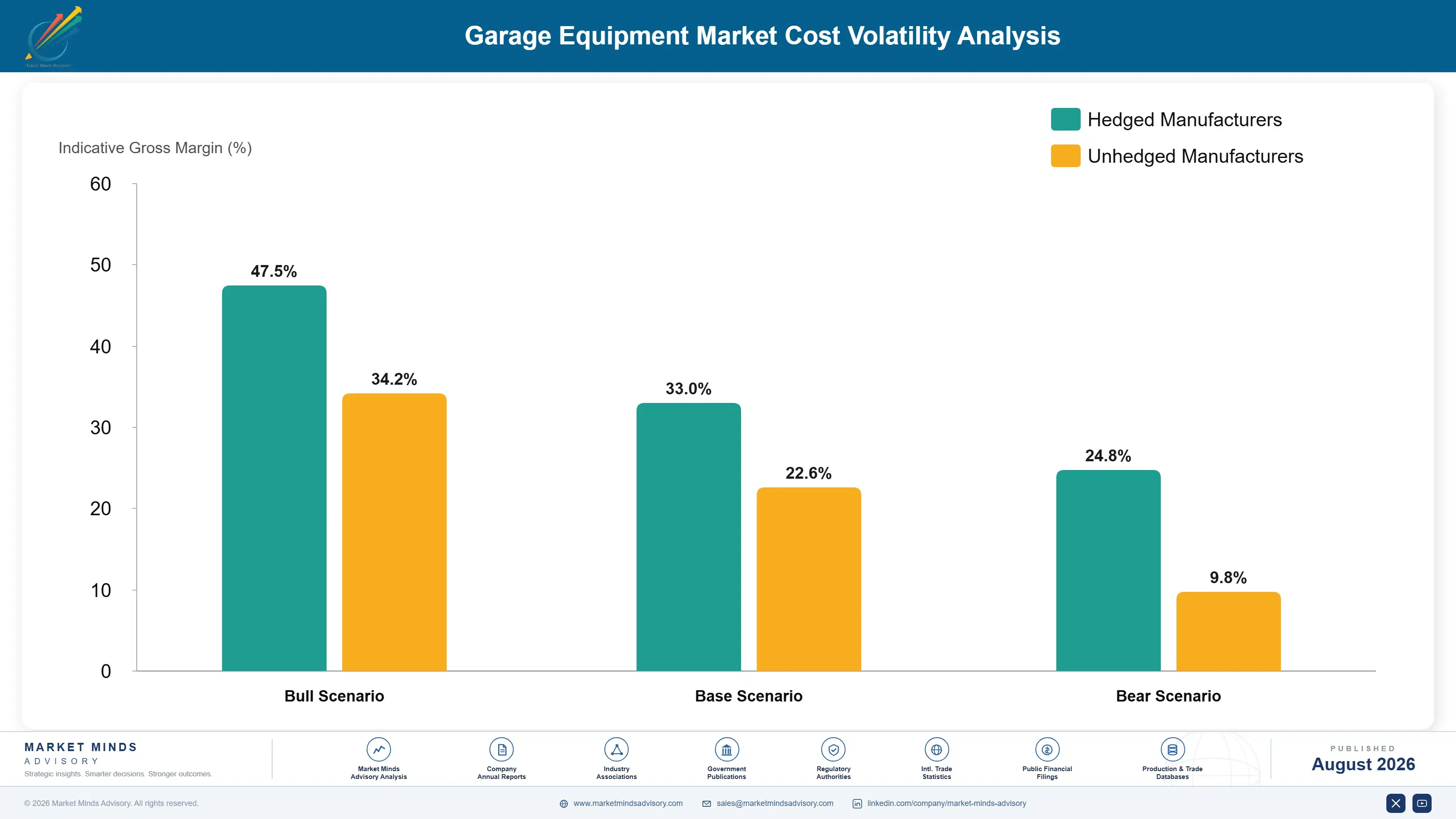
Fabricated steel dominates lift and heavy equipment cost at roughly 34%, sourced regionally because freight on bulky structures is punishing. Electronics, sensors, and control systems take 21% and rise sharply on diagnostic and calibration products. Software development and vehicle coverage maintenance absorb 17% on diagnostic lines and almost nothing on mechanical equipment. Assembly labour, certification testing, and approval maintenance carry the balance.
Steel prices moved sharply through 2021 and 2022, and manufacturers holding distributor price lists set annually absorbed most of it before catalogues could be revised. Snap-on and Bosch both discussed input cost pressure and pricing actions in their reporting for those years. Electronic component availability constrained diagnostic and calibration equipment output separately, which affected the fastest-growing product lines more than the mature mechanical ones. Lead times lengthened accordingly.

Exposure divides on product mix rather than on scale. Manufacturers weighted toward lifts and mechanical equipment carry heavy steel exposure against distributor price lists that reprice annually at best. Diagnostic and calibration lines carry electronics and software cost with far better margins that absorb input movement comfortably. Software coverage maintenance is a fixed cost falling per unit as the installed base grows, which rewards scale as hardware never does.
garage-equipment-market-cost-volatility-analysis-1787551507642

Reprice distributor catalogues on shorter cycles

Annual price lists across a heavy steel product range transfer a full year of input movement to the manufacturer, and steel does not wait for a catalogue revision. Shorter revision cycles or explicit surcharge mechanisms remove the mismatch without disrupting distributor relationships permanently. Manufacturers who repriced during the last steel move recovered position considerably faster than those who waited.

Shift mix toward software-carrying product lines

Diagnostic and calibration equipment carries electronics and software cost with margins that absorb input volatility, while lifts and mechanical products face steel exposure against thin returns. Coverage maintenance is also a fixed cost that falls per unit as the installed base grows. Mix shift addresses both the cost exposure and the growth question at the same time, which is unusual.

Source steel fabrication near assembly sites

Freight on lift structures and heavy workshop equipment is expensive relative to the value carried, which makes distant fabrication a poor decision regardless of the price quoted per tonne. Regional fabrication near assembly removes the haulage and shortens lead times. Manufacturers running centralised fabrication across continents frequently discover the freight exceeds the fabrication saving entirely.

Portfolio Architecture for Margin Defence

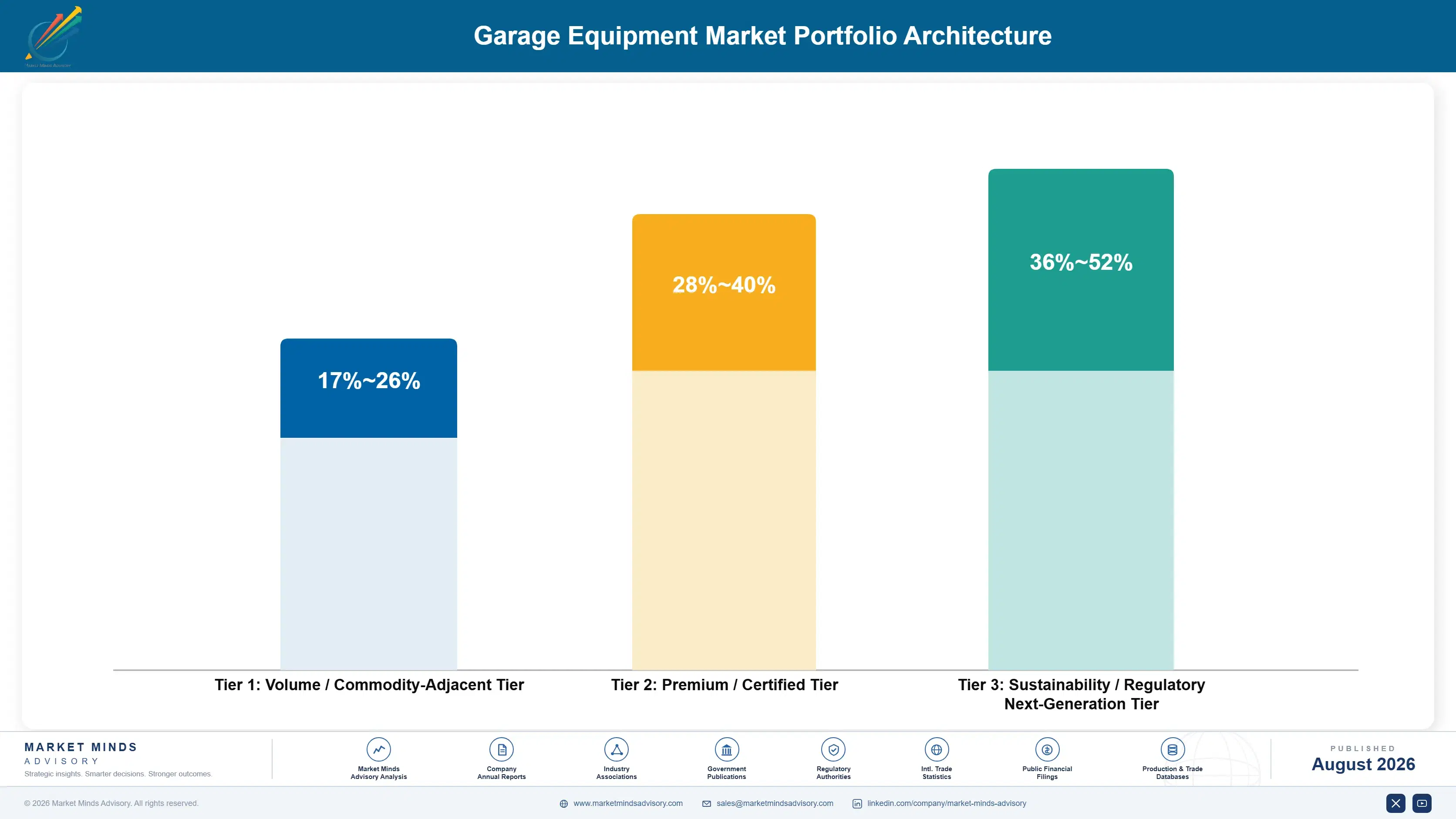
Margin architecture follows whether anything recurs. Vehicle lifts sell once every sixteen years against a steel cost base and regional fabricators who quote competitively, which is a difficult place to earn anything. Wheel service and inspection equipment earns better on approval status and consumable attachment. Diagnostic and calibration systems earn best, because coverage subscriptions renew and the customer cannot function without them.
The volume and premium tension shows in how manufacturers think about the installed base. Hardware businesses treat a sale as complete on delivery and then wait sixteen years. Software-attached businesses treat delivery as the start of a licence relationship worth more over time than the equipment was. Very few manufacturers in this industry have fully made that transition, and the ones that have report noticeably different economics. The transition is harder than the arithmetic makes it look.

High-value pools concentrate in diagnostic coverage subscriptions, calibration systems that fit constrained premises, and statutory testing equipment behind inspection authority approvals. Each is defended by software depth, engineering ingenuity, or regulatory position rather than by manufacturing cost, which regional fabricators will always contest successfully on the heavy product lines. Manufacturing cost decides only the products nobody differentiates.

Volume / Commodity-Adjacent Tier

Vehicle lifts, jacks, and mechanical workshop equipment sold once against sixteen-year replacement cycles. Steel cost and regional fabrication decide outcomes. Freight economics limit how far any manufacturer can compete from a single site.
Gross Margin: 17%-26%

Premium / Certified Tier

Wheel service, air conditioning, and statutory testing equipment approved by national inspection authorities on mandated replacement schedules. Approval status rather than performance defends pricing. The range reflects wide variation between regulated and unregulated categories.
Gross Margin: 28%-40%

Sustainability / Regulatory / Next-Generation Tier

ADAS calibration systems, subscription diagnostic platforms, and high-voltage electric vehicle service equipment. Software coverage and space-efficient engineering both defend position. The range is wide because subscription and hardware economics differ completely from one another.
Gross Margin: 36%-52%
garage-equipment-market-portfolio-architecture-1787551508140

High-value Sub-segments and Strategic Watch-out

Space-Efficient Calibration Systems

Independents refer 38% of calibration work out purely because they cannot create 48 square metres of clear floor, so the addressable market expands the moment somebody makes the procedure work properly in a smaller bay. Financing packages and pricing concessions do nothing about a property constraint.
Gross Margin: 38%-52%

Diagnostic Coverage Subscriptions

Already 23% of diagnostic revenue and rising, renewing because obsolete coverage makes a tool useless rather than merely inconvenient. Manufacturer data access depth determines both coverage and renewal rates directly. Chinese entrants built coverage depth deliberately and now compete on capability rather than price alone.
Gross Margin: 42%-52%

Statutory Testing Equipment

Inspection authority approval gates the category entirely and takes competitors years to clear, while specification changes convert whole installed bases on published timetables regardless of economic conditions anywhere. Approval typically runs 18 to 30 months per jurisdiction, which is exactly why the position holds afterwards.
Gross Margin: 30%-40%

Vehicle Lifts and Mechanical Equipment

The strategic watch-out. Sixteen-year replacement cycles, heavy steel exposure against annual price lists, punishing freight, and regional fabricators who quote competitively on a product nobody differentiates. Regional fabricators quote competitively, and freight economics limit how far any single manufacturing plant can reasonably reach at all.
Gross Margin: 17%-26%

How Workshops Actually Buy

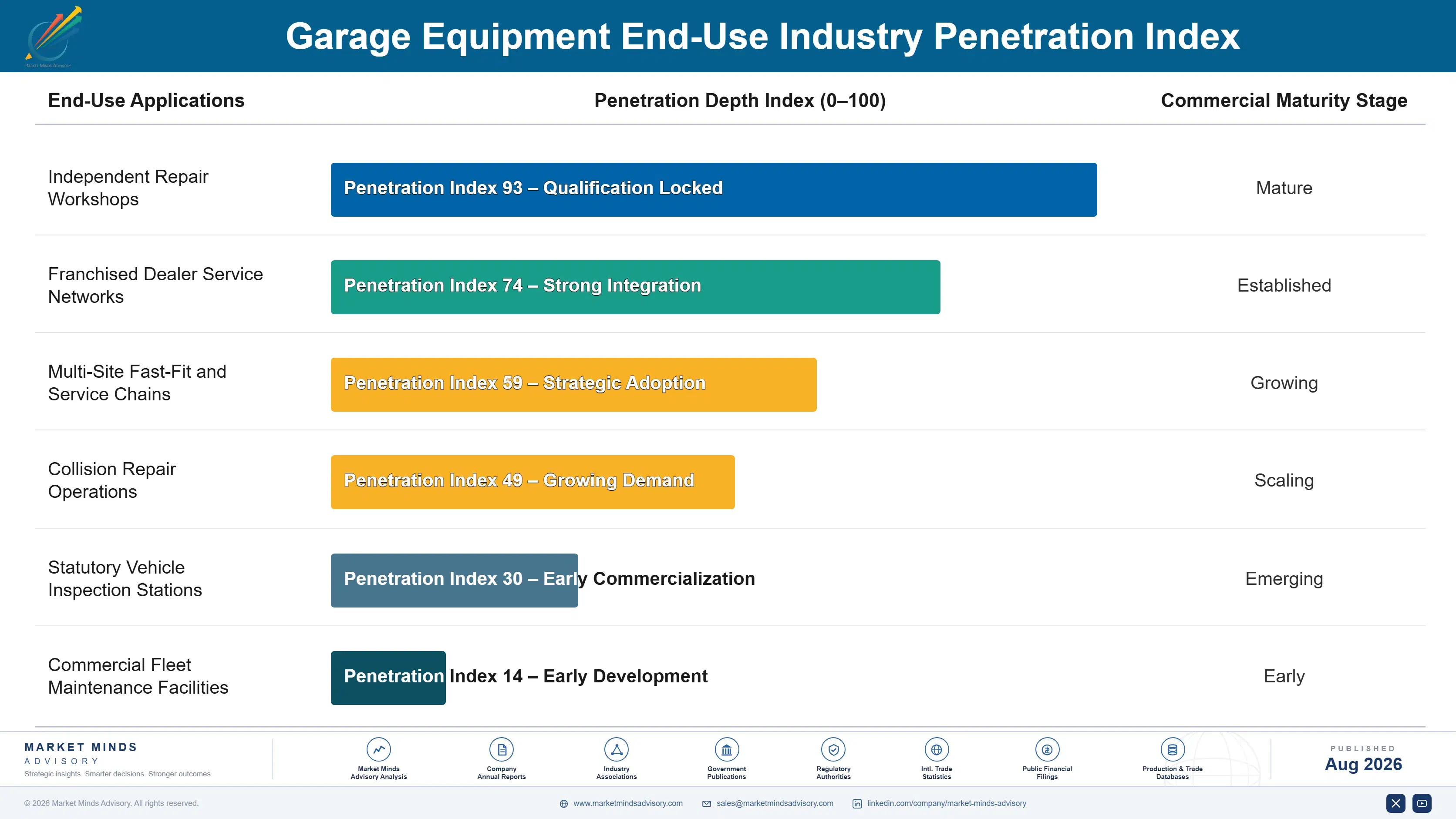
Demand reaches manufacturers through three channels that behave very differently. Mobile tool dealers visit independent workshops weekly, finance purchases, and hold relationships with individual technicians rather than with businesses. Equipment distributors handle heavy installed products with site survey and commissioning attached. Multi-site chains and franchised networks purchase centrally on specification, which removes the field relationship entirely and turns the sale into a tender against written requirements. Those three channels rarely share a commercial approach.
Stickiness follows recurring dependency rather than satisfaction. Diagnostic subscriptions hold because coverage lapses immediately on non-renewal. Statutory testing equipment holds until an approval or specification changes. Lifts hold for sixteen years and then re-compete completely. Calibration systems hold while the workshop can still physically use them. Nothing about the hardware itself creates any of that.

The deciding buyer has shifted noticeably as workshop consolidation progresses. An owner-operator buys from the dealer who visits and finances. A multi-site group buys against a written specification set by a technical director who never meets a field representative. Manufacturers organised entirely around field selling are losing the chains and keeping the sites that are disappearing. Building a specification sales capability is a different organisation entirely.
garage-equipment-market-end-use-penetration-index-1787551508630

Where the Growth Actually Sits

These are among the four positions where our research anticipates prominent divergence between winners and laggards over the coming forecast period. Each is grounded in the demand model, the regulatory perimeter, and the announced capacity pipeline.
01 / SPACE CONSTRAINT ENGINEERING

Solve the floor plan, not the accuracy

Independent workshops refer roughly 38% of calibration work to franchised dealers because static procedures need around 48 square metres of clear level floor that leased premises simply cannot provide at any price at all. Financing packages and pricing concessions do nothing about a property constraint, which is why the barrier has proved so persistent across every market examined. Mobile rigs, dynamic procedures, folding targets, and shared calibration centres each expand the addressable market in ways that better target resolution never manages to.
02 / SUBSCRIPTION RELATIONSHIP BUILDING

Own the coverage, not just the tool

Vehicle coverage now arrives through software updates rather than through the hardware, and 23% of diagnostic revenue already sits in recurring licences that manufacturers increasingly value above the original equipment sale itself these days. Workshops quite openly resent the model and renew anyway, because a tool without current coverage cannot service recent vehicles at all in practice. Manufacturers still treating software as an accessory are surrendering the only recurring revenue available in a business otherwise built around sixteen-year hardware replacement cycles.
03 / INSPECTION APPROVAL BREADTH

Hold approvals across as many jurisdictions as possible

Roller brake testers, emissions analysers, and headlamp aligners require national inspection authority approval before any workshop can use them for statutory testing, which typically takes competitors several years to obtain in each separate jurisdiction they enter. That demand then arrives on published replacement schedules entirely regardless of economic conditions or prevailing workshop sentiment anywhere. Regulatory specification changes convert whole installed bases on entirely known timetables, and manufacturers already holding approvals capture that while newcomers are still working through the paperwork required.
04 / ELECTRIC TRANSITION PACKAGING

Bundle the mandatory equipment against falling revenue

Electric powertrains remove oil, exhaust, and engine work and cut workshop revenue per vehicle by roughly 27% overall, while simultaneously requiring high-voltage safety equipment, insulated tooling, battery lifting systems, and technician certification that no workshop currently holds at all. That combination asks for mandatory investment against a shrinking service opportunity, which makes financing and bundled packaging far more important than any individual product argument anybody makes. Manufacturers packaging the whole transition reach workshops that would otherwise defer the whole decision indefinitely.

Engagement Snapshot From the Field

A live engagement with an industry participant carrying material or product regulatory and market exposure ahead of a defining policy shift, showing how our research translates into a defensible multi-year portfolio strategy.
MARKET MINDS ADVISORY · CLIENT ENGAGEMENT SUMMARY
Garage Equipment Producer Strategic Portfolio Review and Transition Roadmap 2026·Investment Scenario on Garage Equipment Exposure Evaluation 2025-26
CLIENT PROFILE
A European garage equipment manufacturer with revenue near EUR 210 million (client-reported, unverified by MMA), supplying vehicle lifts, wheel service equipment, and a diagnostic range through distributors across several countries. Calibration systems were offered but selling slowly, software was treated as a hardware accessory, and margins had compressed for four consecutive years. Chain purchasing had never been addressed.
STRATEGIC CHALLENGE
Calibration equipment enquiries were converting at a fraction of the expected rate and nobody in the business understood why. Chinese diagnostic entrants were winning on coverage lists at lower prices. Multi-site workshop chains were tendering against written specifications the distributor network could not respond to properly. Nobody had connected the two problems.
MMA APPROACH
MMA analysed calibration enquiry conversion against workshop premises data, modelled diagnostic subscription economics against the existing hardware-led pricing, and assessed distributor coverage against the emerging chain purchasing channel. Forty-seven expert interviews with workshop owners, chain technical directors, distributors, and inspection authorities established where each purchase decision genuinely happens. Premises data was collected across two hundred lost enquiries.
KEY FINDINGS
  1. Lost calibration enquiries correlated almost perfectly with workshop floor area rather than with price, budget, or any competing product, and the sales organisation had never collected premises data.
  2. Diagnostic pricing recovered hardware cost upfront and treated coverage updates as an afterthought, which surrendered the recurring revenue Chinese competitors were already building deliberately.
  3. Three multi-site chains representing substantial volume had run specification tenders the distributor network never saw, and the client had not bid on any of them at all.
  4. Inspection authority approvals were held in only four jurisdictions despite the product range qualifying in several more, and nobody had filed the outstanding applications.
CLIENT PROFILE
A European garage equipment manufacturer with revenue near EUR 210 million (client-reported, unverified by MMA), supplying vehicle lifts, wheel service equipment, and a diagnostic range through distributors across several countries. Calibration systems were offered but selling slowly, software was treated as a hardware accessory, and margins had compressed for four consecutive years. Chain purchasing had never been addressed.
STRATEGIC CHALLENGE
Calibration equipment enquiries were converting at a fraction of the expected rate and nobody in the business understood why. Chinese diagnostic entrants were winning on coverage lists at lower prices. Multi-site workshop chains were tendering against written specifications the distributor network could not respond to properly. Nobody had connected the two problems.
MMA APPROACH
MMA analysed calibration enquiry conversion against workshop premises data, modelled diagnostic subscription economics against the existing hardware-led pricing, and assessed distributor coverage against the emerging chain purchasing channel. Forty-seven expert interviews with workshop owners, chain technical directors, distributors, and inspection authorities established where each purchase decision genuinely happens. Premises data was collected across two hundred lost enquiries.
KEY FINDINGS
  1. Lost calibration enquiries correlated almost perfectly with workshop floor area rather than with price, budget, or any competing product, and the sales organisation had never collected premises data.
  2. Diagnostic pricing recovered hardware cost upfront and treated coverage updates as an afterthought, which surrendered the recurring revenue Chinese competitors were already building deliberately.
  3. Three multi-site chains representing substantial volume had run specification tenders the distributor network never saw, and the client had not bid on any of them at all.
  4. Inspection authority approvals were held in only four jurisdictions despite the product range qualifying in several more, and nobody had filed the outstanding applications.
RECOMMENDED STRATEGY
Phase 1: Phase one: develop a space-efficient calibration configuration, and qualify every workshop enquiry on available floor area before quoting anything at all to them. Phase 2: Phase two: restructure diagnostic pricing toward recurring coverage subscription, accepting materially lower hardware margin in exchange for renewable licence revenue that compounds. Phase 3: Phase three: build a direct specification sales capability aimed at multi-site chains, and file every outstanding inspection authority approval application immediately afterwards.
OUTCOME
The client launched a reduced-footprint calibration configuration within a year and doubled enquiry conversion on qualified premises. Subscription revenue began building, two chain tenders were won, and blended gross margin improved 6.9 percentage points (client-reported, unverified by MMA). Three further approval applications were filed during the year.

Frequently Asked Questions

Foundational context covering the market sizes, CAGR, scope, country, region and competition that inform every finding below. This section is provided to cover basics and most often pre-purchase conversations, answered from the MMA Primary Research Dataset.

What is the current size of the Garage Equipment Market?

The market was valued at USD 8.8 billion in 2025, rising to an estimated USD 9.29 billion in 2026. East Asia holds the largest regional share at 28% of value.

How large will the Garage Equipment Market be by 2036?

MMA forecasts USD 16.02 billion by 2036 under the base case, an expansion multiple of 1.72 times the 2026 value. That represents USD 6.73 billion of incremental value.

What is the CAGR for the Garage Equipment Market 2026 to 2036?

The base case CAGR is 5.6%, with a bull case of 6.8% and a bear case of 4.4%. The spread reflects uncertainty over right-to-repair rules and workshop consolidation.

Which segment is growing fastest?

ADAS calibration systems grow fastest at 16.4%, roughly 2.93 times the market rate, constrained by workshop floor space. Diagnostic equipment follows at 7.6% on subscription growth.

Who are the major companies in the Garage Equipment Market?

Snap-on, Vehicle Service Group, Bosch, Hunter Engineering, and Nexion Group lead, holding roughly 32% between them. Distribution, approvals, and software coverage sustain that position rather than hardware manufacturing capability.

Which country is growing fastest?

India grows fastest at 9.2%, as organised multi-brand service chains displace informal roadside repair and standardise equipment specification across sites at considerable pace. Equipment financing shapes what those chains install.

Report Segmentation Architecture

The full report scope spans multiple orthogonal segmentation dimensions, with cross-tabulated demand data provided for each dimension pair. Coverage extends further to regional breakdowns, trend trajectories, and the competitive detail needed to support segment-level decision-making.

By Equipment Category

  • Vehicle Lifts and Hoists
  • Wheel Service Equipment
  • Diagnostic Equipment and Scan Tools
  • ADAS Calibration Systems
  • Air Conditioning Service Equipment
  • Body Repair and Refinishing Equipment

By End-Use Industry

  • Independent Repair Workshops
  • Franchised Dealer Service Networks
  • Multi-Site Fast-Fit and Service Chains
  • Collision Repair Operations
  • Statutory Vehicle Inspection Stations
  • Commercial Fleet Maintenance Facilities

By Distribution Channel

  • Mobile Tool Dealer Networks
  • Equipment Distributor Supply
  • Direct Chain Specification Tenders
  • Vehicle Manufacturer Programme Supply
  • Online and Catalogue Sales

By Region

  • North America
  • Western Europe
  • East Asia
  • South Asia and Pacific
  • Latin America
  • Middle East and Africa
  • Eastern Europe

Scope, Methodology, and Coverage

Every figure in this report is reproducible from documented input assumptions. The scope below maps the historical period, the forecast horizon, the segmentation dimensions, and the countries covered, alongside the underlying primary and qualitative methodology.
Historical Period
2020 to 2025
Forecast Period
2026 to 2036
Base Year
2025 (USD billions; MMA Primary Research Dataset, August 2026)
Market Definition
The market comprises equipment supplied to vehicle service, repair, and inspection workshops, covering vehicle lifts and hoists, wheel service equipment, diagnostic equipment and scan tools, ADAS calibration systems, air conditioning service equipment, and body repair and refinishing equipment. Value is measured at manufacturer level including attached software licences and service contracts. Hand tools and consumables, replacement vehicle parts, workshop management software sold standalone, fuel dispensing and car wash equipment, and vehicle manufacturer proprietary tooling supplied directly to franchised networks fall outside scope.
Quantitative Units
USD billions (current prices); thousand equipment units shipped annually; USD per installed service bay by equipment category
Segmentation Dimensions
By Equipment Category; By End-Use Industry; By Distribution Channel; By Region
Regions Covered
North America, Western Europe, East Asia, South Asia and Pacific, Latin America, Middle East and Africa, Eastern Europe
Countries Covered
China, Japan, South Korea, Taiwan, India, Australia, Indonesia, Thailand, Vietnam, United States, Canada, Mexico, Germany, France, United Kingdom, Italy, Spain, Netherlands, Belgium, Sweden, Poland, Czechia, Romania, Hungary, Brazil, Argentina, Chile, Saudi Arabia, United Arab Emirates, South Africa
Key Companies Profiled
Snap-on, Vehicle Service Group, Bosch, Hunter Engineering, Nexion Group, Continental, Hella Gutmann, Ravaglioli, Stertil-Koni, BendPak, Launch Tech, Autel, Texa, MAHA Maschinenbau, Nussbaum Lifts, Istobal, Werther International, Blitz Rotary, Sun Automotive, Delphi Technologies
Quantitative Methodology
Primary survey, n=3,800 respondents, Q4 2025, six countries; demand-side model with trade association cross-validation
Qualitative Methodology
47 expert interviews, Q4 2025; applied to validate demand model assumptions, identify emerging dynamics, and assess competitive positioning
Report Format
PDF and XLSX data workbook (Word format preview document)
Publisher
Market Minds Advisory
Report Code
MMA-2026-AUT-259
Published
August 2026
Contact
sales@marketmindsadvisory.com | www.marketmindsadvisory.com

Purchase the full Garage Equipment Market Report (2026 to 2036).

The full report sizes garage equipment demand across six categories, six end-use segments, and seven regions with 2026 to 2036 forecasts under base, bull, and bear cases. It models calibration adoption against workshop floor area rather than against budget, since premises rather than price is what actually limits the fastest-growing category. Competitive profiles cover twenty manufacturers assessed consistently on equipment shipment revenue, software coverage depth, and inspection approval breadth. Cost analysis traces steel, electronics, and software maintenance exposure by product mix. Commercial guidance addresses space constraint engineering, subscription building, approval breadth, and electric transition packaging.
Six equipment categories sized separately by region
Calibration adoption modelled against workshop premises floor area
Diagnostic subscription economics separated from hardware revenue
Inspection authority approval coverage mapped by jurisdiction
Electric vehicle service revenue impact quantified per workshop
Channel economics compared across dealers, distributors, and chain tenders

Built For The People Who Decide

From boardroom strategy to bench-side execution, this report is read cover-to-cover by leaders shaping the next decade of their industry, turning demand scenarios, market dynamics and valuation benchmarks into decisions.
CXOs/ Presidents/ VPs/ Managers
M&A and Corporate Development
Strategy Teams and R&D Heads
Procurement and Product Directors
Regulatory and Compliance Leaders
Investor Relations and Equity Analysts