
Market Minds Advisory
EV Lighting Market

EV Lighting Market: Signature Design, Charge Communication, and the Content Growth Behind a Missing Grille

Remove the grille and the exhaust and a car loses the two things that identified it. Lighting became the brand, and lighting content per vehicle rose accordingly across every segment.

Lead Analyst

David Horsley

Published

September 2026

Make Smarter Decisions with Customized Research Insights

Request a free sample report and evaluate market opportunities, growth trends, and competitive dynamics relevant to your business needs.

2025 MARKET VALUE$9.4BMarket Size 2025
2036 FORECAST VALUE$35.4BBase Case , 2026 to 2036
CAGR 2026 TO 203612.8 %Bull 14.1% / Bear 11.5%
INCREMENTAL OPPORTUNITY$24.8BNet 10- year value creation
EXPANSION MULTIPLE3.33x2036 value over 2026 base
Strategic Levers
M&A Pipeline
Regional Outlook
Country Rankings
Competitive Intelligence
Segmental Deep-dive
Call-Us : 91 93563 13602

Executive Snapshot and Market Trajectory

An electric car has no grille and no exhaust, which removed the two features that told anybody what they were looking at. Lighting took over that job. Content per vehicle rose from roughly 380 dollars on a comparable combustion car to about 550 today. That was not a small change.
Commercial advantage sits with suppliers who own the light signature rather than those who merely build lamps to a drawing, because signature tooling locks a programme for its entire production life. Pedestrian and vehicle communication lighting grows fastest at 23.4%, roughly 1.83 times the market. East Asia holds the largest position at 30% of value, following Chinese electric vehicle production that exceeds every other country combined.
Concentration is high at roughly 62% for the top five, reflecting tooling investment, programme award cycles running 34 months, and photometric homologation that newcomers find genuinely hard to clear. Chinese suppliers have broken into that on domestic programmes at prices Japanese and European incumbents cannot match. Around 71% of new electric vehicles now ship with interior ambient systems. Content on those systems keeps climbing as manufacturers add zones and animation.
Market Definition
The market comprises lighting systems specified for battery electric and plug-in hybrid vehicles at original equipment level, covering headlamp systems, rear combination and signal lamps, illuminated exterior panels and logos, interior ambient lighting systems, charge status and port illumination, and pedestrian and vehicle communication lighting. Value is measured at supplier level. Instrument clusters and head-up displays, infotainment screens, aftermarket accessory lighting, charging station illumination, and lighting fitted to combustion vehicles fall outside scope.
Base Year Value
$9.4B in 2025 (MMA Primary Research Dataset, August 2026)
Forecast Period
2026 to 2036, eleven discrete annual values
CAGR
12.8% base case. Bull 14.1%. Bear 11.5%.
Fastest Growth Segment
Pedestrian and Vehicle Communication Lighting: 23.4% CAGR
Fastest Growth Country
India: 16.2% CAGR
Fastest Growth Region
South Asia and Pacific: 15.0% CAGR
Largest Region
East Asia: 30% of 2025 global value
Market Leaders
Koito Manufacturing, Marelli, Valeo, Forvia HELLA, and Stanley Electric lead on electric vehicle lighting supply revenue. Source: company annual reports and MMA Analysis, July 2026.
Primary Survey
n=3,800 procurement and R&D decision-makers, Q4 2025, six countries
Methodology
Demand-side build-up, cross-validated against public data, 47 expert interviews

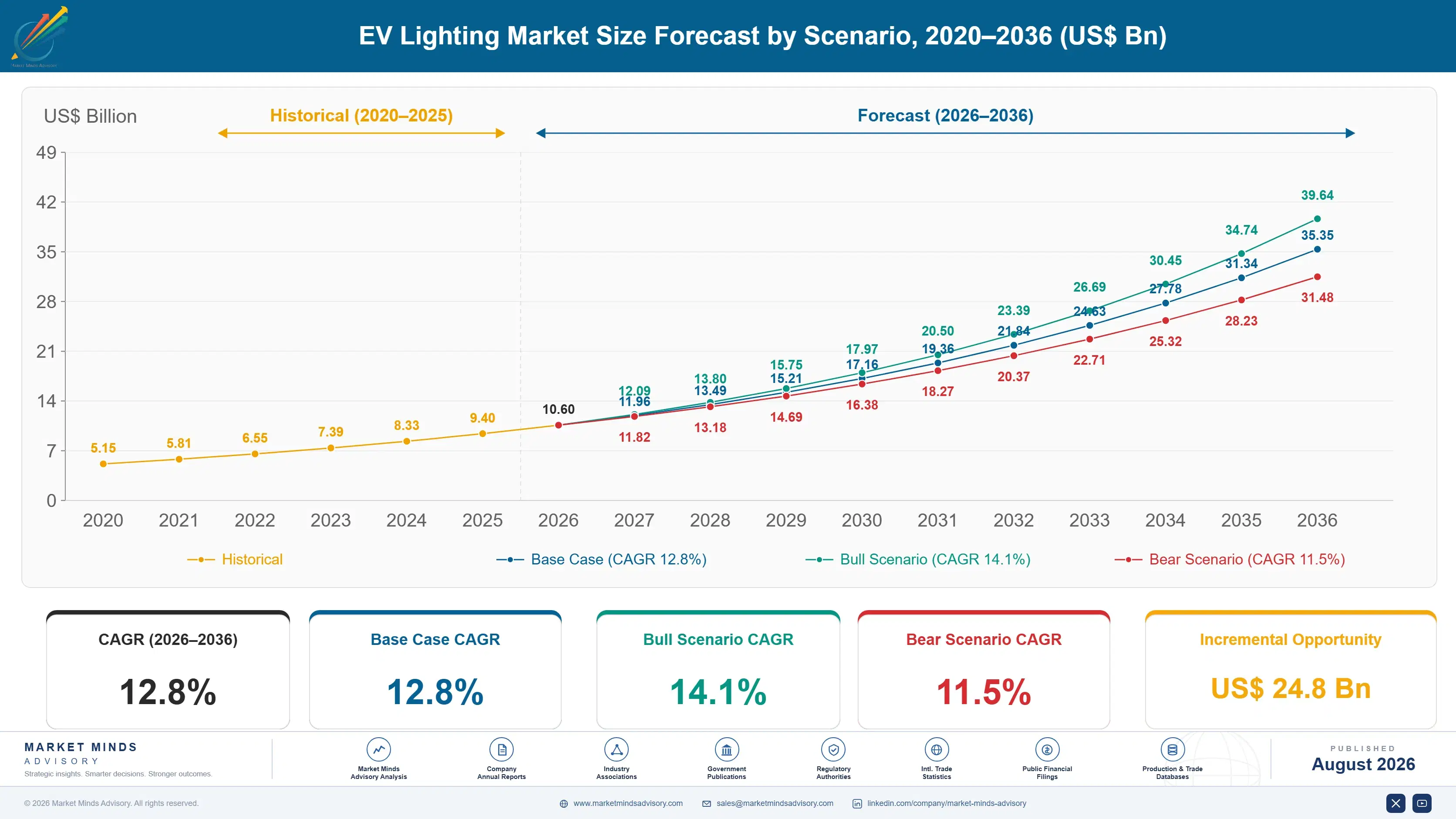
EV Lighting Market Forecast Scenarios

ev-lighting-market-size-forecast-scenario-1787551190475
Growth between 2020 and 2025 tracked electric vehicle volume closely but ran ahead of it on content. Designers discovered that a closed front face is a lighting surface. Ambient interior lighting moved from premium option to near-standard fitment as silent cabins became something to differentiate. The 11.4% historical rate combines rising vehicle production with lighting value per car climbing faster than anybody budgeted for.
The 12.8% base case rests on three mechanisms. Electric vehicle production keeps expanding across China, Europe, and North America, and every unit carries more lighting value than the car it replaced. Regulatory work on pedestrian communication for quiet vehicles is moving from acoustic requirements toward visual signalling. And light signature design has become the primary brand identifier, which sustains content spending even where model pricing is under pressure. Nothing in that list depends on a regulatory decision.
The 14.1% bull case assumes visual pedestrian communication requirements enter regulation on the faster of the timetables under discussion. The 11.5% bear case reflects electric vehicle sales moderating in Europe and North America, aggressive cost reduction on mass-market programmes, and LED emitter deflation converting content growth into price decline rather than revenue. Chinese export pricing sits underneath both cases.

The Front Face Became a Lighting Problem

Three forces set the commercial shape here. Brand identity moved to the light signature once the grille went away, which turned lighting from a regulated necessity into the most visible design decision on the vehicle. Charge state has to be communicated to somebody standing outside the car. And a silent cabin invited interior lighting spending that no combustion vehicle ever justified.
TOP-FIVE CONCENTRATION62%Combined supply share held by the leading lighting manufacturers
LIGHTING CONTENT PER VEHICLEUSD 550Average value of lighting systems fitted per electric vehicle
LED COST SHARE24%Portion of cost of goods sold from emitters
PROGRAMME AWARD LEAD TIME34 monthsTypical gap between design award and start of production
AMBIENT LIGHTING FITMENT71%Share of new electric vehicles fitted with interior ambient systems
TOP PRODUCING COUNTRY SHARE48%Portion of global units built in the leading producing country
Signature ownership is what actually decides the money. A supplier who tools the daytime running light signature holds that programme for its full production life, because changing it means changing how the brand is recognised. Award cycles run 34 months from design selection to start of production, so displacing an incumbent means winning three years before a single unit ships anywhere.
Content growth and price deflation pull against each other constantly. LED emitters at 24% of cost of goods sold fall in price every year, and vehicle manufacturers expect that reflected in piece price. Suppliers stay ahead only by adding functions that were not on the previous car, which is why illuminated panels, charge indicators, and pedestrian signalling matter far beyond their current volumes.
"The most consequential thing electrification did to this industry had nothing to do with propulsion. It deleted the grille, and thirty years of brand recognition went with it, so the light signature had to carry a job it was never designed for. Suppliers who understood that early are still holding those programmes."
Practice Director, Automotive Systems and Vehicle Electrification · MMA Automotive Systems and Components Practice · August 2026

Market Trends

Light Signature Replaces the Grille as Brand Identifier

A closed front face left manufacturers without the feature that had identified their cars for decades, and the daytime running light signature absorbed that role almost immediately. Full-width light bars, illuminated logos, and animated welcome sequences are now specified for recognition rather than illumination. That shifts the supplier relationship considerably, since a signature is tooled once and held for the full production life of the vehicle. Displacing an incumbent means persuading a design studio to change how the brand looks, which almost never happens mid-cycle for cost reasons alone. Cost alone rarely wins that argument.
Market Impact: China builds 48% of global units
Interior Ambient Lighting Reaches Near-Standard Fitment

A cabin without engine noise or vibration became something manufacturers could differentiate on atmosphere, and ambient lighting turned out to be the cheapest way to do it. Fitment now reaches 71% of new electric vehicles, up from a premium-only position a few years earlier. Multi-zone colour systems tied to drive mode, climate state, and charging status carry considerably more value than single-colour strips. Chinese manufacturers pushed this hardest, treating cabin ambience as a primary selling point in a market where powertrain differentiation had largely disappeared. Western manufacturers followed rather than led on this one.
Market Impact: Fastest segment growing at 23.4%

Market Opportunities and Growth Drivers

Chinese Vehicle Production Concentrates Programme Volume Regionally

China builds roughly 48% of the world's electric vehicles, and every one of those programmes awards lighting content to a supplier somewhere. Domestic manufacturers including HASCO Vision and Xingyu have taken substantial share on those awards at price points Japanese and European incumbents cannot approach on a comparable cost base. Programme timelines run considerably shorter than Western practice, frequently around 24 months rather than 34. That combination of volume, price, and speed gives East Asia the largest regional position at 30% of value. Export programmes are now within reach of the same suppliers.
Market Impact: LEDs are 24% of goods cost

Quiet Vehicle Rules Move Toward Visual Pedestrian Signalling

Acoustic vehicle alerting requirements addressed the fact that electric cars are inaudible at low speed, and regulators in several jurisdictions are now examining whether visual signalling should accompany the sound. Automated driving trials have pushed the same question further, since a vehicle with nobody obviously driving needs to communicate intent to people crossing in front of it. Pedestrian and vehicle communication lighting grows at 23.4% from a very small base. Timetables remain uncertain, which is precisely why suppliers are developing capability ahead of any mandate. Premium programmes are carrying the earliest fitment.
Market Impact: Programme cycles run 24 months

Market Restraints and Challenges

LED Emitter Deflation Converts Content Growth Into Price Reduction

Emitter prices fall every year, and vehicle manufacturers track that closely enough to demand it back in annual piece price negotiations. The root cause is that lighting semiconductors follow the same cost curve as other volume semiconductors while the surrounding assembly does not. Suppliers mitigate by adding functions absent from the previous programme, by moving value into electronics and software controlling the light rather than the emitters producing it, and by pursuing signature work where design commitment resists cost-down pressure more effectively. None of these three fully offsets the annual reduction.
Market Impact: Locks programmes across 34-month cycles

Chinese Suppliers Compress Pricing on Mass-Market Programmes

Domestic Chinese lighting suppliers win awards at prices Japanese and European manufacturers cannot match, and they are now qualifying into export programmes rather than serving only local production. The root cause is a cost base built around local tooling, local electronics, and shorter development cycles that carry less engineering overhead. Incumbents mitigate through signature and premium work where design relationship matters more than price, through local manufacturing in China, and by concentrating engineering on functions Chinese suppliers have not yet productised. Mass-market awards are where the pressure lands hardest of all.
Market Impact: Fitment now reaches 71% of vehicles
4 additional market trends, 3 additional growth drivers, and 2 additional restraints and challenges are covered in the full report. Contact sales@marketmindsadvisory.com to access the complete intelligence.

Segment CAGR and Growth Architecture

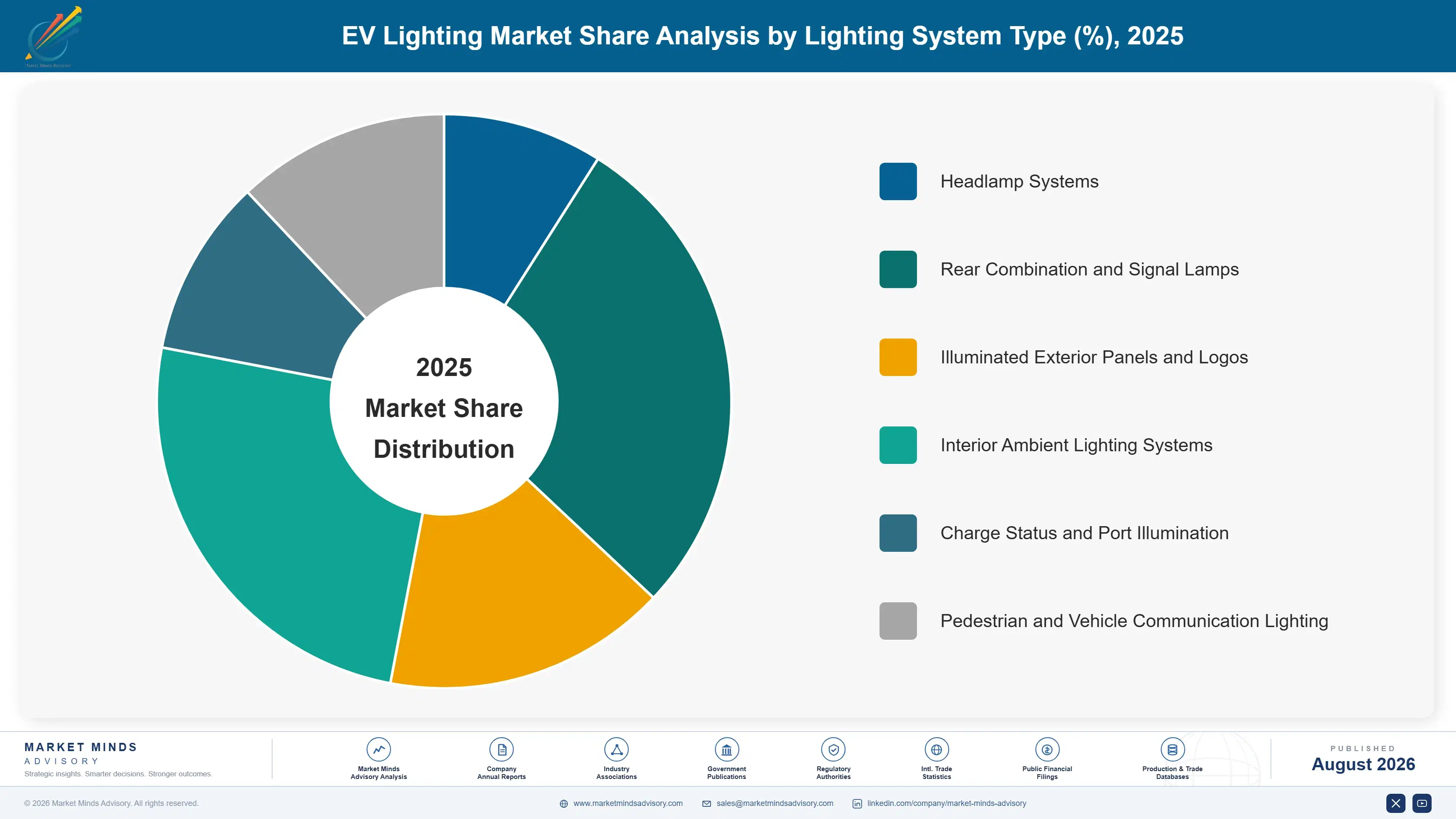
Segmentation follows lighting system type, because each system carries a distinct engineering requirement, homologation path, and commercial relationship with the vehicle manufacturer. Six systems cover original equipment supply, and the division between regulated illumination and unregulated communication or ambience matters more commercially than any difference in emitter technology. That division governs pricing far more than volume does.
ev-lighting-market-market-share-analysis-1787551191029

Pedestrian and Vehicle Communication Lighting

The fastest system at 23.4%, roughly 1.83 times the market, from a base that is still very small. These systems communicate vehicle intent to people outside it: projected ground markings, exterior displays indicating yield or proceed, and signalling tied to automated driving states. Regulation currently addresses sound rather than light for quiet vehicles, and several jurisdictions are examining whether visual signalling should follow. That uncertainty is the whole commercial situation, since suppliers are funding development against a mandate that may arrive on any of several timetables. Premium and automated driving programmes carry the early fitment. Homologation frameworks for projected ground markings differ considerably between jurisdictions, which complicates any single global hardware design.
CAGR 23.4%

Charge Status and Port Illumination

Second fastest at 21.6%, and the only lighting function with no combustion equivalent whatsoever. Somebody standing beside a parked car needs to know whether it is charging, how far along it is, and whether a fault has occurred, which puts a communication requirement on the exterior that never existed before. Implementations range from a simple port ring to full-width indicators readable across a car park. Integration with the vehicle's charging control and with mobile applications adds electronics content well beyond the light itself. Fitment is effectively universal, so growth tracks vehicle volume plus rising sophistication. Charging network operators have begun specifying indicator conventions of their own, which adds a second customer to what was a vehicle decision.
CAGR 21.6%
Full segment breakdown across 6 segments available in the complete report.

Regional Architecture and Country Demand Map

Regional shares follow electric vehicle production location rather than sales, since lighting is supplied to the assembly plant. East Asia dominates on build volume, Western Europe on content value per vehicle, and that split explains most of the competitive dynamics running through this market. Sales figures mislead badly here.

North America

Electric vehicle assembly concentrated in a handful of plants gives lighting suppliers fewer but larger programme awards than elsewhere, which raises the stakes on every design competition considerably. Pickup and large sport utility programmes carry unusually high content, since full-width light bars scale with vehicle width and buyers expect visible presence. Valeo, Forvia HELLA, and Marelli hold established positions alongside Korean and Japanese suppliers with local plants. Content value per vehicle runs among the highest anywhere. Growth of 13.4% depends heavily on how electric vehicle production volumes hold up against shifting policy support across model years. Fleet and commercial van programmes add volume at considerably lower content than passenger vehicles carry.
Share: 23% | CAGR: 13.4% (2026 to 2036)

Western Europe

Design studios here drove the signature lighting shift earliest, and premium German programmes still set what the rest of the industry copies two model cycles later. Content value per vehicle is the highest of any region, supported by matrix headlamp systems, animated welcome sequences, and multi-zone interior ambience specified as standard rather than optional. Forvia HELLA, Valeo, ZKW, and Marelli hold deep design studio relationships that price alone does not displace. Growth of 11.2% is the slowest here, reflecting mature electric vehicle penetration and mass-market programmes now under serious cost pressure. Regulatory bodies here also drive the homologation frameworks that other regions adopt afterwards, which gives European suppliers early sight of what compliant hardware requires.
Share: 24% | CAGR: 11.2% (2026 to 2036)
Regional intelligence for 5 additional markets available in the complete report: East Asia, South Asia and Pacific, Latin America, Middle East and Africa, Eastern Europe. Contact sales@marketmindsadvisory.com.
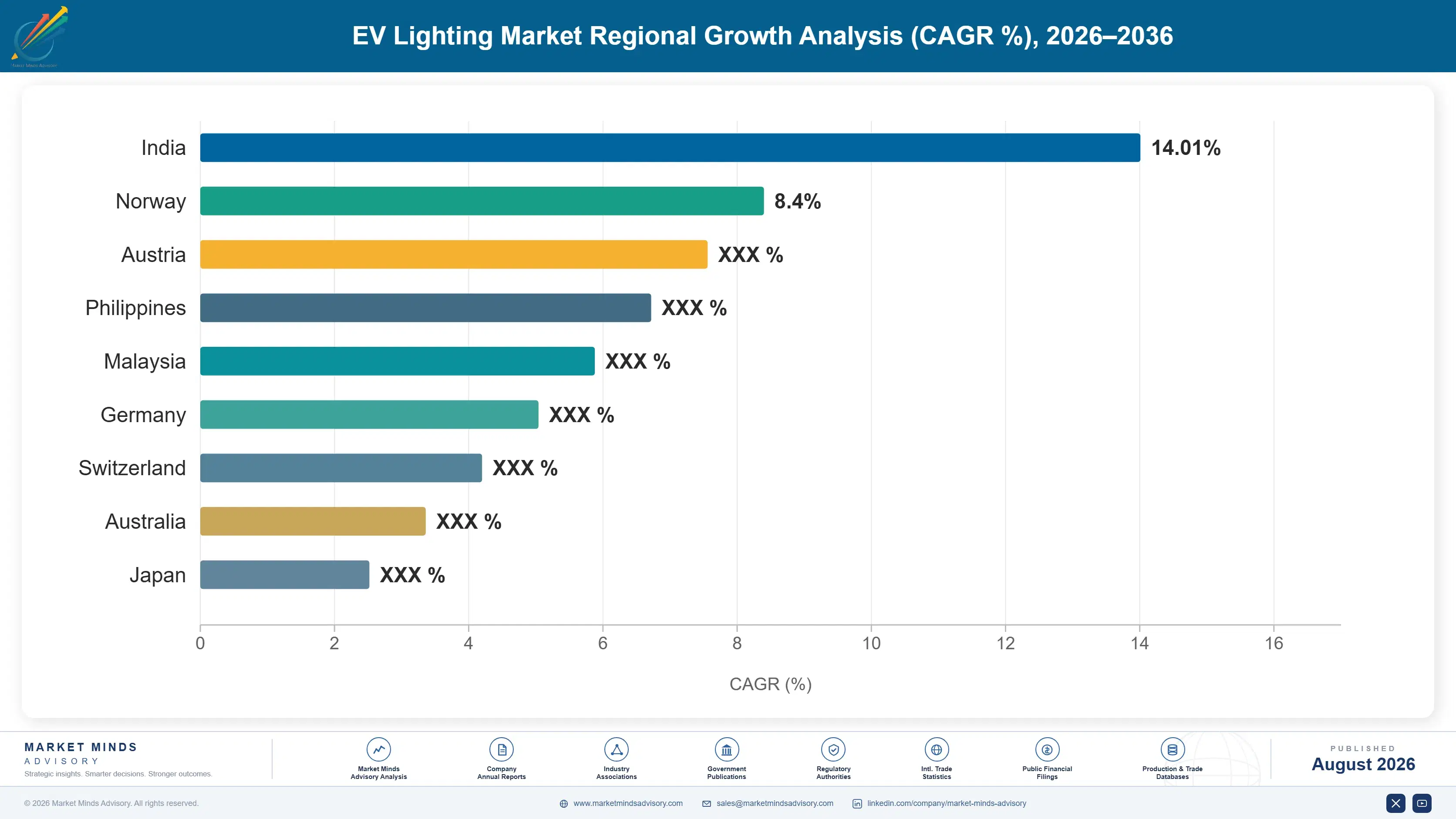
ev-lighting-market-country-cagr-analysis-1787551191551

Four Moves That Hold Programmes

Advantage here comes from owning the signature, adding functions faster than emitters deflate, and reaching programmes before the 34-month award cycle closes. Four moves justify capital across the forecast period, and the first determines whether a supplier holds a programme for its life or re-competes for it constantly. Nothing else here survives an annual cost-down conversation.

Win the signature, not the lamp specification

A supplier who tools the daytime running light signature holds that programme for its full production life, because changing the signature means changing how the brand is recognised and no cost saving justifies that mid-cycle. A lamp built to somebody else's drawing re-competes at every annual negotiation. Award cycles run 34 months, so the design studio relationship is what wins work three years before any unit ships. Suppliers who sell engineering into the styling phase are competing on entirely different terms from those quoting to print. Price enters the conversation far later for them.
Market Impact: Holds programmes across the entire 34-month award cycle

Add functions faster than emitters lose value

LED emitters sit at 24% of cost of goods sold and fall in price annually, and vehicle manufacturers demand that reduction back in piece price every year without fail. The only durable answer is content that was not on the previous car. Illuminated panels, charge indicators, pedestrian signalling, and multi-zone interior systems all add value the cost-down conversation has no precedent for. Suppliers running the same content list into a second programme generation are volunteering for margin compression they could have avoided through engineering. Engineering spend here returns better than any pricing defence.
Market Impact: Offsets annual deflation across 24% of total costs

Manufacture inside China to contest domestic awards

China builds roughly 48% of global electric vehicles, and domestic suppliers win those awards at prices an imported cost base cannot approach under any procurement scenario. Local tooling, local electronics sourcing, and development cycles near 24 months rather than 34 are what make that possible. International suppliers without genuine Chinese manufacturing and engineering are excluded from the largest pool of programme volume in the industry. Establishing it is expensive and slow, and the alternative is conceding almost half the market permanently. Joint assembly arrangements without tooling engineering do not count for this purpose.
Market Impact: Contests the 48% of global units built there

Develop pedestrian signalling ahead of the mandate

Pedestrian and vehicle communication lighting grows at 23.4%, the fastest system here, against regulation that currently addresses sound rather than light for quiet vehicles. Several jurisdictions are examining visual signalling, and automated driving trials have sharpened the question considerably. Suppliers developing now shape what compliant systems look like and hold the premium programmes carrying early fitment. Waiting for the rule means entering against competitors who already have homologated hardware and design studio relationships built around it. Premium and automated driving programmes are where the early awards sit, and those relationships take years to establish.
Market Impact: The fastest lighting system is growing at 23.4%

Who Controls the Margin Pool

Concentration runs at roughly 62% for the top five on supply revenue, which is high and reflects tooling investment, photometric homologation, and 34-month award cycles that reward incumbency heavily. Koito leads on global volume with deep Japanese and North American programme positions. Marelli, Valeo, and Forvia HELLA hold the European design studio relationships that decide signature work, and Stanley Electric maintains strong Japanese and Chinese positions.
Competition runs on three dimensions. Signature and design studio access is the first and separates programme ownership from build-to-print work. Cost base is the second, particularly on mass-market vehicles where Chinese suppliers set the reference price. Function development is the third, since adding content is the only reliable answer to annual emitter deflation.

Pressure is building from Chinese suppliers moving beyond domestic programmes into export awards, carrying cost bases and development speeds incumbents cannot match on mass-market work. Rankings will shift toward suppliers holding both signature relationships in premium markets and genuine manufacturing scale inside China, because either one alone now leaves too much of the industry out of reach. Neither position is quick to build, which is why the concentration figure has held.
ev-lighting-market-company-positioning-matrix-1787551192091

Competitive Moat and Risk Dimensions

KOITO MANUFACTURING

Moat: Global scale and homologation depth

Volume across Japanese, North American, and Chinese programmes gives Koito manufacturing scale and photometric engineering depth that smaller suppliers cannot amortise. Homologation across every major regulatory regime is a capability built over decades rather than bought. That breadth also lets Koito serve global vehicle platforms with consistent hardware, which manufacturers value considerably more than they used to.
KOITO MANUFACTURING

Risk: European signature relationships

Signature design work is decided in European studios where Forvia HELLA, Valeo, and Marelli hold relationships built over many model cycles, and Koito's position there is weaker than its global volume implies. Signature ownership is what holds programmes across their full production life. Competing on engineering excellence alone does not reach decisions taken during styling.
MARELLI

Moat: Design studio integration in Europe

Marelli engages European design studios during styling rather than at request for quotation, which puts it inside decisions about signature form before any specification exists. That access converts into programme awards held for full production life, since changing a tooled signature means changing brand recognition. Competitors quoting to a finished drawing are already competing on price by then.
MARELLI

Risk: Balance sheet and investment capacity

Financial restructuring has constrained the investment capacity needed for Chinese manufacturing scale and for pedestrian signalling development ahead of regulation. Both require sustained spending against uncertain payback timing. Competitors with stronger balance sheets can fund positions in the fastest-growing parts of this market while restructuring absorbs management attention that programme wins genuinely require.

Players Tracked

Prominent Players

Koito Manufacturing
Marelli
Valeo
Forvia HELLA
Stanley Electric

Other Key Players

Hyundai Mobis
Varroc Lighting Systems
ZKW Group
ams-OSRAM
Lumileds
Nichia
Texas Instruments
Grupo Antolin
Yanfeng
HASCO Vision
Xingyu Automotive Lighting
TYC Brother Industrial
Lumax Industries
Samvardhana Motherson
Depo Auto Parts

Recent Developments

JANUARY 2025

Chinese lighting supplier qualifies for European export programme

A domestic Chinese lighting manufacturer completed photometric homologation and supplier qualification for a European vehicle programme, moving beyond the domestic awards that had previously bounded its business entirely. Pricing on the award sat well below what incumbent European suppliers had quoted for comparable content. Homologation took two years.
Signal: Chinese cost bases are now reaching export programmes rather than staying confined to domestic vehicle production
MAY 2025

Premium manufacturer specifies projected pedestrian signalling

A European premium brand specified ground-projected pedestrian communication on a forthcoming automated driving programme, ahead of any regulatory requirement for visual signalling on quiet vehicles. The supplier had funded development against an uncertain mandate timetable for several years beforehand. No mandate existed at all when that funding started.
Signal: Development ahead of regulation is converting into programme awards before any mandate has actually been written
SEPTEMBER 2025

Supplier moves interior ambient content into software licensing

A lighting supplier restructured a multi-zone interior ambience award to include recurring software licensing for drive mode and charging state animations, separating control value from hardware piece price. Annual cost-down negotiations had been eroding the hardware margin steadily for several programme years. Hardware pricing had no remaining headroom.
Signal: Moving value into software is one credible answer to emitter deflation that hardware pricing cannot provide

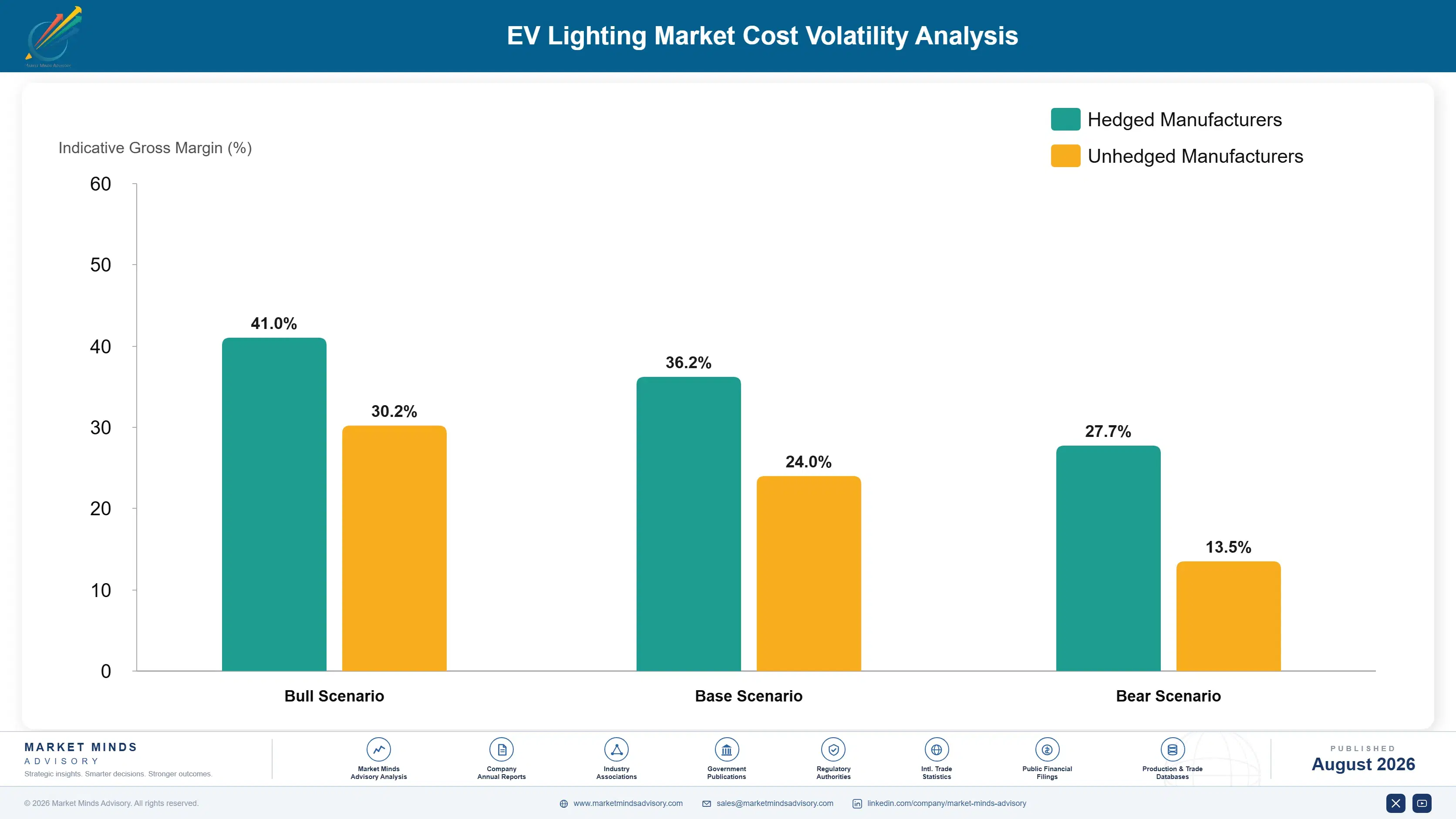
What Sets the Cost Base

LED emitters are the largest single input at roughly 24% of cost of goods sold, sourced from Nichia, ams-OSRAM, Lumileds, and Seoul Semiconductor across Japan, Germany, and Malaysia. Optical-grade polycarbonate for lenses and housings takes a further 18%, supplied by Covestro, SABIC, and Mitsubishi Chemical. Drivers and control electronics absorb 16%. Tooling amortisation over programme life forms a substantial fixed layer beneath all of it.
Semiconductor availability constrained lighting driver supply through 2021 and into 2023, and several lighting suppliers allocated output across programmes rather than meeting full demand anywhere. Koito and Valeo both discussed component availability and its production effects in their reporting for those years. Optical polycarbonate pricing moved with European energy costs at the same time, since the polymerisation is energy intensive. Programme piece prices were largely fixed, so suppliers absorbed most of it directly.

Exposure divides on programme mix and contract structure rather than on scale. Suppliers weighted toward mass-market awards face annual cost-down commitments that assume emitter deflation, so any input increase lands entirely on their margin. Signature and premium programmes carry pricing that resists that pressure considerably better. Suppliers with Chinese manufacturing hold a cost advantage on volume work that procurement alone cannot replicate.
ev-lighting-market-cost-volatility-analysis-1787551192287

Move value into control electronics and software

Emitter deflation at 24% of cost of goods sold is relentless and vehicle manufacturers price it in annually without exception. Control electronics, animation software, and licensing arrangements carry value that hardware cost-down conversations have no established precedent for. Suppliers restructuring awards this way protect margin that piece price negotiation would otherwise remove year after year.

Qualify second sources for driver semiconductors

Driver availability constrained lighting output through the recent shortage, and the components affected are rarely specialised enough to justify single sourcing decisions. Qualifying alternates costs engineering time and photometric revalidation. Suppliers who completed that work during the last tightness shipped programmes while competitors were allocating output across customers who all needed it. Revalidation is the real cost.

Localise polycarbonate supply against energy exposure

Optical-grade polycarbonate at 18% of cost of goods sold is energy intensive to produce, which ties it directly to regional power prices in a way most components are not. Regional sourcing aligned to manufacturing location removes both the freight and the exposure to a single energy market. Qualification of optical grades takes time and it holds afterwards.

Portfolio Architecture for Margin Defence

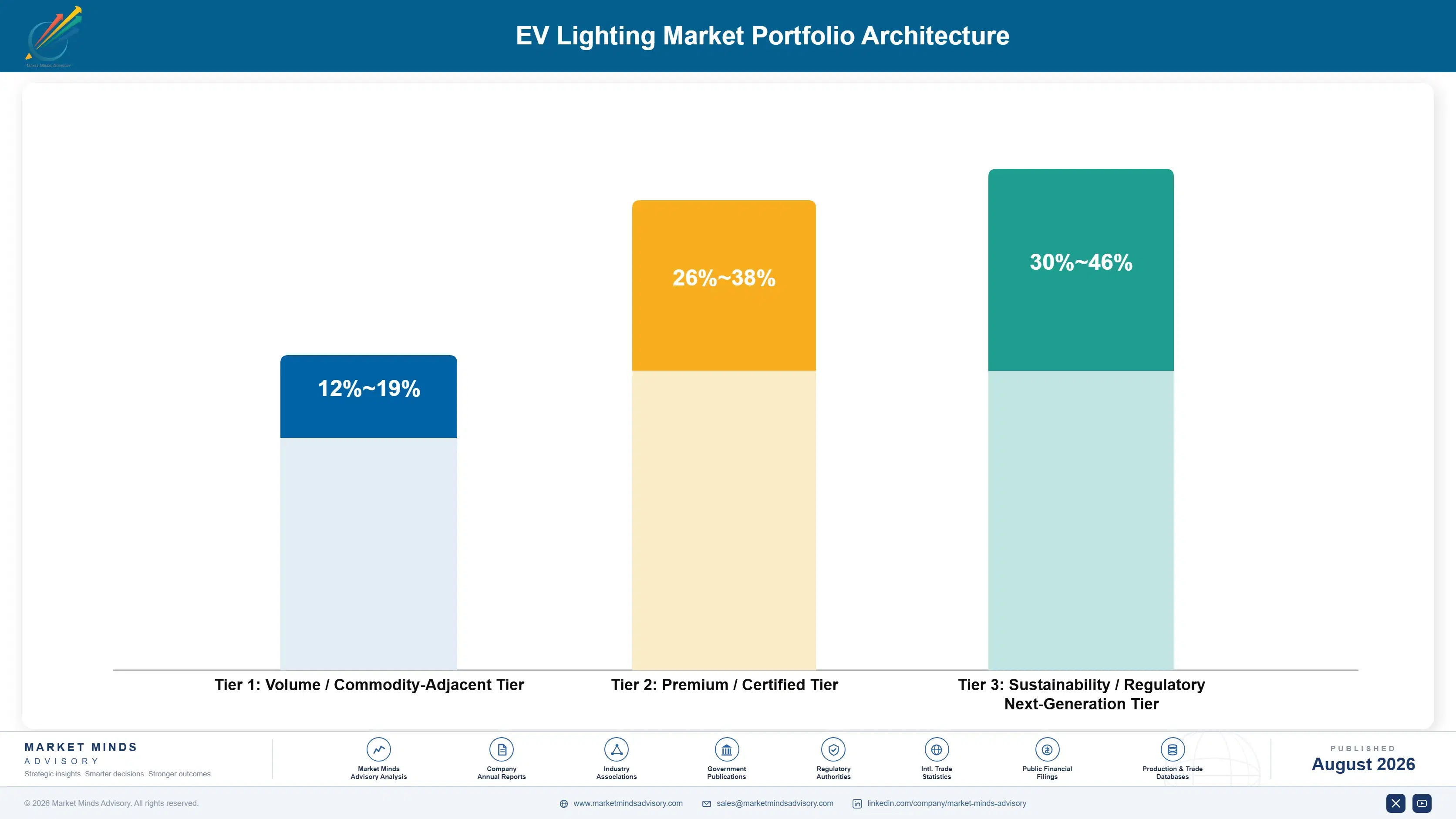
Margin architecture follows design relationship rather than technology, and the spread is wider than the hardware differences would suggest. Build-to-print lamp supply on mass-market programmes competes on emitter cost, resin cost, and tooling efficiency, with Chinese suppliers setting the reference price. Signature work commands considerably more because the design studio committed to a form before any quotation existed. Communication and charge lighting sits higher again on function novelty.
The volume and premium tension shows most clearly in how programmes age. A mass-market award delivers volume immediately and gives back margin every year through cost-down commitments assuming emitter deflation. A signature programme delivers lower volume at prices that hold, because the manufacturer cannot change the light without changing brand recognition. Suppliers chasing volume alone find their best years are their first ones.

High-value pools concentrate in signature ownership, interior ambience with software content, and pedestrian communication systems ahead of regulation. Each is defended by design relationship, engineering investment, or homologation position rather than by manufacturing cost, which is why the concentration figure has stayed as high as it has. Manufacturing cost position matters far less here than it does almost anywhere else in automotive supply.

Volume / Commodity-Adjacent Tier

Build-to-print headlamps and rear combination lamps on mass-market programmes. Competition runs on emitter cost, resin cost, and tooling efficiency. Chinese suppliers set the reference price in every market they can homologate into.
Gross Margin: 12%-19%

Premium / Certified Tier

Signature lighting, matrix headlamp systems, and multi-zone interior ambience specified during styling rather than quoted to drawing. Design commitment resists annual cost-down pressure. The range reflects wide differences between premium and mass-market programme pricing.
Gross Margin: 26%-38%

Sustainability / Regulatory / Next-Generation Tier

Pedestrian and vehicle communication systems, charge status illumination, and software-licensed animation content. Function novelty supports pricing without cost-down precedent. The range is wide because fitment and scope vary enormously across programmes.
Gross Margin: 30%-46%
ev-lighting-market-portfolio-architecture-1787551192791

High-value Sub-segments and Strategic Watch-out

Signature and Design Studio Work

Tooling a brand's recognition signature holds a programme for full production life, since changing it means changing how the car is identified. Award cycles run 34 months, so the relationship precedes any specification by years. Displacing an incumbent means persuading a studio to change the brand.
Gross Margin: 28%-40%

Pedestrian Communication Systems

The fastest system at 23.4% against regulation still addressing sound rather than light. Suppliers developing now shape what compliant hardware looks like and hold the automated driving programmes carrying the earliest fitment anywhere. Homologation frameworks differ between jurisdictions, which favours suppliers already engaged in writing them.
Gross Margin: 32%-46%

Interior Ambient with Software Content

Fitment reaches 71% of new electric vehicles and multi-zone systems tied to drive mode and charging state carry electronics value that annual piece price negotiation has no established precedent for reducing. Licensing arrangements separating control value from hardware piece price are beginning to appear on renewal negotiations.
Gross Margin: 26%-38%

Mass-Market Build-to-Print Supply

The strategic watch-out. Chinese suppliers set pricing, emitters at 24% of cost deflate annually into cost-down commitments, and no design relationship protects the award at renewal. Volume arrives first and margin leaves steadily. Suppliers weighted here find their best programme year is always the first one.
Gross Margin: 12%-19%

How Programmes Actually Get Awarded

Demand reaches suppliers through a cycle that begins years before any revenue does. Design studios select a signature form during styling, engineering translates it into a specification, and award follows roughly 34 months before start of production. A supplier engaged during styling is shaping what gets specified; one receiving the request for quotation is bidding on somebody else's decision. That distinction explains most of the margin difference across this industry, and it is not visible in any tender document.
Stickiness varies sharply by content type. Signature work holds for the full production life because changing it changes brand recognition. Matrix headlamp systems hold on homologation cost. Interior ambience re-competes at facelift. Mass-market build-to-print work re-competes annually on price alone. Charge and pedestrian communication content has no renewal precedent yet at all.

The decisive buyer has moved from purchasing toward design and brand functions on signature content, while purchasing retains full control of mass-market awards. Those are effectively two different customers inside the same company, evaluating on criteria that barely overlap and rarely talking to each other about it. Suppliers who present the same pitch to both are losing one of them every time.
ev-lighting-market-end-use-penetration-index-1787551193284

Where the Value Concentrates

These are among the four positions where our research anticipates prominent divergence between winners and laggards over the coming forecast period. Each is grounded in the demand model, the regulatory perimeter, and the announced capacity pipeline.
01 / SIGNATURE DESIGN OWNERSHIP

Sell into styling, not into the tender

A supplier who tools the brand's recognition signature holds that programme for its entire production life, because changing the signature means changing how the car is identified and no annual cost saving on earth justifies that. Award cycles run 34 months from design selection to start of production, so the studio relationship wins work three years before any unit ships anywhere. Suppliers receiving a finished drawing are bidding on somebody else's decision and competing on price from the very first conversation onward.
02 / FUNCTION CONTENT DEVELOPMENT

Add content faster than emitters lose their value

LED emitters sit at 24% of cost of goods sold and deflate every year, and vehicle manufacturers write that reduction into annual piece price negotiations as a matter of entirely routine practice. The only durable answer is content absent from the previous programme generation: illuminated panels, charge indicators, pedestrian signalling, multi-zone interior systems with software animation. Suppliers carrying an unchanged content list into a second generation are volunteering for margin compression that better engineering would have avoided altogether over several years.
03 / CHINESE MANUFACTURING POSITION

Build inside China or concede half the volume

China now assembles roughly 48% of the world's electric vehicles and domestic suppliers win those awards at prices an imported cost base cannot approach under any realistic procurement scenario currently available. Local tooling, local electronics sourcing, and development cycles near 24 months rather than 34 are what make those prices possible in the first place at all. International suppliers without genuine Chinese manufacturing and engineering are excluded from the largest single pool of programme volume available anywhere in this industry today.
04 / PRE-REGULATORY SIGNALLING CAPABILITY

Develop pedestrian communication before any mandate arrives

Pedestrian and vehicle communication lighting grows at 23.4%, the fastest system in this market, while regulation still addresses sound rather than light for quiet vehicles in most of the jurisdictions that matter. Suppliers developing now shape what compliant hardware looks like and hold the premium and automated driving programmes carrying the earliest fitment of any programmes anywhere. Waiting for a mandate means entering against competitors with homologated systems already in production and design studio relationships built up entirely around that hardware over several years.

Engagement Snapshot From the Field

A live engagement with an industry participant carrying material or product regulatory and market exposure ahead of a defining policy shift, showing how our research translates into a defensible multi-year portfolio strategy.
MARKET MINDS ADVISORY · CLIENT ENGAGEMENT SUMMARY
EV Lighting Producer Strategic Portfolio Review and Transition Roadmap 2026·Investment Scenario on EV Lighting Exposure Evaluation 2025-26
CLIENT PROFILE
A European tier one lighting supplier with revenue near EUR 2.1 billion (client-reported, unverified by MMA), holding strong positions on mass-market headlamp and rear lamp programmes across several volume manufacturers. Signature work was minimal, Chinese manufacturing was limited to a joint assembly arrangement, and margin had declined for five consecutive programme years running. Design studio engagement had never been funded.
STRATEGIC CHALLENGE
Annual cost-down commitments assuming emitter deflation were removing margin faster than volume growth replaced it, and Chinese suppliers had begun winning export programmes the client considered defensible. No design studio engagement existed ahead of any request for quotation, and no pedestrian signalling development had ever been funded internally. Volume growth was no longer covering the gap.
MMA APPROACH
MMA mapped programme awards by content type against realised margin over five years, assessed design studio engagement practice at competitors holding signature work, and modelled Chinese manufacturing scenarios against the domestic award pool. Forty-seven expert interviews with design studios, purchasing organisations, and homologation authorities established how award decisions actually get taken.
KEY FINDINGS
  1. Every programme the client held had been won at request for quotation stage, and every competitor programme carrying materially better margin had been shaped during styling months earlier.
  2. Cost-down commitments across the mass-market portfolio assumed emitter deflation that had already slowed, which meant the client was contractually surrendering margin the component market no longer delivered.
  3. The joint assembly arrangement in China provided manufacturing without engineering or tooling capability, which excluded the client from domestic awards where the shorter development cycle mattered most.
  4. Two competitors had funded pedestrian signalling development for several years and were converting it into premium awards ahead of any regulatory requirement for visual communication on quiet vehicles.
CLIENT PROFILE
A European tier one lighting supplier with revenue near EUR 2.1 billion (client-reported, unverified by MMA), holding strong positions on mass-market headlamp and rear lamp programmes across several volume manufacturers. Signature work was minimal, Chinese manufacturing was limited to a joint assembly arrangement, and margin had declined for five consecutive programme years running. Design studio engagement had never been funded.
STRATEGIC CHALLENGE
Annual cost-down commitments assuming emitter deflation were removing margin faster than volume growth replaced it, and Chinese suppliers had begun winning export programmes the client considered defensible. No design studio engagement existed ahead of any request for quotation, and no pedestrian signalling development had ever been funded internally. Volume growth was no longer covering the gap.
MMA APPROACH
MMA mapped programme awards by content type against realised margin over five years, assessed design studio engagement practice at competitors holding signature work, and modelled Chinese manufacturing scenarios against the domestic award pool. Forty-seven expert interviews with design studios, purchasing organisations, and homologation authorities established how award decisions actually get taken.
KEY FINDINGS
  1. Every programme the client held had been won at request for quotation stage, and every competitor programme carrying materially better margin had been shaped during styling months earlier.
  2. Cost-down commitments across the mass-market portfolio assumed emitter deflation that had already slowed, which meant the client was contractually surrendering margin the component market no longer delivered.
  3. The joint assembly arrangement in China provided manufacturing without engineering or tooling capability, which excluded the client from domestic awards where the shorter development cycle mattered most.
  4. Two competitors had funded pedestrian signalling development for several years and were converting it into premium awards ahead of any regulatory requirement for visual communication on quiet vehicles.
RECOMMENDED STRATEGY
Phase 1: Phase one: place lighting design engineers inside key customer studios during styling, converting request for quotation bidding into signature specification influence on future programmes. Phase 2: Phase two: build genuine Chinese tooling and electronics engineering capability rather than assembly alone, targeting domestic awards where shorter development cycles decide outcomes. Phase 3: Phase three: fund pedestrian signalling and charge communication development against uncertain mandate timing, positioning for premium and automated driving programme awards ahead of regulation.
OUTCOME
The client secured signature engagement on three programmes at two manufacturers within eighteen months and established tooling engineering at its Chinese site. Two domestic Chinese awards followed, blended programme margin improved 4.6 percentage points, and a pedestrian signalling development contract was signed (client-reported, unverified by MMA).

Frequently Asked Questions

Foundational context covering the market sizes, CAGR, scope, country, region and competition that inform every finding below. This section is provided to cover basics and most often pre-purchase conversations, answered from the MMA Primary Research Dataset.

What is the current size of the EV Lighting Market?

The market was valued at USD 9.4 billion in 2025, rising to an estimated USD 10.6 billion in 2026. East Asia holds the largest regional share at 30% of value.

How large will the EV Lighting Market be by 2036?

MMA forecasts USD 35.35 billion by 2036 under the base case, an expansion multiple of 3.33 times the 2026 value. That represents USD 24.75 billion of incremental value.

What is the CAGR for the EV Lighting Market 2026 to 2036?

The base case CAGR is 12.8%, with a bull case of 14.1% and a bear case of 11.5%. The spread reflects uncertainty over vehicle volumes and LED emitter price deflation.

Which segment is growing fastest?

Pedestrian and vehicle communication lighting grows fastest at 23.4%, roughly 1.83 times the market rate. Charge status and port illumination follows at 21.6% on universal fitment.

Who are the major companies in the EV Lighting Market?

Koito Manufacturing, Marelli, Valeo, Forvia HELLA, and Stanley Electric lead on supply revenue, holding roughly 62% between them. Chinese suppliers including HASCO Vision compete strongly domestically.

Which country is growing fastest?

India grows fastest at 16.2%, driven by production-linked incentive support and rapidly expanding domestic electric vehicle assembly. Lumax and Samvardhana Motherson hold strong local supply positions.

Report Segmentation Architecture

The full report scope spans multiple orthogonal segmentation dimensions, with cross-tabulated demand data provided for each dimension pair. Coverage extends further to regional breakdowns, trend trajectories, and the competitive detail needed to support segment-level decision-making.

By Lighting System Type

  • Headlamp Systems
  • Rear Combination and Signal Lamps
  • Illuminated Exterior Panels and Logos
  • Interior Ambient Lighting Systems
  • Charge Status and Port Illumination
  • Pedestrian and Vehicle Communication Lighting

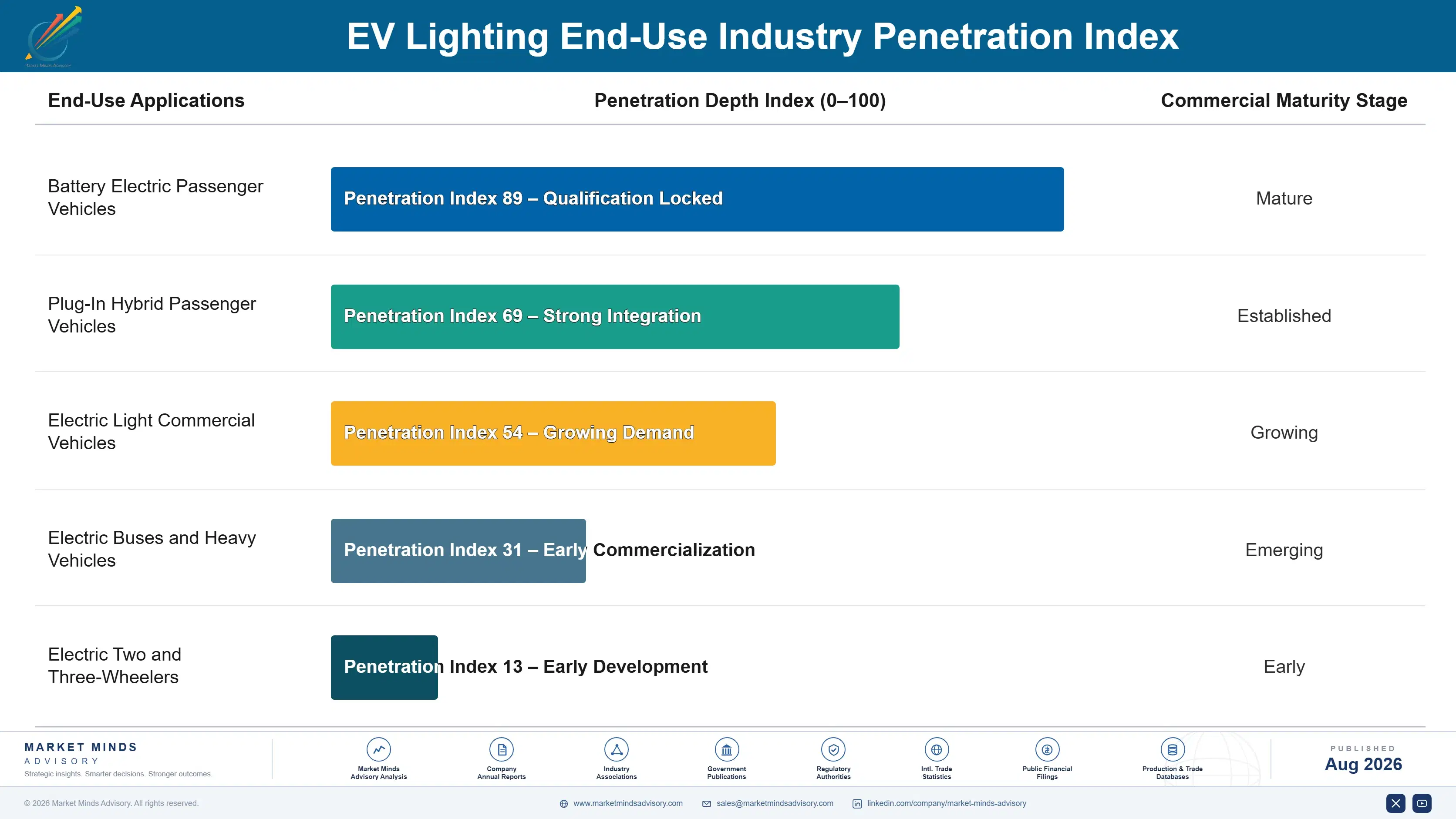
By End-Use Industry

  • Battery Electric Passenger Vehicles
  • Plug-In Hybrid Passenger Vehicles
  • Electric Light Commercial Vehicles
  • Electric Buses and Heavy Vehicles
  • Electric Two and Three-Wheelers

By Customer Type

  • Premium Vehicle Manufacturers
  • Volume Vehicle Manufacturers
  • Chinese Domestic Manufacturers
  • Electric Vehicle Specialist Manufacturers
  • Commercial Fleet Vehicle Producers

By Region

  • North America
  • Western Europe
  • East Asia
  • South Asia and Pacific
  • Latin America
  • Middle East and Africa
  • Eastern Europe

Scope, Methodology, and Coverage

Every figure in this report is reproducible from documented input assumptions. The scope below maps the historical period, the forecast horizon, the segmentation dimensions, and the countries covered, alongside the underlying primary and qualitative methodology.
Historical Period
2020 to 2025
Forecast Period
2026 to 2036
Base Year
2025 (USD billions; MMA Primary Research Dataset, August 2026)
Market Definition
The market comprises lighting systems specified for battery electric and plug-in hybrid vehicles at original equipment level, covering headlamp systems, rear combination and signal lamps, illuminated exterior panels and logos, interior ambient lighting systems, charge status and port illumination, and pedestrian and vehicle communication lighting. Value is measured at supplier level across passenger, commercial, and two and three-wheeler applications. Instrument clusters and head-up displays, infotainment screens, aftermarket accessory lighting, charging station illumination, LED emitter manufacture sold as components, and lighting fitted to combustion vehicles fall outside scope.
Quantitative Units
USD billions (current prices); million lighting systems shipped annually; USD content value per vehicle by system type
Segmentation Dimensions
By Lighting System Type; By End-Use Industry; By Customer Type; By Region
Regions Covered
North America, Western Europe, East Asia, South Asia and Pacific, Latin America, Middle East and Africa, Eastern Europe
Countries Covered
China, Japan, South Korea, Taiwan, Germany, France, United Kingdom, Spain, Italy, Sweden, Belgium, Netherlands, Poland, Czechia, Slovakia, Hungary, Romania, United States, Canada, Mexico, India, Thailand, Indonesia, Australia, Vietnam, Brazil, Argentina, Turkey, Morocco, South Africa
Key Companies Profiled
Koito Manufacturing, Marelli, Valeo, Forvia HELLA, Stanley Electric, Hyundai Mobis, Varroc Lighting Systems, ZKW Group, ams-OSRAM, Lumileds, Nichia, Texas Instruments, Grupo Antolin, Yanfeng, HASCO Vision, Xingyu Automotive Lighting, TYC Brother Industrial, Lumax Industries, Samvardhana Motherson, Depo Auto Parts
Quantitative Methodology
Primary survey, n=3,800 respondents, Q4 2025, six countries; demand-side model with trade association cross-validation
Qualitative Methodology
47 expert interviews, Q4 2025; applied to validate demand model assumptions, identify emerging dynamics, and assess competitive positioning
Report Format
PDF and XLSX data workbook (Word format preview document)
Publisher
Market Minds Advisory
Report Code
MMA-2026-AUT-234
Published
August 2026
Contact
sales@marketmindsadvisory.com | www.marketmindsadvisory.com

Purchase the full EV Lighting Market Report (2026 to 2036).

The full report sizes electric vehicle lighting demand across six system types, five vehicle categories, and seven regions with 2026 to 2036 forecasts under base, bull, and bear cases. It separates signature and design-led work from build-to-print supply, since the margin gap between them is wide and the two compete on entirely different criteria. Competitive profiles cover twenty suppliers assessed consistently on supply revenue, design studio access, and manufacturing footprint. Cost analysis traces emitter, polycarbonate, and electronics exposure against annual cost-down commitments. Commercial guidance addresses signature positioning, content development, Chinese manufacturing, and pre-regulatory signalling capability.
Six lighting system types sized separately by region
Signature work separated from build-to-print programme supply
Content value per vehicle tracked across model segments
Chinese supplier cost position assessed against incumbent bases
Pedestrian signalling regulation timetables mapped by jurisdiction
Emitter deflation modelled against annual cost-down commitments

Built For The People Who Decide

From boardroom strategy to bench-side execution, this report is read cover-to-cover by leaders shaping the next decade of their industry, turning demand scenarios, market dynamics and valuation benchmarks into decisions.
CXOs/ Presidents/ VPs/ Managers
M&A and Corporate Development
Strategy Teams and R&D Heads
Procurement and Product Directors
Regulatory and Compliance Leaders
Investor Relations and Equity Analysts