
Market Minds Advisory
Europe Luxury Packaging Market

Europe Luxury Packaging Market: Selling Restraint At A Premium Price

A commercial reading of the European luxury packaging market, where sustainability commitments now collide directly with the theatrical unboxing experience luxury brands built their entire pricing power around for decades.

Lead Analyst

Bilal Shaikh

Published

September 2026

Make Smarter Decisions with Customized Research Insights

Request a free sample report and evaluate market opportunities, growth trends, and competitive dynamics relevant to your business needs.

2025 MARKET VALUE$14.5BMarket Size 2025
2036 FORECAST VALUE$30.2BBase Case , 2026 to 2036
CAGR 2026 TO 20366.9 %Bull 8.1% / Bear 5.6%
INCREMENTAL OPPORTUNITY$14.7BNet 10- year value creation
EXPANSION MULTIPLE1.95x2036 value over 2026 base
Strategic Levers
M&A Pipeline
Regional Outlook
Country Rankings
Competitive Intelligence
Segmental Deep-dive
Call-Us : 91 93563 13602

Executive Snapshot and Market Trajectory

Europe's luxury packaging industry sells restraint at a genuinely premium price point. A perfume bottle or leather goods box exists mainly to make the product feel worth what the brand charges for it, before the customer even opens it fully.
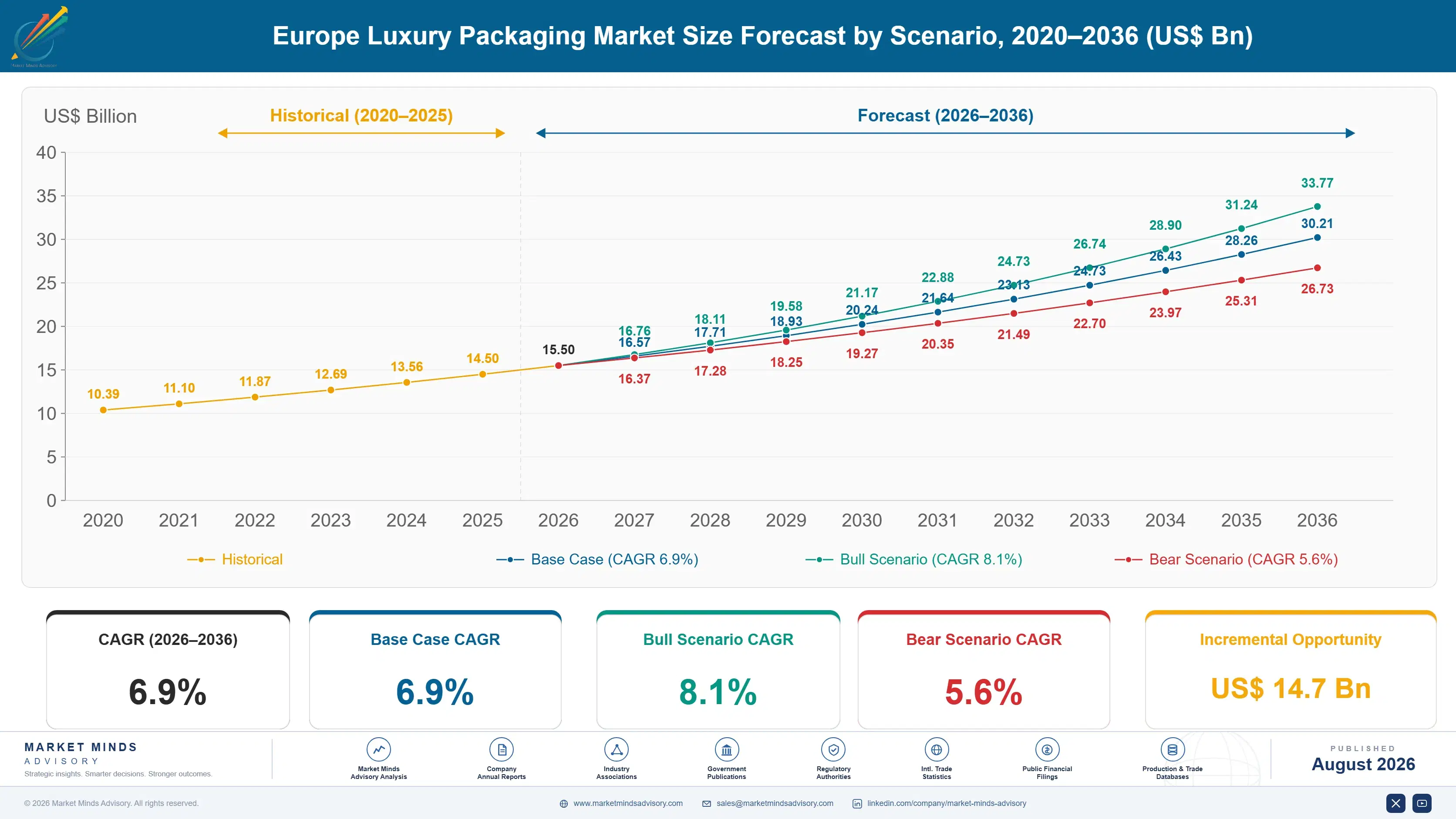
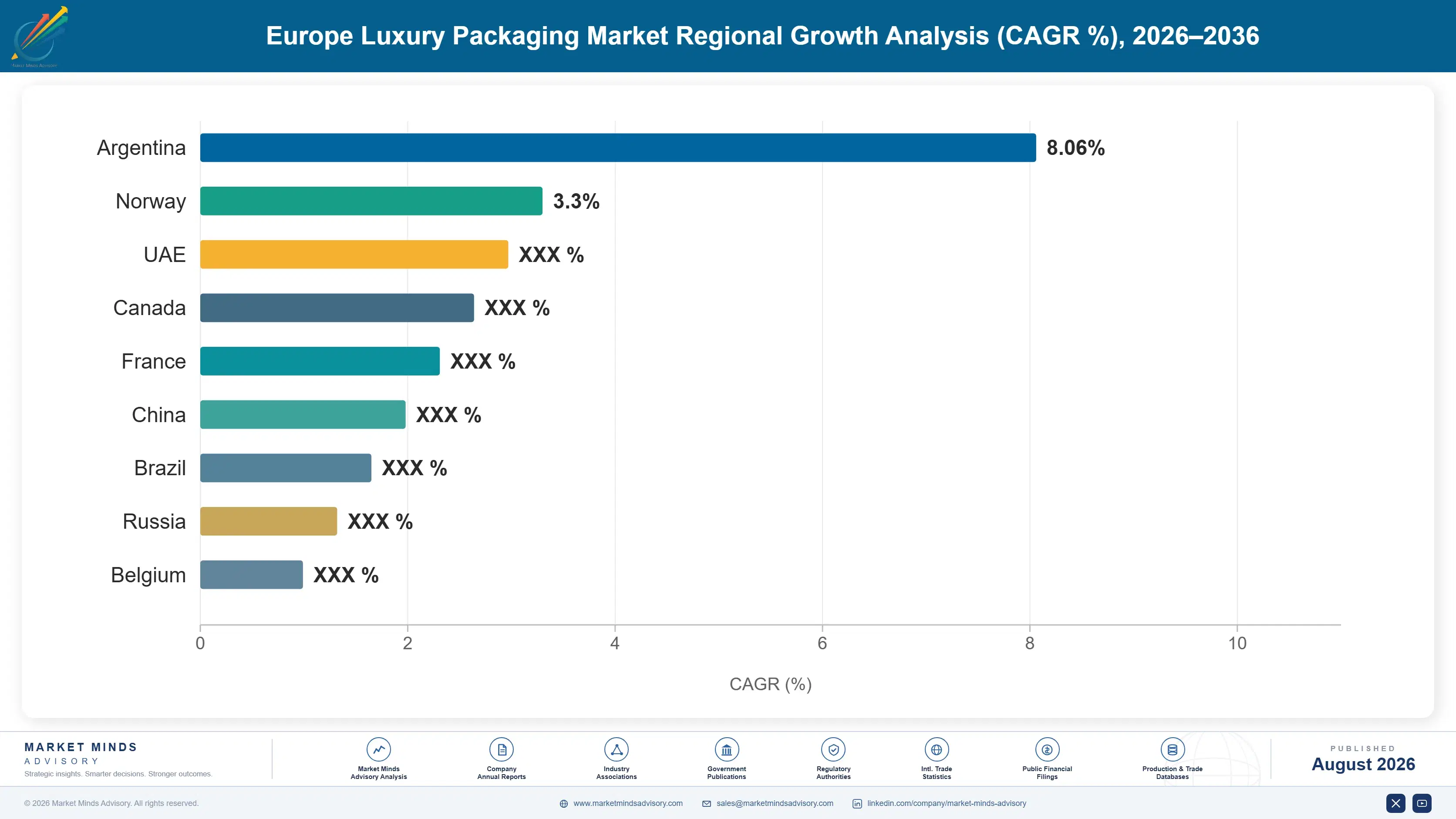
The market stands at USD 14.5 billion in 2025 and reaches USD 30.21 billion by 2036 at a 6.9% CAGR. Rigid luxury boxes and cartons grow fastest at 11.4%, roughly 1.65 times the overall rate, as fashion and leather goods brands expand packaging investment across broader product lines. Western Europe and Eastern Europe together account for 86% of value since this report is scoped specifically to Europe, while France posts the quickest growth at 8.5%.
Concentration is moderate at roughly 34%, split across specialist luxury packaging converters and glass manufacturers competing for exclusive brand contracts across fashion, beauty, and spirits categories throughout the continent. Two forces dominate the period ahead. Sustainability commitments from major luxury conglomerates are forcing a genuine material rethink of packaging built for decades around single-use presentation, and counterfeit protection is pushing authentication features into packaging that previously relied purely on craftsmanship signalling.
Market Definition
This report covers the European luxury packaging market specifically, comprising packaging materials and finished products used for luxury fashion, beauty, spirits, and jewelry goods, valued at converter selling prices. Non-European luxury packaging markets and mass-market consumer packaging are excluded.
Base Year Value
$14.5B in 2025 (MMA Primary Research Dataset, August 2026)
Forecast Period
2026 to 2036, eleven discrete annual values
CAGR
6.9% base case. Bull 8.1%. Bear 5.6%.
Fastest Growth Segment
Rigid Luxury Boxes and Cartons: 11.4% CAGR
Fastest Growth Country
France: 8.5% CAGR
Fastest Growth Region
South Asia and Pacific: 8.8% CAGR
Largest Region
Western Europe: 74% of 2025 global value
Market Leaders
Aptar Group, Verescence, Pochet Group, Autajon Group, API Group. Source: MMA Analysis based on company annual reports.
Primary Survey
n=3,800 procurement and R&D decision-makers, Q4 2025, six countries
Methodology
Demand-side build-up, cross-validated against public data, 47 expert interviews

Europe Luxury Packaging Market Forecast Scenarios

europe-luxury-packaging-market-size-forecast-scenario-1787332746649
Growth from 2020 to 2025 compounded near 5.9%, and luxury goods demand rebounded strongly following pandemic disruption, pushing brands to expand packaging investment across broader product ranges rather than confining premium presentation to flagship items alone. Sustainability commitments from major luxury conglomerates began reshaping material specifications throughout the period, though genuine reformulation lagged corporate pledges considerably as brands balanced environmental commitments against tactile weight and finish.
Three mechanisms carry the base case to 6.9%. First, fashion and leather goods brands extending premium packaging investment across broader product lines rather than confining it to flagship categories alone. Second, sustainability commitments forcing genuine material reformulation as conglomerates face mounting pressure to reduce single-use packaging waste across their portfolio. Third, counterfeit protection driving authentication feature adoption into packaging that previously relied purely on craftsmanship and material quality as its only defence.
The bull case at 8.1% assumes luxury goods demand accelerates further and sustainable material innovation reaches cost parity with conventional premium materials sooner across most categories. The bear case at 5.6% assumes luxury spending softens under economic pressure, sustainability reformulation costs strain converter margins, and brands delay packaging redesign investment during periods of broader cost discipline.

Why Sustainability Keeps Colliding With Tactile Weight

Three forces set demand here. Brand extension drives the most durable volume, as luxury conglomerates apply flagship-level packaging investment across broader product ranges that previously received standard presentation. Sustainability pressure drives a second stream, since conglomerates face mounting pressure to reduce single-use packaging waste. Counterfeit protection drives a third stream, as authentication features increasingly supplement craftsmanship as the primary defence against imitati
MARKET CONCENTRATIONCR5: 34%Moderately fragmented across specialist luxury packaging converters and glass manufacturers
PRICE PREMIUM3 to 6xPrice premium for luxury packaging against equivalent mass-market packaging formats
PACKAGING COST SHAREAbout 8% of priceShare of packaging cost relative to total product retail price
SUSTAINABLE WEIGHT REDUCTIONUp to 20%Reduction in packaging weight achieved through sustainable material reformulation
DESIGN DEVELOPMENT TIMELINE8 to 16 monthsTime to develop and certify a new luxury packaging design
AUTHENTICATION ADOPTION RATEAbout 30%Share of luxury brands now incorporating authentication features into packaging
The commercial character is defined by a widening gap between sustainability commitment and the tactile weight customers associate with luxury presentation. A lighter, more recyclable box can satisfy environmental targets, but customers accustomed to substantial glass bottles and rigid boxes often perceive lighter packaging as somehow less premium. That mismatch concentrates risk with converters who oversimplify sustainable redesign, and rewards converters who solve genuine material innovation without sacrificing tactile signals.
The decade turns on whether sustainable material innovation can match the tactile weight and finish quality luxury customers have come to expect without genuine compromise. Material cost and craftsmanship consistency remain the primary constraints separating credible sustainable redesign from superficial changes customers notice and resent. That shift matters more than any launch, because it determines whether sustainability becomes a genuine differentiator or a cost center brands quietly minimise.
"Customers cannot articulate why a heavier box feels more expensive, but they absolutely notice when it isn't. Solving that perception problem with less material is the hardest design brief in this entire industry."
Director, Luxury Goods and Premium Packaging Practice · MMA Packaging / Luxury G

Market Trends

Flagship Presentation Is Extending Across Full Portfolios

Luxury conglomerates are extending flagship-level packaging investment across broader product ranges that previously received standard presentation, converting packaging spend from a cost concentrated on hero products into a portfolio-wide brand investment applied consistently across every price tier a customer might encounter across the brand's lineup. That shift is expanding the addressable market for premium converters considerably beyond the narrow flagship categories that historically justified the highest packaging investment per unit. Converters who can scale premium presentation economically across broader volume, rather than only at flagship pricing, are capturing this expanding addressable opportunity fastest.
Market Impact: Expands premium packaging spend by
Sustainability Pledges Are Forcing Genuine Reformulation

Sustainability commitments from major luxury conglomerates are forcing genuine material reformulation as public pledges to reduce single-use packaging waste face mounting scrutiny from investors, regulators, and increasingly climate-conscious luxury consumers who expect their purchases to reflect stated brand values. That pressure is pulling capital investment toward recyclable mono-material structures, reduced material weight, and refillable packaging formats that maintain premium tactile quality while measurably cutting environmental footprint. Converters who solve genuine sustainable luxury material innovation, rather than offering only superficial changes, are winning exclusive brand contracts that competitors relying on conventional materials increasingly lose.
Market Impact: Cuts single-use packaging waste by

Market Opportunities and Growth Drivers

Brand Extension Is Expanding The Addressable Market

Luxury conglomerates are applying flagship-level packaging investment across their broader product portfolios rather than confining premium presentation to hero items alone, converting packaging spend into a portfolio-wide brand consistency requirement that expands the addressable market considerably beyond narrow flagship categories. That expansion creates demand independent of underlying luxury goods pricing cycles, since brand consistency investment continues regardless of which specific product categories are performing best in a given season. Each product line extension carrying premium packaging adds directly to addressable demand without requiring independent commercial persuasion from converters already serving comparable brand relationships.
Market Impact: Weight reduction can reach 30%

Sustainability Pledges Are A Direct Compliance Driver

Sustainability commitments from major luxury conglomerates, facing mounting pressure from investors and increasingly climate-conscious consumers, are converting packaging material specification from an aesthetic decision into a genuine environmental compliance requirement tracked against public corporate pledges made to shareholders and regulators alike. That pressure creates durable investment demand regardless of underlying luxury goods sales cycles, since sustainability commitments continue according to corporate reporting timelines rather than short-term sales performance in any given quarter. Each new sustainability pledge from a major luxury conglomerate adds directly to addressable demand for genuinely reformulated packaging materials across the industry.
Market Impact: Redesign takes 12 to 24 months

Market Restraints and Challenges

Sustainable Materials Risk Diluting Perceived Quality

Sustainable packaging materials frequently deliver less tactile weight and finish quality than the conventional glass and rigid board that luxury customers have come to associate with premium presentation, creating genuine tension between environmental commitment and the perceived quality signals brands have spent decades cultivating deliberately. The root cause is that recyclable mono-material structures and lightweight formats inherently sacrifice some of the substantial heft traditional luxury packaging materials achieve through sheer material density and thickness. The commercial impact is that some sustainable redesigns face customer pushback despite genuine environmental improvement. Mitigation runs through material innovation, refillable formats, and careful tactile engineering.
Market Impact: Expands premium spend by 30%

Redesign And Requalification Slows Conversion Timelines

Converting to genuinely sustainable, recyclable luxury packaging requires brands to redesign existing structures, requalify suppliers, and revalidate consumer perception testing across their entire product portfolio, a process that takes considerably longer and costs considerably more than switching a single material line item. The root cause is that luxury packaging redesign touches brand identity, manufacturing tooling, and regulatory labelling simultaneously, requiring coordinated changes across multiple internal functions and external suppliers at once. The commercial impact is that brands delay conversion until forced by mounting external pressure rather than proactively. Mitigation runs through phased conversion planning, converter partnership programmes, and pilot testing.
Market Impact: Cuts packaging weight by 20%
3 additional market trends, 4 additional growth drivers, and 2 additional restraints and challenges are covered in the full report. Contact sales@marketmindsadvisory.com to access the complete intelligence.

Segment CAGR and Growth Architecture

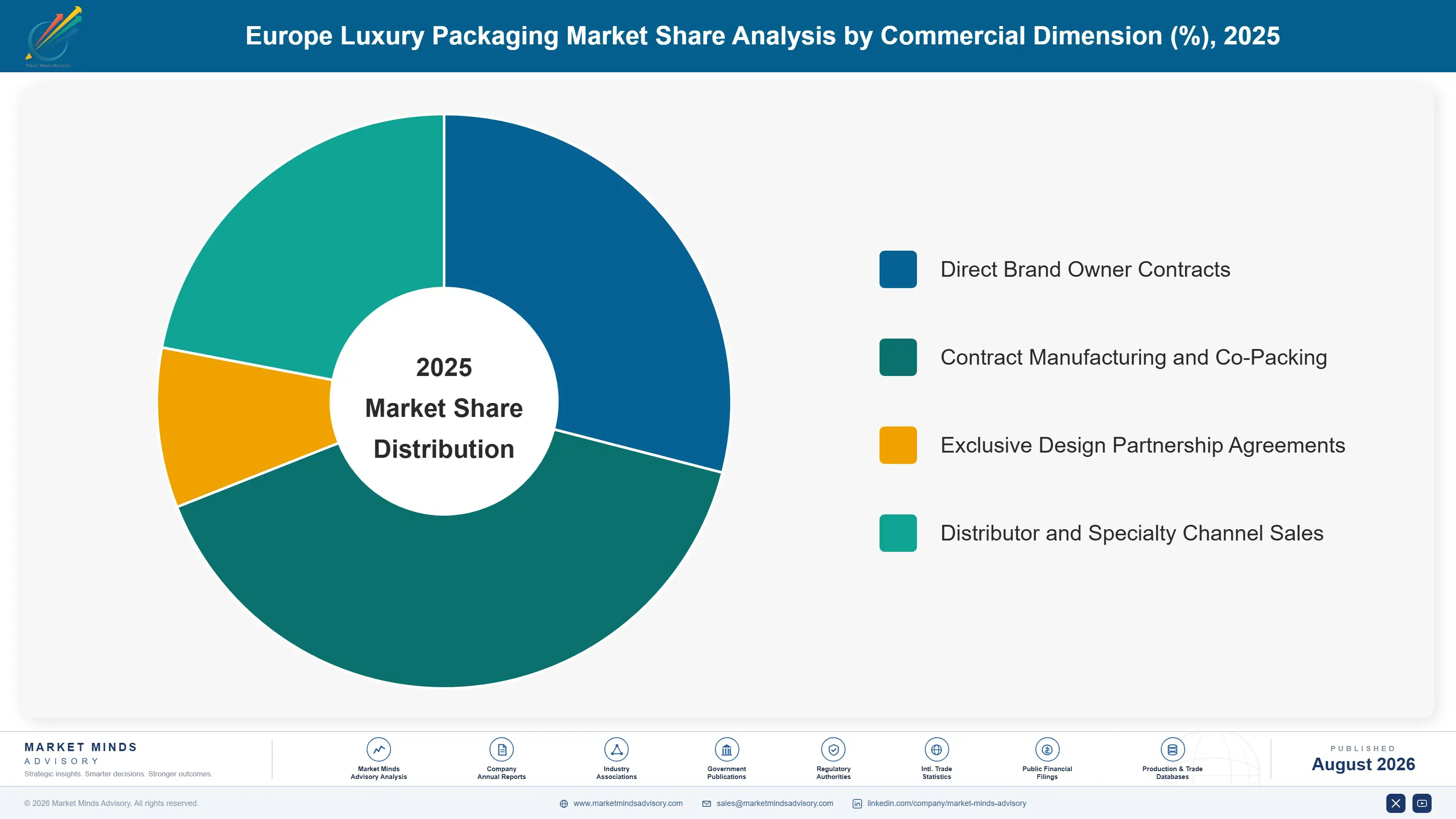
Segmentation follows packaging format, a single physical logic describing what structural type the packaging actually is rather than which luxury product category it protects. Each format carries its own cost structure, material requirement, and craftsmanship intensity, so commercial position tracks the structural format rather than the specific product category it happens to serve currently.
europe-luxury-packaging-market-market-share-analysis-1787332747185

Rigid Luxury Boxes and Cartons

Rigid luxury boxes and cartons grow fastest at 11.4%, about 1.65 times the overall 6.9% rate, as fashion and leather goods brands extend flagship-level packaging investment across broader product ranges that previously received standard presentation across most price tiers today. Growth concentrates where luxury conglomerates apply portfolio-wide brand consistency requirements, since a customer purchasing any product tier increasingly expects the same theatrical unboxing experience regardless of price point or category. Autajon Group and API Group hold established positions in this segment, built on decades of luxury converting expertise. Craftsmanship consistency at expanding production volume remains the primary factor separating credible offerings from converters still limited to small flagship-only production runs.
CAGR 11.4%

Premium Glass and Bottle Packaging

Premium glass and bottle packaging grows at 9.2%, serving perfume and spirits brands that depend on distinctive bottle design as a core element of product differentiation and shelf presence, particularly for fragrance categories where the bottle often outlasts the product itself in customer memory and household display long after use. Adoption is concentrated among brands investing in distinctive silhouette design that competitors cannot easily replicate without infringing established brand identity and trademark protections. Verescence and Pochet Group hold strong positions built on decades of luxury glass manufacturing expertise across multiple fragrance and spirits categories. Glass weight reduction without sacrificing perceived quality remains the primary constraint on sustainable reformulation in this segment.
CAGR 9.2%
Full segment breakdown across 5 segments available in the complete report.

Regional Architecture and Country Demand Map

This report is scoped specifically to the European luxury packaging market, so Western Europe and Eastern Europe together account for the overwhelming majority of value, with the remaining five world regions reflecting only minor cross-border trade linkages. France leads national growth on luxury goods headquarters density.

North America

North America accounts for just 5% of value in this Europe-scoped report, reflecting minor cross-Atlantic trade rather than any meaningful domestic luxury packaging manufacturing presence, since this report covers the European luxury packaging market specifically rather than global production. What limited North American exposure exists comes from European converters shipping finished packaging components to American subsidiaries of European luxury houses maintaining US operations. This share is deliberately far below the standard 22 to 32% band that would apply to a globally scoped report, and it should be read as trade-linkage exposure rather than a genuine regional market assessment. No major European converter treats North America as a manufacturing base currently. Growth of 7.0% reflects this narrow relationship.
Share: 5% | CAGR: 7.0% (2026 to 2036)

Western Europe

Western Europe holds 74% of value at 5.5% growth, the anchor of this Europe-scoped report, reflecting the region's dense concentration of luxury goods conglomerate headquarters, artisanal craftsmanship traditions, and the deepest specialist converter base anywhere in the industry. Aptar Group and Verescence both maintain deep domestic commercial infrastructure spanning decades of luxury packaging manufacturing relationships across major fashion, beauty, and spirits houses. French and Italian converters lead regional production, reflecting the concentration of flagship luxury conglomerates headquartered specifically in those two countries. This share sits well above the standard 18 to 26% band that would apply globally, reflecting this report's explicit European scope. Growth reflects mature market dynamics tempered by genuine sustainability-driven material reformulation investment across the installed converter base.
Share: 74% | CAGR: 5.5% (2026 to 2036)
Regional intelligence for 5 additional markets available in the complete report: East Asia, South Asia and Pacific, Latin America, Middle East and Africa, Eastern Europe. Contact sales@marketmindsadvisory.com.
europe-luxury-packaging-market-country-cagr-analysis-1787332747698

Where European Luxury Packaging Converters Hold Margin

A converter selling generic premium boxes at commodity margins while a competitor holds exclusive flagship brand relationships and proven sustainable material innovation is competing on the wrong axis entirely. The four moves below shift earnings toward what actually captures share: portfolio-wide brand extension, sustainable material innovation, authentication feature integration, and craftsmanship scale that maintains quality at expanding production volume.

Scale Premium Presentation Across Full Portfolios

Converters that scale premium presentation economically across a brand's full product portfolio, rather than confining exceptional craftsmanship to flagship items alone, capture the expanding packaging investment that luxury conglomerates are directing across broader product ranges. That capability commands a premium of 20 to 35% over converters limited to small flagship-only production runs, since brands pay for consistent quality across scale as much as for the underlying craftsmanship itself. Autajon Group and API Group built this scaling capability over years, and it is not quickly replicated by converters entering from a purely artisanal background.
Market Impact: Commands a 20 to 35% scale premium

Solve Sustainable Innovation Without Losing Quality

Sustainable material innovation that maintains genuine tactile weight and finish quality, rather than accepting perceived quality loss as an unavoidable tradeoff, wins exclusive brand contracts that competitors offering only superficial environmental changes cannot secure, cutting packaging weight by roughly 20% without sacrificing customer perception. Converters who solve this genuinely, rather than treating sustainability as a marketing afterthought, capture the growing share of luxury conglomerate packaging budgets tied directly to public environmental commitments. Verescence and Pochet Group have both invested heavily in sustainable glass and material innovation that increasingly differentiates their offering from converters still using conventional formulations.
Market Impact: Cuts packaging weight by 20% quite

Integrate Authentication Features Directly Into Design

Authentication features embedded directly into packaging, rather than relying purely on craftsmanship signalling that counterfeiters increasingly replicate convincingly, protect brand value that counterfeit goods erode considerably, with counterfeit losses now exceeding 50 billion euros annually across an expanding set of luxury categories facing rising imitation. Converters who integrate authentication technology directly into packaging design capture exclusive contracts from brands facing severe counterfeit exposure, since authentication increasingly determines contract renewal decisions as much as aesthetic design quality does. MCC Label and Estal Group have both built authentication integration capability that increasingly wins contracts competitors relying on craftsmanship alone cannot match.
Market Impact: Counterfeit losses now exceed 50 bi

Master Craftsmanship Consistency At Production Scale

Craftsmanship consistency at expanding production volume, rather than the small-batch artisanal approach that historically defined luxury packaging exclusively, lets converters serve brand extension demand without the quality degradation that undermines the entire premium positioning a brand invests decades building, capturing roughly 40% more volume than smaller rivals. Converters who master this scaling challenge capture flagship-level contract expansion that competitors still limited to small production runs simply cannot fulfil reliably at the volume brands increasingly require. Aptar Group has built manufacturing infrastructure combining genuine craftsmanship depth with production scale that competitors struggle to replicate.
Market Impact: Scaled converters now capture 40% m

Who Controls the Margin Pool

Concentration is moderate at roughly 34% for the top five, split across specialist luxury packaging converters and glass manufacturers competing for exclusive brand contracts. The gap between leaders and challengers is craftsmanship scale and sustainable material innovation rather than raw production capacity, broadly comparable across established players. All participants are assessed on one basis, revenue from luxury packaging products and services, excluding general consumer packaging sold ou
Competition runs along three lines. First, craftsmanship scale, since that increasingly determines which converters can serve brand extension demand without quality degradation. Second, sustainable material innovation, which shapes exclusive brand relationships for years once a converter proves genuine tactile quality retention. Third, authentication feature integration, since counterfeit protection increasingly determines contract renewal decisions across luxury categories.

Pressure is building from two directions. Large diversified packaging groups are acquiring specialist luxury converters to build craftsmanship and brand relationship depth faster than organic development allows. Meanwhile smaller artisanal specialists are winning niche flagship contracts directly through deeper craftsmanship than large incumbents typically invest in for high-volume categories. Rankings should favour converters combining craftsmanship scale with genuine sustainable innovation over those competing on production capacity alone.
europe-luxury-packaging-market-company-positioning-matrix-1787332748214

Competitive Moat and Risk Dimensions

APTAR GROUP

Moat: Craftsmanship scale advantage

Aptar Group built manufacturing infrastructure combining genuine craftsmanship depth with production scale over decades of luxury fragrance and beauty packaging relationships. Its established position across multiple luxury conglomerates provides customer relationships smaller specialists cannot easily replicate. Continued investment in sustainable material innovation positions it ahead of converters lacking comparable research capability.
APTAR GROUP

Risk: Scale strains artisanal positioning

Its production scale occasionally strains the perceived artisanal exclusivity that some flagship luxury brands specifically seek from smaller, purely craftsmanship-focused converters. Boutique specialist converters entering with genuinely small-batch positioning are targeting exactly these exclusivity-focused accounts directly. Balancing scale efficiency against artisanal brand positioning remains a genuine ongoing commercial tension.
VERESCENCE

Moat: Luxury glass manufacturing expertise

Verescence built deep luxury glass manufacturing expertise over decades of fragrance and spirits bottle design relationships spanning major global luxury houses. Its distinctive silhouette design capability reaches brand relationships that commodity glass manufacturers never access. Continued investment in sustainable glass formulation extends that expertise into the fastest-growing regulatory-driven segments of this market.
VERESCENCE

Risk: Exposure to fragrance category cycles

Its glass bottle business remains meaningfully exposed to fragrance and spirits category demand cycles, which move independently of the steadily expanding rigid box segment driving broader category growth. Diversification into rigid packaging requires manufacturing capability the business is still actively building outside its glass core. Specialist rigid box converters entering premium categories directly threaten its glass-led market position.

Players Tracked

Prominent Players

Aptar Group
Verescence
Pochet Group
Autajon Group
API Group

Other Key Players

MCC Label
Gerresheimer
Bormioli Luigi
Guala Closures
HCP Packaging
Quadpack
Cosmogen Paris
Estal Group
RPC Bramlage
Faerch Group
O-I Glass
Ardagh Group
SGD Pharma
Roberto Cavagna Group
Toppan

Recent Developments

MAY 2023

Major luxury conglomerate announces group-wide sustainability commitment

A major luxury conglomerate announced a group-wide sustainability commitment requiring all portfolio brands to achieve recyclable packaging across their product lines within a defined timeline. This was a corporate sustainability pledge rather than any transaction, and it converted material reformulation into a mandatory requirement across the conglomerate's entire supplier base.
Signal: Group-wide sustainability pledges from maj
SEPTEMBER 2024

Luxury packaging converter acquires specialist authentication technology firm

A leading luxury packaging converter announced an acquisition of a specialist authentication technology firm, adding counterfeit protection capability directly into its existing craftsmanship-focused product portfolio. This was a genuine acquisition rather than a joint venture or minority stake, and it closed an authentication capability gap the converter previously lacked.
Signal: Acquiring authentication technology direct
FEBRUARY 2025

Major fashion house extends flagship packaging across full product line

A major fashion house announced extension of its flagship packaging design across its entire accessible product line, standardising premium presentation regardless of individual item price point. This was a customer specification decision rather than a corporate transaction, and it provided the converter a credible large-scale portfolio reference case.
Signal: Portfolio-wide packaging standardisation d

Specialty Glass And Energy Cost Exposure

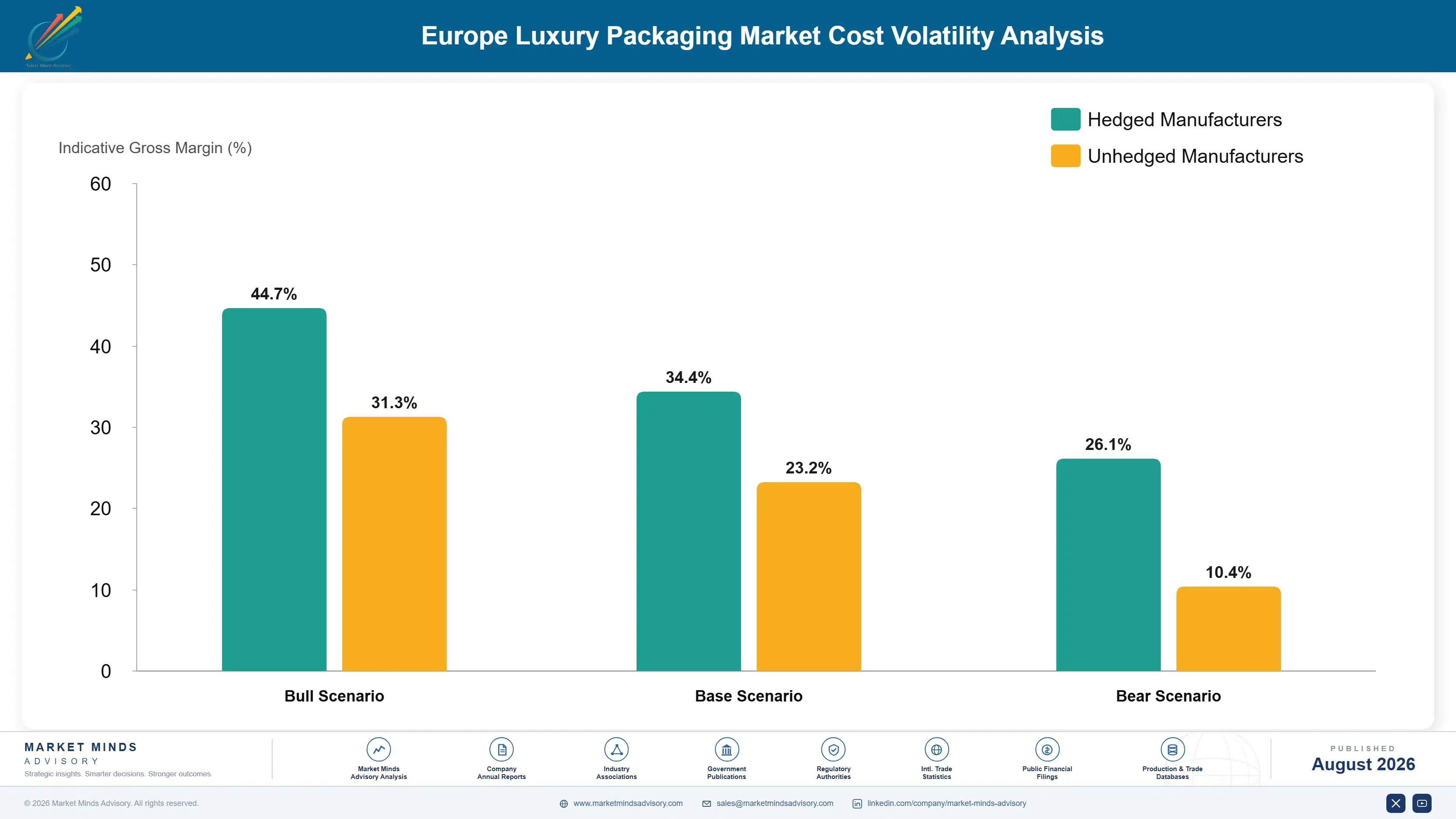
Specialty glass, rigid board, and finishing materials dominate cost structure for luxury packaging. Premium glass formulations, high-grade rigid board substrate, and specialty finishing materials including foil stamping and embossing components together account for a substantial share of production cost, sourced from specialty suppliers concentrated in a handful of countries. Craftsmanship labour and quality control complete the cost structure for finished luxury packaging products.
Specialty glass and rigid board input prices moved considerably through 2021 and 2022 as energy costs affecting glass furnace operations climbed sharply following geopolitical supply disruption, lifting production costs meaningfully faster than the broader packaging market moved during the same period. Several converters disclosed the resulting margin pressure across their annual reporting through that window, and EIA data recorded the parallel energy cost movement that raised specialty glass manufacturing costs across the industry simultaneously.

Exposure divides sharply by energy sourcing strategy rather than by converter size specifically. Converters with long-term energy supply agreements or diversified sourcing held cost considerably better than those buying energy on spot markets into a tightening cycle. The disadvantage compounds, because a converter unable to deliver against exclusive brand contracts during a shortage loses relationships that competitors, once established, retain for years afterward.
europe-luxury-packaging-market-cost-volatility-analysis-1787332748409

Diversify energy sourcing across multiple suppliers

Concentrating energy sourcing with a single supplier ties glass furnace operating cost directly to that supplier's specific capacity and pricing decisions, which the recent tightening cycle demonstrated quite expensively across the entire luxury packaging industry. Diversifying sourcing across multiple qualified suppliers spreads that exposure and improves cost stability during any single supplier's capacity constraint or unexpected disruption considerably.

Secure long-term energy supply agreements early

Spot buying energy for glass furnace operations exposes converters to price spikes precisely when demand for luxury packaging is also rising sharply across the industry simultaneously and quite unpredictably each cycle. Multi-year energy supply agreements, even at modest committed volume, provide pricing stability and delivery priority that spot buyers competing during a tight market cannot access.

Invest in energy-efficient furnace technology

Glass furnace operations locked into older, less efficient technology cannot reduce energy consumption when costs rise, leaving no real alternative but to absorb cost increases directly and pass them downstream to luxury brand customers. Investment in modern, energy-efficient furnace technology preserves margin and competitive positioning across energy price cycles that less efficient competitors simply cannot access.

Portfolio Architecture for Margin Defence

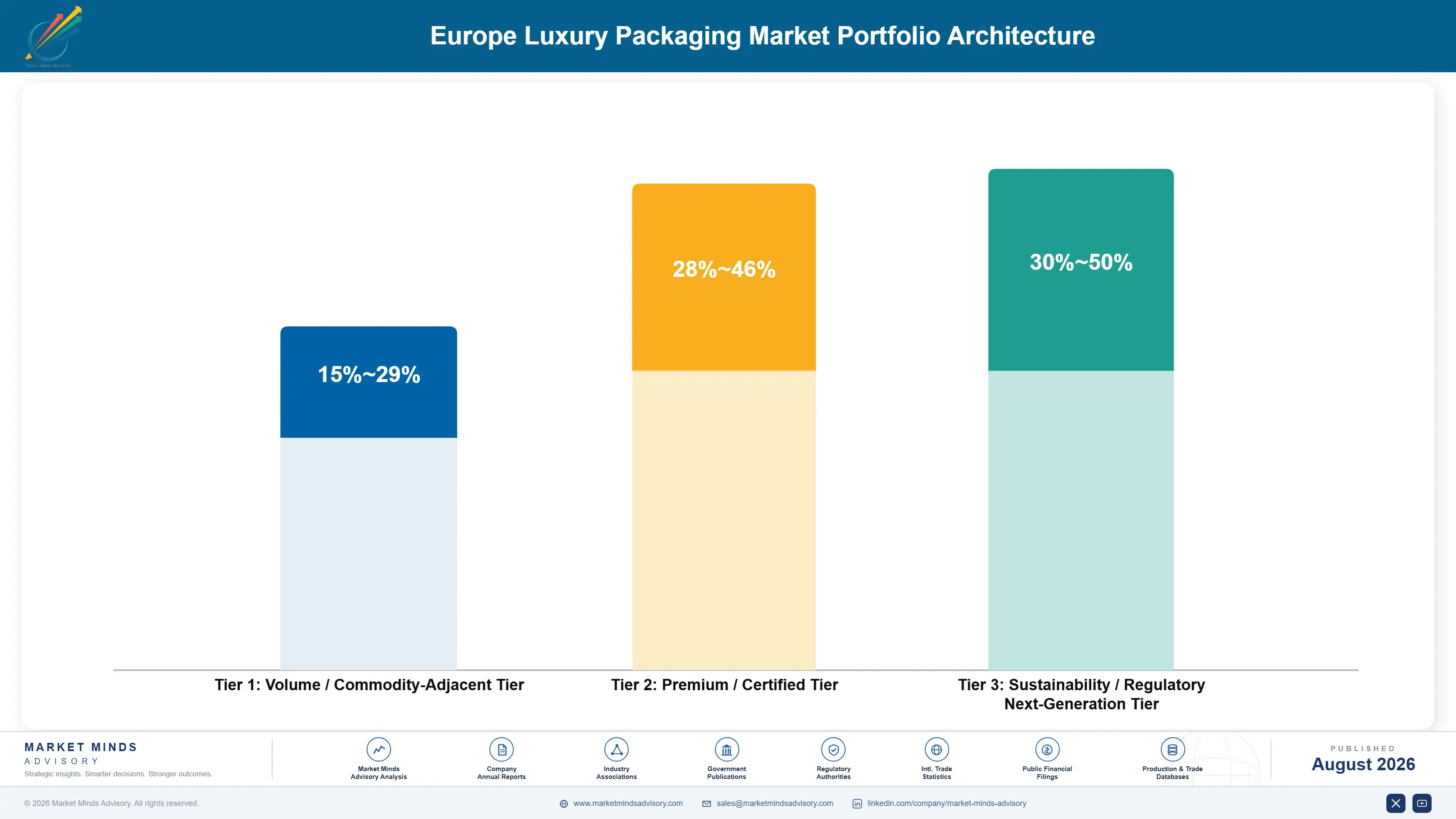
The portfolio splits into three tiers with genuinely different economics. Standard premium packaging sold at broader product-line volume forms the base tier, where craftsmanship efficiency and manufacturing scale drive competition directly. Flagship exclusive packaging earns considerably more, because bespoke craftsmanship and brand exclusivity narrow the qualified field substantially. Sustainable next-generation luxury materials sit differently again, priced against the environmental compliance
The tension runs between standard product-line volume that fills converting capacity and premium flagship work that earns the return. Broader product-line packaging generates the tonnage that keeps converting lines loaded and maintains brand relationships through which higher-value flagship conversations eventually happen. Yet this material competes on cost against every qualified converter serving the same brand-extension demand. Converters managing this well treat standard volume as capacity utilisation and direct investment toward craftsmanship depth.

High-value pools concentrate where craftsmanship exclusivity or compliance urgency genuinely limits competition: flagship packaging commanding bespoke design fees, sustainable material innovation meeting conglomerate environmental pledges, and authentication-integrated packaging protecting brand value against counterfeiting. All three resist the price competition defining standard product-line packaging, because the customer is purchasing a solved brand or compliance problem rather than comparing interchangeable packaging across converters.

Volume / Commodity-Adjacent Tier

Standard premium packaging sold at broader product-line volume into brand-extension demand across most established luxury categories. The range is wide because craftsmanship-efficient converters earn respectably while those competing purely on production cost frequently do not.
Gross Margin: 15-29%

Premium / Certified Tier

Flagship exclusive packaging carrying deep bespoke craftsmanship and established exclusive relationships with the most demanding luxury conglomerate design teams. The range is wide because craftsmanship depth and design exclusivity vary considerably by converter.
Gross Margin: 28-46%

Sustainability / Regulatory / Next-Generation Tier

Sustainable next-generation luxury materials addressing the environmental compliance problem directly and durably ahead of continued conglomerate sustainability pledges. The range is wide because material innovation maturity still varies enormously by converter currently.
Gross Margin: 30-50%
europe-luxury-packaging-market-portfolio-architecture-1787332748903

High-value Sub-segments and Strategic Watch-out

Rigid Luxury Boxes and Cartons

High value and the fastest growth at 11.4%, from a moderate base as luxury conglomerates extend flagship-level packaging investment across broader product ranges nationwide. Craftsmanship scale increasingly determines which converters capture this volume, limiting near-term opportunity to those with proven production consistency specifically across major categories.
Gross Margin: 32-50%

Premium Glass and Bottle Packaging

High value with strong growth, protected by distinctive glass silhouette design and fragrance industry relationships that create a durable barrier newer specialist entrants find genuinely difficult to replicate quickly across markets. Sustainable glass reformulation compounds steadily as customers increasingly factor environmental credentials into purchasing decisions.
Gross Margin: 28-46%

Foil Stamping and Embossing Finishing

The volume core across foil stamping and embossing finishing worldwide, and the category with the longest commercial history of the five segments listed here. Growth is steady but competition on cost is direct, holding margin below the rigid box and glass tiers positioned above it.
Gross Margin: 15-29%

Premium Closures and Caps

The strategic watch-out, growing slowest as brands increasingly favour rigid box and glass formats over standalone premium closures lacking comparable visual impact across most flagship categories today. Limited standalone differentiation constrains addressable volume exactly where growth elsewhere is fastest, threatening this segment's position over time.
Gross Margin: 17-31%

How European Luxury Packaging Contracts Commit

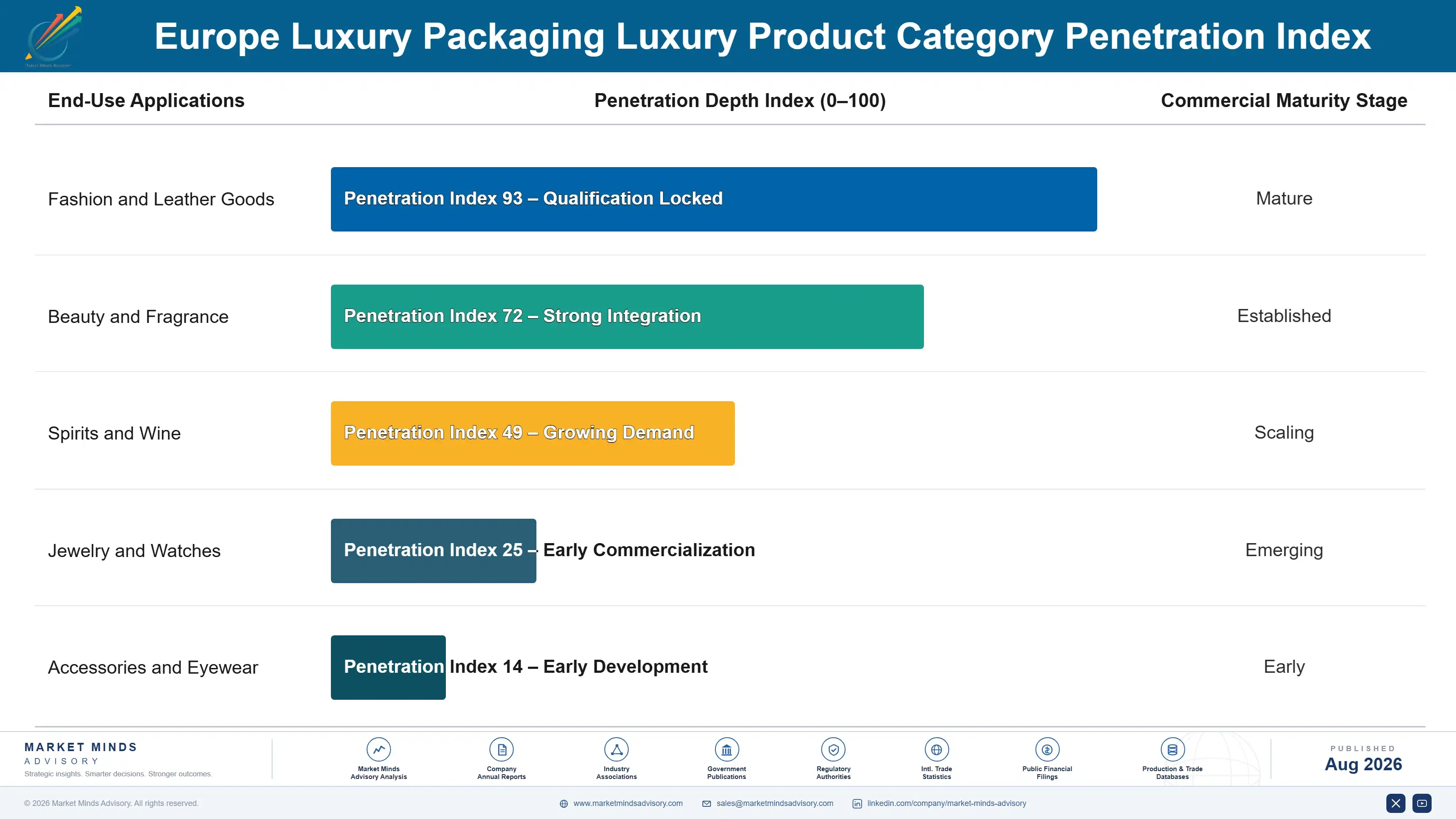
Revenue commits differently depending on which mechanism drives the purchase. Flagship contracts lock in tightly around seasonal collection cycles, since brands commit to exclusive design relationships that continue across multiple seasons once established. Brand-extension packaging revenue accrues incrementally as conglomerates roll out consistent presentation across broader product lines. Sustainability-driven redesign moves more gradually and stays genuinely reversible if cost pressure shifts
Adoption depth varies sharply by brand tier. Flagship luxury conglomerates go deepest, standardising premium packaging across their entire portfolio once brand consistency requirements become mandatory internally. Mid-tier premium brands adopt more selectively, often extending premium packaging only to their highest-margin product lines first. Smaller independent luxury brands weigh cost most heavily, since limited production volume makes bespoke craftsmanship considerably harder to justify economically.

Buyer profiles have shifted from packaging engineers toward creative directors and sustainability officers with distinct priorities entirely. A packaging engineer once compared material cost and durability directly; a creative director now tracks brand consistency across the full product portfolio, and a sustainability officer drives specification against environmental pledges a purely aesthetic evaluation would never have prioritised. Converters still selling on craftsmanship alone find decisions made by people who never reviewed their sustainability credentials.
europe-luxury-packaging-market-end-use-penetration-index-1787332749405

Our Call On Europe Luxury Packaging

These are among the four positions where our research anticipates prominent divergence between winners and laggards over the coming forecast period. Each is grounded in the demand model, the regulatory perimeter, and the announced capacity pipeline.
01 / CRAFTSMANSHIP SCALE STRATEGY

Scale premium presentation across the full brand portfolio

Converters that scale premium presentation economically across a brand's full product portfolio, rather than confining exceptional craftsmanship to flagship items alone, capture the expanding packaging investment that luxury conglomerates are directing across broader product ranges. That capability commands a premium of 20 to 35% over converters limited to small flagship-only production runs, since brands pay for consistent quality across scale as much as for the underlying craftsmanship itself. Converters should prioritise this scale now, because it is not quickly replicated once rivals catch up.
02 / SUSTAINABLE MATERIAL INNOVATION

Solve sustainability without sacrificing tactile quality

Sustainable material innovation that maintains genuine tactile weight and finish quality, rather than accepting perceived quality loss as an unavoidable tradeoff, wins exclusive brand contracts that competitors offering only superficial environmental changes cannot secure, cutting packaging weight by roughly 20% without sacrificing customer perception. Converters who solve this genuinely, rather than treating sustainability as a marketing afterthought, capture the growing share of luxury conglomerate packaging budgets tied directly to public environmental commitments. Converters should invest here now, before rivals close the gap.
03 / AUTHENTICATION INTEGRATION STRATEGY

Integrate authentication before counterfeit exposure worsens

Authentication features embedded directly into packaging, rather than relying purely on craftsmanship signalling that counterfeiters increasingly replicate convincingly, protect brand value that counterfeit goods erode considerably, with counterfeit losses now exceeding 50 billion euros annually across an expanding set of luxury categories facing rising imitation and pressure. Converters who integrate authentication technology directly into packaging design capture exclusive contracts from brands facing severe counterfeit exposure. Converters should build this capability now, ahead of accelerating counterfeit pressure across most product categories.
04 / PRODUCTION SCALE CONSISTENCY

Master craftsmanship at scale before rivals close the gap

Craftsmanship consistency at expanding production volume, rather than the small-batch artisanal approach that historically defined luxury packaging exclusively, lets converters serve brand extension demand without the quality degradation that undermines the entire premium positioning a brand invests decades building, capturing roughly 40% more volume than smaller rivals. Converters who master this scaling challenge capture flagship-level contract expansion that competitors still limited to small production runs simply cannot fulfil reliably. Converters should invest in this capability now, before demand outpaces capacity.

Engagement Snapshot From the Field

A live engagement with an industry participant carrying material or product regulatory and market exposure ahead of a defining policy shift, showing how our research translates into a defensible multi-year portfolio strategy.
MARKET MINDS ADVISORY · CLIENT ENGAGEMENT SUMMARY
Europe Luxury Packaging Producer Strategic Portfolio Review and Transition Roadmap 2026·Investment Scenario on Europe Luxury Packaging Exposure Evaluation 2025-26
CLIENT PROFILE
A mid-sized luxury fragrance house engaged MMA while planning packaging strategy ahead of extending its flagship bottle design across four additional product lines within its portfolio. The client reported annual packaging spend near USD 22 million and faced a board mandate to maintain flagship-level presentation quality while scaling production volume considerably (client-reported, unverified by MMA).
STRATEGIC CHALLENGE
Extending flagship design across additional product lines risked diluting the exclusivity that justified the original flagship's premium positioning, but the client's team had limited experience managing craftsmanship consistency at meaningfully expanded production volume. The board wanted cost certainty across the extension, but converter capability and quality consistency both varied considerably across candidate suppliers.
MMA APPROACH
MMA evaluated five candidate luxury glass converters against demonstrated craftsmanship consistency at scale, sustainable material capability, and technical support availability given the client's expansion timeline. We modelled total cost including quality consistency risk rather than unit price alone. We then assessed each converter's track record with comparable fragrance house portfolio extensions.
KEY FINDINGS
  1. Only two of the five candidate converters had demonstrated craftsmanship consistency at the production volume the client's full four-line extension actually required.
  2. The recommended converter's sustainable glass formulation cut packaging weight by roughly 18% while maintaining the flagship's original tactile quality (client-reported, unverified by MMA).
  3. Quality consistency risk varied considerably by converter, with the weakest candidate showing clearly measurable finish variation across multiple separate pilot production runs.
  4. Selecting a converter purely on unit cost, without proven consistency at scale, would have risked diluting the flagship brand's premium positioning entirely.
CLIENT PROFILE
A mid-sized luxury fragrance house engaged MMA while planning packaging strategy ahead of extending its flagship bottle design across four additional product lines within its portfolio. The client reported annual packaging spend near USD 22 million and faced a board mandate to maintain flagship-level presentation quality while scaling production volume considerably (client-reported, unverified by MMA).
STRATEGIC CHALLENGE
Extending flagship design across additional product lines risked diluting the exclusivity that justified the original flagship's premium positioning, but the client's team had limited experience managing craftsmanship consistency at meaningfully expanded production volume. The board wanted cost certainty across the extension, but converter capability and quality consistency both varied considerably across candidate suppliers.
MMA APPROACH
MMA evaluated five candidate luxury glass converters against demonstrated craftsmanship consistency at scale, sustainable material capability, and technical support availability given the client's expansion timeline. We modelled total cost including quality consistency risk rather than unit price alone. We then assessed each converter's track record with comparable fragrance house portfolio extensions.
KEY FINDINGS
  1. Only two of the five candidate converters had demonstrated craftsmanship consistency at the production volume the client's full four-line extension actually required.
  2. The recommended converter's sustainable glass formulation cut packaging weight by roughly 18% while maintaining the flagship's original tactile quality (client-reported, unverified by MMA).
  3. Quality consistency risk varied considerably by converter, with the weakest candidate showing clearly measurable finish variation across multiple separate pilot production runs.
  4. Selecting a converter purely on unit cost, without proven consistency at scale, would have risked diluting the flagship brand's premium positioning entirely.
RECOMMENDED STRATEGY
Phase 1: Phase 1 (0 to 4 months): Validate the recommended converter's craftsmanship consistency through pilot production across two new product lines. Phase 2: Phase 2 (4 to 10 months): Extend production across the remaining two product lines once pilot quality is fully confirmed. Phase 3: Phase 3 (10 to 18 months): Roll out the sustainable glass formulation across the client's entire flagship product line portfolio.
OUTCOME
The client successfully extended flagship-level presentation across all four new product lines within the eighteen-month timeline, maintaining tactile quality while cutting packaging weight considerably. The sustainable formulation is now standard across the client's entire portfolio, and the pilot-first approach is the client's framework for future extensions (client-reported, unverified by MMA).

Frequently Asked Questions

Foundational context covering the market sizes, CAGR, scope, country, region and competition that inform every finding below. This section is provided to cover basics and most often pre-purchase conversations, answered from the MMA Primary Research Dataset.

What is the current size of the Europe Luxury Packaging Market?

This report covers the European luxury packaging market specifically, valued at USD 14.5 billion in 2025, spanning rigid boxes, glass and bottle packaging, finishing, closures, and sustainable materials for luxury goods. Non-European markets are excluded.

How large will the Europe Luxury Packaging Market be by 2036?

The market is forecast to reach USD 30.21 billion by 2036 in the base case, about 1.95 times the 2026 level. That represents incremental value of roughly USD 14.71 billion across the forecast decade.

What is the CAGR for the Europe Luxury Packaging Market 2026 to 2036?

The market grows at a 6.9% CAGR in the base case, with bull and bear scenarios at 8.1% and 5.6%. The spread turns mainly on sustainable material innovation pace and luxury goods spending cycles.

Which segment is growing fastest?

Rigid luxury boxes and cartons grow fastest at 11.4%, about 1.65 times the overall rate, as brands extend flagship-level packaging investment across broader product lines. Premium glass and bottle packaging follows at 9.2%.

Who are the major companies in the Europe Luxury Packaging Market?

Leading suppliers include Aptar Group, Verescence, Pochet Group, Autajon Group, and API Group, holding roughly 34% between them. Converters combining craftsmanship scale with sustainable innovation are increasingly capturing premium growth.

Which country is growing fastest?

France grows fastest at an 8.5% CAGR, building on its concentration of flagship luxury conglomerate headquarters and specialist craftsmanship traditions. Italy follows closely on comparable luxury manufacturing depth.

Report Segmentation Architecture

The full report scope spans multiple orthogonal segmentation dimensions, with cross-tabulated demand data provided for each dimension pair. Coverage extends further to regional breakdowns, trend trajectories, and the competitive detail needed to support segment-level decision-making.

By Packaging Format

  • Rigid Luxury Boxes and Cartons
  • Premium Glass and Bottle Packaging
  • Foil Stamping and Embossing Finishing
  • Premium Closures and Caps
  • Sustainable Luxury Packaging Materials

By Luxury Product Category

  • Fashion and Leather Goods
  • Beauty and Fragrance
  • Spirits and Wine
  • Jewelry and Watches
  • Accessories and Eyewear

By Commercial Dimension

  • Direct Brand Owner Contracts
  • Contract Manufacturing and Co-Packing
  • Exclusive Design Partnership Agreements
  • Distributor and Specialty Channel Sales

By Region

  • North America
  • Western Europe
  • East Asia
  • South Asia and Pacific
  • Latin America
  • Middle East and Africa
  • Eastern Europe

Scope, Methodology, and Coverage

Every figure in this report is reproducible from documented input assumptions. The scope below maps the historical period, the forecast horizon, the segmentation dimensions, and the countries covered, alongside the underlying primary and qualitative methodology.
Historical Period
2020 to 2025
Forecast Period
2026 to 2036
Base Year
2025 (USD billions; MMA Primary Research Dataset, August 2026)
Market Definition
This report covers the European luxury packaging market specifically, comprising packaging materials and finished products used for luxury fashion, beauty, spirits, and jewelry goods, valued at converter selling prices. It spans rigid luxury boxes and cartons, premium glass and bottle packaging, foil stamping and embossing finishing, premium closures and caps, and sustainable luxury packaging materials used across the European luxury goods sector. Luxury packaging markets outside Europe, mass-market consumer packaging, and luxury product manufacturing equipment are excluded from this scope entirely.
Quantitative Units
USD billions (current prices); packaging volume in units by format where applicable
Segmentation Dimensions
By Packaging Format; By Luxury Product Category; By Commercial Dimension; By Country
Regions Covered
North America, Western Europe, East Asia, South Asia and Pacific, Latin America, Middle East and Africa, Eastern Europe
Countries Covered
France, Italy, UK, Germany, Switzerland, Spain, Netherlands, Belgium, Poland, Czechia, Hungary, Romania, and additional European markets relevant to this sector
Key Companies Profiled
Aptar Group, Verescence, Pochet Group, Autajon Group, API Group, MCC Label, Gerresheimer, Bormioli Luigi, Guala Closures, HCP Packaging, Quadpack, Cosmogen Paris, Estal Group, RPC Bramlage, Faerch Group, O-I Glass, Ardagh Group, SGD Pharma, Roberto Cavagna Group, Toppan
Quantitative Methodology
Primary survey, n=3,800 respondents, Q4 2025, six countries; demand-side model with trade association cross-validation
Qualitative Methodology
47 expert interviews, Q4 2025; applied to validate demand model assumptions, identify emerging dynamics, and assess competitive positioning
Report Format
PDF and XLSX data workbook (Word format preview document)
Publisher
Market Minds Advisory
Report Code
MMA-2026-PAC-225
Published
August 2026
Contact
sales@marketmindsadvisory.com | www.marketmindsadvisory.com

Purchase the full Europe Luxury Packaging Market Report (2026 to 2036).

The full MMA Europe Luxury Packaging report sizes the European market across five packaging formats, five luxury product categories, and detailed national breakdowns through 2036 in depth. It profiles 20 converters on a consistent basis of luxury packaging revenue, scoring each on craftsmanship scale, sustainable material innovation, authentication integration, and flagship brand relationship depth. Scenario models quantify how brand extension investment, sustainability commitments, and counterfeit protection move both volume and achievable margin by packaging format. The report also includes conglomerate sustainability pledge tracking and craftsmanship benchmarking.
Five-format and five-category market sizing through 2036
Twenty-converter benchmark on luxury packaging revenue
Luxury conglomerate sustainability pledge tracking by brand
Craftsmanship scale and consistency benchmarking across converters
Authentication technology adoption tracking by category
Energy and glass furnace input cost risk mapping

Built For The People Who Decide

From boardroom strategy to bench-side execution, this report is read cover-to-cover by leaders shaping the next decade of their industry, turning demand scenarios, market dynamics and valuation benchmarks into decisions.
CXOs/ Presidents/ VPs/ Managers
M&A and Corporate Development
Strategy Teams and R&D Heads
Procurement and Product Directors
Regulatory and Compliance Leaders
Investor Relations and Equity Analysts