
Market Minds Advisory
Engine Flush Market

Engine Flush Market: Preventive Maintenance Demand and Service Channel Shifts Through 2036

Aging vehicle fleets and longer ownership cycles are pushing drivers toward preventive maintenance products, while quick-lube chains and online retail reshape how engine flush products actually reach the vehicles that need them.

Lead Analyst

David Horsley

Published

September 2026

Make Smarter Decisions with Customized Research Insights

Request a free sample report and evaluate market opportunities, growth trends, and competitive dynamics relevant to your business needs.

2025 MARKET VALUE$1.1BMarket Size 2025
2036 FORECAST VALUE$2.0BBase Case , 2026 to 2036
CAGR 2026 TO 20365.5 %Bull 6.7% / Bear 4.3%
INCREMENTAL OPPORTUNITY$0.8BNet 10- year value creation
EXPANSION MULTIPLE1.71x2036 value over 2026 base
Strategic Levers
M&A Pipeline
Regional Outlook
Country Rankings
Competitive Intelligence
Segmental Deep-dive
Call-Us : 91 93563 13602

Executive Snapshot and Market Trajectory

Engine flush products occupy a stubborn niche in vehicle maintenance: mechanics debate whether they help or harm, yet demand keeps climbing as vehicles stay on the road longer and owners look for ways to protect aging engines between major services across most major markets worldwide, regardless of the ongoing debate.
Valvoline and Liqui Moly continue supplying established chemical solvent-based formulations through both retail and professional service channels, since that format remains the most widely trusted option among independent mechanics across most markets and regions today. Enzymatic and low-solvent formulations are capturing disproportionate growth as manufacturers respond to concerns about seal damage linked to aggressive older chemistries used in earlier product generations still sold today.
Quick-lube chains and e-commerce retailers are both investing in bundling engine flush treatments with routine oil changes, betting that convenience-driven upsell captures volume that independent garages once controlled entirely on their own for decades across most local markets nationwide and abroad. Suppliers without established retail shelf presence or quick-lube chain relationships increasingly find themselves confined to smaller regional distribution deals lacking meaningful scale or negotiating leverage with either retailers or chains.
Market Definition
The engine flush market covers chemical solvent-based flush products, enzymatic and low-solvent formulations, diesel-specific flush treatments, universal multi-engine flush products, professional service-channel flush treatments, and retail do-it-yourself flush kits sold for internal combustion engine maintenance. It excludes engine oil itself, oil filters, and coolant system flush products sold as separate maintenance categories.
Base Year Value
$1.1B in 2025 (MMA Primary Research Dataset, August 2026)
Forecast Period
2026 to 2036, eleven discrete annual values
CAGR
5.5% base case. Bull 6.7%. Bear 4.3%.
Fastest Growth Segment
Chemical Solvent-Based Engine Flush: 7.5% CAGR
Fastest Growth Country
India: 7.5% CAGR
Fastest Growth Region
South Asia and Pacific: 7.5% CAGR
Largest Region
North America: 30% of 2025 global value
Market Leaders
Valvoline, Liqui Moly, BG Products, STP, Sea Foam Sales Company. Source: MMA Analysis based on company annual reports.
Primary Survey
n=3,800 procurement and R&D decision-makers, Q4 2025, six countries
Methodology
Demand-side build-up, cross-validated against public data, 47 expert interviews

Engine Flush Market Forecast Scenarios

engine-flush-market-size-forecast-scenario-1787548447848
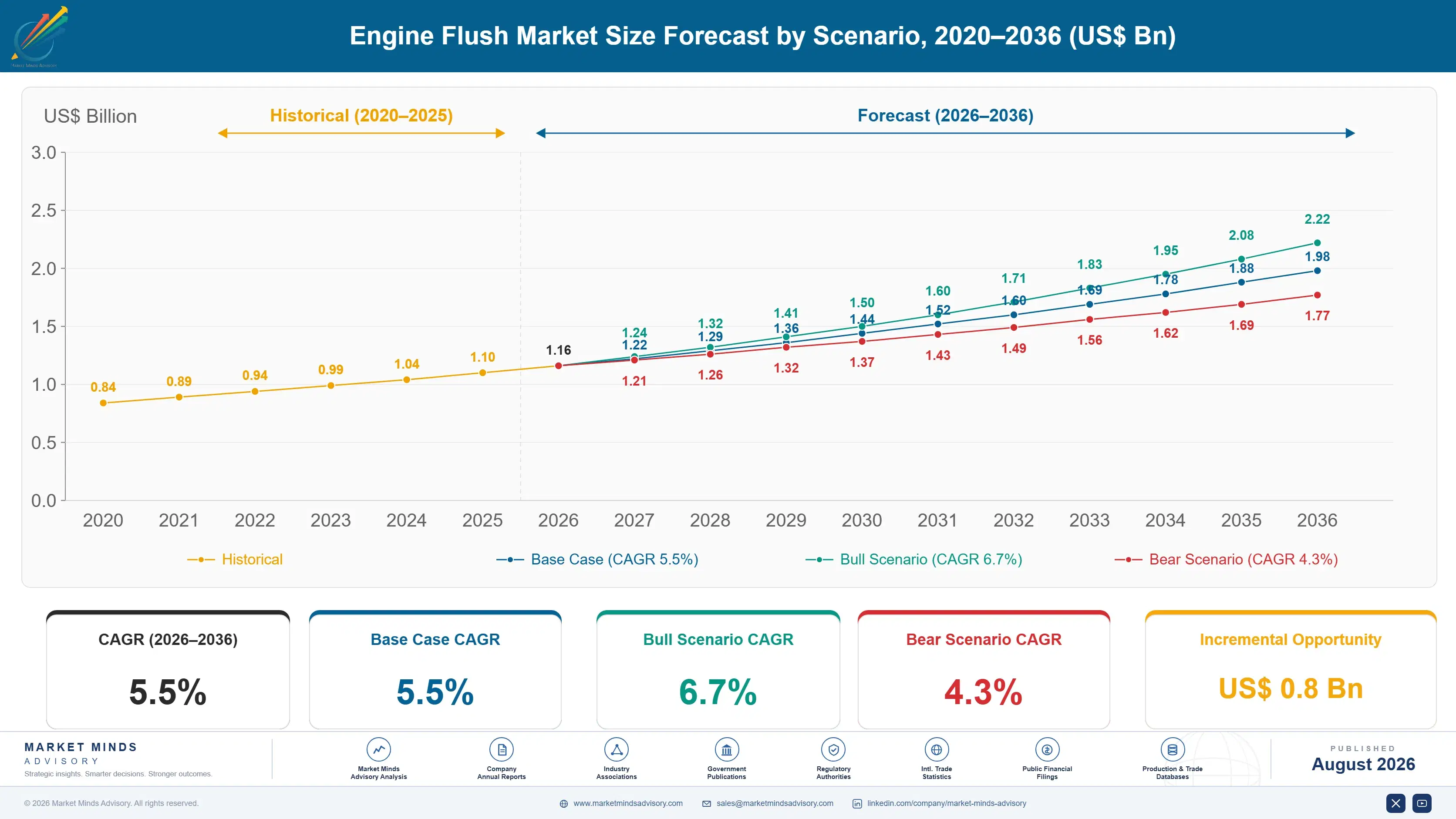
Between 2020 and 2025 the market grew at roughly 4.5 percent a year, as vehicle fleet average age continued climbing across major markets and owners increasingly looked toward preventive maintenance products to extend engine life beyond typical warranty periods and factory service intervals recommended by automakers themselves, particularly for older engines still on the road.
The base case assumes 5.5 percent annual growth to 2036, built on three mechanisms: rising average vehicle age extending the addressable pool of engines old enough to benefit from flush treatments, quick-lube chains bundling flush products into routine service visits at scale across their branch networks, and enzymatic low-solvent formulations expanding the addressable market to owners previously hesitant about aggressive chemical treatments damaging engine seals and gaskets over repeated use across many service cycles.
A bull case near 6.7 percent depends on quick-lube chain bundling adoption accelerating faster than currently planned across additional service networks and regions worldwide over the coming years. The bear case near 4.3 percent assumes vehicle electrification reduces the addressable combustion engine fleet faster than currently projected, shrinking the long-term base for flush product demand meaningfully.

A Maintenance Product Riding an Aging Fleet

Engine flush products are chemical or enzymatic treatments poured into an engine before an oil change to loosen sludge and varnish buildup, then drained along with the old oil. The category sits downstream of base oil and specialty chemical production and upstream of retail auto parts stores, quick-lube chains, and independent repair shops that either sell or apply the product directly.
MARKET CONCENTRATIONCR5 44%Moderate concentration exists with many smaller regional brands
AVERAGE SELLING PRICE$9.50 per bottlePrice varies by formulation type and package size
TOP PRODUCING COUNTRY SHAREUnited States 28%Largest base tied to established retail distribution networks
CAPACITY UTILIZATION68%Ample room given low capital intensity of blending
TRADE INTENSITY22% cross-borderMost volume produced and sold within the same region
COGS INPUT COST SHARE48%Base oil and solvent chemicals dominate production cost
Demand tracks vehicle fleet age more closely than new vehicle sales, since flush products address wear that accumulates over years of driving rather than a need present in new vehicles. Quick-lube chain bundling has become the fastest-growing distribution channel, converting what was once a discretionary do-it-yourself purchase into a routine upsell offered during standard oil change visits across thousands of service bays nationwide, meaningfully expanding the category's reach.
Production remains geographically dispersed given the relatively low capital intensity of chemical blending, with the United States holding the largest single-country share given its dense retail auto parts and quick-lube chain network. India is emerging as a fast growing market given its large aging vehicle fleet and expanding organized service sector reaching more cities each year.
"Mechanics will argue about engine flush forever, but the market does not care who wins that argument. It cares whether the bottle sits on the counter when the customer is already paying for an oil change."
Practice Lead, Automotive Aftermarket and Maintenance Products · MMA Automotive Practice · August 2026

Market Trends

Quick-Lube Chains Turn Flush Into a Standard Upsell

Major quick-lube chains have systematized engine flush as a recommended add-on during routine oil change visits, training technicians to inspect for sludge indicators and present the treatment as preventive maintenance rather than an optional extra. This shift has moved meaningful volume away from the do-it-yourself retail channel, where customers previously bought flush products separately and applied them at home before an oil change. Independent garages have followed with similar bundling practices, though less systematically than national chains with standardized service checklists and point-of-sale prompts built into their service software, further accelerating channel consolidation industry-wide.
Market Impact: Adds 5 percent annual unit volume
Enzymatic Formulations Address Seal Damage Concerns

Manufacturers have introduced enzymatic and low-solvent flush formulations specifically to address long-standing concerns that aggressive chemical solvents can damage rubber seals and gaskets, particularly in older engines already showing wear. These formulations work more slowly than traditional solvents but carry lower risk of causing the leaks that generated much of the skepticism mechanics have historically held toward flush products generally. Liqui Moly and several smaller specialty brands have led this shift, marketing enzymatic formulations at a price premium to buyers willing to pay for reduced risk over faster treatment time.
Market Impact: Sludge buildup risk rises 15 percent

Market Opportunities and Growth Drivers

Aging Vehicle Fleet Expands Addressable Engine Base

Average vehicle age on the road has climbed steadily across major markets as build quality improvements let owners keep cars running well past the ownership periods common a generation ago. Older engines accumulate more internal sludge and varnish than newer ones, making them the primary addressable base for flush product marketing and point-of-sale recommendations at service visits. This demographic shift toward older average fleet age has proven more durable than any single marketing campaign in sustaining baseline product demand, since it reflects a lasting shift in vehicle durability and ownership economics rather than a temporary trend that could reverse quickly.
Market Impact: Skepticism limits penetration to 35 percent

Extended Oil Change Intervals Raise Sludge Risk

Modern synthetic oils and automaker recommendations have extended typical oil change intervals well beyond the shorter cycles common in previous decades, but longer intervals also mean more time for sludge and varnish to accumulate between services when drivers skip or delay recommended maintenance visits. Quick-lube technicians increasingly cite this extended interval risk when recommending flush treatments, framing the product as compensation for maintenance schedules that leave more room for buildup than older, shorter interval schedules once did decades ago. This messaging has proven effective at converting skeptical customers into repeat buyers.
Market Impact: Cuts addressable fleet by 3 percent

Market Restraints and Challenges

Mechanic Skepticism Persists Around Product Effectiveness

A meaningful share of independent mechanics remain skeptical that engine flush products deliver benefits proportional to their cost, and some actively warn customers against using aggressive chemical formulations on higher-mileage engines. The root cause is documented cases where solvent-based products loosened sludge that had been inadvertently sealing worn gaskets, causing leaks that appeared only after the treatment. This skepticism limits category growth among the professional service channel that many consumers trust for maintenance guidance. Manufacturers are mitigating this friction by funding independent seal-compatibility testing and shifting product development toward enzymatic formulations that carry lower documented leak risk.
Market Impact: Lifts attach rates by 22 percent

Vehicle Electrification Shrinks the Long-Term Base

Growing electric vehicle adoption reduces the long-term size of the addressable combustion engine fleet that generates engine flush demand, since electric vehicles have no internal combustion engine requiring this maintenance category at all. The root cause is straightforward technological substitution rather than any weakness specific to flush products themselves. This restraint operates on a multi-decade timeline rather than an immediate one, given how slowly the existing combustion vehicle fleet turns over even as new sales shift toward electric models. Manufacturers are mitigating exposure by expanding into adjacent electric vehicle maintenance categories such as coolant and brake fluid products.
Market Impact: Enzymatic formulas command 30 percent premium
3 additional market trends, 2 additional growth drivers, and 4 additional restraints and challenges are covered in the full report. Contact sales@marketmindsadvisory.com to access the complete intelligence.

Segment CAGR and Growth Architecture

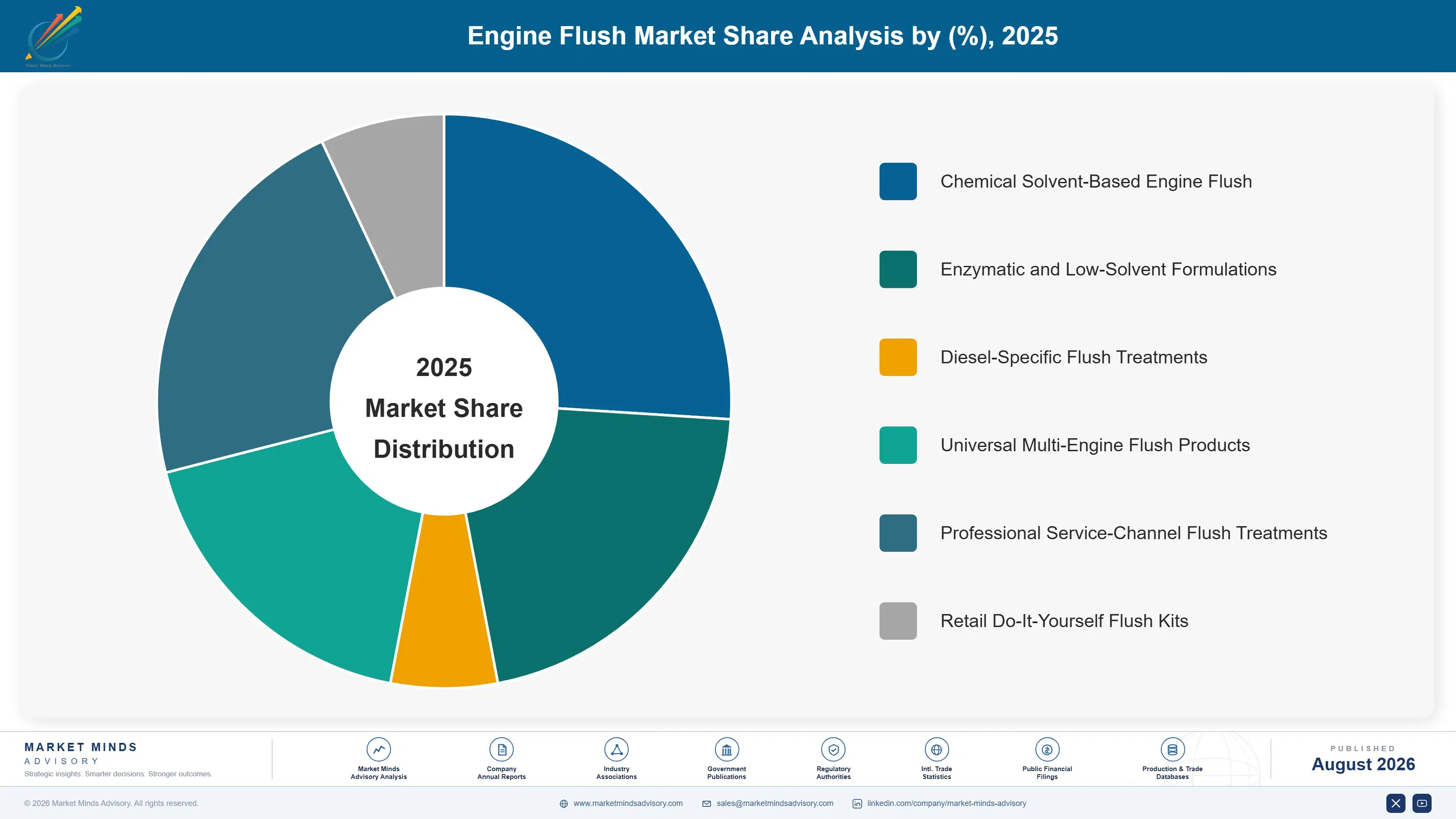
The market splits by chemistry and application format into six segments, since formulation type drives most of the risk perception and pricing variation buyers actually weigh. Chemical solvent-based products hold the largest installed base across professional service channels, while enzymatic formulations and diesel-specific treatments grow fastest as concerns about seal damage and diesel-specific fouling shape purchasing decisions.
engine-flush-market-market-share-analysis-1787548448397

Chemical Solvent-Based Engine Flush

Chemical solvent-based engine flush remains the largest segment and, somewhat surprisingly, is also growing fastest, since it remains the formulation most quick-lube chains stock and recommend given its lower cost and faster treatment time compared with enzymatic alternatives across most service networks nationwide. Valvoline and STP both continue expanding solvent-based product lines specifically to serve this high-volume professional channel, where treatment speed matters more to service bay throughput than the marginal seal-damage risk that concerns some independent mechanics. Manufacturers have also reformulated many solvent products to reduce aggressive chemical concentration, addressing some seal-damage concerns without fully abandoning the format's cost and speed advantages that quick-lube operators value highly across their branch networks.
CAGR 7.5%

Enzymatic and Low-Solvent Formulations

Enzymatic and low-solvent formulations are growing nearly as fast as chemical solvent products, capturing buyers specifically concerned about seal and gasket damage after encountering warnings from mechanics or online forums discussing aggressive chemical treatments used in older product generations still commonly found on retail shelves today across many markets. The segment commands a meaningful price premium over standard solvent products, reflecting both higher production cost and buyer willingness to pay for reduced risk. Liqui Moly has built a specific brand reputation around this formulation type, positioning it as the premium choice for owners of higher-mileage or already-vulnerable engines who cannot afford an unexpected leak from an aggressive treatment gone wrong.
CAGR 7.0%
Full segment breakdown across 7 segments available in the complete report.

Regional Architecture and Country Demand Map

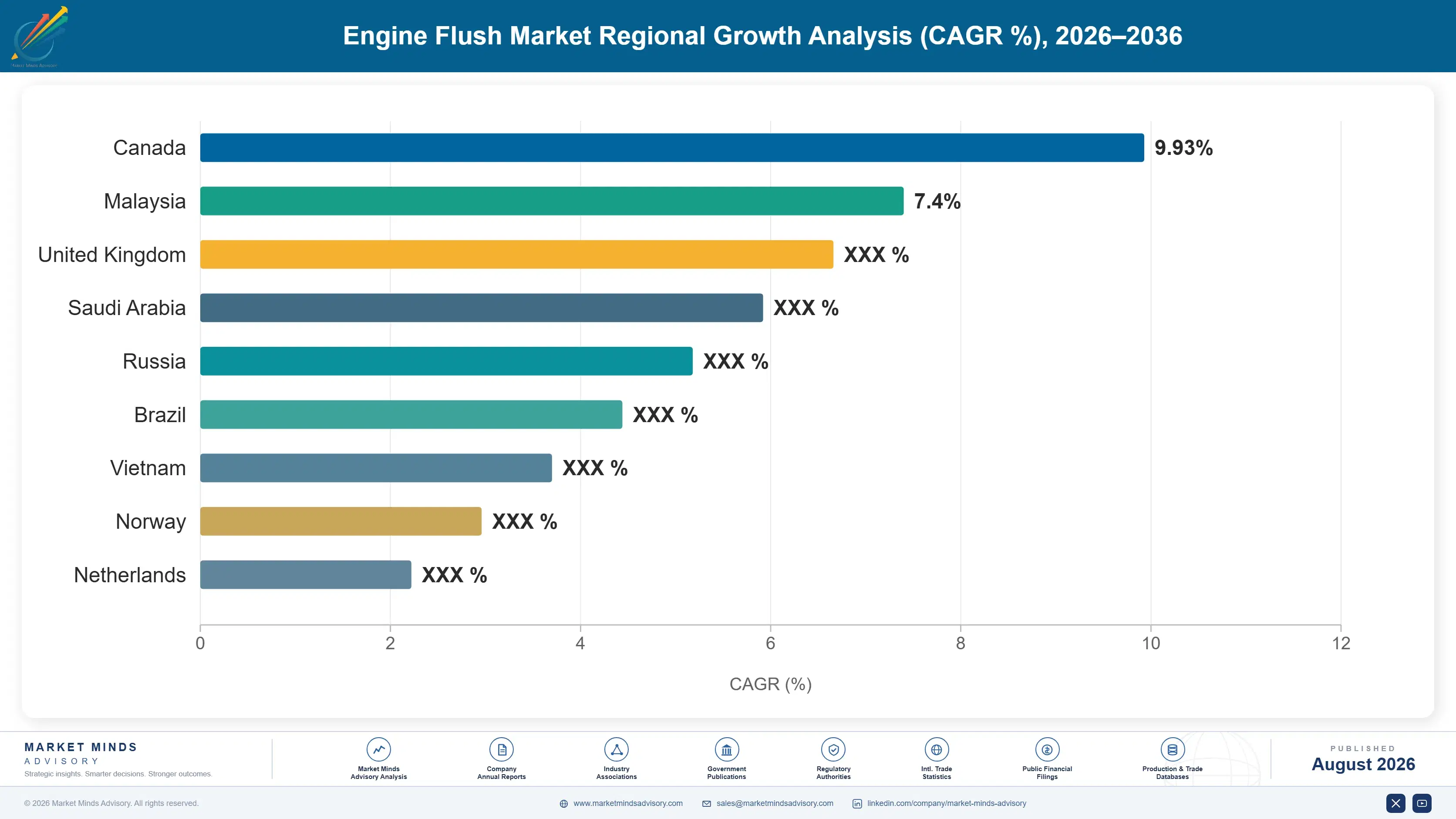
Regional demand concentrates wherever aging vehicle fleets intersect with organized service channels willing to actively recommend the product. North America leads given its uniquely dense quick-lube chain network, while South Asia and Pacific posts the fastest regional growth as India's fleet ages and its service sector formalizes.

North America

The United States anchors regional demand through its uniquely dense quick-lube chain network, with national chains treating engine flush as a standard checklist item during oil change visits far more systematically than in most other markets. Valvoline and STP both maintain their deepest retail and professional channel relationships here, reflecting decades of brand building through national advertising and shelf placement in major auto parts chains. Average vehicle age has climbed steadily as new vehicle prices rise and owners hold onto cars longer, expanding the addressable pool of older engines that benefit most from flush treatments. Canada follows a similar pattern at a smaller scale, with comparable quick-lube chain penetration in major metropolitan areas.
Share: 30% | CAGR: 5.5% (2026 to 2036)

East Asia

China's enormous vehicle parc, built up rapidly over the past two decades, is now aging into the mileage range where flush products see the strongest demand, creating a large and growing addressable base across most provinces. Japanese and South Korean markets show more mature, slower growing demand patterns, reflecting longer-established maintenance habits and a vehicle fleet that has already aged through its highest-demand window in prior years. Domestic Chinese manufacturers have entered the category aggressively, competing on price against established international brands in a market still forming clear brand loyalty patterns. Organized quick-lube chains remain less prevalent here than in North America, keeping more volume within independent garage channels for now across most cities.
Share: 24% | CAGR: 6.5% (2026 to 2036)
Regional intelligence for 5 additional markets available in the complete report: Western Europe, South Asia and Pacific, Latin America, Middle East and Africa, Eastern Europe. Contact sales@marketmindsadvisory.com.
engine-flush-market-country-cagr-analysis-1787548448911

Beyond the Bottle: Where Margin Really Sits

Standard retail flush bottles compete largely on shelf price once a brand is established, leaving thin margins for pure product sales. The stronger revenue opportunities sit in quick-lube channel partnerships, enzymatic formulation premiums, and diesel-specific product lines, categories where distribution access and formulation differentiation still command meaningfully better pricing than commodity retail bottles typically achieve.

Locking In Exclusive Quick-Lube Chain Partnerships

Manufacturers who secure exclusive or preferred supplier agreements with major quick-lube chains capture volume at wholesale pricing that still runs roughly 20 percent above typical retail shelf economics once technician labor and bundling markup are factored in fully. Winning these agreements requires demonstrating consistent product supply and often co-funding technician training programs that teach staff to identify sludge indicators and present the treatment persuasively to hesitant customers. Valvoline has built particularly deep quick-lube relationships through decades of category investment, making this channel harder for newer entrants to penetrate without comparable investment.
Market Impact: Captures a 20 percent better wholesale economics margin

Building a Premium Enzymatic Product Line

Enzymatic and low-solvent formulations command a price premium of roughly 30 percent over standard chemical solvent products, reflecting both higher production cost and buyer willingness to pay for reduced seal-damage risk across most vehicle age brackets. Building credibility in this segment requires investing in independent seal-compatibility testing and marketing that specifically addresses the skepticism mechanics have historically held toward aggressive chemical formulations sold under other brand names. Liqui Moly has captured disproportionate share in this segment by leading with that credibility argument rather than competing purely on treatment speed or shelf price alone.
Market Impact: Commands a full 30 percent retail price premium

Expanding the Line Into Diesel-Specific Formulations

Diesel engines accumulate different fouling patterns than gasoline engines, creating demand for diesel-specific flush formulations that command roughly 25 percent higher prices than universal multi-engine products given their more targeted chemistry and higher production cost overall across most markets. Commercial fleet operators running diesel vehicles represent a particularly attractive customer base, since fleet maintenance contracts generate recurring volume rather than one-time retail purchases spread across many buyers. BG Products has built a specific commercial fleet sales channel around this opportunity, differentiating itself from suppliers focused purely on retail consumer distribution channels.
Market Impact: Commands a full 25 percent diesel formulation premium

Who Controls the Margin Pool

Concentration sits moderate at a CR5 near 44 percent, calculated on retail and wholesale shipment volume across all formulation types. Valvoline holds the clearest leadership position given its scale across both retail shelf presence and quick-lube chain relationships built over decades. The gap to challengers like Liqui Moly is narrower in premium enzymatic formulations than in mainstream chemical solvent products, where Valvoline's distribution scale remains harder to match.
Current competitive activity centers on quick-lube chain partnership agreements and enzymatic formulation development, as suppliers race to capture channel volume and address long-standing seal-damage skepticism simultaneously. BG Products and Sea Foam Sales Company have both expanded commercial fleet sales channels, while STP continues developing retail brand recognition to differentiate from suppliers confined to professional channel distribution only.

Emerging pressure comes from private label and store-brand flush products scaling distribution through major retail chains, a trajectory that could eventually pressure branded product pricing at the value end of the category currently dominated by established national brands. Rankings could shift meaningfully over the next decade if these private label suppliers close the remaining brand trust gap that currently protects established national brands among quick-lube technicians.
engine-flush-market-company-positioning-matrix-1787548449441

Competitive Moat and Risk Dimensions

VALVOLINE

Moat: Deep Quick-Lube Chain Access

Valvoline's decades of investment in quick-lube chain relationships, including its own branded service centers, lets it embed flush products directly into standardized service checklists that independent brands struggle to access without comparable channel infrastructure and technician training investment built over many years of category presence.
VALVOLINE

Risk: Enzymatic Segment Lag Risk

Valvoline's historical strength in chemical solvent-based products creates some organizational inertia around fully committing to enzymatic formulation development, potentially ceding early mover advantage in that faster-growing premium segment to specialists already focused there exclusively and building lasting brand trust with skeptical mechanics over successive product generations.
LIQUI MOLY

Moat: Premium Enzymatic Brand Credibility

Liqui Moly has built a specific brand reputation around enzymatic and low-solvent formulations that address mechanic skepticism directly, positioning it favorably with buyers willing to pay a premium for documented reduced seal-damage risk rather than faster treatment time alone at meaningfully lower cost across most markets.
LIQUI MOLY

Risk: Limited Quick-Lube Chain Scale

Liqui Moly's relative focus on premium retail and independent garage channels potentially limits its exposure to the faster-growing quick-lube chain bundling channel that Valvoline and other scale competitors dominate more thoroughly across North American and broader global markets overall and for years to come as chains expand further.

Players Tracked

Prominent Players

Valvoline
Liqui Moly
BG Products
STP
Sea Foam Sales Company

Other Key Players

Prestone
Lucas Oil
Royal Purple
Motul
Wynn's
Mannol
Bardahl
Red Line Synthetic Oil
CRC Industries
Berryman Products
Gunk Performance Products
Slick 50
Rislone
K&W Products
Amsoil

Recent Developments

JUNE 2025

Valvoline announced an expanded technician training program across its quick-lube network aimed at standardizing engine flush recommendations during routine oil change visits, ahead of a broader rollout planned across additional service locations over the following year across several major regions nationwide and internationally as well.
Signal: Signals supplier confidence that quick-lube bundling will sustain long-term category volume growth broadly overall going forward
DECEMBER 2025

Liqui Moly entered a distribution agreement with a major European auto parts retailer to expand shelf presence for its enzymatic flush product line, reinforcing its position in a category increasingly valued for documented seal-compatibility testing and meaningfully reduced leak risk over time and repeated use.
Signal: Confirms major retailers increasingly favor documented seal-compatibility testing over unverified performance claims made today by rivals
APRIL 2026

BG Products launched an expanded commercial fleet sales division aimed at accelerating adoption of its diesel-specific flush formulations among large trucking and logistics fleet operators entering scheduled maintenance renewal cycles across several regional markets this year and well into the following calendar year as well.
Signal: Signals a competitive shift toward commercial fleet channels rather than pure retail distribution alone today overall

Base Oil and Specialty Solvents Drive Cost

Base oil and specialty solvent chemicals together account for roughly 48 percent of total engine flush production cost across most manufacturers. Base oil traces back to refineries in the Gulf Coast, the Middle East, and increasingly China, while specialty solvent and enzymatic active ingredients source from a smaller group of specialty chemical manufacturers concentrated in Germany and the United States.
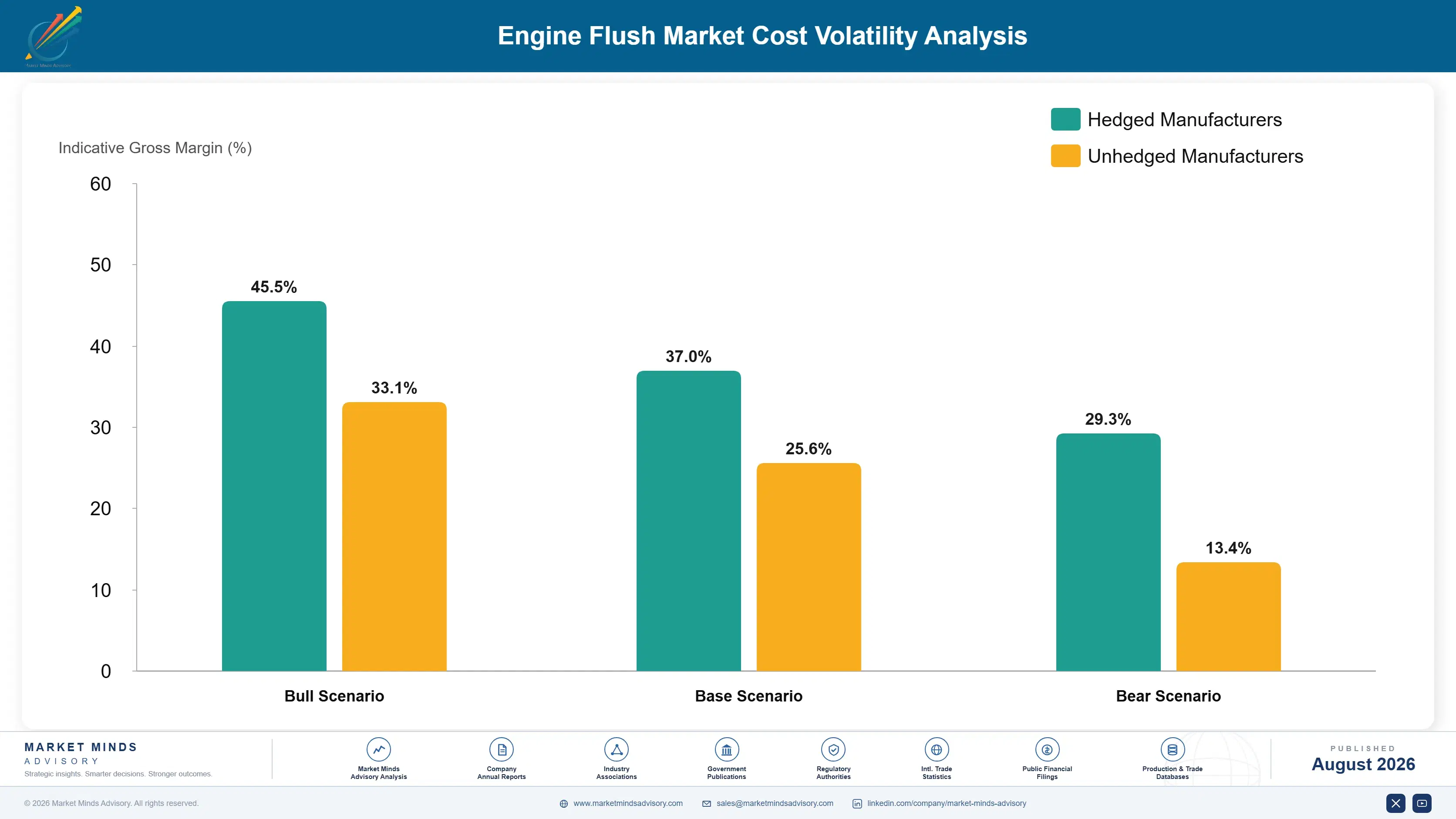
Base oil prices spiked sharply during 2022 as refinery capacity disruptions coincided with broader crude oil market volatility, according to EIA data, pushing manufacturer input costs up meaningfully within a single quarter. Manufacturers locked into annual retail and quick-lube supply contracts could not pass that increase through immediately, compressing margins for several quarters until contract renewal cycles allowed repricing closer to current base oil cost levels across most accounts.

Smaller regional blenders without diversified base oil sourcing face proportionally larger margin swings than large multinational producers who can shift purchasing across multiple refineries depending on relative input cost. This creates a durable cost advantage for scale players, since geographic and supplier diversification functions as a hedge unavailable to single-source regional competitors operating on thinner margins overall.
engine-flush-market-cost-volatility-analysis-1787548449638

Index-Linked Base Oil Pricing in Contracts

Larger producers are negotiating index-linked pricing clauses tied to published base oil benchmarks directly into annual retail and quick-lube supply contracts, letting cost pass-through occur quarterly rather than waiting for full contract renewal. This reduces the multi-quarter margin compression smaller blenders without comparable negotiating leverage continue to experience during base oil price spikes across most regions.

Diversifying Refinery Sourcing Across Regions

Producers are actively qualifying multiple base oil refineries across different regions specifically to reduce dependence on any single supplier during periods of price volatility or regional supply disruption. This diversification strategy requires meaningful upfront qualification testing investment but pays off during exactly the volatility periods when single-source competitors face the largest margin pressure and cost exposure.

Portfolio Architecture for Margin Defence

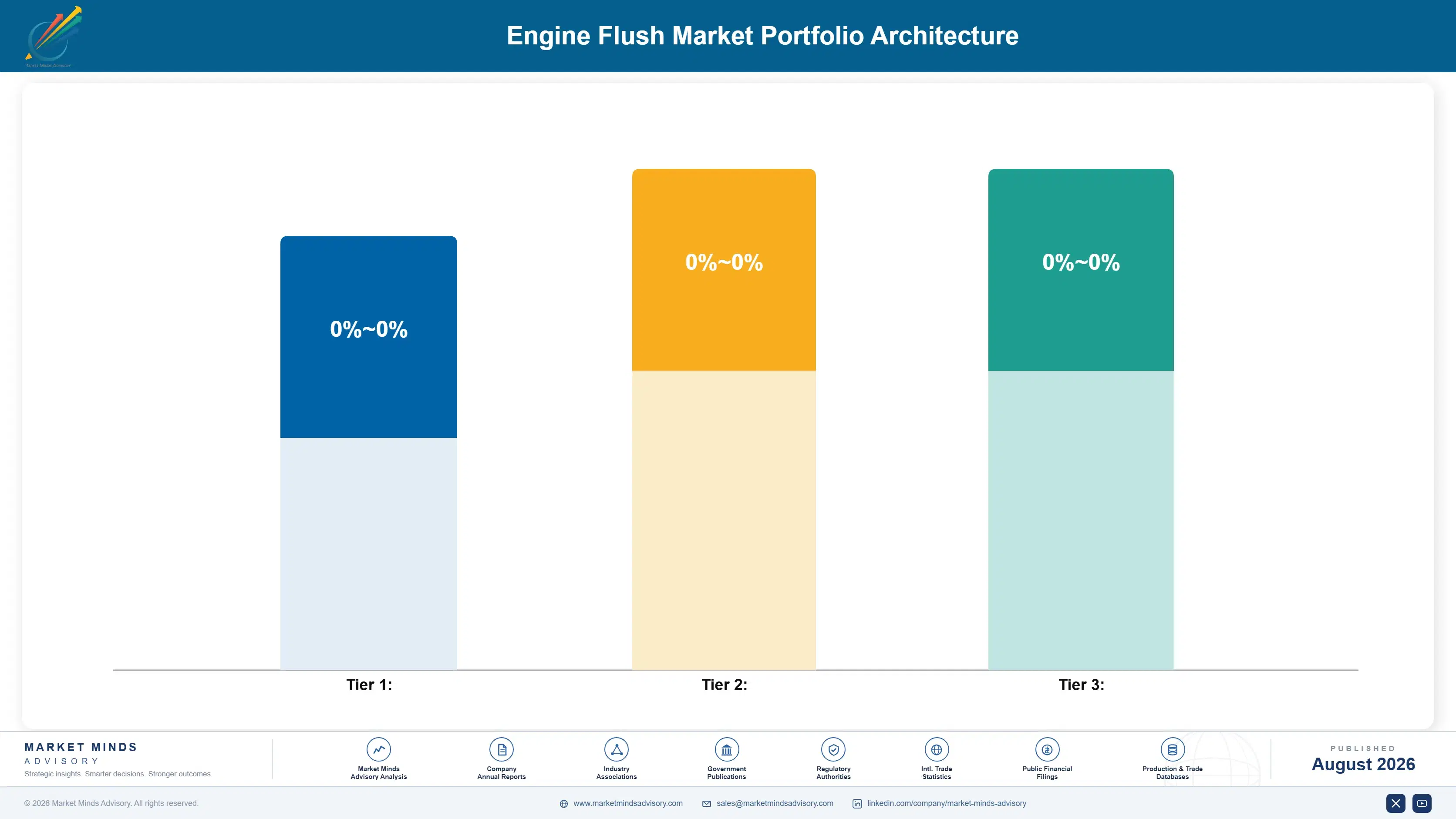
Three margin tiers define this category. Volume and commodity-adjacent products, mostly standard chemical solvent-based bottles sold through mass retail, compete on price with gross margins around 20 to 28 percent. Premium and certified products including enzymatic and diesel-specific formulations command 32 to 40 percent margins. Sustainability and next-generation low-solvent products sit highest, reflecting both formulation scarcity and buyer willingness to pay for documented reduced seal-damage risk.
The volume versus premium tension shows up clearest in retail shelf allocation decisions, since expanding enzymatic product facings reduces available shelf space for lower-margin commodity solvent bottles that still represent the largest single revenue pool today. Producers balancing this tradeoff carefully tend to outperform those chasing premium categories too aggressively before mechanic and consumer trust fully materializes across their target channels, particularly when marketing spend runs ahead of documented seal-safety evidence.

High-value margin pools concentrate specifically around enzymatic formulations and diesel-specific commercial fleet products, both categories where formulation differentiation and channel access support pricing well above commodity retail levels sustainably, even as overall category volume growth moderates toward the middle of the forecast period and quick-lube chains consolidate purchasing toward fewer trusted brands.

Standard chemical solvent-based bottles sold primarily on price through mass retail channels, with limited differentiation between brands beyond shelf placement, price promotion, and modest volume discount structures offered to the largest retail accounts.
Gross Margin

Enzymatic and diesel-specific formulations sold to buyers where documented seal-compatibility testing and targeted chemistry justify meaningfully higher unit prices than standard alternatives, with brand credibility creating a real barrier smaller suppliers rarely clear.
Gross Margin

Low-solvent and reduced-risk formulations sold to buyers prioritizing seal safety over treatment speed, commanding the category's highest margins given constrained formulation supply relative to rising demand and continued skepticism among smaller competitors.
Gross Margin
engine-flush-market-portfolio-architecture-1787548450141

High-value Sub-segments and Strategic Watch-out

Enzymatic and Low-Solvent Formulations

Enzymatic and low-solvent formulations combine premium pricing with the fastest trust-driven growth in the category, as documented seal-compatibility testing increasingly wins over skeptical mechanics and consumers industry-wide, a shift accelerating faster than overall category volume growth would suggest across most tracked retail and professional channels.

Diesel-Specific Flush Treatments

Diesel-specific flush treatments carry strong margins and steady commercial fleet adoption, though growth has moderated slightly as the segment matures beyond its initial fleet contract wins into broader trucking channel penetration that requires somewhat different sales relationships and pricing structures than passenger vehicle retail channels.

Chemical Solvent-Based Engine Flush

Chemical solvent-based engine flush remains the volume backbone of the category, generating the largest absolute revenue even as its relative share slowly declines against faster-growing enzymatic alternatives across most retail channels, particularly among quality-conscious quick-lube accounts adopting newer formulations across their branch networks each year.

Retail Do-It-Yourself Flush Kits

Retail do-it-yourself flush kits remain a shrinking niche today but warrant monitoring, since continued quick-lube chain bundling growth could accelerate the shift away from home application faster than currently expected, reshaping category economics for smaller retail-focused brands over time as channel volume keeps steadily consolidating.

Loyalty Built at the Counter

Engine flush is a repeat consumable tied to periodic maintenance visits rather than a one-time purchase, generating demand that behaves more like an annuity than a durable good sale once a customer accepts the treatment as routine. The recommendation moment happens at the service counter or quick-lube bay, meaning distribution access and technician persuasion matter more to repeat purchase than pure product quality or brand advertising reaching consumers directly at home.
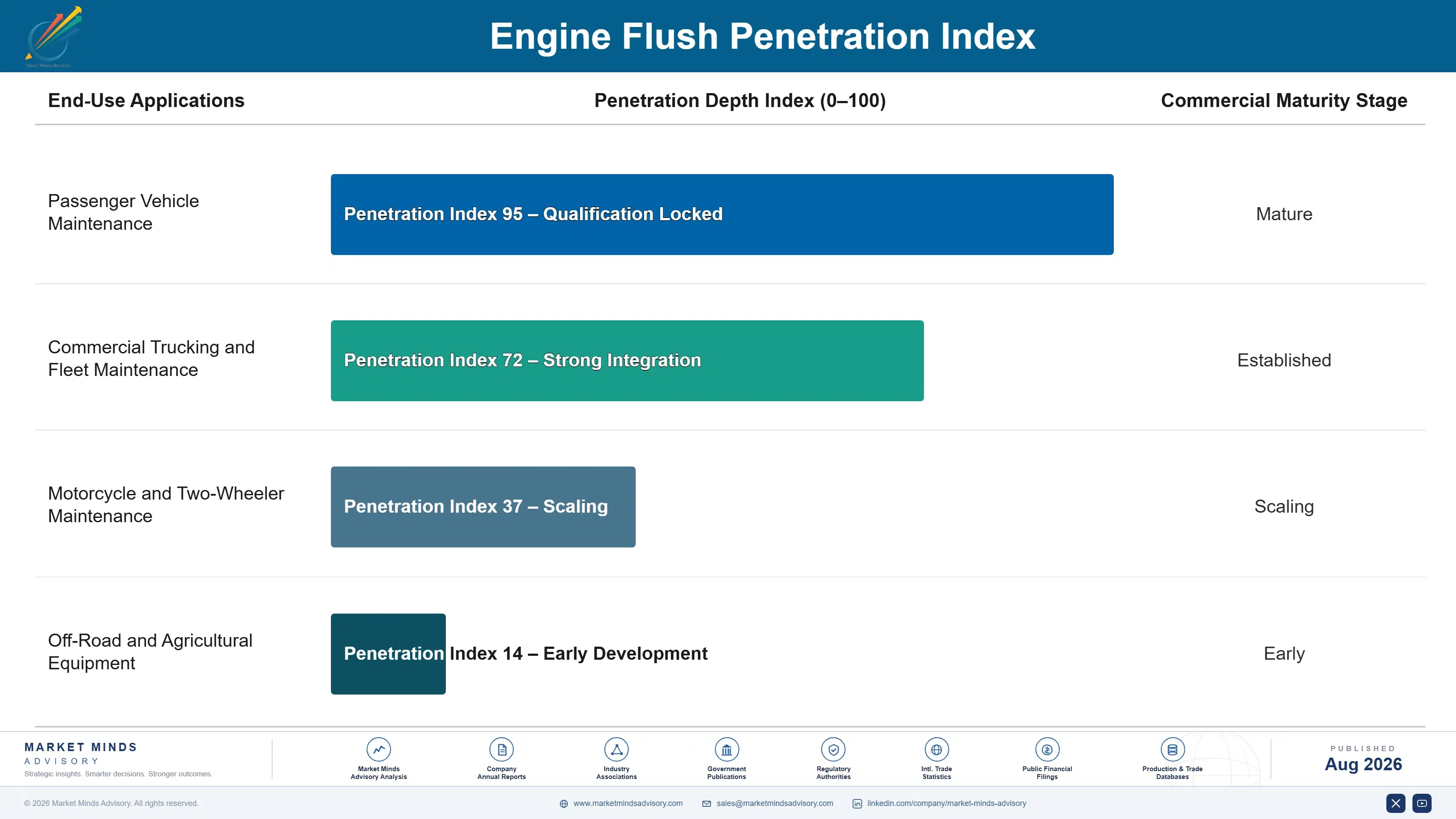
Adoption stickiness varies meaningfully by end-use vertical. Quick-lube chain customers show the deepest lock-in, since technicians consistently recommend whichever brand the chain stocks rather than letting customers choose independently. Do-it-yourself retail buyers show shallower stickiness, since they compare prices and switch brands more freely when shopping auto parts store shelves without a technician's standing recommendation guiding the purchase decision.

Buyer profiles are shifting generationally as younger vehicle owners increasingly research maintenance products online before visiting a shop, arriving with brand preferences already formed rather than accepting whatever a technician recommends on the spot. This has elevated the importance of online reviews and enthusiast forum discussions relative to traditional point-of-sale influence, rewarding brands with strong digital reputations over those relying purely on shelf presence and technician relationships built over decades.
engine-flush-market-end-use-penetration-index-1787548450625

What Determines Share in Engine Flush

These are among the four positions where our research anticipates prominent divergence between winners and laggards over the coming forecast period. Each is grounded in the demand model, the regulatory perimeter, and the announced capacity pipeline.
01 / QUICK-LUBE CHANNEL ACCESS

Lock In Chain Partnerships Before Competitors Do

Suppliers who secure exclusive or preferred quick-lube chain agreements capture wholesale volume that pure retail competitors cannot access, since technicians consistently recommend whichever brand the chain has already stocked and trained staff to sell. Those who wait risk losing entire regional chains to competitors who invested earlier in technician training and co-funded marketing programs across multiple branch networks. Capital committed early to these relationships tends to compound into durable volume that outlasts any single price promotion competitors might run to win shelf space back.
02 / SEAL-SAFETY CREDIBILITY BUILDING

Fund Independent Testing Before Skepticism Hardens

Suppliers who invest in independent seal-compatibility testing before mechanic skepticism becomes entrenched capture premium enzymatic segment share more easily than those trying to rebuild trust after negative word-of-mouth spreads through professional networks and online enthusiast forums over time. Building that credibility after skepticism is already widespread means competing against suppliers who established documented safety records years earlier through sustained testing investment. The credibility-building cycle itself takes long enough that late movers effectively concede the category's highest-margin segment to whoever invested first and built the deepest testing record.
03 / COMMERCIAL FLEET EXPANSION

Prioritize Diesel Fleet Contracts Over Retail Volume

Suppliers who build dedicated commercial fleet sales channels for diesel-specific formulations capture recurring contract revenue that one-time retail purchases cannot match in either predictability or margin over the life of a fleet contract. This works best for suppliers who can demonstrate fleet maintenance cost savings backed by real operational data rather than general product claims alone made in marketing materials. Suppliers pursuing this strategy should prioritize larger trucking and logistics fleets first, since contract economics improve meaningfully with fleet size and renewal frequency.
04 / GEOGRAPHIC GROWTH PRIORITIZATION

Weight Expansion Toward India and Southeast Asia

Producers concentrated in North America and Western Europe should weight incremental expansion investment toward India and Southeast Asia, where the aging vehicle fleet and formalizing service sector are creating the fastest addressable demand growth globally by a clear margin. Waiting for that formalization to complete before entering risks ceding early brand relationships to regional suppliers who move faster despite weaker formulation credibility and thinner distribution infrastructure overall. Early market entry there compounds into durable brand loyalty as the organized service sector keeps expanding across more cities.

Engagement Snapshot From the Field

A live engagement with an industry participant carrying material or product regulatory and market exposure ahead of a defining policy shift, showing how our research translates into a defensible multi-year portfolio strategy.
MARKET MINDS ADVISORY · CLIENT ENGAGEMENT SUMMARY
Engine Flush Producer Strategic Portfolio Review and Transition Roadmap 2026·Investment Scenario on Engine Flush Exposure Evaluation 2025-26
CLIENT PROFILE
The client operates a large North American quick-lube chain with several hundred locations performing routine oil changes and related maintenance services. Facing flat same-store transaction growth and pressure to increase average ticket value per visit, the operations team wanted to determine whether expanding engine flush recommendations chain-wide could meaningfully lift revenue without triggering customer complaints about unnecessary upselling during routine service visits.
STRATEGIC CHALLENGE
The client needed to determine which specific vehicle mileage and age thresholds justified recommending engine flush treatment, and how to train technicians to present the recommendation credibly without triggering the upselling skepticism that has damaged customer trust at other quick-lube chains across the wider industry over these past several recent years.
MMA APPROACH
MMA conducted a structured review of flush product effectiveness data segmented by vehicle mileage and engine type, supplemented by primary interviews with technicians and quick-lube operations managers at comparable chains already running structured flush programs successfully. The analysis modeled attach rate and customer satisfaction tradeoffs across different recommendation approaches and technician training methods.
KEY FINDINGS
  1. Vehicles above a specific mileage threshold showed measurably higher customer acceptance of flush recommendations than lower-mileage vehicles receiving the identical sales pitch.
  2. Technicians trained to reference specific sludge indicators visible during the service visit achieved meaningfully higher attach rates than those using generic scripted recommendations.
  3. Chains that over-recommended flush treatment on lower-mileage vehicles experienced clearly measurable declines in customer satisfaction scores during the entire following fiscal quarter.
  4. Enzymatic formulations generated meaningfully fewer customer complaints about post-treatment issues than chemical solvent alternatives across every single reviewed comparison chain studied closely.
CLIENT PROFILE
The client operates a large North American quick-lube chain with several hundred locations performing routine oil changes and related maintenance services. Facing flat same-store transaction growth and pressure to increase average ticket value per visit, the operations team wanted to determine whether expanding engine flush recommendations chain-wide could meaningfully lift revenue without triggering customer complaints about unnecessary upselling during routine service visits.
STRATEGIC CHALLENGE
The client needed to determine which specific vehicle mileage and age thresholds justified recommending engine flush treatment, and how to train technicians to present the recommendation credibly without triggering the upselling skepticism that has damaged customer trust at other quick-lube chains across the wider industry over these past several recent years.
MMA APPROACH
MMA conducted a structured review of flush product effectiveness data segmented by vehicle mileage and engine type, supplemented by primary interviews with technicians and quick-lube operations managers at comparable chains already running structured flush programs successfully. The analysis modeled attach rate and customer satisfaction tradeoffs across different recommendation approaches and technician training methods.
KEY FINDINGS
  1. Vehicles above a specific mileage threshold showed measurably higher customer acceptance of flush recommendations than lower-mileage vehicles receiving the identical sales pitch.
  2. Technicians trained to reference specific sludge indicators visible during the service visit achieved meaningfully higher attach rates than those using generic scripted recommendations.
  3. Chains that over-recommended flush treatment on lower-mileage vehicles experienced clearly measurable declines in customer satisfaction scores during the entire following fiscal quarter.
  4. Enzymatic formulations generated meaningfully fewer customer complaints about post-treatment issues than chemical solvent alternatives across every single reviewed comparison chain studied closely.
RECOMMENDED STRATEGY
Phase 1: Phase one: train technicians to recommend flush treatment only above the validated mileage threshold using visible sludge indicators they observe. Phase 2: Phase two: transition the recommended product line toward enzymatic formulations to reduce post-treatment complaint risk chain-wide going forward each quarter. Phase 3: Phase three: monitor attach rates and satisfaction scores quarterly, adjusting mileage thresholds as more service visit data steadily and reliably accumulates.
OUTCOME
The client implemented the mileage-based recommendation approach chain-wide, lifting average ticket value meaningfully (client-reported, unverified by MMA) without a measurable increase in customer complaints, according to the client's own internal satisfaction tracking data shared during the engagement across several hundred locations nationwide over the following year.

Frequently Asked Questions

Foundational context covering the market sizes, CAGR, scope, country, region and competition that inform every finding below. This section is provided to cover basics and most often pre-purchase conversations, answered from the MMA Primary Research Dataset.

What is the current size of the Engine Flush Market?

The global engine flush market reached approximately 1.1 billion dollars in 2025. Growth is driven by rising vehicle fleet age and expanding quick-lube chain bundling practices.

How large will the Engine Flush Market be by 2036?

MMA projects the market will reach approximately 1.98 billion dollars by 2036, roughly 1.71 times its 2026 value. Enzymatic formulations and diesel-specific products will drive much of that growth.

What is the CAGR for the Engine Flush Market 2026 to 2036?

The market is projected to grow at a 5.5 percent compound annual rate between 2026 and 2036. Bull and bear scenarios range from 4.3 to 6.7 percent depending on quick-lube bundling adoption speed.

Which segment is growing fastest?

Chemical solvent-based engine flush is growing fastest at a 7.5 percent CAGR, roughly 1.36 times the overall market rate. Its lower cost and faster treatment time drive continued quick-lube adoption.

Who are the major companies in the Engine Flush Market?

Valvoline, Liqui Moly, BG Products, STP, and Sea Foam Sales Company lead the market. Together they hold roughly 44 percent combined share on a shipment volume basis.

Which country is growing fastest?

India leads regional growth at a 7.5 percent CAGR, supported by its large aging vehicle fleet and rapidly formalizing organized service sector. Southeast Asian markets follow closely behind.

Report Segmentation Architecture

The full report scope spans multiple orthogonal segmentation dimensions, with cross-tabulated demand data provided for each dimension pair. Coverage extends further to regional breakdowns, trend trajectories, and the competitive detail needed to support segment-level decision-making.
  • Chemical Solvent-Based Engine Flush
  • Enzymatic and Low-Solvent Formulations
  • Diesel-Specific Flush Treatments
  • Universal Multi-Engine Flush Products
  • Professional Service-Channel Flush Treatments
  • Retail Do-It-Yourself Flush Kits
  • Passenger Vehicle Maintenance
  • Commercial Trucking and Fleet Maintenance
  • Motorcycle and Two-Wheeler Maintenance
  • Off-Road and Agricultural Equipment
  • Retail Auto Parts Distribution
  • Quick-Lube Chain Service Channels
  • Independent Garage Service Channels
  • Commercial Fleet Contract Sales

By Region

  • North America
  • East Asia
  • Western Europe
  • South Asia and Pacific
  • Latin America
  • Middle East and Africa
  • Eastern Europe

Scope, Methodology, and Coverage

Every figure in this report is reproducible from documented input assumptions. The scope below maps the historical period, the forecast horizon, the segmentation dimensions, and the countries covered, alongside the underlying primary and qualitative methodology.
Historical Period
2020 to 2025
Forecast Period
2026 to 2036
Base Year
2025 (USD billions; MMA Primary Research Dataset, August 2026)
Market Definition
The engine flush market covers chemical solvent-based, enzymatic and low-solvent, diesel-specific, universal multi-engine, professional service-channel, and retail do-it-yourself flush products sold for internal combustion engine maintenance. It excludes engine oil itself, oil filters, and coolant system flush products sold as separate maintenance categories.
Quantitative Units
USD billions
Segmentation Dimensions
Regions Covered
North America, East Asia, Western Europe, South Asia and Pacific, Latin America, Middle East and Africa, Eastern Europe
Countries Covered
Key Companies Profiled
Valvoline, Liqui Moly, BG Products, STP, Sea Foam Sales Company, Prestone, Lucas Oil, Royal Purple, Motul, Wynn's, Mannol, Bardahl, Red Line Synthetic Oil, CRC Industries, Berryman Products, Gunk Performance Products, Slick 50, Rislone, K&W Products, Amsoil
Quantitative Methodology
Primary survey, n=3,800 respondents, Q4 2025, six countries; demand-side model with trade association cross-validation
Qualitative Methodology
47 expert interviews, Q4 2025; applied to validate demand model assumptions, identify emerging dynamics, and assess competitive positioning
Report Format
PDF and XLSX data workbook (Word format preview document)
Publisher
Market Minds Advisory
Report Code
MMA-2026-AUT-109
Published
August 2026
Contact
sales@marketmindsadvisory.com | www.marketmindsadvisory.com

Purchase the full Engine Flush Market Report (2026 to 2036).

This report provides a comprehensive assessment of the global engine flush market. It covers sizing, segmentation, competitive dynamics, and regional demand through 2036. The analysis examines the shift from standard chemical solvent formulations toward enzymatic and diesel-specific products driven by mechanic skepticism and rising vehicle fleet age across major markets worldwide. It includes detailed competitive profiling of leading suppliers, input cost exposure across the base oil and specialty chemical supply chain, and a phased case study on quick-lube chain recommendation strategy and technician training approaches.
Ten-year market sizing and forecast scenarios
Six-segment MECE formulation classification breakdown overview
Seven-region demand and growth rate analysis
Competitive profiling of five leading suppliers
Input cost exposure across base oil supply chains
Anonymized client case study on chain recommendation strategy

Built For The People Who Decide

From boardroom strategy to bench-side execution, this report is read cover-to-cover by leaders shaping the next decade of their industry, turning demand scenarios, market dynamics and valuation benchmarks into decisions.
CXOs/ Presidents/ VPs/ Managers
M&A and Corporate Development
Strategy Teams and R&D Heads
Procurement and Product Directors
Regulatory and Compliance Leaders
Investor Relations and Equity Analysts