
Market Minds Advisory
Custom Packaging Market

Custom Packaging Market: E-Commerce Unboxing and Brand Differentiation Reshape Converter Economics

Direct-to-consumer brands are treating packaging as a marketing channel rather than a cost line, pulling custom corrugated and flexible converters into design partnerships that reward speed and print quality over pure unit economics.

Lead Analyst

Bilal Shaikh

Published

September 2026

Make Smarter Decisions with Customized Research Insights

Request a free sample report and evaluate market opportunities, growth trends, and competitive dynamics relevant to your business needs.

2025 MARKET VALUE$42.6BMarket Size 2025
2036 FORECAST VALUE$91.5BBase Case , 2026 to 2036
CAGR 2026 TO 20367.2 %Bull 8.4% / Bear 6.0%
INCREMENTAL OPPORTUNITY$45.9BNet 10- year value creation
EXPANSION MULTIPLE2.00x2036 value over 2026 base
Strategic Levers
M&A Pipeline
Regional Outlook
Country Rankings
Competitive Intelligence
Segmental Deep-dive
Call-Us : 91 93563 13602

Executive Snapshot and Market Trajectory

Unboxing videos turned packaging into a marketing budget line item almost overnight, and converters who can print short runs of branded corrugated fast are winning direct-to-consumer accounts that commodity box suppliers simply cannot serve profitably at comparable speed, quality, and cost.
Custom flexible packaging is capturing the fastest growth as food, beauty, and household brands shift toward mono-material pouches that satisfy both sustainability commitments and shelf standout goals simultaneously. Short-run digital printing has collapsed the minimum order quantities that once forced small and mid-size brands into generic, undifferentiated packaging, opening genuine competitive access to design work previously reserved for large consumer packaged goods companies with dedicated budgets and in-house design teams.
Five converters still account for a meaningful revenue share, yet the category remains far more fragmented than most packaging segments given how many regional printers now compete for the same short-run, quick-turnaround work across nearly every consumer category. Sustainability packaging regulations across the European Union and several US states are compressing material choices at exactly the moment digital printing is expanding design complexity, forcing converters to solve both problems simultaneously with limited engineering headcount.
Market Definition
This market covers custom-printed and structurally customised packaging, including corrugated boxes, flexible pouches and films, rigid plastic containers, paperboard cartons, and labels produced to brand-specific specifications. It excludes generic stock packaging sold without customisation and packaging machinery sold independent of the packaging product itself.
Base Year Value
$42.6B in 2025 (MMA Primary Research Dataset, August 2026)
Forecast Period
2026 to 2036, eleven discrete annual values
CAGR
7.2% base case. Bull 8.4%. Bear 6.0%.
Fastest Growth Segment
Custom Flexible Packaging: 10.4% CAGR
Fastest Growth Country
India: 9.6% CAGR
Fastest Growth Region
South Asia and Pacific: 9.4% CAGR
Largest Region
East Asia: 28% of 2025 global value
Market Leaders
International Paper, Smurfit WestRock, Mondi Group, Packaging Corporation of America, Sonoco Products. Source: MMA Analysis based on company annual reports.
Primary Survey
n=3,800 procurement and R&D decision-makers, Q4 2025, six countries
Methodology
Demand-side build-up, cross-validated against public data, 47 expert interviews

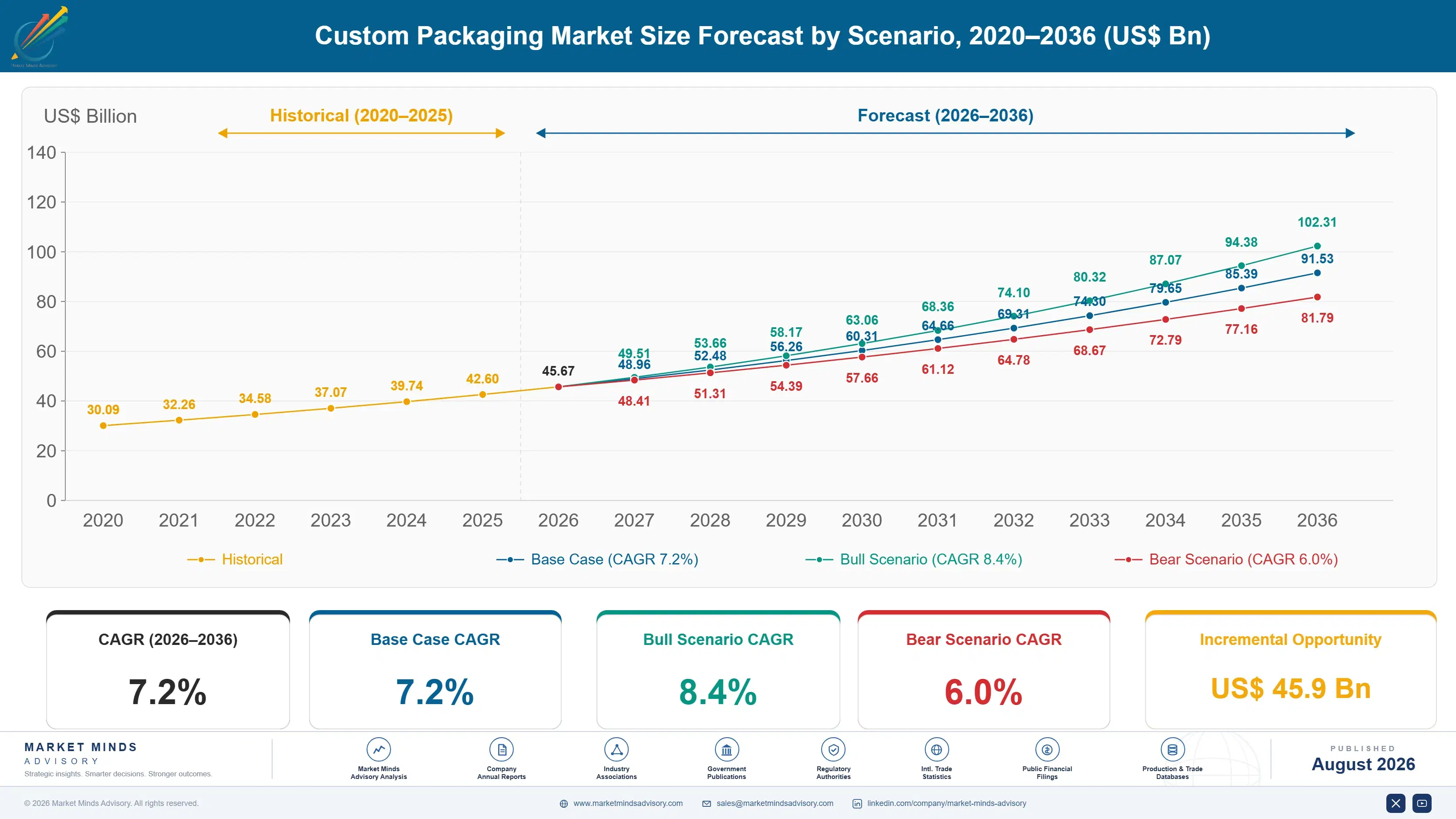
Custom Packaging Market Forecast Scenarios

custom-packaging-market-size-forecast-scenario-1787332407591
Between 2020 and 2025, the market grew at a historical rate near 6.2 percent, driven by pandemic-era e-commerce growth that pulled small and mid-size brands into custom packaging for the first time as direct-to-consumer shipping volume expanded rapidly across nearly every retail category worldwide, well ahead of most converters' existing digital capacity plans at the time.
The base case assumes 7.2 percent annual growth through 2036, built on three mechanisms: continued e-commerce unboxing investment as brands compete for social media visibility, sustainability regulation forcing a shift toward mono-material and recyclable custom formats across major consumer markets worldwide, and digital printing technology lowering minimum order quantities enough to bring custom packaging within reach of smaller brands that previously could not justify the cost of conventional flexographic setup and tooling.
A bull case near 8.4 percent depends on digital printing costs falling fast enough to displace conventional flexographic runs for mid-volume orders across most mainstream categories sold today. The bear case near 6.0 percent reflects slower e-commerce growth normalising after its pandemic-era surge, alongside continued raw material cost pressure squeezing converter margins across the industry and its many participants.

Packaging as Brand Channel, Not Cost Centre

Custom packaging has quietly become a proving ground for how quickly a converter can move from design file to finished product, since brands increasingly treat packaging turnaround time as a competitive advantage over rivals still working through longer conventional production cycles, setup delays, and approval bottlenecks across their organisation and supplier network, especially during peak seasonal ordering windows when every day of delay carries real commercial cost.
TOP 5 CONCENTRATION34% CR5revenue share held by five largest global converters
AVERAGE ORDER TURNAROUND12 daystypical time from design approval to final delivery
LEADING PRODUCING COUNTRYChina, 22%share of global production value, by home country
DIGITAL PRINT PENETRATION28% of volumeshare of custom orders using digital printing methods
MINIMUM ORDER QUANTITY500 unitstypical smallest run accepted by leading digital converters
PULP AND RESIN COST38% of COGSshare of total manufacturing input costs from raw materials
Commercial behaviour splits sharply by order volume. Large consumer packaged goods companies still commit to multi-year flexographic printing contracts at high volume, while direct-to-consumer and emerging brands increasingly favour digital printing suppliers who can deliver small, frequently refreshed runs without the setup cost penalty conventional printing imposes on short orders placed throughout the year across seasonal and promotional calendars tied to product launches and holidays.
The next decade turns on sustainability material transitions. Regulators phasing out multi-material flexible packaging in favour of mono-material recyclable formats will force converters to requalify printing processes across their entire customer base, a transition several converters have only just begun and few have fully budgeted for given the scale of engineering work still required across multiple product lines.
"Brands used to ask what the box costs. Now they ask what it says about them on Instagram, and that single shift changed who wins the printing contract entirely."
Director, Packaging and Materials Practice · MMA Packaging and Materials Practic

Market Trends

Digital Printing Collapses Minimum Order Quantities

Digital printing technology has cut typical minimum order quantities for custom corrugated and flexible packaging from several thousand units down to as few as 500, opening genuine access to custom design work for small and mid-size brands that previously could not justify conventional flexographic setup costs. HP Indigo and Bobst-equipped converters have expanded digital capacity considerably since 2023, targeting direct-to-consumer brands specifically seeking frequent design refreshes tied to seasonal campaigns. Digital printing now accounts for roughly 28 percent of custom packaging volume, up from a considerably smaller share five years earlier, according to industry capacity disclosures MMA analysts reviewed.
Market Impact: Shifts 30% of budget decisions
Mono-Material Mandates Reshape Flexible Packaging Design

The European Union's Packaging and Packaging Waste Regulation is phasing in recyclability requirements that effectively push flexible packaging converters toward mono-material structures rather than the multi-layer laminates that have dominated pouch design for decades. Several major converters, including Mondi Group and Amcor, have launched mono-material product lines specifically to meet incoming requirements ahead of full enforcement beginning in 2029. Brands reformulating packaging to comply face real trade-offs between barrier performance and recyclability, a technical challenge still being solved across the industry's material science teams and packaging engineering departments worldwide, at considerable ongoing cost.
Market Impact: Adds fees across 2 US states

Market Opportunities and Growth Drivers

E-Commerce Unboxing Investment Drives Corrugated Customisation

Direct-to-consumer brands increasingly treat the unboxing moment as a marketing opportunity worth dedicated budget, driving demand for custom-printed corrugated mailers and inserts designed specifically for social media sharing rather than pure shipping protection. Global e-commerce parcel volume has grown considerably since 2020, and brands report that packaging investment measurably improves repeat purchase rates and social media mention volume according to MMA Primary Research surveys of consumer brand marketing teams conducted in Q4 2025. This has pulled packaging budget decisions upward from operations teams into marketing departments at a growing number of mid-size brands.
Market Impact: Cuts shelf life 15 to 25%

Sustainability Regulation Forces Material Reformulation Now

Extended producer responsibility regulations across the European Union and several US states, including California and Colorado, now impose fees on packaging based on recyclability, pushing brands to specify mono-material and reduced-plastic custom packaging to lower compliance costs across their full product portfolio. These fee structures have made packaging material choice a direct financial decision rather than a purely aesthetic one, and converters offering pre-qualified compliant formats capture disproportionate new business as brands rush to avoid escalating fee schedules phasing in through 2027 across multiple jurisdictions and product categories nationwide and across export markets.
Market Impact: Adds 20 to 35% cost

Market Restraints and Challenges

Barrier Performance Trade-Offs Slow Mono-Material Adoption

Mono-material flexible packaging structures generally offer weaker oxygen and moisture barrier performance than the multi-layer laminates they are meant to replace, creating real shelf-life risk for food and beauty brands reluctant to compromise product quality for recyclability compliance alone. The root cause is that barrier coatings compatible with single-material recycling streams remain less effective than the specialised multi-layer films built over decades of material science development. This slows adoption even where regulation pushes hard toward the transition. Several converters are investing in improved barrier coating chemistry specifically to close this performance gap over the coming years.
Market Impact: Cuts minimum orders to 500 units

Short-Run Digital Printing Carries Persistent Cost Premium

Digital printing remains meaningfully more expensive per unit than conventional flexographic printing at moderate to high volumes, limiting its economic advantage to genuinely short runs where flexographic setup costs would otherwise dominate total order cost. The underlying cause is that digital press throughput still trails flexographic press speed considerably at comparable print quality. This keeps larger brands defaulting to conventional printing once order volume crosses a certain threshold. Press manufacturers continue investing in faster digital equipment specifically to narrow this cost gap and expand the addressable order size range for digital printing.
Market Impact: Targets full compliance by 2029
3 additional market trends, 4 additional growth drivers, and 3 additional restraints and challenges are covered in the full report. Contact sales@marketmindsadvisory.com to access the complete intelligence.

Segment CAGR and Growth Architecture

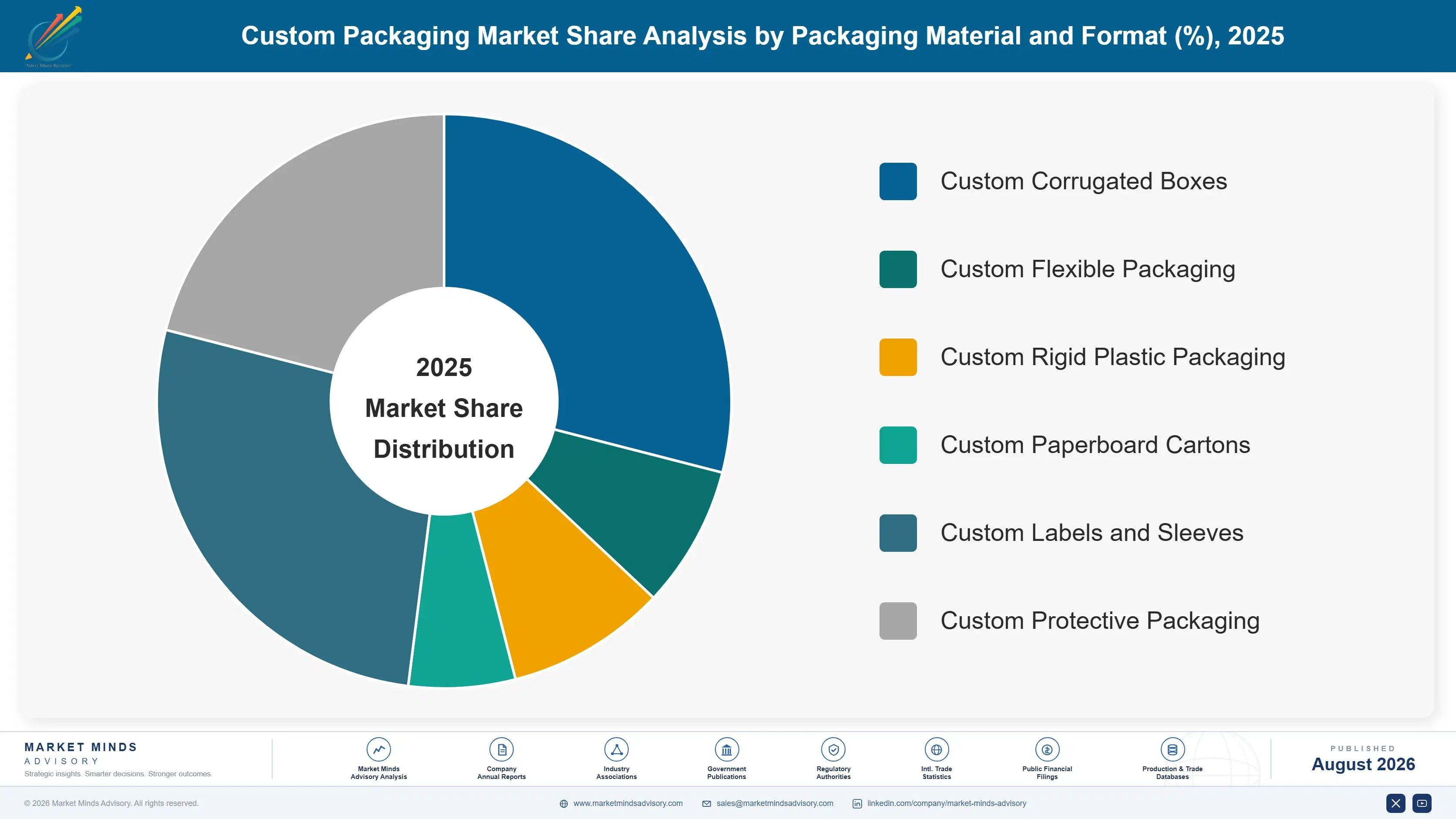
Segmentation follows packaging material and structural format, the classification brand owners and converters already use to specify products by substrate, printing process, and end-use application across every packaging category this report covers, from shipping and logistics through retail shelf presentation and premium unboxing experiences sold worldwide across every consumer segment tracked in this analysis.
custom-packaging-market-market-share-analysis-1787332408124

Custom Flexible Packaging

Custom flexible packaging is the fastest-growing format as food, beauty, and household brands shift toward mono-material pouches and films that satisfy both sustainability commitments and shelf differentiation goals simultaneously. The format benefits from lower material use per unit than rigid alternatives, a cost and sustainability advantage brands increasingly highlight in marketing alongside the visual customisation digital printing now makes economically viable at smaller order volumes. Amcor and Mondi Group lead development of mono-material pouch structures designed specifically to meet incoming European Union recyclability requirements ahead of full enforcement. Growth concentrates in food and personal care categories, where brands compete intensely on shelf standout within retail formats that increasingly reward distinctive packaging design over generic category conventions.
CAGR 10.4%

Custom Corrugated Boxes

Custom corrugated boxes grow fastest among structural packaging formats as direct-to-consumer brands invest in branded mailers and shipping boxes designed specifically for the unboxing moment rather than pure product protection during transit. International Paper and Smurfit WestRock have both expanded digital printing capacity specifically to serve this short-run, design-intensive segment of the corrugated market. Average order sizes have fallen considerably as more brands request smaller, more frequently refreshed print runs tied to seasonal campaigns and limited product releases planned throughout the calendar year. Growth concentrates among e-commerce-native brands and consumer packaged goods companies launching direct-to-consumer channels alongside their traditional retail distribution, both groups treating packaging as a genuine extension of brand identity.
CAGR 9.2%
Full segment breakdown across 6 segments available in the complete report.

Regional Architecture and Country Demand Map

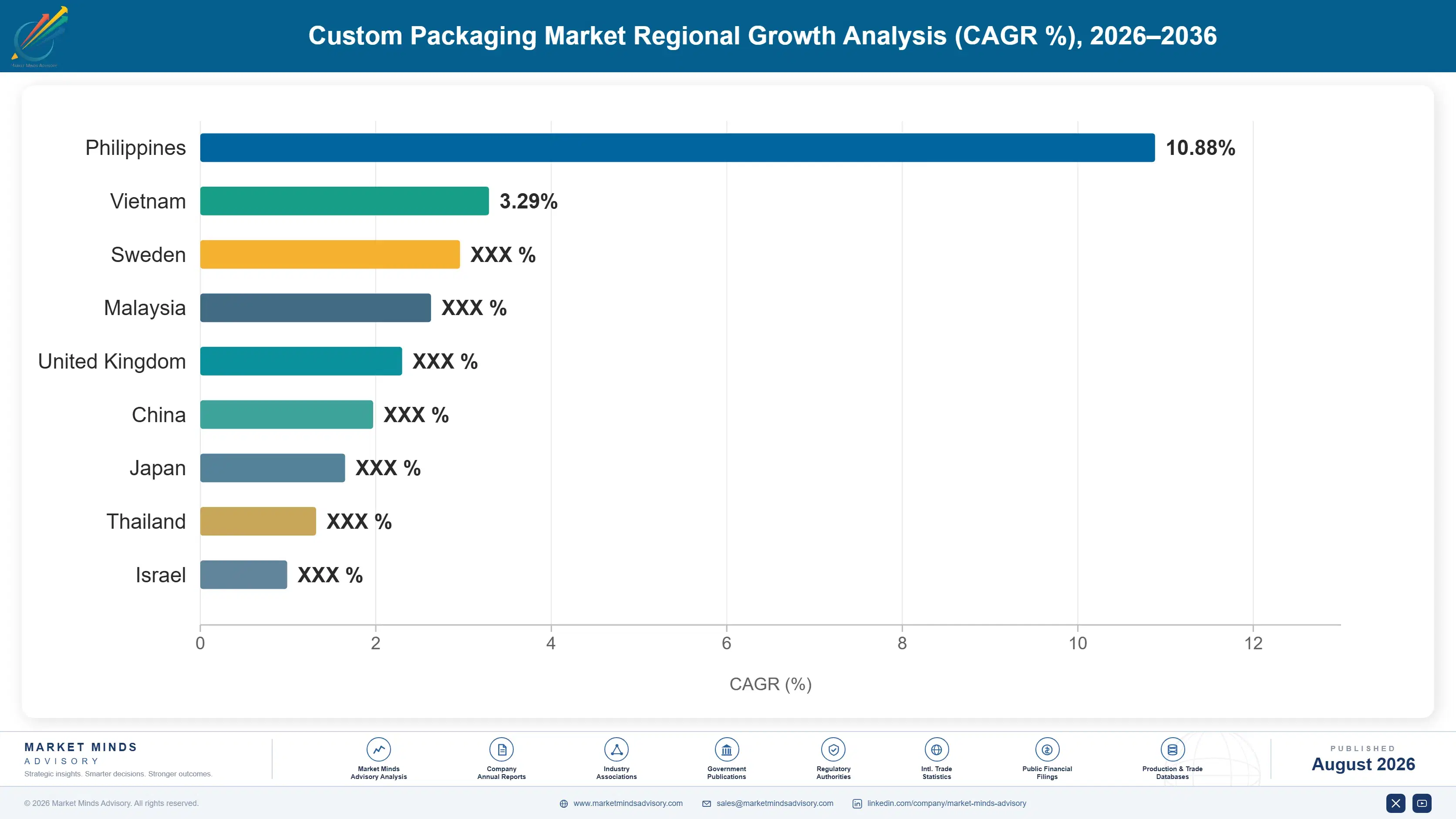
East Asia and North America together account for more than half of global custom packaging revenue, while South Asia and Pacific posts the fastest regional growth on expanding e-commerce and domestic brand competition across multiple rapidly developing markets and their steadily expanding retail formats today.

North America

The United States drives regional demand through its large direct-to-consumer brand base and sustained e-commerce parcel volume growth, both of which sustain steady demand for custom-printed corrugated mailers and inserts designed for social media visibility. Extended producer responsibility fee structures now active in California and Colorado are pushing brands toward compliant material choices faster than in states without comparable regulation currently in force. Canada contributes a smaller but steady share, with its own emerging extended producer responsibility framework following a similar regulatory trajectory to leading US states. Manufacturing investment concentrates around major metropolitan logistics hubs, where converters locate digital printing capacity close to e-commerce fulfilment centres to minimise shipping distance and turnaround time for time-sensitive orders.
Share: 27% | CAGR: 7.6% (2026 to 2036)

Western Europe

Germany anchors regional demand through its large consumer packaged goods manufacturing base and early compliance investment tied to the European Union's Packaging and Packaging Waste Regulation. France and Italy follow with meaningful demand concentrated in food and beauty packaging, sectors where both countries carry outsized global brand influence relative to their population size. The United Kingdom contributes a smaller but stable share, having implemented its own extended producer responsibility scheme independent of European Union requirements following its departure from the bloc. Regional growth trails East Asia and South Asia and Pacific because much of Western Europe's sustainability-driven material transition investment is already well underway relative to less regulated global markets.
Share: 22% | CAGR: 5.8% (2026 to 2036)
Regional intelligence for 5 additional markets available in the complete report: East Asia, South Asia and Pacific, Latin America, Middle East and Africa, Eastern Europe. Contact sales@marketmindsadvisory.com.
custom-packaging-market-country-cagr-analysis-1787332408642

Where Custom Packaging Margin Concentrates

Margin follows design complexity and turnaround speed, not print volume alone. Converters who solve short-run economics through digital printing capture premium pricing that high-volume flexographic competitors cannot profitably match given their fixed setup cost base and minimum order thresholds built into conventional press economics developed over many decades of steady, deliberate industrial engineering practice.

Digital Printing Premium for Short-Run Orders

Converters offering digital printing capture meaningfully higher per-unit pricing on short runs than flexographic competitors can offer profitably, since digital eliminates the setup cost that makes small orders unprofitable on conventional presses used across the industry. HP Indigo-equipped converters have built entire business lines around this pricing advantage, targeting direct-to-consumer brands specifically seeking frequent design refreshes at order volumes flexographic printing cannot serve economically. This positioning supports pricing 25 to 40 percent above comparable flexographic short-run costs, according to MMA Primary Research interviews with converter sales teams conducted in Q4 2025.
Market Impact: Adds a 25 to 40% pricing premium ov

Pre-Qualified Sustainable Material Formats Programme Rollout

Converters who pre-qualify mono-material and recyclable packaging formats ahead of incoming regulatory deadlines capture disproportionate new business from brands racing to avoid escalating extended producer responsibility fees tied to material recyclability scores set by regulators overseeing these programmes across multiple jurisdictions worldwide. Mondi Group and Amcor have both launched pre-qualified compliant product lines specifically to capture this timing advantage over competitors still developing comparable formats. Brands report willingness to pay 10 to 15 percent more for pre-qualified compliant packaging that removes their own regulatory risk and material testing burden entirely.
Market Impact: Commands a 10 to 15% compliance pri

Design Services Bundled with Print Production

Converters who pair custom printing with in-house structural and graphic design services capture higher-margin revenue beyond the physical packaging itself, since smaller brands increasingly lack dedicated packaging design capability and value a single accountable supplier relationship throughout the development process. WestRock's design studio model, now integrated within Smurfit WestRock, has demonstrated this approach at scale across multiple consumer brand accounts seeking full-service packaging partnerships spanning several product lines. This bundled service layer has widened effective project margins by an estimated 15 to 22 percentage points versus pure print production pricing documented in recent investor materials.
Market Impact: Widens margins by 15 to 22 points o

Fast-Turnaround Fulfilment Hub Proximity Advantage Strategy

Converters locating digital printing capacity near major e-commerce fulfilment centres capture time-sensitive orders that brands cannot source from distant suppliers given shipping lead time constraints on seasonal and promotional packaging campaigns planned months in advance across their marketing calendars and product launch schedules planned well ahead of time each quarter. Several converters have opened regional micro-fulfilment printing facilities specifically to serve this proximity advantage, cutting typical order turnaround from several weeks to under 12 days for brands willing to pay a premium for guaranteed fast delivery ahead of campaign launch dates.
Market Impact: Cuts turnaround to under 12 days to

Who Controls the Margin Pool

CR5 sits at 34 percent, low relative to most packaging categories, reflecting how many regional printers and converters compete for short-run custom work that large-scale flexographic specialists serve poorly. International Paper, Smurfit WestRock, Mondi Group, Packaging Corporation of America, and Sonoco Products hold the top five positions, though none commands the dominant share typical of more consolidated packaging segments elsewhere in the industry and its many sub-categories.
Current competitive activity centres on three fronts: large converters expanding digital printing capacity to defend against smaller, more agile regional printers, sustainability-focused entrants racing to pre-qualify mono-material formats ahead of regulatory deadlines, and design-services providers bundling creative work with production to capture higher-margin full-service accounts spanning multiple consumer categories and geographic regions.

Emerging pressure comes from regional digital-native printers, who have moved from basic short-run production toward genuine design partnership relationships with direct-to-consumer brands. Rankings shift most at the account level rather than globally: a converter's dominant position in flexographic high-volume work carries diminishing weight as brands increasingly split orders between conventional and digital suppliers based on run size, turnaround requirements, design complexity, and total landed cost per unit.
custom-packaging-market-company-positioning-matrix-1787332409164

Competitive Moat and Risk Dimensions

INTERNATIONAL PAPER

Moat: Scale After DS Smith Integration

International Paper's 2025 acquisition of DS Smith created the industry's broadest combined manufacturing footprint, giving it corrugated capacity and customer relationships across both North America and Europe that few standalone competitors can match at comparable scale, reach, or breadth of account coverage across both continents.
INTERNATIONAL PAPER

Risk: Post-Merger Integration Complexity

International Paper faces considerable execution risk integrating DS Smith's European operations and customer relationships, and any prolonged integration disruption could open opportunities for competitors to capture accounts during the transition period now underway across the newly combined company's global operations, management structure, and reporting lines.
SMURFIT WESTROCK

Moat: Integrated Corrugated Design Studios

Smurfit WestRock's combined design studio network, inherited from WestRock's pre-merger investment, gives it deep structural and graphic design capability that pure production converters lack, letting it win accounts on creative capability rather than price alone across most consumer categories, account sizes, geographic regions, and retail channels.
SMURFIT WESTROCK

Risk: Merger Integration Distraction

Smurfit WestRock's 2024 merger integration continues consuming management attention that competitors can redirect toward customer-facing investment, a risk that could slow the company's response to fast-moving digital printing competitors during this ongoing transition period across multiple business units, regional operations, reporting structures, and executive priorities.

Players Tracked

Prominent Players

International Paper
Smurfit WestRock
Mondi Group
Packaging Corporation of America
Sonoco Products

Other Key Players

Amcor plc
Berry Global
Sealed Air Corporation
Multi-Color Corporation
CCL Industries
Huhtamaki
ProAmpac
Coveris
Green Bay Packaging
Pratt Industries
Georgia-Pacific
Klabin
Nine Dragons Paper Holdings
WS Packaging Group
Oji Holdings

Recent Developments

FEBRUARY 2026

Mondi Group Launches Mono-Material Pouch Line for European Retailers

Mondi Group launched a new mono-material flexible pouch product line specifically engineered to meet European Union recyclability requirements ahead of full enforcement in 2029. The launch targets food and personal care brands seeking pre-qualified compliant packaging formats before regulatory deadlines compress their transition timeline further.
Signal: Converters are racing to pre-qualify susta
OCTOBER 2025

Smurfit WestRock Expands Digital Printing Capacity in North America

Smurfit WestRock completed an expansion of digital printing capacity across three North American facilities specifically to serve growing direct-to-consumer brand demand for short-run custom corrugated packaging. The expansion adds capacity equivalent to roughly 20 percent of the company's existing digital printing output nationwide across all facilities.
Signal: Large converters are investing heavily to
JUNE 2025

Colorado Extended Producer Responsibility Fees Take Effect for Packaging

Colorado's extended producer responsibility programme began applying recyclability-based fees to packaging sold within the state, following California's earlier implementation of a comparable framework covering similar product categories sold statewide. Brands selling into both states now face compounding compliance cost pressure driving material reformulation decisions across their full product lines.
Signal: State-level packaging regulation is compou

Pulp, Paper, and Resin Feedstock

Pulp, paper, and plastic resin together represent roughly 38 percent of custom packaging manufacturing COGS, sourced from a global base of pulp mills and petrochemical producers serving both packaging and broader industrial end markets simultaneously across multiple continents and regulatory environments worldwide, from raw material extraction through finished conversion, final delivery, brand fulfilment, and retail placement.
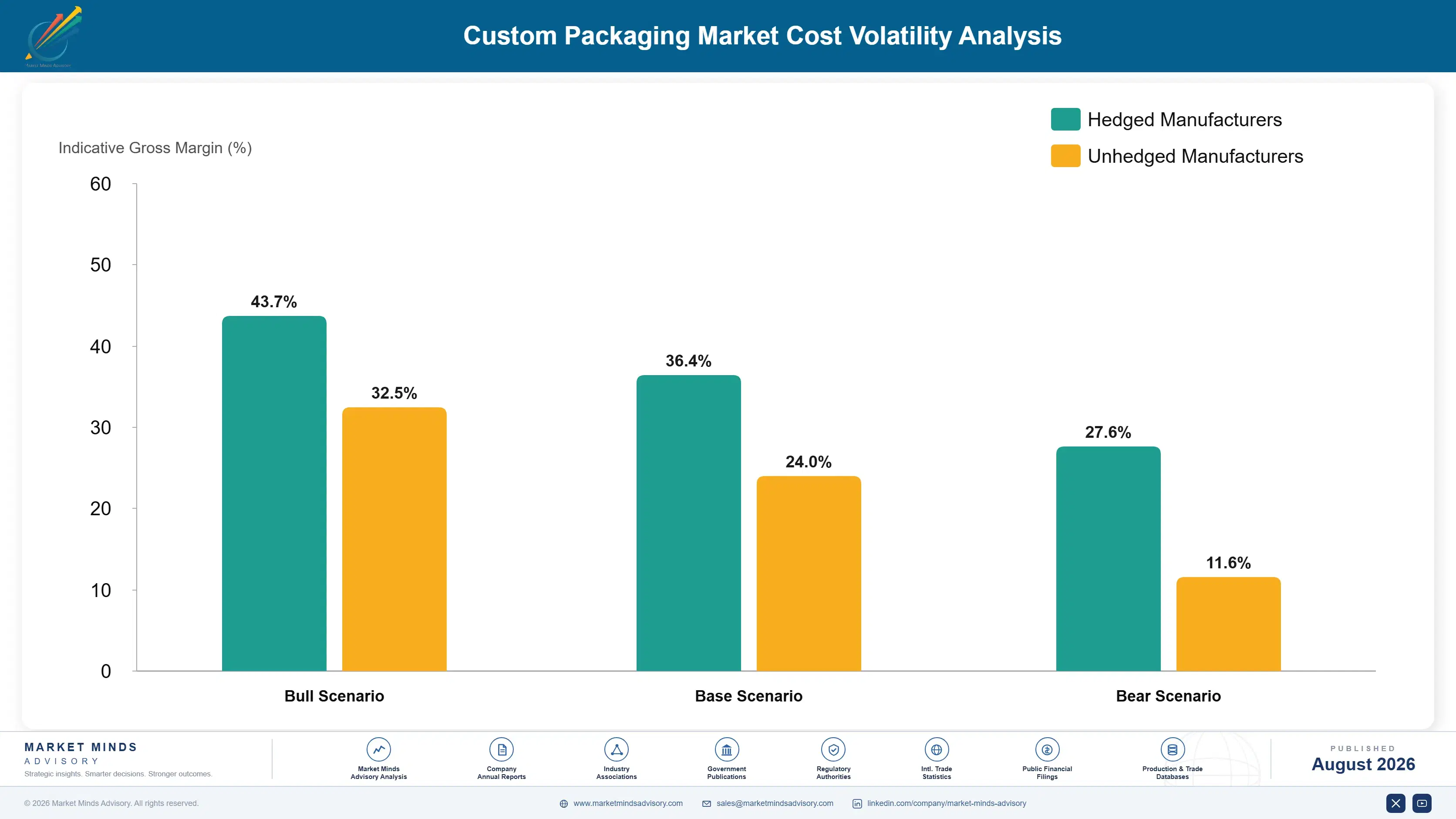
Pulp pricing volatility during 2021 and 2022, driven by mill capacity curtailments documented in industry trade association reports, pushed corrugated input costs up a cumulative 19 percent, forcing several converters to renegotiate customer pricing agreements mid-contract despite existing long-term supply arrangements already in place. Resin pricing has shown comparable volatility tied to crude oil price swings, adding further cost pressure specifically to flexible packaging converters dependent on polyethylene and polypropylene feedstock sourced from a concentrated supplier base.

Exposure varies by format. Corrugated converters remain most exposed to pulp and recovered fibre pricing given their dependence on paper-based substrates, while flexible packaging converters face greater resin price volatility tied to global petrochemical markets that move independently of paper pricing cycles, creating distinct hedging challenges across the two major converter segments and their respective procurement teams.
custom-packaging-market-cost-volatility-analysis-1787332409358

Long-Term Pulp Supply Agreements

Larger converters now lock in multi-year pulp and recovered fibre supply agreements with fixed volume commitments, insulating corrugated pricing from short-term mill capacity swings that previously forced costly mid-contract customer renegotiations across the industry and delayed order fulfilment for major accounts relying on stable, predictable pricing, delivery schedules, inventory planning, and annual budgeting cycles.

Resin Price Hedging for Flexible Converters

Flexible packaging converters increasingly use commodity hedging instruments to manage resin price exposure tied to crude oil volatility, a practice adopted from the broader plastics industry now spreading into custom packaging procurement strategy across multiple regions and converter organisations worldwide seeking greater pricing stability, predictability, budget certainty, and margin protection over multi-year planning horizons ahead.

Recycled Content Sourcing Diversification

Converters increasingly qualify multiple recovered fibre and recycled resin suppliers rather than depending on a single source, reducing exposure to any single supplier's disruption as recycled content requirements expand demand for consistent, qualified recycled feedstock across every major production region, converter facility, sourcing network, procurement team, and quality control process observed year after year.

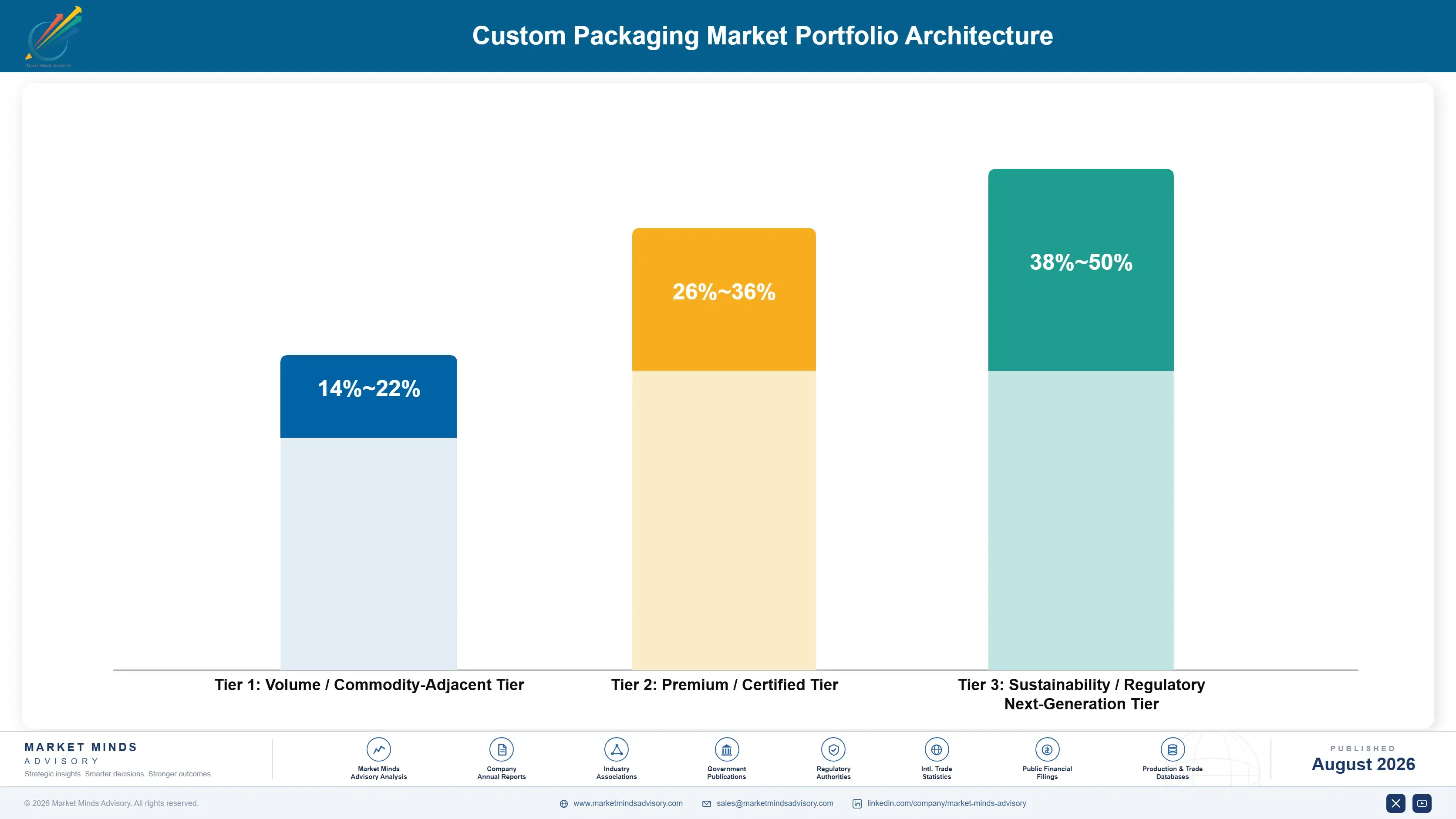
Portfolio Architecture for Margin Defence

Portfolio economics split across three tiers. Standard flexographic printing on established formats competes mainly on price in a fragmented, price-competitive market shaped by decades of manufacturing consolidation and steady technology adoption, while digital short-run printing and sustainability-compliant materials command the highest margins, reflecting the premium brands pay for speed, flexibility, and regulatory compliance simultaneously across their expanding product lines, distribution c
The tension between volume and premium plays out clearly across converter business models. Large flexographic specialists compete on price for high-volume, low-complexity orders, while digital-native converters capture premium pricing on short-run, design-intensive work that volume specialists cannot serve profitably given their fixed setup cost structure and minimum order requirements built into conventional press economics developed over many decades of industrial refinement and capital investment.

High-value margin pools concentrate in pre-qualified sustainable formats and bundled design services, where limited qualified competition keeps pricing power intact well past what commodity flexographic printing retains after decades of established, intensely price-competitive manufacturing across the wider industry and its many regional participants competing for the same accounts, shrinking margins, and thinning order books each successive quarter.

Volume / Commodity-Adjacent Tier

Standard flexographic printing on established packaging formats, competing primarily on price against numerous regional and global converters offering comparable quality, turnaround times, manufacturing scale, pricing, reliability, service, and delivery reliability.
Gross Margin: 14%-22%

Premium / Certified Tier

Digital short-run printing and pre-qualified sustainable material formats carrying established brand relationships or proven regulatory compliance credentials across multiple product categories, export markets, account sizes, retail channels, and diverse geographies worldwide.
Gross Margin: 26%-36%

Sustainability / Regulatory / Next-Generation Tier

Bundled design services and next-generation mono-material formats capturing premium pricing during this early adoption phase ahead of full regulatory enforcement across every major consumer market worldwide, export region, and retail category.
Gross Margin: 38%-50%
custom-packaging-market-portfolio-architecture-1787332409853

High-value Sub-segments and Strategic Watch-out

Pre-Qualified Mono-Material Pouches

Pre-qualified mono-material flexible pouches combine high per-unit value with the fastest specification growth in the category, as brands race to secure compliant packaging ahead of binding European Union recyclability deadlines taking full effect across every member state, export destination, retail channel, product category, and packaging format available.
Gross Margin: 40%-50%

Direct-to-Consumer Branded Corrugated

Custom-printed direct-to-consumer corrugated mailers carry solid margins with a growth curve still accelerating rapidly, as more brands treat packaging as marketing spend rather than pure shipping cost across their fulfilment operations, marketing budgets, social channels, customer loyalty programmes, retention strategies, referral campaigns, and influencer partnerships.
Gross Margin: 28%-38%

Established Retail Shelf-Ready Cartons

Long-established retail shelf-ready paperboard cartons generate steady, predictable volume across mature consumer categories but carry thinner margins after decades of price-competitive manufacturing among a broad group of qualified suppliers worldwide serving the same long-standing accounts, retail partnerships, distribution agreements, category contracts, and long-term vendor relationships.
Gross Margin: 18%-26%

Next-Generation Smart and Connected Packaging

Packaging integrated with QR codes, NFC chips, and connected authentication features represents a strategic watch-out: it remains unclear how quickly brands will pay a sustained premium for connected features beyond an initial marketing novelty phase and early adoption wave among enthusiast early adopters and technology-forward brand teams.
Gross Margin: 32%-44%

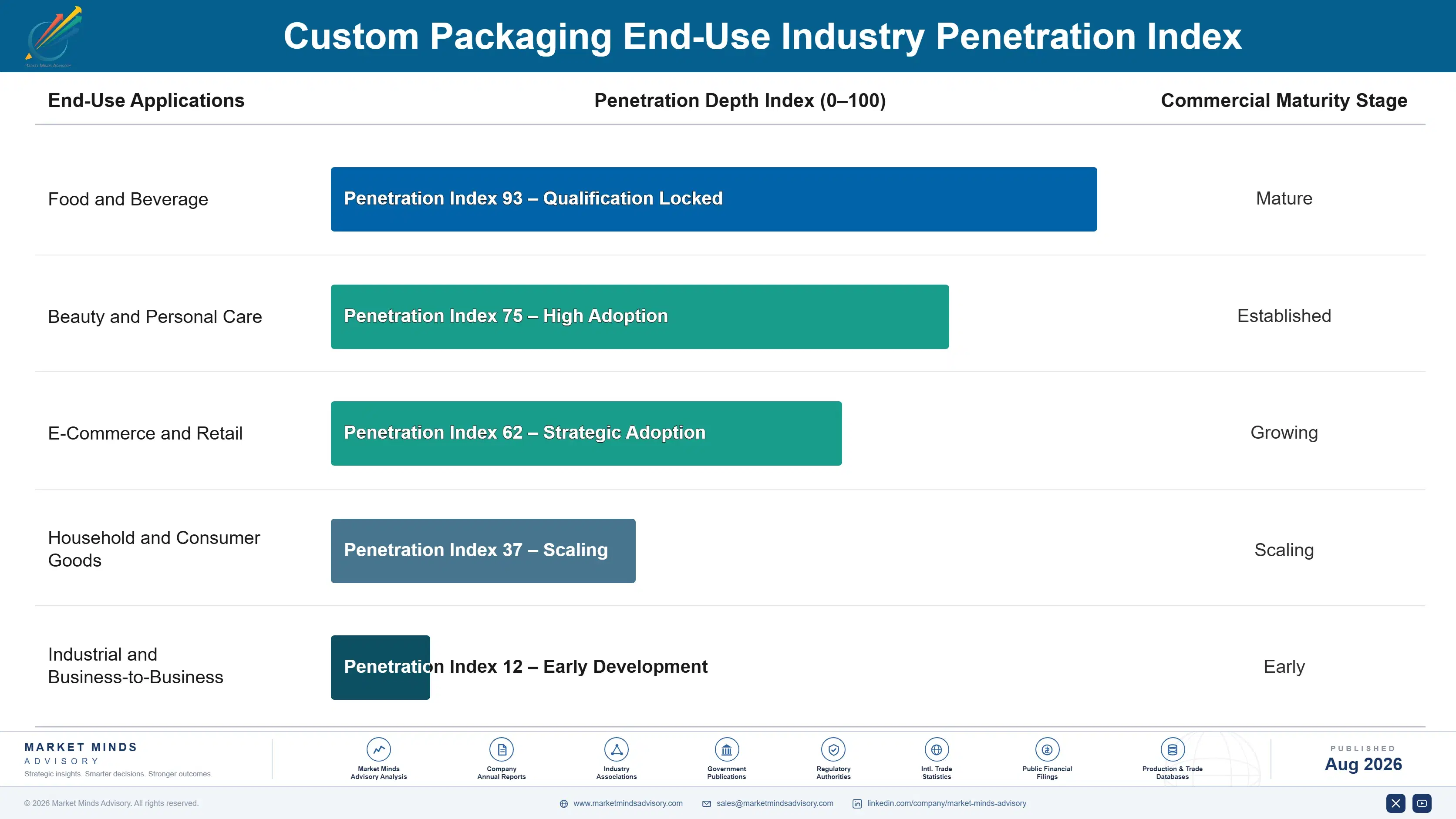
Campaign Cycle Renewal Economics

Custom packaging demand behaves like a campaign-cycle renewal business rather than a simple one-time purchase decision, since brands increasingly refresh packaging design multiple times per year to support seasonal promotions, limited product releases, and ongoing social media marketing campaigns across their direct-to-consumer channels, broader retail partnerships, and international expansion efforts.
Adoption depth varies considerably by brand size and category. Direct-to-consumer and emerging brands adopt custom packaging fastest and most frequently, since packaging doubles as their primary physical marketing touchpoint with consumers who never visit a retail store or interact with the brand in person otherwise. Large, established consumer packaged goods companies show more conservative adoption, balancing packaging refresh costs against supply chain complexity across their much larger production volumes and distribution networks.

A generational shift is underway in brand marketing teams. Marketers who entered the profession after 2015 show meaningfully more comfort treating packaging as a core marketing channel than predecessors trained purely on traditional advertising, a shift that should widen custom packaging adoption further as this cohort gains seniority within brand organisations over the coming decade of continued digital transformation and rising consumer expectations.
custom-packaging-market-end-use-penetration-index-1787332410340

Positioning for the Digital Print Shift

These are among the four positions where our research anticipates prominent divergence between winners and laggards over the coming forecast period. Each is grounded in the demand model, the regulatory perimeter, and the announced capacity pipeline.
01 / DIGITAL CAPACITY INVESTMENT

Build digital printing capacity before short-run demand outpaces supply

Converters that delayed digital printing investment are now watching direct-to-consumer accounts move to competitors who can serve short runs profitably, a pattern accelerating as more brands demand frequent design refreshes tied to marketing campaigns. HP Indigo-equipped converters that invested early captured disproportionate new account growth over the past three years, while flexographic-only competitors increasingly lose bids on exactly the orders growing fastest. Waiting for digital costs to fall further before investing has proven a losing strategy across multiple observed converter transitions.
02 / SUSTAINABILITY COMPLIANCE TIMING

Pre-qualify mono-material formats ahead of binding deadlines

European Union recyclability requirements and expanding US extended producer responsibility fee structures increasingly determine which converters win new brand relationships, yet several established suppliers still treat material reformulation as a future problem rather than a near-term competitive necessity worth addressing now. That delay costs real account share as brands actively seek pre-qualified compliant suppliers ahead of their own regulatory deadlines. Converters who invested early in mono-material development consistently win accounts that competitors still developing comparable formats simply cannot bid on.
03 / DESIGN SERVICE INTEGRATION

Bundle structural and graphic design with production capability

Converters selling pure production capacity increasingly compete on price against low-cost regional printers, while those bundling design services capture meaningfully higher project margins and stickier customer relationships throughout the entire packaging development process from concept through delivery. The most successful converters treat design capability as a core commercial offering rather than an occasional value-add for select accounts only. This bundled posture has protected margins considerably better than pure production supply across the leading converters evaluated this year by MMA analysts.
04 / INPUT COST RESILIENCE PLANNING

Lock in pulp and resin supply before the next volatility cycle

Pulp and resin price volatility during 2021 and 2022 forced several converters to renegotiate customer contracts at a loss, and the underlying supply concentration that caused that volatility has not meaningfully eased in the years since it first emerged across the industry. Converters still buying feedstock on short-term spot contracts remain exposed to the same risk as demand accelerates further. Long-term supply agreements and hedging instruments have already proven their value for converters who adopted them ahead of recent price spikes.

Engagement Snapshot From the Field

A live engagement with an industry participant carrying material or product regulatory and market exposure ahead of a defining policy shift, showing how our research translates into a defensible multi-year portfolio strategy.
MARKET MINDS ADVISORY · CLIENT ENGAGEMENT SUMMARY
Custom Packaging Producer Strategic Portfolio Review and Transition Roadmap 2026·Investment Scenario on Custom Packaging Exposure Evaluation 2025-26
CLIENT PROFILE
The client is a direct-to-consumer beauty brand with annual revenue reported in the 80 to 120 million dollar range (client-reported, unverified by MMA), evaluating a full packaging redesign to support both sustainability commitments and a planned international expansion into European retail channels over the coming eighteen months of sustained growth, investment, and organisational change across the company.
STRATEGIC CHALLENGE
The brand's existing multi-layer flexible packaging would not meet European Union recyclability requirements taking effect ahead of its planned market entry, forcing a choice between a costly full reformulation to mono-material structures or a more limited redesign that risked delaying compliant market entry considerably beyond the target launch window already committed to investors.
MMA APPROACH
MMA benchmarked comparable beauty brand packaging transitions completed over the prior two years, analysing material performance, cost, and consumer perception data across mono-material and hybrid reformulation approaches available today in the market. The team conducted primary interviews with converter technical teams and packaging engineers currently managing similar transitions for other clients.
KEY FINDINGS
  1. Mono-material reformulation added an estimated 18 percent to per-unit packaging cost versus the client's existing multi-layer structure currently used across product lines.
  2. Two of three benchmarked brands reported measurable shelf-life reduction after switching to mono-material barrier films for comparable product categories and packaging formats.
  3. Pre-qualified converter partners offered compliance certainty but required committing to volume minimums the client had not previously accepted in prior supply contracts.
  4. Consumer perception research showed strong positive response to visible sustainability messaging on redesigned mono-material packaging formats tested across multiple focus groups nationwide.
CLIENT PROFILE
The client is a direct-to-consumer beauty brand with annual revenue reported in the 80 to 120 million dollar range (client-reported, unverified by MMA), evaluating a full packaging redesign to support both sustainability commitments and a planned international expansion into European retail channels over the coming eighteen months of sustained growth, investment, and organisational change across the company.
STRATEGIC CHALLENGE
The brand's existing multi-layer flexible packaging would not meet European Union recyclability requirements taking effect ahead of its planned market entry, forcing a choice between a costly full reformulation to mono-material structures or a more limited redesign that risked delaying compliant market entry considerably beyond the target launch window already committed to investors.
MMA APPROACH
MMA benchmarked comparable beauty brand packaging transitions completed over the prior two years, analysing material performance, cost, and consumer perception data across mono-material and hybrid reformulation approaches available today in the market. The team conducted primary interviews with converter technical teams and packaging engineers currently managing similar transitions for other clients.
KEY FINDINGS
  1. Mono-material reformulation added an estimated 18 percent to per-unit packaging cost versus the client's existing multi-layer structure currently used across product lines.
  2. Two of three benchmarked brands reported measurable shelf-life reduction after switching to mono-material barrier films for comparable product categories and packaging formats.
  3. Pre-qualified converter partners offered compliance certainty but required committing to volume minimums the client had not previously accepted in prior supply contracts.
  4. Consumer perception research showed strong positive response to visible sustainability messaging on redesigned mono-material packaging formats tested across multiple focus groups nationwide.
RECOMMENDED STRATEGY
Phase 1: Phase 1 (Months 1 to 5): Finalise mono-material formulation testing and validate shelf-life performance across the full product line and category. Phase 2: Phase 2 (Months 6 to 12): Select a pre-qualified converter partner and negotiate volume commitments tied to European expansion timing. Phase 3: Phase 3 (Months 13 to 18): Execute phased packaging transition, prioritising products launching first in European retail channels and markets.
OUTCOME
The brand committed to mono-material reformulation across its full product line, securing converter capacity six months ahead of its European launch date and avoiding an estimated compliance delay risk identified during the engagement (client-reported, unverified by MMA). Early consumer response to the redesigned packaging exceeded internal targets by a meaningful margin during initial market testing.

Frequently Asked Questions

Foundational context covering the market sizes, CAGR, scope, country, region and competition that inform every finding below. This section is provided to cover basics and most often pre-purchase conversations, answered from the MMA Primary Research Dataset.

What is the current size of the Custom Packaging Market?

The global market reached an estimated 42.6 billion dollars in 2025, driven by e-commerce and brand differentiation demand. Growth is concentrated in digital printing and sustainable material formats worldwide.

How large will the Custom Packaging Market be by 2036?

MMA projects the market will reach approximately 91.53 billion dollars by 2036 under the base-case forecast scenario. This reflects sustained e-commerce and regulatory-driven demand worldwide.

What is the CAGR for the Custom Packaging Market 2026 to 2036?

The base-case compound annual growth rate is 7.2 percent across the full ten-year forecast period. Bull and bear scenarios range from 6.0 to 8.4 percent.

Which segment is growing fastest?

Custom flexible packaging leads at a 10.4 percent CAGR, roughly 1.44 times the overall market growth rate. Custom corrugated boxes follow as the second-fastest segment.

Who are the major companies in the Custom Packaging Market?

International Paper, Smurfit WestRock, Mondi Group, Packaging Corporation of America, and Sonoco Products hold the top five positions by revenue currently. The category remains considerably more fragmented than most packaging segments.

Which country is growing fastest?

India leads at an estimated 9.6 percent CAGR, driven by expanding e-commerce and a rapidly growing direct-to-consumer brand base. Domestic converters are scaling digital printing capacity fast to meet rising demand.

Report Segmentation Architecture

The full report scope spans multiple orthogonal segmentation dimensions, with cross-tabulated demand data provided for each dimension pair. Coverage extends further to regional breakdowns, trend trajectories, and the competitive detail needed to support segment-level decision-making.

By Packaging Material and Format

  • Custom Corrugated Boxes
  • Custom Flexible Packaging
  • Custom Rigid Plastic Packaging
  • Custom Paperboard Cartons
  • Custom Labels and Sleeves
  • Custom Protective Packaging

By End-Use Industry

  • Food and Beverage
  • Beauty and Personal Care
  • E-Commerce and Retail
  • Household and Consumer Goods
  • Industrial and Business-to-Business

By Commercial Dimension

  • Direct Brand Procurement
  • Design and Production Bundled Services
  • Contract Manufacturing Supply
  • Digital Short-Run Printing

By Region

  • North America
  • Western Europe
  • East Asia
  • South Asia and Pacific
  • Latin America
  • Middle East and Africa
  • Eastern Europe

Scope, Methodology, and Coverage

Every figure in this report is reproducible from documented input assumptions. The scope below maps the historical period, the forecast horizon, the segmentation dimensions, and the countries covered, alongside the underlying primary and qualitative methodology.
Historical Period
2020 to 2025
Forecast Period
2026 to 2036
Base Year
2025 (USD billions; MMA Primary Research Dataset, August 2026)
Market Definition
This market covers custom-printed and structurally customised packaging, including corrugated boxes, flexible pouches and films, rigid plastic containers, paperboard cartons, and labels produced to brand-specific specifications. It excludes generic stock packaging sold without customisation and packaging machinery sold independent of the packaging product itself.
Quantitative Units
USD billions (current prices); metric tonnes of packaging material where applicable
Segmentation Dimensions
By Packaging Material and Format; By End-Use Industry; By Commercial Dimension; By Region
Regions Covered
North America, Western Europe, East Asia, South Asia and Pacific, Latin America, Middle East and Africa, Eastern Europe
Countries Covered
USA, China, Germany, France, UK, Japan, South Korea, India, Australia, Canada, Brazil, Mexico, Indonesia, Vietnam, Thailand, Malaysia, UAE, Saudi Arabia, South Africa, Nigeria, Turkey, Poland, Netherlands, Italy, Spain, Sweden, Switzerland, Argentina, Colombia, Singapore, and additional markets relevant to this sector
Key Companies Profiled
International Paper, Smurfit WestRock, Mondi Group, Packaging Corporation of America, Sonoco Products, Amcor plc, Berry Global, Sealed Air Corporation, Multi-Color Corporation, CCL Industries, Huhtamaki, ProAmpac, Coveris, Green Bay Packaging, Pratt Industries, Georgia-Pacific, Klabin, Nine Dragons Paper Holdings, WS Packaging Group, Oji Holdings
Quantitative Methodology
Primary survey, n=3,800 respondents, Q4 2025, six countries; demand-side model with trade association cross-validation
Qualitative Methodology
47 expert interviews, Q4 2025; applied to validate demand model assumptions, identify emerging dynamics, and assess competitive positioning
Report Format
PDF and XLSX data workbook (Word format preview document)
Publisher
Market Minds Advisory
Report Code
MMA-2026-PAC-317
Published
August 2026
Contact
sales@marketmindsadvisory.com | www.marketmindsadvisory.com

Purchase the full Custom Packaging Market Report (2026 to 2036).

The full report delivers a converter-by-converter digital printing capacity tracker covering the top twenty profiled companies across every major production region worldwide today. It includes a regulatory compliance tracker mapping extended producer responsibility fee schedules and packaging mandates across fourteen major markets and their respective enforcement timelines. Material cost benchmark data is provided for pulp, resin, and recycled feedstock, alongside brand-level custom packaging spend estimates by category. Buyers also receive a company-level financial model for each profiled converter, updated quarterly through the subscription period each year.
Converter-by-converter digital capacity and pricing tracker
Regulatory compliance and fee schedule database
Material cost benchmark data by feedstock type
Quarterly competitor financial model and forecast updates
Brand-level packaging spend estimate data set
Custom market entry and material strategy workshops

Built For The People Who Decide

From boardroom strategy to bench-side execution, this report is read cover-to-cover by leaders shaping the next decade of their industry, turning demand scenarios, market dynamics and valuation benchmarks into decisions.
CXOs/ Presidents/ VPs/ Managers
M&A and Corporate Development
Strategy Teams and R&D Heads
Procurement and Product Directors
Regulatory and Compliance Leaders
Investor Relations and Equity Analysts