
Market Minds Advisory
Custom Boxes Market

Custom Boxes Market: The Unboxing Moment Now Drives the Order

A commercial reading of custom boxes, where e-commerce brands pull right-sized mailer demand forward, unboxing experience marketing rewards premium structural design, and rising corrugated costs squeeze margin across the category.

Lead Analyst

Bilal Shaikh

Published

September 2026

Make Smarter Decisions with Customized Research Insights

Request a free sample report and evaluate market opportunities, growth trends, and competitive dynamics relevant to your business needs.

2025 MARKET VALUE$8.5BMarket Size 2025
2036 FORECAST VALUE$17.0BBase Case , 2026 to 2036
CAGR 2026 TO 20366.5 %Bull 7.7% / Bear 5.2%
INCREMENTAL OPPORTUNITY$7.9BNet 10- year value creation
EXPANSION MULTIPLE1.88x2036 value over 2026 base
Strategic Levers
M&A Pipeline
Regional Outlook
Country Rankings
Competitive Intelligence
Segmental Deep-dive
Call-Us : 91 93563 13602

Executive Snapshot and Market Trajectory

A box that arrives dented or oversized costs a direct-to-consumer brand more than the shipping fee, it costs a customer's trust in the unboxing moment, and that specific realization has quietly turned custom packaging from an afterthought into a genuine marketing line item worth budget.
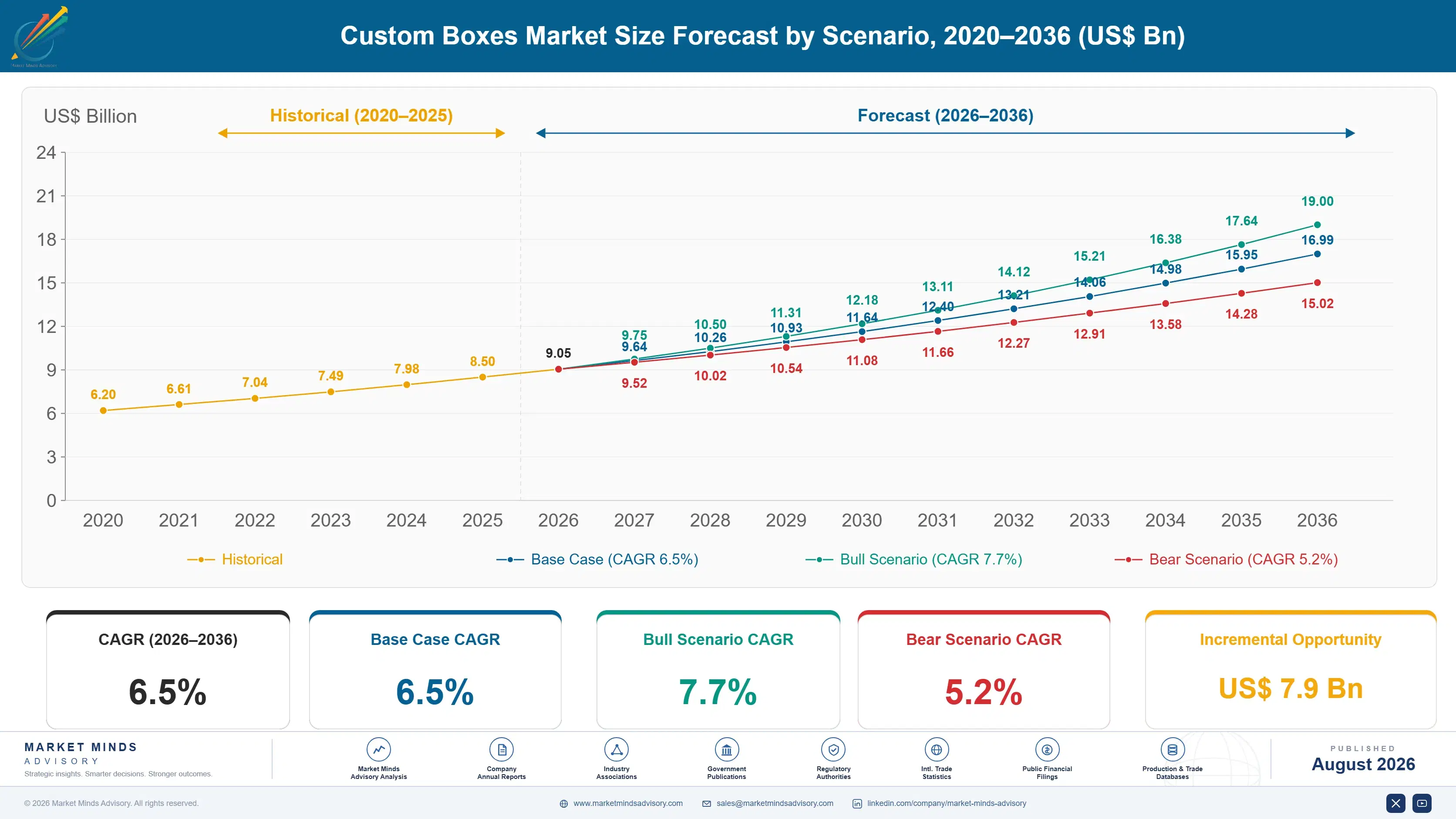
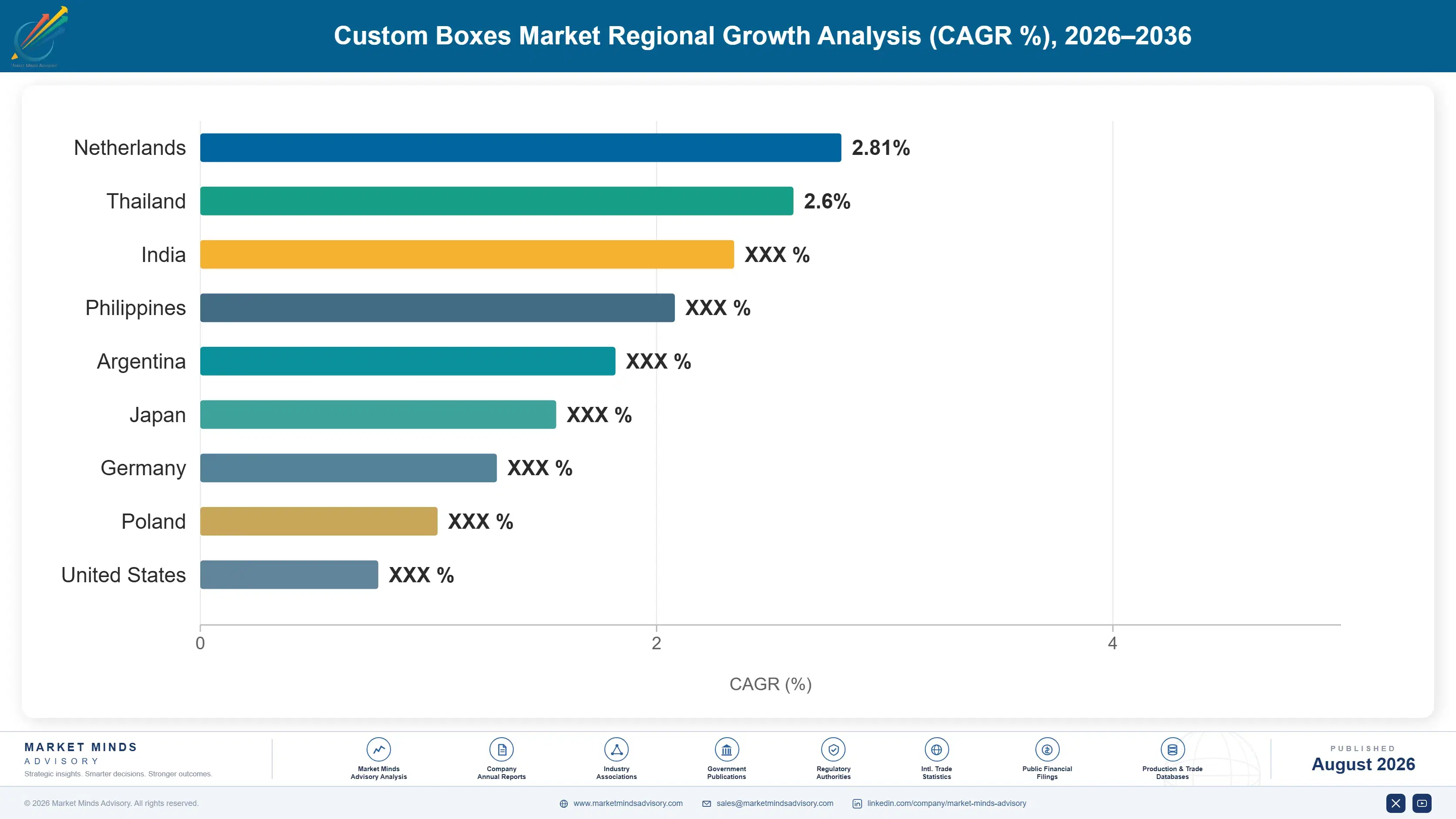
The market stands at USD 8.5 billion in 2025 and reaches USD 16.99 billion by 2036 at a 6.5% CAGR. Custom mailer and e-commerce boxes grow fastest at 9.5%, about 1.46 times the overall rate, pulled forward by rising direct-to-consumer shipping volume across most major retail categories tracked. North America holds 28% of value on established e-commerce fulfillment infrastructure, while India posts the fastest national growth at 9.2% on expanding domestic e-commerce penetration.
Concentration is low at 32% among the top five, reflecting a fragmented category of large integrated packaging producers and thousands of regional print shops competing directly nationwide and regionally. Two forces reshape the field now. E-commerce brands are adopting right-sized custom mailer boxes to cut dimensional weight shipping costs, and sustainable packaging design is reshaping material choices as brands move away from mixed-material laminates toward mono-material recyclable structures.
Market Definition
The custom boxes market covers printed and structurally customized corrugated, rigid, and folding carton boxes produced to a specific brand's dimensions, graphics, or structural design, sold to e-commerce, retail, and consumer goods companies. Standard unprinted stock boxes and industrial bulk shipping containers are excluded.
Base Year Value
$8.5B in 2025 (MMA Primary Research Dataset, August 2026)
Forecast Period
2026 to 2036, eleven discrete annual values
CAGR
6.5% base case. Bull 7.7%. Bear 5.2%.
Fastest Growth Segment
Custom Mailer and E-Commerce Boxes: 9.5% CAGR
Fastest Growth Country
India: 9.2% CAGR
Fastest Growth Region
South Asia and Pacific: 8.6% CAGR
Largest Region
North America: 28% of 2025 global value
Market Leaders
WestRock, International Paper, DS Smith, Mondi Group, Packaging Corporation of America. Source: MMA Analysis based on company annual reports and industry association data.
Primary Survey
n=3,800 procurement and R&D decision-makers, Q4 2025, six countries
Methodology
Demand-side build-up, cross-validated against public data, 47 expert interviews

Custom Boxes Market Forecast Scenarios

custom-boxes-market-size-forecast-scenario-1787332350388
Growth from 2020 to 2025 compounded near 5.8%, supported by steady e-commerce packaging demand before accelerating from 2023 onward as direct-to-consumer brands expanded considerably and unboxing experience marketing pushed more categories toward premium custom structural design across major consumer product segments tracked closely by analysts, manufacturers, and industry participants throughout that period specifically and consistently.
Three mechanisms carry the base case to 6.5%. First, rising direct-to-consumer e-commerce volume, as more brands ship directly to consumers rather than through traditional retail channels requiring custom-fit packaging across most product categories tracked. Second, unboxing experience marketing, which pushes brands toward premium custom packaging that doubles as a social media touchpoint worth genuine investment. Third, dimensional weight shipping cost pressure, which rewards right-sized custom mailers over generic stock boxes across most carrier pricing structures.
The bull case at 7.7% assumes direct-to-consumer e-commerce volume accelerates faster than current retail channel shift suggests and sustainable packaging mandates spread more quickly across major consumer goods categories. The bear case at 5.2% assumes high minimum order quantities continue limiting adoption among smaller brands and rising corrugated material costs keep squeezing custom box margins industry-wide.

Why the Shipping Label Is No Longer the Only Design Constraint

Three forces set demand. E-commerce shipping volume provides the steadiest layer, since every direct-to-consumer order requires a box sized and branded specifically for that shipment. Unboxing experience marketing adds a fast-growing second layer, as brands increasingly treat the box itself as a social media touchpoint worth premium production investment. Sustainable packaging pressure adds a third layer, pushing brands toward recyclable mono-material structures that meet tightening consumer and
MARKET CONCENTRATIONCR5: 32%Highly fragmented across large producers and regional print shops
AVERAGE SELLING PRICEUSD 0.35 to 4.20 per unitVaries considerably by material type and print complexity ordered
TOP CONSUMING REGIONNorth America: 28% of global valueReflects established e-commerce fulfillment and brand packaging infrastructure
DIGITAL PRINT ADOPTION RATERoughly 35% of custom ordersRising steadily as short-run digital printing displaces offset methods
TYPICAL MINIMUM ORDER QUANTITY250 to 2,500 unitsVaries considerably by production method and brand order size
COGS FEEDSTOCK SHAREAbout 45 to 58%Reflects containerboard and paperboard input costs varying by grade
The commercial character rewards production flexibility and design turnaround speed over price competition alone. A brand choosing a custom box supplier increasingly weighs minimum order quantity flexibility and digital printing turnaround as heavily as unit price, since a supplier that cannot fulfil a smaller reorder quickly costs the brand lost sales during a stockout. WestRock's integrated production scale and DS Smith's design consultation depth give both a trust advantage newer entrants must earn.
The next decade turns on two things. Whether digital printing technology can bring minimum order quantities down far enough to serve the long tail of smaller direct-to-consumer brands that traditional offset economics have historically excluded. And whether mono-material recyclable structures can match the print quality and structural strength that mixed-material laminates currently deliver at comparable cost.
"Brands used to think about the box after they designed the product. Now some brands design the unboxing sequence before they finish the product itself, and that inversion has reshaped who wins packaging contracts."
Director, Custom Packaging Practice · MMA Packaging / Custom and Specialty Packa

Market Trends

E-Commerce Brands Adopt Right-Sized Mailer Boxes

Direct-to-consumer brands increasingly specify custom mailer boxes sized precisely to their product dimensions rather than shipping in generic oversized stock boxes, a shift driven directly by carrier dimensional weight pricing that penalizes wasted shipping volume considerably. This matters commercially because right-sizing can meaningfully reduce per-shipment freight cost, a saving that compounds quickly across brands shipping thousands of orders monthly. Packlane and Packhelp have both expanded on-demand custom mailer production capacity considerably to serve this growing direct-to-consumer segment specifically. The commercial consequence is that suppliers without flexible, quick-turnaround production increasingly lose specification to competitors offering genuinely on-demand custom sizing.
Market Impact: DTC shipping volume rose 22% yearly
Sustainable Design Reshapes Material Choices Broadly

Brands increasingly specify mono-material recyclable corrugated and paperboard structures over mixed-material laminates combining plastic windows, foil stamping, and multiple substrate layers that recycling infrastructure struggles to process. This shift reflects both tightening extended producer responsibility regulation and genuine consumer preference for visibly recyclable packaging communicated clearly on the box itself. WestRock and Mondi Group have both expanded mono-material product lines considerably in response to this sustained shift in brand specification preference. The commercial consequence is that suppliers without genuine mono-material design capability increasingly lose specification to competitors offering credible sustainability positioning their brand customers can market directly.
Market Impact: Unboxing content drives 15% of sale

Market Opportunities and Growth Drivers

Rising Direct-to-Consumer Volume Drives Box Demand

Direct-to-consumer e-commerce shipping volume continues expanding considerably faster than traditional retail channel volume, directly requiring custom-branded packaging that generic retail shelf packaging was never designed to support during transit. Every direct-to-consumer order requires a box sized and printed specifically for that brand, unlike retail packaging that ships in bulk to a distribution center before final sale. Consumer goods, apparel, and beauty brands have all expanded direct shipping volume considerably as digital-first retail strategies continue displacing traditional wholesale distribution models. This driver continues strengthening as more categories shift toward direct-to-consumer fulfillment models globally.
Market Impact: Minimum orders run 250-2,500 units

Unboxing Marketing Pushes Premium Packaging Adoption

Brands increasingly treat the physical unboxing moment as a marketing touchpoint worth dedicated design investment, since customers routinely share unboxing videos and photos across social media platforms that generate meaningful organic brand exposure at effectively no advertising cost. This dynamic has pushed premium structural design and print finishing techniques, including embossing and specialty coatings, into categories that previously used only basic printed cartons. Beauty, subscription box, and premium consumer electronics brands have led this shift considerably across recent product launches tracked. This driver continues strengthening as social media commerce expands further across most major consumer categories globally.
Market Impact: Containerboard costs rose 16% recen

Market Restraints and Challenges

High Minimum Orders Limit Adoption Among Small Brands

Traditional offset printing requires minimum order quantities of 250 to 2,500 units depending on complexity, a threshold that remains genuinely difficult for smaller direct-to-consumer brands with limited storage space or uncertain sales velocity to justify economically. The root cause is that offset printing setup costs do not scale down proportionally at smaller run sizes, keeping per-unit cost prohibitively high for brands wanting only a few hundred units. Commercially this concentrates traditional custom box adoption among larger, established brands, leaving smaller brands underserved. Manufacturers are responding with digital printing technology that eliminates setup costs and enables genuinely small custom runs profitably.
Market Impact: Right-sizing cuts freight cost 18%

Rising Material Costs Squeeze Custom Box Margins

Containerboard and paperboard prices have risen considerably in recent years amid broader pulp and paper market volatility, directly compressing margin for custom box producers who cannot always pass through cost increases quickly given competitive pricing pressure from smaller regional print shops. The root cause is constrained global pulp production capacity relative to steadily rising packaging demand across multiple end-use categories simultaneously. Commercially this squeezes margin hardest for producers serving price-sensitive smaller brands who resist cost pass-through more aggressively than larger enterprise customers. Manufacturers are responding with long-term fiber supply contracts that lock in more predictable input costs across multi-year horizons.
Market Impact: Mono-material orders rose 24% yearl
3 additional market trends, 4 additional growth drivers, and 3 additional restraints and challenges are covered in the full report. Contact sales@marketmindsadvisory.com to access the complete intelligence.

Segment CAGR and Growth Architecture

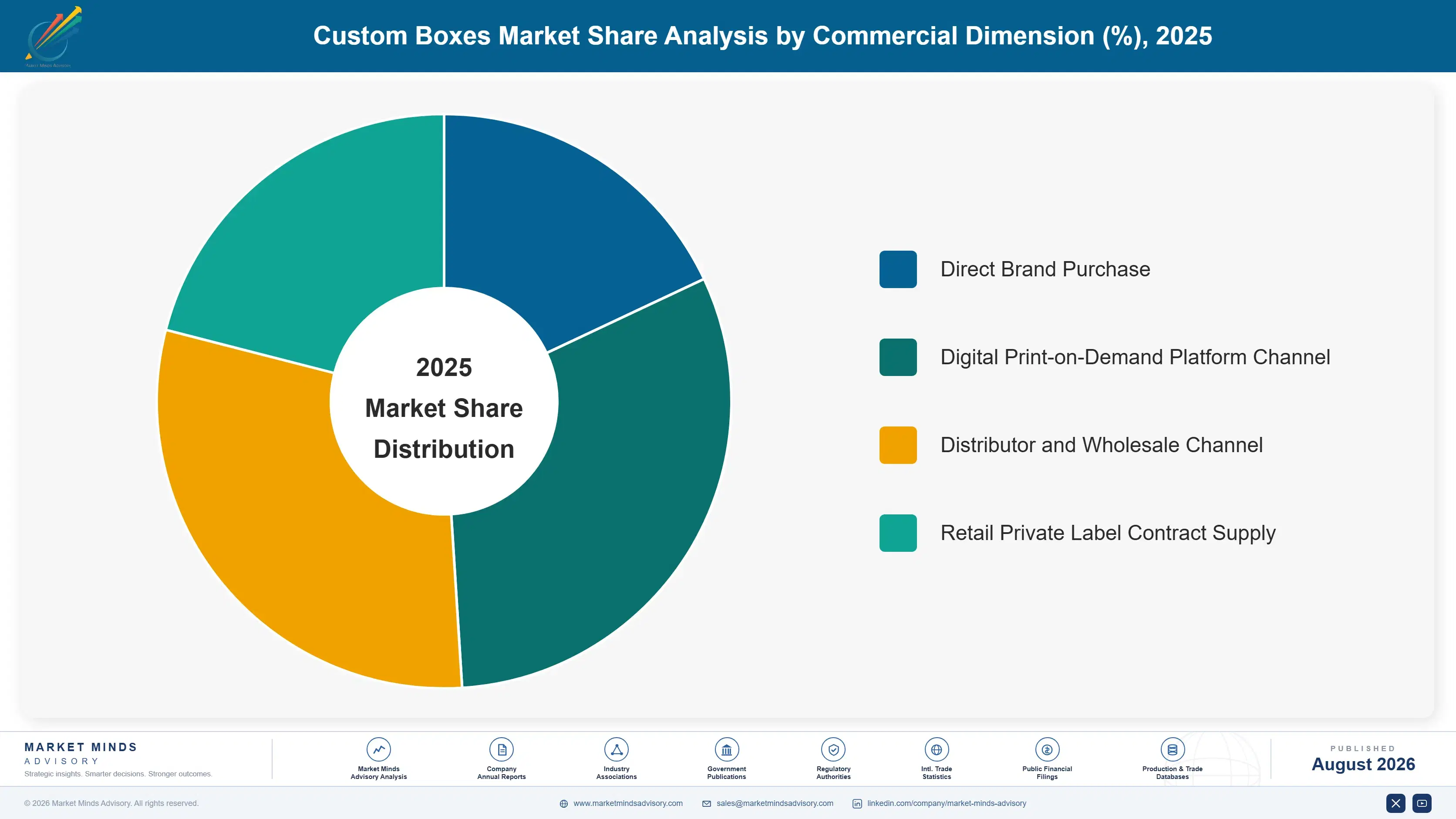
Segmentation follows box construction and material type, a single product logic describing the substrate and structural format each box category uses across applications, end markets, and production methods. Each format carries distinct production economics and design capability, so commercial position tracks construction type rather than end-use industry, which appears separately within the framework below.
custom-boxes-market-market-share-analysis-1787332350918

Custom Mailer and E-Commerce Boxes

Custom mailer and e-commerce boxes grow fastest at 9.5%, about 1.46 times the overall 6.5% rate, pulled forward by rising direct-to-consumer shipping volume across most major retail categories tracked currently worldwide. This category requires production flexibility and quick digital print turnaround that traditional offset producers historically could not offer at the smaller order sizes many direct-to-consumer brands require during early growth stages. Packlane and Packhelp have both expanded on-demand production capacity considerably to serve this growing segment specifically across multiple brand size tiers. Carrier dimensional weight pricing increasingly rewards brands specifying right-sized mailers over generic stock alternatives, reinforcing this category's growth trajectory. Demand continues outpacing traditional offset production capacity in several major markets currently as e-commerce shipping volume keeps expanding.
CAGR 9.5%

Die-Cut Specialty Structural Boxes

Die-cut specialty structural boxes grow at 8.2%, the second-fastest category, as brands increasingly commission custom structural engineering to create distinctive unboxing experiences that generic rectangular boxes cannot deliver at comparable cost or turnaround. This category commands meaningfully higher average selling prices, reflecting the tooling and structural design engineering investment each custom die-cut pattern requires before production begins at scale. WestRock and Mondi Group both maintain meaningful positions here given established structural design engineering teams serving premium consumer goods brands directly across multiple categories. Beauty, subscription box, and premium electronics brands increasingly specify this category first when launching new products given its clear differentiation value in a crowded retail and e-commerce marketplace.
CAGR 8.2%
Full segment breakdown across 5 segments available in the complete report.

Regional Architecture and Country Demand Map

E-commerce fulfillment infrastructure and brand packaging investment together set this distribution, since custom box demand tracks closely where direct-to-consumer shipping volume concentrates globally today and steadily. North America leads on established infrastructure, while South Asia and Pacific posts the fastest regional growth of all seven regions.

North America

Established e-commerce fulfillment infrastructure and brand packaging investment anchor North American demand more than any other single factor. North America holds 28% of value, the largest single share, with United States direct-to-consumer brands driving substantial custom mailer and structural box demand through established digital-first retail channels nationwide. Unboxing experience marketing has grown considerably across the region's beauty, subscription box, and consumer electronics categories specifically and consistently. Canadian e-commerce markets follow similar adoption patterns, though from a smaller overall shipping volume base. Growth of 6.0% reflects mature market dynamics tempered by continued custom mailer adoption expansion across more brand categories. Regional digital printing capacity continues expanding to serve smaller brand order sizes nationally.
Share: 28% | CAGR: 6.0% (2026 to 2036)

Western Europe

Sustainable packaging regulation and established brand design capability together define this market above any other single factor. Western Europe holds 20% of value, with German, British, and French brands driving meaningful custom box demand across both direct-to-consumer and premium retail packaging categories specifically. Extended producer responsibility regulation runs considerably stricter here than in most other regions, pushing brands toward mono-material recyclable structures earlier than elsewhere globally. Premium unboxing experience design remains particularly strong across the region's beauty and luxury goods categories. Growth of 5.0%, the slowest of the seven, reflects mature market penetration in the region's largest e-commerce and retail markets specifically. Scandinavian markets lead in sustainable packaging adoption given strong consumer environmental awareness.
Share: 20% | CAGR: 5.0% (2026 to 2036)
Regional intelligence for 5 additional markets available in the complete report: East Asia, South Asia and Pacific, Latin America, Middle East and Africa, Eastern Europe. Contact sales@marketmindsadvisory.com.
custom-boxes-market-country-cagr-analysis-1787332351418

Where Custom Box Producer Margin Concentrates

Competing purely on unit price per box concentrates margin in exactly the commodity stock-size segment where regional print shops undercut established manufacturers easily and repeatedly worldwide. The four moves below shift value toward positions design capability and production flexibility genuinely protect: digital printing infrastructure, structural design engineering, sustainable material development, and direct-to-consumer brand relationships.

Invest in Digital Printing Infrastructure Broadly

Digital print adoption has reached roughly 35 percent of custom orders, a share that has risen steadily as short-run digital printing eliminates the setup costs that previously made small custom orders economically unviable for many smaller direct-to-consumer brands entering the market. Manufacturers with genuine digital printing capability capture specification that traditional offset-only competitors increasingly cannot match as brands increasingly demand smaller, more frequent custom orders rather than large upfront commitments. Building this capability requires sustained capital investment in digital press technology beyond conventional offset printing infrastructure entirely, a multi-year commitment.
Market Impact: Digital orders now reach roughly 35

Build Structural Design Engineering Capability Now

Brands increasingly commission custom structural engineering to create distinctive unboxing experiences, and die-cut specialty structural boxes command roughly 20 percent higher average selling prices than generic rectangular alternatives given the tooling and engineering investment each pattern requires before production begins at scale and volume. Manufacturers with dedicated structural design teams capture premium specification that generalist producers offering only standard formats increasingly cannot match as brands prioritize differentiation over price alone. This capability requires sustained investment in structural engineering talent and prototyping equipment beyond conventional print production expertise entirely, a genuine commitment.
Market Impact: Structural design now boosts orders

Develop Genuine Mono-Material Sustainable Formats Now

Mono-material recyclable orders have risen roughly 24 percent annually as brands increasingly specify structures that recycling infrastructure can actually process, moving away from mixed-material laminates that regulation and consumer preference both increasingly penalize across most major markets tracked closely and consistently each passing year. Manufacturers with genuine mono-material design capability capture specification that competitors relying on conventional mixed-material formats increasingly cannot claim credibly to environmentally conscious brand customers seeking genuine sustainability. This capability requires sustained materials science investment in coating and finishing technology that maintains print quality without compromising recyclability.
Market Impact: Mono-material orders rose roughly 2

Deepen Direct-to-Consumer Brand Relationships Early On

Direct-to-consumer brands increasingly default to whichever packaging supplier supported their earliest, smallest orders as they scale toward larger production volumes, and early relationships now retain roughly 30 percent more volume than transactional pricing alone could achieve once a brand has invested in supplier-specific design and tooling together over time. Manufacturers investing in flexible, brand-friendly early-stage service capture long-term volume that competitors focused only on large enterprise accounts increasingly miss entirely across most categories. This relationship depth compounds over years as growing brands scale their spend with trusted early suppliers consistently.
Market Impact: Early relationships now retain roug

Who Controls the Margin Pool

Concentration is low at 32% among the top five, reflecting a fragmented category spanning large integrated packaging producers and thousands of regional print shops serving smaller brand customers directly. The gap between leaders and challengers is production flexibility and design capability rather than raw scale, since smaller specialized producers can often out-compete larger integrated players on turnaround speed. All participants here are assessed on global custom box unit shipment volume
Competition runs along four lines. First, digital printing infrastructure that enables smaller, more frequent custom orders profitably. Second, structural design engineering that commands premium pricing for differentiated unboxing experiences. Third, mono-material sustainable format development that satisfies tightening brand and regulatory expectations. Fourth, direct-to-consumer brand relationship depth built during a brand's earliest, smallest order volumes.

Pressure is building from two directions. Digitally native specialists including Packlane and Packhelp have built substantial direct-to-consumer brand relationships and are converting production flexibility into meaningful share gains among smaller, fast-growing brands. Meanwhile established integrated producers continue defending large enterprise accounts through sustained scale and material sourcing advantages that smaller specialists cannot match. Rankings should favour producers combining flexibility with genuine structural design capability over stock box price alone.
custom-boxes-market-company-positioning-matrix-1787332351937

Competitive Moat and Risk Dimensions

WESTROCK

Moat: Integrated production scale

WestRock maintains one of the broadest integrated production networks in the category, spanning containerboard manufacturing through finished custom box production across multiple facilities. Its structural design engineering teams support premium specification for major consumer goods brands directly. Strong material sourcing scale provides cost advantages that smaller specialized competitors cannot easily replicate at comparable volume.
WESTROCK

Risk: Digital-native specialists moving faster

Digitally native specialists including Packlane and Packhelp increasingly out-compete WestRock on turnaround speed and minimum order flexibility for smaller direct-to-consumer brand customers specifically. Its scale advantages matter less as digital printing commoditizes small-run custom production considerably. Regional print shops are increasingly challenging its position in cost-sensitive smaller order segments.
DS SMITH

Moat: Design consultation depth

DS Smith built its position around deep design consultation services that help brands optimize structural design and material choices before production begins. Its sustainability engineering expertise, developed across multiple mono-material product generations, positions it strongly for this increasingly important brand consideration. Established relationships with major European retailers and consumer goods brands provide considerable specification advantage.
DS SMITH

Risk: Regional concentration limits reach

DS Smith's strength concentrates more heavily in European markets than in North America or East Asia, limiting its reach compared with more globally diversified competitors. Digital-native specialists increasingly compete directly for the smaller brand relationships DS Smith has historically served less aggressively. Chinese manufacturers are increasingly challenging its position in cost-sensitive export packaging segments specifically.

Players Tracked

Prominent Players

WestRock
International Paper
DS Smith
Mondi Group
Packaging Corporation of America

Other Key Players

Georgia-Pacific
Smurfit Kappa
Stora Enso
Oji Holdings
Nine Dragons Paper
ProAmpac
Sonoco Products
Huhtamaki
Amcor
Multi Packaging Solutions
Packlane
Packhelp
Arka
Klabin
Cascades Inc

Recent Developments

MARCH 2025

Packlane expands on-demand digital printing capacity

Packlane expanded manufacturing capacity for its on-demand digital printing platform to meet rising demand from smaller direct-to-consumer brands across multiple product categories, order sizes, and geographies nationwide today. This was an organic capacity expansion rather than any acquisition, reflecting confidence in sustained small-brand demand growth.
Signal: Digitally native specialists are scaling p
OCTOBER 2024

WestRock acquires structural design engineering firm

WestRock acquired a specialist structural design engineering firm to strengthen its die-cut and premium packaging capability across its existing custom box product line and future roadmap. This was an acquisition rather than a joint venture, adding proprietary design talent directly into WestRock's existing product development organization.
Signal: Established producers are buying structura
JANUARY 2025

DS Smith signs sustainability partnership with major retailer

DS Smith signed a multi-year sustainability partnership with a major European retailer to develop mono-material packaging formats across an expanding private label product lineup through the end of the decade. This was a partnership agreement rather than a joint venture, sharing development resources without shared ownership.
Signal: Established producers are partnering on su

Containerboard and Paperboard Feedstock

Containerboard and paperboard together account for 45% to 58% of cost of goods sold, reflecting the fiber-intensive nature of custom box production regardless of print complexity or structural design applied to the finished product. These materials are sourced predominantly from integrated pulp and paper producers in North America, Europe, and East Asia directly and reliably.
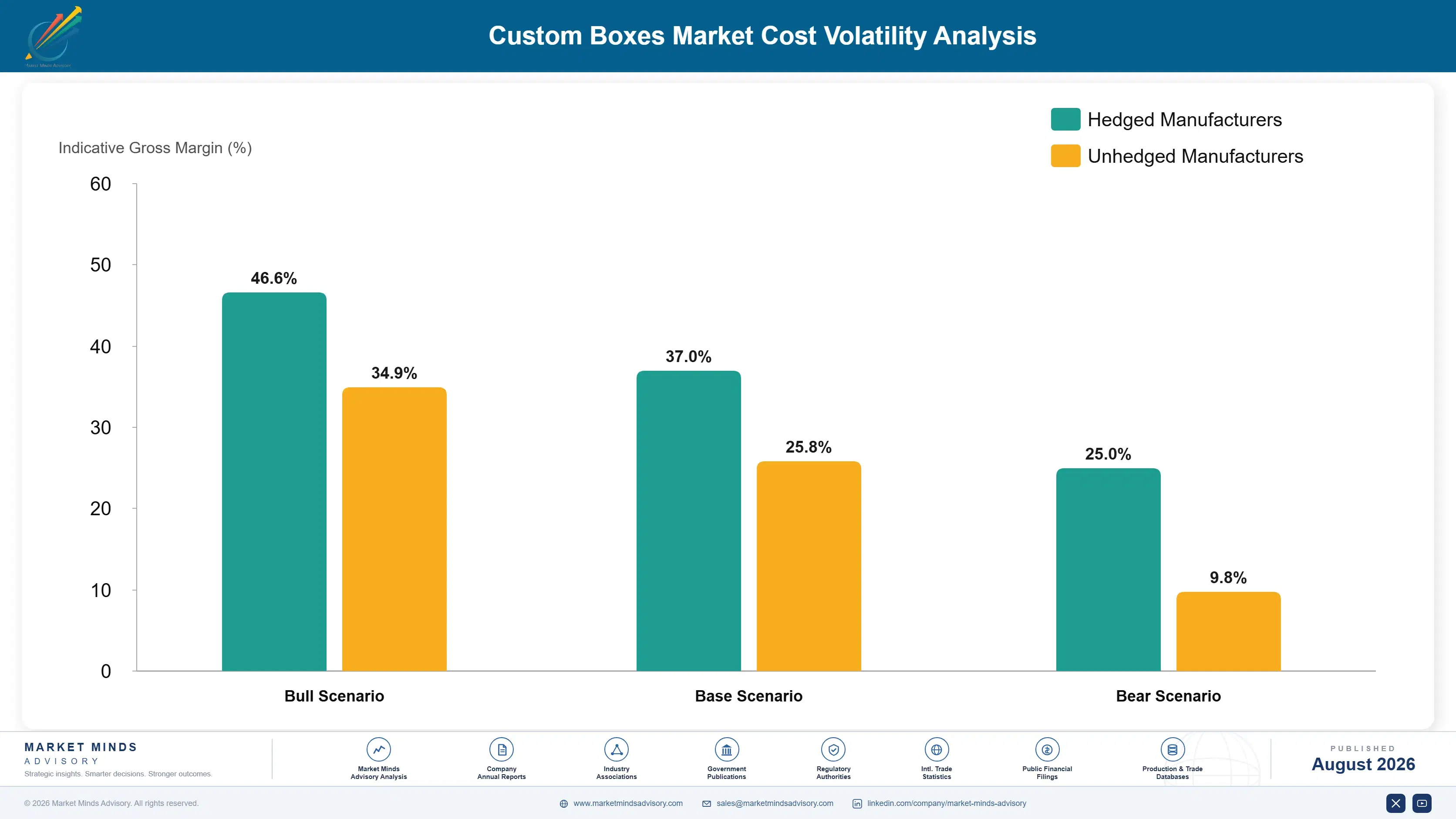
Containerboard prices rose considerably through 2021 and 2022 amid broader pulp and paper market volatility, with several packaging manufacturers disclosing meaningfully higher input costs during that period, per company annual report commentary and industry association data covering that cycle. Several manufacturers passed through a portion of this cost increase to brand customers with a lag of several months, compressing margin temporarily. Prices have since moderated somewhat.

Exposure separates clearly by production scale and fiber sourcing strategy. Larger integrated producers with owned pulp and paper mills absorbed less disruption than smaller print shops purchasing containerboard on the open market during the tightest volatility periods specifically. Manufacturers with long-term fiber supply contracts faced considerably less exposure to the spot market price spikes that affected smaller, less integrated competitors more heavily during recent volatility.
custom-boxes-market-cost-volatility-analysis-1787332352132

Secure long-term fiber supply contracts

Spot-market containerboard purchasing exposed several smaller producers to meaningful cost spikes during the 2021 and 2022 volatility period specifically and repeatedly across the industry. Longer-term fiber supply contracts reduce this exposure considerably across future commodity price cycles ahead for most manufacturers. The trade-off is reduced flexibility to benefit from price declines when paper markets soften unexpectedly later.

Pursue vertical integration where feasible

Larger integrated producers with owned pulp and paper mills faced meaningfully less disruption than smaller print shops dependent on open-market purchasing during recent shortages and price spikes. Vertical integration reduces exposure to fiber market volatility considerably over time and across future cycles. This requires capital investment that only larger, well-capitalized manufacturers can typically justify given current production volumes.

Pass through costs via indexed brand agreements

Multi-year brand supply agreements increasingly include indexed pricing clauses tied to underlying containerboard costs, reducing the margin compression manufacturers previously absorbed during volatility periods entirely and predictably across most contract structures. This shifts commodity price risk more transparently onto the broader supply chain rather than concentrating it entirely on packaging manufacturers alone or their smaller suppliers.

Portfolio Architecture for Margin Defence

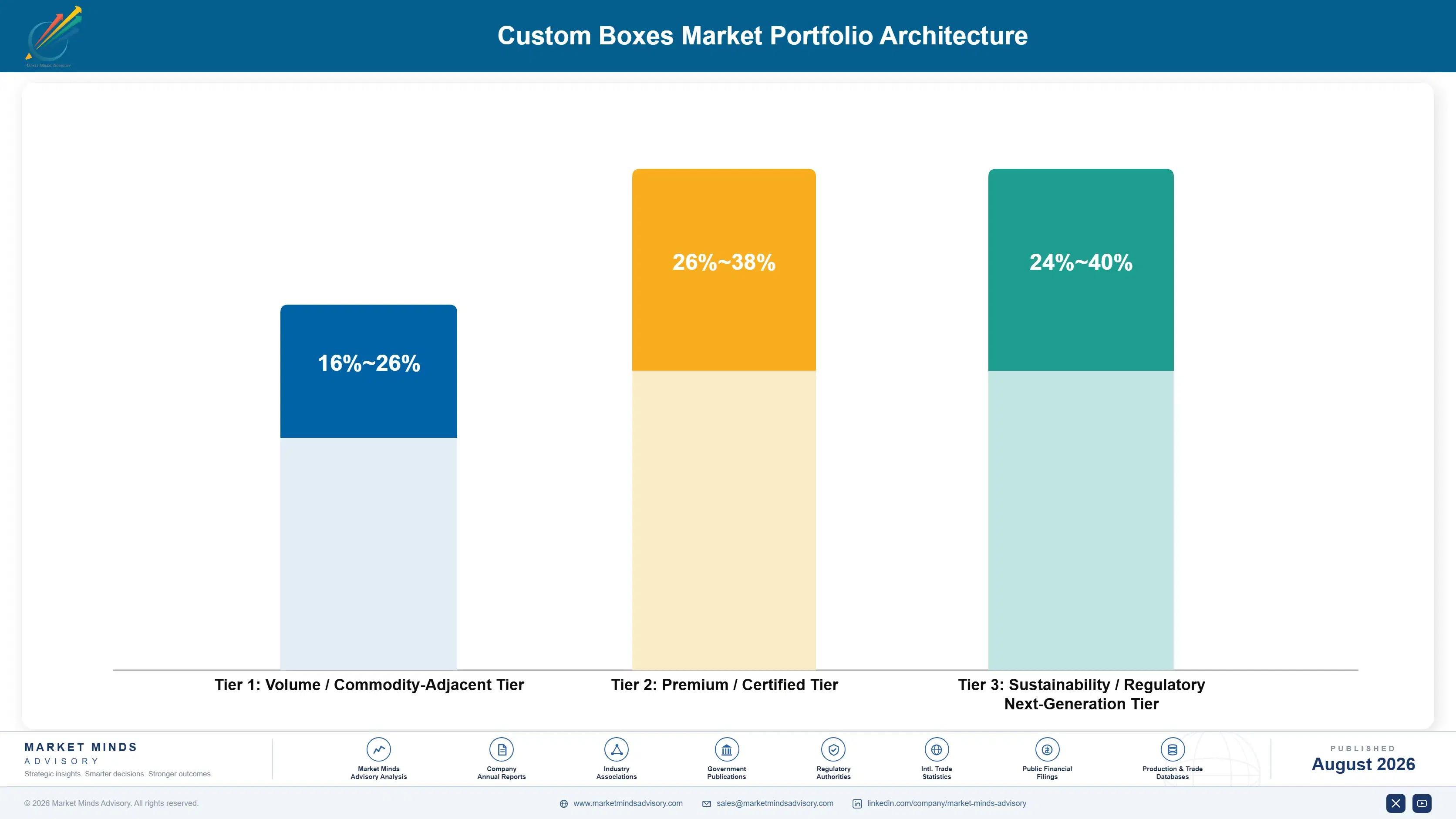
The portfolio splits into three tiers with distinct economics. Standard printed corrugated shipping boxes form the volume tier, competing increasingly on price against regional print shops with margin set by material cost and production efficiency. Structural die-cut boxes and premium finished cartons earn considerably more since design engineering depth and finishing technique breadth deter competitors lacking comparable technical investment. Sustainable material development and brand consultat
The tension runs between standard box revenue that funds the business today and structural design and sustainability investment that positions it for the next decade. A manufacturer defending standard box volume too aggressively against regional print shop competition cedes the highest-margin structural and sustainable segments to competitors investing there directly. Companies managing this well use standard box cash flow to fund design engineering rather than treating them as competing priorities.

High-value pools concentrate where design engineering depth, digital printing flexibility, or sustainability credibility limit competition: die-cut structural boxes, mono-material sustainable formats, and direct-to-consumer brand consultation services. Standard corrugated boxes sold without differentiated capability sit at the other end, competing almost entirely on price against every regional print shop now serving cost-sensitive institutional and small-brand buyers.

Volume / Commodity-Adjacent Tier

Standard printed corrugated shipping boxes competing increasingly on price against regional print shops, with margin set overwhelmingly by material cost and production efficiency across most conventional categories tracked and monitored.
Gross Margin: 16-26%

Premium / Certified Tier

Structural die-cut boxes and premium finished cartons supporting meaningfully stronger margin than standard corrugated production, reflecting genuine design engineering and finishing technique differentiation earned over years of client work and testing.
Gross Margin: 26-38%

Sustainability / Regulatory / Next-Generation Tier

Mono-material recyclable formats, digital printing service platforms, and direct-to-consumer brand consultation programmes developed ahead of tightening extended producer responsibility regulation across multiple jurisdictions currently under active regulatory review and revision.
Gross Margin: 24-40%
custom-boxes-market-portfolio-architecture-1787332352625

High-value Sub-segments and Strategic Watch-out

Custom Mailer and E-Commerce Boxes

High value and high growth at 9.5%, the fastest category in the market, driven by rising direct-to-consumer shipping volume across most major retail categories and carrier dimensional weight pricing rewarding right-sized packaging everywhere globally today and increasingly across most brand tiers, channels, geographies, and product segments.
Gross Margin: 26-38%

Die-Cut Specialty Structural Boxes

High value with strong growth at 8.2%, the second-fastest category, driven by brands increasingly commissioning custom structural engineering to create distinctive unboxing experiences across most premium consumer goods categories, channels, markets, product launches, retail formats, brand campaigns, and global marketing programmes tracked very closely worldwide.
Gross Margin: 26-38%

Corrugated Custom Shipping Boxes

The volume core by revenue, growing near 6.0% as this remains the largest and most established category across nearly every major shipping application tracked currently worldwide, though growth has moderated meaningfully as premium alternatives gain share steadily each year across most established markets and channels.
Gross Margin: 16-26%

Folding Carton Custom Boxes

The strategic watch-out, growing near 5.0% and facing commoditization pressure from regional print shops offering comparable specifications across most standard retail packaging categories currently under sustained budget pressure everywhere globally and regionally today across most channels, brand tiers, product categories, markets, buying groups, and distributors.
Gross Margin: 16-26%

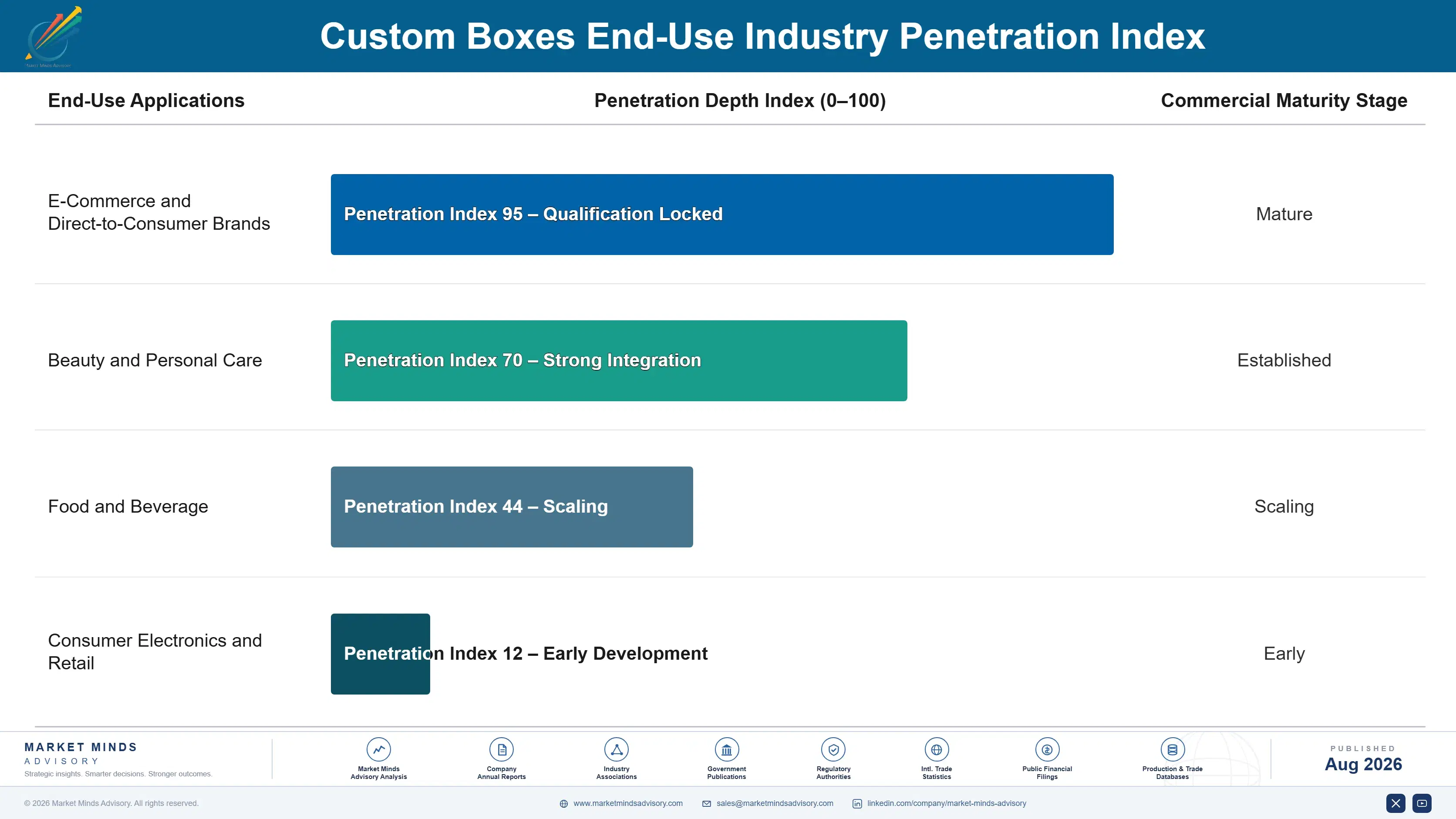
How Early Trust Locks In Volume

Revenue depends on brand relationship depth built during a customer's earliest, smallest orders, and a supplier's default status with a growing direct-to-consumer brand generates years of expanding volume as that brand scales toward larger production runs. Switching suppliers requires redesigning production files and requalifying print specifications, a cost that deters displacement even when a competitor offers marginally better pricing upfront.
Adoption depth varies sharply by category. Structural die-cut buyers commit hardest, given the tooling investment and design interdependence between a specific pattern and its original supplier once production begins at scale. Custom mailer buyers sit in the middle, balancing established supplier relationships against periodic competitive retendering as order volume grows considerably. Standard corrugated buyers switch most readily, since specification differentiation between qualified manufacturers remains genuinely minimal across comparable products offered.

Buyer profiles have shifted from purchasing managers evaluating unit price alone toward brand and marketing teams weighing design flexibility, turnaround speed, and sustainability credentials together. Unboxing experience marketing has introduced a new buyer consideration around social media shareability that conventional shipping economics never required previously. Younger brand founders also weigh supplier design consultation support more heavily than predecessors did, favouring genuinely collaborative production partners.
custom-boxes-market-end-use-penetration-index-1787332353111

Our Call on Custom Boxes

These are among the four positions where our research anticipates prominent divergence between winners and laggards over the coming forecast period. Each is grounded in the demand model, the regulatory perimeter, and the announced capacity pipeline.
01 / DIGITAL PRINTING INVESTMENT

Small-run flexibility now decides specification

Digital print adoption has reached roughly 35 percent of custom orders, a share that has risen steadily as short-run digital printing eliminates the setup costs that previously made small custom orders economically unviable for many smaller direct-to-consumer brands entering the market. Manufacturers with genuine digital printing capability capture specification that traditional offset-only competitors increasingly cannot match as brands demand smaller, more frequent orders. Companies should build this capability now, since it increasingly gates access to the fastest-growing brand segment available.
02 / STRUCTURAL DESIGN DEPTH

Unboxing differentiation rewards engineering investment

Brands increasingly commission custom structural engineering to create distinctive unboxing experiences, and die-cut specialty structural boxes command meaningfully higher average selling prices than generic rectangular alternatives given the tooling and engineering investment each pattern requires before production begins at scale and volume. Manufacturers with dedicated structural design teams capture premium specification that generalist producers increasingly cannot match as brands prioritize differentiation over price. Companies should invest in engineering talent deliberately, since it increasingly determines specification on the category's highest-margin segment currently available.
03 / SUSTAINABLE MATERIAL DEVELOPMENT

Mono-material credibility gates brand trust

Mono-material recyclable orders have risen roughly 24 percent annually as brands increasingly specify structures that recycling infrastructure can actually process, moving away from mixed-material laminates that regulation and consumer preference both increasingly penalize across most major markets tracked closely and consistently each year. Manufacturers with genuine mono-material design capability capture specification that competitors relying on conventional formats increasingly cannot claim credibly to their own customers. Companies should invest in this capability now, since sustainability credibility increasingly determines brand customer trust and loyalty.
04 / EARLY BRAND RELATIONSHIPS

Early-stage service locks in scaling volume

Direct-to-consumer brands increasingly default to whichever packaging supplier supported their earliest, smallest orders as they scale toward larger production volumes, making early relationship depth a genuine competitive moat that transactional pricing alone cannot overcome once tooling and design investment has been made together across production cycles. Manufacturers investing in flexible, brand-friendly early-stage service capture long-term volume that competitors focused only on large enterprise accounts increasingly miss. Companies should prioritise these early relationships deliberately, since they compound into significant volume over time.

Engagement Snapshot From the Field

A live engagement with an industry participant carrying material or product regulatory and market exposure ahead of a defining policy shift, showing how our research translates into a defensible multi-year portfolio strategy.
MARKET MINDS ADVISORY · CLIENT ENGAGEMENT SUMMARY
Custom Boxes Producer Strategic Portfolio Review and Transition Roadmap 2026·Investment Scenario on Custom Boxes Exposure Evaluation 2025-26
CLIENT PROFILE
A direct-to-consumer beauty brand shipping roughly 40,000 orders monthly engaged MMA ahead of transitioning from its original small-batch packaging supplier to a larger production partner capable of supporting its rapid growth trajectory. The client reported growing concerns that its original supplier could not scale production fast enough to match its accelerating order volume (client-reported, unverified by MMA).
STRATEGIC CHALLENGE
Leadership faced a choice between staying loyal to the small supplier that had supported the brand since its earliest days or transitioning to a larger integrated producer with greater scale but a less personalized service relationship. The board worried that switching suppliers could disrupt the distinctive structural design and print quality customers had come to associate closely with the brand's packaging and unboxing experience specifically.
MMA APPROACH
MMA benchmarked production capacity, turnaround time, and design fidelity across the client's current supplier and three larger integrated producer alternatives under consideration. We assessed the technical risk of replicating the brand's existing structural die-cut design and finishing techniques across each alternative supplier evaluated. We then modelled a phased transition approach that preserved design continuity while progressively shifting volume toward greater production scale.
KEY FINDINGS
  1. The client's original supplier's production capacity was projected to become a binding growth constraint within approximately four months at current order growth rates.
  2. Two of the three alternative suppliers evaluated could replicate the existing structural design within acceptable quality tolerances after a brief validation period.
  3. A phased transition retaining the original supplier for a smaller specialty product line preserved design continuity while enabling scale for core products.
  4. Full immediate transition risked a temporary quality dip that could have affected roughly 15 percent of shipments during the changeover period specifically.
CLIENT PROFILE
A direct-to-consumer beauty brand shipping roughly 40,000 orders monthly engaged MMA ahead of transitioning from its original small-batch packaging supplier to a larger production partner capable of supporting its rapid growth trajectory. The client reported growing concerns that its original supplier could not scale production fast enough to match its accelerating order volume (client-reported, unverified by MMA).
STRATEGIC CHALLENGE
Leadership faced a choice between staying loyal to the small supplier that had supported the brand since its earliest days or transitioning to a larger integrated producer with greater scale but a less personalized service relationship. The board worried that switching suppliers could disrupt the distinctive structural design and print quality customers had come to associate closely with the brand's packaging and unboxing experience specifically.
MMA APPROACH
MMA benchmarked production capacity, turnaround time, and design fidelity across the client's current supplier and three larger integrated producer alternatives under consideration. We assessed the technical risk of replicating the brand's existing structural die-cut design and finishing techniques across each alternative supplier evaluated. We then modelled a phased transition approach that preserved design continuity while progressively shifting volume toward greater production scale.
KEY FINDINGS
  1. The client's original supplier's production capacity was projected to become a binding growth constraint within approximately four months at current order growth rates.
  2. Two of the three alternative suppliers evaluated could replicate the existing structural design within acceptable quality tolerances after a brief validation period.
  3. A phased transition retaining the original supplier for a smaller specialty product line preserved design continuity while enabling scale for core products.
  4. Full immediate transition risked a temporary quality dip that could have affected roughly 15 percent of shipments during the changeover period specifically.
RECOMMENDED STRATEGY
Phase 1: Phase 1 (0 to 2 months): Validate structural design replication with the top two alternative suppliers identified beforehand very quickly. Phase 2: Phase 2 (2 to 5 months): Transition core product line volume gradually to the validated larger production partner chosen carefully. Phase 3: Phase 3 (5 to 9 months): Retain the original supplier for specialty and limited-edition product lines requiring closer collaboration ongoing.
OUTCOME
The client transitioned its core product line to the larger production partner while retaining its original supplier for specialty releases, successfully scaling production capacity without disrupting its signature unboxing experience. Order fulfillment reliability improved meaningfully following the phased transition completion nationwide (client-reported, unverified by MMA).

Frequently Asked Questions

Foundational context covering the market sizes, CAGR, scope, country, region and competition that inform every finding below. This section is provided to cover basics and most often pre-purchase conversations, answered from the MMA Primary Research Dataset.

What is the current size of the Custom Boxes Market?

The global custom boxes market is valued at USD 8.5 billion in 2025, covering printed and structurally customized corrugated, rigid, and folding carton boxes. Standard unprinted stock boxes and industrial bulk containers are excluded.

How large will the Custom Boxes Market be by 2036?

The market is forecast to reach USD 16.99 billion by 2036 in the base case, about 1.88 times the 2026 level. That represents incremental value of roughly USD 7.94 billion across the decade.

What is the CAGR for the Custom Boxes Market 2026 to 2036?

The market grows at a 6.5% CAGR in the base case, with bull and bear scenarios at 7.7% and 5.2%. The spread turns mainly on direct-to-consumer e-commerce growth and material cost pressure.

Which segment is growing fastest?

Custom mailer and e-commerce boxes grow fastest at 9.5%, about 1.46 times the overall rate, pulled forward by rising direct-to-consumer shipping volume. Die-cut specialty structural boxes follow at 8.2%.

Who are the major companies in the Custom Boxes Market?

Leading companies include WestRock, International Paper, DS Smith, Mondi Group, and Packaging Corporation of America. Concentration is low at 32%, reflecting a fragmented producer base.

Which country is growing fastest?

India grows fastest at a 9.2% CAGR, driven by rapid domestic e-commerce platform growth and rising direct-to-consumer brand activity. Southeast Asian markets follow closely behind.

Report Segmentation Architecture

The full report scope spans multiple orthogonal segmentation dimensions, with cross-tabulated demand data provided for each dimension pair. Coverage extends further to regional breakdowns, trend trajectories, and the competitive detail needed to support segment-level decision-making.

By Box Construction and Material Type

  • Corrugated Custom Shipping Boxes
  • Rigid Setup Boxes
  • Folding Carton Custom Boxes
  • Custom Mailer and E-Commerce Boxes
  • Die-Cut Specialty Structural Boxes

By End-Use Industry

  • E-Commerce and Direct-to-Consumer Brands
  • Beauty and Personal Care
  • Food and Beverage
  • Consumer Electronics and Retail

By Commercial Dimension

  • Direct Brand Purchase
  • Digital Print-on-Demand Platform Channel
  • Distributor and Wholesale Channel
  • Retail Private Label Contract Supply

By Region

  • North America
  • Western Europe
  • East Asia
  • South Asia and Pacific
  • Latin America
  • Middle East and Africa
  • Eastern Europe

Scope, Methodology, and Coverage

Every figure in this report is reproducible from documented input assumptions. The scope below maps the historical period, the forecast horizon, the segmentation dimensions, and the countries covered, alongside the underlying primary and qualitative methodology.
Historical Period
2020 to 2025
Forecast Period
2026 to 2036
Base Year
2025 (USD billions; MMA Primary Research Dataset, August 2026)
Market Definition
The custom boxes market comprises printed and structurally customized corrugated, rigid, and folding carton boxes produced to a specific brand's dimensions, graphics, or structural design, valued at manufacturer revenue for units sold to e-commerce, retail, and consumer goods companies. Standard unprinted stock boxes and industrial bulk shipping containers are excluded from this scope.
Quantitative Units
USD billions (current prices); unit shipment volume by construction type where applicable
Segmentation Dimensions
By Box Construction and Material Type; By End-Use Industry; By Commercial Dimension; By Region
Regions Covered
North America, Western Europe, East Asia, South Asia and Pacific, Latin America, Middle East and Africa, Eastern Europe
Countries Covered
USA, Canada, Mexico, Germany, France, UK, Italy, Spain, China, Japan, South Korea, India, Australia, Vietnam, Indonesia, Brazil, Argentina, Saudi Arabia, UAE, Turkey, South Africa, Nigeria, Poland, Czech Republic, Romania, Sweden, Netherlands, Singapore, Philippines, Thailand, and additional markets relevant to this sector
Key Companies Profiled
WestRock, International Paper, DS Smith, Mondi Group, Packaging Corporation of America, Georgia-Pacific, Smurfit Kappa, Stora Enso, Oji Holdings, Nine Dragons Paper, ProAmpac, Sonoco Products, Huhtamaki, Amcor, Multi Packaging Solutions, Packlane, Packhelp, Arka, Klabin, Cascades Inc
Quantitative Methodology
Primary survey, n=3,800 respondents, Q4 2025, six countries; demand-side model with trade association cross-validation
Qualitative Methodology
47 expert interviews, Q4 2025; applied to validate demand model assumptions, identify emerging dynamics, and assess competitive positioning
Report Format
PDF and XLSX data workbook (Word format preview document)
Publisher
Market Minds Advisory
Report Code
MMA-2026-PAC-301
Published
August 2026
Contact
sales@marketmindsadvisory.com | www.marketmindsadvisory.com

Purchase the full Custom Boxes Market Report (2026 to 2036).

The full MMA Custom Boxes report sizes the market across five box construction types, four end-use industries, four commercial channels, and seven regions through 2036. It profiles 20 companies on a consistent unit shipment volume basis, scoring each on digital printing infrastructure, structural design engineering, sustainable material development, and direct-to-consumer brand relationship depth. Scenario models quantify how e-commerce growth, unboxing marketing trends, and material cost pressure move both unit demand and achievable margin by category. The report also includes minimum order quantity benchmarking and mono-material adoption tracking for manufacturer and investor strategy teams.
Five-construction and four-channel market sizing to 2036
Twenty-company benchmark on unit shipment volume basis
Digital printing infrastructure competitive positioning analysis
Structural design engineering capability benchmarking review
Mono-material sustainability adoption and regulation tracking
Direct-to-consumer brand relationship and retention analysis

Built For The People Who Decide

From boardroom strategy to bench-side execution, this report is read cover-to-cover by leaders shaping the next decade of their industry, turning demand scenarios, market dynamics and valuation benchmarks into decisions.
CXOs/ Presidents/ VPs/ Managers
M&A and Corporate Development
Strategy Teams and R&D Heads
Procurement and Product Directors
Regulatory and Compliance Leaders
Investor Relations and Equity Analysts