
Market Minds Advisory
Contract Packaging Market

Contract Packaging Market: Brands Are Renting Capacity Instead Of Owning It

A commercial reading of outsourced packaging services, where consumer brands facing shorter product cycles and SKU proliferation increasingly rent flexible capacity rather than own it, and automation is resetting who can compete on price.

Lead Analyst

Bilal Shaikh

Published

September 2026

Make Smarter Decisions with Customized Research Insights

Request a free sample report and evaluate market opportunities, growth trends, and competitive dynamics relevant to your business needs.

2025 MARKET VALUE$42.6BMarket Size 2025
2036 FORECAST VALUE$84.3BBase Case , 2026 to 2036
CAGR 2026 TO 20366.4 %Bull 7.6% / Bear 5.1%
INCREMENTAL OPPORTUNITY$39.0BNet 10- year value creation
EXPANSION MULTIPLE1.86x2036 value over 2026 base
Strategic Levers
M&A Pipeline
Regional Outlook
Country Rankings
Competitive Intelligence
Segmental Deep-dive
Call-Us : 91 93563 13602

Executive Snapshot and Market Trajectory

Brands stopped owning packaging lines for products that might not exist next year. Shorter product cycles and constant SKU proliferation made in-house capacity a liability rather than an asset, and that single shift turned contract packaging from a cost play into a genuine flexibility play for most consumer goods companies.
The market stands at USD 42.6 billion in 2025 and reaches USD 84.30 billion by 2036 at a 6.4% CAGR. Co-packing and assembly services grow fastest at 9.2%, about 1.44 times the overall rate, as brands hand over entire kitting and multi-pack assembly runs rather than just filling. Vietnam posts the quickest national growth at 10.8% as manufacturing diversification pulls consumer goods production away from China and into newer, lower-cost hubs across the region.
Concentration is low at 24% for the top five, reflecting a genuinely fragmented industry of regional and category specialists rather than global consolidators dominating the field. Two forces are reshaping it right now, at real speed. Automation investment is separating scaled operators from small regional shops that cannot fund robotics on their own, and brand owners increasingly demand single-vendor programmes spanning packaging, kitting, and fulfilment together under one roof.
Market Definition
The contract packaging market covers third-party services that fill, pack, label, kit, or assemble finished products on behalf of brand owners across food and beverage, personal care, pharmaceutical, and household goods categories. In-house brand-owned packaging operations, primary packaging material manufacturing sold separately, and pure third-party logistics or warehousing without packaging activity are excluded.
Base Year Value
$42.6B in 2025 (MMA Primary Research Dataset, August 2026)
Forecast Period
2026 to 2036, eleven discrete annual values
CAGR
6.4% base case. Bull 7.6%. Bear 5.1%.
Fastest Growth Segment
Co-Packing and Assembly Services: 9.2% CAGR
Fastest Growth Country
Vietnam: 10.8% CAGR
Fastest Growth Region
South Asia and Pacific: 8.4% CAGR
Largest Region
East Asia: 27% of 2025 global value
Market Leaders
Sonoco, DS Smith, Jones Healthcare Group, Sharp Packaging Solutions, Anderson Packaging. Source: MMA Analysis based on company disclosures.
Primary Survey
n=3,800 procurement and R&D decision-makers, Q4 2025, six countries
Methodology
Demand-side build-up, cross-validated against public data, 47 expert interviews

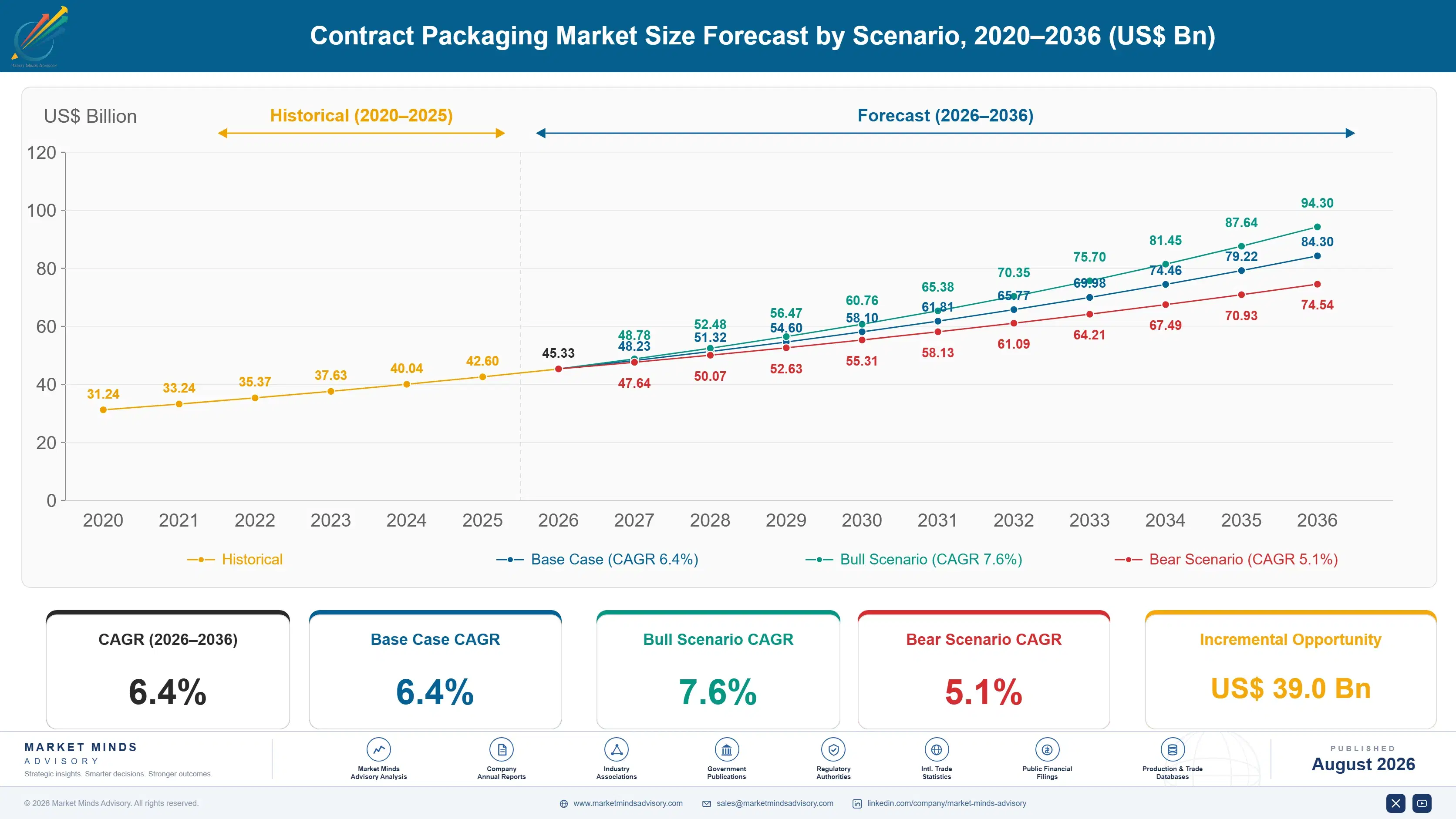
Contract Packaging Market Forecast Scenarios

contract-packaging-market-size-forecast-scenario-1787332125667
Growth from 2020 to 2025 compounded near 5.6%, disrupted by pandemic-era supply chain volatility that pushed some brands to bring packaging in-house temporarily for control over uncertain freight timing and material availability. That reversal proved short-lived. Normal freight and labour availability returned within a couple of years, and outsourcing regained its cost advantage as brands rediscovered how expensive idle in-house capacity actually is between product cycles.
Three mechanisms carry the base case to 6.4%. First, SKU proliferation, since brands running frequent limited editions and regional variants cannot justify dedicated in-house lines for runs that end within months. Second, automation investment, as scaled contract packagers deploy robotics that smaller brand-owned operations cannot afford to match at comparable cost per unit. Third, single-vendor consolidation, as brand owners increasingly prefer one partner spanning packaging through fulfilment rather than managing several separate relationships.
The bull case at 7.6% assumes SKU proliferation accelerates further and more categories, particularly pharmaceutical and beauty, shift meaningfully toward outsourced models across the forecast period. The bear case at 5.1% assumes major consumer goods companies reverse toward vertical integration during a period of supply chain nationalism, reclaiming volume that contract packagers currently run for them.

Why Brands Are Renting Lines Instead Of Owning Them

Three forces set demand. SKU proliferation provides the base, as brands running frequent limited editions and regional pack variants cannot justify dedicated in-house lines for volume that ends within a season. Automation provides the differentiation, since scaled operators running robotic kitting win business that manual shops cannot price competitively. And category expansion into pharmaceutical and beauty adds a third, faster-growing revenue stream.
MARKET CONCENTRATIONCR5: 24%Fragmented among regional and category-specialist packaging operators worldwide
AVERAGE SELLING PRICEUSD 0.08 to 1.40 per unitPer-unit service fee spanning simple filling to complex kitting
TOP PRODUCING COUNTRY SHAREUnited States: about 21%Share of global contract packaging service revenue generated
CAPACITY UTILISATION RATEAbout 74%Average line utilisation across contract packaging facilities today
LABOUR COST SHAREAbout 38% of COGSPortion of service cost represented by direct production labour
CONTRACT RENEWAL CYCLE1 to 3 yearsTypical service agreement length before formal reprocurement begins
The commercial character is set by labour cost more than by equipment sophistication. Direct production labour accounts for roughly 38% of cost of goods sold, and that share is exactly why contract packaging capacity concentrates in lower labour cost regions and why automation investment is the clearest lever available to protect margin as wage inflation continues across most major markets.
The next decade turns on two things. Whether brand owners keep preferring outsourced flexibility over the control that vertical integration offers, since supply chain nationalism sentiment could reverse that preference in select categories. And whether automation investment concentrates volume among fewer, larger operators, since that concentration would squeeze the small regional shops that still make up much of the fragmented competitive landscape today.
"Brands used to build a packaging line the way they'd build a factory, for good. Now they treat it like a lease they can walk away from when the SKU dies, and contract packagers that figured out how to make that math work for both sides are the ones actually growing."
Director, Packaging and Contract Manufacturing Practice · MMA Packaging / Contra

Market Trends

Automation Splits The Field Into Two Competitive Tiers

Scaled contract packagers are deploying robotic case packing, kitting, and palletising equipment that cuts labour cost per unit substantially compared with manual lines, and that investment gap is splitting the industry into automated operators winning large, price-sensitive programmes and smaller regional shops retreating toward complex, low-volume work automation cannot yet handle economically. Sonoco and DS Smith have both disclosed continued automation capital spending through 2024 and 2025 specifically targeting labour cost reduction. Brand owners increasingly request automation roadmaps during vendor selection, treating it as a proxy for long-term price stability rather than a nice technical detail buried in a proposal.
Market Impact: SKU counts have grown 2x+
Single-Vendor Programmes Replace Fragmented Multi-Vendor Sourcing

Brand owners managing separate vendors for filling, kitting, and fulfilment have increasingly consolidated toward single contract packagers capable of running the full sequence, reducing coordination overhead and the quality risk that comes from handoffs between multiple facilities under different ownership. Jones Healthcare Group and Sharp Packaging Solutions have both expanded service scope specifically to capture this consolidation trend among pharmaceutical and personal care clients. The commercial effect favours operators with facility networks broad enough to offer true single-vendor coverage, which smaller regional specialists simply cannot match without partnership or acquisition.
Market Impact: Outsourcing here runs 2x food's pac

Market Opportunities and Growth Drivers

SKU Proliferation Makes Dedicated Lines Uneconomical

Consumer brands now launch limited editions, regional variants, and seasonal packs at a pace that makes building dedicated in-house capacity for any single run financially indefensible, since the line would sit idle the moment the SKU cycles out of range. Contract packagers absorb that volatility by running many brands' short cycles across shared, flexible capacity no single brand could justify owning outright. Major consumer goods companies including those in beauty and snacking categories have cited SKU count growth explicitly in recent investor commentary. This dynamic is the single most reliable driver behind outsourcing decisions industry-wide.
Market Impact: Labour is 38% of cost

Pharmaceutical And Beauty Categories Are Outsourcing Faster Than Food

Pharmaceutical companies face growing complexity in blister packaging, serialisation compliance, and specialty kitting that dedicated contract packagers handle more cost-effectively than in-house lines built for simpler formats years earlier. Beauty brands face comparable pressure from increasingly elaborate multi-component packaging that outstrips what most in-house operations were ever designed to run. Jones Healthcare Group and Sharp Packaging Solutions have both expanded pharmaceutical-specific capacity to meet this demand directly. Category-specific complexity, more than raw volume growth, is what is pulling these two categories toward outsourcing faster than food and beverage currently moves.
Market Impact: Risk limits penetration in 2 catego

Market Restraints and Challenges

Labour Cost Inflation Squeezes Margin Faster Than Pricing Adjusts

Direct production labour represents roughly 38% of cost of goods sold, and minimum wage increases and tightening labour availability across major packaging hubs are the root cause of cost growth that outpaces what contract terms typically allow operators to pass through mid-cycle. Commercially this compresses margin most severely for manual, labour-intensive operators who lack automation investment to offset wage inflation. Larger operators respond by accelerating robotic kitting and case-packing deployment to reduce labour dependency, while smaller shops increasingly specialise in complex, low-volume work where automation offers little advantage. Wage pressure is accelerating industry consolidation more than any other factor today.
Market Impact: Automated lines cut cost 20%+

Brand Owners Fear Losing Quality Control To Third Parties

Brand quality teams have been burned by contract packaging defects that reached retail shelves before detection, and that history is the root cause of persistent hesitation among some brand owners to outsource categories where packaging failure carries genuine safety or reputational risk, particularly pharmaceutical and infant categories. Commercially this restricts outsourcing penetration in exactly the categories where contract packagers could otherwise capture the most value, since regulated categories command premium pricing once trust is established. Operators respond with dedicated quality personnel embedded on client programmes and real-time inspection technology brand quality teams can audit remotely.
Market Impact: Single-vendor deals span 3+ service
3 additional market trends, 4 additional growth drivers, and 2 additional restraints and challenges are covered in the full report. Contact sales@marketmindsadvisory.com to access the complete intelligence.

Segment CAGR and Growth Architecture

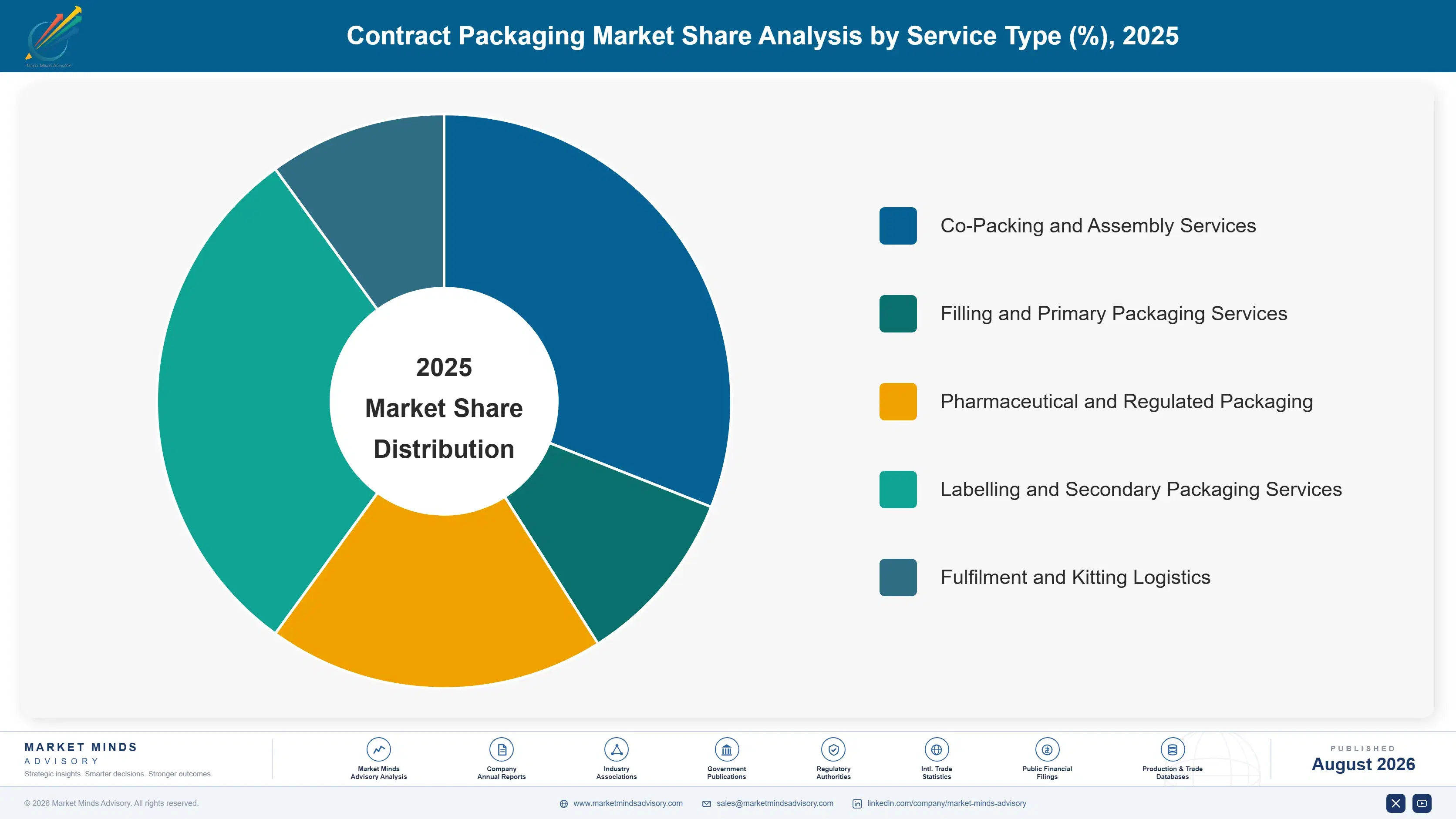
Segmentation follows service type, a single operational logic describing what the contract packager actually does to the product rather than which brand category it serves. Each service type carries its own labour intensity, equipment requirement, and pricing structure, so commercial position tracks the service performed rather than the end customer's industry or product category directly.
contract-packaging-market-market-share-analysis-1787332126203

Co-Packing and Assembly Services

Co-packing and assembly services grow fastest at 9.2%, about 1.44 times the overall 6.4% rate, covering multi-pack bundling, gift set assembly, promotional kitting, and combination product assembly that require brands to hand over an entire finished-goods workflow rather than a single filling step. Demand concentrates around seasonal and promotional cycles where brands need capacity to scale rapidly and then release it just as quickly once the programme ends. Sonoco and several regional specialists have expanded kitting-specific capacity to capture this shift directly. Pricing runs meaningfully above simple filling work, since assembly complexity and labour intensity both scale with the number of components a given kit or set actually contains. This segment rewards operators with genuine flexible labour scheduling capability most.
CAGR 9.2%

Filling and Primary Packaging Services

Filling and primary packaging services grow at 5.8%, the largest segment by installed capacity though no longer the fastest, covering liquid, powder, and solid product filling into primary containers across food, beverage, personal care, and household goods categories. Growth has moderated as the segment matures and competition on straightforward filling work compresses pricing toward commodity levels, pushing differentiation toward speed, changeover flexibility, and minimum order quantity accommodation rather than the filling operation itself. Automation investment matters most here, since scaled operators running high-speed filling lines undercut manual competitors decisively on large-volume programmes. This segment remains the revenue floor beneath the category even as growth concentrates in more complex, higher-margin services elsewhere.
CAGR 5.8%
Full segment breakdown across 5 segments available in the complete report.

Regional Architecture and Country Demand Map

Labour cost and proximity to brand headquarters together set this distribution more than raw manufacturing scale does. East Asia and North America lead on different logics, one on cost and manufacturing density, the other on proximity and service sophistication, while share elsewhere tracks where consumer goods production is diversifying toward.

North America

Proximity to brand headquarters and retailer distribution centres anchors North America's 26% share, since United States consumer goods companies increasingly value contract packagers who can turn around promotional and seasonal programmes on short notice rather than the lowest unit cost alone. Sonoco and several regional operators maintain dense facility networks near major retail distribution hubs specifically to serve this demand. Canadian capacity serves both domestic brands and cross-border programmes for American companies seeking currency and tariff diversification. Pharmaceutical contract packaging is particularly concentrated domestically given regulatory proximity requirements that favour facilities close to brand quality teams. Growth of 6.0% reflects steady SKU proliferation against a mature, already well-penetrated outsourcing base nationally.
Share: 26% | CAGR: 6.0% (2026 to 2036)

Western Europe

Regulatory complexity shapes demand across Western Europe's 20% share more than cost considerations do, with German and French pharmaceutical and personal care brands relying on contract packagers who maintain serialisation and labelling compliance capability across multiple national requirements simultaneously. British contract packaging capacity serves both domestic brands and export programmes, adjusting to post-Brexit customs and labelling requirements that added genuine operational complexity for cross-border clients specifically. Nordic sustainability packaging standards are pushing contract packagers toward recyclable and reduced-material formats faster than in most other regions globally. Growth of 4.8%, the slowest of the seven, reflects a mature outsourcing base against comparatively slower consumer goods volume growth across the continent overall.
Share: 20% | CAGR: 4.8% (2026 to 2036)
Regional intelligence for 5 additional markets available in the complete report: East Asia, South Asia and Pacific, Latin America, Middle East and Africa, Eastern Europe. Contact sales@marketmindsadvisory.com.
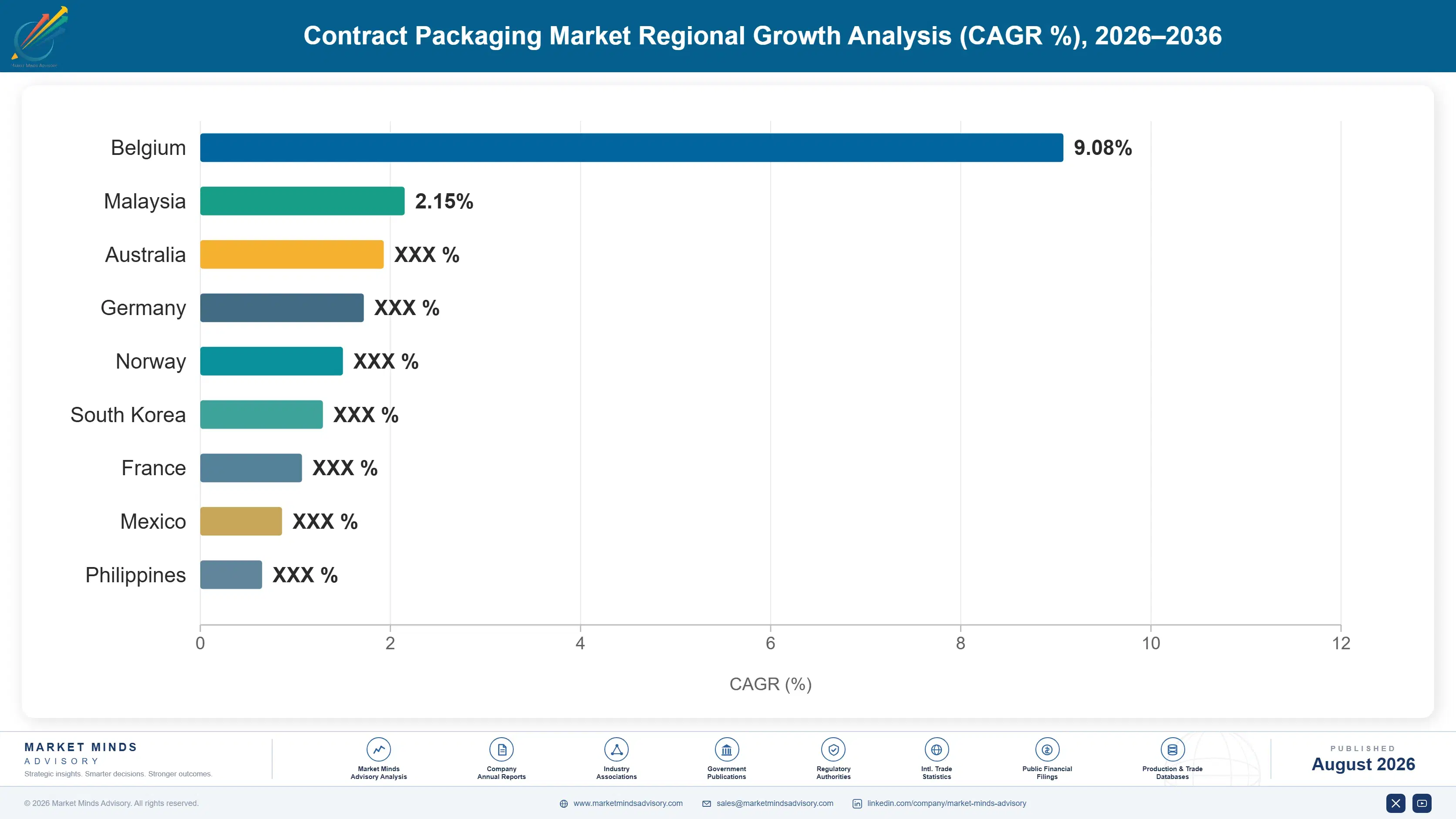
contract-packaging-market-country-cagr-analysis-1787332126716

Where Contract Packagers Actually Grow Margin

Competing purely on per-unit filling price is a race to the bottom against every regional shop with a filling line and cheap labour nearby. The four moves below shift revenue toward positions a lower-priced competitor cannot easily match: automation investment, service breadth, category specialisation, and quality transparency that earns lasting trust in regulated categories.

Deploy Robotics To Defend Margin Against Wage Inflation

Direct production labour represents roughly 38% of cost of goods sold, and operators deploying robotic case packing and kitting equipment cut that exposure substantially compared with manual competitors still absorbing wage inflation directly against thin contract margins. That automation investment also lets an operator quote firmer multi-year pricing, since labour cost volatility no longer drives the bulk of their cost structure the way it does for manual shops. Sonoco has structured recent capital spending explicitly around this logic across its network. Automation is becoming table stakes for winning large, price-sensitive programmes specifically across the industry.
Market Impact: Automation can cut labour cost by m

Build Single-Vendor Programmes Spanning Multiple Services

Brand owners managing separate vendors for filling, kitting, and fulfilment increasingly prefer consolidating toward one partner capable of running the full sequence, reducing coordination overhead and the handoff risk that comes from multiple facilities under different ownership entirely. Operators offering true single-vendor coverage across 3 or more service lines capture larger, stickier contracts than single-service competitors ever can on their own. Jones Healthcare Group has expanded scope specifically to capture this consolidation trend among pharmaceutical clients directly. Breadth is becoming as commercially important as price in most vendor evaluations now.
Market Impact: Multi-service deals now span 3 or m

Specialise In Regulated Categories Commanding Premium Pricing

Pharmaceutical and infant categories carry genuine safety and reputational risk that keeps some brand owners from outsourcing at all, yet the operators who invest in serialisation compliance and dedicated quality personnel earn a margin premium of 15% or more over commodity filling work once that trust is actually established over repeated audits and clean track records. Sharp Packaging Solutions and Jones Healthcare Group have both built pharmaceutical-specific capacity explicitly around this premium. Specialisation converts a trust barrier that excludes most competitors into a genuine competitive moat for operators willing to fund the compliance investment upfront.
Market Impact: Regulated work can earn a 15%+ pric

Offer Real-Time Quality Transparency To Brand Owners

Brand quality teams have been burned by packaging defects reaching retail shelves before detection, and that history keeps outsourcing penetration in the 2 categories carrying the most safety risk artificially low, excluding contract packagers from regulated, premium-priced work brand owners still hesitate to hand over. Operators deploying real-time inspection technology that brand teams can audit remotely directly address the trust deficit driving that hesitation more effectively than contractual guarantees alone ever manage to. This transparency tooling is becoming a genuine differentiator in competitive evaluations for pharmaceutical and infant category contracts specifically.
Market Impact: Remote audit access can win 2x more

Who Controls the Margin Pool

Concentration is low: the top five hold roughly 24% of revenue, reflecting a genuinely fragmented field of regional and category specialists rather than global consolidators dominating the landscape. The gap between leaders and challengers is automation investment and service breadth rather than raw scale, since even large operators compete regionally in most categories rather than nationally. All participants here are assessed on one basis, annual service revenue from contract filling, packing,
Competition runs along three lines. First, automation capability, since robotic operators cut labour cost exposure that manual competitors cannot escape. Second, service breadth, as single-vendor programmes spanning filling through fulfilment increasingly beat fragmented multi-vendor sourcing arrangements. Third, category specialisation, particularly in pharmaceutical and beauty work where regulatory and quality complexity commands durable premium pricing.

Pressure is building from two directions. Larger operators including Sonoco and DS Smith are acquiring regional specialists to build the automation scale and service breadth smaller shops cannot fund independently. Meanwhile brand owners themselves are occasionally reversing toward vertical integration in select categories under supply chain nationalism pressure. Rankings should favour operators combining automation investment with genuine category depth.
contract-packaging-market-company-positioning-matrix-1787332127235

Competitive Moat and Risk Dimensions

SONOCO

Moat: Facility network and automation scale

Sonoco operates a dense facility network across major consumer markets, giving it geographic coverage smaller regional specialists cannot match for brands running national or multi-country programmes. Continued automation capital spending has kept its cost structure competitive against wage inflation better than most manual competitors manage. Its broader packaging materials business also provides cross-selling opportunities pure-play contract packagers lack entirely.
SONOCO

Risk: Scale limits category depth

Sonoco's breadth across categories means it invests less deeply in any single vertical than category specialists including Jones Healthcare Group do in pharmaceutical work specifically. Regional shops undercut it on price for simple, low-complexity filling work where automation scale matters less. Integration costs from continued acquisition activity also periodically strain operational consistency across its network.
JONES HEALTHCARE GROUP

Moat: Pharmaceutical compliance depth

Jones Healthcare Group has built serialisation compliance and dedicated quality personnel capability specifically for pharmaceutical clients, earning trust that generalist operators struggle to replicate quickly. That specialisation commands premium pricing few competitors can match without comparable regulatory investment. Deep relationships with pharmaceutical brand quality teams also generate steady referral-based growth within the category.
JONES HEALTHCARE GROUP

Risk: Narrow exposure beyond pharma

Concentration in pharmaceutical work leaves Jones Healthcare Group exposed to regulatory or reimbursement shifts specific to that category in ways more diversified competitors are not. Its facility network is smaller than Sonoco's, limiting its ability to serve brands wanting single-vendor coverage across unrelated categories simultaneously. Expansion into adjacent categories would require capability it has not yet demonstrated at scale.

Players Tracked

Prominent Players

Sonoco
DS Smith
Jones Healthcare Group
Sharp Packaging Solutions
Anderson Packaging

Other Key Players

Multi Packaging Solutions
PharmaPac
Fenwick Company
AGI Shorewood
Perlen Packaging
Catalent
PCI Pharma Services
Diamond Packaging
Nulogy
Almac Group
Southern Packaging
Package Coordinators Inc
Bulk Handling Systems
WestRock Contract Packaging
TricorBraun Packaging Solutions

Recent Developments

APRIL 2025

Sonoco acquires regional co-packing specialist in the Southeast

Sonoco completed an acquisition of a regional co-packing specialist operating across the southeastern United States, adding assembly capacity and expanding its footprint in a fast-growing market. This was a confirmed acquisition rather than a joint venture, consolidating capacity in a segment where Sonoco previously relied on subcontracted relationships.
Signal: Larger operators are increasingly buying r
OCTOBER 2024

Jones Healthcare Group expands serialisation compliance capacity

Jones Healthcare Group announced capacity expansion at its pharmaceutical packaging facilities specifically to support growing serialisation and track-and-trace compliance requirements across multiple jurisdictions. This was an organic capacity expansion rather than an acquisition, strengthening its position among pharmaceutical clients navigating increasingly complex regulatory reporting obligations.
Signal: Compliance capacity investment ahead of co
JANUARY 2025

DS Smith deploys robotic case-packing across three facilities

DS Smith completed deployment of robotic case-packing and palletising equipment across three major contract packaging facilities, targeting labour cost reduction and throughput improvement on high-volume filling programmes. This was an organic capital investment rather than any acquisition, extending automation capability the company had piloted at a single site previously.
Signal: Automation deployment is moving quickly fr

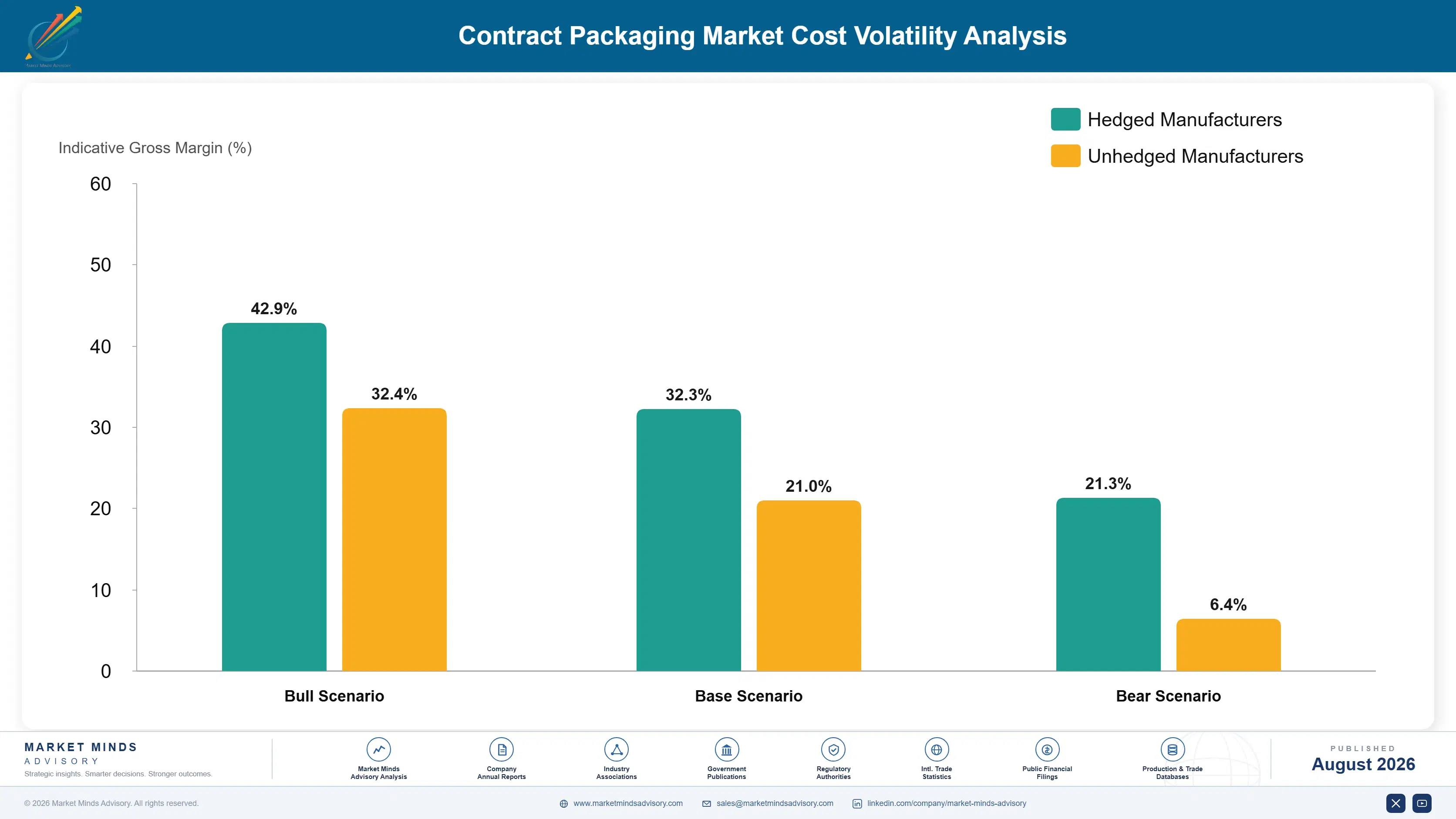
Direct Labour, Packaging Substrates, Freight

Direct production labour accounts for roughly 38% of cost of goods sold, sourced primarily from regional labour markets near each facility rather than any centralised pool. Packaging substrates and components, including cartons, films, and closures purchased from material suppliers, contribute a further 28% to 34%. Equipment depreciation and maintenance take 10% to 14%, with freight and the remainder covering facility overhead and utilities.
Packaging substrate pricing spiked sharply through 2021 and 2022 as pulp and resin costs rose alongside broader supply chain disruption, and contract packagers running fixed-price agreements signed before that spike absorbed significant margin compression until contracts came up for renewal. International Paper's annual report documented substrate cost pressure across that period, and several contract packagers began negotiating shorter contract terms and index-linked pricing clauses specifically to avoid repeating that exposure.

Exposure varies by contract structure and client relationship. Operators with index-linked pricing clauses pass substrate volatility through to brand owners directly, while those still running older fixed-price agreements absorb it against thinning margin until renewal arrives. Smaller regional operators without material purchasing scale also pay higher substrate prices than larger operators negotiating volume discounts across multiple facilities simultaneously.
contract-packaging-market-cost-volatility-analysis-1787332127429

Negotiate index-linked substrate pricing clauses

Contract packagers increasingly build substrate price indexing directly into client agreements, passing raw material volatility through rather than absorbing it against margin, a structure that protects profitability during price spikes though it requires client education and negotiation leverage smaller operators sometimes struggle to secure upfront, before the client relationship is fully established and trust has been built.

Consolidate substrate purchasing across multiple facilities

Operators running several facilities are centralising packaging material procurement to negotiate volume discounts unavailable to any single site purchasing independently, a mitigation that favours scaled operators and is prompting smaller regional shops to explore purchasing cooperatives or group buying arrangements to compete on comparable material cost against much larger, better-funded rivals across every category served.

Invest in automation to offset direct labour cost exposure

Robotic case packing and kitting equipment reduces the direct labour share of cost of goods sold meaningfully, converting a volatile, wage-inflation-exposed cost line into a more predictable capital and maintenance expense that operators can plan and price around with considerably more confidence over a multi-year contract term negotiated directly with major brand owners upfront.

Portfolio Architecture for Margin Defence

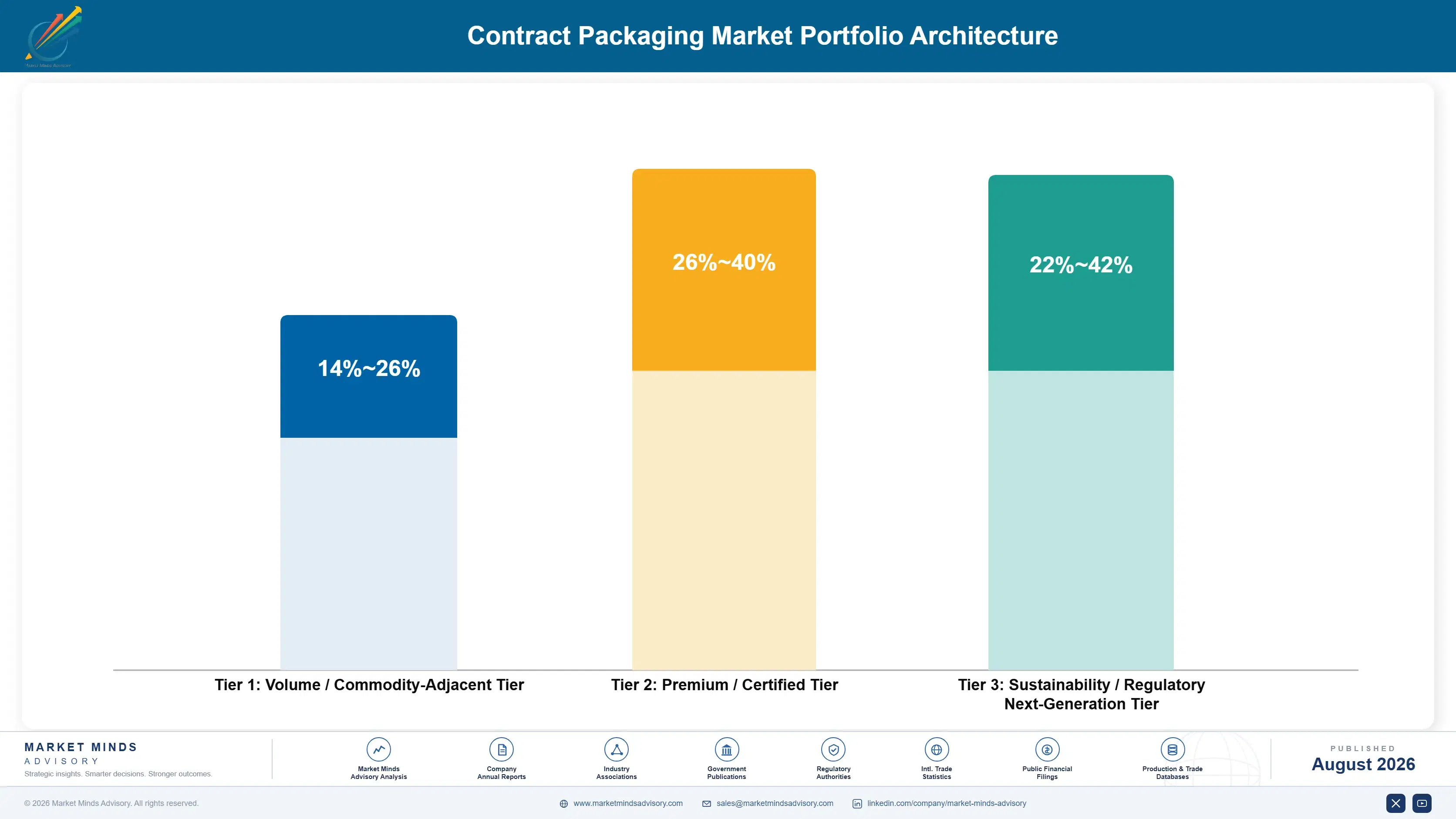
The portfolio splits into three tiers with sharply different economics. Simple filling and primary packaging forms the volume tier, competing largely on price and speed with margin set by labour cost and automation level. Kitting, assembly, and single-vendor programme services earn considerably more because service breadth and coordination complexity both resist commodity price competition. Regulated pharmaceutical and premium beauty work sits differently again, priced against compliance and tru
The tension runs between winning volume on price and building specialised capability that protects margin over time. An operator chasing every low-price filling contract available eventually gets squeezed by automated competitors with lower cost structures, yet building regulated category capability requires investment thin-margin filling work rarely funds adequately. Operators handling this well treat simple filling as the volume base and regulated work as the margin engine.

High-value pools concentrate where compliance investment, service breadth, or automation scale limit competition: pharmaceutical and infant category work with established quality trust, single-vendor programmes spanning multiple services, and kitting work rewarding flexible labour scheduling. Simple filling sits at the other end, competing almost entirely on price against every regional shop with comparable equipment and access to similar labour.

Volume / Commodity-Adjacent Tier

Simple filling and primary packaging work competing largely on price and turnaround speed across regional shops. Margin is thin and set almost entirely by labour cost and the automation level actually achieved.
Gross Margin: 14-26%

Premium / Certified Tier

Kitting, assembly, and single-vendor programmes spanning multiple service lines for established brand relationships built over several contract cycles. Margin reflects coordination complexity and switching cost once embedded into a brand's supply chain.
Gross Margin: 26-40%

Sustainability / Regulatory / Next-Generation Tier

Regulated pharmaceutical, infant category, and premium beauty work requiring compliance investment and established quality trust with brand owners. The wide range reflects the gap between commodity and trusted-partner pricing power.
Gross Margin: 22-42%
contract-packaging-market-portfolio-architecture-1787332127927

High-value Sub-segments and Strategic Watch-out

Co-Packing and Assembly Services

High value and high growth at 9.2%, the fastest service type in the category, as seasonal and promotional programmes reward operators with genuine flexible labour scheduling capability across multiple concurrent client programmes running simultaneously through peak seasons every year across regions and busy retail calendars.
Gross Margin: 26-40%

Pharmaceutical and Regulated Packaging

High value with strong growth at 8.6%, driven by serialisation compliance complexity that dedicated specialists handle far more cost-effectively than in-house lines built for simpler formats years earlier at most brand-owned facilities nationwide and abroad, across nearly every major regulated market worldwide today and going forward.
Gross Margin: 24-42%

Filling and Primary Packaging Services

The volume core by installed capacity, growing at 5.8% as straightforward filling work becomes increasingly price competitive and automation-dependent across most regional markets worldwide, squeezing manual operators hard. Differentiation shifts toward changeover speed and minimum order quantity accommodation for smaller emerging brands entering the category.
Gross Margin: 14-26%

Manual Regional Filling Operations

The strategic watch-out, growing at just 2.4% and steadily displaced by automated competitors as wage inflation erodes the cost position manual shops once relied on heavily for decades across most developed markets. Survival increasingly depends on complex, low-volume niche work automation cannot yet handle economically at scale nationwide.
Gross Margin: 10-20%

How Contract Packaging Revenue Actually Repeats

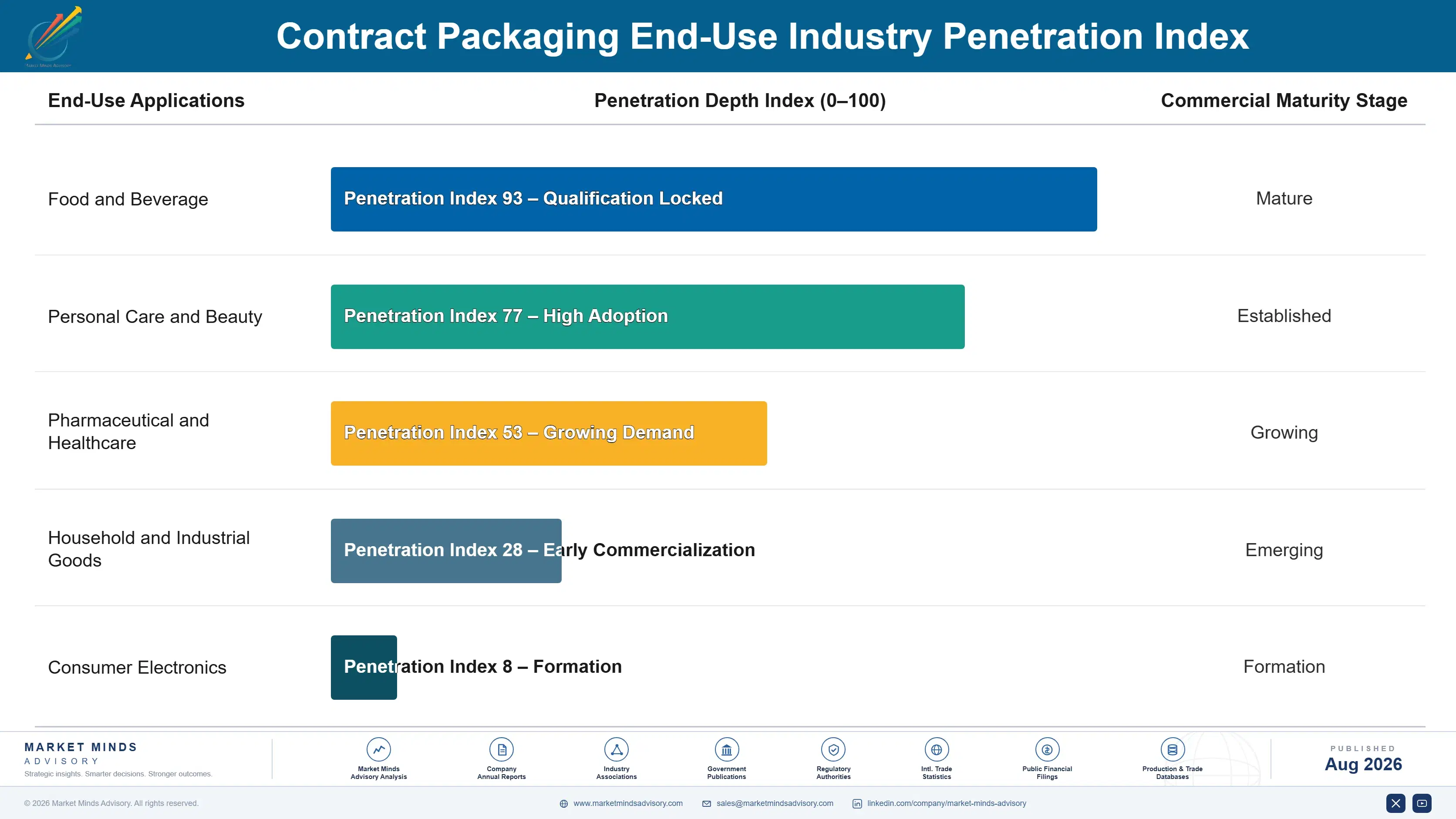
Revenue depends on a programme surviving the brand's own product cycle, not on winning the initial bid. A co-packing programme tied to a seasonal SKU runs for months rather than years by design, so annuity value sits in the relationship renewing across successive launches rather than in any single contract itself. Filling programmes for established, ongoing products behave differently, generating steady multi-year volume once a line is qualified and running reliably.
Stickiness varies sharply by end-use vertical. Pharmaceutical and regulated work sticks hardest, since requalifying an alternative packager against validated compliance documentation carries cost and regulatory risk brand quality teams avoid unless forced. Established filling programmes stick moderately, protected mainly by changeover cost and qualification time rather than genuine differentiation. Seasonal and promotional co-packing switches most readily, since each programme is negotiated fresh with limited carryover loyalty.

Buyer profiles have shifted generationally. Brand procurement teams that once selected packagers primarily on unit price increasingly weigh automation capability and flexibility to scale volume quickly, given how unpredictable SKU performance has become. Supply chain and quality leadership now often sit alongside procurement in vendor selection, particularly for regulated categories where a packaging failure carries consequences procurement alone was never equipped to evaluate.
contract-packaging-market-end-use-penetration-index-1787332128413

Our Call On Contract Packaging

These are among the four positions where our research anticipates prominent divergence between winners and laggards over the coming forecast period. Each is grounded in the demand model, the regulatory perimeter, and the announced capacity pipeline.
01 / AUTOMATION DECIDES MARGIN

Robotics is now the clearest lever against wages

Direct production labour represents roughly 38% of cost of goods sold, and operators deploying robotic case packing and kitting equipment cut that exposure substantially compared with manual competitors still absorbing wage inflation directly against thin contract margins. That investment also lets an operator quote firmer multi-year pricing, since labour volatility no longer drives the bulk of their cost structure the way it does for manual shops. Operators should treat automation as the primary defence against wage inflation rather than a discretionary capital project.
02 / BREADTH BEATS PRICE ALONE

Single-vendor programmes are winning the biggest deals

Brand owners managing separate vendors for filling, kitting, and fulfilment increasingly prefer consolidating toward one partner running the full sequence, reducing coordination overhead and the handoff risk that comes from multiple facilities under different ownership entirely. Operators offering true single-vendor coverage across three or more service lines capture larger, stickier contracts than single-service competitors ever can on their own, year after year. Building that breadth, through partnership or acquisition, should rank above chasing incremental volume on existing service lines alone.
03 / REGULATED WORK PAYS MORE

Compliance investment converts into durable pricing power

Pharmaceutical and infant categories carry genuine safety and reputational risk that keeps some brand owners from outsourcing entirely, yet operators investing in serialisation compliance and dedicated quality personnel earn considerably higher margin than commodity filling work ever delivers once that trust is established through repeated audits and clean track records. Specialisation converts a trust barrier that excludes most competitors into a genuine moat for operators willing to fund compliance investment upfront. Waiting for demand to justify that investment retroactively simply cedes the category to whoever moves first.
04 / FRAGMENTATION WILL NOT LAST

Consolidation is accelerating around scale and trust

Concentration sits at just 24% today, but larger operators including Sonoco and DS Smith are acquiring regional specialists to build the automation scale and service breadth smaller shops cannot fund independently against rising wage and substrate cost pressure. Regional operators unable to invest in either automation or category specialisation face a shrinking addressable market as brand owners consolidate toward fewer, larger, more capable partners over time. Smaller operators should pursue a clear specialisation now rather than competing broadly against consolidators with far deeper capital access.

Engagement Snapshot From the Field

A live engagement with an industry participant carrying material or product regulatory and market exposure ahead of a defining policy shift, showing how our research translates into a defensible multi-year portfolio strategy.
MARKET MINDS ADVISORY · CLIENT ENGAGEMENT SUMMARY
Contract Packaging Producer Strategic Portfolio Review and Transition Roadmap 2026·Investment Scenario on Contract Packaging Exposure Evaluation 2025-26
CLIENT PROFILE
A mid-sized beauty brand running roughly 140 active SKUs across multiple retail and direct-to-consumer channels engaged MMA while managing six separate contract packaging vendors across filling, kitting, and promotional assembly work. The client reported annual packaging services spend near USD 38 million, with coordination overhead cited as a growing internal complaint (client-reported, unverified by MMA).
STRATEGIC CHALLENGE
Managing six vendors across different regions created quality inconsistency between facilities and slowed new product launches, since each vendor required separate qualification and coordination for every new SKU introduced. Leadership wanted to consolidate toward fewer, more capable partners without disrupting existing retail commitments already locked into the current production schedule.
MMA APPROACH
MMA benchmarked the client's six incumbent vendors against scaled single-vendor candidates on automation capability, service breadth, and geographic coverage relative to the client's retail distribution footprint. We modelled coordination cost savings from consolidation against the switching and requalification cost each transition would require. We then sequenced a transition plan that protected committed retail launch dates throughout.
KEY FINDINGS
  1. Consolidating from six vendors to two would reduce estimated internal coordination cost by roughly 30% within the first year of full transition.
  2. Two incumbent vendors lacked automation capability that was driving cost disadvantages of an estimated 12% to 15% versus scaled competitors bidding for the same volume.
  3. Kitting and promotional assembly work commanded meaningfully better pricing when consolidated with a single partner rather than split across specialists (client-reported, unverified by MMA).
  4. A phased eighteen-month transition plan avoided disrupting any committed retail launch date while still completing the full vendor consolidation programme on schedule.
CLIENT PROFILE
A mid-sized beauty brand running roughly 140 active SKUs across multiple retail and direct-to-consumer channels engaged MMA while managing six separate contract packaging vendors across filling, kitting, and promotional assembly work. The client reported annual packaging services spend near USD 38 million, with coordination overhead cited as a growing internal complaint (client-reported, unverified by MMA).
STRATEGIC CHALLENGE
Managing six vendors across different regions created quality inconsistency between facilities and slowed new product launches, since each vendor required separate qualification and coordination for every new SKU introduced. Leadership wanted to consolidate toward fewer, more capable partners without disrupting existing retail commitments already locked into the current production schedule.
MMA APPROACH
MMA benchmarked the client's six incumbent vendors against scaled single-vendor candidates on automation capability, service breadth, and geographic coverage relative to the client's retail distribution footprint. We modelled coordination cost savings from consolidation against the switching and requalification cost each transition would require. We then sequenced a transition plan that protected committed retail launch dates throughout.
KEY FINDINGS
  1. Consolidating from six vendors to two would reduce estimated internal coordination cost by roughly 30% within the first year of full transition.
  2. Two incumbent vendors lacked automation capability that was driving cost disadvantages of an estimated 12% to 15% versus scaled competitors bidding for the same volume.
  3. Kitting and promotional assembly work commanded meaningfully better pricing when consolidated with a single partner rather than split across specialists (client-reported, unverified by MMA).
  4. A phased eighteen-month transition plan avoided disrupting any committed retail launch date while still completing the full vendor consolidation programme on schedule.
RECOMMENDED STRATEGY
Phase 1: Phase 1 (0 to 6 months): Qualify two finalist single-vendor candidates against the client's automation and geographic coverage requirements carefully. Phase 2: Phase 2 (6 to 14 months): Transition filling and kitting volume in stages, protecting all committed retail launch dates throughout. Phase 3: Phase 3 (14 to 18 months): Complete full consolidation and renegotiate pricing under the combined volume across both retained vendors.
OUTCOME
The client completed the transition within the recommended eighteen-month window and achieved coordination cost savings close to the modelled estimate across both retained vendors. Vendor consolidation also improved new product launch timelines meaningfully, which leadership cited as the more valuable outcome overall (client-reported, unverified by MMA).

Frequently Asked Questions

Foundational context covering the market sizes, CAGR, scope, country, region and competition that inform every finding below. This section is provided to cover basics and most often pre-purchase conversations, answered from the MMA Primary Research Dataset.

What is the current size of the Contract Packaging Market?

The global contract packaging market is valued at USD 42.6 billion in 2025, covering third-party filling, packing, kitting, and assembly services for brand owners. In-house brand packaging and primary material manufacturing are excluded.

How large will the Contract Packaging Market be by 2036?

The market is forecast to reach USD 84.30 billion by 2036 in the base case, about 1.86 times the 2026 level. That represents incremental value of roughly USD 38.97 billion across the decade.

What is the CAGR for the Contract Packaging Market 2026 to 2036?

The market grows at a 6.4% CAGR in the base case, with bull and bear scenarios at 7.6% and 5.1%. The spread turns mainly on SKU proliferation pace and brand owner appetite for vertical integration.

Which segment is growing fastest?

Co-packing and assembly services grow fastest at 9.2%, about 1.44 times the overall rate, as brands hand over entire kitting and multi-pack assembly runs. Pharmaceutical and regulated packaging follows at 8.6%.

Who are the major companies in the Contract Packaging Market?

Leading companies include Sonoco, DS Smith, Jones Healthcare Group, Sharp Packaging Solutions, and Anderson Packaging. Concentration is low, with the top five holding roughly 24% of category revenue.

Which country is growing fastest?

Vietnam grows fastest at a 10.8% CAGR, as manufacturing diversification pulls consumer goods production away from China. India follows on rising domestic consumer goods manufacturing investment.

Report Segmentation Architecture

The full report scope spans multiple orthogonal segmentation dimensions, with cross-tabulated demand data provided for each dimension pair. Coverage extends further to regional breakdowns, trend trajectories, and the competitive detail needed to support segment-level decision-making.

By Service Type

  • Co-Packing and Assembly Services
  • Filling and Primary Packaging Services
  • Pharmaceutical and Regulated Packaging
  • Labelling and Secondary Packaging Services
  • Fulfilment and Kitting Logistics

By End-Use Industry

  • Food and Beverage
  • Personal Care and Beauty
  • Pharmaceutical and Healthcare
  • Household and Industrial Goods
  • Consumer Electronics

By Commercial Dimension

  • Direct Service Contracts
  • Single-Vendor Programme Agreements
  • Project-Based Seasonal Contracts
  • Automated Line Leasing Arrangements

By Region

  • North America
  • Western Europe
  • East Asia
  • South Asia and Pacific
  • Latin America
  • Middle East and Africa
  • Eastern Europe

Scope, Methodology, and Coverage

Every figure in this report is reproducible from documented input assumptions. The scope below maps the historical period, the forecast horizon, the segmentation dimensions, and the countries covered, alongside the underlying primary and qualitative methodology.
Historical Period
2020 to 2025
Forecast Period
2026 to 2036
Base Year
2025 (USD billions; MMA Primary Research Dataset, August 2026)
Market Definition
The contract packaging market comprises third-party services that fill, pack, label, kit, or assemble finished products on behalf of brand owners, valued at annual service revenue charged to client brands. It spans co-packing and assembly services, filling and primary packaging services, pharmaceutical and regulated packaging, labelling and secondary packaging services, and fulfilment and kitting logistics across food and beverage, personal care, pharmaceutical, household goods, and consumer electronics categories. In-house brand-owned packaging operations, primary packaging material manufacturing sold separately, and pure third-party logistics or warehousing without packaging activity are excluded.
Quantitative Units
USD billions (current prices); service volume in units processed where applicable
Segmentation Dimensions
By Service Type; By End-Use Industry; By Commercial Dimension; By Region
Regions Covered
North America, Western Europe, East Asia, South Asia and Pacific, Latin America, Middle East and Africa, Eastern Europe
Countries Covered
USA, China, Germany, UK, France, Japan, South Korea, India, Vietnam, Canada, Australia, Mexico, Brazil, Poland, Hungary, Czech Republic, Romania, UAE, Saudi Arabia, South Africa, Thailand, Indonesia, Netherlands, Italy, and additional markets relevant to this sector
Key Companies Profiled
Sonoco, DS Smith, Jones Healthcare Group, Sharp Packaging Solutions, Anderson Packaging, Multi Packaging Solutions, PharmaPac, Fenwick Company, AGI Shorewood, Perlen Packaging, Catalent, PCI Pharma Services, Diamond Packaging, Nulogy, Almac Group, Southern Packaging, Package Coordinators Inc, Bulk Handling Systems, WestRock Contract Packaging, TricorBraun Packaging Solutions
Quantitative Methodology
Primary survey, n=3,800 respondents, Q4 2025, six countries; demand-side model with trade association cross-validation
Qualitative Methodology
47 expert interviews, Q4 2025; applied to validate demand model assumptions, identify emerging dynamics, and assess competitive positioning
Report Format
PDF and XLSX data workbook (Word format preview document)
Publisher
Market Minds Advisory
Report Code
MMA-2026-PAC-113
Published
August 2026
Contact
sales@marketmindsadvisory.com | www.marketmindsadvisory.com

Purchase the full Contract Packaging Market Report (2026 to 2036).

The full MMA Contract Packaging report sizes the market across five service types, five end-use industries, four commercial dimensions, and seven regions through 2036. It profiles 20 companies on a consistent annual service revenue basis, scoring each on automation investment, service breadth, and category specialisation depth. Scenario models quantify how SKU proliferation, labour cost inflation, and automation adoption move both revenue and margin by service type. The report also includes labour and substrate cost benchmarking, single-vendor consolidation tracking, and regulated category penetration analysis for commercial and operations leadership teams.
Five-service and four-dimension market sizing to 2036
Twenty-company benchmark on annual service revenue basis
Labour cost and substrate pricing benchmarking by region
Single-vendor consolidation and service breadth tracking
Automation investment and capacity utilisation modelling
Regulated category penetration and compliance capability tracking

Built For The People Who Decide

From boardroom strategy to bench-side execution, this report is read cover-to-cover by leaders shaping the next decade of their industry, turning demand scenarios, market dynamics and valuation benchmarks into decisions.
CXOs/ Presidents/ VPs/ Managers
M&A and Corporate Development
Strategy Teams and R&D Heads
Procurement and Product Directors
Regulatory and Compliance Leaders
Investor Relations and Equity Analysts