
Market Minds Advisory
Biodegradable Food Packaging Market

Biodegradable Food Packaging Market: Regulation Is Now The Volume Buyer

A commercial reading of compostable and biodegradable food packaging, where single-use plastic bans across dozens of jurisdictions converted a niche sustainability pitch into mandated procurement, while compost infrastructure gaps still limit genuine end-of-life outcomes.

Lead Analyst

Bilal Shaikh

Published

September 2026

Make Smarter Decisions with Customized Research Insights

Request a free sample report and evaluate market opportunities, growth trends, and competitive dynamics relevant to your business needs.

2025 MARKET VALUE$14.2BMarket Size 2025
2036 FORECAST VALUE$52.4BBase Case , 2026 to 2036
CAGR 2026 TO 203612.6 %Bull 14.0% / Bear 11.0%
INCREMENTAL OPPORTUNITY$36.4BNet 10- year value creation
EXPANSION MULTIPLE3.28x2036 value over 2026 base
Strategic Levers
M&A Pipeline
Regional Outlook
Country Rankings
Competitive Intelligence
Segmental Deep-dive
Call-Us : 91 93563 13602

Executive Snapshot and Market Trajectory

Plastic bans did what a decade of sustainability marketing could not. Once a jurisdiction outlaws polystyrene foodware outright, a restaurant chain stops weighing the switch against cost, and compostable packaging becomes the default rather than the premium option nobody wanted to pay extra for, regardless of the marketing behind it.
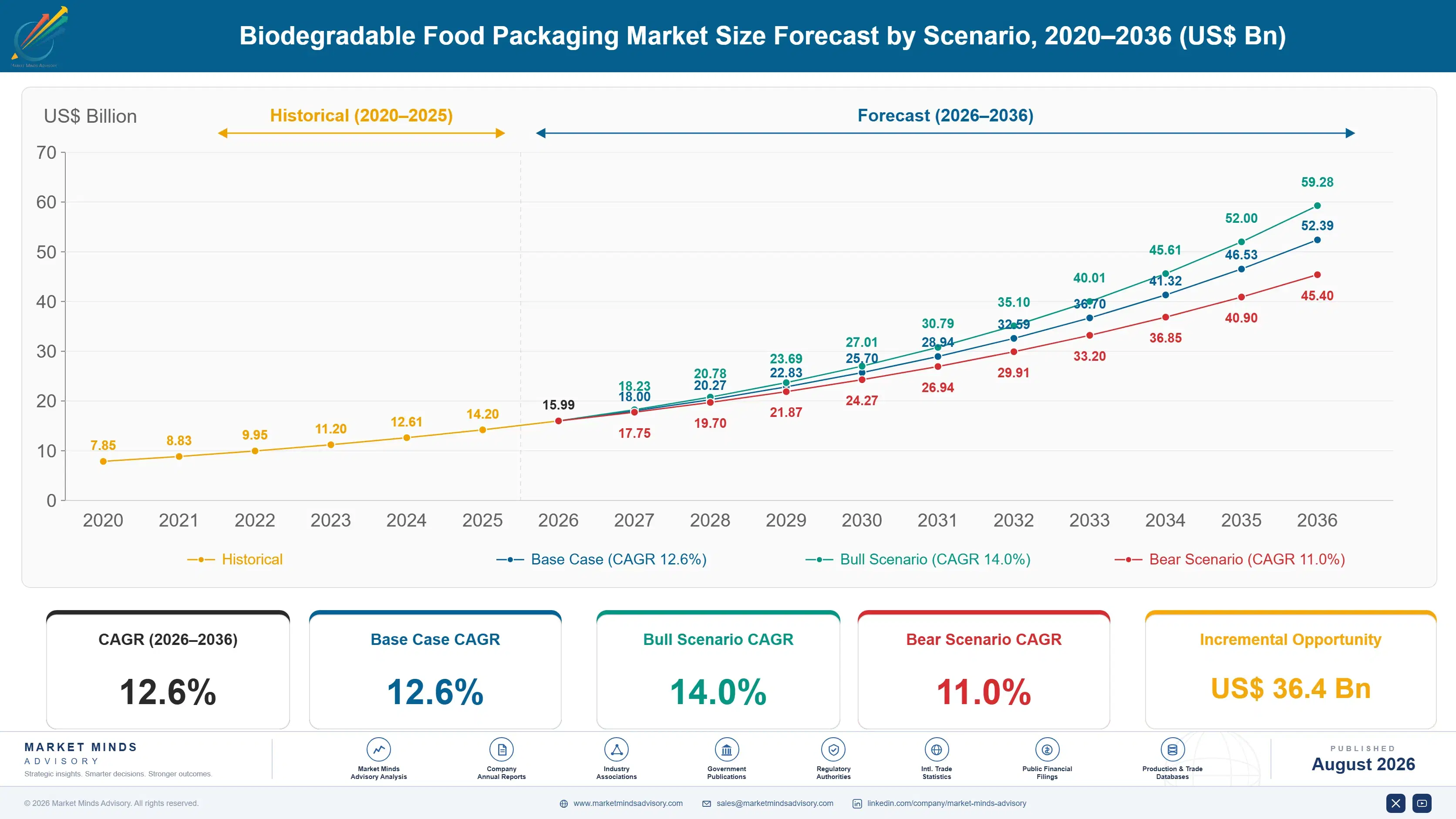
The market stands at USD 14.2 billion in 2025 and reaches USD 52.39 billion by 2036 at a 12.6% CAGR. Moulded fibre containers and trays grow fastest at 16.4%, about 1.30 times the overall rate, as foodservice operators replace expanded polystyrene clamshells under direct regulatory mandate across dozens of jurisdictions. India posts the quickest national growth at 15.9% as state-level plastic bans expand faster than domestic compostable capacity can currently absorb.
Concentration is low at 31% for the top five, reflecting a young industry still absorbing a wave of new entrants chasing regulatory-driven demand rather than an established, consolidated field. Two forces are reshaping it now. Composting infrastructure gaps mean certified compostable packaging frequently ends up in landfill anyway, undermining the environmental case, and feedstock cost volatility in bio-based resins is squeezing margin harder than most new entrants budgeted for when they first entered the category.
Market Definition
The biodegradable food packaging market covers packaging materials certified as compostable or biodegradable under recognised standards, used for food contact applications including foodservice ware, food containers, and flexible film packaging. Conventional recyclable plastic packaging, non-food-contact biodegradable materials, and packaging machinery sold separately are excluded.
Base Year Value
$14.2B in 2025 (MMA Primary Research Dataset, August 2026)
Forecast Period
2026 to 2036, eleven discrete annual values
CAGR
12.6% base case. Bull 14.0%. Bear 11.0%.
Fastest Growth Segment
Moulded Fibre Containers and Trays: 16.4% CAGR
Fastest Growth Country
India: 15.9% CAGR
Fastest Growth Region
South Asia and Pacific: 14.8% CAGR
Largest Region
North America: 25% of 2025 global value
Market Leaders
Huhtamaki, Novolex, Vegware, BioPak, Pactiv Evergreen. Source: MMA Analysis based on company disclosures.
Primary Survey
n=3,800 procurement and R&D decision-makers, Q4 2025, six countries
Methodology
Demand-side build-up, cross-validated against public data, 47 expert interviews

Biodegradable Food Packaging Market Forecast Scenarios

biodegradable-food-packaging-market-size-forecast-scenario-1787332114479
Growth from 2020 to 2025 compounded near 11.0%, driven almost entirely by a wave of single-use plastic bans that accelerated sharply from 2021 onward across the European Union, several American states, and India, converting voluntary sustainability spending into mandated procurement across an enormous foodservice base within a genuinely short window that caught many manufacturers under-capacity.
Three mechanisms carry the base case to 12.6%. First, regulatory expansion, as more jurisdictions add plastic foodware and packaging bans to existing environmental legislation each year. Second, corporate sustainability commitments, as large foodservice and retail chains adopt compostable packaging ahead of regulatory deadlines to protect brand reputation proactively. Third, composting infrastructure investment, which slowly closes the gap between certified compostable material and genuine composting access at the municipal level nationwide.
The bull case at 14.0% assumes regulatory expansion accelerates further across emerging markets and composting infrastructure investment closes the end-of-life gap meaningfully faster than currently projected across most regions worldwide. The bear case at 11.0% assumes feedstock cost volatility in bio-based resins erodes the cost competitiveness compostable packaging needs to win business absent a regulatory mandate specifically forcing the switch.

Why Regulation, Not Consumers, Is The Real Buyer Here

Three forces set demand. Regulation provides the volume base, as plastic foodware and packaging bans convert an entire jurisdiction's foodservice sector into mandated buyers overnight rather than gradually. Corporate sustainability commitment provides a second layer, since large chains adopt compostable packaging ahead of mandates to manage brand risk proactively. And composting infrastructure investment adds a slower, third-order effect that determines whether the environmental promise is actua
MARKET CONCENTRATIONCR5: 31%Fragmented among established converters and fast-growing new entrants
AVERAGE SELLING PRICEUSD 0.04 to 0.85 per unitUnit price spread across simple wraps to moulded fibre containers
TOP PRODUCING COUNTRY SHAREChina: about 24%Share of global compostable packaging manufacturing output produced domestically
COST PREMIUM OVER PLASTICAbout 35% to 60%Typical unit price gap versus conventional plastic packaging equivalents
FEEDSTOCK COST SHAREAbout 42% of COGSPortion of production cost represented by bio-based resin and fibre
COMPOSTING ACCESS RATEAbout 27%Share of American households with access to municipal composting collection
The commercial character is set by feedstock cost more than by conversion technology sophistication. Bio-based resin and fibre account for roughly 42% of cost of goods sold, and that share commands a persistent 35% to 60% price premium over conventional plastic that only regulatory mandate or genuine brand commitment currently overcomes, since cost alone rarely wins the purchasing decision on its own merits.
The next decade turns on two things. Whether composting infrastructure investment closes the gap between certified compostable material and genuine municipal composting access, since only about 27% of American households currently have that access at all. And whether feedstock cost volatility in bio-based resins narrows the price premium enough for demand to hold even where no regulatory mandate applies directly.
"The industry spent years pitching consumers on compostable packaging and consumers mostly shrugged. Then a city council banned polystyrene foodware in an afternoon and did more for this category's revenue than a decade of sustainability marketing ever managed on its own."
Director, Sustainable Packaging and Materials Practice · MMA Packaging / Sustain

Market Trends

Plastic Foodware Bans Are Spreading Faster Than Compliance Capacity

Single-use plastic and expanded polystyrene foodware bans have spread across the European Union's Single-Use Plastics Directive, several American states including California and New York, and an expanding list of Indian states enforcing national plastic waste rules, converting voluntary sustainability spending into mandated procurement within a compressed timeframe most manufacturers were not staffed to serve. Huhtamaki and Novolex have both disclosed capacity expansion tied to anticipated regulatory deadlines through 2024 and 2025. Manufacturers unable to scale fast enough are losing contracts to competitors who invested ahead of the mandate taking effect.
Market Impact: New bans arrive across 2024-2025
Composting Infrastructure Gaps Undermine The Category's Core Promise

Only about 27% of American households currently have access to municipal composting collection capable of processing certified compostable packaging, which means a meaningful share of compostable material still ends up in landfill or contaminating conventional recycling streams instead of composting facilities designed to break it down properly. That gap has drawn increasing scrutiny from environmental groups and regulators questioning whether compostable claims mislead consumers who reasonably assume certified packaging composts wherever they dispose of it. Vegware and BioPak have both invested in consumer education campaigns addressing this disposal confusion directly.
Market Impact: Chains commit 2-3 years ahead

Market Opportunities and Growth Drivers

Regulatory Expansion Keeps Converting Voluntary Spend Into Mandates

Jurisdictions banning single-use plastic foodware convert an entire region's foodservice sector into mandated compostable packaging buyers within months of the law taking effect, a demand shift no amount of consumer marketing could achieve at comparable speed. The European Union, dozens of American states and cities, and an expanding list of Indian states have all added or tightened such bans in recent years, and the pace shows no sign of slowing. Manufacturers including Huhtamaki now track pending legislation almost as closely as raw material pricing, since a single new ban can reshape regional demand overnight.
Market Impact: Feedstock is 42% of cost

Large Foodservice Chains Are Adopting Compostables Ahead Of Mandates

Major restaurant and quick-service chains increasingly switch to compostable packaging voluntarily ahead of regulatory deadlines, treating the transition as brand risk management rather than waiting to be forced into a rushed, potentially more expensive switch later under regulatory pressure. That voluntary adoption also gives manufacturers demand visibility years ahead of actual mandates, letting them plan capacity investment with considerably more confidence than regulation alone would provide on its own. Several major chains have published public compostable packaging transition timelines extending years into the future, giving suppliers a demand signal regulation alone cannot match.
Market Impact: 27% access rate draws scrutiny

Market Restraints and Challenges

Feedstock Cost Volatility Squeezes Margin Against A Price Cap

Bio-based resin and fibre feedstock prices swing considerably more than conventional petrochemical plastic pricing, and that volatility is the root cause of margin compression when input costs spike while contract pricing with large foodservice clients typically locks in for a full year or more at a time. Commercially this hits smaller manufacturers hardest, since they lack the purchasing scale or hedging sophistication larger converters use to smooth feedstock swings across a broader supply base. Operators respond with longer-term supply agreements and increased use of recycled or waste-stream inputs carrying less price correlation to virgin bio-based resin markets.
Market Impact: Bans now span 100+ jurisdictions

Composting Access Gaps Undercut The Category's Core Argument

Only about 27% of American households have access to municipal composting collection, and that infrastructure gap is the root cause of growing scepticism toward compostable packaging claims among consumers, regulators, and environmental groups who reasonably question what happens to certified material that never reaches an actual composting facility. Commercially this creates genuine reputational and regulatory risk, since several jurisdictions have begun scrutinising compostable labelling claims for accuracy specifically. Manufacturers respond by funding composting infrastructure partnerships and clearer disposal labelling, though neither fully resolves a gap that ultimately requires municipal investment well beyond what any single manufacturer can fund alone.
Market Impact: Just 27% of US homes qualify
3 additional market trends, 4 additional growth drivers, and 2 additional restraints and challenges are covered in the full report. Contact sales@marketmindsadvisory.com to access the complete intelligence.

Segment CAGR and Growth Architecture

Segmentation follows material and format type, a single manufacturing logic describing what the packaging is made from and how it is formed rather than which food category it serves. Each format carries its own feedstock cost structure, conversion process, and certification pathway, so commercial position tracks the material technology rather than the end application alone.
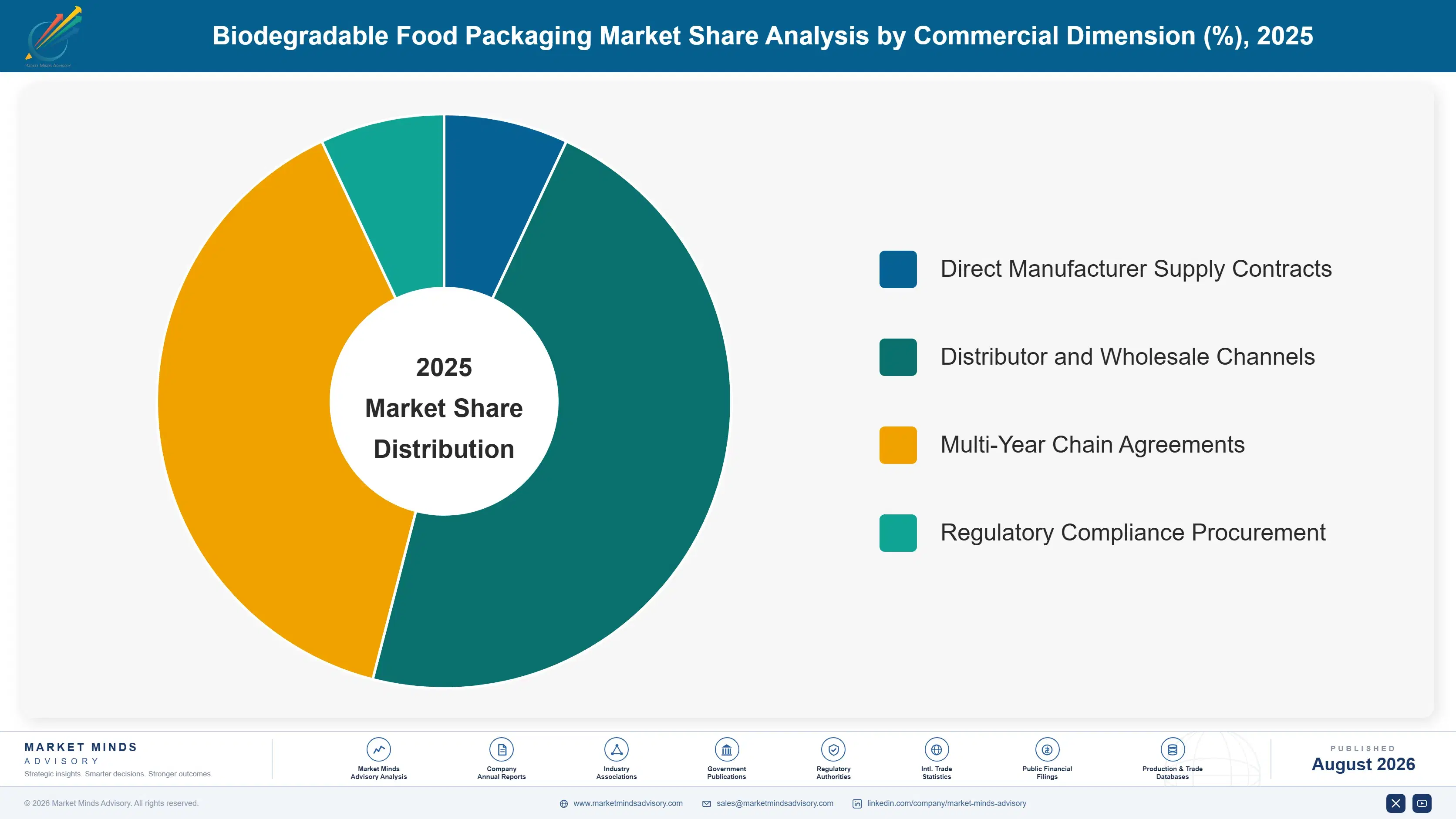
biodegradable-food-packaging-market-market-share-analysis-1787332115058

Moulded Fibre Containers and Trays

Moulded fibre containers and trays grow fastest at 16.4%, about 1.30 times the overall 12.6% rate, covering clamshells, plates, bowls, and trays formed from bagasse, wheat straw, or recycled paper pulp that directly replace expanded polystyrene foodware under the plastic bans spreading across most major markets. This format benefits from being both certified compostable and widely understood by consumers as a genuine paper-like alternative, unlike some bioplastic films that consumers struggle to distinguish visually from conventional plastic. Huhtamaki and Pactiv Evergreen have both expanded moulded fibre capacity specifically to meet foodservice conversion demand. Pricing sits above expanded polystyrene meaningfully, though the gap has narrowed as production scale increases across the industry and manufacturers achieve better utilisation of installed capacity.
CAGR 16.4%

Bioplastic Films and Flexible Packaging

Bioplastic films and flexible packaging grow at 11.8%, covering PLA, PHA, and starch-based films used for wraps, bags, and flexible pouches where moulded fibre formats cannot function given the need for flexibility and barrier properties. Growth trails moulded fibre because certification and performance consistency remain more technically challenging, and consumers sometimes cannot visually distinguish a compostable film from conventional plastic film, which occasionally causes contamination in recycling and composting streams alike. NatureWorks and Novamont both supply base resin to converters serving this segment across multiple end markets. This segment carries the highest technical barrier to entry of any format, favouring specialist resin producers over generalist packaging converters lacking polymer science depth.
CAGR 11.8%
Full segment breakdown across 5 segments available in the complete report.

Regional Architecture and Country Demand Map

Regulatory stringency and manufacturing capacity together set this distribution more than raw foodservice spending does across most markets today. East Asia leads on manufacturing scale, Western Europe on regulatory maturity, and share elsewhere tracks how aggressively each jurisdiction has moved against single-use plastic foodware specifically.

North America

State-level plastic bans anchor North America's 25% share, with California, New York, and a growing list of other states banning polystyrene foodware and driving compostable packaging adoption across large foodservice chains headquartered domestically and operating nationwide. Novolex and Pactiv Evergreen both maintain extensive domestic manufacturing capacity serving this regulatory-driven demand directly and reliably across multiple states simultaneously. Canadian provincial regulation follows a similar trajectory, though somewhat more slowly than the fastest-moving American states currently leading adoption nationwide. Composting infrastructure remains the binding constraint domestically, with only about 27% of American households holding access to municipal collection capable of processing certified material properly and consistently. Growth of 12.0% tracks state-level regulatory expansion closely across the country.
Share: 25% | CAGR: 12.0% (2026 to 2036)

Western Europe

The European Union's Single-Use Plastics Directive anchors Western Europe's 24% share, establishing the most comprehensive regulatory framework globally and pushing compostable packaging adoption across member states simultaneously rather than jurisdiction by jurisdiction, unlike the patchwork approach seen elsewhere globally. German and French composting infrastructure is considerably more developed than American equivalents, giving compostable packaging here a genuine end-of-life pathway that supports the category's core environmental claim credibly and durably across most of the bloc. British regulation has diverged somewhat post-Brexit but maintains comparable plastic reduction ambitions independently of Brussels. Growth of 11.2% reflects a mature regulatory base against already high adoption levels achieved across most member states years earlier in the transition.
Share: 24% | CAGR: 11.2% (2026 to 2036)
Regional intelligence for 5 additional markets available in the complete report: East Asia, South Asia and Pacific, Latin America, Middle East and Africa, Eastern Europe. Contact sales@marketmindsadvisory.com.
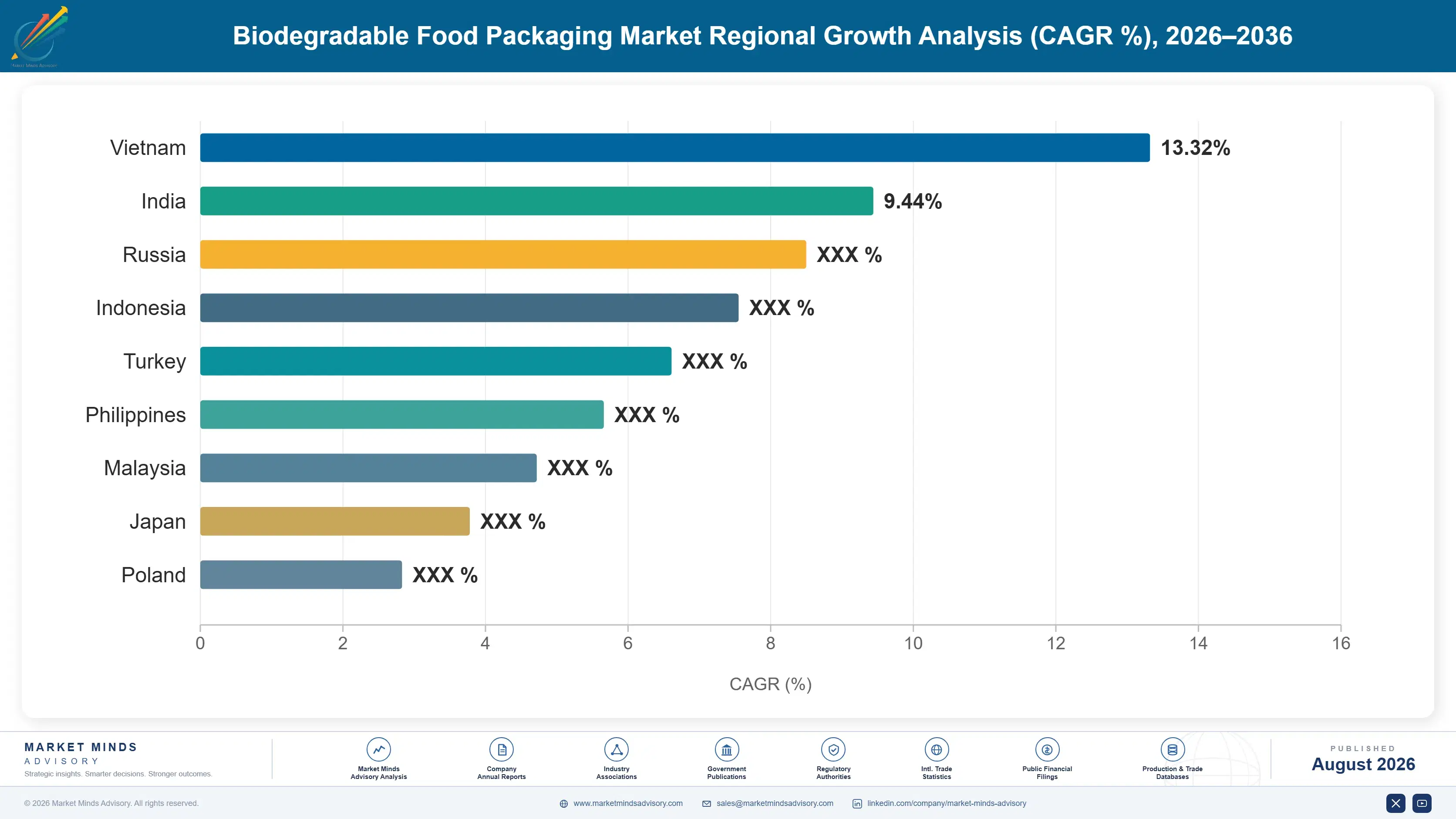
biodegradable-food-packaging-market-country-cagr-analysis-1787332115571

Where Compostable Packaging Makers Actually Win Share

Winning on sustainability messaging alone stops working the moment a competitor undercuts on price with comparable certification and a similar compliance story to tell buyers. The four moves below shift revenue toward positions a cheaper, less-prepared competitor cannot easily match: regulatory timing, feedstock diversification, composting partnerships, and large-chain contract depth built over successive renewal cycles.

Time Capacity Investment Against Regulatory Calendars

Manufacturers who expand capacity ahead of a plastic ban actually taking effect capture the initial surge in mandated demand, while competitors scrambling to scale afterward lose contracts to whoever can deliver first when a deadline arrives. Huhtamaki has structured recent capacity expansion explicitly around tracked regulatory calendars across more than 100 jurisdictions simultaneously rather than reacting after each law passes. That timing advantage compounds, since early movers also secure the large foodservice contracts that anchor a facility's utilisation for years afterward. Regulatory tracking is becoming as important a capability as manufacturing itself.
Market Impact: Early movers capture demand across

Diversify Feedstock To Reduce Bio-Resin Price Exposure

Bio-based resin and fibre feedstock, roughly 42% of cost of goods sold, swings considerably more than conventional plastic pricing, and manufacturers relying on a single feedstock source face margin compression that diversified competitors avoid by blending recycled or waste-stream inputs carrying less price correlation to virgin bio-based resin markets specifically. That diversification also lets a manufacturer quote firmer multi-year pricing to large foodservice clients, since feedstock volatility no longer drives the bulk of cost uncertainty the way it does for single-source competitors. Feedstock diversification is becoming a genuine competitive differentiator across the industry broadly.
Market Impact: Feedstock is 42% of cost, diversify

Fund Composting Partnerships To Defend The Category's Claim

Only about 27% of American households have access to municipal composting collection, and manufacturers funding local composting infrastructure partnerships directly address the credibility gap that increasingly draws regulatory scrutiny toward compostable labelling claims across multiple jurisdictions and consumer watchdog groups. Vegware has built meaningful brand differentiation specifically around funding composting access in the markets it serves most heavily. That investment also generates goodwill with regulators evaluating future compostable packaging policy, which matters considerably given how much revenue still depends on regulatory direction going forward across every major market the company serves.
Market Impact: 27% access rate leaves considerable

Build Multi-Year Contracts With Large Foodservice Chains

Large restaurant and quick-service chains switching to compostable packaging voluntarily, ahead of regulatory deadlines, offer manufacturers demand visibility and contract scale that regulatory-driven small business demand simply cannot match on its own merits. Suppliers securing multi-year agreements spanning 3 or more years with major chains gain both revenue predictability and a reference customer that materially eases sales conversations with smaller regional foodservice operators evaluating the same switch independently and often more cautiously. BioPak has built its commercial strategy substantially around exactly this large-chain contract depth across multiple countries and regulatory regimes.
Market Impact: Chain contracts can span 3 or more

Who Controls the Margin Pool

Concentration is low: the top five hold roughly 31% of revenue, reflecting a young industry still absorbing a wave of new entrants chasing regulatory-driven demand rather than an established field with durable barriers to entry. The gap between leaders and challengers is regulatory tracking and feedstock diversification rather than raw manufacturing scale alone, since even large converters compete regionally given transport cost sensitivity. All participants here are assessed on one basis, annua
Competition runs along three lines. First, regulatory timing, since manufacturers expanding capacity ahead of a ban capture the initial surge in mandated demand. Second, feedstock diversification, as blended input sourcing protects margin against bio-based resin price volatility. Third, large-chain contract depth, particularly with restaurant and quick-service brands adopting compostable packaging ahead of regulatory deadlines voluntarily.

Pressure is building from two directions. Chinese and Indian manufacturers are expanding capacity rapidly to serve both domestic mandates and export demand from markets lacking comparable scale. Meanwhile increasing scrutiny of compostable labelling claims, driven by composting infrastructure gaps, is raising the bar for credible sustainability positioning industry-wide. Rankings should favour manufacturers combining regulatory tracking with genuine composting partnership depth.
biodegradable-food-packaging-market-company-positioning-matrix-1787332116093

Competitive Moat and Risk Dimensions

HUHTAMAKI

Moat: Global scale and regulatory tracking

Huhtamaki operates manufacturing capacity across multiple continents, letting it serve large multinational foodservice clients with consistent supply as regulations tighten on different timelines. Its systematic regulatory calendar tracking across dozens of jurisdictions gives it capacity planning advantages smaller regional competitors cannot match. Deep relationships with major quick-service chains provide distribution new entrants must build from nothing.
HUHTAMAKI

Risk: Scale dilutes speciality depth

Huhtamaki's breadth across conventional and compostable packaging means it invests less intensively in any single compostable format than speciality players including Vegware focus on exclusively. Chinese and Indian manufacturers undercut on price for standard formats where regulatory compliance matters more than brand reputation. Feedstock cost exposure across its broad compostable portfolio is considerable given the scale involved.
NOVOLEX

Moat: American regulatory relationship depth

Novolex has built deep relationships with American state regulators and large domestic foodservice chains navigating the fastest-moving state-level plastic ban landscape globally. Its domestic manufacturing footprint avoids the import complexity and tariff exposure competitors relying on Asian production face directly. Established brand recognition among American foodservice buyers shortens sales cycles considerably compared with newer entrants.
NOVOLEX

Risk: Geographic concentration limits reach

Heavy concentration in the American market limits Novolex's ability to capture fast-growing demand in Indian and Southeast Asian markets the way more globally diversified competitors can pursue directly. Domestic feedstock costs run higher than Asian competitors enjoy, pressuring margin on standard formats specifically. Composting infrastructure gaps in its core American market also expose it to labelling scrutiny risk directly.

Players Tracked

Prominent Players

Huhtamaki
Novolex
Vegware
BioPak
Pactiv Evergreen

Other Key Players

NatureWorks
Novamont
Eco-Products
World Centric
Genpak
Footprint
Vericool
Stora Enso
UFP Technologies
Sabert Corporation
Biopac India
Chuk Eco Solutions
Detpak
TIPA Corp
Notpla

Recent Developments

MARCH 2025

Huhtamaki expands moulded fibre capacity across two facilities

Huhtamaki announced moulded fibre production capacity expansion across two North American facilities, targeting foodservice demand ahead of upcoming state-level plastic foodware bans. This was an organic capacity expansion rather than an acquisition, extending capability the company had piloted successfully at a single site the previous year.
Signal: Capacity investment ahead of confirmed dea
AUGUST 2024

BioPak signs multi-year supply agreement with major quick-service chain

BioPak signed a multi-year supply agreement with a major quick-service restaurant chain to transition its packaging across multiple countries to certified compostable formats. This was a confirmed supply agreement rather than an acquisition or joint venture, securing contract revenue visibility years ahead of most regulatory deadlines.
Signal: Large chains committing years ahead of man
JANUARY 2025

Novolex acquires regional bioplastic film converter

Novolex completed an acquisition of a regional bioplastic film converter, adding flexible packaging capability to its primarily rigid and moulded fibre product portfolio directly. This was a confirmed acquisition rather than a licensing arrangement, expanding Novolex's addressable market into flexible compostable formats it previously lacked entirely.
Signal: Rigid packaging leaders are buying flexibl

Bio-Based Feedstock, Certification, Conversion Energy

Bio-based resin and fibre feedstock accounts for roughly 42% of cost of goods sold, sourced from agricultural byproducts including bagasse and wheat straw as well as purpose-grown feedstock like corn for PLA resin production. Conversion energy and labour contribute a further 24% to 30%, reflecting moulding and extrusion processes required. Certification and testing costs take 6% to 10%, with the remainder covering freight and overhead.
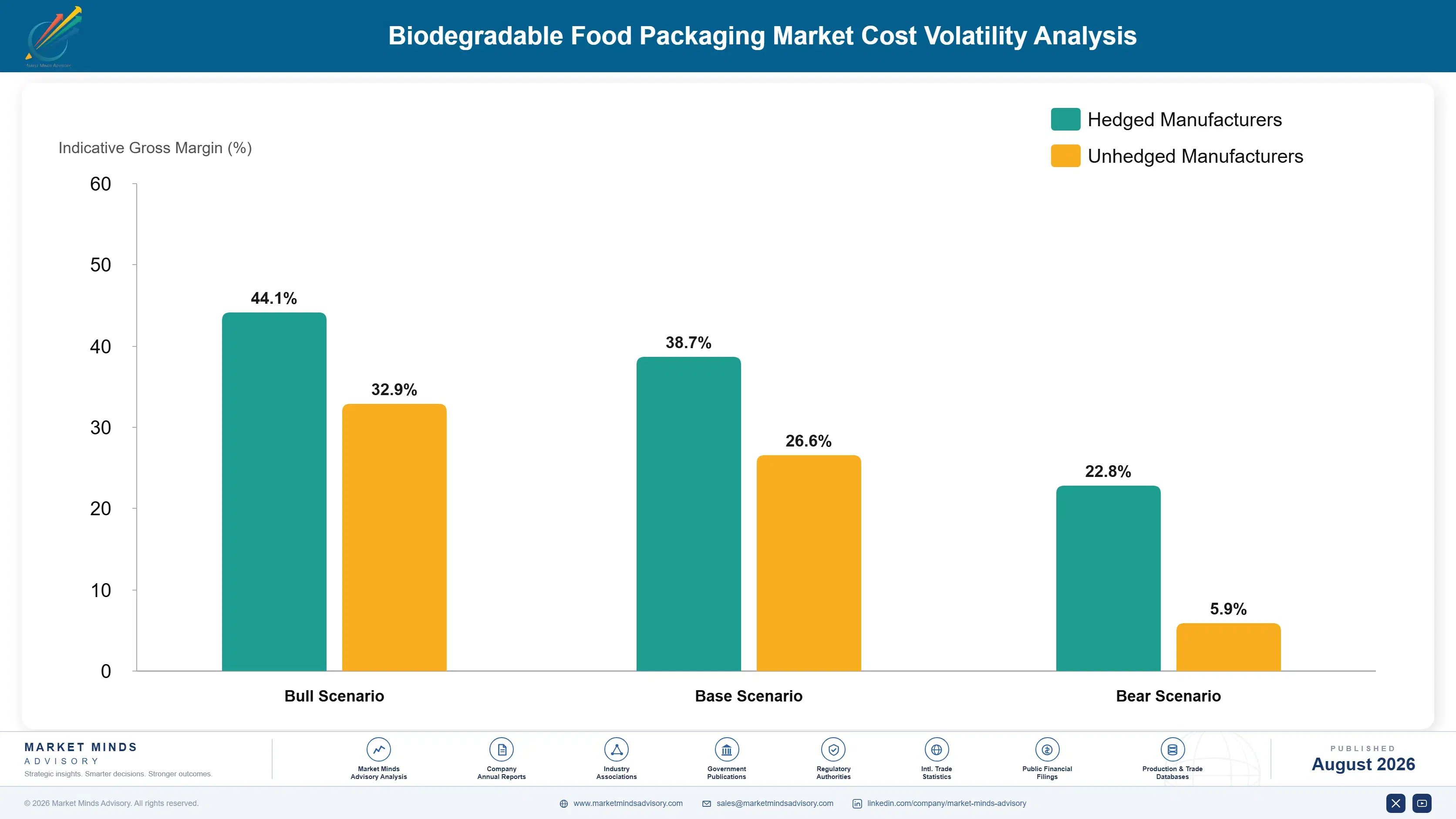
PLA resin pricing spiked considerably through 2021 and 2022 as corn feedstock costs rose alongside broader agricultural commodity inflation tied to supply chain disruption and weather-related crop impacts across several harvests. NatureWorks disclosed material cost pressure across that period in subsequent commentary, and several converters passed rising resin costs through to foodservice clients via contract price adjustments rather than absorbing the full increase against already thin margins.

Exposure varies by feedstock source and contract structure. Manufacturers using agricultural byproduct feedstock like bagasse face less price correlation to food commodity markets than those dependent on purpose-grown corn or sugarcane for PLA resin production specifically. Operators with index-linked pricing clauses in foodservice contracts pass volatility through directly, while those on fixed-price agreements absorb it until renewal arrives.
biodegradable-food-packaging-market-cost-volatility-analysis-1787332116287

Shift toward agricultural byproduct feedstock where possible

Bagasse, wheat straw, and other agricultural byproducts carry less price correlation to food commodity markets than purpose-grown corn or sugarcane feedstock, giving manufacturers using byproduct inputs meaningfully more stable input costs across a full agricultural cycle and considerably less exposure to weather-driven crop volatility that periodically disrupts virgin resin supply chains and pricing agreements industry-wide.

Negotiate index-linked pricing with large foodservice clients

Manufacturers building feedstock price indexing directly into multi-year supply agreements pass volatility through to clients rather than absorbing it against thin margin, a structure that protects profitability during resin price spikes though it requires negotiating leverage smaller converters sometimes struggle to secure with larger foodservice buyers holding considerably more purchasing power and negotiating leverage of their own.

Diversify feedstock sourcing across multiple regions and inputs

Operators sourcing feedstock from multiple agricultural regions and blending different input types reduce concentrated exposure to any single crop's weather or price cycle, a diversification strategy that limited the 2021 to 2022 corn price spike's impact on manufacturers already using blended feedstock sourcing strategies broadly across their entire supplier base and contract portfolio going forward.

Portfolio Architecture for Margin Defence

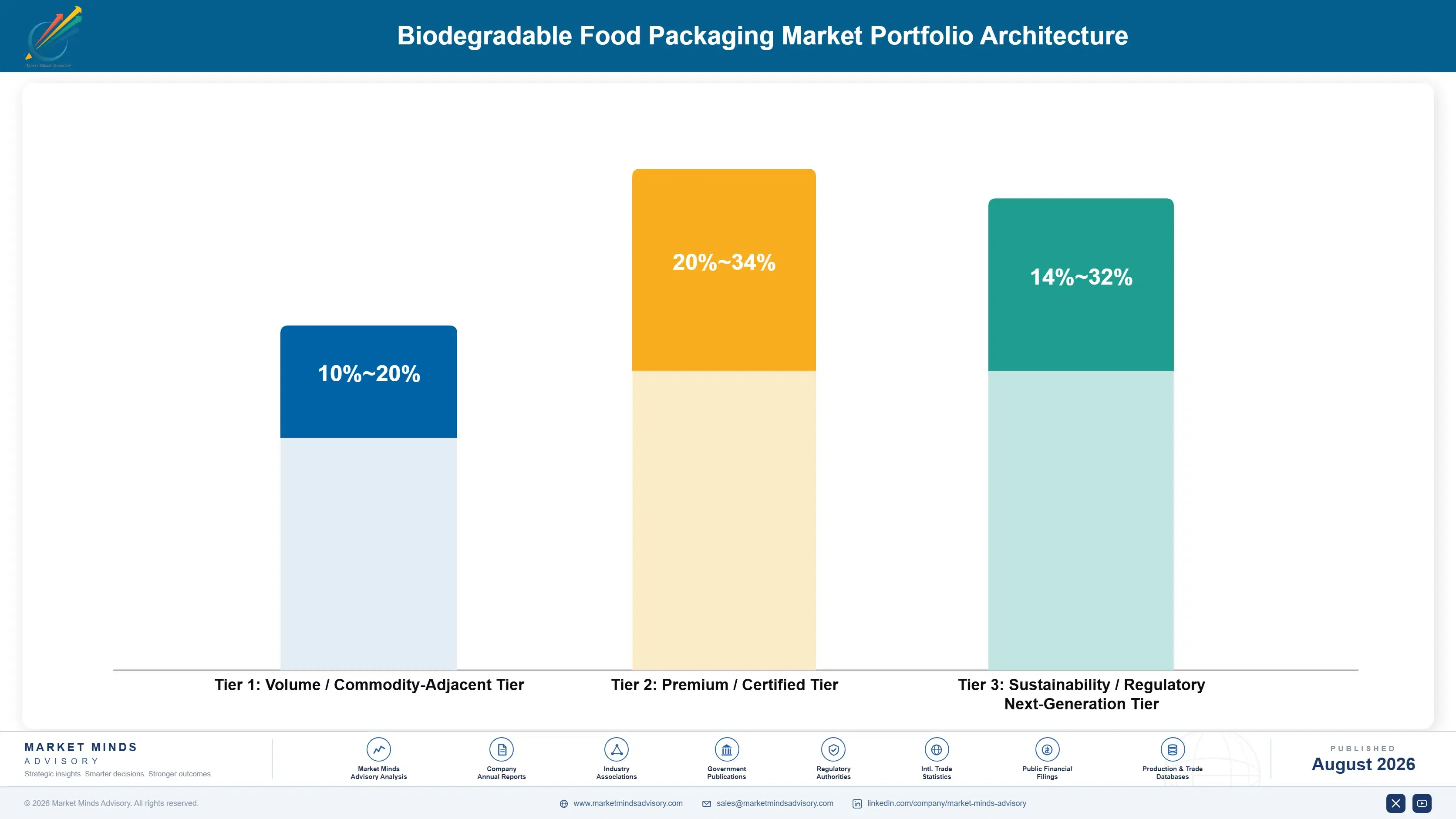
The portfolio splits into three tiers with sharply different economics. Standard moulded fibre and simple compostable formats form the volume tier, competing largely on regulatory compliance with margin set by feedstock cost and manufacturing scale. Certified formats serving large foodservice chain contracts earn considerably more because switching cost and multi-year agreements both resist the price competition hitting commodity formats. Composting-partnership-backed premium formats sit differe
The tension runs between winning regulatory-driven volume on price and building the composting infrastructure credibility that protects margin over the long run. A manufacturer chasing every mandated compliance contract available eventually gets squeezed as more entrants chase the same regulatory volume, yet building genuine composting partnership depth requires investment thin-margin commodity production rarely funds adequately on its own. Manufacturers handling this well treat compliance volume as the base and credibility investment as the margin engine.

High-value pools concentrate where feedstock diversification, contract depth, or composting credibility limit competition: large-chain multi-year contracts, moulded fibre formats with genuine consumer recognition, and composting-partnership-backed premium positioning. Standard compliance-only formats sit at the other end, competing almost entirely on price against every new entrant chasing the same regulatory-driven demand.

Volume / Commodity-Adjacent Tier

Standard moulded fibre and simple compostable formats sold primarily to meet regulatory compliance requirements across a broad, price-sensitive foodservice base. Margin is thin and set almost entirely by feedstock cost and manufacturing scale achieved.
Gross Margin: 10-20%

Premium / Certified Tier

Certified formats under multi-year contracts with large foodservice chains adopting compostable packaging voluntarily ahead of regulatory mandates. Margin reflects contract switching cost and demand visibility large clients provide over the full agreement term.
Gross Margin: 20-34%

Sustainability / Regulatory / Next-Generation Tier

Composting-partnership-backed premium formats and next-generation bio-based films addressing the category's end-of-life credibility gap directly with consumers and regulators. The wide range reflects early-stage pricing still settling industry-wide as adoption scales.
Gross Margin: 14-32%
biodegradable-food-packaging-market-portfolio-architecture-1787332116782

High-value Sub-segments and Strategic Watch-out

Moulded Fibre Containers and Trays

High value and high growth at 16.4%, the fastest format, as foodservice operators replace expanded polystyrene clamshells under direct regulatory mandate across nearly every major market currently tightening plastic foodware restrictions and enforcement timelines steadily each year without exception nationwide and increasingly across export markets too.
Gross Margin: 20-34%

Bioplastic Films and Flexible Packaging

High value with solid growth at 11.8%, constrained by technical certification challenges and occasional consumer confusion with conventional plastic film, though specialist resin producers continue narrowing the performance and cost gap steadily across successive product generations and certification cycles each passing year and every market.
Gross Margin: 16-30%

Standard Compostable Foodservice Ware

The volume core by unit count, growing at 9.4% as basic compostable cups, plates, and cutlery meet compliance requirements across a broad foodservice base without differentiated positioning or premium pricing power available to most manufacturers currently competing here on price alone today and likely tomorrow too.
Gross Margin: 10-20%

Non-Certified Biodegradable Claims Segment

The strategic watch-out, growing at just 4.2% and increasingly displaced by certified compostable alternatives as regulators tighten labelling standards and penalise unsubstantiated biodegradability claims lacking recognised third-party certification across most major markets and enforcement jurisdictions worldwide today and well into the many coming years ahead.
Gross Margin: 8-18%

How Compostable Packaging Revenue Actually Compounds

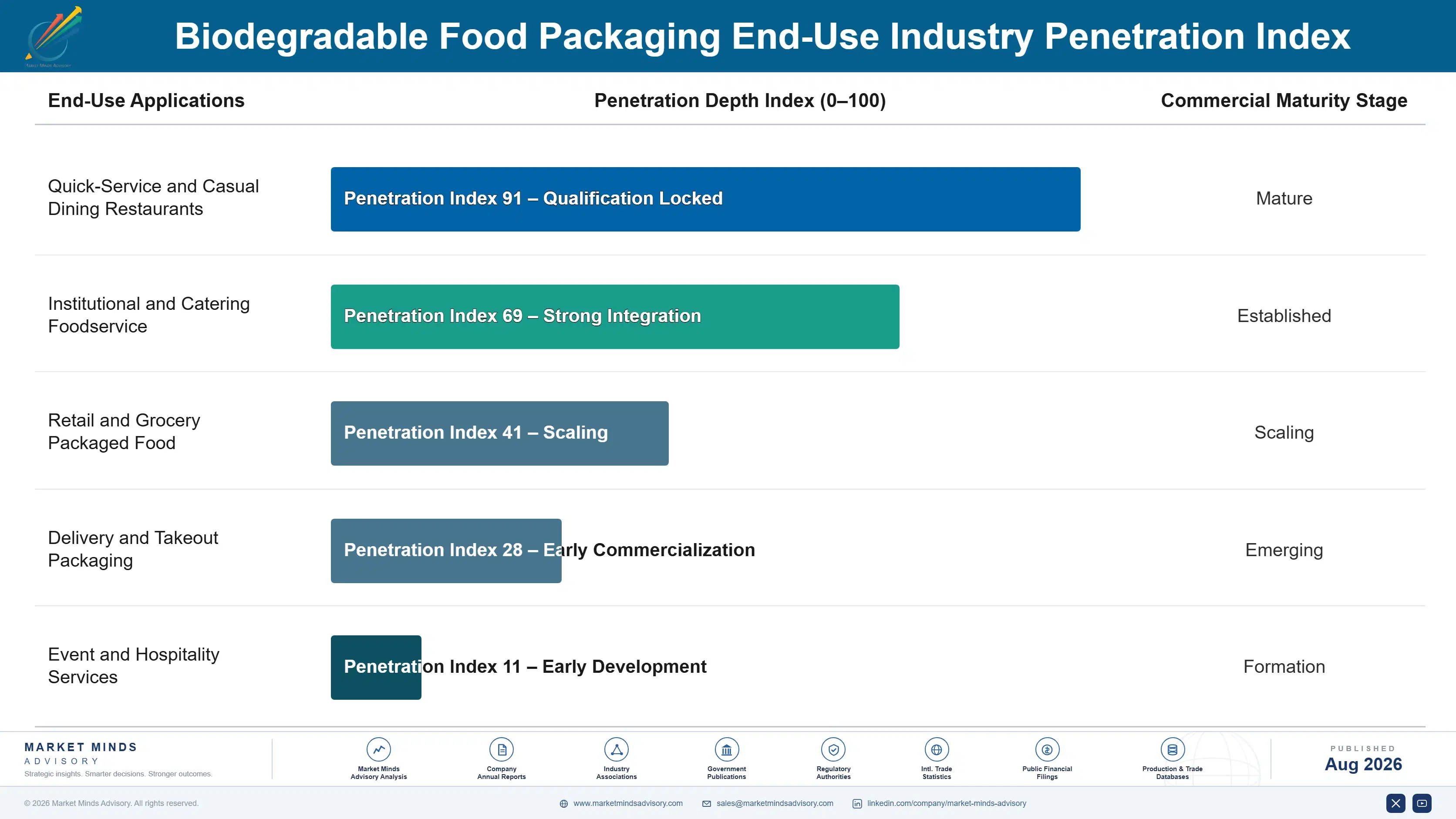
Revenue depends on a jurisdiction's regulatory calendar and a chain's contract renewal more than on winning any single order. A large foodservice chain switching to compostable packaging ahead of a mandate generates volume across every location it operates for the full contract term, so annuity value sits in that chain relationship rather than any individual shipment. Regulatory-driven small business demand behaves differently, generating a volume surge around a ban's effective date that then pl
Stickiness varies sharply by end-use vertical. Large chain contracts stick hardest, since switching a supplier mid-contract risks supply disruption across hundreds or thousands of locations simultaneously, a risk operations teams avoid unless forced. Regulatory compliance demand sticks moderately, protected mainly by qualification time rather than genuine differentiation between suppliers. Price-driven small business demand switches most readily, since compliance is the only requirement and any certified supplier satisfies it.

Buyer profiles have shifted generationally. Foodservice procurement teams that once selected suppliers primarily on unit price increasingly weigh regulatory tracking capability and composting partnership credibility, given how much scrutiny compostable claims now receive. Sustainability and legal teams increasingly sit alongside procurement in supplier selection, a shift regulatory complexity has made necessary rather than optional.
biodegradable-food-packaging-market-end-use-penetration-index-1787332117271

Our Call On Biodegradable Food Packaging

These are among the four positions where our research anticipates prominent divergence between winners and laggards over the coming forecast period. Each is grounded in the demand model, the regulatory perimeter, and the announced capacity pipeline.
01 / REGULATORY TIMING WINS

Capacity built ahead of bans captures the surge

Manufacturers who expand capacity ahead of a plastic ban actually taking effect capture the initial surge in mandated demand, while competitors scrambling to scale afterward lose contracts to whoever can deliver first when a deadline arrives. That timing advantage compounds, since early movers also secure the large foodservice contracts that anchor a facility's utilisation for years afterward rather than just the initial surge. Manufacturers should treat regulatory calendar tracking as a core operating capability rather than a periodic compliance exercise handled reactively.
02 / FEEDSTOCK DIVERSIFICATION PROTECTS MARGIN

Single-source resin exposure is the clearest risk

Bio-based resin and fibre feedstock swings considerably more than conventional plastic pricing, and manufacturers relying on a single feedstock source face margin compression that diversified competitors avoid by blending recycled or waste-stream inputs carrying less price correlation to virgin bio-based resin markets. That diversification also lets a manufacturer quote firmer multi-year pricing to large foodservice clients, since feedstock volatility no longer drives the bulk of cost uncertainty they face. Manufacturers still dependent on a single feedstock source should treat diversification as an urgent, not optional, priority.
03 / COMPOSTING GAPS ARE REAL

The category's credibility depends on infrastructure

Only about 27% of American households have access to municipal composting collection, and that gap is drawing increasing regulatory scrutiny toward compostable labelling claims that consumers reasonably assume mean the packaging will actually compost wherever they dispose of it. Manufacturers funding local composting infrastructure partnerships directly address this credibility gap more effectively than marketing claims alone ever could achieve on their own merits. This investment should be treated as core brand protection, not discretionary philanthropy separate from commercial strategy and regulatory risk management.
04 / LARGE CHAINS ANCHOR REVENUE

Multi-year contracts beat regulatory volume alone

Large restaurant and quick-service chains switching to compostable packaging voluntarily, ahead of regulatory deadlines, offer manufacturers demand visibility and contract scale that regulatory-driven small business demand alone cannot match. Suppliers securing multi-year agreements with major chains gain both revenue predictability and a reference customer that eases sales conversations with smaller regional operators evaluating the same switch independently. Building large-chain relationships should rank above chasing fragmented, price-sensitive regulatory compliance volume that competitors can undercut on price alone at nearly any point in the cycle.

Engagement Snapshot From the Field

A live engagement with an industry participant carrying material or product regulatory and market exposure ahead of a defining policy shift, showing how our research translates into a defensible multi-year portfolio strategy.
MARKET MINDS ADVISORY · CLIENT ENGAGEMENT SUMMARY
Biodegradable Food Packaging Producer Strategic Portfolio Review and Transition Roadmap 2026·Investment Scenario on Biodegradable Food Packaging Exposure Evaluation 2025-26
CLIENT PROFILE
A regional quick-service restaurant chain operating roughly 180 locations across three states engaged MMA while facing an approaching state polystyrene foodware ban with an eighteen-month compliance deadline. The client reported annual packaging spend near USD 22 million, with leadership uncertain whether to switch proactively or wait until the deadline forced action (client-reported, unverified by MMA).
STRATEGIC CHALLENGE
Leadership worried that switching too early would lock the chain into a supplier before the market matured and prices declined with scale, while waiting risked a rushed transition and potential menu disruption if compliant packaging proved unavailable at the volume the chain required near the compliance deadline itself, with little room to recover.
MMA APPROACH
MMA benchmarked three shortlisted suppliers on capacity commitments against the client's location count and volume requirements over the full compliance timeline. We modelled feedstock cost trajectory and pricing trends to assess whether early commitment or delayed procurement offered better economics. We then evaluated each supplier's regulatory tracking capability and composting partnership depth.
KEY FINDINGS
  1. Two of three shortlisted suppliers could not guarantee full-volume capacity within six months of the compliance deadline, risking real menu disruption chain-wide.
  2. Early commitment to a twelve-month supply agreement secured pricing roughly 8% below the rate quoted for a rushed post-deadline procurement process later.
  3. The client's current polystyrene supplier offered no compostable alternative at all, meaning a full supplier transition was unavoidable regardless of timing chosen.
  4. Composting partnership credibility varied significantly across suppliers, with only one able to document genuine end-of-life outcomes at meaningful scale reliably and consistently.
CLIENT PROFILE
A regional quick-service restaurant chain operating roughly 180 locations across three states engaged MMA while facing an approaching state polystyrene foodware ban with an eighteen-month compliance deadline. The client reported annual packaging spend near USD 22 million, with leadership uncertain whether to switch proactively or wait until the deadline forced action (client-reported, unverified by MMA).
STRATEGIC CHALLENGE
Leadership worried that switching too early would lock the chain into a supplier before the market matured and prices declined with scale, while waiting risked a rushed transition and potential menu disruption if compliant packaging proved unavailable at the volume the chain required near the compliance deadline itself, with little room to recover.
MMA APPROACH
MMA benchmarked three shortlisted suppliers on capacity commitments against the client's location count and volume requirements over the full compliance timeline. We modelled feedstock cost trajectory and pricing trends to assess whether early commitment or delayed procurement offered better economics. We then evaluated each supplier's regulatory tracking capability and composting partnership depth.
KEY FINDINGS
  1. Two of three shortlisted suppliers could not guarantee full-volume capacity within six months of the compliance deadline, risking real menu disruption chain-wide.
  2. Early commitment to a twelve-month supply agreement secured pricing roughly 8% below the rate quoted for a rushed post-deadline procurement process later.
  3. The client's current polystyrene supplier offered no compostable alternative at all, meaning a full supplier transition was unavoidable regardless of timing chosen.
  4. Composting partnership credibility varied significantly across suppliers, with only one able to document genuine end-of-life outcomes at meaningful scale reliably and consistently.
RECOMMENDED STRATEGY
Phase 1: Phase 1 (0 to 4 months): Commit to the supplier offering the strongest capacity guarantee and composting partnership credibility overall. Phase 2: Phase 2 (4 to 14 months): Pilot the transition across a subset of locations before scaling to the full network. Phase 3: Phase 3 (14 to 18 months): Complete the full network transition ahead of the compliance deadline with buffer time built in.
OUTCOME
The client completed the transition two months ahead of the compliance deadline, avoiding the rushed procurement risk leadership had initially worried about most throughout planning. Early commitment pricing also delivered savings close to the modelled estimate across the full network transition (client-reported, unverified by MMA).

Frequently Asked Questions

Foundational context covering the market sizes, CAGR, scope, country, region and competition that inform every finding below. This section is provided to cover basics and most often pre-purchase conversations, answered from the MMA Primary Research Dataset.

What is the current size of the Biodegradable Food Packaging Market?

The global biodegradable food packaging market is valued at USD 14.2 billion in 2025, covering certified compostable materials for foodservice ware, containers, and flexible film packaging. Conventional recyclable plastic packaging is excluded.

How large will the Biodegradable Food Packaging Market be by 2036?

The market is forecast to reach USD 52.39 billion by 2036 in the base case, about 3.28 times the 2026 level. That represents incremental value of roughly USD 36.40 billion across the decade.

What is the CAGR for the Biodegradable Food Packaging Market 2026 to 2036?

The market grows at a 12.6% CAGR in the base case, with bull and bear scenarios at 14.0% and 11.0%. The spread turns mainly on regulatory expansion pace and feedstock cost volatility.

Which segment is growing fastest?

Moulded fibre containers and trays grow fastest at 16.4%, about 1.30 times the overall rate, as foodservice operators replace polystyrene clamshells under regulatory mandate. Bioplastic films follow at 11.8%.

Who are the major companies in the Biodegradable Food Packaging Market?

Leading companies include Huhtamaki, Novolex, Vegware, BioPak, and Pactiv Evergreen. Concentration is low, with the top five holding roughly 31% of total category revenue combined.

Which country is growing fastest?

India grows fastest at a 15.9% CAGR, as state-level plastic bans expand faster than domestic compostable manufacturing capacity can currently absorb. China follows on manufacturing scale and export demand.

Report Segmentation Architecture

The full report scope spans multiple orthogonal segmentation dimensions, with cross-tabulated demand data provided for each dimension pair. Coverage extends further to regional breakdowns, trend trajectories, and the competitive detail needed to support segment-level decision-making.

By Material and Format Type

  • Moulded Fibre Containers and Trays
  • Bioplastic Films and Flexible Packaging
  • Standard Compostable Foodservice Ware
  • Coated Paper and Paperboard Packaging
  • Rigid Bioplastic Containers

By End-Use Industry

  • Quick-Service and Casual Dining Restaurants
  • Institutional and Catering Foodservice
  • Retail and Grocery Packaged Food
  • Delivery and Takeout Packaging
  • Event and Hospitality Services

By Commercial Dimension

  • Direct Manufacturer Supply Contracts
  • Distributor and Wholesale Channels
  • Multi-Year Chain Agreements
  • Regulatory Compliance Procurement

By Region

  • North America
  • Western Europe
  • East Asia
  • South Asia and Pacific
  • Latin America
  • Middle East and Africa
  • Eastern Europe

Scope, Methodology, and Coverage

Every figure in this report is reproducible from documented input assumptions. The scope below maps the historical period, the forecast horizon, the segmentation dimensions, and the countries covered, alongside the underlying primary and qualitative methodology.
Historical Period
2020 to 2025
Forecast Period
2026 to 2036
Base Year
2025 (USD billions; MMA Primary Research Dataset, August 2026)
Market Definition
The biodegradable food packaging market comprises packaging materials certified as compostable or biodegradable under recognised standards for food contact applications, valued at manufacturer revenue from certified material production. It spans moulded fibre containers and trays, bioplastic films and flexible packaging, standard compostable foodservice ware, coated paper and paperboard packaging, and rigid bioplastic containers across quick-service, institutional, retail, and delivery channels. Conventional recyclable plastic packaging, non-food-contact biodegradable materials, and packaging machinery sold separately are excluded.
Quantitative Units
USD billions (current prices); unit shipments in billions where applicable
Segmentation Dimensions
By Material and Format Type; By End-Use Industry; By Commercial Dimension; By Region
Regions Covered
North America, Western Europe, East Asia, South Asia and Pacific, Latin America, Middle East and Africa, Eastern Europe
Countries Covered
USA, China, Germany, France, UK, Japan, South Korea, India, Canada, Australia, Brazil, Mexico, UAE, Saudi Arabia, South Africa, Poland, Hungary, Romania, Indonesia, Thailand, Vietnam, Italy, Spain, Netherlands, and additional markets relevant to this sector
Key Companies Profiled
Huhtamaki, Novolex, Vegware, BioPak, Pactiv Evergreen, NatureWorks, Novamont, Eco-Products, World Centric, Genpak, Footprint, Vericool, Stora Enso, UFP Technologies, Sabert Corporation, Biopac India, Chuk Eco Solutions, Detpak, TIPA Corp, Notpla
Quantitative Methodology
Primary survey, n=3,800 respondents, Q4 2025, six countries; demand-side model with trade association cross-validation
Qualitative Methodology
47 expert interviews, Q4 2025; applied to validate demand model assumptions, identify emerging dynamics, and assess competitive positioning
Report Format
PDF and XLSX data workbook (Word format preview document)
Publisher
Market Minds Advisory
Report Code
MMA-2026-PAC-115
Published
August 2026
Contact
sales@marketmindsadvisory.com | www.marketmindsadvisory.com

Purchase the full Biodegradable Food Packaging Market Report (2026 to 2036).

The full MMA Biodegradable Food Packaging report sizes the market across five material formats, five end-use industries, four commercial dimensions, and seven regions through 2036. It profiles 20 companies on a consistent manufacturing revenue basis, scoring each on regulatory tracking capability, feedstock diversification, and large-chain contract depth. Scenario models quantify how plastic ban expansion, feedstock cost volatility, and composting infrastructure investment move both revenue and margin by format. The report also includes regulatory calendar mapping by jurisdiction, feedstock cost benchmarking, and composting infrastructure gap analysis for commercial and policy teams.
Five-format and four-dimension market sizing to 2036
Twenty-company benchmark on manufacturing revenue basis
Regulatory calendar mapping across major jurisdictions worldwide
Feedstock cost and diversification benchmarking by input type
Large-chain contract and multi-year agreement tracking
Composting infrastructure gap analysis by region

Built For The People Who Decide

From boardroom strategy to bench-side execution, this report is read cover-to-cover by leaders shaping the next decade of their industry, turning demand scenarios, market dynamics and valuation benchmarks into decisions.
CXOs/ Presidents/ VPs/ Managers
M&A and Corporate Development
Strategy Teams and R&D Heads
Procurement and Product Directors
Regulatory and Compliance Leaders
Investor Relations and Equity Analysts