
Market Minds Advisory
Bioabsorbable Stents Market

Bioabsorbable Stents Market: Magnesium, Iron, And The Rebuilding Of A Category Trials Once Ended

A polymer scaffold generation failed on strut thickness and resorption timing, and magnesium alloy platforms now carry the clinical case, while sinus and biliary implants quietly ship the volume nobody counts.

Lead Analyst

Alice Ballenger

Published

September 2026

Make Smarter Decisions with Customized Research Insights

Request a free sample report and evaluate market opportunities, growth trends, and competitive dynamics relevant to your business needs.

2025 MARKET VALUE$0.6BMarket Size 2025
2036 FORECAST VALUE$2.1BBase Case , 2026 to 2036
CAGR 2026 TO 203612.4 %Bull 13.7% / Bear 11.1%
INCREMENTAL OPPORTUNITY$1.4BNet 10- year value creation
EXPANSION MULTIPLE3.22x2036 value over 2026 base
Strategic Levers
M&A Pipeline
Regional Outlook
Country Rankings
Competitive Intelligence
Segmental Deep-dive
Call-Us : 91 93563 13602

Executive Snapshot and Market Trajectory

The first generation of bioabsorbable coronary scaffolds failed in trials, and the industry has spent the years since rebuilding on magnesium and iron rather than defending polymer. That reset is the reason this market grows at 12.4% from a base of just USD 0.58 billion.
Magnesium alloy scaffolds grow fastest at 16.8%, about 1.35 times the market rate, because thin struts and a controlled resorption window answer the two failures that killed the polymer generation. North America holds 26% of value and East Asia 25%, though for opposite reasons: Chinese and Japanese approval pathways have moved, while American demand sits in peripheral and non-vascular indications rather than coronary. Europe follows at 24% of value.
Concentration is high, with the top five holding 62% of revenue, because approved platforms are few and the evidence requirement is punishing. Regulators now expect long-term imaging follow-up at multiple timepoints, which adds years to any development programme. The competitive question is no longer whether a scaffold resorbs but whether it does so without the late thrombosis that ended the previous cycle outright. Nobody in the field gets a second reset like that.
Market Definition
The bioabsorbable stents market covers vascular scaffolds and non-vascular stents engineered to fully resorb into surrounding tissue after supporting a lumen, spanning coronary, peripheral, sinus, biliary, oesophageal, and airway applications. Permanent metallic drug-eluting and bare-metal stents are excluded, including those carrying bioresorbable polymer coatings on a permanent frame. Drug-coated balloons, vascular grafts, and closure devices sit outside scope.
Base Year Value
$0.6B in 2025 (MMA Primary Research Dataset, August 2026)
Forecast Period
2026 to 2036, eleven discrete annual values
CAGR
12.4% base case. Bull 13.7%. Bear 11.1%.
Fastest Growth Segment
Magnesium Alloy Scaffolds: 16.8% CAGR
Fastest Growth Country
India: 15.4% CAGR
Fastest Growth Region
South Asia and Pacific: 14.5% CAGR
Largest Region
North America: 26% of 2025 global value
Market Leaders
Abbott, Biotronik, Elixir Medical, Meril Life Sciences, Medtronic. Source: MMA Primary Research Dataset, July 2026.
Primary Survey
n=3,800 procurement and R&D decision-makers, Q4 2025, six countries
Methodology
Demand-side build-up, cross-validated against public data, 47 expert interviews

Bioabsorbable Stents Market Forecast Scenarios

bioabsorbable-stents-market-size-forecast-scenario-1787332484362
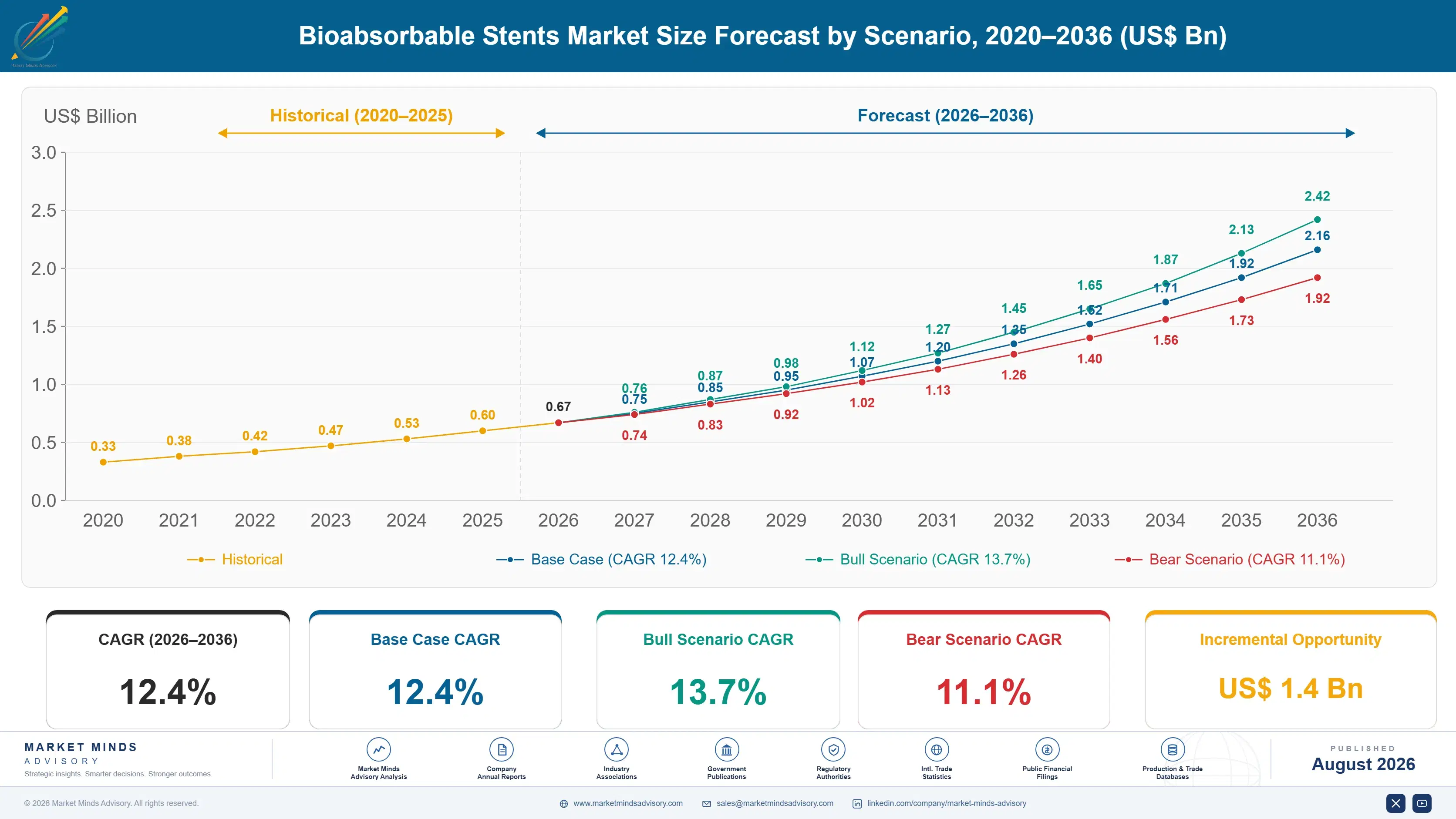
Recovery rather than growth describes 2020 to 2025. The withdrawal of the leading polymer coronary scaffold in 2017 left the category smaller than in 2015, and rebuilding took the whole period. An 11.0% historical CAGR flatters what actually happened, since most of it came from non-vascular indications while coronary programmes were still in trial enrolment rather than commercial supply.
The 12.4% base case rests on three mechanisms. Magnesium alloy platforms carry CE marked clinical use with multi-year imaging follow-up now published, the evidence regulators demanded after 2017. Chinese and Indian approval pathways have cleared iron and polymer scaffolds for domestic commercial supply, adding volume the Western pathway cannot. And Abbott's below-the-knee peripheral approval in 2024 opened an indication where permanent metal has always performed badly, a cleaner clinical argument than coronary ever offered.
The 13.7% bull case turns on a US coronary approval, which would reopen the largest interventional market and pull every reimbursement system behind it. The 11.1% bear case is a single adverse late-outcome signal from any magnesium programme. This category has already demonstrated that one trial result can remove a product line and most of a market's value inside a year, and nobody has forgotten.

Rebuilding A Category That Trials Once Ended

Scale here is small and the reason is clinical, not commercial. At USD 0.58 billion the category is a rounding error beside permanent drug-eluting stents, and it stays there until a scaffold accumulates the long-term outcome data that permanent metal has held for two decades. Concentration at 62% follows from the same fact: very few organisations can fund a programme that takes seven years to reach approval.
TOP FIVE CONCENTRATION62%Few approved platforms keep participation unusually narrow in this category
AVERAGE SELLING PRICEUSD 1,340Premium over permanent drug-eluting stents in the same procedure
LEADING PRODUCER SHARE31%Manufacturing concentrates where the original clinical trial programmes ran
RESORPTION WINDOW12 to 36 monthsTime from implant to complete absorption by surrounding tissue
CORONARY VOLUME SHARE44%Coronary scaffolds carry less than half of total units
TRIAL TO APPROVAL7.5 yearsLongest evidence requirement anywhere in interventional device development
The volume nobody discusses is non-vascular. Bioabsorbable sinus implants and biliary stents ship in far larger numbers than coronary scaffolds, which is why coronary holds only 44% of units despite absorbing nearly all the clinical attention and development spend. That imbalance shapes the commercial reality: cardiology drives the narrative and the valuations, while ENT and gastroenterology pay the manufacturing overhead.
Pricing holds at roughly USD 1,340 against permanent stents that cost considerably less, and hospitals accept it only where the clinical case is specific. Below the knee, where permanent metal fractures and restenoses, that case is easy. In a straightforward coronary lesion it is not, and no amount of engineering elegance changes a purchasing committee's arithmetic when the comparator works.
"The polymer generation didn't fail because resorbable was a bad idea. It failed because a 150 micron strut in a coronary artery is a bad idea, and plenty of people said so before the trial read out. Magnesium fixed the strut, not the concept."
Principal Analyst, Interventional Devices Practice · MMA Medical Devices Practic

Market Trends

Magnesium Alloy Displaces Polymer As Default Chemistry

Polymer scaffolds needed struts around 150 microns to hold radial force, roughly twice a modern permanent stent, and that thickness is what drove the thrombosis signal. Magnesium alloy delivers comparable support at 99 to 120 microns and resorbs inside 12 months rather than three years. Biotronik's Magmaris and its successor platforms carry CE marking with multi-year imaging follow-up published, which is the specific evidence regulators asked for. The chemistry argument is effectively settled in Europe. What remains is scale and a United States pathway. Nobody is funding a new polymer coronary programme in 2026.
Market Impact: About 7.5 years to approval
Below-The-Knee Peripheral Becomes The Credible Commercial Indication

Permanent metal performs poorly below the knee because the vessel moves, and stents fracture under repeated flexion. Abbott's Esprit BTK scaffold reached FDA approval in 2024 on that argument, with the pivotal trial showing better patency than angioplasty alone at 12 months. Critical limb ischaemia gives a cleaner comparison than coronary ever did: the alternative is not a well-performing permanent stent but a procedure with poor durability or an amputation. That framing moves reimbursement conversations quickly. Peripheral programmes now attract development funding that coronary struggles to raise. The money has followed the clinical logic here.
Market Impact: Chinese PCI volume above 1 million

Market Opportunities and Growth Drivers

Long-Term Imaging Requirements Reshape Development Economics

Regulators now expect optical coherence tomography and angiographic follow-up at multiple timepoints out to five years, because that is where the previous generation's failure appeared. A coronary scaffold programme therefore runs about 7.5 years from first-in-human to approval, against roughly three for an iterative permanent stent. That cost is a driver in an unusual sense: it removes competitors. Only organisations able to carry a decade of spending without revenue enter at all, which is precisely why the top five hold 62% of a category this small. Barriers built by regulators protect whoever clears them.
Market Impact: Vessels below 2.5 millimetres exclu

Chinese And Indian Approvals Open Domestic Commercial Supply

Lifetech Scientific's iron bioresorbable scaffold and Meril's MeRes100 both reached domestic approval and commercial use, which gives two very large patient populations access on pathways the Western system does not control. Chinese percutaneous coronary intervention volume runs above one million procedures annually and grows faster than any developed market. Domestic manufacturers price well below imported platforms and sell into provincial tender systems that reward local production directly. That combination adds volume without waiting for a United States decision, and it is why East Asia holds 25% of value. Approval geography now decides growth more than chemistry does.
Market Impact: Hospital absorbs about USD 900 diff

Market Restraints and Challenges

Absorb Withdrawal Still Governs Clinician And Payer Confidence

Interventional cardiologists who implanted the withdrawn polymer scaffold and later managed scaffold thrombosis do not return to the category on a data package alone. The root cause is that the failure was visible in individual patients rather than only in aggregate statistics, which makes it personal rather than academic. Commercially this shows up as slow adoption curves even where a product is approved and reimbursed. Manufacturers are addressing it with registry data, mandated implantation technique training, and sizing protocols, since most of the original problem traced to undersized deployment in vessels below 2.5 millimetres.
Market Impact: Strut thickness down 30 microns

Reimbursement Pays Permanent Stent Rates For Resorbable Devices

Most coding systems reimburse a percutaneous coronary intervention by procedure rather than by device, so a hospital implanting a USD 1,340 scaffold receives the same payment as one using a permanent stent costing far less. The root cause is that device-specific codes require demonstrated outcome superiority, and the long-term data supporting that is exactly what the category is still accumulating. Hospitals therefore absorb the difference or decline the device. Manufacturers are pursuing separate codes for below-the-knee indications first, where the comparator performs badly enough to make the economic case defensible. Coding change is slower than clinical evidence.
Market Impact: FDA approval reached in 2024
4 additional market trends, 2 additional growth drivers, and 3 additional restraints and challenges are covered in the full report. Contact sales@marketmindsadvisory.com to access the complete intelligence.

Segment CAGR and Growth Architecture

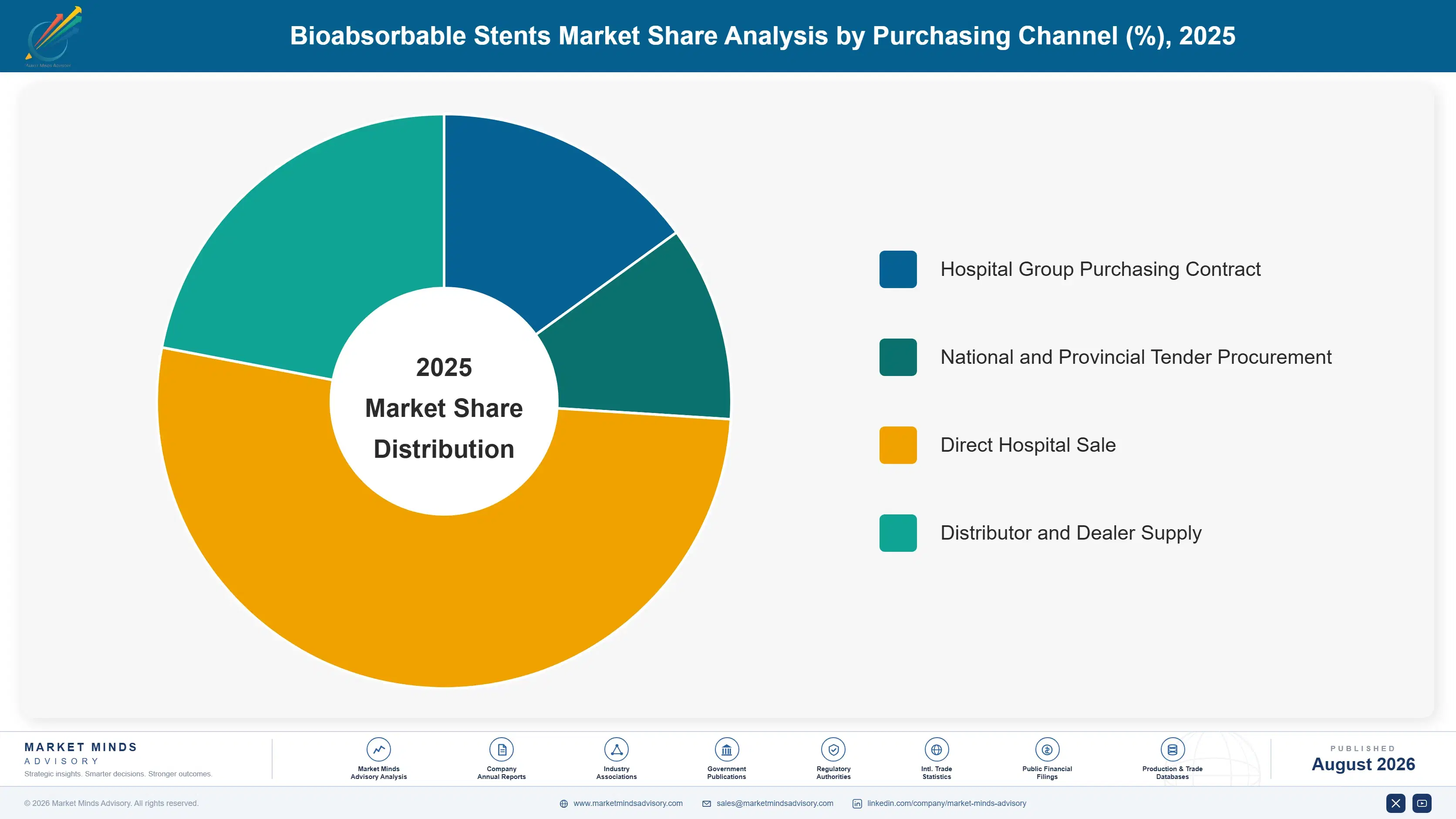
Segmentation follows scaffold material, because material determines radial strength, strut thickness, resorption window, and the regulatory evidence a programme must generate. Anatomical application and clinical indication are handled separately in the framework, since a single magnesium platform serves coronary and peripheral use with different sizing rather than different chemistry. That distinction matters commercially more than it looks.
bioabsorbable-stents-market-market-share-analysis-1787332484899

Magnesium Alloy Scaffolds

Magnesium alloy grows fastest at 16.8%, about 1.35 times the market rate, and it is the segment carrying the category's clinical credibility. The metal gives radial force close to a permanent stent at 99 to 120 micron struts, and it corrodes predictably into magnesium hydroxide and then hydroxyapatite over roughly 12 months. Biotronik holds the commercial position in Europe with published imaging follow-up out to five years, which is precisely the dataset the previous generation lacked. The constraint is manufacturing: magnesium alloy tubing with consistent grain structure is difficult to produce at volume, and yield rates remain well below permanent stent lines. Scale-up, not science, now sets the growth ceiling here.
CAGR 16.8%

Iron and Zinc Alloy Scaffolds

Iron and zinc alloys grow at 15.2% on a different argument from magnesium. Iron offers higher strength than magnesium, allowing struts near 70 microns, but it corrodes slowly enough that resorption can take three years or more, so nitriding and surface treatment are used to accelerate it. Lifetech Scientific's iron platform reached Chinese approval and commercial supply, which makes this the segment with genuine volume outside Europe. Zinc sits between the two metals on corrosion rate and has attracted research interest without a commercial product yet. Growth here depends heavily on Chinese procedure volume and provincial tender outcomes rather than on any Western regulatory decision. Approval geography drives this segment more than metallurgy does.
CAGR 15.2%
Full segment breakdown across 7 segments available in the complete report.

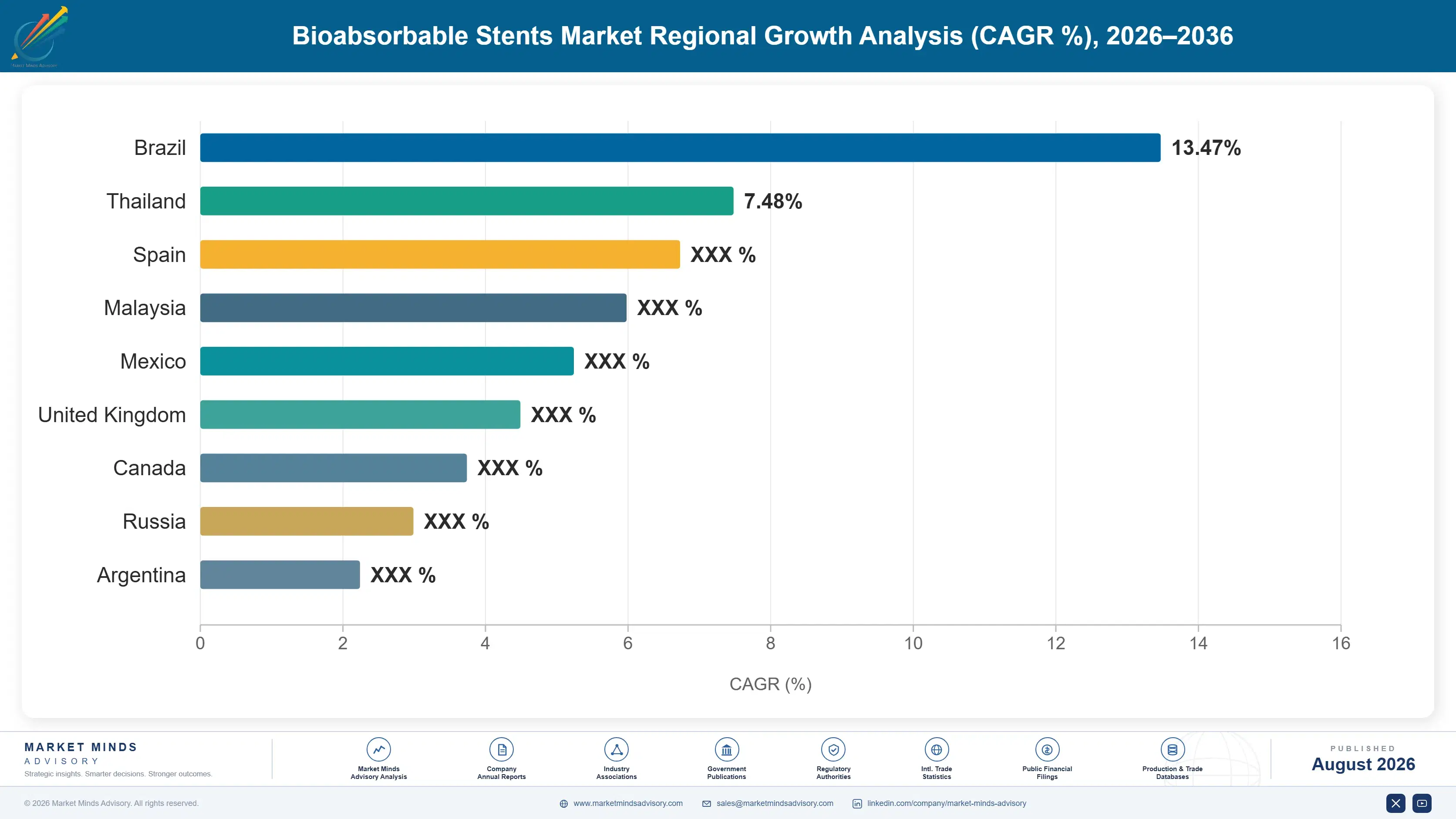
Regional Architecture and Country Demand Map

Regional shares track approval status rather than cardiovascular disease burden, which is unusual. Europe has clinical experience, East Asia has domestic approvals and procedure volume, and North America has peripheral indications but no approved coronary scaffold at all. Growth follows the same logic. Regulators set the map here.

North America

North America holds 26% of value on peripheral and non-vascular demand rather than coronary, because no bioabsorbable coronary scaffold is approved for sale in the United States. Abbott's below-the-knee approval in 2024 created the first substantial vascular indication, and critical limb ischaemia volumes are large enough to matter: roughly 200,000 procedures annually in the United States alone. Bioabsorbable sinus implants add steady volume through ENT practices, where the device replaces a follow-up removal procedure and pays for itself on clinic time. Growth at 11.6% is below the global rate because the coronary opportunity stays closed. Canadian and Mexican adoption follows American approval decisions with a lag of two to three years.
Share: 26% | CAGR: 11.6% (2026 to 2036)

Western Europe

Clinical experience rather than market size explains Western Europe's 24% share. CE marking cleared magnesium scaffolds years before any other region approved a resorbable coronary device, so German, Swiss, Italian, and Spanish centres hold most of the world's implantation experience and most of the published follow-up imaging. That evidence base is an asset the region monetises through early access and through participation in every subsequent trial. Growth at 11.0% trails the global rate because the installed clinician base is already reached and national tender pricing is tight. Nordic and Benelux systems adopt selectively, funding scaffolds only for younger patients where avoiding a permanent implant has decades of value. That patient argument travels well.
Share: 24% | CAGR: 11.0% (2026 to 2036)
Regional intelligence for 5 additional markets available in the complete report: East Asia, South Asia and Pacific, Latin America, Middle East and Africa, Eastern Europe. Contact sales@marketmindsadvisory.com.
bioabsorbable-stents-market-country-cagr-analysis-1787332485411

Where Value Actually Accrues Here

Four levers matter in a category this early, and none is a pricing move. Each concerns evidence, indication selection, manufacturing yield, or regulatory geography, because those are the constraints that actually bind. Suppliers treating this as a conventional device market and competing on features will find no purchase at all. The order of these four also matters.

Enter Through Indications Where Permanent Metal Performs Badly

Coronary is the wrong first indication and always was, because permanent drug-eluting stents work extremely well there and the comparator is unbeatable on price. Below the knee, permanent metal fractures under flexion and one-year patency runs poorly enough that any alternative gets a hearing. Abbott took that route to FDA approval in 2024. Sinus, biliary, and airway indications offer the same asymmetry, where removing a permanent implant requires a second procedure costing roughly USD 2,800. Choosing the indication where the incumbent fails is worth more than any improvement to the device itself.
Market Impact: Avoids a second procedure costing r

Publish Five-Year Imaging Follow-Up Before Competitors Reach Three

Regulators and clinicians both want the timepoint that exposed the previous generation, which was between two and four years after implant. A company holding published optical coherence tomography follow-up at five years is not making a marketing claim, it is answering the only question the field has. Biotronik's position in Europe rests on exactly this. Building it costs perhaps USD 40 million and a decade of patience, and it cannot be bought or accelerated afterwards. Competitors arriving with two-year data are answering a question nobody is still asking. Time is the only input that cannot be purchased.
Market Impact: Costs roughly USD 40 million and a

Fix Magnesium Tubing Yield Before Scaling Commercial Lines

Magnesium alloy tubing with the grain structure needed for consistent corrosion behaviour is genuinely hard to make, and yield rates on scaffold lines run well below the 90% typical of permanent stent manufacturing. Every rejected tube carries the full cost of alloy preparation, extrusion, and drawing. At current volumes the waste is affordable; at ten times the volume it decides gross margin outright. Investing in metallurgy and process control now costs money that produces nothing visible, which is exactly why most companies defer it until scale makes the problem expensive. Deferring it is the most common mistake here.
Market Impact: Yield gap against the 90% permanent

Treat Approval Geography As A Portfolio, Not A Sequence

The default plan runs CE marking first, then FDA, then everywhere else, and it wastes years. Chinese and Indian approval pathways accept domestic trial data and can be run in parallel rather than after, and between them they cover procedure volume above 1 million annually. A device approved and selling in three regions funds the American programme that a device approved in one cannot. Companies that sequenced their filings spent the past decade with no revenue at all, and several did not survive the wait. Parallel filing is cheaper than the delay it avoids.
Market Impact: Parallel filing covers above 1 mill

Who Controls the Margin Pool

Concentration runs at 62% for the top five, which is high for a category this small and reflects how few organisations have completed a scaffold programme. The gap between leaders and challengers is regulatory position and published follow-up duration, not device design, since the engineering is broadly understood. All participants here are assessed on one basis, revenue from bioabsorbable stents and scaffolds, excluding permanent stents carrying resorbable polymer coatings.
Competition runs along four dimensions. Follow-up duration comes first, because five-year imaging answers the question that ended the last cycle. Indication selection comes second, since below-the-knee and non-vascular sites offer a comparator that fails. Approval geography comes third, as Chinese and Indian pathways produce revenue years ahead of American ones. Manufacturing yield comes fourth, and it is the dimension nobody discusses publicly.

Two pressures will move rankings. Chinese manufacturers hold domestic approval, low cost positions, and access to the largest procedure pool anywhere, and their absence from Western markets is regulatory rather than technical. Non-vascular suppliers meanwhile hold the unit volume and the manufacturing scale that coronary specialists lack. Whoever combines coronary clinical credibility with non-vascular manufacturing economics takes the leading position, and no participant currently holds both.
bioabsorbable-stents-market-company-positioning-matrix-1787332485933

Competitive Moat and Risk Dimensions

ABBOTT

Moat: Peripheral approval and trial scale

Abbott holds the only FDA approved bioabsorbable vascular scaffold in the United States, for below-the-knee use, and it reached that on a pivotal trial few competitors could fund. The trial infrastructure built for the withdrawn coronary programme transferred directly. Nobody else can run a study of that size and simultaneously carry the commercial base to absorb the cost.
ABBOTT

Risk: Absorb legacy in cardiology

The withdrawn coronary scaffold carries Abbott's name in every cardiologist's memory of what went wrong, which complicates any future coronary re-entry regardless of the platform used. Peripheral success does not transfer that credibility back. The company also has an enormous permanent stent franchise, which makes an aggressive resorbable coronary push a decision to compete against its own installed revenue.
BIOTRONIK

Moat: Magnesium platform and follow-up

Biotronik holds the longest published imaging follow-up on any resorbable coronary scaffold in commercial use, built over more than a decade of European clinical work. Magnesium alloy processing is a genuine manufacturing capability rather than a licensable design. Together those give a position a competitor cannot reach by matching the specification, because the missing input is elapsed time.
BIOTRONIK

Risk: European concentration without US approval

Almost all of Biotronik's scaffold revenue sits in Europe, where national tender pricing is tight and the addressable clinician base is already reached. Without a United States approval the largest interventional market stays closed. A private company also has limited capacity to fund both an American pivotal trial and the manufacturing scale-up that magnesium yield rates require.

Players Tracked

Prominent Players

Abbott
Biotronik
Elixir Medical
Meril Life Sciences
Medtronic

Other Key Players

Lifetech Scientific
Boston Scientific
Amaranth Medical
ELLA-CS
Q3 Medical
Efemoral Medical
R3 Vascular
Sahajanand Medical Technologies
Translumina
Kyoto Medical Planning
Arterius
QualiMed
Merit Medical
Cook Medical
Terumo

Recent Developments

JUNE 2024

FDA approves first bioabsorbable scaffold for below-the-knee use

Abbott received FDA approval for the Esprit BTK everolimus-eluting resorbable scaffold in infrapopliteal arteries, the first bioabsorbable vascular scaffold cleared in the United States since the coronary withdrawal. This was a regulatory approval rather than any commercial transaction, and it applies to peripheral use only, not coronary.
Signal: The category re-entered the United States
NOVEMBER 2024

Extended magnesium scaffold follow-up imaging published

Multi-year optical coherence tomography and clinical follow-up on magnesium scaffold cohorts appeared in peer-reviewed cardiology literature, covering the two to four year window where the previous polymer generation's failures had emerged. These were clinical publications rather than corporate events, and they addressed the specific evidence gap regulators had identified.
Signal: Publishing the timepoint that killed the l
MARCH 2025

Chinese provincial tenders include domestic bioresorbable scaffolds

Several Chinese provincial volume-based procurement rounds added domestically approved bioresorbable coronary scaffolds to their device lists, at prices well below imported platforms. These were procurement decisions rather than approvals or transactions, and they convert existing regulatory clearance into actual hospital volume across a very large procedure base.
Signal: Tender inclusion converts an approval into

Alloy, Polymer, And Clinical Evidence Costs

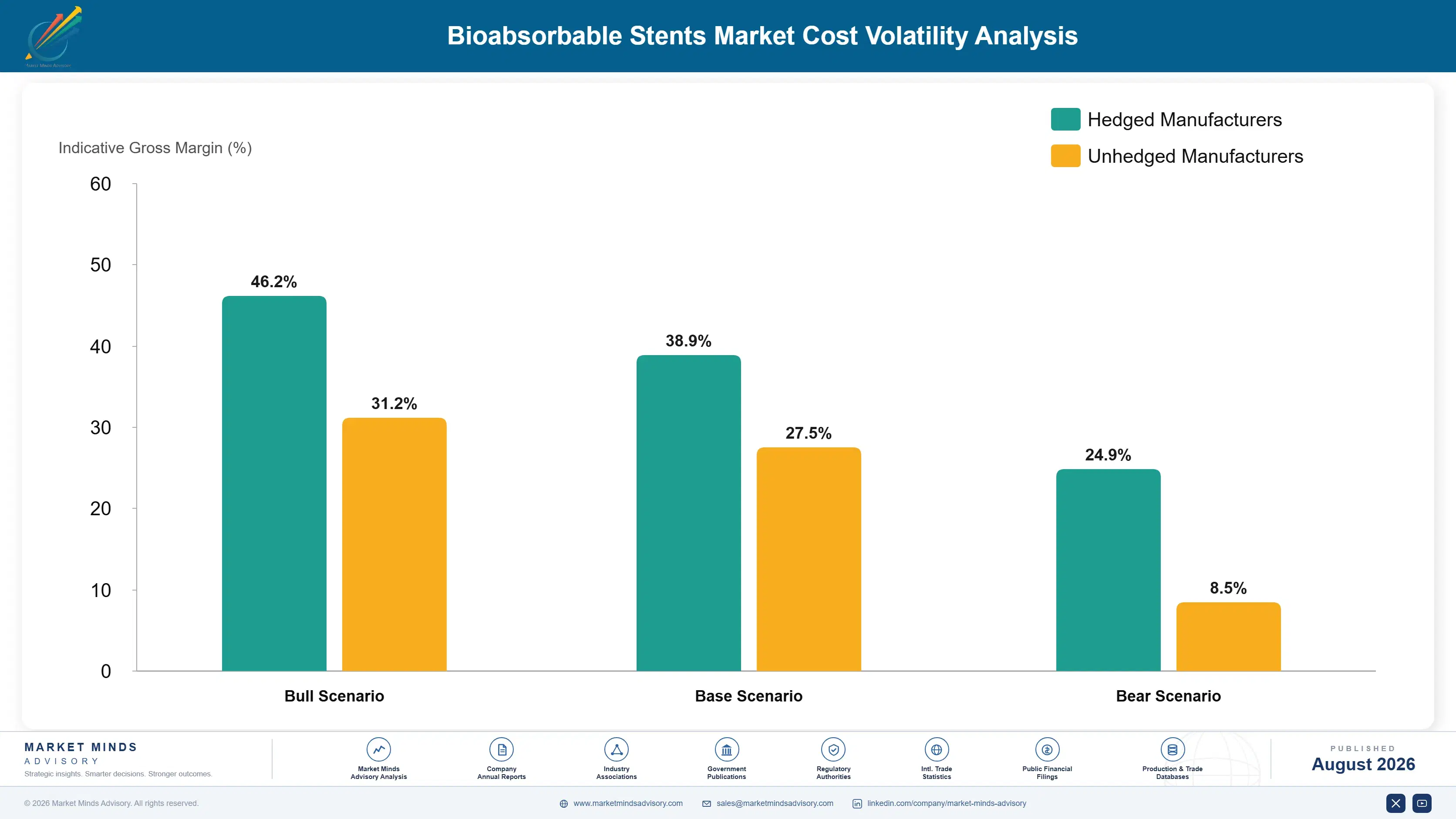
Cost structure here looks nothing like a permanent stent line. Medical-grade magnesium alloy and iron feedstock run 12% to 18% of scaffold cost, sourced from a handful of specialist metallurgy suppliers in Germany and Japan. Bioresorbable polymer resin runs 8% to 14%, largely from European and American producers. Precision tubing, laser cutting, and yield loss together carry 30% to 42%, the dominant line.
European magnesium supply tightened sharply through 2021 and 2022 when Chinese production curtailments under energy consumption controls cut export availability, and prices rose several times over. The IEA documented the underlying industrial energy constraint across that period. For scaffold makers the effect landed less on unit cost, since alloy is a modest share, than on qualification: a change of alloy supplier requires corrosion revalidation and, in some jurisdictions, a regulatory submission.

All three cost ranges above are wide because magnesium, iron, and polymer platforms share almost no process steps. A magnesium producer carries alloy qualification risk nobody can resolve quickly. A polymer producer carries none of that but competes against a commoditising resin. Chinese manufacturers hold feedstock proximity and lower conversion cost, a durable advantage Western entrants cannot match on process.
bioabsorbable-stents-market-cost-volatility-analysis-1787332486128

Qualify a second alloy supplier before you need one

Medical-grade magnesium alloy comes from few specialist metallurgy houses, and switching requires corrosion revalidation because grain structure changes resorption behaviour directly. That work takes months and sometimes a regulatory submission. Doing it while supply is comfortable costs testing time only. Doing it during a shortage means choosing between stopping production and shipping material whose corrosion profile has not been confirmed.

Treat tubing yield as a clinical parameter

Yield loss is the largest cost line, and it is not really a cost problem. A tube with inconsistent grain structure that passes inspection carries unpredictable corrosion behaviour into a patient. Investing in metallurgy and process control therefore buys margin and safety at the same time, which is unusual, and it is the argument that gets the capital approved internally.

Carry non-vascular volume to cover fixed conversion cost

Sinus, biliary, and oesophageal bioabsorbable devices ship in far larger unit numbers than coronary scaffolds and use overlapping polymer processing. Running them through the same plant spreads laser cutting and cleanroom overhead across a much larger base. Coronary-only manufacturers carry that overhead on a few thousand units annually, which is why their conversion cost per device stays uncompetitive.

Portfolio Architecture for Margin Defence

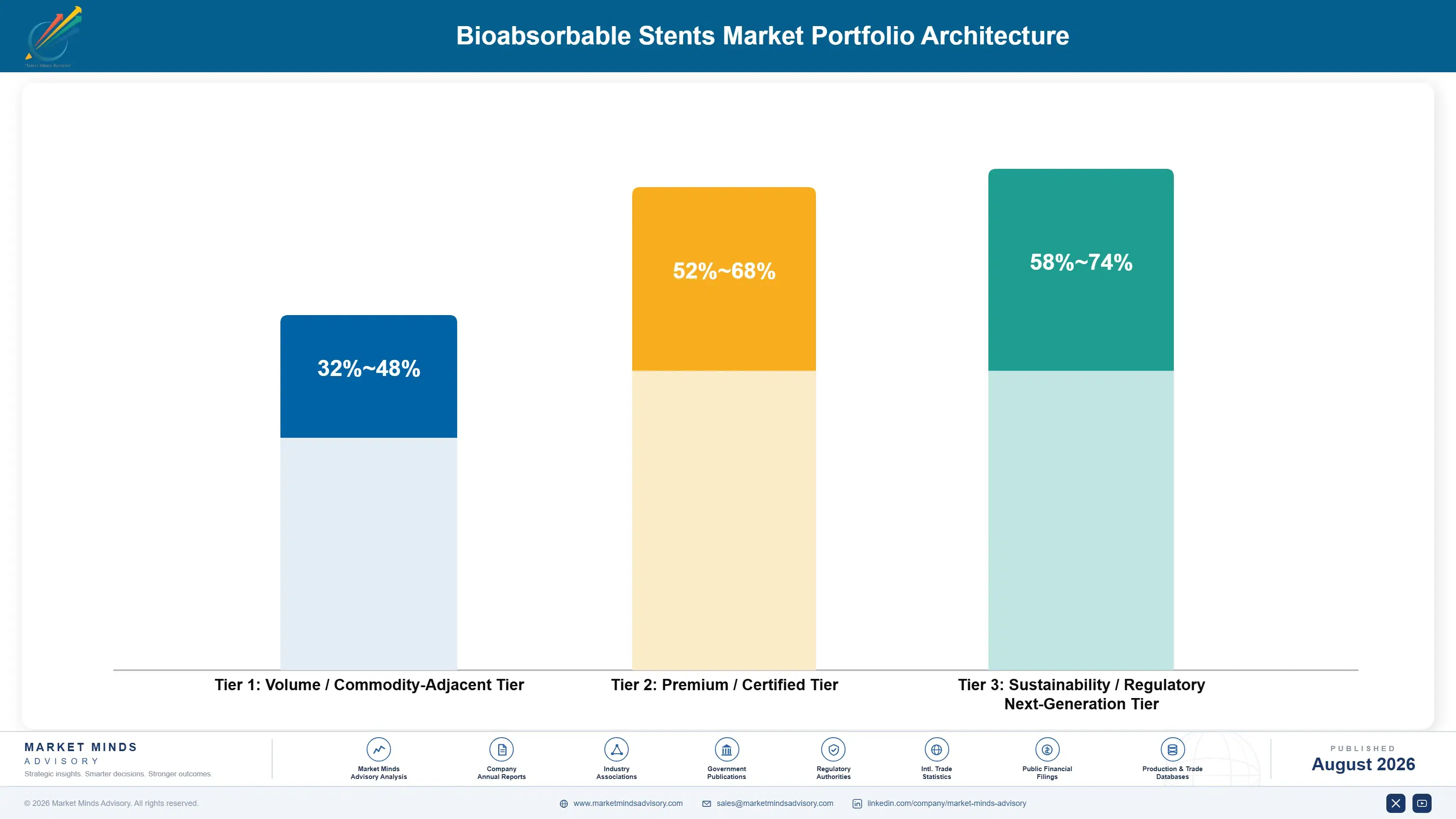
Three tiers with different economics sit inside this category. Non-vascular devices form the volume tier, where polymer processing is well understood, unit numbers are large, and the clinical bar is modest. Coronary and peripheral scaffolds carrying regulatory approval and published follow-up earn considerably more, because approval itself is the barrier. Magnesium and iron alloy platforms price highest, against a clinical argument no polymer device can make.
The tension is between volume that funds the plant and coronary work that funds the story. Sinus and biliary devices pay the overhead and generate cash today. Coronary scaffolds consume a decade of trial spending and may never reach approval. Companies pursuing only the second run out of money, as several have. Companies pursuing only the first are profitable and invisible, and they attract no strategic value at all.

High-value pools concentrate where approval and evidence limit the field: magnesium coronary platforms with five-year imaging, below-the-knee peripheral scaffolds, and any device holding a device-specific reimbursement code. Non-vascular sinus implants sit lower on margin but higher on certainty. The commodity end is polymer coronary scaffolds sold into tender systems on price, where domestic Chinese and Indian manufacturers set the level and nobody else meets it.

Volume / Commodity-Adjacent Tier

Non-vascular bioabsorbable sinus, biliary, and oesophageal devices sold on unit price and availability. The range is wide because polymer sourcing and plant utilisation separate producers considerably at similar selling prices.
Gross Margin: 32-48%

Premium / Certified Tier

Approved coronary and peripheral scaffolds carrying published clinical follow-up and regulatory clearance in a major market. The range is wide because approval in one jurisdiction earns far less than approval in three, and tender exposure varies sharply.
Gross Margin: 52-68%

Sustainability / Regulatory / Next-Generation Tier

Magnesium and iron alloy platforms with multi-year imaging evidence, plus device-specific reimbursement positions. The range is wide because manufacturing yield on alloy tubing still varies enormously between producers while selling prices do not.
Gross Margin: 58-74%
bioabsorbable-stents-market-portfolio-architecture-1787332486618

High-value Sub-segments and Strategic Watch-out

Magnesium Alloy Scaffolds

High value and high growth at 16.8%, the fastest segment, because thin struts and a 12 month resorption window answer both failures of the polymer generation. Manufacturing yield on alloy tubing, not clinical evidence, is now the binding constraint on scale. Scale-up capital decides this one.
Gross Margin: 58-74%

Iron and Zinc Alloy Scaffolds

High value with strong growth at 15.2%, carrying real commercial volume in China where domestic approval and provincial tender inclusion both exist. Slow natural corrosion requires surface treatment to reach an acceptable resorption window, which adds a process step competitors avoid. Chinese procedure volume carries it.
Gross Margin: 50-66%

Other Bioresorbable Polymer Scaffolds

The volume core by units at 11.4%, covering sinus, biliary, oesophageal, and airway devices where polymer processing is mature and the clinical bar is manageable. This segment pays the fixed manufacturing overhead that coronary programmes cannot cover on their own. Unglamorous, profitable, and generally ignored.
Gross Margin: 40-56%

PLLA Scaffolds

The strategic watch-out at 9.8%, carrying the reputational weight of the withdrawn coronary generation despite continued legitimate use in peripheral and non-vascular sites. Strut thickness limits keep it out of small coronary vessels permanently, and no clinical argument recovers that ground. The chemistry has reached its limit.
Gross Margin: 34-50%

How Adoption Actually Commits Here

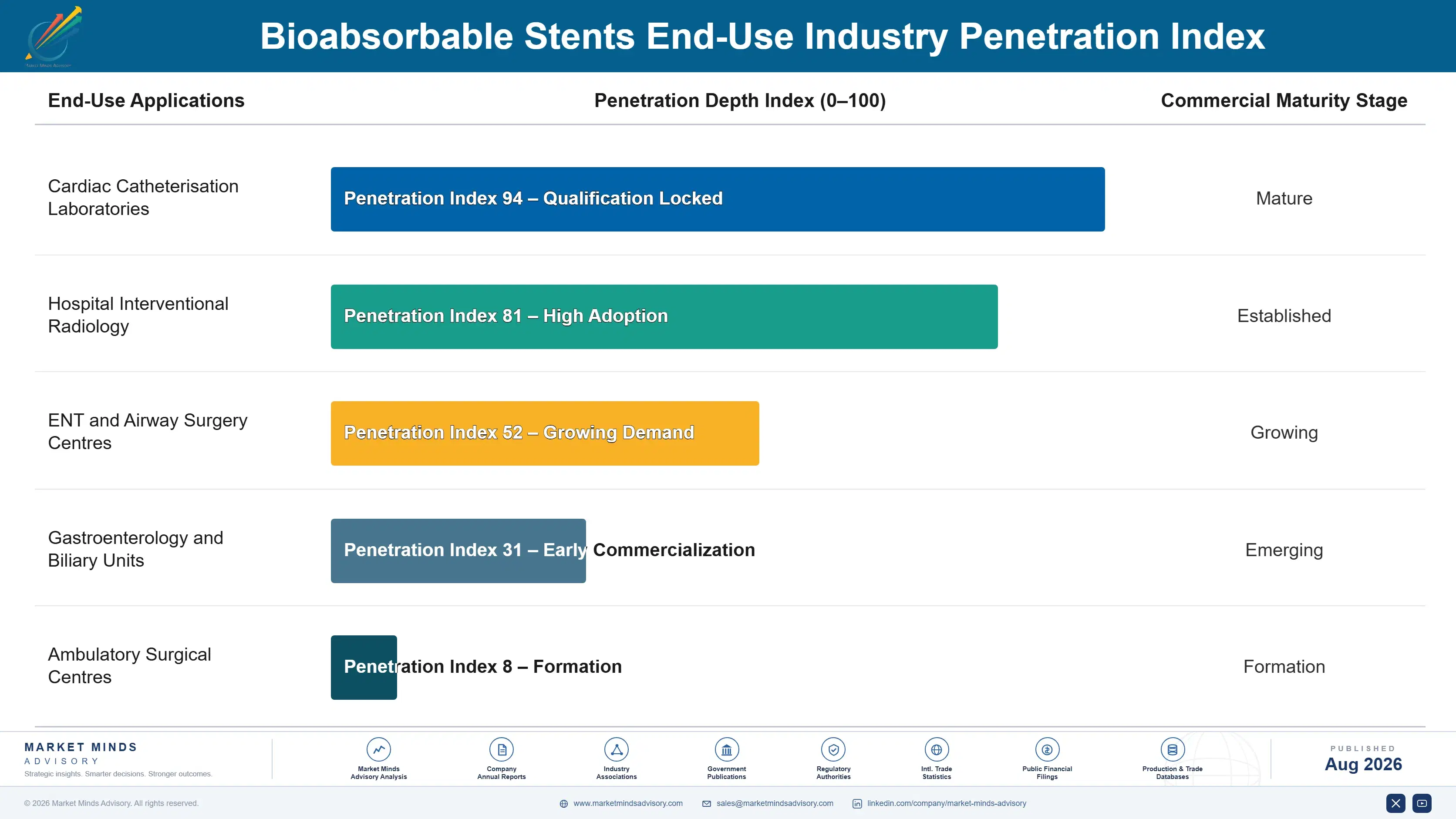
Demand commits at hospital formulary approval and interventionalist training, then repeats procedure by procedure for years. A cardiologist who has implanted 40 scaffolds of one platform has technique specific to that device: sizing, pre-dilatation protocol, post-dilatation pressure. Switching means relearning all of it with a patient on the table. That produces annuity behaviour that looks like loyalty and is actually accumulated muscle memory.
Stickiness varies enormously by vertical. Interventional cardiology is the stickiest, because technique investment is highest and the consequence of error is immediate. Peripheral intervention sticks moderately, since operators handle more device types routinely. ENT sinus implants stick least, as the procedure is simpler and purchasing sits with practice administrators rather than with the surgeon. Gastroenterology sits between the two, where biliary stent choice follows endoscopist preference but switching costs little.

Buyer profiles have shifted from individual interventionalists toward value analysis committees, group purchasing organisations, and national tender boards. A younger generation of operators trained after 2017 has no personal experience of the withdrawal, which removes an emotional barrier but replaces it with indifference: they see a device costing four times more with no outcome advantage they have witnessed. Winning them takes head-to-head data, not history.
bioabsorbable-stents-market-end-use-penetration-index-1787332487105

Our Call On Resorbable Scaffolds

These are among the four positions where our research anticipates prominent divergence between winners and laggards over the coming forecast period. Each is grounded in the demand model, the regulatory perimeter, and the announced capacity pipeline.
01 / INDICATION SEQUENCING DISCIPLINE

Start where permanent metal already fails

Coronary was the wrong first indication because permanent drug-eluting stents perform extremely well there and cost a fraction as much, which made the resorbable argument theoretical rather than clinical. Below the knee, in sinus cavities, and in biliary ducts the incumbent device genuinely fails, and Abbott's 2024 approval shows how quickly a regulator moves when the comparator is weak. Companies still leading with coronary are choosing the hardest possible entry into a market that has already punished exactly that choice once.
02 / EVIDENCE DURATION ADVANTAGE

Five-year imaging is the only real moat

Every technical specification in this category can be matched within a development cycle, but published imaging follow-up at five years cannot be bought, licensed, or accelerated by any amount of capital. Biotronik's European position rests entirely on holding that dataset while competitors hold two-year data answering a question the field stopped asking after 2017. Any company entering now should start the long-term registry before the pivotal trial, because the follow-up clock is the binding constraint on when revenue can begin.
03 / APPROVAL GEOGRAPHY STRATEGY

File in parallel, not in sequence

The conventional path runs CE marking, then FDA, then everywhere else, and it costs a decade of revenue that companies in this category could not afford, which is why several did not survive the wait. Chinese and Indian pathways accept domestic trial data, cover procedure volume above one million annually, and can run alongside a European filing rather than after it. Revenue from three approved regions funds the American pivotal trial that revenue from a single region never will on its own.
04 / MANUFACTURING YIELD INVESTMENT

Alloy tubing yield decides the margin

Yield loss on magnesium and iron tubing sits inside a conversion cost line running 30% to 42% of scaffold cost, and at current low volumes that waste is affordable enough for most companies to ignore it entirely. At ten times the volume it becomes the difference between a viable business and a subsidised one, and process capability of that kind takes years to build rather than months. The companies deferring metallurgy investment until scale arrives will find that scale arrives before the capability does.

Engagement Snapshot From the Field

A live engagement with an industry participant carrying material or product regulatory and market exposure ahead of a defining policy shift, showing how our research translates into a defensible multi-year portfolio strategy.
MARKET MINDS ADVISORY · CLIENT ENGAGEMENT SUMMARY
Bioabsorbable Stents Producer Strategic Portfolio Review and Transition Roadmap 2026·Investment Scenario on Bioabsorbable Stents Exposure Evaluation 2025-26
CLIENT PROFILE
A European interventional device manufacturer with roughly USD 340 million in annual revenue engaged MMA after its board approved a bioresorbable coronary scaffold programme (client-reported, unverified by MMA). The company held strong peripheral and valve device positions but had never run a device trial requiring five-year imaging follow-up, and internal estimates of programme cost varied by a factor of three.
STRATEGIC CHALLENGE
The board wanted a coronary product because coronary is where the prestige and the analyst coverage sit. Commercial leadership suspected the programme would consume the development budget for a decade and reach approval, if at all, into a market already served. Nobody had modelled the alternative of entering through peripheral or non-vascular indications first.
MMA APPROACH
MMA built a full programme cost and timeline model for three entry routes: coronary first, below-the-knee peripheral first, and non-vascular first. We interviewed interventionalists across four countries on switching behaviour and on what evidence would actually change their ordering. We then modelled parallel Chinese and Indian filings against the sequential plan the company had assumed, since that assumption drove most of the timeline.
KEY FINDINGS
  1. Coronary-first entry modelled at roughly USD 210 million and 8.5 years to first revenue, against USD 62 million and 4 years for a peripheral route (client-reported, unverified by MMA).
  2. Interviewed cardiologists said no coronary scaffold would change their practice without head-to-head data against a current drug-eluting stent, which no company had committed to funding.
  3. Parallel Indian and Chinese filing shortened time to first commercial revenue by about 3 years versus the sequential plan, at modest incremental regulatory cost.
  4. The client's existing polymer processing capability transferred to non-vascular devices almost entirely, while magnesium alloy work would have required a new plant and new metallurgy staff.
CLIENT PROFILE
A European interventional device manufacturer with roughly USD 340 million in annual revenue engaged MMA after its board approved a bioresorbable coronary scaffold programme (client-reported, unverified by MMA). The company held strong peripheral and valve device positions but had never run a device trial requiring five-year imaging follow-up, and internal estimates of programme cost varied by a factor of three.
STRATEGIC CHALLENGE
The board wanted a coronary product because coronary is where the prestige and the analyst coverage sit. Commercial leadership suspected the programme would consume the development budget for a decade and reach approval, if at all, into a market already served. Nobody had modelled the alternative of entering through peripheral or non-vascular indications first.
MMA APPROACH
MMA built a full programme cost and timeline model for three entry routes: coronary first, below-the-knee peripheral first, and non-vascular first. We interviewed interventionalists across four countries on switching behaviour and on what evidence would actually change their ordering. We then modelled parallel Chinese and Indian filings against the sequential plan the company had assumed, since that assumption drove most of the timeline.
KEY FINDINGS
  1. Coronary-first entry modelled at roughly USD 210 million and 8.5 years to first revenue, against USD 62 million and 4 years for a peripheral route (client-reported, unverified by MMA).
  2. Interviewed cardiologists said no coronary scaffold would change their practice without head-to-head data against a current drug-eluting stent, which no company had committed to funding.
  3. Parallel Indian and Chinese filing shortened time to first commercial revenue by about 3 years versus the sequential plan, at modest incremental regulatory cost.
  4. The client's existing polymer processing capability transferred to non-vascular devices almost entirely, while magnesium alloy work would have required a new plant and new metallurgy staff.
RECOMMENDED STRATEGY
Phase 1: Phase 1 (0 to 14 months): Enter through below-the-knee peripheral using existing polymer capability, and start the long-term registry immediately rather than later. Phase 2: Phase 2 (14 to 34 months): File in India and China in parallel with the European submission rather than sequencing them behind it. Phase 3: Phase 3 (34 to 60 months): Decide on coronary only once peripheral revenue and five-year registry data both exist to fund and support it.
OUTCOME
The board redirected the programme to peripheral entry and approved the registry investment upfront, which had not been in the original plan. The client reported first commercial revenue arriving roughly four years earlier than the coronary-first model projected, and the coronary decision now sits behind evidence rather than ahead of it (client-reported, unverified by MMA).

Frequently Asked Questions

Foundational context covering the market sizes, CAGR, scope, country, region and competition that inform every finding below. This section is provided to cover basics and most often pre-purchase conversations, answered from the MMA Primary Research Dataset.

What is the current size of the Bioabsorbable Stents Market?

The global market is valued at USD 0.58 billion in 2025, covering fully resorbing vascular scaffolds and non-vascular stents. Permanent stents carrying resorbable polymer coatings are excluded from scope.

How large will the Bioabsorbable Stents Market be by 2036?

The market is forecast to reach USD 2.09 billion by 2036 in the base case, about 3.22 times the 2026 level. That represents incremental value of roughly USD 1.44 billion.

What is the CAGR for the Bioabsorbable Stents Market 2026 to 2036?

The market grows at a 12.4% CAGR in the base case, with bull and bear scenarios at 13.7% and 11.1%. The spread turns mainly on a United States coronary approval and on late-outcome trial data.

Which segment is growing fastest?

Magnesium alloy scaffolds grow fastest at 16.8%, about 1.35 times the overall rate, because thin struts and a controlled resorption window solve the polymer generation's failures. Iron and zinc alloys follow at 15.2%.

Who are the major companies in the Bioabsorbable Stents Market?

Leading participants include Abbott, Biotronik, Elixir Medical, Meril Life Sciences, and Medtronic. Concentration is high, with the top five holding roughly 62% of revenue because approved platforms remain few.

Which country is growing fastest?

India grows fastest at a 15.4% CAGR, supported by domestic approval, low pricing, and a young patient population presenting with coronary disease early. China follows on procedure volume and provincial tenders.

Report Segmentation Architecture

The full report scope spans multiple orthogonal segmentation dimensions, with cross-tabulated demand data provided for each dimension pair. Coverage extends further to regional breakdowns, trend trajectories, and the competitive detail needed to support segment-level decision-making.

By Scaffold Material

  • Magnesium Alloy Scaffolds
  • Iron and Zinc Alloy Scaffolds
  • PLLA Scaffolds
  • Other Bioresorbable Polymer Scaffolds
  • Bioresorbable Hybrid and Composite Scaffolds

By End-Use Industry

  • Cardiac Catheterisation Laboratories
  • Hospital Interventional Radiology
  • ENT and Airway Surgery Centres
  • Gastroenterology and Biliary Units
  • Ambulatory Surgical Centres

By Purchasing Channel

  • Hospital Group Purchasing Contract
  • National and Provincial Tender Procurement
  • Direct Hospital Sale
  • Distributor and Dealer Supply

By Region

  • North America
  • Western Europe
  • East Asia
  • South Asia and Pacific
  • Latin America
  • Middle East and Africa
  • Eastern Europe

Scope, Methodology, and Coverage

Every figure in this report is reproducible from documented input assumptions. The scope below maps the historical period, the forecast horizon, the segmentation dimensions, and the countries covered, alongside the underlying primary and qualitative methodology.
Historical Period
2020 to 2025
Forecast Period
2026 to 2036
Base Year
2025 (USD billions; MMA Primary Research Dataset, August 2026)
Market Definition
The bioabsorbable stents market comprises the manufacture and sale of vascular scaffolds and non-vascular stents engineered to fully resorb into surrounding tissue after temporarily supporting a lumen, valued at manufacturer selling prices to hospitals, ambulatory centres, distributors, and tender authorities. It spans magnesium alloy, iron and zinc alloy, PLLA, other bioresorbable polymer, and hybrid composite platforms, across coronary, peripheral, sinus, biliary, oesophageal, and airway applications, together with the delivery systems and sizing accessories supplied with them. Permanent metallic drug-eluting and bare-metal stents are excluded, including those carrying bioresorbable polymer drug coatings on a permanent frame. Drug-coated balloons, vascular grafts, closure devices, embolic protection, guidewires and catheters sold separately, orthopaedic resorbable fixation, and resorbable surgical sutures and meshes are outside scope.
Quantitative Units
USD billions (current prices); volume in thousands of devices implanted
Segmentation Dimensions
By Scaffold Material; By End-Use Industry; By Purchasing Channel; By Region
Regions Covered
North America, Western Europe, East Asia, South Asia and Pacific, Latin America, Middle East and Africa, Eastern Europe
Countries Covered
USA, Canada, Germany, Switzerland, Italy, Spain, France, UK, Netherlands, Belgium, Sweden, China, Japan, South Korea, Taiwan, India, Australia, Indonesia, Thailand, Vietnam, Brazil, Mexico, Argentina, Colombia, Chile, Saudi Arabia, United Arab Emirates, Israel, Turkey, South Africa, Poland, Czechia, Hungary, and additional markets relevant to this sector
Key Companies Profiled
Abbott, Biotronik, Elixir Medical, Meril Life Sciences, Medtronic, Lifetech Scientific, Boston Scientific, Amaranth Medical, ELLA-CS, Q3 Medical, Efemoral Medical, R3 Vascular, Sahajanand Medical Technologies, Translumina, Kyoto Medical Planning, Arterius, QualiMed, Merit Medical, Cook Medical, Terumo
Quantitative Methodology
Primary survey, n=3,800 respondents, Q4 2025, six countries; demand-side model with trade association cross-validation
Qualitative Methodology
47 expert interviews, Q4 2025; applied to validate demand model assumptions, identify emerging dynamics, and assess competitive positioning
Report Format
PDF and XLSX data workbook (Word format preview document)
Publisher
Market Minds Advisory
Report Code
MMA-2026-MED-414
Published
August 2026
Contact
sales@marketmindsadvisory.com | www.marketmindsadvisory.com

Purchase the full Bioabsorbable Stents Market Report (2026 to 2036).

The full MMA Bioabsorbable Stents report sizes the market across five scaffold materials, five end-use settings, four purchasing channels, and seven regions through 2036. It profiles 20 participants on a consistent basis of bioabsorbable stent and scaffold revenue, scoring each on published follow-up duration, indication breadth, approval geography, and manufacturing yield position. Scenario models quantify how a United States coronary approval, adverse late-outcome data, and Chinese tender pricing move both volume and achievable margin. The report also includes programme cost and timeline modelling by entry route, alloy supply chain mapping, reimbursement code status by market, and switching behaviour survey results from interventionalists across six countries.
Five-material and four-channel market sizing to 2036
Twenty-participant benchmark on bioabsorbable scaffold revenue
Programme cost and timeline modelling by entry route
Alloy and polymer supply chain mapping by origin
Reimbursement code status by market and indication
Interventionalist switching behaviour survey across six countries

Built For The People Who Decide

From boardroom strategy to bench-side execution, this report is read cover-to-cover by leaders shaping the next decade of their industry, turning demand scenarios, market dynamics and valuation benchmarks into decisions.
CXOs/ Presidents/ VPs/ Managers
M&A and Corporate Development
Strategy Teams and R&D Heads
Procurement and Product Directors
Regulatory and Compliance Leaders
Investor Relations and Equity Analysts