
Market Minds Advisory
Benzaldehyde Market

Benzaldehyde Market: Flavor, Fragrance, and Pharmaceutical Intermediate Demand Through 2036

Benzaldehyde now splits into two commercial worlds: certified natural cherry and almond flavor buyers pay steep biotransformation premiums, while pharmaceutical and agrochemical intermediate demand still prices off cheap toluene-route synthetic volume entirely.

Lead Analyst

Lisa Gevelber

Published

September 2026

Make Smarter Decisions with Customized Research Insights

Request a free sample report and evaluate market opportunities, growth trends, and competitive dynamics relevant to your business needs.

2025 MARKET VALUE$0.6BMarket Size 2025
2036 FORECAST VALUE$1.2BBase Case , 2026 to 2036
CAGR 2026 TO 20366.4 %Bull 7.6% / Bear 5.2%
INCREMENTAL OPPORTUNITY$0.6BNet 10- year value creation
EXPANSION MULTIPLE1.86x2036 value over 2026 base
Strategic Levers
M&A Pipeline
Regional Outlook
Country Rankings
Competitive Intelligence
Segmental Deep-dive
Call-Us : 91 93563 13602

Executive Snapshot and Market Trajectory

Benzaldehyde has quietly become a two-tier chemical: synthetic toluene-route material keeps serving agrochemical and resin buyers at commodity pricing, while natural and pharmaceutical-grade volume commands premiums four to six times higher, and the two buyer bases now barely compete with each other on price at all.
Pharmaceutical intermediate demand is now the fastest-growing draw on global benzaldehyde output, expanding at roughly 9.5% annually as Indian and Chinese API makers scale synthesis routes built around it, nearly one and a half times the wider market's pace. China anchors close to three in ten dollars of global value through integrated toluene-oxidation capacity, while certified-natural grades sourced through fermentation and biotransformation carry the flavor segment's separate, faster-growing economics.
Competitive intensity sits mid-pack: no single producer controls more than a slice of global synthetic capacity, so Chinese, Japanese, and European suppliers push each other on price even as natural-grade suppliers such as Robertet and Advanced Biotech build a wholly separate certified-natural franchise with its own margin structure. Regulatory pressure on toluene emissions and REACH-driven disclosure is pushing older batch oxidation units toward retrofit or closure, tightening synthetic supply just as pharmaceutical buyers scale up.
Market Definition
The benzaldehyde market covers commercial production and first sale of synthetic and natural benzaldehyde across flavor, fragrance, pharmaceutical, agrochemical, resin, dye, and personal care intermediate applications. It includes both toluene-route synthetic material and biotransformation-derived natural-grade material sold as a finished intermediate. Downstream formulated products, such as finished flavor compounds or formulated pharmaceuticals, are excluded from the defined scope.
Base Year Value
$0.6B in 2025 (MMA Primary Research Dataset, August 2026)
Forecast Period
2026 to 2036, eleven discrete annual values
CAGR
6.4% base case. Bull 7.6%. Bear 5.2%.
Fastest Growth Segment
Pharmaceutical Intermediates: 9.5% CAGR
Fastest Growth Country
India: 10.4% CAGR
Fastest Growth Region
South Asia and Pacific: 8.5% CAGR
Largest Region
East Asia: 29% of 2025 global value
Market Leaders
Kao Corporation, Robertet SA, Solvay SA, Lanxess AG, Emerald Performance Materials. Source: MMA Analysis based on company annual reports.
Primary Survey
n=3,800 procurement and R&D decision-makers, Q4 2025, six countries
Methodology
Demand-side build-up, cross-validated against public data, 47 expert interviews

Benzaldehyde Market Forecast Scenarios

benzaldehyde-market-trends-growth-insights-size-forecast-scenario-1787462956635
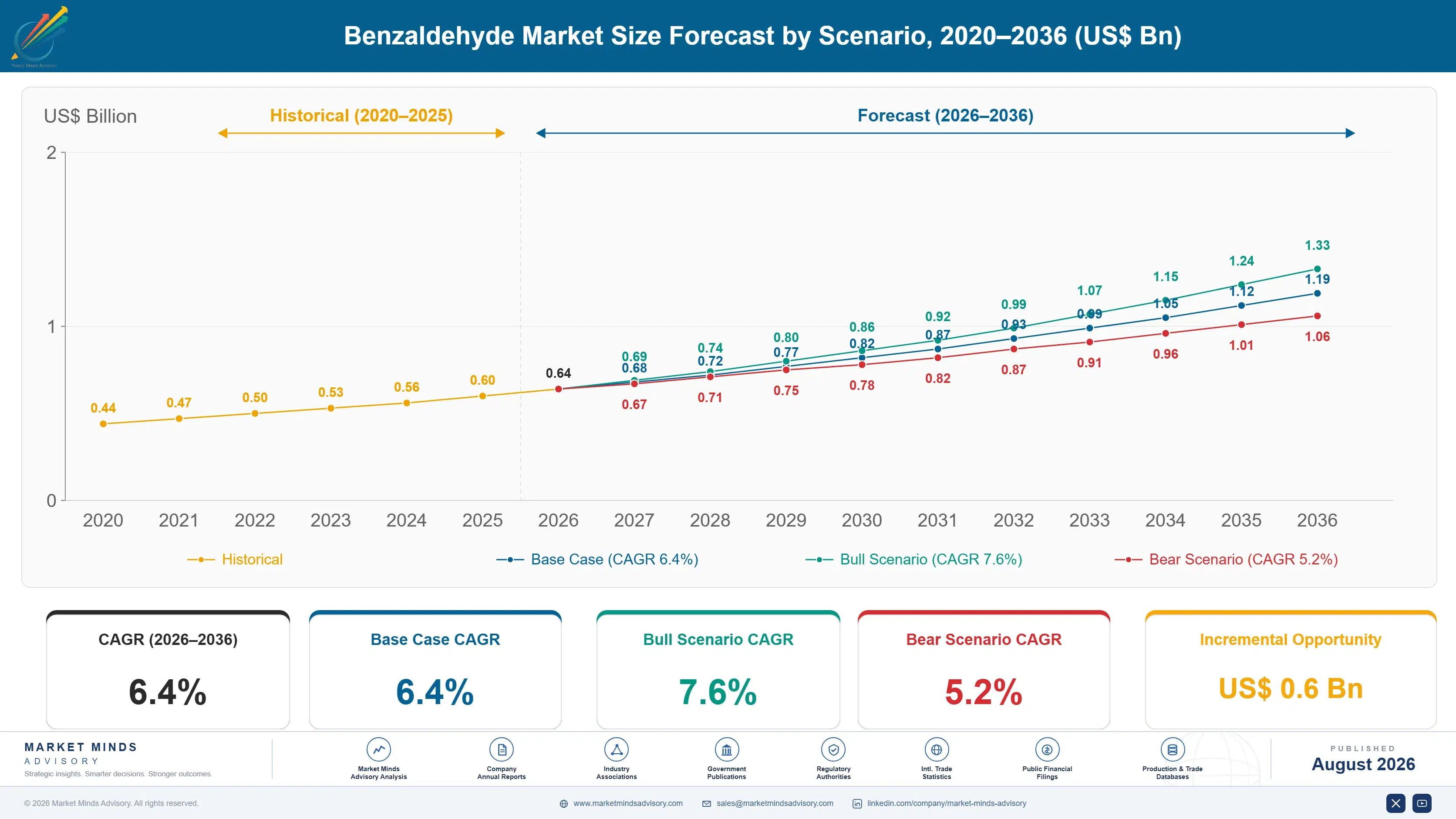
Benzaldehyde volumes recovered unevenly after 2020, as flavor and fragrance buyers rebuilt inventory faster than agrochemical intermediate demand, which stayed depressed through 2022 on weak crop input spending. Pharmaceutical intermediate offtake from Indian API makers provided the steadiest pull across the period, and the market grew at a 5.3% historical CAGR from 2020 to 2025, slower than the forecast pace as capacity lagged demand recovery.
The base case carries benzaldehyde to a 6.4% CAGR through 2036 on three mechanisms. First, Indian and Chinese pharmaceutical intermediate demand keeps scaling as API capacity expands under production-linked incentive schemes. Second, certified-natural flavor demand from cherry, almond, and marzipan applications grows faster than synthetic volume as clean-label pressure spreads through packaged food. Third, REACH-driven retrofit of older European toluene-oxidation units tightens synthetic supply just enough to support pricing without triggering demand destruction among agrochemical buyers.
The bull case, 7.6%, assumes natural benzaldehyde biotransformation costs fall enough to pull flavor volume decisively away from synthetic material while pharmaceutical intermediate demand keeps accelerating. The bear case, 5.2%, assumes agrochemical intermediate demand stays weak on soft crop input spending and Chinese capacity expansion outpaces global offtake, pressuring synthetic pricing and margin across the toluene-oxidation producer base.

Demand Bifurcation Between Synthetic and Natural Grades

Benzaldehyde's commercial story now runs on two separate tracks that rarely intersect. Synthetic material made from toluene oxidation or benzal chloride hydrolysis serves agrochemical, resin, and dye intermediate buyers who care about delivered cost per tonne and little else. Natural and pharmaceutical-grade material, produced through biotransformation or tightly controlled synthesis, serves flavor houses and API makers willing to pay several times more for certification and purity documentation.
MARKET CONCENTRATIONCR5: 42%Top five producers hold well under half of supply
AVERAGE SELLING PRICEUSD 1,850 per tonneSynthetic grade pricing off toluene feedstock costs broadly
TOP PRODUCING COUNTRYChina: 34% of global capacityIntegrated toluene oxidation capacity concentrated near coastal chemical parks
CAPACITY UTILIZATION74%Older batch units run well below nameplate rates
TRADE INTENSITY48% of output crosses a borderCross border flows link Asian output to Western buyers
FEEDSTOCK COST SHARE38% to 45% of COGSToluene price swings drive most margin volatility directly
Buyers rarely switch between the two tracks because certification, not price, gates natural-grade purchasing decisions. Flavor houses need documented non-synthetic origin to label products naturally flavored, and no synthetic producer can retrofit into that certification quickly. Pharmaceutical intermediate buyers separately require pharmacopeia-grade purity and validated impurity profiles that most commodity synthetic producers never bothered to build, leaving that segment to a narrower set of specialized suppliers.
Over the next decade, REACH-driven emissions retrofit costs will squeeze older European batch units out of synthetic supply, while Indian pharmaceutical intermediate capacity keeps expanding under domestic manufacturing incentives. Clean-label packaged food demand should keep pulling natural-grade volume higher, even as agrochemical intermediate offtake stays tied to a slower, more cyclical crop input spending cycle.
"Nobody buys benzaldehyde on price alone anymore, they buy a certification file. The producers still competing purely on delivered cost per tonne are fighting over a shrinking half of the market."
Director, Specialty and Fine Chemicals Practice · MMA Chemicals and Materials Practice · August 2026

Market Trends

India's PLI Scheme Pulls API Intermediate Demand Higher

India's Production Linked Incentive scheme for bulk drugs and key starting materials has pushed domestic API manufacturers to backward-integrate into intermediates including benzaldehyde derivatives, rather than import them from China. Companies including Aarti Industries and Divi's Laboratories have added intermediate capacity tied directly to PLI-approved API lines since 2023. That shift is redirecting benzaldehyde offtake toward India-based buyers who want documented, audited supply chains rather than the lowest landed price. The scheme runs through 2029 with disbursements tied to incremental output, keeping the incentive to backward-integrate active for several more years.
Market Impact: Pharma demand grows 9.5% annually
Clean-Label Rules Push Flavor Buyers Toward Natural Grades

Packaged food and beverage brands across North America and Western Europe have accelerated clean-label reformulation, replacing declared synthetic flavor compounds with certified natural equivalents wherever biotransformation routes exist at commercial scale. Benzaldehyde produced from natural precursors such as bitter almond oil or through microbial biotransformation of cinnamon-derived substrates now commands certification that synthetic material cannot match regardless of purity. Major flavor houses including Robertet and Advanced Biotech have expanded natural-grade capacity since 2022 specifically to meet reformulation demand, and several large branded food manufacturers have committed publicly to phasing out synthetic flavor declarations by 2027.
Market Impact: Natural volume grows near 8% yearly

Market Opportunities and Growth Drivers

Pharmaceutical Intermediate Demand Scales With API Capacity

Global small-molecule API production keeps expanding, and benzaldehyde serves as a building block in several widely manufactured drug classes, giving pharmaceutical intermediate demand a direct link to broader generic drug manufacturing growth. Indian and Chinese API makers, who together supply a majority of the world's generic small-molecule drug volume, have both announced capacity expansions through 2028 that require secured, audited benzaldehyde supply rather than open-market spot purchasing. That shift favors established synthetic and pharma-grade suppliers with validated impurity documentation over smaller unaudited producers competing purely on price, a gap that is widening as audit requirements tighten further.
Market Impact: Feedstock swings move margin 6 points

Flavor and Fragrance Reformulation Lifts Natural-Grade Volume

Consumer preference research consistently shows packaged food buyers respond to natural flavor labeling, pushing branded manufacturers to reformulate cherry, almond, and marzipan flavored products away from synthetic benzaldehyde. Natural-grade material, sourced through biotransformation of cinnamon bark extract or enzymatic conversion of amygdalin from bitter almonds, now carries certification that regulatory labeling frameworks in the United States and European Union both recognize explicitly. Flavor houses report natural-grade order books extending eighteen months or longer, a length unheard of in the synthetic segment, as capacity additions lag the reformulation wave sweeping branded food portfolios.
Market Impact: Certification adds 12% to production cost

Market Restraints and Challenges

Toluene Price Volatility Squeezes Synthetic Producer Margins

Synthetic benzaldehyde producers price almost entirely off toluene, a refinery aromatic whose cost tracks crude oil and regional refining margins rather than benzaldehyde-specific supply and demand. The root cause is straightforward: no viable alternative synthesis route exists at commodity cost, so feedstock exposure cannot be engineered away. When toluene spiked through 2022, several Chinese and European producers absorbed margin compression rather than pass the full increase to agrochemical customers already resisting price increases. Producers are responding by negotiating longer feedstock supply contracts and, in select cases, backward-integrating into toluene supply through refinery partnerships to smooth exposure.
Market Impact: Adds roughly 8,000 tonnes India demand

Natural-Grade Certification Costs Limit Smaller Producer Entry

Certifying benzaldehyde as naturally derived requires documented, audited supply chains back to source botanicals or fermentation substrates, plus regular third-party testing that smaller producers often cannot afford to maintain. The underlying cause is that flavor regulators in major markets define natural narrowly, excluding any material touched by synthetic catalysis at any production step. That keeps natural-grade supply concentrated among a handful of established flavor houses, even as demand for certified natural benzaldehyde keeps growing faster than capacity. Some mid-sized producers are pursuing shared certification consortia and co-investment in biotransformation pilot plants to spread compliance cost across several smaller players.
Market Impact: Natural grade commands 4x price premium
3 additional market trends, 3 additional growth drivers, and 3 additional restraints and challenges are covered in the full report. Contact sales@marketmindsadvisory.com to access the complete intelligence.

Segment CAGR and Growth Architecture

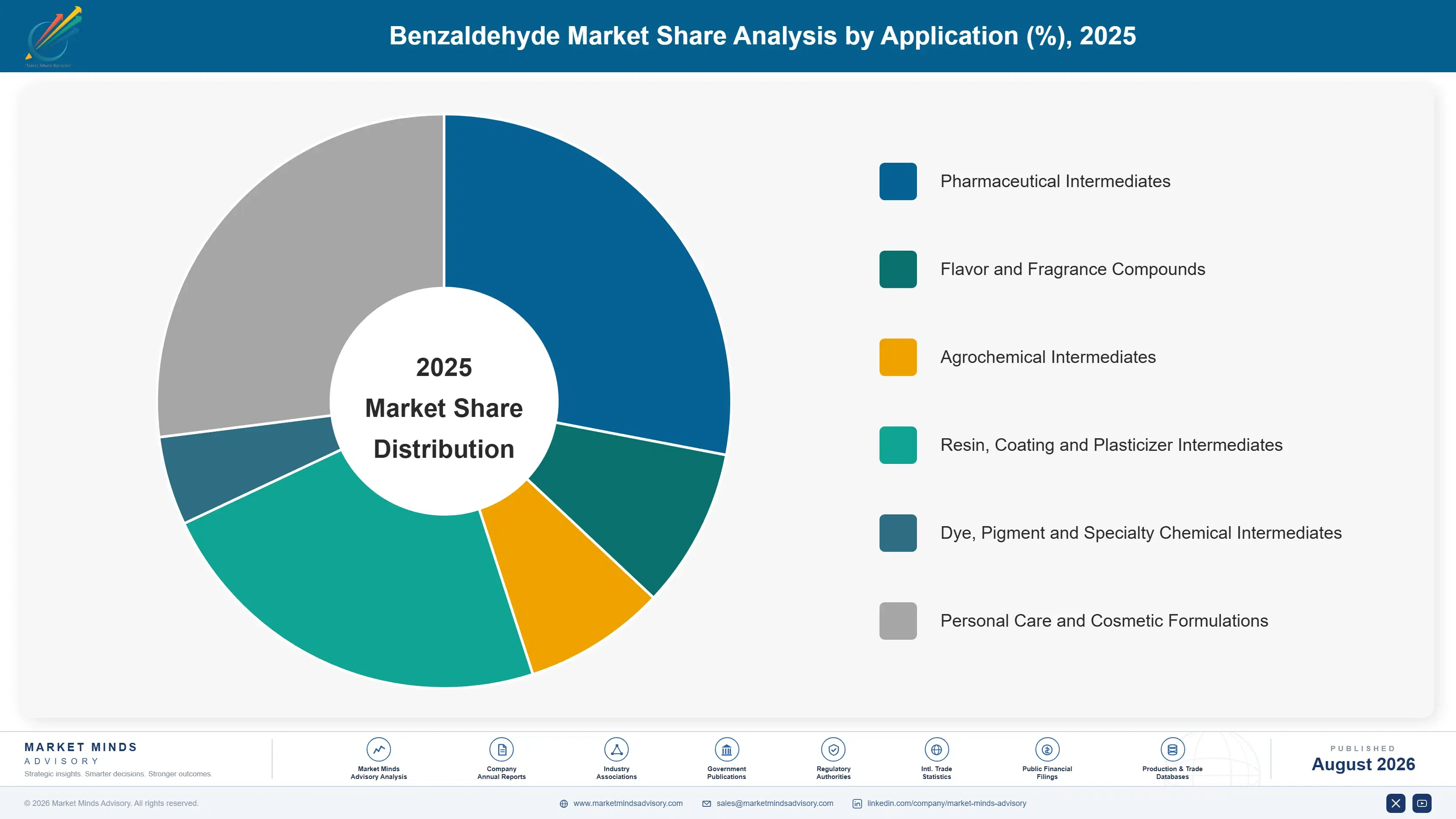
Segmentation follows end-use application, a single commercial logic tying each buyer group to distinct purity requirements, certification needs, and price sensitivity. Flavor, pharmaceutical, agrochemical, resin, dye, and personal care buyers each specify benzaldehyde differently, keeping upstream production route and downstream commercial dynamics from blurring together within one segment, since each buyer group audits suppliers against entirely different criteria.
benzaldehyde-market-trends-growth-insights-market-share-analysis-1787462957204

Pharmaceutical Intermediates

Pharmaceutical intermediate demand is growing at 9.5% annually, nearly one and a half times the wider market's 6.4% pace, as Indian and Chinese API manufacturers backward-integrate into intermediates rather than source them on the open market. Benzaldehyde serves as a building block across several widely manufactured small-molecule drug classes, giving this segment a direct tie to global generic drug production growth. Buyers require pharmacopeia-grade purity with validated impurity profiles, audited manufacturing sites, and consistent batch documentation, which narrows the supplier base considerably compared with commodity synthetic material. Producers serving this segment increasingly hold dual certification covering both flavor and pharmaceutical-grade specifications, letting them serve whichever buyer pays the better margin in a given quarter without running separate production lines.
CAGR 9.5%

Flavor and Fragrance Compounds

Flavor and fragrance demand grows at 7.8% annually, driven almost entirely by clean-label reformulation among branded packaged food manufacturers replacing declared synthetic flavor compounds with certified natural equivalents. Cherry, almond, and marzipan flavored products account for most of the volume, alongside smaller fragrance applications in soap and cosmetic scent compounds. Natural-grade material sourced through biotransformation of cinnamon bark extract or bitter almond enzymatic conversion commands premiums four to six times synthetic pricing, and order books at established flavor houses now extend eighteen months or longer. Capacity additions have lagged the reformulation wave, keeping the segment supply-constrained even as several large food manufacturers commit publicly to phasing out synthetic flavor declarations within the next few years.
CAGR 7.8%
Full segment breakdown across 6 segments available in the complete report.

Regional Architecture and Country Demand Map

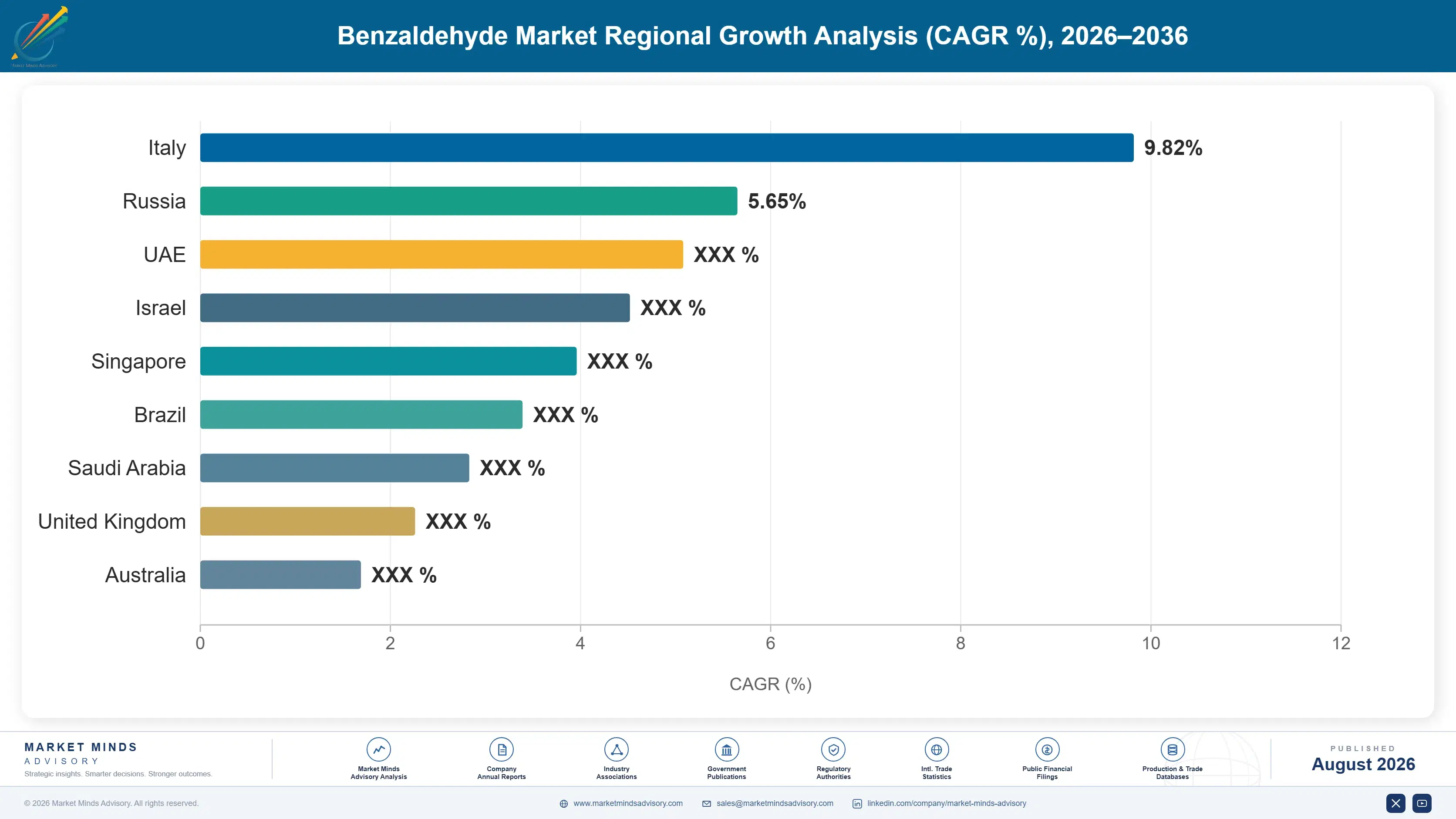
Benzaldehyde production concentrates in East Asia, anchored by integrated Chinese toluene-oxidation capacity serving both domestic and export buyers. North America and Western Europe carry pharmaceutical and flavor-grade demand disproportionate to their production share, while South Asia's API manufacturing buildout is pulling intermediate offtake higher faster than almost anywhere else.

North America

North America consumes disproportionately more benzaldehyde than it produces, importing synthetic volume from Asia while sourcing natural and pharmaceutical-grade material domestically through specialized biotransformation and fine chemical producers. United States flavor houses lead clean-label reformulation among branded packaged food manufacturers, pulling natural-grade demand higher each year as retailers push suppliers to remove synthetic flavor declarations from labels. Pharmaceutical intermediate buyers, concentrated among generic drug manufacturers and contract API producers, add a second steady demand pull tied to domestic pharmaceutical manufacturing reshoring incentives. Growth here tracks close to the global average, reflecting a mature, diversified buyer base rather than any single dominant end-use driving expansion. Contract manufacturing ties to Asian synthetic suppliers remain standard for commodity volume today.
Share: 24% | CAGR: 6.6% (2026 to 2036)

Western Europe

Western Europe's benzaldehyde demand centers on established flavor houses in France and fragrance and fine chemical producers across Germany and Switzerland, many of which pioneered natural-grade biotransformation decades before clean-label labeling became a commercial requirement elsewhere. REACH-driven emissions and process disclosure rules are pushing older toluene-oxidation units toward retrofit or closure, gradually shrinking the region's synthetic production base even as demand for pharmaceutical and natural-grade material holds steady. Agrochemical intermediate offtake has softened alongside tighter European pesticide approval rules, restraining overall regional growth below the global average even as the natural-grade flavor segment keeps expanding at a healthy pace within it. Swiss fine chemical producers add further natural-grade capacity serving global pharmaceutical customers directly.
Share: 19% | CAGR: 4.9% (2026 to 2036)
Regional intelligence for 5 additional markets available in the complete report: East Asia, South Asia and Pacific, Latin America, Middle East and Africa, Eastern Europe. Contact sales@marketmindsadvisory.com.
benzaldehyde-market-trends-growth-insights-country-cagr-analysis-1787462957715

Where Benzaldehyde Suppliers Can Defend Margin

Margin defense in benzaldehyde depends on moving away from commodity toluene-route pricing wherever certification, purity, or supply security lets a producer charge for something buyers cannot easily source elsewhere. The four moves below target the segments growing fastest and the buyers least willing to switch suppliers over small price differences, from pharmaceutical audit files to clean-label certification.

Build Pharmacopeia-Grade Certification Ahead of API Demand

Pharmaceutical intermediate buyers pay a documented premium, often 30% to 50% above commodity synthetic pricing, for benzaldehyde carrying validated impurity profiles and audited manufacturing site history that satisfies API customer quality teams before any order is placed. Producers investing in pharmacopeia-grade documentation now position ahead of India's continuing Production Linked Incentive-driven capacity buildout, rather than competing for that demand after established suppliers have already captured it. The investment requires validated analytical methods and several audit cycles, but it converts a commodity producer into a qualified supplier that pharmaceutical buyers return to repeatedly rather than re-tender every purchase.
Market Impact: Certified pharma-grade material earns 30% to 50% premium

Secure Long-Term Toluene Contracts To Smooth Margin

Synthetic benzaldehyde margin swings almost entirely with spot toluene pricing, which tracks crude oil and regional refining margins rather than anything specific to benzaldehyde demand. Producers that negotiate multi-year feedstock supply contracts, or backward-integrate into toluene supply through refinery partnerships, convert an unpredictable input cost into a planned one, protecting quoted pricing to agrochemical and resin customers who resist frequent price changes. During the 2022 toluene spike, producers without locked-in feedstock contracts saw margin compression of roughly six percentage points, while those with supply agreements held pricing largely steady, a gap that justifies the cost of negotiating longer contracts.
Market Impact: Locked feedstock contracts protect roughly 6 margin points

Expand Natural-Grade Capacity Ahead of Reformulation Demand

Certified natural benzaldehyde commands premiums running 4x to 6x synthetic pricing, and order books at established flavor houses already extend eighteen months or longer as clean-label reformulation outpaces available biotransformation capacity. Producers that commit capital to natural-grade fermentation or enzymatic conversion capacity now capture demand that otherwise goes to a small number of incumbent flavor houses holding most of the certified supply today. The capital requirement is meaningfully higher than adding synthetic capacity, and certification audits add lead time before first sale, but the pricing gap over synthetic material compensates across a normal payback period.
Market Impact: Natural grade premiums run 4x to 6x pricing

Diversify Beyond Agrochemical Buyers Facing Cyclical Demand

Agrochemical intermediate demand tracks crop input spending cycles that swing with commodity grain prices, leaving producers overexposed to a single, cyclical buyer base if agrochemical customers dominate their order book. Diversifying into resin, dye, and personal care intermediate applications, which carry steadier, less commodity-linked demand, smooths revenue across the agricultural spending cycle without requiring the certification investment that pharmaceutical and natural-grade segments demand. Several mid-sized Chinese and Indian producers have rebalanced their customer mix over the past three years specifically to reduce agrochemical concentration, citing 2022 and 2023 order volatility as the trigger for that shift in commercial strategy.
Market Impact: Diversification cuts agrochemical revenue exposure by roughly 15%

Who Controls the Margin Pool

Competitive concentration sits at a moderate CR5 of 42%, reflecting a market split between large diversified chemical producers competing on synthetic volume and smaller specialized flavor houses holding disproportionate share of certified natural-grade supply. The gap between the largest synthetic producers and mid-tier challengers is narrow, since toluene-route synthesis carries no meaningful technology barrier to entry.
Competitive activity currently runs along three lines. Synthetic producers compete almost entirely on delivered cost per tonne, since toluene-route chemistry offers little room for differentiation. Natural-grade suppliers compete on certification breadth and audit history, racing to lock in flavor house contracts before capacity constraints bind further. Pharmaceutical intermediate suppliers compete on validated documentation and manufacturing site audit status, the credential API buyers check before placing any order.

Pressure is building from two directions. Indian producers backward-integrating under Production Linked Incentive support are capturing pharmaceutical intermediate share that Chinese exporters previously held by default, accelerating with each new PLI-approved API line. Meanwhile REACH-driven retrofit costs are forcing some older European synthetic units toward closure, redistributing agrochemical and resin intermediate volume toward Asian producers with newer, compliant capacity. Rankings over the next five years will favor whoever holds certification breadth across more than one buyer segment.
benzaldehyde-market-trends-growth-insights-company-positioning-matrix-1787462958234

Competitive Moat and Risk Dimensions

KAO CORPORATION

Moat: Integrated natural-grade production chain

Kao Corporation runs backward-integrated natural fatty alcohol and biotransformation capacity that lets it produce certified natural benzaldehyde at a cost basis competitors sourcing raw botanicals externally cannot match. That integration, built over decades of oleochemical investment, gives Kao pricing flexibility in flavor and fragrance contracts that pure-play natural-grade specialists lack, particularly when raw botanical input costs spike.
KAO CORPORATION

Risk: Overexposed to consumer product cycles

Kao's benzaldehyde output feeds primarily its own consumer fragrance and personal care lines rather than open-market flavor or pharmaceutical sale, so external revenue from benzaldehyde specifically is limited and tied closely to Kao's own consumer product demand cycles, which can soften independently of underlying benzaldehyde market fundamentals and buyer sentiment.
ROBERTET SA

Moat: Deepest natural certification portfolio

Robertet holds one of the industry's broadest natural-ingredient certification portfolios, built over more than a century of natural flavor and fragrance sourcing relationships across multiple countries. That certification depth lets it win clean-label reformulation contracts from major branded food manufacturers faster than newer entrants still building out audited supply chains and documentation from scratch.
ROBERTET SA

Risk: Small scale limits capacity flexibility

Robertet's natural-grade production scale is modest relative to global synthetic capacity, and expanding biotransformation output requires multi-year capital investment and additional certification audits. That constrains how quickly the company can respond when clean-label reformulation demand accelerates faster than currently planned capacity, potentially ceding share to competitors willing to invest ahead of confirmed demand.

Players Tracked

Prominent Players

Kao Corporation
Robertet SA
Solvay SA
Lanxess AG
Emerald Performance Materials

Other Key Players

Symrise AG
International Flavors & Fragrances Inc
Advanced Biotech
Merck KGaA
Eastman Chemical Company
Zhejiang NHU Company
Jiangsu Fengyuan Pharmaceutical Co
Foodchem International Corporation
Anhui Bayi Chemical Co
Shandong Xinhua Pharmaceutical Co
Vertellus Holdings
Alfa Aesar (Thermo Fisher Scientific)
Loba Chemie Pvt Ltd
Neelikon Food Dyes and Chemicals
Hangzhou Dayangchem Co

Recent Developments

MARCH 2024

Aarti Industries commissions new intermediate capacity in Gujarat

Aarti Industries commissioned expanded benzaldehyde derivative intermediate capacity at its Gujarat manufacturing complex, aligning output with Production Linked Incentive-approved API lines. The expansion targets pharmaceutical intermediate buyers seeking audited, domestic supply rather than imported material, and represents an organic capacity expansion rather than any acquisition or joint venture.
Signal: Signals accelerating Indian backward integration into pharmaceutical intermediates, tightening synthetic export volume available to Chinese producers over time.
SEPTEMBER 2024

Robertet expands biotransformation capacity for natural benzaldehyde

Robertet added enzymatic biotransformation capacity dedicated to natural benzaldehyde production at its Grasse facility, responding to order backlogs extending eighteen months across major flavor house customers. The investment was an organic capacity expansion, not a joint venture or acquisition, funded from Robertet's existing flavor and fragrance operating cash flow.
Signal: Confirms natural-grade supply constraints run deep enough to justify direct capital investment rather than outsourced sourcing.
JANUARY 2025

Lanxess divests select fine chemical intermediate assets to focus portfolio

Lanxess divested a portfolio of fine chemical intermediate assets, including select benzaldehyde-adjacent production lines, to a private specialty chemical buyer as part of a broader portfolio focus toward higher-margin specialty segments. The transaction was an asset divestiture, not a merger or acquisition by Lanxess directly.
Signal: Signals larger diversified chemical producers deprioritizing commodity benzaldehyde-adjacent lines, opening share for focused mid-sized specialty producers.

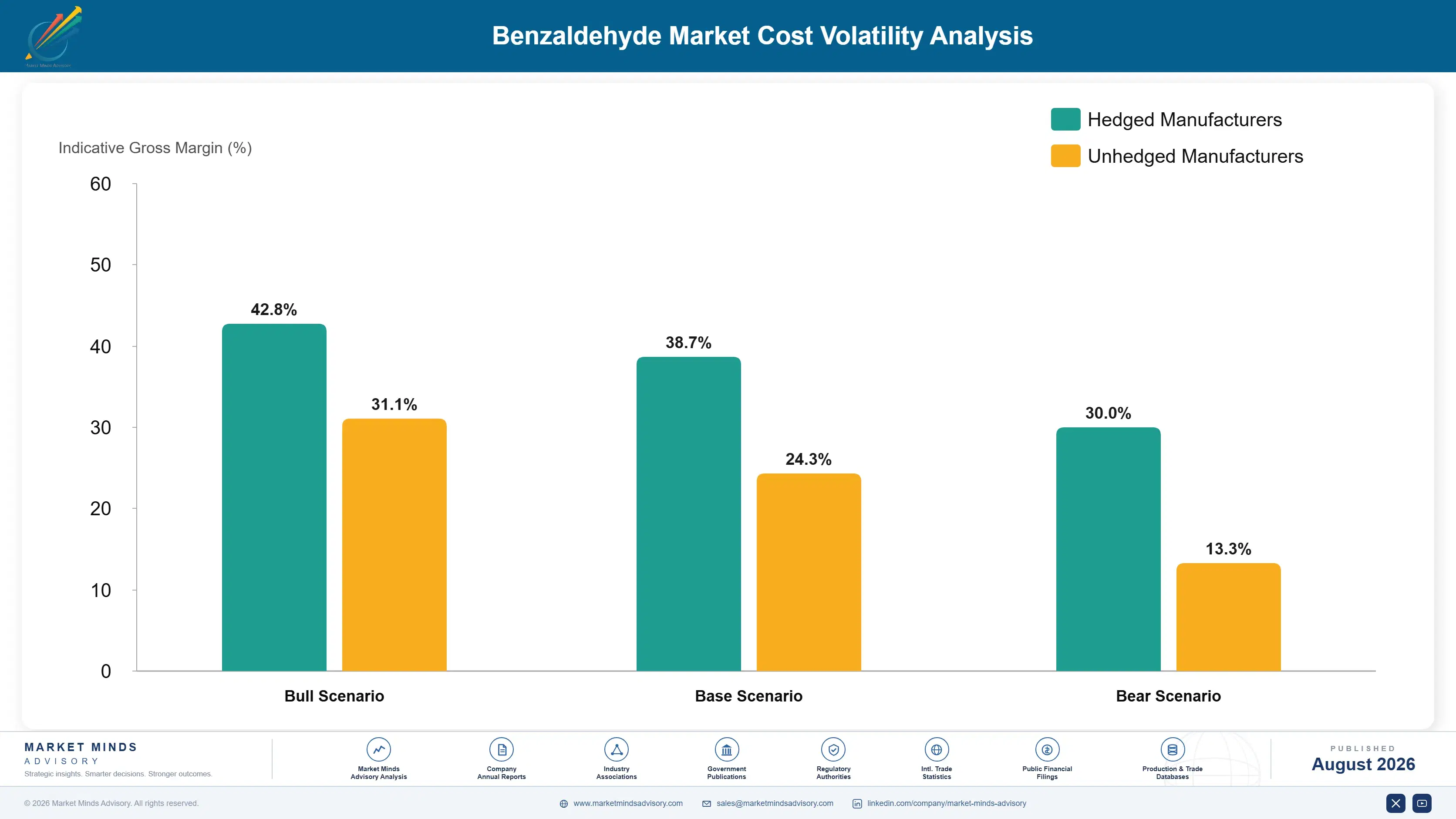
Toluene Feedstock Sets The Margin Floor

Toluene feedstock accounts for 38% to 45% of production cost for synthetic benzaldehyde, sourced almost entirely as a refinery aromatic byproduct from crude oil processing rather than any dedicated feedstock supply chain. Natural-grade production instead sources bitter almond oil, cinnamon bark extract, or fermentation substrates, which carry their own agricultural price volatility tied to weather and harvest conditions rather than crude oil markets.
The 2022 toluene price spike illustrated the exposure directly. EIA data recorded refined product and aromatic feedstock prices reaching multi-year highs through mid-2022 as global refining capacity tightened following Russian supply disruption. Several synthetic benzaldehyde producers, lacking locked-in feedstock contracts, absorbed margin compression of roughly six percentage points rather than pass the full cost increase to agrochemical customers already resisting price increases amid weak crop input spending.

Exposure falls hardest on smaller synthetic producers without long-term feedstock contracts or refinery backward integration, who must buy toluene on the spot market and absorb whatever margin compression results. Larger diversified chemical producers with refinery relationships or integrated aromatics production smooth that exposure considerably. Natural-grade producers face a comparable risk, since bitter almond and cinnamon harvest failures can spike input costs just as sharply as any refinery disruption.
benzaldehyde-market-trends-growth-insights-cost-volatility-analysis-1787462958429

Lock Multi-Year Toluene Supply Contracts With Refiners

Producers negotiating multi-year toluene offtake agreements directly with refiners convert a volatile spot cost into a planned one, protecting quoted pricing to customers who resist frequent adjustments. This requires meaningful purchase volume commitments, which favors larger producers, but mid-sized producers can pool volume through purchasing consortia to access similar contract terms without individually committing to full-scale offtake volumes.

Backward-Integrate Into Refinery-Adjacent Toluene Production

A handful of large chemical producers have backward-integrated into toluene production or secured dedicated refinery partnerships, eliminating spot market exposure for a portion of their feedstock needs. This capital-intensive path suits only the largest producers, but it delivers durable margin protection, since integrated toluene supply removes feedstock cost as a variable from that portion of production entirely.

Diversify Natural-Grade Sourcing Across Botanical Origins

Natural-grade producers reduce harvest-failure exposure by sourcing bitter almond oil, cinnamon bark extract, and fermentation substrates from multiple geographic origins rather than depending on a single growing region. That diversification smooths input availability across seasons and weather events, though it adds supply chain complexity and certification audit burden across each additional origin a producer adds to its approved supplier list.

Portfolio Architecture for Margin Defence

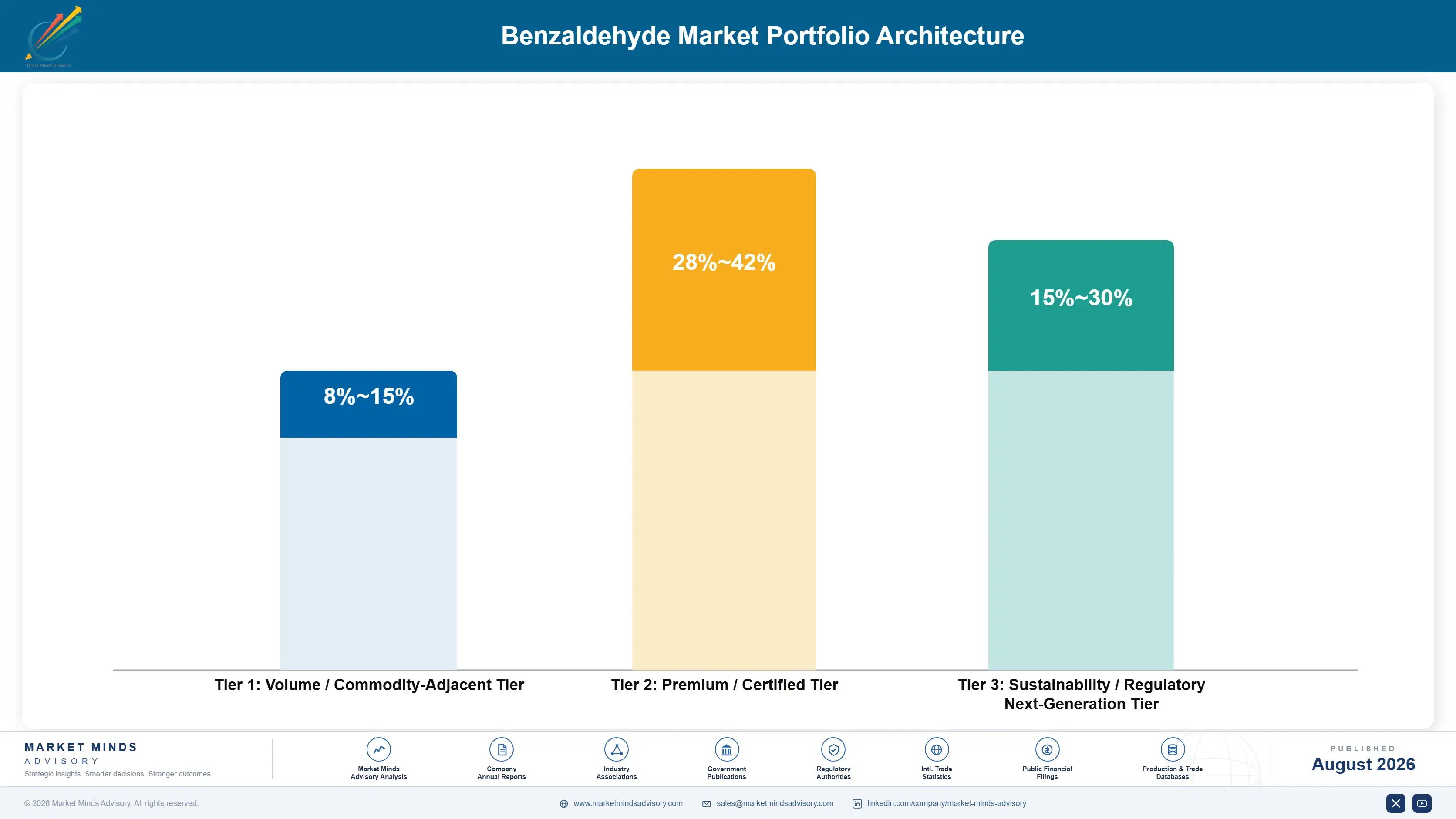
Benzaldehyde's portfolio splits into three tiers with sharply different margin economics. Volume synthetic material, sold into agrochemical, resin, and dye intermediate applications, competes almost entirely on delivered cost per tonne and earns thin, toluene-linked margins. Certified natural and pharmaceutical-grade material earns substantially more, since certification, purity, and audit documentation create switching costs that commodity synthetic producers cannot replicate quickly.
The tension for producers is capital allocation between two economics. Volume synthetic capacity generates steady, if thin, cash flow that funds operations, while natural and pharmaceutical-grade capacity requires years of certification investment before generating comparable returns at much higher margin. Producers that lean entirely volume risk being squeezed by toluene volatility and Asian capacity growth, while those that chase certification too aggressively risk underutilized premium capacity if reformulation demand grows more slowly than currently projected.

High-value margin pools concentrate in natural-grade flavor applications and pharmaceutical intermediate supply carrying validated documentation, both of which command premiums synthetic material cannot match. Frontier opportunity sits in dual-certified capacity serving both segments interchangeably, letting producers route the same underlying investment toward whichever buyer pays the stronger margin in a given period.

Volume / Commodity-Adjacent Tier

Synthetic benzaldehyde sold into agrochemical, resin, dye, and plasticizer intermediate applications, priced almost entirely off toluene feedstock cost with minimal differentiation between competing suppliers beyond delivered logistics and payment terms.
Gross Margin: 8-15%

Premium / Certified Tier

Certified natural flavor-grade and pharmacopeia-grade pharmaceutical intermediate material, carrying documented origin, validated impurity profiles, and audited manufacturing history that commands sustained premiums over commodity synthetic pricing across both buyer segments.
Gross Margin: 28-42%

Sustainability / Regulatory / Next-Generation Tier

Emerging biotransformation and fermentation-route production designed to reduce reliance on petroleum-derived toluene feedstock entirely, positioned ahead of tightening European emissions and process disclosure requirements, though scale-up economics remain largely unproven at commercial volume.
Gross Margin: 15-30%
benzaldehyde-market-trends-growth-insights-portfolio-architecture-1787462958922

High-value Sub-segments and Strategic Watch-out

Pharmaceutical Intermediates

Pharmaceutical intermediate demand grows fastest at 9.5% annually and already commands documented premiums of 30% to 50% over commodity synthetic pricing. Indian and Chinese API manufacturers backward-integrating under domestic incentive schemes continue expanding capacity, and validated impurity documentation keeps the supplier base narrow enough that margin should hold.
Gross Margin: 28-42%

Flavor and Fragrance Compounds

Natural-grade flavor demand grows at a healthy 7.8% annually and commands premiums four to six times synthetic pricing, though capacity constraints and multi-year certification timelines limit how quickly new entrants can capture that margin, keeping the segment concentrated among established flavor houses with deep audit histories.
Gross Margin: 28-42%

Agrochemical Intermediates

Agrochemical intermediate demand remains the largest single application by volume, tracking crop input spending cycles that move with commodity grain prices. Margins stay thin and cyclical, competing almost entirely on delivered cost per tonne, but the segment anchors baseline utilization for most synthetic toluene-oxidation capacity globally.
Gross Margin: 8-15%

Dye, Pigment and Specialty Intermediates

Dye and pigment intermediate demand faces gradual substitution pressure as textile and coatings manufacturers shift toward alternative colorant chemistries with lower regulatory scrutiny under evolving REACH restrictions. Producers concentrated in this segment risk volume erosion over the next decade absent diversification into steadier resin or personal care applications.
Gross Margin: 12-22%

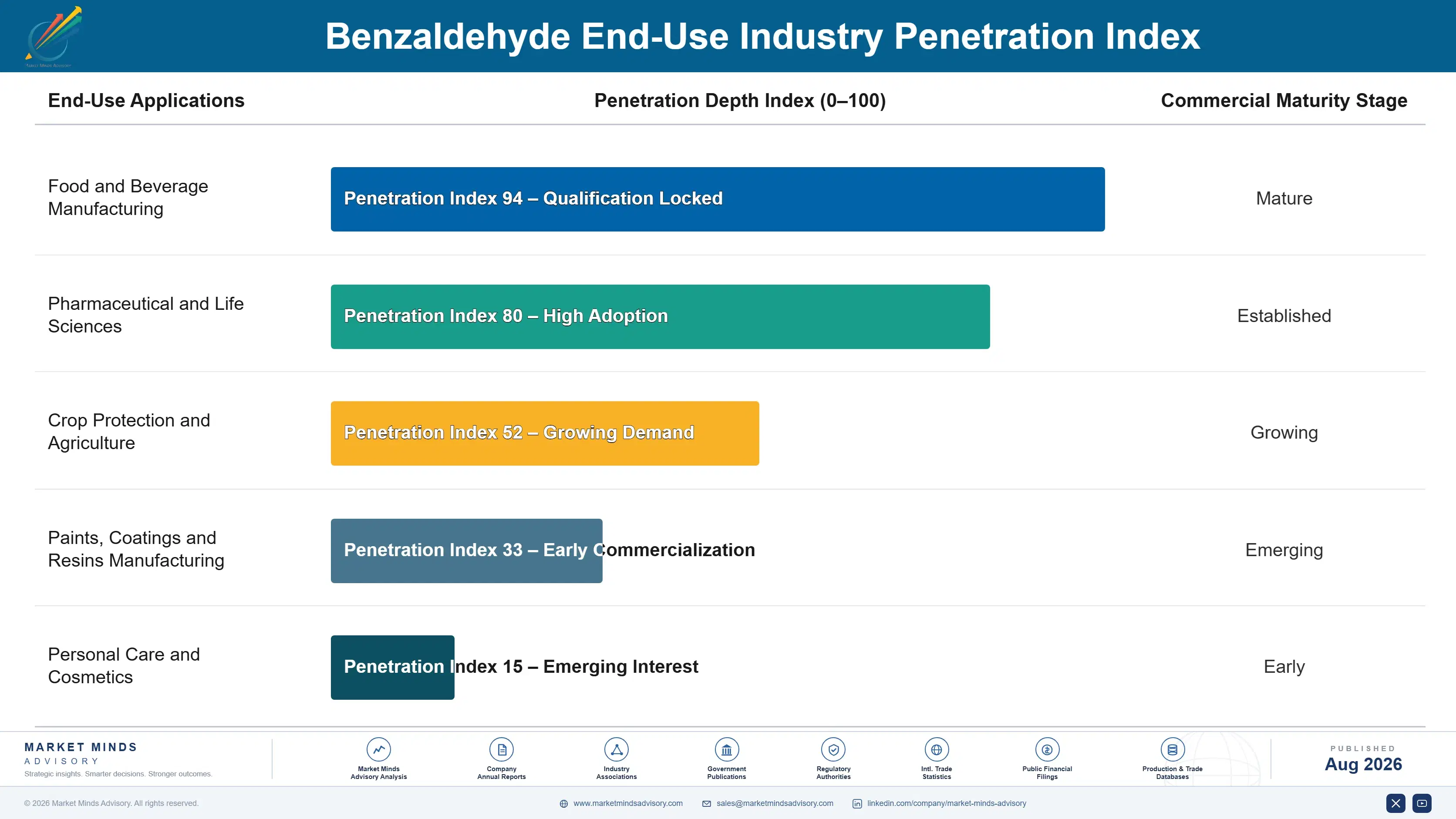
Why Benzaldehyde Demand Rarely Churns

Benzaldehyde demand behaves like an annuity wherever certification gates the purchasing decision. Pharmaceutical intermediate buyers qualify a supplier through a multi-month audit process and then reorder against that qualified source repeatedly rather than re-tender every purchase, since switching suppliers means restarting validation from scratch. Flavor houses behave similarly once a natural-grade certification file is approved for a given branded product formulation, locking in a supply relationship that can run for years.
Stickiness varies sharply by end-use vertical. Pharmaceutical and flavor buyers rarely switch suppliers once qualified, given the audit and reformulation cost involved, while agrochemical and dye intermediate buyers switch readily on price since specification requirements are looser and validation cost is minimal. Resin and plasticizer intermediate buyers sit in between, valuing consistent quality and delivery reliability without demanding the full certification rigor that pharmaceutical and flavor buyers require before any order is placed.

Buyer profiles are shifting generationally. Younger procurement teams at branded food and pharmaceutical companies increasingly treat supply chain documentation and certification as a standing requirement rather than a negotiable line item, a shift that favors producers who invested early in audit infrastructure over those still competing purely on delivered cost per tonne.
benzaldehyde-market-trends-growth-insights-end-use-penetration-index-1787462959407

Where Benzaldehyde Producers Should Bet

These are among the four positions where our research anticipates prominent divergence between winners and laggards over the coming forecast period. Each is grounded in the demand model, the regulatory perimeter, and the announced capacity pipeline.
01 / CERTIFICATION INVESTMENT PRIORITY

Build pharmaceutical and natural-grade certification before competitors close the gap

Pharmaceutical intermediate demand is growing at nearly one and a half times the wider market's pace, and natural-grade flavor material already commands premiums four to six times synthetic pricing, yet both segments remain gated by certification that most commodity producers have not built. Producers that invest now in validated documentation, audited manufacturing sites, and biotransformation capacity position ahead of India's Production Linked Incentive-driven demand and ongoing clean-label reformulation. Waiting risks ceding both segments permanently to the smaller set of suppliers currently building that capability.
02 / FEEDSTOCK RISK MANAGEMENT

Lock long-term toluene contracts before the next crude price shock

Synthetic benzaldehyde margin depends almost entirely on toluene pricing that tracks crude oil and refining margins rather than anything specific to benzaldehyde demand, and the 2022 spike proved that unhedged producers absorb meaningful margin compression when that market moves sharply. Producers with multi-year feedstock contracts or refinery partnerships held pricing steady through that period while unhedged competitors did not. Every producer without a locked-in feedstock strategy today is carrying uncompensated risk that will resurface at the next crude oil disruption.
03 / GEOGRAPHIC SUPPLY DIVERSIFICATION

Diversify beyond China as retrofit and PLI incentives redraw supply

China's dominance of synthetic capacity faces gradual pressure from India's Production Linked Incentive-driven backward integration and from REACH-driven European retrofit costs reshaping where compliant synthetic capacity actually sits today. Producers concentrated purely in Chinese export volume risk losing share as Indian buyers increasingly prefer domestic, audited supply over imported material, a preference now spreading into agrochemical procurement as well. Building presence across more than one region, even at smaller scale, reduces exposure to any single country's regulatory or incentive policy shift over the coming decade.
04 / CUSTOMER PORTFOLIO REBALANCING

Reduce agrochemical concentration before the next crop spending downturn

Agrochemical intermediate demand tracks crop input spending cycles that swing with commodity grain prices, and producers overexposed to that single buyer segment absorb the full force of every downturn in agricultural spending decisions. Diversifying into resin, dye, personal care, and certified segments smooths revenue without requiring the heaviest certification investment that pharmaceutical and natural-grade segments demand. Several mid-sized producers already rebalanced their customer mix after 2022 and 2023 order volatility, and that shift is proving durable rather than cyclical, reinforced by continued grain price swings each planting season.

Engagement Snapshot From the Field

A live engagement with an industry participant carrying material or product regulatory and market exposure ahead of a defining policy shift, showing how our research translates into a defensible multi-year portfolio strategy.
MARKET MINDS ADVISORY · CLIENT ENGAGEMENT SUMMARY
Benzaldehyde Producer Strategic Portfolio Review and Transition Roadmap 2026·Investment Scenario on Benzaldehyde Exposure Evaluation 2025-26
CLIENT PROFILE
A mid-sized flavor and fragrance manufacturer supplying branded packaged food customers across North America and Western Europe approached MMA while evaluating whether to invest in dedicated natural-grade benzaldehyde biotransformation capacity. The client reported annual flavor compound revenue near USD 340 million, with benzaldehyde-adjacent natural ingredients accounting for roughly 9% of total input volume and several major customers actively requesting certified natural reformulation commitments (client-reported, unverified by MMA).
STRATEGIC CHALLENGE
Management faced a capital allocation decision between continuing to purchase certified natural benzaldehyde from established flavor house suppliers at rising premiums, or investing directly in biotransformation capacity to secure supply and capture margin. The commercial team worried that customer reformulation commitments would outpace available third-party natural-grade supply within eighteen to twenty-four months, while the finance team questioned whether in-house production could ever reach competitive scale.
MMA APPROACH
MMA modeled natural-grade supply availability against the client's reformulation commitment timeline, benchmarked in-house biotransformation capital and operating cost against current third-party purchase pricing, and assessed certification audit requirements the client would need to satisfy independently rather than relying on a supplier's existing certification file. We also evaluated a hybrid option combining a minority equity stake in an existing natural-grade producer against an in-house capacity build.
KEY FINDINGS
  1. Third-party natural-grade supply was projected to fall meaningfully short of the client's own reformulation commitments within eighteen months, confirming the supply risk the commercial team had flagged (client-reported, unverified by MMA).
  2. In-house biotransformation capacity reached competitive unit cost only above a minimum production volume the client's current order book alone could not support without additional third-party contract manufacturing.
  3. A minority equity stake in an existing certified natural-grade producer secured priority allocation at a fraction of the capital required for full in-house capacity construction.
  4. Customers requesting reformulation commitments showed limited price sensitivity to natural-grade premiums, suggesting the client could pass through most incremental sourcing cost (client-reported, unverified by MMA).
CLIENT PROFILE
A mid-sized flavor and fragrance manufacturer supplying branded packaged food customers across North America and Western Europe approached MMA while evaluating whether to invest in dedicated natural-grade benzaldehyde biotransformation capacity. The client reported annual flavor compound revenue near USD 340 million, with benzaldehyde-adjacent natural ingredients accounting for roughly 9% of total input volume and several major customers actively requesting certified natural reformulation commitments (client-reported, unverified by MMA).
STRATEGIC CHALLENGE
Management faced a capital allocation decision between continuing to purchase certified natural benzaldehyde from established flavor house suppliers at rising premiums, or investing directly in biotransformation capacity to secure supply and capture margin. The commercial team worried that customer reformulation commitments would outpace available third-party natural-grade supply within eighteen to twenty-four months, while the finance team questioned whether in-house production could ever reach competitive scale.
MMA APPROACH
MMA modeled natural-grade supply availability against the client's reformulation commitment timeline, benchmarked in-house biotransformation capital and operating cost against current third-party purchase pricing, and assessed certification audit requirements the client would need to satisfy independently rather than relying on a supplier's existing certification file. We also evaluated a hybrid option combining a minority equity stake in an existing natural-grade producer against an in-house capacity build.
KEY FINDINGS
  1. Third-party natural-grade supply was projected to fall meaningfully short of the client's own reformulation commitments within eighteen months, confirming the supply risk the commercial team had flagged (client-reported, unverified by MMA).
  2. In-house biotransformation capacity reached competitive unit cost only above a minimum production volume the client's current order book alone could not support without additional third-party contract manufacturing.
  3. A minority equity stake in an existing certified natural-grade producer secured priority allocation at a fraction of the capital required for full in-house capacity construction.
  4. Customers requesting reformulation commitments showed limited price sensitivity to natural-grade premiums, suggesting the client could pass through most incremental sourcing cost (client-reported, unverified by MMA).
RECOMMENDED STRATEGY
Phase 1: Phase 1 (0 to 6 months): Secure a minority equity stake in an established natural-grade producer to guarantee near-term allocation ahead of reformulation deadlines. Phase 2: Phase 2 (6 to 18 months): Pass through incremental natural-grade sourcing cost into customer pricing while monitoring order book growth against a defined in-house threshold. Phase 3: Phase 3 (18 to 36 months): Reassess in-house biotransformation investment once order volume approaches competitive minimum scale, keeping the equity stake as a permanent supply hedge.
OUTCOME
The client took the minority equity stake rather than committing to full in-house capacity, securing priority natural-grade allocation within four months. Reformulation commitments were met on schedule across major customer accounts, and the client passed through most of the incremental sourcing premium, preserving overall margin (client-reported, unverified by MMA).

Frequently Asked Questions

Foundational context covering the market sizes, CAGR, scope, country, region and competition that inform every finding below. This section is provided to cover basics and most often pre-purchase conversations, answered from the MMA Primary Research Dataset.

What is the current size of the Benzaldehyde Market?

The global benzaldehyde market reached USD 0.64 billion in 2025, based on MMA Primary Research Dataset findings. Growth is split between commodity synthetic volume and faster-growing natural and pharmaceutical-grade material.

How large will the Benzaldehyde Market be by 2036?

MMA's base case projects the market reaching USD 1.19 billion by 2036, an incremental opportunity of roughly USD 0.55 billion over the 2026 to 2036 forecast period.

What is the CAGR for the Benzaldehyde Market 2026 to 2036?

The base case CAGR is 6.4%, with a bull case of 7.6% and a bear case of 5.2% depending on reformulation and pharmaceutical demand pace.

Which segment is growing fastest?

Pharmaceutical intermediates lead at a 9.5% CAGR, nearly one and a half times the overall market rate, as Indian and Chinese API manufacturers backward-integrate into intermediate supply.

Who are the major companies in the Benzaldehyde Market?

Leading participants include Kao Corporation, Robertet SA, Solvay SA, Lanxess AG, and Emerald Performance Materials, assessed on production capacity and certification breadth across synthetic and natural grades.

Which country is growing fastest?

India leads country-level growth, driven by Production Linked Incentive-backed pharmaceutical intermediate demand that is pulling backward integration away from imported Chinese material at an accelerating pace.

Report Segmentation Architecture

The full report scope spans multiple orthogonal segmentation dimensions, with cross-tabulated demand data provided for each dimension pair. Coverage extends further to regional breakdowns, trend trajectories, and the competitive detail needed to support segment-level decision-making.

By Application

  • Pharmaceutical Intermediates
  • Flavor and Fragrance Compounds
  • Agrochemical Intermediates
  • Resin, Coating and Plasticizer Intermediates
  • Dye, Pigment and Specialty Chemical Intermediates
  • Personal Care and Cosmetic Formulations

By End-Use Industry

  • Food and Beverage Manufacturing
  • Pharmaceutical and Life Sciences
  • Crop Protection and Agriculture
  • Paints, Coatings and Resins Manufacturing
  • Personal Care and Cosmetics

By Commercial Dimension

  • Direct Contract Supply
  • Distributor and Trader Channels
  • Spot Market Purchasing
  • Certified Natural-Grade Supply Agreements

By Region

  • North America
  • Western Europe
  • East Asia
  • South Asia and Pacific
  • Latin America
  • Middle East and Africa
  • Eastern Europe

Scope, Methodology, and Coverage

Every figure in this report is reproducible from documented input assumptions. The scope below maps the historical period, the forecast horizon, the segmentation dimensions, and the countries covered, alongside the underlying primary and qualitative methodology.
Historical Period
2020 to 2025
Forecast Period
2026 to 2036
Base Year
2025 (USD billions; MMA Primary Research Dataset, August 2026)
Market Definition
The benzaldehyde market covers commercial production and first sale of synthetic and natural benzaldehyde across flavor, fragrance, pharmaceutical, agrochemical, resin, dye, and personal care intermediate applications. It includes both toluene-route synthetic material and biotransformation-derived natural-grade material sold as a finished intermediate. Downstream formulated products, such as finished flavor compounds or formulated pharmaceuticals, are excluded from the defined scope.
Quantitative Units
USD billions (current prices); metric tonnes of benzaldehyde production and trade volume where applicable
Segmentation Dimensions
By Application; By End-Use Industry; By Commercial Dimension; By Region
Regions Covered
North America, Western Europe, East Asia, South Asia and Pacific, Latin America, Middle East and Africa, Eastern Europe
Countries Covered
USA, China, Germany, France, UK, Japan, South Korea, India, Australia, Canada, Brazil, Mexico, Indonesia, Vietnam, Thailand, Malaysia, UAE, Saudi Arabia, South Africa, Nigeria, Turkey, Poland, Netherlands, Italy, Spain, Sweden, Switzerland, Argentina, Colombia, Singapore, and additional markets relevant to this sector
Key Companies Profiled
Kao Corporation, Robertet SA, Solvay SA, Lanxess AG, Emerald Performance Materials, Symrise AG, International Flavors & Fragrances Inc, Advanced Biotech, Merck KGaA, Eastman Chemical Company, Zhejiang NHU Company, Jiangsu Fengyuan Pharmaceutical Co, Foodchem International Corporation, Anhui Bayi Chemical Co, Shandong Xinhua Pharmaceutical Co, Vertellus Holdings, Alfa Aesar (Thermo Fisher Scientific), Loba Chemie Pvt Ltd, Neelikon Food Dyes and Chemicals, Hangzhou Dayangchem Co
Quantitative Methodology
Primary survey, n=3,800 respondents, Q4 2025, six countries; demand-side model with trade association cross-validation
Qualitative Methodology
47 expert interviews, Q4 2025; applied to validate demand model assumptions, identify emerging dynamics, and assess competitive positioning
Report Format
PDF and XLSX data workbook (Word format preview document)
Publisher
Market Minds Advisory
Report Code
MMA-2026-CHM-101
Published
August 2026
Contact
sales@marketmindsadvisory.com | www.marketmindsadvisory.com

Purchase the full Benzaldehyde Market Report (2026 to 2036).

The full MMA Benzaldehyde report sizes the market across six application segments, five end-use industries, four commercial supply channels, and seven regions through 2036. It profiles twenty participants on a consistent basis of production capacity and certification breadth across synthetic and natural-grade output, scoring each on feedstock security, certification depth, and pharmaceutical audit readiness. Scenario models quantify how India's Production Linked Incentive scheme, REACH-driven European retrofit costs, and clean-label reformulation commitments move both demand and realizable pricing across segments. The report also includes toluene feedstock cost modeling, a natural-grade certification pathway assessment, and pharmaceutical intermediate qualification timelines built for procurement, strategy, and investment teams.
Six-segment demand model with certification-adjusted pricing
Toluene feedstock cost and volatility scenario modeling
Natural-grade certification pathway and audit benchmarking
Twenty-company competitive profiling on consistent capacity basis
Seven-region demand map with country-level growth detail
Pharmaceutical intermediate qualification timeline and readiness assessment

Built For The People Who Decide

From boardroom strategy to bench-side execution, this report is read cover-to-cover by leaders shaping the next decade of their industry, turning demand scenarios, market dynamics and valuation benchmarks into decisions.
CXOs/ Presidents/ VPs/ Managers
M&A and Corporate Development
Strategy Teams and R&D Heads
Procurement and Product Directors
Regulatory and Compliance Leaders
Investor Relations and Equity Analysts