
Market Minds Advisory
Benelux Power Tools Market

Benelux Power Tools Market: When Battery Platform Loyalty Replaced Brand Loyalty

A commercial reading of the Benelux power tools market, where cordless battery systems and EU emissions rules on gas-powered outdoor equipment are reshaping a category professional contractors once bought purely on brand habit.

Lead Analyst

David Horsley

Published

September 2026

Make Smarter Decisions with Customized Research Insights

Request a free sample report and evaluate market opportunities, growth trends, and competitive dynamics relevant to your business needs.

2025 MARKET VALUE$1.8BMarket Size 2025
2036 FORECAST VALUE$3.7BBase Case , 2026 to 2036
CAGR 2026 TO 20366.8 %Bull 8.0% / Bear 5.5%
INCREMENTAL OPPORTUNITY$1.8BNet 10- year value creation
EXPANSION MULTIPLE1.93x2036 value over 2026 base
Strategic Levers
M&A Pipeline
Regional Outlook
Country Rankings
Competitive Intelligence
Segmental Deep-dive
Call-Us : 91 93563 13602

Executive Snapshot and Market Trajectory

Benelux power tool purchasing decisions increasingly turn on which cordless battery platform a contractor already owns, not which brand name sits on the tool itself, a shift that is quietly rewriting decades of dealer loyalty and brand allegiance across the entire regional trade.
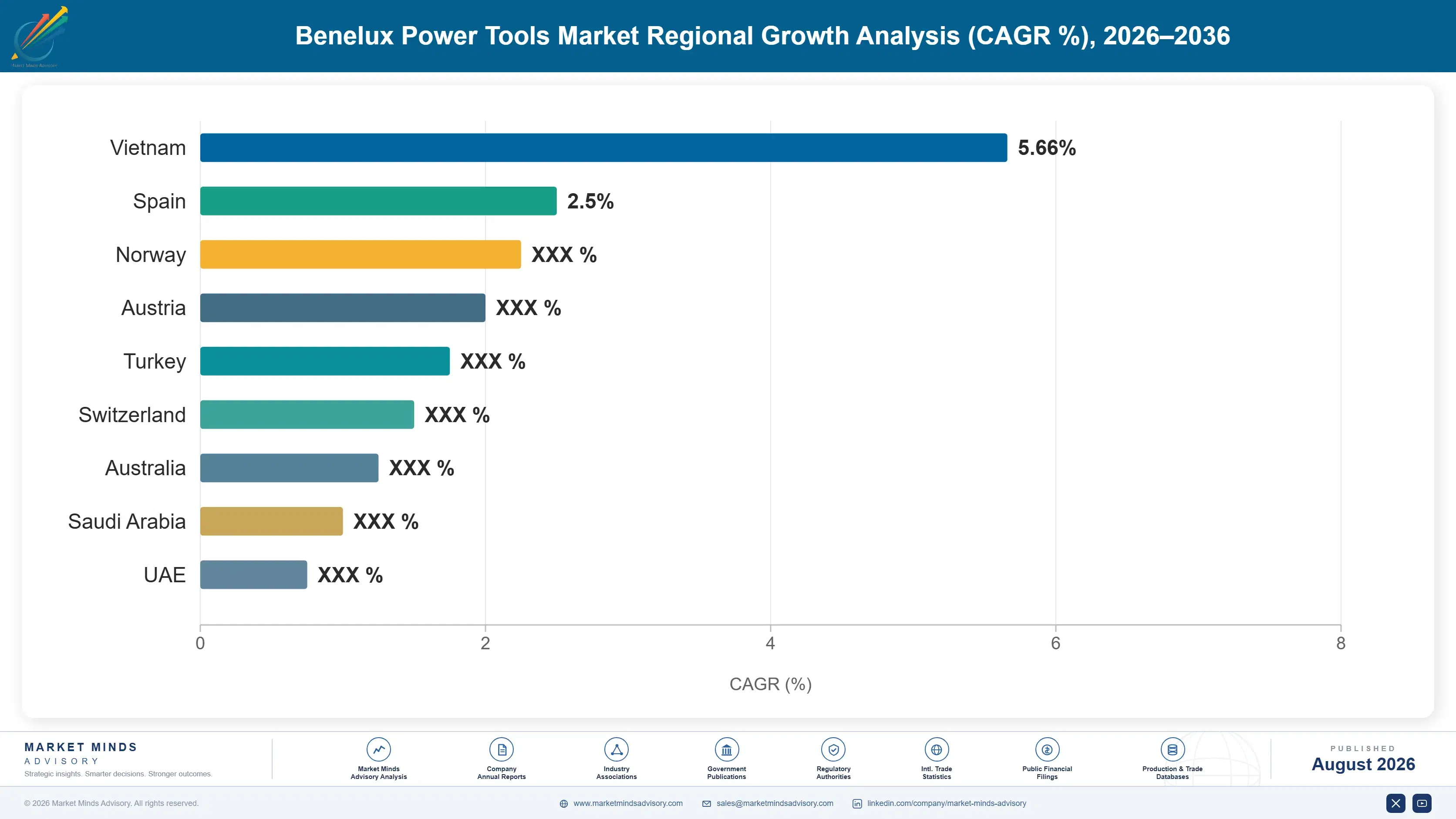
The market stands at USD 1.92 billion in 2025 and reaches USD 3.71 billion by 2036 at a 6.8% CAGR. Cordless power tools grow fastest at 9.8%, roughly 1.44 times the overall rate, as professional contractors consolidate purchasing around a single battery platform rather than mixing corded and cordless equipment across busy job sites. Western Europe holds 78% of value given this report's Benelux scope, while the Netherlands posts the quickest growth at 7.6%.
Concentration sits near 58%, dominated by global power tool brands holding deep contractor and dealer relationships across the region simultaneously and consistently across most trade categories and job types. Two forces dominate ahead. EU emissions regulations are pushing gas-powered outdoor equipment toward electric alternatives faster than any prior replacement cycle, and battery platform lock-in is turning tool purchasing into a multi-year system commitment rather than a single transaction.
Market Definition
This report covers the power tools market scoped specifically to Belgium, the Netherlands, and Luxembourg, spanning cordless, corded, and pneumatic professional and consumer power tools plus outdoor power equipment. Hand tools without motorized power are excluded.
Base Year Value
$1.8B in 2025 (MMA Primary Research Dataset, August 2026)
Forecast Period
2026 to 2036, eleven discrete annual values
CAGR
6.8% base case. Bull 8.0%. Bear 5.5%.
Fastest Growth Segment
Cordless Power Tools: 9.8% CAGR
Fastest Growth Country
Netherlands: 7.6% CAGR
Fastest Growth Region
South Asia and Pacific: 8.8% CAGR
Largest Region
Western Europe: 78% of 2025 global value
Market Leaders
Stanley Black & Decker, TTI (Techtronic Industries), Bosch, Makita, Hilti. Source: MMA Analysis based on company annual reports.
Primary Survey
n=3,800 procurement and R&D decision-makers, Q4 2025, six countries
Methodology
Demand-side build-up, cross-validated against public data, 47 expert interviews

Benelux Power Tools Market Forecast Scenarios

benelux-power-tools-market-size-forecast-scenario-1787334522418
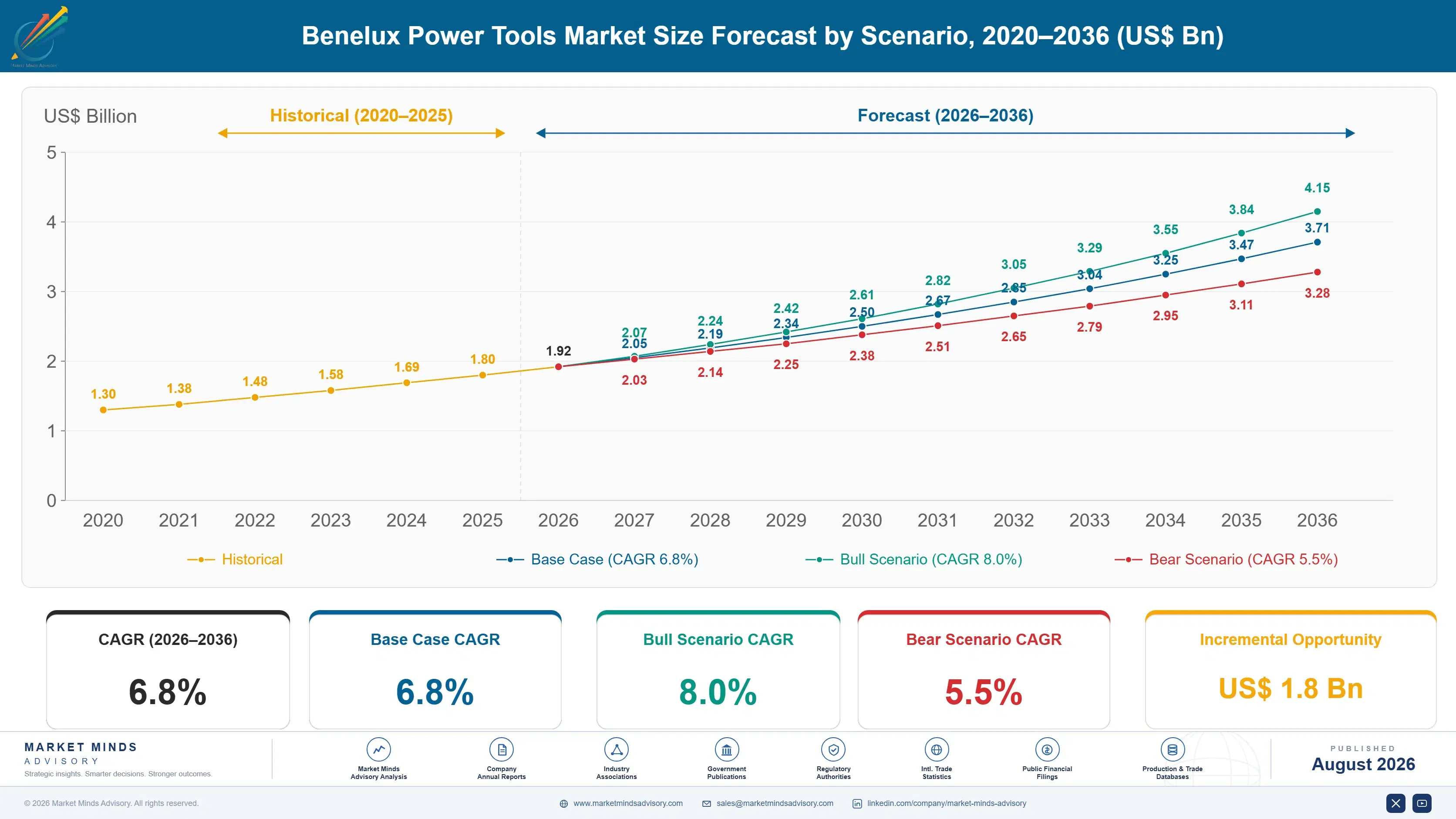
Growth from 2020 to 2025 compounded near 5.4%, tracking construction activity and professional contractor investment closely across the Benelux region, with cordless tool adoption accelerating steadily as battery technology improved and prices fell considerably throughout the period. Outdoor power equipment electrification began accelerating toward the end of the period as several municipalities restricted gas-powered equipment use entirely.
Three mechanisms carry the base case to 6.8%. First, professional contractors consolidating purchasing around a single cordless battery platform rather than mixing tool brands and power sources across job sites and crews. Second, EU emissions regulations pushing gas-powered outdoor equipment toward electric alternatives faster than typical equipment replacement cycles would otherwise justify on economics alone. Third, construction activity across the Benelux region continuing at a steady pace supporting professional tool replacement demand nationally.
The bull case at 8.0% assumes EU emissions enforcement accelerates outdoor equipment electrification faster than currently planned across Benelux municipalities and regions. The bear case at 5.5% assumes construction activity slows considerably amid broader economic pressure, cordless battery price premiums persist longer than expected, and contractors delay platform consolidation decisions given near-term budget constraints and priorities.

Why Battery Platform Lock-In, Not Brand Name, Now Wins Trade Accounts

Three forces set demand here. Battery platform lock-in drives the largest recurring volume, as contractors already invested in one brand's battery system rebuy within that system rather than switching brands. EU emissions regulation drives a second stream, since gas-powered outdoor equipment faces accelerating replacement mandates. Construction activity drives a third stream, concentrated across the region's professional trade contractor base.
MARKET CONCENTRATIONCR5: 58%Dominated by global power tool brands with deep contractor relationships
CORDLESS ADOPTION SHAREAbout 62% of new salesShare of new professional tool sales specifying cordless over corded
AVERAGE BATTERY PLATFORM TOOLS6 to 12 toolsTypical number of tools owned on one battery platform
OUTDOOR EQUIPMENT ELECTRIFICATIONRoughly 45% of new ordersShare of new outdoor power equipment orders specifying electric technology
PROFESSIONAL TRADE CHANNEL SHAREAbout 68% of revenueShare of market revenue flowing through professional trade distribution channels
BATTERY COST SHAREAbout 35% of unit costShare of cordless tool unit cost attributable to battery components
The commercial character is defined by a widening split between platform-locked professional buyers and price-sensitive consumer purchasing. A contractor who owns six drills, three saws, and a grinder on one battery platform will not switch brands for a single tool purchase, regardless of a competitor's price advantage on that item. A power tool maker without an established battery system increasingly loses professional trade accounts to whichever brand the contractor already committed to years earlier.
The decade turns on whether outdoor equipment electrification keeps accelerating fast enough to convert the remaining gas-powered installed base before EU enforcement timelines force the issue anyway. Battery platform depth and electrification credibility remain the primary forces separating power tool makers building durable trade account relationships from those still selling into a shrinking corded and gas-powered replacement cycle. That shift determines which brands lead the next decade.
"A contractor doesn't buy a drill. They buy admission into a battery system they'll be locked into for the next decade, and that's the real sale."
Director, Power Tools and Professional Trade Equipment Practice · MMA Constructi

Market Trends

Battery Platform Consolidation Is Locking In Trade Accounts

Professional contractors across the Benelux region are increasingly consolidating tool purchasing around a single cordless battery platform, buying every new tool within that system rather than mixing brands and power sources across job sites as they once routinely did just years ago. That consolidation is converting power tool purchasing from a per-tool price comparison into a multi-year system commitment contractors rarely reverse once several tools and batteries are already invested in one brand's platform. Tool makers with established battery systems are capturing trade account loyalty that competitors entering later increasingly cannot displace.
Market Impact: Locks in accounts for 5 years
EU Emissions Rules Are Accelerating Outdoor Equipment Electrification

EU emissions regulations restricting gas-powered outdoor equipment are accelerating electric alternative adoption across Benelux municipalities faster than typical equipment replacement cycles would otherwise justify, as landscaping contractors and municipal grounds crews face mounting pressure to retire two-stroke engine equipment ahead of scheduled replacement across most urban and suburban service areas. That regulatory pressure is converting outdoor power equipment from a gradual technology transition into an accelerated compliance-driven replacement cycle municipalities and contractors now budget for directly. Equipment makers with credible electric outdoor platforms are capturing replacement contracts that gas-powered specialists increasingly cannot retain.
Market Impact: Cuts emissions by 90% per unit

Market Opportunities and Growth Drivers

Battery Platform Lock-In Is Driving Recurring Purchases

Contractors consolidating purchasing around a single cordless battery platform are creating recurring demand independent of new construction activity alone, since a contractor already invested in multiple tools and batteries on one platform reorders within that system regardless of broader construction cycle timing or economic conditions affecting other purchasing categories. That platform-driven demand creates a durable order pipeline for tool makers with established battery systems, regardless of general construction sector conditions, since contractors rarely switch platforms once several tools are already invested in one brand. Each new tool purchase within an established platform strengthens this lock-in pipeline considerably.
Market Impact: Switching costs exceed 2,000 euros

EU Emissions Rules Are Expanding Electric Equipment Demand

Municipalities and landscaping contractors specifying electric outdoor equipment to meet EU emissions restrictions are creating demand independent of typical equipment replacement cycles alone, since compliance timelines increasingly override normal maintenance-driven replacement schedules across most Benelux municipalities and service categories currently expanding their electrification programmes considerably each passing year. That regulation-driven demand creates orders tied to compliance deadlines rather than construction activity alone, since municipalities retire gas-powered equipment on regulatory schedules independent of broader budget cycles or seasonal demand patterns. Each new emissions restriction strengthens this electrification demand pipeline industry-wide considerably.
Market Impact: Electric runtime trails gas by 40%

Market Restraints and Challenges

Battery Platform Switching Costs Deter Brand Migration

Contractors already invested in multiple tools and batteries on one cordless platform face substantial switching costs when considering a competitor's platform, since abandoning an established system means replacing tools that still function well purely to gain access to a different brand's newer technology. The root cause is that battery platforms are deliberately proprietary, with manufacturers designing incompatibility to protect their installed base from cross-brand competition on individual tool purchases. The commercial impact is that new entrants struggle to win contractors already committed to a competing platform. Mitigation runs through trade-in programmes and platform migration incentives several challenger brands now offer.
Market Impact: Locks in accounts for 5 years

Gas-Powered Equipment Owners Resist Premature Replacement

Landscaping contractors and municipal grounds crews who own functioning gas-powered outdoor equipment resist replacing it ahead of typical end-of-life schedules, since electric alternatives still carry higher upfront cost and shorter runtime per charge for the most demanding commercial-duty applications. The root cause is that electric outdoor equipment battery technology, while improving steadily, still trails gas-powered runtime and power density for the heaviest commercial-duty landscaping tasks performed daily. The commercial impact is that full electrification proceeds unevenly, concentrated where regulation forces the transition. Mitigation runs through improved battery runtime and municipal equipment financing programmes several suppliers are now offering.
Market Impact: Cuts emissions by 90% per unit
3 additional market trends, 4 additional growth drivers, and 2 additional restraints and challenges are covered in the full report. Contact sales@marketmindsadvisory.com to access the complete intelligence.

Segment CAGR and Growth Architecture

Segmentation follows power source, a single functional logic describing how the tool itself actually receives and delivers power, rather than which trade or industry ultimately purchases and operates it or where the job site physically sits. Each power source carries its own cost structure, system lock-in dynamic, and application fit distinctly across the entire market.
benelux-power-tools-market-market-share-analysis-1787334523001

Cordless Power Tools

Cordless power tools grow fastest at 9.8%, about 1.44 times the overall 6.8% rate, as professional contractors increasingly consolidate purchasing around a single battery platform rather than mixing corded and cordless equipment across job sites and crews throughout the region and well beyond it. Growth concentrates where tool makers offer the broadest battery-compatible tool range, since contractors value platform breadth over any single tool's individual performance advantage. Stanley Black & Decker and TTI both hold established positions in this segment through years of battery system development and dealer network investment. Platform breadth, not individual tool price, remains the primary constraint on how fast this segment keeps expanding across the region.
CAGR 9.8%

Outdoor Power Equipment

Outdoor power equipment grows at 8.6%, serving landscaping contractors and municipal grounds crews replacing gas-powered mowers, trimmers, and blowers under mounting EU emissions restrictions across most Benelux municipalities and service territories currently expanding electrification programmes considerably each passing calendar year quite steadily. Adoption concentrates among operators facing direct regulatory deadlines or municipal contract requirements that make electrification a compliance necessity rather than a purely economic decision weighed against gas-powered alternatives. Bosch and Makita both hold strong positions built on established outdoor equipment distribution relationships spanning years of electrification engineering investment. Battery runtime for heavy-duty applications, not equipment cost alone, remains the primary constraint shaping how quickly operators complete full electrification.
CAGR 8.6%
Full segment breakdown across 5 segments available in the complete report.

Regional Architecture and Country Demand Map

This report is scoped specifically to the Benelux power tools market, so value concentrates overwhelmingly in Western Europe rather than following the global distribution patterns typical of a genuinely worldwide power tools report entirely. All seven regions still appear below for pipeline consistency and completeness.

North America

North America holds 5% of value at 7.2% growth, below the 22 to 32% band, because this report is scoped specifically to the Benelux market, and North American revenue here reflects only cross-border trade and export relationships rather than any genuine domestic demand within the defined scope. Stanley Black & Decker and TTI both maintain limited direct presence, since their North American operations serve separate domestic markets entirely outside this report's scope and coverage entirely. What little North American connection exists runs through corporate parent relationships with Benelux-based distribution subsidiaries. Growth reflects incidental trade flow rather than any genuine North American demand within the defined scope of this specific report.
Share: 5% | CAGR: 7.2% (2026 to 2036)

Western Europe

Western Europe holds 78% of value at 5.5% growth, dramatically above the 18 to 26% band, because this report is scoped specifically to the Benelux power tools market, and Belgium, the Netherlands, and Luxembourg all sit entirely within Western Europe by definition and design. Stanley Black & Decker and Bosch both maintain deep regional infrastructure spanning years of contractor and dealer relationships across most major professional tool categories nationally and regionally. Dutch demand leads decisively, driven by both concentrated construction activity and the region's largest professional contractor base, while Belgian demand follows on comparable trade dynamics. Luxembourg's smaller market follows regional patterns closely, concentrated in commercial construction specifically and consistently.
Share: 78% | CAGR: 5.5% (2026 to 2036)
Regional intelligence for 5 additional markets available in the complete report: East Asia, South Asia and Pacific, Latin America, Middle East and Africa, Eastern Europe. Contact sales@marketmindsadvisory.com.
benelux-power-tools-market-country-cagr-analysis-1787334523509

Where Benelux Power Tool Brands Actually Hold Margin

A tool maker selling individual tools on standalone price into a market where contractors increasingly evaluate battery platform breadth is competing on entirely the wrong commercial axis. The four moves below shift earnings toward what actually captures share: battery system breadth, electrification credibility, trade dealer relationships, and platform migration incentives pursued early and deliberately.

Expand Battery-Compatible Tool Range Ahead Of Rivals

Tool makers that expand their battery-compatible tool range faster than competitors, rather than launching a narrow cordless lineup and adding tools gradually, capture platform lock-in advantages that competitors with narrower ranges increasingly cannot match. That range breadth commands a premium of 18 to 30% in effective contract value over makers offering only a limited cordless lineup, since contractors pay for platform completeness as much as for any individual tool's specifications. Stanley Black & Decker and TTI built this range breadth over years, and it is not quickly replicated by newer entrants.
Market Impact: Commands an 18 to 30% contract prem

Build Credible Electric Outdoor Equipment Platforms

Tool makers that build genuinely credible electric outdoor equipment platforms, rather than treating electrification as a minor product line extension, win municipal and landscaping contracts that gas-powered specialists increasingly cannot retain, adding roughly 25% to addressable outdoor equipment revenue as EU emissions enforcement accelerates across most Benelux municipalities and service territories. That electrification credibility reaches municipal buyers who specifically require compliant equipment ahead of regulatory deadlines, opening contracts that makers without credible electric platforms genuinely cannot access. Bosch and Makita are converting electrification investment into durable municipal contract positioning successfully.
Market Impact: Adds roughly 25% to addressable out

Deepen Trade Dealer Relationships Beyond Retail Channels

Tool makers that build deep trade dealer relationships specifically serving professional contractors, rather than relying purely on general retail distribution, capture recurring professional purchasing that retail-only competitors cannot match, adding roughly 20% to lifetime contractor account revenue through dealer-mediated service and warranty relationships across most professional trade categories and job types. That trade dealer depth reaches contractors who specifically value dealer relationships for warranty service and bulk purchasing terms, opening accounts that makers without dedicated trade channels genuinely cannot access. Hilti and Bosch are converting trade dealer depth into durable professional account positioning successfully.
Market Impact: Adds roughly 20% to lifetime contra

Offer Platform Migration Incentives To Win Switchers

Tool makers that offer trade-in and migration incentive programmes for contractors on a competitor's battery platform, rather than expecting contractors to absorb the full switching cost themselves, capture platform conversion contracts that price-only competition otherwise cannot win, accelerating conversion decisions by roughly 30% compared to makers offering no migration support. That migration incentive reaches contractors who specifically hesitate over switching costs despite preferring a competitor's newer technology, opening accounts that makers without migration programmes genuinely cannot capture. Makers investing in migration incentives early are converting switching friction into a genuine acquisition channel.
Market Impact: Accelerates conversion decisions by

Who Controls the Margin Pool

Concentration sits near 58% for the top five, dominated by global power tool brands holding deep contractor and dealer relationships across the region. The gap between leaders and challengers is battery system breadth and trade dealer relationship depth, broadly comparable across established players. All participants are assessed on one basis, power tool and outdoor equipment revenue, excluding hand tools without motorized power.
Competition runs along three lines. First, battery system breadth, since that increasingly determines which brands win platform-locked contractor loyalty. Second, electrification credibility, which shapes municipal and landscaping contract wins for years once a maker proves reliable electric outdoor equipment performance. Third, trade dealer relationship depth, since professional contractors increasingly value dealer-mediated service over general retail distribution.

Pressure is building from two directions. Large diversified tool groups are expanding battery platform breadth through acquisition, bringing balance sheet strength smaller specialists cannot match on trade dealer network investment. Meanwhile specialized electric outdoor equipment makers are winning niche municipal contracts directly through electrification credibility larger incumbents have not prioritized as aggressively. Rankings should favour brands combining platform breadth with genuine electrification credibility over those competing on individual tool price alone.
benelux-power-tools-market-company-positioning-matrix-1787334524020

Competitive Moat and Risk Dimensions

STANLEY BLACK & DECKER

Moat: Battery system breadth and lock-in

Stanley Black & Decker built genuine battery system breadth over years of DeWalt platform expansion across most major professional tool categories and applications in the region. Its established platform provides contractor lock-in advantages smaller specialists cannot easily replicate. Continued investment in outdoor equipment electrification extends that advantage into the fastest-growing municipal contract segment beyond its traditional professional base.
STANLEY BLACK & DECKER

Risk: Trade dealer relationship gaps

Its trade dealer network in Benelux remains less developed than competitors who have invested more heavily in dedicated professional contractor service and warranty relationships regionally. Dealer-focused competitors with deeper trade relationships are targeting exactly the professional accounts where warranty service and bulk purchasing terms matter most. Expanding trade dealer depth fast enough requires investment the business is still actively allocating.
HILTI

Moat: Trade dealer and professional depth

Hilti built deep trade dealer relationships and direct professional contractor service through years of dedicated distribution investment across most major construction and industrial categories in the region. Its established direct-to-contractor model provides service advantages retail-focused competitors cannot easily replicate. Continued investment in battery platform breadth extends that advantage into the fastest-growing cordless segment beyond its traditional premium positioning.
HILTI

Risk: Limited outdoor equipment electrification depth

Its outdoor equipment electrification portfolio remains less developed than dedicated landscaping equipment specialists who have invested more heavily in electric mower and trimmer technology across the region. Electrification-focused competitors with deeper outdoor equipment depth are capturing municipal specification wins that Hilti's construction-focused positioning increasingly cannot access. Building comparable outdoor equipment depth requires investment the business has not yet made.

Players Tracked

Prominent Players

Stanley Black & Decker
TTI (Techtronic Industries)
Bosch
Makita
Hilti

Other Key Players

Metabo
Festool
Husqvarna
STIHL
Fein
Ingersoll Rand
Atlas Copco
Hikoki Power Tools
Einhell
Positec Tool
Chervon Holdings
Panasonic
Snap-on
Emerson Electric
Worx

Recent Developments

MAY 2023

Manufacturer expands battery-compatible tool lineup for Benelux trade

A leading tool manufacturer announced expanded battery-compatible tool lineup additions specifically for the Benelux professional trade market, extending its cordless platform to cover additional specialty tool categories. This was a product launch rather than any acquisition or merger, and it strengthened platform lock-in for contractors already invested in that system.
Signal: Expanding battery-compatible tool ranges d
OCTOBER 2023

Outdoor equipment maker acquires electric landscaping equipment firm

A major outdoor equipment manufacturer completed acquisition of a specialty electric landscaping equipment firm, adding municipal-grade electric mower and trimmer technology directly into its existing product portfolio. This was a genuine acquisition rather than a joint venture or minority stake, and it closed an electrification technology gap the manufacturer lacked.
Signal: Acquiring electric landscaping technology
MARCH 2024

Municipal association expands gas-powered equipment restrictions

A Benelux municipal association announced expanded restrictions on gas-powered outdoor equipment use across several major cities, requiring electric alternatives for all municipal grounds maintenance contracts starting the following season. This was regulatory and policy implementation rather than any corporate transaction, and it directly expanded addressable demand for electric outdoor equipment.
Signal: Expanding municipal gas-powered equipment

Battery Cell And Motor Component Cost Risk

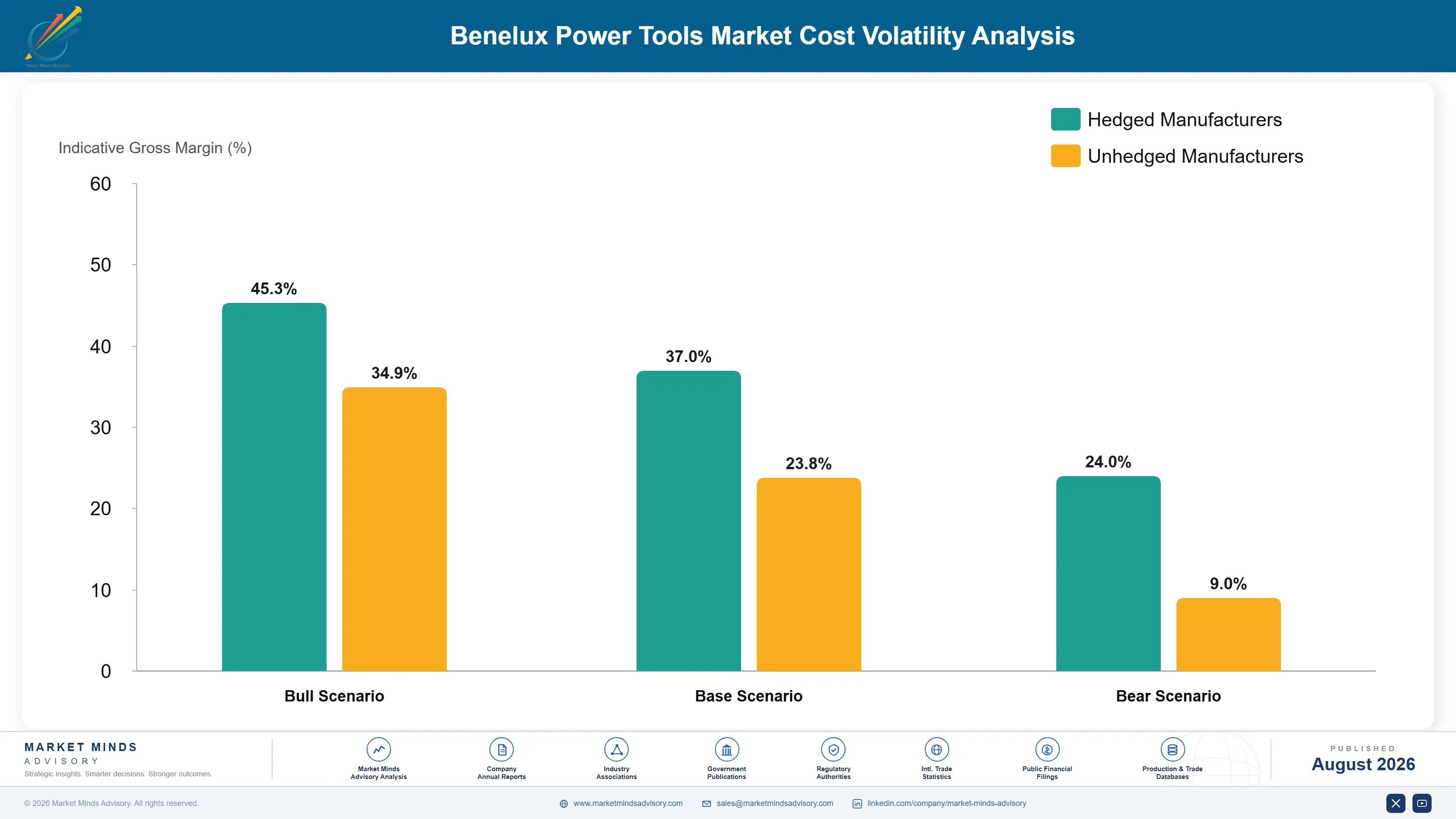
Lithium-ion battery cells and brushless motor components dominate cost structure for cordless power tool manufacturing. Battery cells, permanent magnets, and copper windings together account for a substantial share of unit cost, sourced from specialty cell and magnet suppliers concentrated in a handful of countries. Housing plastics and control electronics complete the cost structure for most tool categories.
Lithium-ion battery cell pricing moved considerably through 2021 and 2022 as global cell manufacturing capacity struggled to keep pace with surging demand from both power tools and electric vehicle production simultaneously across most major manufacturing regions. Several tool makers disclosed the resulting margin pressure across their annual reporting through that window, and industry data recorded meaningfully longer cell procurement lead times that persisted well beyond the initial disruption.

Exposure divides sharply by manufacturer scale rather than by tool category specifically across the industry. Larger manufacturers with negotiated long-term battery cell supply agreements held cost considerably better than smaller specialists relying on spot market purchasing during the tightening cycle. The disadvantage compounds, because a manufacturer unable to deliver committed tool orders during a shortage loses trade dealer relationships that larger, better-capitalized competitors retain.
benelux-power-tools-market-cost-volatility-analysis-1787334524215

Negotiate long-term battery cell supply agreements early

Manufacturers relying on spot market battery cell purchasing absorb the full impact of periodic price spikes directly, which the recent tightening cycle demonstrated quite expensively across the entire power tool manufacturing industry. Negotiating long-term supply agreements with cell manufacturers, even at modest committed volume, provides delivery priority and cost stability during any future shortage considerably and durably.

Diversify battery cell sourcing across multiple suppliers

Manufacturers entirely dependent on a single battery cell supplier cannot control allocation priority when a shortage hits, leaving no real alternative but to absorb delay and cost increases directly and pass them downstream to trade dealer customers. Diversifying cell sourcing across multiple qualified suppliers preserves supply continuity that single-supplier competitors simply cannot access as effectively.

Build modular designs tolerating cell chemistry substitution

Tool designs locked into a single battery cell chemistry cannot adapt quickly when that specific cell type becomes scarce during a shortage, forcing costly redesign work under considerable time pressure across affected product lines. Designing modular battery architectures that tolerate qualified cell chemistry alternatives preserves manufacturing continuity that single-chemistry designs competing during a shortage cannot access as readily.

Portfolio Architecture for Margin Defence

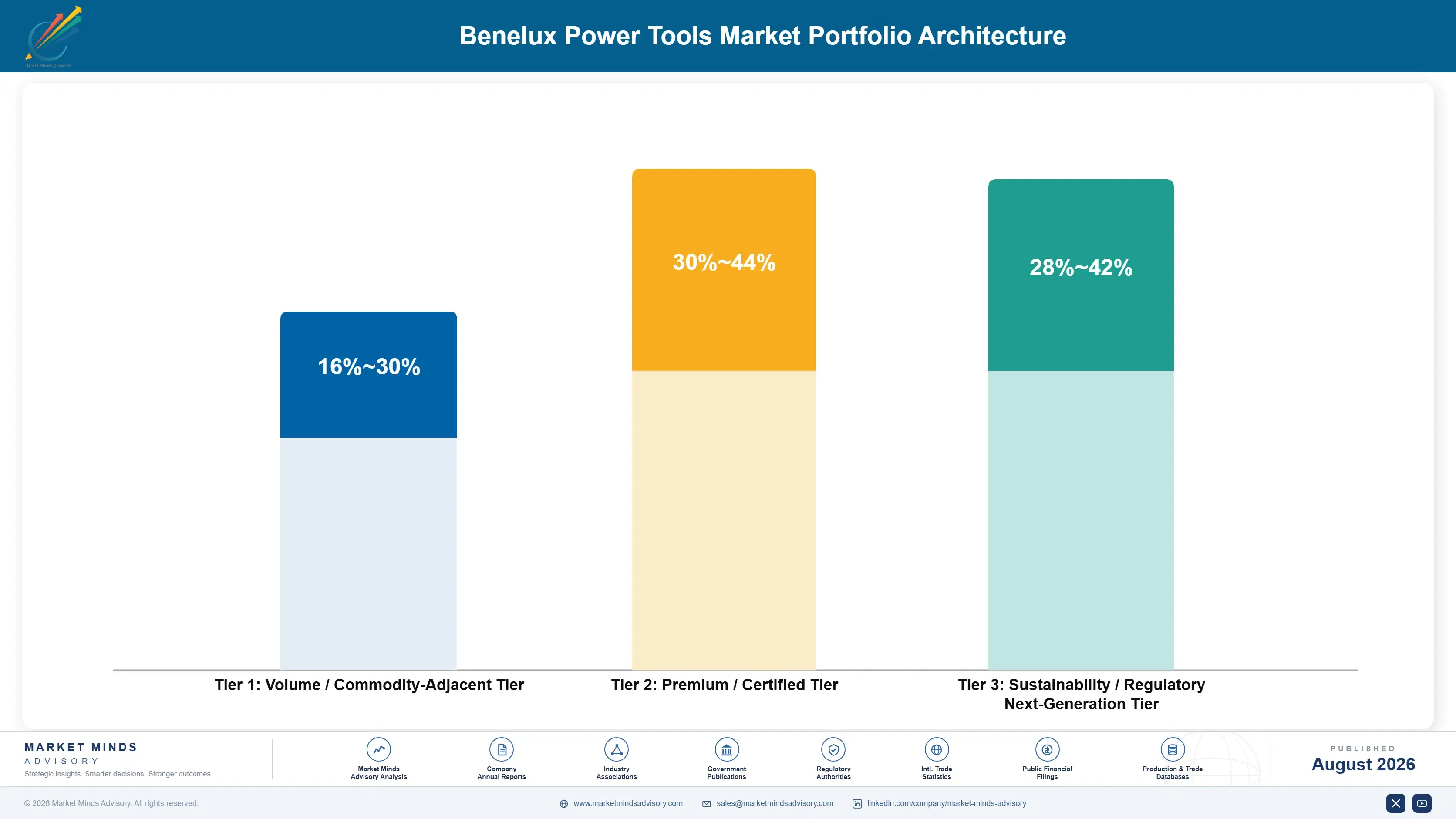
The portfolio splits into three tiers with genuinely different economics across the industry. Standard corded and entry-level cordless tools form the volume tier, where equipment commoditization and retail price competition drive competition directly. Professional cordless platforms and pneumatic tools earn considerably more, because system breadth and trade dealer relationships narrow the field. Electric outdoor equipment sits differently again, priced against the compliance and electrification
The tension runs between standard tool volume that fills retail shelf space and premium platform work that earns the return. Entry-level cordless tools generate the transaction volume that keeps manufacturing lines loaded and maintains retail relationships through which higher-value professional platform conversations happen. Yet this segment competes on price against every qualified retail competitor. Manufacturers managing this well treat standard volume as brand awareness capital.

High-value pools concentrate where system breadth or electrification credibility genuinely limits competition: professional cordless platforms solving the multi-tool consolidation problem, electric outdoor equipment meeting municipal compliance requirements, and trade dealer relationships resolving the recurring service constraint. All three resist the price competition defining entry-level cordless tools, since the customer is purchasing a solved platform or compliance problem rather than comparing interchangeable tools.

Volume / Commodity-Adjacent Tier

Standard corded and entry-level cordless tools sold at commodity pricing against qualified retail competitors competing on standard specifications. The range is wide because manufacturing-efficient producers earn respectably while those competing purely on price frequently do not.
Gross Margin: 16-30%

Premium / Certified Tier

Professional cordless platforms and pneumatic tools carrying system breadth and trade dealer relationships in the most demanding professional construction and industrial categories. The range is wide because platform maturity and dealer relationship depth vary considerably by manufacturer.
Gross Margin: 30-44%

Sustainability / Regulatory / Next-Generation Tier

Electric outdoor equipment with municipal-grade electrification addressing the compliance problem directly and durably across contractors requiring genuine emissions reduction assurance. The range is wide because electrification maturity still varies enormously by manufacturer currently.
Gross Margin: 28-42%
benelux-power-tools-market-portfolio-architecture-1787334524720

High-value Sub-segments and Strategic Watch-out

Cordless Power Tools

High value and the fastest growth at 9.8%, from a small base as professional contractors consolidate purchasing around one battery platform rather than mixing brands and power sources across job sites. Platform breadth increasingly determines which makers capture this volume, limiting near-term opportunity to those with proven battery system depth.
Gross Margin: 32-46%

Outdoor Power Equipment

High value with strong growth, protected by electrification credibility and municipal contract relationships that create a durable barrier newer specialist entrants find genuinely difficult to replicate quickly at scale. EU emissions enforcement compounds steadily as municipalities expand restrictions supporting broader outdoor equipment electrification goals across most Benelux service territories.
Gross Margin: 28-42%

Pneumatic Power Tools

The volume core across corded tools and pneumatic equipment worldwide, and the category with the longest commercial history of the five power source types listed here in this framework. Growth is steady but competition on price is direct, holding margin below the cordless and outdoor equipment tiers positioned above it.
Gross Margin: 16-30%

Corded Power Tools

The strategic watch-out, growing slowest as basic corded tools increasingly lose ground to cordless alternatives offering better job site flexibility and battery system integration across most demanding professional categories today. Declining format preference limits addressable volume exactly where growth elsewhere is fastest, threatening this segment's long-term position considerably.
Gross Margin: 14-26%

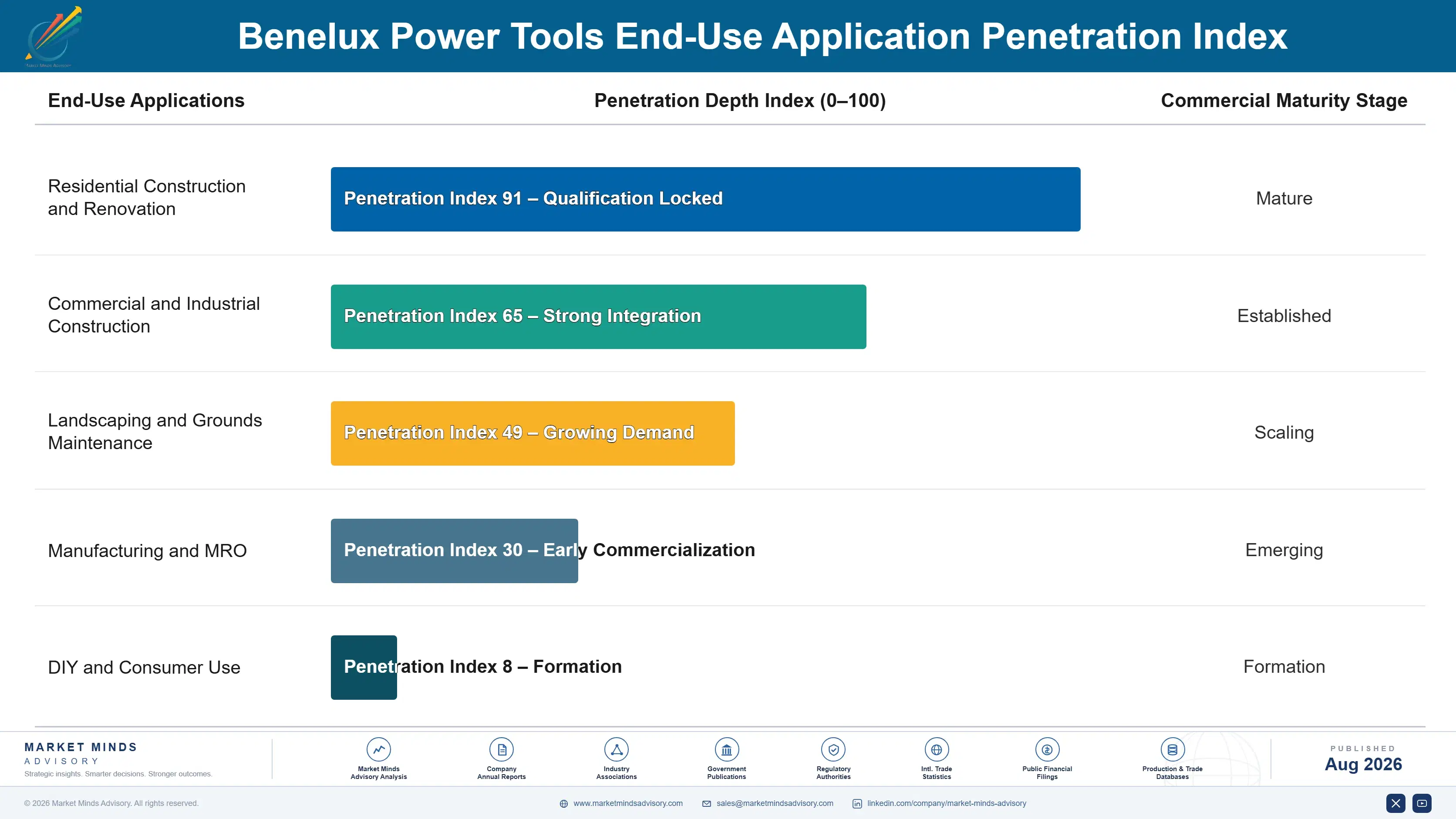
How Power Tool Revenue Locks In

Revenue commits differently depending on which mechanism drives the purchase. Battery platform contracts lock in tightly once a contractor invests in several tools on one system, since replacement and expansion purchases reorder consistently within that platform across years of professional use. Standalone corded tool purchases stay genuinely reversible if a competitor offers better pricing. Municipal electrification contracts persist on committed compliance schedules regardless of near-term bud
Adoption depth varies sharply by contractor scale and trade specialization. Large construction firms go deepest, standardizing an entire crew's tools across one battery platform once the system proves reliable and complete. Independent tradespeople adopt more selectively, often mixing brands until a compelling platform switch justifies full conversion. Municipal buyers weigh compliance timelines most heavily, since regulatory deadlines override normal budget-driven replacement cycles.

Buyer profiles have shifted from individual tradespeople toward procurement managers and sustainability officers at larger contracting firms with distinct priorities. An individual tradesperson once compared tool price and brand reputation directly; a procurement manager now tracks fleet-wide platform standardization costs, and a sustainability officer drives specification against emissions compliance data a purely price-focused evaluation would never have prioritised.
benelux-power-tools-market-end-use-penetration-index-1787334525208

Our Call On Benelux Power Tools

These are among the four positions where our research anticipates prominent divergence between winners and laggards over the coming forecast period. Each is grounded in the demand model, the regulatory perimeter, and the announced capacity pipeline.
01 / BATTERY SYSTEM STRATEGY

Expand battery-compatible tool range ahead of rivals

Tool makers that expand their battery-compatible tool range faster than competitors, rather than launching a narrow cordless lineup and adding tools gradually, capture platform lock-in advantages that competitors with narrower ranges increasingly cannot match. That range breadth commands a premium of 18 to 30% in effective contract value over makers offering only a limited cordless lineup, since contractors pay for platform completeness as much as for any individual tool's specifications. Makers should prioritise this now, because it is not quickly replicated.
02 / ELECTRIFICATION CREDIBILITY STRATEGY

Build credible electric outdoor equipment platforms early

Tool makers that build genuinely credible electric outdoor equipment platforms, rather than treating electrification as a minor product line extension, win municipal and landscaping contracts that gas-powered specialists increasingly cannot retain, adding roughly 25% to addressable outdoor equipment revenue as EU emissions enforcement accelerates across most Benelux municipalities and service territories and jurisdictions. That electrification credibility reaches municipal buyers who specifically require compliant equipment ahead of regulatory deadlines and enforcement timelines. Makers should build this credibility now, before rivals establish it first.
03 / TRADE DEALER RELATIONSHIP STRATEGY

Deepen trade dealer relationships beyond retail channels

Tool makers that build deep trade dealer relationships specifically serving professional contractors, rather than relying purely on general retail distribution, capture recurring professional purchasing that retail-only competitors cannot match, adding roughly 20% to lifetime contractor account revenue through dealer-mediated service and warranty relationships across most professional trade categories and job types. That trade dealer depth reaches contractors who specifically value dealer relationships for warranty service and bulk purchasing terms. Makers should build this depth now, before rivals close the gap.
04 / PLATFORM MIGRATION STRATEGY

Offer platform migration incentives to win switchers

Tool makers that offer trade-in and migration incentive programmes for contractors on a competitor's battery platform, rather than expecting contractors to absorb the full switching cost themselves, capture platform conversion contracts that price-only competition otherwise cannot win, accelerating conversion decisions by roughly 30% compared to makers offering no migration support whatsoever across the entire market. That migration incentive reaches contractors who specifically hesitate over switching costs despite preferring newer technology. Makers should offer this now, before rivals establish comparable programmes.

Engagement Snapshot From the Field

A live engagement with an industry participant carrying material or product regulatory and market exposure ahead of a defining policy shift, showing how our research translates into a defensible multi-year portfolio strategy.
MARKET MINDS ADVISORY · CLIENT ENGAGEMENT SUMMARY
Benelux Power Tools Producer Strategic Portfolio Review and Transition Roadmap 2026·Investment Scenario on Benelux Power Tools Exposure Evaluation 2025-26
CLIENT PROFILE
A regional Benelux construction contracting group engaged MMA while evaluating standardization of its multi-crew tool fleet onto a single cordless battery platform after years of accumulated brand fragmentation across acquired subsidiary crews. The group reported roughly 220 active tradespeople across its combined operations and faced pressure to cut tool inventory complexity before the next fiscal year (client-reported, unverified by MMA).
STRATEGIC CHALLENGE
Standardizing onto a single platform risked writing off substantial value in existing tools across multiple brands still in active use across several crews, but continuing with fragmented platforms meant ongoing inefficiency in battery and charger inventory across crews. Leadership needed a standardization approach balancing existing tool value against long-term platform consolidation savings.
MMA APPROACH
MMA evaluated three candidate platforms against documented tool range breadth, trade dealer service coverage across the group's operating territories, and trade-in value for existing equipment across all brands currently in use. We modelled total fleet cost under each platform's actual pricing structure rather than accepting vendor projections alone. We then assessed each platform's warranty and service terms.
KEY FINDINGS
  1. Only one of the three candidate platforms had trade-in programmes covering all the brands currently active across the group's combined crew inventory.
  2. The recommended platform's standardization reduced projected battery and charger inventory cost by an estimated 40% across the fleet (client-reported, unverified by MMA).
  3. Trade dealer service coverage varied considerably across platforms, with the recommended platform offering the broadest coverage across the group's entire operating territories and regions.
  4. Standardizing all crews simultaneously, without phasing by existing tool age, would have risked writing off meaningfully more residual tool value entirely across crews.
CLIENT PROFILE
A regional Benelux construction contracting group engaged MMA while evaluating standardization of its multi-crew tool fleet onto a single cordless battery platform after years of accumulated brand fragmentation across acquired subsidiary crews. The group reported roughly 220 active tradespeople across its combined operations and faced pressure to cut tool inventory complexity before the next fiscal year (client-reported, unverified by MMA).
STRATEGIC CHALLENGE
Standardizing onto a single platform risked writing off substantial value in existing tools across multiple brands still in active use across several crews, but continuing with fragmented platforms meant ongoing inefficiency in battery and charger inventory across crews. Leadership needed a standardization approach balancing existing tool value against long-term platform consolidation savings.
MMA APPROACH
MMA evaluated three candidate platforms against documented tool range breadth, trade dealer service coverage across the group's operating territories, and trade-in value for existing equipment across all brands currently in use. We modelled total fleet cost under each platform's actual pricing structure rather than accepting vendor projections alone. We then assessed each platform's warranty and service terms.
KEY FINDINGS
  1. Only one of the three candidate platforms had trade-in programmes covering all the brands currently active across the group's combined crew inventory.
  2. The recommended platform's standardization reduced projected battery and charger inventory cost by an estimated 40% across the fleet (client-reported, unverified by MMA).
  3. Trade dealer service coverage varied considerably across platforms, with the recommended platform offering the broadest coverage across the group's entire operating territories and regions.
  4. Standardizing all crews simultaneously, without phasing by existing tool age, would have risked writing off meaningfully more residual tool value entirely across crews.
RECOMMENDED STRATEGY
Phase 1: Phase 1 (0 to 3 months): Standardize the oldest and least-brand-loyal crews first, validating platform performance and dealer service coverage. Phase 2: Phase 2 (3 to 9 months): Expand standardization across remaining crews as existing tools reach natural replacement age and trade-in value. Phase 3: Phase 3 (9 to 12 months): Complete fleet-wide standardization and validate inventory cost reduction against the original 40% savings target.
OUTCOME
The group completed fleet-wide standardization within the twelve-month timeline, achieving inventory cost reduction in line with the projected estimate while minimizing residual tool value written off. Crew productivity improved as battery and charger confusion across job sites disappeared, and the phased standardization framework is now the group's standard approach for future acquisitions (client-reported, unverified by MMA).

Frequently Asked Questions

Foundational context covering the market sizes, CAGR, scope, country, region and competition that inform every finding below. This section is provided to cover basics and most often pre-purchase conversations, answered from the MMA Primary Research Dataset.

What is the current size of the Benelux Power Tools Market?

The Benelux power tools market is valued at USD 1.92 billion in 2025, covering cordless, corded, and pneumatic tools plus outdoor power equipment across Belgium, the Netherlands, and Luxembourg. Hand tools are excluded.

How large will the Benelux Power Tools Market be by 2036?

The market is forecast to reach USD 3.71 billion by 2036 in the base case, about 1.93 times the 2026 level. That represents incremental value of roughly USD 1.79 billion across the forecast decade.

What is the CAGR for the Benelux Power Tools Market 2026 to 2036?

The market grows at a 6.8% CAGR in the base case, with bull and bear scenarios at 8.0% and 5.5%. The spread turns mainly on EU emissions enforcement pace and construction activity trends.

Which segment is growing fastest?

Cordless power tools grow fastest at 9.8%, about 1.44 times the overall rate, as contractors consolidate purchasing around a single battery platform. Outdoor power equipment follows at 8.6% on emissions-driven electrification.

Who are the major companies in the Benelux Power Tools Market?

Leading brands include Stanley Black & Decker, TTI, Bosch, Makita, and Hilti, holding roughly 58% between them. Brands combining battery system breadth with trade dealer relationships are increasingly capturing premium growth.

Which country is growing fastest?

The Netherlands grows fastest at a 7.6% CAGR, building on concentrated construction activity and the region's largest professional contractor base. Belgium follows closely on comparable trade dynamics.

Report Segmentation Architecture

The full report scope spans multiple orthogonal segmentation dimensions, with cross-tabulated demand data provided for each dimension pair. Coverage extends further to regional breakdowns, trend trajectories, and the competitive detail needed to support segment-level decision-making.

By Power Source

  • Cordless Power Tools
  • Corded Power Tools
  • Pneumatic Power Tools
  • Outdoor Power Equipment
  • Power Tool Accessories and Consumables

By End-Use Application

  • Residential Construction and Renovation
  • Commercial and Industrial Construction
  • Landscaping and Grounds Maintenance
  • Manufacturing and MRO
  • DIY and Consumer Use

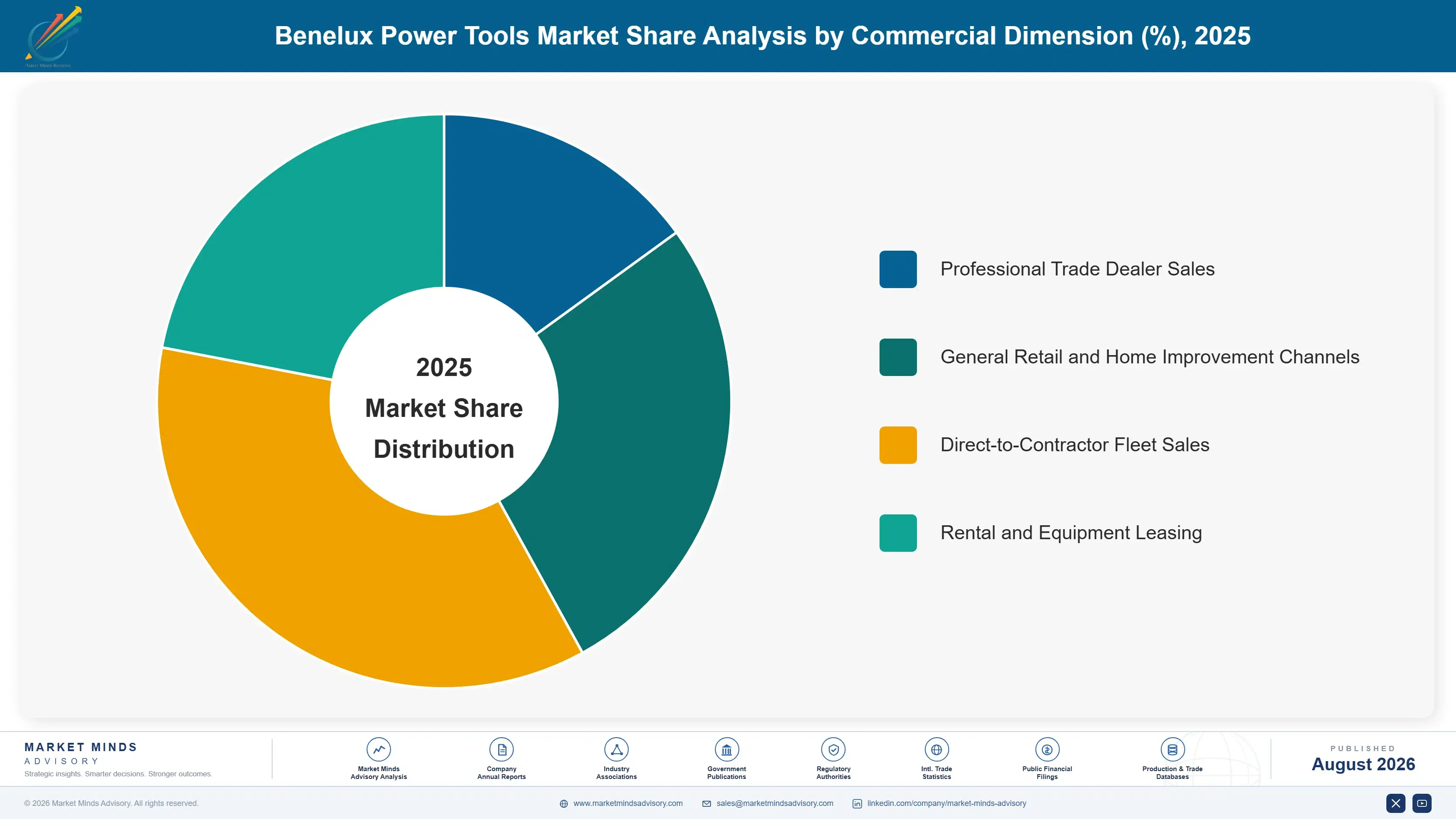
By Commercial Dimension

  • Professional Trade Dealer Sales
  • General Retail and Home Improvement Channels
  • Direct-to-Contractor Fleet Sales
  • Rental and Equipment Leasing

By Region

  • North America
  • Western Europe
  • East Asia
  • South Asia and Pacific
  • Latin America
  • Middle East and Africa
  • Eastern Europe

Scope, Methodology, and Coverage

Every figure in this report is reproducible from documented input assumptions. The scope below maps the historical period, the forecast horizon, the segmentation dimensions, and the countries covered, alongside the underlying primary and qualitative methodology.
Historical Period
2020 to 2025
Forecast Period
2026 to 2036
Base Year
2025 (USD billions; MMA Primary Research Dataset, August 2026)
Market Definition
This report covers the power tools market scoped specifically to Belgium, the Netherlands, and Luxembourg, valued at manufacturer selling prices into the region. It spans cordless power tools, corded power tools, pneumatic power tools, outdoor power equipment, and power tool accessories and consumables serving professional construction, industrial, and consumer applications across the region. Hand tools without motorized power and adjacent building materials are excluded from this scope entirely.
Quantitative Units
USD billions (current prices); unit shipments across the Benelux region where applicable
Segmentation Dimensions
By Power Source; By End-Use Application; By Commercial Dimension; By Region
Regions Covered
North America, Western Europe, East Asia, South Asia and Pacific, Latin America, Middle East and Africa, Eastern Europe
Countries Covered
Belgium, Netherlands, Luxembourg, and cross-border trade relationships with Germany, France, UK, China, Japan, South Korea, India, Poland, Czechia, and additional markets relevant to component supply and trade
Key Companies Profiled
Stanley Black & Decker, TTI (Techtronic Industries), Bosch, Makita, Hilti, Metabo, Festool, Husqvarna, STIHL, Fein, Ingersoll Rand, Atlas Copco, Hikoki Power Tools, Einhell, Positec Tool, Chervon Holdings, Panasonic, Snap-on, Emerson Electric, Worx
Quantitative Methodology
Primary survey, n=3,800 respondents, Q4 2025, six countries; demand-side model with trade association cross-validation
Qualitative Methodology
47 expert interviews, Q4 2025; applied to validate demand model assumptions, identify emerging dynamics, and assess competitive positioning
Report Format
PDF and XLSX data workbook (Word format preview document)
Publisher
Market Minds Advisory
Report Code
MMA-2026-CON-211
Published
August 2026
Contact
sales@marketmindsadvisory.com | www.marketmindsadvisory.com

Purchase the full Benelux Power Tools Market Report (2026 to 2036).

The full MMA Benelux Power Tools report sizes the market across five power source categories and multiple end-use applications through 2036, scoped specifically to Belgium, the Netherlands, and Luxembourg. It profiles 20 manufacturers on a consistent basis of power tool and outdoor equipment revenue, scoring each on battery system breadth, electrification credibility, trade dealer relationship depth, and platform migration incentives. Scenario models quantify how EU emissions enforcement and construction activity move both volume and achievable margin by category. The report also includes trade dealer network mapping and platform breadth benchmarking.
Five-category Benelux market sizing through 2036
Twenty-manufacturer benchmark on power tool revenue
EU emissions enforcement and electrification pipeline tracking
Battery system breadth benchmarking across leading brands
Trade dealer network coverage mapping by territory
Battery cell and motor component supply chain risk mapping

Built For The People Who Decide

From boardroom strategy to bench-side execution, this report is read cover-to-cover by leaders shaping the next decade of their industry, turning demand scenarios, market dynamics and valuation benchmarks into decisions.
CXOs/ Presidents/ VPs/ Managers
M&A and Corporate Development
Strategy Teams and R&D Heads
Procurement and Product Directors
Regulatory and Compliance Leaders
Investor Relations and Equity Analysts