
Market Minds Advisory
Basil Leaves Market

Basil Leaves Market: Culinary Demand, Essential Oil Extraction and the Seed Beverage Surge

Basil leaves now sit at the intersection of Mediterranean culinary demand, essential oil extraction for personal care, and a fast-scaling seed beverage trend across Southeast Asia, straining smallholder supply chains built for single-use harvests.

Lead Analyst

Lisa Gevelber

Published

September 2026

Make Smarter Decisions with Customized Research Insights

Request a free sample report and evaluate market opportunities, growth trends, and competitive dynamics relevant to your business needs.

2025 MARKET VALUE$2.6BMarket Size 2025
2036 FORECAST VALUE$5.2BBase Case , 2026 to 2036
CAGR 2026 TO 20366.4 %Bull 7.7% / Bear 5.1%
INCREMENTAL OPPORTUNITY$2.4BNet 10- year value creation
EXPANSION MULTIPLE1.86x2036 value over 2026 base
Strategic Levers
M&A Pipeline
Regional Outlook
Country Rankings
Competitive Intelligence
Segmental Deep-dive
Call-Us : 91 93563 13602

Executive Snapshot and Market Trajectory

Smallholder basil supply chains built for single harvest fresh sales are now serving three distinct buyers at once: foodservice chefs, essential oil distillers, and beverage bottlers, each demanding different harvest timing and post-harvest handling that growers cannot fully satisfy simultaneously.
Basil seed beverages are pulling the fastest growth in the category, scaling rapidly across Southeast Asia and spreading into North American and European functional drink aisles, while essential oil distillation remains concentrated in Egypt and India where labor costs support the steam distillation volumes cosmetics brands require. Fresh culinary basil retains the largest single revenue pool, anchored in Mediterranean cuisine demand across Western Europe and North America.
Competitive structure remains fragmented, dominated by regional processors and cooperatives rather than global branded players, since basil's short shelf life and regional cultivar preferences resist the consolidation seen in more storable herbs and spices. Certification pressure is rising as European buyers tighten pesticide residue limits, forcing smallholder cooperatives toward costly compliance programs or exit from export markets entirely. a bifurcation increasingly visible across major growing regions.
Market Definition
The basil leaves market covers fresh, dried, and processed basil in the form of leaves, puree, extracts, essential oil, and edible seeds sold into food, beverage, cosmetic, and nutraceutical end uses. It excludes potted ornamental basil plants sold through garden retail and excludes basil incorporated into finished packaged sauces where basil is not the primary listed ingredient.
Base Year Value
$2.6B in 2025 (MMA Primary Research Dataset, August 2026)
Forecast Period
2026 to 2036, eleven discrete annual values
CAGR
6.4% base case. Bull 7.7%. Bear 5.1%.
Fastest Growth Segment
Basil Seeds for Functional Beverages: 10.2% CAGR
Fastest Growth Country
Vietnam: 10.6% CAGR
Fastest Growth Region
South Asia and Pacific: 8.6% CAGR
Largest Region
North America: 24% of 2025 global value
Market Leaders
McCormick and Company, Kerry Group, Naturex (Givaudan), Van Drunen Farms, and Kanegrade. Source: MMA Analysis based on company annual reports.
Primary Survey
n=3,800 procurement and R&D decision-makers, Q4 2025, six countries
Methodology
Demand-side build-up, cross-validated against public data, 47 expert interviews

Basil Leaves Market Forecast Scenarios

basil-leaves-market-size-forecast-scenario-1787463054260
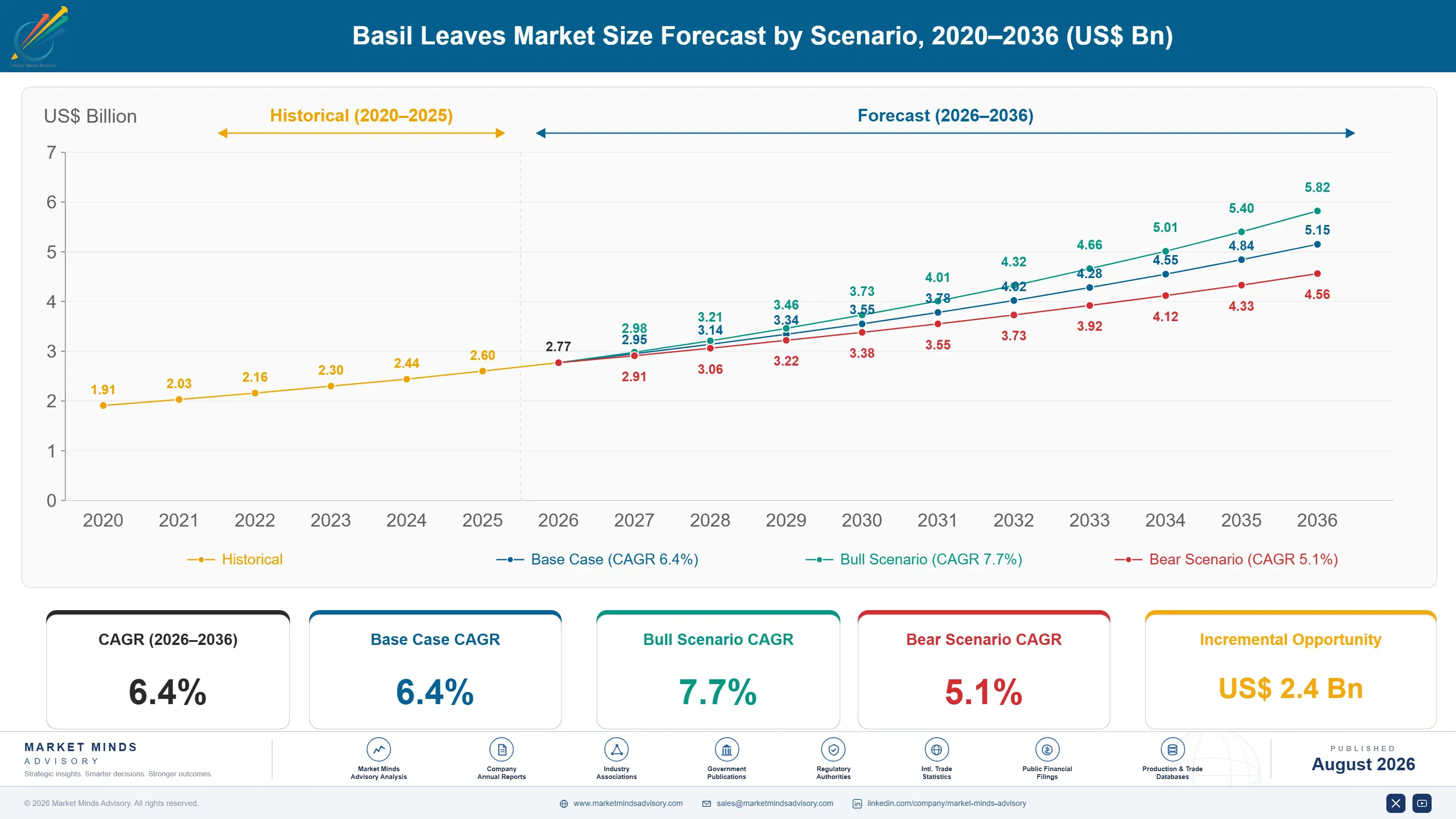
Between 2020 and 2025 the market grew steadily as pandemic-driven home cooking lifted fresh basil retail sales and early basil seed beverage adoption began scaling from a near-zero base across a handful of Southeast Asian markets, delivering a historical pace of roughly 5.6 percent annually across combined product forms. Retailer and foodservice buyers during this period still treated basil as a single-use culinary commodity.
The base case assumes growth near 6.4 percent annually through 2036, anchored in three commercial mechanisms: expanding basil seed beverage distribution into mainstream North American and European retail, tightening European pesticide residue standards that push buyers toward certified growers commanding premium pricing, and steady essential oil demand growth from natural personal care formulators replacing synthetic fragrance compounds. These mechanisms are reinforcing each other faster than most smallholder cooperatives can plan capital investment around, compressing planning cycles.
A bull scenario builds on basil seed beverages achieving mainstream functional drink aisle placement across major Western retailers within three years, while a bear scenario centers on climate-driven crop losses in Egypt and India disrupting essential oil distillation volumes and pushing buyers toward substitute aromatic botanicals at lower price points. a scenario already visible in early 2025 distillation capacity reports.

Multi-Use Demand Pulling Against Fragmented Supply

Three demand streams are converging on the same smallholder supply base at once: foodservice and retail buyers wanting consistent fresh leaf quality year round, cosmetics formulators wanting stable essential oil supply, and beverage bottlers wanting cleaned, graded basil seed at volumes few current suppliers can reliably deliver. This convergence is straining post-harvest infrastructure built originally for a single buyer type.
MARKET CONCENTRATIONCR5 18%top five processors hold a modest combined share
AVERAGE FARMGATE PRICEUSD 2.10-2.80/kgtypical price paid to fresh basil growers directly
LEADING PRODUCING COUNTRYIndialargest single national cultivation and processing base overall
ESSENTIAL OIL EXTRACTION YIELD0.15-0.30%typical oil recovered relative to fresh leaf weight
EXPORT REJECTION RATE6-9%shipments failing destination pesticide residue compliance testing checks
COLD CHAIN LOSS RATE12-18%fresh leaf volume lost between harvest and retail
Commercially the category behaves less like a single herb market and more like three loosely connected supply chains sharing a common crop, where the same farm may sell wilted or off-grade leaf to a distiller while selling premium leaf fresh, a dual-channel model that is becoming more formalized as buyers seek supply security through direct contracts rather than spot market purchases. a dual-channel model still uncommon outside the largest and most capitalized growing cooperatives.
Over the next decade, the growers and processors most likely to capture disproportionate value are those investing in post-harvest cold chain and multi-product processing flexibility, since single-use farms remain exposed to price swings in whichever single end market they serve exclusively. Growers slow to diversify remain fully exposed to price swings in whichever single market they serve.
"Basil is no longer just a kitchen herb. The same leaf now competes for shelf space against synthetic fragrance chemicals and against sugar-heavy sports drinks, and most growers have no idea they are in three markets at once."
Director, Agricultural Commodities Practice · MMA Agriculture / Culinary Herbs and Botanicals Practice · August 2026

Market Trends

Basil Seed Beverages Scaling Beyond Southeast Asia

Basil seed drinks, long popular in Thailand, Vietnam, and India as sabja or tukmaria beverages, are now appearing in mainstream Western retail as functional hydration and fiber products, aided by clean label positioning that appeals to shoppers seeking alternatives to synthetic gelling agents. Several specialty beverage brands in the United States and United Kingdom launched basil seed drink lines in the past two years, and at least two major retailers have added dedicated shelf sets for the category. Seed supply remains the binding constraint, since cleaning infrastructure suited to beverage use exists in only a handful of processing facilities across South and Southeast Asia.
Market Impact: Lifts essential oil demand by 11%
European Pesticide Residue Standards Tightening Sharply

The European Union has lowered maximum residue limits on several pesticide classes commonly used in basil cultivation across exporting countries, following a series of import alerts triggered by residue detections above prior thresholds. Exporters serving European retail and foodservice channels must now demonstrate compliance through third party residue testing at the point of export rather than relying on origin country certification alone. This has accelerated adoption of integrated pest management practices among larger cooperatives able to absorb testing costs, while smaller independent growers increasingly exit direct European export in favor of domestic or regional sales.
Market Impact: Adds 9% to fresh basil demand

Market Opportunities and Growth Drivers

Natural Fragrance Reformulation in Personal Care

Personal care formulators are replacing synthetic linalool and other fragrance compounds with naturally derived basil essential oil as clean beauty positioning spreads from niche brands into mainstream personal care portfolios. This shift has lifted essential oil demand growth above the category average, particularly for holy basil and sweet basil oil grades preferred for their fragrance profile and documented traceability to specific growing regions. Distillers in India and Egypt are expanding steam distillation capacity to meet this demand, though capacity additions lag order growth by twelve to eighteen months in most cases, keeping oil pricing elevated relative to five years ago.
Market Impact: Limits fresh export share to 8%

Mediterranean Cuisine Expansion in Retail Foodservice

Continued growth of Mediterranean and Italian-inspired quick service and fast casual restaurant concepts across North America and parts of Asia is sustaining steady demand for fresh basil at volumes large enough to justify dedicated grower contracts rather than spot market sourcing. Chains increasingly specify cultivar and leaf size requirements tied to specific menu applications, pushing growers toward contract farming arrangements that offer price stability in exchange for volume and quality commitments. This channel remains the largest single demand pool for fresh basil by revenue, even as its growth rate trails the newer seed beverage and essential oil applications.
Market Impact: Caps certified supply at 15%

Market Restraints and Challenges

Short Shelf Life Limits Export Market Access

Fresh basil wilts and blackens within days of harvest even under refrigeration, a limitation rooted in the leaf's high respiration rate and sensitivity to chilling injury below certain storage temperatures, restricting export-grade fresh basil almost entirely to air freight routes that add considerable cost relative to the product's value. The commercial impact is that most cross-border basil trade moves as dried, frozen, or processed forms rather than fresh leaf, ceding the premium fresh culinary segment to domestic and near-shore growers. Several exporters now invest in modified atmosphere packaging and cooling protocols to extend shelf life enough to reach nearby regional markets by refrigerated road transport.
Market Impact: Adds 14% to seed volume

Fragmented Smallholder Base Slows Certification Adoption

The vast majority of global basil cultivation occurs on smallholder plots too small to independently justify the cost of organic or residue-free certification, an inherent feature of the crop's low capital entry barrier that has historically supported easy market entry for new growers. The commercial impact is that certified, traceable basil supply remains a small fraction of total volume despite growing buyer demand for it, creating persistent premium pricing for certified product. Cooperative aggregation models, where smallholders share certification and testing costs, are expanding in India and parts of Southeast Asia as the most viable mitigation path for smaller growers.
Market Impact: Raises export compliance cost 22%
3 additional market trends, 3 additional growth drivers, and 4 additional restraints and challenges are covered in the full report. Contact sales@marketmindsadvisory.com to access the complete intelligence.

Segment CAGR and Growth Architecture

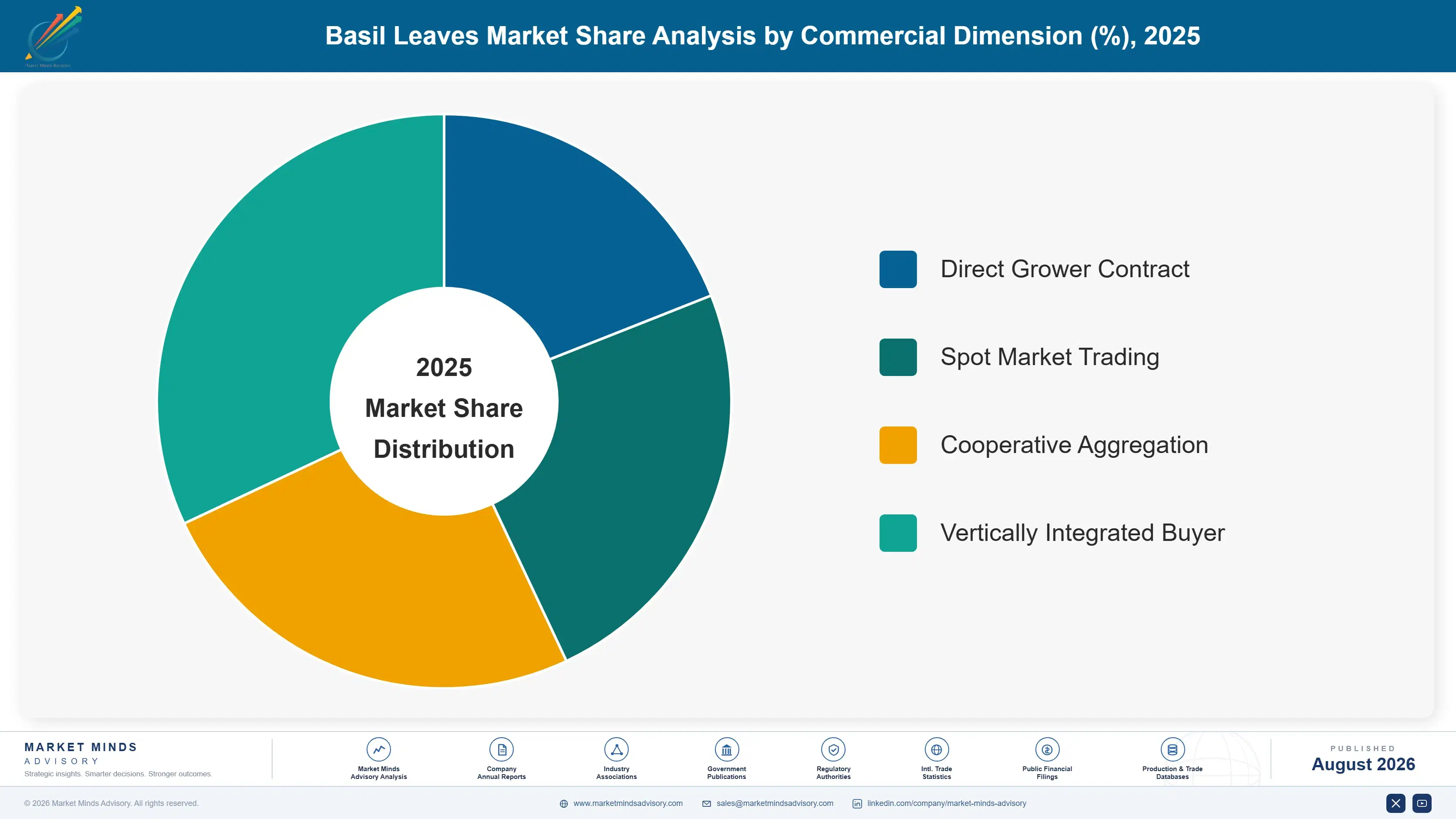
Segmentation follows product form, since fresh, dried, essential oil, frozen, extract, and seed forms of basil serve distinct end markets with different processing infrastructure, shelf life characteristics, and buyer bases despite originating from the same underlying crop, growing regions, and smallholder cultivation practices common across most supplying countries.
basil-leaves-market-market-share-analysis-1787463054878

Basil Seeds for Functional Beverages

Basil seed demand is scaling fastest as functional beverage brands in North America and Europe adopt the ingredient for its fiber content and gel-forming texture, building on decades of established consumption in South and Southeast Asian sabja and tukmaria drinks. Processing requirements differ materially from culinary basil, since beverage grade seed must be cleaned, sorted, and tested to food safety standards well beyond what traditional seed markets required, creating a supply bottleneck that is attracting new processing investment. Thailand, India, and Vietnam currently supply most global seed volume, though new processing facilities are being developed in each country specifically to serve Western beverage brand specifications rather than traditional domestic markets, a shift reshaping trade flows.
CAGR 10.2%

Basil Essential Oil

Essential oil demand is accelerating as natural personal care formulation displaces synthetic fragrance compounds, with holy basil and sweet basil varieties commanding different price points based on their distinct aromatic profiles and end use applications in fragrance versus aromatherapy products. Steam distillation remains concentrated in India and Egypt, where established grower networks and distillation infrastructure built over decades give incumbent processors a durable cost advantage over new entrants. Buyers increasingly request single-origin traceability and residue testing documentation, pushing distillers toward direct grower contracts and away from aggregated spot market leaf purchases that cannot guarantee consistent traceability back to a specific farm or growing region. Buyers increasingly favor distillers who can document the specific farm cooperative supplying each production batch.
CAGR 9.5%
Full segment breakdown across 6 segments available in the complete report.

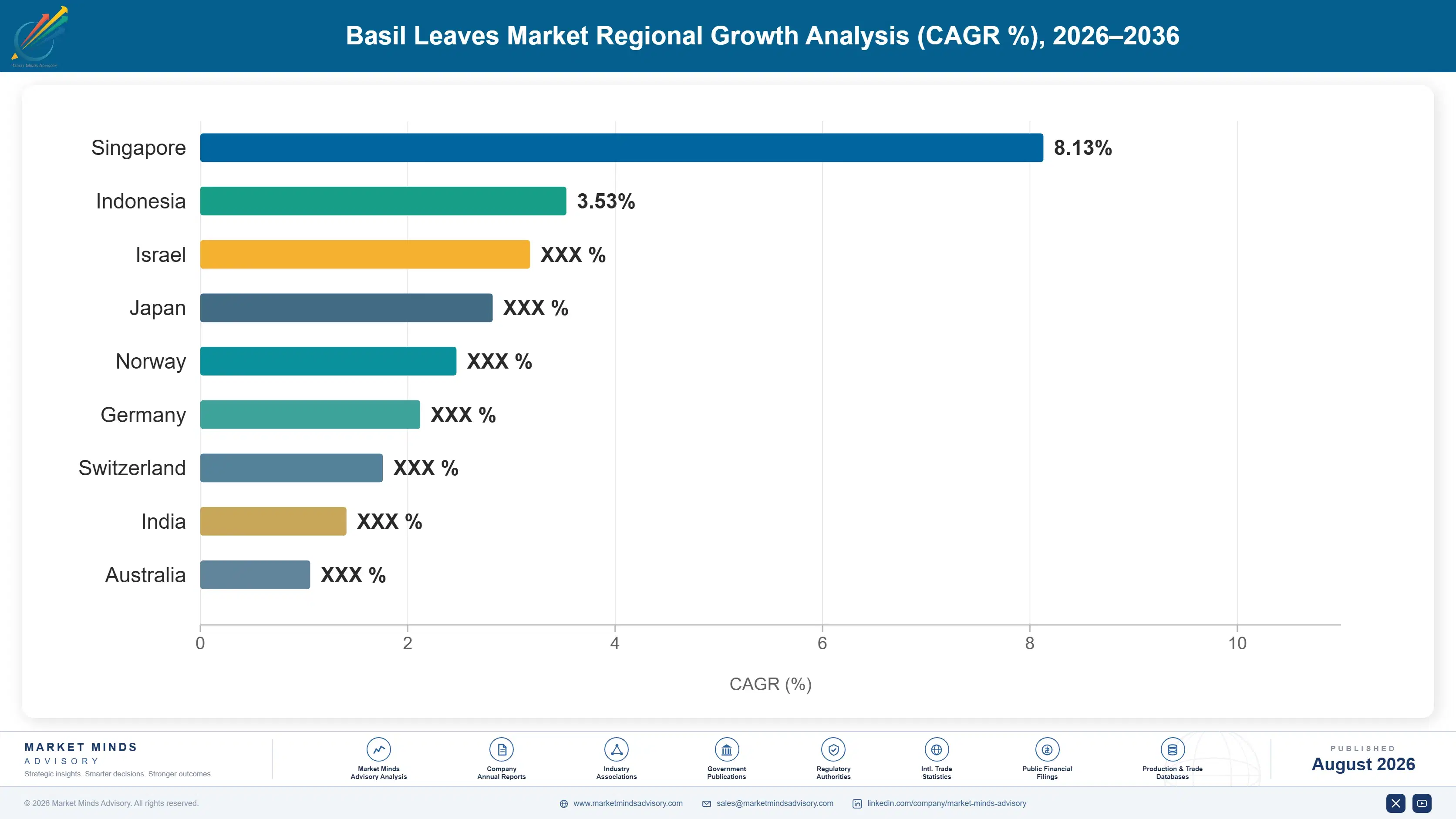
Regional Architecture and Country Demand Map

Western Europe leads on culinary and premium personal care demand, North America follows closely, while South Asia and Pacific and East Asia anchor the fastest growth in essential oil and seed beverage production and consumption across smaller current revenue bases.

North America

United States foodservice demand for fresh basil, driven by Mediterranean and Italian inspired fast casual chains, anchors the region's largest single revenue pool, while a fast-growing specialty beverage segment is introducing basil seed drinks into mainstream grocery within the past two years. Canada's smaller market follows similar culinary demand patterns, importing most fresh and processed basil rather than cultivating domestically at scale given climate constraints on outdoor growing seasons. Organic and pesticide-free certification carries meaningful price premiums across both countries, reflecting shopper willingness to pay for verified clean sourcing in a herb increasingly consumed for wellness positioning as well as culinary use, particularly among younger urban shoppers. Basil seed beverage brands here increasingly source seed directly from Southeast Asian processors rather than domestic distributors.
Share: 24% | CAGR: 7.6% (2026 to 2036)

Western Europe

Italy, France, and the United Kingdom anchor the region's culinary basil demand, with fresh basil consumption tied closely to Mediterranean and Italian cuisine popularity across foodservice and retail channels. The European Union's tightening pesticide residue standards are reshaping import sourcing patterns, pushing retailers toward certified growers in Kenya, Israel, and parts of Eastern Europe capable of meeting the new compliance requirements. Germany and the Nordic countries lead regional demand for essential oil used in natural personal care formulation, a smaller but faster growing segment than fresh culinary basil, reflecting the region's advanced clean beauty retail infrastructure and informed consumer base. Retailers across the region are also piloting basil seed beverage private label lines in response to rising shopper interest.
Share: 24% | CAGR: 5.0% (2026 to 2036)
Regional intelligence for 5 additional markets available in the complete report: East Asia, South Asia and Pacific, Latin America, Middle East and Africa, Eastern Europe. Contact sales@marketmindsadvisory.com.
basil-leaves-market-country-cagr-analysis-1787463055406

Multi-Channel Processing and Certification Levers

Processors are pulling four commercial levers at once: multi-product processing flexibility, certification investment, direct grower contracting, and beverage grade seed capacity, each addressing a distinct margin opportunity created by basil's expanding and increasingly divergent end markets across food, beverage, and personal care buyers worldwide.

Multi-Product Processing Flexibility Across End Uses

Processors capable of directing the same harvested crop toward fresh sale, drying, distillation, or seed cleaning depending on real time price signals across end markets are capturing meaningfully better blended margins than single-use processors exposed to whichever single market they serve. This flexibility requires modest additional capital investment in drying and basic distillation equipment but pays back quickly given the price volatility differences that regularly emerge between fresh, dried, and oil markets for the same underlying crop. Cooperative-owned multi-product facilities in India have demonstrated blended margin improvements of roughly 15 percent over single-purpose peers.
Market Impact: Lifts blended processor margin by roughly 15 percent

Third-Party Residue Certification for Export Access

Investing in third party pesticide residue testing and certification ahead of shipment, rather than relying on origin country documentation alone, is increasingly a condition of European retail access rather than a competitive differentiator. Growers and cooperatives that adopted certification early have avoided the rejection rates now affecting roughly 6 to 9 percent of uncertified shipments at European ports of entry. Certification costs remain modest relative to the price premium and market access it preserves, particularly for cooperatives able to spread testing costs across pooled grower volume rather than bearing them individually.
Market Impact: Cuts shipment rejection rate by roughly 7 percent

Direct Grower Contracts Replacing Spot Market Purchasing

Beverage bottlers and personal care formulators are increasingly bypassing spot market aggregators in favor of direct multi-year contracts with specific growing cooperatives, securing supply consistency and traceability documentation that spot purchases cannot reliably provide. This shift is giving growers with contract relationships more predictable revenue and access to buyer-funded agronomic support, while growers without such relationships remain exposed to price volatility across fragmented spot markets. Early adopting cooperatives report contract volume now approaching 30 percent of total sales within three years of program launch. This shift is also reducing price volatility exposure for growers holding multi-year contract positions.
Market Impact: Secures roughly 30 percent of volume under contract

Beverage Grade Seed Cleaning Capacity Expansion

Investment in dedicated beverage grade seed cleaning and grading lines, separate from traditional culinary and agricultural seed handling infrastructure, is opening access to Western functional beverage brands willing to pay meaningfully more for consistently graded, food safety tested seed than traditional buyers offer. Processors in Thailand and Vietnam that made this investment early have signed multi-year supply agreements with beverage brands entering new Western markets, effectively locking in demand growth ahead of competitors still serving only traditional domestic seed markets at lower price points. Early movers have captured roughly 20 percent more contract volume than processors still serving only domestic markets.
Market Impact: Adds an 18 percent price premium on graded seed

Who Controls the Margin Pool

Concentration remains low, with the top five processors holding a combined 18 percent share on a revenue basis, reflecting basil's fragmented smallholder cultivation base and the persistence of regional cooperatives and independent processors across every major growing origin rather than global consolidation. This gap has persisted even as certification and beverage grade processing investment accelerates industry wide.
Current competitive activity centers on three dimensions: certification investment to preserve European export access, direct contracting with beverage and personal care buyers to secure volume ahead of competitors, and processing capacity expansion into beverage grade seed cleaning that few traditional processors currently offer at scale. These three dimensions are increasingly pursued simultaneously by the largest cooperatives and processors.

Emerging pressure comes from vertically integrated beverage brands establishing direct sourcing relationships that bypass traditional processor intermediaries entirely, and from cooperative aggregation models in India and Southeast Asia that are capturing certification and processing margin previously captured by larger regional trading houses, threatening to redistribute value away from established intermediaries over the coming decade. Rankings among current leading processors could shift meaningfully as beverage brand sourcing relationships mature further.
basil-leaves-market-company-positioning-matrix-1787463055966

Competitive Moat and Risk Dimensions

MCCORMICK AND COMPANY

Moat: Global Sourcing Flexibility

McCormick's established sourcing relationships across multiple basil growing origins and its extensive retail and foodservice distribution network give it supply flexibility that smaller regional processors cannot replicate, allowing it to shift sourcing between origins as pricing or compliance conditions change without disrupting customer supply commitments.
MCCORMICK AND COMPANY

Risk: Limited Seed Beverage Presence

McCormick's portfolio remains concentrated in dried and processed culinary basil formats, with limited direct presence in the fast-growing basil seed beverage segment, leaving that growth opportunity largely open to specialty beverage brands and Asian processors moving faster into the category. Competitors moving faster into beverage grade processing could capture disproportionate future category growth.
KERRY GROUP

Moat: Integrated Flavor Applications

Kerry's position as a flavor and ingredient systems supplier to major food and beverage brands allows it to embed basil extracts within broader flavor formulations, creating switching costs for customers that a standalone basil ingredient supplier competing on price alone cannot establish as easily. This embedded position is difficult for standalone basil suppliers to replicate quickly.
KERRY GROUP

Risk: Exposure to Formulation Substitution

Because basil often appears within blended flavor systems rather than as a standalone branded ingredient, Kerry faces constant pressure from customers reformulating toward lower-cost natural flavor alternatives, a risk less pronounced for suppliers selling directly branded, traceable basil products. Kerry's basil specific revenue therefore remains harder to isolate and defend than a standalone branded ingredient line.

Players Tracked

Prominent Players

McCormick and Company
Kerry Group
Naturex (Givaudan)
Van Drunen Farms
Kanegrade

Other Key Players

Foodchem International
Synthite Industries
Ultra International
Vishwas Aromatics
Hunan Sunfull Bio-Tech
Guangxi Bailong Huasheng
Ozone Naturals
Bio Botanica
Robertet Group
Ungerer and Company
Aromel SAS
Falcon Aromatics
Marudhar Extracts
Naturence Ingredients
Herbi Care Enterprises

Recent Developments

FEBRUARY 2026

Van Drunen Farms Expands Basil Seed Cleaning Line

Van Drunen Farms commissioned a new dedicated basil seed cleaning and grading line at its Illinois facility, aimed at supplying food safety certified seed to functional beverage brands entering the North American market, addressing a supply bottleneck that had slowed several planned product launches across the category this year.
Signal: Signals processor investment ahead of mainstream basil seed beverage retail expansion as certified seed supply constraints ease across key exporting countries.
OCTOBER 2025

Naturex Signs Direct Sourcing Agreement in India

Naturex, part of Givaudan, signed a multi-year direct sourcing agreement with a basil grower cooperative in southern India covering essential oil and extract supply, securing traceability documentation increasingly required by European personal care customers facing tightening natural ingredient sourcing disclosure requirements. ahead of expected European Union disclosure rule changes.
Signal: Confirms direct grower contracting is displacing spot market aggregator purchasing across the broader natural personal care ingredient category.
JUNE 2025

Kerry Group Acquires Minority Stake in Thai Beverage Ingredient Processor

Kerry Group acquired a minority equity stake in a Thai basil seed and botanical beverage ingredient processor, gaining preferential access to graded seed supply and regional processing capacity as it expands its functional beverage ingredient portfolio across Asian and Western export markets. as it competes for beverage brand sourcing relationships.
Signal: Demonstrates equity investment as a preferred entry route into beverage grade seed processing within the broader functional beverage ingredient category.

Labor and Distillation Energy Exposure

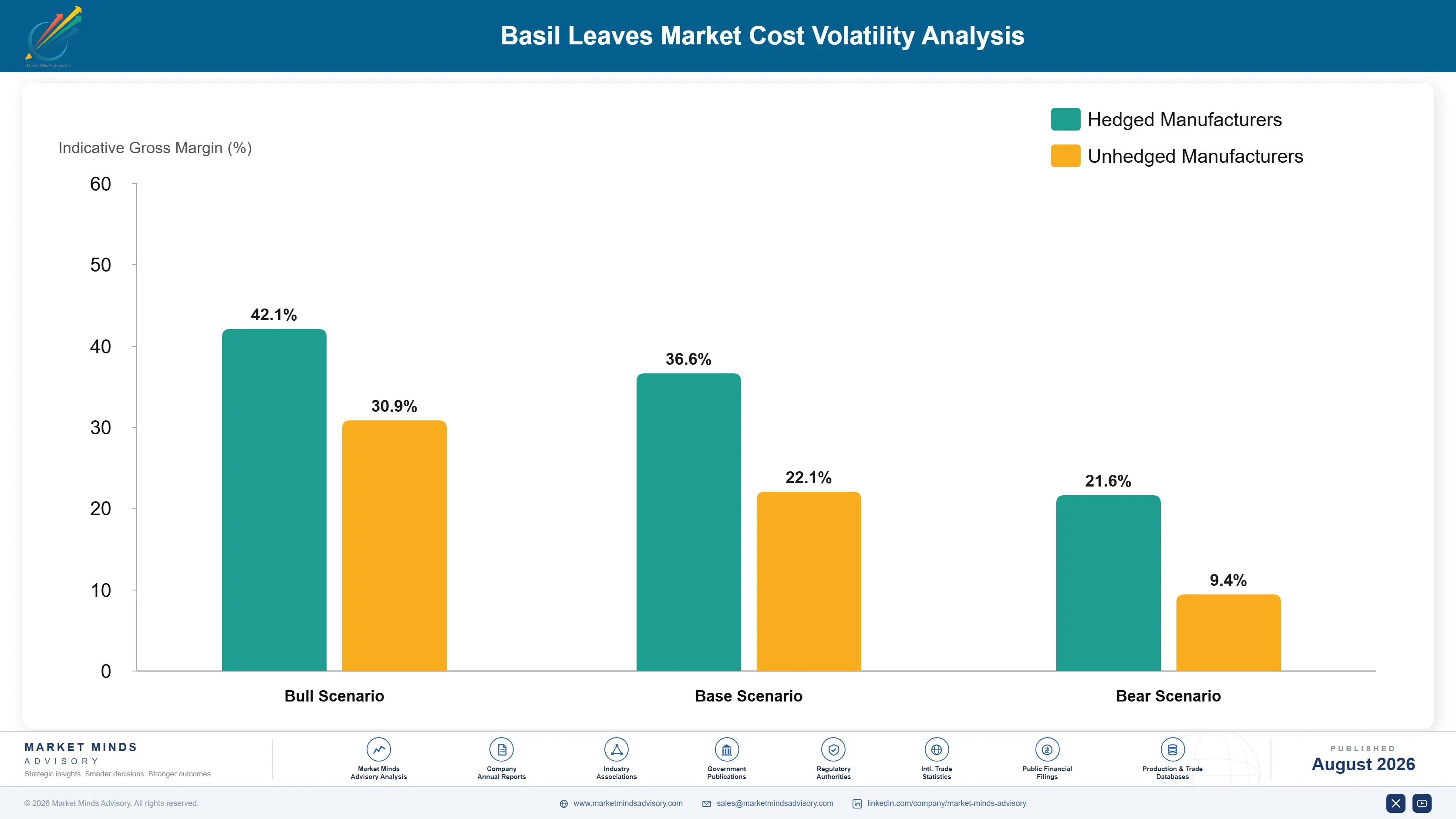
Hand harvesting labor and steam distillation energy together represent roughly 58 percent of cost of goods sold for basil essential oil, sourced primarily from smallholder farms and mid-sized distillation facilities concentrated in India and Egypt, with natural gas or biomass fuel powering most distillation steam generation across both origins. with smaller distillation volumes also processed across parts of Eastern Europe and North Africa.
Natural gas price spikes following supply disruptions in 2022 sharply raised distillation costs across Egyptian processing facilities, a volatility event documented in International Energy Agency energy price reporting, forcing several mid-sized distillers to temporarily idle capacity and shift toward biomass fuel sources that carry lower but less consistent energy output per batch. Several mid-sized Egyptian distillers reported margin compression continuing into 2023 as fuel costs remained elevated relative to pre-disruption baseline levels.

Exposure varies considerably by player type: large processors with owned distillation infrastructure and diversified fuel sourcing have absorbed volatility more easily than smaller independent distillers reliant on a single fuel source, creating a cost disadvantage that is accelerating consolidation of smaller distillation operations into larger cooperative-owned facilities across both India and Egypt. This consolidation trend is expected to continue as energy price volatility persists across the region.
basil-leaves-market-cost-volatility-analysis-1787463056173

Biomass Fuel Diversification for Distillation Energy

Larger distillers are converting steam generation systems to accept both natural gas and agricultural biomass residue, reducing exposure to natural gas price spikes while using otherwise low-value crop waste as a supplementary fuel source, a mitigation now spreading from early adopters to mid-sized cooperative facilities across both India and Egypt. This conversion typically pays back its capital cost within two to three operating seasons.

Cooperative-Owned Distillation to Spread Fixed Costs

Smallholder growers pooling resources into cooperative-owned distillation facilities spread fixed energy and equipment costs across a larger processing volume than any individual grower could justify independently, improving cost resilience during energy price volatility while preserving smallholder ownership of the higher-margin processing step. Several cooperatives report meaningful improvements in operating margin stability within the first year of adoption.

Mechanized Harvesting Trials to Reduce Labor Dependence

Several larger growing operations in India are piloting mechanized harvesting equipment adapted from other leafy crop harvesting systems, aiming to reduce labor cost exposure though early trials show meaningful leaf damage rates that currently limit mechanized harvest to lower-value distillation-bound crop rather than premium fresh leaf. Wider adoption will likely depend on further reductions in leaf damage rates during mechanized cutting.

Portfolio Architecture for Margin Defence

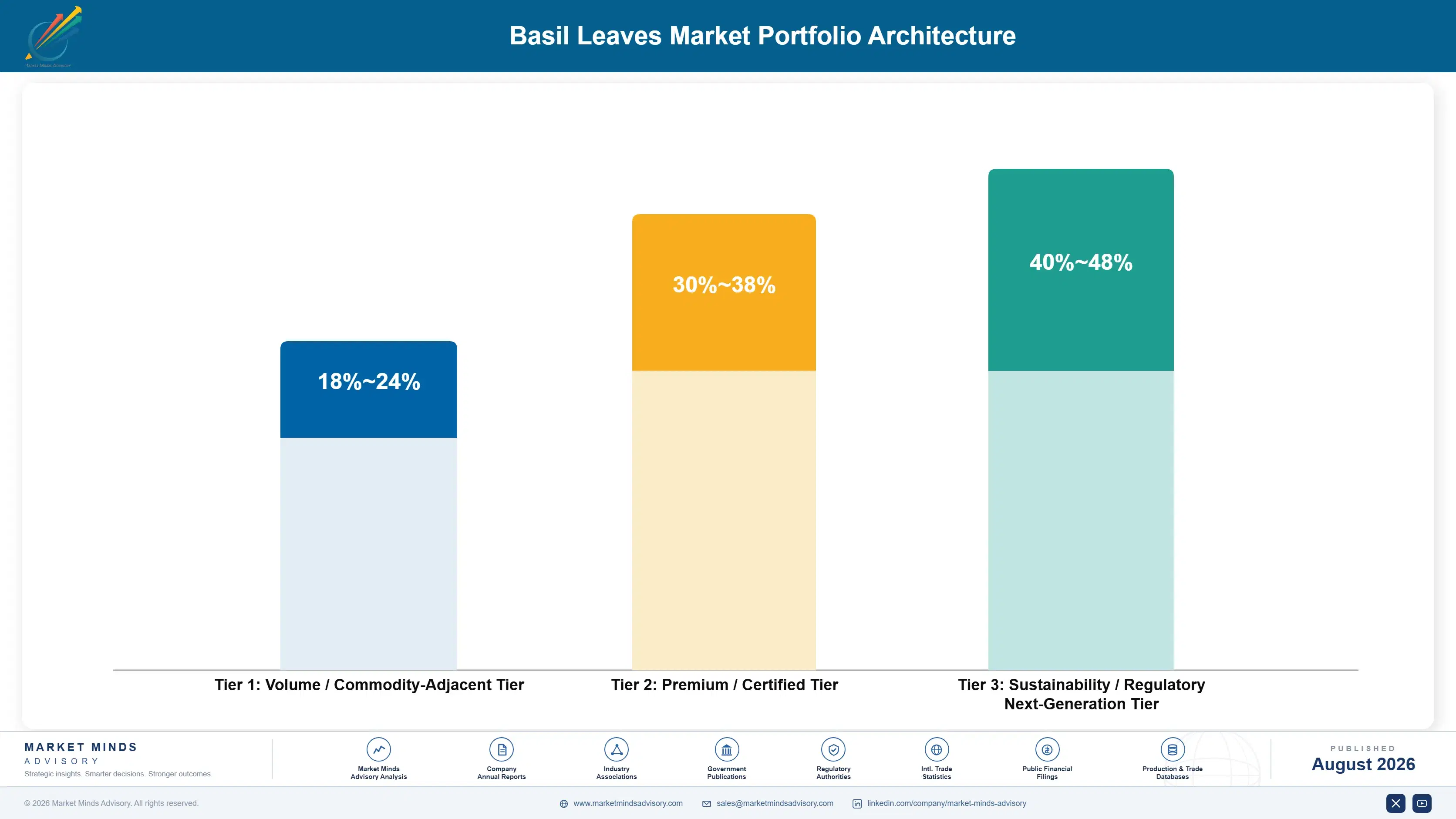
Portfolio economics split across three tiers: commodity dried and bulk essential oil competing largely on price and volume, certified traceable fresh and oil products commanding premium pricing from compliance focused buyers, and emerging beverage grade seed and specialty extract formats capturing the highest margin as new buyer categories scale. This split increasingly determines which growers can access buyer-funded agronomic support programs.
The tension between volume and premium positioning plays out differently across product forms: bulk dried basil faces intense price competition from multiple growing origins, while certified fresh and traceable essential oil retain pricing power tied to compliance requirements that bulk buyers cannot avoid indefinitely as European standards continue tightening. Buyers in the premium tier are also beginning to fund grower certification costs directly to secure preferential access.

High value margin pools concentrate in beverage grade seed and single-origin traceable essential oil sold directly to formulators, where buyers exhibit lower price sensitivity and higher willingness to pay for documented supply chain traceability than in commodity dried herb channels. Processors without direct formulator relationships largely remain confined to lower-margin commodity channels.

Volume / Commodity-Adjacent Tier

Bulk dried basil and undifferentiated essential oil sold through commodity trading channels competing primarily on price. Margins here depend heavily on freight efficiency and scale rather than on any differentiated sourcing story.
Gross Margin: 18-24%

Premium / Certified Tier

Certified pesticide-residue-tested fresh basil and traceable essential oil commanding premium pricing from compliance-focused European and North American buyers. Buyers in this tier increasingly require documented chain of custody back to the specific originating farm.
Gross Margin: 30-38%

Sustainability / Regulatory / Next-Generation Tier

Beverage grade cleaned basil seed and single-origin extracts serving functional beverage and personal care formulators directly. Capacity here remains limited, keeping this tier the most supply constrained across the category currently.
Gross Margin: 40-48%
basil-leaves-market-portfolio-architecture-1787463056691

High-value Sub-segments and Strategic Watch-out

Beverage Grade Basil Seed

Scaling fastest as Western functional beverage brands adopt the ingredient, this segment commands the highest per-unit pricing in the category but remains constrained by limited food safety certified cleaning and grading capacity across current supplying origins. Processors investing early in dedicated cleaning lines are best positioned to capture this growth.
Gross Margin: 42-50%

Single-Origin Traceable Essential Oil

Personal care formulators increasingly demand documented single-origin traceability, supporting durable pricing power for distillers investing in direct grower contracts over those relying on aggregated spot market leaf purchases lacking clear origin documentation. Distillers without direct grower relationships increasingly struggle to meet this documentation requirement.
Gross Margin: 35-42%

Commodity Dried Basil for Food Manufacturing

The largest volume segment by tonnage, competing primarily on price for use in packaged sauce and seasoning manufacturing, and increasingly exposed to substitution from lower-cost dried herb origins entering the market. Buyers here remain highly price sensitive, limiting the pricing power any single supplier can sustain.
Gross Margin: 16-22%

Uncertified Smallholder Export Volume

Facing rising rejection risk as European pesticide residue standards tighten further, this segment requires urgent cooperative certification investment or faces continued exclusion from the highest-value export channels over the coming years. Cooperative-led certification programs offer the most realistic path back into higher-value channels.
Gross Margin: 14-20%

Three-Channel Crop Monetization

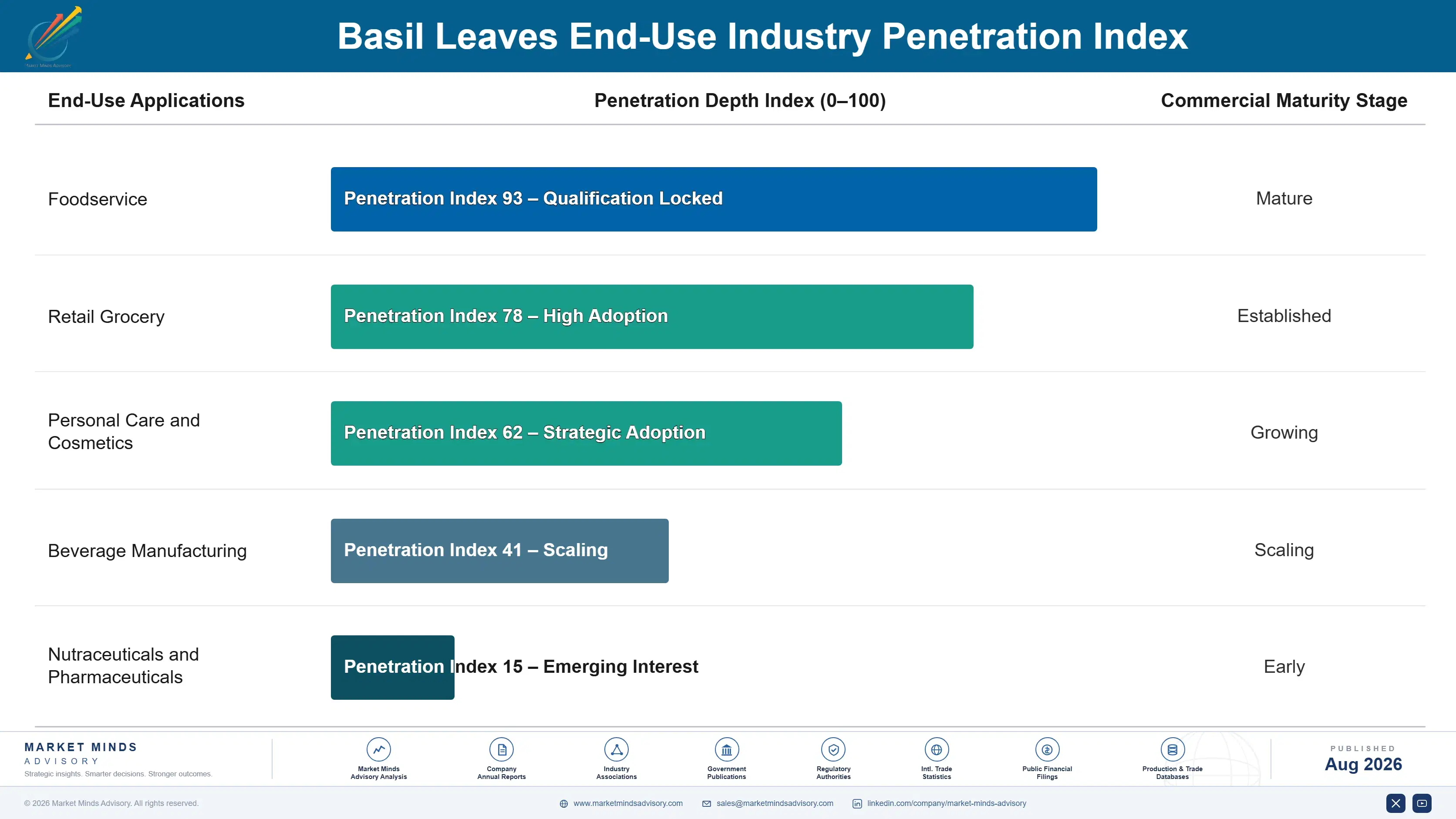
Demand in this category increasingly resembles a shared-crop monetization model rather than a single herb market, since the same basil harvest can be routed toward fresh sale, distillation, or seed processing depending on grade and buyer demand, creating a form of built-in revenue diversification for growers who invest in multi-product processing flexibility rather than committing to a single end use exclusively. Growers who diversify across all three channels are better insulated from single-market price swings.
Adoption depth varies considerably by end use vertical: personal care formulators show the deepest and most consistent adoption of traceability and certification requirements, foodservice shows moderate adoption tied to specific menu applications and cultivar preferences, and beverage bottlers remain the shallowest but fastest growing adopter, still scaling supply relationships to match rapidly expanding retail distribution. Beverage bottlers are investing heavily in supply relationships to close this adoption gap quickly.

Younger buyers entering the beverage and wellness categories increasingly expect functional and traceability claims as a baseline expectation, a generational shift that is pulling basil further from its traditional identity as a purely culinary herb toward a multi-use functional ingredient across several distinct industries simultaneously. Processors slow to adapt risk losing relevance with these increasingly wellness-oriented buyers.
basil-leaves-market-end-use-penetration-index-1787463057206

Where Basil Supply Investment Should Concentrate

These are among the four positions where our research anticipates prominent divergence between winners and laggards over the coming forecast period. Each is grounded in the demand model, the regulatory perimeter, and the announced capacity pipeline.
01 / MULTI-PRODUCT PROCESSING INVESTMENT

Build flexible processing before committing to a single end use

Basil's three converging demand streams reward processors able to route the same harvest toward fresh sale, distillation, or seed cleaning depending on real time price signals, rather than committing fixed capacity to a single end market exclusively. Cooperative facilities that made this investment early have already captured blended margin improvements unavailable to single-purpose competitors. This advantage will likely widen as beverage and personal care buyers continue scaling demand faster than traditional culinary channels, rewarding early flexible processing investment disproportionately over time.
02 / CERTIFICATION AND COMPLIANCE STRATEGY

Secure third-party residue certification ahead of tightening standards

European pesticide residue standards are tightening faster than many smallholder cooperatives can currently adapt, making early certification investment a more durable market access advantage than competing purely on price. Cooperatives that certified early have avoided the rejection rates now affecting a meaningful share of uncertified shipments at European ports of entry, a share now approaching one in ten shipments overall. Growers delaying certification investment risk permanent exclusion from the highest-value export channels as compliance requirements continue tightening across major destination markets.
03 / BEVERAGE CHANNEL ENTRY TIMING

Enter beverage grade seed processing now, not after scale arrives

The basil seed beverage segment remains supply constrained rather than demand constrained, meaning early investment in food safety certified cleaning and grading capacity captures disproportionate value before competing processors catch up to current demand levels. Processors in Thailand and Vietnam that invested early have already signed multi-year agreements with Western beverage brands entering new markets. Waiting for the segment to mature further will mean competing for capacity investment against better-capitalized entrants with established beverage brand relationships and greater balance sheet capacity already in place.
04 / GROWER CONTRACT STRUCTURING

Shift toward direct multi-year grower contracts over spot purchasing

Direct multi-year contracts between buyers and growing cooperatives are increasingly displacing spot market aggregator purchasing as traceability and supply consistency requirements tighten across personal care and beverage end markets. Growers with contract relationships already report more predictable revenue and access to buyer-funded agronomic support unavailable to spot market sellers. Buyers slow to establish direct contracts risk losing preferential access to the most reliable certified growing cooperatives as competing buyers lock in supply first across the same limited pool of certified cooperatives.

Engagement Snapshot From the Field

A live engagement with an industry participant carrying material or product regulatory and market exposure ahead of a defining policy shift, showing how our research translates into a defensible multi-year portfolio strategy.
MARKET MINDS ADVISORY · CLIENT ENGAGEMENT SUMMARY
Basil Leaves Producer Strategic Portfolio Review and Transition Roadmap 2026·Investment Scenario on Basil Leaves Exposure Evaluation 2025-26
CLIENT PROFILE
The client is a grower cooperative in southern India representing approximately 1,400 smallholder basil farmers, generating an estimated 34 million dollars in annual combined member revenue (client-reported, unverified by MMA), historically selling fresh and dried basil into domestic wholesale markets with limited direct access to export or specialty processing buyers. The cooperative had previously relied on a single regional wholesale buyer for the majority of its annual sales volume.
STRATEGIC CHALLENGE
Facing stagnant domestic wholesale pricing and limited leverage in price negotiations, the cooperative needed to diversify member revenue across essential oil distillation and beverage grade seed processing without the capital or technical expertise to evaluate which investment would deliver the strongest returns for its members within a constrained multi-year investment timeline.
MMA APPROACH
MMA conducted a comparative feasibility assessment of essential oil distillation versus beverage grade seed processing investment, incorporating buyer interviews, capital cost modeling, and regional competitive benchmarking, then developed a phased three year diversification roadmap sequenced to the cooperative's available capital and existing member skill base. Recommendations were stress tested against three different capital availability scenarios.
KEY FINDINGS
  1. Beverage grade seed processing offered a faster payback period than essential oil distillation given lower required capital investment per unit of output capacity.
  2. Existing member relationships with wholesale buyers could be preserved while adding parallel seed processing capacity without disrupting current revenue streams. during the transition period.
  3. Direct contracts with two Western beverage brands were feasible within eighteen months given the cooperative's existing organic certification status. pending final buyer due diligence review.
  4. Essential oil distillation remained attractive as a second-phase investment once initial seed processing revenue established stronger cooperative cash reserves. once initial capital investment is recovered.
CLIENT PROFILE
The client is a grower cooperative in southern India representing approximately 1,400 smallholder basil farmers, generating an estimated 34 million dollars in annual combined member revenue (client-reported, unverified by MMA), historically selling fresh and dried basil into domestic wholesale markets with limited direct access to export or specialty processing buyers. The cooperative had previously relied on a single regional wholesale buyer for the majority of its annual sales volume.
STRATEGIC CHALLENGE
Facing stagnant domestic wholesale pricing and limited leverage in price negotiations, the cooperative needed to diversify member revenue across essential oil distillation and beverage grade seed processing without the capital or technical expertise to evaluate which investment would deliver the strongest returns for its members within a constrained multi-year investment timeline.
MMA APPROACH
MMA conducted a comparative feasibility assessment of essential oil distillation versus beverage grade seed processing investment, incorporating buyer interviews, capital cost modeling, and regional competitive benchmarking, then developed a phased three year diversification roadmap sequenced to the cooperative's available capital and existing member skill base. Recommendations were stress tested against three different capital availability scenarios.
KEY FINDINGS
  1. Beverage grade seed processing offered a faster payback period than essential oil distillation given lower required capital investment per unit of output capacity.
  2. Existing member relationships with wholesale buyers could be preserved while adding parallel seed processing capacity without disrupting current revenue streams. during the transition period.
  3. Direct contracts with two Western beverage brands were feasible within eighteen months given the cooperative's existing organic certification status. pending final buyer due diligence review.
  4. Essential oil distillation remained attractive as a second-phase investment once initial seed processing revenue established stronger cooperative cash reserves. once initial capital investment is recovered.
RECOMMENDED STRATEGY
Phase 1: Phase 1 (Months 1 to 6): Secure food safety certification and install initial beverage grade seed cleaning capacity. with technical support from an external food safety consultant. Phase 2: Phase 2 (Months 7 to 18): Negotiate direct multi-year contracts with Western beverage brands entering export markets. while maintaining existing wholesale volume commitments. Phase 3: Phase 3 (Months 19 to 36): Invest distributed profits into shared distillation infrastructure for essential oil diversification. to further diversify member revenue streams.
OUTCOME
Within eighteen months, the cooperative reported securing two direct beverage brand contracts representing roughly 22 percent of total member revenue and achieving a 31 percent increase in blended average price received per kilogram across the diversified product mix (client-reported, unverified by MMA). Member satisfaction with the cooperative's leadership also improved measurably during the same period.

Frequently Asked Questions

Foundational context covering the market sizes, CAGR, scope, country, region and competition that inform every finding below. This section is provided to cover basics and most often pre-purchase conversations, answered from the MMA Primary Research Dataset.

What is the current size of the Basil Leaves Market?

The Basil Leaves Market is valued at approximately 2.6 billion dollars in 2025, spanning fresh, dried, essential oil, and beverage seed product forms across global food, beverage, and personal care end uses.

How large will the Basil Leaves Market be by 2036?

The market is projected to reach roughly 5.15 billion dollars by 2036, driven by expanding basil seed beverage adoption and rising natural personal care demand for essential oil.

What is the CAGR for the Basil Leaves Market 2026 to 2036?

The market is expected to grow at a compound annual growth rate of approximately 6.4 percent between 2026 and 2036, supported by diversifying end use demand across three distinct product channels.

Which segment is growing fastest?

Basil seeds for functional beverages are the fastest growing segment, expanding at roughly 1.6 times the overall market rate as Western beverage brands scale distribution beyond their traditional Asian markets.

Who are the major companies in the Basil Leaves Market?

Leading companies include McCormick and Company, Kerry Group, Naturex, Van Drunen Farms, and Kanegrade, each expanding sourcing and processing capacity across multiple product forms. across both mature and emerging export markets.

Which country is growing fastest?

Vietnam is the fastest growing single country, as its basil seed processing infrastructure scales rapidly to serve export contracts with Western functional beverage brands. ahead of most competing processing origins.

Report Segmentation Architecture

The full report scope spans multiple orthogonal segmentation dimensions, with cross-tabulated demand data provided for each dimension pair. Coverage extends further to regional breakdowns, trend trajectories, and the competitive detail needed to support segment-level decision-making.

By Product Form

  • Fresh Basil
  • Dried Basil
  • Basil Essential Oil
  • Frozen Basil Puree and Paste
  • Basil Extracts
  • Basil Seeds

By End-Use Industry

  • Foodservice
  • Retail Grocery
  • Personal Care and Cosmetics
  • Beverage Manufacturing
  • Nutraceuticals and Pharmaceuticals

By Commercial Dimension

  • Direct Grower Contract
  • Spot Market Trading
  • Cooperative Aggregation
  • Vertically Integrated Buyer

By Region

  • North America
  • Western Europe
  • East Asia
  • South Asia and Pacific
  • Latin America
  • Middle East and Africa
  • Eastern Europe

Scope, Methodology, and Coverage

Every figure in this report is reproducible from documented input assumptions. The scope below maps the historical period, the forecast horizon, the segmentation dimensions, and the countries covered, alongside the underlying primary and qualitative methodology.
Historical Period
2020 to 2025
Forecast Period
2026 to 2036
Base Year
2025 (USD billions; MMA Primary Research Dataset, August 2026)
Market Definition
The basil leaves market covers fresh, dried, and processed basil in the form of leaves, puree, extracts, essential oil, and edible seeds sold into food, beverage, cosmetic, and nutraceutical end uses. It excludes potted ornamental basil plants sold through garden retail and excludes basil incorporated into finished packaged sauces where basil is not the primary listed ingredient.
Quantitative Units
USD billions (current prices); metric tons for select volume metrics
Segmentation Dimensions
By Product Form; By End-Use Industry; By Commercial Dimension; By Region
Regions Covered
North America, Western Europe, East Asia, South Asia and Pacific, Latin America, Middle East and Africa, Eastern Europe
Countries Covered
USA, China, Germany, France, UK, Japan, South Korea, India, Australia, Canada, Brazil, Mexico, Indonesia, Vietnam, Thailand, Malaysia, UAE, Saudi Arabia, South Africa, Nigeria, Turkey, Poland, Netherlands, Italy, Spain, Sweden, Switzerland, Argentina, Colombia, Singapore, and additional markets relevant to this sector
Key Companies Profiled
McCormick and Company, Kerry Group, Naturex (Givaudan), Van Drunen Farms, Kanegrade, Foodchem International, Synthite Industries, Ultra International, Vishwas Aromatics, Hunan Sunfull Bio-Tech, Guangxi Bailong Huasheng, Ozone Naturals, Bio Botanica, Robertet Group, Ungerer and Company, Aromel SAS, Falcon Aromatics, Marudhar Extracts, Naturence Ingredients, Herbi Care Enterprises
Quantitative Methodology
Primary survey, n=3,800 respondents, Q4 2025, six countries; demand-side model with trade association cross-validation
Qualitative Methodology
47 expert interviews, Q4 2025; applied to validate demand model assumptions, identify emerging dynamics, and assess competitive positioning
Report Format
PDF and XLSX data workbook (Word format preview document)
Publisher
Market Minds Advisory
Report Code
MMA-2026-AGR-202
Published
August 2026
Contact
sales@marketmindsadvisory.com | www.marketmindsadvisory.com

Purchase the full Basil Leaves Market Report (2026 to 2036).

The full report delivers a complete quantitative and qualitative assessment of the basil leaves market, including detailed segment level forecasts through 2036, regional analyses across all seven covered geographies, and profiles of twenty leading processors and ingredient suppliers. It incorporates primary survey data from 3,800 respondents and 47 expert interviews conducted in the fourth quarter of 2025. Buyers receive editable data tables, a customizable Excel forecast model, and access to MMA analysts for follow up questions during a defined post purchase support window. The report also includes detailed input cost sensitivity analysis calibrated to current energy and labor cost benchmarks.
Detailed segment-level market forecasts through 2036
All seven regional market analyses included
Twenty profiled leading processors and suppliers
Editable Excel based forecast data model
Primary survey and expert interview data
Extended post-purchase MMA analyst support access

Built For The People Who Decide

From boardroom strategy to bench-side execution, this report is read cover-to-cover by leaders shaping the next decade of their industry, turning demand scenarios, market dynamics and valuation benchmarks into decisions.
CXOs/ Presidents/ VPs/ Managers
M&A and Corporate Development
Strategy Teams and R&D Heads
Procurement and Product Directors
Regulatory and Compliance Leaders
Investor Relations and Equity Analysts