
Market Minds Advisory
Banana Milk Market

Banana Milk Market: Flavored Dairy, Plant-Based, and Functional Beverage Demand Through 2036

Banana milk built its global reputation on South Korea's Binggrae carton, but genuinely competitive economics now split between dairy-based traditionalists, protein-fortified functional entrants, and plant-based challengers chasing lactose-free demand across three very different retail channels.

Lead Analyst

Lisa Gevelber

Published

September 2026

Make Smarter Decisions with Customized Research Insights

Request a free sample report and evaluate market opportunities, growth trends, and competitive dynamics relevant to your business needs.

2025 MARKET VALUE$3.2BMarket Size 2025
2036 FORECAST VALUE$6.6BBase Case , 2026 to 2036
CAGR 2026 TO 20366.8 %Bull 8.1% / Bear 5.5%
INCREMENTAL OPPORTUNITY$3.2BNet 10- year value creation
EXPANSION MULTIPLE1.93x2036 value over 2026 base
Strategic Levers
M&A Pipeline
Regional Outlook
Country Rankings
Competitive Intelligence
Segmental Deep-dive
Call-Us : 91 93563 13602

Executive Snapshot and Market Trajectory

Banana milk has outgrown its identity as a Korean convenience-store staple: protein-fortified and plant-based versions now sell in Western grocery chains as a functional beverage, and category growth increasingly tracks fitness and lactose-free trends rather than the nostalgia marketing that built the original product.
Plant-based banana milk is now the fastest-growing format, expanding at roughly 9.5% annually as lactose-free and vegan buyers seek an alternative to traditional dairy-based cartons, nearly one and a half times the wider market's pace. East Asia anchors close to three in ten dollars of global value through South Korea and Vietnam's entrenched dairy retail culture, while functional and protein-fortified variants pull fitness-oriented consumers across North American and Western European grocery and convenience channels simultaneously.
Competitive intensity concentrates around a handful of established Korean and Vietnamese dairy processors who built distribution decades before global interest emerged, even as newer plant-based entrants such as Oatly chase the same lactose-free consumer with a different supply chain. Regulatory attention on added sugar content and clean-label claims is pushing reformulation across every format, while retail buyers increasingly demand traceable banana sourcing tied to sustainability commitments branded manufacturers have made.
Market Definition
The banana milk market covers commercial production and retail sale of banana-flavored milk beverages, including dairy-based, plant-based, powdered, and functional fortified formats sold as ready-to-drink or reconstituted beverages. It excludes fresh banana fruit sales, banana-flavored yogurt, and banana-based smoothies blended fresh at point of sale.
Base Year Value
$3.2B in 2025 (MMA Primary Research Dataset, August 2026)
Forecast Period
2026 to 2036, eleven discrete annual values
CAGR
6.8% base case. Bull 8.1%. Bear 5.5%.
Fastest Growth Segment
Plant-Based Banana Milk: 9.5% CAGR
Fastest Growth Country
Vietnam: 11.2% CAGR
Fastest Growth Region
South Asia and Pacific: 8.9% CAGR
Largest Region
East Asia: 30% of 2025 global value
Market Leaders
Binggrae Co Ltd, Maeil Dairies Co Ltd, Vietnam Dairy Products JSC, Meiji Holdings Co Ltd, Lotte Foods Co Ltd. Source: MMA Analysis based on company annual reports.
Primary Survey
n=3,800 procurement and R&D decision-makers, Q4 2025, six countries
Methodology
Demand-side build-up, cross-validated against public data, 47 expert interviews

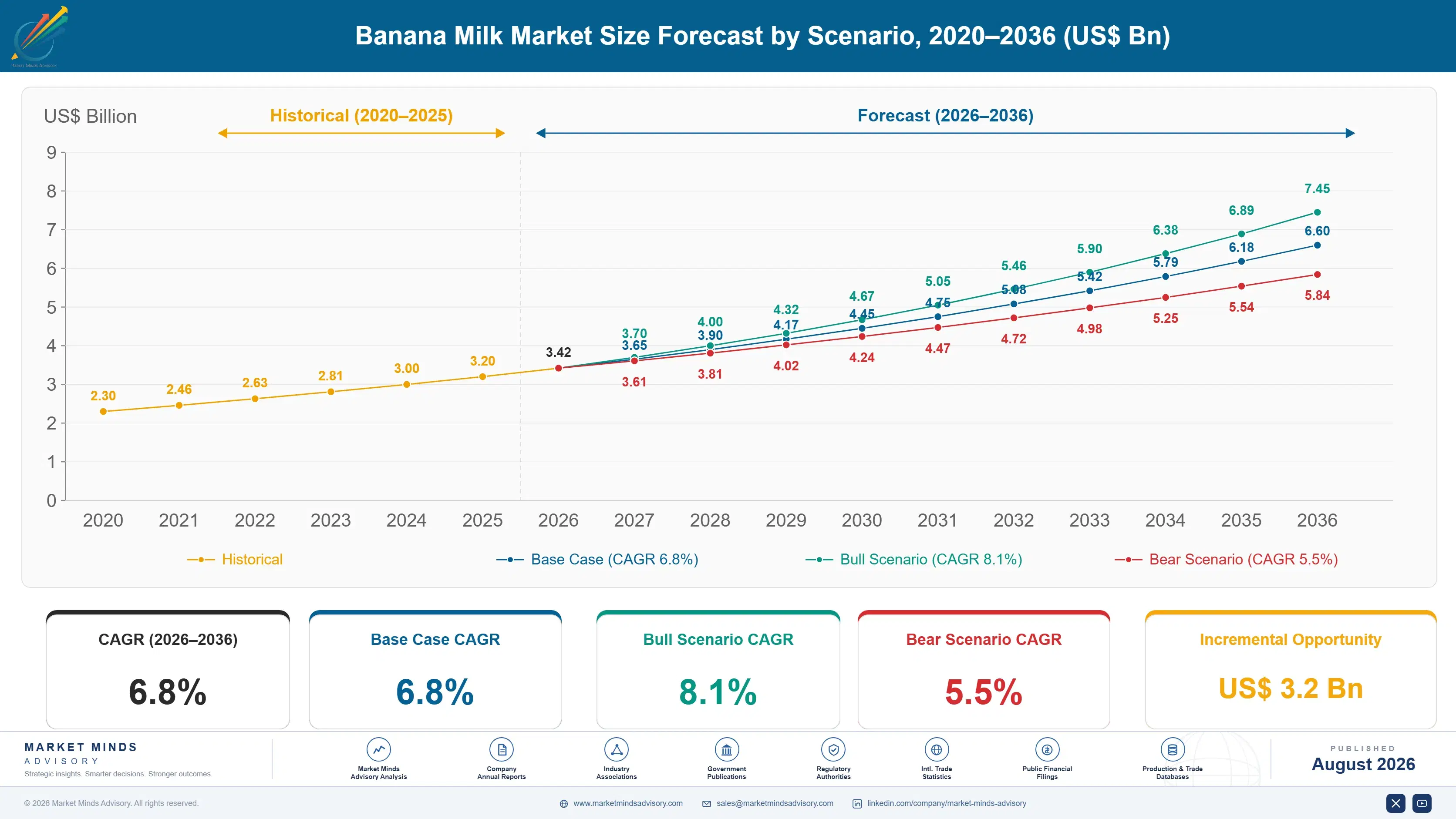
Banana Milk Market Forecast Scenarios

banana-milk-market-trends-growth-size-forecast-scenario-1787462938238
Banana milk demand grew unevenly from 2020 to 2025, as pandemic-era grocery stockpiling briefly lifted shelf-stable UHT sales before growth normalized around core Korean and Vietnamese dairy consumption. Social media exposure through 2023 and 2024 introduced the category to Western consumers previously unfamiliar with it, accelerating growth in the later years. The market grew at a 6.0% historical CAGR from 2020 to 2025.
The base case carries banana milk to a 6.8% CAGR through 2036 on three mechanisms. First, plant-based reformulation keeps pulling lactose-free and vegan consumers who previously avoided the traditional dairy-based format entirely. Second, functional variants expand distribution into Western fitness retail channels that never previously stocked banana milk. Third, Korean and Vietnamese dairy processors keep investing in export-oriented packaging and cold-chain logistics to meet international demand that social media exposure created faster than infrastructure could originally absorb.
The bull case, 8.1%, assumes plant-based and functional variants sustain viral social media momentum long enough to establish permanent Western retail shelf space beyond a passing trend. The bear case, 5.5%, assumes interest fades as quickly as it arrived, leaving core Korean and Vietnamese dairy consumption as the category's only durable demand base while newer export volume stalls.

Banana Milk's Shift From Regional Staple to Global Category

Banana milk's commercial identity is splitting three ways at once. Traditional dairy-based cartons, led by South Korea's Binggrae, still generate most category revenue through convenience store and grocery channels built over five decades. Plant-based alternatives target lactose-free and vegan consumers who previously had no banana milk option at all, while functional protein-fortified variants chase fitness-oriented buyers willing to pay a real premium for added nutritional claims and clean, verifiable ingredient labels.
MARKET CONCENTRATIONCR5: 48%Top five brands hold roughly half of global sales
AVERAGE SELLING PRICEUSD 1.85 per literRetail pricing varies sharply between dairy and plant based
TOP CONSUMING COUNTRYSouth Korea: 21% of global volumeKorean convenience retail still anchors category consumption patterns broadly
EXPORT TRADE INTENSITY22% of output crosses a borderCold chain logistics increasingly link Asian output to Western buyers
DAIRY INPUT COST SHARE32% to 40% of COGSRaw milk price swings drive most margin volatility directly
PLANT-BASED PRICE PREMIUM35% to 55% over dairy baseOat and almond bases cost more than milk
Buyers rarely cross between formats because taste, texture, and dietary need each gate purchasing differently. Dairy-based loyalists prize the creamy, nostalgic flavor that built the category's reputation across East Asia, and few plant-based substitutes replicate it convincingly yet. Functional buyers care more about protein content and added ingredients than flavor authenticity, giving fortified variants room to compete on nutrition labels rather than taste comparison.
Over the next decade, plant-based reformulation should keep gaining share as dairy alternatives improve in taste and texture, while functional fortification spreads into new retail categories entirely. Korean and Vietnamese dairy processors that built the category's original distribution infrastructure remain best positioned to capture export demand, provided they invest in cold-chain logistics and reformulated recipes fast enough.
"Banana milk stopped being a nostalgia purchase the moment a protein-fortified version showed up next to the sports drinks. That's a different customer entirely, and most legacy producers haven't caught up."
Director, Beverage and Functional Nutrition Practice · MMA Food and Beverage Practice · August 2026

Market Trends

Social Media Exposure Drives Western Retail Listings

Viral social media coverage through 2023 and 2024 introduced banana milk to Western consumers who had never encountered the Korean convenience-store staple, driving retailers across the United States and United Kingdom to list imported and domestically produced versions for the first time. Major grocery chains added dedicated banana milk shelf space in dairy and plant-based beverage aisles, a listing decision retailers rarely reverse once search volume proves sustained interest rather than a passing spike. Binggrae reported export gains tied directly to this exposure, and several smaller domestic producers launched competing products to capture newly created Western shelf space.
Market Impact: Plant-based segment grows nearly 9.5% yearly

Protein Fortification Expands Into Sports Nutrition Retail

Functional beverage brands have begun fortifying banana milk with added whey or plant protein, positioning it as a recovery drink alongside traditional sports nutrition products rather than as a dairy category beverage. Retailers increasingly stock these fortified versions in sports nutrition and functional beverage sections rather than traditional dairy aisles, exposing the product to an entirely new buyer who never previously considered banana milk at all. Several fitness-focused direct-to-consumer brands launched fortified banana milk specifically targeting gym-goers and post-workout recovery occasions, a positioning that commands meaningfully higher retail pricing than traditional dairy-based cartons ever achieved.
Market Impact: Western retail listings grow 28% yearly

Market Opportunities and Growth Drivers

Lactose-Free Demand Pulls Plant-Based Reformulation Forward

Lactose intolerance affects a majority of adults across large parts of East Asia and Southeast Asia, the very regions where traditional dairy-based banana milk originated and still sells the most volume, creating an unusually large addressable population for plant-based reformulation. Oat, almond, and soy-based variants have expanded rapidly as producers recognized that reformulating an already-popular flavor profile carries less launch risk than introducing an entirely new plant-based beverage concept. Established Korean dairy processors have begun licensing plant-based production technology rather than developing it independently, accelerating availability across markets that previously offered only dairy-based versions.
Market Impact: Texture gap limits crossover by 20%

Western Grocery Retailers Add Dedicated Category Shelf Space

Major grocery chains across North America and Western Europe have added dedicated banana milk shelf space following sustained consumer search volume and social media coverage, a listing decision that meaningfully expands addressable market beyond the Asian diaspora communities that previously drove most Western sales. Retailers report banana milk performing well against comparable flavored dairy and plant-based beverage categories, encouraging further shelf space expansion into 2026 and beyond. That retail validation gives both established Korean exporters and newer domestic Western producers a credible distribution channel that did not exist just a few years earlier, changing category economics.
Market Impact: Sugar rules affect 30% of formulations

Market Restraints and Challenges

Authentic Flavor Replication Limits Plant-Based Substitution

Plant-based banana milk struggles to replicate the creamy mouthfeel and flavor profile that built dairy-based banana milk's reputation across East Asia, since oat and almond bases carry different fat content and protein structure than dairy milk. The root cause is chemical: dairy fat globules create a mouthfeel that plant-based emulsifiers approximate but rarely match exactly, leaving taste-sensitive consumers unconvinced regardless of marketing investment. That gap concentrates plant-based adoption among lactose-intolerant buyers who prioritize digestibility over authentic taste. Producers are responding by investing in improved fermentation and protein-blending techniques designed to close the remaining texture gap.
Market Impact: Adds roughly USD 40 million exports

Added Sugar Content Draws Regulatory And Retailer Scrutiny

Traditional banana milk formulations carry meaningfully higher added sugar content than plain dairy milk, drawing scrutiny as sugar reduction regulations tighten across multiple markets including South Korea's own nutrition labeling requirements. The underlying cause is that banana flavor concentrate historically required substantial added sugar to achieve the sweetness consumers associate with the category, a choice made decades before sugar reduction became a retailer priority. Some major retailers now require reduced-sugar reformulation as a condition of continued shelf placement, pressuring legacy producers to reformulate a recipe unchanged since launch, responding with natural sweetener substitution and smaller portion sizing.
Market Impact: Fortified variants command 35% price premium
3 additional market trends, 3 additional growth drivers, and 3 additional restraints and challenges are covered in the full report. Contact sales@marketmindsadvisory.com to access the complete intelligence.

Segment CAGR and Growth Architecture

Segmentation follows product format, a single classification logic separating banana milk by base ingredient, processing method, and nutritional positioning. Dairy-based, plant-based, UHT shelf-stable, refrigerated fresh, powdered concentrate, and functional fortified formats each carry distinct production economics, keeping upstream ingredient sourcing and downstream retail positioning from blurring together, since each format targets a genuinely different buyer motivation entirely.
banana-milk-market-trends-growth-market-share-analysis-1787462938773

Plant-Based Banana Milk

Plant-based banana milk is growing at 9.5% annually, nearly one and a half times the wider market's 6.8% pace, as lactose-intolerant and vegan consumers across East Asia and increasingly North America seek an alternative to traditional dairy-based cartons. Oat, almond, and soy bases each carry different cost and texture tradeoffs, with oat currently commanding the strongest consumer preference for its neutral flavor profile that pairs well with banana flavoring. Established Korean dairy processors have begun licensing plant-based production technology rather than developing it independently, accelerating availability across markets that previously only offered dairy-based versions. Retail pricing runs 35% to 55% above traditional dairy-based cartons, reflecting higher input costs and a willingness among target consumers to pay for dietary accommodation.
CAGR 9.5%

Functional and Fortified Banana Milk

Functional and fortified banana milk grows at 8.7% annually, driven by protein and probiotic fortification that repositions the category from a nostalgic snack beverage into a recovery and nutrition product sold alongside sports drinks. Fitness-focused direct-to-consumer brands launched fortified versions specifically targeting gym-goers and post-workout recovery occasions, a positioning that commands meaningfully higher retail pricing than traditional formulations ever achieved. Major retailers increasingly stock these variants in sports nutrition sections rather than traditional dairy aisles, exposing the product to an entirely new buyer demographic. Established dairy processors are responding by launching their own fortified lines rather than ceding the fastest-growing functional positioning entirely to newer direct-to-consumer entrants competing on nutrition credentials alone.
CAGR 8.7%
Full segment breakdown across 6 segments available in the complete report.

Regional Architecture and Country Demand Map

Banana milk production and consumption concentrate in East Asia, anchored by South Korea's decades-old convenience retail culture and Vietnam's growing dairy manufacturing base. North America and Western Europe carry disproportionate demand growth relative to production share, as social media exposure pulls Western retail interest well ahead of local manufacturing capacity.

North America

North America's banana milk demand grew from near zero five years ago into a genuine retail category, driven initially by Korean diaspora grocery stores and now by mainstream chains responding to viral social media coverage. United States retailers added dedicated shelf space through 2023 and 2024, stocking both imported Korean product and newer domestically produced plant-based and functional variants targeting fitness-oriented consumers. Canada follows a similar pattern at smaller scale, concentrated in urban grocery chains near large Korean and Vietnamese immigrant communities. Growth here outpaces the global average as retail listings continue expanding faster than in almost any other region, reflecting how recently the category entered mainstream Western awareness, with several chains adding permanent shelf sets rather than seasonal placement.
Share: 22% | CAGR: 7.0% (2026 to 2036)

Western Europe

Western Europe's banana milk demand concentrates in the United Kingdom and Germany, where Asian grocery retailers and increasingly mainstream supermarket chains stock both imported Korean cartons and domestically produced plant-based alternatives. France and the Netherlands contribute smaller but growing demand tied to broader plant-based beverage category expansion rather than specific banana milk enthusiasm. Growth trails the global average as European retailers have been slower than American counterparts to dedicate shelf space, and stricter added sugar labeling requirements push reformulation costs onto producers before wider retail expansion can proceed, while a more cautious functional beverage retail culture also slows fortified variant adoption relative to North America and parts of East Asia.
Share: 18% | CAGR: 5.2% (2026 to 2036)
Regional intelligence for 5 additional markets available in the complete report: East Asia, South Asia and Pacific, Latin America, Middle East and Africa, Eastern Europe. Contact sales@marketmindsadvisory.com.
banana-milk-market-trends-growth-country-cagr-analysis-1787462939288

Where Banana Milk Brands Can Capture Margin

Margin defense in banana milk increasingly depends on moving beyond the traditional low-margin convenience carton toward positioning that lets a producer charge for functional benefit, dietary accommodation, or authentic sourcing story. The four moves below target the fastest-growing consumer segments and the retail channels most willing to pay well above commodity flavored-milk pricing for genuine differentiation.

Fortify With Protein To Enter Sports Nutrition Retail

Fortified banana milk carrying added whey or plant protein commands retail pricing running 30% to 45% above traditional formulations, and retailers increasingly stock these versions in sports nutrition sections rather than standard dairy aisles, exposing the product to an entirely new buyer who never previously considered banana milk. Producers that invest in fortification now capture a fast-growing functional beverage occasion before fitness-focused direct-to-consumer brands establish permanent category ownership. The reformulation investment is meaningful, requiring new protein sourcing and updated nutritional labeling, but the margin uplift and access to a new retail category justify the cost for most established processors.
Market Impact: Protein fortification adds a 30% to 45% pricing

Build Plant-Based Lines Ahead of Reformulation Demand

Lactose intolerance affects roughly 70% of adults across East Asia, the very region where traditional dairy-based banana milk originated and still sells the most volume, creating a large addressable population for reformulation. Producers that license or develop plant-based production technology now capture demand that will otherwise flow entirely to newer, smaller entrants building oat and almond-based alternatives from scratch without established brand recognition. The capital and formulation investment required is meaningful, and taste replication remains imperfect relative to dairy-based originals, but the addressable population size and current lack of established plant-based leaders makes early investment a defensible position.
Market Impact: Plant-based segment typically commands 35% to 55% premium

Expand Export Cold-Chain Infrastructure Into Western Retail

Social media exposure created Western retail demand faster than existing cold-chain export infrastructure could originally absorb, leaving significant unmet demand in United States and United Kingdom grocery chains that added shelf space ahead of confirmed reliable supply. Producers that invest in dedicated export packaging and refrigerated logistics capture retail listings before competitors establish similar distribution relationships, since retailers rarely switch suppliers once a reliable 2-year supply chain relationship proves itself. The investment requires meaningful capital in packaging redesign and logistics partnerships, but the alternative is losing newly created Western shelf space to competitors willing to invest in export readiness first.
Market Impact: Export infrastructure investment captures roughly 28% retail growth

License Authentic Sourcing Story To Differentiate Pricing

Consumers increasingly respond to traceable banana sourcing and authentic Korean or Vietnamese origin claims, letting producers charge a premium of 10% to 15% for verified provenance rather than competing purely on flavor and price against private-label alternatives. Producers that build auditable sourcing documentation and communicate origin story clearly in retail packaging differentiate from private-label and newer entrant competitors lacking any comparable heritage narrative to draw on. The documentation investment is modest compared with fortification or plant-based reformulation, making this one of the more accessible margin levers available even to mid-sized producers without significant capital for larger production changes.
Market Impact: Authentic sourcing claims typically add a 15% premium

Who Controls the Margin Pool

Competitive concentration sits at a moderate CR5 of 48%, reflecting a market still anchored by a small number of established Korean and Vietnamese dairy processors even as newer plant-based and functional entrants chip away at share. The gap between category-defining Binggrae and mid-tier challengers remains wide, built on five decades of uninterrupted distribution.
Competitive activity currently runs along three lines. Established dairy processors compete on distribution breadth and brand heritage, leaning on decades of convenience retail presence that newer entrants cannot replicate quickly. Plant-based challengers compete on dietary accommodation and taste improvement, racing to close the texture gap with dairy-based originals. Functional and fortified entrants compete on nutritional positioning, targeting fitness retail categories that traditional banana milk producers had never previously entered.

Pressure is building from two directions. Western direct-to-consumer brands launching fortified and plant-based versions are capturing retail shelf space that established Korean exporters have been slower to claim, since domestic production avoids the cold-chain export challenges importers still face. Meanwhile social media-driven demand keeps outpacing manufacturing capacity broadly, rewarding whichever producer scales export infrastructure fastest. Rankings over the next five years will favor whoever combines authentic heritage positioning with genuinely credible plant-based or functional reformulation.
banana-milk-market-trends-growth-company-positioning-matrix-1787462939809

Competitive Moat and Risk Dimensions

BINGGRAE CO LTD

Moat: Decades of category-defining distribution

Binggrae created the modern banana milk category in 1974 and still holds convenience store and grocery distribution relationships across South Korea that newer entrants, domestic or international, cannot replicate on any reasonable timeline. That distribution depth, combined with genuine brand nostalgia among Korean consumers, gives Binggrae pricing power in its home market that export-focused competitors lack entirely.
BINGGRAE CO LTD

Risk: Overexposed to slowing domestic dairy

Binggrae's revenue still concentrates heavily in South Korea's mature, slow-growing dairy category, and the company has been slower than some competitors to scale plant-based or fortified functional variants that are capturing the category's fastest-growing demand internationally, leaving genuine export and reformulation upside still largely uncaptured today.
VIETNAM DAIRY PRODUCTS JSC

Moat: Domestic banana cultivation cost advantage

Vinamilk benefits from Vietnam's substantial domestic banana cultivation base, giving it meaningfully lower flavor concentrate input costs than competitors importing tropical fruit inputs from elsewhere. That cost advantage, combined with rapidly expanding domestic dairy processing capacity, positions Vinamilk to compete on price in export markets that Korean producers cannot match as easily.
VIETNAM DAIRY PRODUCTS JSC

Risk: Limited brand recognition beyond region

Vinamilk lacks the global brand recognition that Binggrae's decades of Korean cultural export built organically through social media and diaspora communities, meaning Vinamilk must compete primarily on price and cost advantage rather than the premium heritage positioning that established Korean competitors increasingly command in Western retail.

Players Tracked

Prominent Players

Binggrae Co Ltd
Maeil Dairies Co Ltd
Vietnam Dairy Products JSC
Meiji Holdings Co Ltd
Lotte Foods Co Ltd

Other Key Players

Namyang Dairy Products Co Ltd
Seoul Dairy Cooperative
TH True Milk
Nutifood Nutrition Food JSC
Yakult Honsha Co Ltd
Danone SA
Nestle SA
Oatly Group AB
Califia Farms LLC
Chobani LLC
Fonterra Co-operative Group
Gujarat Cooperative Milk Marketing Federation
Britannia Industries Limited
Inner Mongolia Yili Industrial Group
China Mengniu Dairy Company Limited

Recent Developments

JUNE 2024

Binggrae expands export packaging line for United States retail

Binggrae commissioned dedicated export-oriented packaging capacity designed to extend shelf life for United States and European grocery distribution, responding to retail demand that outpaced available cold-chain export volume through 2023. The investment was an organic expansion, not a joint venture or acquisition, funded from Binggrae's existing beverage cash flow.
Signal: Signals established Korean producers investing directly in export infrastructure rather than ceding newly created Western demand to smaller competitors.
NOVEMBER 2024

Oatly launches banana-flavored oat milk targeting Asian retail crossover

Oatly launched a banana-flavored oat milk variant specifically positioned to capture lactose-intolerant consumers familiar with traditional dairy-based banana milk, targeting both Western retail and Asian diaspora grocery channels simultaneously. The launch was an organic product introduction, not an acquisition or joint venture with any existing banana milk producer.
Signal: Signals plant-based beverage majors entering banana milk directly rather than leaving the flavor crossover opportunity to dairy incumbents.
FEBRUARY 2025

Vinamilk acquires minority stake in Southeast Asian beverage distributor

Vinamilk acquired a minority equity stake in a Southeast Asian beverage distribution company to strengthen export logistics across Indonesia, the Philippines, and Malaysia ahead of anticipated regional demand growth. The transaction was a minority equity investment, not a full acquisition, merger, or joint venture arrangement.
Signal: Signals Vietnamese producers building distribution infrastructure ahead of confirmed demand, betting that regional growth will validate the investment.

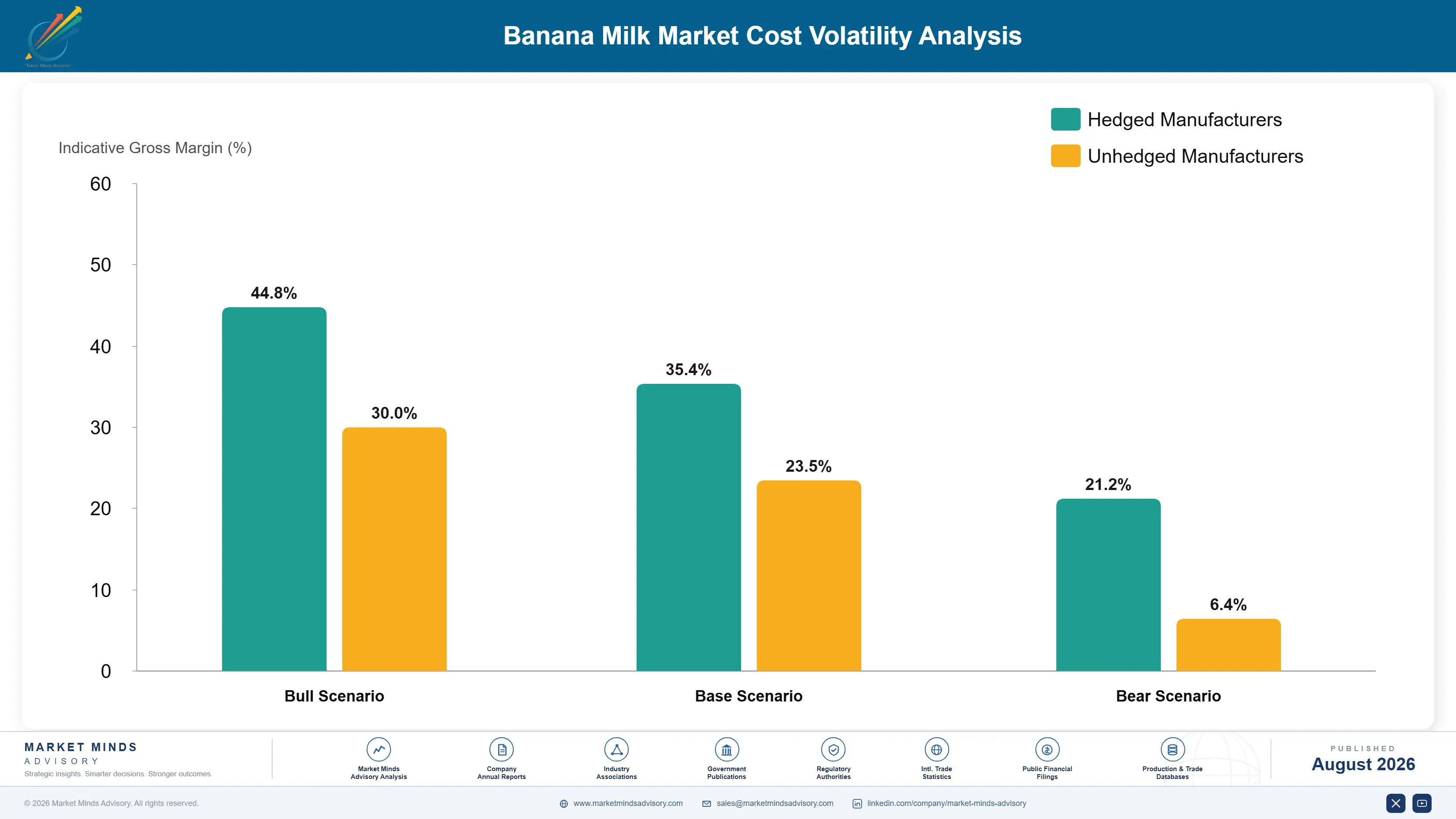
Dairy and Flavor Inputs Drive Margin

Raw milk accounts for 32% to 40% of production cost for dairy-based banana milk, sourced from domestic dairy cooperatives across South Korea and Vietnam rather than any internationally traded commodity market. Banana flavor concentrate adds a further meaningful share, sourced either domestically in banana-growing regions or imported from Latin American and Southeast Asian tropical fruit exporters depending on producer location and existing supply relationships.
The 2022 to 2023 global dairy price surge illustrated raw milk exposure directly. USDA dairy market data recorded milk product prices reaching multi-year highs through 2022 as feed costs and herd reductions tightened global supply. Korean dairy processors, most operating on domestic milk procurement contracts, absorbed the increase gradually rather than facing the sharper spikes fully spot-exposed producers experienced, though margin compression still occurred broadly.

Exposure falls hardest on smaller producers without long-term milk procurement contracts or domestic dairy cooperative relationships, who must source raw milk closer to spot pricing and absorb whatever margin compression results from global supply swings. Plant-based producers face a comparable risk, since oat and almond input costs can spike with poor harvests, while banana flavor concentrate importers carry currency exposure domestic sourcing producers avoid.
banana-milk-market-trends-growth-cost-volatility-analysis-1787462940004

Lock Multi-Year Milk Procurement Contracts With Cooperatives

Producers negotiating multi-year milk procurement agreements directly with domestic dairy cooperatives convert volatile spot pricing into a planned input cost, protecting retail pricing that convenience retailers resist adjusting frequently. This favors larger established processors with existing cooperative relationships, but newer entrants can access similar terms by joining regional dairy purchasing consortia rather than negotiating individually against larger established buyers.

Diversify Banana Flavor Sourcing Across Growing Regions

Producers reduce tropical weather and currency exposure by sourcing banana flavor concentrate from multiple growing regions, including domestic supply where available, rather than depending on a single import relationship. That diversification smooths input availability across seasons and currency swings, though it adds supplier qualification complexity and quality consistency testing across each additional origin a producer adds to its approved list.

Expand Domestic Plant-Based Input Processing Capacity

Plant-based producers reduce oat and almond price volatility by investing in domestic processing capacity closer to agricultural sourcing regions, cutting exposure to international shipping cost swings and import tariff changes that can move input pricing sharply within a single season. This capital investment suits larger producers best, but smaller processors can access similar protection through longer-term supply contracts.

Portfolio Architecture for Margin Defence

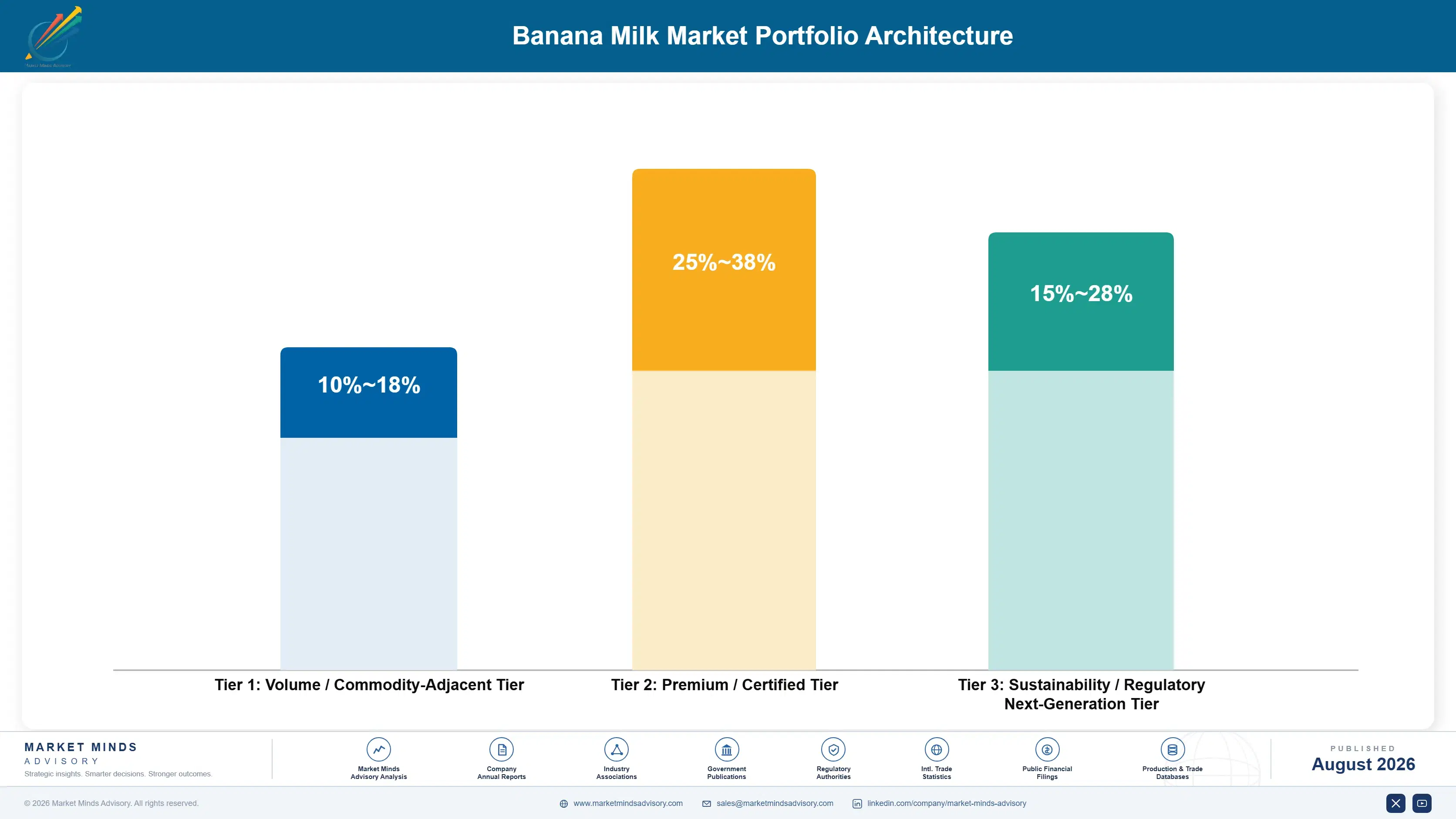
Banana milk's portfolio splits into three tiers with meaningfully different margin economics. Volume dairy-based cartons, sold through convenience and grocery channels on brand heritage and habitual repurchase, compete on price and earn steady but thin margins. Certified plant-based and functional fortified variants earn substantially more, since dietary accommodation and nutritional positioning create switching costs that traditional dairy-based competitors cannot replicate quickly.
The tension for producers is capital allocation between two economics. Volume dairy-based production generates dependable cash flow that funds operations and brand marketing, while plant-based and functional capacity requires meaningful reformulation investment before generating comparable returns at much higher margin. Producers leaning entirely on volume risk losing share to newer, faster-growing formats, while those chasing reformulation too aggressively risk underutilized premium capacity if Western retail interest proves less durable than currently projected across every format simultaneously.

High-value margin pools concentrate in functional fortified and plant-based formats carrying genuine dietary or nutritional differentiation that traditional cartons cannot match. Frontier opportunity sits in combining authentic heritage sourcing story with credible plant-based or functional reformulation, letting producers capture premium pricing from health-conscious Western buyers while retaining loyal traditional consumers across every core market simultaneously.

Volume / Commodity-Adjacent Tier

Traditional dairy-based banana milk sold through convenience and grocery channels on brand heritage and habitual repurchase, priced close to standard flavored milk with minimal differentiation between competing regional producers beyond distribution reach.
Gross Margin: 10-18%

Premium / Certified Tier

Plant-based and functional fortified banana milk carrying dietary accommodation claims, added protein content, or verified sourcing documentation that commands sustained premiums over traditional dairy-based cartons across both Western and Asian retail channels.
Gross Margin: 25-38%

Sustainability / Regulatory / Next-Generation Tier

Emerging reduced-sugar and traceable-sourcing reformulations designed to meet tightening added sugar regulations and retailer sustainability requirements, positioned ahead of stricter nutrition labeling rules affecting legacy formulations, though reformulated taste profiles remain unproven with core consumers.
Gross Margin: 15-28%
banana-milk-market-trends-growth-portfolio-architecture-1787462940519

High-value Sub-segments and Strategic Watch-out

Plant-Based Banana Milk

Plant-based demand grows fastest at 9.5% annually and already commands retail premiums of 35% to 55% over traditional dairy-based cartons. Established Korean processors licensing plant-based technology and newer specialized entrants both continue expanding capacity, and improving taste replication should keep margin strong through the forecast period.
Gross Margin: 25-38%

Functional and Fortified Banana Milk

Functional fortified demand grows at a healthy 8.7% annually and commands premiums 30% to 45% above traditional formulations, though retail category positioning and nutrition labeling requirements limit how quickly new entrants can establish credibility, keeping the segment concentrated among producers with genuine sports nutrition retail relationships.
Gross Margin: 25-38%

Dairy-Based Banana Milk

Traditional dairy-based banana milk remains the largest format by volume, anchored by decades of convenience retail habit across South Korea and Vietnam. Margins stay steady but modest, competing on brand heritage and distribution reach rather than differentiation, but the segment anchors baseline category revenue globally today.
Gross Margin: 10-18%

Powdered and Concentrate Banana Milk

Powdered and concentrate banana milk mixes face gradual substitution pressure as ready-to-drink formats gain convenience appeal and refrigerated retail infrastructure expands across previously underserved emerging markets. Producers concentrated in this segment risk volume erosion over the next decade absent diversification into ready-to-drink or functional formats.
Gross Margin: 8-15%

Why Banana Milk Loyalty Runs Deep

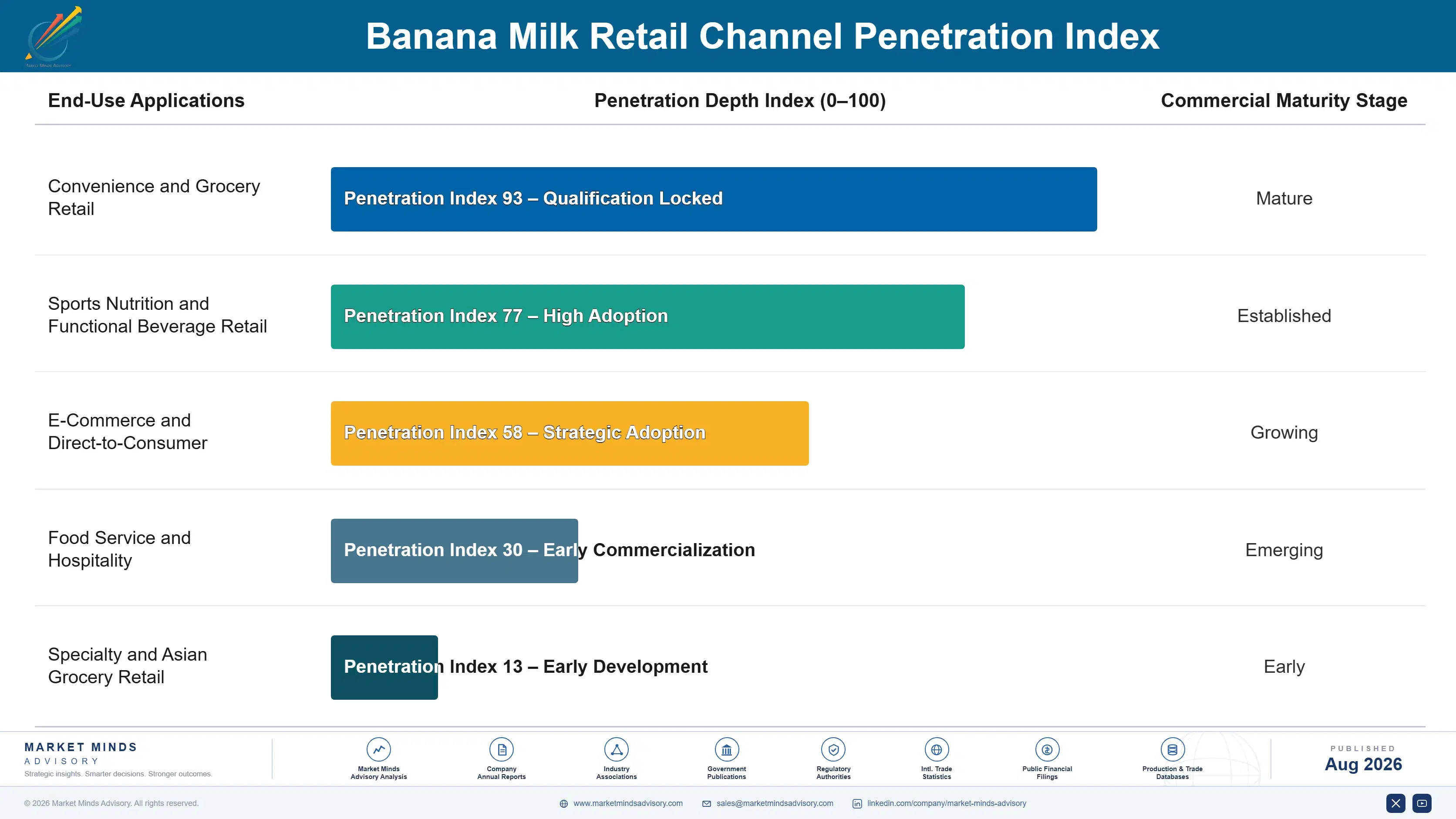
Banana milk demand behaves like an annuity within its core Korean and Vietnamese consumer base, where habitual convenience store repurchase built over decades creates remarkably stable baseline volume regardless of broader beverage category trends. Western demand behaves differently, still forming and therefore less predictable, though early fortified and plant-based adopters show signs of developing the same habitual repurchase pattern that sustained the category domestically for fifty years.
Stickiness varies sharply by consumer segment. Traditional dairy-based loyalists rarely switch away once established, given genuine flavor preference and nostalgic brand attachment built over years of habitual purchase. Fitness-oriented functional buyers show similar loyalty once a fortified brand proves effective, treating it as a recovery staple rather than an occasional purchase. Newer Western trial buyers remain the least sticky segment, still forming purchase habits that could fade as quickly as social media attention moves elsewhere.

Buyer profiles are shifting generationally. Younger Western consumers discovered banana milk through social media rather than cultural heritage, treating it as a novel functional beverage rather than a nostalgic dairy product, a framing that favors fortified and plant-based positioning over traditional marketing that emphasizes decades of Korean brand history.
banana-milk-market-trends-growth-end-use-penetration-index-1787462941010

Where Banana Milk Brands Should Bet

These are among the four positions where our research anticipates prominent divergence between winners and laggards over the coming forecast period. Each is grounded in the demand model, the regulatory perimeter, and the announced capacity pipeline.
01 / REFORMULATION INVESTMENT PRIORITY

Build plant-based and functional lines before Western interest fades

Plant-based banana milk is growing at nearly one and a half times the wider market's pace, and functional fortified variants already command premiums 30% to 45% above traditional formulations, yet both segments remain dominated by newer entrants rather than established Korean and Vietnamese incumbents. Producers that invest now in taste-improved plant-based reformulation and credible protein fortification position ahead of continuing Western retail expansion and lactose-free demand growth. Waiting risks ceding both fast-growing segments permanently to direct-to-consumer brands currently building consumer loyalty from scratch.
02 / EXPORT INFRASTRUCTURE TIMING

Scale cold-chain export capacity before social media attention fades

Social media exposure created Western retail demand faster than existing cold-chain export infrastructure could originally absorb, and retailers that added shelf space ahead of confirmed supply will not wait indefinitely for producers to catch up. Korean and Vietnamese processors that invest now in dedicated export packaging and logistics capture retail listings before domestic Western entrants establish comparable distribution relationships, and that window is already narrowing. Every producer without an export readiness plan today risks losing newly created shelf space permanently to faster-moving competitors.
03 / SUGAR REFORMULATION TIMING

Reformulate added sugar content before regulation forces the issue

Traditional banana milk formulations carry meaningfully higher added sugar content than plain dairy milk, and sugar reduction regulations are tightening steadily across multiple markets including South Korea's own domestic nutrition labeling requirements. Producers that reformulate proactively, using natural sweetener substitution and smaller portion sizing, avoid the disruption of reactive reformulation once retailers or regulators impose hard deadlines. Legacy producers that delay risk both regulatory penalty exposure and retailer delisting once reduced-sugar alternatives become the retail category norm across every major export market.
04 / HERITAGE STORY MONETIZATION

License authentic sourcing narrative before private label competitors do

Consumers increasingly respond to traceable banana sourcing and authentic Korean or Vietnamese origin claims, letting established producers charge a premium for verified provenance that private-label alternatives cannot credibly replicate regardless of manufacturing quality. Producers that build auditable sourcing documentation now differentiate before private-label grocery brands, which compete purely on price, erode the category's margin structure through undifferentiated flavored milk. This lever requires modest investment relative to reformulation, making it accessible even to smaller regional producers without significant marketing budgets to spend.

Engagement Snapshot From the Field

A live engagement with an industry participant carrying material or product regulatory and market exposure ahead of a defining policy shift, showing how our research translates into a defensible multi-year portfolio strategy.
MARKET MINDS ADVISORY · CLIENT ENGAGEMENT SUMMARY
Banana Milk Producer Strategic Portfolio Review and Transition Roadmap 2026·Investment Scenario on Banana Milk Exposure Evaluation 2025-26
CLIENT PROFILE
A mid-sized North American beverage distributor supplying independent grocery and convenience retailers across the United States approached MMA while evaluating whether to add banana milk to its flavored beverage portfolio following sustained retailer inquiries. The client reported annual beverage distribution revenue near USD 210 million, with flavored dairy and plant-based beverages accounting for roughly 22% of total volume (client-reported, unverified by MMA).
STRATEGIC CHALLENGE
Management faced a sourcing decision between importing established Korean brands at higher landed cost with proven consumer recognition, or partnering with a domestic co-packer to produce a private-label version at lower cost but without brand heritage. The commercial team worried retailer interest reflected a passing social media trend rather than durable demand, while the operations team questioned whether domestic co-packing could match import quality.
MMA APPROACH
MMA analyzed search volume and retail sell-through data across comparable social media-driven beverage launches to assess demand durability, benchmarked landed import cost against domestic co-packing economics at several volume tiers, and evaluated consumer taste testing data comparing imported Korean product against prototype domestic formulations. We also assessed private-label margin economics against branded import distribution rights.
KEY FINDINGS
  1. Comparable social media-driven beverage launches showed durable demand in roughly two-thirds of cases where retailers maintained shelf placement past an initial twelve-month period, suggesting genuine rather than purely trend-driven interest.
  2. Domestic co-packing reached competitive landed cost only above a minimum volume threshold the client's current retail commitments alone could not support without additional distribution partnerships.
  3. Taste testing showed prototype domestic formulations scored within a narrow margin of imported Korean product among consumers unfamiliar with the original brand (client-reported, unverified by MMA).
  4. Private-label distribution economics offered meaningfully higher margin than branded import rights, though branded product carried lower marketing investment requirement given existing consumer awareness.
CLIENT PROFILE
A mid-sized North American beverage distributor supplying independent grocery and convenience retailers across the United States approached MMA while evaluating whether to add banana milk to its flavored beverage portfolio following sustained retailer inquiries. The client reported annual beverage distribution revenue near USD 210 million, with flavored dairy and plant-based beverages accounting for roughly 22% of total volume (client-reported, unverified by MMA).
STRATEGIC CHALLENGE
Management faced a sourcing decision between importing established Korean brands at higher landed cost with proven consumer recognition, or partnering with a domestic co-packer to produce a private-label version at lower cost but without brand heritage. The commercial team worried retailer interest reflected a passing social media trend rather than durable demand, while the operations team questioned whether domestic co-packing could match import quality.
MMA APPROACH
MMA analyzed search volume and retail sell-through data across comparable social media-driven beverage launches to assess demand durability, benchmarked landed import cost against domestic co-packing economics at several volume tiers, and evaluated consumer taste testing data comparing imported Korean product against prototype domestic formulations. We also assessed private-label margin economics against branded import distribution rights.
KEY FINDINGS
  1. Comparable social media-driven beverage launches showed durable demand in roughly two-thirds of cases where retailers maintained shelf placement past an initial twelve-month period, suggesting genuine rather than purely trend-driven interest.
  2. Domestic co-packing reached competitive landed cost only above a minimum volume threshold the client's current retail commitments alone could not support without additional distribution partnerships.
  3. Taste testing showed prototype domestic formulations scored within a narrow margin of imported Korean product among consumers unfamiliar with the original brand (client-reported, unverified by MMA).
  4. Private-label distribution economics offered meaningfully higher margin than branded import rights, though branded product carried lower marketing investment requirement given existing consumer awareness.
RECOMMENDED STRATEGY
Phase 1: Phase 1 (0 to 6 months): Import an established Korean brand to validate demand durability across initial retail accounts before committing to domestic production investment. Phase 2: Phase 2 (6 to 18 months): Develop a private-label domestic formulation once import volume confirms sustained retailer reorder rates beyond the initial trial period. Phase 3: Phase 3 (18 to 36 months): Scale private-label production once domestic formulation achieves taste parity, retaining import distribution as a premium-tier complement.
OUTCOME
The client began with imported Korean product, confirming sustained reorder demand across most initial retail accounts within eight months. Domestic private-label development proceeded on schedule, achieving taste parity sufficient for broader retail rollout, and the client reported meaningfully improved category margin after transitioning volume toward private label (client-reported, unverified by MMA).

Frequently Asked Questions

Foundational context covering the market sizes, CAGR, scope, country, region and competition that inform every finding below. This section is provided to cover basics and most often pre-purchase conversations, answered from the MMA Primary Research Dataset.

What is the current size of the Banana Milk Market?

The global banana milk market reached USD 3.42 billion in 2025, based on MMA Primary Research Dataset findings. Growth increasingly reflects plant-based and functional reformulation rather than traditional dairy-based volume alone.

How large will the Banana Milk Market be by 2036?

MMA's base case projects the market reaching USD 6.60 billion by 2036, an incremental opportunity of roughly USD 3.18 billion over the 2026 to 2036 forecast period.

What is the CAGR for the Banana Milk Market 2026 to 2036?

The base case CAGR is 6.8%, with a bull case of 8.1% and a bear case of 5.5% depending on how durable Western retail interest proves.

Which segment is growing fastest?

Plant-based banana milk leads at a 9.5% CAGR, nearly one and a half times the overall market rate, as lactose-intolerant and vegan consumers seek dairy alternatives.

Who are the major companies in the Banana Milk Market?

Leading participants include Binggrae Co Ltd, Maeil Dairies Co Ltd, Vietnam Dairy Products JSC, Meiji Holdings Co Ltd, and Lotte Foods Co Ltd, assessed on distribution reach and format breadth.

Which country is growing fastest?

Vietnam leads country-level growth, driven by expanding domestic dairy processing capacity and a genuine banana cultivation cost advantage that keeps flavor concentrate sourcing cheaper than importing producers face.

Report Segmentation Architecture

The full report scope spans multiple orthogonal segmentation dimensions, with cross-tabulated demand data provided for each dimension pair. Coverage extends further to regional breakdowns, trend trajectories, and the competitive detail needed to support segment-level decision-making.

By Product Format

  • Dairy-Based Banana Milk
  • Plant-Based Banana Milk
  • UHT Shelf-Stable Banana Milk
  • Refrigerated Fresh Banana Milk
  • Powdered and Concentrate Banana Milk
  • Functional and Fortified Banana Milk

By Retail Channel

  • Convenience and Grocery Retail
  • Sports Nutrition and Functional Beverage Retail
  • E-Commerce and Direct-to-Consumer
  • Food Service and Hospitality
  • Specialty and Asian Grocery Retail

By Commercial Dimension

  • Branded Import Distribution
  • Private-Label and Co-Packed Supply
  • Direct-to-Consumer Subscription
  • Wholesale and Foodservice Contracts

By Region

  • North America
  • Western Europe
  • East Asia
  • South Asia and Pacific
  • Latin America
  • Middle East and Africa
  • Eastern Europe

Scope, Methodology, and Coverage

Every figure in this report is reproducible from documented input assumptions. The scope below maps the historical period, the forecast horizon, the segmentation dimensions, and the countries covered, alongside the underlying primary and qualitative methodology.
Historical Period
2020 to 2025
Forecast Period
2026 to 2036
Base Year
2025 (USD billions; MMA Primary Research Dataset, August 2026)
Market Definition
The banana milk market covers commercial production and retail sale of banana-flavored milk beverages, including dairy-based, plant-based, powdered, and functional fortified formats sold as ready-to-drink or reconstituted beverages. It excludes fresh banana fruit sales, banana-flavored yogurt, and banana-based smoothies blended fresh at point of sale.
Quantitative Units
USD billions (current prices); liters of banana milk production and retail volume where applicable
Segmentation Dimensions
By Product Format; By Retail Channel; By Commercial Dimension; By Region
Regions Covered
North America, Western Europe, East Asia, South Asia and Pacific, Latin America, Middle East and Africa, Eastern Europe
Countries Covered
USA, China, Germany, France, UK, Japan, South Korea, India, Australia, Canada, Brazil, Mexico, Indonesia, Vietnam, Thailand, Malaysia, UAE, Saudi Arabia, South Africa, Nigeria, Turkey, Poland, Netherlands, Italy, Spain, Sweden, Switzerland, Argentina, Colombia, Singapore, and additional markets relevant to this sector
Key Companies Profiled
Binggrae Co Ltd, Maeil Dairies Co Ltd, Vietnam Dairy Products JSC, Meiji Holdings Co Ltd, Lotte Foods Co Ltd, Namyang Dairy Products Co Ltd, Seoul Dairy Cooperative, TH True Milk, Nutifood Nutrition Food JSC, Yakult Honsha Co Ltd, Danone SA, Nestle SA, Oatly Group AB, Califia Farms LLC, Chobani LLC, Fonterra Co-operative Group, Gujarat Cooperative Milk Marketing Federation, Britannia Industries Limited, Inner Mongolia Yili Industrial Group, China Mengniu Dairy Company Limited
Quantitative Methodology
Primary survey, n=3,800 respondents, Q4 2025, six countries; demand-side model with trade association cross-validation
Qualitative Methodology
47 expert interviews, Q4 2025; applied to validate demand model assumptions, identify emerging dynamics, and assess competitive positioning
Report Format
PDF and XLSX data workbook (Word format preview document)
Publisher
Market Minds Advisory
Report Code
MMA-2026-AGR-101
Published
August 2026
Contact
sales@marketmindsadvisory.com | www.marketmindsadvisory.com

Purchase the full Banana Milk Market Report (2026 to 2036).

The full MMA Banana Milk report sizes the market across six product format segments, five retail channels, four commercial supply models, and seven regions through 2036. It profiles twenty participants on a consistent basis of distribution reach and format breadth across dairy-based, plant-based, and functional variants, scoring each on brand heritage, reformulation pace, and export infrastructure readiness. Scenario models quantify how social media-driven Western retail expansion, sugar reduction regulation, and lactose-free demand growth move both category volume and realizable pricing. The report also includes dairy and flavor concentrate cost modeling, a plant-based reformulation readiness assessment, and export cold-chain investment benchmarking built for brand, retail, and investment strategy teams.
Six-format demand model with reformulation-adjusted pricing
Dairy and flavor concentrate cost volatility modeling
Plant-based reformulation readiness and taste benchmarking
Twenty-company competitive profiling on consistent distribution basis
Seven-region demand map with country-level growth detail
Export cold-chain infrastructure investment benchmarking assessment

Built For The People Who Decide

From boardroom strategy to bench-side execution, this report is read cover-to-cover by leaders shaping the next decade of their industry, turning demand scenarios, market dynamics and valuation benchmarks into decisions.
CXOs/ Presidents/ VPs/ Managers
M&A and Corporate Development
Strategy Teams and R&D Heads
Procurement and Product Directors
Regulatory and Compliance Leaders
Investor Relations and Equity Analysts