
Market Minds Advisory
Bakery Emulsions Market

Bakery Emulsions Market: Clean Label Reformulation and the Lecithin Supply Squeeze

Bakery emulsions now face a clean label reformulation mandate that is displacing synthetic mono- and diglycerides, a sunflower lecithin supply squeeze tied to Eastern European crush capacity, and enzyme-based emulsifying system adoption among industrial bakeries.

Lead Analyst

Lisa Gevelber

Published

September 2026

Make Smarter Decisions with Customized Research Insights

Request a free sample report and evaluate market opportunities, growth trends, and competitive dynamics relevant to your business needs.

2025 MARKET VALUE$1.9BMarket Size 2025
2036 FORECAST VALUE$3.6BBase Case , 2026 to 2036
CAGR 2026 TO 20366.1 %Bull 7.4% / Bear 4.8%
INCREMENTAL OPPORTUNITY$1.6BNet 10- year value creation
EXPANSION MULTIPLE1.81x2036 value over 2026 base
Strategic Levers
M&A Pipeline
Regional Outlook
Country Rankings
Competitive Intelligence
Segmental Deep-dive
Call-Us : 91 93563 13602

Executive Snapshot and Market Trajectory

Industrial bakeries are replacing synthetic mono- and diglyceride emulsifiers with enzyme-based systems and sunflower lecithin faster than ingredient suppliers can qualify new formulations, creating a reformulation backlog across mid-sized bakery manufacturers that lack dedicated application labs. leaving supply chains strained across multiple product categories simultaneously.
Enzyme-based emulsifying systems are pulling category growth well ahead of traditional emulsifier chemistries, as clean label retailer scorecards push bakeries toward ingredients that can be labeled without an E-number, while lecithin-based systems benefit from the same trend at a lower reformulation cost. East Asia commands the largest and fastest-growing volume base, anchored in China's rapidly industrializing packaged bakery sector, while North America and Western Europe drive most premium clean label reformulation demand.
Competitive structure remains moderately concentrated among global specialty chemical and ingredient producers, with the top five holding meaningful combined share, though regional lecithin processors are gaining ground as bakeries diversify supply away from synthetic emulsifier producers. Regulatory pressure on titanium dioxide and other legacy bakery additives is compounding reformulation urgency, pushing large manufacturers toward acquisition of specialty enzyme and lecithin processing capacity rather than slower internal development programs.
Market Definition
The bakery emulsions market covers emulsifying ingredients and pre-blended emulsion systems used in bread, cake, pastry, and other baked goods to control dough stability, crumb structure, and shelf life, including mono- and diglycerides, DATEM, SSL and CSL, lecithin-based systems, polyglycerol esters, and enzyme-based emulsifying systems. It excludes standalone leavening agents, preservatives, and flavor systems sold independently of an emulsifying function.
Base Year Value
$1.9B in 2025 (MMA Primary Research Dataset, August 2026)
Forecast Period
2026 to 2036, eleven discrete annual values
CAGR
6.1% base case. Bull 7.4%. Bear 4.8%.
Fastest Growth Segment
Enzyme-Based Emulsifying Systems: 9.6% CAGR
Fastest Growth Country
India: 9.5% CAGR
Fastest Growth Region
South Asia and Pacific: 8.3% CAGR
Largest Region
East Asia: 29% of 2025 global value
Market Leaders
Cargill, ADM, Corbion, Kerry Group, and Puratos. Source: MMA Analysis based on company annual reports.
Primary Survey
n=3,800 procurement and R&D decision-makers, Q4 2025, six countries
Methodology
Demand-side build-up, cross-validated against public data, 47 expert interviews

Bakery Emulsions Market Forecast Scenarios

bakery-emulsions-market-trends-growth-size-forecast-scenario-1787463035158
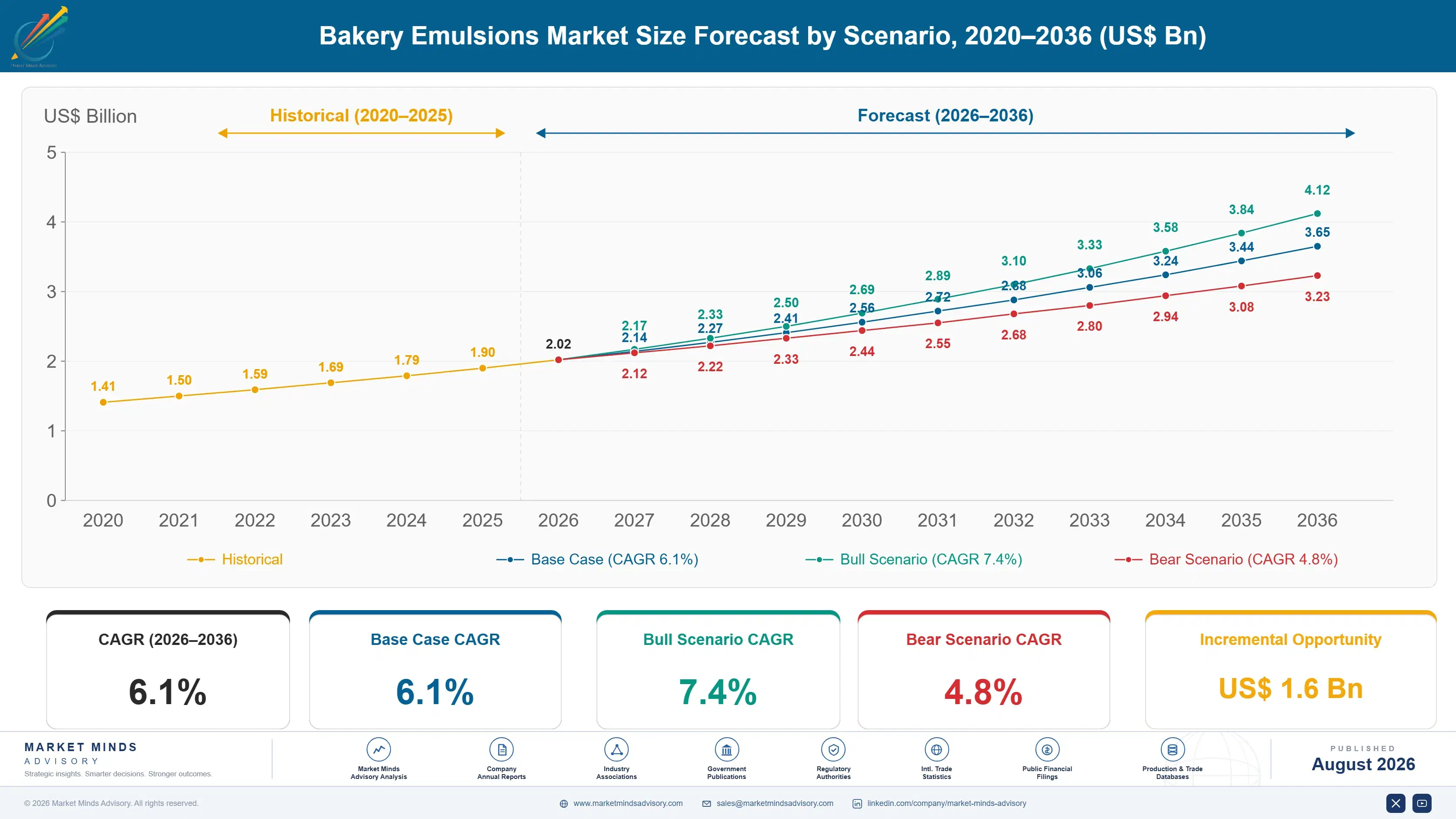
Between 2020 and 2025 the market grew at a historical pace of roughly 5.2 percent annually, as pandemic era home baking briefly lifted retail demand before industrial bakery reformulation toward clean label emulsifiers became the dominant growth driver through the back half of the period, gradually accelerating category volume across most developed baking markets. Industrial adoption accelerated only after 2023 retailer policy changes.
The base case assumes growth near 6.1 percent annually through 2036, anchored in three commercial mechanisms: retailer clean label scorecards that increasingly penalize E-number emulsifiers at the shelf reset level, expanding enzyme-based emulsifying system capacity that lowers reformulation cost per tonne, and rising sunflower lecithin adoption as bakeries diversify away from soy lecithin amid non-GMO labeling preferences across major consuming regions. These mechanisms increasingly reinforce each other as retailers, suppliers, and feedstock processors coordinate around reformulation timelines.
A bull scenario builds on accelerated titanium dioxide and legacy additive phase-outs forcing faster emulsifier reformulation across the remaining conventional bakery ingredient base, while a bear scenario centers on sunflower crop disruption in Ukraine and Russia repeating the 2022 supply shock and pushing bakeries back toward cheaper synthetic emulsifier chemistries at scale. a scenario several suppliers are already hedging against.

Reformulation Velocity Against Feedstock Constraints

Three forces are converging on the bakery emulsifier category at once: retailer clean label scorecards are penalizing E-number emulsifiers at the shelf reset level, feedstock suppliers are racing to expand sunflower lecithin crush capacity to meet non-GMO demand, and enzyme system developers are scaling production fast enough to displace meaningful synthetic emulsifier volume for the first time in the category's history. This convergence is compressing multi-year reformulation timelines into single fiscal years.
MARKET CONCENTRATIONCR5 42%top five producers hold a meaningful combined share
AVERAGE EMULSIFIER DOSAGE0.3-0.6%typical inclusion rate relative to total dough weight
LEADING PRODUCING COUNTRYChinalargest single national production and consumption base overall
SUNFLOWER LECITHIN PRICE PREMIUM18-25%premium typically charged over standard soy lecithin equivalents
CLEAN LABEL REFORMULATION RATE34%share of industrial bakery SKUs reformulated in recent years
LECITHIN FEEDSTOCK COST SHARE46% of COGSoilseed feedstock as portion of total emulsifier cost
Commercially the category increasingly behaves like a reformulation pipeline rather than a stable commodity ingredient market, since a bakery's emulsifier choice is now tied as much to its retailer's labeling policy as to functional dough performance, forcing suppliers to treat regulatory and retailer tracking as a core commercial capability rather than a compliance afterthought. a shift that increasingly rewards suppliers who can document compliance status as fluently as functional performance.
Over the next decade, suppliers most likely to gain share are those who can match enzyme or lecithin performance to synthetic emulsifier functionality without requiring bakeries to fully requalify their existing production lines, since full requalification remains costly and slow for most mid-sized industrial bakery operators. Suppliers slow to close this gap risk losing projects to faster-moving competitors.
"Nobody buys a bakery emulsion for its own sake. They buy crumb structure and shelf life, and the moment a clean label alternative delivers both without a line change, the synthetic incumbent loses that account permanently."
Director, Food Ingredients Practice · MMA Food Ingredients / Bakery and Confectionery Additives Practice · August 2026

Market Trends

Enzyme-Based Emulsifying Systems Displacing Synthetic Chemistries

Enzyme-based emulsifying systems, primarily lipases and phospholipases applied directly to dough or pre-treated flour, are scaling rapidly as an alternative to mono- and diglyceride emulsifiers that carry an E-number under most labeling regimes. Several large industrial bakeries in North America and Western Europe have completed pilot reformulations showing comparable crumb softness and shelf life extension without requiring changes to existing mixing or baking equipment. Enzyme suppliers are now expanding production capacity to meet demand that industry participants describe as outpacing supply, particularly for phospholipase formulations tailored to high-speed industrial bread lines.
Market Impact: Shifts 15% of private label volume
Titanium Dioxide and Legacy Additive Phase-Outs

Regulatory restrictions on titanium dioxide as a food additive across the European Union and growing scrutiny in other jurisdictions are prompting bakeries to conduct comprehensive additive reviews that frequently extend to emulsifier reformulation as well, since reformulation projects are typically bundled to minimize disruption to production lines. This has accelerated emulsifier reformulation timelines that might otherwise have proceeded more gradually, compressing multi-year transition plans into shorter windows as bakeries address several additive categories within a single regulatory compliance cycle rather than sequentially over multiple years. Retailers describe this bundled approach as reducing overall project management overhead.
Market Impact: Lifts sunflower lecithin demand 16%

Market Opportunities and Growth Drivers

Retailer Clean Label Scorecards Penalizing E-Number Emulsifiers

Major grocery retailers across North America and Western Europe have incorporated E-number emulsifier content into supplier clean label scorecards used at private label contract renewal, a practice that has expanded significantly from a small number of premium retailers five years ago to mainstream grocery chains today. Private label bakery suppliers unable to demonstrate a credible reformulation roadmap increasingly lose shelf space to competitors offering enzyme or lecithin-based alternatives at comparable price points. This has converted emulsifier reformulation from a brand differentiation choice into a private label contract retention requirement across most major grocery categories.
Market Impact: Delays 22% of planned reformulations

Non-GMO Labeling Preference Favoring Sunflower Lecithin

Growing non-GMO labeling preference among bakery brands, particularly in North America where voluntary non-GMO certification carries meaningful retail shelf appeal, is driving sustained substitution of sunflower lecithin for conventional soy lecithin despite a persistent price premium. Sunflower lecithin processing capacity remains concentrated in a small number of European crushing facilities, creating a persistent bottleneck when demand spikes coincide with weak sunflower harvests. Bakeries increasingly secure multi-year supply contracts directly with crushers rather than purchasing through ingredient distributors exposed to spot market volatility. Several bakeries report this bottleneck as the primary constraint on faster non-GMO reformulation timelines currently.
Market Impact: Raises lecithin cost volatility 28%

Market Restraints and Challenges

Reformulation Requalification Costs Slow Mid-Sized Bakery Adoption

Switching emulsifier chemistry frequently requires extensive line trials and shelf life validation testing before a reformulated product can be sold commercially, a requirement rooted in the sensitivity of dough rheology to even small changes in emulsifier functionality across different flour and recipe combinations. The commercial impact is that mid-sized bakeries without dedicated application laboratories delay reformulation far longer than large multinational operators with in-house testing capability, creating a widening capability gap. Ingredient suppliers are increasingly offering co-development support and shared testing resources to smaller customers as a mitigation path, absorbing some qualification cost themselves to accelerate adoption and protect volume.
Market Impact: Displaces up to 12% of volume

Sunflower Lecithin Supply Remains Geographically Concentrated

The bulk of global sunflower lecithin processing capacity sits within a handful of crushing facilities concentrated in Ukraine, Russia, and a few Western European countries, a concentration that reflects decades of sunflower cultivation and crushing infrastructure investment specific to that region. The commercial impact became visible in 2022, when the war in Ukraine disrupted crushing operations and sharply lifted sunflower lecithin prices across every consuming region simultaneously. Processors outside the traditional supply base, including new crushing investments in Argentina and Eastern Europe, are positioning to diversify supply, though new capacity remains years away from easing the concentration risk.
Market Impact: Compresses reformulation timelines by 12 months
3 additional market trends, 4 additional growth drivers, and 3 additional restraints and challenges are covered in the full report. Contact sales@marketmindsadvisory.com to access the complete intelligence.

Segment CAGR and Growth Architecture

Segmentation follows emulsifier chemistry and technology type, since mono- and diglycerides, DATEM, SSL and CSL, lecithin-based systems, polyglycerol esters, and enzyme-based systems each carry distinct functional performance, regulatory labeling status, and feedstock exposure despite serving overlapping bakery applications across bread, cake, and pastry production lines. and because feedstock exposure differs sharply between synthetic, lecithin, and enzyme production pathways.
bakery-emulsions-market-trends-growth-market-share-analysis-1787463035732

Enzyme-Based Emulsifying Systems

Enzyme-based systems are growing fastest as bakeries seek functional replacements for synthetic emulsifiers that avoid E-number labeling entirely, since enzymes are typically classified as processing aids rather than additives under most major labeling regimes, giving them a distinct regulatory advantage over lecithin and polyglycerol ester alternatives that still require ingredient declaration. Phospholipase formulations tailored to industrial bread production are seeing the fastest adoption, aided by demonstrated performance parity with mono- and diglycerides in crumb softness and shelf life extension trials conducted by several large industrial bakery operators. Supply remains concentrated among a small number of specialty enzyme producers, creating capacity constraints that are drawing new investment from both established enzyme companies and new entrants targeting the bakery application specifically.
CAGR 9.6%

Lecithin-Based Emulsion Systems

Lecithin-based systems are the second fastest growing segment, driven by non-GMO labeling preference favoring sunflower lecithin over conventional soy lecithin despite sunflower's persistent price premium and more concentrated supply base. Bakeries value lecithin's lower reformulation cost relative to enzyme systems, since lecithin substitution typically requires less extensive line requalification than switching to an entirely different emulsifying technology, making it the more accessible clean label reformulation path for mid-sized bakeries lacking dedicated application testing resources. Supply concentration in Ukraine, Russia, and a handful of Western European crushing facilities remains the primary constraint on faster segment growth, particularly following the 2022 sunflower crushing disruption that lifted prices across every consuming region. Retailers increasingly specify lecithin origin directly in private label contract terms.
CAGR 8.2%
Full segment breakdown across 6 segments available in the complete report.

Regional Architecture and Country Demand Map

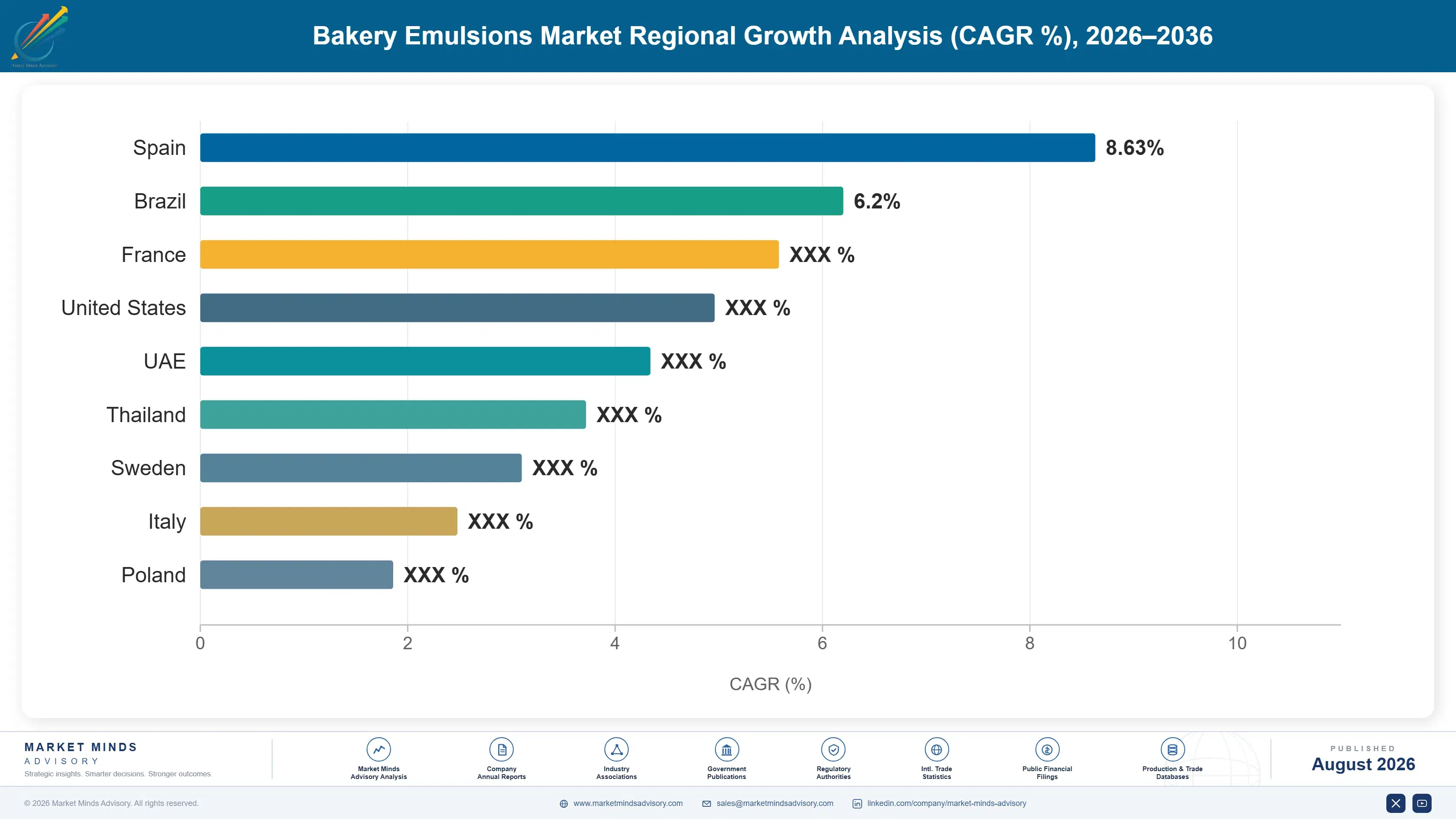
East Asia leads on production and consumption volume anchored in China's industrial bakery sector, North America follows on premium clean label reformulation spend, while South Asia and Pacific scales fastest off a smaller current base as packaged bakery penetration expands regionally. with smaller regions growing steadily too.

North America

United States industrial bakeries lead regional clean label reformulation, driven by retailer scorecards at major grocery chains that increasingly penalize E-number emulsifiers during private label contract renewal negotiations. Enzyme-based systems are gaining fastest adoption here, aided by a concentration of specialty enzyme producers with established application laboratories able to support bakery customer reformulation projects directly. Canada follows similar reformulation patterns roughly two years behind the United States. Non-GMO sunflower lecithin demand is also strongest in this region, reflecting voluntary non-GMO certification programs that carry meaningful shelf appeal across premium and mainstream bakery retail categories alike. Retailers piloting shared reformulation programs report faster private label compliance timelines than suppliers working independently.
Share: 24% | CAGR: 7.0% (2026 to 2036)

Western Europe

The European Union's titanium dioxide ban and broader additive scrutiny have made this region the most regulation-driven market for emulsifier reformulation, with bakeries frequently bundling emulsifier changes into broader additive review projects triggered by the same compliance deadlines. Germany, France, and the United Kingdom anchor regional demand, with sunflower lecithin sourcing advantaged by geographic proximity to Ukrainian and Eastern European crushing facilities relative to other consuming regions. Smaller artisanal and craft bakery segments across the region show slower reformulation adoption than large industrial operators, since traditional recipes carry stronger consumer expectation around unchanged taste and texture. Artisanal bakeries across France and Italy remain the slowest adopters given strong consumer attachment to unchanged recipes.
Share: 19% | CAGR: 4.6% (2026 to 2036)
Regional intelligence for 5 additional markets available in the complete report: East Asia, South Asia and Pacific, Latin America, Middle East and Africa, Eastern Europe. Contact sales@marketmindsadvisory.com.
bakery-emulsions-market-trends-growth-country-cagr-analysis-1787463036265

Reformulation Support and Feedstock Diversification Levers

Suppliers are pulling four commercial levers at once: co-development reformulation support, sunflower feedstock diversification, enzyme capacity expansion, and private label reformulation partnerships, each addressing a distinct margin opportunity created by the category's accelerating clean label transition across major consuming regions. These levers increasingly overlap in practice, since suppliers pursuing feedstock diversification often simultaneously expand co-development and enzyme capacity investment.

Co-Development Reformulation Support for Mid-Sized Bakeries

Ingredient suppliers offering shared application laboratory access and co-funded line trials to mid-sized bakeries lacking in-house testing capability are converting reformulation delay into accelerated adoption, capturing customer relationships that would otherwise gravitate toward whichever supplier can demonstrate the fastest path to a validated reformulation. This investment typically pays back through higher volume commitments once a customer completes reformulation with a given supplier's system, since switching costs rise substantially after a successful line qualification. Early adopting suppliers report customer retention rates roughly 20 percent higher than suppliers offering ingredient sales without reformulation support.
Market Impact: Lifts customer retention by roughly 20 percent overall

Sunflower Feedstock Diversification Beyond Ukraine and Russia

Investing directly in sunflower crushing capacity across Argentina, Eastern Europe, or other emerging growing regions reduces exposure to the geographic concentration risk that produced sharp price spikes following the 2022 disruption in Ukrainian and Russian crushing operations. Suppliers securing diversified feedstock contracts ahead of the next potential disruption are positioned to offer more stable pricing to bakery customers than competitors reliant on the traditional concentrated supply base. This diversification requires meaningful upfront capital investment but addresses a risk that bakery customers increasingly ask suppliers to demonstrate mitigation plans for during contract negotiations.
Market Impact: Cuts single-region supply exposure by roughly 30 percent

Enzyme Production Capacity Expansion for Bakery Applications

Expanding phospholipase and lipase production capacity specifically calibrated for bakery applications addresses a supply constraint that industry participants describe as currently limiting faster category-wide adoption of enzyme-based emulsifying systems. Suppliers moving first on capacity expansion are securing multi-year supply agreements with large industrial bakeries eager to lock in enzyme access ahead of anticipated demand growth, a dynamic increasingly resembling early-stage capacity allocation seen in other specialty ingredient categories facing rapid adoption curves. Capacity utilization across existing enzyme production facilities has already reached roughly 88 percent in some regions. Utilization rates are expected to climb further as new capacity comes online.
Market Impact: Adds roughly 10 percent enzyme production capacity annually

Private Label Reformulation Partnerships With Major Retailers

Rather than waiting for private label bakery suppliers to independently pursue reformulation, several ingredient producers are now partnering directly with major grocery retailers to develop pre-validated clean label formulations that private label suppliers can adopt with minimal additional qualification work. This approach accelerates retailer clean label scorecard compliance across an entire private label bakery category simultaneously rather than supplier by supplier, giving the ingredient partner preferred status across the retailer's full private label bakery supply base. Retailers piloting this model report reformulation timelines shortened by roughly 35 percent. Suppliers slower to adopt this model risk losing preferred retailer status entirely.
Market Impact: Cuts retailer-wide reformulation timeline by roughly 35 percent

Who Controls the Margin Pool

Concentration remains moderate, with the top five producers holding a combined 42 percent share on a revenue basis, reflecting a market where global specialty chemical producers compete alongside regional lecithin processors and a growing number of specialty enzyme developers entering the category from adjacent industrial biotechnology applications rather than traditional bakery ingredient backgrounds. This blurring of category boundaries is reshaping who customers consider a primary supplier.
Current competitive activity centers on three dimensions: co-development partnerships with bakery customers to accelerate reformulation adoption, direct investment in sunflower crushing capacity to secure feedstock supply, and enzyme production capacity expansion to meet demand that several suppliers describe as currently outpacing available supply across key phospholipase formulations. Suppliers pursuing multiple levers simultaneously are pulling ahead of single-lever competitors steadily.

Emerging pressure comes from specialty enzyme developers entering bakery applications from adjacent industrial biotechnology backgrounds, and from regional lecithin processors in Eastern Europe and Argentina building direct relationships with bakery customers that bypass traditional specialty chemical distributor intermediaries, threatening to redistribute share away from established emulsifier producers over the coming decade as these newer entrants scale production capacity. Established producers slow to respond risk ceding meaningful share within the next several years.
bakery-emulsions-market-trends-growth-company-positioning-matrix-1787463036795

Competitive Moat and Risk Dimensions

CARGILL

Moat: Integrated Feedstock and Processing

Cargill's integrated position across oilseed crushing, lecithin processing, and bakery ingredient formulation gives it feedstock cost and supply security advantages that pure-play emulsifier producers reliant on third party lecithin purchases cannot match, particularly during periods of sunflower or soy feedstock price volatility across major growing regions.
CARGILL

Risk: Slower Enzyme System Pivot

Cargill's core strength in feedstock-based emulsifiers gives it less natural advantage in enzyme-based systems, an adjacent technology where specialty biotechnology focused competitors are moving faster, potentially ceding early share in the fastest-growing segment of the category to newer entrants with dedicated enzyme development capability. This risk grows as bakery demand for enzyme systems accelerates further.
CORBION

Moat: Specialty Emulsifier Expertise

Corbion's deep specialization in bakery-specific emulsifier chemistry and dedicated application laboratory network gives it faster reformulation support turnaround for bakery customers than more diversified specialty chemical competitors managing emulsifiers as one product line among many broader industrial portfolios. This specialization also shortens the qualification timeline bakeries require before committing to a full-scale reformulation.
CORBION

Risk: Limited Feedstock Integration

Without upstream oilseed crushing operations, Corbion remains more exposed to lecithin feedstock price volatility than vertically integrated competitors like Cargill, a disadvantage that becomes more pronounced during supply disruptions like the 2022 sunflower crushing shock affecting Ukrainian and Russian capacity. This gap could widen further if feedstock volatility repeats at the scale seen in 2022.

Players Tracked

Prominent Players

Cargill
ADM
Corbion
Kerry Group
Puratos

Other Key Players

BASF
Palsgaard
Lasenor Emul
Stern-Wywiol Gruppe
Danisco (IFF)
Riken Vitamin
American Lecithin Company
Lecico GmbH
Sonic Biochem Extractions
Novozymes
DSM-Firmenich
AAK AB
Ingredion
Bunge Limited
Wilmar International

Recent Developments

APRIL 2026

Corbion Expands Enzyme-Compatible Emulsifier Application Lab

Corbion opened a new application laboratory dedicated to co-developing enzyme-compatible bakery formulations with mid-sized industrial customers, aiming to accelerate reformulation adoption among bakeries lacking in-house testing capability and to defend private label contract relationships facing rising clean label scorecard pressure from major grocery retail customers.
Signal: Signals reformulation support becoming a core competitive differentiator across bakery ingredient suppliers as bakeries seek faster reformulation partnerships.
NOVEMBER 2025

Cargill Acquires Minority Stake in Argentine Sunflower Crusher

Cargill acquired a minority equity stake in an Argentine sunflower crushing facility, securing preferential access to feedstock volume as it diversifies sunflower lecithin sourcing away from traditional Ukrainian and Russian supply concentrated in a region that experienced significant disruption following the 2022 conflict. ahead of the next crushing season.
Signal: Confirms feedstock diversification is accelerating ahead of the next potential supply disruption ahead of the next potential supply shock.
AUGUST 2025

Novozymes Launches Phospholipase Platform for Industrial Bread Lines

Novozymes launched a new phospholipase enzyme platform specifically calibrated for high-speed industrial bread production lines, targeting bakeries seeking synthetic emulsifier replacement without requiring equipment changes. The platform has already been adopted by two North American bakery operators in initial trials. Bakery operators report favorable early feedback on crumb texture consistency.
Signal: Demonstrates specialty biotechnology entrants scaling capacity ahead of anticipated demand growth among large-scale industrial bread manufacturers specifically.

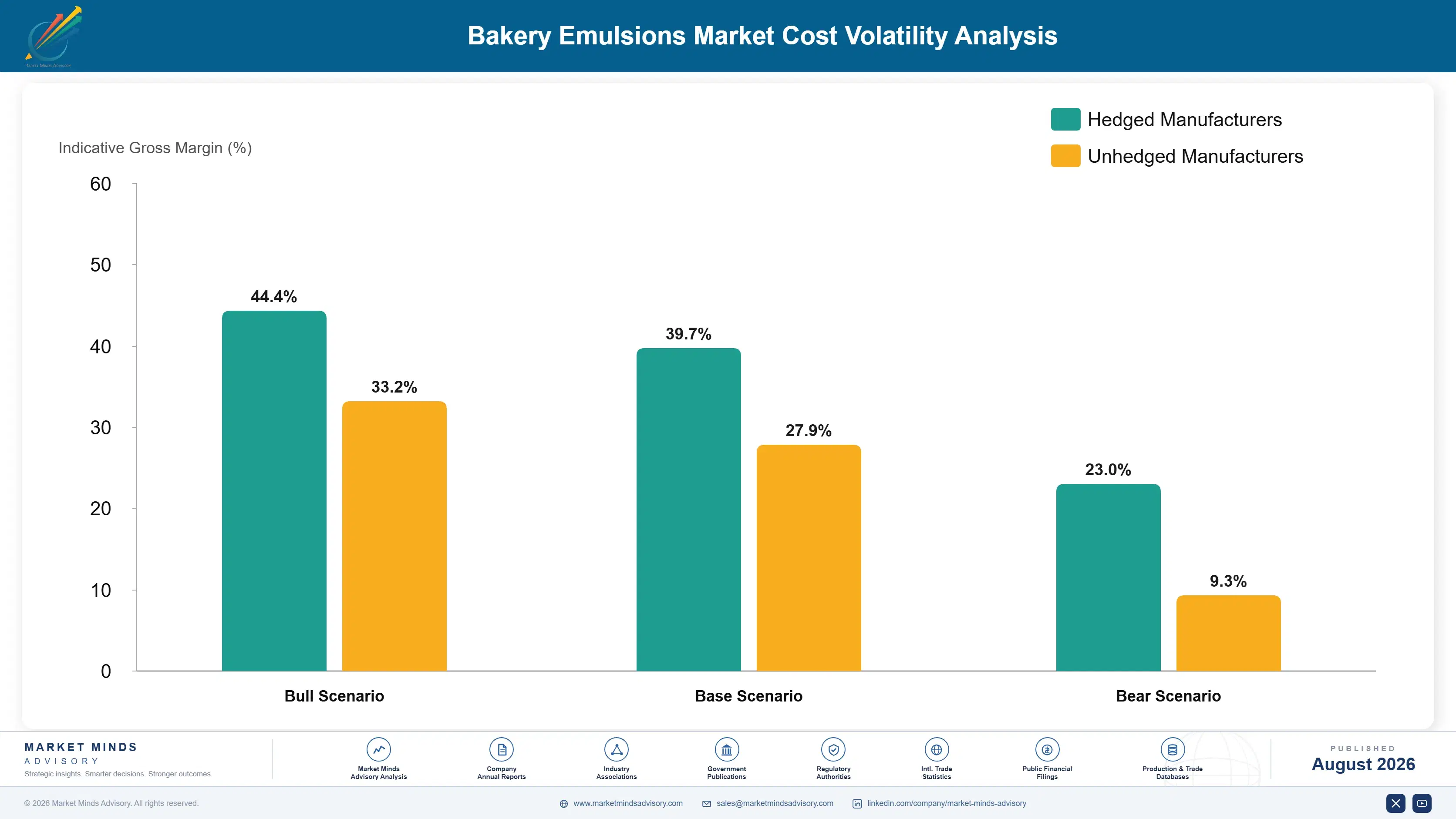
Oilseed Feedstock Exposure

Sunflower and soybean feedstock together represent roughly 46 percent of cost of goods sold for lecithin-based bakery emulsions, sourced primarily from Ukrainian, Russian, and Western European crushing facilities for sunflower and from North and South American processors for soybean-derived lecithin, with a smaller share of specialty enzyme inputs sourced from dedicated biotechnology fermentation facilities. with smaller volumes also processed across South American crushing facilities.
Sunflower lecithin prices spiked sharply in 2022 following the disruption of Ukrainian crushing operations and export logistics, a volatility event documented in European Commission agricultural market reporting, forcing several bakery ingredient suppliers to temporarily substitute soy lecithin or delay planned non-GMO reformulation launches by two to four quarters while sunflower supply chains stabilized. Several bakery ingredient suppliers reported continued margin pressure into 2023 as sunflower crushing capacity took longer than expected to normalize fully.

Exposure varies considerably by player type: vertically integrated producers with owned crushing capacity have absorbed volatility more easily than pure-play emulsifier formulators reliant on third party lecithin purchases, a disadvantage that is increasingly steering smaller specialty producers toward long-term feedstock supply agreements or acquisition by larger integrated competitors seeking secured input access. This trend continues as feedstock volatility persists across regions.
bakery-emulsions-market-trends-growth-cost-volatility-analysis-1787463036993

Multi-Year Sunflower Feedstock Supply Agreements

Locking in three to five year supply agreements directly with crushing facilities across multiple geographic origins protects margin during volatility events, though it requires accurate long-term demand forecasting that smaller emulsifier producers with less established reformulation pipelines often find difficult to commit to with confidence given uncertain bakery customer adoption timelines. Adoption has grown steadily since 2023.

Soy Lecithin Substitution During Sunflower Supply Disruptions

Maintaining dual-sourcing capability across both sunflower and soy lecithin allows producers to shift blended formulations toward whichever feedstock offers more stable pricing during a given supply disruption, preserving customer supply continuity even when non-GMO positioning temporarily requires compromise during acute shortage periods. Several large bakery suppliers have already formalized this dual-sourcing approach into standard procurement policy across their networks.

Vertical Integration Into Oilseed Crushing Capacity

Larger producers are acquiring or building dedicated crushing capacity to internalize feedstock margin and reduce exposure to third party pricing volatility, a capital-intensive mitigation available primarily to the largest global producers rather than smaller regional specialty emulsifier formulators lacking comparable capital access. This mitigation remains available primarily to the largest producers given the scale of capital investment required.

Portfolio Architecture for Margin Defence

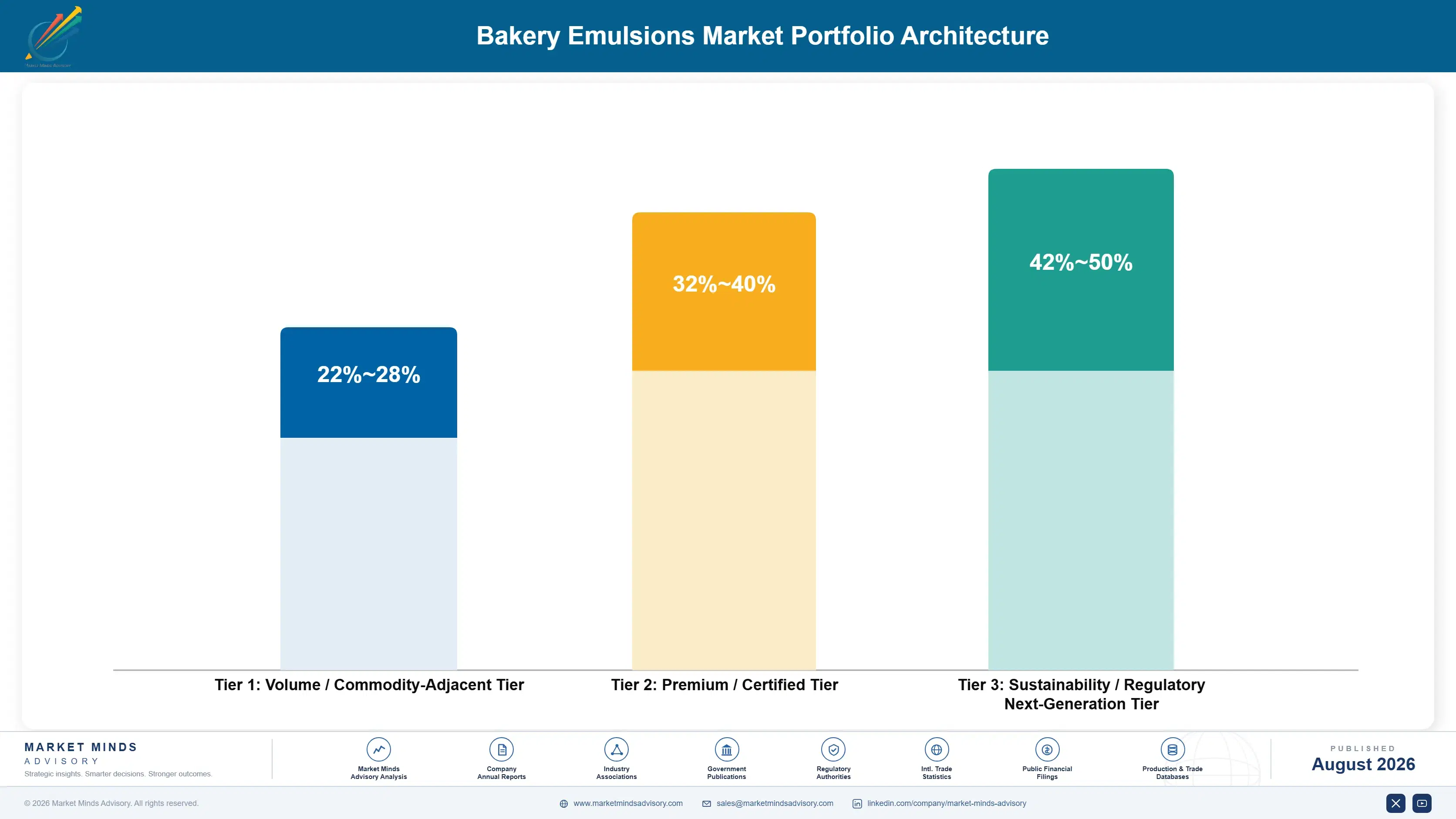
Portfolio economics split across three tiers: commodity synthetic emulsifiers competing largely on price and functional consistency, certified non-GMO and clean label lecithin systems commanding meaningful premium pricing, and emerging enzyme-based systems capturing the highest margin as bakeries pay for both regulatory advantage and demonstrated functional performance parity. This split increasingly determines which suppliers can secure preferred access to major retailer reformulation programs going forward.
The tension between volume and premium positioning is sharpest at private label contract renewal, where retailer clean label scorecards are compressing commodity synthetic emulsifier volume faster than premium tier growth can fully offset, pushing suppliers to defend commodity tier share on cost efficiency while investing disproportionately in premium and next-generation tier innovation where competitive intensity remains lower. Suppliers investing early in premium tier innovation are increasingly better positioned than those still defending commodity volume alone.

High value margin pools concentrate in enzyme-based systems and co-developed reformulation partnerships with major bakery customers, where suppliers capture value both from the ingredient itself and from the application support services increasingly bundled into reformulation contracts. Producers without enzyme capability increasingly risk losing access to the fastest-growing reformulation contracts entirely.

Volume / Commodity-Adjacent Tier

Synthetic mono- and diglyceride and DATEM emulsifiers competing primarily on price and functional consistency across conventional bakery lines. Margins here depend heavily on production scale and logistics efficiency rather than on differentiated ingredient sourcing.
Gross Margin: 22-28%

Premium / Certified Tier

Certified non-GMO sunflower lecithin and traceable polyglycerol ester systems commanding premium pricing from clean label focused bakery customers. Buyers in this tier increasingly require documented non-GMO certification and traceable feedstock origin records.
Gross Margin: 32-40%

Sustainability / Regulatory / Next-Generation Tier

Enzyme-based emulsifying systems and co-developed reformulation partnerships serving bakeries seeking full E-number elimination. Capacity remains limited across this tier, keeping it the most supply constrained segment of the category currently as enzyme production scales gradually.
Gross Margin: 42-50%
bakery-emulsions-market-trends-growth-portfolio-architecture-1787463037488

High-value Sub-segments and Strategic Watch-out

Phospholipase Systems for Industrial Bread

Scaling fastest among enzyme-based options as large industrial bakeries validate performance parity with synthetic emulsifiers, this segment remains constrained by limited specialty enzyme production capacity relative to accelerating bakery demand across major consuming regions. Suppliers investing early in dedicated production lines are best positioned to capture this accelerating demand curve.
Gross Margin: 44-52%

Certified Non-GMO Sunflower Lecithin

Non-GMO labeling preference supports durable pricing power here, though supply concentration in Ukraine, Russia, and Western Europe leaves the segment exposed to periodic volatility that certified soy lecithin alternatives do not face to the same degree. Buyers without documented origin traceability increasingly struggle to meet retailer certification requirements consistently.
Gross Margin: 34-40%

Conventional Mono- and Diglyceride Emulsifiers

The largest volume segment by tonnage, competing primarily on price for conventional bakery lines not yet subject to retailer clean label scorecard pressure, and increasingly exposed to gradual share erosion as reformulation spreads further across mainstream grocery categories. Suppliers here compete mainly on cost efficiency rather than positioning.
Gross Margin: 20-26%

Titanium Dioxide-Adjacent Legacy Additive Systems

Facing accelerating phase-out risk as European Union and other jurisdictions restrict legacy bakery additives bundled into broader reformulation projects, this segment requires urgent transition planning or faces continued exclusion from European retail channels over the coming years. Suppliers with cooperative certification partnerships offer a path back into premium retail channels.
Gross Margin: 18-24%

Reformulation Contract Economics

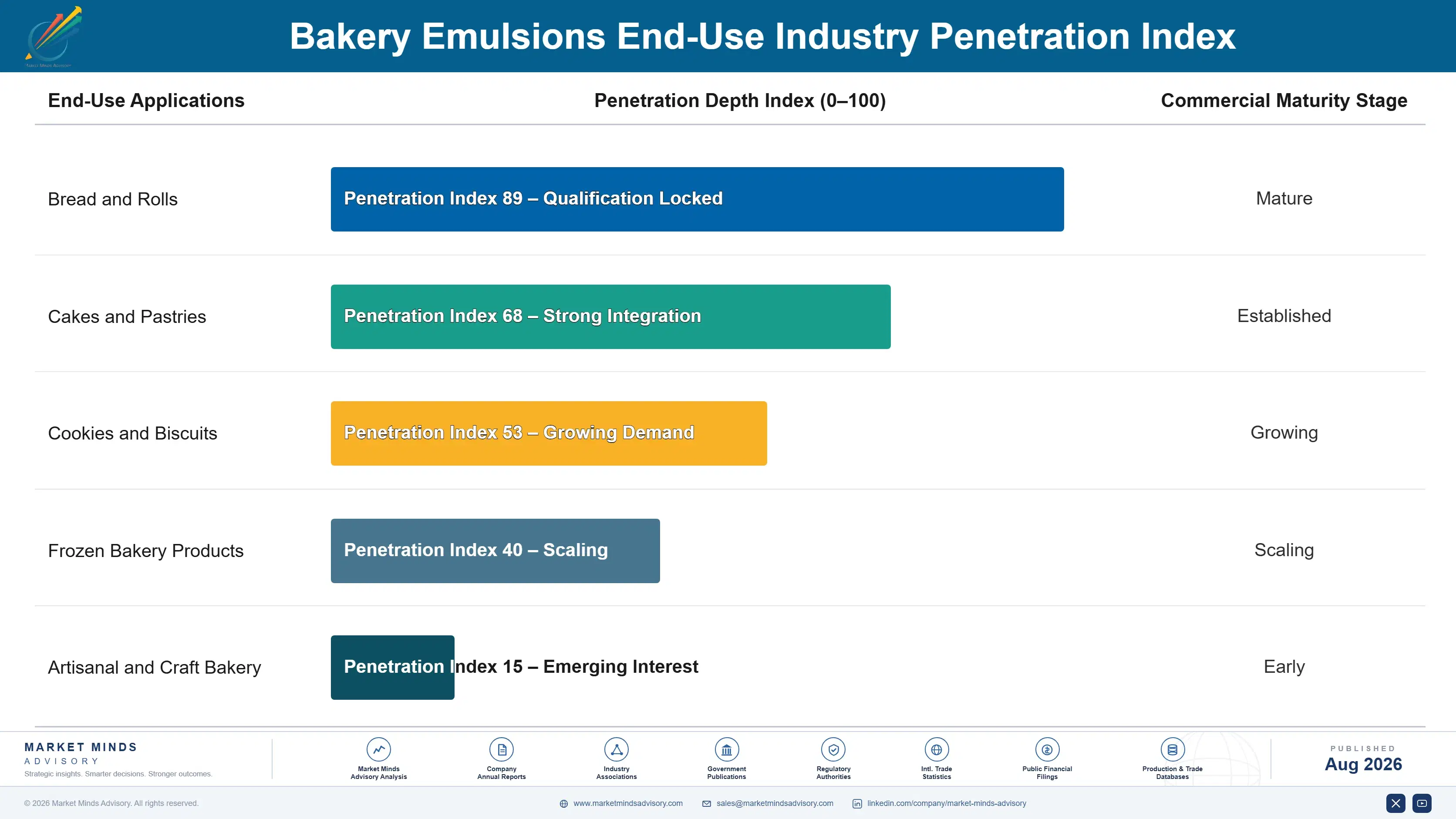
Demand in this category increasingly behaves like a recurring reformulation service relationship rather than a one-time ingredient purchase, since retailer clean label scorecards reset periodically and bakeries depend on suppliers to maintain ongoing reformulation and application support capability, creating a form of annuity demand for suppliers embedded early in a customer's reformulation roadmap. Suppliers embedded early in a reformulation roadmap capture disproportionate follow-on volume.
Adoption depth varies considerably by end use vertical: large industrial bakeries with dedicated application laboratories show the deepest and most consistent adoption of enzyme-based systems, mid-sized private label bakeries show moderate but accelerating adoption tied directly to retailer contract renewal cycles, and artisanal or craft bakeries remain the shallowest adopters, still prioritizing unchanged taste and texture over clean label labeling advantage. Craft bakeries are expected to remain the slowest segment to adopt these clean label standards.

Younger bakery category managers entering procurement roles increasingly expect clean label credentials as a baseline sourcing requirement rather than a premium differentiator, a generational shift that is compressing the price premium clean label emulsifiers can command even as unit volume continues expanding across most major consuming regions globally. Suppliers slow to adapt risk losing relevance with these compliance-driven bakery buyers.
bakery-emulsions-market-trends-growth-end-use-penetration-index-1787463037987

Where Emulsifier Reformulation Capital Should Concentrate

These are among the four positions where our research anticipates prominent divergence between winners and laggards over the coming forecast period. Each is grounded in the demand model, the regulatory perimeter, and the announced capacity pipeline.
01 / REFORMULATION SUPPORT INVESTMENT

Prioritize co-development capability over ingredient sales alone

Retailer clean label scorecards are changing faster than mid-sized bakeries can independently requalify production lines, making shared application laboratory access and co-funded trials a more defensible growth investment than ingredient sales alone. Suppliers offering this support have already captured customer relationships that competitors selling ingredients without reformulation assistance struggle to displace once a line qualification is complete. This advantage compounds with each retailer scorecard update, since switching suppliers after a successful qualification carries real requalification cost for the bakery customer.
02 / FEEDSTOCK DIVERSIFICATION STRATEGY

Diversify sunflower sourcing before the next supply disruption

Sunflower lecithin supply concentration in Ukraine and Russia has already demonstrated its volatility potential once this decade, and crushing capacity additions elsewhere continue to lag demand growth in most years. Producers without diversified feedstock contracts remain exposed to the next disruption, a disadvantage increasingly steering bakery customers toward suppliers who can demonstrate mitigation plans. Securing diversified agreements now, while new crushing capacity is still being built out, costs less than waiting for the next geopolitical shock, a risk now shaping supplier selection criteria industry wide.
03 / ENZYME CAPACITY TIMING

Expand enzyme production capacity ahead of demand rather than behind it

Enzyme-based emulsifying systems remain supply constrained rather than demand constrained across several key phospholipase formulations, meaning early capacity investment captures disproportionate value before competing producers catch up to current bakery demand levels. Suppliers that expanded capacity early have already signed multi-year agreements with large industrial bakeries eager to lock in access. Waiting for demand to fully materialize before investing will mean competing for capacity against better-capitalized entrants with established bakery customer relationships already secured, a dynamic already visible in recent capacity investment announcements across the category.
04 / PRIVATE LABEL PARTNERSHIP APPROACH

Build retailer-level reformulation partnerships, not supplier by supplier

Partnering directly with major grocery retailers to develop pre-validated clean label formulations accelerates compliance across an entire private label bakery category simultaneously, rather than working supplier by supplier through a slower, fragmented adoption process. Ingredient partners securing this retailer-level relationship gain preferred status across the retailer's full private label bakery supply base. Suppliers slower to pursue this model risk losing private label volume to competitors already embedded in retailer-level reformulation programs, a dynamic already reshaping which suppliers retailers prefer to work with during contract renewal cycles.

Engagement Snapshot From the Field

A live engagement with an industry participant carrying material or product regulatory and market exposure ahead of a defining policy shift, showing how our research translates into a defensible multi-year portfolio strategy.
MARKET MINDS ADVISORY · CLIENT ENGAGEMENT SUMMARY
Bakery Emulsions Producer Strategic Portfolio Review and Transition Roadmap 2026·Investment Scenario on Bakery Emulsions Exposure Evaluation 2025-26
CLIENT PROFILE
The client is a mid-sized North American industrial bakery generating approximately 310 million dollars in annual revenue (client-reported, unverified by MMA), supplying private label bread and cake products to several major grocery retailers across the United States, facing increasing pressure from retailer clean label emulsifier scorecards at contract renewal. The client's manufacturing footprint spans two facilities in the American Midwest.
STRATEGIC CHALLENGE
Facing potential private label contract non-renewal on roughly 40 percent of its product portfolio due to E-number emulsifier content, the client needed to prioritize reformulation investment across multiple product lines without in-house application testing capability sufficient to validate replacement formulations before the next major retailer contract renewal cycle. with limited internal application testing infrastructure available.
MMA APPROACH
MMA conducted a product line reformulation feasibility assessment combining retailer scorecard analysis, enzyme and lecithin substitution cost modeling, and shelf life comparison testing coordination with two ingredient supplier partners, then developed a phased eighteen month reformulation roadmap sequenced to the client's contract renewal calendar. Recommendations were validated against the client's existing production line specifications.
KEY FINDINGS
  1. Roughly 70 percent of at-risk SKUs could be reformulated using enzyme-based systems without requiring line equipment changes. reducing the need for new capital equipment purchases.
  2. Sunflower lecithin substitution offered a lower-cost path for the remaining product lines despite a modest ongoing price premium. making it the preferred near-term reformulation path.
  3. Two ingredient suppliers were willing to co-fund application testing in exchange for multi-year supply commitments from the client. strengthening the client's long-term supplier relationships.
  4. Reformulation sequencing aligned to contract renewal dates reduced total testing cost by avoiding simultaneous validation of all product lines at once. and easing internal resource constraints.
CLIENT PROFILE
The client is a mid-sized North American industrial bakery generating approximately 310 million dollars in annual revenue (client-reported, unverified by MMA), supplying private label bread and cake products to several major grocery retailers across the United States, facing increasing pressure from retailer clean label emulsifier scorecards at contract renewal. The client's manufacturing footprint spans two facilities in the American Midwest.
STRATEGIC CHALLENGE
Facing potential private label contract non-renewal on roughly 40 percent of its product portfolio due to E-number emulsifier content, the client needed to prioritize reformulation investment across multiple product lines without in-house application testing capability sufficient to validate replacement formulations before the next major retailer contract renewal cycle. with limited internal application testing infrastructure available.
MMA APPROACH
MMA conducted a product line reformulation feasibility assessment combining retailer scorecard analysis, enzyme and lecithin substitution cost modeling, and shelf life comparison testing coordination with two ingredient supplier partners, then developed a phased eighteen month reformulation roadmap sequenced to the client's contract renewal calendar. Recommendations were validated against the client's existing production line specifications.
KEY FINDINGS
  1. Roughly 70 percent of at-risk SKUs could be reformulated using enzyme-based systems without requiring line equipment changes. reducing the need for new capital equipment purchases.
  2. Sunflower lecithin substitution offered a lower-cost path for the remaining product lines despite a modest ongoing price premium. making it the preferred near-term reformulation path.
  3. Two ingredient suppliers were willing to co-fund application testing in exchange for multi-year supply commitments from the client. strengthening the client's long-term supplier relationships.
  4. Reformulation sequencing aligned to contract renewal dates reduced total testing cost by avoiding simultaneous validation of all product lines at once. and easing internal resource constraints.
RECOMMENDED STRATEGY
Phase 1: Phase 1 (Months 1 to 6): Reformulate highest-risk private label SKUs using co-funded enzyme system trials. with two ingredient suppliers providing co-funded testing support. Phase 2: Phase 2 (Months 7 to 12): Complete sunflower lecithin substitution for remaining at-risk product lines. completing validation ahead of the retailer's contract renewal deadline. Phase 3: Phase 3 (Months 13 to 18): Secure multi-year supply agreements locking in reformulation gains ahead of the next scorecard update.
OUTCOME
Within eighteen months of implementation, the client reported retaining 95 percent of at-risk private label contract volume through the following renewal cycle and reducing total reformulation testing cost by 24 percent through supplier co-funding arrangements (client-reported, unverified by MMA). Supplier relationships established during the project also reduced future reformulation lead times.

Frequently Asked Questions

Foundational context covering the market sizes, CAGR, scope, country, region and competition that inform every finding below. This section is provided to cover basics and most often pre-purchase conversations, answered from the MMA Primary Research Dataset.

What is the current size of the Bakery Emulsions Market?

The Bakery Emulsions Market is valued at approximately 1.9 billion dollars in 2025, spanning synthetic, lecithin-based, and enzyme-based emulsifying systems used across industrial and retail bakery production.

How large will the Bakery Emulsions Market be by 2036?

The market is projected to reach roughly 3.65 billion dollars by 2036, driven by accelerating clean label reformulation and expanding enzyme-based emulsifying system adoption. ahead of the current decade's end.

What is the CAGR for the Bakery Emulsions Market 2026 to 2036?

The market is expected to grow at a compound annual growth rate of approximately 6.1 percent between 2026 and 2036, supported by ongoing reformulation and feedstock diversification trends.

Which segment is growing fastest?

Enzyme-based emulsifying systems are the fastest growing segment, expanding at roughly 1.6 times the overall market rate as bakeries seek E-number-free alternatives to synthetic emulsifiers.

Who are the major companies in the Bakery Emulsions Market?

Leading companies include Cargill, ADM, Corbion, Kerry Group, and Puratos, each expanding reformulation support and feedstock diversification capabilities across major consuming regions. across both established and emerging supply regions.

Which country is growing fastest?

India is the fastest growing single country, as its packaged bakery sector scales rapidly and modern retail penetration expands beyond metropolitan centers into smaller cities.

Report Segmentation Architecture

The full report scope spans multiple orthogonal segmentation dimensions, with cross-tabulated demand data provided for each dimension pair. Coverage extends further to regional breakdowns, trend trajectories, and the competitive detail needed to support segment-level decision-making.

By Emulsifier Chemistry Type

  • Mono- and Diglycerides
  • DATEM
  • SSL and CSL
  • Lecithin-Based Systems
  • Polyglycerol Esters
  • Enzyme-Based Systems

By End-Use Industry

  • Bread and Rolls
  • Cakes and Pastries
  • Cookies and Biscuits
  • Frozen Bakery Products
  • Artisanal and Craft Bakery

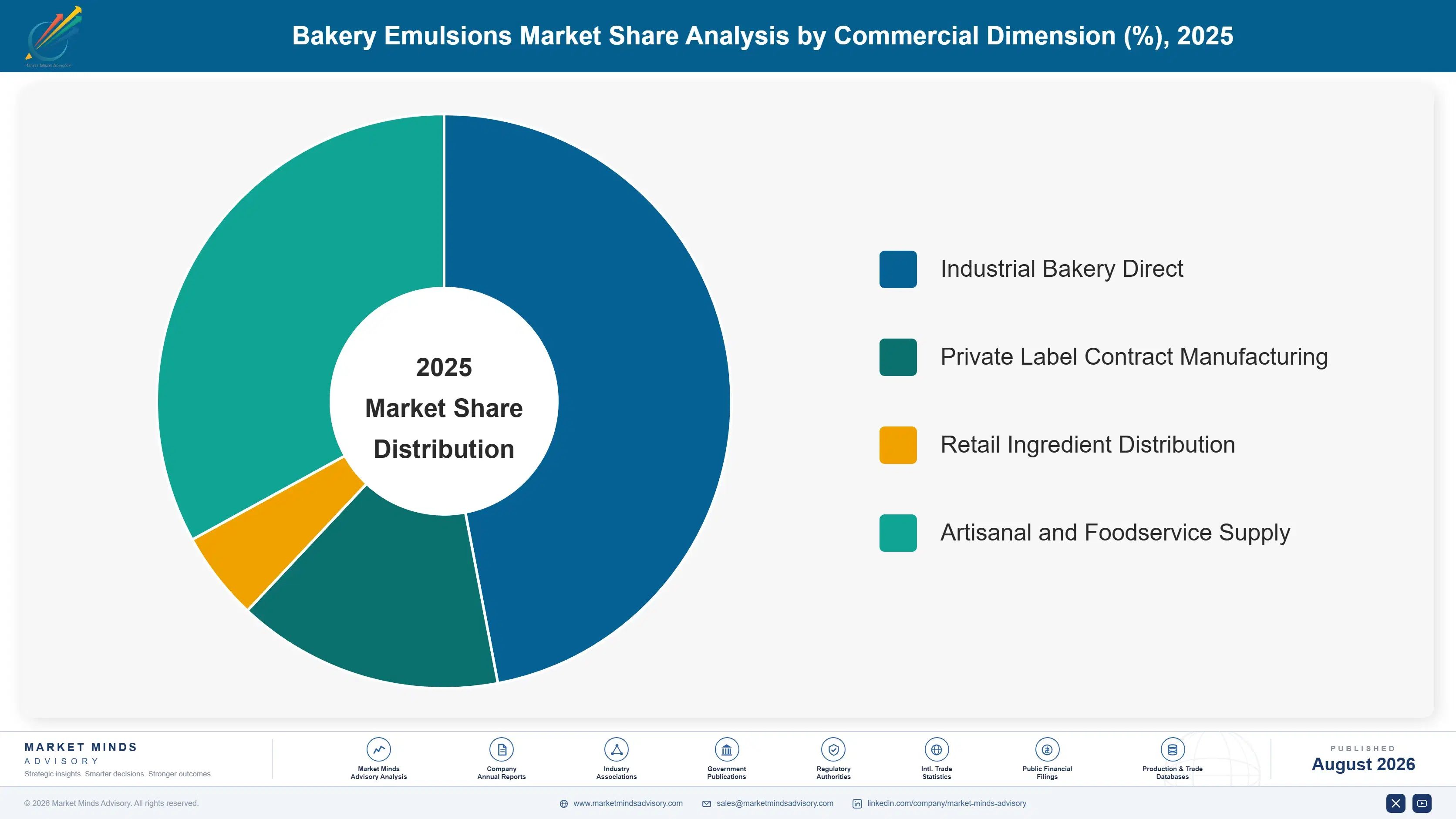
By Commercial Dimension

  • Industrial Bakery Direct
  • Private Label Contract Manufacturing
  • Retail Ingredient Distribution
  • Artisanal and Foodservice Supply

By Region

  • North America
  • Western Europe
  • East Asia
  • South Asia and Pacific
  • Latin America
  • Middle East and Africa
  • Eastern Europe

Scope, Methodology, and Coverage

Every figure in this report is reproducible from documented input assumptions. The scope below maps the historical period, the forecast horizon, the segmentation dimensions, and the countries covered, alongside the underlying primary and qualitative methodology.
Historical Period
2020 to 2025
Forecast Period
2026 to 2036
Base Year
2025 (USD billions; MMA Primary Research Dataset, August 2026)
Market Definition
The bakery emulsions market covers emulsifying ingredients and pre-blended emulsion systems used in bread, cake, pastry, and other baked goods to control dough stability, crumb structure, and shelf life, including mono- and diglycerides, DATEM, SSL and CSL, lecithin-based systems, polyglycerol esters, and enzyme-based emulsifying systems. It excludes standalone leavening agents, preservatives, and flavor systems sold independently of an emulsifying function.
Quantitative Units
USD billions (current prices); metric tons for select volume metrics
Segmentation Dimensions
By Emulsifier Chemistry Type; By End-Use Industry; By Commercial Dimension; By Region
Regions Covered
North America, Western Europe, East Asia, South Asia and Pacific, Latin America, Middle East and Africa, Eastern Europe
Countries Covered
USA, China, Germany, France, UK, Japan, South Korea, India, Australia, Canada, Brazil, Mexico, Indonesia, Vietnam, Thailand, Malaysia, UAE, Saudi Arabia, South Africa, Nigeria, Turkey, Poland, Netherlands, Italy, Spain, Sweden, Switzerland, Argentina, Colombia, Singapore, and additional markets relevant to this sector
Key Companies Profiled
Cargill, ADM, Corbion, Kerry Group, Puratos, BASF, Palsgaard, Lasenor Emul, Stern-Wywiol Gruppe, Danisco (IFF), Riken Vitamin, American Lecithin Company, Lecico GmbH, Sonic Biochem Extractions, Novozymes, DSM-Firmenich, AAK AB, Ingredion, Bunge Limited, Wilmar International
Quantitative Methodology
Primary survey, n=3,800 respondents, Q4 2025, six countries; demand-side model with trade association cross-validation
Qualitative Methodology
47 expert interviews, Q4 2025; applied to validate demand model assumptions, identify emerging dynamics, and assess competitive positioning
Report Format
PDF and XLSX data workbook (Word format preview document)
Publisher
Market Minds Advisory
Report Code
MMA-2026-AGR-203
Published
August 2026
Contact
sales@marketmindsadvisory.com | www.marketmindsadvisory.com

Purchase the full Bakery Emulsions Market Report (2026 to 2036).

The full report delivers a complete quantitative and qualitative assessment of the bakery emulsions market, including detailed segment level forecasts through 2036, regional analyses across all seven covered geographies, and profiles of twenty leading ingredient producers. It incorporates primary survey data from 3,800 respondents and 47 expert interviews conducted in the fourth quarter of 2025. Buyers receive editable data tables, a customizable Excel forecast model, and access to MMA analysts for follow up questions during a defined post purchase support window. The report also includes detailed feedstock cost sensitivity analysis calibrated to current sunflower and soybean price benchmarks.
Detailed segment-level market forecasts through 2036
All seven regional market analyses included
Twenty profiled leading ingredient producers overall
Editable Excel based forecast data model
Primary survey and expert interview data
Extended post-purchase analyst support access included

Built For The People Who Decide

From boardroom strategy to bench-side execution, this report is read cover-to-cover by leaders shaping the next decade of their industry, turning demand scenarios, market dynamics and valuation benchmarks into decisions.
CXOs/ Presidents/ VPs/ Managers
M&A and Corporate Development
Strategy Teams and R&D Heads
Procurement and Product Directors
Regulatory and Compliance Leaders
Investor Relations and Equity Analysts