
Market Minds Advisory
Automotive Soft Trim Interior Materials Market

Automotive Soft Trim Interior Materials Market: Sustainable Textiles Reshape the Cabin as EV Interiors Redefine Comfort

European sustainability disclosure rules and Chinese electric vehicle interior premiumization are pulling soft trim demand toward bio-based textiles and synthetic leather faster than legacy foam and fabric suppliers can retool their production lines.

Lead Analyst

David Horsley

Published

September 2026

Make Smarter Decisions with Customized Research Insights

Request a free sample report and evaluate market opportunities, growth trends, and competitive dynamics relevant to your business needs.

2025 MARKET VALUE$14.2BMarket Size 2025
2036 FORECAST VALUE$28.1BBase Case , 2026 to 2036
CAGR 2026 TO 20366.4 %Bull 7.7% / Bear 5.1%
INCREMENTAL OPPORTUNITY$13.0BNet 10- year value creation
EXPANSION MULTIPLE1.86x2036 value over 2026 base
Strategic Levers
M&A Pipeline
Regional Outlook
Country Rankings
Competitive Intelligence
Segmental Deep-dive
Call-Us : 91 93563 13602

Executive Snapshot and Market Trajectory

Automotive soft trim interior materials reached USD 14.2 billion in 2025, a fragmented category now being reshaped by sustainability disclosure rules and electric vehicle cabin premiumization pulling demand toward bio-based and synthetic materials across nearly every price segment and vehicle class sold worldwide today and steadily.
Sustainable and bio-based textile materials grow fastest at 10.8%, about 1.69 times the overall 6.4% rate, as European sustainability disclosure requirements and automaker recycled-content commitments push bio-based fabrics into vehicle segments that previously used only conventional synthetic textiles. East Asia carries the largest regional share on China's enormous vehicle production base, while China posts the quickest national growth as domestic electric vehicle makers race to differentiate cabin experience through premium interior materials.
Competition sits at a fragmented CR5 of 38%, split among global interior suppliers, regional textile fabricators, and specialty leather processors serving automaker platforms directly across dozens of production hubs worldwide today and increasingly across export markets. Sustainability certification and synthetic leather substitution are the two forces deciding which suppliers keep winning platform business as automakers balance cost against evolving buyer expectations for cabin material quality and feel.
Market Definition
The automotive soft trim interior materials market covers textiles, synthetic and genuine leather, foam padding, and nonwoven materials used in seat covers, headliners, door panels, and interior trim surfaces. It excludes hard interior plastics, dashboards, and structural interior components not covered in soft trim fabric or padding.
Base Year Value
$14.2B in 2025 (MMA Primary Research Dataset, August 2026)
Forecast Period
2026 to 2036, eleven discrete annual values
CAGR
6.4% base case. Bull 7.7%. Bear 5.1%.
Fastest Growth Segment
Sustainable and Bio-Based Textile Materials: 10.8% CAGR
Fastest Growth Country
China: 9.6% CAGR
Fastest Growth Region
South Asia and Pacific: 8.5% CAGR
Largest Region
East Asia: 30% of 2025 global value
Market Leaders
Adient plc, Lear Corporation, Forvia Faurecia, Toyota Boshoku Corporation, Sage Automotive Interiors. Source: MMA Analysis based on company annual reports.
Primary Survey
n=3,800 procurement and R&D decision-makers, Q4 2025, six countries
Methodology
Demand-side build-up, cross-validated against public data, 47 expert interviews

Automotive Soft Trim Interior Materials Market Forecast Scenarios

automotive-soft-trim-interior-materials-market-tre-size-forecast-scenario-1787464994878
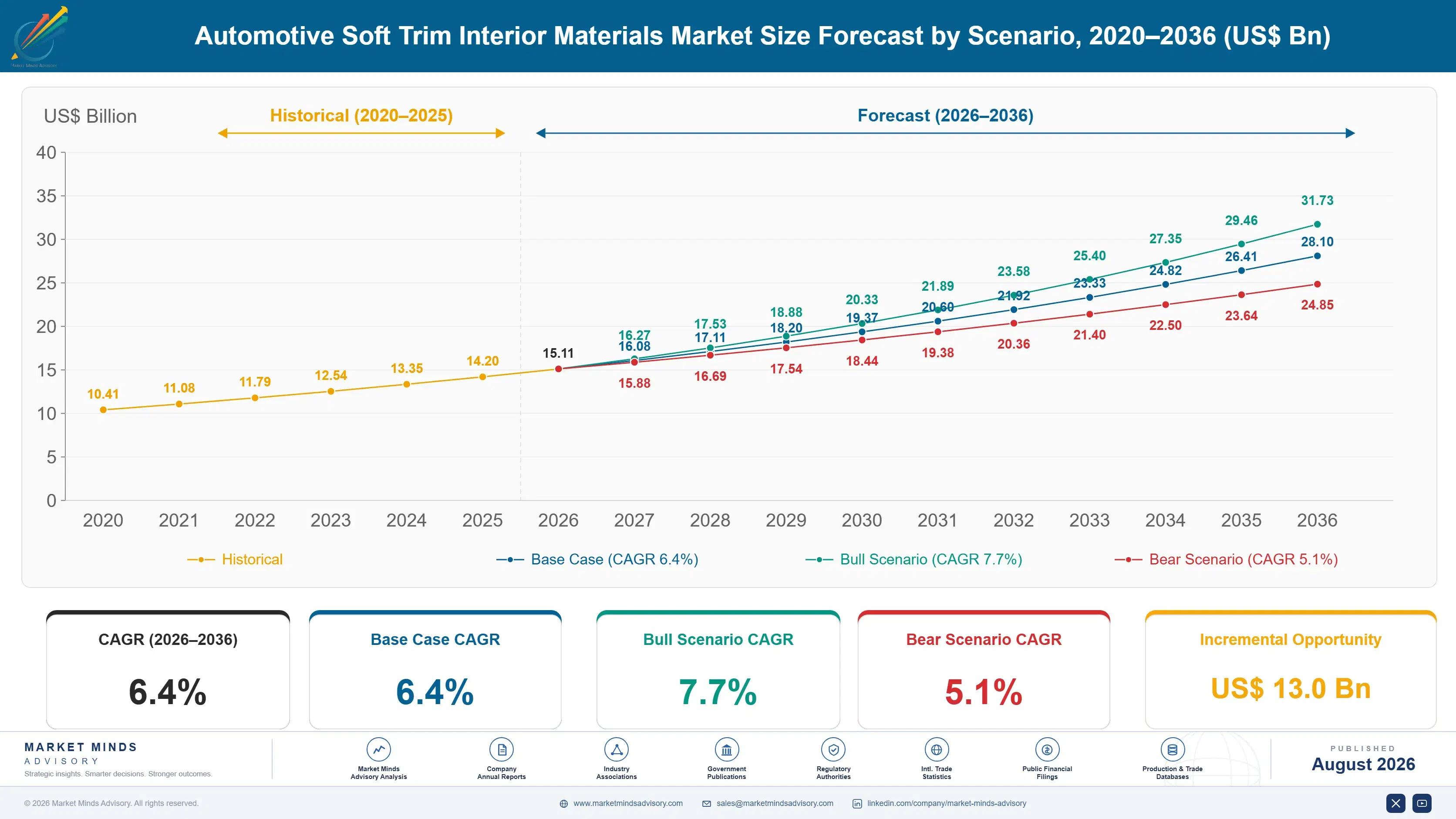
Between 2020 and 2025 the market grew near 5.7% annually as global vehicle production recovered from pandemic-era disruption while interior material content per vehicle rose steadily across most price segments worldwide today and consistently. Sustainability disclosure pressure accelerated late in the period, pushing early bio-based textile adoption in Europe well ahead of most other mature markets.
The base case carries the market to 6.4% through 2036 on three mechanisms. First, tightening European sustainability disclosure requirements keep pushing bio-based and recycled-content textiles into vehicle segments that previously used only conventional synthetic fabrics. Second, electric vehicle cabin premiumization creates an independent demand driver for synthetic leather and acoustic textile upgrades, since automakers compete on perceived cabin quality more than on powertrain differentiation alone. Third, Chinese domestic vehicle production keeps expanding, adding volume for interior material suppliers serving that market.
The bull case reaches 7.7% if additional automakers finalize recycled-content commitments faster than currently scheduled, accelerating bio-based textile adoption across mainstream vehicle segments worldwide today. The bear case falls to 5.1% if global vehicle production growth slows meaningfully, a pattern already visible during periods of elevated interest rates that have periodically depressed new vehicle sales across several major markets.

A Fragmented Category Reweighting Toward Sustainable Materials

Soft trim spent decades as a cost-driven category, chosen mainly for durability and price rather than any meaningful brand differentiation across most vehicle segments sold today and consistently. That framing has genuinely shifted as European sustainability disclosure rules and electric vehicle cabin premiumization pull bio-based textiles and synthetic leather into a category that automakers now treat as a genuine differentiator.
MARKET CONCENTRATIONCR5: 38%Split among global suppliers and regional textile fabricators
AVERAGE SELLING PRICEUSD 8 to 65 per square meterReflects wide gap between standard and premium materials
TOP PRODUCING REGION SHAREEast Asia: 30%Anchored directly by China's enormous vehicle production base
CAPACITY UTILISATION68% to 78%Reflects a fragmented category with steady incremental growth
FEEDSTOCK SHARE OF COGS35% to 45%Polyester and leather feedstock pricing drives cost structure
REPLACEMENT CYCLE LENGTH4 to 6 yearsTime between major vehicle interior redesign programs overall
Commercially, the category increasingly rewards sustainability certification and synthetic leather formulation capability over pure textile weaving scale alone today and quite consistently. A supplier capable of delivering certified recycled-content fabrics alongside premium synthetic leather can command meaningfully higher per-vehicle content than one selling standard polyester textiles, since automakers increasingly specify material sourcing credentials rather than accepting generic supplier claims.
Over the next decade, the pace of sustainability disclosure regulation and electric vehicle cabin competition will decide how quickly bio-based and synthetic materials become standard equipment across mainstream vehicle segments worldwide today and consistently. Suppliers with proven certified material supply chains already validated across multiple automaker programs are positioned to capture that expansion first regardless of how quickly individual disclosure rules finalize their remaining outstanding requirements.
"Soft trim used to be the part of the car nobody photographed. Now automakers put recycled-content percentages on the window sticker, and that alone tells you how much this category has changed."
Director, Automotive Interior Materials Practice · MMA Automotive Interior Materials Practice · August 2026

Market Trends

Bio-Based Textiles Enter Mainstream Vehicle Interior Programs

Automakers are increasingly specifying bio-based and recycled-content textiles rather than sourcing purely virgin polyester fabrics, driven by European sustainability disclosure regulation that requires documented recycled-content percentages alongside supply chain traceability well beyond what conventional textiles have historically provided. This shift follows years of material science work proving that bio-based and recycled fiber blends can meet durability and abrasion resistance requirements comparable to virgin materials. Sage Automotive Interiors and Adient have both restructured their materials divisions specifically around certified sustainable textile sales, reflecting how thoroughly this shift has reshaped supplier commercial strategy.
Market Impact: Requires disclosure across 27 member states
Chinese Electric Vehicle Makers Scale Synthetic Leather Adoption

Chinese domestic electric vehicle manufacturers have expanded synthetic leather adoption substantially to differentiate cabin experience without the cost and supply constraints of genuine leather, driven by both competitive benchmarking and consumer preference shifts away from animal-derived materials across most price segments. This adoption is beginning to pressure established international leather processors on pricing for premium seating surfaces, even as those same international suppliers retain an advantage in higher-value certified genuine leather formulations requiring deeper sourcing validation. Domestic Chinese suppliers are increasingly winning platform contracts from local automakers specifically on cost grounds.
Market Impact: Adds 15% premium content per vehicle

Market Opportunities and Growth Drivers

European Sustainability Disclosure Rules Mandate Recycled Content

European Union sustainability disclosure regulation increasingly requires automakers to report and disclose recycled and bio-based content percentages across interior materials, following the established precedent set by broader corporate sustainability reporting directives covering the vast majority of vehicles sold into the European market. This regulatory pressure forces certified recycled-content textile adoption into vehicle segments and price points that previously relied entirely on virgin polyester construction. Automakers serving multiple regulatory jurisdictions increasingly standardize on certified sustainable materials across their full model range rather than maintaining separate designs for each regulatory regime, simplifying platform sourcing considerably.
Market Impact: Adds 20% to 35% cost

Electric Vehicle Cabin Premiumization Drives Material Upgrades

Electric vehicle programs pursue cabin premiumization independent of traditional badge-based luxury positioning, since automakers use interior material quality to justify pricing and differentiate models that otherwise share broadly similar powertrain and range specifications across a crowded competitive field worldwide today. This demand is scaling directly alongside global electric vehicle production growth, giving synthetic leather and acoustic textile suppliers a genuine volume tailwind independent of traditional vehicle segment pricing tiers. Suppliers with established premium synthetic leather designs validated across multiple electric vehicle platforms are capturing this incremental content ahead of competitors.
Market Impact: Adds 12 to 18 months

Market Restraints and Challenges

Recycled Material Cost Premium Slows Broad Adoption

Certified recycled and bio-based textiles cost meaningfully more than conventional virgin polyester fabrics on a per-meter basis, limiting their use mainly to premium vehicle segments and automakers with dedicated sustainability marketing programs across most current production volumes. The root cause is the higher processing cost of certified recycled fiber streams combined with limited current-generation bio-based feedstock supply relative to established virgin polyester manufacturing capacity built over decades. This restricts adoption pace among cost-sensitive mainstream automakers competing on entry-level vehicle pricing. Several suppliers are scaling recycled fiber processing capacity to narrow this cost gap over time.
Market Impact: Cuts virgin fiber use by 40%

Genuine Leather Sourcing Faces Traceability Compliance Pressure

Genuine leather sourcing increasingly faces deforestation-linked traceability requirements under European Union supply chain regulation, forcing leather processors to document cattle ranch origin across a supply chain that historically operated with limited upstream visibility beyond the immediate tannery relationship. The root cause is the genuine difficulty of tracing hide origin back through multiple intermediary buyers and processing stages common in global cattle and leather supply chains built over many decades. This restricts genuine leather sourcing options for automakers unwilling to accept compliance risk. Larger suppliers are investing in blockchain-based traceability systems to address this gap directly.
Market Impact: Adds 8 new domestic suppliers
3 additional market trends, 4 additional growth drivers, and 3 additional restraints and challenges are covered in the full report. Contact sales@marketmindsadvisory.com to access the complete intelligence.

Segment CAGR and Growth Architecture

Segmentation follows soft trim material construction, a single technology dimension shared across every interior surface sold into global vehicle cabins and platforms worldwide today and quite consistently. Each material carries distinct cost, sourcing, and sustainability characteristics, so commercial position tracks the underlying construction itself rather than the vehicle segment or geography it ultimately serves.
automotive-soft-trim-interior-materials-market-tre-market-share-analysis-1787464995431

Sustainable and Bio-Based Textile Materials

Sustainable and bio-based textile materials grow fastest at 10.8%, about 1.69 times the overall 6.4% rate, as European sustainability disclosure regulation pushes certified recycled and bio-based content into vehicle segments that previously relied entirely on conventional virgin polyester textiles. Growth concentrates most heavily in Europe and increasingly China, where regulatory and consumer pressure are compressing adoption timelines fastest and forcing automakers to standardize sustainable material fitment across broader portions of their model ranges than originally planned. Established textile suppliers with validated recycled fiber supply chains are capturing this segment's growth disproportionately, since automakers remain genuinely cautious about certifying unproven sourcing claims from unverified suppliers regardless of cost advantages offered by newer entrants.
CAGR 10.8%

Synthetic Leather and Leatherette Materials

Synthetic leather and leatherette materials grow at 9.2% as automakers increasingly specify synthetic alternatives over genuine leather to reduce cost, sourcing complexity, and traceability compliance risk while still delivering a premium tactile cabin experience across most vehicle price segments worldwide today and quite consistently. This segment benefits from material science advances that have made synthetic leather considerably more difficult to distinguish from genuine hide than it was even five years ago, expanding its addressable vehicle segment range meaningfully across most price points. Growth trails the bio-based textile segment specifically because synthetic leather adoption is driven primarily by cost and sourcing convenience rather than regulatory disclosure requirements currently in force today.
CAGR 9.2%
Full segment breakdown across 6 segments available in the complete report.

Regional Architecture and Country Demand Map

East Asia leads on China's enormous vehicle production base and rapid electric vehicle cabin premiumization, followed closely by North America and then by Western Europe overall today. South Asia and Pacific posts the fastest regional growth as vehicle production and interior content expand together steadily.

North America

The United States anchors regional demand through a large vehicle production base and automaker sustainability commitments that have gradually pushed recycled-content textile fitment into most mainstream trim levels nationwide today, even ahead of binding domestic disclosure regulation comparable to Europe's current framework overall. Canada and Mexico contribute meaningful assembly volume tied to integrated North American vehicle production supply chains serving the broader regional market consistently and reliably. Growth here tracks near the global average as automakers balance voluntary sustainability marketing against the cost premium of certified recycled materials across mainstream vehicle segments and price tiers. Suppliers with established American manufacturing footprints continue to benefit from proximity to major assembly plants.
Share: 23% | CAGR: 6.0% (2026 to 2036)

Western Europe

Germany, France, and the United Kingdom drive regional demand through sophisticated vehicle production sectors operating under some of the strictest sustainability disclosure regulation globally, pushing certified recycled-content textile adoption ahead of most other mature markets worldwide today and quite consistently over time and reliably. Growth trails East Asia and South Asia as the region's disclosure framework, while comprehensive, has already driven most major automakers to standardize sustainable material content across their European model ranges over the past several years and beyond. Southern European markets add modest additional demand tied to smaller domestic vehicle assembly operations. Scandinavian markets contribute a smaller but steadily growing segment oriented toward premium sustainable material adoption.
Share: 19% | CAGR: 4.9% (2026 to 2036)
Regional intelligence for 5 additional markets available in the complete report: East Asia, South Asia and Pacific, Latin America, Middle East and Africa, Eastern Europe. Contact sales@marketmindsadvisory.com.
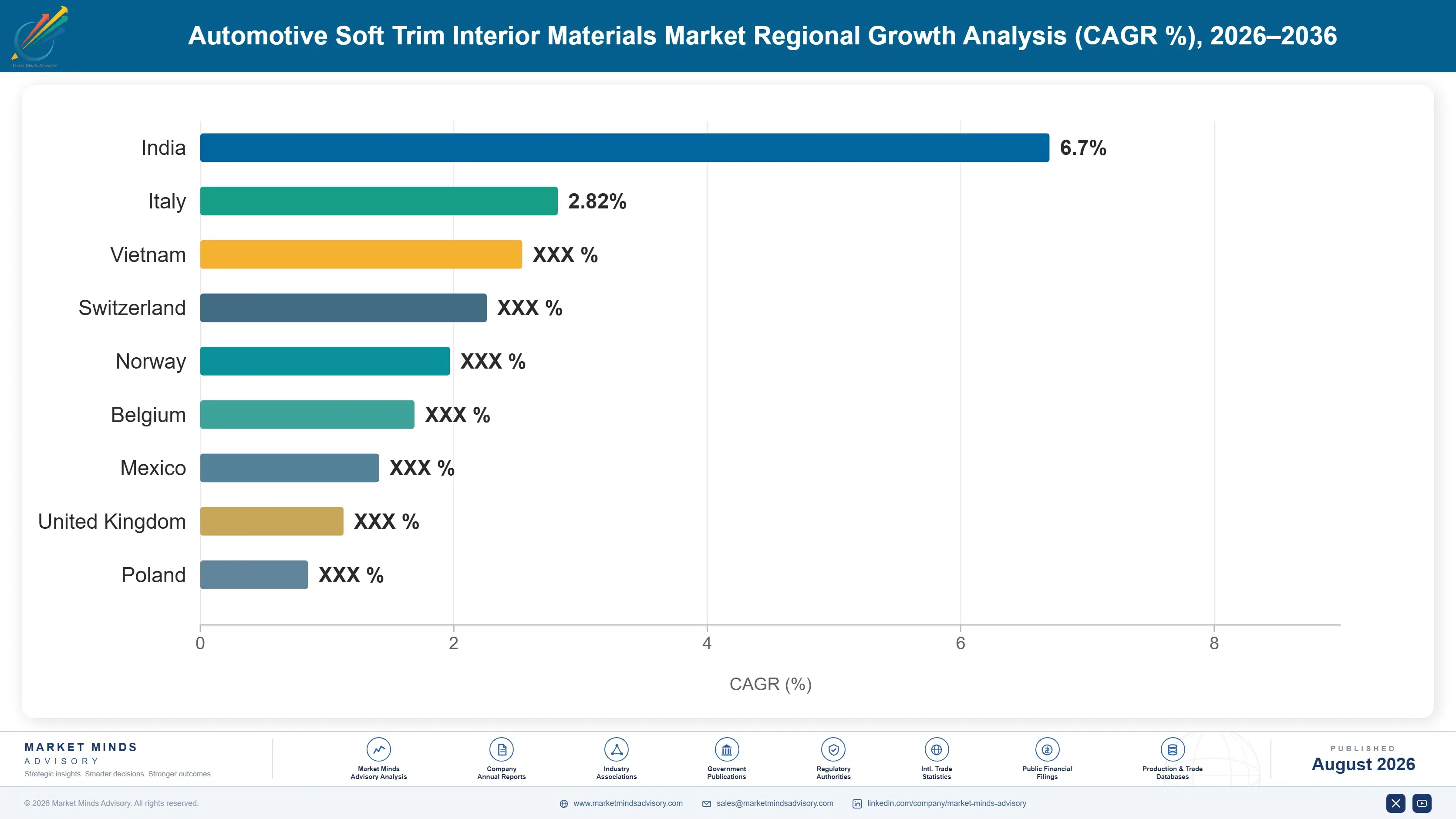
automotive-soft-trim-interior-materials-market-tre-country-cagr-analysis-1787464995962

Capturing Margin as Sustainability Reshapes the Cabin

Sustainability certification, not textile weaving scale, is the clearest margin opportunity this category has seen in years, rewarding suppliers who can deliver validated recycled and bio-based materials across every platform and price segment worldwide today and quite consistently. The four moves below target where participants across the value chain can build lasting competitive advantage.

Build Certified Recycled-Content Supply Chain Networks

Automakers increasingly specify certified recycled-content textiles rather than sourcing generic virgin polyester fabrics, making proprietary validated sourcing and traceability capability a genuine competitive moat rather than a material afterthought for suppliers competing on platform design wins. Suppliers with proven certified supply chains are capturing pricing 15% to 30% above standard textile sales, converting a compliance investment into durable recurring platform revenue across multiple vehicle programs. This investment requires sustained sourcing audits but compounds across successive automaker programs that reuse validated certification rather than restarting disclosure compliance from scratch each time.
Market Impact: Lifts platform pricing by 15% to 30% overall

Scale Premium Synthetic Leather for Electric Vehicles

Electric vehicle programs pursue cabin premiumization independent of traditional luxury positioning, and suppliers securing validated premium synthetic leather designs ahead of competitors are capturing content worth 15% additional per-vehicle interior revenue that rivals relying only on standard fabric cannot easily match. This capability increasingly functions as a genuine sales advantage with automakers seeking maximum cabin differentiation per dollar spent on interior upgrades, converting a material science function into a customer-facing differentiator. Larger suppliers with meaningful formulation budgets are best positioned to secure these certifications ahead of smaller competitors lacking comparable testing infrastructure.
Market Impact: Adds 15% additional per-vehicle interior revenue overall today

Invest in Blockchain-Based Leather Traceability Systems

Genuine leather sourcing increasingly faces deforestation-linked traceability requirements, and suppliers investing in blockchain-based traceability systems ahead of competitors are capturing content worth 10% of premium leather revenue from rivals still developing comparable documentation capability internally at meaningfully higher cost and slower pace. This traceability increasingly functions as a genuine market access requirement rather than a discretionary compliance cost, since several automakers now tie premium leather sourcing decisions directly to documented traceability credentials worth pursuing. Suppliers without a credible traceability system risk losing meaningful premium leather platform volume to better-prepared competitors.
Market Impact: Preserves access to 10% of leather revenue overall

Expand Recycled Fiber Processing Capacity in China

Chinese domestic electric vehicle production keeps expanding by 6% to 9% annually, and suppliers establishing recycled fiber processing capacity ahead of import duty structures are capturing content that competitors shipping certified textiles internationally cannot price competitively against domestic production costs and tariffs. This localization increasingly functions as a genuine market access requirement rather than a discretionary cost optimization, since several Chinese automakers now tie preferential sourcing incentives directly to domestic recycled content thresholds worth pursuing at scale. Suppliers without a credible local processing footprint risk losing meaningful platform volume to established domestic producers.
Market Impact: Captures 12% cost advantage on local content overall

Who Controls the Margin Pool

Concentration sits at a fragmented CR5 of 38%, reflecting a category split among global interior suppliers with decades of automotive qualification history and smaller regional textile fabricators and leather processors serving domestic automakers directly. The gap between Adient, the broadest interior materials portfolio holder, and specialized regional fabricators is meaningful given the certification investment required to compete on validated materials. All participants are assessed on one basis: revenue attributable to soft trim interior material product lines.
Current competitive activity runs along three lines. Sustainability certification increasingly differentiates suppliers competing for complete platform wins from those confined to standard textile sales only. Synthetic leather formulation development is emerging as a genuine advantage in premium and electric vehicle segments. Chinese domestic supplier consolidation is reshaping the competitive base for standard grades, pressuring international suppliers on price.

Emerging pressure comes from Chinese domestic textile and leather companies building sustainability and synthetic leather capability close to the world's largest electric vehicle production base, challenging the advantage international specialists held through decades of validation experience. Rankings over the next five years will likely shift toward whichever companies combine proven certified sourcing with synthetic leather credentials and credible China market access.
automotive-soft-trim-interior-materials-market-tre-company-positioning-matrix-1787464996508

Competitive Moat and Risk Dimensions

ADIENT PLC

Moat: Broadest interior materials portfolio

Adient's position as one of the largest global automotive seating and interior suppliers gives it manufacturing scale and certification depth across textile and leather grades that smaller regional competitors cannot easily replicate, supporting cost leadership across both standard and certified sustainable platform packages sold to automakers worldwide.
ADIENT PLC

Risk: Diversified conglomerate margin pressure

Adient's soft trim revenue competes internally for capital and engineering resources against the company's much broader seating structure and mechanism business, potentially slowing its response to fast-moving sustainability certification opportunities relative to more narrowly focused and specialized textile competitors over the coming several years ahead.
SAGE AUTOMOTIVE INTERIORS

Moat: Deep sustainable textile certification expertise

Sage Automotive Interiors has invested heavily in recycled-content and bio-based textile certification validated across European disclosure requirements, giving it credibility that suppliers without comparable long-term sourcing and traceability testing cannot easily match on newly disclosure-mandated platforms entering additional developing markets worldwide today and quite consistently.
SAGE AUTOMOTIVE INTERIORS

Risk: Chinese domestic price competition exposure

Sage Automotive Interiors faces mounting price pressure from Chinese domestic suppliers on standard textile grades sold into China's large domestic electric vehicle market, and sustained share loss on hardware volume could genuinely erode the scale advantages supporting its broader certification investment over the coming years ahead.

Players Tracked

Prominent Players

Adient plc
Lear Corporation
Forvia Faurecia
Toyota Boshoku Corporation
Sage Automotive Interiors

Other Key Players

Grupo Antolin
Seiren Co Ltd
Nishikawa Rubber Co
Freudenberg Performance Materials
Dow Automotive Systems
TWE Group
NHK Spring Co
Hyundai Transys
Kolon Industries
Toray Industries
Autoneum Holding AG
Suminoe Textile Co
Continental Structural Plastics
Recticel Automotive
Boxmark Leather

Recent Developments

MAY 2025

Adient Expands Recycled-Content Textile Weaving Capacity in Michigan

Adient commissioned additional recycled-content textile weaving capacity at its existing facility in Michigan to meet growing demand for certified sustainable fabrics across North American vehicle platforms. The expansion was funded from Adient's own capital budget as an organic capacity addition. Full production ramp is expected within eleven months.
Signal: Confirms certified sustainable textile demand now justifies dedicated new weaving capacity investment, not routine annual expansion.
SEPTEMBER 2025

Sage Automotive Interiors and a Chinese Textile Firm Form Joint Venture

Sage Automotive Interiors entered a joint venture with a Chinese textile manufacturer to produce synthetic leather specifically for the domestic Chinese electric vehicle market. The venture combines Sage's certification technology with the partner's local manufacturing scale and automaker relationships. Initial production is targeted for early 2026 across facilities.
Signal: Signals that joint ventures, not direct competition alone, are now the preferred strategy for accessing China.
JANUARY 2026

Lear Corporation Acquires Synthetic Leather Formulation Specialist

Lear Corporation acquired a smaller specialty synthetic leather manufacturer with established premium formulation technology to expand its cabin premiumization capability beyond its existing seating manufacturing operations. The acquired company brought proprietary coating technology that Lear previously lacked internally. Integration is expected to complete within nine months of close.
Signal: Confirms seating-focused suppliers now see synthetic leather formulation as a genuine and direct acquisition target overall.

Textile and Leather Feedstock Exposure

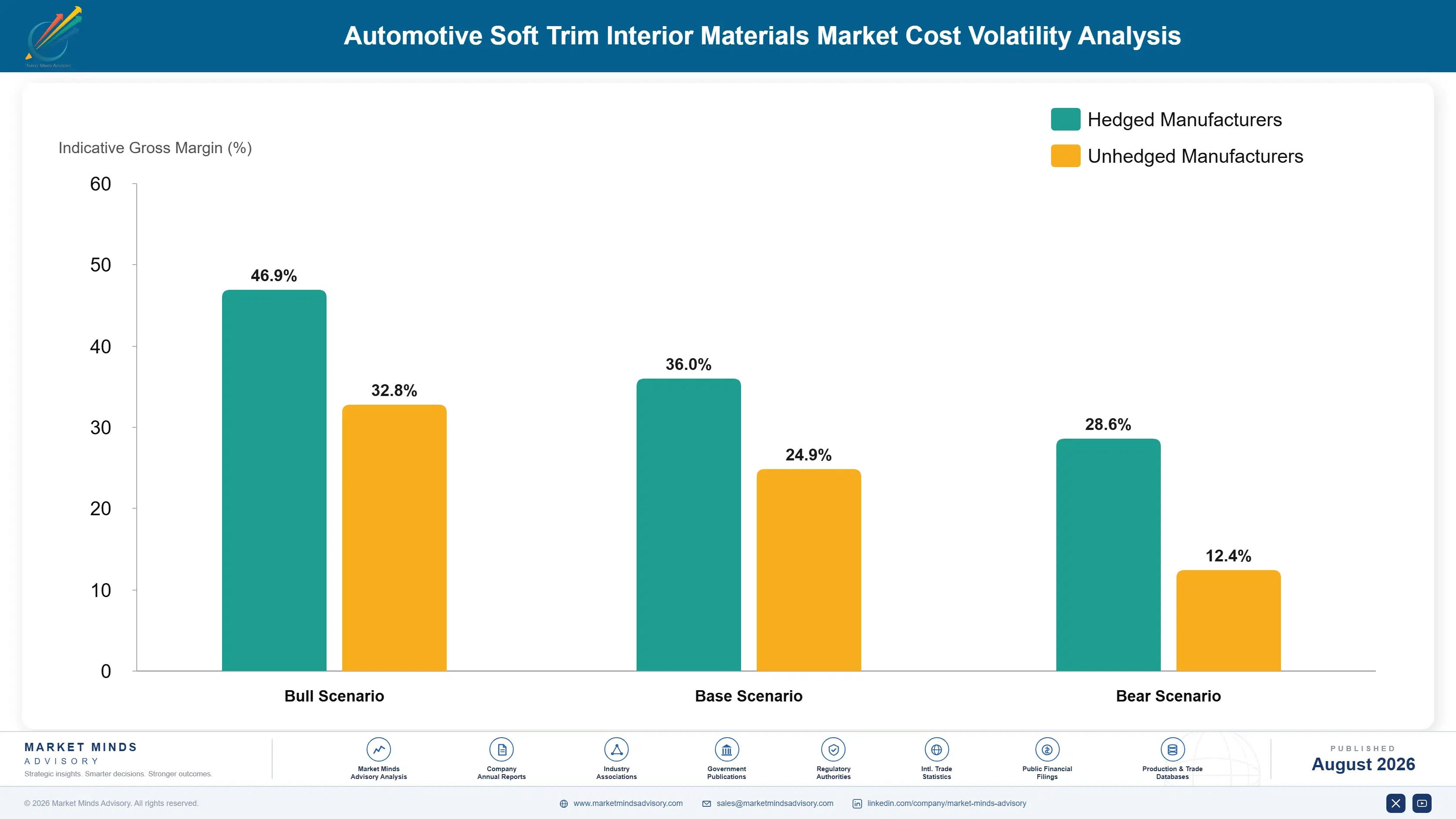
Polyester fiber and genuine leather together account for 35% to 45% of cost of goods sold across soft trim manufacturers, sourced primarily from petrochemical producers and cattle hide processors concentrated in China, Brazil, and the United States overall. This concentration leaves the category exposed to both petrochemical feedstock cycles and overall agricultural commodity price swings.
The 2022 global cotton and polyester price spike, documented in United States Department of Agriculture reports, pushed textile input costs up sharply within a single year as petrochemical feedstock prices tracked broader energy market volatility following geopolitical supply disruption. Suppliers with diversified fiber sourcing across multiple regions absorbed that disruption more smoothly than those dependent on a single supplier contract. Conditions gradually normalized over the following eighteen months as feedstock prices eased.

Exposure varies by supplier scale and sourcing depth. Larger suppliers with long-term fiber and hide supply agreements absorb feedstock volatility more smoothly than smaller regional fabricators buying primarily through distributors, who face sharper cost swings during tight supply periods. Geography matters too: suppliers with direct Chinese or Brazilian sourcing relationships face different exposure than those dependent on American feedstock specifically.
automotive-soft-trim-interior-materials-market-tre-cost-volatility-analysis-1787464996723

Diversify Fiber Sourcing Across Multiple Regions

Manufacturers qualifying polyester and leather supply from multiple producers across different geographic regions simultaneously reduce dependence on any single facility's feedstock allocation decisions in a given calendar period each and every year and season. This adds supplier qualification complexity but meaningfully smooths aggregate input cost volatility across a full multi-year sourcing horizon and planning cycle.

Secure Long-Term Fiber and Hide Supply Agreements

Larger suppliers are negotiating dedicated long-term fiber and hide supply agreements directly with producers, locking allocation priority ahead of the broader commodity market's cyclical demand swings across multiple end-use categories and applications each and every passing year. This requires meaningful upfront commitment but delivers substantially more predictable input supply during future disruption periods and planning cycles.

Expand Recycled Fiber Content in Textile Designs

Some suppliers are developing textile designs capable of using a higher proportion of recycled fiber content, reducing dependence on primary petrochemical feedstock and its associated price and supply allocation risk across the broader industry today. This requires genuine engineering validation investment but expands sourcing flexibility meaningfully over time and across multiple future product generations.

Portfolio Architecture for Margin Defence

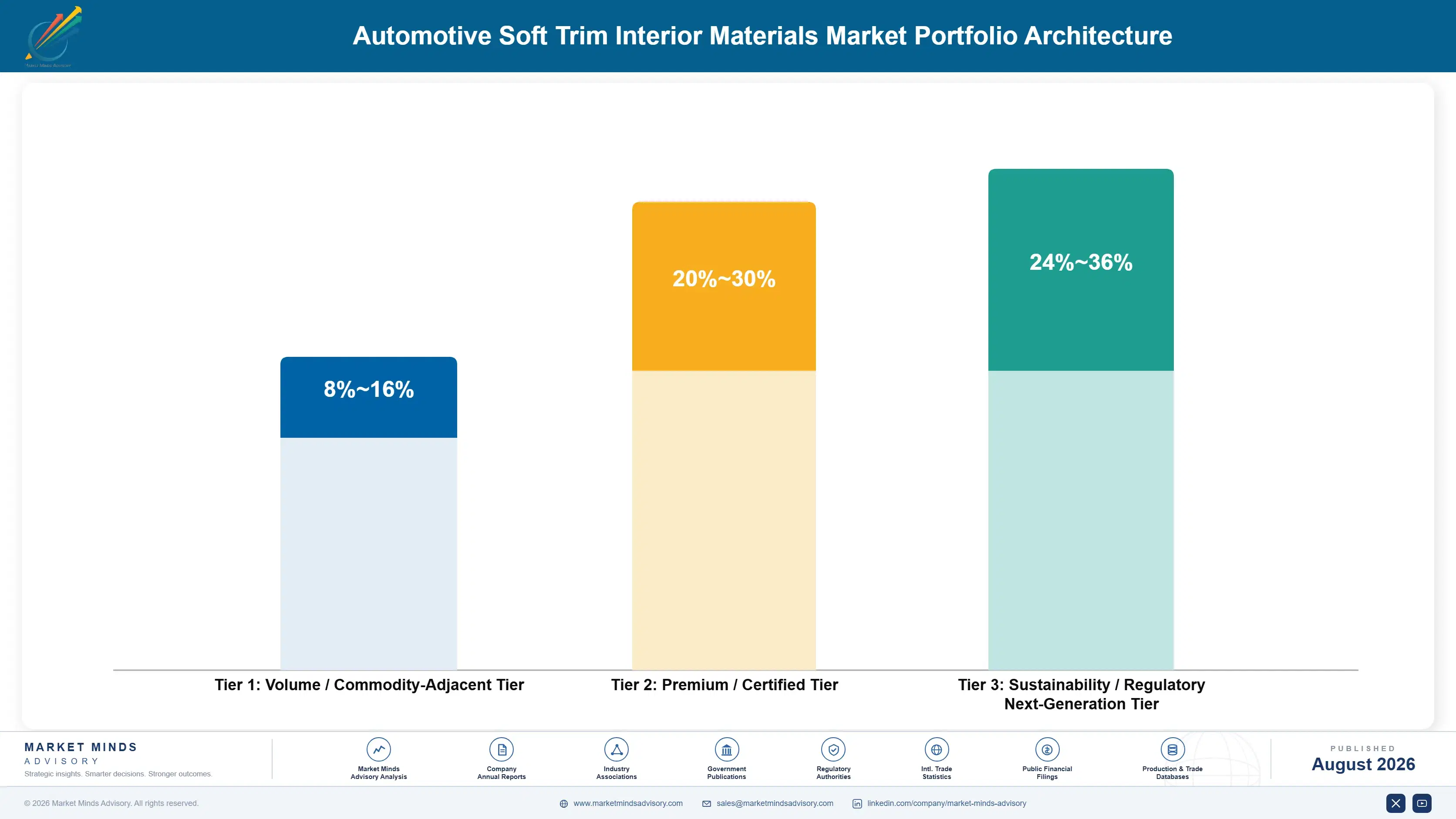
The portfolio splits into three tiers with meaningful margin separation tied to sustainability and material sophistication rather than raw fabric cost alone. Standard virgin polyester textiles compete mainly on price and delivery reliability, while certified recycled fabrics and premium synthetic leather command durable premiums tied to validated sourcing credentials and complete cabin design responsibility.
The tension between hardware volume and sustainability premium is sharpening as disclosure regulation and cabin premiumization expand certified material demand faster than standard textile demand grows, pulling supplier investment toward the higher-margin segment even though standard textiles remain the larger unit volume base globally today, particularly in cost-sensitive markets. Suppliers that maintain a foothold in both segments preserve optionality, while those chasing only certified platform contracts risk losing the stable cash flow that standard textile sales still reliably provide.

High-value margin pools concentrate specifically in certified recycled-content textiles and premium synthetic leather formulations for electric vehicles, both requiring genuine sourcing and validation investment that generic textile suppliers must build or acquire rather than simply extend from existing manufacturing capability. Standard virgin polyester textiles, by contrast, remain a large but slower-growing volume base offering thinner, more commoditized margins for most participants going forward.

Volume / Commodity-Adjacent Tier

Standard virgin polyester textiles sold primarily on price and delivery reliability into vehicle segments without sustainability disclosure or premiumization requirements yet, particularly across cost-sensitive emerging markets worldwide today and consistently over time.
Gross Margin: 8-16%

Premium / Certified Tier

Premium synthetic leather and certified textiles integrated into automaker-certified cabin platforms commanding durable premiums tied to formulation validation depth and a proven multi-year track record with global regulators and buyers worldwide.
Gross Margin: 20-30%

Sustainability / Regulatory / Next-Generation Tier

Certified recycled and bio-based textile formulations representing the newest and most technically demanding corner of the entire product portfolio, built specifically for disclosure-mandated vehicle platforms sold globally today and consistently.
Gross Margin: 24-36%
automotive-soft-trim-interior-materials-market-tre-portfolio-architecture-1787464997254

High-value Sub-segments and Strategic Watch-out

Certified Recycled-Content Textile Formulations

High value and high growth, driven by sustainability disclosure mandates expanding certified textiles across broader vehicle segments worldwide and every price point today. Suppliers with proven formulations are capturing this segment's fastest-growing platform design wins globally right now, across nearly every major market and region.
Gross Margin: 24-36%

Premium Synthetic Leather for Electric Vehicles

High value with strong growth, tied directly to global electric vehicle production scaling independent of broader disclosure regulation cycles worldwide and across most segments today. Validated synthetic leather designs increasingly decide which supplier wins long-term electric vehicle platform contracts across most major automakers and regions worldwide.
Gross Margin: 20-30%

Standard Virgin Polyester Textiles

The volume core, serving vehicle segments across most global markets regardless of sustainability adoption pace or regulatory timeline currently in place today and consistently. Steady growth tracks vehicle production volume rather than any specific technology trend emerging currently across the wider category and industry overall today.
Gross Margin: 8-16%

Unvalidated Chinese Domestic Synthetic Hardware

The strategic watch-out, facing accelerating price competition as domestic suppliers scale production for cost-sensitive vehicle segments worldwide and across every single price tier today and quite consistently overall. Remaining international supplier volume concentrates in accounts still requiring proven validation history and long-established track records overall.
Gross Margin: 6-14%

Design Cycles Meet Disclosure Timelines

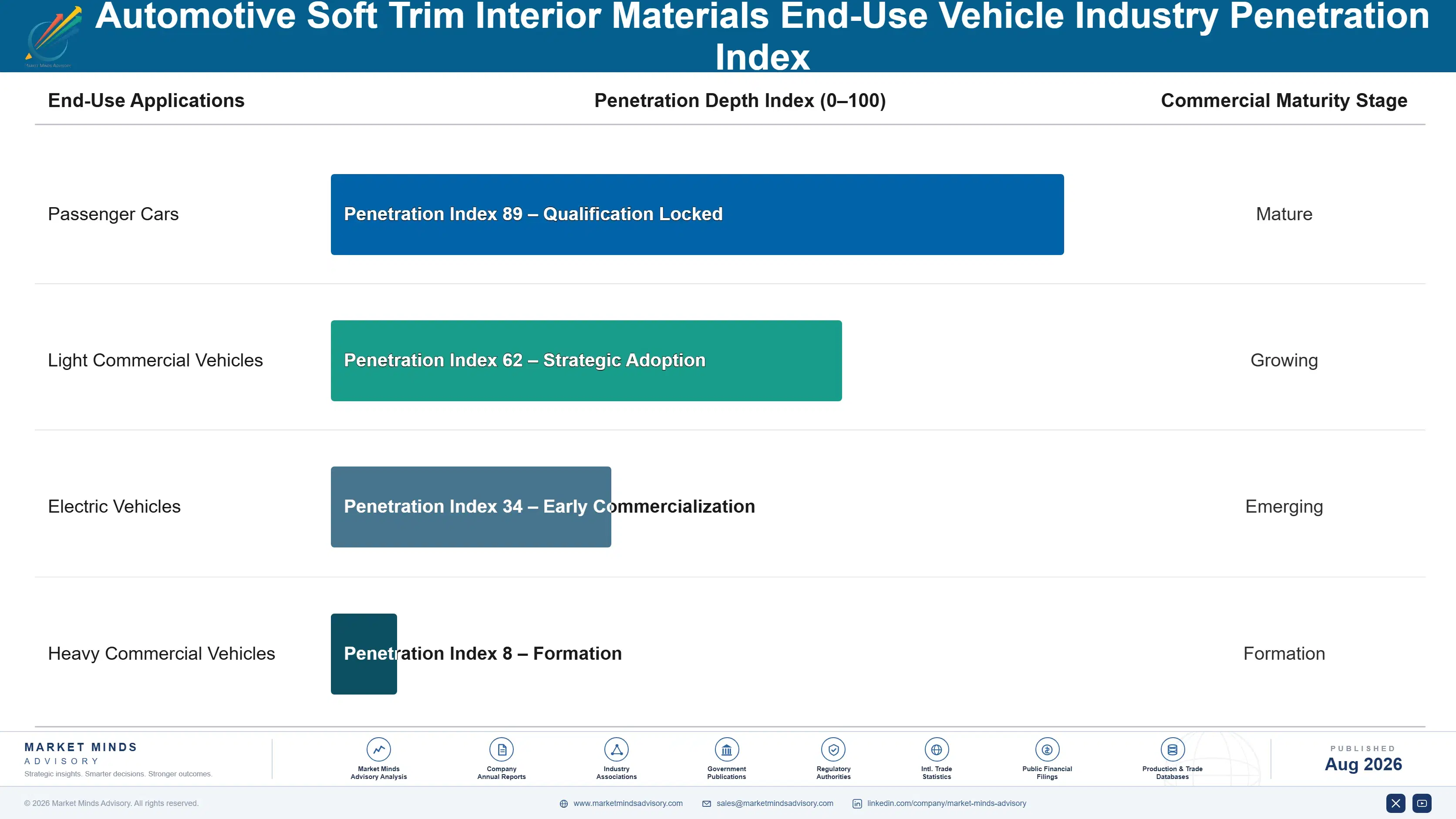
Demand compounds through vehicle platform design cycles rather than simple repeat commodity purchasing patterns. Once an automaker validates a material supplier's sourcing and certification against a platform's disclosure and durability requirements, switching suppliers means repeating validation that typically runs 12 to 24 months, creating genuine lock-in once a contract is secured. That lock-in makes won contracts closer to an annuity than a spot sale.
Adoption depth varies sharply by vehicle segment and automaker scale. Premium and electric automakers show the deepest sustainability lock-in, having validated complete certified material suites years before regulation required broader adoption. Mainstream volume automakers show more price-driven switching behavior as they extend certified materials into lower trims under disclosure pressure. Commercial vehicle manufacturers sit between the two, with loyalty varying by durability requirements.

Generational buyer shifts are reshaping who makes these platform sourcing decisions across the industry today. Younger vehicle designers increasingly prioritize validated sustainability credentials and cabin experience data over established supplier relationships that shaped earlier generations of automotive purchasing professionals. This shift favors suppliers investing in transparent certification data over those relying primarily on legacy relationship depth built over decades.
automotive-soft-trim-interior-materials-market-tre-end-use-penetration-index-1787464997757

Where Soft Trim Suppliers Focus

These are among the four positions where our research anticipates prominent divergence between winners and laggards over the coming forecast period. Each is grounded in the demand model, the regulatory perimeter, and the announced capacity pipeline.
01 / SUSTAINABLE SOURCING INVESTMENT

Build Certified Recycled Supply Chains Before Rules Tighten

European sustainability disclosure regulation continues tightening across model years, and suppliers without certified recycled-content textile supply chains are losing platform design wins to competitors that invested in this capability years ahead of the current regulatory wave sweeping most vehicle segments across the continent. This gap will only widen as automakers standardize certified material content across broader portions of their model ranges to simplify global platform disclosure reporting across regulated and unregulated markets alike. Suppliers relying only on standard virgin textile sales should treat certification investment as an urgent strategic priority.
02 / ELECTRIC VEHICLE CABIN STRATEGY

Scale Premium Synthetic Leather Ahead of Cabin Competition

Electric vehicle cabin premiumization competition keeps intensifying across nearly every major automaker program, and suppliers without validated premium synthetic leather formulations are losing platform business to competitors that secured differentiated cabin materials years before benchmarking pressure tightened across these flagship electric vehicle segments today. This gap keeps widening as more automakers chase distinctive cabin experience, pushing premium synthetic material demand into vehicle segments that previously used only standard textiles exclusively. Suppliers without a credible premium formulation pipeline risk permanently losing platform volume to better-prepared competitors.
03 / CHINA MARKET ACCESS STRATEGY

Pursue Joint Ventures Rather Than Direct Price Competition

Chinese domestic suppliers are scaling synthetic leather and textile production and winning platform contracts on cost grounds within the world's largest electric vehicle production market, and international suppliers competing purely on hardware price against domestic competitors face a genuinely difficult position given local cost advantages. Joint venture partnerships combining international certification depth with domestic manufacturing scale address both the cost competitiveness and market access challenges simultaneously and directly. Suppliers without a credible China joint venture strategy risk losing meaningful platform volume permanently to purely domestic competitors.
04 / LEATHER TRACEABILITY COMPLIANCE

Invest in Blockchain Traceability Ahead of Compliance Mandates

Genuine leather sourcing increasingly faces deforestation-linked traceability requirements under tightening European Union supply chain regulation, and suppliers without credible traceability systems are losing premium leather platform business to competitors that invested in documentation infrastructure years before mandates tightened across these key automotive markets today. This gap keeps widening as more governments finalize supply chain disclosure rules, pushing traceability-verified demand into premium segments that previously accepted limited upstream visibility. Suppliers without a credible traceability pipeline risk permanently losing platform volume to better-prepared competitors.

Engagement Snapshot From the Field

A live engagement with an industry participant carrying material or product regulatory and market exposure ahead of a defining policy shift, showing how our research translates into a defensible multi-year portfolio strategy.
MARKET MINDS ADVISORY · CLIENT ENGAGEMENT SUMMARY
Automotive Soft Trim Interior Materials Producer Strategic Portfolio Review and Transition Roadmap 2026·Investment Scenario on Automotive Soft Trim Interior Materials Exposure Evaluation 2025-26
CLIENT PROFILE
A mid-sized German automaker approached MMA while planning an interior material overhaul across its compact vehicle range ahead of tightening European sustainability disclosure requirements nationwide and across every trim level offered. The client reported annual vehicle production near 210,000 units and had previously sourced standard virgin polyester textiles from a single domestic supplier without recycled content (client-reported, unverified by MMA).
STRATEGIC CHALLENGE
Management needed to identify a certified recycled-content textile supplier capable of meeting new disclosure requirements within a compressed compliance timeline while keeping incremental per-vehicle cost within the client's competitive compact vehicle pricing constraints and margin targets. The client's procurement team had limited prior experience validating recycled fiber sourcing at this production scale.
MMA APPROACH
MMA benchmarked certified textile pricing and validation timelines across four candidate suppliers under the client's specific compliance deadline and cost targets. We modeled total platform integration cost including disclosure documentation and assessed each supplier's fiber supply security given recent feedstock volatility. We also evaluated each candidate's experience validating comparable certified materials for other European automaker programs.
KEY FINDINGS
  1. Two of the four candidate suppliers had already validated comparable certified textiles for other regional automakers, meaningfully reducing expected certification timeline risk (client-reported, unverified by MMA).
  2. The client's incumbent domestic supplier could not deliver validated recycled-content textiles within the disclosure deadline without a costly and rushed development program.
  3. Per-vehicle textile cost increased meaningfully under the recommended certified formulation but remained within the client's stated competitive pricing tolerance for the segment.
  4. Fiber supply commitments varied significantly among candidates, with only two suppliers offering dedicated long-term agreements protecting future delivery timelines fully and reliably.
CLIENT PROFILE
A mid-sized German automaker approached MMA while planning an interior material overhaul across its compact vehicle range ahead of tightening European sustainability disclosure requirements nationwide and across every trim level offered. The client reported annual vehicle production near 210,000 units and had previously sourced standard virgin polyester textiles from a single domestic supplier without recycled content (client-reported, unverified by MMA).
STRATEGIC CHALLENGE
Management needed to identify a certified recycled-content textile supplier capable of meeting new disclosure requirements within a compressed compliance timeline while keeping incremental per-vehicle cost within the client's competitive compact vehicle pricing constraints and margin targets. The client's procurement team had limited prior experience validating recycled fiber sourcing at this production scale.
MMA APPROACH
MMA benchmarked certified textile pricing and validation timelines across four candidate suppliers under the client's specific compliance deadline and cost targets. We modeled total platform integration cost including disclosure documentation and assessed each supplier's fiber supply security given recent feedstock volatility. We also evaluated each candidate's experience validating comparable certified materials for other European automaker programs.
KEY FINDINGS
  1. Two of the four candidate suppliers had already validated comparable certified textiles for other regional automakers, meaningfully reducing expected certification timeline risk (client-reported, unverified by MMA).
  2. The client's incumbent domestic supplier could not deliver validated recycled-content textiles within the disclosure deadline without a costly and rushed development program.
  3. Per-vehicle textile cost increased meaningfully under the recommended certified formulation but remained within the client's stated competitive pricing tolerance for the segment.
  4. Fiber supply commitments varied significantly among candidates, with only two suppliers offering dedicated long-term agreements protecting future delivery timelines fully and reliably.
RECOMMENDED STRATEGY
Phase 1: Phase 1 (0 to 3 months): Select the validated certified textile supplier and finalize integration and testing terms fully and promptly. Phase 2: Phase 2 (3 to 8 months): Complete full disclosure documentation and durability testing thoroughly against updated European requirements and standards. Phase 3: Phase 3 (8 to 12 months): Launch the updated compact vehicle range with fully certified sustainable interior materials in place.
OUTCOME
The client completed certification within the twelve-month timeline, meeting the disclosure deadline without production disruption. The certified interior materials also supported a marketing campaign emphasizing recycled content, contributing to a reported sales uplift among sustainability-conscious buyers in several urban markets nationwide (client-reported, unverified by MMA).

Frequently Asked Questions

Foundational context covering the market sizes, CAGR, scope, country, region and competition that inform every finding below. This section is provided to cover basics and most often pre-purchase conversations, answered from the MMA Primary Research Dataset.

What is the current size of the Automotive Soft Trim Interior Materials Market?

The market stood at approximately USD 14.2 billion in 2025, according to MMA's primary research dataset. This reflects global demand across textile, leather, and synthetic leather interior technologies.

How large will the Automotive Soft Trim Interior Materials Market be by 2036?

MMA projects the market will reach approximately USD 28.10 billion by 2036 under the base case scenario. This represents roughly 1.86 times the 2026 market entry value.

What is the CAGR for the Automotive Soft Trim Interior Materials Market 2026 to 2036?

The base case CAGR is 6.4%, with a bull case of 7.7% and a bear case of 5.1%. The range reflects uncertainty around sustainability disclosure regulation.

Which segment is growing fastest?

Sustainable and bio-based textile materials grow fastest at 10.8%, about 1.69 times the overall market rate. European sustainability disclosure regulation is the primary driver of this growth.

Who are the major companies in the Automotive Soft Trim Interior Materials Market?

Leading companies include Adient plc, Lear Corporation, Forvia Faurecia, Toyota Boshoku Corporation, and Sage Automotive Interiors. These five companies together hold an estimated 38% of the market.

Which country is growing fastest?

China posts the fastest national growth at 9.6% CAGR, driven by intense electric vehicle cabin premiumization competition. This outpaces the broader East Asia regional average by a meaningful margin.

Report Segmentation Architecture

The full report scope spans multiple orthogonal segmentation dimensions, with cross-tabulated demand data provided for each dimension pair. Coverage extends further to regional breakdowns, trend trajectories, and the competitive detail needed to support segment-level decision-making.

By Soft Trim Material Type

  • Woven and Knitted Textile Fabrics
  • Synthetic Leather and Leatherette Materials
  • Genuine Leather Materials
  • Sustainable and Bio-Based Textile Materials
  • PU and PVC Foam Padding
  • Nonwoven Fabrics

By End-Use Vehicle Industry

  • Passenger Cars
  • Light Commercial Vehicles
  • Electric Vehicles
  • Heavy Commercial Vehicles

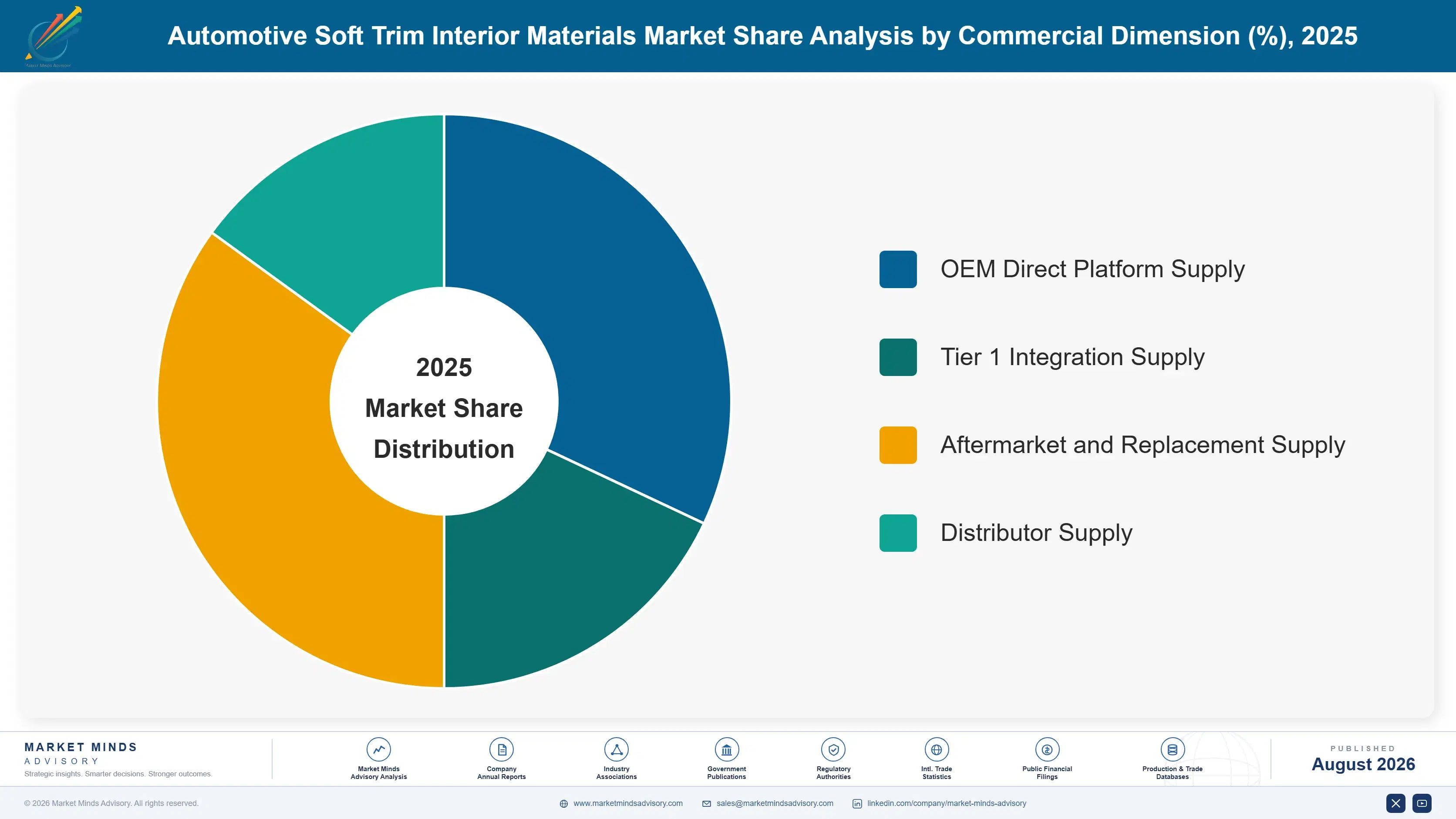
By Commercial Dimension

  • OEM Direct Platform Supply
  • Tier 1 Integration Supply
  • Aftermarket and Replacement Supply
  • Distributor Supply

By Region

  • North America
  • Western Europe
  • East Asia
  • South Asia and Pacific
  • Latin America
  • Middle East and Africa
  • Eastern Europe

Scope, Methodology, and Coverage

Every figure in this report is reproducible from documented input assumptions. The scope below maps the historical period, the forecast horizon, the segmentation dimensions, and the countries covered, alongside the underlying primary and qualitative methodology.
Historical Period
2020 to 2025
Forecast Period
2026 to 2036
Base Year
2025 (USD billions; MMA Primary Research Dataset, August 2026)
Market Definition
The automotive soft trim interior materials market covers textiles, synthetic and genuine leather, foam padding, and nonwoven materials used in seat covers, headliners, door panels, and interior trim surfaces. It excludes hard interior plastics, dashboards, and structural interior components not covered in soft trim fabric or padding.
Quantitative Units
USD billions (current prices); unit shipment volume where applicable
Segmentation Dimensions
By Soft Trim Material Type; By End-Use Vehicle Industry; By Commercial Dimension; By Region
Regions Covered
North America, Western Europe, East Asia, South Asia and Pacific, Latin America, Middle East and Africa, Eastern Europe
Countries Covered
USA, China, Germany, France, UK, Japan, South Korea, India, Australia, Canada, Brazil, Mexico, Indonesia, Vietnam, Thailand, Malaysia, UAE, Saudi Arabia, South Africa, Nigeria, Turkey, Poland, Russia, Netherlands, Italy, Spain, Sweden, Argentina, Colombia, Singapore, and additional markets relevant to this sector
Key Companies Profiled
Adient plc, Lear Corporation, Forvia Faurecia, Toyota Boshoku Corporation, Sage Automotive Interiors, Grupo Antolin, Seiren Co Ltd, Nishikawa Rubber Co, Freudenberg Performance Materials, Dow Automotive Systems, TWE Group, NHK Spring Co, Hyundai Transys, Kolon Industries, Toray Industries, Autoneum Holding AG, Suminoe Textile Co, Continental Structural Plastics, Recticel Automotive, Boxmark Leather
Quantitative Methodology
Primary survey, n=3,800 respondents, Q4 2025, six countries; demand-side model with trade association cross-validation
Qualitative Methodology
47 expert interviews, Q4 2025; applied to validate demand model assumptions, identify emerging dynamics, and assess competitive positioning
Report Format
PDF and XLSX data workbook (Word format preview document)
Publisher
Market Minds Advisory
Report Code
MMA-2026-AUT-104
Published
August 2026
Contact
sales@marketmindsadvisory.com | www.marketmindsadvisory.com

Purchase the full Automotive Soft Trim Interior Materials Market Report (2026 to 2036).

The full MMA Automotive Soft Trim Interior Materials report sizes the market across six material types, four vehicle types, and seven regions through 2036. It profiles 20 participants on a consistent revenue basis, scoring each on sustainability certification, synthetic leather formulation depth, and China market access strategy. Scenario models quantify how European sustainability disclosure regulation and electric vehicle cabin premiumization move demand and pricing across standard and certified segments. The report also includes delivered fiber cost modeling, a disclosure regulation tracker, and a China domestic supplier screen built for procurement and category strategy teams.
Six-material segmentation with detailed growth forecasts
Polyester and leather feedstock supply risk assessment
European sustainability disclosure tracking dashboard tool
Standard versus certified material margin model
China cabin premiumization demand mapping tool
Twenty-company competitive benchmarking scorecard overall today

Built For The People Who Decide

From boardroom strategy to bench-side execution, this report is read cover-to-cover by leaders shaping the next decade of their industry, turning demand scenarios, market dynamics and valuation benchmarks into decisions.
CXOs/ Presidents/ VPs/ Managers
M&A and Corporate Development
Strategy Teams and R&D Heads
Procurement and Product Directors
Regulatory and Compliance Leaders
Investor Relations and Equity Analysts