
Market Minds Advisory
Automotive Seating Systems Market

Automotive Seating Systems Market: Sequenced Delivery Monopolies, Comfort Content Escalation, and the Reclined Occupant Problem

A seat plant sits within an hour of the assembly line it feeds and delivers in build sequence, which makes every award a local monopoly for the whole programme life and switching almost unthinkable.

Lead Analyst

David Horsley

Published

September 2026

Make Smarter Decisions with Customized Research Insights

Request a free sample report and evaluate market opportunities, growth trends, and competitive dynamics relevant to your business needs.

2025 MARKET VALUE$86.2BMarket Size 2025
2036 FORECAST VALUE$153.7BBase Case , 2026 to 2036
CAGR 2026 TO 20365.4 %Bull 6.6% / Bear 4.2%
INCREMENTAL OPPORTUNITY$62.9BNet 10- year value creation
EXPANSION MULTIPLE1.69x2036 value over 2026 base
Strategic Levers
M&A Pipeline
Regional Outlook
Country Rankings
Competitive Intelligence
Segmental Deep-dive
Call-Us : 91 93563 13602

Executive Snapshot and Market Trajectory

Seating is the most expensive system inside a vehicle interior and the most logistically constrained. Roughly 78% ships just-in-sequence from a plant within an hour of the line, matched to individual vehicles. Every award is a local monopoly. Switching mid-programme is close to unthinkable, whatever the commercial friction involved.
Commercial power sits with suppliers who added comfort electronics to that logistics position. Ventilation, heating, massage, and posture functions have moved from luxury options into mainstream fitment, pushed hardest by Chinese electric platforms that made reclining comfort seating a mass-market expectation. Comfort and wellness systems grow fastest at 11.6%, roughly 2.15 times the market. East Asia holds 30% of value. Content escalation is arriving from a direction Western planning did not watch.
Concentration is high at roughly 54% for the top five, because sequenced delivery, crash validation, and programme-length capital commitments all favour scale. The engineering problem nobody has solved is the reclined occupant: as seats gain travel and recline for relaxed and eventually automated driving, restraining a passenger who is not sitting upright becomes considerably harder than any current standard requires. Regulation has not caught up.
Market Definition
This report covers complete seating systems and their constituent elements supplied to light vehicles, spanning seat structures and frames, foam and cushioning systems, trim covers and surface materials, adjustment mechanisms and motors, comfort and wellness systems, and integrated safety and restraint structures. Value is measured at system level as delivered to vehicle assembly. Commercial vehicle and bus seating, aircraft and rail seating, child restraints, and aftermarket seat covers fall outside scope.
Base Year Value
$86.2B in 2025 (MMA Primary Research Dataset, August 2026)
Forecast Period
2026 to 2036, eleven discrete annual values
CAGR
5.4% base case. Bull 6.6%. Bear 4.2%.
Fastest Growth Segment
Comfort and Wellness Systems: 11.6% CAGR
Fastest Growth Country
India: 8.1% CAGR
Fastest Growth Region
South Asia and Pacific: 7.4% CAGR
Largest Region
East Asia: 30% of 2025 global value
Market Leaders
Adient, Lear Corporation, Toyota Boshoku, Forvia, Magna Seating. Source: MMA Analysis based on company annual reports.
Primary Survey
n=3,800 procurement and R&D decision-makers, Q4 2025, six countries
Methodology
Demand-side build-up, cross-validated against public data, 47 expert interviews

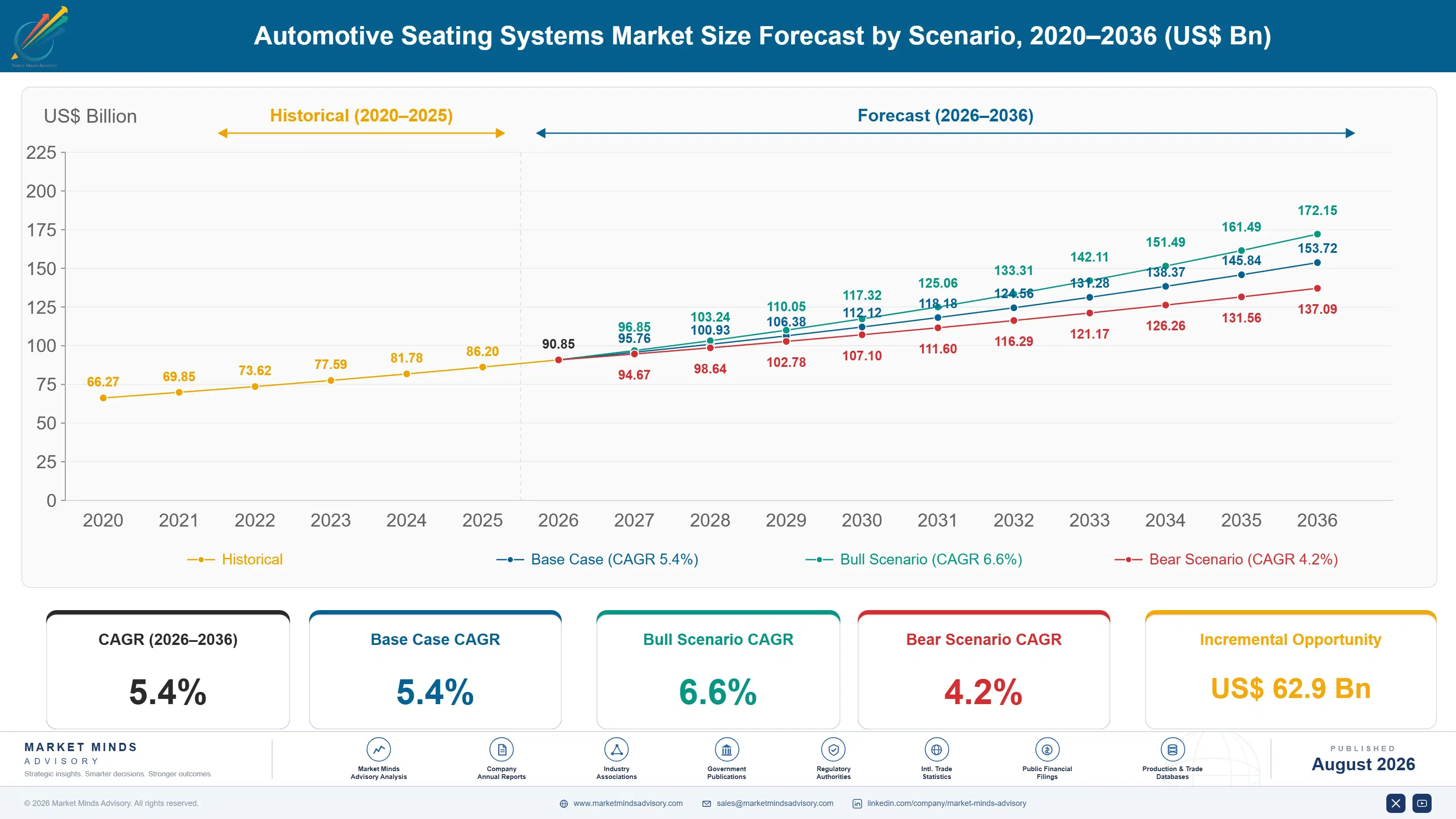
Automotive Seating Systems Market Forecast Scenarios

automotive-seating-systems-market-size-forecast-scenario-1787465319824
The 2020 to 2025 period raised content while volumes stayed flat. Seat heating became near-universal, ventilation spread down from premium, and Chinese electric platforms introduced reclining comfort seating that reset buyer expectations at price points nobody had previously served. Steel, foam chemical, and labour costs all rose sharply through 2021 and 2022. The 4.3% historical growth reflects content escalation rather than any production recovery.
The 5.4% base case rests on three mechanisms. Comfort content keeps spreading downward through the price ladder as Chinese platforms demonstrate what buyers will pay for and Western programmes respond. Electric vehicle packaging keeps driving thin-profile and lightweight seat structures that carry higher engineering value than the conventional frames they replace. And occupant safety requirements keep tightening around reclined and adjustable positions, adding restraint integration content that conventional seats never carried at all.
The 6.6% bull case assumes automated driving features spread far enough to justify swivelling and fully reclining seat architectures across mainstream platforms. The 4.2% bear case reflects vehicle production weakness combined with cost engineering that strips comfort content, which is the most visible discretionary line item in any seat specification review. Cost engineering discipline decides which of those two cases arrives.

Why Seat Plants Are Local Monopolies

Three forces govern seating and none of them is styling. Logistics comes first, because sequenced delivery from a nearby plant makes the award effectively unmovable once tooling and a facility are committed. Comfort content comes second, escalating faster than any other element and carrying the electronics that buyers actually notice. Occupant safety comes third, and it gets harder as seats gain recline and travel.
TOP-FIVE CONCENTRATION54%Share of global seating system supply held collectively
AVERAGE CONTENT VALUE$1,420Complete seating system spend per light vehicle produced
COMFORT FEATURE PENETRATION36%Vehicles fitted with ventilated or massage seating functions
SEQUENCED DELIVERY SHARE78%Volume shipped just-in-sequence directly to assembly plant lines
LABOUR COST SHARE24%Assembly and sewing labour within total production cost
CAPACITY UTILISATION73%Average loading across frame, foam, and assembly operations
The commercial character is unusual for a component category. A seating award is really a commitment to build or dedicate a plant, staff it, and run it in sequence with a customer's assembly line for six to nine years, which is closer to an infrastructure decision than a supply contract. That commitment is why concentration stays high and margins, while thin, stay stable.
The next decade turns on comfort content and occupant protection together. Chinese platforms have demonstrated that buyers value reclining comfort seating far below the price points where it used to sit, which pulls content down the ladder faster than Western product planning assumed. Meanwhile protecting a reclined occupant is genuinely difficult, and nobody has a complete answer yet.
"A seating award is not a contract, it is a building. Once a supplier has put a plant next to an assembly line and staffed it, the commercial conversation for the next eight years is about price adjustment, not about switching."
Director, Seating and Occupant Systems Practice · MMA Automotive / Occupant and Interior Systems Practice · August 2026

Market Trends

Chinese Platforms Pull Comfort Seating Down the Price Ladder

Reclining comfort seating with ventilation, heating, massage, and leg support arrived on Chinese electric vehicles at price points where Western manufacturers had never offered any of it, and buyers encountering those cabins now expect the features elsewhere. Li Auto, NIO, and Zeekr made second-row comfort a headline specification rather than a luxury option. Western programme teams have responded by raising seat content targets while attempting to hold cost, which pushes suppliers toward Chinese sourcing partnerships. The content escalation originates in a market most Western planners were not benchmarking against five years ago.
Market Impact: Cuts backrest thickness 28%
Reclined Occupant Protection Becomes an Unsolved Engineering Problem

Seats designed for relaxed and eventually automated driving allow recline angles and travel positions that conventional restraint systems were never validated against, because a belt geometry optimised for an upright occupant behaves very differently when the torso is inclined. Submarining risk rises, airbag interaction changes, and the seat structure itself must carry loads it previously did not. Regulation has not yet caught up with what manufacturers are already offering. Suppliers developing integrated restraint structures and reclined-position validation hold capability that competitors cannot assemble quickly at all. Programme teams are discovering this after specifying the positions rather than before.
Market Impact: Grows 11.6% on feature spread

Market Opportunities and Growth Drivers

Electric Packaging Demands Thin and Lightweight Seat Structures

Battery packs raise floor height and consume cabin volume, so seat designers must recover space and headroom through thinner backrests and cushions while keeping comfort and crash performance intact. Weight matters more on electric platforms too, since every kilogram costs range that battery capacity would otherwise have to supply at considerably greater expense. High-strength steel, aluminium, and magnesium structures carry more engineering content and better pricing than conventional frames. That combination of packaging and mass pressure has made seat structure engineering a genuine differentiator rather than a commodity fabrication exercise.
Market Impact: Ties 78% of volume locally

Comfort Electronics Escalate Content Faster Than Any Other Element

Heating has become near-universal in temperate markets, ventilation has spread from premium into mid-range, and massage functions once confined to luxury saloons now appear on mainstream crossovers across several manufacturers. Each function adds motors, blowers, controllers, sensors, and wiring to a system that used to be foam and fabric. Growth of 11.6% in comfort and wellness reflects that spread rather than any price increase on existing content. Suppliers holding electronics and control capability capture the additional value, while those supplying frames and foam beneath it do not. Frame and foam suppliers beneath that content capture none of the increase.
Market Impact: Strips 14% of comfort content

Market Restraints and Challenges

Sequenced Delivery Ties Capital to Individual Assembly Plants

Just-in-sequence supply means a dedicated plant within roughly an hour of the customer line, built and staffed for one programme with very little alternative use, and 78% of volume moves that way. The root cause is bulk: seats cannot be stockpiled economically or shipped far, so proximity is not optional. When a vehicle programme ends or moves, the facility strands. Suppliers respond by seeking multi-programme plant loading where assembly plants build several models, by negotiating volume guarantees, and by structuring capital contribution into award terms rather than absorbing it entirely.
Market Impact: Reaches 36% comfort feature fitment

Comfort Content Is the First Target in Cost Engineering

Ventilation, massage, and premium trim are visible line items with no regulatory protection, which makes them the obvious candidates whenever a programme cost review begins in earnest. The root cause is that comfort value is difficult to quantify against a saving that is not. Suppliers respond by tying content to buyer preference research, by designing feature families that scale across trim levels rather than single fixed specifications, and by bundling comfort functions with safety or thermal management justifications that survive scrutiny more reliably than pure amenity arguments do. Buyer preference evidence is the only argument that reliably holds.
Market Impact: Adds 7.3% restraint content growth
3 additional market trends, 2 additional growth drivers, and 4 additional restraints and challenges are covered in the full report. Contact sales@marketmindsadvisory.com to access the complete intelligence.

Segment CAGR and Growth Architecture

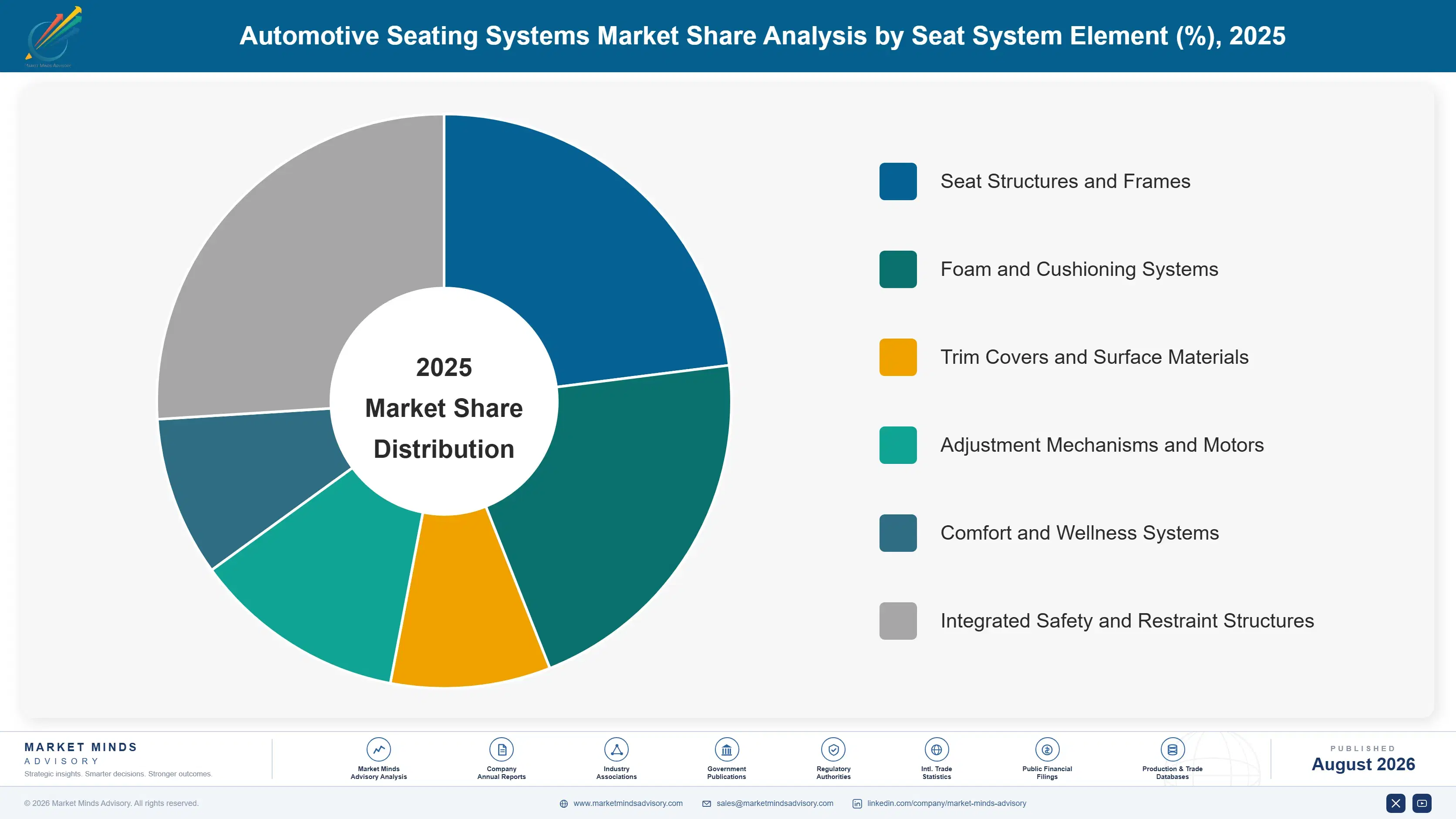
Segmentation follows seat system element, the single logic that determines manufacturing route, supplier capability required, and how content is awarded within a programme. Element decides whether a supplier competes on metal forming, foam chemistry, sewing labour, or electronics integration, which are entirely different businesses. Vehicle segment, seat row, and channel structure appear separately in the framework as commercial dimensions.
automotive-seating-systems-market-market-share-analysis-1787465320401

Comfort and Wellness Systems

Heating, ventilation, massage, lumbar adjustment, posture sensing, and increasingly occupant monitoring have moved from luxury options into mainstream fitment, and growth of 11.6%, roughly 2.15 times the market, tracks that spread rather than any pricing change on existing content. The capability required spans blowers, thermoelectric or resistive heating, pneumatic bladder systems, motors, controllers, and software behaviour, none of which resembles foam moulding or frame welding. Chinese electric platforms accelerated adoption dramatically by fitting features at price points Western planners had not considered viable. Suppliers holding electronics and control capability capture this content while frame and foam specialists supply structure beneath it. Chinese platforms accelerated the whole shift far faster than anyone modelled.
CAGR 11.6%

Integrated Safety and Restraint Structures

Seat-integrated belts, whiplash protection systems, side airbag housings, and load-bearing structures that carry restraint forces through the seat rather than the body shell all grow at 7.3% as vehicle architecture and occupant positions change. Electric platforms with flat floors and reclining comfort seating both push restraint loads into the seat itself. The reclined occupant question makes this segment strategically important beyond its size, because protecting a passenger who is not upright requires belt geometry, airbag interaction, and structural load paths that no current standard fully specifies. Suppliers building validation capability now will hold positions competitors cannot contest later. Capability built now cannot be assembled quickly by anybody arriving later, which is the point.
CAGR 7.3%
Full segment breakdown across 6 segments available in the complete report.

Regional Architecture and Country Demand Map

East Asia holds the largest share at 30%, driven by Chinese production scale and comfort specifications that now set global expectations. North America follows on large vehicle content, while South Asia and Pacific grows fastest as Indian specification rises quickly. Latin America supplies the cut-and-sew work.

North America

Large vehicles carry more seats and bigger ones, so content value per vehicle runs above most regions before any specification decision is taken. Three-row sport utility and pickup dominance means second and third-row seating carries genuine engineering complexity around folding, tumbling, and access. Adient, Lear, and Magna Seating operate dense sequenced plant networks alongside American and transplant assembly. Heated and ventilated seating is near-universal in mid-range and above, and massage functions are spreading. Labour cost in seat assembly and sewing is higher than in most producing regions, which pushes cut-and-sew work toward Mexico. Regional growth of 4.7% is content-led rather than volume-led. Cut-and-sew work migrates toward Mexico for exactly that labour reason.
Share: 25% | CAGR: 4.7% (2026 to 2036)

Western Europe

European seat engineering has traditionally led on ergonomics, posture support, and long-distance comfort, with German premium programmes specifying adjustment ranges and lumbar systems that mainstream markets never required. That advantage is being challenged by Chinese platforms offering more visible comfort features at lower cost. Recycled content proposals for interior materials are the most demanding anywhere and are reshaping foam and trim material selection well ahead of implementation. Forvia, Adient, and Grammer hold substantial regional engineering and sequenced production capability. Production volumes keep contracting. Growth of 3.8% is the slowest of any region and reflects that volume decline offsetting genuine content increases. Recycled content proposals are reshaping foam and trim selection well ahead of implementation.
Share: 20% | CAGR: 3.8% (2026 to 2036)
Regional intelligence for 5 additional markets available in the complete report: East Asia, South Asia and Pacific, Latin America, Middle East and Africa, Eastern Europe. Contact sales@marketmindsadvisory.com.
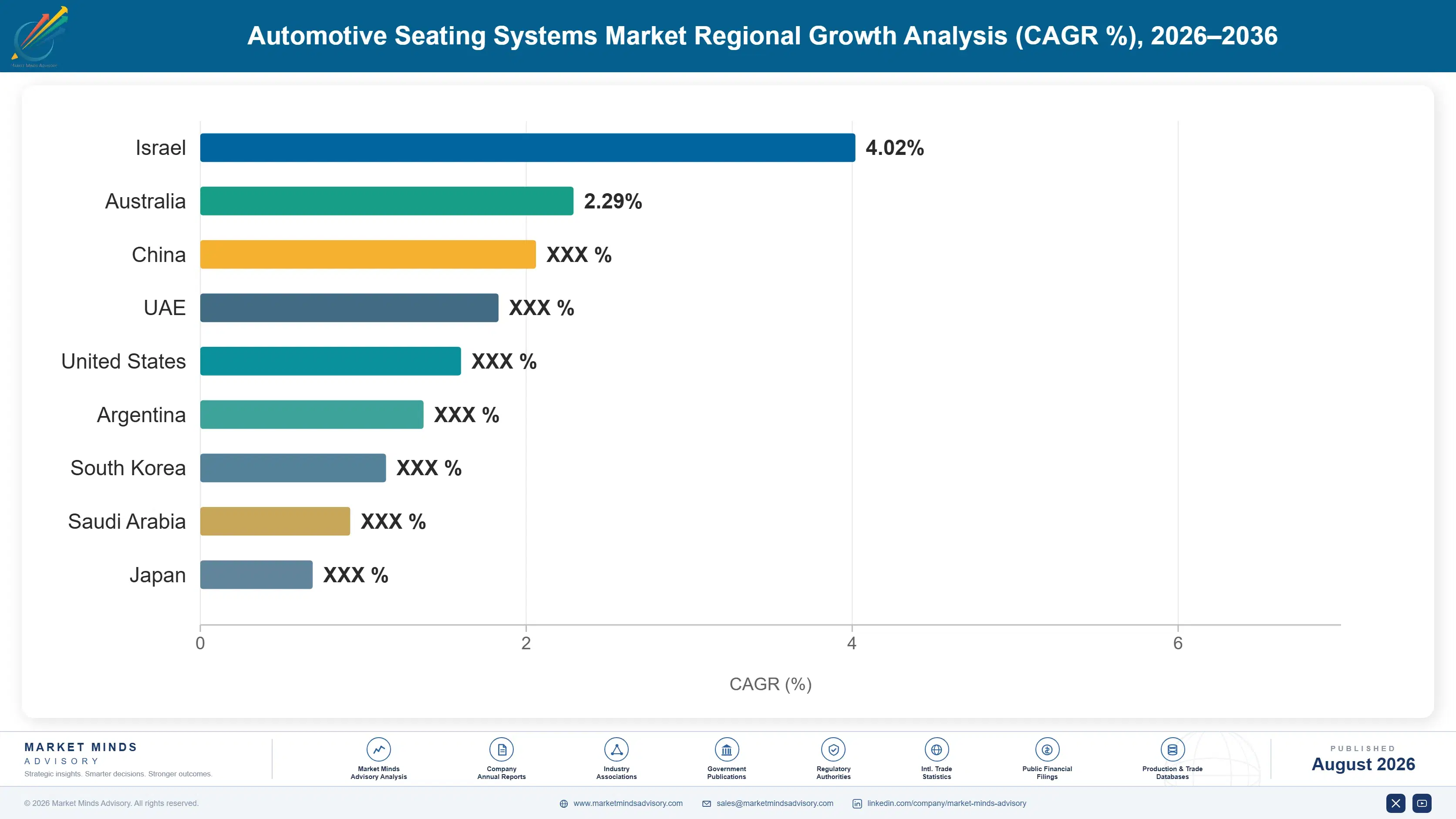
automotive-seating-systems-market-country-cagr-analysis-1787465320937

Where Seating Systems Margin Actually Sits

Welding frames and moulding foam next to an assembly line is a stable, capital-heavy, thin-margin business that logistics protects and nothing else does. The four moves below add value the plant proximity cannot deliver alone: comfort electronics, reclined occupant validation, multi-programme plant loading, and scalable feature architecture that survives the cost review. None of the four requires a new plant.

Own Comfort Electronics Rather Than Integrating Bought Modules

Heating, ventilation, massage, and posture systems now carry the content buyers notice and grow at 11.6% while frames and foam grow at under half that rate. Suppliers integrating bought-in modules capture assembly value only, surrendering roughly 40% to 55% of comfort content value to the module supplier. Building blower, controller, and software capability costs around $14 million and converts a seat assembler into a system owner. It also gives visibility of feature requirements a year before they reach a purchase order. Nobody buys a seat because of who welded the frame inside it.
Market Impact: Recovers 40 to 55% of the comfort value

Build Reclined Occupant Validation Capability Ahead of Regulation

Manufacturers are already offering recline and travel positions that conventional restraint validation never covered, and no current standard fully specifies protection for a non-upright occupant. Building sled test capability, belt geometry modelling, and structural load path expertise for reclined positions costs perhaps $11 million. It positions a supplier as the answer when regulation arrives and, more immediately, when a programme team realises they have specified seating they cannot fully validate. That conversation is happening now on several platforms. Several platforms are already having exactly that conversation internally. Nobody else has done this work.
Market Impact: Addresses restraint content now growing at 7.3% annually

Load Sequenced Plants Across Multiple Vehicle Programmes

A dedicated seat plant serving one programme strands when that programme ends, and 78% of volume moves through exactly that arrangement. Targeting assembly sites that build several models, and structuring awards so one facility serves multiple programmes, raises utilisation from the 73% typical of single-programme plants toward 85% and spreads end-of-programme risk considerably. It also strengthens the negotiating position at renewal, because the customer knows the facility is not wholly dependent on them. A single-programme plant is a wasting asset from the day it opens, and everyone knows it. Renewal talks change entirely.
Market Impact: Lifts plant utilisation from 73% toward 85% overall

Design Comfort Features That Scale Across Trim Levels

Ventilation and massage are the most visible discretionary items in any seat specification and the first things a cost review targets, with roughly 14% of comfort content typically stripped when programmes come under pressure. Designing feature families that scale from a shared architecture lets a manufacturer reduce specification without removing the supplier, preserving around 60% of content value where a fixed single specification loses all of it. The engineering discipline costs little and protects revenue precisely when competitors lose theirs. Competitors offering fixed specification lose the content entirely instead. The discipline costs almost nothing.
Market Impact: Preserves 60% of content through every cost review

Who Controls the Margin Pool

The top five hold roughly 54% of supply, measured consistently as complete seating system revenue at supplier level. Adient, Lear, Toyota Boshoku, Forvia, and Magna Seating operate the sequenced plant networks and crash validation capability that seating awards require, and that infrastructure is the principal barrier to entry. Chinese suppliers including Yanfeng and Daimay hold substantial domestic positions and are extending into export programmes steadily.
Competition runs along three lines. Sequenced plant network density is the first, since proximity to assembly determines who can bid at all on a given programme. Comfort electronics capability is the second, deciding whether a supplier owns the content buyers notice or merely assembles somebody else's modules into a seat. The third is occupant safety validation, which reclined seating is making considerably more demanding than conventional crash performance required.

Two pressures will reshape positions. Chinese suppliers operating from a market that now sets comfort benchmarks are quoting into Western programmes with specifications and cost positions established at home. Meanwhile comfort electronics suppliers keep capturing content that seat assemblers integrate but do not own. The exposed position is a frame and foam specialist with single-programme plants, bought-in modules, and no reclined occupant capability.
automotive-seating-systems-market-company-positioning-matrix-1787465321469

Competitive Moat and Risk Dimensions

ADIENT

Moat: Global Sequenced Plant Network

Adient operates one of the densest sequenced seating plant networks anywhere, positioned beside assembly sites across every major producing region, which lets it bid programmes competitors cannot reach without building a facility first. That footprint took decades and enormous capital to establish. Crash validation capability and metal forming scale reinforce a position that is genuinely difficult to attack from outside.
ADIENT

Risk: Thin Margin Capital Intensity

Seating combines heavy fixed capital, high labour content, and margins thinner than most tier one categories, which leaves limited room to absorb input cost movements or programme volume shortfalls. Single-programme plants strand when models end. Funding comfort electronics capability from that earnings base competes directly against maintaining the plant network the business depends upon.
LEAR CORPORATION

Moat: Seating and Electrical Combination

Lear combines complete seating with electrical distribution and electronics capability from its separate business, which lets it own comfort functions, wiring, and control behaviour inside the seat rather than integrating modules from third parties. That breadth captures content that pure seating specialists surrender. It also gives early sight of electrical architecture decisions determining what seat functions a platform supports.
LEAR CORPORATION

Risk: Comfort Content Cost Exposure

Comfort features are the most visible discretionary content in a seat and the first casualty of programme cost reviews, so the electronics advantage is exposed to exactly the spending manufacturers cut first under pressure. Chinese competitors offering comparable features at lower cost intensify that exposure. Defending the content requires buyer preference evidence that purchasing teams do not always accept.

Players Tracked

Prominent Players

Adient
Lear Corporation
Toyota Boshoku
Forvia
Magna Seating

Other Key Players

TS Tech
Yanfeng
Hyundai Transys
NHK Spring
Grammer
Tachi-S
Brose Fahrzeugteile
Gentherm
Kongsberg Automotive
Sitech Sitztechnik
Daimay Automotive
Aunde Group
Camaco-Amvian
Freedman Seating
Isringhausen

Recent Developments

FEBRUARY 2025

Chinese platforms extend reclining comfort seating below premium pricing

Chinese electric vehicle manufacturers continued fitting reclining second-row seating with ventilation, heating, and massage functions on models priced well below where Western brands offer comparable content. Export volumes carrying those specifications reached buyers in Europe and Southeast Asia, raising expectations that regional programme teams are now working to meet.
Signal: Comfort content expectations are being set in a market Western product planners were not benchmarking against.
SEPTEMBER 2024

Suppliers advance reclined occupant restraint development programmes

Seating suppliers extended development work on restraint systems for reclined and travelled occupant positions, addressing belt geometry, submarining risk, and airbag interaction that conventional validation never covered. Manufacturers are already offering recline positions that current regulatory test procedures do not specifically address in any jurisdiction.
Signal: Product capability has moved ahead of regulation, and suppliers are validating against a standard that does not exist.
JUNE 2025

Electric platform packaging drives thin-profile seat structure adoption

Vehicle manufacturers continued specifying thinner backrest and cushion architectures to recover cabin volume lost to battery packaging, using high-strength steel, aluminium, and magnesium structures. The designs carry more engineering content than conventional frames while reducing mass, which matters directly for certified electric vehicle range figures.
Signal: Seat structure engineering has now become a genuine differentiator rather than merely a commodity fabrication exercise.

Steel, Foam Chemicals, and Sewing Labour

Steel and metal components account for roughly 26% of seating system cost, purchased against regional benchmark pricing for high-strength grades. Assembly and sewing labour takes 24%, which is unusually high for an automotive system and explains why cut-and-sew work migrates toward lower-cost geographies. Foam chemicals contribute 15%, trim materials 14%, and comfort electronics a rising share.
Polyol and isocyanate pricing for foam moved sharply through 2021 and 2022 alongside broader petrochemical inflation, while European energy costs documented in IEA reporting raised both foam production and moulding operations. Labour costs rose across Mexico, Eastern Europe, and China through the same period. Adient and Lear both referenced input cost and labour pressure across their 2022 and 2023 reporting, and suppliers on fixed pricing recovered far less than they absorbed.

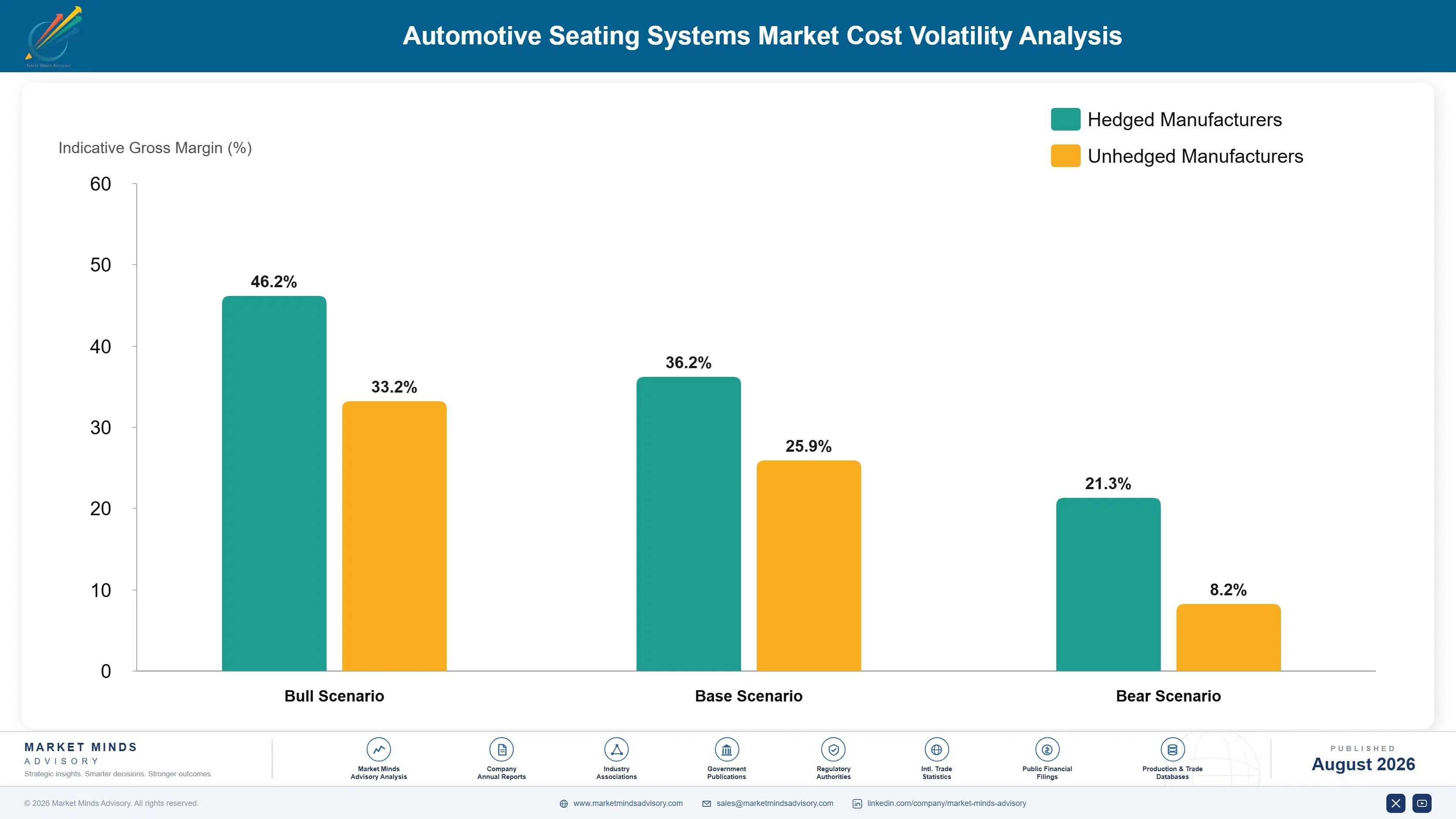
Exposure divides on labour geography and contract structure rather than on scale. Suppliers with cut-and-sew operations in Mexico, Eastern Europe, North Africa, and Asia held cost positions that those sewing in high-wage locations could not match. Those holding raw material indexation passed steel and chemical movements through with a quarter of lag, while fixed-price contracts absorbed the full swing. Comfort electronics adds semiconductor exposure seating suppliers never previously carried.
automotive-seating-systems-market-cost-volatility-analysis-1787465321666

Locate cut-and-sew operations where labour cost genuinely differs

Sewing and assembly labour is 24% of seating cost, far higher than most automotive systems, and trim covers ship compactly compared with finished seats. That combination makes separating cut-and-sew from final assembly commercially obvious, with covers made in low-wage locations and seats assembled in sequence near the customer. Suppliers sewing in high-wage plants carry a gap no efficiency programme closes.

Negotiate steel and chemical indexation into programme awards

Seating programmes run six to nine years against steel and polyurethane chemicals that move continuously, and requesting relief mid-programme leaves a supplier negotiating from weakness. Manufacturers accept indexation at award considerably more readily than they grant relief later. Suppliers who secured it protected margin that competitors on fixed pricing surrendered entirely through the 2022 movement.

Structure plant capital contribution into award terms explicitly

A sequenced seat plant is largely single-purpose capital committed for one programme, and absorbing that entirely while accepting thin assembly margin is a poor trade the industry has tolerated for too long. Negotiating customer capital contribution or volume guarantees at award changes the risk profile materially. Manufacturers resist, then concede when no credible bidder sits within delivery range.

Portfolio Architecture for Margin Defence

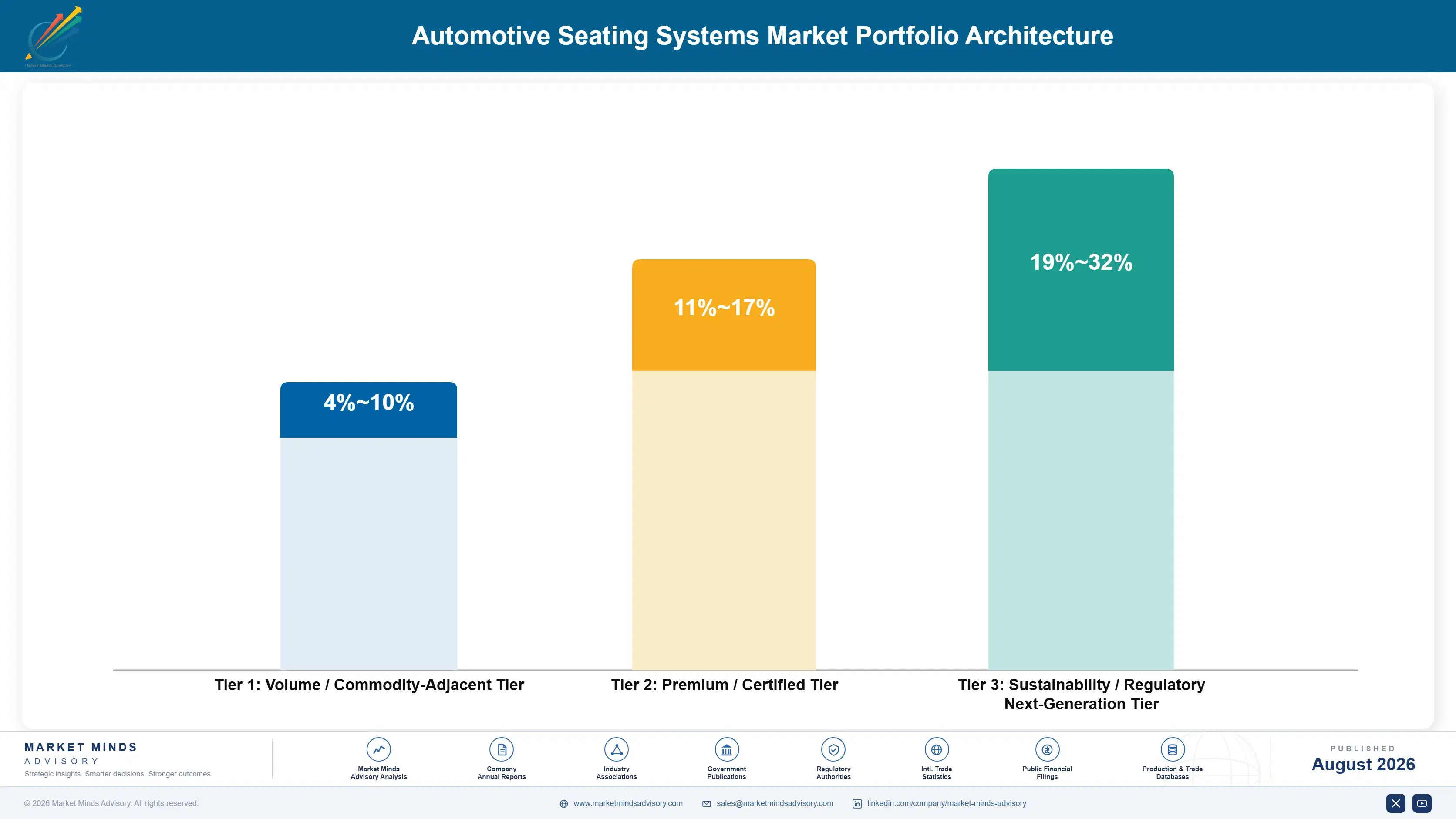
Three tiers separate on what the supplier owns beyond assembly. Frame, foam, and trim supply into somebody else's complete seat earns 4% to 10%, because it is conversion work priced against regional labour and metal cost. Complete seat assembly with sequenced delivery earns 11% to 17%, supported by the logistics position and validation responsibility. Comfort electronics and integrated safety structures earn most, and the gap explains most competitive repositioning in the category.
The tension is that the logistics moat protects thin margins rather than good ones. Sequenced delivery makes an award unmovable, which sounds valuable and mostly means a supplier is locked into a low-margin programme for six to nine years with dedicated capital committed against it. The suppliers earning well are those who used that secure base to add comfort electronics and safety validation content rather than treating assembly volume as the whole business.

High-value pools sit where the customer buys capability rather than conversion. Comfort function ownership, reclined occupant validation, and thin-profile structure engineering all require investment a programme team cannot assemble internally, which is exactly why they resist the labour-rate comparison that seat assembly invites immediately.

Volume / Commodity-Adjacent Tier

Frames, foam, and trim covers supplied into complete seats assembled by others, priced as conversion work against regional labour and metal cost. The wide range reflects large differences in labour geography, metal sourcing, and plant scale between suppliers globally.
Gross Margin: 4%-10%

Premium / Certified Tier

Complete seat assembly with sequenced delivery, crash validation responsibility, and supplier-owned structural design. Range width separates conventional seat programmes from thin-profile lightweight architectures carrying greater engineering content within the same tier.
Gross Margin: 11%-17%

Sustainability / Regulatory / Next-Generation Tier

Comfort and wellness electronics owned rather than integrated, integrated restraint structures, and reclined occupant validation capability. Engineering capability and validation depth, rather than assembly economics, sustain the margin structure throughout this tier.
Gross Margin: 19%-32%
automotive-seating-systems-market-portfolio-architecture-1787465322169

High-value Sub-segments and Strategic Watch-out

Owned Comfort and Wellness Electronics

Highest value in the category, growing at 11.6% as ventilation and massage spread down the price ladder. Integrating bought modules surrenders 40% to 55% of that value to the module supplier rather than capturing it. Owning it converts an assembler into a system supplier entirely.
Gross Margin: 24%-32%

Reclined Occupant Restraint Structures

High value with 7.3% growth and strategic importance beyond its size, since manufacturers already offer recline positions no standard fully covers. Validation capability built now cannot be assembled quickly by competitors afterwards. Manufacturers are asking about it already, ahead of any rule. Validation depth is the barrier.
Gross Margin: 20%-28%

Complete Seat Sequenced Assembly

The volume core, protected absolutely by logistics and unmovable once a plant is committed, yet earning thin margins for six to nine years. It is a secure base to build on rather than a business worth defending alone. Logistics protects it absolutely and rewards it thinly.
Gross Margin: 12%-17%

Frame and Trim Component Supply

The strategic watch-out. Priced as conversion work against regional labour rates with no defensible differentiation available, and it positions the supplier beneath whoever assembles the complete seat rather than beside the manufacturer. Conversion pricing is all that is on offer here. Assembly sits above it, capturing more.
Gross Margin: 4%-9%

Why Sequenced Supply Locks Awards

Seating revenue is the most locked-in annuity in automotive supply, and logistics rather than technology explains why. A supplier awarded a seating programme builds or dedicates a plant within roughly an hour of the assembly line, staffs it, and delivers in build sequence matched to individual vehicles on the moving track, which means switching supplier mid-programme requires the replacement to have a facility ready. Typical programme tenure runs six to nine years and extends through facelifts almost without exception.
Stickiness varies less than in most categories because the logistics constraint dominates everything else. Complete seat awards with sequenced delivery are effectively unmovable once a plant exists, whatever the commercial friction. Comfort electronics owned by the seat supplier are equally protected, since they are validated inside the seat system. Component supply of frames, foam, or trim into somebody else's assembly is the exception, retendered on conversion cost with no logistics protection whatsoever behind it.

Buyer profiles have shifted noticeably. Comfort feature specification now involves user experience and product planning teams alongside purchasing, and buyer preference evidence carries weight it did not five years ago. Purchasing no longer decides comfort specification on its own, which changes how suppliers should sell it.
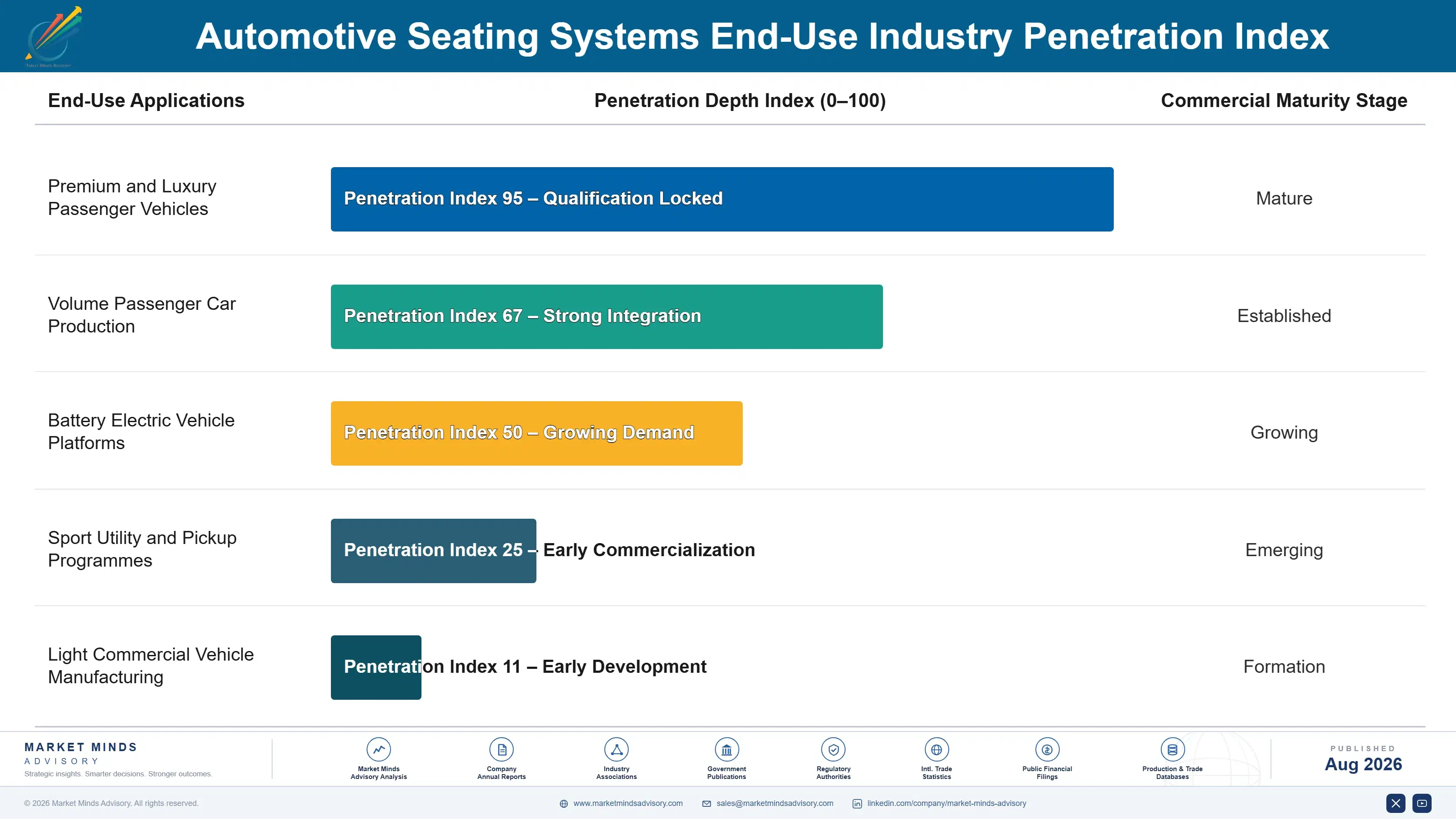
automotive-seating-systems-market-end-use-penetration-index-1787465322666

Where Seating Capital Should Go

These are among the four positions where our research anticipates prominent divergence between winners and laggards over the coming forecast period. Each is grounded in the demand model, the regulatory perimeter, and the announced capacity pipeline.
01 / COMFORT ELECTRONICS OWNERSHIP

Own the functions buyers notice instead of integrating them

Heating, ventilation, massage, and posture systems carry the content buyers actually perceive and grow at 11.6% while frames and foam grow at under half that rate across every region. Suppliers integrating bought-in modules capture assembly value alone, surrendering roughly 40% to 55% of comfort content value to whoever supplies the module. Building blower, controller, and software capability costs around $14 million and converts a seat assembler into a system owner with visibility of feature requirements well ahead of purchase orders.
02 / RECLINED OCCUPANT CAPABILITY

Validate positions regulation has not caught up with yet

Manufacturers are already offering recline and travel positions that conventional restraint validation never covered, and no current test procedure in any jurisdiction fully specifies protection for a non-upright occupant during any crash event at all. Building sled test capability, belt geometry modelling, and structural load path expertise for reclined positions costs perhaps $11 million. It positions a supplier as the answer both when regulation eventually arrives and, more immediately, when a programme team realises exactly what they have already specified.
03 / MULTI-PROGRAMME PLANT LOADING

Stop building single-purpose plants that strand at programme end

A dedicated sequenced seat plant serving one vehicle programme becomes very largely worthless the moment that programme ends, and roughly 78% of all seating volume moves through exactly that arrangement across the industry. Targeting assembly sites that build several models, and structuring awards so that one facility serves multiple programmes, lifts utilisation from the 73% typical of single-programme plants toward 85%. It also strengthens renewal negotiations considerably, because the customer knows the facility no longer depends entirely on them alone.
04 / SCALABLE FEATURE ARCHITECTURE

Build comfort content that survives the cost review intact

Ventilation and massage are the most visible discretionary items in any seat specification and the first casualties whenever programme cost engineering begins, with roughly 14% of comfort content typically stripped when platforms come under margin pressure. Designing feature families that scale from a shared architecture across trim levels lets a manufacturer reduce specification without removing the supplier entirely, preserving around 60% of content value. The engineering discipline itself costs very little and protects revenue exactly when competitors are losing theirs.

Engagement Snapshot From the Field

A live engagement with an industry participant carrying material or product regulatory and market exposure ahead of a defining policy shift, showing how our research translates into a defensible multi-year portfolio strategy.
MARKET MINDS ADVISORY · CLIENT ENGAGEMENT SUMMARY
Automotive Seating Systems Producer Strategic Portfolio Review and Transition Roadmap 2026·Investment Scenario on Automotive Seating Systems Exposure Evaluation 2025-26
CLIENT PROFILE
A European seating supplier operating four sequenced assembly plants and two cut-and-sew facilities serving German and Czech vehicle programmes, with annual revenue near EUR 1.4 billion (client-reported, unverified by MMA). Complete seat assembly supplied roughly 84% of revenue, all comfort electronics were bought in from module suppliers, and three of the four sequenced plants served a single vehicle programme each.
STRATEGIC CHALLENGE
One programme was ending within twenty months with no replacement award secured, stranding a dedicated plant, and comfort content on two other programmes had been reduced in cost reviews the client could not influence. Group margin had fallen to 3.9%, and a Chinese competitor had won a bid on comfort specification the client could only match by eliminating its own margin.
MMA APPROACH
MMA rebuilt profitability by plant and by content element, separating assembly conversion value from owned content. Comfort electronics capability build was costed against continued module purchase across projected volumes. Multi-programme loading options were assessed at each assembly site the client served, and reclined occupant validation requirements were reviewed, with findings tested through 47 expert interviews during Q4 2025.
KEY FINDINGS
  1. Bought-in comfort modules represented 47% of comfort content value on awarded programmes, none of which the client captured beyond a small assembly margin.
  2. Two of the four sequenced plants sat beside assembly sites building three or more models, yet the client held seating awards on only one programme at each.
  3. The plant facing programme end could serve two other models built at the same assembly site if the client bid them, requiring modest retooling rather than new capital.
  4. No reclined occupant validation capability existed internally, and two customers had already begun asking about restraint performance in extended recline positions on future platforms.
CLIENT PROFILE
A European seating supplier operating four sequenced assembly plants and two cut-and-sew facilities serving German and Czech vehicle programmes, with annual revenue near EUR 1.4 billion (client-reported, unverified by MMA). Complete seat assembly supplied roughly 84% of revenue, all comfort electronics were bought in from module suppliers, and three of the four sequenced plants served a single vehicle programme each.
STRATEGIC CHALLENGE
One programme was ending within twenty months with no replacement award secured, stranding a dedicated plant, and comfort content on two other programmes had been reduced in cost reviews the client could not influence. Group margin had fallen to 3.9%, and a Chinese competitor had won a bid on comfort specification the client could only match by eliminating its own margin.
MMA APPROACH
MMA rebuilt profitability by plant and by content element, separating assembly conversion value from owned content. Comfort electronics capability build was costed against continued module purchase across projected volumes. Multi-programme loading options were assessed at each assembly site the client served, and reclined occupant validation requirements were reviewed, with findings tested through 47 expert interviews during Q4 2025.
KEY FINDINGS
  1. Bought-in comfort modules represented 47% of comfort content value on awarded programmes, none of which the client captured beyond a small assembly margin.
  2. Two of the four sequenced plants sat beside assembly sites building three or more models, yet the client held seating awards on only one programme at each.
  3. The plant facing programme end could serve two other models built at the same assembly site if the client bid them, requiring modest retooling rather than new capital.
  4. No reclined occupant validation capability existed internally, and two customers had already begun asking about restraint performance in extended recline positions on future platforms.
RECOMMENDED STRATEGY
Phase 1: Phase 1 (months one to seven): bid the two adjacent programmes at the assembly site facing closure and negotiate indexation into any new award. Phase 2: Phase 2 (months eight to twenty-two): build comfort electronics capability covering ventilation and lumbar systems rather than continuing to buy modules. Phase 3: Phase 3 (months twenty-three to thirty-six): establish reclined occupant validation capability and bid integrated restraint content on the next platform.
OUTCOME
The supplier won one of the two adjacent programmes and avoided plant closure, reporting group margin improving from 3.9% to 8.6% within nineteen months (client-reported, unverified by MMA). Comfort electronics capability reached production readiness on ventilation. Reclined occupant validation investment was approved and is under construction.

Frequently Asked Questions

Foundational context covering the market sizes, CAGR, scope, country, region and competition that inform every finding below. This section is provided to cover basics and most often pre-purchase conversations, answered from the MMA Primary Research Dataset.

What is the current size of the Automotive Seating Systems Market?

The market was valued at USD 86.2 billion in 2025, rising to an estimated USD 90.85 billion in 2026. East Asia holds the largest regional share at 30% of global value.

How large will the Automotive Seating Systems Market be by 2036?

MMA forecasts USD 153.72 billion by 2036 under the base case, an expansion multiple of 1.69 times the 2026 level. Incremental value creation reaches USD 62.87 billion across the period.

What is the CAGR for the Automotive Seating Systems Market 2026 to 2036?

The base case CAGR is 5.4%, with a bull case of 6.6% and a bear case of 4.2%. Historical growth between 2020 and 2025 ran at 4.3%, driven by content rather than volume.

Which segment is growing fastest?

Comfort and wellness systems, at 11.6%, roughly 2.15 times the overall market rate. Ventilation, heating, and massage functions keep spreading downward through the vehicle price ladder.

Who are the major companies in the Automotive Seating Systems Market?

Adient, Lear Corporation, Toyota Boshoku, Forvia, and Magna Seating lead, holding roughly 54% of supply between them. Yanfeng and Hyundai Transys hold strong regional positions.

Which country is growing fastest?

India, at 8.1%, driven by production expansion alongside rapid specification increase, as domestic buyers show clear willingness to pay for visible comfort features in seating.

Report Segmentation Architecture

The full report scope spans multiple orthogonal segmentation dimensions, with cross-tabulated demand data provided for each dimension pair. Coverage extends further to regional breakdowns, trend trajectories, and the competitive detail needed to support segment-level decision-making.

By Seat System Element

  • Seat Structures and Frames
  • Foam and Cushioning Systems
  • Trim Covers and Surface Materials
  • Adjustment Mechanisms and Motors
  • Comfort and Wellness Systems
  • Integrated Safety and Restraint Structures

By End-Use Industry

  • Premium and Luxury Passenger Vehicles
  • Volume Passenger Car Production
  • Battery Electric Vehicle Platforms
  • Sport Utility and Pickup Programmes
  • Light Commercial Vehicle Manufacturing

By Commercial Dimension

  • Complete Seat Sequenced Supply
  • Component and Sub-Assembly Supply
  • Comfort Module Tier Two Sales
  • Cut-and-Sew Contract Manufacturing

By Region

  • North America
  • Western Europe
  • East Asia
  • South Asia and Pacific
  • Latin America
  • Middle East and Africa
  • Eastern Europe

Scope, Methodology, and Coverage

Every figure in this report is reproducible from documented input assumptions. The scope below maps the historical period, the forecast horizon, the segmentation dimensions, and the countries covered, alongside the underlying primary and qualitative methodology.
Historical Period
2020 to 2025
Forecast Period
2026 to 2036
Base Year
2025 (USD billions; MMA Primary Research Dataset, August 2026)
Market Definition
The market comprises complete seating systems and constituent elements supplied to light vehicles at original equipment level, covering seat structures and frames, foam and cushioning systems, trim covers and surface materials, adjustment mechanisms and motors, comfort and wellness systems, and integrated safety and restraint structures. Value is measured at system level as delivered to vehicle assembly plants. Commercial vehicle, bus, aircraft and rail seating, child restraint systems, and aftermarket seat covers or accessories fall outside scope.
Quantitative Units
USD billions (current prices); vehicles equipped annually; USD per vehicle seating content value
Segmentation Dimensions
By Seat System Element; By End-Use Industry; By Commercial Dimension; By Region
Regions Covered
North America, Western Europe, East Asia, South Asia and Pacific, Latin America, Middle East and Africa, Eastern Europe
Countries Covered
USA, China, Germany, France, UK, Japan, South Korea, India, Australia, Canada, Brazil, Mexico, Indonesia, Vietnam, Thailand, Malaysia, UAE, Saudi Arabia, South Africa, Nigeria, Turkey, Poland, Netherlands, Italy, Spain, Sweden, Switzerland, Argentina, Colombia, Singapore, and additional markets relevant to this sector
Key Companies Profiled
Adient, Lear Corporation, Toyota Boshoku, Forvia, Magna Seating, TS Tech, Yanfeng, Hyundai Transys, NHK Spring, Grammer, Tachi-S, Brose Fahrzeugteile, Gentherm, Kongsberg Automotive, Sitech Sitztechnik, Daimay Automotive, Aunde Group, Camaco-Amvian, Freedman Seating, Isringhausen
Quantitative Methodology
Primary survey, n=3,800 respondents, Q4 2025, six countries; demand-side model with trade association cross-validation
Qualitative Methodology
47 expert interviews, Q4 2025; applied to validate demand model assumptions, identify emerging dynamics, and assess competitive positioning
Report Format
PDF and XLSX data workbook (Word format preview document)
Publisher
Market Minds Advisory
Report Code
MMA-2026-AUT-127
Published
August 2026
Contact
sales@marketmindsadvisory.com | www.marketmindsadvisory.com

Purchase the full Automotive Seating Systems Market Report (2026 to 2036).

The full report sizes seating system demand across six elements and seven regions with 2026 to 2036 forecasts under base, bull, and bear cases. It models comfort feature penetration by price segment and region, showing how far Chinese specification benchmarks have pulled content down the ladder. Competitive profiles cover twenty suppliers assessed consistently on seating system revenue, sequenced plant footprint, and comfort electronics ownership. Occupant safety analysis covers reclined position validation requirements against current regulatory coverage. Commercial guidance addresses electronics ownership, validation capability, plant loading, and scalable feature architecture.
Six seat elements sized and forecast separately
Comfort feature penetration mapped by price segment
Twenty supplier profiles on consistent system revenue basis
Sequenced plant networks mapped against assembly footprints
Reclined occupant validation gaps assessed by jurisdiction
Cut-and-sew labour cost positions compared across producing regions

Built For The People Who Decide

From boardroom strategy to bench-side execution, this report is read cover-to-cover by leaders shaping the next decade of their industry, turning demand scenarios, market dynamics and valuation benchmarks into decisions.
CXOs/ Presidents/ VPs/ Managers
M&A and Corporate Development
Strategy Teams and R&D Heads
Procurement and Product Directors
Regulatory and Compliance Leaders
Investor Relations and Equity Analysts