
Market Minds Advisory
Automotive Interior Market

Automotive Interior Market: Screens Eating the Cockpit, Recycled Content Mandates, and Chinese Benchmarks Nobody Can Match

As powertrains commoditise toward broadly similar electric drivetrains, the cabin becomes the only place a manufacturer can still make a vehicle feel different, and interior development budgets have moved accordingly.

Lead Analyst

David Horsley

Published

September 2026

Make Smarter Decisions with Customized Research Insights

Request a free sample report and evaluate market opportunities, growth trends, and competitive dynamics relevant to your business needs.

2025 MARKET VALUE$128.4BMarket Size 2025
2036 FORECAST VALUE$241.2BBase Case , 2026 to 2036
CAGR 2026 TO 20365.9 %Bull 7.2% / Bear 4.6%
INCREMENTAL OPPORTUNITY$105.2BNet 10- year value creation
EXPANSION MULTIPLE1.77x2036 value over 2026 base
Strategic Levers
M&A Pipeline
Regional Outlook
Country Rankings
Competitive Intelligence
Segmental Deep-dive
Call-Us : 91 93563 13602

Executive Snapshot and Market Trajectory

Electrification took away the engine note, the gear change, and most of what distinguished one car from another. What remains is the cabin, which is why interior content per vehicle keeps rising while other categories fight over cost. Interiors stopped being a cost line and became a product argument entirely.
Commercial power is shifting toward suppliers who can integrate electronics into surfaces rather than mould and trim them. Displays, ambient lighting, and hidden-until-lit functions now define perceived quality more than material grain does, and Chinese electric vehicle makers have set interior benchmarks at price points European premium brands struggle to match. Interior lighting and surface electronics grow fastest at 12.8%. East Asia holds 30% of value. Perceived quality has moved.
Concentration is low at roughly 29% for the top five, because interiors span moulding, textiles, foam, electronics, and assembly across suppliers with very different origins. Regulation is becoming a design input rather than a compliance afterthought: European end-of-life vehicle proposals target recycled plastic content, and Chinese cabin air quality standards impose volatile organic compound limits that exceed European requirements considerably. Compliance now shapes material selection several years before any deadline actually binds on a programme.
Market Definition
This report covers interior systems supplied to light vehicles, spanning instrument panels and cockpit modules, door panels and trim, overhead systems and headliners, centre consoles and storage systems, flooring and acoustic systems, and interior lighting and surface electronics. Value is measured at system level as supplied to vehicle manufacturers. Complete seating systems, steering wheels, infotainment head units sold separately, climate control hardware, and aftermarket interior accessories fall outside scope.
Base Year Value
$128.4B in 2025 (MMA Primary Research Dataset, August 2026)
Forecast Period
2026 to 2036, eleven discrete annual values
CAGR
5.9% base case. Bull 7.2%. Bear 4.6%.
Fastest Growth Segment
Interior Lighting and Surface Electronics: 12.8% CAGR
Fastest Growth Country
India: 8.6% CAGR
Fastest Growth Region
South Asia and Pacific: 7.9% CAGR
Largest Region
East Asia: 30% of 2025 global value
Market Leaders
Forvia, Yanfeng, Grupo Antolin, Toyota Boshoku, Marelli. Source: MMA Analysis based on company annual reports.
Primary Survey
n=3,800 procurement and R&D decision-makers, Q4 2025, six countries
Methodology
Demand-side build-up, cross-validated against public data, 47 expert interviews

Automotive Interior Market Forecast Scenarios

automotive-interior-ambient-lighting-market-trends-size-forecast-scenario-1787465298767
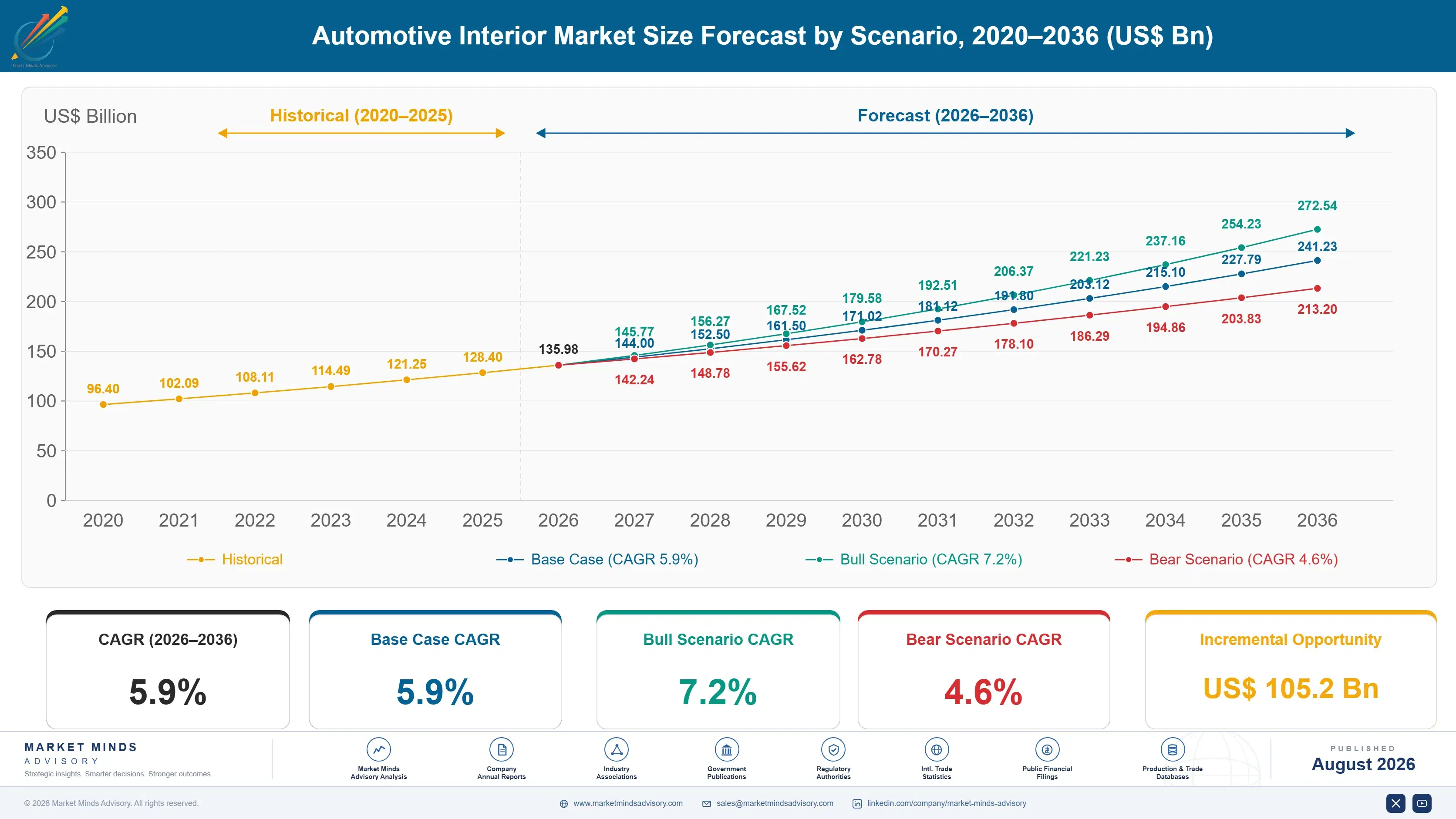
The 2020 to 2025 period saw interior content rise while vehicle volumes stayed flat. Display area expanded rapidly across every segment, ambient lighting moved from premium option to mainstream fitment, and Chinese electric vehicle makers established cabin specifications that reset buyer expectations across the industry. Polymer and semiconductor costs both spiked through 2021 and 2022. The 4.7% historical growth reflects content increase rather than any recovery in production volume.
The 5.9% base case rests on three mechanisms. Cabin differentiation keeps absorbing budget as powertrains converge and manufacturers look for something buyers can actually perceive. Display and surface electronics content keeps growing across every price segment, not merely at the premium end where it started. And recycled content requirements keep forcing material reformulation that raises specification and cost per part while delivering no visible benefit to the buyer at all.
The 7.2% bull case assumes software-defined cockpit architectures let suppliers capture integration value currently held by electronics tier ones. The 4.6% bear case reflects vehicle production weakness combined with cost reduction programmes that strip the discretionary content manufacturers added when they believed interiors would sell cars on their own. Cost engineering discipline decides which of those two cases arrives.

Why the Cabin Became the Differentiator

Three forces are reorganising interiors and none of them is styling fashion. Powertrain convergence comes first, because an electric drivetrain feels much like any other electric drivetrain and the cabin is where perceived difference now lives. Surface electronics come second, moving quality perception from material grain toward display behaviour and lighting. Regulation comes third, with recycled content and cabin air quality rules becoming design constraints rather than compliance paperwork.
TOP-FIVE CONCENTRATION29%Share of global interior systems supply held collectively
AVERAGE CONTENT VALUE$1,840Interior system spend per vehicle across all segments
DISPLAY AREA FITTED1.9 sq mAverage screen area specified in new premium cockpits
RECYCLED CONTENT SHARE17%Recycled polymer proportion within interior trim components today
COCKPIT MODULE PENETRATION43%Programmes awarding integrated cockpit rather than separate components
CAPACITY UTILISATION76%Average loading across moulding, foaming, and assembly lines
The commercial character has divided sharply. Traditional interior suppliers hold moulding, foaming, textile, and assembly capability that remains necessary and increasingly describes a smaller share of perceived value. Electronics suppliers arriving from displays and lighting capture the content buyers actually notice. The awards that matter are integrated cockpit modules, and winning them requires both disciplines inside one organisation, which very few suppliers genuinely possess today.
The next decade turns on who owns the cockpit integration. Roughly 43% of programmes now award an integrated module rather than separate components, and that share keeps rising because manufacturers want one supplier accountable for fit, finish, electronics, and software behaviour together. Suppliers who can carry that accountability capture content that component specialists supply into. Those who cannot become second-tier vendors inside somebody else's module.
"A buyer can no longer hear the difference between two cars and increasingly cannot feel it either. What they can see is the cabin, and every manufacturer in the world has now reached that same conclusion at once."
Director, Vehicle Interiors and Cockpit Systems Practice · MMA Automotive / Interior Systems Practice · August 2026

Market Trends

Display Surfaces Displace Material Grain as Quality Signal

Pillar-to-pillar screens, passenger-side displays, and curved organic light-emitting diode panels have moved from concept show pieces into production across Chinese, Korean, and European platforms, and buyers now read screen size and responsiveness as quality indicators in the way they once read stitching and grain. Average fitted display area in premium cockpits has reached roughly 1.9 square metres. That shifts value decisively toward suppliers holding display integration, optical bonding, and thermal management capability rather than toward those perfecting injection-moulded surface texture and soft-touch coatings. Grain and stitching still matter, but they no longer decide the verdict.
Market Impact: Lifts content to $1,840 per vehicle
Recycled Content Rules Become a Material Design Constraint

European end-of-life vehicle proposals target substantial recycled plastic content in new vehicles, with a portion required to come from vehicle recycling specifically rather than from any post-consumer stream. That converts material selection from a cost decision into a compliance one, and recycled polymer behaves differently in moulding, colour matching, odour, and long-term ageing than virgin material does. Suppliers who invested in recyclate qualification and closed-loop supply arrangements early hold an advantage that competitors cannot assemble quickly, since the qualification work itself takes years. Qualification work itself takes years, which nobody can compress afterwards.
Market Impact: Sets benchmarks below $40,000 vehicles

Market Opportunities and Growth Drivers

Powertrain Convergence Redirects Differentiation Budget Inward

Battery electric drivetrains from different manufacturers feel broadly similar to drive, which removes the engine character, transmission behaviour, and exhaust note that historically distinguished brands from one another. Product planners have responded by moving differentiation budget into the cabin, where a buyer spends the entire ownership experience and where perceived quality is immediate. Interior content value per vehicle has risen accordingly across every price segment. That reallocation is a deliberate strategic choice rather than a passing trend, and it survives cost reduction rounds better than most discretionary content does. Product planners made that choice deliberately rather than drifting into it.
Market Impact: Screens 340 material combinations

Chinese Electric Platforms Reset Cabin Expectations Globally

Chinese manufacturers including NIO, Li Auto, and Zeekr specify large display arrays, premium materials, and sophisticated ambient lighting at price points that European and American brands cannot match on comparable cost structures. Those cabins are now the benchmark against which buyers in export markets compare everything else. Western programme teams have responded by raising interior specification while attempting to hold cost, which pushes suppliers toward Chinese sourcing and design partnerships. The competitive pressure originates in cabin content rather than in powertrain or chassis engineering. Competitive pressure now originates in the cabin rather than under the bonnet.
Market Impact: Strips 12% of discretionary content

Market Restraints and Challenges

Cabin Air Quality Limits Constrain Material and Adhesive Choice

Chinese cabin air quality standards impose volatile organic compound and odour limits that exceed European and American requirements considerably, and every adhesive, foam, coating, and polymer in the cabin contributes to the measured result. The root cause is that interiors combine many materials in a sealed heated volume where emissions accumulate. Suppliers exporting into China or supplying global platforms must formulate to the strictest standard rather than the local one. Responses include low-emission adhesive systems, extended material screening programmes, and cabin-level emissions modelling during design. Global platforms must therefore formulate to the strictest standard rather than the local one.
Market Impact: Reaches 1.9 square metres fitted

Cost Reduction Programmes Target Discretionary Cabin Content

Interior content added when manufacturers believed cabins would sell vehicles becomes the obvious target when programme cost engineering begins, because ambient lighting, decorative trim, and display size are all visible line items with no regulatory protection. The root cause is that perceived quality is difficult to quantify against a cost saving that is not. Suppliers respond by tying content to measurable buyer preference data, by offering scalable specification across trim levels rather than single fixed content, and by concentrating on functions that carry regulatory or safety justification alongside their aesthetic contribution.
Market Impact: Targets 25% recycled plastic content
3 additional market trends, 2 additional growth drivers, and 4 additional restraints and challenges are covered in the full report. Contact sales@marketmindsadvisory.com to access the complete intelligence.

Segment CAGR and Growth Architecture

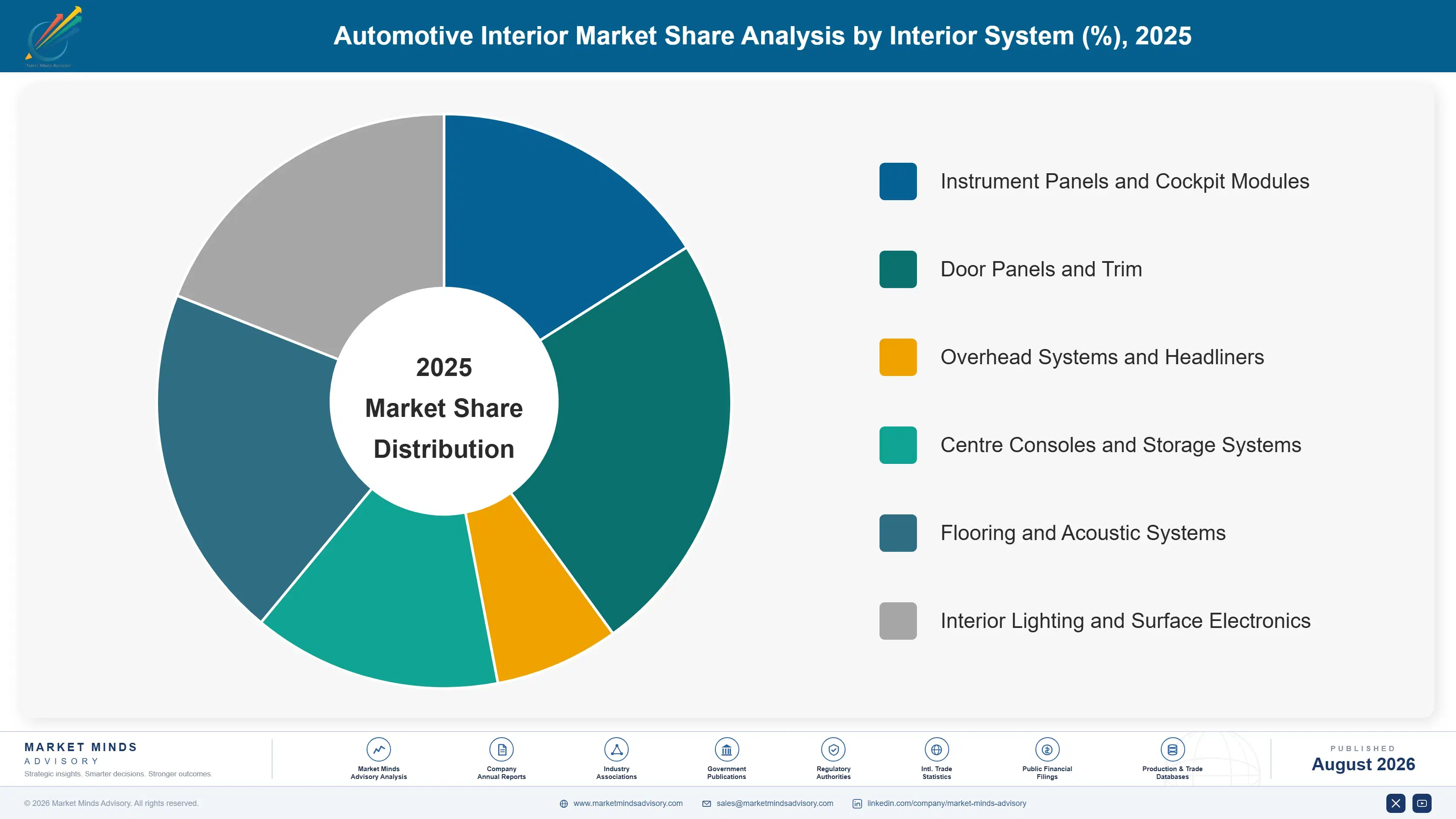
Segmentation follows interior system, the single logic that determines manufacturing route, supplier capability required, and how the content is awarded within a vehicle programme. System decides whether a supplier competes on moulding and trim craft or on electronics integration. Vehicle segment, powertrain type, and channel structure appear separately in the framework as commercial dimensions rather than parallel segments.
automotive-interior-ambient-lighting-market-trends-market-share-analysis-1787465299609

Interior Lighting and Surface Electronics

Ambient lighting, illuminated trim, hidden-until-lit surfaces, capacitive controls, and display integration have moved from premium options into mainstream fitment across almost every segment, and growth of 12.8%, roughly 2.17 times the market, reflects that spread rather than any premium price increase. The capability required is entirely different from traditional interior manufacture, spanning optics, light guide design, electronics packaging, thermal management, and software behaviour. Suppliers arriving from lighting and electronics have captured much of this content while moulding specialists supply the substrates beneath it. That division of value explains most of the competitive repositioning happening across the wider interior supply base. Moulding specialists now supply substrates beneath content they do not own.
CAGR 12.8%

Instrument Panels and Cockpit Modules

The instrument panel remains the largest single interior system by value and is increasingly awarded as a complete cockpit module rather than as a set of components, with roughly 43% of programmes now structured that way. A module award bundles the panel, displays, air vents, wiring, controls, and sometimes airbag and fundamental elements under one supplier responsible for fit, finish, electronics behaviour, and software integration together. That accountability is precisely what manufacturers want and what most component specialists cannot offer. Growth of 6.2% understates the strategic importance, because winning the module determines whether a supplier leads the cabin or merely feeds components into somebody else's. Component specialists cannot offer that accountability, which is exactly why the awards keep concentrating.
CAGR 6.2%
Full segment breakdown across 6 segments available in the complete report.

Regional Architecture and Country Demand Map

East Asia holds the largest share at 30%, driven by Chinese vehicle production scale and cabin specifications that now set global benchmarks. North America and Western Europe follow on premium content, while South Asia and Pacific grows fastest on Indian production and rising specification. Latin America converges on imported specification.

North America

Large vehicles carry large interiors, and pickup and sport utility dominance here means content value per vehicle runs above most regions before any specification decision is made. Display adoption has accelerated across domestic and transplant programmes as manufacturers respond to Chinese and Korean cabin benchmarks reaching American buyers through imported models. Forvia, Yanfeng, and Magna operate substantial regional moulding, assembly, and cockpit integration capability. Recycled content requirements are less prescriptive than European equivalents, which reduces the compliance burden but also the pressure to develop recyclate capability. Regional growth of 5.2% reflects content increase rather than any production volume recovery. Large vehicles carry large interiors, which lifts content before any decision is taken.
Share: 24% | CAGR: 5.2% (2026 to 2036)

Western Europe

European interiors have historically led on material quality and craftsmanship, and that advantage is being challenged by Chinese cabins offering more visible technology at lower cost. End-of-life vehicle proposals targeting recycled plastic content are the most demanding regulatory requirement anywhere and are reshaping material selection across the regional supply base well ahead of implementation. Grupo Antolin, Forvia, and Draexlmaier hold deep engineering capability serving German and French premium programmes. Production volumes across the region continue contracting. Growth of 4.3% is the slowest of any region and reflects that volume decline offsetting genuine specification increases. Craftsmanship advantage is being challenged by visible technology at lower cost, and volume decline compounds it.
Share: 21% | CAGR: 4.3% (2026 to 2036)
Regional intelligence for 5 additional markets available in the complete report: East Asia, South Asia and Pacific, Latin America, Middle East and Africa, Eastern Europe. Contact sales@marketmindsadvisory.com.
automotive-interior-ambient-lighting-market-trends-country-cagr-analysis-1787465300524

Where Interior Systems Margin Actually Sits

Moulding excellent substrates for somebody else's illuminated surface is a shrinking share of a growing category. The four moves below follow perceived value: cockpit module accountability, surface electronics capability, recyclate qualification ahead of mandate, and scalable specification that survives the cost engineering round rather than being deleted by it. None of the four requires new moulding capacity.

Bid Complete Cockpit Modules Rather Than Components

Roughly 43% of programmes now award an integrated cockpit module, bundling panel, displays, vents, wiring, controls, and software behaviour under one supplier accountable for the whole result, and that share keeps rising. Winning module awards requires electronics and software capability alongside moulding and assembly, costing perhaps $18 million to build. Suppliers who cannot carry that accountability become second-tier vendors inside somebody else's module, capturing perhaps 35% of the content they previously supplied directly to the manufacturer. Module accountability is what manufacturers are actually buying, and few suppliers can offer it credibly today.
Market Impact: Retains 65% of the previously direct content value

Build Surface Electronics and Lighting Integration Capability

Ambient lighting, hidden-until-lit surfaces, capacitive controls, and display bonding now carry the content buyers actually notice, growing at 12.8% while traditional trim grows at a third of that rate. The capability spans optics, light guide design, electronics packaging, and thermal management, none of which transfers from moulding expertise. Investment runs around $12 million for credible capability. Suppliers who moved early capture content that moulding specialists now supply substrates into, which is a materially worse commercial position. Suppliers who moved early now own content that moulding specialists merely support beneath. That gap keeps widening.
Market Impact: Accesses a segment now growing at 12.8% annually

Qualify Recyclate Grades Before the Mandate Arrives

European end-of-life vehicle proposals target substantial recycled plastic content with a portion required from vehicle recycling specifically, and recyclate behaves differently in moulding, colour matching, odour, and ageing than virgin polymer does. Qualification takes two to three years per material family and cannot be compressed once requirements bind. Suppliers who invested early can quote compliant content while competitors are still testing, which typically supports 6% to 11% pricing advantage on affected parts and wins awards outright on programmes approaching the deadline. Programmes approaching the deadline cannot wait for a competitor to catch up.
Market Impact: Supports a 6 to 11% pricing advantage overall

Offer Scalable Specification Across Trim Levels

Discretionary cabin content is the first thing programme cost engineering targets, because ambient lighting and decorative trim are visible line items with no regulatory protection behind them. Designing content families that scale across trim levels from a common architecture lets a manufacturer reduce specification without deleting the supplier, preserving roughly 60% of content value where a fixed single specification would have lost all of it. The engineering discipline costs little and protects revenue through exactly the cost rounds that catch competitors out. Fixed single specification loses everything when the cost round arrives instead.
Market Impact: Preserves roughly 60% of the total content value

Who Controls the Margin Pool

The top five hold roughly 29% of supply, measured consistently as interior system revenue at supplier level. Yanfeng, Forvia, Grupo Antolin, Toyota Boshoku, and Marelli combine moulding, trim, and increasingly cockpit integration capability across regions. Concentration is low because interiors span polymers, textiles, foam, electronics, and assembly, and suppliers arrived at the category from very different technical origins with correspondingly different strengths.
Competition runs along three lines. Cockpit module capability is the first and increasingly determines whether a supplier leads the cabin or supplies into it. Surface electronics integration is the second, covering the lighting and display content buyers actually perceive as quality. The third is recyclate qualification, where European regulation is converting material capability into an award criterion well ahead of the compliance date itself.

Two pressures will reshape positions. Chinese suppliers operating from a domestic base that sets global cabin benchmarks are quoting into Western programmes at cost points that reset expectations. Meanwhile electronics suppliers keep capturing the content that defines perceived quality. The exposed position is a moulding-led supplier with strong craft capability, no electronics integration, no recyclate portfolio, and component-level awards rather than module accountability.
automotive-interior-ambient-lighting-market-trends-company-positioning-matrix-1787465301425

Competitive Moat and Risk Dimensions

YANFENG

Moat: Chinese Base and Global Scale

Yanfeng operates from the domestic market that now sets global cabin benchmarks, giving it early sight of specification trends that Western manufacturers subsequently chase, alongside a cost base built for Chinese programme economics. Global footprint lets it carry those learnings into European and North American awards. That combination of scale, cost, and specification proximity is difficult for competitors to assemble.
YANFENG

Risk: Western Programme Trust Barriers

Geopolitical scrutiny of Chinese-owned suppliers has complicated access to some Western programmes, particularly where cockpit modules carry connected electronics and data handling. That constraint has little to do with product capability and considerable commercial effect. Localisation and joint venture structures address it partially while adding cost and organisational complexity the company would rather avoid.
FORVIA

Moat: Interiors and Electronics Combination

Forvia combines interior systems capability with electronics and display expertise brought together through consolidation, letting it bid complete cockpit modules where moulding specialists must partner or subcontract. European manufacturer relationships give early visibility of architecture decisions. That breadth is exactly what module awards now require, and few competitors hold both disciplines inside one engineering organisation.
FORVIA

Risk: European Volume Concentration

The strongest positions sit with European manufacturers whose production volumes keep contracting and whose cost pressure keeps intensifying under Chinese competition. Growth concentrates in Asia, where domestic suppliers hold cost advantages and specification proximity. Building equivalent Asian position means competing against companies already setting the benchmarks that European programmes are trying to reach.

Players Tracked

Prominent Players

Forvia
Yanfeng
Grupo Antolin
Toyota Boshoku
Marelli

Other Key Players

Magna International
Motherson
Draexlmaier
IAC Group
Kasai Kogyo
Hayashi Telempu
Seoyon E-Hwa
Ningbo Huaxiang Electronic
Novares
Continental
Panasonic Automotive Systems
LG Display
BOE Technology
Autoneum
Adler Pelzer Group

Recent Developments

FEBRUARY 2025

European recycled content proposals advance toward implementation

European end-of-life vehicle regulatory proposals targeting recycled plastic content in new vehicles advanced through legislative process, with a portion of the requirement specified to come from vehicle recycling streams rather than general post-consumer sources. Interior suppliers accelerated recyclate qualification programmes across trim and moulded component families in response.
Signal: Material qualification has now become an award criterion several years before the compliance requirement actually binds.
OCTOBER 2024

Chinese cabin specifications reset expectations in export markets

Chinese electric vehicle makers continued exporting models carrying display arrays, ambient lighting, and material specification well above what Western brands offer at comparable price points. European and American programme teams responded by raising interior content targets while attempting to hold cost, increasing pressure on established regional suppliers.
Signal: Cabin specification is now where Chinese manufacturers apply competitive pressure most visibly across every export market.
JULY 2025

Integrated cockpit module awards expand across programme structures

Vehicle manufacturers continued shifting from component-level interior sourcing toward integrated cockpit module awards, bundling panel, displays, controls, wiring, and software behaviour under single supplier accountability. The structure favours suppliers holding both interior manufacturing and electronics integration capability within one engineering organisation. Award structures continued shifting through 2025.
Signal: Module accountability now separates the suppliers who lead the cabin from those who merely supply into it.

Polymers, Displays, and Moulding Energy

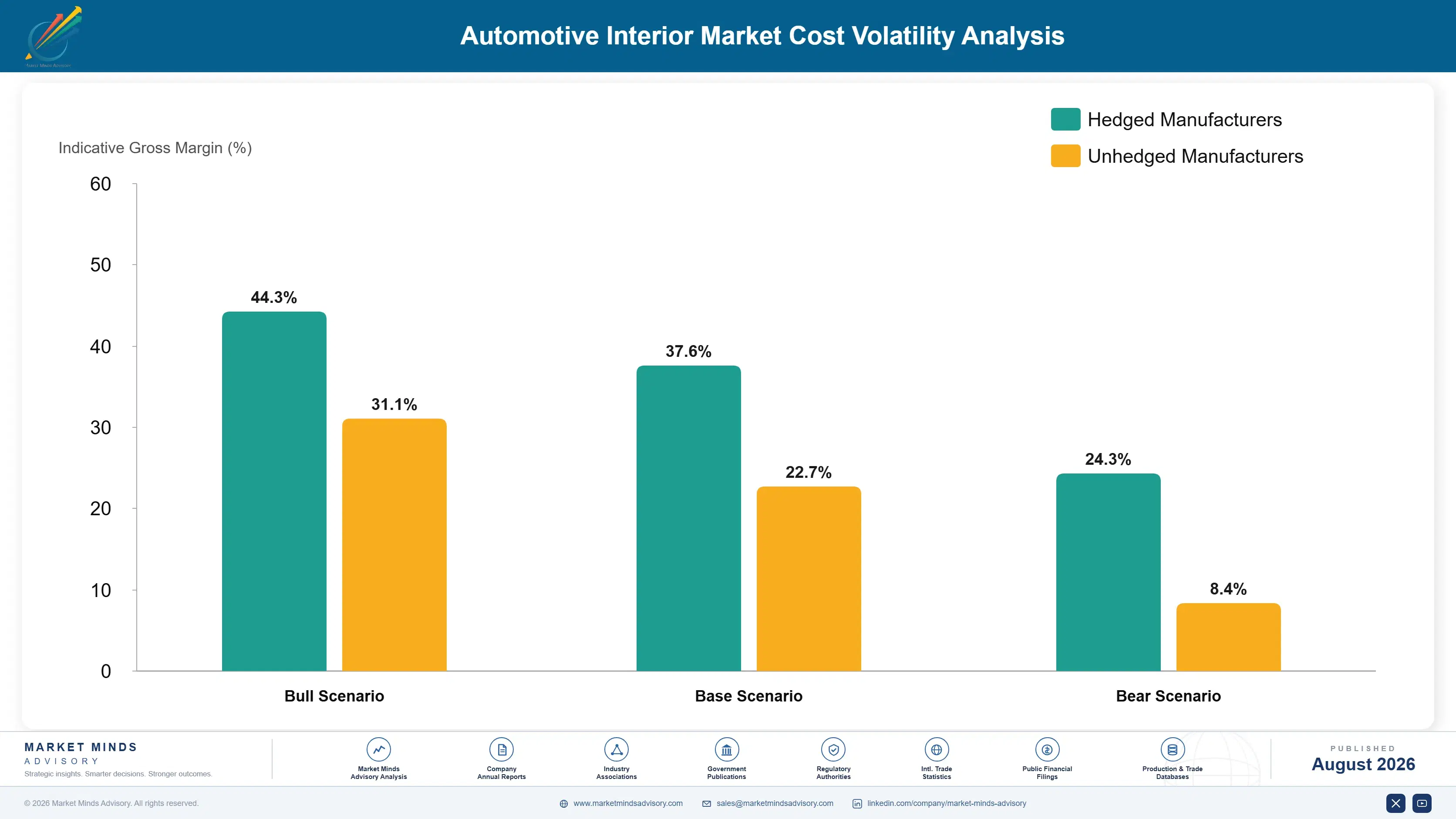
Engineering polymers and compounds account for roughly 31% of interior system cost, principally polypropylene, acrylonitrile butadiene styrene, and thermoplastic elastomers priced against petrochemical feedstocks. Display panels and electronics contribute 24% and rising as surface content grows. Textiles, foam, and leather substitutes take 14%, and moulding, painting, and assembly energy absorbs most of the remaining cost across typical operations.
European industrial energy prices rose steeply through 2022 and 2023 according to IEA reporting, raising both polymer production and the energy-intensive moulding and painting operations interior parts require. Display panel pricing moved sharply through the same window on semiconductor and panel capacity constraints. Forvia and Grupo Antolin both referenced input cost and supply pressure across their 2022 and 2023 reporting, and suppliers on fixed pricing recovered far less than they absorbed.

Exposure varies with contract structure and content mix rather than with manufacturing scale. Suppliers holding raw material indexation passed polymer movements through with a quarter of lag. Those on fixed pricing absorbed the swing across contracts running years longer. Electronics content adds semiconductor and panel exposure traditional interior suppliers never carried, with different volatility. Asian suppliers, closer to polymer and display supply, held positions Western plants could not approach.
automotive-interior-ambient-lighting-market-trends-cost-volatility-analysis-1787465301732

Negotiate polymer indexation into every programme award at signature

Interior programmes run five to seven years against polymer feedstocks that move continuously, and requesting relief mid-programme puts a supplier in the weakest negotiating position available. Manufacturers accept indexation at award far more readily than they grant relief afterwards. Suppliers who secured it through the 2022 movement protected margin that competitors on fixed pricing simply surrendered without recourse.

Qualify recyclate grades that also reduce virgin polymer exposure

Recycled polymer qualification is being driven by regulation, and it happens to reduce exposure to virgin feedstock pricing at the same time, since recyclate prices track different drivers. Treating the compliance programme as a sourcing hedge as well as a regulatory requirement improves the internal business case considerably. The work takes years either way, so the dual benefit costs nothing.

Contract display panel supply separately from electronics assembly

Panel pricing and availability move on semiconductor and display industry cycles entirely unrelated to automotive demand, and bundling them inside an electronics assembly contract hides that exposure rather than managing it. Contracting panels directly gives visibility and negotiating position. Interior suppliers new to display content frequently discover this only after a panel shortage disrupts a launch.

Portfolio Architecture for Margin Defence

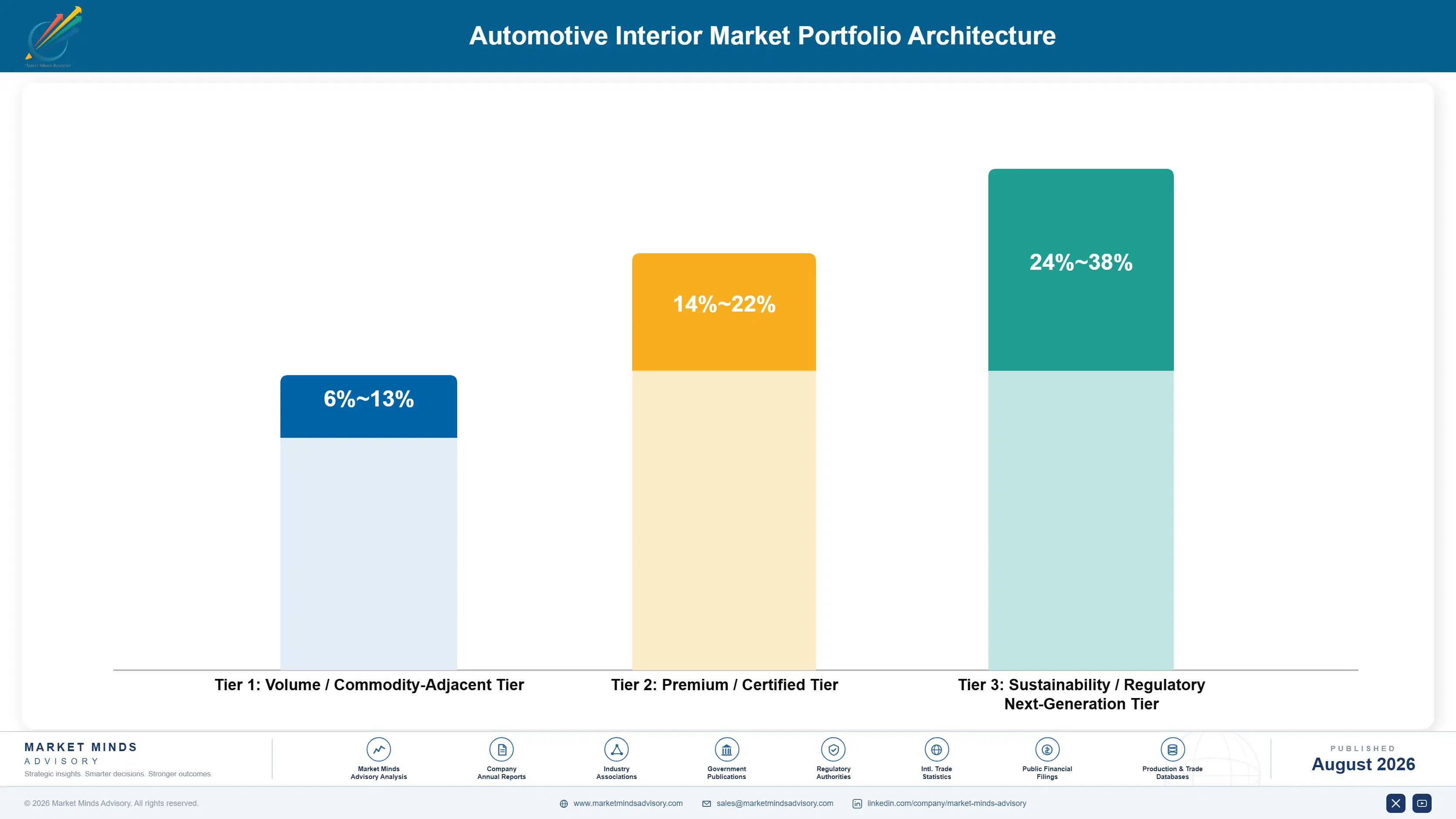
Three tiers separate on what the supplier is accountable for. Component-level moulded trim supplied against manufacturer designs earns 6% to 13%, competing on quotation against Eastern European, Chinese, and Indian cost positions. System-level supply with supplier-owned design and validation earns 14% to 22%, since integration risk transfers with the award. Cockpit modules with electronics and software accountability earn most, and that gap keeps widening as module awards spread.
The tension is that component volume fills the presses while module capability wins the future. Moulded trim keeps utilisation near 76%, which the capital in tooling and paint genuinely requires, yet it earns least and positions the supplier as a converter rather than a partner. Suppliers who defended component volume rather than building electronics capability now find themselves quoting substrates into modules their competitors lead, which is a considerably worse place to be than lower utilisation.

High-value pools sit where the manufacturer buys accountability rather than parts. Cockpit module integration, surface electronics behaviour, and qualified recyclate content all involve capability a programme team cannot assemble internally, which is exactly why they resist the quotation comparison that moulded components invite immediately.

Volume / Commodity-Adjacent Tier

Moulded trim panels, substrates, and components supplied against manufacturer-owned designs on quotation. Competes on tooling and conversion cost alone. The wide range reflects large differences in plant location, labour cost, and moulding scale between suppliers globally.
Gross Margin: 6%-13%

Premium / Certified Tier

System-level supply of door panels, overhead systems, and consoles where the supplier owns design, validation, and material qualification. Range width separates standard system supply from fully validated recyclate-compliant content within the same tier.
Gross Margin: 14%-22%

Sustainability / Regulatory / Next-Generation Tier

Integrated cockpit modules with electronics and software accountability, surface electronics, and lighting systems. Integration capability and regulatory material qualification, rather than manufacturing economics, sustain the margin structure throughout this tier.
Gross Margin: 24%-38%
automotive-interior-ambient-lighting-market-trends-portfolio-architecture-1787465302559

High-value Sub-segments and Strategic Watch-out

Integrated Cockpit Module Supply

Highest value in the category, bundling panel, displays, controls, and software under single accountability that manufacturers increasingly demand. Roughly 43% of programmes now award this way. Suppliers without electronics capability become second-tier vendors inside somebody else's module. Electronics capability is the entry requirement. Few hold it.
Gross Margin: 28%-38%

Surface Electronics and Ambient Lighting

High value with 12.8% growth, carrying the content buyers actually perceive as quality rather than the substrates beneath it. Optics, light guide, and thermal capability do not transfer from moulding expertise at all. Optics and thermal design are the barrier, and neither comes from moulding heritage.
Gross Margin: 24%-34%

Door Panel and Overhead System Supply

The reliable core, protected by system-level design ownership and validation responsibility that component quotation does not touch. It funds the electronics transition and holds plant utilisation, which the tooling capital genuinely requires. Design ownership is what protects it from quotation. It funds the electronics transition entirely.
Gross Margin: 15%-22%

Component Moulded Trim Supply

The strategic watch-out. Quoted against Eastern European, Chinese, and Indian cost positions with no defensible differentiation available anywhere. It positions the supplier as a converter rather than a partner, which affects every subsequent conversation. Every subsequent conversation starts from that position. No differentiation is available at all.
Gross Margin: 5%-12%

Why Cockpit Awards Run Long

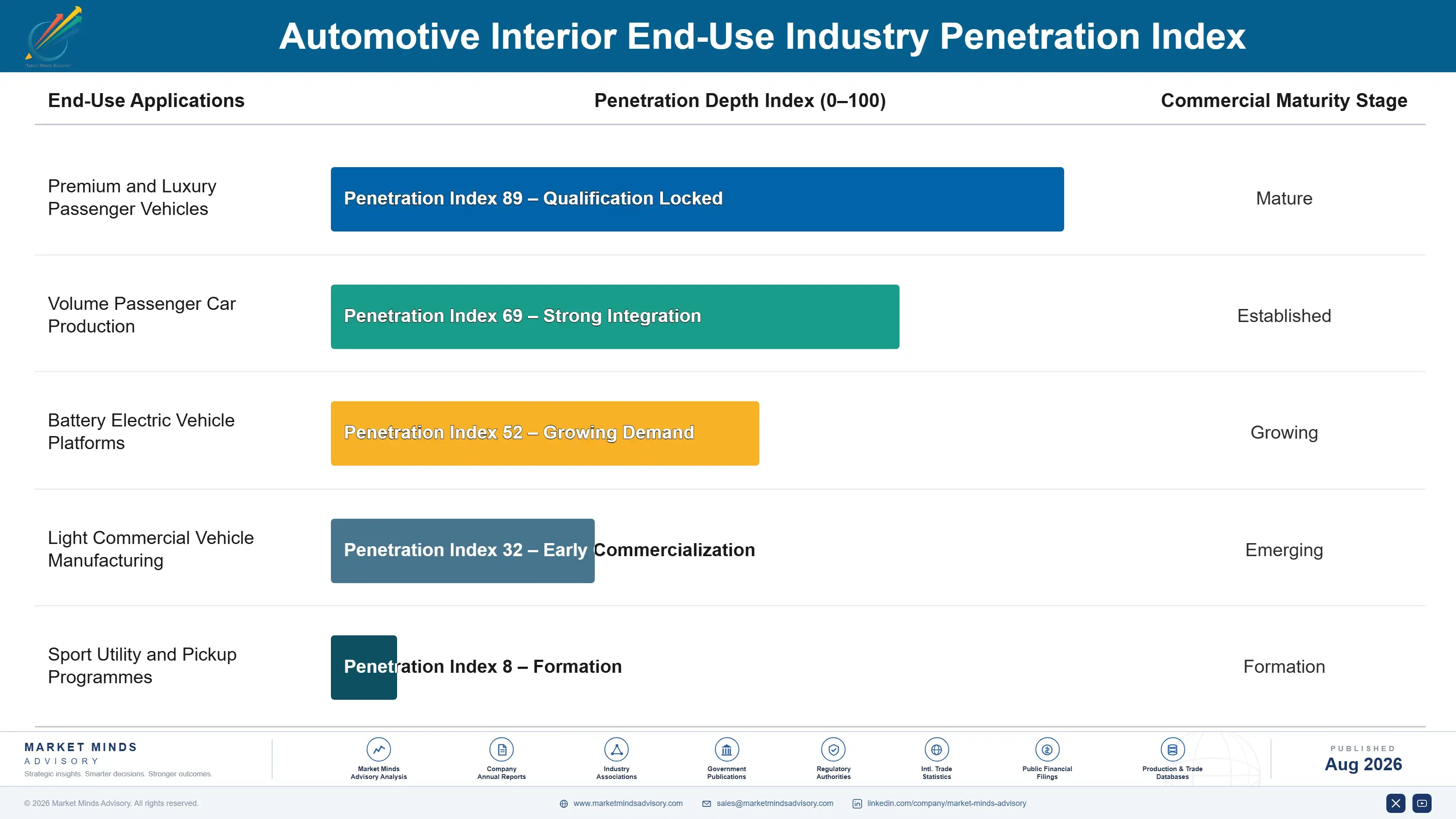
Interior revenue is programme revenue with unusually high switching cost, because tooling, colour and grain matching, crash validation, and cabin emissions certification all assume the specific supplier and specific materials. A cockpit module award in particular embeds electronics interfaces and software behaviour that cannot be substituted mid-programme without recertifying the whole cabin. Typical programme tenure runs six to nine years, and module awards frequently extend across facelifts because retooling an entire cockpit is rarely justified by a price improvement.
Stickiness varies sharply with award level. Cockpit modules are the most durable, since the supplier is accountable for integration that a replacement would have to reproduce entirely, including software behaviour validated across the vehicle. System-level supply comes next, protected by design ownership and validation investment. Component moulded trim is the least sticky of all, retendered at every model action on quotation with no attachment to the incumbent and no switching cost worth mentioning.

Buyer profiles have changed considerably. Software and user experience teams now sit in interior supplier selection alongside purchasing and manufacturing, and questions about display behaviour and lighting control arrive before any discussion of moulding capability.
automotive-interior-ambient-lighting-market-trends-end-use-penetration-index-1787465303396

Where Interior Capital Should Go

These are among the four positions where our research anticipates prominent divergence between winners and laggards over the coming forecast period. Each is grounded in the demand model, the regulatory perimeter, and the announced capacity pipeline.
01 / COCKPIT MODULE CAPABILITY

Bid for accountability, or supply substrates into someone else's module

Roughly 43% of programmes now award an integrated cockpit module bundling panel, displays, vents, wiring, controls, and software behaviour under one supplier accountable for the entire result, and that share keeps rising every year. Building the electronics and software capability required costs perhaps $18 million alongside the existing manufacturing strength. Suppliers who cannot carry that accountability become second-tier vendors inside a competitor's module, capturing roughly 35% of the content they previously supplied directly to the manufacturer themselves, and very few suppliers currently hold both disciplines.
02 / SURFACE ELECTRONICS INVESTMENT

Own the content buyers notice, not the substrate beneath it

Ambient lighting, hidden-until-lit surfaces, capacitive controls, and display bonding now carry the perceived quality that material grain and stitching used to, growing at 12.8% while traditional trim grows at roughly a third of that rate. The required capability spans optics, light guide design, electronics packaging, and thermal management, none of which transfers from moulding expertise at all. Investment runs around $12 million for credible capability, and suppliers who moved early already own what moulding specialists now merely support beneath, and that division of value looks permanent.
03 / RECYCLATE QUALIFICATION TIMING

Qualify recycled grades before the requirement actually binds

European end-of-life vehicle proposals target substantial recycled plastic content with a portion specified from vehicle recycling streams, and recyclate behaves differently in moulding, colour matching, odour, and ageing than virgin polymer does in every respect. Qualification takes two to three years per material family and cannot be compressed once the requirement binds on programmes already in development. Suppliers who invested early quote compliant content while competitors test, supporting a 6% to 11% pricing advantage on every affected part, and late entrants simply cannot catch up.
04 / SCALABLE CONTENT ARCHITECTURE

Design content that survives cost engineering instead of being deleted

Discretionary cabin content is the first target when programme cost engineering begins, because ambient lighting and decorative trim are visible line items carrying no regulatory protection whatsoever behind them. Designing content families that scale across trim levels from a common architecture lets a manufacturer reduce specification without deleting the supplier entirely, preserving roughly 60% of content value where fixed single specification would have lost all of it. The engineering discipline costs very little and protects revenue through exactly the rounds that catch competitors out.

Engagement Snapshot From the Field

A live engagement with an industry participant carrying material or product regulatory and market exposure ahead of a defining policy shift, showing how our research translates into a defensible multi-year portfolio strategy.
MARKET MINDS ADVISORY · CLIENT ENGAGEMENT SUMMARY
Automotive Interior Producer Strategic Portfolio Review and Transition Roadmap 2026·Investment Scenario on Automotive Interior Exposure Evaluation 2025-26
CLIENT PROFILE
A European interior systems supplier operating moulding, foaming, and assembly across six plants serving German, French, and Eastern European vehicle programmes, with annual revenue near EUR 1.1 billion (client-reported, unverified by MMA). Component and system-level trim supplied roughly 81% of revenue, no surface electronics capability existed internally, and recyclate qualification had been treated as a future compliance task rather than a current programme.
STRATEGIC CHALLENGE
The client had been excluded from two cockpit module bids for lack of electronics and software capability, and a third customer had signalled that future awards would be module-based. Polymer and energy increases absorbed under fixed-price programmes had cut group margin to 5.4%, and a major customer had begun requesting recyclate content the client could not yet quote compliantly.
MMA APPROACH
MMA rebuilt profitability by award level, separating component quotation work from system-level supply with design ownership. Electronics capability build was costed against partnership and acquisition routes with integration risk assessed. Recyclate qualification timelines were mapped against customer programme deadlines, and scalable content architecture opportunities were identified, with findings tested through 47 expert interviews during Q4 2025.
KEY FINDINGS
  1. Component-level quotation work generated 5% contribution margin against 19% for system-level supply where the client owned the design and validation responsibility itself across the programme.
  2. Cockpit module exclusion had cost an estimated EUR 140 million of lifetime programme value across two bids, with a third award expected within eighteen months.
  3. Recyclate qualification across the client's four principal material families would take roughly thirty months, which was longer than the lead customer's stated programme timeline allowed.
  4. Building surface electronics capability internally would cost around EUR 11 million against EUR 95 million to acquire a comparable position through acquisition of a specialist.
CLIENT PROFILE
A European interior systems supplier operating moulding, foaming, and assembly across six plants serving German, French, and Eastern European vehicle programmes, with annual revenue near EUR 1.1 billion (client-reported, unverified by MMA). Component and system-level trim supplied roughly 81% of revenue, no surface electronics capability existed internally, and recyclate qualification had been treated as a future compliance task rather than a current programme.
STRATEGIC CHALLENGE
The client had been excluded from two cockpit module bids for lack of electronics and software capability, and a third customer had signalled that future awards would be module-based. Polymer and energy increases absorbed under fixed-price programmes had cut group margin to 5.4%, and a major customer had begun requesting recyclate content the client could not yet quote compliantly.
MMA APPROACH
MMA rebuilt profitability by award level, separating component quotation work from system-level supply with design ownership. Electronics capability build was costed against partnership and acquisition routes with integration risk assessed. Recyclate qualification timelines were mapped against customer programme deadlines, and scalable content architecture opportunities were identified, with findings tested through 47 expert interviews during Q4 2025.
KEY FINDINGS
  1. Component-level quotation work generated 5% contribution margin against 19% for system-level supply where the client owned the design and validation responsibility itself across the programme.
  2. Cockpit module exclusion had cost an estimated EUR 140 million of lifetime programme value across two bids, with a third award expected within eighteen months.
  3. Recyclate qualification across the client's four principal material families would take roughly thirty months, which was longer than the lead customer's stated programme timeline allowed.
  4. Building surface electronics capability internally would cost around EUR 11 million against EUR 95 million to acquire a comparable position through acquisition of a specialist.
RECOMMENDED STRATEGY
Phase 1: Phase 1 (months one to six): begin recyclate qualification immediately across all four material families and decline component quotations without polymer indexation. Phase 2: Phase 2 (months seven to twenty-two): build surface electronics and lighting capability internally, and partner for display integration on the next module bid. Phase 3: Phase 3 (months twenty-three to thirty-six): bid complete cockpit modules independently and shift plant mix away from component quotation work.
OUTCOME
The supplier reported group margin improving from 5.4% to 11.2% within eighteen months as component work was declined and system supply grew (client-reported, unverified by MMA). Recyclate qualification completed on two material families. Surface electronics capability reached production readiness and one partnered module bid was submitted.

Frequently Asked Questions

Foundational context covering the market sizes, CAGR, scope, country, region and competition that inform every finding below. This section is provided to cover basics and most often pre-purchase conversations, answered from the MMA Primary Research Dataset.

What is the current size of the Automotive Interior Market?

The market was valued at USD 128.4 billion in 2025, rising to an estimated USD 135.98 billion in 2026. East Asia holds the largest regional share at 30% of global value.

How large will the Automotive Interior Market be by 2036?

MMA forecasts USD 241.22 billion by 2036 under the base case, an expansion multiple of 1.77 times the 2026 level. Incremental value creation reaches USD 105.24 billion across the period.

What is the CAGR for the Automotive Interior Market 2026 to 2036?

The base case CAGR is 5.9%, with a bull case of 7.2% and a bear case of 4.6%. Historical growth between 2020 and 2025 ran at 4.7%, driven by content rather than volume.

Which segment is growing fastest?

Interior lighting and surface electronics, at 12.8%, roughly 2.17 times the overall market rate. It carries the content buyers now perceive as quality rather than material grain.

Who are the major companies in the Automotive Interior Market?

Forvia, Yanfeng, Grupo Antolin, Toyota Boshoku, and Marelli lead, holding roughly 29% of supply between them. Motherson, Magna, and Draexlmaier follow closely with substantial regional positions.

Which country is growing fastest?

India, at 8.6%, driven by production expansion alongside rapid specification increase, as domestic buyers show strong willingness to pay for visible cabin content and technology.

Report Segmentation Architecture

The full report scope spans multiple orthogonal segmentation dimensions, with cross-tabulated demand data provided for each dimension pair. Coverage extends further to regional breakdowns, trend trajectories, and the competitive detail needed to support segment-level decision-making.

By Interior System

  • Instrument Panels and Cockpit Modules
  • Door Panels and Trim
  • Overhead Systems and Headliners
  • Centre Consoles and Storage Systems
  • Flooring and Acoustic Systems
  • Interior Lighting and Surface Electronics

By End-Use Industry

  • Premium and Luxury Passenger Vehicles
  • Volume Passenger Car Production
  • Battery Electric Vehicle Platforms
  • Light Commercial Vehicle Manufacturing
  • Sport Utility and Pickup Programmes

By Commercial Dimension

  • Integrated Cockpit Module Awards
  • System-Level Programme Supply
  • Component Supply Against Customer Designs
  • Tier Two Substrate and Sub-Assembly

By Region

  • North America
  • Western Europe
  • East Asia
  • South Asia and Pacific
  • Latin America
  • Middle East and Africa
  • Eastern Europe

Scope, Methodology, and Coverage

Every figure in this report is reproducible from documented input assumptions. The scope below maps the historical period, the forecast horizon, the segmentation dimensions, and the countries covered, alongside the underlying primary and qualitative methodology.
Historical Period
2020 to 2025
Forecast Period
2026 to 2036
Base Year
2025 (USD billions; MMA Primary Research Dataset, August 2026)
Market Definition
The market comprises interior systems supplied to light vehicles at original equipment level, covering instrument panels and cockpit modules, door panels and trim, overhead systems and headliners, centre consoles and storage systems, flooring and acoustic systems, and interior lighting and surface electronics. Value is measured at system level as supplied to vehicle manufacturers. Complete seating systems, steering wheels, infotainment head units sold separately, climate control hardware, glazing, and aftermarket interior accessories fall outside scope.
Quantitative Units
USD billions (current prices); vehicles equipped annually; USD per vehicle interior content value
Segmentation Dimensions
By Interior System; By End-Use Industry; By Commercial Dimension; By Region
Regions Covered
North America, Western Europe, East Asia, South Asia and Pacific, Latin America, Middle East and Africa, Eastern Europe
Countries Covered
USA, China, Germany, France, UK, Japan, South Korea, India, Australia, Canada, Brazil, Mexico, Indonesia, Vietnam, Thailand, Malaysia, UAE, Saudi Arabia, South Africa, Nigeria, Turkey, Poland, Netherlands, Italy, Spain, Sweden, Switzerland, Argentina, Colombia, Singapore, and additional markets relevant to this sector
Key Companies Profiled
Forvia, Yanfeng, Grupo Antolin, Toyota Boshoku, Marelli, Magna International, Motherson, Draexlmaier, IAC Group, Kasai Kogyo, Hayashi Telempu, Seoyon E-Hwa, Ningbo Huaxiang Electronic, Novares, Continental, Panasonic Automotive Systems, LG Display, BOE Technology, Autoneum, Adler Pelzer Group
Quantitative Methodology
Primary survey, n=3,800 respondents, Q4 2025, six countries; demand-side model with trade association cross-validation
Qualitative Methodology
47 expert interviews, Q4 2025; applied to validate demand model assumptions, identify emerging dynamics, and assess competitive positioning
Report Format
PDF and XLSX data workbook (Word format preview document)
Publisher
Market Minds Advisory
Report Code
MMA-2026-AUT-112
Published
August 2026
Contact
sales@marketmindsadvisory.com | www.marketmindsadvisory.com

Purchase the full Automotive Interior Market Report (2026 to 2036).

The full report sizes interior system demand across six categories and seven regions with 2026 to 2036 forecasts under base, bull, and bear cases. It models content value migration from moulded surfaces toward electronics and lighting, quantifying how much of rising interior spend actually reaches traditional suppliers. Competitive profiles cover twenty companies assessed consistently on interior system revenue, integration capability, and material qualification depth. Regulatory analysis maps recycled content proposals and cabin air quality requirements across jurisdictions. Commercial guidance addresses module bidding, surface electronics investment, recyclate timing, and scalable content architecture.
Six interior systems sized and forecast separately
Content migration modelled from surfaces toward electronics
Twenty supplier profiles on consistent system revenue basis
Recycled content proposals mapped against qualification timelines
Cabin air quality standards compared across major jurisdictions
Cockpit module award penetration tracked by manufacturer and region

Built For The People Who Decide

From boardroom strategy to bench-side execution, this report is read cover-to-cover by leaders shaping the next decade of their industry, turning demand scenarios, market dynamics and valuation benchmarks into decisions.
CXOs/ Presidents/ VPs/ Managers
M&A and Corporate Development
Strategy Teams and R&D Heads
Procurement and Product Directors
Regulatory and Compliance Leaders
Investor Relations and Equity Analysts