
Market Minds Advisory
Automotive Headliner Market

Automotive Headliner Market: Cabin Comfort, Acoustic Performance, and Integrated Lighting Architecture

Automakers are racing to differentiate cabin experience through integrated lighting, ambient displays, and acoustic comfort, pushing headliner suppliers toward smart composite architectures as commodity foam-backed designs face margin compression across every vehicle segment worldwide.

Lead Analyst

David Horsley

Published

September 2026

Make Smarter Decisions with Customized Research Insights

Request a free sample report and evaluate market opportunities, growth trends, and competitive dynamics relevant to your business needs.

2025 MARKET VALUE$13.8BMarket Size 2025
2036 FORECAST VALUE$27.3BBase Case , 2026 to 2036
CAGR 2026 TO 20366.4 %Bull 7.6% / Bear 5.2%
INCREMENTAL OPPORTUNITY$12.6BNet 10- year value creation
EXPANSION MULTIPLE1.86x2036 value over 2026 base
Strategic Levers
M&A Pipeline
Regional Outlook
Country Rankings
Competitive Intelligence
Segmental Deep-dive
Call-Us : 91 93563 13602

Executive Snapshot and Market Trajectory

Automotive headliner suppliers are shifting fastest where cabin electrification meets premiumization: integrated ambient lighting, sunroof modules, and acoustic layering now define winning programs, while legacy commodity non-woven designs face steady price erosion across mainstream vehicle trims worldwide this year and into the following model cycle.
Electric vehicle platforms have compressed noise, vibration, and harshness budgets into the headliner itself, forcing suppliers to fuse mechanical, acoustic, and electronic functions into a single molded assembly rather than treating each as a separate trim component. China's domestic vehicle programs are absorbing the fastest volume growth, with premium suede-faced and sensor-integrated designs commanding a widening price premium over commodity foam-backed alternatives across nearly every regional market this year.
Five global interior suppliers hold roughly two-fifths of production volume, yet none commands outright pricing power because automakers dual-source aggressively across nearly every vehicle platform they build today. Lightweighting mandates, sustainable fiber substitution rules taking hold across Western Europe, and rising demand for concealed sensor housings are reshaping which suppliers win next-generation sourcing contracts across every major automaker's global platform lineup over the coming several years, particularly among mid-tier challengers fighting for relevance.
Market Definition
The automotive headliner market covers the design, manufacture, and supply of interior roof-lining assemblies for passenger and light commercial vehicles, including face fabric, foam or composite backing, and integrated functional modules. It excludes standalone sunroof glass, roof racks, and vehicle structural roof panels, which are addressed in adjacent component markets.
Base Year Value
$13.8B in 2025 (MMA Primary Research Dataset, August 2026)
Forecast Period
2026 to 2036, eleven discrete annual values
CAGR
6.4% base case. Bull 7.6%. Bear 5.2%.
Fastest Growth Segment
Integrated Smart Headliner Systems: 11.5% CAGR
Fastest Growth Country
China: 8.0% CAGR
Fastest Growth Region
South Asia and Pacific: 8.4% CAGR
Largest Region
East Asia: 43% of 2025 global value
Market Leaders
Grupo Antolin, Adient plc, Lear Corporation, Yanfeng Automotive Interiors, Magna International Inc. Source: MMA Analysis based on company annual reports.
Primary Survey
n=3,800 procurement and R&D decision-makers, Q4 2025, six countries
Methodology
Demand-side build-up, cross-validated against public data, 47 expert interviews

Automotive Headliner Market Forecast Scenarios

automotive-headliner-market-trends-size-forecast-scenario-1787465116067
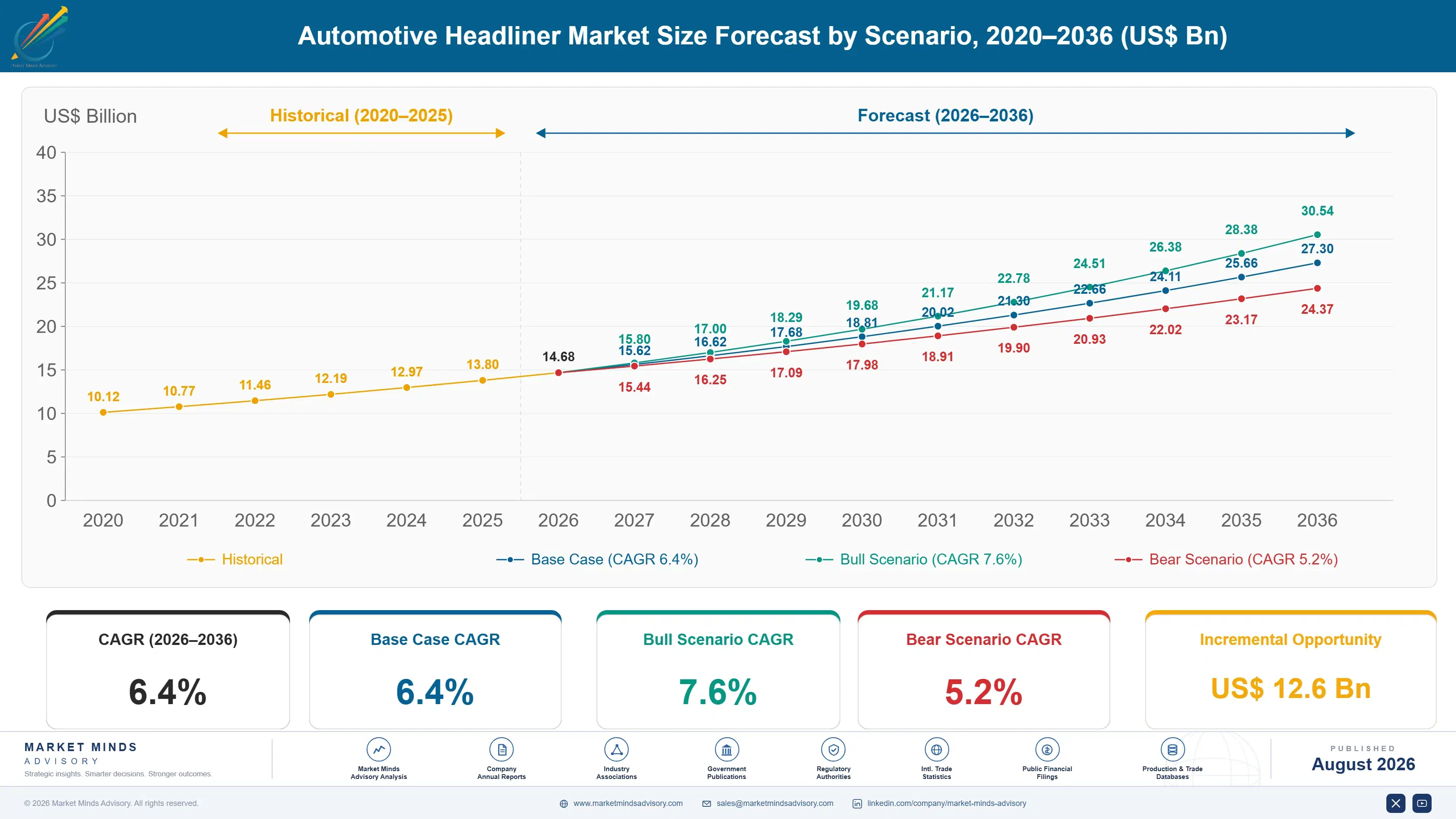
Between 2020 and 2025 headliner demand tracked global light-vehicle production through a volatile stretch of semiconductor shortages and shifting platform mixes, with the sharpest volume swings concentrated in North America and Western Europe as automakers repeatedly rescheduled interior trim orders around chip-constrained assembly lines. Suppliers absorbed considerable working-capital strain navigating that unpredictable production cadence across nearly every regional plant they served.
The base case assumes global light-vehicle output stabilizes while three commercial mechanisms drive value growth: rising sunroof and panoramic-roof attachment rates across mainstream trims, migration toward multi-functional smart headliners bundling ambient lighting and sensor housings into a single assembly, and accelerating premiumization in China's domestic new-energy-vehicle segment. Together these three forces outpace unit volume growth by a wide margin through most of the forecast decade, lifting average content value per vehicle steadily.
The bull case rests on faster-than-expected panoramic-roof and ambient-lighting attachment across mid-market vehicle trims, not just luxury nameplates, pulling premium content years ahead of current adoption curves. The bear case centers on a prolonged shift toward stripped-down, cost-engineered electric vehicle interiors among value-focused automakers, which would compress average headliner content value even as global vehicle unit volumes continue recovering steadily worldwide.

Cabin Differentiation Economics and Supply Concentration

Headliner economics increasingly hinge on function density rather than surface area, as automakers push suppliers to embed lighting circuits, microphone arrays, and sunroof motor housings into a component once judged purely on acoustic damping and visual fit and finish quality. This shift is rewriting supplier qualification criteria across nearly every major vehicle program launched in the current model cycle, forcing converters that lack electronics capability to rethink their long-term competitive position entirely.
TOP PRODUCER SHAREChina, 34%Share of worldwide headliner production output concentrated domestically
MARKET CONCENTRATIONCR5 38%Combined share held by the largest suppliers globally
AVERAGE SELLING PRICE$42-68 per unitTypical price range spanning distinct vehicle segment tiers
SUNROOF ATTACHMENT RATE31%Share of new vehicles ordered with sunroof modules
INPUT COST SHARE58% of COGSFiber and foam feedstock share of production cost
CAPACITY UTILIZATION76%Average utilization rate across major global production lines
The commercial character of the market is bifurcating sharply: volume commodity programs compete almost entirely on landed cost and delivery reliability, while premium platforms now negotiate multi-year co-development contracts that lock suppliers into specific vehicle nameplates for an entire model generation cycle. Suppliers straddling both tiers face a genuine organizational challenge, running fundamentally different cost structures and engineering teams under one corporate roof.
Over the next decade, sustainable fiber mandates in Western Europe, sensor-housing integration for advanced driver assistance systems, and China's fast-cycling new-energy-vehicle platforms will decide which suppliers hold their current sourcing positions and which lose ground to faster-moving regional challengers. The pace of change is accelerating each successive model year, leaving little room for suppliers still operating on decade-old product architectures.
"The headliner stopped being a commodity the day it became a wiring harness. Suppliers who still price it like foam and fabric are going to lose the next sourcing round."
Director, Automotive Interior Systems Practice · MMA Automotive Interior Components Practice · August 2026

Market Trends

Panoramic Roof and Ambient Lighting Convergence

Panoramic and fixed-glass roof attachment rates have climbed steadily across mid-market vehicle segments, not just luxury trims, pulling headliner suppliers into direct co-development of ambient lighting strips, acoustic glass interfaces, and motorized shade mechanisms. Several major automakers now specify lighting-integrated headliner assemblies as standard equipment on volume electric vehicle platforms rather than optional packages, a shift that materially raises average component content value per vehicle. Suppliers without in-house electronics integration capability are increasingly forced into subcontracted lighting partnerships, ceding margin and design control to specialist electronics vendors on programs they previously owned outright from concept through production launch.
Market Impact: Adds 4.2 points to growth
Sustainable Fiber Substitution Under EU Circularity Rules

The European Union's End-of-Life Vehicles Regulation recast is pushing automakers toward recycled and natural-fiber headliner substrates well ahead of the formal compliance deadline, with several German and French platforms already specifying thirty to fifty percent recycled polyester content in new headliner programs. Suppliers with established natural-fiber and recycled-substrate production lines are winning early qualification slots on next-generation European platforms, while competitors reliant solely on virgin polyester nonwoven capacity face requalification costs and slower program entry. The shift is reshaping supplier selection criteria across Western Europe well before the regulation reaches full legal force across all member states.
Market Impact: Raises unit value by roughly $7

Market Opportunities and Growth Drivers

China's Rapid New-Energy-Vehicle Cabin Premiumization Wave

China's domestic new-energy-vehicle makers are specifying suede-faced, sensor-integrated headliners on mainstream models well below the price points where such content historically appeared in Western and Japanese vehicle lineups, compressing the premiumization timeline by several years. Domestic suppliers with established relationships to BYD, NIO, and other fast-scaling automakers are capturing disproportionate volume growth as these programs multiply across new model launches each year. The pace of specification upgrades is forcing global suppliers to match domestic Chinese cost structures or cede share entirely, reshaping competitive dynamics across the entire East Asian supply base within a compressed multi-year window.
Market Impact: Cuts value nearly $11

ADAS Sensor Housing Integration Regulatory Mandates

Advanced driver assistance systems increasingly require cabin-facing sensors, including driver monitoring cameras and microphone arrays, housed within or adjacent to the headliner assembly rather than the dashboard or door panels. Regulatory mandates in the European Union and several US states requiring driver monitoring on new vehicle platforms starting within the current model cycle are accelerating supplier co-development contracts that bundle sensor housings directly into headliner tooling from the earliest design stage. This integration raises unit content value meaningfully and favors suppliers already qualified on electronics-adjacent manufacturing processes over pure textile and foam converters lacking those capabilities.
Market Impact: Swings input cost 9-14% per cycle

Market Restraints and Challenges

Volume EV Interior Cost Stripping Pressure

Several value-focused electric vehicle programs, particularly in China's entry-level segment and among US direct-to-consumer challengers, are deliberately stripping headliner content back to single-layer molded substrates without lighting or sunroof provisions to protect vehicle-level margins under intense price competition. The root cause is thin overall vehicle gross margin in the sub-thirty-thousand-dollar EV segment, which leaves little room for interior content that does not directly support the advertised feature list. Suppliers are responding by developing lower-cost modular architectures that preserve some upgrade path without the tooling cost of a fully bespoke stripped-down design, though adoption remains uneven across automaker programs so far.
Market Impact: Adds $6-9 per unit

Fiber and Foam Feedstock Price Volatility

Polyester fiber and polyurethane foam feedstock prices, both derived substantially from petrochemical inputs, have swung sharply over recent contract cycles, squeezing supplier margins on fixed-price multi-year automaker contracts that offer little built-in cost pass-through mechanism. The root cause lies in feedstock exposure to crude oil and propylene pricing cycles that automotive supply contracts were never designed to absorb gracefully. Larger suppliers are mitigating exposure through index-linked contract clauses and dual-sourced feedstock agreements, while smaller regional converters remain largely exposed to spot-market volatility on every purchasing cycle, a gap that is slowly reshaping the competitive field.
Market Impact: Cuts virgin fiber use nearly 40%
3 additional market trends, 4 additional growth drivers, and 3 additional restraints and challenges are covered in the full report. Contact sales@marketmindsadvisory.com to access the complete intelligence.

Segment CAGR and Growth Architecture

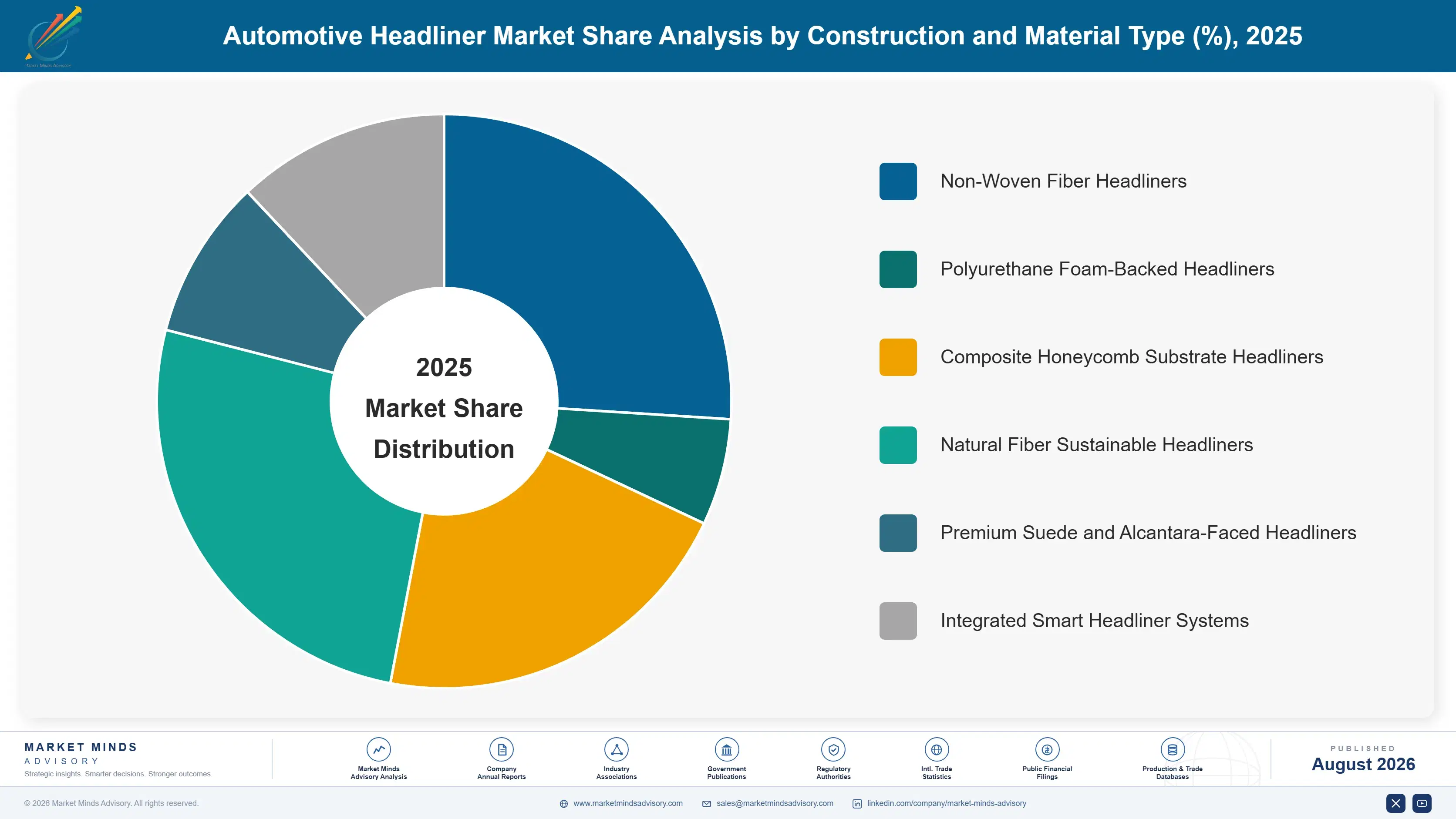
Segmentation follows headliner construction and material technology, the dimension automakers actually specify against in sourcing programs, rather than by vehicle class or distribution channel, both of which sit outside this defined market scope entirely and belong instead to adjacent commercial, channel-level, and vehicle-platform analysis kept separate from this specific report and its stated scope.
automotive-headliner-market-trends-market-share-analysis-1787465116633

Integrated Smart Headliner Systems

Integrated smart headliners embed ambient lighting circuits, driver-monitoring camera housings, microphone arrays, and motorized sunroof shade mechanisms directly into the molded substrate rather than adding them as separate trim pieces. Automakers are specifying this architecture earliest on electric vehicle flagship models and China's new-energy-vehicle lineups, where cabin technology differentiates otherwise similar powertrain platforms. Suppliers need electronics integration capability alongside traditional textile and foam expertise, a combination only a handful of global players currently hold at scale. Tooling costs run meaningfully higher than commodity designs, but average unit content value climbs enough to justify the investment on high-volume platforms, and the segment is pulling qualification budgets away from simpler foam-backed programs across nearly every major automaker's product roadmap.
CAGR 11.5%

Premium Suede and Alcantara-Faced Headliners

Premium suede and Alcantara-faced headliners use synthetic or blended microfiber face materials that deliver a tactile, visually distinct cabin surface favored on luxury trims and increasingly on mainstream vehicles seeking a premium cabin impression at a lower price point than true leather alternatives. China's domestic automakers have adopted this material tier on mid-market new-energy-vehicle models well ahead of historical premiumization timelines, pulling volume growth forward several years faster than in Western markets. Suppliers with established microfiber sourcing relationships and color-matching capability across large production runs hold an early advantage. The segment carries meaningfully higher gross margin than standard woven fabric designs, making it a priority qualification target for suppliers seeking to escape commodity pricing pressure entirely.
CAGR 9.8%
Full segment breakdown across 6 segments available in the complete report.

Regional Architecture and Country Demand Map

East Asia's dominant vehicle production base and China's fast-cycling new-energy-vehicle premiumization anchor global headliner demand, while North America and Western Europe carry the largest premium and ADAS-integrated content value per vehicle across their respective established automaker platform programs, longstanding supplier relationships, and regional sourcing networks.

North America

US and Canadian light-vehicle assembly remains concentrated among a handful of automakers whose full-size truck and SUV platforms specify large panoramic-roof headliner assemblies, keeping average content value per vehicle among the highest globally. Driver-monitoring mandates phasing in across several states are pulling sensor-housing integration into new vehicle programs faster than in most other regions. Supplier consolidation among Tier 1 interior specialists has left three companies controlling the bulk of regional production capacity, giving automakers limited alternative sourcing options during periods of tight capacity. Nearshoring pressure tied to trade policy is also nudging some Asian-owned suppliers toward new Mexican production lines to preserve tariff-free access to US assembly plants and protect delivery schedules.
Share: 22% | CAGR: 5.0% (2026 to 2036)

Western Europe

Germany and France anchor regional demand through premium automaker platforms that specify Alcantara-faced and sensor-integrated headliners as standard equipment well ahead of most other markets, supporting above-average content value per vehicle despite comparatively modest unit volume growth across the wider region. The European Union's End-of-Life Vehicles Regulation recast is accelerating recycled and natural-fiber substrate adoption faster here than anywhere else, forcing supplier requalification across dozens of active platforms simultaneously and on tight timelines. Regional vehicle production has grown only modestly this decade, which caps overall volume upside even as content value per unit continues climbing steadily. Suppliers without established recycled-fiber capacity risk losing qualification slots on next-generation European platforms entirely within the next several years.
Share: 18% | CAGR: 4.9% (2026 to 2036)
Regional intelligence for 5 additional markets available in the complete report: East Asia, South Asia and Pacific, Latin America, Middle East and Africa, Eastern Europe. Contact sales@marketmindsadvisory.com.
automotive-headliner-market-trends-country-cagr-analysis-1787465117241

Where Headliner Suppliers Can Defend Margin

Suppliers facing commodity pricing pressure on foam-backed designs have four realistic paths to defend and expand margin without waiting for automakers to specify premium content unprompted across every new vehicle program launched in the coming years across every major regional market they currently serve, plan to enter soon, or still hope eventually to win.

Bundled Lighting and Sensor Co-Development Contracts

Suppliers that build in-house electronics integration capability can bid for bundled lighting and sensor-housing contracts rather than losing that scope to specialist electronics vendors during program development. Co-development contracts of this kind typically lock in multi-year sourcing exclusivity and raise average unit content value by $6-9 compared with a standard commodity foam-backed design lacking any integrated functionality whatsoever. The capability requires meaningful upfront investment in electronics-adjacent manufacturing processes and design engineering talent, but suppliers who move early are securing qualification slots on flagship electric vehicle platforms years before competitors without this capability can catch up to them.
Market Impact: Adds $6-9 per unit across multi-year exclusive contracts

Recycled and Natural Fiber Substrate Capacity

Building qualified recycled-polyester and natural-fiber substrate production lines ahead of regulatory deadlines positions suppliers to win early qualification slots on European and increasingly North American platforms before compliance becomes mandatory across the board. Early movers are already capturing 30-50% recycled-content specifications on new German and French platforms, a premium-priced qualification that laggard suppliers cannot easily match without their own capacity investment. The requalification cost is real, but suppliers delaying this shift risk losing established platform positions entirely once mandates take full legal effect across the European Union in the coming years.
Market Impact: Secures 30-50% recycled-content platform contracts early each year

Modular Architecture for Value EV Programs

Developing a lower-cost modular headliner architecture that preserves an upgrade path to lighting or sunroof integration, without the full tooling cost of a bespoke premium design, lets suppliers retain volume programs at value-focused automakers without fully abandoning margin on those platforms. This approach protects unit economics on stripped-down electric vehicle programs priced near $20-25 per unit while keeping a foothold for future content upgrades as those same platforms mature and automakers reconsider feature specification in later model years. Suppliers ignoring this tier risk losing volume entirely to lower-cost regional converters undercutting aggressively on price alone across every bid cycle.
Market Impact: Protects margin on $20-25 volume programs at scale

Direct China New-Energy-Vehicle Platform Sourcing Access

Establishing direct supplier relationships with China's fastest-scaling new-energy-vehicle makers, rather than relying solely on legacy joint-venture automaker relationships, gives suppliers access to the fastest unit volume and premiumization growth in the global market today, expanding at roughly 8% annually. Domestic Chinese suppliers already hold strong incumbency here, so global suppliers need genuinely competitive local cost structures and manufacturing footprint to win qualification rounds rather than exporting Western pricing assumptions into a materially different competitive environment. Suppliers succeeding at this are capturing outsized share of the fastest-growing demand pool worldwide today.
Market Impact: Captures share of an 8% China growth pool

Who Controls the Margin Pool

The five largest global interior suppliers hold roughly thirty-eight percent of production volume on a shipment basis, a concentration level that leaves meaningful room for regional challengers, particularly in China, to win share on cost and speed rather than scale alone. The gap between the largest suppliers and mid-tier regional challengers has narrowed as domestic Chinese converters scale smart-headliner capability faster than expected.
Current competitive activity centers on three dimensions: electronics integration capability for lighting and sensor housings, recycled-fiber substrate qualification ahead of European regulatory deadlines, and direct sourcing relationships with China's fastest-scaling new-energy-vehicle makers rather than legacy joint-venture channels. Suppliers investing across all three simultaneously are pulling ahead of competitors focused on just one dimension at a time.

Emerging pressure is coming from Chinese domestic converters that have closed much of the technology gap on smart-headliner integration within a few product cycles, threatening established suppliers' historical hold on premium Chinese platform sourcing. Rankings are most likely to shift among mid-tier global suppliers lacking either electronics capability or sustainable-fiber qualification, both of which are becoming baseline requirements rather than differentiators on next-generation platform sourcing decisions worldwide.
automotive-headliner-market-trends-company-positioning-matrix-1787465117796

Competitive Moat and Risk Dimensions

GRUPO ANTOLIN

Moat: Global Platform Co-Development Scale

Grupo Antolin's established co-development relationships across dozens of global automaker platforms give it design-in access from the earliest vehicle architecture stage, a position new entrants cannot easily replicate. Its manufacturing footprint spans every major production region, letting it serve multinational platform programs from a single qualified supplier relationship rather than requiring automakers to coordinate multiple regional suppliers separately.
GRUPO ANTOLIN

Risk: European Regulatory Compliance Cost

Heavy exposure to Western European platforms means Grupo Antolin faces the earliest and most extensive recycled-fiber requalification costs under the End-of-Life Vehicles Regulation recast, a burden competitors with smaller European footprints face on a smaller scale. Passing these costs through to automaker customers is difficult given intense multi-sourced pricing competition across the region's platform programs.
YANFENG AUTOMOTIVE INTERIORS

Moat: China Domestic Platform Incumbency

Yanfeng's joint-venture heritage and deep relationships with China's largest domestic and international automaker programs give it a scale advantage in the world's fastest-growing premiumization market that global competitors are still working to replicate through their own local partnerships and manufacturing investment across the country and wider region.
YANFENG AUTOMOTIVE INTERIORS

Risk: Geographic Concentration Exposure

Yanfeng's revenue base skews heavily toward China relative to global peers, leaving it more exposed to any slowdown in Chinese vehicle production or a shift in domestic automaker sourcing preference toward smaller local converters competing aggressively on price within its core home market and neighboring territories.

Players Tracked

Prominent Players

Grupo Antolin
Adient plc
Lear Corporation
Yanfeng Automotive Interiors
Magna International Inc.

Other Key Players

Toyota Boshoku Corporation
IAC Group
Motus Integrated Technologies
Howa Co. Ltd.
UGN Inc.
SA Automotive
Hayashi Telempu Corporation
Glen Raven Inc.
Cindus Corporation
Johns Manville
Harodite Industries
Atlas Roofing Corporation
Shawmut Corporation
Sage Automotive Interiors
Nolar Industries

Recent Developments

MARCH 2026

Grupo Antolin Opens Recycled-Fiber Substrate Line

Grupo Antolin commissioned a new recycled-polyester headliner substrate production line at its German facility, targeting qualification on multiple premium European platforms ahead of upcoming End-of-Life Vehicles Regulation compliance deadlines across the wider European Union market this decade and into the next production cycle as well.
Signal: Signals suppliers are front-loading regulatory compliance investment well ahead of mandatory deadlines to secure early qualification.
SEPTEMBER 2025

Yanfeng Expands Smart Headliner Capacity in China

Yanfeng Automotive Interiors expanded production capacity for sensor-integrated smart headliner assemblies at its Shanghai facility, supporting growing orders from several domestic new-energy-vehicle makers scaling premium cabin technology across multiple mainstream model lines launched this year while preparing additional capacity for further planned expansion next year.
Signal: Confirms that China's premiumization curve is compressing years faster than comparable Western markets have historically moved.
JANUARY 2026

Lear Corporation Acquires Acoustic Materials Specialist

Lear Corporation completed the acquisition of a specialist acoustic nonwoven materials producer, adding proprietary sound-damping substrate technology to its headliner and interior trim portfolio and further strengthening its position on premium noise-sensitive electric vehicle platform programs globally across several key automaker customer relationships worldwide this year.
Signal: Shows established suppliers buying specialized capability rather than building it internally to accelerate platform qualification timelines.

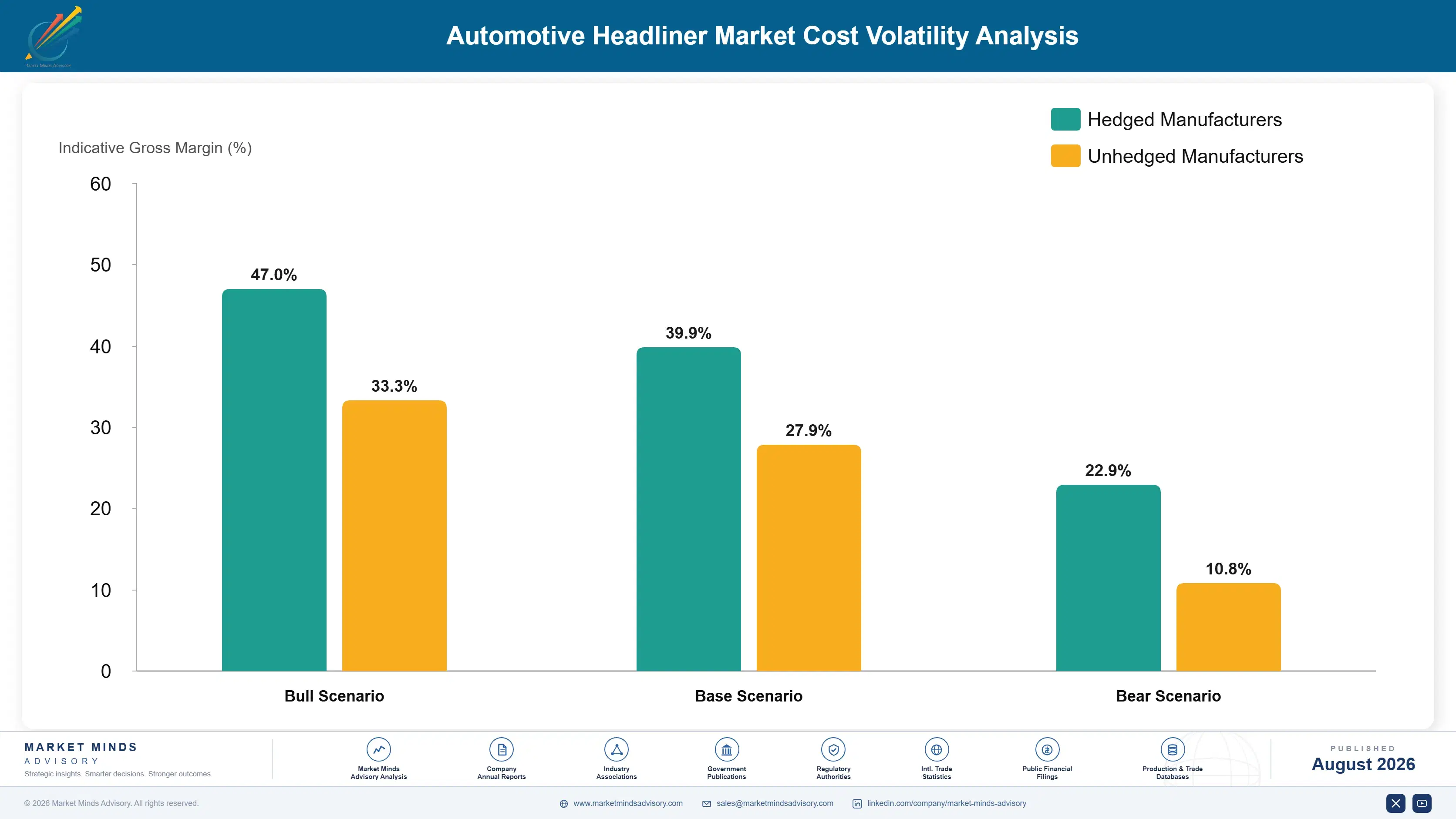
Fiber and Foam Feedstock Exposure

Polyester fiber and polyurethane foam together account for roughly fifty-eight percent of headliner production cost, with both inputs ultimately traced back to petrochemical feedstock sourced from a concentrated group of regional refining and polymer producers across Asia, the Gulf, and North America, leaving suppliers exposed to shifts in several distant commodity markets simultaneously across every purchasing cycle and contract negotiation.
Global polyurethane feedstock prices spiked sharply during the 2022 to 2023 energy price disruption tracked by the International Energy Agency, forcing several interior suppliers to renegotiate fixed-price automaker contracts mid-cycle or absorb margin compression they had not budgeted for entering those multi-year sourcing agreements several years earlier under far calmer market conditions than those that eventually followed across the industry, reshaping how contracts get written today and in coming renewal cycles.

Larger suppliers with index-linked contract clauses and diversified feedstock sourcing across multiple regions absorb volatility far better than smaller regional converters locked into fixed-price agreements without built-in cost pass-through mechanisms, a gap in commercial contract sophistication that is slowly reshaping which suppliers survive successive volatility cycles across the wider industry landscape over the coming years.
automotive-headliner-market-trends-cost-volatility-analysis-1787465117996

Index-Linked Automaker Contract Clauses

Negotiating feedstock price index clauses into multi-year automaker sourcing contracts lets suppliers pass through a defined share of raw material volatility rather than absorbing the full swing themselves, a structure larger suppliers have increasingly standardized across new contract negotiations with their major automaker customers worldwide over the past several successive contract renewal cycles today.

Dual-Region Feedstock Sourcing Agreements

Qualifying polyester and foam feedstock suppliers across two or more geographic regions reduces exposure to any single refining disruption or regional trade policy shift, giving procurement teams alternative sourcing options during periods of tight regional feedstock availability and unpredictable pricing swings across the wider global supply chain network each successive production year and beyond.

Recycled Fiber Cost Hedge Positioning

Building recycled-fiber substrate capacity ahead of regulatory mandates offers a secondary benefit beyond compliance: recycled feedstock pricing tends to track differently from virgin petrochemical inputs, giving early movers a partial natural hedge against future virgin fiber volatility cycles across several coming contract renewal periods and future platform sourcing rounds as well each coming year.

Portfolio Architecture for Margin Defence

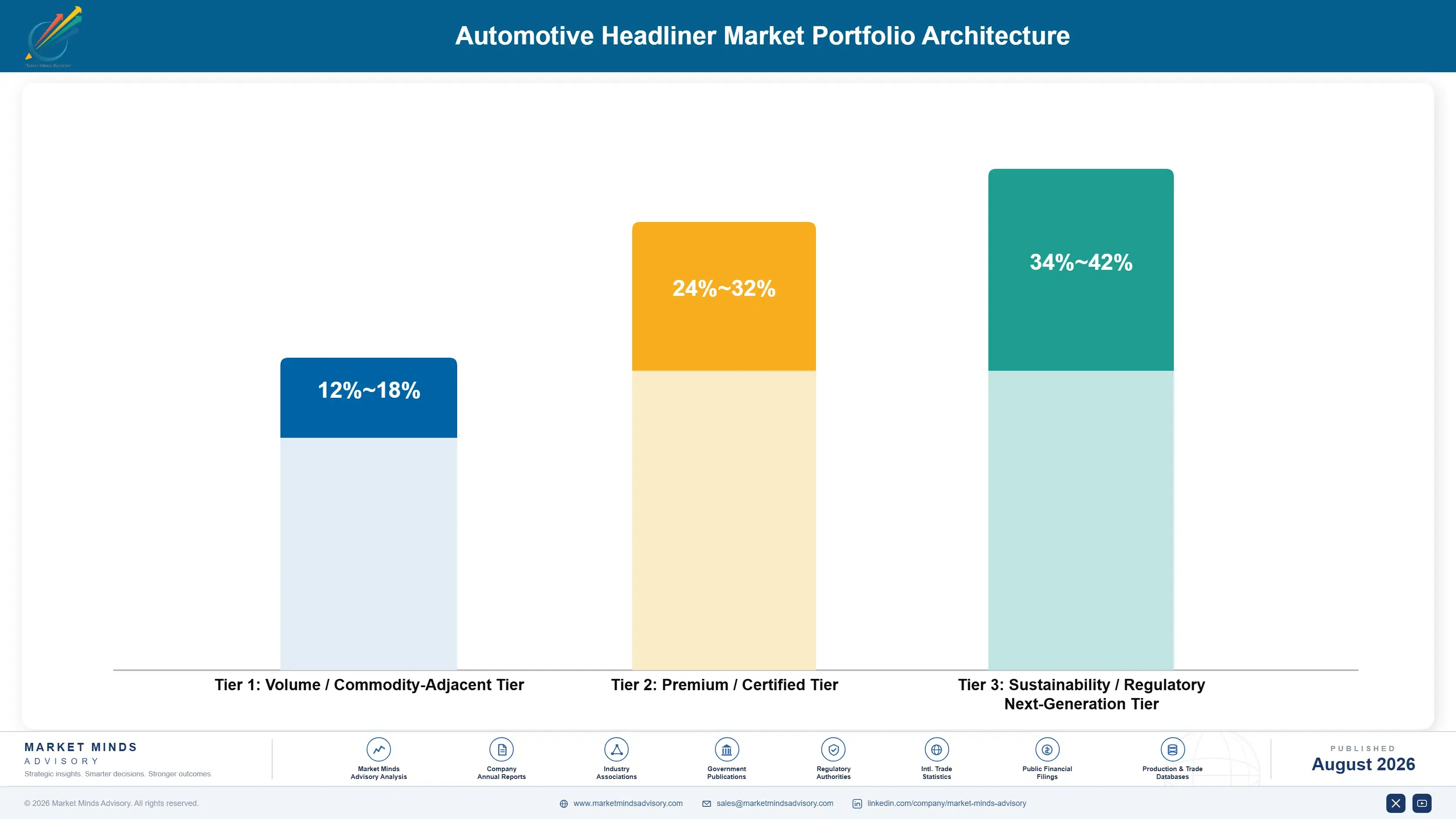
Headliner suppliers organize their portfolios across three tiers separated primarily by material sophistication and integrated functionality rather than by vehicle class alone, with gross margin climbing sharply from commodity foam-backed programs toward sensor-integrated smart designs commanding genuine technology differentiation. The gap between the lowest and highest tier has widened considerably as electronics content becomes a genuine qualification requirement rather than an optional upgrade automakers may or may not choose to specify on a given platform program.
The volume-versus-premium tension is intensifying as automakers simultaneously demand cost reduction on entry-level electric vehicle programs while accelerating premium content specification on flagship models, forcing suppliers to run fundamentally different manufacturing and engineering organizations under a single corporate roof. Suppliers that fail to separate these two operating models organizationally often see margin erosion bleed from the volume tier into programs that should command premium pricing.

High-value margin pools concentrate overwhelmingly in sensor-integrated smart headliners and recycled-fiber certified programs, both of which command qualification barriers that commodity converters cannot easily cross without meaningful capital investment and multi-year engineering capability development across their existing production base. Suppliers building both capabilities simultaneously are positioning themselves to capture a disproportionate share of industry margin over the coming decade.

Volume / Commodity-Adjacent Tier

Standard non-woven and basic foam-backed headliners sold primarily on landed cost and delivery reliability across mainstream mass-market vehicle trims, where automakers prioritize consistent supply and price over feature differentiation each sourcing cycle.
Gross Margin: 12-18%

Premium / Certified Tier

Suede and Alcantara-faced designs with recycled-fiber certification, commanding higher pricing on premium and mid-market platform programs where automakers actively differentiate cabin experience against direct competitors each new vehicle model year and beyond.
Gross Margin: 24-32%

Sustainability / Regulatory / Next-Generation Tier

Sensor-integrated smart headliners and fully recycled-substrate designs meeting the newest regulatory and platform technology requirements, commanding the steepest qualification barriers and the richest margin pools across the entire supplier portfolio.
Gross Margin: 34-42%
automotive-headliner-market-trends-portfolio-architecture-1787465118494

High-value Sub-segments and Strategic Watch-out

Sensor-Integrated Smart Headliners

Highest-value, fastest-growing segment as ADAS mandates and premium electric vehicle platforms specify embedded lighting and camera housings as standard equipment across an expanding share of new model launches worldwide each year, pulling qualification budgets away from simpler commodity foam-backed designs entirely across the industry. across the board.
Gross Margin: 36-42%

Recycled-Fiber Certified Programs

High-value, moderate-growth segment expanding steadily as European regulatory deadlines approach, offering suppliers a durable margin premium tied to certification rather than volume scale alone across qualifying platforms and multiple vehicle segments each successive model year and well beyond into future platform generations too. each time.
Gross Margin: 26-32%

Standard Foam-Backed Mainstream Trims

The volume core of the market, carrying thin but stable margin across the largest share of global vehicle production, remaining essential to supplier fixed-cost absorption even as growth concentrates elsewhere in premium and smart-integrated segments across the wider industry landscape each year. nationwide each year.
Gross Margin: 12-18%

Stripped-Down Value EV Modular Designs

Strategic watch-out segment where aggressive cost stripping on entry-level electric vehicle programs threatens to erode average content value across a growing share of new vehicle production over time, pressuring supplier portfolios broadly across every regional market and vehicle price tier segment. over the coming years.
Gross Margin: 8-13%

Platform Sourcing Cycles and Content Depth

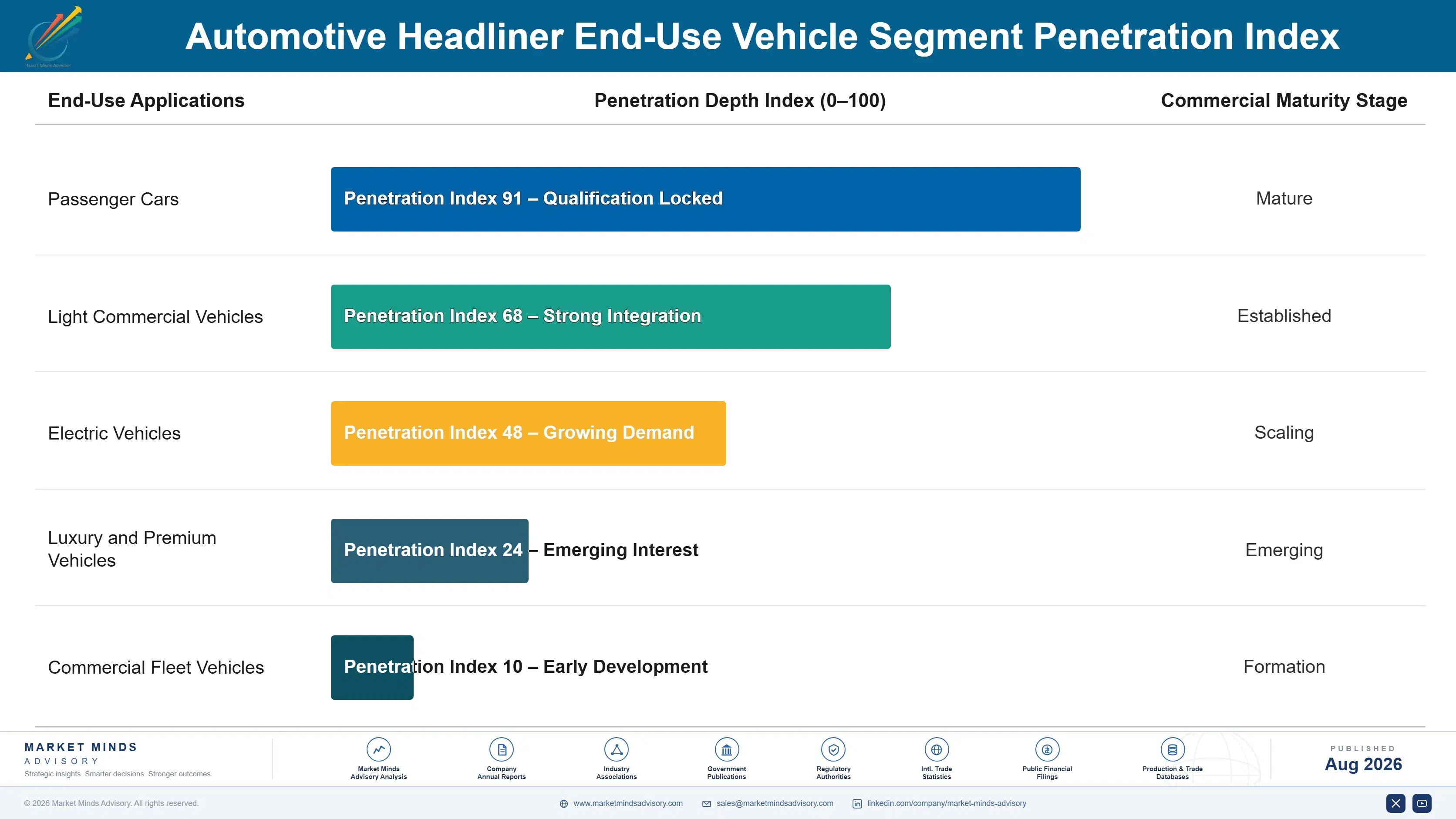
Headliner demand behaves like an annuity anchored to vehicle platform sourcing cycles rather than one-off transactions: once a supplier wins design-in on a given nameplate, it typically holds that position for the full multi-year production run, giving qualified suppliers predictable revenue visibility across several years of platform life. This annuity character makes initial qualification wins disproportionately valuable relative to their upfront cost of winning them.
Adoption depth varies sharply by end-use vertical. Luxury and premium electric vehicle platforms specify the deepest integrated content, including lighting and sensor housings, while entry-level and commercial vehicle segments still specify largely commodity designs, creating a widening content-value gap between the top and bottom of the vehicle price spectrum. Mid-market platforms sit in between, adopting premium features selectively rather than wholesale across every trim level offered.

A generational shift in buyer profile is underway as China's younger new-energy-vehicle buyers treat cabin technology as a primary purchase driver rather than a secondary comfort feature, pulling automaker specification decisions toward richer headliner content years earlier in the platform lifecycle than in prior vehicle generations. Western markets are following a similar trajectory, though at a noticeably slower and more cautious pace so far.
automotive-headliner-market-trends-end-use-penetration-index-1787465118983

Where Suppliers Should Place Capital Next

These are among the four positions where our research anticipates prominent divergence between winners and laggards over the coming forecast period. Each is grounded in the demand model, the regulatory perimeter, and the announced capacity pipeline.
01 / ELECTRONICS INTEGRATION CAPABILITY

Build in-house lighting and sensor co-development capability now

Suppliers lacking electronics-adjacent manufacturing capability are ceding the fastest-growing, highest-margin segment of the market to specialist vendors and better-equipped competitors across nearly every major electric vehicle program launched this decade. Bundled lighting and sensor contracts lock in multi-year exclusivity and raise unit content value meaningfully above commodity designs, giving early movers a durable revenue advantage over slower-moving rivals still relying on subcontracted electronics partners. Waiting for automakers to specify this content unprompted means missing qualification windows on the flagship platforms defining the next product generation entirely.
02 / SUSTAINABLE SUBSTRATE QUALIFICATION

Secure recycled-fiber qualification ahead of European mandates

European regulatory deadlines are approaching faster than many mid-tier suppliers have prepared for, and qualification slots on premium platforms are already filling among early movers with established recycled-fiber capacity built well ahead of the formal compliance schedule. Suppliers that wait until compliance becomes mandatory will find themselves requalifying under time pressure while competitors already hold the relevant platform positions locked in for years to come. Early investment here protects both margin and existing customer relationships across the entire European platform portfolio.
03 / CHINA DIRECT SOURCING ACCESS

Establish direct relationships with China's fastest new-energy-vehicle makers

China's domestic new-energy-vehicle segment is premiumizing years faster than any other market, and suppliers relying solely on legacy joint-venture channels are missing the fastest volume growth available globally today across nearly every vehicle price tier and body style. Direct qualification requires genuinely competitive local cost structures rather than exported Western pricing assumptions built for a fundamentally different competitive environment entirely. Suppliers that succeed here capture a disproportionate share of the industry's best growth opportunity over the coming decade and beyond.
04 / VALUE EV PORTFOLIO PROTECTION

Develop modular architecture before value EV stripping accelerates further

Aggressive cost stripping on entry-level electric vehicle programs threatens to erode content value across a growing share of global production, and suppliers without a credible lower-cost modular response risk losing volume entirely to regional converters competing purely on price across nearly every value-focused platform program worldwide. A modular architecture preserving future upgrade paths protects both current volume and future repositioning options as those platforms mature over successive model generations. Suppliers ignoring this tier concentrate risk in their highest-margin segments alone.

Engagement Snapshot From the Field

A live engagement with an industry participant carrying material or product regulatory and market exposure ahead of a defining policy shift, showing how our research translates into a defensible multi-year portfolio strategy.
MARKET MINDS ADVISORY · CLIENT ENGAGEMENT SUMMARY
Automotive Headliner Producer Strategic Portfolio Review and Transition Roadmap 2026·Investment Scenario on Automotive Headliner Exposure Evaluation 2025-26
CLIENT PROFILE
The client is a global Tier 1 automotive interior supplier with headliner production facilities across three continents, serving both legacy internal combustion and electric vehicle platform programs for a broad roster of international automaker customers across multiple vehicle segments, price tiers, and regional markets worldwide, with annual headliner revenue in the low hundreds of millions (client-reported, unverified by MMA).
STRATEGIC CHALLENGE
The client was losing qualification bids on next-generation electric vehicle platforms to competitors offering integrated lighting and sensor-housing capability it did not yet possess in-house, while simultaneously facing margin pressure on its commodity foam-backed product lines from lower-cost regional converters undercutting aggressively on price across multiple long-standing key accounts and regions.
MMA APPROACH
MMA conducted a platform-by-platform competitive benchmarking exercise across the client's active and prospective automaker relationships, combined with primary interviews among procurement decision-makers, to identify which specific capability gaps were costing qualification bids and quantify the revenue opportunity available from closing them within a realistic multi-year capital investment and hiring timeline.
KEY FINDINGS
  1. Roughly sixty percent of lost bids over the prior two years traced directly to missing electronics integration capability rather than price competitiveness alone.
  2. Automaker procurement teams ranked sustainable-fiber certification as a rising qualification criterion, moving from optional to expected within roughly eighteen months across most major European platforms.
  3. China-based competitors had closed most of the historical technology gap on smart-headliner integration within two to three product cycles, narrowing the client's traditional advantage considerably.
  4. Value-focused electric vehicle programs represented a growing share of new sourcing volume that the client had been systematically excluded from due to its premium-only product architecture.
CLIENT PROFILE
The client is a global Tier 1 automotive interior supplier with headliner production facilities across three continents, serving both legacy internal combustion and electric vehicle platform programs for a broad roster of international automaker customers across multiple vehicle segments, price tiers, and regional markets worldwide, with annual headliner revenue in the low hundreds of millions (client-reported, unverified by MMA).
STRATEGIC CHALLENGE
The client was losing qualification bids on next-generation electric vehicle platforms to competitors offering integrated lighting and sensor-housing capability it did not yet possess in-house, while simultaneously facing margin pressure on its commodity foam-backed product lines from lower-cost regional converters undercutting aggressively on price across multiple long-standing key accounts and regions.
MMA APPROACH
MMA conducted a platform-by-platform competitive benchmarking exercise across the client's active and prospective automaker relationships, combined with primary interviews among procurement decision-makers, to identify which specific capability gaps were costing qualification bids and quantify the revenue opportunity available from closing them within a realistic multi-year capital investment and hiring timeline.
KEY FINDINGS
  1. Roughly sixty percent of lost bids over the prior two years traced directly to missing electronics integration capability rather than price competitiveness alone.
  2. Automaker procurement teams ranked sustainable-fiber certification as a rising qualification criterion, moving from optional to expected within roughly eighteen months across most major European platforms.
  3. China-based competitors had closed most of the historical technology gap on smart-headliner integration within two to three product cycles, narrowing the client's traditional advantage considerably.
  4. Value-focused electric vehicle programs represented a growing share of new sourcing volume that the client had been systematically excluded from due to its premium-only product architecture.
RECOMMENDED STRATEGY
Phase 1: Phase 1 (Months 1-6): Establish an electronics integration partnership and pilot bundled lighting-sensor headliner assemblies on one qualifying platform program. Phase 2: Phase 2 (Months 6-14): Build recycled-fiber substrate qualification ahead of European regulatory deadlines across two priority manufacturing sites and supplier networks. Phase 3: Phase 3 (Months 14-24): Launch a modular low-cost architecture targeting value electric vehicle programs while protecting existing premium platform relationships.
OUTCOME
Within eighteen months of implementation, the client reported winning qualification on two additional electric vehicle platform programs specifying integrated lighting content, alongside a measurable improvement in bid win rate on sustainability-scored sourcing evaluations across its European customer base and several new prospective accounts (client-reported, unverified by MMA).

Frequently Asked Questions

Foundational context covering the market sizes, CAGR, scope, country, region and competition that inform every finding below. This section is provided to cover basics and most often pre-purchase conversations, answered from the MMA Primary Research Dataset.

What is the current size of the Automotive Headliner Market?

The global automotive headliner market is valued at approximately $13.8 billion in 2025. Growth is concentrated in integrated smart headliner content and China's premiumizing new-energy-vehicle segment.

How large will the Automotive Headliner Market be by 2036?

The market is projected to reach approximately $27.3 billion by 2036 under the base case scenario. This reflects roughly 1.86 times expansion from 2026 levels.

What is the CAGR for the Automotive Headliner Market 2026 to 2036?

The base case CAGR is 6.4% over the forecast period. Bull and bear scenarios range from 7.6% down to 5.2% depending on vehicle premiumization pace.

Which segment is growing fastest?

Integrated Smart Headliner Systems is the fastest-growing segment at an 11.5% CAGR, roughly 1.80 times the overall market rate. Premium Suede and Alcantara-Faced Headliners follows closely at 9.8%.

Who are the major companies in the Automotive Headliner Market?

Leading suppliers include Grupo Antolin, Adient plc, Lear Corporation, Yanfeng Automotive Interiors, and Magna International Inc. Together they hold roughly thirty-eight percent of global production volume.

Which country is growing fastest?

China leads global growth at an 8.0% CAGR, driven by rapid premiumization across its domestic new-energy-vehicle segment. Domestic suppliers are scaling smart-headliner capability alongside this demand surge.

Report Segmentation Architecture

The full report scope spans multiple orthogonal segmentation dimensions, with cross-tabulated demand data provided for each dimension pair. Coverage extends further to regional breakdowns, trend trajectories, and the competitive detail needed to support segment-level decision-making.

By Construction and Material Type

  • Non-Woven Fiber Headliners
  • Polyurethane Foam-Backed Headliners
  • Composite Honeycomb Substrate Headliners
  • Natural Fiber Sustainable Headliners
  • Premium Suede and Alcantara-Faced Headliners
  • Integrated Smart Headliner Systems

By End-Use Vehicle Segment

  • Passenger Cars
  • Light Commercial Vehicles
  • Electric Vehicles
  • Luxury and Premium Vehicles
  • Commercial Fleet Vehicles

By Commercial Sourcing Dimension

  • Original Equipment Manufacturer Direct Contracts
  • Tier 1 Co-Development Programs
  • Aftermarket Replacement Supply
  • Regional Joint Venture Sourcing

By Region

  • North America
  • Western Europe
  • East Asia
  • South Asia and Pacific
  • Latin America
  • Middle East and Africa
  • Eastern Europe

Scope, Methodology, and Coverage

Every figure in this report is reproducible from documented input assumptions. The scope below maps the historical period, the forecast horizon, the segmentation dimensions, and the countries covered, alongside the underlying primary and qualitative methodology.
Historical Period
2020 to 2025
Forecast Period
2026 to 2036
Base Year
2025 (USD billions; MMA Primary Research Dataset, August 2026)
Market Definition
The automotive headliner market covers the design, manufacture, and supply of interior roof-lining assemblies for passenger and light commercial vehicles, including face fabric, foam or composite backing, and integrated functional modules such as lighting and sensor housings. It excludes standalone sunroof glass, roof racks, and vehicle structural roof panels.
Quantitative Units
USD billions (current prices); production volume in million units where applicable
Segmentation Dimensions
By Construction and Material Type; By End-Use Vehicle Segment; By Commercial Sourcing Dimension; By Region
Regions Covered
North America, Western Europe, East Asia, South Asia and Pacific, Latin America, Middle East and Africa, Eastern Europe
Countries Covered
USA, China, Germany, France, UK, Japan, South Korea, India, Australia, Canada, Brazil, Mexico, Indonesia, Vietnam, Thailand, Malaysia, UAE, Saudi Arabia, South Africa, Nigeria, Turkey, Poland, Netherlands, Italy, Spain, Sweden, Switzerland, Argentina, Colombia, Singapore, and additional markets relevant to this sector
Key Companies Profiled
Grupo Antolin, Adient plc, Lear Corporation, Yanfeng Automotive Interiors, Magna International Inc., Toyota Boshoku Corporation, IAC Group, Motus Integrated Technologies, Howa Co. Ltd., UGN Inc., SA Automotive, Hayashi Telempu Corporation, Glen Raven Inc., Cindus Corporation, Johns Manville, Harodite Industries, Atlas Roofing Corporation, Shawmut Corporation, Sage Automotive Interiors, Nolar Industries
Quantitative Methodology
Primary survey, n=3,800 respondents, Q4 2025, six countries; demand-side model with trade association cross-validation
Qualitative Methodology
47 expert interviews, Q4 2025; applied to validate demand model assumptions, identify emerging dynamics, and assess competitive positioning
Report Format
PDF and XLSX data workbook (Word format preview document)
Publisher
Market Minds Advisory
Report Code
MMA-2026-AUT-112
Published
August 2026
Contact
sales@marketmindsadvisory.com | www.marketmindsadvisory.com

Purchase the full Automotive Headliner Market Report (2026 to 2036).

The full report delivers a comprehensive analysis of the global automotive headliner market, including detailed segmentation by construction and material type, regional demand forecasts across all seven MMA-tracked geographies, and competitive benchmarking of the twenty leading suppliers profiled. It includes primary survey data from three thousand eight hundred respondents and forty-seven expert interviews conducted in the fourth quarter of 2025. Buyers receive supplier capability matrices, input cost sensitivity models, and platform sourcing cycle analysis. The full ten-year forecast spans 2026 through 2036 across every major regional market.
Ten-year quantitative forecast model spanning 2026-2036
Seven-region demand breakdown with growth drivers
Twenty-company competitive benchmarking profiles included in full
Primary survey and expert interview data
Input cost sensitivity and volatility analysis
Platform sourcing cycle and qualification mapping

Built For The People Who Decide

From boardroom strategy to bench-side execution, this report is read cover-to-cover by leaders shaping the next decade of their industry, turning demand scenarios, market dynamics and valuation benchmarks into decisions.
CXOs/ Presidents/ VPs/ Managers
M&A and Corporate Development
Strategy Teams and R&D Heads
Procurement and Product Directors
Regulatory and Compliance Leaders
Investor Relations and Equity Analysts