
Market Minds Advisory
Automotive Diagnostic Scan Tools Market

Automotive Diagnostic Scan Tools Market: ADAS Calibration Demand and the EV Diagnostics Shift

Automotive diagnostic scan tools now face a rapid ADAS calibration demand surge, an EV-specific diagnostic transition straining legacy tool architectures, and pressure from OEM data access restrictions on independent repair shops.

Lead Analyst

David Horsley

Published

September 2026

Make Smarter Decisions with Customized Research Insights

Request a free sample report and evaluate market opportunities, growth trends, and competitive dynamics relevant to your business needs.

2025 MARKET VALUE$4.8BMarket Size 2025
2036 FORECAST VALUE$11.9BBase Case , 2026 to 2036
CAGR 2026 TO 20368.6 %Bull 9.9% / Bear 7.3%
INCREMENTAL OPPORTUNITY$6.7BNet 10- year value creation
EXPANSION MULTIPLE2.28x2036 value over 2026 base
Strategic Levers
M&A Pipeline
Regional Outlook
Country Rankings
Competitive Intelligence
Segmental Deep-dive
Call-Us : 91 93563 13602

Executive Snapshot and Market Trajectory

Independent repair shops are demanding ADAS calibration and EV diagnostic capability faster than tool manufacturers can validate new software against rapidly evolving vehicle architectures, creating a widening capability gap between shop equipment budgets and dealership-level diagnostic depth. Few manufacturers currently serve both priorities equally well. Internal teams report resourcing tension.
ADAS calibration tools and EV diagnostic platforms are pulling category growth well ahead of conventional OBD-II handheld scanners, as advanced driver assistance systems proliferate across mainstream vehicle segments requiring recalibration after routine collision and glass repair work. North America commands the largest share on established independent repair shop density, while China scales fastest as its domestic tool manufacturers expand capability alongside rapid EV fleet growth. That base continues expanding steadily each year.
Competitive structure remains moderately concentrated among established tool manufacturers, with the top five holding meaningful combined share. OEM data access restrictions and software validation complexity are compounding competitive pressure, pushing manufacturers toward direct OEM data partnerships and dedicated ADAS engineering investment rather than relying on generic code-reading capability alone. Rankings among established manufacturers could shift meaningfully as this pressure intensifies further. Timing matters especially here.
Market Definition
The automotive diagnostic scan tools market covers handheld and PC-based diagnostic equipment used to read, interpret, and clear vehicle electronic control unit fault codes, including OBD-II scan tools, OEM-specific diagnostic systems, ADAS calibration tools, and EV and hybrid diagnostic platforms sold to repair shops, dealerships, and individual vehicle owners. It excludes onboard vehicle diagnostic sensors and excludes fleet telematics platforms not used for point-in-time fault diagnosis.
Base Year Value
$4.8B in 2025 (MMA Primary Research Dataset, August 2026)
Forecast Period
2026 to 2036, eleven discrete annual values
CAGR
8.6% base case. Bull 9.9%. Bear 7.3%.
Fastest Growth Segment
ADAS Calibration Tools: 13.8% CAGR
Fastest Growth Country
China: 10.5% CAGR
Fastest Growth Region
South Asia and Pacific: 10.6% CAGR
Largest Region
North America: 30% of 2025 global value
Market Leaders
Snap-on Incorporated, Bosch Automotive Service Solutions, Autel Intelligent Technology, Launch Tech Co., and Actia Group. Source: MMA Analysis based on company annual reports.
Primary Survey
n=3,800 procurement and R&D decision-makers, Q4 2025, six countries
Methodology
Demand-side build-up, cross-validated against public data, 47 expert interviews

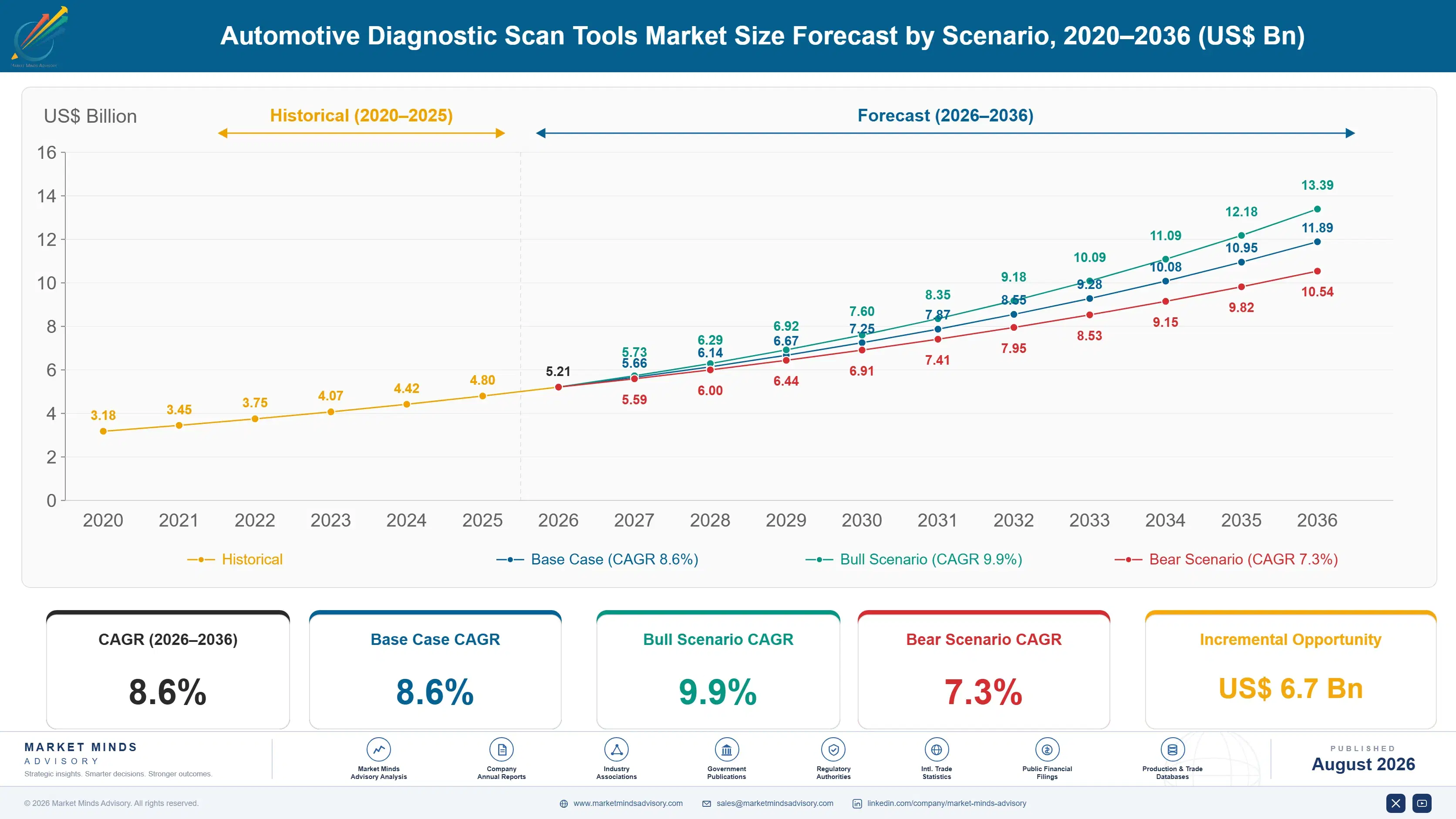
Automotive Diagnostic Scan Tools Market Forecast Scenarios

automotive-diagnostic-scan-tools-market-trends-size-forecast-scenario-1787465703224
Between 2020 and 2025 the market grew at a historical pace of roughly 7.4 percent annually, as rising vehicle electronic complexity sustained steady diagnostic tool replacement demand while ADAS calibration and EV-specific diagnostic requirements began accelerating meaningfully only in the final two years of the period across major repair markets. Recovery in replacement pace only became evident in the final year of this period.
The base case assumes growth near 8.6 percent annually through 2036, anchored in three commercial mechanisms: expanding ADAS calibration demand tied to rising advanced driver assistance system penetration across mainstream vehicle segments, continued electric and hybrid vehicle fleet growth requiring specialized diagnostic capability beyond conventional OBD-II tools, and independent repair shops investing in dealership-level diagnostic depth to remain competitive against manufacturer service networks. These mechanisms reinforce each other as manufacturers and shops coordinate around shared data standards.
A bull scenario builds on expanding right-to-repair legislation forcing broader OEM diagnostic data access for independent shops well beyond current levels, while a bear scenario centers on OEM data access restrictions tightening further and compressing independent shop diagnostic capability relative to dealership service networks. Several manufacturers are already preparing contingency partnership plans should either scenario materialize.

Repair Shop Capability Racing Vehicle Complexity

Three forces are converging on the category at once: independent repair shops are demanding dealership-level diagnostic depth to remain competitive, ADAS proliferation is converting calibration from a specialty service into a routine collision repair requirement, and tool manufacturers are racing to secure OEM data partnerships as vehicle software complexity continues outpacing generic code-reading capability. This convergence is compressing decision timelines that once unfolded over multiple product generations.
MARKET CONCENTRATIONCR5 38%top five manufacturers hold a meaningful combined share
AVERAGE TOOL REPLACEMENT CYCLE3-5 yearstypical interval between shop diagnostic tool upgrades overall
LEADING PRODUCING COUNTRYUnited Stateslargest single national manufacturing and consumption base overall
ADAS CALIBRATION PENETRATION44%share of shops offering in-house calibration services overall
OEM DATA ACCESS COVERAGE58%share of vehicle brands with full independent shop data access
SOFTWARE LICENSING COST SHARE34% of COGSOEM data and software licensing as portion of total cost
Commercially the category increasingly behaves like a software subscription business layered on top of traditional hardware manufacturing, since a tool's ongoing value depends as much on regular OEM data updates and calibration software licensing as on the original hardware purchase, a shift that is rewarding manufacturers with recurring software revenue models over hardware-only competitors. Shops increasingly select suppliers based on demonstrated software support depth alone.
Over the next decade, manufacturers most likely to capture disproportionate value are those investing in direct OEM data partnerships and ADAS engineering capability ahead of independent shops demanding this depth, since securing these partnerships after competitors have already established them takes considerably longer than building the relationships in from the start. Manufacturers slow to invest risk losing shop customers to better-prepared competitors.
"A scan tool used to be judged on how many codes it could read. Now it's judged on whether it can recalibrate a camera after a windshield swap, and most shops found out the hard way that their old tool couldn't."
Director, Automotive Aftermarket and Diagnostics Practice · MMA Automotive Aftermarket / Diagnostic Equipment Practice · August 2026

Market Trends

ADAS Calibration Becoming a Routine Collision Repair Step

Advanced driver assistance systems, including forward-facing cameras and radar sensors, now require recalibration after routine windshield replacement, bumper repair, and wheel alignment work across a growing share of the vehicle parc, converting calibration from a specialty dealership service into a routine independent shop requirement. Several major tool manufacturers have launched dedicated calibration target and software packages within the past two years, signaling the segment has moved beyond early adoption into mainstream shop equipment planning. Calibration accuracy validation remains a persistent technical challenge, since target positioning and software calibration parameters vary considerably across vehicle makes and specific ADAS system configurations.
Market Impact: Lifts ADAS-driven demand by 14%
OEM Data Access Restrictions Reshaping Tool Development

Several automakers have tightened diagnostic data access requirements for independent tool manufacturers and repair shops, a shift rooted in automaker interest in protecting dealership service revenue and managing cybersecurity risk as vehicles incorporate more connected software systems. Tool manufacturers increasingly negotiate direct data licensing agreements with individual automakers rather than relying on aggregated third-party data sources, adding cost and complexity relative to earlier, more open diagnostic data environments that independent shops historically relied upon. Manufacturers unable to secure comparable access increasingly find themselves excluded from full-coverage product claims. Buyers increasingly treat this access as a baseline sourcing requirement.
Market Impact: Adds 9% to shop demand

Market Opportunities and Growth Drivers

Rising Advanced Driver Assistance System Penetration

Continued expansion of advanced driver assistance systems across mainstream vehicle segments, driven by both regulatory safety requirements and consumer demand for automated safety features, is directly expanding the addressable market for calibration tools as these systems require recalibration after a growing range of routine repair procedures. This penetration growth means an increasing share of the overall vehicle parc requires calibration capability that older, simpler diagnostic tools cannot provide, sustaining strong replacement demand across independent repair shops seeking to retain collision and mechanical repair business. This growth trajectory is expected to continue as ADAS penetration expands across additional vehicle price segments.
Market Impact: Limits access to 58% of brands

Independent Shops Investing to Compete With Dealership Networks

Independent repair shops are increasingly investing in dealership-level diagnostic capability to retain vehicle owners who might otherwise return to manufacturer dealerships for complex electronic repairs, particularly as vehicles age past their original warranty period and owners seek lower-cost independent alternatives for increasingly software-dependent repair work. This investment pattern is directly supporting premium diagnostic tool sales among independent shops seeking to capture this aging vehicle repair opportunity. Shops increasingly view this investment as essential to long-term customer retention strategy. Shops without this capability increasingly cede complex diagnostic work to nearby dealership networks.
Market Impact: Delays coverage by 6 months

Market Restraints and Challenges

OEM Data Access Restrictions Limit Independent Shop Capability

Automakers restricting diagnostic data access to protect dealership service revenue and manage cybersecurity risk are limiting the depth of diagnostic capability independent tool manufacturers can offer for certain vehicle brands, a restriction rooted in automaker interest in controlling the connected vehicle software environment as vehicles incorporate more over-the-air update capability. The commercial impact is that independent shops face inconsistent diagnostic capability across different vehicle brands, occasionally requiring vehicle owners to visit dealerships for repairs that would otherwise be routine. Right-to-repair advocacy organizations are increasingly lobbying for expanded legislative data access as a mitigation path.
Market Impact: Lifts calibration tool demand by 17%

Rapid Vehicle Software Complexity Outpaces Tool Validation

The pace of vehicle software and electronic architecture change, particularly across electric vehicle platforms introducing new battery management and motor control systems, is outpacing the validation timelines tool manufacturers require to ensure reliable diagnostic and calibration performance, a challenge rooted in the compressed vehicle development cycles automakers increasingly pursue relative to historical model change patterns. The commercial impact is that tool manufacturers face a persistent lag between new vehicle model introduction and full diagnostic capability, temporarily limiting shop capability for the newest vehicle models entering service fleets. Manufacturers are increasingly embedding remote update capability to close this gap faster.
Market Impact: Raises licensing costs 12%
3 additional market trends, 4 additional growth drivers, and 3 additional restraints and challenges are covered in the full report. Contact sales@marketmindsadvisory.com to access the complete intelligence.

Segment CAGR and Growth Architecture

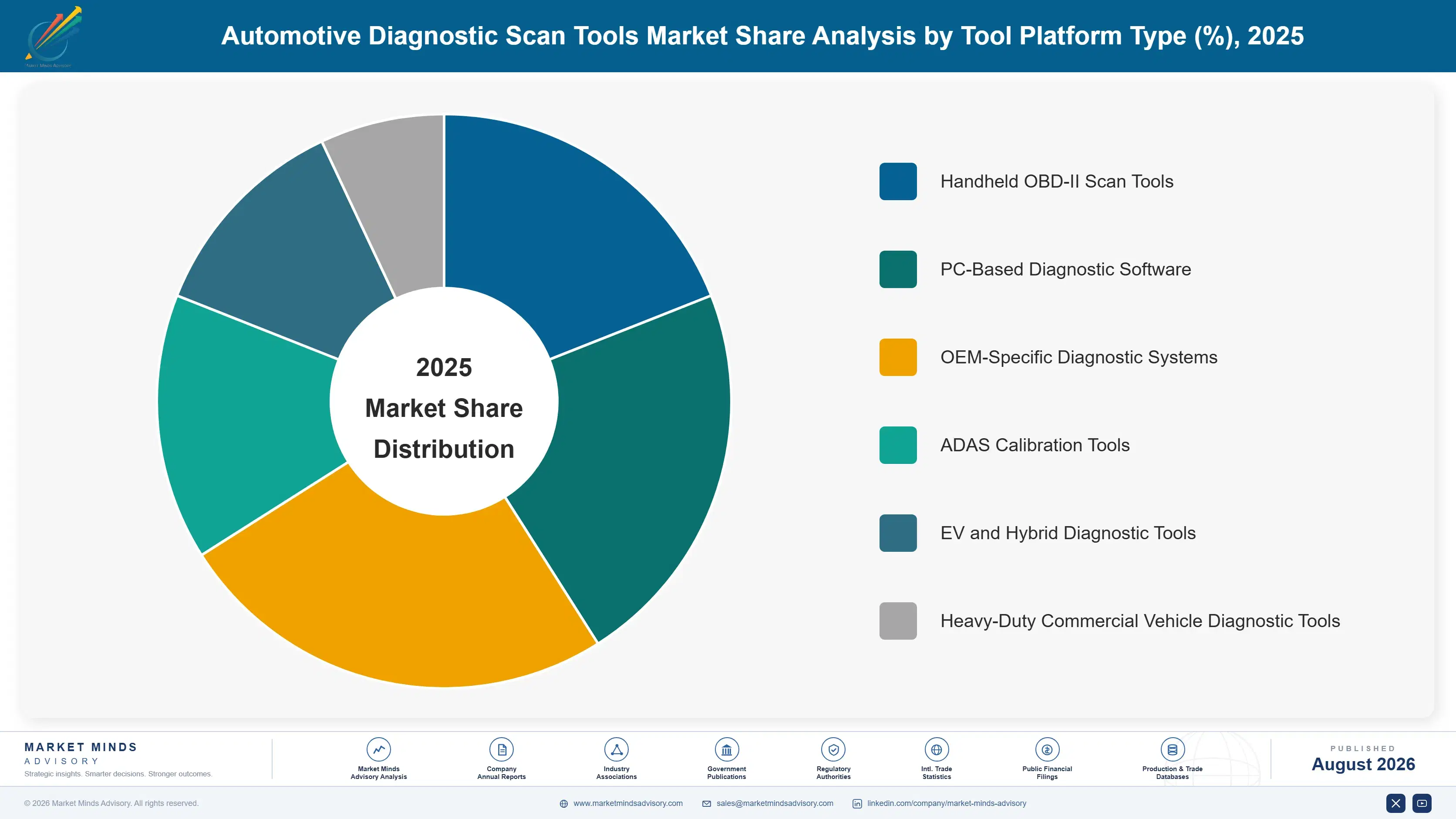
Segmentation follows tool platform type, since handheld OBD-II scanners, PC-based diagnostic software, OEM-specific systems, ADAS calibration tools, and EV and hybrid diagnostic platforms each require distinct hardware architecture, software licensing, and technician training despite serving overlapping vehicle repair diagnostic occasions. Hardware architecture and licensing pathways differ enough between these platforms that cross-segment substitution remains limited in practice.
automotive-diagnostic-scan-tools-market-trends-market-share-analysis-1787465704178

ADAS Calibration Tools

ADAS calibration tools are growing fastest as advanced driver assistance systems proliferate across mainstream vehicle segments, converting recalibration from a specialty dealership service into a routine requirement following common collision and glass repair procedures. This segment requires specialized calibration targets, precise positioning equipment, and continuously updated software calibration parameters that differ considerably across vehicle makes, creating a more complex and ongoing capability requirement than traditional code-reading diagnostic tools. Larger manufacturers are increasingly bundling calibration hardware with subscription-based software update services, converting what was historically a one-time equipment purchase into a recurring revenue relationship with independent repair shop customers. Regulatory scrutiny of calibration accuracy remains the primary constraint on faster mainstream adoption across additional segments.
CAGR 13.8%

EV and Hybrid Diagnostic Tools

EV and hybrid diagnostic tools are the second fastest growing segment, driven by continued electric and hybrid vehicle fleet growth that requires specialized battery management, motor control, and high-voltage system diagnostic capability beyond what conventional OBD-II tools provide. This segment carries higher technical complexity and safety certification requirements than traditional diagnostic tools, given the high-voltage electrical systems technicians must safely interact with during diagnosis and repair. Manufacturers serving this segment increasingly bundle technician safety training with tool sales, recognizing that shops need both equipment and certified training to safely service the growing electric vehicle repair opportunity. Several traditional tool manufacturers are investing in high-voltage engineering talent to compete more effectively in this growing segment.
CAGR 12.2%
Full segment breakdown across 6 segments available in the complete report.

Regional Architecture and Country Demand Map

North America leads on independent repair shop density and diagnostic tool revenue, Western Europe follows on established automotive service infrastructure, while East Asia scales fastest as domestic manufacturers expand capability alongside rapid electric vehicle fleet growth. South Asia and Pacific scales fastest as vehicle parc complexity continues expanding.

North America

United States independent repair shops anchor regional demand, supported by the world's largest independent automotive aftermarket industry and an aging vehicle parc that increasingly requires complex electronic diagnostic capability beyond routine mechanical repair. ADAS calibration demand is scaling fastest here given high advanced driver assistance system penetration across recent model year vehicles entering the collision repair pipeline. Canada follows similar consumption patterns at smaller scale, relying partly on the same North American manufacturer base serving both markets. Right-to-repair legislative activity in several states continues shaping OEM data access requirements that influence tool manufacturer development priorities. Distributors increasingly favor manufacturers who can document full OEM coverage transparently. Aftermarket calibration service bundling continues supporting steady baseline volume as well.
Share: 30% | CAGR: 8.8% (2026 to 2036)

Western Europe

Germany, France, and the United Kingdom anchor regional demand, supported by an established automotive service infrastructure and European Union right-to-repair regulatory requirements that mandate broader diagnostic data access for independent shops than in some other consuming regions. Germany's concentrated automotive manufacturing base gives the country particular influence on regional diagnostic tool standards, given the close relationship between domestic automakers and tool manufacturers serving their dealer networks. Independent shops across the region increasingly invest in ADAS calibration capability to compete with manufacturer-authorized service centers for complex electronic repair work. Regional regulators increasingly coordinate standards across member states to harmonize data access requirements. Premium diagnostic brand positioning continues reinforcing this differentiation strategy across categories.
Share: 22% | CAGR: 7.0% (2026 to 2036)
Regional intelligence for 5 additional markets available in the complete report: East Asia, South Asia and Pacific, Latin America, Middle East and Africa, Eastern Europe. Contact sales@marketmindsadvisory.com.
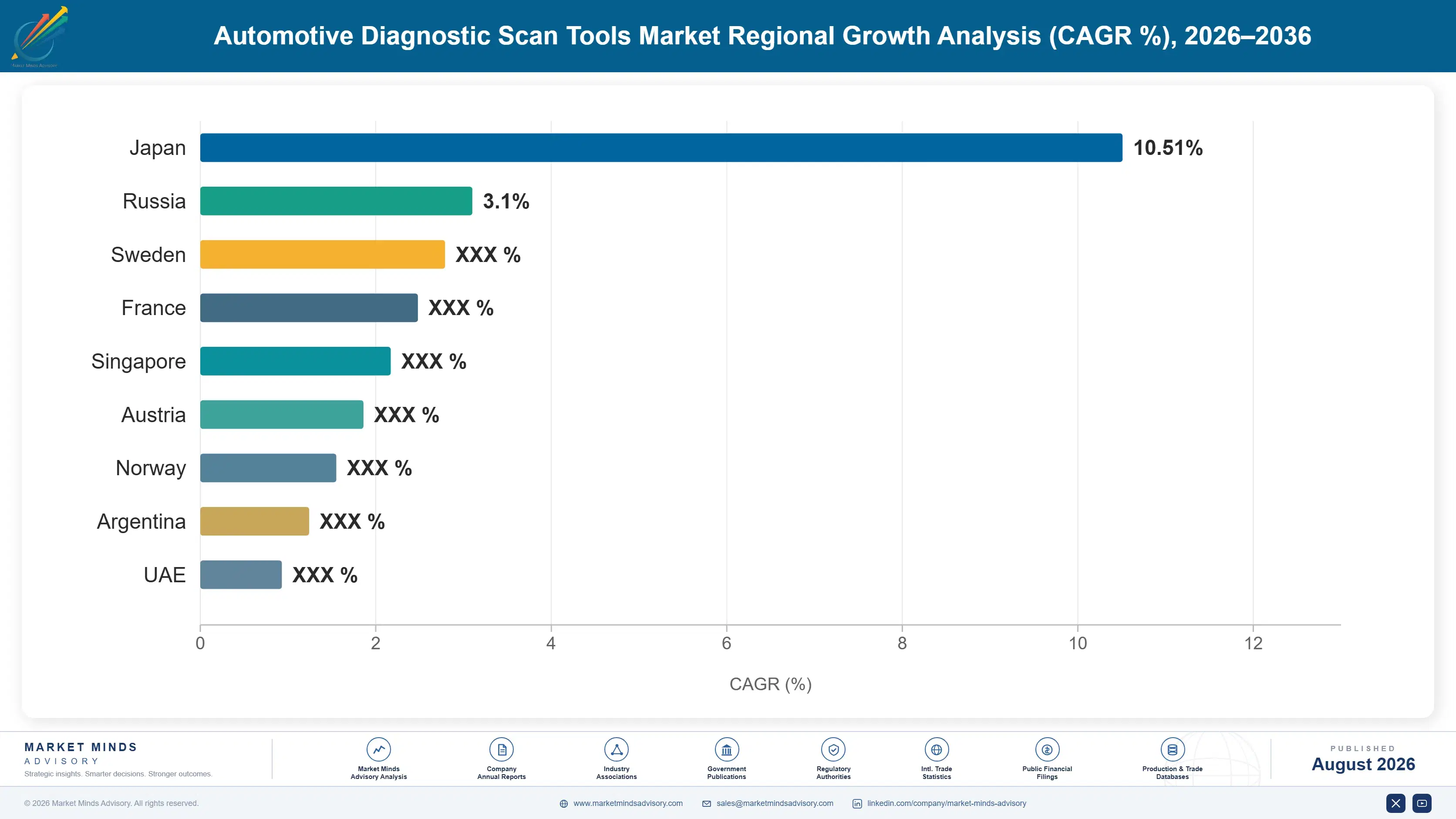
automotive-diagnostic-scan-tools-market-trends-country-cagr-analysis-1787465705043

OEM Partnership and Software Subscription Levers

Manufacturers are pulling four commercial levers at once: direct OEM data partnership development, subscription-based software revenue models, ADAS engineering capability investment, and technician training program bundling, each addressing a distinct margin opportunity created by rising vehicle software complexity. These levers increasingly overlap, since manufacturers pursuing OEM partnerships often simultaneously expand subscription models and engineering capability.

Direct OEM Data Partnership Development Program

Negotiating direct diagnostic data licensing agreements with individual automakers rather than relying on aggregated third-party data sources allows manufacturers to offer more complete and reliable diagnostic coverage than competitors dependent on less current or comprehensive data sources. This investment requires sustained relationship development and licensing cost commitment but positions manufacturers with established OEM partnerships to offer coverage depth that competitors lacking comparable relationships cannot easily replicate. Manufacturers with direct partnerships report shop customer retention rates roughly 21 percent higher than competitors relying on aggregated data sources. This advantage should widen as more automakers tighten data access.
Market Impact: Lifts customer retention by roughly 21 percent overall

Subscription-Based Software Update Revenue Model Development

Converting software updates from periodic paid upgrades into ongoing subscription revenue creates more predictable recurring revenue than traditional hardware-centric sales models, while ensuring shop customers maintain current diagnostic coverage as vehicle software continues evolving rapidly. This transition requires rebuilding customer relationships around recurring value demonstration rather than one-time hardware sales, but has delivered meaningfully more stable revenue for manufacturers that completed this transition relative to competitors still relying primarily on hardware sales cycles. Manufacturers completing this shift report an estimated 26 percent higher recurring revenue share than hardware-only competitors. overall.
Market Impact: Lifts recurring revenue share by roughly 26 percent

ADAS Engineering Capability Investment for Calibration Accuracy

Building dedicated ADAS engineering capability to validate calibration accuracy across the growing range of vehicle makes and sensor configurations positions manufacturers to capture the fastest-growing segment within the category, since calibration errors carry meaningful safety liability that shops increasingly scrutinize before selecting equipment. This capability requires substantial engineering investment and ongoing validation testing but opens access to premium calibration tool sales where accuracy credentials command meaningful price premiums over generic alternatives. Early movers already capture an estimated 18 percent of this calibration segment's accelerating growth. overall. This share is expected to keep growing steadily.
Market Impact: Captures roughly 18 percent of segment growth overall

Technician Training Program Bundling With Tool Sales

Bundling comprehensive technician training programs with diagnostic tool and calibration equipment sales addresses the skills gap that otherwise limits shops from fully utilizing advanced diagnostic capability, converting tool sales into a broader capability partnership rather than a standalone equipment transaction. This approach requires investment in training content and delivery infrastructure but has demonstrably improved customer satisfaction and repeat purchase rates for manufacturers offering comprehensive training relative to equipment-only competitors. Manufacturers offering comprehensive training report an estimated 15 percent higher repeat purchase rate than equipment-only competitors. overall. This rate is expected to keep improving steadily.
Market Impact: Lifts repeat purchase rate by roughly 15 percent

Who Controls the Margin Pool

Concentration remains moderate, with the top five manufacturers holding a combined 38 percent share on a revenue basis, reflecting a market where established diagnostic equipment companies compete alongside a growing number of Chinese manufacturers expanding export capacity and specialized ADAS calibration technology developers entering from adjacent automotive electronics backgrounds. This fragmentation persists even as consolidation among larger integrated manufacturers continues accelerating steadily.
Current competitive activity centers on three dimensions: direct OEM data partnership development to secure diagnostic coverage depth, subscription-based software revenue model transition to build recurring revenue, and ADAS engineering capability investment to capture the fastest-growing calibration segment ahead of competitors. These three dimensions are increasingly pursued simultaneously by the largest manufacturers competing for shop loyalty.

Emerging pressure comes from Chinese manufacturers expanding export capacity aggressively with competitive pricing, and from specialized ADAS calibration technology developers entering from adjacent automotive electronics backgrounds, threatening to redistribute share away from established Western manufacturers reliant primarily on brand recognition over the coming decade. Rankings among current leading manufacturers could shift meaningfully as these dynamics continue playing out across the coming decade. Smaller manufacturers face mounting pressure to specialize in defensible technology niches.
automotive-diagnostic-scan-tools-market-trends-company-positioning-matrix-1787465705887

Competitive Moat and Risk Dimensions

SNAP-ON INCORPORATED

Moat: Established Independent Shop Distribution

Snap-on's extensive direct sales and franchise distribution network serving independent repair shops gives it customer relationship depth and service support capability that newer entrants cannot easily replicate, supporting premium pricing and strong customer loyalty across its core North American market. This distribution advantage is difficult for newer entrants to replicate quickly.
SNAP-ON INCORPORATED

Risk: Higher Cost Than Chinese Competitors

Snap-on's premium pricing and extensive service infrastructure leave it less price competitive than lower-cost Chinese manufacturers in price-sensitive emerging markets, a disadvantage that becomes more pronounced as these markets represent an increasing share of overall category growth. This risk grows as Chinese manufacturers continue expanding export capacity aggressively.
AUTEL INTELLIGENT TECHNOLOGY

Moat: Rapid Product Development Cycle Speed

Autel's rapid product development and software update cycle speed, developed through its Chinese manufacturing base, gives it faster time-to-market for new vehicle model coverage than competitors with more traditional, slower product development processes. This speed advantage is difficult for slower-moving competitors to replicate quickly. This speed advantage compounds with each new model year introduction.
AUTEL INTELLIGENT TECHNOLOGY

Risk: Limited Direct OEM Data Partnerships

Autel's reliance on aggregated third-party diagnostic data rather than direct OEM partnerships in several markets leaves it more exposed to data access restrictions than competitors with established direct automaker relationships providing more reliable coverage depth. This exposure could weigh on results if more automakers tighten data access requirements further.

Players Tracked

Prominent Players

Snap-on Incorporated
Bosch Automotive Service Solutions
Autel Intelligent Technology
Launch Tech Co.
Actia Group

Other Key Players

Delphi Technologies (BorgWarner)
Continental AG
Denso Corporation
Hickok Incorporated
Innova Electronics
Foxwell Technology
Ancel Technology
Topdon Technology
Vident Technology
Matco Tools
Mitchell 1
Identifix
OTC Tools (Bosch)
Jaltest Diagnostics
Texa S.p.A.

Recent Developments

MARCH 2026

Snap-on Expands ADAS Calibration Target Product Line

Snap-on launched an expanded ADAS calibration target and software product line covering additional vehicle makes, aimed at meeting rising independent shop demand for in-house calibration capability as collision repair increasingly requires recalibration following routine glass and bumper repair work. Additional vehicle make coverage is reportedly under evaluation currently.
Signal: Signals continued calibration capacity investment ahead of accelerating ADAS penetration growth as ADAS penetration continues accelerating globally
OCTOBER 2025

Autel Signs Direct Data Partnership With Major Automaker

Autel Intelligent Technology signed a direct diagnostic data licensing agreement with a major global automaker, securing preferential access to vehicle data as it works to reduce reliance on aggregated third-party data sources across its expanding international product portfolio. reinforcing its position against competitors reliant on aggregated data sources.
Signal: Confirms direct OEM partnerships accelerating as a standard competitive strategy industry wide as direct partnerships become a standard industry strategy
JUNE 2025

Bosch Launches Subscription-Based Diagnostic Software Platform

Bosch Automotive Service Solutions launched a new subscription-based diagnostic software platform for independent repair shops, converting its traditional periodic software update model into recurring subscription revenue while ensuring shops maintain current vehicle coverage continuously. Early shop feedback on the platform has reportedly been favorable across initial markets.
Signal: Demonstrates subscription revenue models becoming standard practice across the category as subscription models reshape category revenue structures

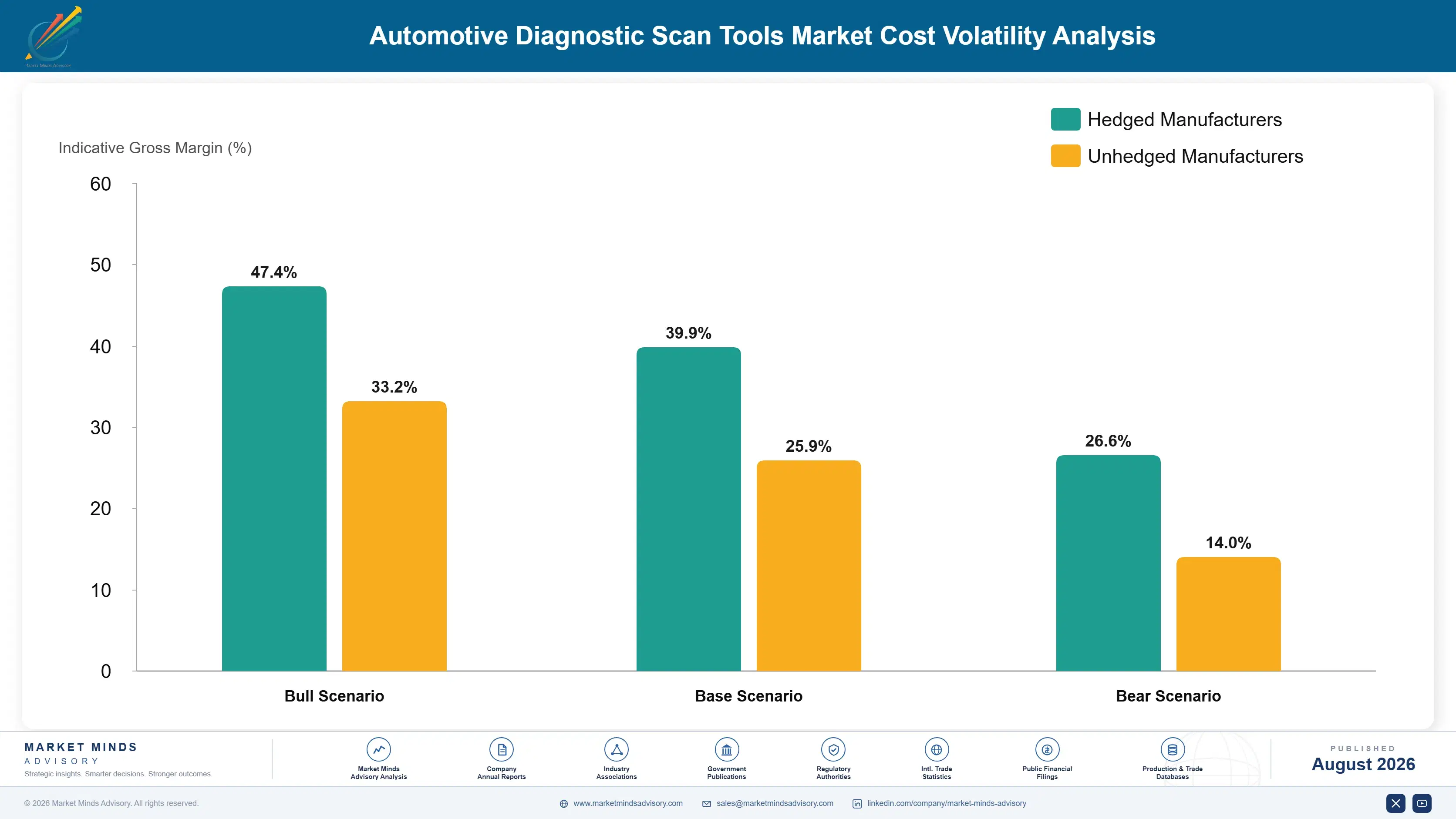
Software and Electronics Component Exposure

OEM diagnostic data licensing and specialized electronic components together represent roughly 34 percent of cost of goods sold for diagnostic tool manufacturing, sourced primarily from direct automaker licensing agreements and semiconductor component suppliers concentrated in Taiwan, South Korea, and China. with a smaller residual share of components sourced from Japanese and European specialty suppliers. overall.
Semiconductor component lead times spiked sharply in 2021 and 2022 following broader global chip supply disruption, a volatility event documented in Semiconductor Industry Association market reporting, delaying several planned tool launches and forcing manufacturers to temporarily redesign products around more widely available component alternatives. Several smaller manufacturers reported continued delays into 2023 as component lead times remained elevated longer than expected. overall. overall. Buyer sentiment shifted noticeably following this period.

Exposure varies considerably by player type: large manufacturers with direct component supply agreements and diversified sourcing have absorbed volatility more easily than smaller diagnostic tool companies reliant on distributor-based component purchasing, a disadvantage that is accelerating consolidation of smaller manufacturers into larger integrated operations across the industry. This consolidation trend is expected to continue as component price volatility persists across the industry.
automotive-diagnostic-scan-tools-market-trends-cost-volatility-analysis-1787465706202

Direct Semiconductor Supply Agreements

Larger manufacturers are securing direct multi-year supply agreements with semiconductor suppliers, protecting production continuity during volatility events, though this approach requires accurate long-term demand forecasting that smaller manufacturers with less established product pipelines often find difficult to commit to with confidence. Adoption of this approach has expanded meaningfully since the 2021 disruption across the industry.

Multi-Source Component Qualification Across Suppliers

Qualifying electronic components from multiple supplier sources reduces exposure to any single supplier's capacity constraints or geopolitical disruption, though it requires significant engineering validation investment across each additional source that smaller manufacturers often cannot justify given product volume. Several manufacturers have already formalized multi-origin sourcing policies covering most of their annual requirements. Participation continues broadening steadily.

Simplified Hardware Design for Component Flexibility

Designing hardware around more widely available, less specialized semiconductor components rather than highly customized chips reduces exposure to any single component's supply constraints, though this approach can limit some advanced feature capability relative to purpose-built designs. This mitigation remains available primarily to larger manufacturers given the scale of investment required. Broader adoption continues expanding across the industry over time.

Portfolio Architecture for Margin Defence

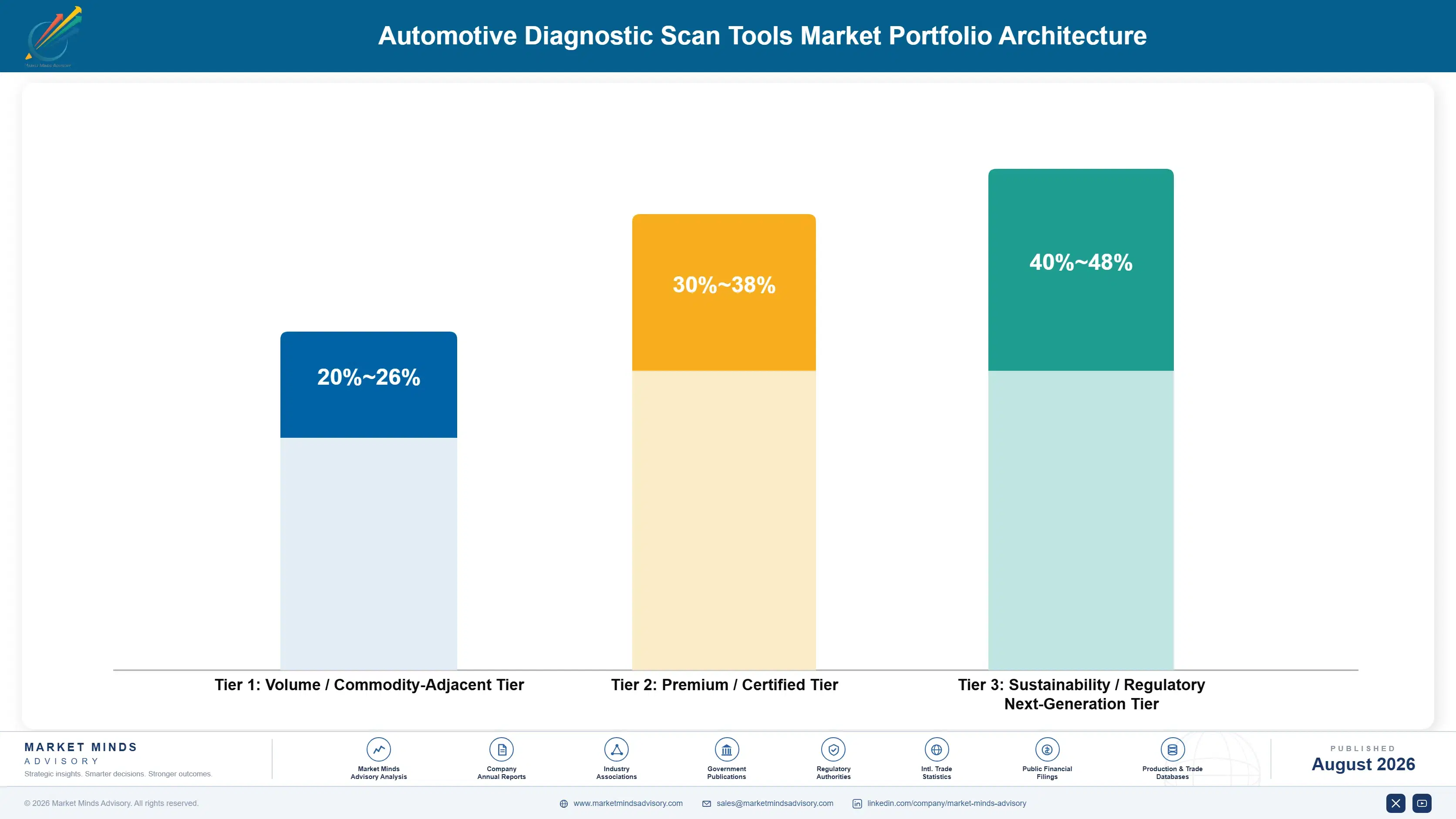
Portfolio economics split across three tiers: commodity handheld OBD-II scanners competing largely on price and basic functionality, mid-tier OEM-specific and PC-based diagnostic platforms commanding meaningful premium pricing tied to coverage depth, and premium ADAS calibration and EV diagnostic systems capturing the highest margin as shops pay for both specialized capability and ongoing software support. This split increasingly determines which manufacturers can access the most attractive long-term shop contracts.
The tension between volume and premium positioning is sharpest as rising vehicle complexity increasingly mandates advanced diagnostic capability regardless of shop size, compressing the traditional segmentation between basic tools for small shops and premium tools for larger operations, pushing manufacturers to defend margin through software subscription and training differentiation rather than hardware exclusivity alone. Manufacturers investing early in premium tier innovation are increasingly better positioned than those defending commodity volume alone.

High value margin pools concentrate in ADAS calibration and EV diagnostic platforms sold with ongoing software subscription support, where OEM data partnership depth and calibration accuracy credentials limit competition to manufacturers with established engineering and licensing capability. Manufacturers without comparable engineering capability increasingly risk losing access to the most attractive shop contracts entirely.

Volume / Commodity-Adjacent Tier

Commodity handheld OBD-II scanners competing primarily on price and basic code-reading functionality across mainstream retail channels. Margins here depend heavily on distribution scale and manufacturing cost efficiency rather than on software depth.
Gross Margin: 20-26%

Premium / Certified Tier

OEM-specific and PC-based diagnostic platforms commanding premium pricing tied to coverage depth and direct data partnership credentials. Buyers in this tier increasingly require documented coverage depth and consistent data partnership credentials.
Gross Margin: 30-38%

Sustainability / Regulatory / Next-Generation Tier

ADAS calibration and EV diagnostic systems serving shops requiring the deepest specialized capability and ongoing software support. Capacity here remains concentrated among a small number of manufacturers, keeping margins durably elevated for now.
Gross Margin: 40-48%
automotive-diagnostic-scan-tools-market-trends-portfolio-architecture-1787465707019

High-value Sub-segments and Strategic Watch-out

ADAS Calibration Software Subscriptions

Scaling fastest as calibration becomes a routine collision repair requirement, this segment commands the highest margins but remains constrained by validation complexity across the growing range of vehicle configurations. Manufacturers investing early in dedicated engineering are best positioned to capture this accelerating demand. Demand keeps outpacing capacity.
Gross Margin: 42-48%

EV and Hybrid Diagnostic Platforms

Growing electric vehicle fleets support durable pricing power for manufacturers with established high-voltage system expertise over generic tool competitors lacking comparable technical depth. Adoption continues broadening as more shops invest in electric vehicle repair capability. Suppliers with established expertise continue capturing the bulk of this opportunity.
Gross Margin: 36-44%

Conventional OBD-II Handheld Scanners

The largest volume segment by unit count, competing primarily on price and basic functionality across mainstream retail and small shop channels, and largely insulated from the software complexity affecting premium segments. Brand loyalty here remains modest, leaving this segment most exposed to continued price competition.
Gross Margin: 18-24%

Legacy Aggregated-Data-Only Diagnostic Tools

Facing declining relevance as OEM data access restrictions tighten further, this segment requires urgent direct partnership investment or faces continued exclusion from full diagnostic coverage across major vehicle brands. Partnership investment now offers the clearest path back into full coverage relevance. Buyers reward early commitment.
Gross Margin: 14-20%

Recurring Software Relationship Economics

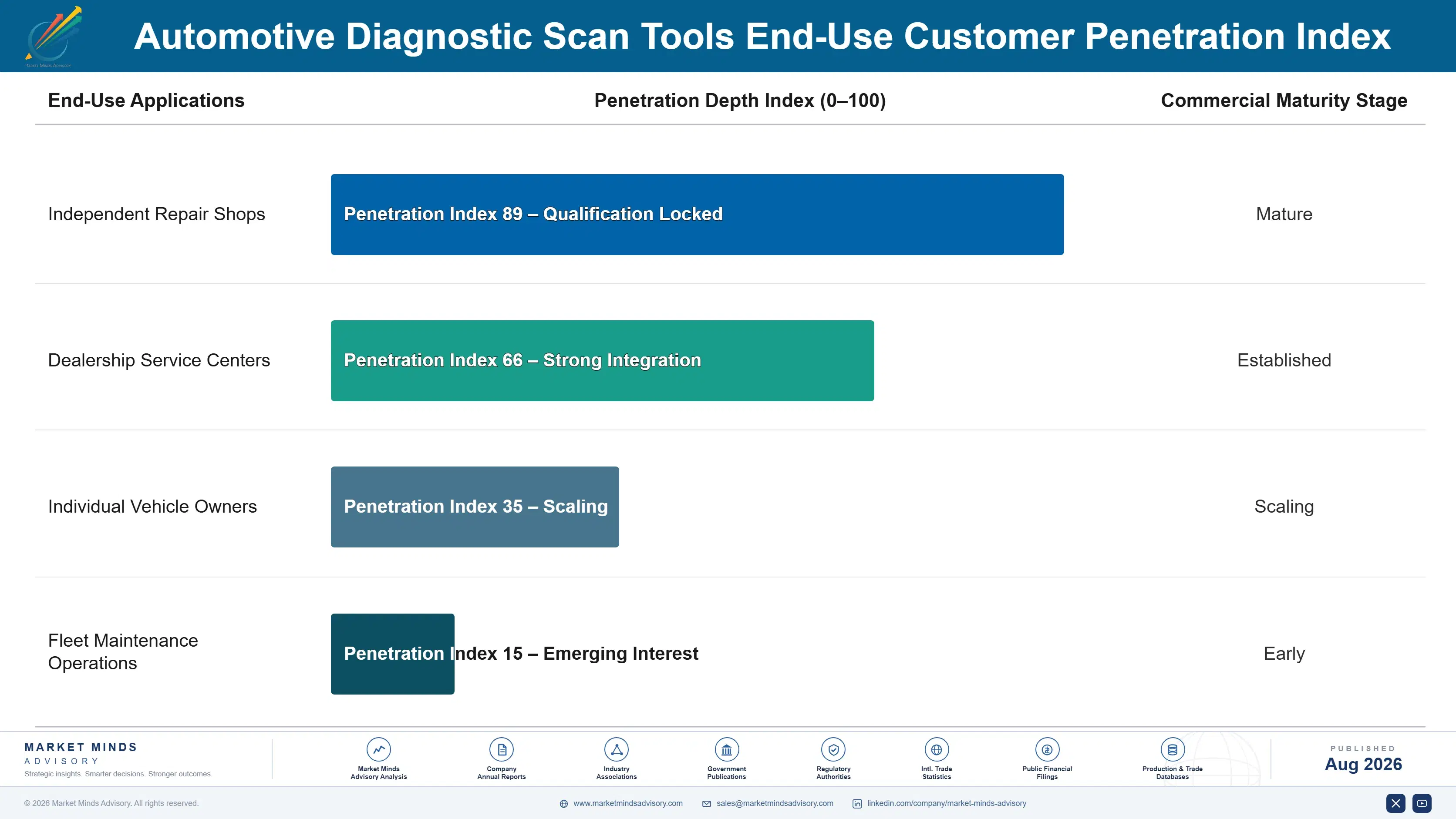
Demand in this category increasingly resembles a recurring software subscription relationship rather than a one-time hardware purchase, since shops require regular data and calibration software updates to maintain current vehicle coverage, creating a form of annuity demand for manufacturers embedded early in a shop's diagnostic tool relationship. Manufacturers embedded early in a shop's diagnostic relationship capture disproportionate follow-on volume.
Adoption depth varies considerably by end use vertical: dealership-affiliated and larger independent repair chains show the deepest and most consistent adoption of premium ADAS calibration and EV diagnostic capability, mid-sized independent shops show moderate but accelerating adoption tied to competitive pressure from dealership networks, and small independent shops remain the shallowest adopters, still relying primarily on conventional OBD-II tools for basic diagnostic needs. Small shop adoption of premium capability is expected to remain limited for the foreseeable future given cost sensitivity.

Younger technicians entering the repair industry increasingly expect comprehensive software-supported diagnostic capability as a baseline job expectation rather than a specialized skill, a generational shift that is pushing shop owners toward more sophisticated tool investment to attract and retain technical talent over time. Manufacturers slow to adapt risk losing relevance with this increasingly software-driven younger cohort.
automotive-diagnostic-scan-tools-market-trends-end-use-penetration-index-1787465707892

Where Diagnostic Tool Capital Should Concentrate

These are among the four positions where our research anticipates prominent divergence between winners and laggards over the coming forecast period. Each is grounded in the demand model, the regulatory perimeter, and the announced capacity pipeline.
01 / OEM PARTNERSHIP INVESTMENT

Secure direct data partnerships before access restrictions tighten further

OEM data access restrictions are converting direct automaker partnerships from a competitive advantage into a baseline coverage requirement faster than many manufacturers currently plan for within their development timelines. Manufacturers with established direct partnerships already report meaningfully higher shop customer retention than competitors relying on aggregated data sources. This advantage compounds as more automakers tighten data access requirements, an advantage that widens considerably as conventional aggregated data access continues narrowing, leaving later movers a steeper climb back once qualification cycles close.
02 / SUBSCRIPTION REVENUE TRANSITION

Build recurring software revenue before competitors capture shop relationships first

Converting hardware-centric sales into subscription-based software revenue creates more predictable recurring income than traditional periodic upgrade cycles, making this transition a more defensible long-term strategy than continued reliance on one-time hardware sales. Manufacturers completing this transition already report meaningfully more stable revenue than competitors still relying primarily on hardware sales cycles. Manufacturers delaying this transition risk losing shop relationships to competitors offering more predictable ongoing value, leaving later movers facing mounting pressure as coverage gaps keep widening, a gap that widens with each cycle.
03 / ADAS ENGINEERING INVESTMENT

Build calibration accuracy capability ahead of accelerating penetration growth

ADAS calibration tools remain the fastest-growing segment within the category, yet require specialized engineering validation capability that many established diagnostic tool manufacturers have not yet fully developed. Early movers building this capability are already capturing meaningful share of the calibration segment's accelerating growth. Manufacturers delaying this investment risk permanently ceding the calibration opportunity to competitors with stronger engineering credentials already established, leaving later movers a steeper climb as these relationships solidify, where timing increasingly separates winners from laggards, and delay compounds this exposure considerably.
04 / TRAINING PROGRAM BUNDLING

Bundle technician training before competitors capture shop loyalty first

Shops increasingly need both equipment and trained technicians to fully utilize advanced diagnostic capability, making training program bundling a more defensible customer relationship strategy than equipment-only sales. Manufacturers offering comprehensive training already report meaningfully higher repeat purchase rates than equipment-only competitors. Manufacturers delaying this investment risk losing shop loyalty to competitors offering more complete capability partnerships, leaving later movers a steeper climb once loyalty fully forms, an edge that compounds steadily over time as delay only adds to this exposure.

Engagement Snapshot From the Field

A live engagement with an industry participant carrying material or product regulatory and market exposure ahead of a defining policy shift, showing how our research translates into a defensible multi-year portfolio strategy.
MARKET MINDS ADVISORY · CLIENT ENGAGEMENT SUMMARY
Automotive Diagnostic Scan Tools Producer Strategic Portfolio Review and Transition Roadmap 2026·Investment Scenario on Automotive Diagnostic Scan Tools Exposure Evaluation 2025-26
CLIENT PROFILE
The client is a mid-sized North American diagnostic tool manufacturer generating approximately 95 million dollars in annual revenue (client-reported, unverified by MMA), historically selling conventional OBD-II handheld scanners to independent repair shops without ADAS calibration capability of its own. The client operates a single manufacturing facility serving both domestic and export markets. Its engineering team historically focused exclusively on mechanical diagnostic hardware.
STRATEGIC CHALLENGE
Facing declining new customer acquisition as independent shops increasingly specified ADAS calibration capability the client could not offer, the client needed to evaluate whether to build internal calibration engineering capability or acquire it externally, without sufficient capital to pursue both approaches simultaneously within its available investment timeline. Board approval was required before committing meaningful capital toward recovery.
MMA APPROACH
MMA conducted a build-versus-acquire feasibility assessment for ADAS calibration capability, incorporating independent shop customer interviews, capital cost modeling, and competitive benchmarking against established calibration tool manufacturers, then developed a phased eighteen month capability development roadmap sequenced to the client's available capital. Recommendations were validated against two prospective shop chain requirements directly.
KEY FINDINGS
  1. Acquiring a small calibration engineering firm offered a faster path to market than building capability internally given the client's limited existing ADAS talent.
  2. Two regional independent shop chains expressed preliminary interest in expanded orders contingent on demonstrated calibration accuracy within twelve months. pending final technical evaluation results.
  3. Existing customer relationships could be used to secure initial calibration product distribution commitments once capability was established. once the acquisition was fully integrated.
  4. Technician training infrastructure required significant additional investment beyond the acquisition itself to meet current shop expectations. beyond the initial engineering acquisition budget.
CLIENT PROFILE
The client is a mid-sized North American diagnostic tool manufacturer generating approximately 95 million dollars in annual revenue (client-reported, unverified by MMA), historically selling conventional OBD-II handheld scanners to independent repair shops without ADAS calibration capability of its own. The client operates a single manufacturing facility serving both domestic and export markets. Its engineering team historically focused exclusively on mechanical diagnostic hardware.
STRATEGIC CHALLENGE
Facing declining new customer acquisition as independent shops increasingly specified ADAS calibration capability the client could not offer, the client needed to evaluate whether to build internal calibration engineering capability or acquire it externally, without sufficient capital to pursue both approaches simultaneously within its available investment timeline. Board approval was required before committing meaningful capital toward recovery.
MMA APPROACH
MMA conducted a build-versus-acquire feasibility assessment for ADAS calibration capability, incorporating independent shop customer interviews, capital cost modeling, and competitive benchmarking against established calibration tool manufacturers, then developed a phased eighteen month capability development roadmap sequenced to the client's available capital. Recommendations were validated against two prospective shop chain requirements directly.
KEY FINDINGS
  1. Acquiring a small calibration engineering firm offered a faster path to market than building capability internally given the client's limited existing ADAS talent.
  2. Two regional independent shop chains expressed preliminary interest in expanded orders contingent on demonstrated calibration accuracy within twelve months. pending final technical evaluation results.
  3. Existing customer relationships could be used to secure initial calibration product distribution commitments once capability was established. once the acquisition was fully integrated.
  4. Technician training infrastructure required significant additional investment beyond the acquisition itself to meet current shop expectations. beyond the initial engineering acquisition budget.
RECOMMENDED STRATEGY
Phase 1: Phase 1 (Months 1 to 6): Complete acquisition of calibration engineering firm and begin product integration. with dedicated integration management oversight established. Phase 2: Phase 2 (Months 7 to 14): Validate calibration accuracy and launch training program alongside product rollout. while maintaining existing conventional tool volume. Phase 3: Phase 3 (Months 15 to 18): Secure distribution commitments from interested independent shop chains. to formalize long-term distribution agreements. and expand into new markets.
OUTCOME
Within eighteen months of implementation, the client reported securing two regional shop chain distribution agreements representing roughly 21 percent of total revenue and achieving a 17 percent increase in overall product line revenue through combined calibration and conventional tool sales (client-reported, unverified by MMA). Employee retention through the acquisition also exceeded initial expectations.

Frequently Asked Questions

Foundational context covering the market sizes, CAGR, scope, country, region and competition that inform every finding below. This section is provided to cover basics and most often pre-purchase conversations, answered from the MMA Primary Research Dataset.

What is the current size of the Automotive Diagnostic Scan Tools Market?

The Automotive Diagnostic Scan Tools Market is valued at approximately 4.8 billion dollars in 2025, spanning handheld, OEM-specific, ADAS calibration, and EV diagnostic tool categories worldwide.

How large will the Automotive Diagnostic Scan Tools Market be by 2036?

The market is projected to reach roughly 11.89 billion dollars by 2036, driven by expanding ADAS calibration demand and rising electric vehicle diagnostic requirements. across all diagnostic tool categories combined.

What is the CAGR for the Automotive Diagnostic Scan Tools Market 2026 to 2036?

The market is expected to grow at a compound annual growth rate of approximately 8.6 percent between 2026 and 2036, among the faster rates in automotive aftermarket equipment.

Which segment is growing fastest?

ADAS calibration tools are the fastest growing segment, expanding at roughly 1.6 times the overall market rate as advanced driver assistance systems become a routine collision repair requirement.

Who are the major companies in the Automotive Diagnostic Scan Tools Market?

Leading companies include Snap-on Incorporated, Bosch Automotive Service Solutions, Autel Intelligent Technology, Launch Tech, and Actia Group, each investing in OEM partnerships and ADAS capability.

Which country is growing fastest?

China is the fastest growing single country, as its domestic tool manufacturers expand capability alongside rapid electric vehicle fleet growth nationwide. ahead of most other automotive manufacturing nations.

Report Segmentation Architecture

The full report scope spans multiple orthogonal segmentation dimensions, with cross-tabulated demand data provided for each dimension pair. Coverage extends further to regional breakdowns, trend trajectories, and the competitive detail needed to support segment-level decision-making.

By Tool Platform Type

  • Handheld OBD-II Scan Tools
  • PC-Based Diagnostic Software
  • OEM-Specific Diagnostic Systems
  • ADAS Calibration Tools
  • EV and Hybrid Diagnostic Tools
  • Heavy-Duty Commercial Vehicle Diagnostic Tools

By End-Use Customer

  • Independent Repair Shops
  • Dealership Service Centers
  • Individual Vehicle Owners
  • Fleet Maintenance Operations

By Commercial Dimension

  • Direct Manufacturer Sales
  • Distributor and Retail Channel
  • Subscription Software Licensing
  • Training and Certification Bundled Contract

By Region

  • North America
  • Western Europe
  • East Asia
  • South Asia and Pacific
  • Latin America
  • Middle East and Africa
  • Eastern Europe

Scope, Methodology, and Coverage

Every figure in this report is reproducible from documented input assumptions. The scope below maps the historical period, the forecast horizon, the segmentation dimensions, and the countries covered, alongside the underlying primary and qualitative methodology.
Historical Period
2020 to 2025
Forecast Period
2026 to 2036
Base Year
2025 (USD billions; MMA Primary Research Dataset, August 2026)
Market Definition
The automotive diagnostic scan tools market covers handheld and PC-based diagnostic equipment used to read, interpret, and clear vehicle electronic control unit fault codes, including OBD-II scan tools, OEM-specific diagnostic systems, ADAS calibration tools, and EV and hybrid diagnostic platforms sold to repair shops, dealerships, and individual vehicle owners. It excludes onboard vehicle diagnostic sensors and excludes fleet telematics platforms not used for point-in-time fault diagnosis.
Quantitative Units
USD billions (current prices); unit shipments for select volume metrics
Segmentation Dimensions
By Tool Platform Type; By End-Use Customer; By Commercial Dimension; By Region
Regions Covered
North America, Western Europe, East Asia, South Asia and Pacific, Latin America, Middle East and Africa, Eastern Europe
Countries Covered
USA, China, Germany, France, UK, Japan, South Korea, India, Australia, Canada, Brazil, Mexico, Indonesia, Vietnam, Thailand, Malaysia, UAE, Saudi Arabia, South Africa, Nigeria, Turkey, Poland, Netherlands, Italy, Spain, Sweden, Switzerland, Argentina, Colombia, Singapore, and additional markets relevant to this sector
Key Companies Profiled
Snap-on Incorporated, Bosch Automotive Service Solutions, Autel Intelligent Technology, Launch Tech Co., Actia Group, Delphi Technologies (BorgWarner), Continental AG, Denso Corporation, Hickok Incorporated, Innova Electronics, Foxwell Technology, Ancel Technology, Topdon Technology, Vident Technology, Matco Tools, Mitchell 1, Identifix, OTC Tools (Bosch), Jaltest Diagnostics, Texa S.p.A.
Quantitative Methodology
Primary survey, n=3,800 respondents, Q4 2025, six countries; demand-side model with trade association cross-validation
Qualitative Methodology
47 expert interviews, Q4 2025; applied to validate demand model assumptions, identify emerging dynamics, and assess competitive positioning
Report Format
PDF and XLSX data workbook (Word format preview document)
Publisher
Market Minds Advisory
Report Code
MMA-2026-AUT-303
Published
August 2026
Contact
sales@marketmindsadvisory.com | www.marketmindsadvisory.com

Purchase the full Automotive Diagnostic Scan Tools Market Report (2026 to 2036).

The full report delivers a complete quantitative and qualitative assessment of the automotive diagnostic scan tools market, including detailed segment level forecasts through 2036, regional analyses across all seven covered geographies, and profiles of twenty leading manufacturers. It incorporates primary survey data from 3,800 respondents and 47 expert interviews conducted in the fourth quarter of 2025. Buyers receive editable data tables, a customizable Excel forecast model, and access to MMA analysts for follow up questions during a defined post purchase support window. The report also includes detailed semiconductor cost sensitivity analysis calibrated to current component market benchmarks.
Detailed segment-level market forecasts through 2036
All seven regional market analyses included
Twenty profiled leading tool manufacturers overall
Editable Excel based forecast data model
Primary survey and expert interview data
Extended post-purchase analyst support access included

Built For The People Who Decide

From boardroom strategy to bench-side execution, this report is read cover-to-cover by leaders shaping the next decade of their industry, turning demand scenarios, market dynamics and valuation benchmarks into decisions.
CXOs/ Presidents/ VPs/ Managers
M&A and Corporate Development
Strategy Teams and R&D Heads
Procurement and Product Directors
Regulatory and Compliance Leaders
Investor Relations and Equity Analysts