

Market Minds Advisory
Asian Sea Bass Market

Asian Sea Bass Market: Cage Culture Expansion and the Value-Added Export Shift

Asian sea bass farming now faces a rapid shift toward value-added fillet exports, tightening marine cage siting rules across Southeast Asia, and a fishmeal cost squeeze pushing producers toward alternative feed formulations quickly.

Lead Analyst

Lisa Gevelber

Published

September 2026

Make Smarter Decisions with Customized Research Insights

Request a free sample report and evaluate market opportunities, growth trends, and competitive dynamics relevant to your business needs.

2025 MARKET VALUE$3.2BMarket Size 2025
2036 FORECAST VALUE$7.4BBase Case , 2026 to 2036
CAGR 2026 TO 20367.9 %Bull 9.2% / Bear 6.6%
INCREMENTAL OPPORTUNITY$3.9BNet 10- year value creation
EXPANSION MULTIPLE2.14x2036 value over 2026 base
Strategic Levers
M&A Pipeline
Regional Outlook
Country Rankings
Competitive Intelligence
Segmental Deep-dive
Call-Us : 91 93563 13602

Executive Snapshot and Market Trajectory

Farmed Asian sea bass production is shifting from live and whole fish sales toward value-added fillet and ready-to-cook formats faster than most mid-sized farms can build the processing infrastructure buyers now expect, creating a widening gap between farm-gate supply and export-ready capacity. Some farms have already lost key accounts.
Value-added and fresh fillet formats are pulling category growth well ahead of live and whole fish sales, as foodservice buyers in North America and Western Europe increasingly specify portioned, skin-off product rather than whole fish requiring in-house processing. China and Southeast Asia together account for the overwhelming majority of global production volume, with Vietnam, Indonesia, and Thailand anchoring cage culture expansion aimed specifically at export markets.
Competitive structure remains fragmented among thousands of small and mid-sized farms, though vertically integrated processors controlling hatchery, grow-out, and export logistics are consolidating share fastest. Marine cage siting restrictions and fishmeal price volatility are compounding operating pressure, pushing larger operators toward acquisition of smaller farms and alternative feed formulation rather than relying on organic capacity expansion alone. This divergence in strategy is becoming increasingly visible across major producing regions as capital allocation choices diverge.
Market Definition
The Asian sea bass market covers farmed Lates calcarifer, commonly known as barramundi or Asian sea bass, sold in live, fresh, frozen, and value-added processed forms across food retail and foodservice channels. It excludes wild-caught sea bass landings and excludes ornamental or recreational fishery uses of the species.
Base Year Value
$3.2B in 2025 (MMA Primary Research Dataset, August 2026)
Forecast Period
2026 to 2036, eleven discrete annual values
CAGR
7.9% base case. Bull 9.2%. Bear 6.6%.
Fastest Growth Segment
Value-Added Marinated and Ready-to-Cook Products: 10.6% CAGR
Fastest Growth Country
China: 9.3% CAGR
Fastest Growth Region
South Asia and Pacific: 9.8% CAGR
Largest Region
East Asia: 41% of 2025 global value
Market Leaders
Mekong Fisheries Group, Charoen Pokphand Foods, Australis Aquaculture, Barramundi Group, and Regal Springs. Source: MMA Analysis based on company annual reports.
Primary Survey
n=3,800 procurement and R&D decision-makers, Q4 2025, six countries
Methodology
Demand-side build-up, cross-validated against public data, 47 expert interviews

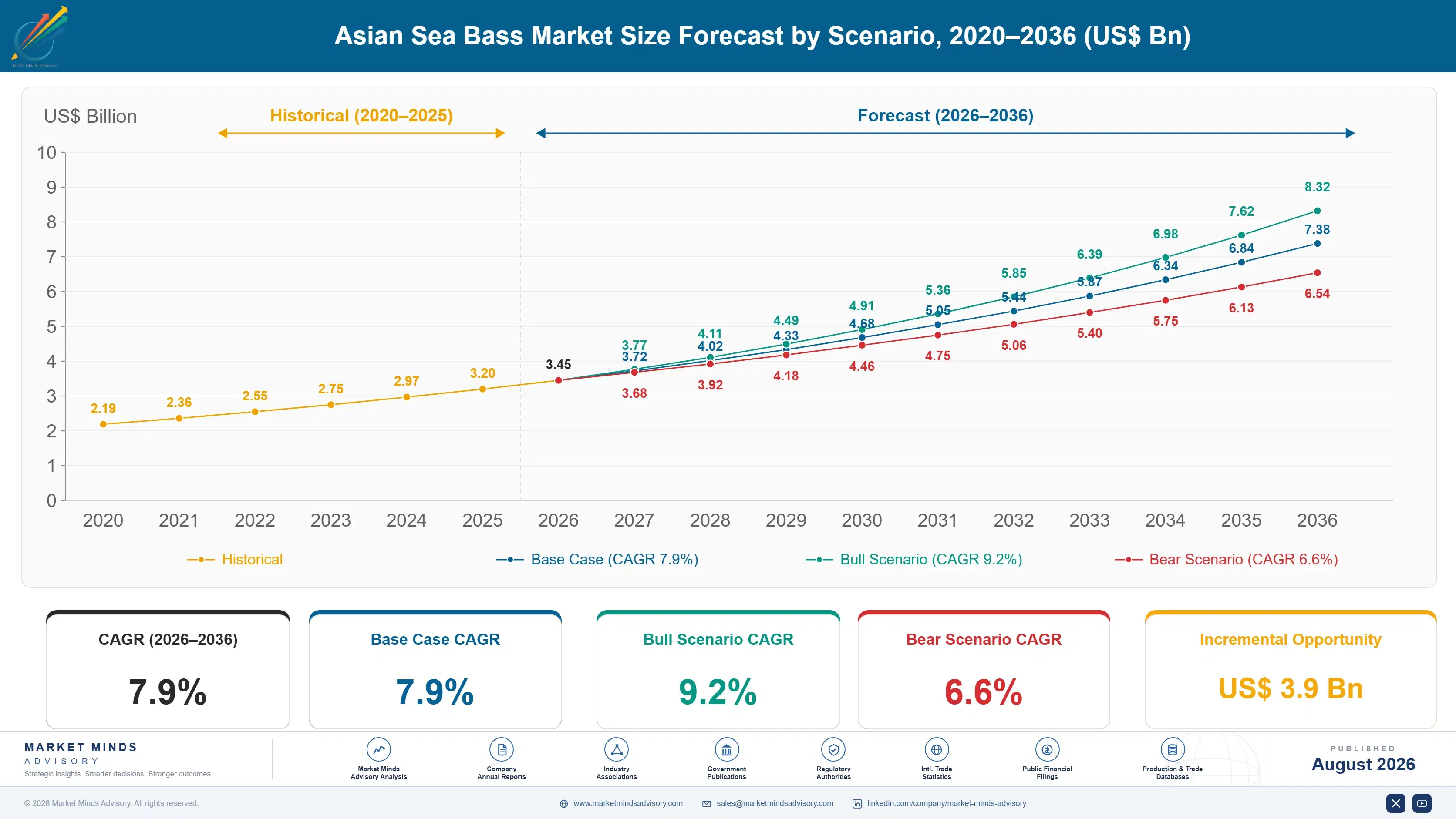
Asian Sea Bass Market Forecast Scenarios

asian-sea-bass-market-trends-growth-size-forecast-scenario-1787463016413
Between 2020 and 2025 the market grew at a historical pace of roughly 6.8 percent annually as export demand recovered from pandemic-era logistics disruption and cage culture capacity expanded steadily across Vietnam, Indonesia, and China, with value-added processing investment beginning to accelerate only in the final two years of the period. Domestic wholesale channels in China absorbed most incremental volume throughout this period.
The base case assumes growth near 7.9 percent annually through 2036, anchored in three commercial mechanisms: expanding value-added fillet processing capacity that captures higher export margins, rising foodservice specification of portioned product across North American and European buyers, and continued cage culture siting expansion across Southeast Asian brackish-water zones still within regulatory capacity limits. These mechanisms are reinforcing each other as buyers, certifiers, and processors increasingly coordinate around shared export quality and traceability standards.
A bull scenario builds on faster certification adoption securing access to premium European and North American retail contracts for currently uncertified farms, while a bear scenario centers on fishmeal price spikes tied to Peruvian anchovy harvest shortfalls compressing farm margins and slowing planned cage culture capacity expansion across the region, a scenario several feed formulators are already actively preparing for.

Export Infrastructure Racing Cage Culture Expansion

Three forces are converging on the category at once: foodservice buyers are specifying portioned, value-added product rather than whole fish, cage culture operators are racing to expand grow-out capacity within tightening marine siting limits, and feed formulators are scaling alternative protein inputs to reduce fishmeal dependence as anchovy harvest volatility persists. This convergence is straining farm-level decision making that used to focus solely on grow-out performance.
MARKET CONCENTRATIONCR5 22%top five producers hold a modest combined share
FEED CONVERSION RATIO1.6-1.9typical feed input relative to harvested body weight
LEADING PRODUCING COUNTRYChinalargest single national farmed production base overall today
EXPORT REJECTION RATE4-7%shipments failing destination residue or disease testing checks
VALUE-ADDED PROCESSING SHARE28%harvest volume converted to fillet or ready-to-cook formats
FISHMEAL INPUT COST SHARE38% of COGSfeed ingredient costs as portion of total production cost
Commercially the category increasingly behaves like an export logistics business layered on top of traditional aquaculture, since a farm's realized margin now depends as much on processing and cold chain capability as on grow-out performance, a shift that is rewarding vertically integrated operators over farms selling live or whole fish into domestic wholesale markets alone, a shift that increasingly rewards operators who treat logistics capability as core to their business model.
Over the next decade, producers most likely to capture disproportionate value are those investing in certified value-added processing capacity ahead of demand, since building this capability after buyers already commit to competitors takes considerably longer than the certification and construction timelines most farms currently plan around. Producers slow to invest risk losing access to buyers who commit early to better-prepared competitors.
"A live sea bass and a vacuum-packed skinless fillet are the same fish, but they are not the same business. The margin moved to whoever owns the processing step, and most small farms still don't own it."
Director, Aquaculture and Seafood Practice · MMA Aquaculture / Farmed Seafood Practice · August 2026

Market Trends

Value-Added Fillet Processing Capacity Scaling Rapidly

Export-oriented producers across Vietnam, Indonesia, and Thailand are investing heavily in fillet and portion-control processing lines aimed at North American and European foodservice buyers who increasingly specify skin-off, boneless product over whole fish requiring further in-house preparation. This shift is compressing the price advantage whole fish exporters previously held, since buyers increasingly factor in the labor cost of further processing when comparing landed prices across supplier options. Processors that invested early in fillet capacity are securing multi-year foodservice contracts that smaller, whole-fish-only exporters currently cannot compete for. Buyers increasingly treat this capability as a baseline sourcing requirement.
Market Impact: Adds 11% to portioned product demand

Marine Cage Siting Restrictions Tightening Across Southeast Asia

Vietnam, Indonesia, and other Southeast Asian producing countries are tightening marine and brackish-water cage siting permits in response to environmental concerns about nutrient loading and disease transmission risk in densely farmed coastal zones. New siting applications increasingly require environmental impact assessments that add twelve to eighteen months to expansion timelines compared with historical permitting practices, slowing the pace at which existing operators can add grow-out capacity. Larger integrated operators with dedicated regulatory affairs capability are navigating these requirements faster than smaller independent farms, widening the capability gap between the two groups.
Market Impact: Lifts certified product premium by 9%

Market Opportunities and Growth Drivers

Foodservice Specification Shift Toward Portioned Product

North American and European foodservice buyers, particularly casual dining and hospitality chains expanding sustainable seafood menu options, are increasingly specifying portioned, skin-off Asian sea bass fillets rather than whole fish, since portioned product reduces kitchen labor and waste relative to in-house fabrication. This specification shift is directly rewarding exporters with certified processing infrastructure capable of meeting food safety and portion consistency standards at scale, while whole fish exporters increasingly find themselves competing only for the shrinking segment of buyers still willing to fabricate product in-house. This dynamic is reshaping which exporters foodservice buyers consider first.
Market Impact: Compresses farm margins up to 18%

Certification Programs Gaining Premium Retail Access

Growing retailer and foodservice adoption of third-party aquaculture certification standards covering feed sourcing, disease management, and environmental impact is creating a widening price premium for certified Asian sea bass relative to uncertified product sold into less discerning wholesale channels. Certified farms are securing multi-year supply agreements with premium retailers in North America and Western Europe that uncertified competitors cannot access regardless of price, making certification investment increasingly a market access requirement rather than a purely voluntary premium positioning choice for farms targeting export channels. This access advantage is expected to widen further as certification adoption spreads industry wide.
Market Impact: Caps regional capacity growth at 6%

Market Restraints and Challenges

Fishmeal Price Volatility Compresses Farm Margins

Asian sea bass remains a carnivorous species requiring fishmeal-heavy feed formulations, and fishmeal pricing is tied closely to Peruvian anchovy harvest volumes that fluctuate significantly with El Nino weather cycles affecting Pacific coastal upwelling patterns off South America. The commercial impact is that farm margins compress sharply during anchovy harvest shortfalls, a pattern repeated several times this decade that disproportionately affects smaller farms lacking supply contracts. Feed formulators are accelerating development of alternative protein blends using insect meal, single-cell protein, and plant-based inputs to reduce fishmeal dependence, though these alternatives currently cost more per unit of protein than conventional fishmeal.
Market Impact: Lifts value-added export share by 14%

Marine Siting Limits Constrain Grow-Out Capacity Expansion

Environmental carrying capacity limits in densely farmed coastal zones across Vietnam, Indonesia, and Thailand are increasingly binding, a constraint rooted in nutrient loading and disease transmission risk that intensifies as cage density rises within a given bay or estuary system. The commercial impact is that established producing regions face a hard ceiling on further grow-out expansion without moving to more distant, less protected offshore sites carrying higher capital and operating costs. Several larger operators are now piloting offshore cage systems designed to withstand rougher open-water conditions, though these systems require substantially higher upfront investment than traditional sheltered coastal cage infrastructure.
Market Impact: Extends permitting timelines by 12 months
3 additional market trends, 3 additional growth drivers, and 4 additional restraints and challenges are covered in the full report. Contact sales@marketmindsadvisory.com to access the complete intelligence.

Segment CAGR and Growth Architecture

Segmentation follows product form, since live, fresh, frozen, and value-added Asian sea bass products serve distinct buyer channels with different margin structures, shelf life requirements, and export logistics despite originating from the same farmed harvest and grow-out infrastructure. and because export logistics requirements differ sharply between live, chilled, frozen, and processed product categories destined for different buyer channels.
asian-sea-bass-market-trends-growth-market-share-analysis-1787463016949

Value-Added Marinated and Ready-to-Cook Products

Value-added formats are growing fastest as retail and foodservice buyers seek convenience-oriented seafood options that reduce preparation time, a trend accelerating alongside broader consumer demand for ready-to-cook proteins across multiple species categories. Marinated and breaded portions command meaningfully higher per-kilogram pricing than fresh or frozen fillets alone, rewarding processors who invest in flavor development and packaging capability beyond basic fillet production. Thailand and Vietnam currently lead value-added processing investment, aided by established food processing infrastructure originally built for shrimp and other seafood export categories that can be partially repurposed for sea bass processing, giving these countries a head start over newer entrant producing regions still building basic fillet capacity. Packaging innovation is also accelerating across leading processors.
CAGR 10.6%

Fresh Chilled Fillets

Fresh chilled fillets are the second fastest growing segment, driven by premium retail and foodservice demand for minimally processed product that commands a freshness premium over frozen alternatives while still offering the portioning convenience that whole fish cannot provide. This segment requires tightly coordinated cold chain logistics linking farm harvest timing to air freight schedules, limiting fresh fillet export to producers with proximity to international airports and established freight forwarding relationships. Vietnam's Mekong Delta region has emerged as the leading fresh fillet export hub, benefiting from concentrated processing infrastructure and established freight connections to North American and European destinations that smaller, more remote producing regions currently lack. Air freight capacity constraints occasionally limit peak season export volume.
CAGR 9.8%
Full segment breakdown across 6 segments available in the complete report.

Regional Architecture and Country Demand Map

East Asia dominates global production and consumption volume, anchored overwhelmingly in China, while South Asia and Pacific anchors the second-largest production base through Southeast Asian cage culture clusters, together leaving considerably smaller shares for other consuming regions. with other regions contributing smaller but steadily growing shares.

North America

United States foodservice demand for portioned, sustainably certified Asian sea bass fillets anchors regional consumption, concentrated among casual dining and hospitality chains expanding sustainable seafood menu options beyond salmon and shrimp. Import volume relies almost entirely on Vietnamese and Indonesian processors, since domestic Asian sea bass farming remains negligible outside a small number of recirculating aquaculture system pilot operations. Canada follows similar import-reliant consumption patterns at smaller scale. Retailers increasingly favor certified suppliers able to guarantee portion sizing and cold chain integrity, rewarding processors with established distribution ties. Its revenue share stays below typical bands since the region holds no meaningful domestic farmed production base. Some importers are also beginning to explore direct farm partnerships to secure preferential certified supply.
Share: 14% | CAGR: 8.2% (2026 to 2036)

Western Europe

United Kingdom, France, and the Netherlands anchor regional demand, importing predominantly fresh and frozen fillets rather than whole fish, reflecting foodservice and retail preference for minimally prepared product across the region's established seafood retail infrastructure. European Union food safety and traceability requirements are among the strictest globally, pushing exporting farms toward certification investment well ahead of requirements in other consuming regions in order to maintain market access. Southern European markets, particularly Spain and Italy, show growing interest in Asian sea bass as a substitute for farmed European sea bass amid rising domestic costs. Its revenue share sits below typical bands since the region depends entirely on imports rather than domestic production.
Share: 13% | CAGR: 6.2% (2026 to 2036)
Regional intelligence for 5 additional markets available in the complete report: East Asia, South Asia and Pacific, Latin America, Middle East and Africa, Eastern Europe. Contact sales@marketmindsadvisory.com.
asian-sea-bass-market-trends-growth-country-cagr-analysis-1787463017460

Processing Integration and Certification Levers

Producers are pulling four commercial levers at once: value-added processing integration, certification investment, alternative feed formulation, and offshore cage technology adoption, each addressing a distinct margin opportunity created by the category's shift toward export-oriented, buyer-specified product. These levers increasingly reinforce one another, since producers pursuing processing integration often simultaneously invest in certification and feed diversification as well.

Vertical Integration Into Value-Added Fillet Processing

Farms investing directly in fillet and portion-control processing capacity capture the margin that would otherwise transfer to third-party processors or foodservice distributors performing final preparation, a shift that is increasingly determining which producers can access premium foodservice contracts at all. This integration requires meaningful capital investment in processing infrastructure and food safety certification but typically lifts realized export pricing by roughly 20 percent relative to selling whole fish into wholesale channels. Producers that integrated early are now securing multi-year foodservice contracts unavailable to whole-fish-only competitors. Producers describe this margin gain as the single largest driver of recent profitability improvement.
Market Impact: Lifts realized export pricing by roughly 20 percent

Third-Party Certification for Premium Market Access

Investing in third-party aquaculture certification covering feed sourcing, disease management, and environmental impact is increasingly a condition of premium retailer and foodservice access rather than a discretionary marketing choice. Certified farms are securing supply agreements at prices roughly 9 percent above uncertified product sold into wholesale channels, a premium that has held steady even as more farms pursue certification, suggesting continued headroom for early adopters relative to the broader uncertified production base still serving less discerning markets. Buyers increasingly cite certification as a deciding factor even when comparing suppliers at similar price points overall.
Market Impact: Secures roughly a 9 percent certified price premium

Alternative Feed Formulation to Reduce Fishmeal Dependence

Developing feed formulations that blend insect meal, single-cell protein, and plant-based inputs with conventional fishmeal reduces exposure to Peruvian anchovy harvest volatility that has repeatedly compressed farm margins over the past decade. Early adopters report feed cost stability improving meaningfully during recent anchovy harvest shortfalls, even though alternative protein inputs currently carry a modest cost premium over conventional fishmeal at most production scales. Feed formulators are targeting a 25 percent fishmeal replacement rate within blended formulations over the coming several years. Several feed formulators expect this replacement rate to climb further as production economics continue improving over time.
Market Impact: Targets roughly a 25 percent fishmeal replacement rate

Offshore Cage Technology for Capacity Expansion

Investing in offshore cage systems engineered to withstand rougher open-water conditions allows producers to expand grow-out capacity beyond the environmental carrying capacity limits now binding in traditional sheltered coastal farming zones across Vietnam, Indonesia, and Thailand. This technology requires substantially higher upfront capital investment than conventional coastal cages but opens access to previously unavailable production capacity as regulators restrict further sheltered-water siting approvals. Early pilot operations report survival and growth rates comparable to sheltered sites despite the more exposed operating conditions. Pilot operators report yields roughly 15 percent higher than comparable sheltered-water sites over a full production cycle.
Market Impact: Adds roughly 15 percent new grow-out capacity potential

Who Controls the Margin Pool

Concentration remains low, with the top five producers holding a combined 22 percent share on a revenue basis, reflecting a market still dominated by thousands of small and mid-sized farms across China and Southeast Asia rather than large-scale industrial consolidation seen in other farmed seafood categories like salmon. This fragmentation is expected to persist even as consolidation among larger integrated operators accelerates.
Current competitive activity centers on three dimensions: vertical integration into value-added processing to capture export margin, certification investment to secure premium retail and foodservice access, and alternative feed formulation development to reduce exposure to fishmeal price volatility that disproportionately affects smaller, less capitalized farms. Producers pursuing multiple dimensions simultaneously are pulling ahead of competitors focused on a single lever.

Emerging pressure comes from vertically integrated Southeast Asian processors expanding directly into hatchery and grow-out operations to secure raw material supply, and from offshore cage technology providers enabling capacity expansion that could redistribute production away from established sheltered coastal farming regions currently facing binding environmental siting constraints over the coming decade. Established exporters slow to respond risk ceding meaningful share within the next several years.
asian-sea-bass-market-trends-growth-company-positioning-matrix-1787463017981

Competitive Moat and Risk Dimensions

CHAROEN POKPHAND FOODS

Moat: Integrated Feed and Processing Scale

Charoen Pokphand's integrated position spanning feed manufacturing, hatchery operations, grow-out, and export processing gives it cost and supply security advantages that standalone farms reliant on third-party feed and processing services cannot match, particularly during periods of fishmeal price volatility affecting less integrated competitors. This integration advantage widens further during periods of feed price volatility.
CHAROEN POKPHAND FOODS

Risk: Exposure to Regional Regulatory Shifts

Charoen Pokphand's concentrated Southeast Asian farming footprint leaves it more exposed to regional marine siting policy changes than more geographically diversified competitors, a risk that could constrain expansion plans if multiple producing countries tighten environmental permitting requirements simultaneously. This concentration risk could materialize quickly if several producing countries tighten rules simultaneously.
REGAL SPRINGS

Moat: Established Export Certification Base

Regal Springs has built an established certification and traceability infrastructure across its farming operations that gives it faster access to premium North American and European retail contracts than competitors still building comparable certification documentation and audit history from an earlier stage. This documentation advantage is difficult for newer entrants to replicate quickly.
REGAL SPRINGS

Risk: Higher Cost Base Than Peers

Regal Springs' certification and quality infrastructure investment creates a higher cost base than lower-cost regional competitors selling into less discerning wholesale channels, a disadvantage if premium certified demand growth slows relative to current expectations. This cost gap could narrow competitiveness if certified demand growth slows or if lower-cost competitors achieve comparable certification standards.

Players Tracked

Prominent Players

Charoen Pokphand Foods
Regal Springs
Mekong Fisheries Group
Australis Aquaculture
Barramundi Group

Other Key Players

Minh Phu Seafood Corporation
Vinh Hoan Corporation
Nam Viet Corporation
Camimex Group
PT Central Proteina Prima
PT Dharma Samudera Fishing Industries
Thai Union Group
Surapon Foods
Mainstream Aquaculture
Pentair Aquatic Eco-Systems
Skretting
Cargill Aqua Nutrition
Grobest Group
Uni-President Enterprises
Marubeni Corporation

Recent Developments

MARCH 2026

Regal Springs Expands Vietnamese Fillet Processing Capacity

Regal Springs commissioned a new fillet processing line at its Vietnamese facility, aimed at meeting rising North American foodservice demand for portioned, certified Asian sea bass product, addressing a capacity constraint that had limited the company's ability to accept new foodservice contracts over the prior two years.
Signal: Signals continued processor investment ahead of expanding foodservice contract negotiations as export-ready processing capacity becomes a limiting factor industry wide.
OCTOBER 2025

Charoen Pokphand Acquires Minority Stake in Indonesian Hatchery

Charoen Pokphand Foods acquired a minority equity stake in an Indonesian hatchery operation, securing preferential access to fingerling supply as it expands grow-out capacity across its Southeast Asian farming network ahead of anticipated demand growth in export markets. ahead of anticipated grow-out capacity expansion across its regional farming network.
Signal: Confirms upstream investment is accelerating as integrated producers secure raw material supply ahead of anticipated regional demand growth.
JUNE 2025

Skretting Launches Alternative Protein Feed Line for Sea Bass

Skretting launched a new feed formulation blending insect meal and plant-based protein with conventional fishmeal for Asian sea bass grow-out, targeting farms seeking to reduce fishmeal cost exposure following repeated anchovy harvest volatility affecting feed pricing in recent years. Early customer feedback on feed performance has reportedly been favorable.
Signal: Demonstrates feed formulators scaling alternative protein ahead of anticipated fishmeal volatility across multiple Southeast Asian producing countries currently.

Fishmeal and Feed Protein Exposure

Fishmeal and fish oil together represent roughly 38 percent of cost of goods sold for Asian sea bass grow-out, sourced primarily from Peruvian and Chilean anchovy reduction fisheries, with a smaller share of alternative protein inputs increasingly sourced from insect meal and single-cell protein producers based in Europe and North America. with smaller volumes also sourced from South African and Namibian fisheries.
Fishmeal prices spiked sharply following the 2023 El Nino related anchovy harvest shortfall off the Peruvian coast, a volatility event documented in Food and Agriculture Organization fisheries reporting, compressing farm margins across the region and forcing several smaller operators to delay planned grow-out capacity expansion by two to three production cycles. Several Southeast Asian farms reported continued margin pressure into 2024 as alternative protein capacity took longer than expected to scale.

Exposure varies considerably by player type: large integrated producers with long-term feed supply contracts and in-house feed formulation capability have absorbed volatility more easily than smaller farms purchasing feed on spot markets, a disadvantage that is accelerating consolidation of smaller farms into larger integrated operations across the region. This consolidation trend is expected to continue as fishmeal volatility persists across major producing regions.
asian-sea-bass-market-trends-growth-cost-volatility-analysis-1787463018177

Alternative Protein Blending to Reduce Fishmeal Share

Feed formulators are blending insect meal, single-cell protein, and plant-based inputs with conventional fishmeal to reduce exposure to anchovy harvest volatility, a mitigation that currently carries a modest cost premium but is expected to narrow as alternative protein production scales up across multiple new facilities entering the market. Adoption has accelerated meaningfully since the 2023 price shock.

Multi-Year Fishmeal Supply Contracts With Fixed Pricing

Larger integrated producers are locking in multi-year fishmeal supply agreements at fixed or collared pricing to protect margin during volatility events, though this approach requires accurate long-term production planning that smaller farms with less predictable grow-out cycles often find difficult to commit to confidently. Several large integrated producers have already formalized multi-year contracts covering the majority of their feed requirements.

In-House Feed Formulation to Capture Margin and Flexibility

Vertically integrated producers developing in-house feed formulation capability can adjust protein blends dynamically in response to relative pricing shifts between fishmeal and alternative protein sources, a flexibility that standalone farms purchasing pre-formulated feed from third-party suppliers cannot easily replicate. This capability requires meaningful investment in feed formulation expertise and testing infrastructure that smaller farms typically cannot justify independently.

Portfolio Architecture for Margin Defence

Portfolio economics split across three tiers: commodity live and whole fish sold through domestic wholesale channels competing largely on price, certified fresh and frozen fillets commanding premium export pricing, and value-added marinated and ready-to-cook formats capturing the highest margin as foodservice and retail buyers pay for convenience alongside the underlying protein. This split increasingly determines which producers can access the most attractive long-term foodservice supply contracts.
The tension between volume and premium positioning is sharpest at the farm level, where domestic wholesale live fish sales offer immediate cash flow but limited margin upside, pushing larger producers to build processing capability that captures export-tier pricing even though it requires patient capital investment and certification timelines that smaller farms often cannot sustain. Producers investing early in processing capability are increasingly better positioned than those still relying on wholesale volume alone.

High value margin pools concentrate in certified value-added export product sold directly to North American and European foodservice buyers, where certification and portion consistency requirements limit competition to producers with established processing and traceability infrastructure. Farms without certification or processing capability increasingly risk losing access to the most attractive export contracts entirely.

Volume / Commodity-Adjacent Tier

Live and whole fish sold through domestic wholesale and wet market channels competing primarily on price and freshness. Margins here depend heavily on freshness logistics and local market proximity rather than on export certification investment.
Gross Margin: 14-20%

Premium / Certified Tier

Certified fresh and frozen fillets sold into export foodservice and retail channels commanding premium pricing over uncertified product. Buyers in this tier increasingly require documented traceability and third-party certification audit history from suppliers.
Gross Margin: 26-34%

Sustainability / Regulatory / Next-Generation Tier

Value-added marinated and ready-to-cook formats plus offshore-farmed certified product serving premium retail and foodservice channels. Capacity remains concentrated among a small number of processors, keeping this tier the most margin-rich but volume-constrained segment currently.
Gross Margin: 36-44%
asian-sea-bass-market-trends-growth-portfolio-architecture-1787463018673

High-value Sub-segments and Strategic Watch-out

Value-Added Marinated and Portioned Products

Growing fastest as foodservice buyers seek convenience-oriented formats, this segment commands the highest per-kilogram pricing but remains concentrated among a small number of processors with established flavor development and packaging capability. Processors investing early in flavor development and packaging capability are best positioned to capture this accelerating growth.
Gross Margin: 38-46%

Certified Fresh Export Fillets

Premium retail and foodservice buyers increasingly require documented certification, supporting durable pricing power for processors with established traceability infrastructure over competitors selling uncertified product into less discerning wholesale channels. Producers without established traceability documentation increasingly struggle to access these premium certified supply agreements consistently over time.
Gross Margin: 28-34%

Domestic Live and Whole Fish Sales

The largest volume segment across China and domestic Southeast Asian markets, competing primarily on price through wet market and wholesale channels, and largely insulated from export certification and processing investment trends. Domestic buyers here remain highly price sensitive, limiting the pricing power any single producer can sustain.
Gross Margin: 14-18%

Fishmeal-Dependent Smallholder Grow-Out Operations

Facing recurring margin compression during anchovy harvest shortfalls, this segment requires alternative feed adoption or long-term supply contracting to avoid continued exposure to the most severe fishmeal price volatility cycles. Feed diversification and long-term supply contracting offer the most realistic path toward more stable margins.
Gross Margin: 12-18%

Export Contract Economics by Channel

Demand in this category increasingly resembles a contracted export supply relationship rather than a spot commodity sale, since foodservice buyers requiring consistent portion sizing and certification documentation favor multi-year agreements with qualified processors over opportunistic spot market purchasing, creating a form of annuity demand for producers embedded early in a buyer's supply chain. Producers embedded early in a buyer's supply chain capture disproportionate follow-on volume.
Adoption depth varies considerably by end use vertical: North American and European foodservice chains show the deepest and most consistent adoption of certified, value-added product, retail grocery shows moderate adoption concentrated in premium seafood sections, and domestic Asian wholesale channels remain the shallowest adopters, still trading primarily live and whole fish with minimal certification requirements. Retail grocery adoption is accelerating as more chains expand premium seafood sections.

Younger foodservice buyers and menu developers entering procurement roles increasingly expect sustainability certification as a baseline sourcing requirement rather than a premium differentiator, a generational shift that is compressing the certified price premium over time even as unit volume continues expanding across most major consuming regions. Producers slow to adapt risk losing relevance with these increasingly compliance-driven buyers.
asian-sea-bass-market-trends-growth-end-use-penetration-index-1787463019163

Where Sea Bass Capital Should Concentrate

These are among the four positions where our research anticipates prominent divergence between winners and laggards over the coming forecast period. Each is grounded in the demand model, the regulatory perimeter, and the announced capacity pipeline.
01 / PROCESSING INTEGRATION PRIORITY

Build value-added processing before competitors lock up foodservice contracts

Foodservice buyers are shifting specification toward portioned, certified product faster than most farms can build comparable processing infrastructure, making early integration into value-added fillet processing a more defensible investment than expanding grow-out capacity alone. Producers that integrated early have already secured multi-year foodservice contracts unavailable to whole-fish-only competitors. This advantage compounds as remaining unprocessed capacity increasingly competes only for the shrinking pool of buyers still willing to fabricate product in-house, a pool that continues shrinking each year as more buyers adopt formal sourcing specifications.
02 / CERTIFICATION INVESTMENT TIMING

Pursue certification now, before it becomes a baseline requirement

Premium retailers and foodservice buyers are converting certification from a discretionary premium positioning choice into a baseline market access requirement, making early certification investment a more durable advantage than waiting for broader industry adoption to force the issue. Certified farms are already securing supply agreements at meaningful price premiums over uncertified product. Farms delaying certification risk losing access to the highest-value export channels as buyers formalize certification requirements into standard sourcing policy across their full supplier base within the next several years.
03 / FEED DIVERSIFICATION STRATEGY

Diversify feed protein sources ahead of the next anchovy shortfall

Fishmeal price volatility tied to Peruvian anchovy harvest cycles has repeatedly compressed farm margins over the past decade, and alternative protein production capacity continues to lag demand growth in most years. Producers without diversified feed contracts remain exposed to the next disruption, a disadvantage increasingly steering buyers toward suppliers who can demonstrate feed security. Securing diversified feed agreements now, while alternative protein capacity is still scaling, costs less than waiting for the next harvest shortfall to force the issue on less favorable terms.
04 / OFFSHORE CAPACITY EXPANSION TIMING

Evaluate offshore cage technology before sheltered-water permits close entirely

Environmental carrying capacity limits in traditional sheltered coastal farming zones are increasingly binding across major producing countries, making offshore cage technology investment a more realistic path to capacity expansion than competing for a shrinking pool of sheltered-water siting permits. Early pilot operations already report survival and growth rates comparable to sheltered sites. Producers waiting for offshore technology to fully mature risk losing access to expansion capacity altogether as remaining sheltered-water permits are allocated to earlier, better-prepared movers in the meantime.

Engagement Snapshot From the Field

A live engagement with an industry participant carrying material or product regulatory and market exposure ahead of a defining policy shift, showing how our research translates into a defensible multi-year portfolio strategy.
MARKET MINDS ADVISORY · CLIENT ENGAGEMENT SUMMARY
Asian Sea Bass Producer Strategic Portfolio Review and Transition Roadmap 2026·Investment Scenario on Asian Sea Bass Exposure Evaluation 2025-26
CLIENT PROFILE
The client is a mid-sized Vietnamese Asian sea bass cage culture operator generating approximately 42 million dollars in annual revenue (client-reported, unverified by MMA), historically selling live and whole frozen fish into domestic wholesale and limited export channels without dedicated value-added processing capability. The client's operations span three cage culture sites along the Mekong Delta coastline.
STRATEGIC CHALLENGE
Facing declining wholesale margins and growing pressure from foodservice buyers specifying portioned product, the client needed to evaluate whether to invest in fillet processing capacity, pursue third-party certification, or both simultaneously, without sufficient capital to fund every option within its available multi-year investment timeline. with board approval required before committing to either path.
MMA APPROACH
MMA conducted a comparative feasibility assessment of fillet processing investment versus certification investment, incorporating foodservice buyer interviews, capital cost modeling, and competitive benchmarking against established Vietnamese exporters, then developed a phased three year investment roadmap sequenced to the client's available capital. Recommendations were validated against two prospective foodservice buyer requirements.
KEY FINDINGS
  1. Fillet processing investment offered a faster payback period than certification alone given immediate access to higher per-kilogram foodservice pricing. within the first operating year.
  2. Certification remained necessary within eighteen months regardless of sequencing, since foodservice buyers increasingly required both simultaneously. making early certification the safer sequencing choice.
  3. Existing domestic wholesale relationships could be preserved while adding parallel export-focused fillet processing capacity. reducing near-term revenue disruption risk considerably during the transition period.
  4. Two North American foodservice distributors expressed preliminary interest contingent on the client completing both fillet processing and certification investment. subject to final contract terms being agreed.
CLIENT PROFILE
The client is a mid-sized Vietnamese Asian sea bass cage culture operator generating approximately 42 million dollars in annual revenue (client-reported, unverified by MMA), historically selling live and whole frozen fish into domestic wholesale and limited export channels without dedicated value-added processing capability. The client's operations span three cage culture sites along the Mekong Delta coastline.
STRATEGIC CHALLENGE
Facing declining wholesale margins and growing pressure from foodservice buyers specifying portioned product, the client needed to evaluate whether to invest in fillet processing capacity, pursue third-party certification, or both simultaneously, without sufficient capital to fund every option within its available multi-year investment timeline. with board approval required before committing to either path.
MMA APPROACH
MMA conducted a comparative feasibility assessment of fillet processing investment versus certification investment, incorporating foodservice buyer interviews, capital cost modeling, and competitive benchmarking against established Vietnamese exporters, then developed a phased three year investment roadmap sequenced to the client's available capital. Recommendations were validated against two prospective foodservice buyer requirements.
KEY FINDINGS
  1. Fillet processing investment offered a faster payback period than certification alone given immediate access to higher per-kilogram foodservice pricing. within the first operating year.
  2. Certification remained necessary within eighteen months regardless of sequencing, since foodservice buyers increasingly required both simultaneously. making early certification the safer sequencing choice.
  3. Existing domestic wholesale relationships could be preserved while adding parallel export-focused fillet processing capacity. reducing near-term revenue disruption risk considerably during the transition period.
  4. Two North American foodservice distributors expressed preliminary interest contingent on the client completing both fillet processing and certification investment. subject to final contract terms being agreed.
RECOMMENDED STRATEGY
Phase 1: Phase 1 (Months 1 to 8): Install fillet processing line and begin certification audit preparation simultaneously. with an external certification consultant engaged. Phase 2: Phase 2 (Months 9 to 18): Complete third-party certification and finalize foodservice distributor contract negotiations. while onboarding initial contracted export volume. Phase 3: Phase 3 (Months 19 to 36): Expand grow-out capacity to meet contracted export volume commitments. and pursue additional distributor relationships.
OUTCOME
Within twenty months of implementation, the client reported securing two North American foodservice distribution contracts representing roughly 30 percent of total revenue and achieving a 26 percent increase in blended average price received per kilogram across its exported product mix (client-reported, unverified by MMA). Farm-level profitability also improved measurably within the same reporting period.

Frequently Asked Questions

Foundational context covering the market sizes, CAGR, scope, country, region and competition that inform every finding below. This section is provided to cover basics and most often pre-purchase conversations, answered from the MMA Primary Research Dataset.

What is the current size of the Asian Sea Bass Market?

The Asian Sea Bass Market is valued at approximately 3.2 billion dollars in 2025, spanning live, fresh, frozen, and value-added farmed product sold across domestic and export channels.

How large will the Asian Sea Bass Market be by 2036?

The market is projected to reach roughly 7.38 billion dollars by 2036, driven by expanding value-added processing capacity and rising foodservice demand for certified, portioned product.

What is the CAGR for the Asian Sea Bass Market 2026 to 2036?

The market is expected to grow at a compound annual growth rate of approximately 7.9 percent between 2026 and 2036, supported by export infrastructure investment and cage culture expansion.

Which segment is growing fastest?

Value-added marinated and ready-to-cook products are the fastest growing segment, expanding at roughly 1.3 times the overall market rate as foodservice buyers seek convenience-oriented seafood formats.

Who are the major companies in the Asian Sea Bass Market?

Leading companies include Charoen Pokphand Foods, Regal Springs, Mekong Fisheries Group, Australis Aquaculture, and Barramundi Group, each expanding processing and certification capabilities. across major producing and consuming regions.

Which country is growing fastest?

China is the fastest growing single country, as its domestic farmed production base scales rapidly to meet enormous and still-expanding wet market and retail demand.

Report Segmentation Architecture

The full report scope spans multiple orthogonal segmentation dimensions, with cross-tabulated demand data provided for each dimension pair. Coverage extends further to regional breakdowns, trend trajectories, and the competitive detail needed to support segment-level decision-making.

By Product Form

  • Live Fish
  • Fresh Chilled Whole Fish
  • Fresh Chilled Fillets
  • Frozen Whole Fish
  • Frozen Fillets
  • Value-Added Marinated Products

By End-Use Industry

  • Foodservice
  • Retail Grocery
  • Institutional Catering
  • Export Distribution

By Commercial Dimension

  • Domestic Wholesale
  • Certified Export Contract
  • Direct Foodservice Supply
  • Retail Private Label

By Region

  • North America
  • Western Europe
  • East Asia
  • South Asia and Pacific
  • Latin America
  • Middle East and Africa
  • Eastern Europe

Scope, Methodology, and Coverage

Every figure in this report is reproducible from documented input assumptions. The scope below maps the historical period, the forecast horizon, the segmentation dimensions, and the countries covered, alongside the underlying primary and qualitative methodology.
Historical Period
2020 to 2025
Forecast Period
2026 to 2036
Base Year
2025 (USD billions; MMA Primary Research Dataset, August 2026)
Market Definition
The Asian sea bass market covers farmed Lates calcarifer, commonly known as barramundi or Asian sea bass, sold in live, fresh, frozen, and value-added processed forms across food retail and foodservice channels. It excludes wild-caught sea bass landings and excludes ornamental or recreational fishery uses of the species.
Quantitative Units
USD billions (current prices); metric tons for select volume metrics
Segmentation Dimensions
By Product Form; By End-Use Industry; By Commercial Dimension; By Region
Regions Covered
North America, Western Europe, East Asia, South Asia and Pacific, Latin America, Middle East and Africa, Eastern Europe
Countries Covered
USA, China, Germany, France, UK, Japan, South Korea, India, Australia, Canada, Brazil, Mexico, Indonesia, Vietnam, Thailand, Malaysia, UAE, Saudi Arabia, South Africa, Nigeria, Turkey, Poland, Netherlands, Italy, Spain, Sweden, Switzerland, Argentina, Colombia, Singapore, and additional markets relevant to this sector
Key Companies Profiled
Charoen Pokphand Foods, Regal Springs, Mekong Fisheries Group, Australis Aquaculture, Barramundi Group, Minh Phu Seafood Corporation, Vinh Hoan Corporation, Nam Viet Corporation, Camimex Group, PT Central Proteina Prima, PT Dharma Samudera Fishing Industries, Thai Union Group, Surapon Foods, Mainstream Aquaculture, Pentair Aquatic Eco-Systems, Skretting, Cargill Aqua Nutrition, Grobest Group, Uni-President Enterprises, Marubeni Corporation
Quantitative Methodology
Primary survey, n=3,800 respondents, Q4 2025, six countries; demand-side model with trade association cross-validation
Qualitative Methodology
47 expert interviews, Q4 2025; applied to validate demand model assumptions, identify emerging dynamics, and assess competitive positioning
Report Format
PDF and XLSX data workbook (Word format preview document)
Publisher
Market Minds Advisory
Report Code
MMA-2026-AGR-204
Published
August 2026
Contact
sales@marketmindsadvisory.com | www.marketmindsadvisory.com

Purchase the full Asian Sea Bass Market Report (2026 to 2036).

The full report delivers a complete quantitative and qualitative assessment of the Asian sea bass market, including detailed segment level forecasts through 2036, regional analyses across all seven covered geographies, and profiles of twenty leading producers and processors. It incorporates primary survey data from 3,800 respondents and 47 expert interviews conducted in the fourth quarter of 2025. Buyers receive editable data tables, a customizable Excel forecast model, and access to MMA analysts for follow up questions during a defined post purchase support window. The report also includes detailed fishmeal cost sensitivity analysis calibrated to current anchovy harvest forecasts.
Detailed segment-level market forecasts through 2036
All seven regional market analyses included
Twenty profiled leading producers and processors
Editable Excel based forecast data model
Primary survey and expert interview data
Extended post-purchase analyst support access included

Built For The People Who Decide

From boardroom strategy to bench-side execution, this report is read cover-to-cover by leaders shaping the next decade of their industry, turning demand scenarios, market dynamics and valuation benchmarks into decisions.
CXOs/ Presidents/ VPs/ Managers
M&A and Corporate Development
Strategy Teams and R&D Heads
Procurement and Product Directors
Regulatory and Compliance Leaders
Investor Relations and Equity Analysts