
Market Minds Advisory
Aronia Berries Market

Aronia Berries Market: Superfood, Juice, and Nutraceutical Ingredient Demand Through 2036

Aronia berries built a genuine cultivation monopoly in Poland decades before Western superfood marketing discovered them, and the resulting supply concentration now shapes juice, powder, and nutraceutical pricing far more than antioxidant demand curves do.

Lead Analyst

Lisa Gevelber

Published

September 2026

Make Smarter Decisions with Customized Research Insights

Request a free sample report and evaluate market opportunities, growth trends, and competitive dynamics relevant to your business needs.

2025 MARKET VALUE$0.3BMarket Size 2025
2036 FORECAST VALUE$0.7BBase Case , 2026 to 2036
CAGR 2026 TO 20367.0 %Bull 8.3% / Bear 5.8%
INCREMENTAL OPPORTUNITY$0.4BNet 10- year value creation
EXPANSION MULTIPLE1.97x2036 value over 2026 base
Strategic Levers
M&A Pipeline
Regional Outlook
Country Rankings
Competitive Intelligence
Segmental Deep-dive
Call-Us : 91 93563 13602

Executive Snapshot and Market Trajectory

Aronia berries hold a genuine cultivation monopoly: Poland accounts for the overwhelming majority of commercial global supply, so pricing, availability, and even the flavor of downstream juice and powder products trace back to a handful of Eastern European growing regions few Western brands ever mention to their own customers.
Nutraceutical and supplement demand is now the fastest-growing use, expanding at roughly 10.2% annually as antioxidant-focused buyers seek concentrated polyphenol ingredients, well over four in ten faster than the wider market's pace. Eastern Europe anchors close to a quarter of global value through Poland's entrenched growing cooperatives, while Japan's functional food industry pulls East Asian demand higher through antioxidant beverage formulations Western brands have generally been much slower to develop and commercialize.
Competitive intensity concentrates around a small group of European fruit processors and cooperatives who control raw supply, even as American and Asian ingredient companies compete downstream on powder, extract, and juice concentrate formulation. Rising interest in polyphenol-rich functional foods is pushing extract and powder segments ahead of raw fruit sales, while sourcing transparency increasingly determines which nutraceutical brands earn premium retail shelf space worldwide today.
Market Definition
The aronia berries market covers commercial cultivation and first-stage processing of aronia melanocarpa fruit into juice, juice concentrate, powder, extract, dried fruit, and nutraceutical ingredient formats. It excludes finished consumer products such as branded juice bottles or supplement capsules sold at retail, which the industry classifies as separate downstream categories.
Base Year Value
$0.3B in 2025 (MMA Primary Research Dataset, August 2026)
Forecast Period
2026 to 2036, eleven discrete annual values
CAGR
7.0% base case. Bull 8.3%. Bear 5.8%.
Fastest Growth Segment
Aronia Nutraceutical and Supplement Ingredients: 10.2% CAGR
Fastest Growth Country
Japan: 10.8% CAGR
Fastest Growth Region
South Asia and Pacific: 9.0% CAGR
Largest Region
Eastern Europe: 23% of 2025 global value
Market Leaders
AGRANA Beteiligungs-AG, Sensient Technologies Corporation, FutureCeuticals Inc, Van Drunen Farms, Iprona SpA. Source: MMA Analysis based on company annual reports.
Primary Survey
n=3,800 procurement and R&D decision-makers, Q4 2025, six countries
Methodology
Demand-side build-up, cross-validated against public data, 47 expert interviews

Aronia Berries Market Forecast Scenarios

aronia-berries-market-trends-growth-size-forecast-scenario-1787462900033
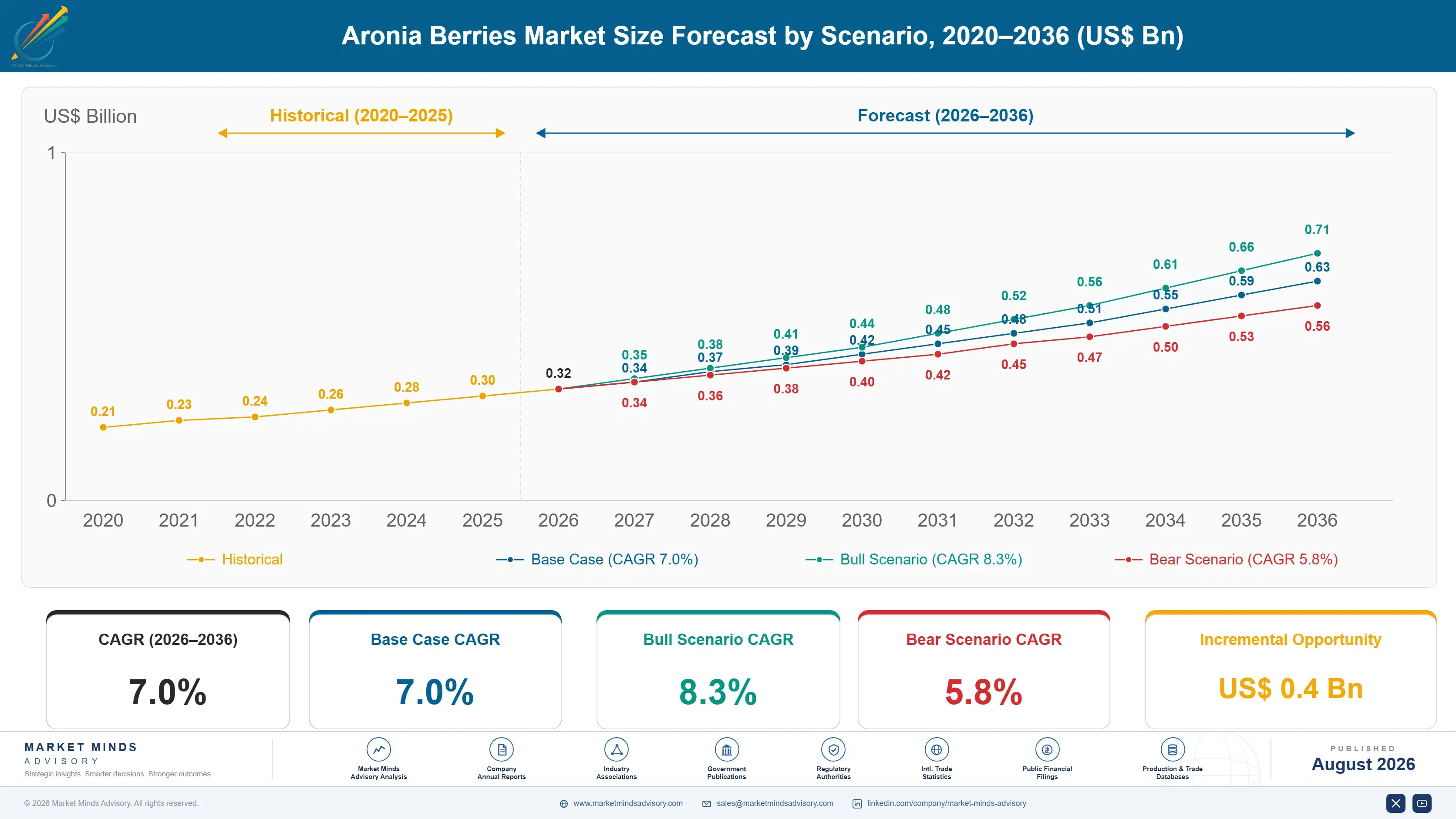
Aronia berries demand grew steadily from 2020 to 2025, as antioxidant-focused nutraceutical buyers discovered the fruit's exceptionally high polyphenol content relative to more established superfoods like blueberries and cranberries. Polish growing acreage expanded modestly to meet rising demand, though several cooperatives reported waiting lists for new contracted growers throughout the period. The market grew at a 6.0% historical CAGR from 2020 to 2025.
The base case carries aronia berries to a 7.0% CAGR through 2036 on three mechanisms. First, nutraceutical and supplement manufacturers keep scaling polyphenol-concentrated ingredient formulations as antioxidant health claims gain broader consumer acceptance across developed markets. Second, Japan and South Korea's functional food industries keep expanding antioxidant beverage and food applications that Western markets have been slower to commercialize. Third, Polish cooperatives keep expanding acreage to meet demand that has outpaced supply.
The bull case, 8.3%, assumes nutraceutical demand accelerates faster than currently projected as clinical research further validates aronia's polyphenol health claims relative to competing superfood ingredients. The bear case, 5.8%, assumes Polish supply constraints persist longer than expected, capping downstream product growth even as underlying consumer demand for antioxidant ingredients continues rising steadily.

A Supply-Concentrated Superfood Built On One Growing Region

Aronia berries occupy an unusual commercial position: a genuinely concentrated agricultural supply chain feeding an increasingly diversified set of downstream buyers. Poland's cooperative growing infrastructure, built up over decades, still supplies the overwhelming majority of global commercial fruit, giving Polish processors pricing influence few specialty crop categories concentrated this tightly ever grant a single country's cooperatives.
MARKET CONCENTRATIONCR5: 35%Top five processors hold roughly a third of sales
AVERAGE SELLING PRICEUSD 4.80 per kilogram powderExtract and powder pricing varies sharply by purity
TOP PRODUCING COUNTRYPoland: 76% of global cultivationDecades of cooperative growing infrastructure anchor production concentration
EXPORT TRADE INTENSITY58% of output crosses a borderCross border trade links Polish output to global buyers
RAW FRUIT COST SHARE35% to 45% of COGSHarvest yield swings drive most margin volatility directly
NUTRACEUTICAL GRADE PREMIUM55% to 90% over juice baseConcentrated extract commands far higher prices than juice
Downstream buyers split sharply by processing sophistication. Juice and juice concentrate buyers compete largely on price and delivered volume, while nutraceutical and supplement manufacturers pay meaningfully more for standardized polyphenol concentration and traceable sourcing documentation that raw juice processors rarely provide. That gap has widened as clinical interest in aronia's antioxidant profile has grown faster than raw juice demand itself, and it shows few signs of narrowing given how differently the two buyer groups make purchasing decisions.
Over the next decade, nutraceutical and functional food demand should keep pulling value upstream toward concentrated extract and powder formats, while Polish growing cooperatives face pressure to expand acreage faster than historical patterns suggest is easily achievable. Processing capacity, not raw demand, increasingly looks like the binding constraint on category growth.
"Everyone talks about polyphenol content, but almost nobody talks about the fact that a poor Polish harvest year moves global pricing more than any amount of clinical research ever could."
Director, Specialty Agriculture and Functional Ingredients Practice · MMA Agriculture and Food Ingredients Practice · August 2026

Market Trends

Clinical Research Validates Polyphenol Health Claims

A growing body of peer-reviewed research has documented aronia berries' exceptionally high polyphenol and anthocyanin content relative to blueberries, cranberries, and other established antioxidant fruits, giving nutraceutical marketers a genuinely differentiated clinical story to sell. Supplement brands increasingly cite specific polyphenol concentration figures on packaging, a marketing approach that requires standardized extract processing most raw juice suppliers cannot provide. Several university research programs across Europe and North America have published comparative antioxidant studies specifically featuring aronia, lending independent credibility that purely marketing-driven superfood claims often lack. This clinical validation is accelerating adoption faster than general consumer awareness.
Market Impact: Extract segment grows 9.0% annually
Japanese Functional Food Brands Adopt Antioxidant Formulations

Japan's established functional food industry, built around decades of consumer acceptance for health-claim beverages and supplements, has begun incorporating aronia extract into antioxidant-positioned drinks and functional food products at a pace Western markets have not matched. Japanese formulators value aronia's polyphenol concentration alongside its relatively neutral processing characteristics compared with more strongly flavored antioxidant fruits. Several major Japanese beverage companies have launched aronia-containing products since 2023, introducing the ingredient to a consumer base already primed to pay for functional health claims. This adoption pattern gives East Asian demand a commercial sophistication that newer Western nutraceutical entrants are still developing.
Market Impact: Research-backed brands command 35% premium

Market Opportunities and Growth Drivers

Antioxidant Supplement Demand Outpaces Raw Juice Growth

Consumer interest in concentrated antioxidant supplementation has grown considerably faster than demand for raw fruit juice, pushing nutraceutical manufacturers to secure standardized, traceable aronia extract supply well ahead of processing capacity expansion. Supplement brands increasingly specify minimum polyphenol concentration thresholds in supplier contracts, a quality requirement raw juice cooperatives were not originally built to meet at scale. That specification gap is pushing capital investment toward dedicated extract processing facilities separate from traditional juice concentrate infrastructure, a capital allocation shift still working through the Polish cooperative system as of 2025, unevenly across growers.
Market Impact: Poor harvests move pricing 25%

Comparative Antioxidant Research Builds Premium Positioning

Published comparative research consistently ranks aronia berries among the highest anthocyanin and polyphenol concentrations of any commercially cultivated fruit, a differentiated clinical story that nutraceutical marketers have increasingly built entire product positioning around rather than treating aronia as an interchangeable superfood ingredient. This research credibility lets premium supplement brands charge meaningfully more than for comparable antioxidant ingredients lacking similar published validation. Several ingredient suppliers have begun funding additional clinical research specifically to strengthen this positioning further, treating research investment as a genuine competitive differentiator rather than a marketing cost alone.
Market Impact: Awareness gap limits retail sales 20%

Market Restraints and Challenges

Polish Supply Concentration Creates Single-Region Risk

Poland's dominance of global commercial aronia cultivation, while historically advantageous for cost and quality consistency, exposes the entire category to weather, labor, and policy risk concentrated in a single growing region rather than diversified across multiple countries. The underlying cause is decades of accumulated growing infrastructure newer regions cannot replicate quickly, since aronia bushes need years to reach full yield. A poor Polish harvest year can move global pricing meaningfully within a single season, a volatility exposure buyers in more diversified categories rarely face. Some processors are responding by contracting acreage in Ukraine and the Baltic states as a hedge.
Market Impact: Nutraceutical demand grows 10.2% annually

Limited Consumer Awareness Outside Core Markets

Aronia berries remain genuinely unfamiliar to most consumers outside Central and Eastern Europe and a narrow band of nutraceutical-focused buyers elsewhere, limiting mainstream retail demand relative to more established superfoods like blueberries or acai. The underlying cause is that decades of Polish cultivation served primarily juice concentrate blending applications rather than direct consumer marketing, so the fruit never developed the branded consumer awareness that marketing-driven superfood categories built deliberately. That awareness gap constrains addressable direct-to-consumer market size even as nutraceutical demand grows steadily. Some brands are responding by blending aronia into more familiar berry products rather than marketing it standalone.
Market Impact: Japanese imports grow roughly 14% yearly
3 additional market trends, 3 additional growth drivers, and 3 additional restraints and challenges are covered in the full report. Contact sales@marketmindsadvisory.com to access the complete intelligence.

Segment CAGR and Growth Architecture

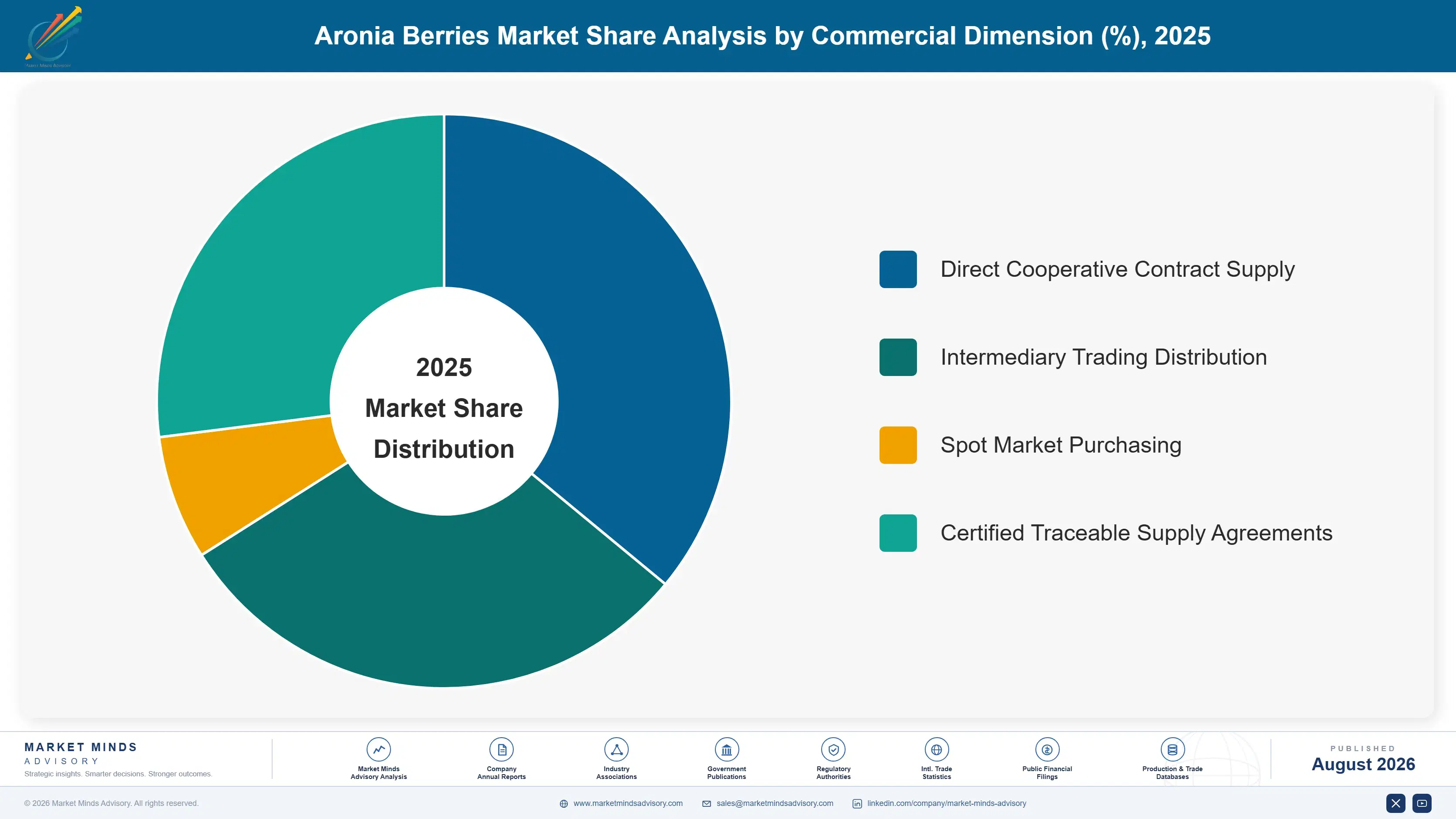
Segmentation follows product form, a single processing-based logic separating aronia berries by concentration and transformation applied to raw fruit. Fresh, juice, powder, dried, functional food, and nutraceutical formats each carry distinct input costs and buyer sophistication, keeping cultivation economics and commercial positioning from blurring together.
aronia-berries-market-trends-growth-market-share-analysis-1787462900564

Aronia Nutraceutical and Supplement Ingredients

Nutraceutical and supplement ingredient demand is growing at 10.2% annually, well over four in ten faster than the wider market's 7.0% pace, as supplement brands seek standardized, high-polyphenol extract for capsule and powder supplement formulations. Buyers require documented polyphenol concentration, traceable sourcing, and consistent batch quality that raw juice cooperatives were not originally built to provide at scale, narrowing the supplier base to processors that have invested specifically in extract-grade capacity. Retail pricing for nutraceutical-grade extract runs 55% to 90% above juice concentrate equivalents, reflecting both processing complexity and the clinical credibility premium research-backed positioning commands. Several Polish cooperatives have begun investing directly in dedicated extract processing infrastructure rather than continuing to sell primarily into commodity juice concentrate markets exclusively.
CAGR 10.2%

Aronia Powder and Extract

Powder and extract demand grows at 9.0% annually, driven by functional food manufacturers incorporating concentrated aronia into beverages, baked goods, and snack products seeking antioxidant positioning without the shelf-life complexity of fresh or juice formats. Japanese and South Korean functional food brands have adopted powder formats specifically because they blend more neutrally into existing product formulations than strongly flavored juice concentrate. Powder pricing sits below nutraceutical-grade extract but meaningfully above juice concentrate, reflecting moderate processing investment and drying infrastructure that most established Polish cooperatives have already built. Capacity expansion in this format has lagged demand growth somewhat, as processors have prioritized higher-margin nutraceutical extract investment over powder capacity in recent years.
CAGR 9.0%
Full segment breakdown across 6 segments available in the complete report.

Regional Architecture and Country Demand Map

Aronia berries production concentrates overwhelmingly in Eastern Europe, where Poland's cooperative growing infrastructure supplies the large majority of global commercial fruit. East Asia and North America carry disproportionate downstream nutraceutical demand relative to their production share, pulling processed exports from Polish growing regions higher each year.

North America

United States demand anchors North American aronia berries consumption, split between nutraceutical supplement manufacturers importing Polish extract and a smaller but growing domestic cultivation base concentrated in the Midwest, where aronia grows natively. FutureCeuticals and Van Drunen Farms both process domestically grown fruit alongside imported Polish concentrate to serve supplement and functional food customers. Canada follows a similar pattern at smaller scale, relying more heavily on imported extract given limited domestic cultivation. Growth here outpaces the global average as nutraceutical demand compounds alongside gradually expanding domestic acreage, reducing reliance on Polish imports for at least a portion of regional supply over time, a shift buyers increasingly value for its documented domestic traceability.
Share: 22% | CAGR: 7.8% (2026 to 2036)

Western Europe

Western Europe's aronia berries demand centers on Germany, where established juice and functional food brands built early consumer awareness decades before superfood marketing spread elsewhere, alongside growing nutraceutical demand in France and the Netherlands. German processors including AGRANA source heavily from neighboring Polish growing regions, benefiting from short supply chains and established cross-border trade relationships within the European Union. Growth trails the global average as the region's juice and functional food category is already relatively mature, with nutraceutical extract demand still representing a smaller share of overall consumption than in faster-growing Asian and North American markets currently, despite the region's early consumer familiarity with the fruit and its decades-old juice heritage.
Share: 18% | CAGR: 5.5% (2026 to 2036)
Regional intelligence for 5 additional markets available in the complete report: East Asia, South Asia and Pacific, Latin America, Middle East and Africa, Eastern Europe. Contact sales@marketmindsadvisory.com.
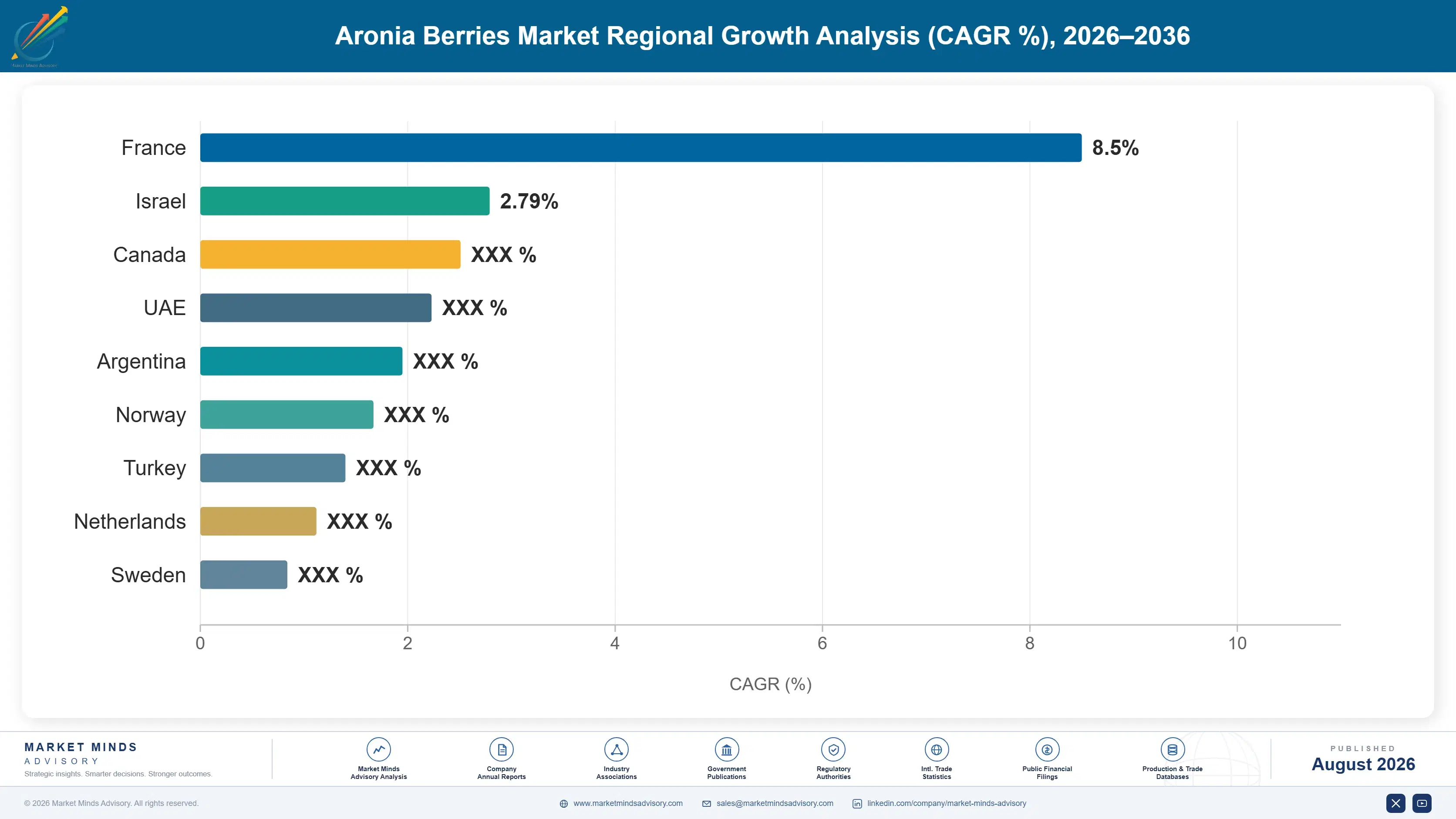
aronia-berries-market-trends-growth-country-cagr-analysis-1787462901070

Where Aronia Processors Can Capture Margin

Margin defense in aronia berries increasingly depends on moving beyond commodity juice concentrate pricing toward positioning that lets a processor charge for standardized extract quality, clinical credibility, or traceable sourcing documentation. The four moves below target the fastest-growing nutraceutical and functional food buyers most willing to pay well above juice concentrate pricing for genuine differentiation.

Build Dedicated Extract Processing Ahead of Demand

Nutraceutical-grade extract commands retail pricing running 55% to 90% above juice concentrate equivalents, and demand from supplement manufacturers has grown considerably faster than dedicated extract processing capacity across Polish cooperatives. Processors that invest in standardized extract infrastructure now capture premium nutraceutical contracts before competitors establish comparable processing capability, since supplement brands increasingly specify minimum polyphenol concentration thresholds that commodity juice processing cannot reliably meet. The capital investment is meaningful, requiring new drying and concentration equipment, but the margin uplift over juice concentrate pricing more than justifies the cost for most established cooperatives.
Market Impact: Extract processing captures a 55% to 90% premium

Fund Clinical Research To Build Premium Credibility

Published comparative antioxidant research has become an increasingly decisive purchasing signal for nutraceutical brands, letting research-backed suppliers command retail pricing running roughly 35% above unvalidated competitors regardless of underlying polyphenol content similarity. Processors that fund university research partnerships now capture premium contracts before competitors establish similar clinical credibility, since supplement brands increasingly treat published validation as a baseline sourcing requirement rather than a differentiating bonus. The research investment requires meaningful time and funding commitment before publication, but the pricing premium and contract security more than compensate across a multi-year supplier relationship for most mid-sized processors.
Market Impact: Research-backed suppliers typically earn roughly a 35% premium

Diversify Growing Regions To Hedge Weather Risk

Poland's near-total dominance of commercial cultivation exposes every downstream buyer to single-region weather and harvest risk that can move pricing by 25% or more within a single poor season. Processors that contract acreage expansion in Ukraine, the Baltic states, or North American Midwest growing regions now build supply diversification that competitors relying purely on Polish sourcing cannot match during a bad harvest year. The diversification investment requires multi-year acreage development given aronia's slow maturation to full commercial yield, but the supply security it provides justifies the cost for processors serving contract-sensitive nutraceutical customers.
Market Impact: Diversified sourcing typically reduces price risk by 25%

Expand Into Japanese and Korean Functional Food Contracts

Japan and South Korea's functional food industries have adopted aronia extract faster than most Western markets, with Japanese import volume growing roughly 14% annually since 2023, giving early-moving processors access to a buyer base already primed to pay for clinically validated antioxidant ingredients. Processors that build direct relationships with Japanese and Korean functional food manufacturers now capture contracts before competitors establish comparable Asian distribution, since these buyers increasingly prefer direct sourcing over intermediary trading companies. The relationship-building investment requires meaningful time and regulatory compliance, but the contract volume available exceeds most comparable Western opportunities currently.
Market Impact: Asian functional food contracts grow roughly 14% yearly

Who Controls the Margin Pool

Competitive concentration sits at a moderate CR5 of 35%, reflecting a market split between large diversified European fruit processors competing on juice concentrate volume and smaller specialized nutraceutical ingredient suppliers holding disproportionate share of extract-grade demand. The gap between category leaders and mid-tier challengers remains meaningful but not overwhelming, since raw fruit supply concentration in Poland matters more than any individual processor's scale.
Competitive activity currently runs along three lines. Large juice concentrate processors compete on volume and established European distribution relationships built over decades of commodity fruit trading. Extract specialists compete on standardization and research credibility, racing to secure contracts before competitors establish validation. Growing cooperatives compete on raw fruit supply security, since access to Polish acreage increasingly determines downstream processing capacity regardless of technical sophistication.

Pressure is building from two directions. Asian and North American nutraceutical buyers are increasingly contracting directly with Polish growing cooperatives, bypassing traditional European trading intermediaries that once controlled most export volume. Meanwhile clinical research investment is becoming a differentiator, rewarding processors willing to fund validation studies over those competing purely on price. Rankings over five years will favor whoever combines secured supply with credible processing capability.
aronia-berries-market-trends-growth-company-positioning-matrix-1787462901593

Competitive Moat and Risk Dimensions

AGRANA BETEILIGUNGS-AG

Moat: Established European fruit trading scale

AGRANA's decades of European fruit preparation and juice concentrate trading give it purchasing relationships across Polish growing cooperatives that newer entrants cannot replicate quickly, alongside processing infrastructure spanning multiple product categories. That scale lets AGRANA offer supply reliability that smaller specialized processors, however technically sophisticated, genuinely struggle to match consistently.
AGRANA BETEILIGUNGS-AG

Risk: Overexposed to commodity juice pricing

AGRANA's aronia business remains concentrated in commodity juice concentrate trading rather than higher-margin nutraceutical extract, exposing the company to thinner margins than specialized competitors capture, and the company has been slower than some smaller rivals to build dedicated extract processing capacity despite growing nutraceutical demand signals.
FUTURECEUTICALS INC

Moat: Vertically integrated domestic supply chain

FutureCeuticals controls domestic Midwest aronia cultivation alongside processing infrastructure, giving it supply chain traceability and quality consistency that importers relying entirely on Polish sourcing cannot easily replicate for United States nutraceutical customers seeking documented domestic origin claims, a positioning that has taken years to build credibly.
FUTURECEUTICALS INC

Risk: Limited scale versus Polish supply

FutureCeuticals' domestic growing capacity remains small relative to Polish cultivation volume, meaning the company cannot fully insulate itself from global pricing dynamics set primarily by Polish harvest conditions, limiting how much of its own growth it can support through domestic supply alone without meaningful additional acreage investment.

Players Tracked

Prominent Players

AGRANA Beteiligungs-AG
Sensient Technologies Corporation
FutureCeuticals Inc
Van Drunen Farms
Iprona SpA

Other Key Players

Naturex SA
Artemis International Inc
Kanegrade Limited
Milne Fruit Products Inc
Symrise AG
DDW The Colour House
Diana Food
Nutrafur SA
Pektowin Sp. z o.o.
Fructus d.o.o.
Global Organics Ltd
Nordic Berries AB
SVZ International BV
Dohler Group SE
Wild Flavors Inc

Recent Developments

MAY 2024

FutureCeuticals expands Midwest aronia growing acreage

FutureCeuticals expanded contracted domestic aronia growing acreage across its Midwest supplier network, responding to sustained nutraceutical customer demand for documented domestic-origin fruit alongside imported Polish extract. The expansion was an organic acreage investment, not a joint venture or acquisition, funded through existing operating cash flow.
Signal: Signals nutraceutical buyers valuing domestic traceability enough to fund acreage expansion outside Poland's dominant growing base.
SEPTEMBER 2024

AGRANA opens dedicated extract processing line in Poland

AGRANA commissioned a dedicated nutraceutical-grade extract processing line at an existing Polish facility, shifting incremental capacity away from commodity juice concentrate toward higher-margin supplement ingredient production for its growing customer base. The investment was an organic capacity expansion, not a joint venture or acquisition of any Polish grower cooperative.
Signal: Signals large commodity processors following smaller specialists into higher-margin nutraceutical extract production directly rather than staying purely commodity-focused.
FEBRUARY 2025

Sensient Technologies acquires minority stake in Baltic growing cooperative

Sensient Technologies acquired a minority equity stake in a Baltic aronia growing cooperative to diversify raw fruit sourcing beyond its existing Polish supply relationships ahead of anticipated capacity constraints. The transaction was a minority equity investment, not a full acquisition, merger, or joint venture arrangement.
Signal: Signals established processors hedging single-region supply risk through direct upstream investment rather than long-term contracts alone.

Raw Fruit Supply Sets The Margin Ceiling

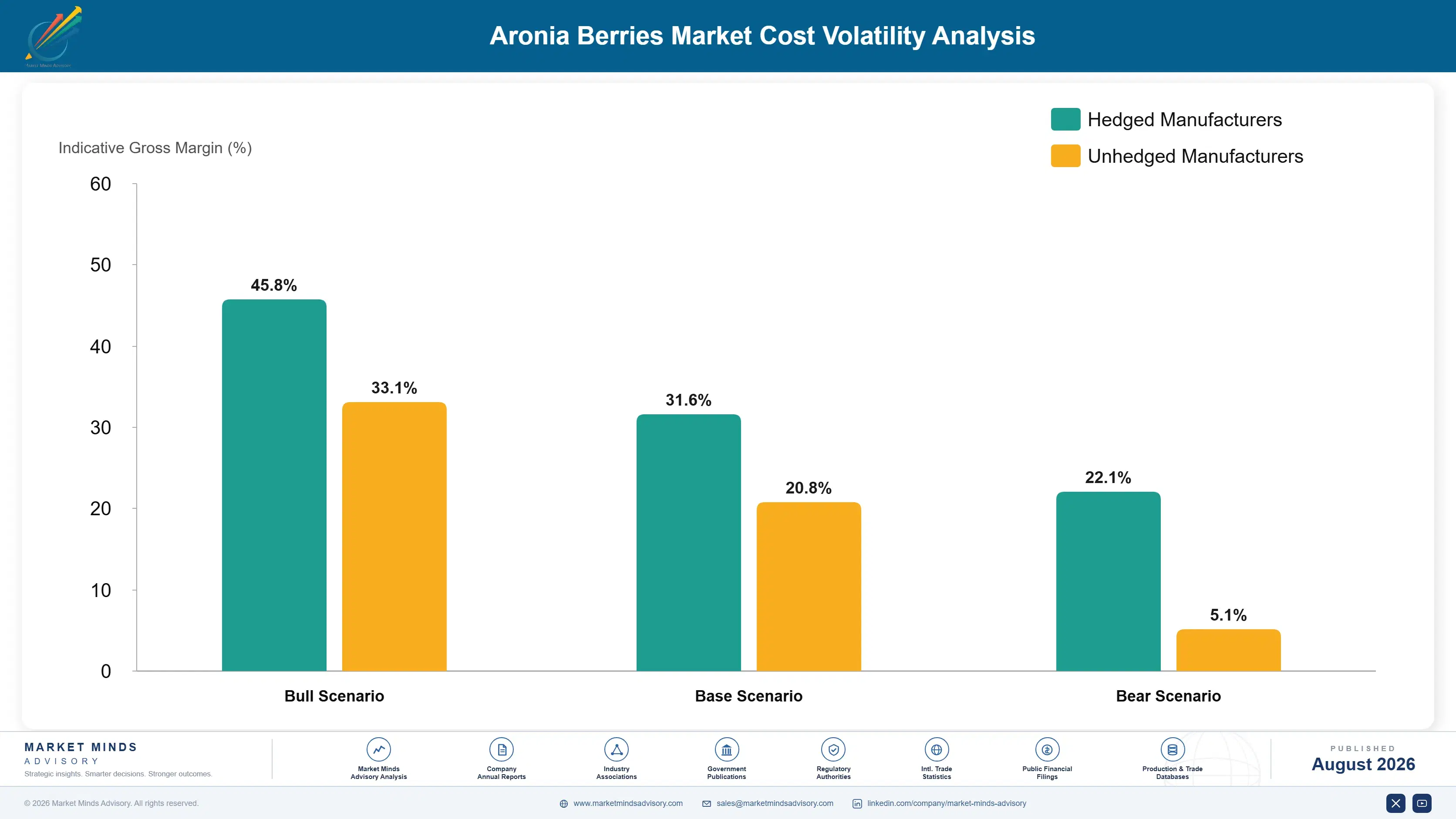
Raw aronia fruit accounts for 35% to 45% of production cost across juice, powder, and extract formats, sourced almost entirely from Polish and Baltic growing cooperatives rather than any globally diversified agricultural supply chain. Processing costs including drying, concentration, and standardized extraction add a further meaningful share, varying considerably depending on whether a processor targets commodity juice concentrate or nutraceutical-grade extract output specifically.
The 2023 Polish harvest shortfall illustrated raw fruit exposure directly. Polish agricultural ministry data recorded a meaningfully reduced aronia harvest that year following unfavorable spring weather conditions across major growing regions. Processors without diversified sourcing or forward supply contracts absorbed significant cost increases, passing some of that cost through to nutraceutical customers who had few alternative supply sources to switch toward given Poland's overwhelming cultivation dominance.

Exposure falls hardest on smaller processors without long-term growing cooperative relationships or forward purchase contracts, who must buy raw fruit closer to spot pricing during harvest season and absorb whatever margin compression results from weather-driven yield swings. Larger diversified processors with established multi-year cooperative relationships and diversified growing region exposure smooth that volatility considerably better than smaller, single-region-dependent competitors.
aronia-berries-market-trends-growth-cost-volatility-analysis-1787462901788

Lock Multi-Year Growing Cooperative Contracts

Processors negotiating multi-year forward purchase agreements directly with Polish and Baltic growing cooperatives convert volatile harvest-season spot pricing into a planned input cost, protecting downstream customer pricing that nutraceutical buyers resist adjusting frequently. This favors larger established processors with existing cooperative relationships, but smaller processors can access similar terms through regional purchasing consortia rather than negotiating individually.

Diversify Growing Region Exposure Beyond Poland

Processors reduce single-region weather exposure by contracting acreage across Poland, Ukraine, the Baltic states, and North American Midwest growing regions rather than depending entirely on Polish supply. That diversification smooths input availability across different weather patterns and harvest timing, though it adds supplier qualification complexity across each additional growing region a processor decides to incorporate into its network.

Build Forward Inventory Buffers Ahead of Harvest Risk

Processors serving contract-sensitive nutraceutical customers increasingly hold larger frozen and dried fruit inventory buffers ahead of harvest season, reducing exposure to any single poor harvest disrupting customer supply commitments. This inventory strategy requires meaningful working capital investment, but protects customer relationships that would otherwise face supply disruption during weather-driven shortfalls affecting the broader Polish growing region.

Portfolio Architecture for Margin Defence

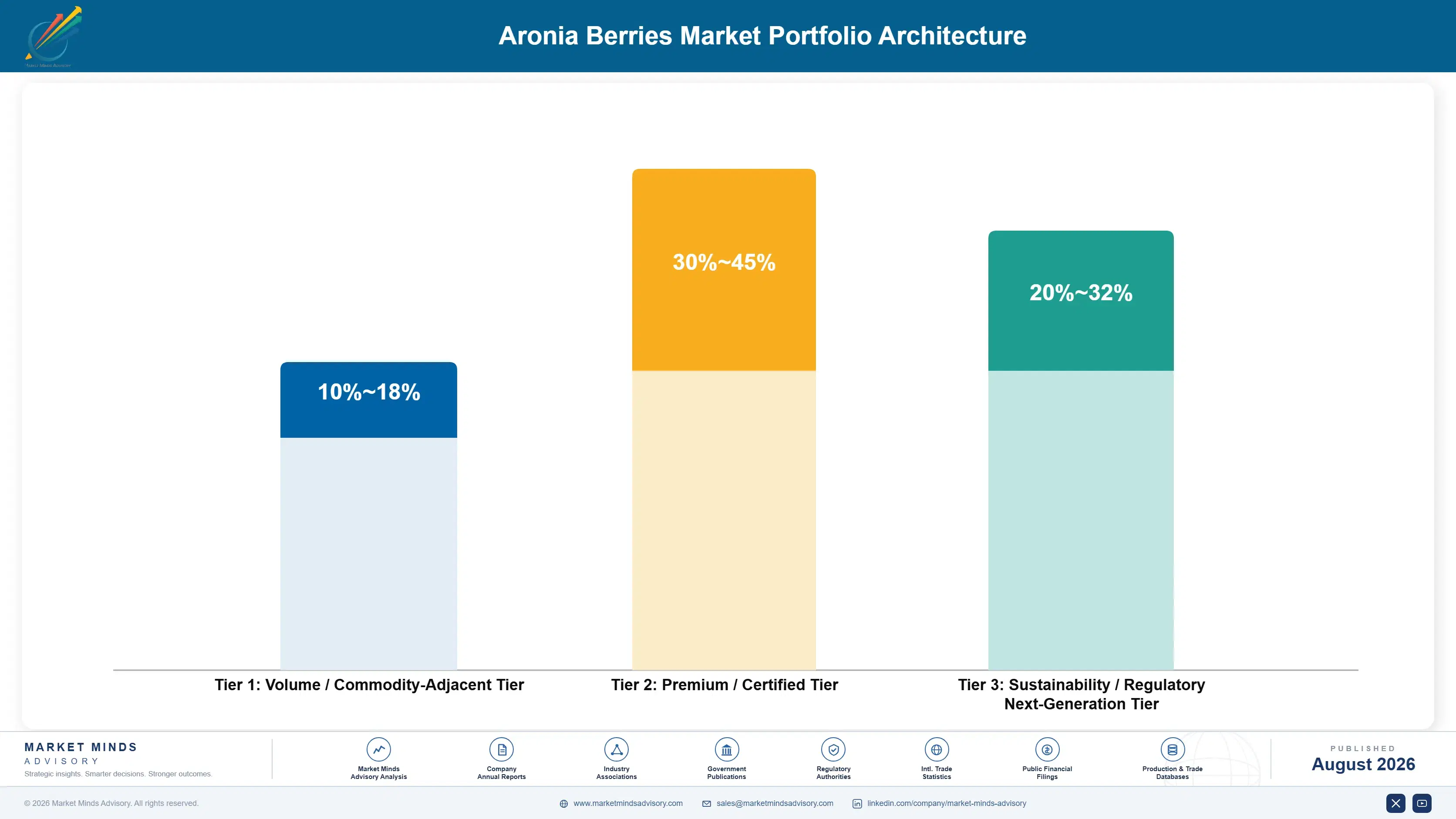
Aronia berries' portfolio splits into three tiers with meaningfully different margin economics. Volume juice concentrate, sold through commodity fruit trading channels on price and delivered volume, competes on cost and earns steady but thin margins. Certified nutraceutical extract and clinically validated ingredient formats earn substantially more, since polyphenol standardization and research credibility create switching costs that commodity juice processors cannot replicate quickly.
The tension for processors is capital allocation between two economics. Volume juice concentrate production generates dependable cash flow that funds operations and raw fruit purchasing, while nutraceutical extract capacity requires meaningful processing investment before generating comparable returns at much higher margin. Processors leaning entirely on volume risk losing share to faster-growing nutraceutical formats, while those chasing extract capacity too aggressively risk underutilized premium capacity if supplement demand growth proves less durable than currently projected.

High-value margin pools concentrate in nutraceutical extract and research-validated ingredient formats carrying genuine clinical differentiation that commodity juice cannot match. Frontier opportunity sits in combining secured diversified raw supply with credible clinical research investment, letting processors capture premium pricing from supplement manufacturers while retaining steady commodity juice concentrate revenue simultaneously.

Volume / Commodity-Adjacent Tier

Juice concentrate sold through commodity fruit trading channels on price and delivered volume, priced close to comparable berry juice concentrates with minimal differentiation between competing European processors beyond delivered logistics.
Gross Margin: 10-18%

Premium / Certified Tier

Standardized nutraceutical-grade extract and powder carrying documented polyphenol concentration and traceable sourcing that commands sustained premiums over commodity juice concentrate across supplement and functional food buyers worldwide, particularly in Asia.
Gross Margin: 30-45%

Sustainability / Regulatory / Next-Generation Tier

Emerging clinically-validated, research-backed ingredient formulations positioned ahead of growing nutraceutical sourcing transparency requirements, though scale-up economics and diversified sourcing infrastructure remain unproven at full commercial production volume across most current producers today.
Gross Margin: 20-32%
aronia-berries-market-trends-growth-portfolio-architecture-1787462902290

High-value Sub-segments and Strategic Watch-out

Aronia Nutraceutical and Supplement Ingredients

Nutraceutical demand grows fastest at 10.2% annually and already commands retail premiums of 55% to 90% over juice concentrate. Polish cooperatives investing in extract processing and specialized ingredient suppliers both continue expanding capacity, and growing clinical validation should keep margin strong through the forecast period ahead.
Gross Margin: 30-45%

Aronia Powder and Extract

Powder and extract demand grows at a healthy 9.0% annually, driven by Japanese and Korean functional food adoption, though processing capacity constraints and Polish harvest variability limit how quickly suppliers can scale beyond current contracted volume commitments across most of their existing customer base today.
Gross Margin: 25-38%

Aronia Juice and Juice Concentrate

Juice concentrate remains the largest format by volume, anchored by decades of European commodity fruit trading relationships. Margins stay steady but modest, competing on price and delivered volume rather than differentiation, but the segment anchors baseline category revenue globally today across every major established processor.
Gross Margin: 10-18%

Fresh and Frozen Aronia Berries

Fresh and frozen fruit sales face gradual substitution pressure as processed powder and extract formats gain shelf-life and formulation convenience advantages over raw fruit sold directly. Producers concentrated in this segment risk volume erosion over the next decade absent diversification into processed formats entirely.
Gross Margin: 8-15%

Why Aronia Supply Contracts Run Long

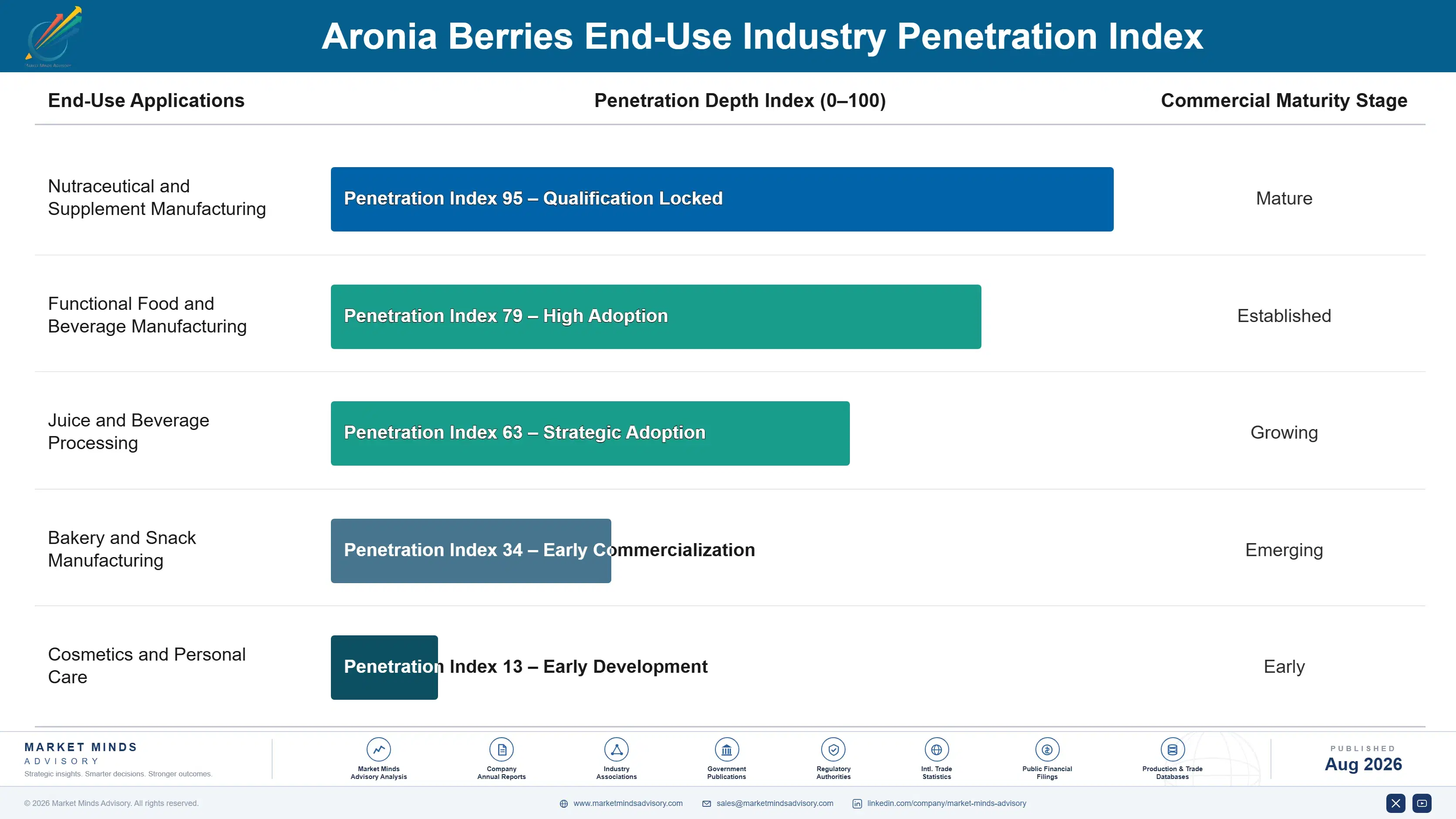
Aronia berries demand behaves like an annuity within nutraceutical supply relationships, since supplement manufacturers qualify a processor through documented polyphenol testing and then commit to multi-year forward purchase agreements rather than re-tendering every harvest season, given the risk of supply disruption from switching suppliers during Poland's constrained growing capacity. Juice concentrate buyers behave more transactionally, switching more readily on price since standardization requirements are looser.
Stickiness varies sharply by buyer sophistication. Nutraceutical and supplement manufacturers rarely switch processors once qualified, given the testing and validation cost involved in establishing a new supply relationship. Functional food buyers in Japan and South Korea show similarly strong loyalty once a supplier proves consistent quality. Commodity juice concentrate buyers remain the least sticky segment, switching between processors more readily as price and delivered volume shift season to season.

Buyer profiles are shifting generationally within supplement and functional food companies specifically. Younger procurement teams increasingly treat clinical research validation and sourcing traceability as standing requirements rather than negotiable preferences, a shift that favors processors who invested early in research partnerships and diversified, documented supply chains over those still competing purely on commodity pricing.
aronia-berries-market-trends-growth-end-use-penetration-index-1787462902777

Where Aronia Processors Should Bet

These are among the four positions where our research anticipates prominent divergence between winners and laggards over the coming forecast period. Each is grounded in the demand model, the regulatory perimeter, and the announced capacity pipeline.
01 / EXTRACT CAPACITY INVESTMENT

Build nutraceutical extract processing before demand outpaces supply

Nutraceutical extract demand is growing at well over four in ten faster than the wider market's pace, and already commands premiums of 55% to 90% above juice concentrate, yet most Polish cooperatives still process primarily for commodity juice markets rather than dedicated extract production. Processors that invest now in standardized extract infrastructure position ahead of continuing supplement manufacturer demand growth across every major developed market. Waiting risks ceding the category's fastest-growing and highest-margin segment permanently to competitors currently building that capacity.
02 / SUPPLY DIVERSIFICATION PRIORITY

Diversify growing regions before the next Polish harvest shortfall

Poland's overwhelming dominance of commercial cultivation exposes every processor and downstream buyer to single-region weather risk that has already moved pricing by 25% or more within a single poor season. Processors that contract acreage expansion in Ukraine, the Baltic states, or North American growing regions now build supply security that competitors relying purely on Polish sourcing cannot match during the next weather-driven shortfall. Every processor without a diversification plan today carries uncompensated risk that will resurface at the next harvest disruption.
03 / CLINICAL RESEARCH TIMING

Fund validation research before it becomes a baseline requirement

Published comparative antioxidant research has become an increasingly decisive purchasing signal commanding roughly a 35% pricing premium over unvalidated competitors, yet that premium will likely compress as research validation becomes a baseline sourcing expectation rather than genuine differentiation. Processors that fund research partnerships now capture premium contracts while the credential still meaningfully differentiates their supply from unvalidated competitors in a crowded sourcing landscape most buyers now scrutinize closely. Processors that delay this investment risk entering a market where validation carries cost but no longer commands meaningful premium pricing.
04 / ASIAN MARKET EXPANSION

Build direct Japanese and Korean relationships before intermediaries do

Japan and South Korea's functional food industries have adopted aronia extract faster than most Western markets, giving early-moving processors access to a sophisticated buyer base already willing to pay for clinically validated antioxidant ingredients through direct sourcing relationships. Processors that build these relationships now capture contract volume before competitors or trading intermediaries establish comparable Asian distribution networks of their own. Every processor relying purely on European and North American sales risks missing the category's most sophisticated and fastest-growing buyer base entirely.

Engagement Snapshot From the Field

A live engagement with an industry participant carrying material or product regulatory and market exposure ahead of a defining policy shift, showing how our research translates into a defensible multi-year portfolio strategy.
MARKET MINDS ADVISORY · CLIENT ENGAGEMENT SUMMARY
Aronia Berries Producer Strategic Portfolio Review and Transition Roadmap 2026·Investment Scenario on Aronia Berries Exposure Evaluation 2025-26
CLIENT PROFILE
A mid-sized United States nutraceutical ingredient supplier serving supplement and functional food manufacturers approached MMA while evaluating whether to expand direct sourcing relationships with Polish growing cooperatives or continue purchasing through established European trading intermediaries. The client reported annual ingredient revenue near USD 140 million, with aronia extract accounting for roughly 15% of total volume and sourcing costs rising following the 2023 Polish harvest shortfall (client-reported, unverified by MMA).
STRATEGIC CHALLENGE
Management faced a sourcing decision between building direct cooperative relationships requiring meaningful upfront relationship investment and travel, or continuing to purchase through intermediaries at a markup but with lower operational complexity. The commercial team worried direct sourcing would take years to establish reliable volume commitments, while the finance team questioned whether intermediary markups justified the operational simplicity they provided.
MMA APPROACH
MMA benchmarked direct cooperative sourcing costs against current intermediary pricing across several volume scenarios, assessed the client's operational capacity to manage direct international grower relationships, and evaluated comparable direct-sourcing transitions among peer nutraceutical ingredient suppliers. We also modeled supply security improvements from direct relationships against the Polish harvest shortfall risk the client had already experienced.
KEY FINDINGS
  1. Direct cooperative sourcing offered meaningful cost savings above a minimum volume threshold, but required dedicated staff time the client's existing operations team could not support without additional hiring.
  2. Comparable peer transitions to direct sourcing typically took twelve to eighteen months to establish reliable volume commitments, longer than the client's initial planning assumed for full transition.
  3. Intermediary relationships provided harvest shortfall flexibility through pooled cooperative access that direct single-cooperative relationships could not immediately replicate without additional supplier diversification (client-reported, unverified by MMA).
  4. A hybrid approach combining direct sourcing for baseline volume with intermediary relationships for surge capacity balanced cost savings against supply security more effectively than either pure approach.
CLIENT PROFILE
A mid-sized United States nutraceutical ingredient supplier serving supplement and functional food manufacturers approached MMA while evaluating whether to expand direct sourcing relationships with Polish growing cooperatives or continue purchasing through established European trading intermediaries. The client reported annual ingredient revenue near USD 140 million, with aronia extract accounting for roughly 15% of total volume and sourcing costs rising following the 2023 Polish harvest shortfall (client-reported, unverified by MMA).
STRATEGIC CHALLENGE
Management faced a sourcing decision between building direct cooperative relationships requiring meaningful upfront relationship investment and travel, or continuing to purchase through intermediaries at a markup but with lower operational complexity. The commercial team worried direct sourcing would take years to establish reliable volume commitments, while the finance team questioned whether intermediary markups justified the operational simplicity they provided.
MMA APPROACH
MMA benchmarked direct cooperative sourcing costs against current intermediary pricing across several volume scenarios, assessed the client's operational capacity to manage direct international grower relationships, and evaluated comparable direct-sourcing transitions among peer nutraceutical ingredient suppliers. We also modeled supply security improvements from direct relationships against the Polish harvest shortfall risk the client had already experienced.
KEY FINDINGS
  1. Direct cooperative sourcing offered meaningful cost savings above a minimum volume threshold, but required dedicated staff time the client's existing operations team could not support without additional hiring.
  2. Comparable peer transitions to direct sourcing typically took twelve to eighteen months to establish reliable volume commitments, longer than the client's initial planning assumed for full transition.
  3. Intermediary relationships provided harvest shortfall flexibility through pooled cooperative access that direct single-cooperative relationships could not immediately replicate without additional supplier diversification (client-reported, unverified by MMA).
  4. A hybrid approach combining direct sourcing for baseline volume with intermediary relationships for surge capacity balanced cost savings against supply security more effectively than either pure approach.
RECOMMENDED STRATEGY
Phase 1: Phase 1 (0 to 6 months): Hire dedicated sourcing staff and establish initial direct relationships with two Polish cooperatives for baseline volume commitments. Phase 2: Phase 2 (6 to 18 months): Scale direct sourcing volume gradually while retaining intermediary relationships for surge capacity during harvest variability. Phase 3: Phase 3 (18 to 36 months): Reassess intermediary reliance once direct cooperative relationships prove reliable across at least one full harvest cycle.
OUTCOME
The client began building direct cooperative relationships while retaining intermediary access for surge capacity, achieving meaningful cost savings on baseline volume within the first year. Supply reliability held steady through a subsequent moderate harvest variation, and the client reported improved margin on nutraceutical extract sourcing overall (client-reported, unverified by MMA).

Frequently Asked Questions

Foundational context covering the market sizes, CAGR, scope, country, region and competition that inform every finding below. This section is provided to cover basics and most often pre-purchase conversations, answered from the MMA Primary Research Dataset.

What is the current size of the Aronia Berries Market?

The global aronia berries market reached USD 0.37 billion in 2025, based on MMA Primary Research Dataset findings. Growth increasingly reflects nutraceutical and functional food demand rather than commodity juice volume alone.

How large will the Aronia Berries Market be by 2036?

MMA's base case projects the market reaching USD 0.73 billion by 2036, an incremental opportunity of roughly USD 0.36 billion over the 2026 to 2036 forecast period.

What is the CAGR for the Aronia Berries Market 2026 to 2036?

The base case CAGR is 7.0%, with a bull case of 8.3% and a bear case of 5.8% depending on Polish supply expansion and nutraceutical demand pace.

Which segment is growing fastest?

Nutraceutical and supplement ingredients lead at a 10.2% CAGR, well over four in ten faster than the overall market rate, as supplement brands seek standardized polyphenol extract.

Who are the major companies in the Aronia Berries Market?

Leading participants include AGRANA Beteiligungs-AG, Sensient Technologies Corporation, FutureCeuticals Inc, Van Drunen Farms, and Iprona SpA, assessed on processing capacity, supply chain reach, and sourcing diversification.

Which country is growing fastest?

Japan leads country-level growth, driven by its established functional food industry rapidly adopting antioxidant-positioned beverages and foods built around aronia extract ahead of most Western markets.

Report Segmentation Architecture

The full report scope spans multiple orthogonal segmentation dimensions, with cross-tabulated demand data provided for each dimension pair. Coverage extends further to regional breakdowns, trend trajectories, and the competitive detail needed to support segment-level decision-making.

By Product Form

  • Fresh and Frozen Aronia Berries
  • Aronia Juice and Juice Concentrate
  • Aronia Powder and Extract
  • Dried Aronia Berries
  • Aronia-Infused Functional Foods and Beverages
  • Aronia Nutraceutical and Supplement Ingredients

By End-Use Industry

  • Nutraceutical and Supplement Manufacturing
  • Functional Food and Beverage Manufacturing
  • Juice and Beverage Processing
  • Bakery and Snack Manufacturing
  • Cosmetics and Personal Care

By Commercial Dimension

  • Direct Cooperative Contract Supply
  • Intermediary Trading Distribution
  • Spot Market Purchasing
  • Certified Traceable Supply Agreements

By Region

  • North America
  • Western Europe
  • East Asia
  • South Asia and Pacific
  • Latin America
  • Middle East and Africa
  • Eastern Europe

Scope, Methodology, and Coverage

Every figure in this report is reproducible from documented input assumptions. The scope below maps the historical period, the forecast horizon, the segmentation dimensions, and the countries covered, alongside the underlying primary and qualitative methodology.
Historical Period
2020 to 2025
Forecast Period
2026 to 2036
Base Year
2025 (USD billions; MMA Primary Research Dataset, August 2026)
Market Definition
The aronia berries market covers commercial cultivation and first-stage processing of aronia melanocarpa fruit into juice, juice concentrate, powder, extract, dried fruit, and nutraceutical ingredient formats. It excludes finished consumer products such as branded juice bottles or supplement capsules sold at retail, which the industry classifies as separate downstream categories.
Quantitative Units
USD billions (current prices); metric tonnes of aronia fruit production and processed ingredient volume where applicable
Segmentation Dimensions
By Product Form; By End-Use Industry; By Commercial Dimension; By Region
Regions Covered
North America, Western Europe, East Asia, South Asia and Pacific, Latin America, Middle East and Africa, Eastern Europe
Countries Covered
USA, China, Germany, France, UK, Japan, South Korea, India, Australia, Canada, Brazil, Mexico, Indonesia, Vietnam, Thailand, Malaysia, UAE, Saudi Arabia, South Africa, Nigeria, Turkey, Poland, Netherlands, Italy, Spain, Sweden, Switzerland, Argentina, Colombia, Singapore, and additional markets relevant to this sector
Key Companies Profiled
AGRANA Beteiligungs-AG, Sensient Technologies Corporation, FutureCeuticals Inc, Van Drunen Farms, Iprona SpA, Naturex SA, Artemis International Inc, Kanegrade Limited, Milne Fruit Products Inc, Symrise AG, DDW The Colour House, Diana Food, Nutrafur SA, Pektowin Sp. z o.o., Fructus d.o.o., Global Organics Ltd, Nordic Berries AB, SVZ International BV, Dohler Group SE, Wild Flavors Inc
Quantitative Methodology
Primary survey, n=3,800 respondents, Q4 2025, six countries; demand-side model with trade association cross-validation
Qualitative Methodology
47 expert interviews, Q4 2025; applied to validate demand model assumptions, identify emerging dynamics, and assess competitive positioning
Report Format
PDF and XLSX data workbook (Word format preview document)
Publisher
Market Minds Advisory
Report Code
MMA-2026-AGR-102
Published
August 2026
Contact
sales@marketmindsadvisory.com | www.marketmindsadvisory.com

Purchase the full Aronia Berries Market Report (2026 to 2036).

The full MMA Aronia Berries report sizes the market across six product form segments, five end-use industries, four commercial supply models, and seven regions through 2036. It profiles twenty participants on a consistent basis of processing capacity and supply chain reach across juice, powder, and nutraceutical extract formats, scoring each on sourcing diversification, clinical research investment, and Asian market access. Scenario models quantify how Polish harvest variability, nutraceutical demand growth, and Japanese functional food adoption move both category volume and realizable pricing. The report also includes raw fruit cost modeling, a clinical research investment benchmark, and Asian market entry assessment built for ingredient, brand, and investment strategy teams.
Six-format demand model with processing-adjusted pricing
Raw fruit cost and harvest volatility scenario modeling
Clinical research investment and credibility benchmarking
Twenty-company competitive profiling on consistent processing basis
Seven-region demand map with country-level growth detail
Japanese and Korean functional food market entry assessment

Built For The People Who Decide

From boardroom strategy to bench-side execution, this report is read cover-to-cover by leaders shaping the next decade of their industry, turning demand scenarios, market dynamics and valuation benchmarks into decisions.
CXOs/ Presidents/ VPs/ Managers
M&A and Corporate Development
Strategy Teams and R&D Heads
Procurement and Product Directors
Regulatory and Compliance Leaders
Investor Relations and Equity Analysts