
Market Minds Advisory
Anti-Stress Feed Supplements Market

Anti-Stress Feed Supplements Market: Heat Stress Mitigation and the Antibiotic-Free Transition

Anti-stress feed supplements now sit at the center of a heat-stress mitigation push across dairy and poultry operations, an antibiotic-free production mandate, and an adaptogenic ingredient sourcing race outpacing supplier qualification cycles.

Lead Analyst

Lisa Gevelber

Published

September 2026

Make Smarter Decisions with Customized Research Insights

Request a free sample report and evaluate market opportunities, growth trends, and competitive dynamics relevant to your business needs.

2025 MARKET VALUE$1.1BMarket Size 2025
2036 FORECAST VALUE$4.5BBase Case , 2026 to 2036
CAGR 2026 TO 203613.6 %Bull 14.9% / Bear 12.2%
INCREMENTAL OPPORTUNITY$3.2BNet 10- year value creation
EXPANSION MULTIPLE3.58x2036 value over 2026 base
Strategic Levers
M&A Pipeline
Regional Outlook
Country Rankings
Competitive Intelligence
Segmental Deep-dive
Call-Us : 91 93563 13602

Executive Snapshot and Market Trajectory

Livestock producers are adopting anti-stress feed supplements faster than independent efficacy data can keep pace, as heat stress losses and antibiotic-free production mandates push dairy and poultry operations toward adaptogenic and probiotic formulations with limited long-term field validation across commercial scale herds and flocks. Adoption timelines vary considerably.
Adaptogenic herbal extracts and postbiotic formulations are pulling category growth well ahead of conventional electrolyte and vitamin blends, as producers seek measurable productivity recovery during heat events rather than simple hydration support. North America commands the largest share on advanced adoption infrastructure, while India and Brazil are scaling fastest as dairy heat stress and poultry export quality requirements push adoption from a much smaller current base.
Competitive structure remains moderately concentrated among established animal nutrition majors, though specialty adaptogen and postbiotic developers are gaining share through faster new product introduction cycles than larger incumbents can match. Regulatory pressure on antibiotic growth promoters continues compounding adoption urgency, pushing large feed additive companies toward acquisition of specialty ingredient developers rather than slower internal formulation programs. a divergence increasingly visible across major producing regions and supplier categories. That gap is expected to widen.
Market Definition
The anti-stress feed supplements market covers functional feed additives formulated to mitigate physiological stress from heat, transport, weaning, and disease challenge in livestock and poultry, including adaptogenic herbal extracts, betaine and osmolytes, probiotics and postbiotics, electrolyte and mineral complexes, vitamin and antioxidant blends, and essential oil-based calming additives. It excludes standalone therapeutic veterinary pharmaceuticals and excludes general-purpose vitamin premixes not specifically marketed for stress mitigation.
Base Year Value
$1.1B in 2025 (MMA Primary Research Dataset, August 2026)
Forecast Period
2026 to 2036, eleven discrete annual values
CAGR
13.6% base case. Bull 14.9%. Bear 12.2%.
Fastest Growth Segment
Adaptogenic Herbal Extract Supplements: 17.2% CAGR
Fastest Growth Country
India: 16.2% CAGR
Fastest Growth Region
South Asia and Pacific: 15.6% CAGR
Largest Region
North America: 27% of 2025 global value
Market Leaders
Kemin Industries, Novus International, Adisseo, Alltech, and DSM-Firmenich Animal Nutrition and Health. Source: MMA Analysis based on company annual reports.
Primary Survey
n=3,800 procurement and R&D decision-makers, Q4 2025, six countries
Methodology
Demand-side build-up, cross-validated against public data, 47 expert interviews

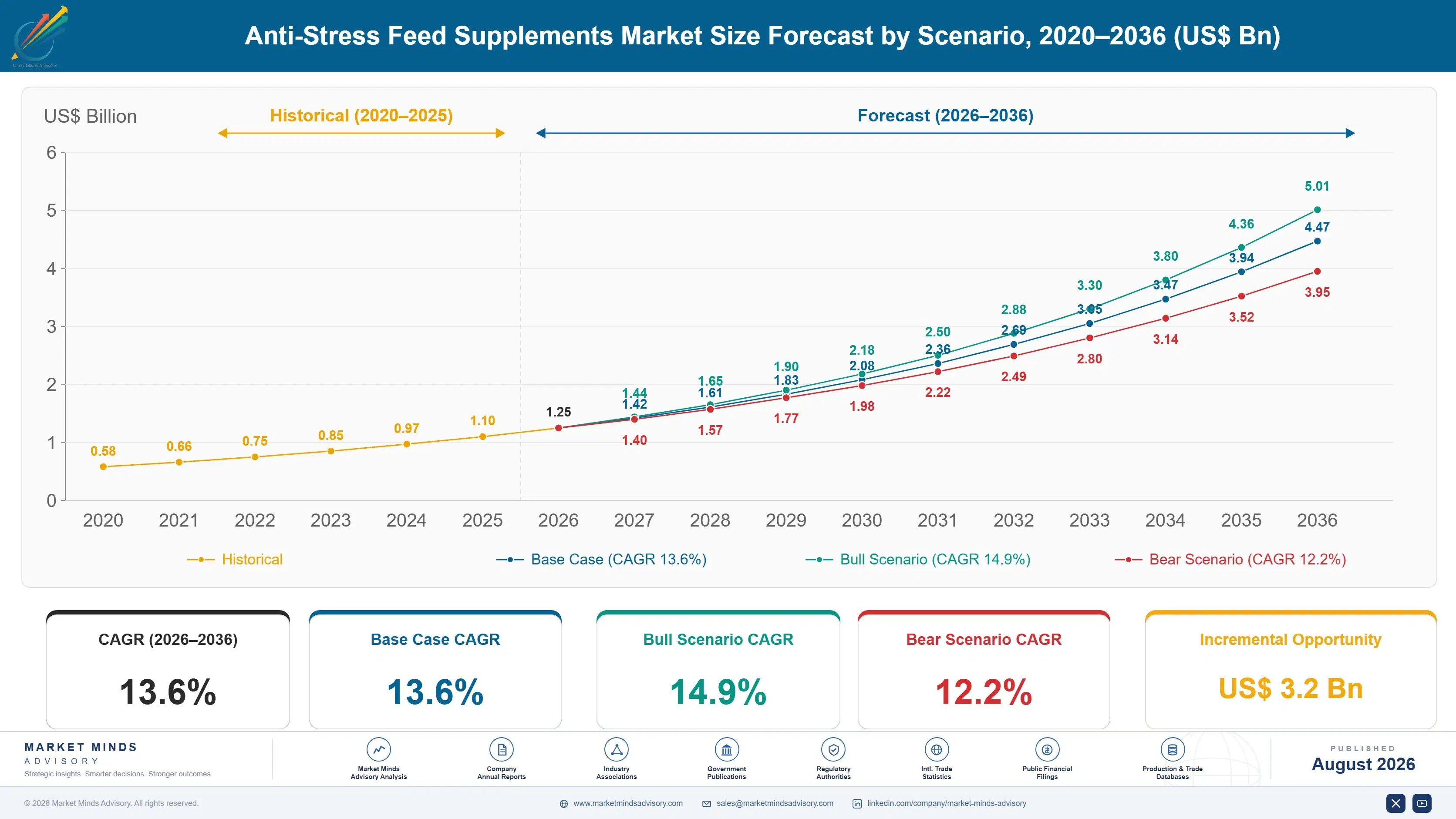
Anti-Stress Feed Supplements Market Forecast Scenarios

anti-stress-feed-supplements-market-trend-size-forecast-scenario-1787462998169
Between 2020 and 2025 the market grew at a historical pace of roughly 12.3 percent annually, as antibiotic growth promoter restrictions expanded across major producing regions and recurring severe heat events pushed dairy and poultry operations toward functional stress mitigation additives that had previously been treated as a niche premium input rather than a standard production practice.
The base case assumes growth near 13.6 percent annually through 2036, anchored in three commercial mechanisms: expanding antibiotic-free production certification requirements that favor functional additives over prophylactic antibiotic use, rising frequency of severe heat events documented across major dairy and poultry producing regions, and growing processor-level premiums for verified low-stress animal welfare production practices that reward supplement adoption. These mechanisms increasingly reinforce each other as processors, veterinarians, and suppliers coordinate around shared certification and efficacy documentation standards.
A bull scenario builds on faster independent efficacy validation securing broader veterinary recommendation and insurance-linked adoption incentives, while a bear scenario centers on adaptogenic botanical feedstock supply constraints and rising raw material costs slowing planned formulation expansion across mid-sized feed additive producers. a scenario several formulators are already actively preparing contingency sourcing plans to address.

Efficacy Validation Racing Commercial Adoption

Three forces are converging on the category at once: dairy and poultry operators are treating heat stress mitigation as a standard production practice rather than an emergency response, antibiotic-free certification programs are expanding the addressable market for functional alternatives, and specialty adaptogen developers are scaling botanical feedstock sourcing faster than larger incumbents can formulate comparable products. This convergence is compressing decision timelines that used to unfold over multiple production seasons.
MARKET CONCENTRATIONCR5 38%top five producers hold a meaningful combined share
AVERAGE INCLUSION RATE0.1-0.5%typical dosage relative to total feed ration weight
LEADING PRODUCING COUNTRYUnited Stateslargest single national manufacturing and formulation base overall
DAIRY ADOPTION RATE31%share of commercial dairy operations using formulations regularly
HEAT STRESS LOSS REDUCTION12-18%typical productivity loss recovered through regular supplementation programs
BOTANICAL FEEDSTOCK COST SHARE34% of COGSadaptogenic ingredient costs as portion of total cost
Commercially the category increasingly behaves like a preventive health investment rather than a traditional feed additive purchase, since producers are budgeting for stress mitigation supplementation across an entire production cycle rather than reacting only during acute heat events, a shift that rewards suppliers able to demonstrate consistent year-round productivity data, a benefit that continues rewarding suppliers who document performance consistently across full production cycles.
Over the next decade, suppliers most likely to gain share are those investing in independent, peer-reviewed efficacy trials, since veterinary and nutritionist recommendation increasingly depends on published data rather than supplier-generated marketing claims that producers have grown more skeptical of over time. Suppliers slow to publish independent data risk losing recommendation to faster-moving competitors.
"Every supplement in this category claims to reduce stress. The ones winning veterinary recommendation are the ones that published a trial someone else ran."
Director, Animal Nutrition Practice · MMA Animal Nutrition / Livestock Feed Additives Practice · August 2026

Market Trends

Adaptogenic Herbal Extracts Scaling Beyond Niche Positioning

Adaptogenic botanical extracts, including ashwagandha, ginseng, and various proprietary herbal blends originally marketed as premium niche additives, are scaling into mainstream commercial dairy and poultry nutrition programs as published trial data demonstrates measurable productivity recovery during heat events. Several major feed additive companies have launched adaptogen-based product lines within the past two years, signaling category validation beyond early specialty adopters. Botanical feedstock sourcing remains the binding constraint on faster growth, since cultivation and extraction capacity for several key adaptogenic species has not scaled at the same pace as commercial demand.
Market Impact: Lifts heat-driven demand by 13%
Antibiotic-Free Certification Programs Expanding Addressable Market

Major poultry and dairy processors across North America and Western Europe are expanding antibiotic-free production certification requirements for supplier farms, following retailer and foodservice buyer pressure for reduced antibiotic use in animal protein supply chains. Producers seeking certification increasingly adopt anti-stress supplementation as a replacement tool for managing production challenges previously addressed through prophylactic antibiotic use. This has converted anti-stress supplementation from an optional productivity input into a near-mandatory component of antibiotic-free production protocols across a growing share of certified supply chains. Processors describe this shift as increasingly non-negotiable across their certified supply base.
Market Impact: Adds 8% premium pricing incentive

Market Opportunities and Growth Drivers

Rising Frequency of Severe Heat Events Across Producing Regions

Documented increases in the frequency and severity of extreme heat events across major dairy and poultry producing regions in the United States, India, and Brazil are directly lifting demand for supplementation proven to reduce heat-related productivity losses, which can otherwise reach double-digit percentage declines in milk yield or feed conversion efficiency during severe heat waves. Producers in regions experiencing repeated severe heat events are increasingly budgeting for year-round preventive supplementation rather than reactive treatment only during acute heat waves, a shift that is expanding baseline category demand independent of any single extreme weather event.
Market Impact: Slows adoption by 14% overall

Processor-Level Premiums for Verified Low-Stress Production

A growing number of dairy cooperatives and poultry processors are introducing premium pricing tiers for supplier farms that can document verified low-stress animal welfare production practices, including anti-stress supplementation protocols, as consumer and retailer attention to animal welfare credentials continues expanding across premium retail categories. Farms achieving verified certification status report meaningful per-unit price premiums relative to standard production, creating a direct commercial incentive for supplementation adoption beyond the underlying productivity benefit alone. This pricing incentive is expected to strengthen further as certification programs expand across additional processors. Adoption should broaden as more processors introduce comparable tiers.
Market Impact: Raises botanical input costs by 19%

Market Restraints and Challenges

Limited Independent Efficacy Validation Slows Veterinary Adoption

Much of the published efficacy data supporting anti-stress supplement claims originates from supplier-funded trials rather than fully independent peer-reviewed research, a gap rooted in the relatively young commercial history of several product categories within this space and the high cost of conducting rigorous, blinded field trials at commercial livestock scale. The commercial impact is that veterinarians and livestock nutritionists remain cautious about broad recommendation absent independent validation, slowing adoption among more conservative commercial operations. Several larger suppliers are now funding independent university-run trials as a mitigation path, accepting near-term cost to build credibility for broader veterinary recommendation.
Market Impact: Adds 15% to adaptogen segment volume

Adaptogenic Botanical Feedstock Supply Remains Constrained

Cultivation and extraction capacity for several key adaptogenic botanical species has not scaled at the pace commercial feed additive demand now requires, a constraint rooted in the multi-year cultivation cycles many of these botanicals require and the limited number of growing regions with suitable climate conditions. The commercial impact is periodic input cost spikes and occasional supply shortages that compress margins for formulators lacking long-term supply agreements with growers. Larger companies are increasingly investing directly in contracted cultivation programs, while smaller formulators remain more exposed to spot market sourcing and its associated price volatility.
Market Impact: Expands addressable farms by 22%
3 additional market trends, 4 additional growth drivers, and 3 additional restraints and challenges are covered in the full report. Contact sales@marketmindsadvisory.com to access the complete intelligence.

Segment CAGR and Growth Architecture

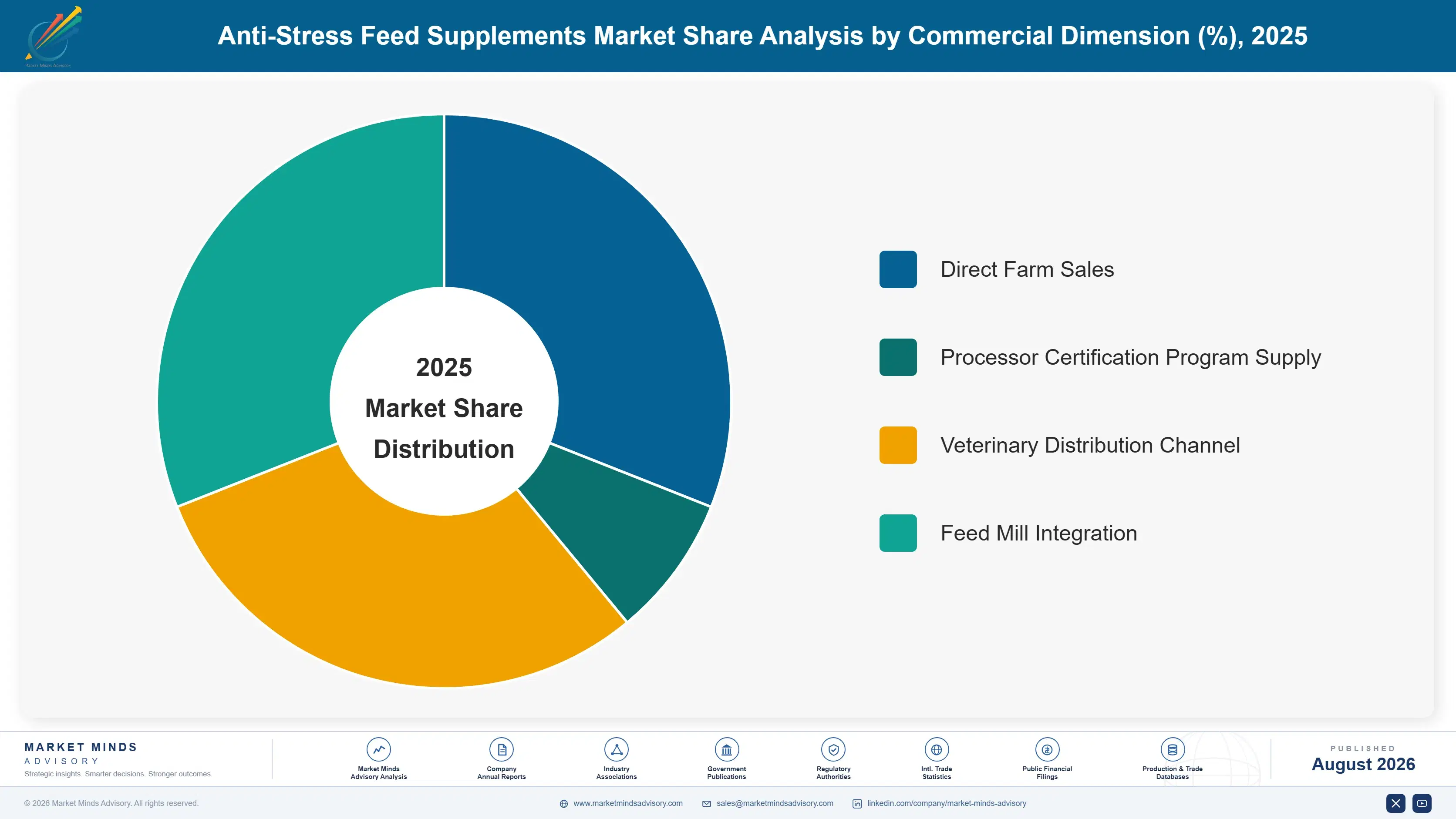
Segmentation follows active ingredient type, since adaptogenic extracts, probiotics, electrolytes, vitamins, and essential oil-based additives each carry distinct mechanisms of action, regulatory classification, and sourcing infrastructure despite serving the shared goal of physiological stress mitigation across livestock and poultry production systems. and because sourcing infrastructure spans agricultural cultivation for some ingredients and industrial fermentation for others.
anti-stress-feed-supplements-market-trend-market-share-analysis-1787462998699

Adaptogenic Herbal Extract Supplements

Adaptogenic herbal extracts are growing fastest as published trial data increasingly demonstrates measurable productivity recovery during heat and transport stress events, moving the category beyond its earlier positioning as an unproven premium niche input. Ashwagandha, ginseng, and various proprietary botanical blends each carry distinct mechanisms of action and cost profiles, giving formulators room to differentiate beyond simple price competition. Botanical feedstock sourcing constraints remain the primary limit on faster growth, since cultivation capacity for several key species has not scaled at the pace commercial demand now requires, creating a supply bottleneck attracting new contracted cultivation investment from larger companies seeking secured ingredient access. Larger companies are increasingly pursuing joint ventures with growers to secure long-term feedstock access.
CAGR 17.2%

Probiotic and Postbiotic Stress Resilience Formulations

Probiotic and postbiotic formulations are the second fastest growing segment, benefiting directly from antibiotic-free production certification programs that favor gut microbiome support as a replacement tool for previously antibiotic-managed production challenges. Postbiotic formulations, which use inactivated microbial components rather than live cultures, are gaining particular traction given their greater formulation stability across feed manufacturing and storage conditions relative to live probiotic strains. Major animal nutrition companies are expanding postbiotic production capacity significantly faster than for adaptogenic botanicals, since microbial fermentation infrastructure scales more predictably than agricultural cultivation of specialty botanical species. Several large animal nutrition companies have announced new postbiotic production lines within the past eighteen months, signaling continued category validation.
CAGR 16.5%
Full segment breakdown across 6 segments available in the complete report.

Regional Architecture and Country Demand Map

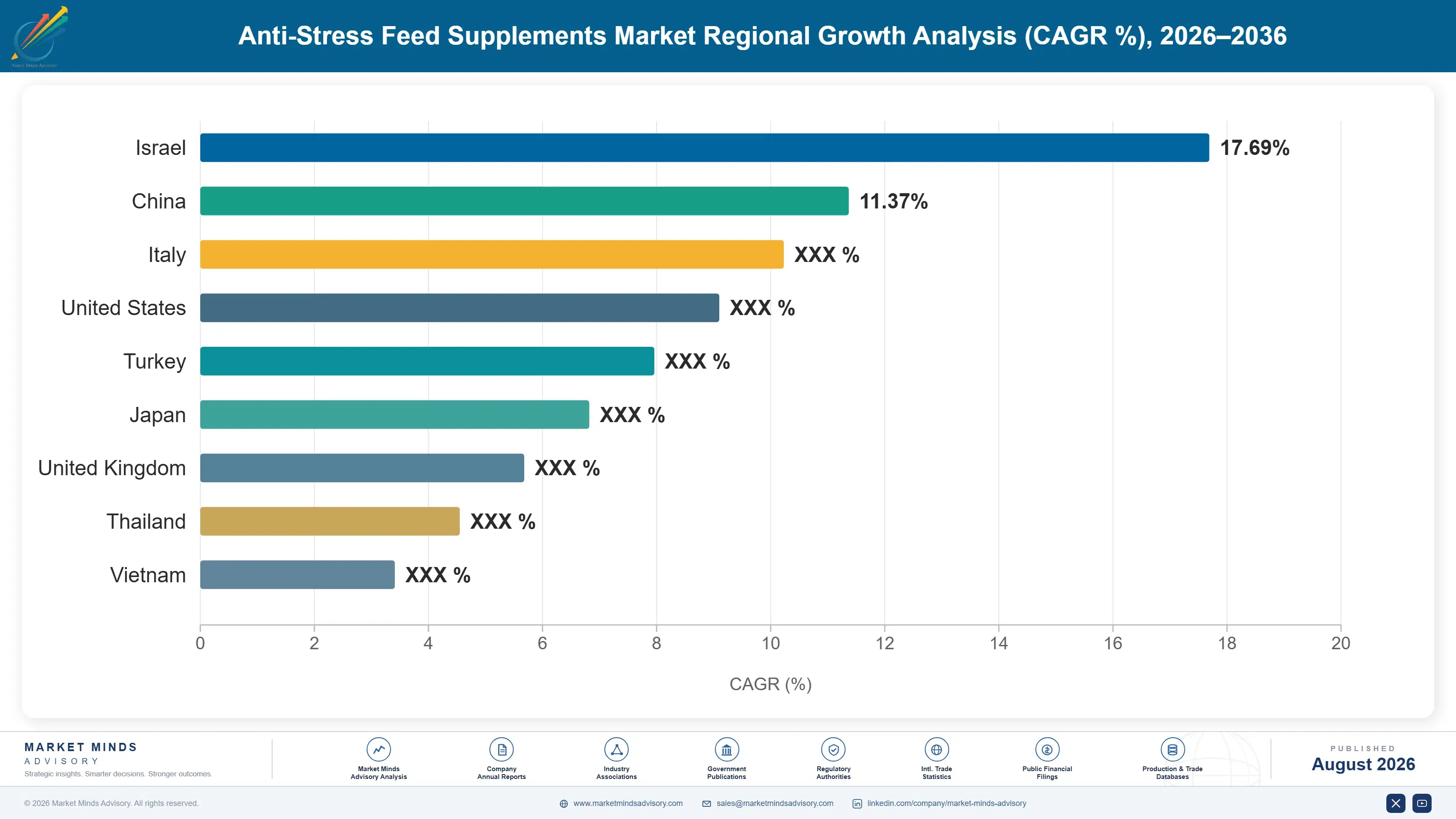
North America leads on advanced adoption infrastructure and antibiotic-free certification depth, East Asia follows on livestock production scale, while South Asia and Pacific and Latin America scale fastest off smaller current bases as heat stress and export quality pressures intensify. with other regions contributing meaningfully smaller shares currently.

North America

United States dairy and poultry operations lead regional adoption, driven by expanding antibiotic-free certification programs at major processors and well-established relationships with domestic animal nutrition companies capable of providing formulation support and field trial data. Recurring severe heat events across the Southeast and Midwest dairy belts are sustaining strong demand for heat stress specific formulations beyond general-purpose stress mitigation products. Canada follows similar adoption patterns at smaller scale, concentrated primarily in dairy operations. Veterinary nutritionist involvement in supplementation decisions is more established here than in most other regions, reflecting deeper integration between animal health professionals and commercial feed formulation practices across the region's advanced livestock production infrastructure. Insurance-linked incentives are also emerging for farms documenting verified protocols.
Share: 27% | CAGR: 14.0% (2026 to 2036)

Western Europe

Antibiotic growth promoter restrictions, in place across the European Union for considerably longer than in most other regions, have made this the most mature market for anti-stress supplements as a functional antibiotic alternative rather than a productivity supplement alone. Germany, France, and the Netherlands anchor regional demand, with strong dairy and poultry integration favoring probiotic and postbiotic formulations specifically. Animal welfare certification schemes carry particular commercial weight across retail supply chains here, creating additional demand for verified low-stress production documentation beyond what pure productivity economics alone would support in this already mature and well-established regional market. Retailers across the region increasingly require documented low-stress production evidence as a private label sourcing condition.
Share: 20% | CAGR: 12.0% (2026 to 2036)
Regional intelligence for 5 additional markets available in the complete report: East Asia, South Asia and Pacific, Latin America, Middle East and Africa, Eastern Europe. Contact sales@marketmindsadvisory.com.
anti-stress-feed-supplements-market-trend-country-cagr-analysis-1787462999211

Efficacy Validation and Certification Access Levers

Suppliers are pulling four commercial levers at once: independent efficacy trial investment, adaptogenic feedstock securement, postbiotic capacity expansion, and processor certification partnerships, each addressing a distinct margin opportunity created by the category's rapid but still-maturing adoption curve across major livestock producing regions. These levers increasingly overlap, since suppliers pursuing feedstock security often simultaneously expand fermentation capacity and certification partnerships.

Independent Peer-Reviewed Efficacy Trial Investment Programs

Funding independent, university-run field trials rather than relying solely on supplier-generated data is increasingly the deciding factor in veterinary and nutritionist recommendation, converting cautious conservative buyers into confident adopters faster than marketing claims alone can achieve. This investment requires meaningful upfront cost and multi-year trial timelines but builds a credibility advantage that competitors relying only on internal data cannot easily replicate quickly. Suppliers publishing independent trial results report veterinary recommendation rates roughly 25 percent higher than suppliers without comparable published data. This credibility gap is expected to widen further as more veterinarians request published data before recommending new products.
Market Impact: Lifts veterinary recommendation rate by roughly 25 percent

Contracted Adaptogenic Botanical Cultivation Supply Agreements

Securing long-term contracted cultivation agreements directly with growers of key adaptogenic botanical species reduces exposure to the spot market price volatility that has periodically compressed margins for formulators reliant on open market sourcing. This investment requires patient, multi-year capital commitment given the cultivation cycles several key botanical species require, but positions suppliers with secured feedstock access as commercial demand continues outpacing current cultivation capacity across most producing regions. Early movers report input cost stability roughly 20 percent better than spot market dependent competitors. Suppliers without such agreements remain exposed to the next cultivation shortfall regardless of current pricing conditions.
Market Impact: Cuts input cost volatility by roughly 20 percent

Dedicated Postbiotic Fermentation Capacity Expansion Investment

Expanding microbial fermentation capacity specifically calibrated for postbiotic production addresses a supply opportunity that scales more predictably than adaptogenic botanical cultivation, since fermentation infrastructure investment follows more conventional industrial biotechnology capacity planning rather than agricultural cultivation cycles subject to weather and growing season constraints. Suppliers expanding postbiotic capacity early are securing multi-year supply agreements with antibiotic-free certified processors seeking reliable, formulation-stable alternatives to live probiotic strains that require more careful handling. Suppliers expanding capacity early expect utilization to reach roughly 85 percent within two years of commissioning. Capacity build continues as certification spreads.
Market Impact: Adds roughly an 18 percent overall capacity gain

New Direct Processor Certification Partnership Programs

Rather than waiting for individual farms to independently pursue antibiotic-free or low-stress certification, several suppliers are now partnering directly with major dairy cooperatives and poultry processors to develop pre-validated supplementation protocols that supplier farms can adopt with minimal additional qualification work. This approach accelerates certification compliance across an entire processor supply base simultaneously rather than farm by farm, giving the supplement partner preferred status across the processor's full certified supply network and locking in volume ahead of competitors still selling farm by farm. Suppliers pursuing this model report processor volume capture roughly 30 percent higher than farm-by-farm sales approaches.
Market Impact: Secures 30 percent of processor supply base volume

Who Controls the Margin Pool

Concentration remains moderate, with the top five producers holding a combined 38 percent share on a revenue basis, reflecting a market where established animal nutrition majors compete alongside a growing number of specialty adaptogen and postbiotic developers entering from adjacent nutraceutical and industrial biotechnology backgrounds rather than traditional feed additive origins. This blurring of traditional category boundaries is reshaping which suppliers processors consider a credible primary partner.
Current competitive activity centers on three dimensions: independent efficacy trial investment to build veterinary recommendation credibility, contracted botanical cultivation agreements to secure adaptogenic feedstock supply, and direct certification partnerships with major processors to accelerate adoption across entire supply networks simultaneously rather than farm by farm. Suppliers pursuing multiple dimensions simultaneously are pulling ahead of competitors still focused on a single lever.

Emerging pressure comes from specialty adaptogen and postbiotic developers entering the category from adjacent nutraceutical and industrial biotechnology backgrounds, and from processor-led certification programs that increasingly favor whichever supplier can demonstrate the most credible independent data, threatening to redistribute share away from established incumbents relying primarily on brand recognition over the coming decade. Established incumbents slow to respond risk ceding meaningful share within the next several years.
anti-stress-feed-supplements-market-trend-company-positioning-matrix-1787462999733

Competitive Moat and Risk Dimensions

KEMIN INDUSTRIES

Moat: Established Efficacy Data Library

Kemin's long operating history in the category has built an extensive library of field trial and efficacy data across multiple species and stress conditions that newer entrants cannot replicate quickly, giving it a credibility advantage in veterinary and nutritionist recommendation conversations that newer specialty developers still lack.
KEMIN INDUSTRIES

Risk: Slower Adaptogen Portfolio Pivot

Kemin's core strength in established conventional formulations gives it less natural advantage in adaptogenic botanicals, an adjacent category where specialty developers are moving faster, potentially ceding early share in the fastest-growing segment of the category to newer, more focused competitors. This risk grows as adaptogen-focused competitors continue gaining veterinary trust.
ALLTECH

Moat: Integrated Fermentation Infrastructure

Alltech's established fermentation and microbial production infrastructure, built originally for its broader animal nutrition portfolio, gives it faster and lower-cost postbiotic production scaling than competitors needing to build comparable fermentation capacity from an earlier stage of development. This infrastructure advantage is difficult for newer fermentation entrants to replicate quickly.
ALLTECH

Risk: Limited Adaptogenic Botanical Presence

Alltech's fermentation-centered capability gives it less natural positioning in adaptogenic botanical extracts, an adjacent segment growing even faster than postbiotics, potentially ceding share to competitors building dedicated botanical cultivation and extraction capability instead. This gap could widen further if botanical-focused competitors continue outpacing Alltech's postbiotic growth rate.

Players Tracked

Prominent Players

Kemin Industries
Novus International
Adisseo
Alltech
DSM-Firmenich Animal Nutrition and Health

Other Key Players

Evonik Industries
BASF Animal Nutrition
Cargill Animal Nutrition
ADM Animal Nutrition
Nutreco (Trouw Nutrition)
Phibro Animal Health
Lallemand Animal Nutrition
Vetagro
Anpario
Nuscience Group
Norel
Impextraco
Kerry Animal Nutrition
Biomin
Zagro

Recent Developments

FEBRUARY 2026

Kemin Industries Launches Independent Ashwagandha Trial Program

Kemin Industries announced a multi-year independent field trial program conducted with three university partners to validate ashwagandha-based supplement efficacy across heat stress conditions in commercial dairy herds, aiming to build peer-reviewed evidence for broader veterinary recommendation among skeptical buyers. Several additional universities have since expressed interest in joining the program.
Signal: Signals independent validation becoming a core competitive requirement across the category as buyers increasingly request third-party validation before adoption.
SEPTEMBER 2025

Alltech Expands Postbiotic Fermentation Capacity in Kentucky

Alltech commissioned expanded fermentation capacity at its Kentucky production facility specifically calibrated for postbiotic ingredient manufacturing, addressing capacity constraints that had limited its ability to accept new supply agreements with antibiotic-free certified poultry and dairy processors across North America. ahead of the next certification renewal cycle for key customers.
Signal: Confirms postbiotic capacity investment is accelerating ahead of certification-driven demand ahead of anticipated certification-driven demand growth.
MAY 2025

Novus International Acquires Minority Stake in Indian Adaptogen Supplier

Novus International acquired a minority equity stake in an Indian adaptogenic botanical extraction company, securing preferential feedstock access as it expands its stress mitigation portfolio to serve India's rapidly scaling dairy sector facing severe recurring heat stress losses. as it expands presence in India's rapidly scaling dairy sector.
Signal: Demonstrates upstream investment accelerating as suppliers secure adaptogenic feedstock access across multiple emerging adaptogenic feedstock producing regions.

Botanical and Fermentation Input Exposure

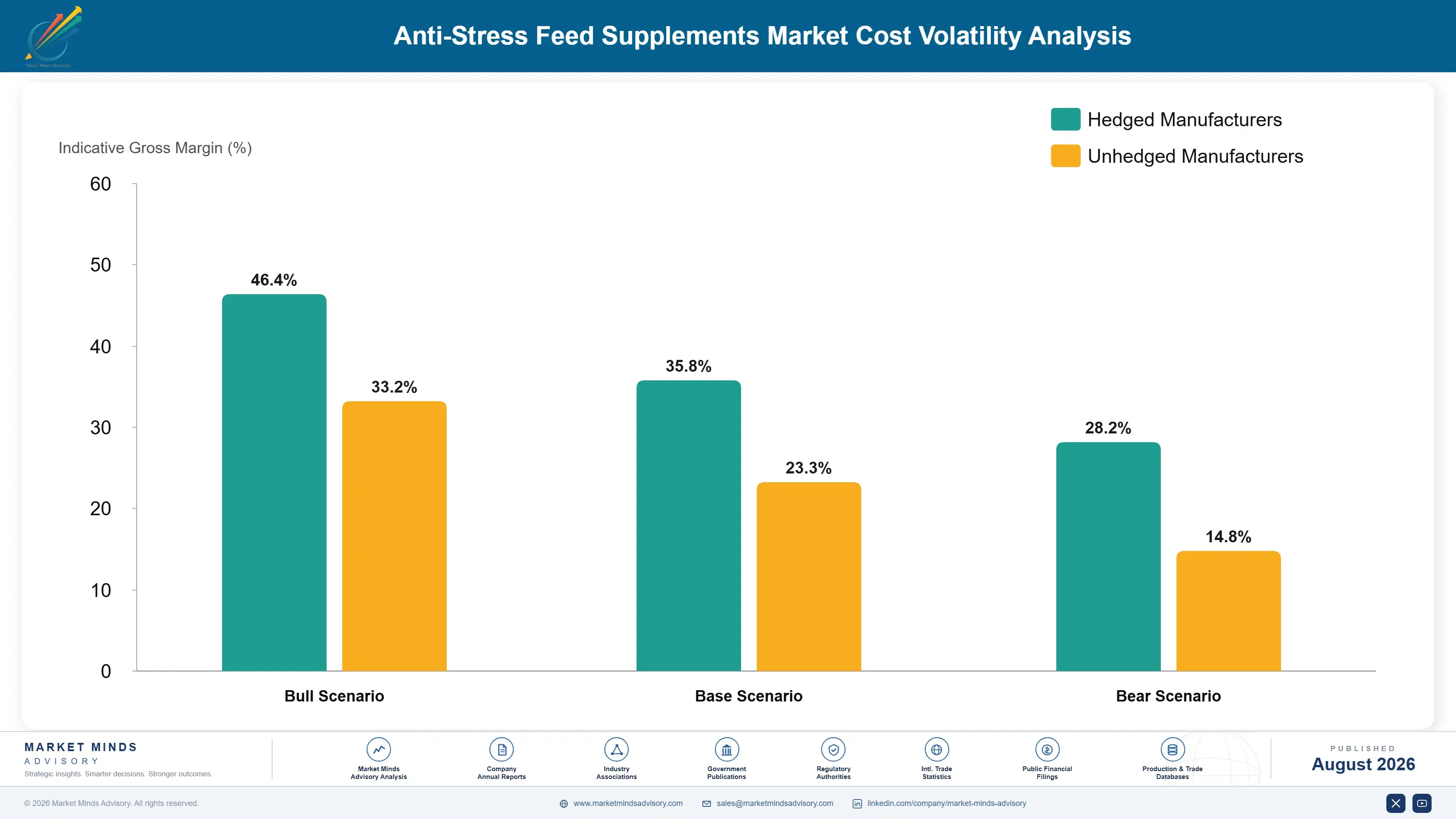
Adaptogenic botanical feedstock and fermentation substrate together represent roughly 34 percent of cost of goods sold for anti-stress formulations, sourced primarily from Indian, Chinese, and Southeast Asian botanical growers for adaptogenic extracts, with fermentation substrate for postbiotic production sourced mostly from North American and European agricultural commodity suppliers. with smaller volumes also sourced from East African botanical growing regions.
Ashwagandha and related botanical prices spiked sharply in 2023 following weather-related cultivation shortfalls in key Indian growing regions, a volatility event documented in Ministry of Commerce India trade reporting, forcing several formulators to temporarily substitute alternative adaptogenic species or delay planned product launches by two to three quarters while botanical supply chains stabilized. Several formulators reported continued cost pressure into 2024 as cultivation recovery took longer than expected across affected growing regions.

Exposure varies considerably by player type: large formulators with contracted cultivation agreements have absorbed volatility more easily than smaller developers reliant on spot market botanical purchases, a disadvantage that is increasingly steering smaller specialty producers toward long-term supply agreements or acquisition by larger integrated competitors seeking secured feedstock access. This consolidation trend is expected to continue as botanical price volatility persists across producing regions.
anti-stress-feed-supplements-market-trend-cost-volatility-analysis-1787462999928

Contracted Cultivation Agreements With Botanical Growers

Larger formulators are locking in multi-year contracted cultivation agreements directly with growers of key adaptogenic species, securing preferential pricing and volume access ahead of spot market buyers during periods of tight supply, while sharing agronomic risk with established growing cooperatives rather than bearing sourcing risk entirely independently. Adoption of this approach has accelerated meaningfully since the 2023 price shock.

Multi-Species Formulation Flexibility to Manage Substitution

Developing formulations that can substitute between several adaptogenic botanical species with similar mechanisms of action allows suppliers to shift sourcing toward whichever species offers more stable pricing during a given supply disruption, preserving customer supply continuity during acute shortage periods without requiring complete reformulation. Several large formulators have already standardized this multi-species approach across their core product lines.

Vertical Integration Into Fermentation Substrate Sourcing

Larger postbiotic producers are securing direct agreements with agricultural commodity suppliers for fermentation substrate, reducing exposure to third-party pricing volatility, a mitigation available primarily to the largest producers rather than smaller specialty postbiotic developers lacking comparable purchasing scale and capital access. This mitigation remains available primarily to the largest producers given the scale of investment required.

Portfolio Architecture for Margin Defence

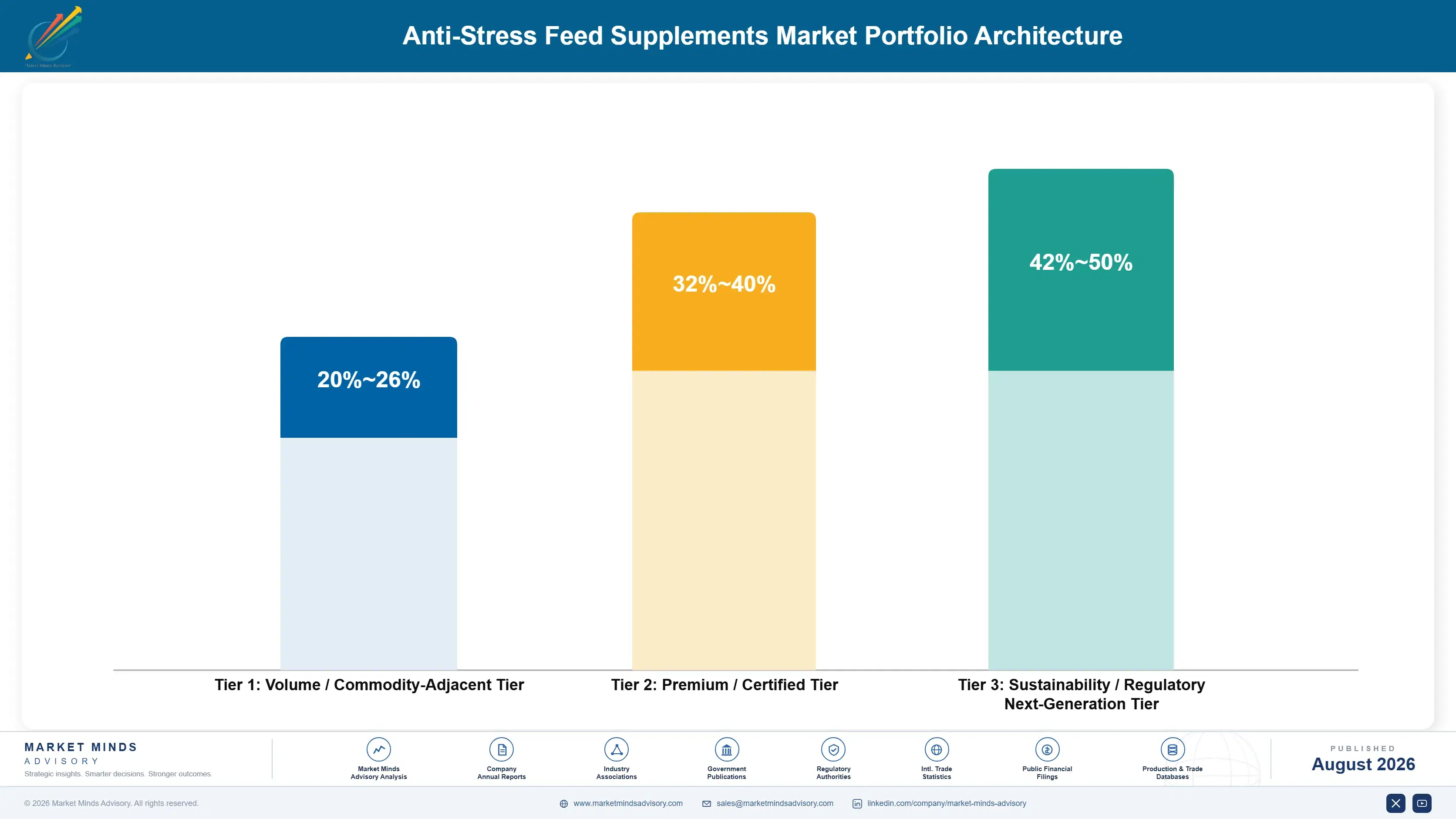
Portfolio economics split across three tiers: commodity electrolyte and vitamin blends competing largely on price and broad availability, certified probiotic and postbiotic formulations commanding premium pricing tied to antibiotic-free certification programs, and emerging adaptogenic botanical formulations capturing the highest margin as producers pay for both novel mechanism of action and published efficacy data. This split increasingly determines which suppliers can access the most attractive long-term processor contracts.
The tension between volume and premium positioning is sharpest at the processor certification level, where antibiotic-free program requirements are compressing commodity tier volume faster than premium tier growth can fully offset, pushing suppliers to defend commodity tier share on cost efficiency while investing disproportionately in premium and next-generation tier innovation where competitive intensity remains comparatively lower. Suppliers investing early in premium tier innovation are increasingly better positioned than those defending commodity volume alone.

High value margin pools concentrate in adaptogenic botanical formulations backed by independent efficacy data and sold directly into certified processor supply programs, where veterinary recommendation and documented trial results limit competition to suppliers with established credibility infrastructure. Suppliers without independent efficacy data increasingly risk losing access to the most attractive certified channels entirely.

Volume / Commodity-Adjacent Tier

Electrolyte and vitamin blend supplements competing primarily on price and broad retail availability across conventional production. Margins here depend heavily on distribution scale and broad retail availability rather than on differentiated efficacy claims.
Gross Margin: 20-26%

Premium / Certified Tier

Probiotic and postbiotic formulations commanding premium pricing tied to antibiotic-free certification and processor supply programs. Buyers in this tier increasingly require documented certification and consistent supply chain traceability from suppliers.
Gross Margin: 32-40%

Sustainability / Regulatory / Next-Generation Tier

Adaptogenic botanical formulations backed by independent efficacy trials serving certified processor and veterinary-recommended channels. Capacity here remains limited, keeping this tier the most supply constrained segment of the category currently.
Gross Margin: 42-50%
anti-stress-feed-supplements-market-trend-portfolio-architecture-1787463000450

High-value Sub-segments and Strategic Watch-out

Ashwagandha and Adaptogenic Botanical Blends

Scaling fastest as published trial data validates measurable productivity recovery, this segment commands the highest per-unit pricing but remains constrained by limited cultivation capacity across current supplying regions relative to rapidly accelerating demand. Suppliers investing early in contracted cultivation are best positioned to capture this accelerating demand curve.
Gross Margin: 44-52%

Postbiotic Stress Resilience Formulations

Antibiotic-free certification programs increasingly favor postbiotic formulations for their formulation stability, supporting durable pricing power for producers with established fermentation infrastructure over smaller developers still building comparable capacity. Producers without established fermentation infrastructure increasingly struggle to meet this growing certification-driven demand quickly. Adoption should accelerate as more programs formalize preference.
Gross Margin: 34-42%

Conventional Electrolyte and Mineral Supplements

The largest volume segment by tonnage, competing primarily on price for conventional dairy and poultry operations not yet pursuing antibiotic-free certification, and increasingly exposed to gradual share erosion as certification programs expand further. Suppliers here compete mainly on price and distribution reach rather than on differentiated efficacy claims.
Gross Margin: 18-24%

Unvalidated Supplier-Data-Only Formulations

Facing rising skepticism from veterinarians and nutritionists as independent efficacy validation becomes a standard buyer expectation, this segment requires urgent trial investment or faces continued exclusion from the highest-value certified processor channels over the coming years. Independent trial investment offers the clearest path back into premium channels.
Gross Margin: 16-22%

Preventive Supplementation Budget Economics

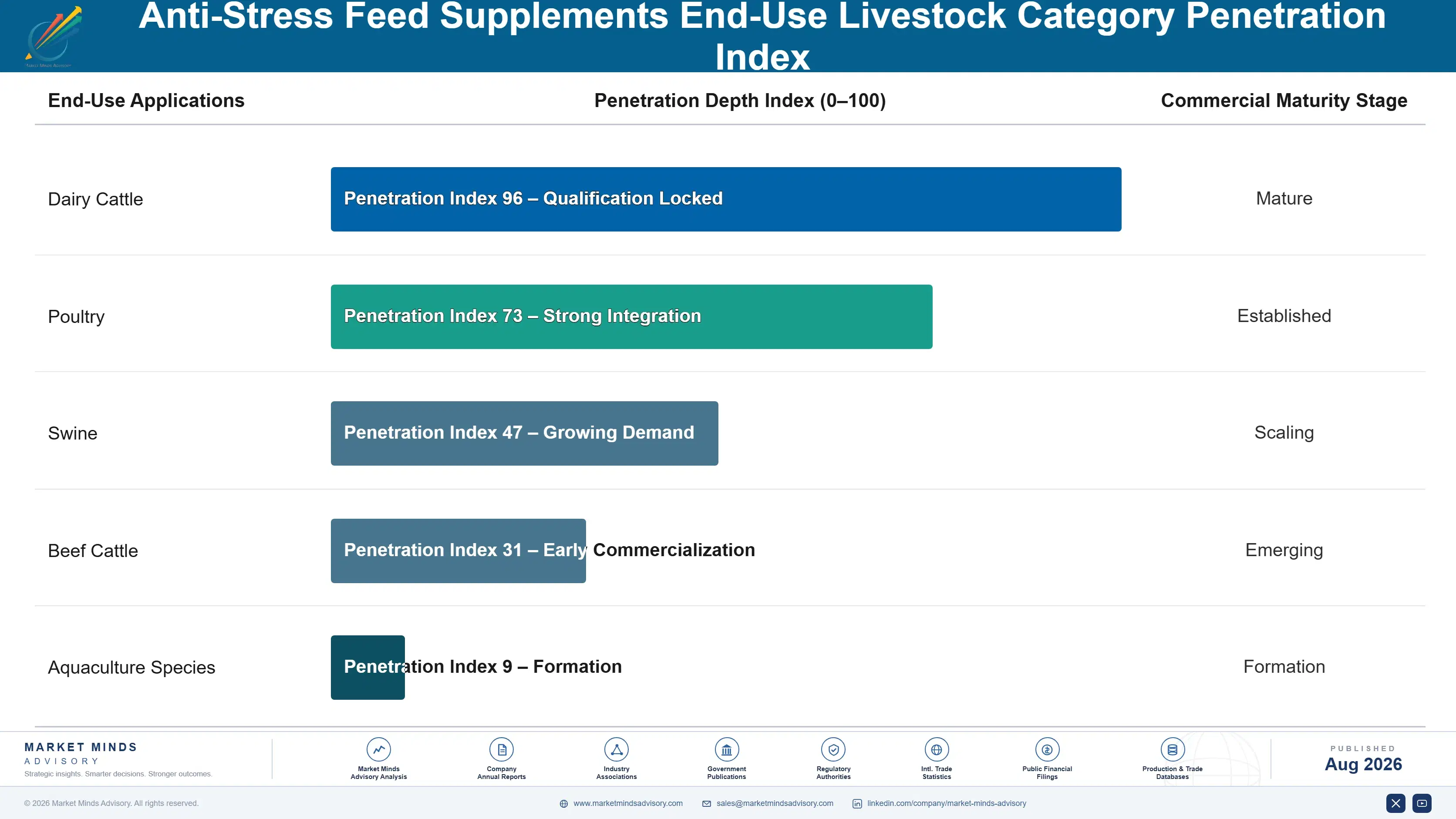
Demand in this category increasingly resembles a preventive health budget line rather than a reactive emergency purchase, since producers are now allocating supplementation spend across an entire production cycle rather than responding only during acute heat or transport stress events, creating a form of annuity demand for suppliers embedded early in a producer's standard nutrition program. Suppliers embedded early in a producer's annual nutrition budget capture disproportionate follow-on volume over time.
Adoption depth varies considerably by end use vertical: large industrial dairy and poultry operations with dedicated veterinary nutritionist support show the deepest and most consistent adoption of adaptogenic and postbiotic formulations, mid-sized commercial operations show moderate but accelerating adoption tied to certification program requirements, and smallholder operations remain the shallowest adopters, still relying primarily on conventional electrolyte supplementation during acute stress events only. Certification programs are accelerating adoption among mid-sized operations faster than organic demand alone.

Younger veterinarians and farm managers entering the industry increasingly expect published efficacy data as a baseline expectation rather than accepting supplier marketing claims alone, a generational shift that is pushing the entire category toward more rigorous, independently validated product development over time. Suppliers slow to publish data risk losing relevance with this cohort.
anti-stress-feed-supplements-market-trend-end-use-penetration-index-1787463000941

Where Supplement Development Capital Should Concentrate

These are among the four positions where our research anticipates prominent divergence between winners and laggards over the coming forecast period. Each is grounded in the demand model, the regulatory perimeter, and the announced capacity pipeline.
01 / EFFICACY VALIDATION INVESTMENT

Fund independent trials before competitors establish credibility first

Veterinary and nutritionist recommendation increasingly depends on independently published efficacy data rather than supplier-generated marketing claims that producers have grown skeptical of over time. Suppliers publishing independent trial results already report meaningfully higher veterinary recommendation rates than competitors relying solely on internal data. This credibility advantage compounds over time, since veterinarians tend to continue recommending products with established track records rather than switching to newer, less validated alternatives once trust has been built, an advantage increasingly difficult for later entrants to overcome.
02 / BOTANICAL FEEDSTOCK SECURITY

Secure contracted cultivation before the next supply shortfall

Adaptogenic botanical feedstock supply has already demonstrated its volatility potential following the 2023 Indian cultivation shortfall, and cultivation capacity additions continue to lag demand growth in most years. Formulators without contracted cultivation agreements remain exposed to the next disruption, a disadvantage increasingly steering processors toward suppliers who can demonstrate feedstock security. Securing contracted agreements now, while cultivation capacity is still expanding, costs less than waiting for the next shortfall, a risk growing more acute as certification requirements expand further, a gap that widens each cycle.
03 / POSTBIOTIC CAPACITY TIMING

Expand fermentation capacity ahead of certification-driven demand

Postbiotic formulations remain supply constrained rather than demand constrained as antibiotic-free certification programs increasingly favor their formulation stability over live probiotic alternatives. Suppliers expanding fermentation capacity early are already securing multi-year supply agreements with certified processors eager to lock in reliable access ahead of anticipated demand growth. Waiting for demand to fully materialize before investing will mean competing for capacity against better-capitalized entrants with established processor relationships already secured, a dynamic already visible in recent supply agreement announcements, where timing matters considerably.
04 / PROCESSOR PARTNERSHIP STRUCTURING

Build certification partnerships at the processor level, not farm by farm

Partnering directly with major dairy cooperatives and poultry processors to develop pre-validated supplementation protocols accelerates certification compliance across an entire supply network simultaneously, rather than working farm by farm through a slower, fragmented adoption process. Suppliers securing this processor-level relationship gain preferred status across the processor's full certified supply base. Suppliers slower to pursue this model risk losing volume to competitors already embedded in processor-level certification programs, reshaping which suppliers processors prefer during contract renewal, leaving later movers a steeper climb back.

Engagement Snapshot From the Field

A live engagement with an industry participant carrying material or product regulatory and market exposure ahead of a defining policy shift, showing how our research translates into a defensible multi-year portfolio strategy.
MARKET MINDS ADVISORY · CLIENT ENGAGEMENT SUMMARY
Anti-Stress Feed Supplements Producer Strategic Portfolio Review and Transition Roadmap 2026·Investment Scenario on Anti-Stress Feed Supplements Exposure Evaluation 2025-26
CLIENT PROFILE
The client is a mid-sized North American dairy cooperative representing approximately 180 member farms generating an estimated 260 million dollars in annual combined milk revenue (client-reported, unverified by MMA), facing recurring summer heat stress losses across its member farm base concentrated in the American Midwest. The cooperative's member farms are concentrated within a two hundred mile radius of its processing facility.
STRATEGIC CHALLENGE
Facing declining milk yield during increasingly severe summer heat waves and growing pressure from a major processor buyer to document verified low-stress production practices, the cooperative needed to select and roll out a supplementation program across its member farms without internal veterinary nutrition expertise to independently evaluate competing supplier claims.
MMA APPROACH
MMA conducted a comparative efficacy and cost assessment of three leading anti-stress supplement suppliers, incorporating published trial data review, cost modeling across the cooperative's member farm scale, and processor certification requirement mapping, then developed a phased two year rollout roadmap sequenced to member farm readiness and available capital. Recommendations were validated against the cooperative's existing veterinary advisory relationships.
KEY FINDINGS
  1. Adaptogenic botanical formulations with independent trial data offered the strongest documented heat stress productivity recovery among the suppliers evaluated. across the herds evaluated during the assessment period.
  2. Roughly 65 percent of member farms could adopt the recommended protocol without requiring additional on-farm infrastructure investment. within the initial rollout budget available.
  3. Processor certification requirements could be met within twelve months given the selected supplier's existing documentation and audit support capability. given the selected supplier's existing regional presence.
  4. Phased rollout by farm size reduced total implementation cost by prioritizing larger farms where productivity recovery would generate the fastest payback. while preserving cash flow across the rollout period.
CLIENT PROFILE
The client is a mid-sized North American dairy cooperative representing approximately 180 member farms generating an estimated 260 million dollars in annual combined milk revenue (client-reported, unverified by MMA), facing recurring summer heat stress losses across its member farm base concentrated in the American Midwest. The cooperative's member farms are concentrated within a two hundred mile radius of its processing facility.
STRATEGIC CHALLENGE
Facing declining milk yield during increasingly severe summer heat waves and growing pressure from a major processor buyer to document verified low-stress production practices, the cooperative needed to select and roll out a supplementation program across its member farms without internal veterinary nutrition expertise to independently evaluate competing supplier claims.
MMA APPROACH
MMA conducted a comparative efficacy and cost assessment of three leading anti-stress supplement suppliers, incorporating published trial data review, cost modeling across the cooperative's member farm scale, and processor certification requirement mapping, then developed a phased two year rollout roadmap sequenced to member farm readiness and available capital. Recommendations were validated against the cooperative's existing veterinary advisory relationships.
KEY FINDINGS
  1. Adaptogenic botanical formulations with independent trial data offered the strongest documented heat stress productivity recovery among the suppliers evaluated. across the herds evaluated during the assessment period.
  2. Roughly 65 percent of member farms could adopt the recommended protocol without requiring additional on-farm infrastructure investment. within the initial rollout budget available.
  3. Processor certification requirements could be met within twelve months given the selected supplier's existing documentation and audit support capability. given the selected supplier's existing regional presence.
  4. Phased rollout by farm size reduced total implementation cost by prioritizing larger farms where productivity recovery would generate the fastest payback. while preserving cash flow across the rollout period.
RECOMMENDED STRATEGY
Phase 1: Phase 1 (Months 1 to 6): Roll out supplementation protocol across the largest twenty-five member farms first. with dedicated on-site training support provided. Phase 2: Phase 2 (Months 7 to 14): Extend rollout to remaining member farms and complete processor certification documentation. while monitoring early productivity recovery data. Phase 3: Phase 3 (Months 15 to 24): Negotiate premium pricing terms with the processor based on verified certification status. to secure long-term premium pricing terms.
OUTCOME
Within eighteen months of implementation, the cooperative reported recovering approximately 14 percent of prior summer heat stress related milk yield losses and securing a premium pricing agreement with its primary processor buyer worth an estimated 3 percent uplift on certified milk volume (client-reported, unverified by MMA).

Frequently Asked Questions

Foundational context covering the market sizes, CAGR, scope, country, region and competition that inform every finding below. This section is provided to cover basics and most often pre-purchase conversations, answered from the MMA Primary Research Dataset.

What is the current size of the Anti-Stress Feed Supplements Market?

The Anti-Stress Feed Supplements Market is valued at approximately 1.1 billion dollars in 2025, spanning adaptogenic, probiotic, electrolyte, and vitamin-based formulations used across dairy and poultry production.

How large will the Anti-Stress Feed Supplements Market be by 2036?

The market is projected to reach roughly 4.47 billion dollars by 2036, driven by expanding antibiotic-free certification programs and rising frequency of severe heat events.

What is the CAGR for the Anti-Stress Feed Supplements Market 2026 to 2036?

The market is expected to grow at a compound annual growth rate of approximately 13.6 percent between 2026 and 2036, among the fastest rates in animal nutrition.

Which segment is growing fastest?

Adaptogenic herbal extract supplements are the fastest growing segment, expanding at roughly 1.3 times the overall market rate as published trial data validates their heat stress productivity benefits.

Who are the major companies in the Anti-Stress Feed Supplements Market?

Leading companies include Kemin Industries, Novus International, Adisseo, Alltech, and DSM-Firmenich Animal Nutrition and Health, each expanding efficacy validation and formulation capacity. across established and emerging producing regions.

Which country is growing fastest?

India is the fastest growing single country, as its massive dairy sector scales anti-stress supplementation rapidly to counter severe recurring summer heat stress losses. ahead of most other major dairy producing nations.

Report Segmentation Architecture

The full report scope spans multiple orthogonal segmentation dimensions, with cross-tabulated demand data provided for each dimension pair. Coverage extends further to regional breakdowns, trend trajectories, and the competitive detail needed to support segment-level decision-making.

By Active Ingredient Type

  • Adaptogenic Herbal Extracts
  • Betaine and Osmolytes
  • Probiotics and Postbiotics
  • Electrolyte and Mineral Complexes
  • Vitamin and Antioxidant Blends
  • Essential Oil-Based Calming Additives

By End-Use Livestock Category

  • Dairy Cattle
  • Poultry
  • Swine
  • Beef Cattle
  • Aquaculture Species

By Commercial Dimension

  • Direct Farm Sales
  • Processor Certification Program Supply
  • Veterinary Distribution Channel
  • Feed Mill Integration

By Region

  • North America
  • Western Europe
  • East Asia
  • South Asia and Pacific
  • Latin America
  • Middle East and Africa
  • Eastern Europe

Scope, Methodology, and Coverage

Every figure in this report is reproducible from documented input assumptions. The scope below maps the historical period, the forecast horizon, the segmentation dimensions, and the countries covered, alongside the underlying primary and qualitative methodology.
Historical Period
2020 to 2025
Forecast Period
2026 to 2036
Base Year
2025 (USD billions; MMA Primary Research Dataset, August 2026)
Market Definition
The anti-stress feed supplements market covers functional feed additives formulated to mitigate physiological stress from heat, transport, weaning, and disease challenge in livestock and poultry, including adaptogenic herbal extracts, betaine and osmolytes, probiotics and postbiotics, electrolyte and mineral complexes, vitamin and antioxidant blends, and essential oil-based calming additives. It excludes standalone therapeutic veterinary pharmaceuticals and excludes general-purpose vitamin premixes not specifically marketed for stress mitigation.
Quantitative Units
USD billions (current prices); metric tons for select volume metrics
Segmentation Dimensions
By Active Ingredient Type; By End-Use Livestock Category; By Commercial Dimension; By Region
Regions Covered
North America, Western Europe, East Asia, South Asia and Pacific, Latin America, Middle East and Africa, Eastern Europe
Countries Covered
USA, China, Germany, France, UK, Japan, South Korea, India, Australia, Canada, Brazil, Mexico, Indonesia, Vietnam, Thailand, Malaysia, UAE, Saudi Arabia, South Africa, Nigeria, Turkey, Poland, Netherlands, Italy, Spain, Sweden, Switzerland, Argentina, Colombia, Singapore, and additional markets relevant to this sector
Key Companies Profiled
Kemin Industries, Novus International, Adisseo, Alltech, DSM-Firmenich Animal Nutrition and Health, Evonik Industries, BASF Animal Nutrition, Cargill Animal Nutrition, ADM Animal Nutrition, Nutreco (Trouw Nutrition), Phibro Animal Health, Lallemand Animal Nutrition, Vetagro, Anpario, Nuscience Group, Norel, Impextraco, Kerry Animal Nutrition, Biomin, Zagro
Quantitative Methodology
Primary survey, n=3,800 respondents, Q4 2025, six countries; demand-side model with trade association cross-validation
Qualitative Methodology
47 expert interviews, Q4 2025; applied to validate demand model assumptions, identify emerging dynamics, and assess competitive positioning
Report Format
PDF and XLSX data workbook (Word format preview document)
Publisher
Market Minds Advisory
Report Code
MMA-2026-AGR-205
Published
August 2026
Contact
sales@marketmindsadvisory.com | www.marketmindsadvisory.com

Purchase the full Anti-Stress Feed Supplements Market Report (2026 to 2036).

The full report delivers a complete quantitative and qualitative assessment of the anti-stress feed supplements market, including detailed segment level forecasts through 2036, regional analyses across all seven covered geographies, and profiles of twenty leading animal nutrition companies. It incorporates primary survey data from 3,800 respondents and 47 expert interviews conducted in the fourth quarter of 2025. Buyers receive editable data tables, a customizable Excel forecast model, and access to MMA analysts for follow up questions during a defined post purchase support window. The report also includes detailed botanical feedstock cost sensitivity analysis calibrated to current cultivation and trade benchmarks.
Detailed segment-level market forecasts through 2036
All seven regional market analyses included
Twenty profiled leading nutrition companies overall
Editable Excel based forecast data model
Primary survey and expert interview data
Extended post-purchase analyst support access included

Built For The People Who Decide

From boardroom strategy to bench-side execution, this report is read cover-to-cover by leaders shaping the next decade of their industry, turning demand scenarios, market dynamics and valuation benchmarks into decisions.
CXOs/ Presidents/ VPs/ Managers
M&A and Corporate Development
Strategy Teams and R&D Heads
Procurement and Product Directors
Regulatory and Compliance Leaders
Investor Relations and Equity Analysts