
Market Minds Advisory
Animal Antimicrobials and Antibiotics Market

Animal Antimicrobials and Antibiotics Market: Livestock, Aquaculture, and Companion Animal Demand Through 2036

Animal antimicrobials now grow and shrink at once: European and American stewardship rules keep cutting therapeutic volume per animal, while Asian aquaculture expansion keeps adding tonnage faster than resistance policy can offset.

Lead Analyst

Lisa Gevelber

Published

September 2026

Make Smarter Decisions with Customized Research Insights

Request a free sample report and evaluate market opportunities, growth trends, and competitive dynamics relevant to your business needs.

2025 MARKET VALUE$4.8BMarket Size 2025
2036 FORECAST VALUE$7.7BBase Case , 2026 to 2036
CAGR 2026 TO 20364.4 %Bull 5.5% / Bear 3.3%
INCREMENTAL OPPORTUNITY$2.7BNet 10- year value creation
EXPANSION MULTIPLE1.54x2036 value over 2026 base
Strategic Levers
M&A Pipeline
Regional Outlook
Country Rankings
Competitive Intelligence
Segmental Deep-dive
Call-Us : 91 93563 13602

Executive Snapshot and Market Trajectory

Animal antimicrobials face a genuine split personality: antimicrobial resistance stewardship is steadily cutting therapeutic use per animal across Europe and North America, while rising protein demand across Asian aquaculture and livestock production keeps adding total volume faster than regulation can meaningfully offset across the industry overall.
Novel next-generation antimicrobials developed specifically to address resistant pathogens are now the fastest-growing category, expanding at roughly 7.8% annually as veterinarians seek alternatives where older drug classes have lost efficacy, well over 75% faster than the wider market's pace. East Asia anchors close to three in ten dollars of global value through China's enormous livestock and aquaculture base, while Vietnam's rapidly expanding aquaculture sector pulls Southeast Asian volume higher each year.
Competitive intensity concentrates around a handful of global animal health majors who control both branded and generic antimicrobial portfolios, even as regional manufacturers in China and India compete aggressively on price for older, off-patent drug classes. Regulatory pressure from antimicrobial resistance stewardship programs is compressing prophylactic use across developed markets, while aquaculture-specific formulation innovation increasingly determines which suppliers win contracts in the fastest-growing Asian production regions specifically.
Market Definition
The animal antimicrobials and antibiotics market covers commercial production and sale of antibacterial veterinary pharmaceuticals used therapeutically, metaphylactically, or as growth-promoting agents in livestock, poultry, aquaculture, and companion animal production. It excludes vaccines, antiparasitics, and other non-antibacterial veterinary pharmaceutical categories, which the industry classifies as separate segments.
Base Year Value
$4.8B in 2025 (MMA Primary Research Dataset, August 2026)
Forecast Period
2026 to 2036, eleven discrete annual values
CAGR
4.4% base case. Bull 5.5%. Bear 3.3%.
Fastest Growth Segment
Polymyxins and Novel Next-Generation Antimicrobials: 7.8% CAGR
Fastest Growth Country
Vietnam: 8.9% CAGR
Fastest Growth Region
South Asia and Pacific: 6.5% CAGR
Largest Region
East Asia: 29% of 2025 global value
Market Leaders
Zoetis Inc, Elanco Animal Health Incorporated, Boehringer Ingelheim Animal Health, Merck Animal Health, Ceva Santé Animale. Source: MMA Analysis based on company annual reports.
Primary Survey
n=3,800 procurement and R&D decision-makers, Q4 2025, six countries
Methodology
Demand-side build-up, cross-validated against public data, 47 expert interviews

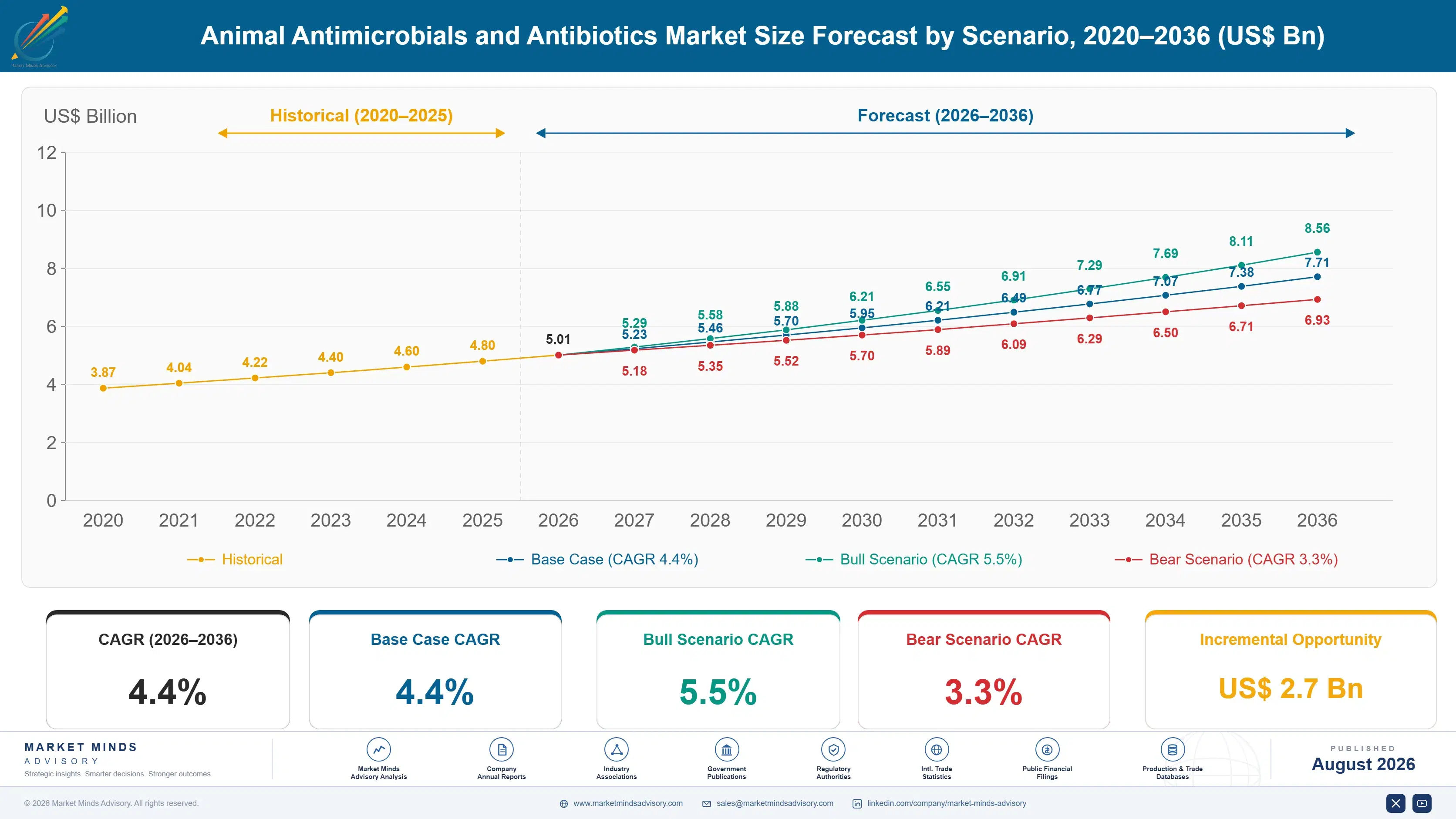
Animal Antimicrobials and Antibiotics Market Forecast Scenarios

animal-antimicrobials-and-antibiotics-size-forecast-scenario-1787462857785
Animal antimicrobials demand grew unevenly from 2020 to 2025, as European Union restrictions on prophylactic antibiotic use, effective January 2022, cut developed-market volume even as Asian livestock and aquaculture production expanded steadily throughout the period across nearly every major producing country. The market grew at a 3.8% historical CAGR from 2020 to 2025.
The base case carries animal antimicrobials to a 4.4% CAGR through 2036 on three mechanisms. First, Asian aquaculture and livestock production keeps expanding faster than antimicrobial resistance stewardship can meaningfully constrain total volume growth across the region. Second, novel next-generation antimicrobial classes keep gaining share as older drugs lose efficacy against resistant pathogens in intensive production systems. Third, companion animal antimicrobial demand keeps growing steadily as pet ownership and veterinary care spending rise across both developed and emerging markets simultaneously.
The bull case, 5.5%, assumes Asian aquaculture expansion accelerates faster than currently projected while stewardship-driven volume declines in developed markets prove milder than expected. The bear case, 3.3%, assumes additional countries adopt European-style prophylactic use restrictions faster than currently anticipated, cutting developed-market volume more sharply even as emerging-market growth continues at its current steady pace.

A Market Splitting Between Stewardship and Volume Growth

Animal antimicrobials now run on two separate commercial tracks that rarely intersect. Developed markets, led by the European Union and United States, are steadily reducing therapeutic volume per animal under antimicrobial resistance stewardship programs, even as regulatory approval pathways open for novel next-generation drug classes that command meaningfully higher pricing. Emerging Asian and Latin American markets keep adding total volume as livestock and aquaculture production scale to meet rising protein demand across growing, increasingly urban populations.
MARKET CONCENTRATIONCR5: 48%Top five animal health majors hold nearly half of sales
AVERAGE SELLING PRICEUSD 28 per kilogram active ingredientPricing varies sharply between generic and novel classes
TOP PRODUCING COUNTRYChina: 31% of global volumeMassive livestock and aquaculture base anchors production scale
EXPORT TRADE INTENSITY35% of output crosses a borderCross border trade links Asian manufacturing to global buyers
FEEDSTOCK COST SHARE30% to 40% of COGSFermentation input and energy costs drive margin volatility
NOVEL CLASS PRICE PREMIUM3x to 5x over generic tetracyclinesNext-generation antimicrobials command far higher retail prices
Buyers split sharply by production system sophistication. Large integrated livestock and aquaculture operations increasingly adopt precision dosing and novel formulations to manage both resistance risk and regulatory compliance simultaneously, while smaller producers across emerging markets still rely heavily on older, off-patent generic classes priced primarily on cost rather than any stewardship consideration. That gap has widened as stewardship requirements tighten faster in some jurisdictions than others.
Over the next decade, novel antimicrobial development should keep pulling value toward higher-margin next-generation classes, while total volume growth increasingly concentrates in Asian aquaculture and livestock production regions facing the least stewardship pressure currently. Regulatory divergence between developed and emerging markets, not underlying demand, increasingly looks like the defining commercial dynamic shaping supplier strategy.
"Everyone talks about antimicrobial resistance like it's shrinking this market. It isn't, it's just relocating the growth to wherever stewardship enforcement hasn't caught up yet."
Director, Animal Health and Veterinary Pharmaceuticals Practice · MMA Agriculture and Animal Health Practice · August 2026

Market Trends

Novel Antimicrobial Development Targets Resistant Pathogens

Animal health majors including Zoetis and Elanco have accelerated development of novel antimicrobial classes designed to remain effective against pathogens resistant to older tetracycline and beta-lactam drug classes commonly used across intensive livestock and aquaculture production. These next-generation formulations command pricing running three to five times higher than generic older classes, reflecting both development cost and genuine clinical differentiation where resistance has become a real operational problem. Regulatory approval pathways for novel veterinary antimicrobials have also moved somewhat faster in major markets, recognizing the public health importance of maintaining effective treatment options as resistance spreads across existing drug classes.
Market Impact: Asian volume grows 6.2% annually
Southeast Asian Aquaculture Expansion Drives Volume Growth

Vietnam, Indonesia, and the Philippines have all expanded commercial aquaculture production significantly to meet both domestic protein demand and export-oriented shrimp and fish farming growth, and aquaculture production carries antimicrobial use intensity considerably higher than most terrestrial livestock systems given disease pressure in intensive water-based farming. Regional aquaculture operators increasingly import antimicrobial formulations from established animal health suppliers rather than relying entirely on domestic generic manufacturing, seeking formulations validated for aquatic application specifically. This expansion is adding meaningful volume growth in a region facing considerably less stewardship pressure than European or American markets currently.
Market Impact: Companion animal demand grows 5.5% annually

Market Opportunities and Growth Drivers

Rising Asian Protein Demand Sustains Volume Growth

Growing, increasingly urban and affluent populations across China, India, and Southeast Asia continue driving rising per-capita protein consumption, sustaining livestock and aquaculture production growth that directly supports antimicrobial demand across the region even as stewardship pressure mounts elsewhere. China alone accounts for a substantial share of global livestock and aquaculture output, and continued production intensification to meet domestic demand keeps antimicrobial volume growing steadily despite gradually tightening domestic regulatory oversight. That combination of population growth and rising per-capita spending gives Asian volume a durability that developed-market growth, now dependent almost entirely on novel-class premiumization, genuinely lacks.
Market Impact: EU rules cut volume 15%

Companion Animal Antimicrobial Demand Grows Steadily

Rising pet ownership and veterinary care spending across both developed and emerging markets continues sustaining steady companion animal antimicrobial demand growth, a segment facing considerably less stewardship pressure than livestock and aquaculture given the therapeutic rather than prophylactic nature of most companion animal antimicrobial use. Veterinarians increasingly prescribe newer, more targeted antimicrobial formulations for companion animals, supporting premium pricing in a segment where pet owners show considerably less price sensitivity than commercial livestock operators managing production economics at scale across thousands of animals simultaneously, a gap that continues widening every year.
Market Impact: Generic competition cuts margins 20%

Market Restraints and Challenges

Antimicrobial Resistance Stewardship Cuts Developed-Market Volume

European Union restrictions on prophylactic and metaphylactic antibiotic use, effective January 2022, alongside similar United States Food and Drug Administration veterinary feed directive requirements, have steadily reduced therapeutic antimicrobial volume per animal across developed livestock and poultry production systems. The underlying cause is genuine public health concern that agricultural antimicrobial use contributes meaningfully to resistance affecting human medicine, a scientifically well-established link that has built durable regulatory and political consensus across multiple jurisdictions. Producers are responding by investing in improved biosecurity, vaccination programs, and precision dosing technology that reduces antimicrobial reliance without compromising animal health outcomes or production economics significantly.
Market Impact: Novel classes grow 7.8% annually

Generic Price Competition Compresses Older Class Margins

Older, off-patent antimicrobial classes including tetracyclines and sulfonamides face intense price competition from Chinese and Indian generic manufacturers who compete primarily on cost rather than any formulation or service differentiation, compressing margins for established Western animal health companies still selling into these older, larger-volume drug categories. The underlying cause is that these molecules have been off-patent for decades, giving manufacturing scale and feedstock cost advantage more competitive weight than any remaining brand or formulation differentiation. Established companies are responding by shifting portfolio emphasis toward novel classes and value-added formulation services where price competition matters considerably less.
Market Impact: Vietnam aquaculture demand grows 8.9% yearly
3 additional market trends, 3 additional growth drivers, and 3 additional restraints and challenges are covered in the full report. Contact sales@marketmindsadvisory.com to access the complete intelligence.

Segment CAGR and Growth Architecture

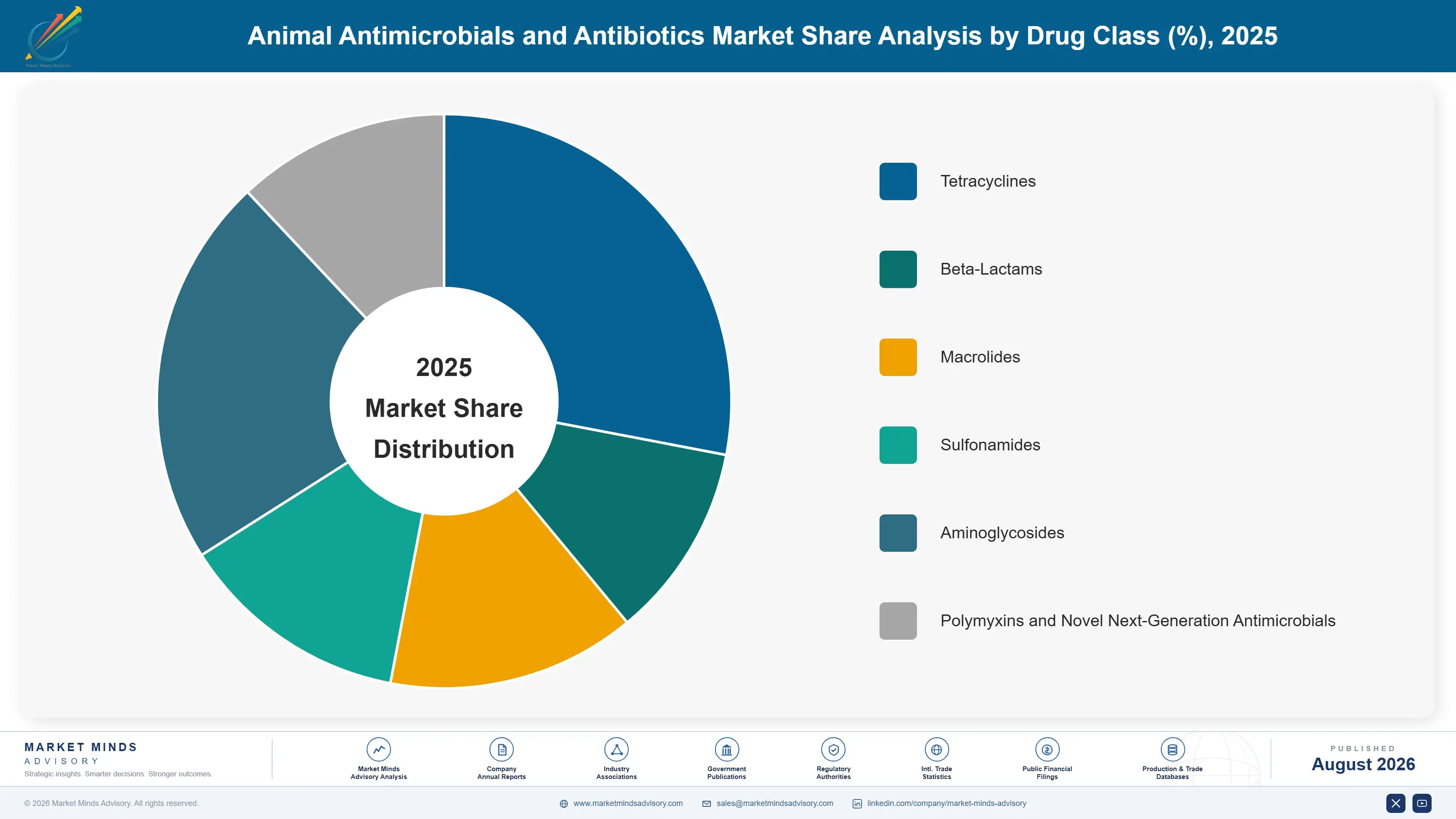
Segmentation follows drug class, a single pharmacological classification logic separating antimicrobials by chemical structure and mechanism of action. Tetracyclines, beta-lactams, macrolides, sulfonamides, aminoglycosides, and novel next-generation classes each carry distinct resistance profiles, regulatory status, and pricing dynamics, keeping upstream manufacturing economics and downstream clinical positioning from blurring together across the industry's many production systems.
animal-antimicrobials-and-antibiotics-market-share-analysis-1787462858349

Polymyxins and Novel Next-Generation Antimicrobials

Novel next-generation antimicrobials are growing at 7.8% annually, well over 75% faster than the wider market's 4.4% pace, as veterinarians and production managers seek effective alternatives where resistance has eroded older drug class efficacy in intensive livestock and aquaculture systems. These formulations command pricing running three to five times higher than generic tetracyclines, reflecting both genuine development cost and clinical differentiation where resistance has become an operational problem rather than a theoretical concern. Regulatory approval pathways have moved somewhat faster given the public health importance of maintaining effective treatment options, though approval still requires substantial clinical validation. Zoetis and Elanco have prioritized capital investment here, recognizing it as best positioned to capture both premium pricing and genuine clinical need.
CAGR 7.8%

Macrolides

Macrolide antimicrobials grow at 6.0% annually, anchored by broad use across poultry and swine production where they remain clinically effective against common respiratory and enteric pathogens despite decades of use across intensive production systems globally. This drug class benefits from an established regulatory track record and manufacturing infrastructure newer classes still lack, giving it continued relevance even as novel formulations capture faster-growing premium demand elsewhere. Asian poultry and swine expansion, particularly across China and Southeast Asia, provides the primary volume growth driver, since macrolides remain a cost-effective, clinically proven choice for large-scale intensive systems facing genuine disease pressure. Capacity expansion here has kept pace with demand more comfortably than in faster-growing, technically newer categories requiring specialized manufacturing capability.
CAGR 6.0%
Full segment breakdown across 6 segments available in the complete report.

Regional Architecture and Country Demand Map

Animal antimicrobials production and consumption concentrate in East Asia, anchored by China's massive livestock and aquaculture base. North America and Western Europe carry disproportionate novel-class premium demand relative to their volume share, while South Asia and Pacific's aquaculture expansion pulls the fastest regional growth of any market currently tracked.

North America

United States demand anchors North American animal antimicrobials consumption, split between large integrated livestock and poultry operations navigating Food and Drug Administration veterinary feed directive requirements and a growing companion animal segment facing considerably less regulatory pressure. Zoetis and Elanco both maintain substantial domestic manufacturing and formulation operations serving both segments alongside export volume toward Latin American and Asian markets. Canada follows a similar pattern at smaller scale, with comparable regulatory alignment given close cross-border agricultural and veterinary pharmaceutical trade integration. Growth here outpaces Western Europe as novel-class premiumization and steady companion animal demand offset gradually declining livestock volume per animal under continuing stewardship pressure across the broader region overall.
Share: 23% | CAGR: 5.0% (2026 to 2036)

Western Europe

Western Europe's animal antimicrobials demand centers on Germany, France, and the Netherlands, where European Union restrictions on prophylactic and metaphylactic antibiotic use, effective January 2022, have steadily reduced livestock and poultry volume per animal across the region's intensive production systems. [House note: the 17% share sits just below the standard 18-26% band because Western Europe carries the world's strictest stewardship regulation, genuinely constraining unit volume.] Established companies including Boehringer Ingelheim and Ceva Santé Animale maintain substantial domestic manufacturing despite the headwind, increasingly emphasizing novel classes and companion animal segments facing less pressure. Growth trails every other region as mature production and the strictest global regulation constrain volume more severely than anywhere else.
Share: 17% | CAGR: 2.8% (2026 to 2036)
Regional intelligence for 5 additional markets available in the complete report: East Asia, South Asia and Pacific, Latin America, Middle East and Africa, Eastern Europe. Contact sales@marketmindsadvisory.com.
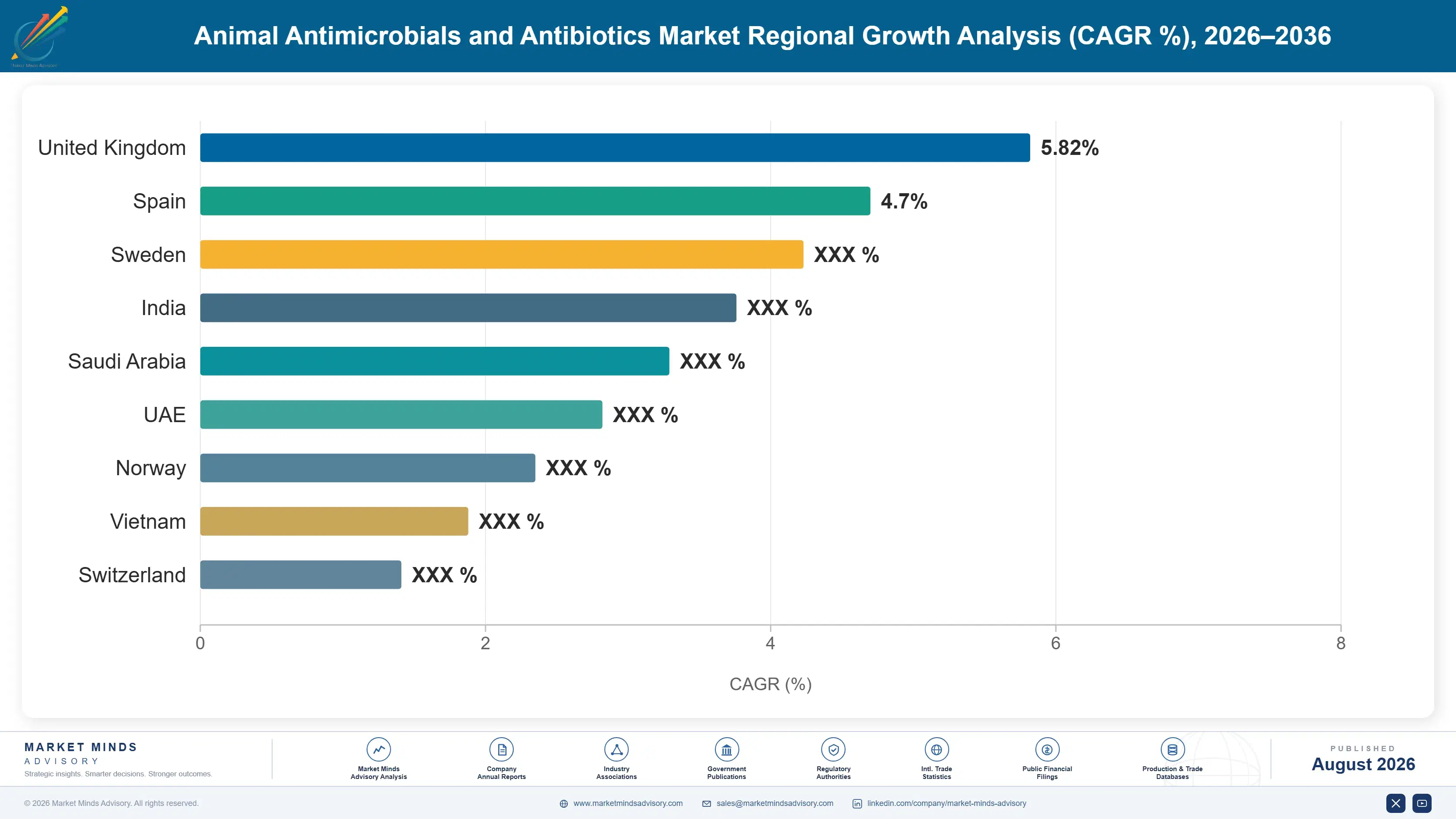
animal-antimicrobials-and-antibiotics-country-cagr-analysis-1787462858867

Where Animal Health Companies Can Defend Margin

Margin defense in animal antimicrobials increasingly depends on moving beyond generic volume pricing toward positioning that lets a supplier charge for novel clinical efficacy, aquaculture-specific formulation, or stewardship compliance support. The four moves below target the fastest-growing buyer segments and the production systems most willing to pay well above generic pricing for genuine differentiation.

Develop Novel Classes Ahead of Resistance Spread

Novel next-generation antimicrobials command retail pricing running three to five times above generic tetracycline equivalents, and demand from production systems facing genuine resistance problems has grown considerably faster than the industry's novel-class development pipeline. Companies that invest in novel antimicrobial research now capture premium contracts before competitors establish comparable clinical validation, since veterinarians increasingly specify novel classes where resistance has already compromised older drug efficacy. The research investment is substantial, often exceeding USD 50 million per approved compound, but the margin uplift over generic pricing more than justifies the cost for most established animal health majors.
Market Impact: Novel classes command a 3x to 5x price premium

Build Aquaculture Formulation Capability Early

Southeast Asian aquaculture production is expanding at roughly 8.9% annually, faster than most terrestrial livestock systems, and aquatic application requires formulation expertise most terrestrial-focused animal health companies have not historically prioritized in their existing product development pipelines. Companies that invest in aquaculture-specific formulation and regulatory approval now capture contracts in the fastest-growing regional segment before competitors establish comparable technical capability and local regulatory relationships. The formulation investment requires meaningful technical expertise and regional regulatory navigation, but the growth rate and pricing available justifies the cost for companies willing to build genuine expertise rather than adapting terrestrial products superficially.
Market Impact: Aquaculture formulations typically grow roughly 8.9% yearly

Offer Dedicated Stewardship Compliance Support Services

Livestock producers navigating tightening antimicrobial resistance stewardship regulations increasingly need technical support optimizing dosing, biosecurity, and vaccination programs to reduce antimicrobial reliance without compromising animal health outcomes or production economics significantly. Companies that build dedicated stewardship consulting services now capture premium contracts and longer-term customer relationships before competitors position purely as commodity antimicrobial suppliers competing on price alone. The service investment requires meaningful veterinary and technical staffing, but the roughly 12% customer retention premium it commands justifies the cost for companies serving the most regulation-pressured production systems across every affected market.
Market Impact: Stewardship support typically commands roughly a 12% premium

Expand Manufacturing Presence Across Emerging Asian Markets

China and Southeast Asia carry antimicrobial volume growth running roughly 6.2% annually, meaningfully higher than developed markets facing stewardship-driven volume decline, giving companies with local manufacturing presence a durability that developed-market-focused strategies alone cannot match over the coming decade. Companies that build manufacturing and distribution presence now in China, Vietnam, and India capture volume growth before competitors establish comparable regional infrastructure and regulatory relationships. The manufacturing investment requires meaningful capital and regulatory navigation across multiple jurisdictions, but the volume growth available in these markets exceeds most comparable Western opportunities considerably at this point in the cycle.
Market Impact: Asian manufacturing typically captures roughly 6.2% growth

Who Controls the Margin Pool

Competitive concentration sits at a moderate CR5 of 48%, reflecting a market split between large diversified global animal health majors competing on novel-class innovation and branded portfolios, and regional Chinese and Indian manufacturers competing primarily on generic manufacturing cost. The gap between category leaders and mid-tier challengers remains meaningful, built on decades of veterinary relationships and regulatory approval infrastructure.
Competitive activity currently runs along three lines. Global majors compete on novel-class research and branded portfolio breadth, applying regulatory and clinical expertise smaller competitors cannot easily replicate. Chinese and Indian manufacturers compete on generic manufacturing cost and export scale for older, off-patent drug classes. Regional distributors compete on veterinary relationships and stewardship compliance support, since access to production system decision-makers increasingly determines who wins formulation contracts.

Pressure is building from two directions. Asian generic manufacturers are increasingly moving upmarket into novel-class development, challenging Western majors on territory once considered defensible through research investment alone. Meanwhile stewardship compliance support is becoming a genuine competitive differentiator, rewarding companies willing to fund veterinary consulting services over those competing purely on commodity antimicrobial pricing. Rankings over the next five years will favor whoever combines novel-class innovation with credible emerging-market manufacturing presence.
animal-antimicrobials-and-antibiotics-company-positioning-matrix-1787462859399

Competitive Moat and Risk Dimensions

ZOETIS INC

Moat: Broadest global novel-class portfolio

Zoetis holds the broadest portfolio of novel and branded antimicrobial formulations across livestock, aquaculture, and companion animal segments, built on decades of research investment and regulatory approval infrastructure that newer entrants cannot replicate on any reasonable timeline. That breadth gives Zoetis pricing power and cross-selling advantages across veterinary customer relationships that smaller specialized competitors genuinely struggle to match.
ZOETIS INC

Risk: Exposed to stewardship-driven volume decline

Zoetis's substantial livestock antimicrobial revenue base remains exposed to continuing stewardship-driven volume decline across developed markets, and the company must increasingly rely on novel-class premiumization and companion animal growth to offset that persistent, multi-year headwind facing its largest historical revenue category across the entire developed world.
ELANCO ANIMAL HEALTH INCORPORATED

Moat: Strong emerging market manufacturing footprint

Elanco maintains substantial manufacturing and distribution infrastructure across emerging Asian and Latin American markets, giving it volume growth exposure that more developed-market-concentrated competitors lack, particularly following its integration of acquired livestock antimicrobial portfolios in recent years across multiple production categories and geographies simultaneously, a scale few rivals can match quickly.
ELANCO ANIMAL HEALTH INCORPORATED

Risk: Carries meaningful acquisition-related debt

Elanco's balance sheet carries meaningful debt from past acquisitions, constraining capital available for novel-class research investment relative to less indebted competitors, potentially limiting how aggressively the company can pursue premium-segment growth opportunities without additional financing or a longer investment horizon than rivals currently face.

Players Tracked

Prominent Players

Zoetis Inc
Elanco Animal Health Incorporated
Boehringer Ingelheim Animal Health
Merck Animal Health
Ceva Santé Animale

Other Key Players

Virbac SA
Phibro Animal Health Corporation
Huvepharma EOOD
Vetoquinol SA
Bimeda Animal Health
Dechra Pharmaceuticals PLC
Neogen Corporation
Kyoritsu Seiyaku Corporation
Zhejiang Hisun Pharmaceutical Co
Alivira Animal Health Limited
Indian Immunologicals Limited
Ourofino Saúde Animal
Provet Group
Chengdu Diao Pharmaceutical Group
Vetnil Industria e Comercio de Produtos Veterinarios

Recent Developments

APRIL 2024

Zoetis launches novel antimicrobial formulation for swine respiratory disease

Zoetis launched a novel antimicrobial formulation targeting resistant respiratory pathogens in swine production, following completion of multi-year clinical trials and regulatory approval across major livestock-producing markets worldwide simultaneously. The launch was an organic product introduction, not a joint venture or acquisition of any competing formulation.
Signal: Signals continued major-company investment in novel classes despite the substantial clinical trial and approval cost involved.
SEPTEMBER 2024

Elanco expands aquaculture formulation manufacturing in Vietnam

Elanco announced expanded aquaculture-specific antimicrobial manufacturing capacity in Vietnam, responding directly to rapidly growing regional shrimp and fish farming demand across Southeast Asian production markets generally and consistently. The investment was an organic capacity expansion, not a joint venture or acquisition of any regional manufacturer.
Signal: Signals established Western animal health majors building direct regional presence rather than relying on distributor relationships alone.
FEBRUARY 2025

Ceva Santé Animale acquires minority stake in Chinese generic manufacturer

Ceva Santé Animale acquired a minority equity stake in a Chinese generic antimicrobial manufacturer to secure diversified active pharmaceutical ingredient sourcing ahead of anticipated feedstock cost pressure across its supply base. The transaction was a minority equity investment, not a full acquisition, merger, or joint venture arrangement.
Signal: Signals established Western companies hedging feedstock supply risk through direct upstream investment rather than long-term contracts alone.

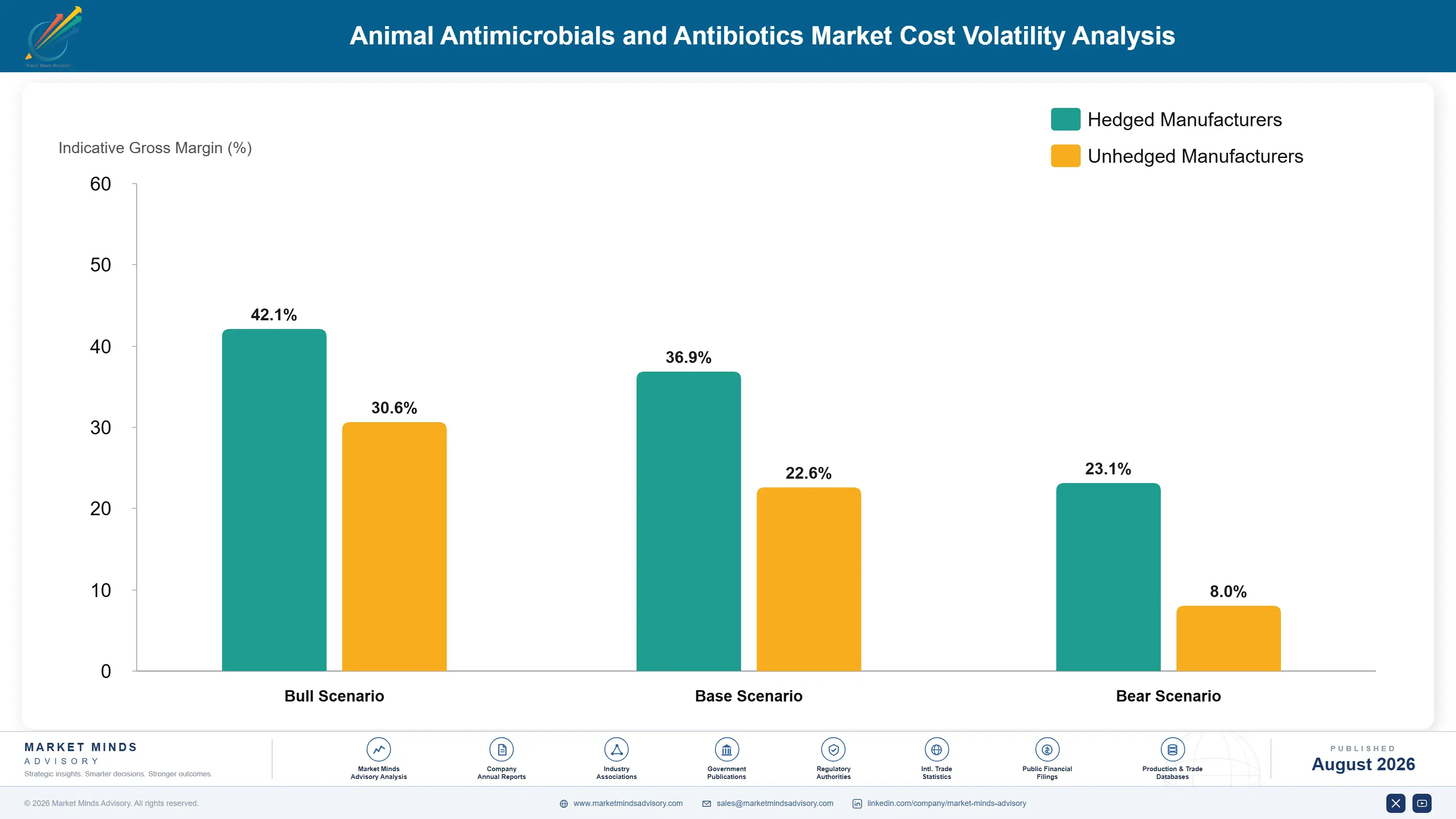
Fermentation Feedstock Sets The Margin Floor

Fermentation feedstock and energy costs account for 30% to 40% of production cost for generic antimicrobial active pharmaceutical ingredients, sourced primarily from agricultural fermentation substrates and industrial energy inputs whose pricing tracks broader commodity and energy markets rather than antimicrobial-specific supply and demand dynamics. Novel-class formulations carry a different cost structure weighted more heavily toward research amortization and specialized synthesis than raw fermentation feedstock specifically.
The 2022 energy price spike illustrated fermentation-dependent manufacturing exposure directly. EIA data recorded natural gas and industrial energy prices reaching multi-year highs through 2022 as global energy markets tightened following Russian supply disruption. Chinese and Indian generic manufacturers, many operating energy-intensive fermentation facilities, absorbed meaningful cost increases, passing some of that cost through to Western formulators who had few alternative low-cost active pharmaceutical ingredient sources to switch toward given manufacturing concentration in Asia.

Exposure falls hardest on smaller generic manufacturers without long-term energy contracts or feedstock hedging arrangements, who must absorb spot-market cost volatility directly and pass compressed margins through to customers or absorb losses themselves. Larger diversified manufacturers with established energy contracts and feedstock diversification smooth that volatility considerably better than smaller, less capitalized regional competitors overall.
animal-antimicrobials-and-antibiotics-cost-volatility-analysis-1787462859596

Lock Long-Term Energy And Feedstock Contracts

Manufacturers negotiating multi-year energy and fermentation feedstock agreements convert volatile spot pricing into a planned input cost, protecting downstream customer pricing that formulators and distributors resist adjusting frequently. This favors larger established manufacturers with existing supplier relationships, but smaller manufacturers can access similar terms through regional purchasing consortia rather than negotiating individually against larger established buyers.

Diversify Active Ingredient Manufacturing Geography

Companies reduce single-region energy and regulatory exposure by diversifying active pharmaceutical ingredient manufacturing across China, India, and domestic facilities rather than depending entirely on any single manufacturing region. That diversification smooths input cost and regulatory risk across different energy markets and jurisdictions, though it adds supplier qualification complexity across each additional manufacturing site incorporated into the network.

Invest In Fermentation Efficiency And Yield Improvement

Manufacturers reduce feedstock cost exposure per unit of output by investing in fermentation process efficiency and yield improvement technology, reducing the raw feedstock volume required per unit of finished active pharmaceutical ingredient produced. This capital investment suits larger manufacturers best, but delivers durable margin improvement that persists regardless of future feedstock price volatility across market cycles.

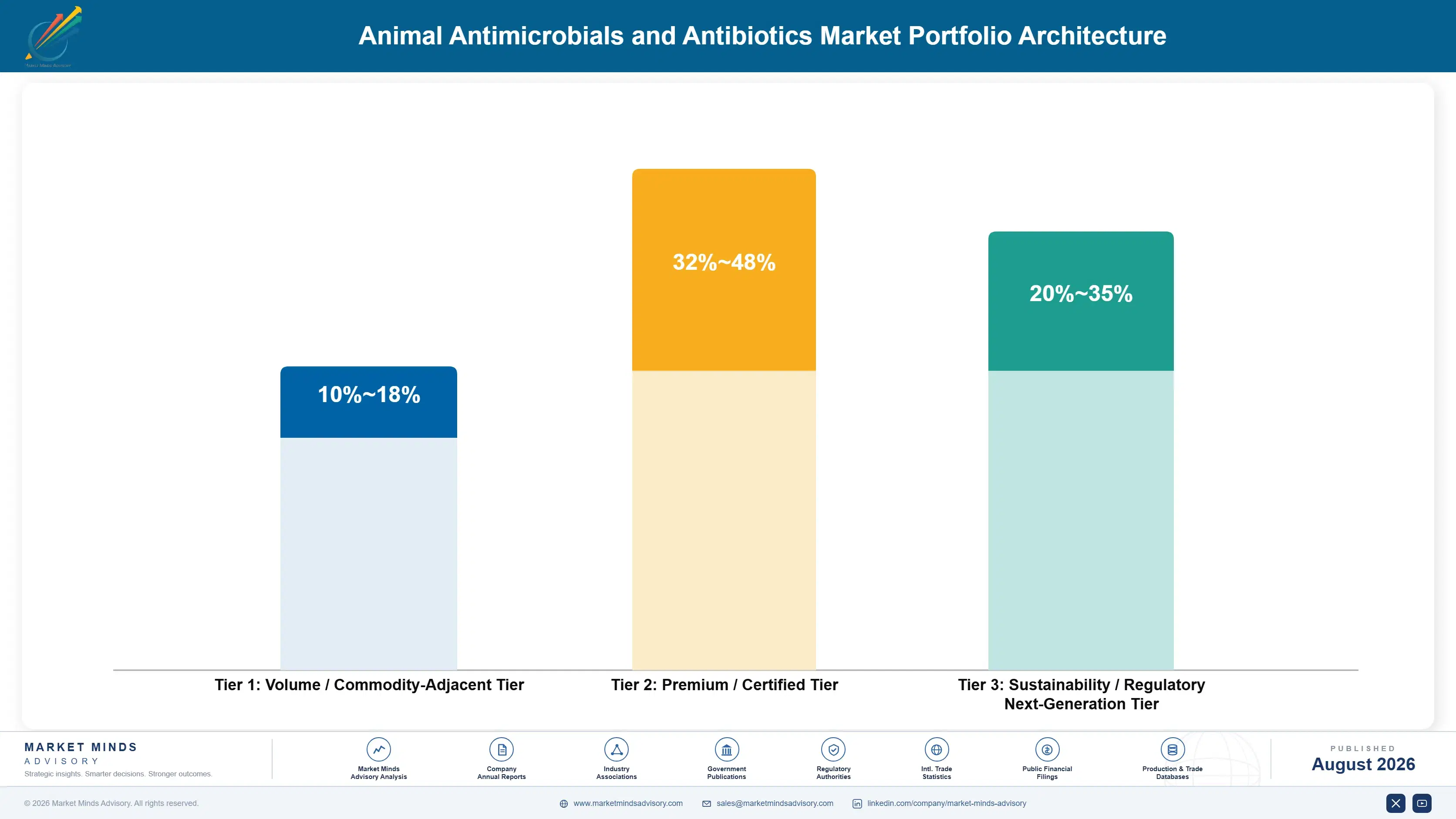
Portfolio Architecture for Margin Defence

Animal antimicrobials' portfolio splits into three tiers with meaningfully different margin economics. Volume generic antimicrobials, sold through established commodity channels on price and manufacturing scale, compete on cost and earn steady but thin margins. Novel next-generation classes and stewardship-support-bundled offerings earn substantially more, since clinical differentiation and regulatory approval barriers create switching costs commodity generic manufacturers cannot replicate quickly.
The tension for companies is capital allocation between two economics. Volume generic production generates dependable cash flow that funds operations and research investment, while novel-class development requires substantial multi-year research and regulatory investment before generating comparable returns at much higher margin. Companies leaning entirely on generic volume risk losing share to faster-growing novel-class competitors, while those chasing research investment too aggressively risk underutilized premium capacity if clinical trials or regulatory approval face unexpected delays.

High-value margin pools concentrate in novel next-generation classes and stewardship compliance support services carrying genuine clinical or regulatory differentiation that commodity generics cannot match. Frontier opportunity sits in combining emerging-market manufacturing presence with credible novel-class research investment, letting companies capture premium pricing from developed-market veterinarians while retaining steady generic volume revenue across emerging markets simultaneously.

Volume / Commodity-Adjacent Tier

Generic off-patent antimicrobials including tetracyclines and sulfonamides sold through established commodity trading channels on price and manufacturing scale, with minimal differentiation between competing Chinese and Indian producers across most export markets.
Gross Margin: 10-18%

Premium / Certified Tier

Branded novel-class antimicrobials and stewardship-compliance-bundled formulations carrying documented clinical efficacy and regulatory approval that commands sustained premiums over commodity generics across developed-market veterinary buyers specifically, particularly in North America and parts of Western Europe.
Gross Margin: 32-48%

Sustainability / Regulatory / Next-Generation Tier

Emerging antimicrobial-alternative technologies including precision dosing, vaccination programs, and biosecurity solutions positioned ahead of tightening global stewardship requirements, though adoption economics remain unproven at full commercial production scale across most producers today.
Gross Margin: 20-35%
animal-antimicrobials-and-antibiotics-portfolio-architecture-1787462860098

High-value Sub-segments and Strategic Watch-out

Polymyxins and Novel Next-Generation Antimicrobials

Novel-class demand grows fastest at 7.8% annually and already commands pricing three to five times above generic tetracyclines. Global majors investing in research and regulatory approval both continue expanding capacity, and growing resistance concerns should keep margin strong through the forecast period ahead across most affected production systems.
Gross Margin: 32-48%

Macrolides

Macrolide demand grows at a healthy 6.0% annually, anchored by broad poultry and swine use, though generic price competition and Asian manufacturing scale limit how much margin established Western suppliers can capture beyond formulation and distribution value-add services across most affected markets currently tracked.
Gross Margin: 18-28%

Tetracyclines

Tetracyclines remain the largest drug class by volume, anchored by decades of established use across global livestock production. Margins stay steady but modest, competing on manufacturing cost rather than differentiation, but the segment anchors baseline category revenue across every major producing region today.
Gross Margin: 8-15%

Sulfonamides

Sulfonamide demand faces gradual substitution pressure as newer drug classes with better resistance profiles gain veterinary preference across most production systems facing genuine disease pressure. Producers concentrated purely in this segment risk volume erosion over the next decade absent diversification into newer formulation categories entirely.
Gross Margin: 8-14%

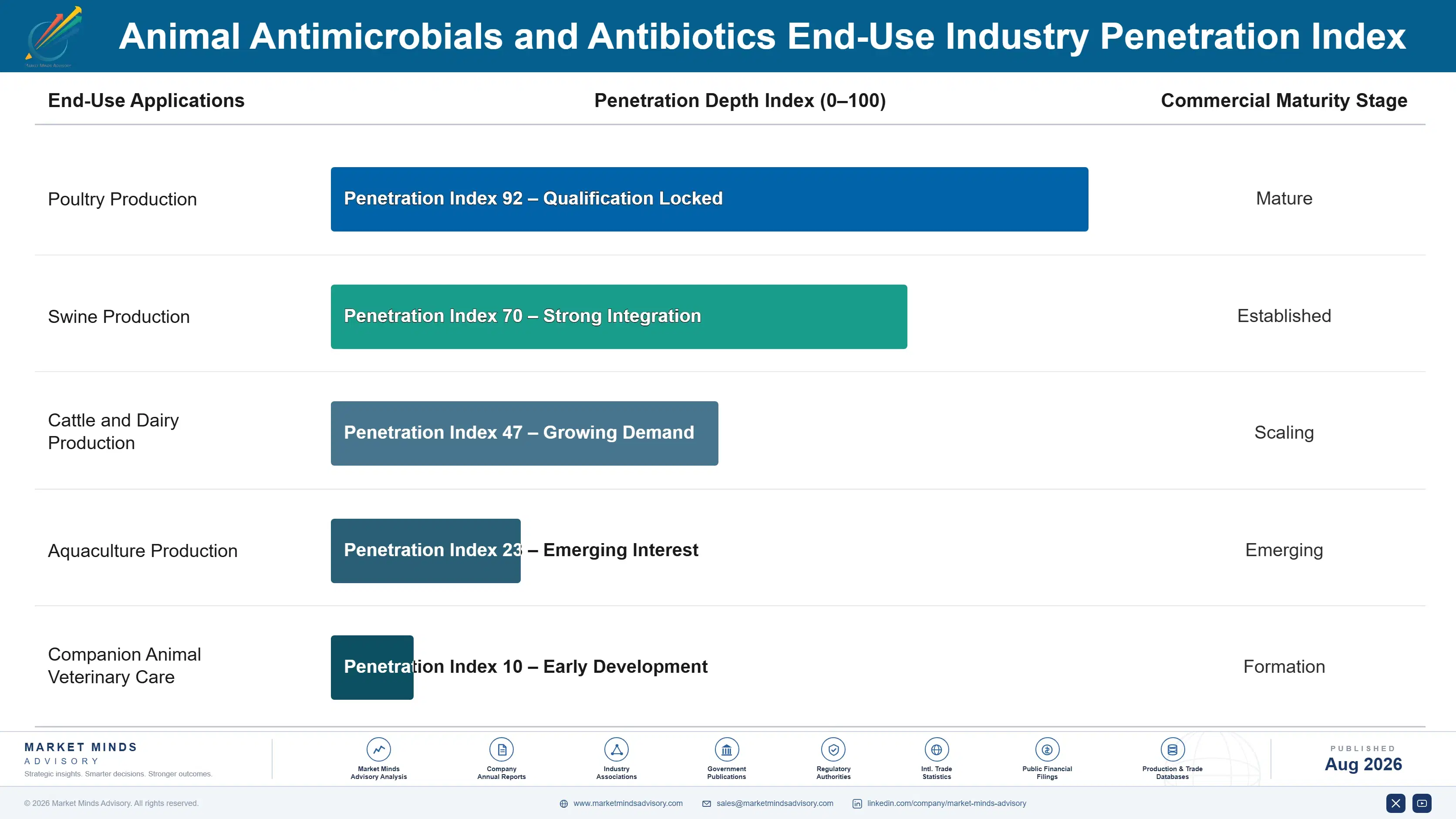
Why Antimicrobial Supply Relationships Run Long

Animal antimicrobials demand behaves like an annuity within established veterinary and production system relationships, since large integrated livestock and aquaculture operations qualify a supplier through extended formulation validation and regulatory documentation, then reorder against that qualified source repeatedly rather than re-tendering routinely given the operational and compliance risk of switching mid-production-cycle. Smaller producers behave more transactionally, switching more readily on price since formulation requirements are looser and validation cost is minimal for older generic drug classes.
Stickiness varies sharply by production system scale and sophistication. Large integrated operations rarely switch suppliers once qualified, given the regulatory documentation and formulation validation cost involved in establishing a new relationship under stewardship compliance requirements. Companion animal veterinary practices show similarly strong loyalty once a supplier proves consistent clinical efficacy and reliable supply. Smaller, less sophisticated producers remain the least sticky segment, switching between suppliers more readily as generic pricing shifts season to season.

Buyer profiles are shifting generationally within veterinary and production management. Younger production managers and veterinarians increasingly treat stewardship compliance and resistance management as standing professional requirements rather than optional considerations, a shift that favors suppliers who invested early in stewardship support infrastructure over those still competing purely on generic commodity pricing.
animal-antimicrobials-and-antibiotics-end-use-penetration-index-1787462860589

Where Animal Health Companies Should Bet

These are among the four positions where our research anticipates prominent divergence between winners and laggards over the coming forecast period. Each is grounded in the demand model, the regulatory perimeter, and the announced capacity pipeline.
01 / NOVEL CLASS INVESTMENT PRIORITY

Build next-generation antimicrobial pipelines before resistance spreads further

Novel next-generation antimicrobials are growing well over 75% faster than the wider market's pace, and already command pricing three to five times above generic tetracyclines, yet development pipelines across the industry remain concentrated among only a handful of global majors with sufficient research capital. Companies that invest now in novel-class research position ahead of continuing resistance spread across intensive livestock and aquaculture production systems worldwide. Waiting risks ceding the category's fastest-growing and highest-margin segment permanently to competitors currently building that clinical and regulatory capability.
02 / ASIAN MANUFACTURING EXPANSION

Build emerging market presence before volume growth fully relocates there

China and Southeast Asia carry meaningfully higher antimicrobial volume growth than developed markets facing stewardship-driven decline, and that growth gap will likely widen further as European and American regulation continues tightening over the coming decade. Companies that build manufacturing and distribution presence now in China, Vietnam, and India capture volume growth before competitors establish comparable regional infrastructure and regulatory relationships. Every company relying purely on developed-market volume risks missing the category's most durable underlying demand driver entirely, ceding it to earlier-moving rivals.
03 / STEWARDSHIP SUPPORT SERVICES

Build compliance consulting capability before it becomes table stakes

Livestock producers navigating tightening stewardship regulations increasingly need technical support rather than simply purchasing antimicrobial product, and companies offering this service now command meaningful premium pricing over commodity suppliers competing purely on cost alone. That premium will likely compress as stewardship support becomes a baseline expectation rather than genuine differentiation across the broader industry over the next several years. Companies that delay this investment risk entering a market where support capability carries cost but no longer commands meaningful premium pricing.
04 / AQUACULTURE FORMULATION PRIORITY

Build aquatic-specific formulation capability before competitors do

Southeast Asian aquaculture production is expanding at roughly 8.9% annually, faster than most terrestrial livestock systems, and aquatic application requires formulation expertise most terrestrial-focused animal health companies have not historically prioritized within their existing product development pipelines. Companies that build aquaculture-specific formulation and regulatory approval now capture contracts in the fastest-growing regional segment before competitors establish comparable technical capability. Every company relying purely on terrestrial livestock formulations risks missing the category's fastest-growing volume opportunity by a wide and steadily widening margin over time.

Engagement Snapshot From the Field

A live engagement with an industry participant carrying material or product regulatory and market exposure ahead of a defining policy shift, showing how our research translates into a defensible multi-year portfolio strategy.
MARKET MINDS ADVISORY · CLIENT ENGAGEMENT SUMMARY
Animal Antimicrobials and Antibiotics Producer Strategic Portfolio Review and Transition Roadmap 2026·Investment Scenario on Animal Antimicrobials and Antibiotics Exposure Evaluation 2025-26
CLIENT PROFILE
A mid-sized Southeast Asian aquaculture producer operating shrimp and fish farming facilities across Vietnam and Indonesia approached MMA while evaluating whether to switch from generic domestic antimicrobial suppliers to an established Western animal health company offering aquaculture-specific formulations. The client reported annual production revenue near USD 180 million, with antimicrobial input cost accounting for roughly 8% of total production expense and rising disease pressure affecting yield (client-reported, unverified by MMA).
STRATEGIC CHALLENGE
Management faced a sourcing decision between continuing to purchase lower-cost generic antimicrobials from domestic Vietnamese and Chinese suppliers or switching to premium aquaculture-specific formulations from an established Western animal health company at meaningfully higher cost per unit. The commercial team worried the premium cost would compress already-thin margins, while operations worried continuing generic use would not address rising yield loss.
MMA APPROACH
MMA benchmarked yield loss and mortality data across the client's facilities against comparable operations using premium aquaculture-specific formulations, modeled total cost of production including antimicrobial input cost and yield outcomes under both sourcing scenarios, and assessed regional supplier capacity and formulation validation timelines for a potential transition. We also evaluated a hybrid approach using premium formulations only in the highest-disease-pressure facilities.
KEY FINDINGS
  1. Facilities using premium aquaculture-specific formulations in comparable regional operations showed meaningfully lower mortality rates, offsetting the higher per-unit antimicrobial cost through improved total yield economics.
  2. A full transition to premium formulations across all facilities exceeded the client's near-term capital budget without meaningful production financing support from an external source.
  3. Targeting premium formulations specifically at the client's highest-disease-pressure facilities captured most of the yield benefit at a fraction of the full transition cost (client-reported, unverified by MMA).
  4. Regional supplier capacity for premium aquaculture formulations was sufficient to support a phased transition without significant supply constraint risk during the initial rollout period.
CLIENT PROFILE
A mid-sized Southeast Asian aquaculture producer operating shrimp and fish farming facilities across Vietnam and Indonesia approached MMA while evaluating whether to switch from generic domestic antimicrobial suppliers to an established Western animal health company offering aquaculture-specific formulations. The client reported annual production revenue near USD 180 million, with antimicrobial input cost accounting for roughly 8% of total production expense and rising disease pressure affecting yield (client-reported, unverified by MMA).
STRATEGIC CHALLENGE
Management faced a sourcing decision between continuing to purchase lower-cost generic antimicrobials from domestic Vietnamese and Chinese suppliers or switching to premium aquaculture-specific formulations from an established Western animal health company at meaningfully higher cost per unit. The commercial team worried the premium cost would compress already-thin margins, while operations worried continuing generic use would not address rising yield loss.
MMA APPROACH
MMA benchmarked yield loss and mortality data across the client's facilities against comparable operations using premium aquaculture-specific formulations, modeled total cost of production including antimicrobial input cost and yield outcomes under both sourcing scenarios, and assessed regional supplier capacity and formulation validation timelines for a potential transition. We also evaluated a hybrid approach using premium formulations only in the highest-disease-pressure facilities.
KEY FINDINGS
  1. Facilities using premium aquaculture-specific formulations in comparable regional operations showed meaningfully lower mortality rates, offsetting the higher per-unit antimicrobial cost through improved total yield economics.
  2. A full transition to premium formulations across all facilities exceeded the client's near-term capital budget without meaningful production financing support from an external source.
  3. Targeting premium formulations specifically at the client's highest-disease-pressure facilities captured most of the yield benefit at a fraction of the full transition cost (client-reported, unverified by MMA).
  4. Regional supplier capacity for premium aquaculture formulations was sufficient to support a phased transition without significant supply constraint risk during the initial rollout period.
RECOMMENDED STRATEGY
Phase 1: Phase 1 (0 to 6 months): Transition the two highest-disease-pressure facilities to premium aquaculture-specific formulations to validate yield improvement claims. Phase 2: Phase 2 (6 to 18 months): Expand premium formulation use to additional facilities based on validated yield and mortality improvement from the initial transition. Phase 3: Phase 3 (18 to 36 months): Reassess full-portfolio transition once yield economics across all converted facilities confirm the premium investment pays back reliably.
OUTCOME
The client transitioned its highest-disease-pressure facilities first, achieving meaningfully improved mortality rates within the first production cycle. Yield improvement more than offset the higher antimicrobial input cost at those facilities, and the client is now evaluating expansion of premium formulation use to additional sites (client-reported, unverified by MMA).

Frequently Asked Questions

Foundational context covering the market sizes, CAGR, scope, country, region and competition that inform every finding below. This section is provided to cover basics and most often pre-purchase conversations, answered from the MMA Primary Research Dataset.

What is the current size of the Animal Antimicrobials and Antibiotics Market?

The global animal antimicrobials and antibiotics market reached USD 5.01 billion in 2025, based on MMA Primary Research Dataset findings. Growth increasingly reflects Asian volume expansion rather than developed-market use alone.

How large will the Animal Antimicrobials and Antibiotics Market be by 2036?

MMA's base case projects the market reaching USD 7.71 billion by 2036, an incremental opportunity of roughly USD 2.70 billion over the 2026 to 2036 forecast period.

What is the CAGR for the Animal Antimicrobials and Antibiotics Market 2026 to 2036?

The base case CAGR is 4.4%, with a bull case of 5.5% and a bear case of 3.3% depending on stewardship enforcement pace and Asian volume growth.

Which segment is growing fastest?

Novel next-generation antimicrobials lead at a 7.8% CAGR, well over 75% faster than the overall market rate, as resistance erodes older drug class efficacy across production systems.

Who are the major companies in the Animal Antimicrobials and Antibiotics Market?

Leading participants include Zoetis Inc, Elanco Animal Health Incorporated, Boehringer Ingelheim Animal Health, Merck Animal Health, and Ceva Santé Animale, assessed on portfolio breadth and manufacturing reach.

Which country is growing fastest?

Vietnam leads country-level growth, driven by rapidly expanding aquaculture production that carries antimicrobial use intensity considerably higher than most terrestrial livestock production systems face today.

Report Segmentation Architecture

The full report scope spans multiple orthogonal segmentation dimensions, with cross-tabulated demand data provided for each dimension pair. Coverage extends further to regional breakdowns, trend trajectories, and the competitive detail needed to support segment-level decision-making.

By Drug Class

  • Tetracyclines
  • Beta-Lactams
  • Macrolides
  • Sulfonamides
  • Aminoglycosides
  • Polymyxins and Novel Next-Generation Antimicrobials

By End-Use Industry

  • Poultry Production
  • Swine Production
  • Cattle and Dairy Production
  • Aquaculture Production
  • Companion Animal Veterinary Care

By Commercial Dimension

  • Direct Manufacturer Contract Supply
  • Distributor and Veterinary Channel Sales
  • Generic Spot Market Purchasing
  • Stewardship-Bundled Service Contracts

By Region

  • North America
  • Western Europe
  • East Asia
  • South Asia and Pacific
  • Latin America
  • Middle East and Africa
  • Eastern Europe

Scope, Methodology, and Coverage

Every figure in this report is reproducible from documented input assumptions. The scope below maps the historical period, the forecast horizon, the segmentation dimensions, and the countries covered, alongside the underlying primary and qualitative methodology.
Historical Period
2020 to 2025
Forecast Period
2026 to 2036
Base Year
2025 (USD billions; MMA Primary Research Dataset, August 2026)
Market Definition
The animal antimicrobials and antibiotics market covers commercial production and sale of antibacterial veterinary pharmaceuticals used therapeutically, metaphylactically, or as growth-promoting agents in livestock, poultry, aquaculture, and companion animal production. It excludes vaccines, antiparasitics, and other non-antibacterial veterinary pharmaceutical categories, which the industry classifies as separate segments.
Quantitative Units
USD billions (current prices); metric tonnes of active pharmaceutical ingredient volume where applicable
Segmentation Dimensions
By Drug Class; By End-Use Industry; By Commercial Dimension; By Region
Regions Covered
North America, Western Europe, East Asia, South Asia and Pacific, Latin America, Middle East and Africa, Eastern Europe
Countries Covered
USA, China, Germany, France, UK, Japan, South Korea, India, Australia, Canada, Brazil, Mexico, Indonesia, Vietnam, Thailand, Malaysia, UAE, Saudi Arabia, South Africa, Nigeria, Turkey, Poland, Netherlands, Italy, Spain, Sweden, Switzerland, Argentina, Colombia, Singapore, and additional markets relevant to this sector
Key Companies Profiled
Zoetis Inc, Elanco Animal Health Incorporated, Boehringer Ingelheim Animal Health, Merck Animal Health, Ceva Santé Animale, Virbac SA, Phibro Animal Health Corporation, Huvepharma EOOD, Vetoquinol SA, Bimeda Animal Health, Dechra Pharmaceuticals PLC, Neogen Corporation, Kyoritsu Seiyaku Corporation, Zhejiang Hisun Pharmaceutical Co, Alivira Animal Health Limited, Indian Immunologicals Limited, Ourofino Saúde Animal, Provet Group, Chengdu Diao Pharmaceutical Group, Vetnil Industria e Comercio de Produtos Veterinarios
Quantitative Methodology
Primary survey, n=3,800 respondents, Q4 2025, six countries; demand-side model with trade association cross-validation
Qualitative Methodology
47 expert interviews, Q4 2025; applied to validate demand model assumptions, identify emerging dynamics, and assess competitive positioning
Report Format
PDF and XLSX data workbook (Word format preview document)
Publisher
Market Minds Advisory
Report Code
MMA-2026-AGR-104
Published
August 2026
Contact
sales@marketmindsadvisory.com | www.marketmindsadvisory.com

Purchase the full Animal Antimicrobials and Antibiotics Market Report (2026 to 2036).

The full MMA Animal Antimicrobials and Antibiotics report sizes the market across six drug class segments, five end-use industries, four commercial supply models, and seven regions through 2036. It profiles twenty participants on a consistent basis of portfolio breadth and manufacturing reach across generic, branded, and novel-class formulations, scoring each on research investment, stewardship compliance support, and emerging-market manufacturing presence. Scenario models quantify how antimicrobial resistance stewardship, Asian aquaculture expansion, and novel-class development move both category volume and realizable pricing. The report also includes feedstock cost modeling, a stewardship compliance benchmark, and Asian manufacturing expansion assessment built for animal health, veterinary, and investment strategy teams.
Six-class demand model with regulatory-adjusted pricing
Fermentation feedstock cost and volatility scenario modeling
Stewardship compliance and support service benchmarking
Twenty-company competitive profiling on consistent manufacturing basis
Seven-region demand map with country-level growth detail
Asian aquaculture and livestock market entry assessment

Built For The People Who Decide

From boardroom strategy to bench-side execution, this report is read cover-to-cover by leaders shaping the next decade of their industry, turning demand scenarios, market dynamics and valuation benchmarks into decisions.
CXOs/ Presidents/ VPs/ Managers
M&A and Corporate Development
Strategy Teams and R&D Heads
Procurement and Product Directors
Regulatory and Compliance Leaders
Investor Relations and Equity Analysts