
Market Minds Advisory
Air Barrier Market

Air Barrier Market: Where Energy Codes Made The Invisible Layer Mandatory

A commercial reading of air barrier systems, where energy codes now mandate continuous building envelope sealing, and fluid-applied membranes are winning the installer labour argument sheet products simply cannot match.

Lead Analyst

Bilal Shaikh

Published

September 2026

Make Smarter Decisions with Customized Research Insights

Request a free sample report and evaluate market opportunities, growth trends, and competitive dynamics relevant to your business needs.

2025 MARKET VALUE$3.8BMarket Size 2025
2036 FORECAST VALUE$8.2BBase Case , 2026 to 2036
CAGR 2026 TO 20367.2 %Bull 8.4% / Bear 5.9%
INCREMENTAL OPPORTUNITY$4.1BNet 10- year value creation
EXPANSION MULTIPLE2.00x2036 value over 2026 base
Strategic Levers
M&A Pipeline
Regional Outlook
Country Rankings
Competitive Intelligence
Segmental Deep-dive
Call-Us : 91 93563 13602

Executive Snapshot and Market Trajectory

Air barriers used to be a specification afterthought buried in construction documents nobody read closely on a typical project. Energy codes changed that, turning continuous air sealing into a mandatory line item contractors now budget for explicitly across most commercial and residential projects.
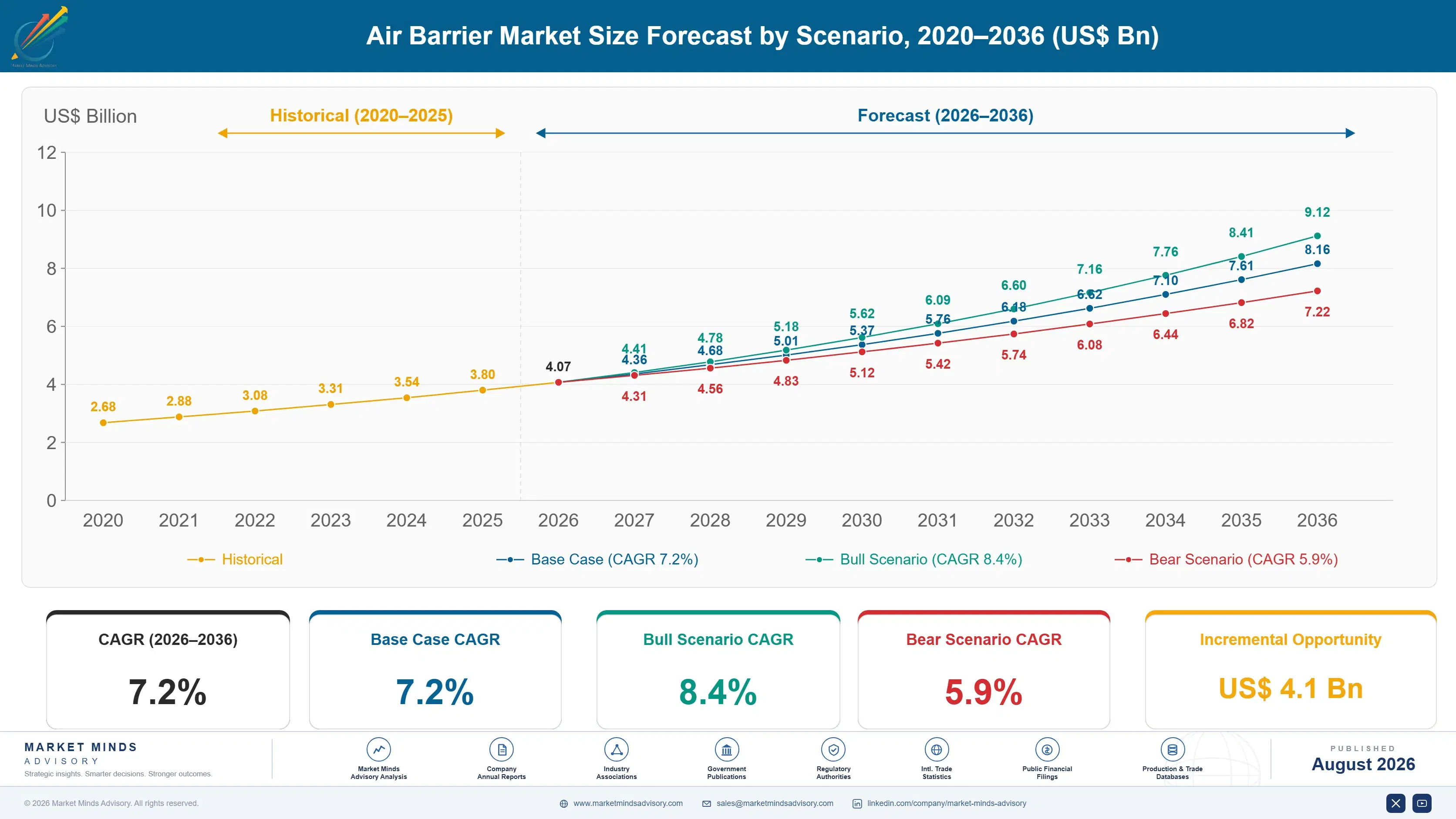
The market stands at USD 3.8 billion in 2025 and reaches USD 8.16 billion by 2036 at a 7.2% CAGR. Fluid-applied membrane air barriers grow fastest at 11.8%, roughly 1.64 times the overall rate, as installers favour continuous application over sheet product seaming labour across most project types. North America holds 34% of value on the most stringent and widely enforced building energy codes anywhere, while Canada posts the quickest national growth at 10.2%.
Concentration is moderate at roughly 34%, split across building envelope material majors and specialist manufacturers competing for contractor and specifier relationships across commercial and residential construction categories broadly. Two forces dominate the period ahead. Tightening energy codes are converting air barriers from a discretionary specification into a mandatory continuous envelope requirement, and installer labour shortages are pushing contractors toward faster-applied fluid and spray systems over labour-intensive sheet membrane seaming.
Market Definition
The air barrier market covers building envelope products designed specifically to control air leakage through the building enclosure, valued at manufacturer selling prices. General building envelope products such as vapour barriers and uncertified weather-resistive barriers are excluded.
Base Year Value
$3.8B in 2025 (MMA Primary Research Dataset, August 2026)
Forecast Period
2026 to 2036, eleven discrete annual values
CAGR
7.2% base case. Bull 8.4%. Bear 5.9%.
Fastest Growth Segment
Fluid-Applied Membrane Air Barriers: 11.8% CAGR
Fastest Growth Country
Canada: 10.2% CAGR
Fastest Growth Region
South Asia and Pacific: 9.3% CAGR
Largest Region
North America: 34% of 2025 global value
Market Leaders
Sika, Carlisle Companies, Saint-Gobain, Owens Corning, Soprema. Source: MMA Analysis based on company annual reports.
Primary Survey
n=3,800 procurement and R&D decision-makers, Q4 2025, six countries
Methodology
Demand-side build-up, cross-validated against public data, 47 expert interviews

Air Barrier Market Forecast Scenarios

air-barrier-market-size-forecast-scenario-1787332174455
Growth from 2020 to 2025 compounded near 6.2%, and tightening building energy codes did most of the early work, as jurisdictions adopted continuous air barrier requirements that previously left the choice to individual project specification. Fluid-applied membrane adoption accelerated considerably during the period as installer labour shortages pushed contractors toward faster application methods than traditional mechanically fastened sheet products required.
Three mechanisms carry the base case to 7.2%. First, building energy codes continuing to tighten and spread to additional jurisdictions, converting continuous air barriers from optional best practice into mandatory specification. Second, installer labour shortages favouring faster-applied fluid and spray systems over labour-intensive sheet membrane seaming across most commercial construction. Third, building envelope commissioning and testing requirements increasingly verifying air barrier performance, rewarding systems that demonstrably meet air leakage thresholds.
The bull case at 8.4% assumes energy code adoption accelerates further and fluid-applied system costs fall enough to broaden adoption beyond commercial construction into residential categories more broadly. The bear case at 5.9% assumes code enforcement remains inconsistent across jurisdictions, contractor familiarity with newer application methods lags considerably, and construction spending broadly softens under tighter financing conditions.

Why Field Execution, Not Material Choice, Determines Performance

Three forces set demand here. Energy code mandate drives the most durable volume, as continuous air barrier requirements spread across a growing number of jurisdictions adopting the latest code editions. Installer labour shortage drives a second stream, since contractors increasingly favour faster fluid-applied systems over sheet seaming. Building envelope commissioning drives a third stream, as testing requirements increasingly verify air barrier performance rather than assuming it.
MARKET CONCENTRATIONCR5: 34%Moderately fragmented across building envelope material majors and specialist manufacturers
FLUID-APPLIED COST PREMIUM15 to 30%Installed cost premium for fluid-applied systems against mechanically fastened sheet
COMMERCIAL SPECIFICATION RATEAbout 55%Share of new commercial construction projects specifying continuous air barriers
AIR LEAKAGE REDUCTIONUp to 40%Reduction in air leakage achieved through continuous air barrier installation
INSTALLATION TIMELINE1 to 3 daysTime to install and cure a fluid-applied membrane wall system
INSTALLATION DEFECT SHAREAbout 60%Share of envelope failure claims attributable to air barrier defects
The commercial character is defined by a widening gap between what energy codes require and what contractors can actually install correctly on a live job site. A continuous air barrier looks simple on drawings, yet field execution around windows and transitions determines whether the system performs as designed. That mismatch concentrates risk with manufacturers whose systems require precise execution, and rewards manufacturers who simplify installation for ordinary crews.
The decade turns on whether fluid-applied and spray systems can extend their labour advantage into residential construction, where adoption still lags commercial projects considerably. Cost and contractor familiarity remain the primary barriers separating fluid-applied systems from becoming the default across every construction category rather than staying concentrated in commercial work. That shift matters more than any innovation, because it determines whether air barriers become truly universal.
"A perfect membrane installed badly around a window flashing fails exactly the same way as a mediocre membrane. The material stopped being the constraint years ago; the crew on site is."
Director, Building Envelope and Construction Materials Practice · MMA Constructi

Market Trends

Fluid-Applied Systems Are Winning The Labour Argument

Fluid-applied membrane systems are winning specification battles against traditional mechanically fastened sheet products as contractors increasingly prioritise application speed over material cost alone, since a fluid-applied system eliminates the seaming, taping, and fastening labour that sheet products require across every wall penetration and transition. That labour advantage matters considerably more now that skilled installer availability has tightened across most construction markets, making a system that a smaller crew can apply correctly and quickly genuinely more valuable than one offering marginally lower material cost. Manufacturers with proven fluid-applied technology are capturing specification share from sheet product incumbents at an accelerating rate.
Market Impact: Mandated across 40 US states
Commissioning Is Spreading Beyond Specialist Commercial Projects

Building envelope commissioning, which independently tests and verifies air barrier performance before a building receives occupancy approval, is spreading from a specialist practice reserved for the most demanding commercial projects into a standard requirement across an expanding set of jurisdictions and building types. That verification requirement is rewarding manufacturers whose systems demonstrably meet air leakage thresholds under real testing conditions, rather than those relying purely on laboratory specification sheets that may not reflect actual field installation quality. Commissioning failures increasingly trace back to installation execution rather than material selection, shifting manufacturer competition toward installer training and technical support depth.
Market Impact: Cuts crew size requirements by 30%

Market Opportunities and Growth Drivers

Energy Codes Are Making Continuous Barriers Mandatory

Building energy codes across a growing number of jurisdictions now mandate continuous air barrier systems explicitly, converting what was once a discretionary specification decision into a compliance requirement that new construction projects cannot legally bypass. That regulatory structure creates durable demand regardless of underlying construction cost cycles, since a building permit applicant cannot obtain approval without demonstrating compliant continuous air sealing under the applicable code edition. Each new jurisdiction adopting a comparable energy code amendment adds directly to addressable demand without requiring independent commercial persuasion from manufacturers already serving comparable regulated markets.
Market Impact: Premiums reach 15 to 35% more

Labour Shortages Are Rewarding Faster Application Methods

Installer labour shortages across the construction trades have made application speed a genuine competitive differentiator, since contractors facing crew availability constraints increasingly specify fluid-applied and spray systems that a smaller team can install correctly in considerably less time than traditional sheet membrane seaming requires. That labour dynamic creates demand independent of underlying material cost comparison, since a contractor unable to staff a labour-intensive installation simply cannot bid competitively on projects requiring extensive sheet product seaming. Each additional skilled installer shortage strengthens the economic case for faster-applied alternative systems across that specific contractor's project pipeline.
Market Impact: Installation defects cause 60% of f

Market Restraints and Challenges

Cost Premium Limits Adoption In Price-Sensitive Categories

Fluid-applied and spray air barrier systems typically cost 15% to 35% more per square foot than mechanically fastened sheet products, a premium that price-sensitive residential and smaller commercial projects cannot always absorb without a specific code mandate or contractor preference driving the decision. The root cause is that fluid-applied systems require more raw material volume and specialised application equipment than sheet products, which benefit from decades of standardised manufacturing scale. The commercial impact is that adoption concentrates in commercial construction and code-mandated categories rather than spreading universally. Mitigation runs through production scale-up, application equipment cost reduction, and hybrid system approaches.
Market Impact: Cuts installation labour hours by 3

Field Installation Quality Determines Actual Performance

Air barrier system performance depends heavily on field installation quality around windows, penetrations, and transitions, and even a well-engineered product can fail to deliver rated air leakage performance if installers execute those critical details incorrectly on site. The root cause is that most construction crews receive limited formal training on air barrier installation specifics, treating it as a secondary task subordinate to the primary weatherproofing work they were trained for originally. The commercial impact is that building envelope commissioning increasingly identifies installation defects rather than material failures. Mitigation runs through contractor training programmes, simplified installation systems, and manufacturer technical support.
Market Impact: Required on 40% of projects
3 additional market trends, 4 additional growth drivers, and 2 additional restraints and challenges are covered in the full report. Contact sales@marketmindsadvisory.com to access the complete intelligence.

Segment CAGR and Growth Architecture

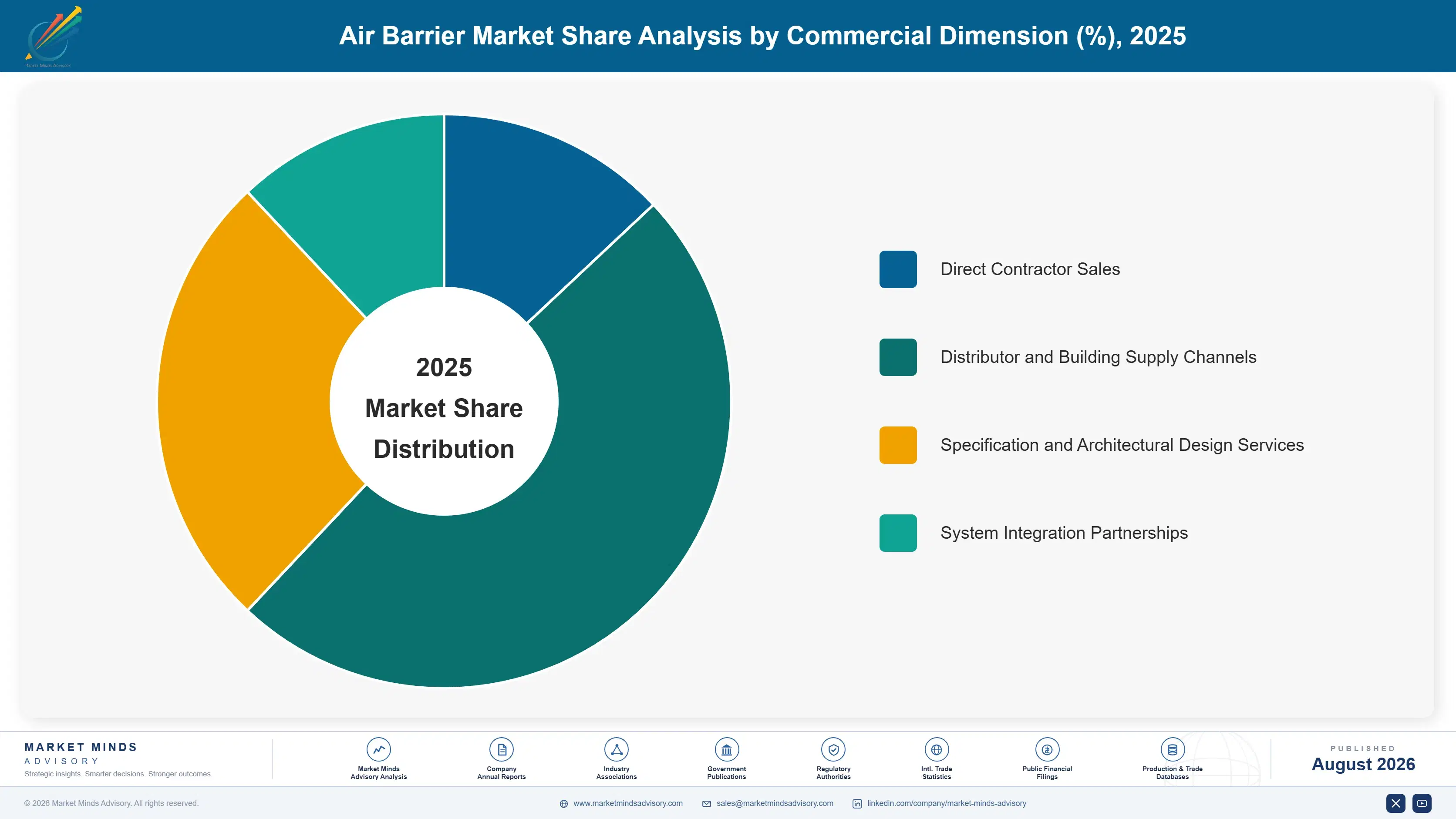
Segmentation follows product technology, a single physical logic describing how the air barrier system is actually applied to the building envelope rather than what building type it protects. Each technology carries its own installation labour requirement, cost structure, and performance profile, so commercial position tracks the application method rather than the construction category it serves.
air-barrier-market-market-share-analysis-1787332175002

Fluid-Applied Membrane Air Barriers

Fluid-applied membrane air barriers grow fastest at 11.8%, about 1.64 times the overall 7.2% rate, as installers favour continuous application over the seaming, taping, and fastening labour that sheet products require across every wall penetration and transition point. Growth concentrates where installer labour shortages make application speed a genuine competitive differentiator, since a fluid-applied system lets a smaller crew complete installation considerably faster than sheet product seaming allows on a typical project. Sika and Carlisle Companies hold established positions in this segment, built on decades of building envelope material engineering. Application equipment cost and installer training requirements remain the primary factors separating credible offerings from products still limited to specialist commercial applicators only.
CAGR 11.8%

Self-Adhered Sheet Membrane Air Barriers

Self-adhered sheet membrane air barriers grow at 9.0%, offering contractors familiar sheet-product installation methods while still delivering meaningfully faster application than mechanically fastened alternatives requiring separate fastening and sealing steps at every single joint encountered on any given site. Adoption is concentrated among contractors transitioning away from traditional mechanically fastened systems without adopting fluid-applied technology requiring specialised spray equipment investment and training. Saint-Gobain and Owens Corning hold strong positions built on decades of building envelope membrane manufacturing experience across multiple construction categories and climates worldwide. Adhesive performance across varying temperature and substrate conditions remains the primary constraint on how broadly this format can displace both older and newer alternatives available.
CAGR 9.0%
Full segment breakdown across 5 segments available in the complete report.

Regional Architecture and Country Demand Map

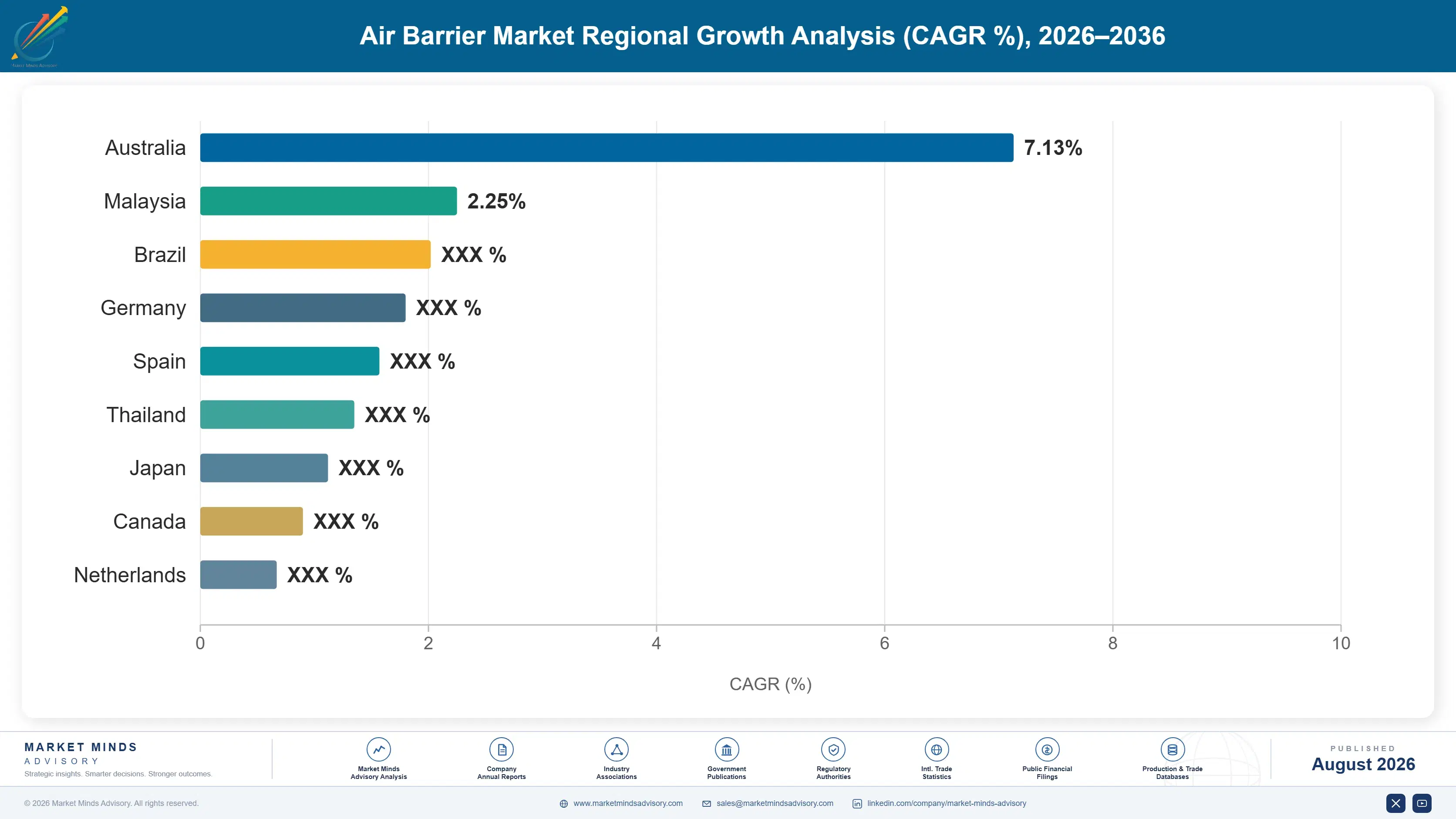
Building energy code stringency and enforcement depth, rather than population, set this seven-region value distribution across the market. North America dominates on the most stringent and widely enforced energy codes anywhere, East Asia follows on construction manufacturing scale, and Canada grows fastest on cold-climate energy code intensity.

North America

North America holds 34% of value at 8.2% growth, well above the 22 to 32% band, because the United States and Canada together maintain the most stringent and most consistently enforced building energy codes requiring continuous air barriers anywhere in the world. Sika and Carlisle Companies both maintain deep domestic commercial infrastructure spanning decades of building envelope material relationships across major construction markets. The Air Barrier Association of America has driven consistent testing and certification standards that considerably strengthen code enforcement compared to jurisdictions without comparable industry infrastructure. Canadian demand follows even stricter cold-climate energy requirements at somewhat smaller absolute scale. Domestic contractors increasingly treat continuous air barriers as standard specification rather than an optional upgrade for new commercial construction.
Share: 34% | CAGR: 8.2% (2026 to 2036)

Western Europe

Western Europe holds 24% of value at 6.0% growth, shaped by building energy efficiency directives that have driven air barrier adoption for considerably longer than most other regions, leaving less remaining headroom for new adoption across most member states currently. Saint-Gobain and Soprema both hold deep regional positions built on decades of building envelope material engineering and testing expertise across the continent and beyond. German and Nordic construction markets lead regional adoption, driven by stringent energy efficiency standards in cold-climate construction specifically and consistently. Growth reflects incremental expansion into remaining categories rather than any broad new adoption wave, since much of the addressable commercial market already specifies continuous air barriers.
Share: 24% | CAGR: 6.0% (2026 to 2036)
Regional intelligence for 5 additional markets available in the complete report: East Asia, South Asia and Pacific, Latin America, Middle East and Africa, Eastern Europe. Contact sales@marketmindsadvisory.com.
air-barrier-market-country-cagr-analysis-1787332175511

Where Air Barrier Manufacturers Hold Margin

A manufacturer selling raw membrane material at commodity margins while a competitor holds proven fast-application technology and installer training programmes is competing on the wrong axis entirely. The four moves below shift earnings toward what actually captures share: application speed advantage, contractor training depth, code compliance positioning, and commissioning-verified performance credentials built early for demanding commercial specifiers.

Build Application Speed Advantage Through Fluid Technology

Manufacturers that reduce application time through fluid or spray technology, rather than requiring the seaming and fastening labour sheet products demand, capture specification wins from contractors facing genuine crew availability constraints across most construction markets today. That capability commands a premium of 15 to 30% over sheet product alternatives, since contractors pay for labour savings as much as for the underlying material performance itself. Sika and Carlisle Companies built this application speed advantage over years, and it is not quickly replicated by manufacturers entering from a traditional sheet product background.
Market Impact: Commands a 15 to 30% application pr

Build Contractor Training Programmes That Prevent Failures

Contractor training programmes that teach correct field execution around windows, penetrations, and transitions convert a manufacturer's material advantage into an actual installed performance advantage, cutting commissioning failure rates by roughly 40%, since even the best-engineered product fails to deliver rated air leakage performance when installers execute critical details incorrectly on site. Manufacturers investing in genuine training infrastructure see considerably fewer commissioning failures than competitors who ship product without comparable installer support. That training depth converts into a durable specifier relationship, since architects increasingly specify by installed track record rather than laboratory rating alone.
Market Impact: Cuts commissioning failure rates by

Pre-Position Compliant Systems Ahead Of Code Adoption

Building energy codes typically pass with a defined adoption date set 12 to 24 months in advance, and manufacturers positioned with code-compliant systems and contractor training before that date takes effect capture disproportionate early share that later entrants find genuinely difficult to displace once specifier relationships solidify around a proven solution. That compliance-driven demand persists regardless of underlying material cost, since a project cannot obtain permit approval without demonstrating compliant continuous air sealing under the applicable code. Manufacturers tracking code adoption calendars closely and pre-positioning ahead of enactment consistently outperform those reacting only after enforcement begins.
Market Impact: Codes now cover over 40 US states d

Build Commissioning-Verified Performance Track Records Early

Building envelope commissioning increasingly verifies air barrier performance through independent testing before occupancy approval, and manufacturers who can point to genuine commissioning-verified track records win 3 times more specification battles than competitors relying purely on laboratory data can match regardless of underlying formulation quality. That verified credibility becomes especially valuable as commissioning spreads from specialist commercial projects into a broader set of building types and jurisdictions requiring independent performance confirmation. Manufacturers with strong commissioning track records increasingly dominate competitive shortlists for large institutional and commercial projects requiring documented performance assurance.
Market Impact: Verified systems now win 3x more sp

Who Controls the Margin Pool

Concentration is moderate at roughly 34% for the top five, split across building envelope material majors and specialist manufacturers competing for contractor and specifier relationships. The gap between leaders and challengers is application speed advantage and contractor training depth rather than raw manufacturing scale, broadly comparable across established players. All participants are assessed on one basis, revenue from air barrier systems and components, excluding general building envelo
Competition runs along three lines. First, application speed advantage, since that increasingly determines which manufacturers win specification against labour-constrained contractors. Second, contractor training depth, which shapes specifier relationships for years once a manufacturer demonstrates fewer commissioning failures. Third, code compliance positioning ahead of energy code adoption dates, since compliance-driven demand persists regardless of underlying material cost.

Pressure is building from two directions. Large diversified building material groups are acquiring specialist fluid-applied technology firms to build application speed capability faster than organic development allows. Meanwhile smaller regional manufacturers are winning contractor relationships directly through deeper training support than large incumbents typically invest in for smaller markets. Rankings should favour manufacturers combining application speed advantage with genuine commissioning-verified performance over those competing on sheet product scale alone.
air-barrier-market-company-positioning-matrix-1787332176028

Competitive Moat and Risk Dimensions

SIKA

Moat: Application speed advantage depth

Sika built deep fluid-applied membrane technology over decades of building envelope engineering, giving contractors application speed advantages competitors relying on sheet products cannot match. Its global manufacturing scale supports competitive pricing alongside the technical depth. Continued investment in installer training infrastructure positions it ahead of manufacturers lacking comparable field support programmes.
SIKA

Risk: Premium pricing limits smaller accounts

Its fluid-applied systems carry a cost structure that prices out smaller residential and light commercial contractors unable to absorb the premium over mechanically fastened sheet alternatives. Regional manufacturers entering with lower-cost sheet products are targeting exactly these price-sensitive accounts directly. Maintaining premium positioning while regional specialists gain credibility remains a genuine ongoing commercial challenge.
CARLISLE COMPANIES

Moat: Building envelope engineering scale

Carlisle Companies built deep building envelope engineering expertise over decades of commercial roofing and wall system relationships spanning major construction markets nationally. Its integrated system approach bundles air barriers with complementary envelope components that contractors increasingly prefer sourcing from one supplier. Continued investment in commissioning-verified performance data extends that engineering depth into the fastest-growing regulatory-driven segments.
CARLISLE COMPANIES

Risk: Exposure to commercial construction cycles

Its commercial construction concentration exposes it meaningfully to cyclical construction spending patterns, which move independently of the steadily expanding residential air barrier segment driving broader category growth. Diversification into residential construction requires contractor relationships the business is still actively building outside its commercial core. Specialist manufacturers entering residential air barriers directly threaten its ability to capture that broader diversification opportunity.

Players Tracked

Prominent Players

Sika
Carlisle Companies
Saint-Gobain
Owens Corning
Soprema

Other Key Players

Henry Company
DuPont
GAF Materials
Tremco
Kingspan Group
VaproShield
Benjamin Obdyke
Grace Construction Products
ICP Building Solutions
Polyguard Products
W.R. Meadows
ProSoCo
Delta Membrane Systems
3M
Georgia-Pacific

Recent Developments

OCTOBER 2021

International Energy Conservation Code updates continuous air barrier requirements

The International Energy Conservation Code updated continuous air barrier requirements in its latest edition, adopted by a growing number of states and jurisdictions. This was regulatory implementation rather than a corporate transaction, and it converted air barrier specification into a compliance requirement across an expanding share of new commercial construction.
Signal: Model energy code updates adopted across m
MARCH 2024

Building envelope manufacturer acquires specialist fluid-applied membrane firm

A leading building envelope material manufacturer announced an acquisition of a specialist fluid-applied membrane technology firm, adding application speed capability directly into its existing product portfolio. This was a genuine acquisition rather than a joint venture or minority stake, and it closed a technology gap the manufacturer previously lacked.
Signal: Acquiring fluid-applied technology directl
AUGUST 2025

Major commercial developer standardises on commissioning-verified air barrier systems

A major commercial developer announced standardisation on commissioning-verified air barrier systems across its entire national construction portfolio following documented performance failures on prior legacy specifications used previously. This was a customer specification decision rather than a corporate transaction, and it provided manufacturers a credible large-scale reference case.
Signal: Large developer standardisation on commiss

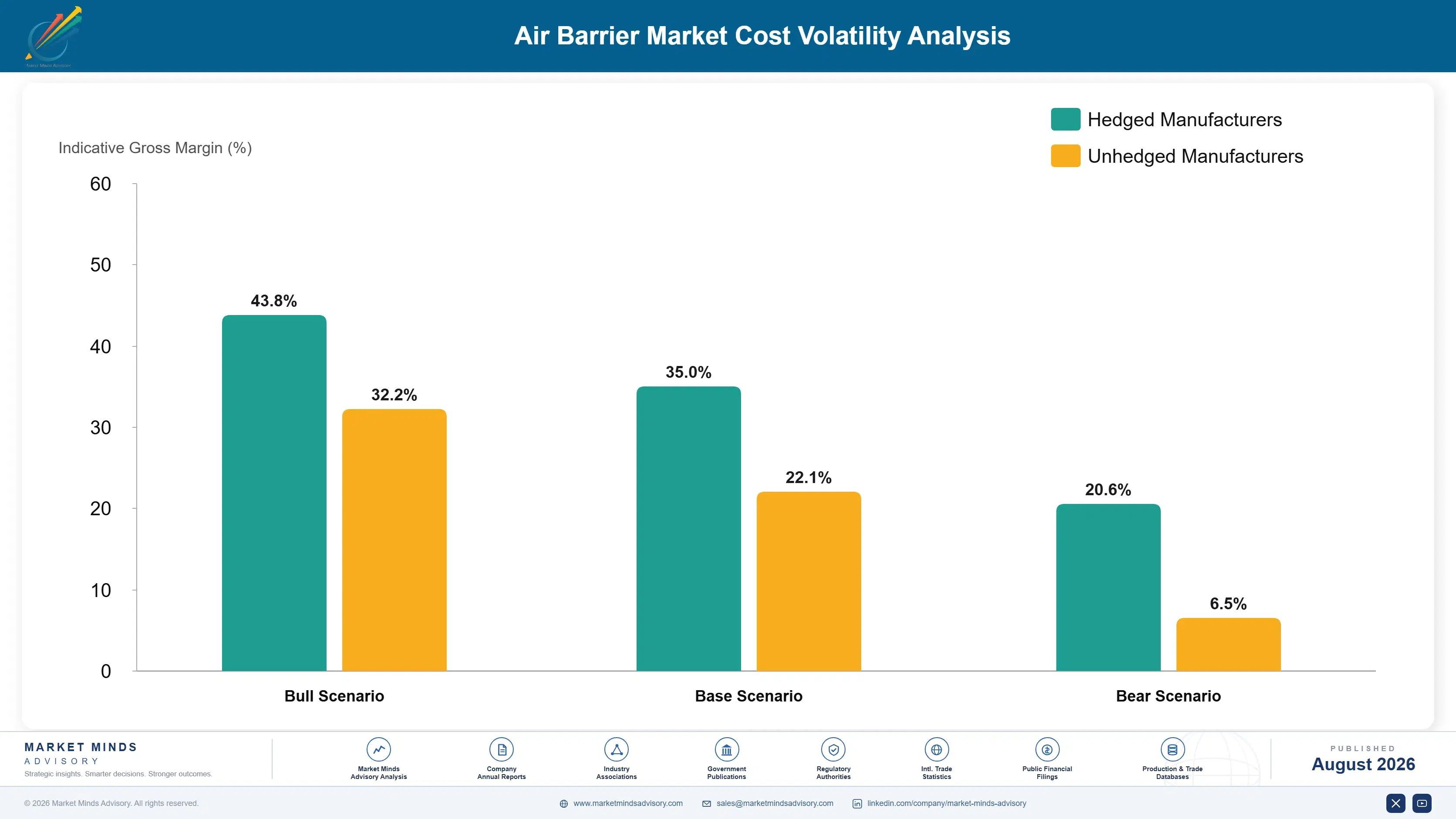
Polymer Resin And Bitumen Feedstock Supply Risk

Polymer resin and asphalt bitumen dominate cost structure for air barrier systems. Elastomeric polymer resins, rubberised asphalt, and specialty adhesive formulations together account for a substantial share of finished product cost, priced against petrochemical commodity markets that move independently of construction demand. Release liners, reinforcing fabric, and packaging complete the cost structure for finished air barrier products.
Petrochemical feedstock prices moved considerably through 2021 and 2022 as global supply markets tightened following geopolitical disruption and energy cost pressure, lifting polymer resin and asphalt costs meaningfully faster than the broader construction materials market moved during the same period. Several manufacturers disclosed the resulting margin pressure across their annual reporting through that window, and EIA data recorded the parallel petrochemical price movement that raised input costs across the industry simultaneously.

Exposure divides sharply by feedstock sourcing strategy rather than by manufacturer size specifically. Manufacturers with long-term petrochemical supply agreements or diversified resin sourcing held cost considerably better than those buying on spot markets into a tightening cycle. The disadvantage compounds, because a manufacturer unable to deliver against contractor and specifier commitments during a shortage loses project specifications that competitors, once established, retain for years afterward.
air-barrier-market-cost-volatility-analysis-1787332176224

Diversify petrochemical sourcing across multiple suppliers

Concentrating feedstock sourcing with a single petrochemical supplier ties production directly to that supplier's specific capacity and allocation decisions, which the recent tightening cycle demonstrated quite expensively across the entire construction materials industry. Diversifying sourcing across multiple qualified suppliers spreads that exposure and improves feedstock availability during any single supplier's capacity constraint or unexpected disruption considerably.

Secure long-term petrochemical supply agreements early

Spot buying polymer resin and asphalt exposes manufacturers to price spikes precisely when demand for air barrier systems is also rising sharply across the industry simultaneously and quite unpredictably each cycle. Multi-year supply agreements with petrochemical suppliers, even at modest committed volume, provide pricing stability and delivery priority that spot buyers competing during a tight market cannot access.

Invest in feedstock-flexible product formulations

Product formulations locked to a single feedstock type cannot pivot when that specific input tightens, leaving no real alternative but to absorb cost increases directly and pass them downstream to contractor customers. Formulations engineered to accept multiple feedstock inputs preserve production flexibility and negotiating leverage across petrochemical cycles that single-feedstock competitors simply cannot access or replicate.

Portfolio Architecture for Margin Defence

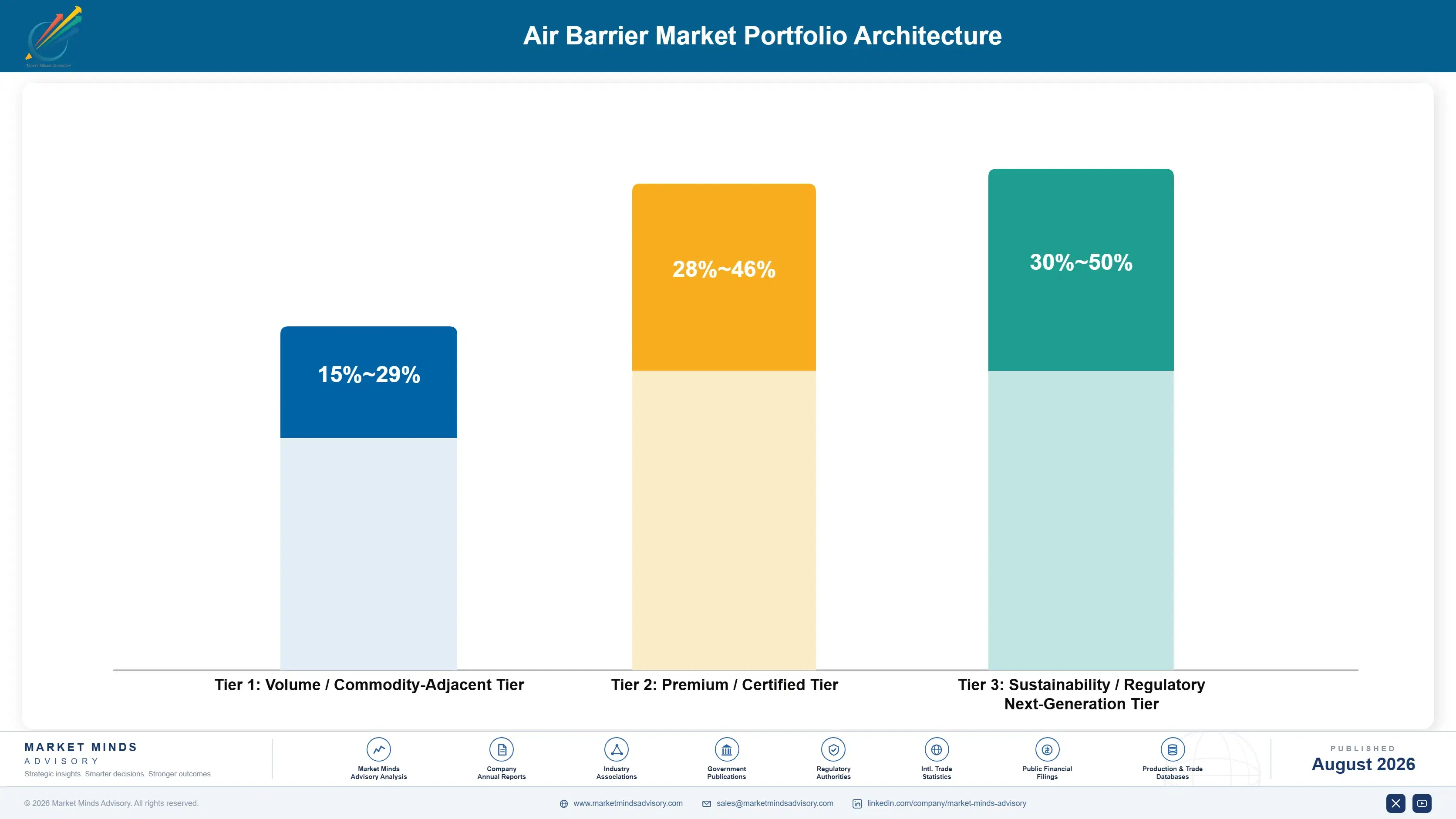
The portfolio splits into three tiers with genuinely different economics. Standard mechanically fastened sheet products form the volume tier, where material cost and manufacturing scale drive competition directly. Fluid-applied and self-adhered membrane systems earn considerably more, because application speed advantage and installer training depth narrow the qualified field. Commissioning-verified premium systems sit differently again, priced against the documented performance problem they solv
The tension runs between standard sheet product volume that fills manufacturing capacity and premium fluid-applied work that earns the return. Commodity sheet products generate the tonnage that keeps production lines loaded and maintains contractor relationships through which higher-value conversations eventually happen. Yet this material competes on cost against every qualified manufacturer serving the same demand. Manufacturers managing this well treat standard volume as capacity utilisation and direct investment toward application speed depth.

High-value pools concentrate where installation complexity or verification urgency genuinely limits competition: fluid-applied systems solving the labour shortage problem directly, commissioning-verified performance meeting institutional specifier requirements, and contractor training programmes reducing field execution risk. All three resist the price competition defining standard sheet products, because the customer is purchasing a solved installation problem rather than comparing interchangeable materials across manufacturers.

Volume / Commodity-Adjacent Tier

Standard mechanically fastened sheet products sold into cost-sensitive commercial and residential demand across most established construction categories. The range is wide because scale-efficient manufacturers earn respectably while those competing purely on price frequently do not.
Gross Margin: 15-29%

Premium / Certified Tier

Fluid-applied and self-adhered membrane systems carrying deep application speed advantage and established contractor training relationships in the most demanding markets. The range is wide because application speed depth and training investment vary considerably by manufacturer.
Gross Margin: 28-46%

Sustainability / Regulatory / Next-Generation Tier

Commissioning-verified premium systems addressing the documented performance problem directly and durably across institutional and large commercial projects requiring assurance. The range is wide because verification track record and specifier relationships vary considerably.
Gross Margin: 30-50%
air-barrier-market-portfolio-architecture-1787332176724

High-value Sub-segments and Strategic Watch-out

Fluid-Applied Membrane Air Barriers

High value and the fastest growth at 11.8%, from a moderate base as installers favour continuous fluid application over labour-intensive sheet product seaming today. Application speed advantage increasingly determines which manufacturers capture this volume, limiting near-term opportunity to those with proven contractor training programmes specifically.
Gross Margin: 32-50%

Self-Adhered Sheet Membrane Air Barriers

High value with strong growth, protected by adhesive formulation expertise and familiar sheet-product installation methods that create a durable barrier newer specialist entrants find genuinely difficult to replicate quickly. Contractor transition demand compounds steadily as more crews move away from traditional mechanically fastened systems entirely.
Gross Margin: 28-46%

Mechanically Fastened Sheet Air Barriers

The volume core across mechanically fastened sheet products worldwide, and the category with the longest commercial history of the five segments listed in this section. Growth is steady but competition on cost is direct, holding margin below the fluid-applied and self-adhered tiers positioned above it.
Gross Margin: 15-29%

Air Barrier Sealants and Tapes

The strategic watch-out, growing slowest as contractors increasingly favour integrated membrane or spray systems over standalone sealant and tape products lacking continuous coverage across most commercial applications today. Limited standalone demand constrains addressable volume exactly where integrated systems are growing fastest, threatening this segment's position.
Gross Margin: 17-31%

How Air Barrier Specifications Actually Commit

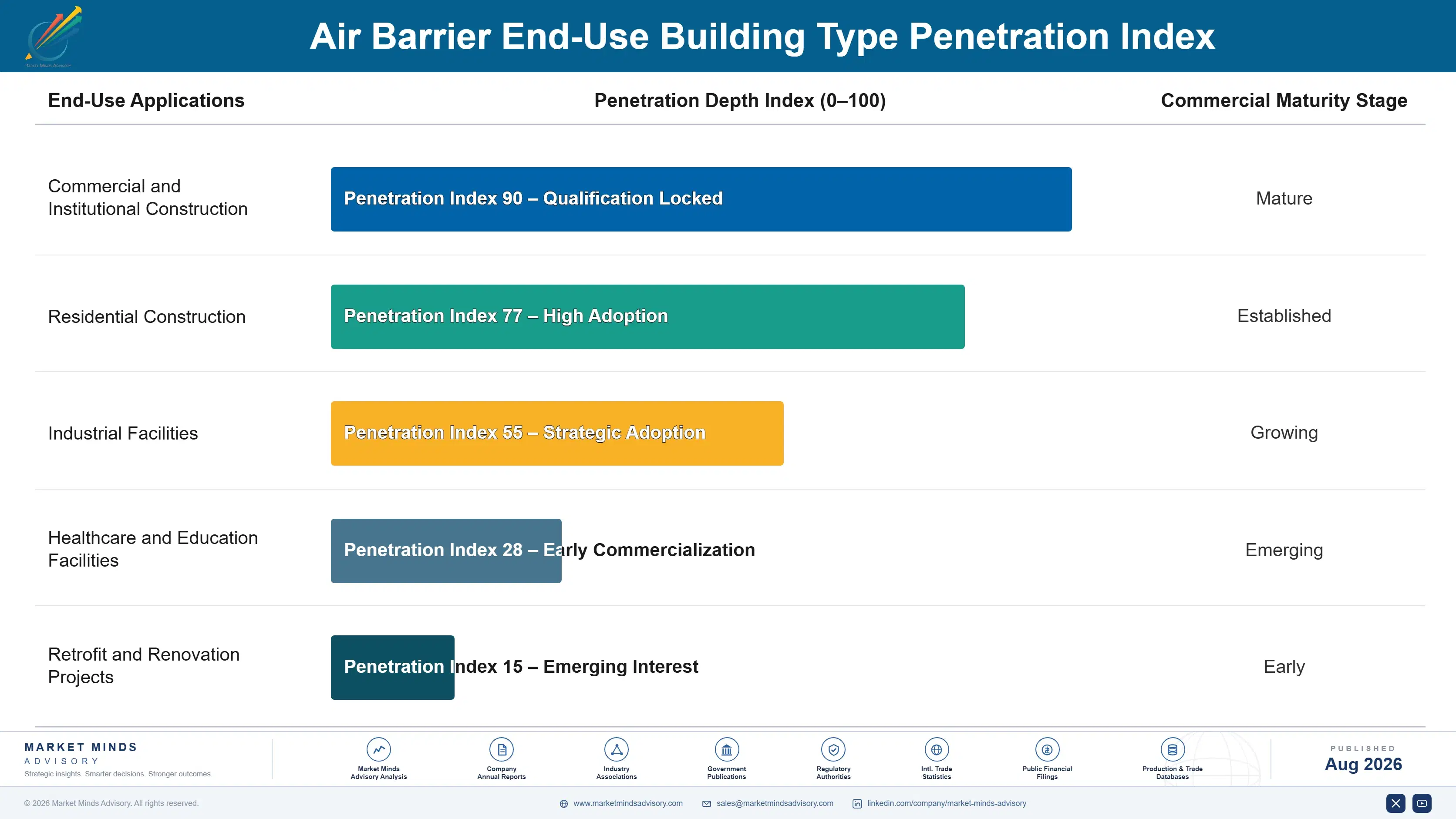
Revenue commits differently depending on which mechanism drives the purchase. Code-mandated specification locks in tightly once a project requires permit approval, since contractors have no alternative but compliant systems and reorder without further evaluation for comparable project types. Labour-driven adoption also locks in once a contractor standardises on faster-applied systems. Voluntary sustainability-driven upgrades move more slowly and stay genuinely reversible if cost pressure shifts.
Adoption depth varies sharply by project type. Large commercial and institutional projects go deepest, standardising commissioning-verified systems across their entire portfolio once compliance becomes mandatory in their operating jurisdictions. Mid-sized commercial projects adopt more selectively, often specifying air barriers only where code explicitly requires them. Residential builders weigh cost most heavily, since limited project budgets make premium fluid-applied systems considerably harder to justify.

Buyer profiles have shifted from general contractors toward architects and building envelope consultants with distinct priorities entirely. A general contractor once compared material cost and installation speed directly; an architect now tracks code compliance documentation, and a building envelope consultant drives specification against commissioning performance data a purely cost-focused evaluation would never have prioritised. Manufacturers still selling on price alone find decisions made by consultants who never handled their product directly.
air-barrier-market-end-use-penetration-index-1787332177211

Our Call On Air Barrier Systems

These are among the four positions where our research anticipates prominent divergence between winners and laggards over the coming forecast period. Each is grounded in the demand model, the regulatory perimeter, and the announced capacity pipeline.
01 / APPLICATION SPEED STRATEGY

Build fluid-applied technology to solve the labour problem

Manufacturers that reduce application time through fluid or spray technology, rather than requiring the seaming and fastening labour sheet products demand, capture specification wins from contractors facing genuine crew availability constraints across most construction markets today and increasingly going forward. That capability commands a premium of 15 to 30% over sheet product alternatives, since contractors pay for labour savings as much as for underlying material performance. Manufacturers should prioritise this advantage now, because it is not quickly replicated once rivals catch up.
02 / CONTRACTOR TRAINING INVESTMENT

Build training programmes that reduce commissioning failures

Contractor training programmes that teach correct field execution around windows, penetrations, and transitions convert a manufacturer's material advantage into an actual installed performance advantage, cutting commissioning failure rates by roughly 40%, since even the best-engineered product fails when installers execute critical details incorrectly on site. Manufacturers investing in genuine training infrastructure see considerably fewer commissioning failures than competitors shipping product without comparable installer support. That training depth converts into a durable specifier relationship that competitors struggle to displace over time.
03 / CODE COMPLIANCE TIMING

Pre-position compliant systems ahead of code adoption dates

Building energy codes typically pass with a defined adoption date set 12 to 24 months in advance, and manufacturers positioned with code-compliant systems and contractor training before that date takes effect capture disproportionate early share that later entrants find genuinely difficult to displace once specifier relationships solidify. That compliance-driven demand persists regardless of underlying material cost, since a project cannot obtain permit approval without demonstrating compliant continuous air sealing. Manufacturers should track code adoption calendars closely, positioning ahead of enactment.
04 / COMMISSIONING VERIFICATION STRATEGY

Build documented performance track records for specifiers

Building envelope commissioning increasingly verifies air barrier performance through independent testing before occupancy approval, and manufacturers who can point to genuine commissioning-verified track records win specification battles that competitors relying purely on laboratory data cannot match convincingly regardless of underlying formulation quality involved in the comparison. That verified credibility becomes especially valuable as commissioning spreads from specialist commercial projects into a broader set of building types requiring independent confirmation. Manufacturers with strong track records increasingly dominate competitive shortlists for large institutional projects.

Engagement Snapshot From the Field

A live engagement with an industry participant carrying material or product regulatory and market exposure ahead of a defining policy shift, showing how our research translates into a defensible multi-year portfolio strategy.
MARKET MINDS ADVISORY · CLIENT ENGAGEMENT SUMMARY
Air Barrier Producer Strategic Portfolio Review and Transition Roadmap 2026·Investment Scenario on Air Barrier Exposure Evaluation 2025-26
CLIENT PROFILE
A regional commercial general contractor engaged MMA while evaluating a shift from mechanically fastened sheet products to fluid-applied air barrier systems following recurring crew scheduling difficulty across its active project pipeline. The client reported annual air barrier installation volume near USD 18 million and faced growing pressure from developers to reduce installation timelines without sacrificing commissioning performance (client-reported, unverified by MMA).
STRATEGIC CHALLENGE
Switching to fluid-applied systems would address the labour constraint, but the client's project managers had no prior experience specifying or overseeing fluid-applied installation, creating genuine risk of commissioning failures during the transition period. The board wanted cost certainty and a credible performance case before committing across the full project pipeline simultaneously.
MMA APPROACH
MMA evaluated four candidate fluid-applied system manufacturers against demonstrated commissioning track records, contractor training programme depth, and technical support availability given the client's limited internal expertise. We modelled total project cost including labour savings rather than material price alone. We then assessed each manufacturer's track record with comparable commercial general contractors.
KEY FINDINGS
  1. Only two of the four candidate manufacturers had commissioning-verified performance data directly comparable to the client's typical building types and climate conditions.
  2. The recommended manufacturer's training programme cut the client's projected commissioning failure risk by roughly 50% compared to self-directed installation (client-reported, unverified by MMA).
  3. Crew scheduling difficulty had already delayed three projects in the twelve months before the engagement began, confirming the urgency behind the transition.
  4. A manufacturer selected purely on material price, without proven training support, would have risked costly commissioning failures across the client's varied project types.
CLIENT PROFILE
A regional commercial general contractor engaged MMA while evaluating a shift from mechanically fastened sheet products to fluid-applied air barrier systems following recurring crew scheduling difficulty across its active project pipeline. The client reported annual air barrier installation volume near USD 18 million and faced growing pressure from developers to reduce installation timelines without sacrificing commissioning performance (client-reported, unverified by MMA).
STRATEGIC CHALLENGE
Switching to fluid-applied systems would address the labour constraint, but the client's project managers had no prior experience specifying or overseeing fluid-applied installation, creating genuine risk of commissioning failures during the transition period. The board wanted cost certainty and a credible performance case before committing across the full project pipeline simultaneously.
MMA APPROACH
MMA evaluated four candidate fluid-applied system manufacturers against demonstrated commissioning track records, contractor training programme depth, and technical support availability given the client's limited internal expertise. We modelled total project cost including labour savings rather than material price alone. We then assessed each manufacturer's track record with comparable commercial general contractors.
KEY FINDINGS
  1. Only two of the four candidate manufacturers had commissioning-verified performance data directly comparable to the client's typical building types and climate conditions.
  2. The recommended manufacturer's training programme cut the client's projected commissioning failure risk by roughly 50% compared to self-directed installation (client-reported, unverified by MMA).
  3. Crew scheduling difficulty had already delayed three projects in the twelve months before the engagement began, confirming the urgency behind the transition.
  4. A manufacturer selected purely on material price, without proven training support, would have risked costly commissioning failures across the client's varied project types.
RECOMMENDED STRATEGY
Phase 1: Phase 1 (0 to 3 months): Complete contractor training and pilot the fluid-applied system on two lower-risk active construction projects. Phase 2: Phase 2 (3 to 9 months): Extend deployment across the majority of the client's active commercial construction project pipeline fully. Phase 3: Phase 3 (9 to 15 months): Standardise fluid-applied specification across all new commercial project bids going forward permanently and consistently.
OUTCOME
The client successfully transitioned its project pipeline to fluid-applied systems within fifteen months, reducing installation labour requirements while maintaining strong commissioning performance across all pilot and rollout projects. Crew scheduling conflicts dropped considerably, and the fluid-applied specification is now the client's standard approach for new commercial bids (client-reported, unverified by MMA).

Frequently Asked Questions

Foundational context covering the market sizes, CAGR, scope, country, region and competition that inform every finding below. This section is provided to cover basics and most often pre-purchase conversations, answered from the MMA Primary Research Dataset.

What is the current size of the Air Barrier Market?

The global air barrier market is valued at USD 3.8 billion in 2025, covering fluid-applied, self-adhered sheet, mechanically fastened, sealant, and spray foam air barrier systems. General building envelope products outside air barrier applications are excluded.

How large will the Air Barrier Market be by 2036?

The market is forecast to reach USD 8.16 billion by 2036 in the base case, about 2.00 times the 2026 level. That represents incremental value of roughly USD 4.09 billion across the forecast decade.

What is the CAGR for the Air Barrier Market 2026 to 2036?

The market grows at a 7.2% CAGR in the base case, with bull and bear scenarios at 8.4% and 5.9%. The spread turns mainly on energy code adoption pace and installer training availability.

Which segment is growing fastest?

Fluid-applied membrane air barriers grow fastest at 11.8%, about 1.64 times the overall rate, as installers favour continuous application over sheet product seaming labour. Self-adhered sheet membranes follow at 9.0%.

Who are the major companies in the Air Barrier Market?

Leading suppliers include Sika, Carlisle Companies, Saint-Gobain, Owens Corning, and Soprema, holding roughly 34% between them. Manufacturers combining application speed with contractor training are increasingly capturing premium positioning.

Which country is growing fastest?

Canada grows fastest at a 10.2% CAGR, building on stringent cold-climate energy code requirements demanding continuous air barrier performance. The United States follows closely on broad energy code adoption.

Report Segmentation Architecture

The full report scope spans multiple orthogonal segmentation dimensions, with cross-tabulated demand data provided for each dimension pair. Coverage extends further to regional breakdowns, trend trajectories, and the competitive detail needed to support segment-level decision-making.

By Product Technology

  • Fluid-Applied Membrane Air Barriers
  • Self-Adhered Sheet Membrane Air Barriers
  • Mechanically Fastened Sheet Air Barriers
  • Air Barrier Sealants and Tapes
  • Spray Polyurethane Foam Air Barrier Systems

By End-Use Building Type

  • Commercial and Institutional Construction
  • Residential Construction
  • Industrial Facilities
  • Healthcare and Education Facilities
  • Retrofit and Renovation Projects

By Commercial Dimension

  • Direct Contractor Sales
  • Distributor and Building Supply Channels
  • Specification and Architectural Design Services
  • System Integration Partnerships

By Region

  • North America
  • Western Europe
  • East Asia
  • South Asia and Pacific
  • Latin America
  • Middle East and Africa
  • Eastern Europe

Scope, Methodology, and Coverage

Every figure in this report is reproducible from documented input assumptions. The scope below maps the historical period, the forecast horizon, the segmentation dimensions, and the countries covered, alongside the underlying primary and qualitative methodology.
Historical Period
2020 to 2025
Forecast Period
2026 to 2036
Base Year
2025 (USD billions; MMA Primary Research Dataset, August 2026)
Market Definition
The air barrier market comprises building envelope products designed specifically to control air leakage through the building enclosure, valued at manufacturer selling prices. It spans fluid-applied membrane systems, self-adhered sheet membranes, mechanically fastened sheet systems, air barrier sealants and tapes, and spray polyurethane foam air barrier systems used in new construction and retrofit applications. General building envelope products such as vapour barriers, weather-resistive barriers without air barrier certification, and insulation products not functioning as air barriers are excluded from this scope entirely.
Quantitative Units
USD billions (current prices); installed area in square metres by product technology where applicable
Segmentation Dimensions
By Product Technology; By End-Use Building Type; By Commercial Dimension; By Region
Regions Covered
North America, Western Europe, East Asia, South Asia and Pacific, Latin America, Middle East and Africa, Eastern Europe
Countries Covered
USA, Canada, Germany, France, UK, Sweden, Norway, Netherlands, China, Japan, South Korea, India, Australia, Vietnam, Indonesia, Brazil, Mexico, Chile, Argentina, UAE, Saudi Arabia, South Africa, Egypt, Poland, Czechia, Hungary, Romania, and additional markets relevant to this sector
Key Companies Profiled
Sika, Carlisle Companies, Saint-Gobain, Owens Corning, Soprema, Henry Company, DuPont, GAF Materials, Tremco, Kingspan Group, VaproShield, Benjamin Obdyke, Grace Construction Products, ICP Building Solutions, Polyguard Products, W.R. Meadows, ProSoCo, Delta Membrane Systems, 3M, Georgia-Pacific
Quantitative Methodology
Primary survey, n=3,800 respondents, Q4 2025, six countries; demand-side model with trade association cross-validation
Qualitative Methodology
47 expert interviews, Q4 2025; applied to validate demand model assumptions, identify emerging dynamics, and assess competitive positioning
Report Format
PDF and XLSX data workbook (Word format preview document)
Publisher
Market Minds Advisory
Report Code
MMA-2026-CON-172
Published
August 2026
Contact
sales@marketmindsadvisory.com | www.marketmindsadvisory.com

Purchase the full Air Barrier Market Report (2026 to 2036).

The full MMA Air Barrier report sizes the market across five product technologies, five end-use building types, and seven regions through 2036 in considerable detail. It profiles 20 manufacturers on a consistent basis of air barrier revenue, scoring each on application speed advantage, contractor training depth, code compliance positioning, and commissioning-verified performance credentials. Scenario models quantify how energy code adoption, installer labour availability, and commissioning requirements move both volume and achievable margin by product technology. The report also includes energy code adoption tracking and commissioning failure benchmarking.
Five-technology and five-building-type market sizing through 2036
Twenty-manufacturer benchmark on air barrier revenue
Building energy code adoption tracking by jurisdiction
Commissioning failure and installation defect benchmarking
Contractor training programme coverage tracking by manufacturer
Petrochemical feedstock supply chain risk mapping

Built For The People Who Decide

From boardroom strategy to bench-side execution, this report is read cover-to-cover by leaders shaping the next decade of their industry, turning demand scenarios, market dynamics and valuation benchmarks into decisions.
CXOs/ Presidents/ VPs/ Managers
M&A and Corporate Development
Strategy Teams and R&D Heads
Procurement and Product Directors
Regulatory and Compliance Leaders
Investor Relations and Equity Analysts