
Market Minds Advisory
Aeroponics Market

Aeroponics Market: Vertical Farming Scale-Up and the Water-Nutrient Precision Race

Singapore and Japanese food security mandates are pushing vertical farm operators toward aeroponic systems that cut water use sharply, forcing equipment makers to compete on nutrient dosing precision rather than raw installation price.

Lead Analyst

Lisa Gevelber

Published

September 2026

Make Smarter Decisions with Customized Research Insights

Request a free sample report and evaluate market opportunities, growth trends, and competitive dynamics relevant to your business needs.

2025 MARKET VALUE$1.8BMarket Size 2025
2036 FORECAST VALUE$5.4BBase Case , 2026 to 2036
CAGR 2026 TO 203610.5 %Bull 11.8% / Bear 9.3%
INCREMENTAL OPPORTUNITY$3.4BNet 10- year value creation
EXPANSION MULTIPLE2.71x2036 value over 2026 base
Strategic Levers
M&A Pipeline
Regional Outlook
Country Rankings
Competitive Intelligence
Segmental Deep-dive
Call-Us : 91 93563 13602

Executive Snapshot and Market Trajectory

Aeroponics is shifting from a research-stage cultivation technique into a commercial vertical farming standard, as operators chase the water savings and root health advantages that soil and standard hydroponic systems cannot match at comparable planting density and vertical stacking height per site.
Nutrient dosing and control systems still absorb a growing share of equipment spend, but AI-driven precision dosing software is growing fastest as operators chase yield consistency across large installations spanning multiple growing towers and crop varieties simultaneously. East Asia now hosts the largest concentration of commercial-scale aeroponic vertical farms, driven by government food security programs in Japan, Singapore, and China that directly subsidize controlled-environment agriculture infrastructure investment across newly built urban and peri-urban facility sites.
No single equipment maker controls more than a modest share of global installations, since vertical farm operators frequently integrate components from multiple specialist suppliers rather than buying a single turnkey system from one vendor. Rising electricity costs for LED lighting and climate control are forcing operators to renegotiate energy contracts more aggressively than in past cycles, squeezing margin for growers without long-term power purchase agreements already locked in.
Market Definition
This market comprises aeroponic system hardware, nutrient dosing and control software, and turnkey vertical farm installations sold to commercial operators, government food security programs, and research institutions. It excludes hydroponic and aquaponic systems that use a growing medium or fish-based nutrient loops.
Base Year Value
$1.8B in 2025 (MMA Primary Research Dataset, August 2026)
Forecast Period
2026 to 2036, eleven discrete annual values
CAGR
10.5% base case. Bull 11.8%. Bear 9.3%.
Fastest Growth Segment
Nutrient Dosing and Control Systems: 14.5% CAGR
Fastest Growth Country
India: 15.5% CAGR
Fastest Growth Region
South Asia and Pacific: 12.5% CAGR
Largest Region
East Asia: 30% of 2025 global value
Market Leaders
AeroFarms, Plenty Unlimited, LettUs Grow, Priva, Signify Horticulture. Source: MMA Analysis based on company annual reports.
Primary Survey
n=3,800 procurement and R&D decision-makers, Q4 2025, six countries
Methodology
Demand-side build-up, cross-validated against public data, 47 expert interviews

Aeroponics Market Forecast Scenarios

aeroponics-market-2024-2034-trends-growth-size-forecast-scenario-1787464172836
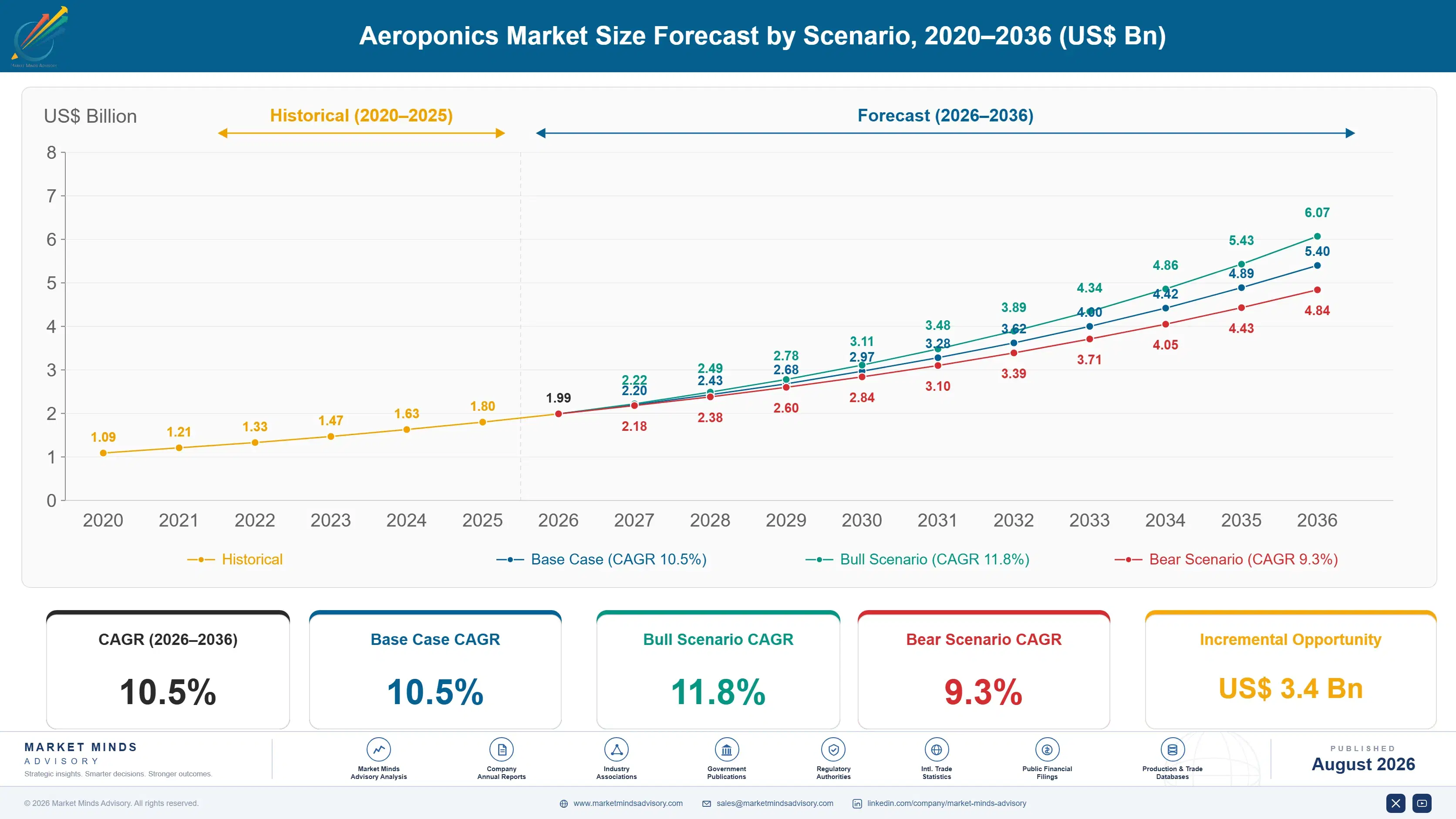
Between 2020 and 2025 the market grew quickly as early commercial vertical farm operators proved out aeroponic yield and water savings claims at pilot scale, attracting venture and government investment into larger facility rollouts across multiple continents. Equipment reliability improved substantially through the period, lowering the operational failure rates that had discouraged institutional buyers early in the technology's commercial rollout.
The base case assumes vertical farm operators keep scaling aeroponic installations while equipment makers consolidate around proven nutrient dosing and control platforms that reduce integration risk. Three mechanisms drive the forecast: government food security subsidies expanding controlled-environment agriculture infrastructure across East Asia, AI-driven dosing software improving yield consistency enough to justify premium pricing, and falling LED lighting costs gradually improving the unit economics that have historically limited aeroponic adoption beyond leafy greens.
The bull case turns on aeroponic systems expanding beyond leafy greens into higher-value fruiting crops faster than expected, lifting equipment volume well above trend across new facility construction. The bear case centers on electricity cost inflation outpacing what crop pricing can absorb, slowing new facility construction and forcing some existing operators to scale back expansion plans considerably.

Where Precision Engineering Meets Food Security Policy

Aeroponics sits at the intersection of precision agriculture engineering and fast-moving urban food security policy. Operators reformulate nutrient dosing schedules constantly to hit narrow crop-specific yield targets, while equipment makers absorb the integration complexity those custom schedules create across a genuinely diverse installed base of facility types. Currency swings and electricity pricing now move facility operating cost almost as much as equipment capital expenditure does.
MARKET CONCENTRATIONCR5 24%installations stay fragmented across many specialist equipment integrators
AVERAGE SELLING PRICE$185/sq meterturnkey installations command significantly higher per-area installed pricing
TOP PRODUCING COUNTRYChina, 26% sharesingle country hosts over a quarter of installed capacity
CAPACITY UTILISATION74%commercial facilities run near full operational capacity most months
TRADE INTENSITY33% cross-bordermeaningful equipment volume crosses borders before final installation occurs
FEEDSTOCK COST SHARE44% of COGSelectricity and lighting inputs dominate total operating cost base
Commercial activity now concentrates around three demand pools: government-backed food security installations renewing multi-year infrastructure contracts, venture-funded vertical farm operators sourcing scalable turnkey systems, and research and propagation buyers purchasing smaller specialized aeroponic cloning equipment for breeding and trial work. Each pool rewards a different equipment maker capability, splitting the market into distinct commercial tiers rather than a single undifferentiated hardware business.
Over the next decade, energy efficiency and yield consistency will separate equipment makers who can defend margin from those competing purely on installation price, particularly as operators scale beyond leafy greens into crops requiring more sophisticated dosing precision. Suppliers that invest early in AI-driven control software should capture a growing share of premium turnkey facility contracts, while smaller integrators without that capability increasingly get pushed toward commodity component supply.
"Water scarcity used to be a talking point in aeroponics pitch decks. Now it is the line item that actually gets a facility permitted in half the cities building these farms."
Director, Agricultural Technology and Controlled Environment Practice · MMA Agricultural Technology and Equipment Practice · August 2026

Market Trends

AI-Driven Nutrient Dosing Optimization Technology Advances

Equipment makers are embedding machine learning models into nutrient dosing controllers that adjust misting frequency, nutrient concentration, and root chamber humidity in real time based on sensor feedback rather than fixed schedules. Early commercial deployments report yield consistency improvements meaningful enough to justify premium software licensing fees on top of hardware costs, a pricing model few equipment buyers accepted just several years ago. Operators running AI-driven dosing systems report crop cycle variability reduced substantially compared with fixed-schedule systems, a difference that matters enormously for buyers supplying retail contracts with strict delivery consistency requirements.
Market Impact: Cuts water use 90% versus soil
Government Food Security Programs Fund Facility Buildout

Singapore, Japan, and the United Arab Emirates have launched direct subsidy and grant programs targeting controlled-environment agriculture infrastructure, explicitly citing aeroponic systems as a preferred technology given their water efficiency advantages over soil and standard hydroponic cultivation. These programs are underwriting facility construction costs that would otherwise deter smaller operators from entering the category, meaningfully lowering the capital barrier to commercial-scale entry. Equipment makers with established government procurement relationships are winning a disproportionate share of these subsidized facility contracts ahead of newer entrants still building public sector credibility and track record with government procurement offices.
Market Impact: Cuts crop cycle time by 25%

Market Opportunities and Growth Drivers

Land and Water Scarcity Drive CEA Adoption

Urban centers facing land constraints and agricultural regions facing water scarcity are turning to aeroponic systems as a way to grow food closer to consumption points without the acreage or irrigation volume conventional farming requires. Aeroponic systems use meaningfully less water than soil-based cultivation for comparable crop volume, a difference that matters enormously in regions facing binding water allocation constraints. Municipal and national governments increasingly treat controlled-environment agriculture as critical food security infrastructure rather than a niche agricultural technology experiment, accelerating permitting and investment approval timelines considerably across most major urban centers pursuing food resilience strategies.
Market Impact: Raises entry capital cost 40%

Faster Crop Cycles Improve Facility Unit Economics

Aeroponic systems deliver faster crop cycles than soil-based cultivation for leafy greens and herbs, since root systems suspended in air access oxygen and nutrients more efficiently than roots growing through soil or growing media. This cycle speed advantage directly improves facility unit economics, since operators can turn over more harvests per square meter of growing space each year than competing cultivation methods allow. Operators report harvest cycles shortened meaningfully compared with traditional hydroponic systems growing comparable leafy green varieties, improving payback periods on facility capital investment substantially across most commercial-scale operations.
Market Impact: Raises operating costs 20% yearly

Market Restraints and Challenges

High Upfront Capital Cost Limits Smaller Operators

Aeroponic facility construction requires significant upfront investment in misting systems, root chambers, climate control, and LED lighting infrastructure that exceeds what conventional greenhouse or field agriculture demands. The root cause is the technology's precision engineering requirements, every component must maintain tight tolerances to prevent misting failures that can destroy an entire crop cycle within hours. The commercial impact falls hardest on smaller operators without institutional capital access, who face financing costs that larger venture-backed competitors do not carry. Some equipment makers now offer leasing arrangements to help smaller buyers spread capital cost over time.
Market Impact: Cuts crop cycle variability by 30%

Electricity Costs Squeeze Facility Operating Margins

LED lighting and climate control systems required for indoor aeroponic cultivation consume substantial electricity, making facilities highly sensitive to regional power pricing in ways field agriculture never faces. The root cause is the fundamental energy intensity of replacing natural sunlight and outdoor climate regulation with artificial systems operating continuously. The commercial impact falls hardest on facilities in high electricity cost regions without renewable power access or long-term contracts, eroding margins that already run thinner than traditional agriculture. Some operators are now co-locating facilities near renewable generation sites to manage this exposure directly.
Market Impact: Funds facility subsidies worth $400 million
3 additional market trends, 2 additional growth drivers, and 4 additional restraints and challenges are covered in the full report. Contact sales@marketmindsadvisory.com to access the complete intelligence.

Segment CAGR and Growth Architecture

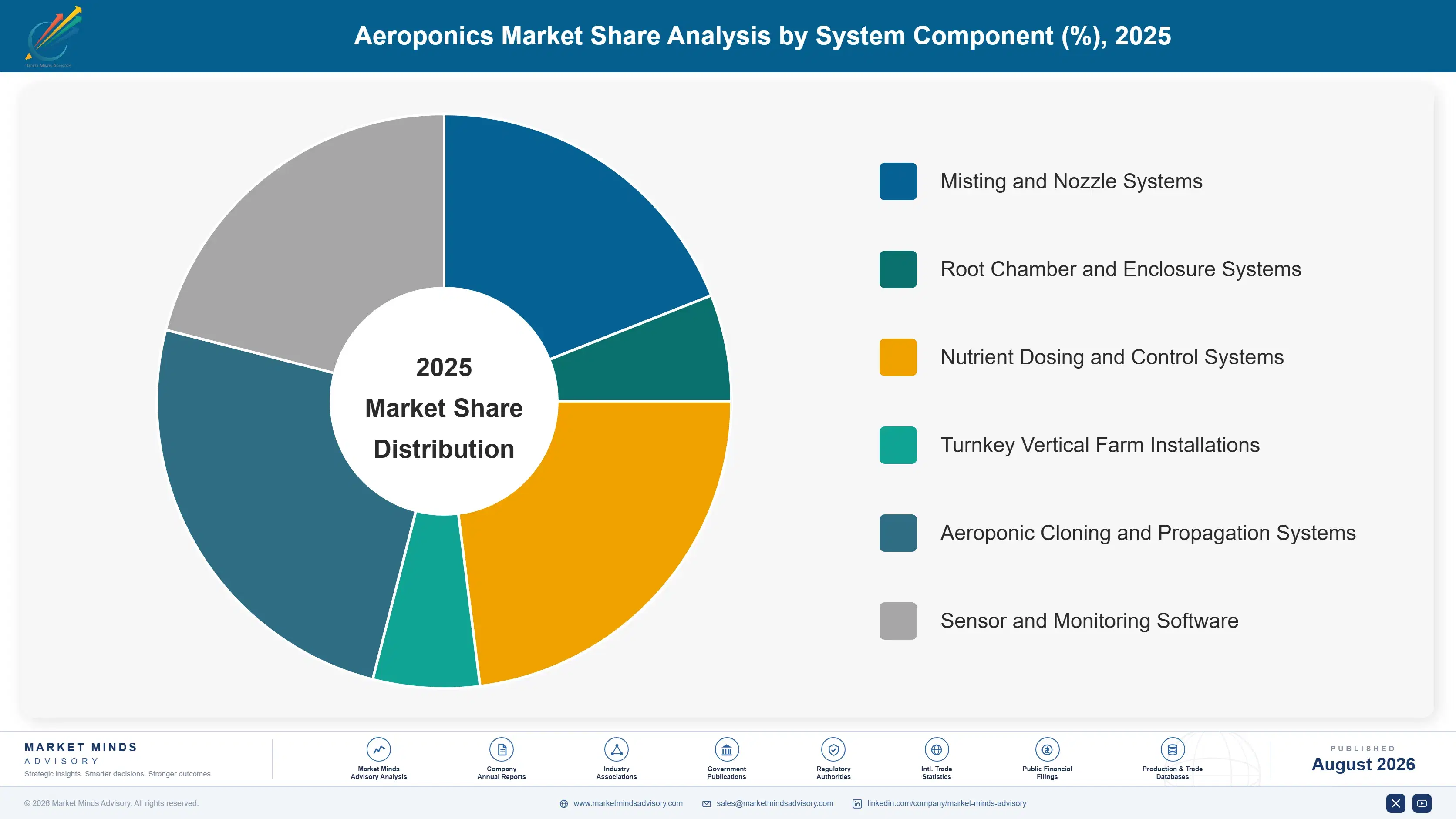
Segmentation follows system component, the dimension buyers actually order against when specifying facility builds or upgrading existing installations each procurement cycle without exception whatsoever. Six categories span the market, from misting hardware to the AI-driven dosing and control software driving the fastest incremental demand across commercial-scale operations worldwide each new annual budget planning cycle.
aeroponics-market-2024-2034-trends-growth-market-share-analysis-1787464173368

Nutrient Dosing and Control Systems

Nutrient dosing and control systems cover the sensors, pumps, and increasingly AI-driven software that manage misting frequency, nutrient concentration, and root chamber conditions in real time, a category requiring far more sophisticated engineering than basic misting hardware. Demand is expanding as commercial operators multiply facility square footage across North American and Asian markets, each requiring precise dosing calibration that protects yield consistency. Equipment makers with proprietary dosing algorithms are capturing disproportionate share of this category, since the machine learning models require years of cultivation data to tune properly for each crop variety. Growth here runs well above the market average, making it the single most valuable category for makers investing in software capability.
CAGR 14.5%

Turnkey Vertical Farm Installations

Turnkey vertical farm installations, covering complete facility packages spanning structural racking, misting systems, lighting, and climate control sold as a single integrated project, are scaling quickly as government food security programs and venture-funded operators seek to minimize integration risk on large capital projects. These installations require system integrators capable of managing complex multi-vendor engineering projects, a capability that pure component manufacturers often lack entirely. Asian equipment makers hold a natural cost advantage here, given proximity to component manufacturing and government subsidy programs that favor domestic integrators. This category is also where operators are experimenting most aggressively with new crop varieties that established leafy-green-focused competitors have been slower to pursue commercially.
CAGR 12.8%
Full segment breakdown across 6 segments available in the complete report.

Regional Architecture and Country Demand Map

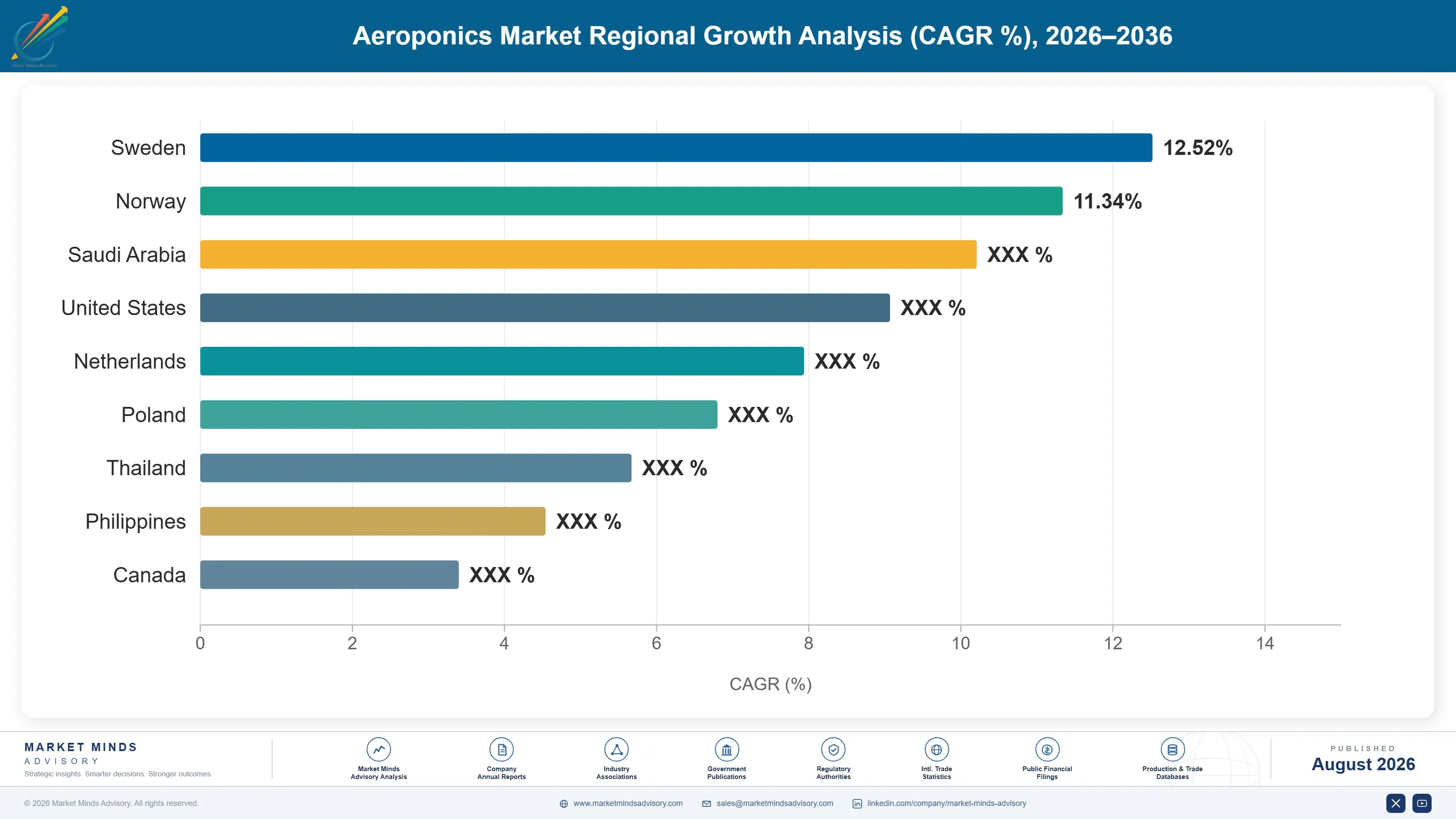
East Asia anchors the largest share of global aeroponic installation capacity, with North America and Western Europe holding substantial but slower-growing positions and South Asia and Pacific posting the fastest regional growth off a small base as new facilities steadily come online each construction cycle.

North America

North America hosts the largest concentration of venture-funded commercial vertical farm operators, anchored by facilities across the United States pursuing both retail and food service supply contracts. Retail grocery chains have expanded shelf space for locally grown leafy greens meaningfully since 2023, rewarding aeroponic operators who can guarantee year-round supply regardless of regional weather disruption. Electricity costs vary sharply by state, pushing new facility construction toward regions with lower industrial power rates and renewable generation access. Canada's smaller market follows similar patterns at reduced scale, importing much of its specialized equipment from the same suppliers serving the United States. Growth here trails East Asia because subsidy programs remain smaller and more fragmented across individual states rather than coordinated nationally.
Share: 22% | CAGR: 9.7% (2026 to 2036)

Western Europe

Western Europe's aeroponic demand centers on the Netherlands, Germany, and the United Kingdom, where existing greenhouse and controlled-environment agriculture expertise gives operators a technical head start over newer entrants elsewhere. EU sustainability and water-use regulations increasingly favor water-efficient cultivation methods, creating durable regulatory tailwinds for aeroponic adoption over conventional field agriculture. The Netherlands' concentration of horticultural technology suppliers gives regional operators easier access to specialized components than markets without an established supply chain nearby. Overall regional growth lags the global average, reflecting a mature controlled-environment agriculture base and higher energy costs that compress unit economics. Retailers are also testing private-label sourcing directly with aeroponic operators rather than traditional wholesale distributors.
Share: 18% | CAGR: 9.0% (2026 to 2036)
Regional intelligence for 5 additional markets available in the complete report: East Asia, South Asia and Pacific, Latin America, Middle East and Africa, Eastern Europe. Contact sales@marketmindsadvisory.com.
aeroponics-market-2024-2034-trends-growth-country-cagr-analysis-1787464173897

Where Equipment Makers Can Defend Margin

Margin defense increasingly depends on software capability rather than hardware volume alone. Four commercial moves stand out for equipment makers seeking to protect pricing power as government subsidy programs expand and Asian integrators compete aggressively on turnkey installation cost across every major facility type worldwide, from leafy green staples through to fast-growing multi-crop formats reshaping operator procurement priorities.

Proprietary AI Dosing Software Development Programs

Equipment makers holding proprietary AI-driven dosing software command pricing premiums that hardware-only competitors cannot match, since the algorithms require years of cultivation data across multiple crop varieties to tune properly. Building this capability requires sustained investment in data science and field trial partnerships, typically three to four years before a platform matures enough to win competitive facility bids against established rivals. Makers that made this investment early are now capturing outsized share of the fastest-growing control systems category, with software-attached contracts commanding price premiums of 30 to 45 percent over hardware-only equivalent installations.
Market Impact: Adds 30 to 45 percent software pricing premium

Long-Term Government Procurement Relationship Building Work

Equipment makers with established government procurement relationships are winning a disproportionate share of subsidized facility contracts across Singapore, Japan, and the Gulf states, since public sector buyers heavily favor vendors with demonstrated compliance and delivery track records built over multiple prior project cycles. Building these relationships takes years of smaller pilot project delivery before qualifying for larger subsidized tenders that meaningfully move overall company revenue. Makers with active government relationships report facility contract win rates roughly 35 percentage points higher than newer entrants still building public sector credibility from scratch.
Market Impact: Lifts contract win rate by 35 percentage points

Renewable Power Co-Location Partnership Site Agreements

Equipment makers and operators co-locating facilities near renewable generation sites or securing long-term power purchase agreements avoid a meaningful share of the electricity cost spikes that have squeezed facility margins in high-cost power regions. This lever requires early site selection planning and utility negotiation capability that smaller operators often lack independently, but it increasingly separates facilities that can hold stable operating margins from those exposed to volatile spot electricity pricing. Facilities with locked-in renewable power report operating cost stability roughly 25 percent stronger than those on standard commercial electricity rates.
Market Impact: Improves operating cost stability by roughly 25 percent

Multi-Crop Cultivation Protocol Expansion Investment Programs

Equipment makers expanding validated cultivation protocols beyond leafy greens into herbs, strawberries, and select fruiting crops are capturing new demand as operators seek to diversify revenue beyond commodity lettuce and herb pricing that has compressed steadily as more facilities enter that specific category. This expansion requires significant research investment to validate dosing schedules for each new crop variety, a technically demanding process that hardware-focused competitors often cannot replicate quickly. Early movers into multi-crop protocol libraries report revenue per facility roughly 20 percent higher than operators still limited to leafy green cultivation exclusively.
Market Impact: Lifts revenue per facility by 20 percent overall

Who Controls the Margin Pool

The top five equipment makers hold a combined share in the mid-twenties, leaving a wide but not dominant gap between the largest integrators and the next tier of regional specialists. AeroFarms and Plenty Unlimited lead on proprietary dosing algorithm depth, while Priva and Signify Horticulture compete more aggressively on component-level climate and lighting control, and no single maker controls enough share to set pricing unilaterally across the broader market.
Competitive activity currently plays out across three dimensions: dosing software development to defend against hardware-only entrants, government procurement relationship building to qualify for subsidized facility contracts, and multi-crop protocol expansion aimed at capturing demand beyond commodity leafy greens before competitors can respond. Pricing competition on standardized misting hardware remains intense, particularly from Chinese component manufacturers undercutting established Western suppliers.

Emerging pressure is coming from mid-sized Asian integrators that have moved beyond commodity hardware into full turnkey facility delivery, categories previously dominated by the largest Western equipment makers. Rankings are most likely to shift among the second tier of suppliers, where software capability and government relationship depth increasingly determine which challengers close the gap on established leaders over the coming decade.
aeroponics-market-2024-2034-trends-growth-company-positioning-matrix-1787464174441

Competitive Moat and Risk Dimensions

AEROFARMS

Moat: Proprietary Dosing Algorithm Depth

AeroFarms' years of cultivation data across dozens of crop varieties give it a dosing algorithm library that smaller competitors cannot replicate quickly, particularly for complex multi-crop facility designs. This depth lets the company win premium facility contracts where operators need proven yield consistency rather than unproven hardware, supporting pricing power that newer entrants simply cannot match.
AEROFARMS

Risk: Capital-Intensive Facility Model

AeroFarms' historical reliance on owning and operating large capital-intensive facilities rather than purely licensing technology leaves it more exposed to electricity cost inflation and facility financing risk than asset-light competitors. Defending margin under this model increasingly means accepting slower expansion or shifting toward a licensing-heavier revenue mix the company has not fully resolved yet.
PRIVA

Moat: Established Climate Control Integration

Priva's decades of greenhouse and controlled-environment climate control expertise give it integration credibility that newer aeroponics-only entrants lack, particularly for large institutional facility projects. This track record also supports long-term service contracts that stabilize revenue better than smaller specialists can manage on their own installed base and service network capacity.
PRIVA

Risk: Aeroponics-Specific Feature Gap

Priva's broader controlled-environment agriculture focus means its aeroponics-specific dosing features trail specialists who built their platforms exclusively around aeroponic cultivation requirements from the start. Customers requiring the most advanced aeroponic-specific capability increasingly look toward specialist competitors, an erosion Priva has only partially offset through recent acquisitions.

Players Tracked

Prominent Players

AeroFarms
Plenty Unlimited
LettUs Grow
Priva
Signify Horticulture

Other Key Players

Urban Crop Solutions
Freight Farms
Netled
Growy
Jones Food Company
Spread Co Ltd
Mirai Co Ltd
Sky Greens
Sananbio
Certhon
Netafim
General Hydroponics
Heliospectra
Agrilution
80 Acres Farms

Recent Developments

MARCH 2025

Plenty Unlimited Expands Singapore Facility Capacity

Plenty Unlimited completed an expansion of its Singapore facility footprint, adding growing towers dedicated to leafy green and herb production under the country's food security subsidy program. The investment positions the company to strengthen its government relationship while scaling domestic supply closer to major retail accounts.
Signal: Signals equipment makers increasingly prioritizing government-subsidized markets over purely commercial expansion opportunities elsewhere in the region
SEPTEMBER 2024

Signify Horticulture Acquires Dosing Software Startup

Signify Horticulture acquired a small AI-driven nutrient dosing software startup to strengthen its control systems portfolio, adding machine learning capability to its existing lighting business. The deal gives Signify faster access to a category growing well above the broader market average without building the underlying data science internally.
Signal: Signals acquisition becoming the faster route into dosing software capability versus much slower internal development timelines
JANUARY 2025

AeroFarms and Utility Sign Renewable Power Agreement

AeroFarms signed a long-term renewable power purchase agreement with a regional utility, locking in electricity pricing ahead of anticipated rate increases across its facility footprint. The agreement is structured to reduce exposure to spot market volatility that has repeatedly squeezed facility operating margins across the industry in recent seasons.
Signal: Signals long-term power contracts becoming standard risk management practice among leading operators facing sustained rising electricity costs

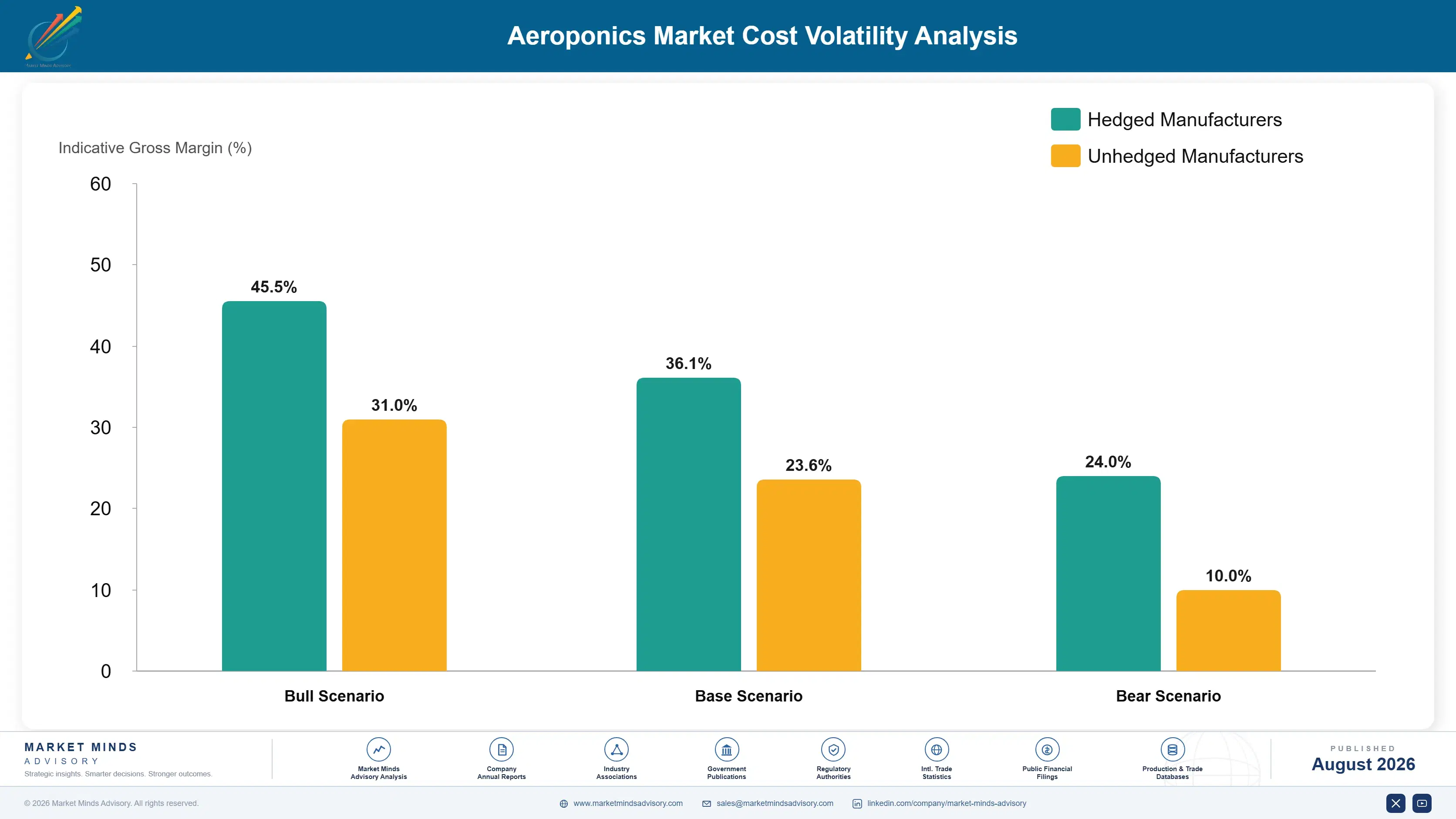
Electricity and Lighting Cost Exposure

Electricity for LED lighting and climate control accounts for roughly 44 percent of operating cost of goods sold for a typical commercial facility, sourced primarily through grid power in the United States, China, and Singapore. Nutrient inputs, water treatment, and equipment maintenance make up most of the remaining cost base, since the technology requires minimal traditional agricultural input beyond these categories.
Regional power grid rate increases across several major producing markets in 2024 pushed operating costs up sharply within a single fiscal year according to national energy regulator disclosures and company annual reports. Facilities without long-term power purchase agreements absorbed the increase directly, some passing over 15 percent of the cost onto wholesale produce pricing within two quarters, a speed of pass-through that surprised several retail buyers accustomed to stable seasonal contract pricing.

The competitive disadvantage falls hardest on facilities in high electricity cost regions without renewable power access, since they cannot smooth energy cost volatility across a broader operational base the way larger multi-facility operators can. Exposure also varies by geography: facilities concentrated in regions with volatile spot electricity pricing carry materially more risk than those with locked-in renewable or long-term contracted power supply.
aeroponics-market-2024-2034-trends-growth-cost-volatility-analysis-1787464174638

Long-Term Renewable Power Purchase Agreements

Locking multi-year renewable power purchase agreements reduces exposure to spot electricity price spikes that have squeezed facility margins across several major producing regions in recent years. Operators that secured these agreements ahead of the 2024 rate increases held operating costs meaningfully steadier than facilities buying power on standard commercial utility rates that same season.

LED Lighting Efficiency Upgrade Programs

Upgrading to higher-efficiency LED lighting systems reduces per-unit electricity consumption without sacrificing the light intensity crops require for optimal growth rates and consistent harvest cycles throughout the year. Several operators report meaningfully lower lighting-related electricity costs after completing efficiency upgrades across their full facility footprint over the past two years of active capital investment.

Multi-Facility Portfolio Diversification Strategy

Operating facilities across multiple electricity grid regions rather than concentrating in one market reduces exposure to any single region's rate volatility or supply disruption. This requires meaningful capital and operational coordination that smaller single-facility operators often cannot achieve, but it increasingly separates diversified operators from those exposed to one grid's pricing swings each year.

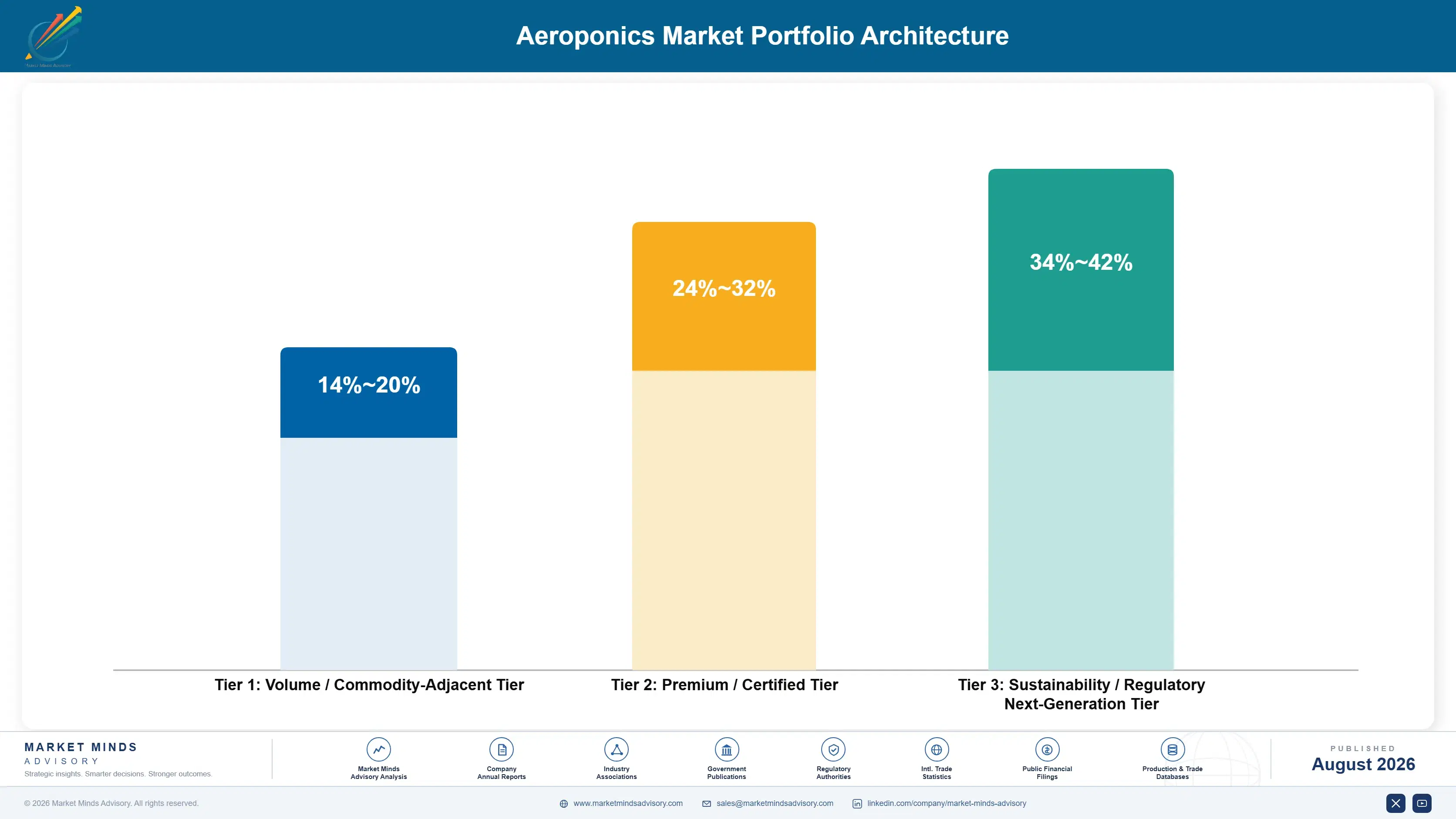
Portfolio Architecture for Margin Defence

Three tiers structure the aeroponics equipment market, and margin economics separate them clearly given how differently each tier is engineered and supported. Volume and commodity-adjacent products, covering standardized misting and root chamber hardware, compete primarily on price and reliable large-scale supply. Premium and certified products carry dosing software integration and government compliance documentation, commanding meaningfully higher margins than commodity equivalents produced at comparable volume.
The sustainability and next-generation tier, covering AI-driven dosing platforms and multi-crop protocol libraries, generates the highest margins but requires the heaviest upfront investment in software development and field trial validation over multiple growing seasons. Tension between volume and premium positioning defines strategy for most mid-sized equipment makers, who cannot fully fund next-generation capability while still defending commodity hardware volume against low-cost Asian manufacturers undercutting on price across standardized profiles.

High-value margin pools concentrate overwhelmingly in software-integrated turnkey installations, categories where genuine technical differentiation protects pricing power rather than relying on brand reputation alone to defend margin against determined new entrants. Makers anchored purely in the hardware volume tier face a much lower ceiling on achievable profitability regardless of manufacturing scale or component cost advantages built over time.

Volume / Commodity-Adjacent Tier

Standardized misting nozzles, root chamber enclosures, and basic control hardware sold primarily on price and reliable large-volume supply for smaller facility builds and research installations without advanced software integration requirements.
Gross Margin: 14-20%

Premium / Certified Tier

Integrated dosing systems with government compliance documentation, commanding premium pricing from operators requiring certified traceability before approving new subsidized facility construction projects each annual government budget approval cycle without exception.
Gross Margin: 24-32%

Sustainability / Regulatory / Next-Generation Tier

AI-driven dosing platforms and multi-crop protocol libraries, commanding the highest margins in the portfolio and requiring the deepest ongoing investment in software development and field trial validation work across seasons.
Gross Margin: 34-42%
aeroponics-market-2024-2034-trends-growth-portfolio-architecture-1787464175148

High-value Sub-segments and Strategic Watch-out

AI-Driven Dosing Software Platforms

High-value and high-growth, this segment commands the strongest margins in the market as operators multiply facility square footage across North American and Asian markets, rewarding makers with proprietary dosing algorithms that smaller hardware-only competitors cannot yet provide at comparable scale, documentation depth, or field-validated reliability.
Gross Margin: 34-42%

Turnkey Government Subsidized Installations

High-value with moderate growth, government-subsidized turnkey installations benefit from durable food security policy demand even as volume growth trails the faster-expanding software segment, giving makers a stable, well-margined revenue base tied to public sector budget cycles rather than volatile venture funding rounds tied to broader capital market sentiment.
Gross Margin: 26-32%

Standard Misting and Hardware Components

This volume core segment anchors most makers' revenue base even as margins compress under pricing pressure from Asian manufacturers, remaining commercially essential despite offering the weakest growth and thinnest margin trajectory across the entire market, since it funds working capital that supports investment in higher-margin software development elsewhere.
Gross Margin: 12-18%

Unintegrated Legacy Hydroponic Retrofits

A strategic watch-out segment, legacy hydroponic facilities retrofitting toward aeroponics without full software integration face shrinking competitiveness as certified turnkey installations set the performance benchmark, leaving unintegrated retrofits exposed to accelerating obsolescence over the coming years unless they invest in software upgrades soon enough to remain commercially competitive.
Gross Margin: 10-16%

Facility Contracts, Recurring Software Revenue

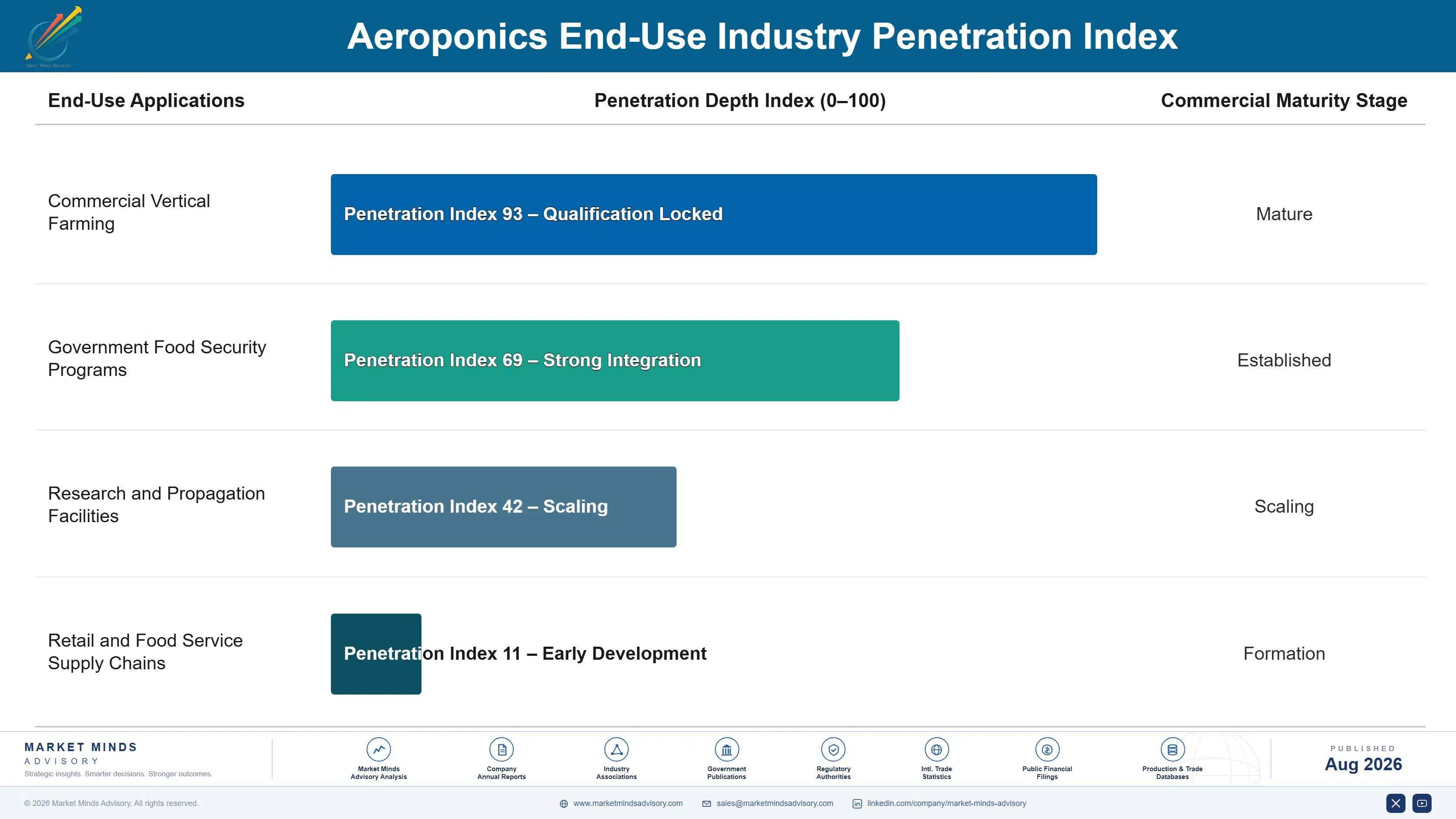
Facility service and software licensing contracts function much like annuities once an equipment relationship is established, since switching providers mid-operation risks disrupting dosing calibration that took seasons to optimize. This creates multi-year revenue visibility for incumbent makers that new entrants struggle to displace without offering a clearly better price or yield performance credential, which is why makers invest heavily in defending existing facility relationships.
Adoption stickiness varies sharply by end-use vertical. Government-subsidized facilities rarely switch equipment vendors once a project is approved, given the compliance risk of introducing unvetted suppliers mid-contract, while venture-funded commercial operators rebid supply more frequently as they chase lower cost or better software performance from emerging competitors each budget cycle. This split means vendor retention economics differ meaningfully by customer type overall.

A generational shift in buyer profiles is underway as younger facility operators prioritize documented yield data and software transparency over legacy hardware brand relationships built on personal trust alone, rewarding equipment makers who can demonstrate performance credentials quickly during vendor evaluations. This is gradually eroding the advantage that decades-old hardware relationships once provided incumbent equipment makers across most major producing regions.
aeroponics-market-2024-2034-trends-growth-end-use-penetration-index-1787464175671

What Matters Most Through 2036

These are among the four positions where our research anticipates prominent divergence between winners and laggards over the coming forecast period. Each is grounded in the demand model, the regulatory perimeter, and the announced capacity pipeline.
01 / SOFTWARE CAPABILITY INVESTMENT

Build proprietary dosing algorithms now or lose premium contracts

Facility operators have moved AI-driven dosing capability from a nice-to-have feature into a contracting requirement across most major turnkey installation programs, and the shift has happened faster than many hardware-focused makers anticipated. Equipment makers still lacking proprietary dosing algorithms by the next major facility procurement cycle risk losing bids regardless of hardware price competitiveness, since buyers now screen vendors on software capability before evaluating cost. The investment case is strongest for mid-sized makers that still have a narrow window left to close the gap.
02 / GOVERNMENT RELATIONSHIP BUILDING

Deepen public sector ties before subsidy programs mature further

Government food security subsidy programs command facility contracting volume that purely commercial channels cannot match, and the credibility barrier to winning these tenders is real rather than merely perceived by competitors evaluating market entry. Makers building government procurement relationships now are positioning themselves to capture disproportionate share of the fastest-growing subsidized segment in the entire market over the coming decade. Waiting risks ceding this ground permanently to competitors who moved earlier and already locked in public sector credibility and delivery track record.
03 / RENEWABLE POWER COST MANAGEMENT

Lock long-term power contracts before the next rate shock hits

Electricity cost volatility has repeatedly punished facilities buying power on spot markets over the past several seasons, while diversified long-term power purchase agreements held operating costs meaningfully steadier throughout the same period. This is not a hypothetical risk category, it has already materially affected margins across the industry more than once in recent memory. Operators that lock in multi-year renewable power agreements now will be far better positioned than spot-market competitors when the next regional rate increase inevitably arrives somewhere in their footprint.
04 / MULTI-CROP PROTOCOL EXPANSION

Expand beyond leafy greens before rivals capture the category

Aeroponic systems expanding beyond commodity leafy greens into herbs, strawberries, and select fruiting crops command pricing premiums that established leafy-green-focused competitors cannot match without years of additional protocol validation work across many separate crop varieties. Makers building multi-crop capability now are positioning themselves to capture disproportionate share of the highest-value segment before rivals close the technical gap entirely. Waiting risks ceding this ground permanently to competitors who moved much earlier and already validated dosing schedules for these higher-value crop varieties.

Engagement Snapshot From the Field

A live engagement with an industry participant carrying material or product regulatory and market exposure ahead of a defining policy shift, showing how our research translates into a defensible multi-year portfolio strategy.
MARKET MINDS ADVISORY · CLIENT ENGAGEMENT SUMMARY
Aeroponics Producer Strategic Portfolio Review and Transition Roadmap 2026·Investment Scenario on Aeroponics Exposure Evaluation 2025-26
CLIENT PROFILE
The client is a mid-sized North American vertical farm operator running three commercial facilities, producing leafy greens and herbs for both retail and food service accounts. Annual equipment and software procurement spend was reported at approximately $9 million (client-reported, unverified by MMA), split between legacy hardware-only systems and newer dosing software upgrades, with leadership seeking to standardize on a single integrated platform.
STRATEGIC CHALLENGE
Leadership needed to determine whether consolidating onto a single AI-driven dosing platform across all three facilities would justify the switching cost and disruption risk during the transition period. Prior attempts to integrate multiple vendor systems had produced inconsistent yield data, and the client lacked a clear framework for evaluating platform vendors before committing to a multi-year contract.
MMA APPROACH
MMA conducted structured interviews with dosing software vendors and benchmarked their yield consistency claims against the client's existing multi-vendor baseline using independent facility performance data. The engagement combined primary survey data with a supplier capability scoring framework covering software maturity, integration complexity, and documented customer retention across comparable multi-site accounts.
KEY FINDINGS
  1. Two vendors matched or exceeded the client's existing yield consistency benchmarks within acceptable variance across all three facility types and crop varieties tested.
  2. Platform consolidation reduced average technician training time from six weeks to under two weeks, meaningfully improving the client's ability to onboard new facility staff.
  3. One candidate vendor lacked sufficient multi-facility deployment references, disqualifying it entirely from consideration for the client's largest and most complex facility rollout.
  4. Standardized software licensing reduced the client's total technology spend compared with maintaining separate legacy systems across its three distinct facility locations each year.
CLIENT PROFILE
The client is a mid-sized North American vertical farm operator running three commercial facilities, producing leafy greens and herbs for both retail and food service accounts. Annual equipment and software procurement spend was reported at approximately $9 million (client-reported, unverified by MMA), split between legacy hardware-only systems and newer dosing software upgrades, with leadership seeking to standardize on a single integrated platform.
STRATEGIC CHALLENGE
Leadership needed to determine whether consolidating onto a single AI-driven dosing platform across all three facilities would justify the switching cost and disruption risk during the transition period. Prior attempts to integrate multiple vendor systems had produced inconsistent yield data, and the client lacked a clear framework for evaluating platform vendors before committing to a multi-year contract.
MMA APPROACH
MMA conducted structured interviews with dosing software vendors and benchmarked their yield consistency claims against the client's existing multi-vendor baseline using independent facility performance data. The engagement combined primary survey data with a supplier capability scoring framework covering software maturity, integration complexity, and documented customer retention across comparable multi-site accounts.
KEY FINDINGS
  1. Two vendors matched or exceeded the client's existing yield consistency benchmarks within acceptable variance across all three facility types and crop varieties tested.
  2. Platform consolidation reduced average technician training time from six weeks to under two weeks, meaningfully improving the client's ability to onboard new facility staff.
  3. One candidate vendor lacked sufficient multi-facility deployment references, disqualifying it entirely from consideration for the client's largest and most complex facility rollout.
  4. Standardized software licensing reduced the client's total technology spend compared with maintaining separate legacy systems across its three distinct facility locations each year.
RECOMMENDED STRATEGY
Phase 1: Phase 1 (Weeks 1 to 4): Benchmark dosing software vendors carefully against the client's existing multi-vendor baseline data in detail. Phase 2: Phase 2 (Weeks 5 to 9): Pilot the selected platform at one facility location with full yield performance validation testing. Phase 3: Phase 3 (Weeks 10 to 16): Scale the newly standardized platform fully across the two remaining client facility locations completely.
OUTCOME
The client consolidated all three facilities onto a single dosing platform within nine months, reporting a blended technology cost reduction of roughly 18 percent (client-reported, unverified by MMA) alongside meaningfully improved yield consistency across its full facility portfolio and entire crop lineup over the following fiscal year.

Frequently Asked Questions

Foundational context covering the market sizes, CAGR, scope, country, region and competition that inform every finding below. This section is provided to cover basics and most often pre-purchase conversations, answered from the MMA Primary Research Dataset.

What is the current size of the Aeroponics Market?

The market is valued at $1.8 billion in 2025, MMA's defined base year for this analysis. This reflects global demand for aeroponic systems, dosing controls, and turnkey vertical farm installations.

How large will the Aeroponics Market be by 2036?

MMA projects the market will reach $5.4 billion by 2036, nearly triple the 2026 opening value. Growth is led by government food security programs and AI-driven dosing software adoption.

What is the CAGR for the Aeroponics Market 2026 to 2036?

The base case CAGR is 10.5 percent across the 2026 to 2036 forecast period. Bull and bear scenarios range from 9.3 percent to 11.8 percent depending on electricity cost trends.

Which segment is growing fastest?

Nutrient dosing and control systems lead at a 14.5 percent CAGR, well above the market average. Turnkey vertical farm installations follow closely at 12.8 percent.

Who are the major companies in the Aeroponics Market?

AeroFarms, Plenty Unlimited, LettUs Grow, Priva, and Signify Horticulture lead the market today. Combined, the top five suppliers hold a CR5 of approximately 24 percent.

Which country is growing fastest?

China leads country-level growth as government-subsidized facility construction accelerates nationwide each new fiscal year. Singapore and India follow closely, both scaling controlled-environment agriculture investment steadily higher.

Report Segmentation Architecture

The full report scope spans multiple orthogonal segmentation dimensions, with cross-tabulated demand data provided for each dimension pair. Coverage extends further to regional breakdowns, trend trajectories, and the competitive detail needed to support segment-level decision-making.

By System Component

  • Misting and Nozzle Systems
  • Root Chamber and Enclosure Systems
  • Nutrient Dosing and Control Systems
  • Turnkey Vertical Farm Installations
  • Aeroponic Cloning and Propagation Systems
  • Sensor and Monitoring Software

By End-Use Industry

  • Commercial Vertical Farming
  • Government Food Security Programs
  • Research and Propagation Facilities
  • Retail and Food Service Supply Chains

By Commercial Dimension

  • Turnkey Installation Contracts
  • Component-Level Equipment Sales
  • Software and Data Licensing
  • Facility Service and Maintenance Contracts

By Region

  • North America
  • Western Europe
  • East Asia
  • South Asia and Pacific
  • Latin America
  • Middle East and Africa
  • Eastern Europe

Scope, Methodology, and Coverage

Every figure in this report is reproducible from documented input assumptions. The scope below maps the historical period, the forecast horizon, the segmentation dimensions, and the countries covered, alongside the underlying primary and qualitative methodology.
Historical Period
2020 to 2025
Forecast Period
2026 to 2036
Base Year
2025 (USD billions; MMA Primary Research Dataset, August 2026)
Market Definition
This report covers aeroponic system hardware, nutrient dosing and control software, and turnkey vertical farm installations sold to commercial operators, government food security programs, and research institutions. It excludes hydroponic and aquaponic systems that use a growing medium or fish-based nutrient loops.
Quantitative Units
USD billions (current prices); installed square meters where volume context applies
Segmentation Dimensions
By System Component; By End-Use Industry; By Commercial Dimension; By Region
Regions Covered
North America, Western Europe, East Asia, South Asia and Pacific, Latin America, Middle East and Africa, Eastern Europe
Countries Covered
USA, China, Germany, France, UK, Japan, South Korea, India, Australia, Canada, Brazil, Mexico, Indonesia, Vietnam, Thailand, Malaysia, UAE, Saudi Arabia, South Africa, Nigeria, Turkey, Poland, Netherlands, Italy, Spain, Sweden, Switzerland, Argentina, Colombia, Singapore, and additional markets relevant to this sector
Key Companies Profiled
AeroFarms, Plenty Unlimited, LettUs Grow, Priva, Signify Horticulture, Urban Crop Solutions, Freight Farms, Netled, Growy, Jones Food Company, Spread Co Ltd, Mirai Co Ltd, Sky Greens, Sananbio, Certhon, Netafim, General Hydroponics, Heliospectra, Agrilution, 80 Acres Farms
Quantitative Methodology
Primary survey, n=3,800 respondents, Q4 2025, six countries; demand-side model with trade association cross-validation
Qualitative Methodology
47 expert interviews, Q4 2025; applied to validate demand model assumptions, identify emerging dynamics, and assess competitive positioning
Report Format
PDF and XLSX data workbook (Word format preview document)
Publisher
Market Minds Advisory
Report Code
MMA-2026-AGR-201
Published
August 2026
Contact
sales@marketmindsadvisory.com | www.marketmindsadvisory.com

Purchase the full Aeroponics Market Report (2026 to 2036).

The full report delivers a complete market model spanning 2020 through 2036, with segmentation by system component, end-use industry, and commercial dimension across all seven covered regions. It includes detailed competitive profiles of the twenty companies assessed in this summary, along with primary survey data from 3,800 respondents and 47 expert interviews conducted in the fourth quarter of 2025. Country-level detail covers thirty additional markets beyond the seven headline regions, supporting granular sourcing decisions. Analysts provide supplementary guidance on government procurement strategy, energy cost management, and multi-crop expansion relevant to facility investment teams.
Full 2020-2036 historical and forecast data model
Segment-level CAGR and share breakdowns by component
Twenty-company competitive profiles and moat analysis
Regional demand analysis across all seven covered geographies
Energy cost and government subsidy risk assessment
Analyst briefing call included with report purchase

Built For The People Who Decide

From boardroom strategy to bench-side execution, this report is read cover-to-cover by leaders shaping the next decade of their industry, turning demand scenarios, market dynamics and valuation benchmarks into decisions.
CXOs/ Presidents/ VPs/ Managers
M&A and Corporate Development
Strategy Teams and R&D Heads
Procurement and Product Directors
Regulatory and Compliance Leaders
Investor Relations and Equity Analysts