
Market Minds Advisory
Aerogel Market

Aerogel Market: The Best Insulator Available And Still Too Expensive

A commercial reading of aerogel insulation, where the thermal performance has never been in doubt and thirty years of supercritical drying cost has kept it out of every application that buys on price.

Lead Analyst

Bilal Shaikh

Published

September 2026

Make Smarter Decisions with Customized Research Insights

Request a free sample report and evaluate market opportunities, growth trends, and competitive dynamics relevant to your business needs.

2025 MARKET VALUE$1.3BMarket Size 2025
2036 FORECAST VALUE$5.0BBase Case , 2026 to 2036
CAGR 2026 TO 203612.9 %Bull 14.2% / Bear 11.5%
INCREMENTAL OPPORTUNITY$3.5BNet 10- year value creation
EXPANSION MULTIPLE3.39x2036 value over 2026 base
Strategic Levers
M&A Pipeline
Regional Outlook
Country Rankings
Competitive Intelligence
Segmental Deep-dive
Call-Us : 91 93563 13602

Executive Snapshot and Market Trajectory

Aerogel has been the best thermal insulator available for decades and it still loses most tenders. Supercritical drying is slow, capital intensive, and expensive, so the material only wins where space is genuinely unavailable or where failure is catastrophic rather than inconvenient. Nothing else about the material is in question.
The market stands at USD 1.3 billion in 2025 and reaches USD 4.98 billion by 2036 at a 12.9% CAGR. Battery thermal barrier materials grow fastest at 24.6%, about 1.91 times the overall rate, as cell-to-pack designs require thin barriers that stop thermal propagation between cells. East Asia holds 30% of value on battery and electronics manufacturing, while China posts the quickest national growth at 18.4%.
Concentration is severe, with the top five holding roughly 63% of aerogel revenue because supercritical drying capacity is expensive and few producers hold it at scale. Two forces pull against each other. Battery safety requirements and industrial insulation replacement both create applications where thickness matters more than material cost, while ambient drying routes and competing thin insulation keep threatening the premium the incumbents depend on. Cost has never stopped being the whole argument.
Market Definition
The aerogel market covers highly porous low-density solid materials produced by removing liquid from a gel while preserving its structure, spanning silica aerogel blankets and panels, battery thermal barrier materials, aerogel particles and granules, polymer and organic aerogels, and carbon and specialty aerogels. Conventional insulation including mineral wool, foam and vacuum panels, silica gel desiccants, precipitated and fumed silica, insulated building envelope systems sold as assemblies, and installation and lagging services are excluded.
Base Year Value
$1.3B in 2025 (MMA Primary Research Dataset, August 2026)
Forecast Period
2026 to 2036, eleven discrete annual values
CAGR
12.9% base case. Bull 14.2%. Bear 11.5%.
Fastest Growth Segment
Battery Thermal Barrier Materials: 24.6% CAGR
Fastest Growth Country
China: 18.4% CAGR
Fastest Growth Region
South Asia and Pacific: 15.0% CAGR
Largest Region
East Asia: 30% of 2025 global value
Market Leaders
Aspen Aerogels, Cabot Corporation, Armacell, Guangdong Alison Hi-Tech, Nano Tech Company. Source: MMA Analysis based on company annual reports.
Primary Survey
n=3,800 procurement and R&D decision-makers, Q4 2025, six countries
Methodology
Demand-side build-up, cross-validated against public data, 47 expert interviews

Aerogel Market Forecast Scenarios

aerogel-market-size-forecast-scenario-1787331953260
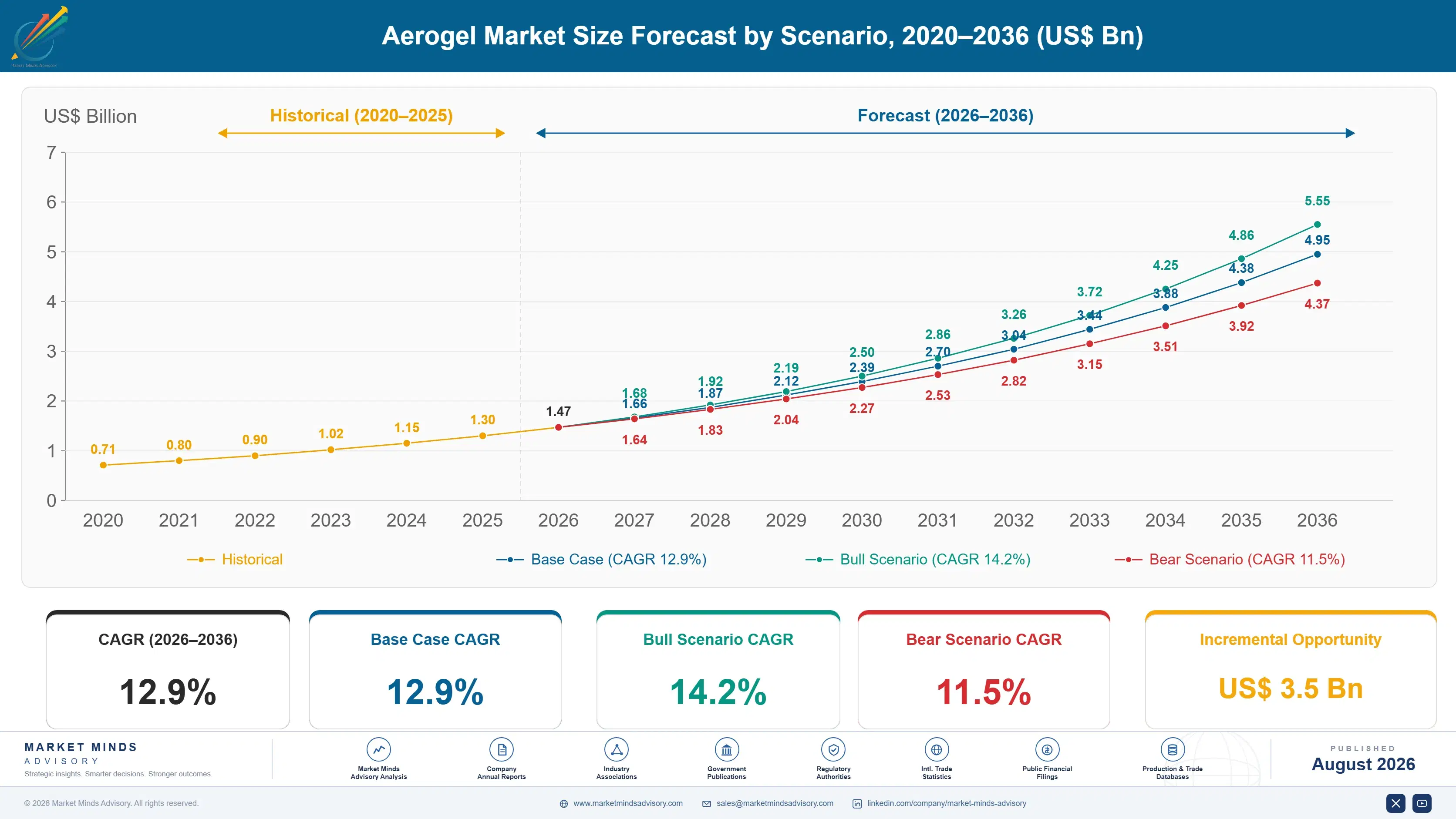
Growth from 2020 to 2025 compounded near 11.6%, and one application arrived from almost nowhere. Battery thermal barrier demand did not exist in 2019 and became a material share of the category by 2024 as cell-to-pack designs eliminated the space conventional barriers needed. Oil and gas insulation demand meanwhile stayed cyclical and unexciting. Capacity additions ran behind battery demand throughout.
Three mechanisms carry the base case to 12.9%. First, battery thermal propagation requirements, where regulation and manufacturer specification both demand barriers thin enough to fit between cells and stable enough to survive a runaway event. Second, industrial insulation replacement, where aerogel wins on refurbishment because it delivers the same thermal resistance in a fraction of the thickness. Third, capacity expansion finally arriving after years of supply constraint holding volume back.
The bull case at 14.2% assumes battery barrier adoption spreads across more cell formats and ambient drying cuts production cost materially. The bear case at 11.5% assumes cell chemistry changes reduce propagation risk enough to weaken the barrier requirement, oil and gas capital spending stays cautious, and competing thin insulation including vacuum panels and microporous boards takes the industrial applications where cost sensitivity is highest.

Thin Enough To Win, Expensive Enough To Lose

Demand rests on three foundations. Space constraint provides the win condition, since aerogel delivers equivalent thermal resistance in a quarter to a half of the thickness and that only matters where thickness is unavailable. Safety criticality provides the second, because a battery barrier or a cryogenic line failure is catastrophic rather than merely inefficient. And cost sets the ceiling, since the material runs five to 15 times conventional insulation per unit of thermal resistance.
MARKET CONCENTRATIONCR5: 63%Concentrated because supercritical drying capacity is costly to build
THERMAL CONDUCTIVITYAbout 0.014Watts per metre kelvin against conventional insulation alternatives
COST MULTIPLE5 to 15 timesAerogel cost against conventional insulation per thermal resistance
THICKNESS ADVANTAGE2 to 4 timesReduction in installed depth for equivalent thermal performance
PLANT BUILD TIMELINE3 to 4 yearsPeriod from investment decision to qualified commercial output
CAPACITY UTILISATIONAbout 88%Running rate across dedicated aerogel production assets today
Commercially the pattern has held for thirty years. Aerogel wins refurbishment work where pipework has no room for thicker lagging, wins battery barriers where cells sit millimetres apart, and loses new-build industrial insulation where a contractor can simply specify more mineral wool. Utilisation near 88% shows supply has been the constraint rather than demand, which is unusual for a material this expensive.
The next decade turns on production cost. Supercritical drying with carbon dioxide is slow, batch-oriented, and capital intensive, and it is the reason the price premium has never fallen far. Ambient pressure drying routes promise considerably lower cost and have been promised for years. Battery barriers at 24.6% growth are meanwhile a rare application where the customer genuinely cannot substitute anything thinner.
"Every aerogel pitch for three decades has led with thermal conductivity, and every lost tender has been about dollars per square metre. The battery barrier application is the first one in years where the customer has no cheaper way to solve the problem at all."
Director, Advanced Materials and Thermal Systems Practice · MMA Chemicals and Ma

Market Trends

Cell-To-Pack Designs Create A Barrier Application

Removing module housings from a battery pack to gain energy density also removes the space that conventional thermal barriers occupied, and it puts cells millimetres apart where a runaway event can propagate directly to its neighbour. Aerogel barriers a few millimetres thick withstand the temperatures involved and fit the gap, which almost nothing else does. Battery thermal barrier materials grow at 24.6% against a market at 12.9% for that reason alone. Manufacturer specification and safety regulation both point the same way, which is unusual and commercially valuable. Nothing thinner survives the temperatures involved.
Market Impact: Thickness falls 2 to 4 times
Ambient Drying Routes Threaten The Cost Structure

Supercritical drying with carbon dioxide is slow, batch-oriented, and capital intensive, and it explains why aerogel has stayed five to 15 times conventional insulation cost for three decades. Ambient pressure drying avoids the pressure vessel entirely and promises substantially lower production cost, and several producers claim commercial progress toward it. Whether the resulting material matches supercritical properties at scale remains genuinely unsettled. Incumbents with supercritical capacity face a real question about whether their capital advantage becomes a capital burden. A capital advantage can turn into a capital burden remarkably quickly here.
Market Impact: Failure costs exceed material 100 t

Market Opportunities and Growth Drivers

Refurbishment Insulation Has No Room For Thickness

Replacing insulation on existing pipework, vessels, and offshore risers means working inside clearances designed decades ago, and a contractor who needs equivalent thermal resistance in a quarter of the depth has very few options. Aerogel blankets deliver that and the installation labour saving frequently offsets a substantial part of the material premium. Refurbishment is also less price-sensitive than new build because the alternative is rerouting pipework. This is where the category has earned its living for twenty years and it remains genuinely defensible. Rerouting the pipework is the only real alternative.
Market Impact: Cost premium reaches 15 times

Safety Criticality Overrides Cost Comparison Entirely

Cryogenic lines, subsea flow assurance, fire barriers, and battery packs all share a property that conventional insulation applications do not: failure is catastrophic rather than inefficient. A buyer facing thermal runaway propagation or a hydrate blockage in a subsea line is not comparing dollars per square metre against mineral wool. Those applications accept the premium because the alternative outcome is unacceptable at any saving. Identifying them accurately is the whole commercial skill in this category and most producers do it poorly. Price comparison does not really enter into those decisions at all.
Market Impact: Dust needs 3 protective measures

Market Restraints and Challenges

Production Cost Keeps Losing Price-Sensitive Applications

Aerogel costs five to 15 times conventional insulation per unit of thermal resistance, which excludes it from new-build industrial work where a contractor can simply specify thicker mineral wool at a fraction of the price. The root cause is supercritical drying, a slow batch process requiring pressure vessels and carbon dioxide recovery that has resisted cost reduction for thirty years. Commercially this caps the addressable market severely. Participants mitigate through ambient drying development, thinner composite constructions, and rigorous targeting of space-constrained applications only. Thirty years of cost reduction attempts have not changed it.
Market Impact: Barriers fit under 3 millimetres

Handling And Dust Complicate Field Installation

Aerogel blankets shed fine silica dust when cut and handled, which requires respiratory protection and makes installers dislike the material regardless of its thermal performance. The root cause is the structure itself, since the particle sizes that deliver low conductivity are the ones that become airborne. Commercially this creates resistance at exactly the point of specification where contractor preference matters. Producers mitigate through encapsulated and reinforced constructions, dust-suppressed formulations, pre-cut shapes, and installer training programmes that most competitors do not fund. Contractor preference decides far more specification than engineers ever admit.
Market Impact: Cost runs 5 to 15 times
4 additional market trends, 3 additional growth drivers, and 2 additional restraints and challenges are covered in the full report. Contact sales@marketmindsadvisory.com to access the complete intelligence.

Segment CAGR and Growth Architecture

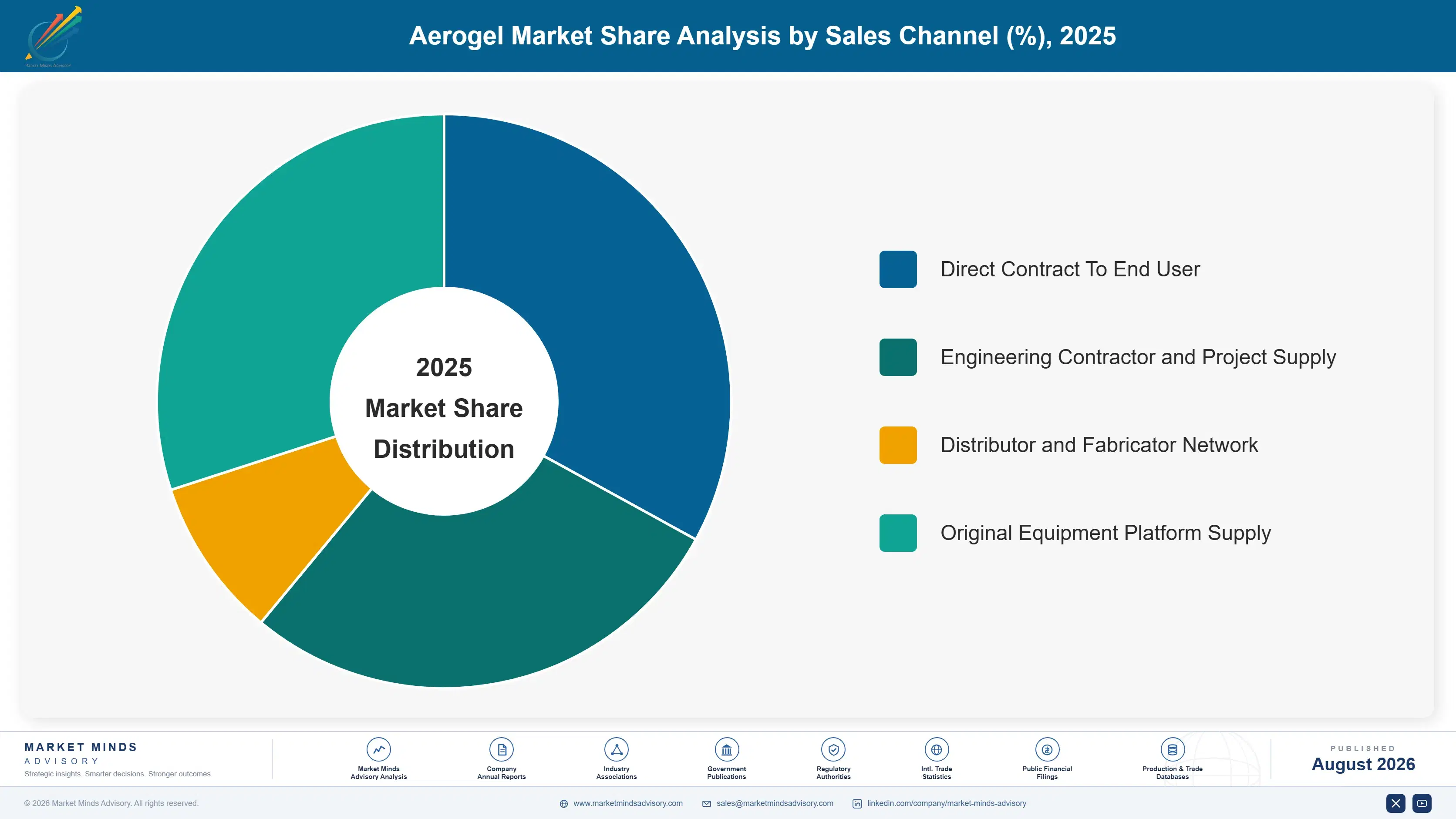
Segmentation follows product form and chemistry, a single classification describing the physical format and base material of the aerogel supplied. Each form carries its own production route, handling behaviour, application set, and price position, so economics track the format rather than the industry consuming it. End-use industry and sales channel appear separately within the framework as their own distinct dimensions.
aerogel-market-market-share-analysis-1787331953826

Battery Thermal Barrier Materials

Battery thermal barrier materials grow fastest at 24.6%, about 1.91 times the overall 12.9% rate, and pack architecture rather than any material improvement explains it. Cell-to-pack designs removed the module housings that once carried thermal separation, leaving cells millimetres apart with direct propagation paths between them. An aerogel barrier a few millimetres thick survives runaway temperatures and fits the gap, which very little else manages. Manufacturer specification and safety regulation both push the same way, and the customer genuinely has no thinner substitute. Qualification into a cell platform takes many months and rarely reopens once complete. Pack architecture rather than any commercial argument is what created this entire application in the first place.
CAGR 24.6%

Silica Aerogel Blankets and Panels

Silica aerogel blankets and panels grow at 11.4%, the second-fastest form and by far the largest by revenue, serving industrial process insulation, subsea flow assurance, cryogenic service, and building refurbishment. Refurbishment is where the format earns its living, because equivalent thermal resistance in a quarter of the depth is worth paying for when clearances were set decades ago. Installation labour saving frequently offsets a real part of the material premium. Dust during cutting remains the persistent field objection and encapsulated constructions address it partially. New-build industrial work is largely lost to thicker conventional insulation on cost. Chinese industrial-grade supply now competes hard on everything except the most demanding specifications anywhere.
CAGR 11.4%
Full segment breakdown across 5 segments available in the complete report.

Regional Architecture and Country Demand Map

Battery manufacturing and industrial process capacity together set this distribution rather than construction activity. East Asia leads on cell and electronics production, while South Asia and Pacific grows quickest as refinery and industrial insulation refurbishment expands from a small base. Space constraint rather than efficiency decides adoption.

North America

North America holds 26% of value, and refinery refurbishment alongside battery pack production explains most of it. Ageing petrochemical and refining assets across the Gulf Coast generate steady insulation replacement work where clearances leave no room for thicker lagging, which is exactly the condition aerogel needs. Aspen Aerogels built its position here and its capacity expansion is aimed squarely at battery barriers for North American cell plants. Oil and gas capital cycles make the industrial half genuinely lumpy. Growth of 12.3% combines battery pack demand with refurbishment work that continues regardless of new construction. Battery capacity committed here depends on vehicle programmes that slip routinely, which makes utilisation genuinely uncertain.
Share: 26% | CAGR: 12.3% (2026 to 2036)

Western Europe

Industrial efficiency regulation and building refurbishment shape demand here. Western Europe holds 22% of value, with energy efficiency obligations on industrial process plant and a very large stock of buildings that cannot accept thicker insulation without losing internal space or altering facades. Energy costs since 2022 improved the payback arithmetic considerably on process insulation upgrades. Battery pack production is expanding though behind announced schedules. Armacell holds a European position in insulation systems more broadly. Growth of 11.2% is the slowest of the seven regions, reflecting mature industrial capacity and construction volumes that have not grown. Building refurbishment where facades cannot be altered is a natural application that nobody markets properly.
Share: 22% | CAGR: 11.2% (2026 to 2036)
Regional intelligence for 5 additional markets available in the complete report: East Asia, South Asia and Pacific, Latin America, Middle East and Africa, Eastern Europe. Contact sales@marketmindsadvisory.com.
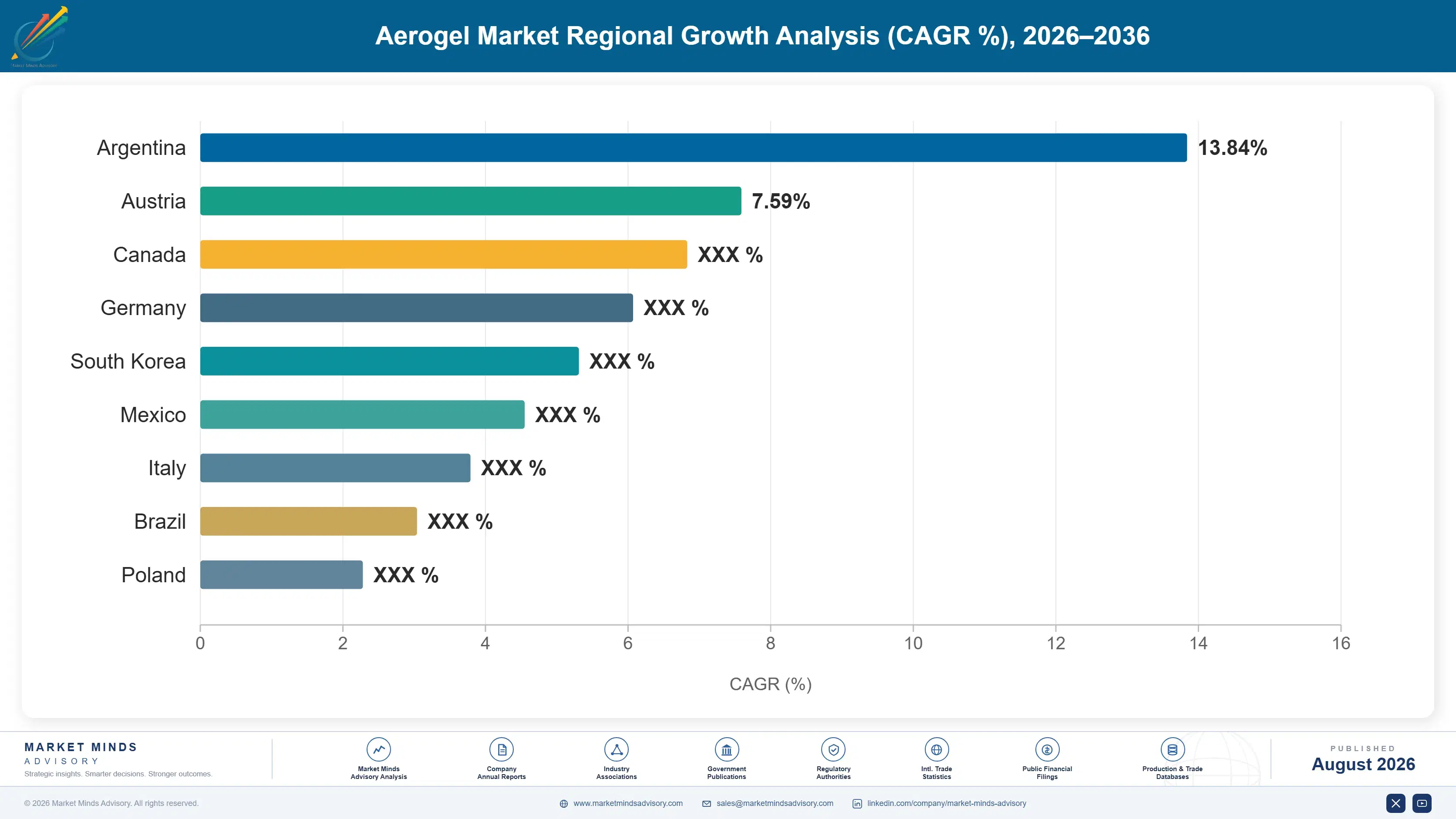
aerogel-market-country-cagr-analysis-1787331954329

Where Aerogel Producers Actually Win Work

Leading with thermal conductivity has lost this industry tenders for thirty years, because the buyer is comparing dollars per square metre. The four moves below reach the applications where that comparison does not apply: space constraint, catastrophic failure consequence, battery qualification, and installed cost rather than material cost. None of the four is a thermal conductivity argument.

Qualify Into Battery Platforms Before Cell Designs Freeze

Cell-to-pack architectures leave cells millimetres apart with direct propagation paths, and a barrier a few millimetres thick that survives runaway temperatures has almost no substitute. Battery barriers grow at 24.6% against a market at 12.9% for exactly that reason. Qualification into a cell platform takes many months of thermal and mechanical testing and rarely reopens once complete, which makes each position durable across the platform life. Producers arriving after a pack design freezes are quoting into a specification written around somebody else's material. Pack design freezes are the moment that matters.
Market Impact: Barriers grow at 24.6% against a 12

Sell Installed Cost, Not Material Cost Per Square Metre

Aerogel costs five to 15 times conventional insulation per unit of thermal resistance and delivers it in a quarter to a half of the thickness, which means fewer layers, less labour, smaller cladding, and no pipework rerouting. On refurbishment work that labour and clearance saving frequently offsets a real part of the premium, and it is invisible in any material price comparison. Producers who let a contractor compare dollars per square metre have already lost. The argument has to reach whoever owns the total project cost. Whoever owns total project cost is the audience.
Market Impact: Installed thickness drops by 2 to 4

Target Failure Consequence Rather Than Efficiency Gain

Cryogenic lines, subsea flow assurance, fire barriers, and battery packs share one property that ordinary insulation applications do not, which is that failure is catastrophic rather than merely wasteful. Buyers facing thermal runaway propagation or a subsea hydrate blockage are not comparing material prices at all. Those applications accept a 15 times premium because the alternative outcome is unacceptable at any saving. Identifying them accurately is the entire commercial skill here, and most producers spread their effort far too widely across the efficiency market. Spreading effort across the efficiency market wastes it.
Market Impact: The premium reaches 15 times conven

Fix The Dust Objection Before The Installer Raises It

Aerogel blankets shed fine silica when cut, installers dislike handling them, and contractor preference decides a great deal of specification in practice regardless of what an engineer wrote. Encapsulated constructions, dust-suppressed formulations, pre-cut shapes, and funded installer training all address it and most competitors do none of them. This is unglamorous work that never appears in a technical datasheet. It also removes the single most common practical objection raised on site, which is worth more than another point of thermal conductivity. A single site objection can void 300 line items of specification.
Market Impact: Dust handling requires at least 3 p

Who Controls the Margin Pool

Concentration is severe: the top five hold roughly 63% of aerogel revenue, because supercritical drying capacity is expensive and few producers hold it at meaningful scale. The gap between leaders and challengers is capacity and application qualification rather than gel chemistry, which is well documented. All participants here are assessed on one basis, revenue from aerogel material and product sales, excluding conventional insulation, silica gel desiccants, fumed silica, and installation servi
Competition runs along four lines. First, qualified capacity, since supply rather than demand has constrained this market for years. Second, battery platform qualification, which locks a supplier in for a pack generation. Third, handling and encapsulation engineering, because contractor resistance decides field specification. Fourth, production cost route, as ambient drying could reset the economics that supercritical incumbents built their positions on.

Pressure is building from two directions. Chinese producers supply industrial-grade material at costs Western suppliers cannot approach and are now exporting into their markets. Meanwhile competing thin insulation including vacuum panels and microporous boards contests the space-constrained applications aerogel treats as its own. Rankings should favour producers with battery qualification and credible cost reduction routes over those defending industrial blanket volume on thermal performance alone.
aerogel-market-company-positioning-matrix-1787331954849

Competitive Moat and Risk Dimensions

ASPEN AEROGELS

Moat: Battery qualification and capacity commitment

Aspen Aerogels holds early battery thermal barrier qualification with vehicle manufacturers and has committed capacity specifically against that demand, which matters in a market where supply has been the binding constraint for years. Its industrial insulation position in refining and subsea provides a base that predates the battery opportunity. Application engineering depth in space-constrained refurbishment is difficult to replicate quickly.
ASPEN AEROGELS

Risk: Capital intensity and customer concentration

Capacity expansion requires capital committed three to four years ahead of revenue with battery demand dependent on vehicle programmes that slip routinely. A small number of automotive customers account for a substantial share of the barrier opportunity, which concentrates that exposure sharply. Chinese producers competing on industrial material cost also pressure the base business that funds the battery investment.
CABOT CORPORATION

Moat: Particle capability and chemical scale

Cabot brings large-scale specialty chemical manufacturing discipline and a strong position in aerogel particles and granules, which serve coatings, composites, and translucent applications blanket producers reach poorly. Integration with a much larger materials business absorbs development cost that standalone producers must fund from a small revenue base. Global distribution and technical service reach is broader than specialist competitors hold.
CABOT CORPORATION

Risk: Format limits and battery position

Particle and granule formats do not address the battery barrier application that carries most of the growth, which leaves the fastest segment largely to blanket and panel producers. Aerogel sits inside a far larger portfolio and competes internally for capital against businesses with shorter payback. Chinese particle producers also compete effectively on cost wherever specification is least demanding.

Players Tracked

Prominent Players

Aspen Aerogels
Cabot Corporation
Armacell
Guangdong Alison Hi-Tech
Nano Tech Company

Other Key Players

Aerogel Technologies
Active Aerogels
Enersens
JIOS Aerogel
Svenska Aerogel
Taasi Corporation
Aerogel UK
Zhejiang Xinjing Aerogel
Shenzhen Aerogel Technology
IBIH Advanced Materials
BASF
Dow
Johns Manville
Rockwool
Morgan Advanced Materials

Recent Developments

FEBRUARY 2025

Battery thermal barrier qualifications extend across cell platforms

Aerogel barrier materials completed qualification on additional cell-to-pack battery platforms as manufacturers addressed thermal propagation requirements in designs that removed module housings. These were qualification milestones rather than commercial transactions, and each fixes material supply for the platform life rather than for a purchasing cycle.
Signal: A pack design freeze closes the material d
AUGUST 2024

Aerogel capacity expansions target battery barrier demand

Producers committed additional supercritical drying capacity aimed specifically at battery thermal barrier volume rather than at industrial insulation, after years in which supply rather than demand constrained the category. These were organic capacity investments rather than acquisitions, and each carries a three to four year timeline before qualified output arrives.
Signal: Capacity committed against vehicle program
APRIL 2024

Ambient drying routes advance toward commercial claims

Several producers reported progress on ambient pressure drying processes that avoid the supercritical pressure vessels responsible for most aerogel production cost. These were process development claims rather than transactions, and whether the resulting material matches supercritical properties at commercial scale remains genuinely unsettled. Nobody has published verified property data.
Signal: Cheaper drying would reset the whole econo

Silica Precursors, Carbon Dioxide, Energy, Reinforcement

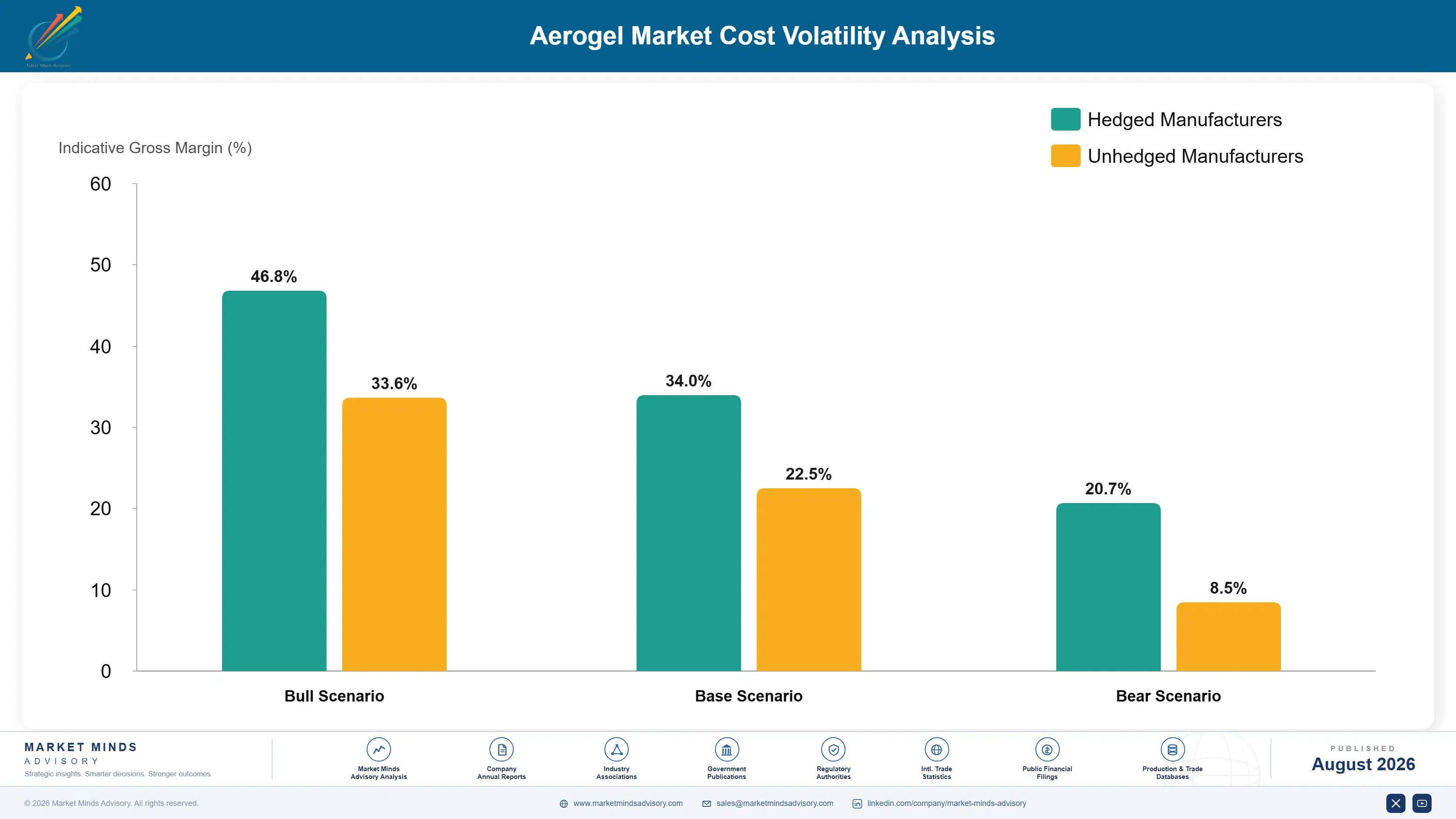
Process rather than raw material dominates this cost sheet, which is unusual in chemicals. Silica precursors including sodium silicate and alkoxysilanes run 18% to 26% of production cost. Supercritical carbon dioxide with its recovery and compression adds 14% to 22%. Energy for the drying cycle contributes 16% to 24%, reinforcement and facing materials 12% to 18%, and the capital charge on pressure vessels sits above all of it.
European energy costs through 2022 hit this process particularly hard, since supercritical drying runs long cycles at pressure and cannot be throttled economically, with IEA analysis recording industrial gas at several times prior-year levels. Aspen Aerogels disclosed manufacturing cost pressure across that reporting period. Alkoxysilane precursor pricing also rose on upstream silicon metal constraints, and neither could be passed to customers already resisting the premium.

Exposure separates by drying route rather than by scale. A producer running supercritical extraction carries pressure vessel capital, carbon dioxide recovery cost, and long batch cycles that ambient routes largely avoid, which is why the process claims matter commercially. Geography compounds it, since Chinese producers combine lower energy cost with lower capital charges and supply industrial-grade material at prices no Western plant can approach.
aerogel-market-cost-volatility-analysis-1787331955044

Develop ambient drying before a competitor commercialises it

Supercritical drying carries pressure vessel capital, carbon dioxide recovery, and long batch cycles that explain most of the premium keeping aerogel out of ordinary applications. Ambient routes avoid the vessel entirely. The material properties question is genuinely unresolved and development is expensive, but an incumbent whose competitor solves it first holds capacity that became a liability rather than a barrier.

Recover and recycle carbon dioxide across every cycle

Supercritical carbon dioxide and its compression run up to a fifth of production cost, and losses per cycle compound across continuous operation. Closed-loop recovery with efficient compression cuts both purchase volume and the energy needed to reach supercritical conditions. Retrofit on older vessels is awkward and the capital is real, which is why several producers have deferred it past payback.

Qualify sodium silicate routes alongside alkoxysilane precursors

Alkoxysilane precursors deliver better control and cleaner chemistry while sodium silicate costs considerably less, and the resulting materials differ enough that applications must be qualified separately. Holding both routes lets a producer serve industrial-grade demand on the cheaper precursor while reserving alkoxysilane for battery and cryogenic specification. Running one route alone concedes either the premium applications or the volume ones.

Portfolio Architecture for Margin Defence

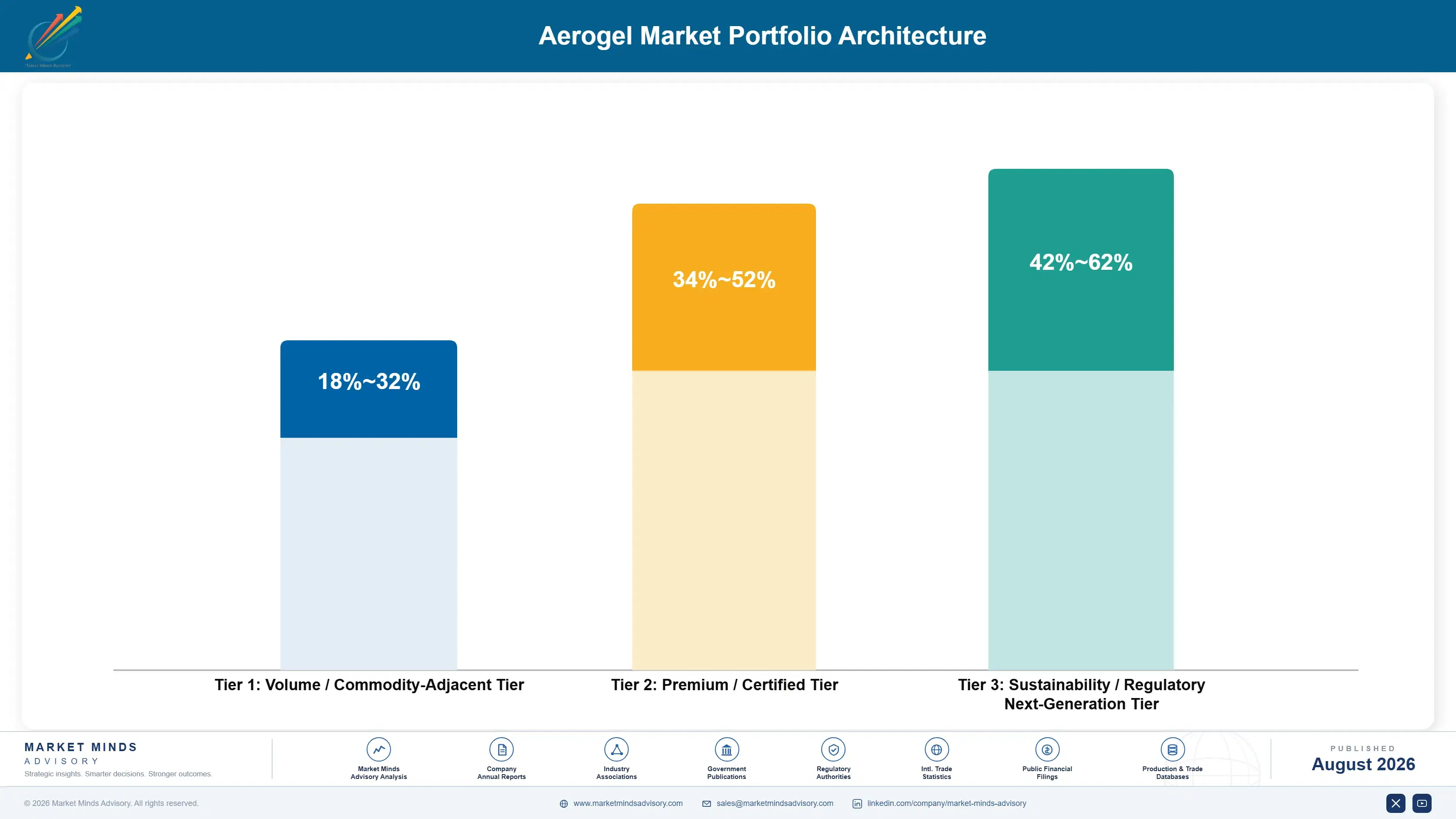
The portfolio splits into three tiers with different economics. Industrial-grade blankets for general process insulation form the volume tier, where Chinese producers set pricing and thermal performance alone does not justify the premium. Cryogenic and subsea grades earn considerably more because failure consequence rather than efficiency drives the specification. Battery barriers and encapsulated constructions price against qualification scarcity rather than a competing insulation quotation.
The tension runs between industrial blanket volume that fills the vessels and qualified specialty grades that earn the return. Industrial material keeps supercritical capacity loaded, absorbs the capital charge on expensive pressure vessels, and maintains the relationships through which specialty work arrives. Yet it competes against Chinese supply on cost Western plants cannot match. Producers handling this well accept thin industrial margin for utilisation while directing capacity toward battery and cryogenic qualification.

High-value pools concentrate where qualification or consequence limits competition: battery barriers qualified into cell platforms, cryogenic and subsea grades where failure is catastrophic, encapsulated constructions that solve the dust objection, and particle grades for coatings and translucent glazing. All four escape the dollars per square metre comparison. General industrial blanket sits at the other end, where conventional insulation wins whenever space permits it.

Volume / Commodity-Adjacent Tier

Industrial-grade silica blankets for general process and pipework insulation sold on delivered price. The range is wide because energy cost, capital vintage, and drying route separate producers enormously at similar selling prices.
Gross Margin: 18-32%

Premium / Certified Tier

Cryogenic, subsea flow assurance, and fire barrier grades carrying qualification and documented performance under failure conditions. The range is wide because project specification varies and qualification depth protects some grades far better than others.
Gross Margin: 34-52%

Sustainability / Regulatory / Next-Generation Tier

Battery thermal barriers, encapsulated dust-suppressed constructions, and ambient-dried material. The range is wide because battery qualification supports strong pricing while ambient routes still carry unrecovered development cost entirely. Qualification protects the pricing.
Gross Margin: 42-62%
aerogel-market-portfolio-architecture-1787331955543

High-value Sub-segments and Strategic Watch-out

Battery Thermal Barrier Materials

High value and high growth at 24.6%, the fastest form, because cell-to-pack architectures leave no room for anything thicker and no substitute survives runaway temperatures. Qualification into a cell platform takes months and rarely reopens, which makes each position durable. No substitute exists at that thickness.
Gross Margin: 42-62%

Silica Aerogel Blankets and Panels

High value with strong growth at 11.4%, the largest form by revenue, earning its living on refurbishment where clearances leave no room for thicker lagging. Dust during cutting remains the persistent field objection that decides contractor preference on site. Encapsulated constructions only partially solve that problem.
Gross Margin: 22-38%

Aerogel Particles and Granules

The volume core in chemical terms, growing at 10.6% into coatings, composites, and translucent glazing where the format suits blending rather than wrapping. Chinese particle supply competes hard wherever specification is least demanding, which is most of it. Specification demands are lowest anywhere in this format.
Gross Margin: 26-42%

Carbon and Specialty Aerogels

The strategic watch-out, growing at 14.2% on energy storage electrodes, catalysis supports, and filtration where the porosity rather than the insulation matters. Volumes are small, applications are research-adjacent, and commercial scale-up has disappointed repeatedly. Commercial scale-up has disappointed repeatedly, which warrants genuine caution on any forecast.
Gross Margin: 38-58%

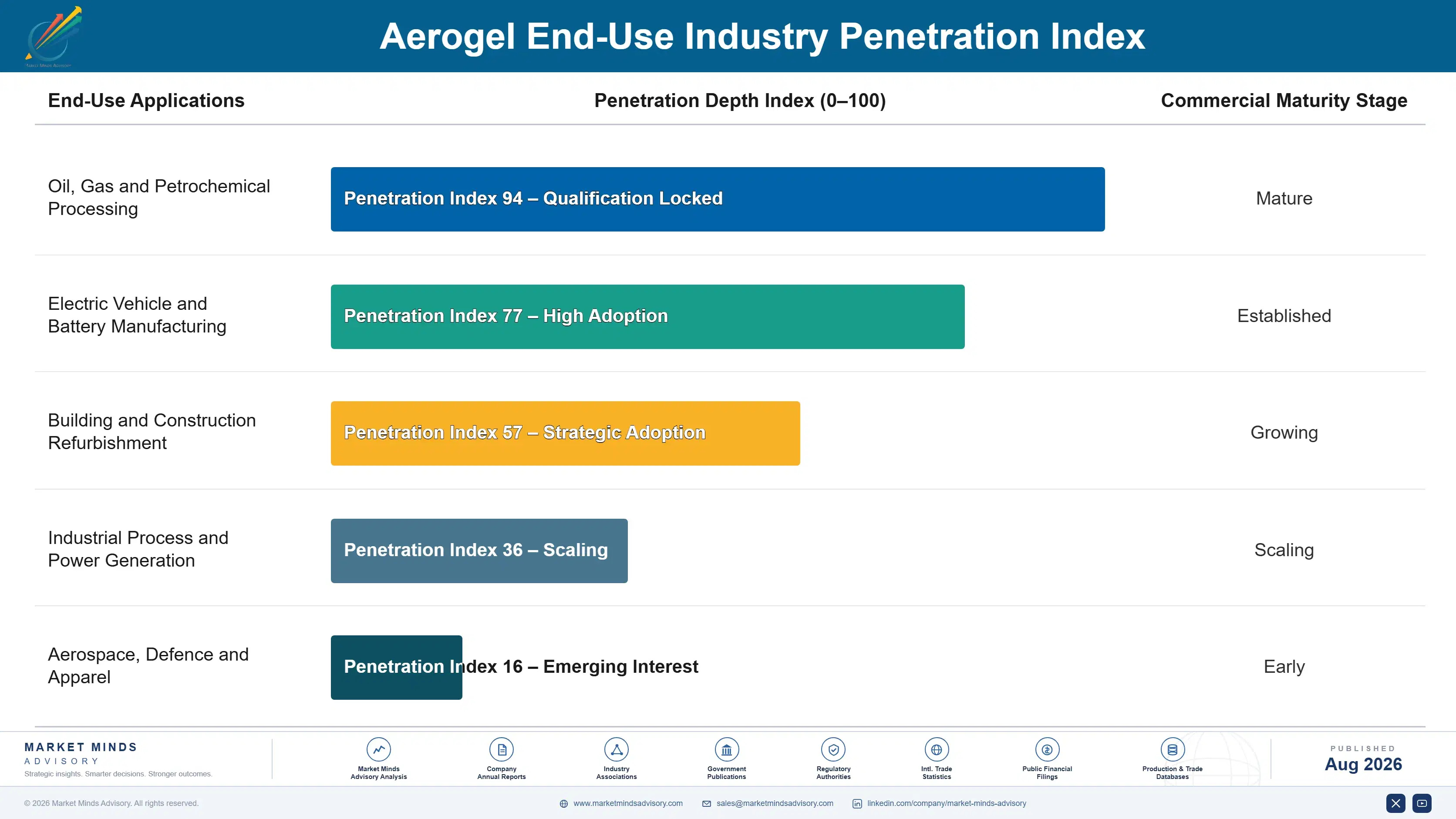
How Aerogel Specifications Actually Hold

Demand commits at specification or platform qualification and repeats for the life of the asset. A material written into a battery pack design or subsea specification has passed thermal, mechanical, and often fire testing, and requalifying an alternative means repeating all of it while shipping. That protects incumbents strongly. The genuine competitive moments are a new pack architecture, a refinery turnaround, and any project where a contractor writes the specification afresh.
Stickiness varies by consequence and qualification depth. Battery barriers stick hardest, since requalification touches a safety case nobody reopens casually. Cryogenic and subsea grades stick nearly as firmly through project qualification and failure consequence. Encapsulated industrial constructions stick through contractor familiarity. General industrial blanket sticks least, moving on delivered price at every tender because Chinese material meets the same thermal specification for considerably less.

Buyer profiles have moved from insulation contractors comparing material prices toward battery engineers, project engineering contractors, and safety functions holding decisive input. Battery pack designers now specify barrier material during architecture work rather than at procurement. That change rewards producers bringing qualification data, failure-condition testing, and handling engineering, and penalises those still presenting thermal conductivity figures to a contractor buying by the square metre.
aerogel-market-end-use-penetration-index-1787331956028

Our Call On Aerogel

These are among the four positions where our research anticipates prominent divergence between winners and laggards over the coming forecast period. Each is grounded in the demand model, the regulatory perimeter, and the announced capacity pipeline.
01 / BATTERY PLATFORM QUALIFICATION

The one application with no thinner substitute

Cell-to-pack architectures leave cells millimetres apart with direct propagation paths, and a barrier a few millimetres thick that survives runaway temperatures has almost no viable alternative at any price. Battery barriers grow at 24.6% against a market at 12.9% for that single reason, and manufacturer specification and safety regulation both happen to push the same way. Qualification into a cell platform takes months and rarely reopens, so producers arriving after a pack design freezes are simply quoting into somebody else's material specification.
02 / INSTALLED COST FRAMING

Material price per square metre is a losing argument

Aerogel costs five to 15 times conventional insulation per unit of thermal resistance and delivers it in a quarter to a half of the thickness, which means fewer layers, less labour, smaller cladding, and no pipework rerouting on refurbishment work. That saving is entirely invisible in a material price comparison, which is exactly the comparison contractors run. Producers who let the conversation stay at dollars per square metre have lost before they start, and thirty years of tender history says so.
03 / FAILURE CONSEQUENCE TARGETING

Sell where inefficiency becomes catastrophe instead

Cryogenic lines, subsea flow assurance, fire barriers, and battery packs share the property that failure is catastrophic rather than merely wasteful, and buyers in those particular applications are not comparing material prices at all. They accept a 15 times premium because the alternative outcome is simply unacceptable at any saving whatsoever. Identifying those applications accurately is the whole commercial skill in this category, and most producers dilute their effort across an efficiency market that is never going to pay the premium.
04 / DRYING ROUTE EXPOSURE

Supercritical capacity could become a liability

Supercritical drying explains most of the price premium that has kept aerogel out of ordinary applications for three full decades, and ambient pressure routes avoid the pressure vessel and its capital charge entirely. Whether ambient material can match supercritical properties at commercial scale is genuinely unresolved, which is precisely why the risk here is so asymmetric. An incumbent whose competitor solves it first is holding expensive capacity that has stopped being a barrier to entry and started being an outright burden instead.

Engagement Snapshot From the Field

A live engagement with an industry participant carrying material or product regulatory and market exposure ahead of a defining policy shift, showing how our research translates into a defensible multi-year portfolio strategy.
MARKET MINDS ADVISORY · CLIENT ENGAGEMENT SUMMARY
Aerogel Producer Strategic Portfolio Review and Transition Roadmap 2026·Investment Scenario on Aerogel Exposure Evaluation 2025-26
CLIENT PROFILE
An engineering contractor delivering refinery turnaround work across three countries engaged MMA after aerogel specifications it had written were being substituted on site for conventional insulation. The client reported roughly 340 insulation line items per turnaround, no record of which substitutions were justified, and installer resistance it had never formally investigated (client-reported, unverified by MMA).
STRATEGIC CHALLENGE
Substitution was happening at site level without engineering review, which meant thermal performance the client had guaranteed was not being delivered. Installers cited dust and handling difficulty while procurement cited material cost. The board needed to know whether its specifications were wrong, its supply chain was failing, or its site supervision was, before the next turnaround season.
MMA APPROACH
MMA reviewed each substitution against the clearance available at that specific location rather than accepting either the engineering specification or the site decision, which nobody had done. We interviewed installers about handling rather than relying on procurement's cost explanation. We then modelled installed cost including labour and cladding for both materials at each line item, since material price alone had driven every conversation on site.
KEY FINDINGS
  1. About 44% of substitutions occurred where clearance genuinely permitted conventional insulation, meaning the original aerogel specification had been unnecessary (client-reported, unverified by MMA).
  2. Installer resistance rather than material cost drove roughly two thirds of the remaining substitutions, and dust during cutting was cited in almost every case.
  3. Installed cost including labour and cladding favoured aerogel at 61 of the 340 line items, against material cost favouring it at almost none of them.
  4. Encapsulated aerogel constructions were available from two suppliers and had never been specified, because the client's standard drawings predated them entirely on any project.
CLIENT PROFILE
An engineering contractor delivering refinery turnaround work across three countries engaged MMA after aerogel specifications it had written were being substituted on site for conventional insulation. The client reported roughly 340 insulation line items per turnaround, no record of which substitutions were justified, and installer resistance it had never formally investigated (client-reported, unverified by MMA).
STRATEGIC CHALLENGE
Substitution was happening at site level without engineering review, which meant thermal performance the client had guaranteed was not being delivered. Installers cited dust and handling difficulty while procurement cited material cost. The board needed to know whether its specifications were wrong, its supply chain was failing, or its site supervision was, before the next turnaround season.
MMA APPROACH
MMA reviewed each substitution against the clearance available at that specific location rather than accepting either the engineering specification or the site decision, which nobody had done. We interviewed installers about handling rather than relying on procurement's cost explanation. We then modelled installed cost including labour and cladding for both materials at each line item, since material price alone had driven every conversation on site.
KEY FINDINGS
  1. About 44% of substitutions occurred where clearance genuinely permitted conventional insulation, meaning the original aerogel specification had been unnecessary (client-reported, unverified by MMA).
  2. Installer resistance rather than material cost drove roughly two thirds of the remaining substitutions, and dust during cutting was cited in almost every case.
  3. Installed cost including labour and cladding favoured aerogel at 61 of the 340 line items, against material cost favouring it at almost none of them.
  4. Encapsulated aerogel constructions were available from two suppliers and had never been specified, because the client's standard drawings predated them entirely on any project.
RECOMMENDED STRATEGY
Phase 1: Phase 1 (0 to 5 months): Rewrite specifications to call aerogel only where clearance genuinely requires it, removing the unnecessary line items. Phase 2: Phase 2 (5 to 14 months): Specify encapsulated constructions on the remaining items and fund installer training before the next turnaround begins. Phase 3: Phase 3 (14 to 24 months): Move approval authority for substitution from site to engineering, with installed cost data attached.
OUTCOME
The client cut aerogel line items by roughly 40% while eliminating unauthorised substitution on the rest, which improved delivered thermal performance and reduced total insulation cost simultaneously. Encapsulated constructions and installer training removed the dust objection almost entirely, and substitution requests fell to a handful per turnaround (client-reported, unverified by MMA).

Frequently Asked Questions

Foundational context covering the market sizes, CAGR, scope, country, region and competition that inform every finding below. This section is provided to cover basics and most often pre-purchase conversations, answered from the MMA Primary Research Dataset.

What is the current size of the Aerogel Market?

The global aerogel market is valued at USD 1.3 billion in 2025, covering silica blankets and panels, battery thermal barriers, particles and granules, polymer aerogels, and carbon aerogels. Conventional insulation and silica gel desiccants are excluded.

How large will the Aerogel Market be by 2036?

The market is forecast to reach USD 4.98 billion by 2036 in the base case, about 3.39 times the 2026 level. That represents incremental value of roughly USD 3.51 billion across the decade.

What is the CAGR for the Aerogel Market 2026 to 2036?

The market grows at a 12.9% CAGR in the base case, with bull and bear scenarios at 14.2% and 11.5%. The spread turns mainly on battery barrier adoption and whether ambient drying cuts production cost.

Which segment is growing fastest?

Battery thermal barrier materials grow fastest at 24.6%, about 1.91 times the overall rate, because cell-to-pack designs leave no room for thicker barriers. Silica blankets and panels follow at 11.4%.

Who are the major companies in the Aerogel Market?

Leading producers include Aspen Aerogels, Cabot Corporation, Armacell, Guangdong Alison Hi-Tech, and Nano Tech Company. Concentration is severe, with the top five holding roughly 63% of aerogel revenue.

Which country is growing fastest?

China grows fastest at an 18.4% CAGR, on battery cell production and domestic aerogel capacity expansion. India and Indonesia follow on refinery and petrochemical insulation demand.

Report Segmentation Architecture

The full report scope spans multiple orthogonal segmentation dimensions, with cross-tabulated demand data provided for each dimension pair. Coverage extends further to regional breakdowns, trend trajectories, and the competitive detail needed to support segment-level decision-making.

By Product Form And Chemistry

  • Silica Aerogel Blankets and Panels
  • Battery Thermal Barrier Materials
  • Aerogel Particles and Granules
  • Polymer and Organic Aerogels
  • Carbon and Specialty Aerogels

By End-Use Industry

  • Oil, Gas and Petrochemical Processing
  • Electric Vehicle and Battery Manufacturing
  • Building and Construction Refurbishment
  • Industrial Process and Power Generation
  • Aerospace, Defence and Apparel

By Sales Channel

  • Direct Contract To End User
  • Engineering Contractor and Project Supply
  • Distributor and Fabricator Network
  • Original Equipment Platform Supply

By Region

  • North America
  • Western Europe
  • East Asia
  • South Asia and Pacific
  • Latin America
  • Middle East and Africa
  • Eastern Europe

Scope, Methodology, and Coverage

Every figure in this report is reproducible from documented input assumptions. The scope below maps the historical period, the forecast horizon, the segmentation dimensions, and the countries covered, alongside the underlying primary and qualitative methodology.
Historical Period
2020 to 2025
Forecast Period
2026 to 2036
Base Year
2025 (USD billions; MMA Primary Research Dataset, August 2026)
Market Definition
The aerogel market comprises the manufacture and sale of highly porous low-density solid materials produced by removing the liquid phase from a gel while preserving its solid network, valued at producer selling prices to end users, engineering contractors, fabricators, and original equipment manufacturers. It spans silica aerogel blankets and rigid panels, battery thermal barrier materials, aerogel particles and granules for blending and glazing, polymer and organic aerogels, and carbon and specialty aerogels, together with the encapsulation, reinforcement, and facing systems supplied with them. Conventional insulation including mineral wool, glass wool, polyurethane and polystyrene foam, microporous boards and vacuum insulated panels, silica gel desiccants, precipitated and fumed silica sold as fillers or thickeners, insulated building envelope and cladding systems sold as complete assemblies, refrigeration and cryogenic equipment, and insulation installation, lagging and removal services are excluded.
Quantitative Units
USD billions (current prices); volume in thousand tonnes and million square metres of blanket
Segmentation Dimensions
By Product Form And Chemistry; By End-Use Industry; By Sales Channel; By Region
Regions Covered
North America, Western Europe, East Asia, South Asia and Pacific, Latin America, Middle East and Africa, Eastern Europe
Countries Covered
USA, China, Germany, Japan, South Korea, India, UK, France, Netherlands, Italy, Spain, Sweden, Norway, Poland, Czech Republic, Romania, Brazil, Mexico, Chile, Argentina, UAE, Saudi Arabia, Qatar, South Africa, Egypt, Australia, Indonesia, Malaysia, Thailand, Canada, and additional markets relevant to this sector
Key Companies Profiled
Aspen Aerogels, Cabot Corporation, Armacell, Guangdong Alison Hi-Tech, Nano Tech Company, Aerogel Technologies, Active Aerogels, Enersens, JIOS Aerogel, Svenska Aerogel, Taasi Corporation, Aerogel UK, Zhejiang Xinjing Aerogel, Shenzhen Aerogel Technology, IBIH Advanced Materials, BASF, Dow, Johns Manville, Rockwool, Morgan Advanced Materials
Quantitative Methodology
Primary survey, n=3,800 respondents, Q4 2025, six countries; demand-side model with trade association cross-validation
Qualitative Methodology
47 expert interviews, Q4 2025; applied to validate demand model assumptions, identify emerging dynamics, and assess competitive positioning
Report Format
PDF and XLSX data workbook (Word format preview document)
Publisher
Market Minds Advisory
Report Code
MMA-2026-CHM-365
Published
August 2026
Contact
sales@marketmindsadvisory.com | www.marketmindsadvisory.com

Purchase the full Aerogel Market Report (2026 to 2036).

The full MMA Aerogel report sizes the market across five product forms, five end-use industries, four sales channels, and seven regions through 2036. It profiles 20 producers on a consistent basis of aerogel material and product revenue, scoring each on qualified capacity, battery platform qualification, handling and encapsulation engineering, and production cost route. Scenario models quantify how battery barrier adoption, ambient drying commercialisation, and industrial capital cycles move both volume and achievable margin by form. The report also includes installed cost comparison against conventional insulation by application, battery platform qualification mapping, drying route cost decomposition, and space-constraint application sizing across industrial end uses.
Five-form and four-channel market sizing to 2036
Twenty-producer benchmark on aerogel material and product revenue
Installed cost comparison against conventional insulation by application
Battery platform qualification mapping across cell architectures
Drying route cost decomposition for supercritical and ambient processes
Space-constraint application sizing across industrial end uses

Built For The People Who Decide

From boardroom strategy to bench-side execution, this report is read cover-to-cover by leaders shaping the next decade of their industry, turning demand scenarios, market dynamics and valuation benchmarks into decisions.
CXOs/ Presidents/ VPs/ Managers
M&A and Corporate Development
Strategy Teams and R&D Heads
Procurement and Product Directors
Regulatory and Compliance Leaders
Investor Relations and Equity Analysts