
Market Minds Advisory
Advanced Lead Acid Battery Market

Advanced Lead Acid Battery Market: Start-Stop Mandates Meet Next-Gen Chemistry

Start-stop vehicle mandates are pulling automotive lead-acid batteries upmarket from flooded chemistry toward enhanced flooded and absorbent glass mat designs, while lead-carbon and bipolar architectures threaten to make even those premium formats obsolete.

Lead Analyst

David Horsley

Published

September 2026

Make Smarter Decisions with Customized Research Insights

Request a free sample report and evaluate market opportunities, growth trends, and competitive dynamics relevant to your business needs.

2025 MARKET VALUE$9.8BMarket Size 2025
2036 FORECAST VALUE$20.2BBase Case , 2026 to 2036
CAGR 2026 TO 20366.8 %Bull 8.0% / Bear 5.6%
INCREMENTAL OPPORTUNITY$9.7BNet 10- year value creation
EXPANSION MULTIPLE1.93x2036 value over 2026 base
Strategic Levers
M&A Pipeline
Regional Outlook
Country Rankings
Competitive Intelligence
Segmental Deep-dive
Call-Us : 91 93563 13602

Executive Snapshot and Market Trajectory

Advanced lead-acid batteries exist because start-stop engine systems destroy conventional flooded batteries within months, forcing automakers toward enhanced flooded and absorbent glass mat chemistry that can survive thousands of extra charge cycles. That single engineering requirement has turned a century-old battery chemistry into a genuine growth category.
East Asia leads global production and consumption, anchored by China's automotive manufacturing base and domestic battery giants like Camel Group and Chaowei Power Holdings supplying both start-stop and stationary applications. North America and Western Europe follow, driven by strict fuel-economy regulation that mandates start-stop technology across most new vehicle platforms sold in both regions. Bipolar lead-acid architecture is growing fastest as a next-generation technology promising higher power density and longer service life than AGM designs.
Competition is concentrated, with the top five suppliers holding under forty percent of global capacity across both automotive and industrial applications. Clarios dominates the automotive original equipment channel, while Chinese manufacturers like Camel Group and Chaowei Power Holdings compete on price for aftermarket and export volume. Lead-carbon and bipolar architectures are the next technology battleground, since whichever chemistry wins will define premium pricing across the category long-term.
Market Definition
The advanced lead-acid battery market covers enhanced flooded, absorbent glass mat, valve-regulated, and next-generation lead-carbon and bipolar battery technologies designed for start-stop automotive, stationary backup power, and deep-cycle renewable energy storage applications. It excludes conventional flooded lead-acid batteries without enhanced cycling capability, and excludes lithium-ion and other non-lead battery chemistries.
Base Year Value
$9.8B in 2025 (MMA Primary Research Dataset, August 2026)
Forecast Period
2026 to 2036, eleven discrete annual values
CAGR
6.8% base case. Bull 8.0%. Bear 5.6%.
Fastest Growth Segment
Bipolar Lead-Acid Batteries: 11.8% CAGR
Fastest Growth Country
China: 8.9% CAGR
Fastest Growth Region
South Asia and Pacific: 8.8% CAGR
Largest Region
East Asia: 30% of 2025 global value
Market Leaders
Clarios, EnerSys, Exide Technologies, GS Yuasa, and Camel Group lead global supply. Source: MMA Analysis based on company annual reports.
Primary Survey
n=3,800 procurement and R&D decision-makers, Q4 2025, six countries
Methodology
Demand-side build-up, cross-validated against public data, 47 expert interviews

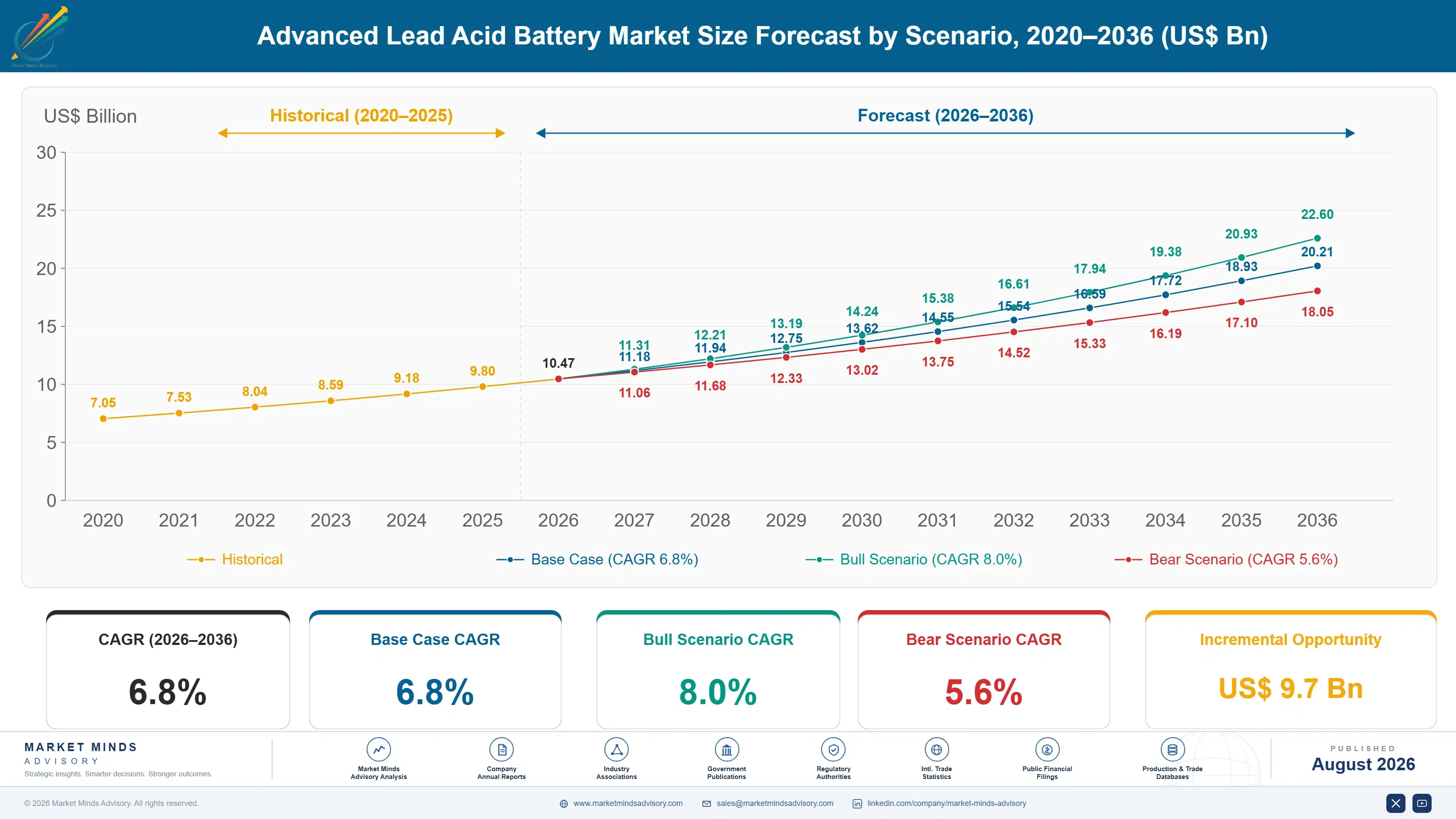
Advanced Lead Acid Battery Market Forecast Scenarios

advanced-lead-acid-battery-market-trends-size-forecast-scenario-1787464112379
Between 2020 and 2025, advanced lead-acid battery demand grew at an estimated 6.0% annually as start-stop vehicle mandates expanded across additional automotive markets and stationary backup power demand grew alongside expanding data center and telecom infrastructure. Clarios and Camel Group both expanded absorbent glass mat production capacity through the period to meet growing original equipment automotive demand.
MMA's base case projects 6.8% annual growth to 2036 on three mechanisms: expansion of start-stop vehicle mandates across emerging automotive markets that have not yet fully transitioned from conventional flooded batteries, growing stationary backup power demand tied to data center and telecom infrastructure expansion, and adoption of lead-carbon and bipolar architectures offering meaningfully improved cycle life and charge acceptance over conventional designs. Renewable energy storage integrators are adding a fourth, smaller growth channel through deep-cycle advanced lead-acid applications.
A bull catalyst comes from additional major automotive markets mandating start-stop technology across their full vehicle fleets, which could pull tens of millions of vehicles into the advanced battery replacement cycle within a few years. The bear risk is technology substitution: if lithium-ion costs continue falling faster than expected, automakers could bypass advanced lead-acid entirely in favor of lithium-based start-stop and micro-hybrid systems.

Start-Stop Mandates Meet Next-Generation Chemistry Race

Advanced lead-acid batteries solve a specific engineering problem conventional flooded batteries cannot: surviving the constant partial-state-of-charge cycling that start-stop engine systems impose every time a vehicle idles at a traffic light. That single requirement separates this category from ordinary automotive batteries, which fail quickly under start-stop duty cycles. Manufacturers that master enhanced cycling technology capture multi-year original equipment contracts competitors cannot easily win. That distinction increasingly separates manufacturers that win multi-year contracts from those that do not.
MARKET CONCENTRATION38%Top five suppliers hold under forty percent of total
AVERAGE SELLING PRICE$142/unitBipolar and lead-carbon designs command the steepest price premium
TOP PRODUCING COUNTRYChinaLargest automotive production base drives overall battery consumption volume
CAPACITY UTILIZATION79%Production lines run near capacity meeting automotive OEM demand
FEEDSTOCK COST SHARE44% of COGSRefined lead and sulfuric acid dominate total input costs
TRADE INTENSITY33% exportedAbout a third of finished battery volume crosses borders
Commercially, the category behaves like a specialty industrial manufacturing business layered onto commodity lead and sulfuric acid input costs. Lead pricing tracks global commodity metal markets directly, while finished battery pricing increasingly tracks cycling technology, charge acceptance rate, and service life rather than raw lead content alone. Manufacturers that invest in lead-carbon and bipolar technology are capturing multiples of conventional AGM pricing.
Over the next decade, expect next-generation lead-carbon and bipolar architectures to matter more than incremental improvements to existing AGM designs, particularly as stationary storage and deep-cycle applications demand ever-longer service life. Manufacturers investing in these next-generation chemistries are positioned to capture premium replacement and original equipment demand that conventional AGM producers increasingly cannot access even when their underlying pricing looks competitive on paper.
"Everyone still calls this a mature battery chemistry, but the lead-carbon and bipolar designs coming out now perform closer to lithium than to the flooded batteries this industry built its reputation on."
Director, Energy Storage and Battery Technology Practice · MMA Energy Storage and Battery Technology Practice · August 2026

Market Trends

Automakers Standardize Start-Stop Across More Platforms

Automakers are standardizing start-stop engine technology across additional vehicle platforms and price segments, extending a feature once reserved for premium vehicles into mainstream and entry-level models across most major automotive markets. Clarios and GS Yuasa have both expanded enhanced flooded and absorbent glass mat production capacity over the past two years specifically to supply this platform expansion. At least a handful of major automakers have extended start-stop standardization to entry-level vehicle segments since 2023, and original equipment suppliers report advanced battery specification requirements now apply to a meaningfully larger share of total vehicle production than just a few years ago.
Market Impact: Credits 5%+ efficiency gains
Lead-Carbon Technology Closes the Cycle Life Gap

Lead-carbon battery technology, which incorporates carbon additives into the negative electrode to improve charge acceptance and cycle life, is closing the performance gap between advanced lead-acid and lithium-ion chemistry in stationary and deep-cycle applications. EnerSys and several specialty manufacturers have expanded lead-carbon production capacity specifically to serve renewable energy storage and telecom backup applications previously trending toward lithium alternatives. At least a dozen new lead-carbon deployment projects have been announced across renewable storage and telecom infrastructure applications since 2024, and industry contacts report lead-carbon systems now compete credibly with lithium on total lifecycle cost for several stationary use cases.
Market Impact: Adds demand across 5+ years

Market Opportunities and Growth Drivers

Fuel Economy Regulation Sustains Start-Stop Expansion

Fuel economy and emissions regulation across major automotive markets continues favoring start-stop engine technology as a low-cost fuel efficiency improvement that automakers can deploy across existing internal combustion engine platforms without major powertrain redesign. Regulatory fuel economy targets in several major markets have specifically credited start-stop technology adoption as a meaningful contributor to fleet-wide efficiency improvement over the past several years. Automotive suppliers report regulatory pressure remains a stronger near-term driver of advanced battery specification than consumer demand for the feature itself.
Market Impact: Risks losing 15%+ share by 2030

Data Center Growth Drives Stationary Backup Demand

Rapid data center construction growth, driven by expanding cloud computing and artificial intelligence infrastructure investment, is driving substantial stationary backup power battery demand across telecom and data center facility operators globally. EnerSys and C&D Technologies have both reported meaningful order growth tied specifically to data center uninterruptible power supply battery replacement and new facility deployment over the past several years. Industry analysts report data center construction pipeline growth provides a stable, multi-year demand visibility window for stationary advanced lead-acid battery suppliers regardless of automotive market cyclicality. This demand visibility is attracting continued manufacturer capacity investment industry-wide.
Market Impact: Compresses margins 10%+ during lead spikes

Market Restraints and Challenges

Lithium-Ion Cost Declines Threaten Long-Term Substitution

Continued lithium-ion battery cost declines threaten long-term substitution risk for advanced lead-acid batteries, and the root cause is that lithium-ion cell manufacturing costs have fallen faster than lead-acid manufacturers anticipated when advanced lead-acid technology roadmaps were developed. Several automakers have begun evaluating lithium-based micro-hybrid systems as a potential replacement for advanced lead-acid start-stop batteries in premium vehicle segments. This risk is most acute in premium and stationary applications where lifecycle cost increasingly favors lithium despite lead-acid's lower upfront price. Lead-acid manufacturers are mitigating this by accelerating lead-carbon and bipolar development to close the performance gap before substitution accelerates further.
Market Impact: Adds 5+ major automaker platform expansions

Lead Price Volatility Compresses Manufacturer Margins

Lead commodity price volatility, tied to global mining supply and recycling market dynamics, creates persistent margin pressure for advanced lead-acid battery manufacturers, and the root cause is that lead accounts for such a large share of production cost that manufacturers cannot easily absorb sustained price spikes without passing costs through to customers. A significant lead price increase can compress manufacturer margins meaningfully within a single quarter before contract repricing catches up to the new cost baseline. This volatility affects manufacturers without long-term lead supply contracts or integrated recycling operations that provide a partial hedge. Larger manufacturers are mitigating this by expanding integrated recycling operations that provide a captive, lower-volatility lead supply source.
Market Impact: Adds 12+ new lead-carbon deployment projects
3 additional market trends, 3 additional growth drivers, and 3 additional restraints and challenges are covered in the full report. Contact sales@marketmindsadvisory.com to access the complete intelligence.

Segment CAGR and Growth Architecture

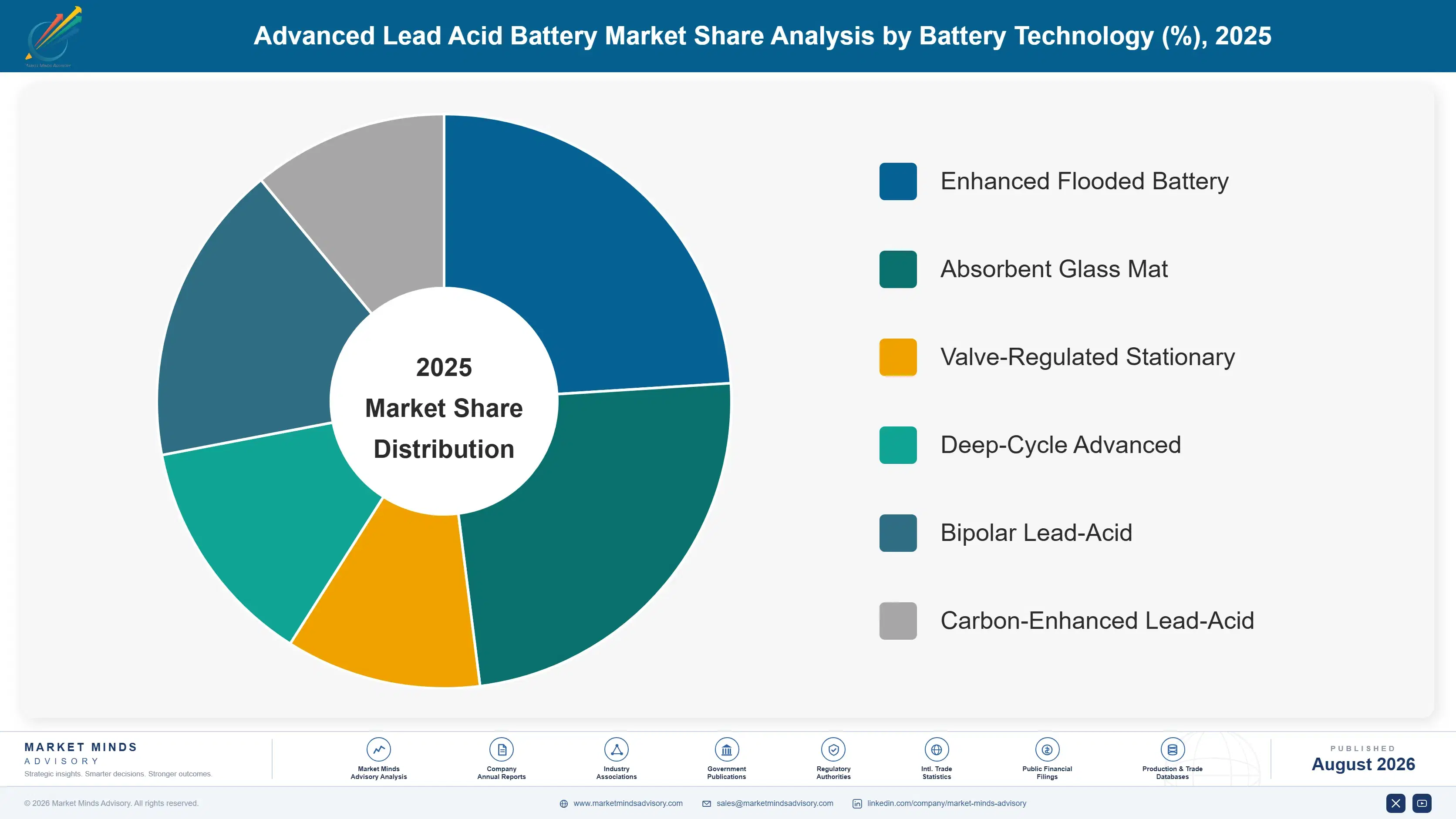
Advanced lead-acid batteries are segmented by battery technology, the classification that determines cycling performance, cost structure, and target application: enhanced flooded, absorbent glass mat, valve-regulated stationary, deep-cycle advanced, bipolar, and carbon-enhanced designs each serve distinct automotive, stationary, or renewable storage buyers, avoiding the overlap an end-use-based split would create, a distinction rarely revisited once qualified.
advanced-lead-acid-battery-market-trends-market-share-analysis-1787464112995

Bipolar Lead-Acid Batteries

Bipolar lead-acid batteries, which stack electrode plates in a fundamentally different architecture than conventional monoblock designs, are the fastest-growing segment as the technology promises meaningfully higher power density and longer service life than conventional absorbent glass mat batteries. This architecture remains in relatively early commercial deployment, with only a small number of manufacturers having successfully scaled production beyond pilot facilities. Manufacturers that have commercialized bipolar technology are capturing premium pricing from customers in demanding stationary and high-power automotive applications seeking performance closer to lithium-ion than conventional lead-acid can typically deliver. Production costs remain meaningfully above conventional AGM technology, but premium pricing for demonstrated performance improvement more than compensates manufacturers with genuine bipolar manufacturing capability.
CAGR 11.8%

Carbon-Enhanced Lead-Acid Batteries

Carbon-enhanced lead-acid batteries, incorporating carbon additives into the negative electrode to improve charge acceptance and cycle life, are scaling quickly as renewable energy storage and telecom backup applications seek improved performance without fully transitioning to lithium-ion chemistry. EnerSys and several specialty manufacturers have expanded carbon-enhanced production capacity specifically to serve this segment, benefiting from adjacent stationary battery manufacturing infrastructure already in place. Renewable energy integrators increasingly specify carbon-enhanced technology by name in procurement contracts rather than accepting conventional lead-acid, reflecting growing recognition of the meaningful cycle life improvement the technology delivers. Pricing commands a meaningful premium over conventional stationary lead-acid, though the gap remains smaller than for bipolar or lithium-ion alternatives.
CAGR 10.2%
Full segment breakdown across 6 segments available in the complete report.

Regional Architecture and Country Demand Map

East Asia leads global advanced lead-acid battery demand, anchored by China's automotive manufacturing base and domestic battery giants, while North America and Western Europe follow closely on the strength of strict fuel-economy regulation mandating start-stop technology across most new vehicle platforms across both mature and emerging automotive markets.

East Asia

China's massive automotive manufacturing base makes it the world's largest single consumer of advanced lead-acid batteries, supplied domestically by battery giants including Camel Group, Chaowei Power Holdings, and Tianneng Power that increasingly compete with multinational suppliers on both cost and quality. Japan and South Korea maintain more mature, higher-specification battery markets, with GS Yuasa and Sebang Global Battery supplying premium original equipment automotive customers. Domestic Chinese manufacturers are scaling lead-carbon and bipolar technology investment specifically to compete with Western technology leaders rather than remaining confined to commodity AGM production. Regional growth outpaces most other regions because automotive production and start-stop mandate adoption continue expanding across China's domestic and export-oriented manufacturing base.
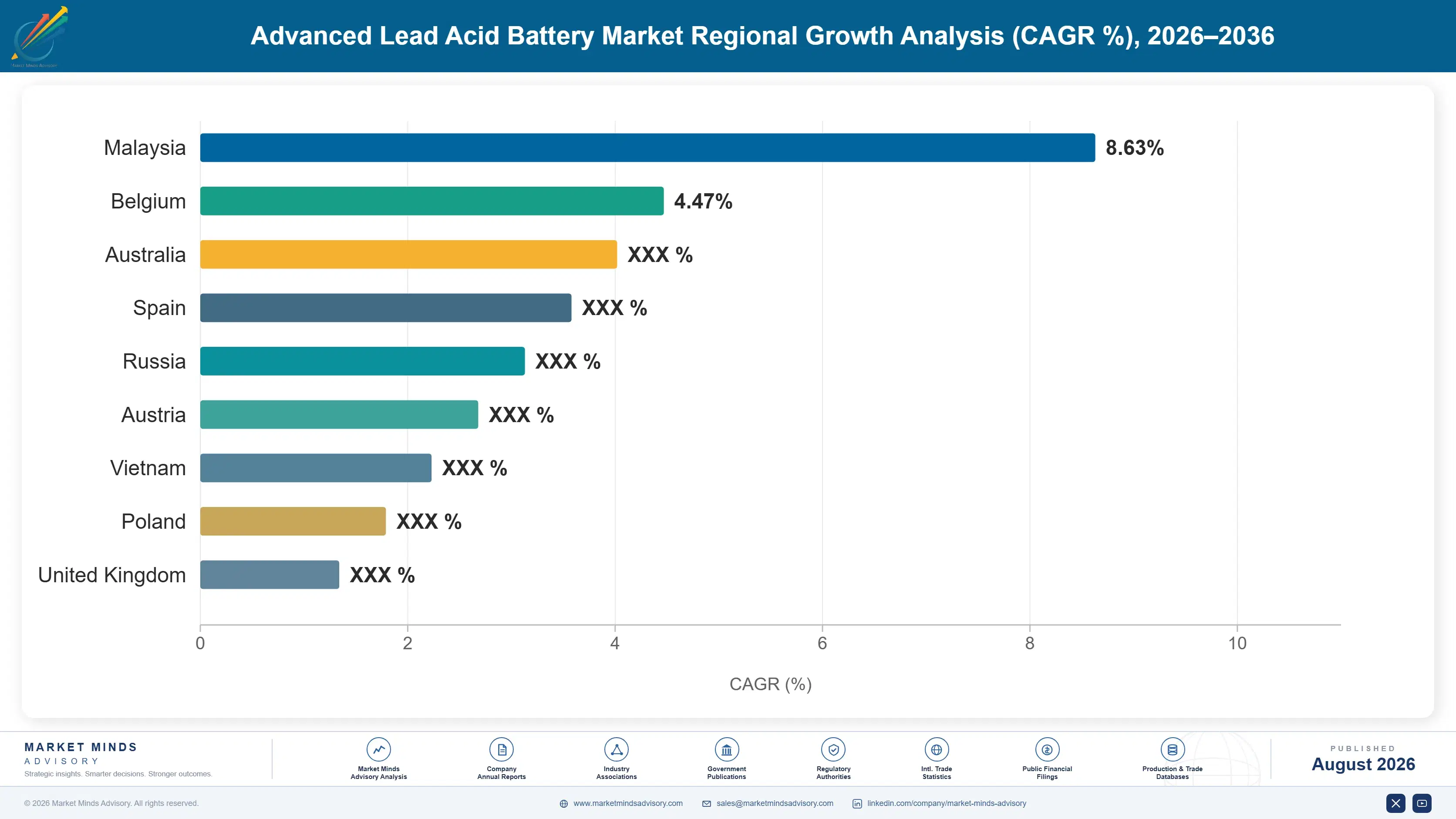
Share: 30% | CAGR: 7.8% (2026 to 2036)

North America

The United States drives most of the region's demand through strict fuel-economy regulation that has pushed start-stop technology into a large majority of new vehicle production across most price segments. Clarios maintains extensive domestic manufacturing and distribution networks supplying original equipment automotive customers and the aftermarket replacement battery channel simultaneously. Canadian automotive manufacturing, tightly integrated with US supply chains, follows similar advanced battery specification requirements. Data center and telecom stationary backup power demand is particularly strong here, given the region's concentration of major cloud computing and artificial intelligence infrastructure investment.
Share: 25% | CAGR: 6.6% (2026 to 2036)
Regional intelligence for 5 additional markets available in the complete report: Western Europe, South Asia and Pacific, Latin America, Middle East and Africa, Eastern Europe. Contact sales@marketmindsadvisory.com.
advanced-lead-acid-battery-market-trends-country-cagr-analysis-1787464113527

Where Battery Manufacturers Can Capture Margin

Margin capture in advanced lead-acid batteries increasingly depends on next-generation chemistry investment rather than raw commodity manufacturing volume. Manufacturers that can deliver lead-carbon and bipolar performance, secure integrated recycling operations, and provide stationary backup power reliability documentation are commanding meaningfully better pricing than those competing purely on cost per unit of conventional AGM production.

Lead-Carbon Battery Technology for Stationary Uses

Manufacturers that develop lead-carbon battery technology for stationary and renewable storage applications are capturing premium pricing from customers seeking improved cycle life without fully transitioning to lithium-ion chemistry. EnerSys' lead-carbon product line, expanded in 2024, reportedly commands a 30 to 45 percent price premium over conventional stationary lead-acid batteries of comparable capacity. Manufacturers without dedicated lead-carbon research capability are increasingly partnering with technology licensors to offer comparable products, adding cost but preserving access to renewable storage and telecom backup contracts that now specify improved cycling performance. This positioning increasingly determines large enterprise account wins beyond simple compliance certification.
Market Impact: Commands a 30 to 45 percent price premium

Bipolar Architecture Development for High-Power Uses

Manufacturers that develop bipolar battery architecture are capturing premium pricing from customers in demanding high-power stationary and automotive applications seeking performance closer to lithium-ion than conventional lead-acid can deliver. Early commercial bipolar deployments reportedly command a 50 to 70 percent price premium over conventional AGM batteries of comparable capacity, reflecting both performance improvement and current production scale limitations. Building this capability requires sustained research and manufacturing investment over multiple years, a barrier that has kept this higher-margin segment concentrated among a small number of established manufacturers
Market Impact: Commands a 50 to 70 percent price premium

Integrated Recycling Operations for Cost Hedging

Manufacturers that operate integrated battery recycling capacity capture a captive, lower-volatility lead supply source that insulates production costs from the commodity lead price spikes that squeeze manufacturers relying entirely on open-market lead purchases. Integrated recycling reportedly reduces effective lead input costs by 10 to 15 percent compared with fully open-market sourcing during periods of elevated commodity price volatility. This capability requires significant capital investment in recycling infrastructure, a barrier that has kept integrated recycling concentrated among larger, better-capitalized manufacturers with sufficient scale to justify the investment. Manufacturers increasingly prioritize this hedge over spot-market flexibility when evaluating capital investment.
Market Impact: Cuts effective lead costs by 10 to 15 percent

Bundled Stationary Reliability Monitoring Package

Bundling reliability documentation, remote monitoring, and predictive maintenance support alongside the physical stationary battery sale helps data center and telecom customers that require verified uptime guarantees for critical backup power infrastructure. Manufacturers offering this bundled service report shortened customer procurement evaluation timelines by several weeks on average, since customers avoid commissioning duplicate reliability testing the manufacturer has already conducted. This service layer also raises effective per-unit pricing by an estimated 8 to 12 percent, since customers otherwise face independent reliability verification costs running into meaningful sums if commissioned separately across most regional accounts.
Market Impact: Raises effective pricing by 8 to 12 percent

Who Controls the Margin Pool

Five suppliers hold under forty percent of global advanced lead-acid battery capacity on a production-volume basis, reflecting a market that spans both branded automotive original equipment suppliers and numerous regional manufacturers competing on price. The gap between technology-focused global leaders and regional commodity manufacturers is wide on price and next-generation chemistry sophistication, even though both compete under the same broad advanced lead-acid category label.
Current competitive activity centers on three fronts: lead-carbon and bipolar technology development to defend against lithium-ion substitution, integrated recycling investment to hedge lead commodity cost volatility, and stationary reliability documentation to win data center and telecom accounts. Clarios and EnerSys have both announced technology development investment in the past two years specifically targeting these higher-margin, technically differentiated segments.

Emerging pressure is coming from Chinese domestic manufacturers improving both cost efficiency and next-generation technology quality, threatening the technology advantage established multinational suppliers have historically held in premium automotive and stationary accounts. Rankings could shift meaningfully over the next several years if Chinese manufacturers close the lead-carbon and bipolar technology gap that currently keeps Western suppliers dominant in premium enterprise and automotive original equipment accounts.
advanced-lead-acid-battery-market-trends-company-positioning-matrix-1787464114046

Competitive Moat and Risk Dimensions

CLARIOS

Moat: Dominant Automotive OEM Relationships

Clarios maintains deep, long-standing original equipment supply relationships with major global automakers, built over decades as the automotive battery business spun out of Johnson Controls. That entrenched customer relationship base gives Clarios qualification and contract renewal advantages that newer entrants attempting to win original equipment business from scratch cannot easily replicate.
CLARIOS

Risk: Exposure to Automotive Cyclicality

Clarios' heavy concentration in automotive original equipment supply exposes the company to automotive production cyclicality more directly than diversified competitors with stronger stationary and industrial battery business segments. A sustained automotive production slowdown could compress Clarios' volume and margins more than competitors with more balanced end-market exposure.
ENERSYS

Moat: Diversified Stationary Battery Portfolio

EnerSys maintains a diversified battery portfolio spanning stationary telecom backup, data center, and industrial motive power applications, reducing its dependence on any single end market compared with automotive-focused competitors. That diversification gives EnerSys more stable revenue visibility across different economic cycles than automotive-concentrated competitors face.
ENERSYS

Risk: Limited Automotive OEM Scale

EnerSys maintains meaningfully smaller automotive original equipment battery business than Clarios or GS Yuasa, limiting its exposure to the largest single end-use category within the broader advanced lead-acid market. As automotive demand continues representing the majority of category volume, EnerSys' stationary-focused positioning could limit its addressable market growth relative to automotive-focused competitors.

Players Tracked

Prominent Players

Clarios
EnerSys
Exide Technologies
GS Yuasa
Camel Group

Other Key Players

Chaowei Power Holdings
Tianneng Power
East Penn Manufacturing
Leoch International
Amara Raja Batteries
C&D Technologies
HBL Power Systems
Hoppecke Batteries
Banner Batteries
FIAMM Energy Technology
Exide Industries
Panasonic
Sebang Global Battery
Shin-Kobe Electric Machinery
Crown Battery Manufacturing

Recent Developments

APRIL 2024

EnerSys Expands Lead-Carbon Production Capacity

EnerSys expanded its lead-carbon battery production capacity in April 2024, targeting growing renewable energy storage and telecom backup power demand seeking improved cycle life performance without fully transitioning to lithium-ion chemistry, responding directly to customer requests for a credible intermediate technology option across all regions.
Signal: Signals stationary battery manufacturers are investing in performance parity with lithium rather than ceding the category entirely.
OCTOBER 2023

Clarios Announces Bipolar Battery Pilot Program

Clarios announced a bipolar battery pilot production program in October 2023, targeting high-power stationary and automotive applications seeking performance closer to lithium-ion than conventional absorbent glass mat technology can typically deliver, marking a significant technology investment beyond incremental AGM improvement industry-wide.
Signal: Signals established automotive battery leaders are investing in genuinely next-generation architecture rather than incremental improvement over time.
FEBRUARY 2025

Camel Group Expands Domestic AGM Manufacturing Capacity

Camel Group expanded its domestic absorbent glass mat manufacturing capacity in February 2025, targeting growing Chinese automotive original equipment demand as domestic automakers increasingly standardize start-stop technology across mainstream and entry-level vehicle platforms previously equipped with conventional flooded batteries nationwide.
Signal: Signals Chinese domestic manufacturers are scaling capacity to capture growing start-stop mandate compliance demand directly directly today.

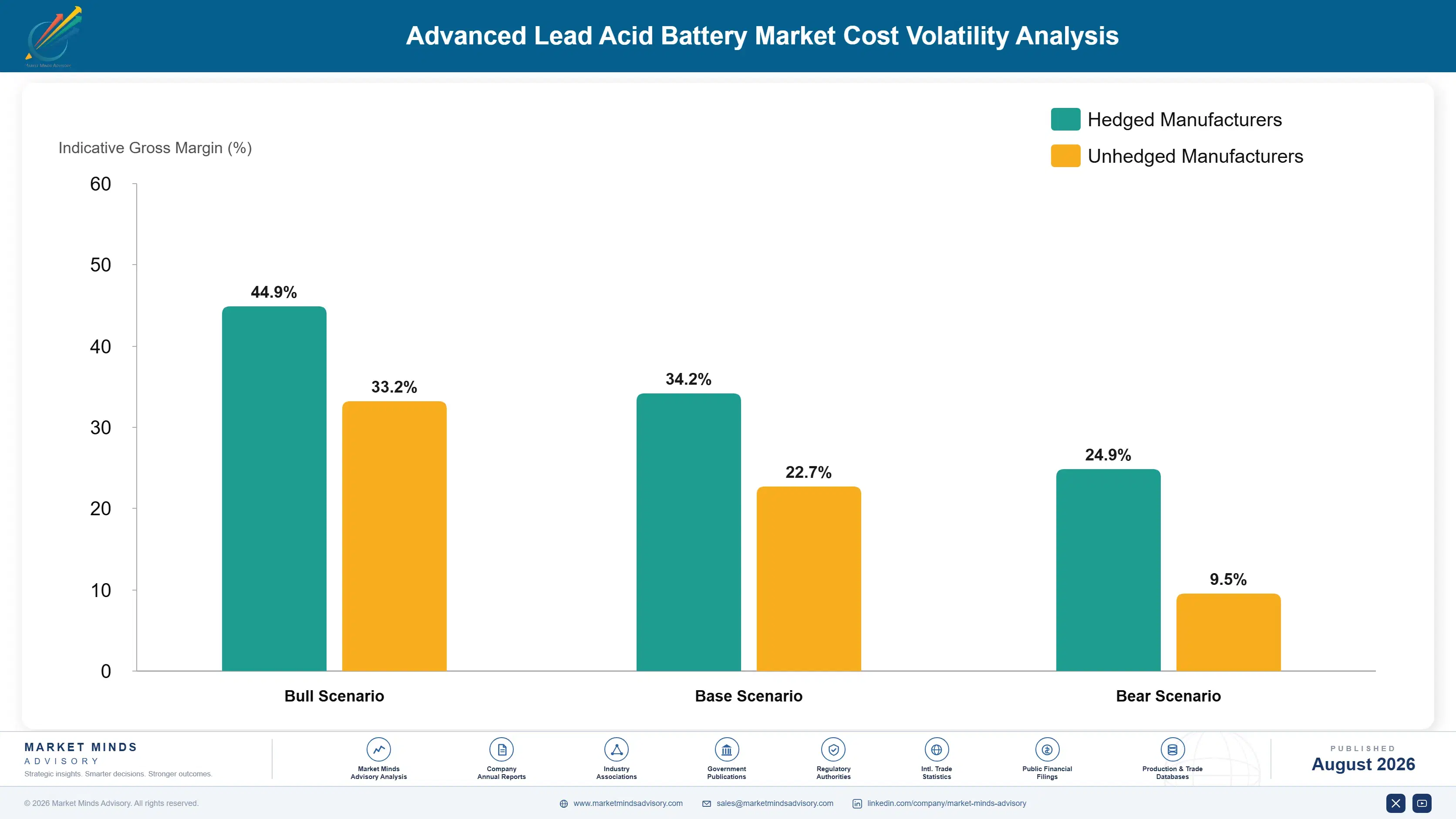
Lead Commodity and Sulfuric Acid Cost Exposure

Refined lead and sulfuric acid together account for roughly forty-four percent of total production cost across the industry, reflecting the fundamentally commodity-intensive nature of lead-acid battery manufacturing regardless of the specific advanced technology tier. Lead pricing tracks global commodity metal markets directly, while manufacturers with integrated recycling operations can partially offset open-market lead price exposure through captive secondary lead supply.
Global lead prices rose meaningfully during 2021 and 2022 following broader commodity market disruption, according to industry trade reporting and Clarios' public disclosures, increasing production costs across the advanced lead-acid battery manufacturing industry. Manufacturers without integrated recycling operations or long-term lead supply contracts faced the steepest cost increases, since open-market spot lead purchases fully exposed them to commodity price volatility during the period across the broader manufacturing base.

Smaller manufacturers relying entirely on open-market lead purchases carry meaningfully more cost exposure than larger, vertically integrated suppliers like Clarios or EnerSys that operate captive recycling operations providing a partial natural hedge against commodity volatility. Manufacturers pursuing lead-carbon and bipolar technology face an additional cost exposure profile tied to specialty carbon additive and manufacturing technology costs beyond conventional lead and acid input pricing.
advanced-lead-acid-battery-market-trends-cost-volatility-analysis-1787464114246

Expand Integrated Battery Recycling Operations

Larger manufacturers are expanding integrated battery recycling capacity to capture a captive, lower-volatility lead supply source that reduces dependence on open-market commodity purchases. This approach requires capital investment but has measurably reduced cost volatility for manufacturers that built this capability before recent lead price spikes.

Negotiate Long-Term Lead Supply Contracts

Manufacturers without integrated recycling capability are negotiating longer-term supply contracts with lead producers and secondary lead suppliers, reducing exposure to spot market price volatility. This approach requires meaningful working capital commitment but has kept production costs more stable for manufacturers that adopted it before recent commodity price increases. Manufacturers report this approach also reduces production planning uncertainty.

Diversify Toward Higher-Margin Technology Mix

Manufacturers are shifting production mix toward higher-margin lead-carbon and bipolar technology tiers, reducing sensitivity to commodity lead cost pressure that affects lower-margin conventional AGM economics most directly. This approach requires technology investment but has improved overall margin resilience for manufacturers that pursued it before recent cost increases. Manufacturers report these investments also improve long-term margin predictability.

Portfolio Architecture for Margin Defence

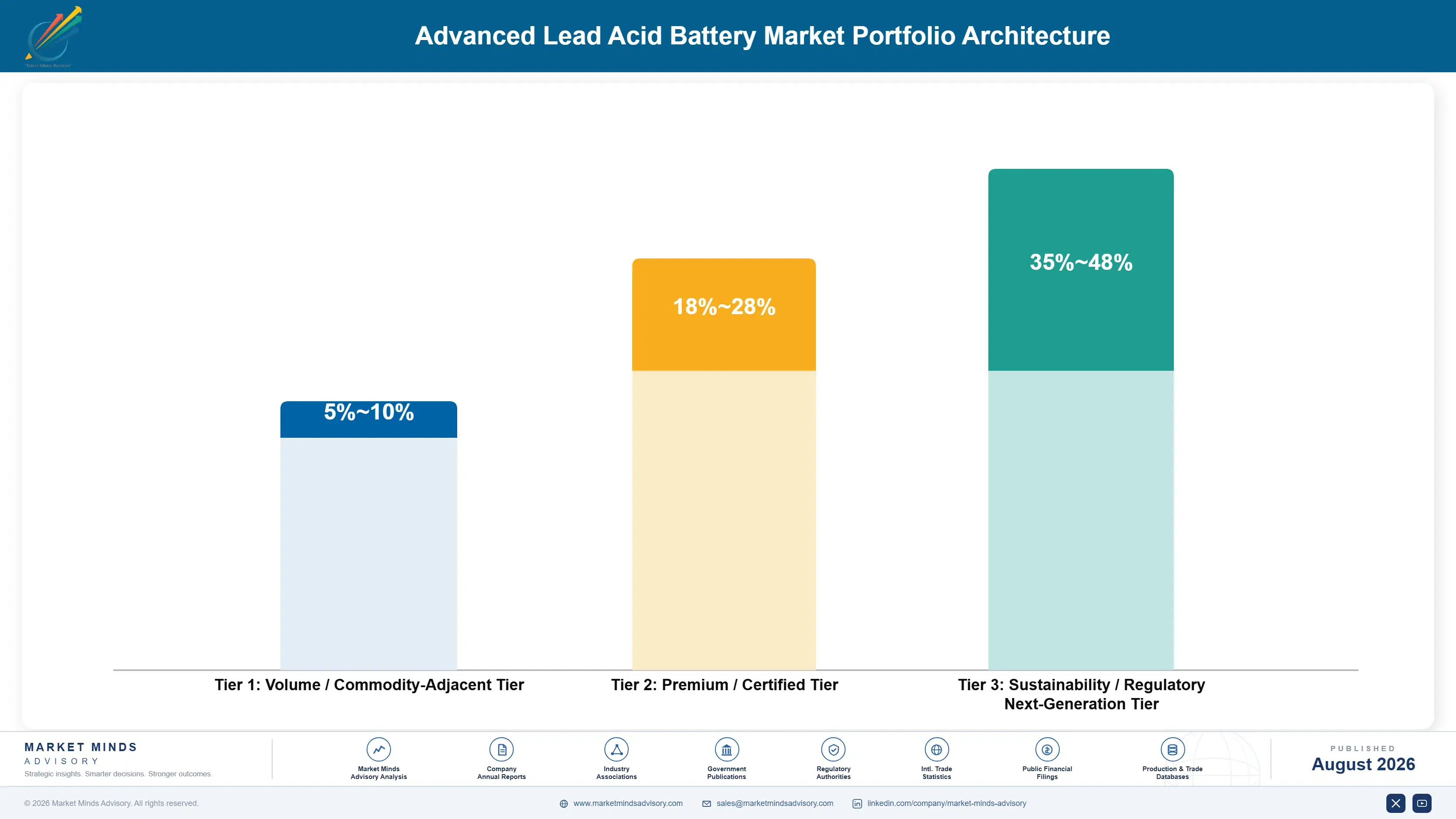
Advanced lead-acid battery manufacturers operate a three-tier portfolio spanning conventional enhanced flooded and AGM batteries sold largely on cost per unit into mainstream automotive and stationary markets, valve-regulated and deep-cycle formulations commanding premium pricing from demanding industrial and renewable storage accounts, and lead-carbon and bipolar technologies positioned for the highest-margin premium automotive and stationary accounts. Gross margins vary sharply across these tiers, from thin single digits on conventional AGM to well above forty percent on bipolar and lead-carbon technology.
The volume versus premium tension is intensifying as more manufacturers chase lead-carbon and bipolar margins, but conventional AGM and enhanced flooded batteries still represent the majority of shipped volume and remain essential for covering fixed production costs across the industry's large mainstream automotive customer base. Manufacturers that abandon conventional volume too quickly in pursuit of premium accounts risk underutilizing capacity built for automotive scale.

High-value margin pools concentrate specifically in bipolar and lead-carbon technology sold to demanding stationary and premium automotive accounts, and in integrated recycling operations that provide manufacturers a captive, lower-cost lead supply advantage. Conventional AGM and enhanced flooded batteries remain the volume anchor but carry the thinnest margins, squeezed further by Chinese manufacturers competing on cost.

Volume / Commodity-Adjacent Tier

Conventional enhanced flooded and absorbent glass mat batteries sold primarily on cost per unit into mainstream automotive original equipment and aftermarket replacement markets, where price competition among global and regional manufacturers is intense.
Gross Margin: 5-10%

Premium / Certified Tier

Valve-regulated stationary and deep-cycle advanced formulations sold into demanding industrial, telecom, and renewable storage accounts, commanding premium pricing through documented reliability and cycling performance Pricing reflects documented reliability testing investment rather than raw material cost alone.
Gross Margin: 18-28%

Sustainability / Regulatory / Next-Generation Tier

Bipolar and lead-carbon technology positioned for premium stationary and high-power automotive accounts paying the category's highest per-unit prices for performance approaching lithium-ion Capital and technology requirements keep this tier concentrated among a handful of manufacturers.
Gross Margin: 35-48%
advanced-lead-acid-battery-market-trends-portfolio-architecture-1787464114768

High-value Sub-segments and Strategic Watch-out

Bipolar High-Power Architecture

Bipolar battery architecture is capturing the highest margins in the category as demanding stationary and automotive applications seek performance closer to lithium-ion than conventional AGM can deliver, and established manufacturers are accelerating commercial-scale production investment to capture this emerging premium demand.
Gross Margin: 35-48%

Lead-Carbon Stationary Storage

Lead-carbon batteries for stationary and renewable storage applications are gaining share as customers seek improved cycle life without fully transitioning to lithium-ion, though specialized carbon additive technology remains concentrated among a smaller number of established suppliers. Adoption should broaden as more suppliers scale comparable carbon additive technology.
Gross Margin: 18-28%

Commodity AGM Automotive Supply

Standard absorbent glass mat batteries sold into mainstream automotive original equipment and aftermarket channels remain the category's volume core, anchored by established original equipment relationships but facing intense price competition from Chinese manufacturers. Most incumbents defend this tier through OEM scale rather than active technology differentiation.
Gross Margin: 5-10%

Conventional Flooded Battery Remnant Demand

Conventional flooded batteries without enhanced cycling capability face declining demand as start-stop mandates expand into additional vehicle segments, making this a segment manufacturers should actively transition away from over time. Several manufacturers on this basis have already lost OEM allocations.
Gross Margin: 2-6%

Advanced Lead-Acid's OEM Lock-In Economics

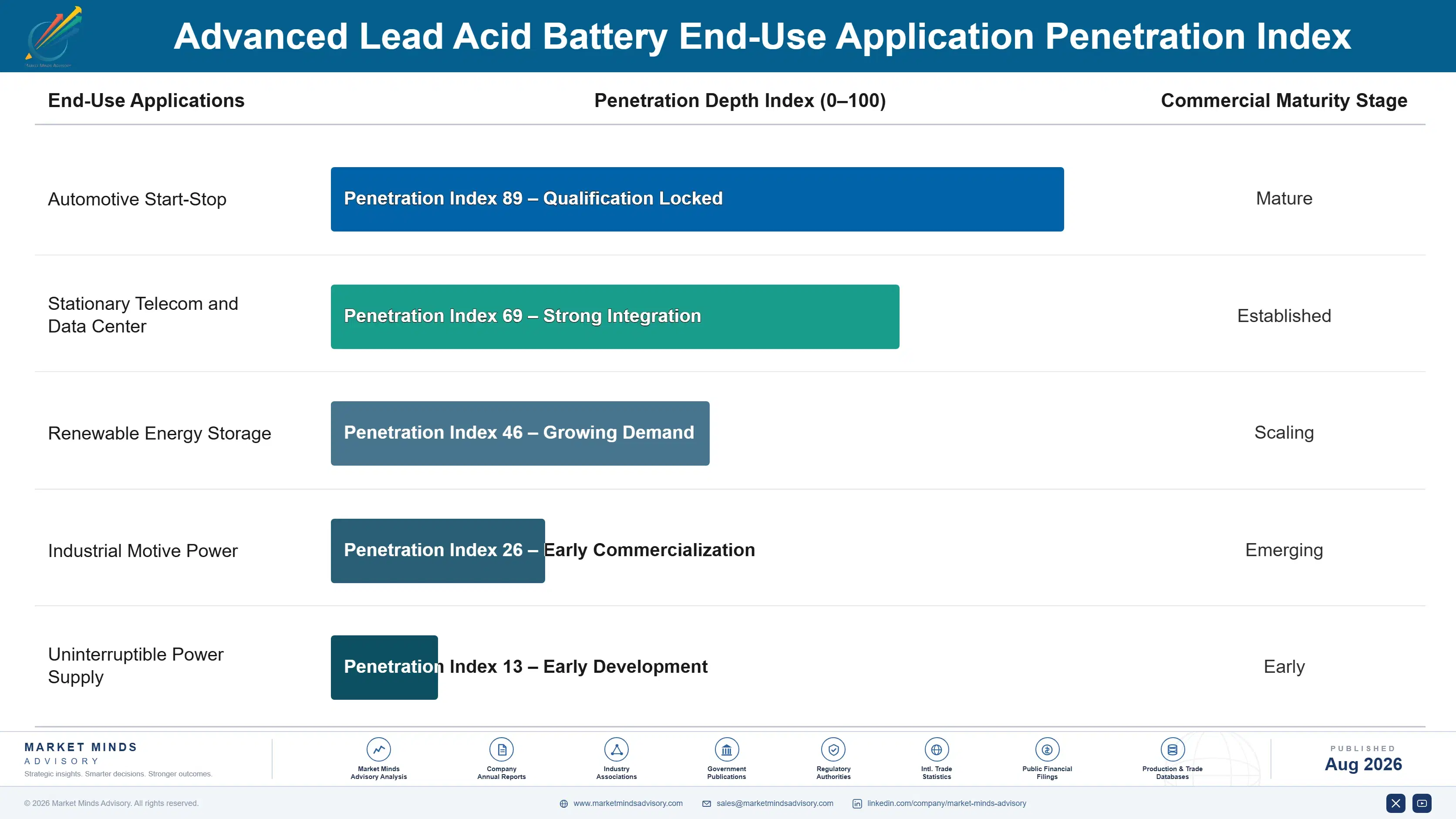
Advanced lead-acid batteries behave like a true annuity product once qualified into an automotive original equipment program, because requalifying a different battery supplier requires extensive vehicle-level testing across the full range of operating conditions a battery must withstand over its service life. That inertia gives incumbent suppliers multi-year revenue visibility once qualified, particularly in original equipment programs where a single vehicle platform can run production for five to seven years. That lock-in can persist for a decade or more once a platform enters full production across multiple model years.
Adoption depth varies sharply by end-use vertical. Automotive original equipment customers qualify new battery technology relatively slowly given extensive testing requirements, while stationary and renewable storage customers move somewhat more quickly when clear cycle life or total cost of ownership improvements are demonstrable through field data. Manufacturers serving both segments increasingly run separate qualification and sales teams to match each customer's pace.

Generational buyer shifts are visible mainly in the stationary and renewable storage channel, where younger engineering teams favor lead-carbon and bipolar technology specifically for documented performance improvement, while legacy automotive original equipment purchasing teams remain anchored to established conventional AGM suppliers with decades-long, safety-validated qualification relationships.
advanced-lead-acid-battery-market-trends-end-use-penetration-index-1787464115301

Where Advanced Lead-Acid Value Concentrates

These are among the four positions where our research anticipates prominent divergence between winners and laggards over the coming forecast period. Each is grounded in the demand model, the regulatory perimeter, and the announced capacity pipeline.
01 / NEXT-GENERATION CHEMISTRY INVESTMENT

Invest in lead-carbon and bipolar technology ahead of substitution

Lithium-ion cost declines represent a genuine long-term substitution threat to advanced lead-acid across both automotive and stationary applications, and manufacturers that close the performance gap through lead-carbon and bipolar technology are best positioned to defend category relevance. EnerSys and Clarios have both already demonstrated meaningful commercial traction with next-generation chemistry, confirming genuine customer demand exists for improved lead-acid performance. MMA recommends manufacturers without next-generation technology capability invest in development now, before lithium substitution accelerates further in premium and stationary applications specifically.
02 / INTEGRATED RECYCLING INVESTMENT

Expand integrated recycling ahead of continued lead price volatility

Lead commodity price volatility creates persistent margin pressure for manufacturers relying entirely on open-market purchases, and integrated recycling operations provide a captive, lower-volatility supply source that meaningfully reduces this exposure. Larger manufacturers with existing recycling infrastructure are already capturing this cost advantage over smaller, non-integrated competitors. MMA recommends manufacturers without integrated recycling capability evaluate investment now, before continued lead price volatility further disadvantages non-integrated competitors relative to established recyclers Later movers attempting to catch up will find recycling infrastructure considerably more expensive to build from scratch.
03 / STATIONARY RELIABILITY DOCUMENTATION

Build reliability documentation ahead of data center demand growth

Data center and telecom backup power demand is growing substantially, driven by expanding cloud computing and artificial intelligence infrastructure investment, and customers increasingly require documented reliability and predictive maintenance capability before committing to large-scale procurement. Manufacturers that have already built this documentation and monitoring capability are winning large enterprise contracts that competitors without comparable capability cannot access. MMA recommends manufacturers without established reliability documentation capability invest in it now, while data center demand growth remains available to a still-developing competitive set.
04 / EMERGING MARKET MANUFACTURING EXPANSION

Expand emerging market capacity ahead of mandate acceleration

India and other emerging automotive manufacturing markets are tightening fuel-economy standards and expanding start-stop mandate adoption meaningfully faster than mature Western markets on a percentage growth basis. Manufacturers without established emerging market manufacturing and distribution infrastructure risk losing first-mover positioning to domestic competitors building local capacity and customer relationships. MMA recommends manufacturers with sufficient resources evaluate emerging market expansion now, while manufacturing and distribution relationships remain available to a still-developing competitive landscape Waiting risks permanently ceding ground to competitors already embedded with local manufacturing partners.

Engagement Snapshot From the Field

A live engagement with an industry participant carrying material or product regulatory and market exposure ahead of a defining policy shift, showing how our research translates into a defensible multi-year portfolio strategy.
MARKET MINDS ADVISORY · CLIENT ENGAGEMENT SUMMARY
Advanced Lead Acid Battery Producer Strategic Portfolio Review and Transition Roadmap 2026·Investment Scenario on Advanced Lead Acid Battery Exposure Evaluation 2025-26
CLIENT PROFILE
The client is a mid-sized North American automotive original equipment supplier generating an estimated seven hundred million dollars in annual revenue (client-reported, unverified by MMA), supplying start-stop battery systems to several major vehicle platforms. The client faced a decision about whether to invest in next-generation lead-carbon technology or continue with conventional AGM supply as competitors began evaluating similar upgrades.
STRATEGIC CHALLENGE
A major automaker customer indicated it was evaluating lead-carbon technology for an upcoming vehicle platform refresh, creating competitive pressure for the client to develop comparable capability or risk losing the qualification opportunity to a competitor already investing in next-generation technology. The client needed to evaluate the investment case within a compressed qualification timeline.
MMA APPROACH
MMA conducted a structured evaluation of lead-carbon technology licensing and development options from three potential technology partners, benchmarking performance data, licensing cost structure, and development timeline against the client's platform qualification deadline. The engagement included direct technical assessments and customer requirement validation to confirm the recommended technology path would meet the automaker's specification within the available timeline.
KEY FINDINGS
  1. The automaker customer's lead-carbon specification required cycle life performance improvement that conventional AGM technology could not meet without the licensed lead-carbon additive technology.
  2. Licensing lead-carbon technology from the recommended partner added roughly fourteen percent to per-unit production cost but met the platform qualification requirement within the available timeline.
  3. One of the three evaluated technology partners could not provide a development timeline compatible with the client's platform qualification deadline despite offering competitive licensing terms.
  4. The client's successful qualification preserved its position on the vehicle platform and opened discussion for additional platforms requiring similar technology (client-reported, unverified by MMA).
CLIENT PROFILE
The client is a mid-sized North American automotive original equipment supplier generating an estimated seven hundred million dollars in annual revenue (client-reported, unverified by MMA), supplying start-stop battery systems to several major vehicle platforms. The client faced a decision about whether to invest in next-generation lead-carbon technology or continue with conventional AGM supply as competitors began evaluating similar upgrades.
STRATEGIC CHALLENGE
A major automaker customer indicated it was evaluating lead-carbon technology for an upcoming vehicle platform refresh, creating competitive pressure for the client to develop comparable capability or risk losing the qualification opportunity to a competitor already investing in next-generation technology. The client needed to evaluate the investment case within a compressed qualification timeline.
MMA APPROACH
MMA conducted a structured evaluation of lead-carbon technology licensing and development options from three potential technology partners, benchmarking performance data, licensing cost structure, and development timeline against the client's platform qualification deadline. The engagement included direct technical assessments and customer requirement validation to confirm the recommended technology path would meet the automaker's specification within the available timeline.
KEY FINDINGS
  1. The automaker customer's lead-carbon specification required cycle life performance improvement that conventional AGM technology could not meet without the licensed lead-carbon additive technology.
  2. Licensing lead-carbon technology from the recommended partner added roughly fourteen percent to per-unit production cost but met the platform qualification requirement within the available timeline.
  3. One of the three evaluated technology partners could not provide a development timeline compatible with the client's platform qualification deadline despite offering competitive licensing terms.
  4. The client's successful qualification preserved its position on the vehicle platform and opened discussion for additional platforms requiring similar technology (client-reported, unverified by MMA).
RECOMMENDED STRATEGY
Phase 1: Phase 1 (Weeks 1 to 4): Benchmark three lead-carbon technology partners against performance, licensing cost, and timeline requirements ahead of the deadline. Phase 2: Phase 2 (Weeks 5 to 8): Validate technology performance against the automaker's specific platform specification requirements before finalizing the licensing agreement. Phase 3: Phase 3 (Weeks 9 to 14): Finalize licensing agreement, complete platform qualification testing, and confirm production readiness across the full production line.
OUTCOME
The client successfully qualified lead-carbon battery technology within the automaker's required timeline, preserving its position on the vehicle platform (client-reported, unverified by MMA). The successful qualification also opened discussions for additional vehicle platforms requiring similar next-generation battery technology. The engagement also strengthened the client's broader technology development relationship with the automaker.

Frequently Asked Questions

Foundational context covering the market sizes, CAGR, scope, country, region and competition that inform every finding below. This section is provided to cover basics and most often pre-purchase conversations, answered from the MMA Primary Research Dataset.

What is the current size of the Advanced Lead Acid Battery Market?

The global advanced lead-acid battery market is valued at approximately $9.80 billion in 2025. Growth is driven by expanding start-stop vehicle mandates alongside rising stationary backup power demand.

How large will the Advanced Lead Acid Battery Market be by 2036?

MMA projects the market will reach approximately $20.21 billion by 2036, roughly 1.9 times its 2026 base value. Bipolar battery technology will account for a growing share of that expansion.

What is the CAGR for the Advanced Lead Acid Battery Market 2026 to 2036?

The market is expected to grow at a compound annual growth rate of 6.8% between 2026 and 2036. Bull and bear scenarios range from 5.6% to 8.0% depending on technology and regulatory conditions.

Which segment is growing fastest?

Bipolar lead-acid batteries are the fastest-growing segment, expanding at roughly 11.8% annually, about 1.7 times the overall market rate. Performance approaching lithium-ion is the primary driver.

Who are the major companies in the Advanced Lead Acid Battery Market?

Clarios, EnerSys, Exide Technologies, GS Yuasa, and Camel Group lead global supply. The top five suppliers together hold under forty percent of global capacity across regions.

Which country is growing fastest?

China is growing fastest, driven by its expanding automotive manufacturing base and rapidly scaling domestic start-stop mandate compliance. Capacity investment is reinforcing this growth across multiple provinces.

Report Segmentation Architecture

The full report scope spans multiple orthogonal segmentation dimensions, with cross-tabulated demand data provided for each dimension pair. Coverage extends further to regional breakdowns, trend trajectories, and the competitive detail needed to support segment-level decision-making.

By Battery Technology

  • Enhanced Flooded Battery
  • Absorbent Glass Mat
  • Valve-Regulated Stationary
  • Deep-Cycle Advanced
  • Bipolar Lead-Acid
  • Carbon-Enhanced Lead-Acid

By End-Use Application

  • Automotive Start-Stop
  • Stationary Telecom and Data Center
  • Renewable Energy Storage
  • Industrial Motive Power
  • Uninterruptible Power Supply

By Commercial Dimension

  • Original Equipment Supply
  • Aftermarket Replacement Supply
  • Stationary Direct Contract Supply
  • Distributor Channel Supply

By Region

  • North America
  • Western Europe
  • East Asia
  • South Asia and Pacific
  • Latin America
  • Middle East and Africa
  • Eastern Europe

Scope, Methodology, and Coverage

Every figure in this report is reproducible from documented input assumptions. The scope below maps the historical period, the forecast horizon, the segmentation dimensions, and the countries covered, alongside the underlying primary and qualitative methodology.
Historical Period
2020 to 2025
Forecast Period
2026 to 2036
Base Year
2025 (USD billions; MMA Primary Research Dataset, August 2026)
Market Definition
The advanced lead-acid battery market covers enhanced flooded, absorbent glass mat, valve-regulated, and next-generation lead-carbon and bipolar battery technologies designed for start-stop automotive, stationary backup power, and deep-cycle renewable energy storage applications. It excludes conventional flooded lead-acid batteries without enhanced cycling capability, and excludes lithium-ion and other non-lead battery chemistries.
Quantitative Units
USD billions (current prices); million units of finished battery capacity where applicable
Segmentation Dimensions
By Battery Technology; By End-Use Application; By Commercial Dimension; By Region
Regions Covered
North America, Western Europe, East Asia, South Asia and Pacific, Latin America, Middle East and Africa, Eastern Europe
Countries Covered
USA, China, Germany, France, UK, Japan, South Korea, India, Australia, Canada, Brazil, Mexico, Indonesia, Vietnam, Thailand, Malaysia, UAE, Saudi Arabia, South Africa, Nigeria, Turkey, Poland, Netherlands, Italy, Spain, Sweden, Switzerland, Argentina, Colombia, Singapore, and additional markets relevant to this sector
Key Companies Profiled
Clarios, EnerSys, Exide Technologies, GS Yuasa, Camel Group, Chaowei Power Holdings, Tianneng Power, East Penn Manufacturing, Leoch International, Amara Raja Batteries, C&D Technologies, HBL Power Systems, Hoppecke Batteries, Banner Batteries, FIAMM Energy Technology, Exide Industries, Panasonic, Sebang Global Battery, Shin-Kobe Electric Machinery, Crown Battery Manufacturing
Quantitative Methodology
Primary survey, n=3,800 respondents, Q4 2025, six countries; demand-side model with trade association cross-validation
Qualitative Methodology
47 expert interviews, Q4 2025; applied to validate demand model assumptions, identify emerging dynamics, and assess competitive positioning
Report Format
PDF and XLSX data workbook (Word format preview document)
Publisher
Market Minds Advisory
Report Code
MMA-2026-ENE-201
Published
August 2026
Contact
sales@marketmindsadvisory.com | www.marketmindsadvisory.com

Purchase the full Advanced Lead Acid Battery Market Report (2026 to 2036).

This report delivers a complete assessment of the global advanced lead-acid battery market across all major battery technologies, end-use applications, and geographic regions through 2036. It includes detailed competitive profiling of twenty companies, segmentation analysis distinguishing enhanced flooded, absorbent glass mat, valve-regulated, deep-cycle, bipolar, and carbon-enhanced technologies, and regional demand modeling across all seven MMA-covered geographies. Buyers will find quantified forecasts for market size, segment growth rates, and regional CAGR alongside qualitative analysis of lithium-ion substitution risk, next-generation chemistry trends, and lead commodity cost exposure. A dedicated revenue lever framework identifies four specific commercial actions manufacturers can take to capture margin as chemistry innovation accelerates.
Twenty-company competitive profiling with moat and risk analysis
Seven-region demand model with justified share and CAGR bands
Battery-technology segmentation across six MECE categories
Quantified revenue lever framework for margin capture strategies
Lead commodity and recycling cost exposure analysis
Anonymized case study on lead-carbon technology qualification

Built For The People Who Decide

From boardroom strategy to bench-side execution, this report is read cover-to-cover by leaders shaping the next decade of their industry, turning demand scenarios, market dynamics and valuation benchmarks into decisions.
CXOs/ Presidents/ VPs/ Managers
M&A and Corporate Development
Strategy Teams and R&D Heads
Procurement and Product Directors
Regulatory and Compliance Leaders
Investor Relations and Equity Analysts