
Market Minds Advisory
Advanced Energy Storage System Market

Advanced Energy Storage System Market: Grid-Scale Deployment and Chinese Manufacturing Scale Through 2036

Grid operators are deploying lithium-ion and flow battery storage at a pace utilities never attempted a decade ago, as renewable curtailment costs and grid stability mandates turn storage into a required companion to new capacity.

Lead Analyst

David Horsley

Published

September 2026

Make Smarter Decisions with Customized Research Insights

Request a free sample report and evaluate market opportunities, growth trends, and competitive dynamics relevant to your business needs.

2025 MARKET VALUE$45.0BMarket Size 2025
2036 FORECAST VALUE$149.0BBase Case , 2026 to 2036
CAGR 2026 TO 203611.5 %Bull 13.0% / Bear 10.0%
INCREMENTAL OPPORTUNITY$98.8BNet 10- year value creation
EXPANSION MULTIPLE2.97x2036 value over 2026 base
Strategic Levers
M&A Pipeline
Regional Outlook
Country Rankings
Competitive Intelligence
Segmental Deep-dive
Call-Us : 91 93563 13602

Executive Snapshot and Market Trajectory

Energy storage has moved from a niche grid-balancing tool into a mandatory companion technology for new renewable capacity, as utilities discover that solar and wind investment without storage increasingly means paying to curtail generation they already built, financed, and connected to the grid.
China's battery manufacturing scale, anchored by CATL and BYD, gives East Asia commanding cost and volume advantages that Western manufacturers are only beginning to challenge through domestic incentive programs. Lithium-ion technology still dominates deployed capacity, but flow batteries and emerging solid-state chemistries are capturing disproportionate investment attention as grid operators seek longer discharge durations than conventional lithium-ion economics currently support, and that gap keeps widening each year as regulatory pressure intensifies consistently each time.
Grid-scale deployment now outpaces behind-the-meter residential and commercial storage growth, reflecting utility procurement cycles that dwarf individual homeowner purchasing decisions in both scale and predictability. Supply chain control over battery-grade lithium, cobalt, and nickel increasingly determines which manufacturers can offer buyers reliable multi-year delivery commitments rather than the spot-market pricing volatility that characterized the category just a few years ago, and buyer priorities across every major deployment corridor tracked.
Market Definition
The advanced energy storage system market covers lithium-ion battery storage, flow battery storage, flywheel energy storage, compressed air energy storage, thermal energy storage, and solid-state and next-generation battery storage sold for grid-scale, commercial, and residential applications. It excludes pumped hydro storage and conventional automotive traction batteries sold for vehicle propulsion.
Base Year Value
$45.0B in 2025 (MMA Primary Research Dataset, August 2026)
Forecast Period
2026 to 2036, eleven discrete annual values
CAGR
11.5% base case. Bull 13.0%. Bear 10.0%.
Fastest Growth Segment
Solid-State and Next-Generation Battery Storage: 18.0% CAGR
Fastest Growth Country
India: 14.0% CAGR
Fastest Growth Region
South Asia and Pacific: 13.5% CAGR
Largest Region
East Asia: 30% of 2025 global value
Market Leaders
CATL, LG Energy Solution, Tesla, BYD, Samsung SDI. Source: MMA Analysis based on company annual reports.
Primary Survey
n=3,800 procurement and R&D decision-makers, Q4 2025, six countries
Methodology
Demand-side build-up, cross-validated against public data, 47 expert interviews

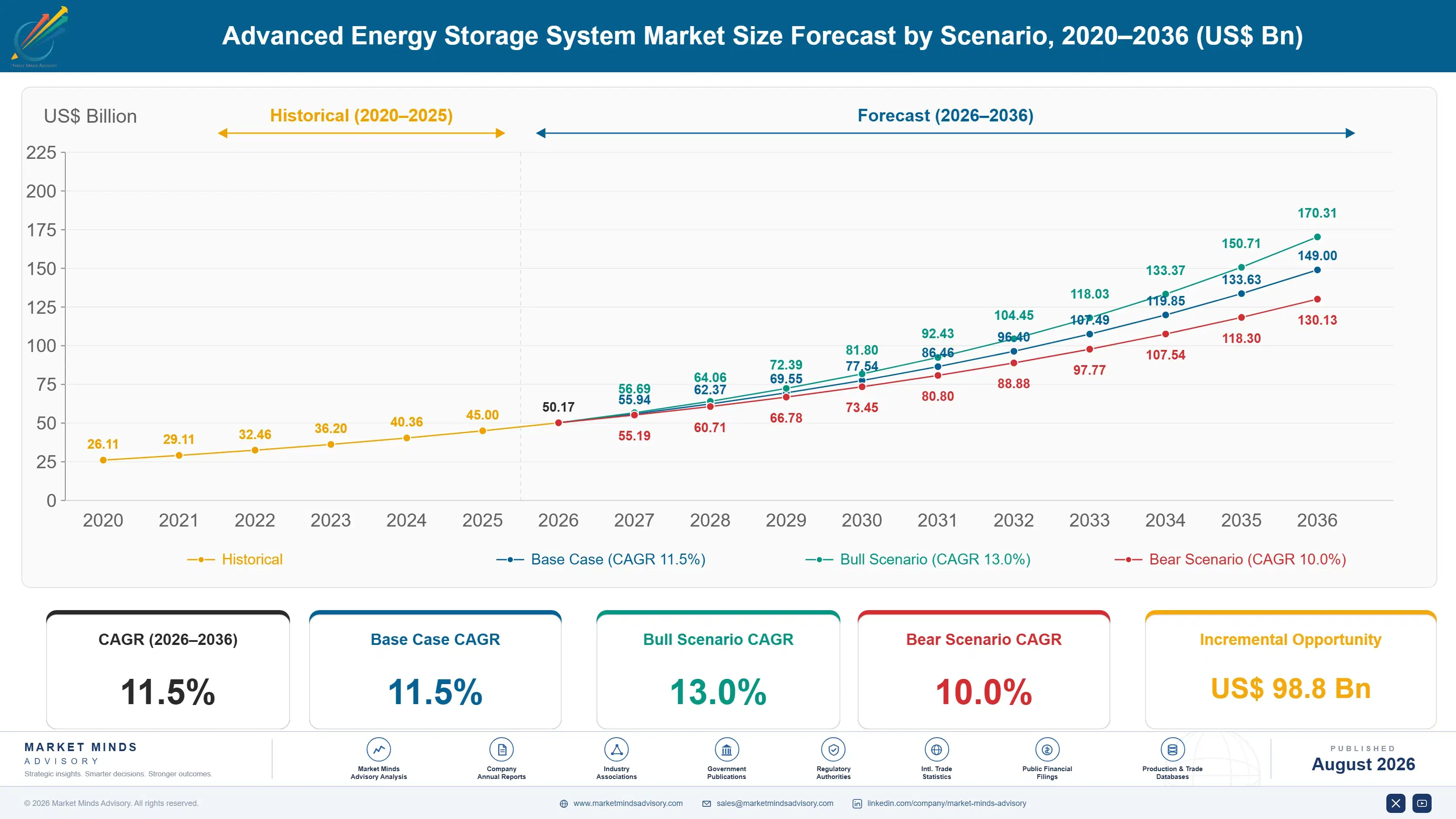
Advanced Energy Storage System Market Forecast Scenarios

advanced-energy-storage-system-market-size-forecast-scenario-1787463531963
Between 2020 and 2025 the market grew at roughly 10.0 percent a year, with early pandemic supply chain disruption briefly slowing battery cell delivery before renewable capacity additions accelerated deployment through the back half of the period as grid operators confronted mounting curtailment costs across major solar and wind markets worldwide. Deployment resumed quickly once supply chains stabilized in most markets.
The base case assumes 11.5 percent annual growth to 2036, built on three mechanisms: accelerating grid-scale deployment as renewable capacity additions require paired storage to avoid curtailment losses, expanding long-duration flow battery adoption as utilities seek discharge durations beyond what conventional lithium-ion chemistry economically supports, and gradual cost reduction across battery manufacturing as Chinese and emerging Western capacity both scale further. Together these three mechanisms sustain growth well above general electricity demand trends.
A bull case near 13.0 percent depends on additional grid operators adopting mandatory storage attachment requirements for new renewable capacity faster than currently planned across major markets. The bear case near 10.0 percent assumes battery-grade mineral supply constraints limit manufacturing expansion enough that deployment growth moderates toward simple renewable capacity addition rates across every major deployment corridor tracked.

Renewable Attachment Economics and Manufacturing Scale

Energy storage economics increasingly hinge on avoided curtailment cost rather than simple arbitrage between cheap and expensive electricity hours, since grid operators now model storage attachment as a direct offset against renewable generation they would otherwise have to waste. That reframing has turned storage procurement into a core planning input for utility renewable portfolios rather than an optional add-on evaluated after the fact once curtailment costs became visible.
PRODUCER CONCENTRATIONCR5 45%top five hold nearly half of global capacity
AVERAGE SELLING PRICE$145/kWhblended price across cell and system integration costs
CHINA MANUFACTURING SHARE62%share of global battery cell output originating from this region
GRID-SCALE DEPLOYMENT SHARE58%share of total capacity deployed in utility-scale installations
TRADE INTENSITY48%share of volume crossing a border before final system integration
BATTERY MINERAL COST SHARE38% of COGSlithium, cobalt, and nickel cost burden within total production cost
Commercially, the market splits between standardized lithium-ion systems sold at volume for short-duration grid balancing and a faster-growing long-duration tier spanning flow batteries and emerging chemistries sold for multi-hour discharge applications utilities increasingly specify. Margins concentrate in the long-duration tier, where technical differentiation still matters more than the commoditized lithium-ion segment where Chinese manufacturing scale dominates pricing, particularly across utility-scale grid deployment contracts.
Over the next decade, battery-grade mineral supply chain control and long-duration technology commercialization will matter more to competitive position than simple manufacturing capacity expansion, since lithium-ion cell production technology itself is now widely accessible across multiple large manufacturers competing on cost alone across every regional market tracked and buyer expectations, and formulation contract decisions across the industry.
"Nobody argues about whether batteries can stabilize a grid anymore. The argument is entirely about who controls the lithium, cobalt, and nickel that go into the cells, because that supply chain decides who actually profits from this decade of buildout."
Director, Energy Practice · MMA Energy Practice · August 2026

Market Trends

Renewable Curtailment Costs Force Mandatory Storage Attachment

Grid operators across major solar and wind markets have documented rising curtailment costs as renewable capacity additions outpace transmission and storage infrastructure buildout, and several jurisdictions have responded by requiring new renewable projects to include paired storage capacity before receiving interconnection approval. CATL and BYD have both expanded grid-scale system integration capacity specifically to serve this regulatory-driven demand wave rather than pure behind-the-meter residential growth. This trend is spreading from early-adopter markets into broader renewable procurement policy as more grid operators recognize storage attachment as cheaper than accepting ongoing curtailment losses.
Market Impact: Renewable capacity grows 10%+ yearly
Long-Duration Flow Battery Technology Gains Utility Interest

Utilities seeking discharge durations of four hours or longer have increasingly turned to flow battery technology, since conventional lithium-ion economics degrade meaningfully at longer discharge durations compared with shorter grid-balancing applications where lithium-ion remains cost-competitive. Invinity Energy Systems and ESS Inc have both expanded flow battery production capacity specifically to serve this emerging long-duration demand segment that lithium-ion struggles to serve economically. This technology shift is still early, but utility pilot programs are converting into commercial procurement contracts faster than most flow battery manufacturers had originally planned for this stage of adoption.
Market Impact: Cell costs fell 80% in decade

Market Opportunities and Growth Drivers

Renewable Capacity Additions Sustain Storage Attachment Demand

Global solar and wind capacity additions have grown at a double-digit pace annually over the past several years, and each additional gigawatt of intermittent renewable capacity increases the economic case for paired storage that smooths generation variability across daily and seasonal cycles affecting grid stability. This volume relationship gives energy storage demand a predictable growth floor tied directly to broader renewable capacity expansion rather than depending on any single utility's individual procurement decisions within the competitive landscape shaping grid investment priorities each fiscal year across every region tracked consistently, a pattern likely to persist.
Market Impact: Delays expansion by 1-2 years

Battery Manufacturing Cost Reduction Expands Addressable Market

Lithium-ion battery cell costs have fallen by an estimated 80 percent over the past decade as Chinese manufacturing scale and process improvements compounded year over year across the entire supply chain. That cost trajectory has expanded the addressable market well beyond early grid-balancing niches into mainstream utility procurement planning. CATL and LG Energy Solution have both driven this cost curve through continuous manufacturing scale expansion, making storage economically viable in applications that would have been unaffordable just five years ago across most utility procurement budgets worldwide, a trend expected to continue.
Market Impact: Queue delays average 3-5 years

Market Restraints and Challenges

Battery-Grade Mineral Supply Chain Concentration Limits Expansion

Lithium, cobalt, and nickel supply chains remain concentrated among a limited number of mining and refining countries, and the underlying cause is that battery-grade mineral processing requires specialized infrastructure that few countries have developed at commercial scale beyond a handful of established producing regions worldwide. The commercial impact shows up whenever mineral price spikes squeeze manufacturer margins or delay capacity expansion plans that depend on predictable input costs. Mitigation efforts include manufacturers signing long-term mineral supply agreements and investing directly in mining and refining joint ventures to secure feedstock too.
Market Impact: Mandates now cover 5+ major markets

Grid Interconnection Queue Delays Slow Deployment Timelines

Grid interconnection queues in major renewable markets have grown substantially longer over the past several years, and the underlying cause is transmission infrastructure investment that has not kept pace with the volume of new renewable and storage projects seeking connection approval across major grid operators. The commercial impact delays project revenue timelines for developers who have already committed capital to storage system procurement, creating cash flow pressure during extended queue waiting periods. Grid operators are mitigating this through queue reform initiatives that prioritize projects with paired storage capacity as well.
Market Impact: Pilot-to-contract conversion up 40%
3 additional market trends, 3 additional growth drivers, and 3 additional restraints and challenges are covered in the full report. Contact sales@marketmindsadvisory.com to access the complete intelligence.

Segment CAGR and Growth Architecture

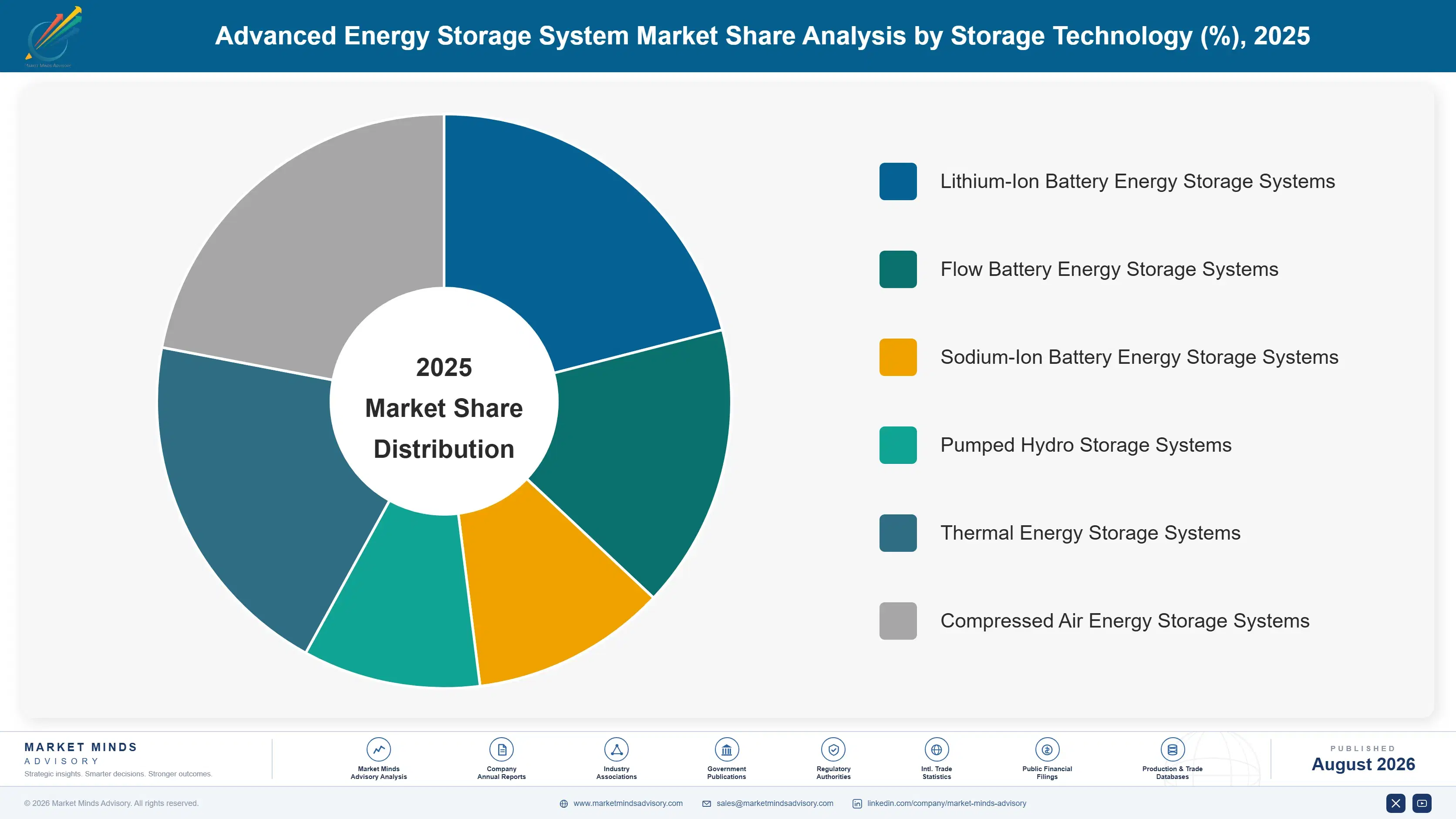
The market segments by storage technology rather than application, since a single technology such as lithium-ion or flow battery chemistry typically serves grid-scale, commercial, and residential applications interchangeably depending on the specific discharge duration and cost profile a buyer's project requires across different deployment scales, geographies, and evolving grid interconnection requirements each cycle, and buyer priorities.
advanced-energy-storage-system-market-market-share-analysis-1787463532557

Solid-State and Next-Generation Battery Storage

Solid-state and next-generation battery storage is the fastest-growing segment as manufacturers pursue chemistries offering higher energy density and improved safety characteristics compared with conventional liquid-electrolyte lithium-ion cells. Demand is concentrated among early-adopter grid operators and premium application developers willing to pay a substantial premium for performance advantages still being commercially proven at scale. Form Energy and several Chinese manufacturers both lead innovation in this category, though commercial deployment volume remains small relative to conventional lithium-ion capacity currently installed worldwide. Pricing carries a significant premium over established chemistries, reflecting both the manufacturing scale-up costs and the technical risk premium early customers accept when adopting unproven commercial technology ahead of broader market validation.
CAGR 18.0%

Flow Battery Storage

Flow battery storage demand is climbing as utilities seeking discharge durations beyond four hours find conventional lithium-ion economics increasingly unfavorable compared with flow chemistry that scales energy capacity independently from power capacity. Invinity Energy Systems and ESS Inc both lead this segment, backed by growing utility pilot programs converting into commercial procurement contracts faster than manufacturers originally expected at this stage of technology adoption. Vanadium redox chemistry remains the most commercially mature flow battery variant, though iron-based and other alternative chemistries are attracting research investment aimed at reducing the vanadium supply cost exposure that currently affects the broader flow battery category across multiple manufacturers and geographies competing for the same utility contracts.
CAGR 15.0%
Full segment breakdown across 6 segments available in the complete report.

Regional Architecture and Country Demand Map

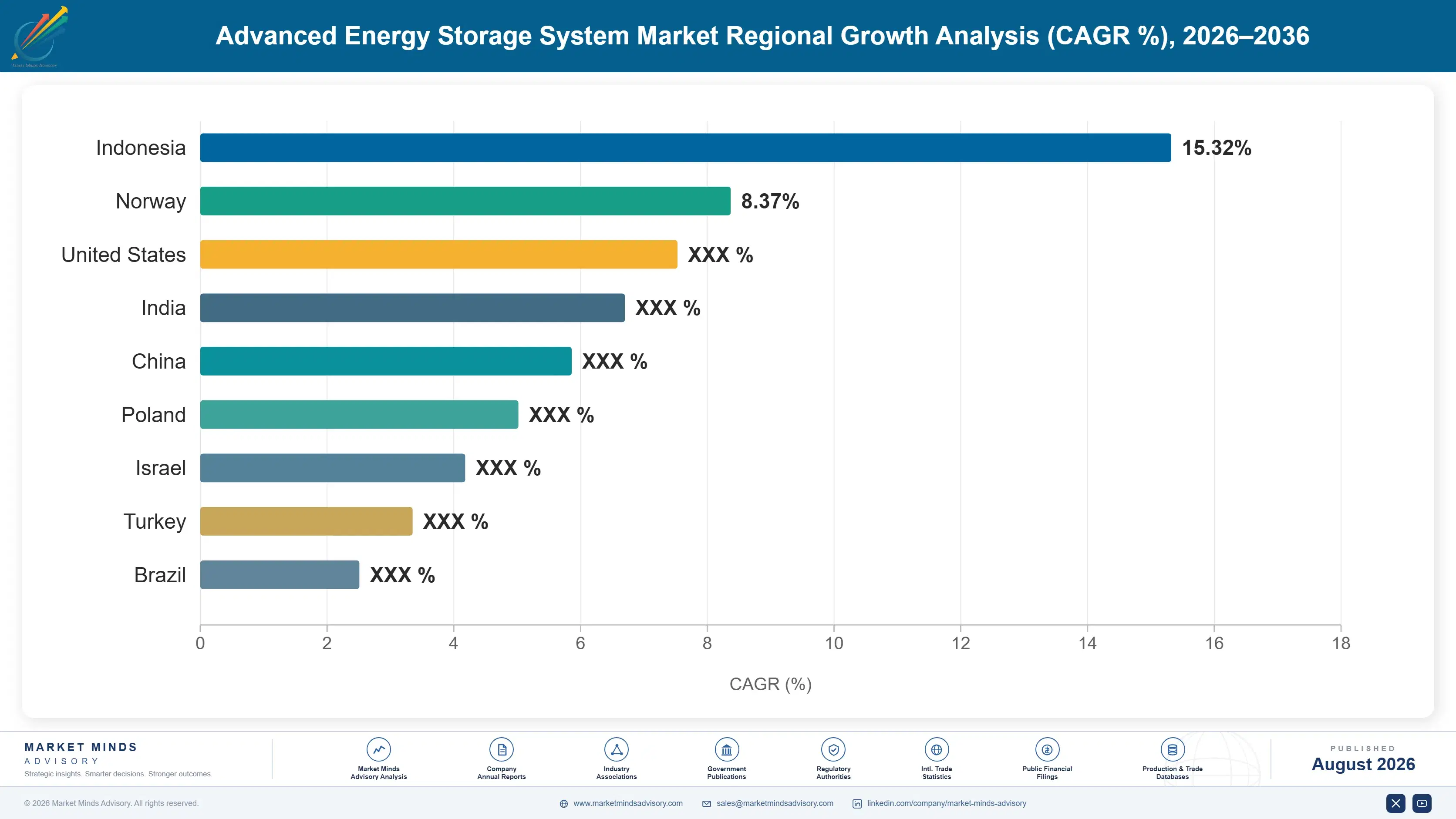
East Asia holds the largest regional share on the strength of Chinese battery manufacturing scale, with North America following as a rapidly expanding grid-scale deployment market and South Asia and Pacific posting the fastest regional growth as renewable capacity additions accelerate and grid modernization investment.

North America

US grid-scale storage deployment has accelerated sharply as federal tax incentives under the Inflation Reduction Act made standalone storage projects economically viable independent of paired solar generation for the first time, releasing a wave of utility procurement that previously required renewable co-location to justify project economics. Tesla and Fluence Energy both maintain substantial domestic system integration capacity, reflecting the depth of utility relationships this market demands relative to simpler equipment sales elsewhere. Canadian demand tracks provincial renewable procurement policy closely, growing steadily but at a smaller absolute scale than the American market. Growth here remains strong but trails the fastest-growing regions since domestic manufacturing capacity still depends partly on imported battery cells from Asian suppliers.
Share: 26% | CAGR: 11.5% (2026 to 2036)

Western Europe

German and UK grid operators lead regional storage deployment, driven by some of the world's most ambitious renewable capacity targets that require paired storage to manage the resulting generation variability across increasingly wind-dependent national grids. Northvolt's Swedish battery manufacturing ambitions, despite recent financial difficulties, reflect the region's determination to build domestic cell production capacity rather than depending entirely on Chinese imports for a category increasingly viewed as strategically important. Siemens Energy and ABB both anchor system integration capability across the region's major utility contracts. Growth trails East Asia and South Asia given the region's more mature renewable capacity base and slower overall electricity demand growth compared with faster-expanding emerging markets.
Share: 20% | CAGR: 10.0% (2026 to 2036)
Regional intelligence for 5 additional markets available in the complete report: East Asia, South Asia and Pacific, Latin America, Middle East and Africa, Eastern Europe. Contact sales@marketmindsadvisory.com.
advanced-energy-storage-system-market-country-cagr-analysis-1787463533081

Where Storage Manufacturers Can Capture Value

Manufacturers who move beyond standardized lithium-ion cell sales toward long-duration technology, mineral supply chain control, and grid integration services capture materially better margins than those competing purely on price for commodity battery cells sold without any system-level differentiation across every regional market this analysis tracks and every buyer segment served consistently, and every buyer type.

Long-Duration Flow Battery Technology Investment Programs

Investing in flow battery and other long-duration technology development lets manufacturers capture a demand segment growing at 15 percent annually that conventional lithium-ion economics cannot serve competitively beyond four-hour discharge durations across most utility applications. Invinity Energy Systems and ESS Inc have both prioritized this technology bet, positioning themselves ahead of utilities increasingly specifying longer discharge requirements in procurement contracts. The approach requires sustained research investment before commercial payoff, but early movers are converting utility pilot programs into multi-year supply agreements faster than competitors entering this segment later each fiscal year.
Market Impact: Captures a demand segment growing 15% each year

Battery-Grade Mineral Supply Chain Vertical Integration

Investing directly in lithium, cobalt, and nickel mining and refining joint ventures lets manufacturers secure feedstock cost visibility that competitors dependent on open-market mineral purchasing cannot match, protecting margin during price spikes of 30 percent or more that have periodically squeezed the industry over the past several years and disrupted planning cycles. CATL and several other large manufacturers have both pursued this vertical integration strategy specifically to reduce feedstock volatility exposure. This approach requires substantial upfront capital but delivers multi-year cost predictability that pure cell manufacturers cannot offer their own customers consistently, at scale.
Market Impact: Secures 10-year cost visibility across every planning cycle

Grid Integration and System Design Service Development

Offering grid integration and system design services alongside battery cell supply lets manufacturers capture a larger share of total project value, since utilities increasingly prefer a single accountable vendor over separately procuring cells, inverters, and software from different suppliers across a fragmented vendor landscape. Fluence Energy demonstrates this model, capturing system integration margin worth an estimated 20 to 25 percent above standalone cell sales through bundled project delivery. This approach requires engineering capability beyond pure manufacturing, but it builds customer relationships that pure cell suppliers cannot replicate as easily too.
Market Impact: Adds 20 to 25 percent system integration margin

Regional Manufacturing Capacity Near Growth Markets

Building cell manufacturing capacity closer to fast-growing North American and Indian demand rather than exporting exclusively from Chinese production centers cuts freight cost and lead time by an estimated 15 to 20 percent compared with long-distance shipping routes currently serving much of the world's utility markets. Manufacturers making this move early capture long-term supply contracts with regional utilities before local competitors scale enough capacity to compete directly on cost and delivery speed, particularly as domestic content incentive programs increasingly favor regionally manufactured components over imports each fiscal year, at competitive cost.
Market Impact: Cuts landed cost by 15 to 20 percent

Who Controls the Margin Pool

CR5 sits near 45 percent, reflecting genuine manufacturing scale advantages that a handful of large Asian battery cell producers have built over more than a decade of continuous capacity expansion and cost reduction investment. The gap between these leaders and smaller specialty manufacturers is wide on manufacturing cost, though considerably narrower on system integration and long-duration technology capability where scale matters less than technical differentiation.
Current competitive activity centers on three fronts: long-duration flow battery technology investment by specialty manufacturers chasing a demand segment lithium-ion cannot serve economically, mineral supply chain vertical integration by large cell manufacturers seeking cost predictability, and grid integration service expansion by system suppliers aiming to capture more total project value than standalone cell sales provide on their own, each competing for the same growing pool of utility contracts.

Emerging pressure comes from Western manufacturers scaling domestic cell production under government incentive programs designed to reduce dependence on Chinese battery imports, potentially challenging current supply concentration over the next decade. Rankings among the largest Asian manufacturers are unlikely to shift quickly given their cost and scale advantages, but Western capacity is growing faster than most analysts expected just a few years ago.
advanced-energy-storage-system-market-company-positioning-matrix-1787463533605

Competitive Moat and Risk Dimensions

CATL

Moat: Unmatched manufacturing scale and cost

CATL's manufacturing scale, built over more than a decade of continuous capacity expansion, gives it cost advantages that smaller competitors cannot match regardless of their own efficiency improvements, letting it price aggressively while maintaining margins that specialty manufacturers struggle to sustain at comparable volume, even during periods of rapid demand growth.
CATL

Risk: Geopolitical exposure in Western markets

CATL's Chinese origin increasingly exposes it to trade policy risk in North American and European markets where governments are actively incentivizing domestic battery manufacturing alternatives, potentially limiting its addressable market growth in these regions over time, as trade tensions continue evolving, and beyond, too, as well.
FLUENCE ENERGY

Moat: Integrated grid system design capability

Fluence Energy's system integration and grid design expertise lets it capture a larger share of total project value than pure cell manufacturers, positioning itself as an accountable single vendor that utilities increasingly prefer over managing multiple separate component suppliers themselves, across multiple continents, and utility segments.
FLUENCE ENERGY

Risk: Dependent on third-party cell supply

As a system integrator rather than a cell manufacturer, Fluence Energy depends on third-party battery cell supply, exposing it to the same mineral and manufacturing cost volatility affecting its suppliers without the vertical integration advantages large cell producers increasingly build, have already begun building, internally.

Players Tracked

Prominent Players

CATL
LG Energy Solution
Tesla
BYD
Samsung SDI

Other Key Players

Fluence Energy
Form Energy
ESS Inc
Invinity Energy Systems
Highview Power
Panasonic
SK On
Siemens Energy
ABB
Hitachi Energy
Sungrow Power Supply
Wärtsilä
Northvolt
EVE Energy
Vestas

Recent Developments

MARCH 2026

CATL Expands Grid-Scale Battery Production Capacity in China

CATL completed a capacity expansion at its Chinese grid-scale battery production facility, adding output aimed at meeting utility customer demand that had outpaced existing supply agreements across multiple export markets. The expansion followed roughly eighteen months of construction and permitting work, across several key accounts.
Signal: Dedicated capacity growth signals grid-scale storage demand has moved well past a temporary renewable buildout phase
SEPTEMBER 2025

Fluence Energy Signs Multi-Year Grid Integration Agreement in Australia

Fluence Energy entered a multi-year system integration agreement with a major Australian utility covering grid-scale storage deployment tied to the utility's broader renewable transition roadmap, securing revenue visibility beyond typical single-project contract terms, spanning several major projects across the state, and grid regions, too, as well.
Signal: Utilities are locking in system integration partnerships years ahead of individual project construction timelines in this maturing market
JANUARY 2026

Form Energy Announces Iron-Air Battery Pilot Expansion in Minnesota

Form Energy announced an expansion of its iron-air battery pilot deployment in Minnesota, positioning the company to demonstrate long-duration storage economics at a larger scale than its initial commercial installations achieved, backed by continued state and federal support, and grant funding, as well, too overall.
Signal: Long-duration battery pilots are scaling faster than most manufacturers originally planned for this technology stage given early results

Battery Mineral and Cell Manufacturing Exposure

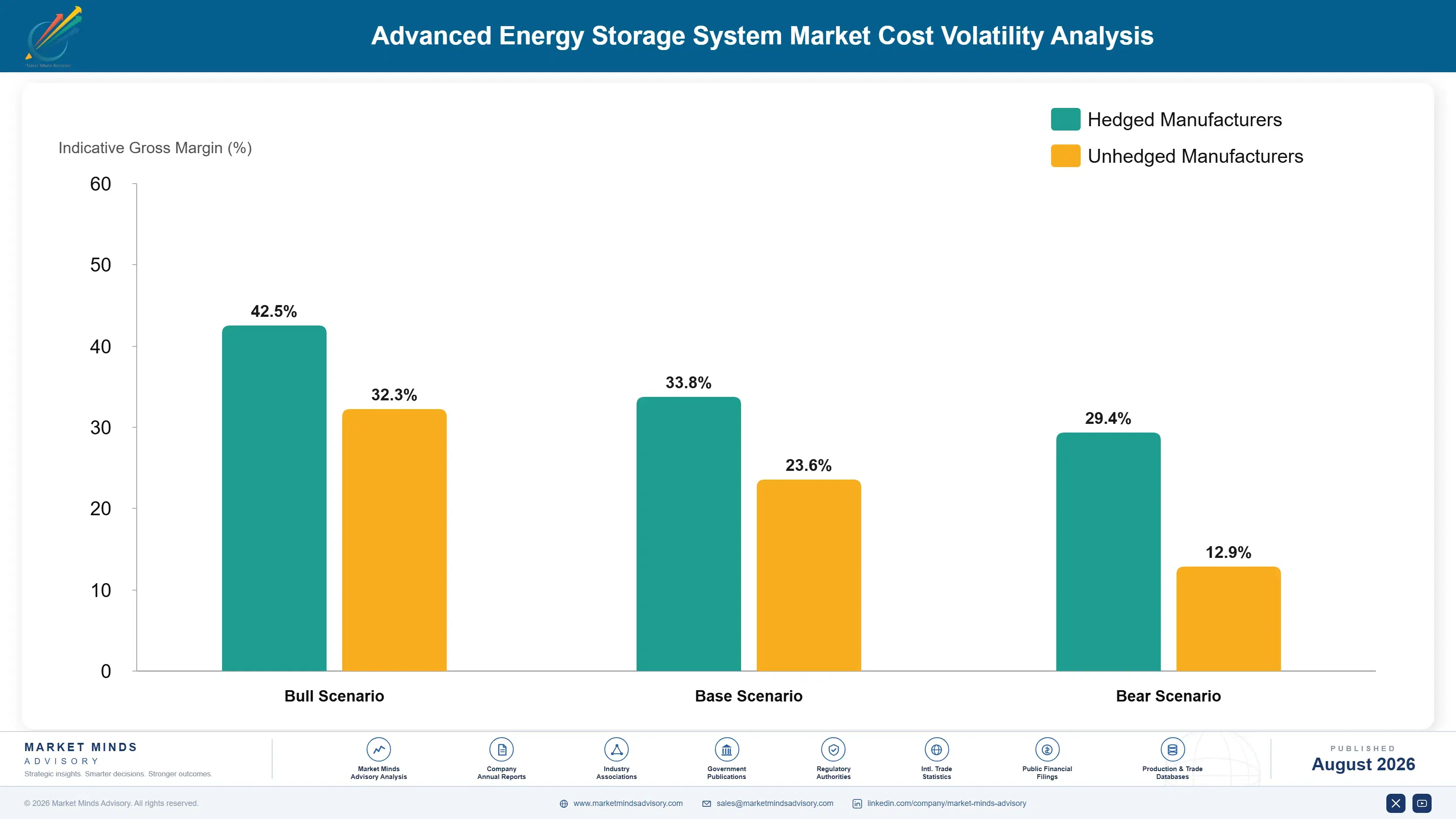
Lithium, cobalt, and nickel together represent roughly 38 percent of cost of goods sold for battery cell manufacturers, concentrated among a limited number of mining and refining countries whose own export policies and processing capacity investment decisions directly shape global cell pricing months before any individual manufacturer's own cost structure changes materially, and this dynamic shapes procurement negotiations across every major manufacturing region.
Lithium carbonate prices rose more than 400 percent during a 2022 demand surge tied to accelerating electric vehicle and grid storage deployment, according to industry commodity pricing data, before falling sharply as new mining capacity came online through 2023 and 2024. That volatility passed through to battery cell contract pricing within roughly two to three quarters, and manufacturers without long-term mineral supply agreements absorbed the sharpest cost swings during both the spike and subsequent correction.

Smaller specialty manufacturers without diversified mineral sourcing or long-term supply contracts absorb price volatility directly in margin, while larger diversified manufacturers with vertical integration into mining and refining smooth pricing for their downstream utility and system integrator customers instead. That gap in resilience increasingly determines which manufacturers can offer multi-year fixed-price contracts that large utility buyers now require.
advanced-energy-storage-system-market-cost-volatility-analysis-1787463533800

Vertical Integration Into Mining and Refining

Larger manufacturers are investing directly in lithium, cobalt, and nickel mining and refining joint ventures to secure feedstock cost visibility, reducing exposure to the open-market price swings that have repeatedly disrupted smaller competitors without comparable upstream investment capability, a strategy now standard among the five largest manufacturers active in this category, each fiscal year.

Diversified Mineral Sourcing Across Regions

Manufacturers are securing mineral feedstock through multiple mining regions rather than relying on a single source, smoothing cost volatility during regional supply disruptions that periodically affect specific lithium, cobalt, or nickel producing countries and their export policies, particularly across Australian, South American, and African supply corridors serving multiple continents, where filing standards can differ meaningfully.

Long-Term Fixed-Price Supply Agreements

Manufacturers are negotiating long-term fixed-price agreements with mineral suppliers and utility customers alike, smoothing volatility for all parties while reducing the spot market exposure that hurt buyers during the recent lithium price spike and subsequent correction, a practice that has grown more common since mineral price volatility intensified further, across geographies, too too consistently.

Portfolio Architecture for Margin Defence

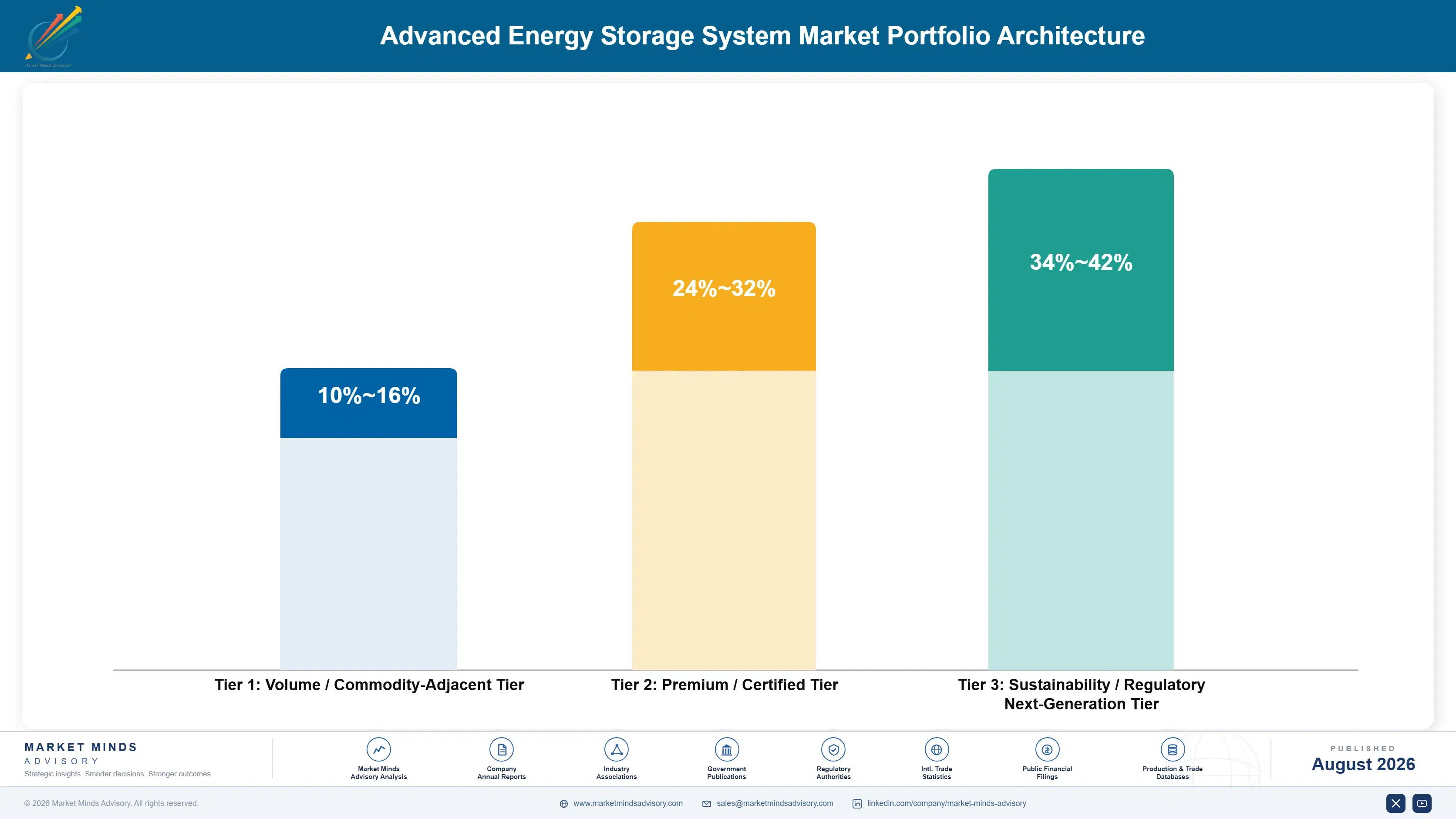
The market splits across three tiers: standardized lithium-ion cells sold on thin margins against commodity grid-balancing demand, long-duration flow battery and system integration services sold at a premium, and an emerging tier of solid-state and next-generation chemistries commanding the highest margins as manufacturers pursue performance advantages still being commercially validated, a structure that mirrors the broader specialty manufacturing sector worldwide.
Volume sits overwhelmingly in the standardized lithium-ion tier, where bulk cell contracts with utilities and system integrators generate massive revenue scale but comparatively thin margins given intense Chinese manufacturing competition. Premium tension is sharpest in long-duration and next-generation chemistries, where technical differentiation still commands meaningfully better margins than commoditized lithium-ion, pulling investment toward capacity that can serve both tiers, without compromising either segment's distinct commercial requirements.

High-value margin pools concentrate in long-duration flow battery systems and grid integration services sold to utilities seeking discharge durations beyond conventional lithium-ion economics, a category still small relative to total lithium-ion volume but growing faster and attracting disproportionate investment from the leading manufacturers each year, particularly among manufacturers already serving the largest utility accounts, each fiscal year, and beyond.

Volume / Commodity-Adjacent Tier

Standardized lithium-ion battery cells sold on multi-year volume contracts to utilities and system integrators, competing primarily on manufacturing cost and delivery reliability, Manufacturers here typically operate on thin single-digit to low double-digit margins.
Gross Margin: 10%-16%

Premium / Certified Tier

Long-duration flow battery systems and integrated grid design services sold with technical differentiation, commanding a premium over standardized lithium-ion equivalents, Manufacturers with strong engineering teams typically win this business over price-only competitors.
Gross Margin: 24%-32%

Sustainability / Regulatory / Next-Generation Tier

Solid-state and next-generation battery chemistries tied to emerging performance advantages, sold into the industry's highest-margin early-adopter contracts available today, This tier remains small in volume but is expanding fastest across every region tracked.
Gross Margin: 34%-42%
advanced-energy-storage-system-market-portfolio-architecture-1787463534295

High-value Sub-segments and Strategic Watch-out

Long-Duration Flow Battery Systems

Flow battery systems addressing discharge durations beyond four hours command the category's highest margins and are growing fastest as utilities increasingly specify long-duration requirements in procurement contracts each year, and continue investing heavily each year, Manufacturers with existing pilot programs hold a clear early advantage here.

Grid Integration Service Contracts

Bundled grid integration and system design services command steady premium pricing on accountability value, growing reliably as utilities prefer single vendors over managing multiple separate component suppliers themselves, across every program renewal cycle, Manufacturers with proven engineering partnerships win the bulk of new contracts, each cycle.

Standardized Lithium-Ion Cell Contracts

The largest volume pool by far, standardized lithium-ion contracts generate massive scale revenue for top manufacturers but offer little margin expansion room given intense Chinese manufacturing price competition, across nearly every contract negotiation, Manufacturers here compete mainly on manufacturing scale rather than technical differentiation, too.

Domestic Western Manufacturing Capacity

Government-incentivized Western manufacturing capacity could challenge Chinese cost dominance within domestic markets over the next decade, a shift in competitive geography worth monitoring closely for its pricing implications, as government incentive programs continue expanding, Chinese manufacturers are responding by deepening local partnerships instead, over time.

Procurement Cycles and Utility Contract Renewal

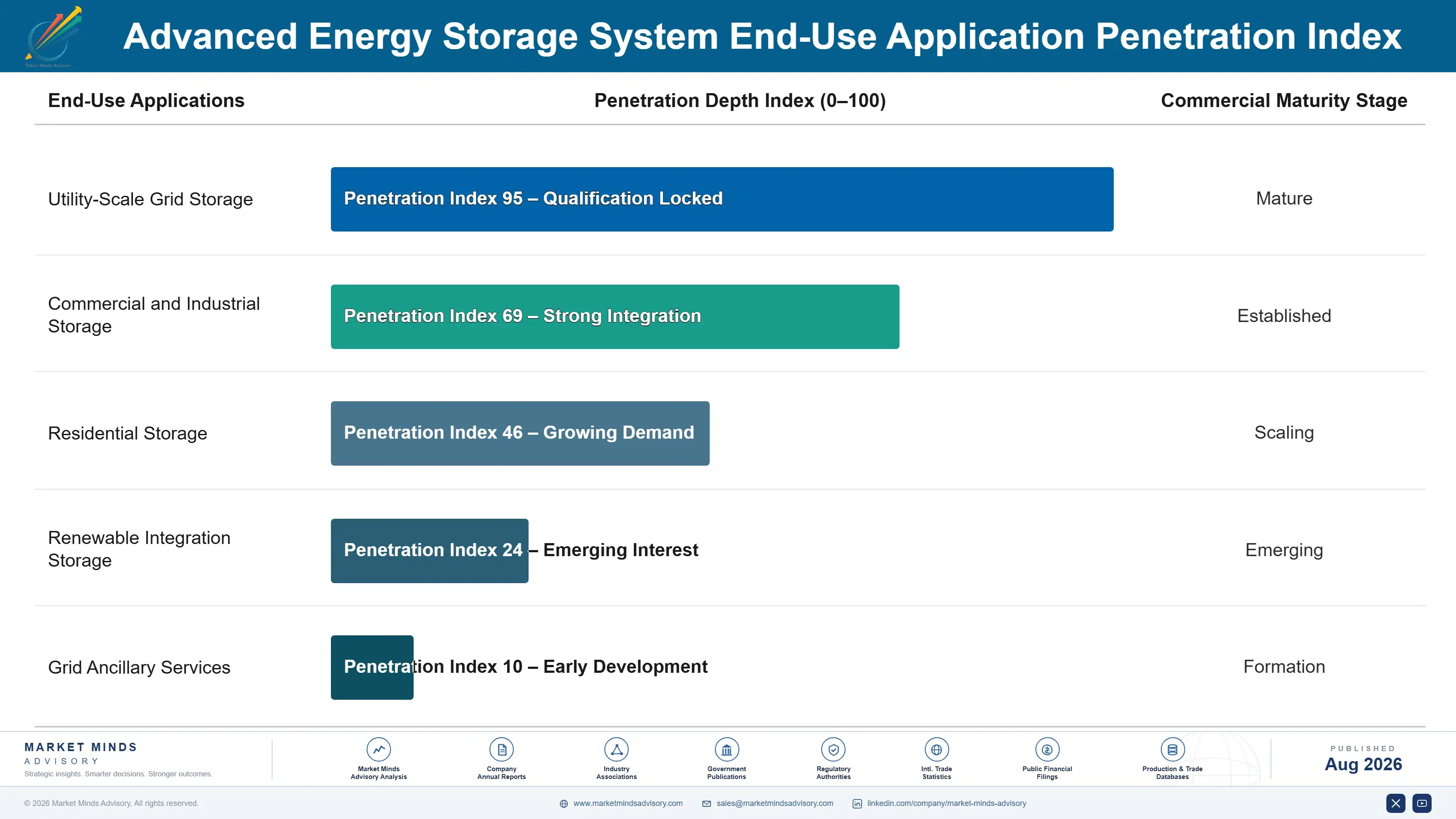
Grid-scale storage demand behaves like an annuity once a utility qualifies a specific manufacturer's system against its own interconnection and performance specifications, since switching suppliers again requires repeating extensive qualification testing that most utilities avoid unless supply is disrupted, giving incumbent manufacturers durable multi-year volume once they win the initial qualification and pass the first contract renewal cycle, and suppliers who lose that initial contract rarely win it back.
Adoption depth varies by application: large utility-scale projects show the deepest supplier stickiness given the scale of interconnection qualification required, while smaller commercial and residential storage buyers switch suppliers more readily based on price alone since qualification requirements remain comparatively loose across most behind-the-meter applications sold at scale, and this split shapes how manufacturers allocate their technical account teams, each fiscal year.

A generational shift among younger utility procurement officers toward treating storage attachment as a default planning input rather than an optional add-on is pulling supplier selection earlier into renewable project development, giving technically differentiated manufacturers a seat at the table that legacy equipment vendors historically never had, and this shift favors manufacturers who invest early in credibility.
advanced-energy-storage-system-market-end-use-penetration-index-1787463534784

Positioning for the Deployment Decade

These are among the four positions where our research anticipates prominent divergence between winners and laggards over the coming forecast period. Each is grounded in the demand model, the regulatory perimeter, and the announced capacity pipeline.
01 / LONG-DURATION TECHNOLOGY INVESTMENT

Invest in flow battery technology ahead of long-duration demand

Utilities seeking discharge durations beyond four hours find conventional lithium-ion economics increasingly unfavorable, and this demand segment is growing at 15 percent annually as more grid operators specify longer discharge requirements in procurement contracts. Invinity Energy Systems and ESS Inc already convert utility pilot programs into commercial contracts faster than manufacturers entering this segment later would manage. Manufacturers who commit to long-duration technology now will capture this growing demand pool before lithium-ion competitors can credibly match its economics, before larger lithium-ion incumbents fully pivot.
02 / MINERAL SUPPLY CHAIN INTEGRATION

Vertically integrate mineral supply before the next price spike

Lithium carbonate prices rose more than 400 percent during the 2022 demand surge, and given how concentrated mineral supply chains remain, another similar spike would again squeeze manufacturers without diversified sourcing or vertical integration already in place. CATL and other large manufacturers already secure cost visibility through direct mining and refining investment that smaller competitors cannot easily replicate. Manufacturers who pursue vertical integration now will enter the next volatility cycle with predictable costs their unhedged rivals cannot match, across every future procurement negotiation.
03 / GRID INTEGRATION SERVICE EXPANSION

Expand system integration services to capture full project value

Utilities increasingly prefer a single accountable vendor managing cells, inverters, and software over separately procuring components from multiple suppliers, a preference Fluence Energy has already converted into system integration margins worth 20 to 25 percent above standalone cell sales. Manufacturers without comparable engineering capability capture only the commoditized cell portion of total project value, ceding the higher-margin integration layer to specialized competitors. Building this capability now positions a manufacturer to capture a larger share of every future utility contract, regardless of underlying cell technology.
04 / REGIONAL MANUFACTURING EXPANSION

Build regional manufacturing capacity ahead of domestic incentives

Government incentive programs in North America and India increasingly favor domestically manufactured storage components over Chinese imports, creating a durable cost advantage for manufacturers who build regional capacity ahead of competitors still relying entirely on Asian production centers. This proximity also cuts landed cost by 15 to 20 percent compared with long-distance shipping routes currently serving these fast-growing markets. Manufacturers who invest in regional capacity now will capture incentive-backed contracts before domestic competition intensifies further, and secure long-term customer loyalty in the process.

Engagement Snapshot From the Field

A live engagement with an industry participant carrying material or product regulatory and market exposure ahead of a defining policy shift, showing how our research translates into a defensible multi-year portfolio strategy.
MARKET MINDS ADVISORY · CLIENT ENGAGEMENT SUMMARY
Advanced Energy Storage System Producer Strategic Portfolio Review and Transition Roadmap 2026·Investment Scenario on Advanced Energy Storage System Exposure Evaluation 2025-26
CLIENT PROFILE
A regional utility planning a major renewable capacity expansion engaged MMA to guide its grid-scale storage procurement strategy after preliminary curtailment modeling revealed significant projected losses without paired storage capacity. The client's planned storage procurement budget exceeded 120 million dollars (client-reported, unverified by MMA), making technology and supplier selection a material decision for its senior planning leadership team.
STRATEGIC CHALLENGE
The utility needed to select between standardized lithium-ion systems and emerging long-duration flow battery technology for a portfolio of renewable projects with varying discharge duration requirements, but lacked the internal technical expertise to model the comparative economics across its full project pipeline within the tight procurement timeline already committed to regulators.
MMA APPROACH
MMA benchmarked lithium-ion and flow battery suppliers against discharge duration requirements for each project in the client's pipeline, modeled comparative lifecycle economics across multiple technology scenarios, and structured a blended procurement strategy that matched technology choice to each project's specific discharge duration needs, before finalizing a recommendation for the client's board.
KEY FINDINGS
  1. Short-duration projects favored standardized lithium-ion systems on cost grounds, while longer-duration projects favored flow battery technology, based on comparative lifecycle cost modeling.
  2. A blended technology portfolio reduced total procurement cost compared with the client's original single-technology proposal across the full pipeline, spanning every project phase evaluated.
  3. Multiple qualified suppliers in each technology category gave the client meaningful negotiating leverage during the final pricing and volume commitment discussions that followed.
  4. Phased procurement across project phases reduced the client's exposure to any single supplier's delivery timeline risk, across the full deployment schedule, too.
CLIENT PROFILE
A regional utility planning a major renewable capacity expansion engaged MMA to guide its grid-scale storage procurement strategy after preliminary curtailment modeling revealed significant projected losses without paired storage capacity. The client's planned storage procurement budget exceeded 120 million dollars (client-reported, unverified by MMA), making technology and supplier selection a material decision for its senior planning leadership team.
STRATEGIC CHALLENGE
The utility needed to select between standardized lithium-ion systems and emerging long-duration flow battery technology for a portfolio of renewable projects with varying discharge duration requirements, but lacked the internal technical expertise to model the comparative economics across its full project pipeline within the tight procurement timeline already committed to regulators.
MMA APPROACH
MMA benchmarked lithium-ion and flow battery suppliers against discharge duration requirements for each project in the client's pipeline, modeled comparative lifecycle economics across multiple technology scenarios, and structured a blended procurement strategy that matched technology choice to each project's specific discharge duration needs, before finalizing a recommendation for the client's board.
KEY FINDINGS
  1. Short-duration projects favored standardized lithium-ion systems on cost grounds, while longer-duration projects favored flow battery technology, based on comparative lifecycle cost modeling.
  2. A blended technology portfolio reduced total procurement cost compared with the client's original single-technology proposal across the full pipeline, spanning every project phase evaluated.
  3. Multiple qualified suppliers in each technology category gave the client meaningful negotiating leverage during the final pricing and volume commitment discussions that followed.
  4. Phased procurement across project phases reduced the client's exposure to any single supplier's delivery timeline risk, across the full deployment schedule, too.
RECOMMENDED STRATEGY
Phase 1: Phase 1 (Months 1-3): Finalize technology selection criteria and qualify suppliers in each category, meeting the client's technical and budget requirements. Phase 2: Phase 2 (Months 4-9): Execute procurement contracts across the blended technology portfolio in stages, reviewed monthly by the client's planning team. Phase 3: Phase 3 (Months 10-18): Complete supplier onboarding and begin phased project deployment, and confirm interconnection readiness at each site, as well.
OUTCOME
The client completed procurement within its regulatory timeline and reported meaningfully reduced total portfolio cost compared with its original single-technology approach (client-reported, unverified by MMA), alongside improved supply resilience through the blended, multi-supplier structure MMA recommended across its project pipeline, across its entire renewable portfolio.

Frequently Asked Questions

Foundational context covering the market sizes, CAGR, scope, country, region and competition that inform every finding below. This section is provided to cover basics and most often pre-purchase conversations, answered from the MMA Primary Research Dataset.

What is the current size of the Advanced Energy Storage System Market?

The global advanced energy storage system market was valued at approximately $45.0 billion in 2025. Grid-scale deployment drives most current demand, across every storage technology category.

How large will the Advanced Energy Storage System Market be by 2036?

MMA projects the market will reach approximately $149.0 billion by 2036, roughly 2.97 times its 2026 value. Renewable capacity growth drives much of this expansion.

What is the CAGR for the Advanced Energy Storage System Market 2026 to 2036?

The market is projected to grow at an 11.5 percent compound annual rate between 2026 and 2036. Bull and bear scenarios range from 10.0 to 13.0 percent.

Which segment is growing fastest?

Solid-state and next-generation battery storage is the fastest-growing segment at an 18.0 percent CAGR, well above the overall market rate. Performance advantages drive this early-stage growth.

Who are the major companies in the Advanced Energy Storage System Market?

Leading manufacturers include CATL, LG Energy Solution, Tesla, BYD, and Samsung SDI. Together they hold a CR5 near 45 percent of global capacity, and continue expanding steadily.

Which country is growing fastest?

India posts the fastest national growth at roughly 14.0 percent, driven by ambitious renewable capacity targets requiring paired storage. Domestic manufacturing capacity is expanding to meet this rising demand.

Report Segmentation Architecture

The full report scope spans multiple orthogonal segmentation dimensions, with cross-tabulated demand data provided for each dimension pair. Coverage extends further to regional breakdowns, trend trajectories, and the competitive detail needed to support segment-level decision-making.

By Storage Technology

  • Lithium-Ion Battery Storage
  • Flow Battery Storage
  • Flywheel Energy Storage
  • Compressed Air Energy Storage
  • Thermal Energy Storage
  • Solid-State and Next-Generation Battery Storage

By End-Use Application

  • Utility-Scale Grid Storage
  • Commercial and Industrial Storage
  • Residential Storage
  • Renewable Integration Storage
  • Grid Ancillary Services

By Distribution Channel

  • Direct Utility Contract Supply
  • System Integrator Partnerships
  • Distributor Networks
  • Government Procurement Programs

By Region

  • North America
  • Western Europe
  • East Asia
  • South Asia and Pacific
  • Latin America
  • Middle East and Africa
  • Eastern Europe

Scope, Methodology, and Coverage

Every figure in this report is reproducible from documented input assumptions. The scope below maps the historical period, the forecast horizon, the segmentation dimensions, and the countries covered, alongside the underlying primary and qualitative methodology.
Historical Period
2020 to 2025
Forecast Period
2026 to 2036
Base Year
2025 (USD billions; MMA Primary Research Dataset, August 2026)
Market Definition
The advanced energy storage system market covers lithium-ion battery storage, flow battery storage, flywheel energy storage, compressed air energy storage, thermal energy storage, and solid-state and next-generation battery storage sold for grid-scale, commercial, and residential applications. It excludes pumped hydro storage and conventional automotive traction batteries sold for vehicle propulsion.
Quantitative Units
USD billions (current prices); gigawatt-hours (GWh) for capacity detail
Segmentation Dimensions
By Storage Technology; By End-Use Application; By Distribution Channel; By Region
Regions Covered
North America, Western Europe, East Asia, South Asia and Pacific, Latin America, Middle East and Africa, Eastern Europe
Countries Covered
USA, China, Germany, France, UK, Japan, South Korea, India, Australia, Canada, Brazil, Mexico, Indonesia, Vietnam, Thailand, Malaysia, UAE, Saudi Arabia, South Africa, Nigeria, Turkey, Poland, Netherlands, Italy, Spain, Sweden, Switzerland, Argentina, Colombia, Singapore, and additional markets relevant to this sector
Key Companies Profiled
CATL, LG Energy Solution, Tesla, BYD, Samsung SDI, Fluence Energy, Form Energy, ESS Inc, Invinity Energy Systems, Highview Power, Panasonic, SK On, Siemens Energy, ABB, Hitachi Energy, Sungrow Power Supply, Wärtsilä, Northvolt, EVE Energy, Vestas
Quantitative Methodology
Primary survey, n=3,800 respondents, Q4 2025, six countries; demand-side model with trade association cross-validation
Qualitative Methodology
47 expert interviews, Q4 2025; applied to validate demand model assumptions, identify emerging dynamics, and assess competitive positioning
Report Format
PDF and XLSX data workbook (Word format preview document)
Publisher
Market Minds Advisory
Report Code
MMA-2026-ENE-101
Published
August 2026
Contact
sales@marketmindsadvisory.com | www.marketmindsadvisory.com

Purchase the full Advanced Energy Storage System Market Report (2026 to 2036).

The full Advanced Energy Storage System Market report delivers a comprehensive 2026 to 2036 forecast across six storage technologies, seven regions, and twenty profiled companies active in this category. It includes detailed segmentation by end-use application, battery mineral and manufacturing cost modeling, and competitive benchmarking measured against a single consistent revenue basis throughout. Analysts document the renewable attachment and long-duration technology trends reshaping manufacturer positioning across the industry. Buyers receive full access to the underlying data tables, regional breakouts, and a customizable Excel model built for scenario planning.
2026-2036 volume and value forecasts by segment
Six-segment storage technology breakdown and detailed analysis
Seven-region market sizing and share detail
Twenty-company competitive profiles and full benchmarking
Battery mineral and manufacturing cost sensitivity modeling
Editable Excel forecast workbook with scenario toggles

Built For The People Who Decide

From boardroom strategy to bench-side execution, this report is read cover-to-cover by leaders shaping the next decade of their industry, turning demand scenarios, market dynamics and valuation benchmarks into decisions.
CXOs/ Presidents/ VPs/ Managers
M&A and Corporate Development
Strategy Teams and R&D Heads
Procurement and Product Directors
Regulatory and Compliance Leaders
Investor Relations and Equity Analysts