
Market Minds Advisory
Absinthe Market

Absinthe Market: Heritage Revival Meets the Craft Cocktail Ready-to-Drink Wave

Absinthe now splits between heritage verte production defended by legacy French and Swiss distillers and a fast-scaling ready-to-drink cocktail format, straining wormwood and anise botanical sourcing chains built for small-batch, not mainstream bar volume.

Lead Analyst

Lisa Gevelber

Published

September 2026

Make Smarter Decisions with Customized Research Insights

Request a free sample report and evaluate market opportunities, growth trends, and competitive dynamics relevant to your business needs.

2025 MARKET VALUE$0.4BMarket Size 2025
2036 FORECAST VALUE$0.9BBase Case , 2026 to 2036
CAGR 2026 TO 20366.8 %Bull 8.0% / Bear 5.6%
INCREMENTAL OPPORTUNITY$0.4BNet 10- year value creation
EXPANSION MULTIPLE1.93x2036 value over 2026 base
Strategic Levers
M&A Pipeline
Regional Outlook
Country Rankings
Competitive Intelligence
Segmental Deep-dive
Call-Us : 91 93563 13602

Executive Snapshot and Market Trajectory

Absinthe demand is splitting between heritage verte production defended by legacy European distillers and a fast-scaling ready-to-drink cocktail format that most traditional houses have no established capacity to serve, forcing a choice between defending tradition and chasing volume. Few brands currently serve both audiences equally well.
Ready-to-drink absinthe cocktails and craft artisanal small-batch releases are pulling category growth well ahead of traditional verte and commercial mass-market bottlings, as craft cocktail bars and younger drinkers seek convenience formats and provenance storytelling over strict historical recipe fidelity. Western Europe commands the largest revenue pool through France, Switzerland, and Czech production heritage, while the United States scales fastest off a smaller base as craft cocktail culture expands distribution.
Competitive structure remains fragmented among small and mid-sized distillers, with legacy French and Swiss houses defending heritage positioning while newer craft entrants compete on flavor innovation and ready-to-drink convenience. Wormwood and anise botanical sourcing constraints are compounding margin pressure across both tiers, pushing larger producers toward direct grower contracts rather than spot market herb purchasing. Rankings among established houses could shift meaningfully as this divergence continues widening across the category. Timing matters greatly here.
Market Definition
The absinthe market covers wormwood-based distilled spirits historically associated with Artemisia absinthium, sold as traditional verte and blanche bottlings, craft artisanal releases, and ready-to-drink cocktail formats through retail and on-premise channels. It excludes wormwood-flavored wines and vermouths, and excludes absinthe-branded merchandise or experiences sold independent of the distilled spirit itself.
Base Year Value
$0.4B in 2025 (MMA Primary Research Dataset, August 2026)
Forecast Period
2026 to 2036, eleven discrete annual values
CAGR
6.8% base case. Bull 8.0%. Bear 5.6%.
Fastest Growth Segment
Ready-to-Drink Absinthe Cocktails: 9.8% CAGR
Fastest Growth Country
United States: 8.6% CAGR
Fastest Growth Region
South Asia and Pacific: 8.8% CAGR
Largest Region
Western Europe: 34% of 2025 global value
Market Leaders
Pernod Ricard, La Fee Absinthe, Kubler Absinthe, Lucid Absinthe Superieure, and Hill's Absinth. Source: MMA Analysis based on company annual reports.
Primary Survey
n=3,800 procurement and R&D decision-makers, Q4 2025, six countries
Methodology
Demand-side build-up, cross-validated against public data, 47 expert interviews

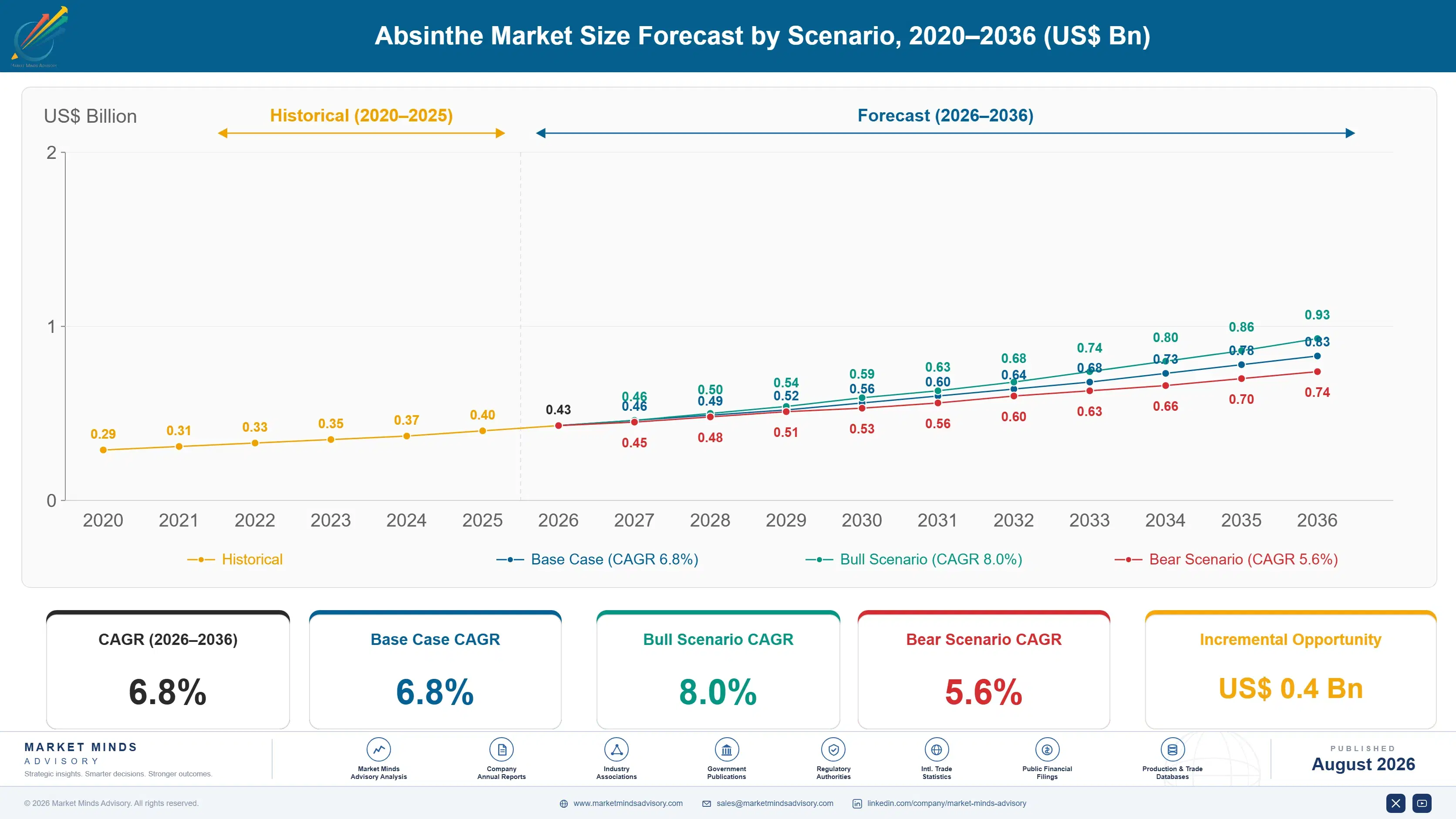
Absinthe Market Forecast Scenarios

absinthe-market-size-forecast-scenario-1787464232336
Between 2020 and 2025 the market grew at a historical pace of roughly 5.9 percent annually, as craft cocktail culture continued expanding absinthe's presence on bar menus well beyond its niche revival era positioning, while ready-to-drink format experimentation began accelerating only in the final two years of the period across major consuming markets. Distribution consolidation began accelerating only in the final two years of this period.
The base case assumes growth near 6.8 percent annually through 2036, anchored in three commercial mechanisms: expanding ready-to-drink absinthe cocktail distribution into mainstream retail and grocery channels, continued craft cocktail bar menu inclusion sustaining premium on-premise consumption, and younger drinkers seeking provenance-driven craft spirits stories over mass-market commodity positioning across major consuming regions. These mechanisms increasingly reinforce each other as distillers, retailers, and bartenders coordinate more closely around shared format standards.
A bull scenario builds on ready-to-drink formats achieving mainstream grocery shelf placement across major Western retailers within three years, while a bear scenario centers on wormwood and anise botanical supply constraints tied to limited specialized cultivation acreage compressing margins and slowing planned craft distillery capacity expansion. Several producers are already preparing contingency sourcing plans should botanical constraints intensify further.

Heritage Defense Against Convenience Format Growth

Three forces are converging on the category at once: ready-to-drink cocktail formats are pulling volume away from traditional bottle-and-mix consumption occasions, craft distillers are scaling artisanal small batch production to meet provenance-driven demand, and legacy houses are defending heritage positioning against both convenience formats and lower-priced commercial competitors. This convergence is compressing decision timelines that once unfolded over multiple planning cycles. Producers increasingly treat this as standard planning.
MARKET CONCENTRATIONCR5 22%top five producers hold a modest combined share
AVERAGE RETAIL PRICEUSD 35-65/bottletypical price range across traditional bottled formats overall
LEADING PRODUCING COUNTRYFrancelargest single national production and export base overall
THUJONE COMPLIANCE RATE94%share of exported product meeting import thujone limits
ON-PREMISE CHANNEL SHARE47%share of total volume consumed through bars and restaurants
BOTANICAL FEEDSTOCK COST SHARE29% of COGSwormwood and anise inputs as portion of total cost
Commercially the category increasingly behaves like two connected but distinct businesses, since a producer's growth now depends on whether it competes in traditional bottled formats sold through specialty retail or in ready-to-drink formats sold through mainstream grocery and convenience channels, a divergence reshaping which distillers can profitably serve both audiences at once. Retailers increasingly select suppliers based on demonstrated format versatility alone. Brands slow to adapt risk losing negotiations.
Over the next decade, producers most likely to capture disproportionate value are those investing in ready-to-drink formulation capability without abandoning heritage bottled positioning entirely, since younger drinkers increasingly expect both convenience and an authentic provenance story from the same brand. Producers slow to adapt risk losing shelf space to better-prepared competitors. Early movers already report stronger retailer relationships.
"Nobody drinks absinthe by accident anymore. Every bottle sold is a deliberate choice, which means the story on the label now matters as much as what's actually in the glass."
Director, Spirits and Beverage Alcohol Practice · MMA Alcoholic Beverages / Craft Spirits Practice · August 2026

Market Trends

Ready-to-Drink Absinthe Cocktails Entering Mainstream Retail

Ready-to-drink absinthe-based cocktails, including classic preparations like the Sazerac and Corpse Reviver adapted into canned and bottled formats, are moving from niche craft cocktail bar menus into mainstream grocery and convenience retail distribution across North America and Western Europe. Several craft distillers and larger beverage alcohol companies have launched dedicated ready-to-drink absinthe cocktail lines within the past two years, signaling the format has moved beyond experimentation into a defined growth category. Distribution remains concentrated in states and countries with favorable ready-to-drink cocktail regulatory frameworks, creating uneven category availability across otherwise similar consuming markets.
Market Impact: Sustains 9% on-premise demand growth
Wormwood Botanical Sourcing Constraints Tightening Supply

Specialized wormwood and anise cultivation acreage has not scaled at the pace ready-to-drink and craft segment demand now requires, a constraint rooted in the limited number of growing regions with climate conditions suited to high-thujone-content Artemisia absinthium cultivation and the multi-year establishment period specialty herb cultivation typically requires. Distillers increasingly compete for the same limited botanical supply base, creating periodic price spikes that compress margins for smaller producers lacking long-term grower contracts. Larger distillers are increasingly investing directly in contracted cultivation to secure supply ahead of continued category growth. Larger distillers increasingly favor direct grower relationships over spot purchasing.
Market Impact: Lifts craft segment demand by 11%

Market Opportunities and Growth Drivers

Craft Cocktail Bar Culture Sustaining Premium On-Premise Demand

Continued expansion of craft cocktail bar culture across major metropolitan markets in North America and Western Europe is sustaining premium on-premise absinthe consumption well beyond the category's niche revival era positioning, as bartenders increasingly feature absinthe in both classic and original cocktail preparations. This channel rewards provenance, botanical complexity, and brand storytelling over price competition, giving craft and heritage producers a durable premium pricing advantage that mass-market commercial bottlings cannot access regardless of underlying product quality or thujone compliance credentials. This channel is expected to remain the category's most durable premium revenue base for years to come.
Market Impact: Limits full-strength exports to 6%

Younger Drinkers Seeking Provenance-Driven Craft Spirits Stories

Younger legal-drinking-age consumers entering the spirits category increasingly favor craft and heritage brands with documented production provenance and authentic historical narrative over mass-market commodity bottlings, a preference pattern consistent with broader craft spirits category trends across whiskey, gin, and other historically niche categories now experiencing similar revival dynamics. This preference is directly benefiting smaller craft distillers able to tell a compelling origin story, even when their production scale remains far smaller than established legacy houses competing primarily on brand recognition alone. This preference pattern is expected to strengthen further as more craft brands enter the category with compelling narratives.
Market Impact: Caps mainstream trial rate at 8%

Market Restraints and Challenges

Thujone Regulatory Limits Constrain Formulation Flexibility

Most major consuming markets, including the United States and European Union member states, impose maximum thujone content limits on commercially sold absinthe, a restriction rooted in historical and largely since-revised concerns about thujone's neurological effects that nonetheless remain codified in current import and production regulations across these markets. The commercial impact is that producers must formulate to meet the strictest applicable market's limit if pursuing multi-market distribution, constraining the intensity of traditional wormwood character some heritage recipes historically featured. Several producers maintain separate formulations for different regulatory markets, adding complexity relative to one universal recipe.
Market Impact: Lifts ready-to-drink segment volume by 15%

Limited Consumer Familiarity Slows Mainstream Category Adoption

Absinthe retains lingering historical associations with hallucinogenic effects and cultural mystique that, while commercially useful for storytelling, also create hesitation among mainstream consumers unfamiliar with the modern, regulated product's actual character and legal status across most major markets. The commercial impact is that category growth remains concentrated among craft cocktail enthusiasts and existing spirits category adopters rather than expanding broadly across the general spirits-drinking population. Producers are increasingly investing in consumer education content and bartender training programs as a mitigation path to broaden mainstream familiarity and trial. Several producers report education spend has modestly improved trial rates.
Market Impact: Raises botanical input costs by 17%
3 additional market trends, 4 additional growth drivers, and 3 additional restraints and challenges are covered in the full report. Contact sales@marketmindsadvisory.com to access the complete intelligence.

Segment CAGR and Growth Architecture

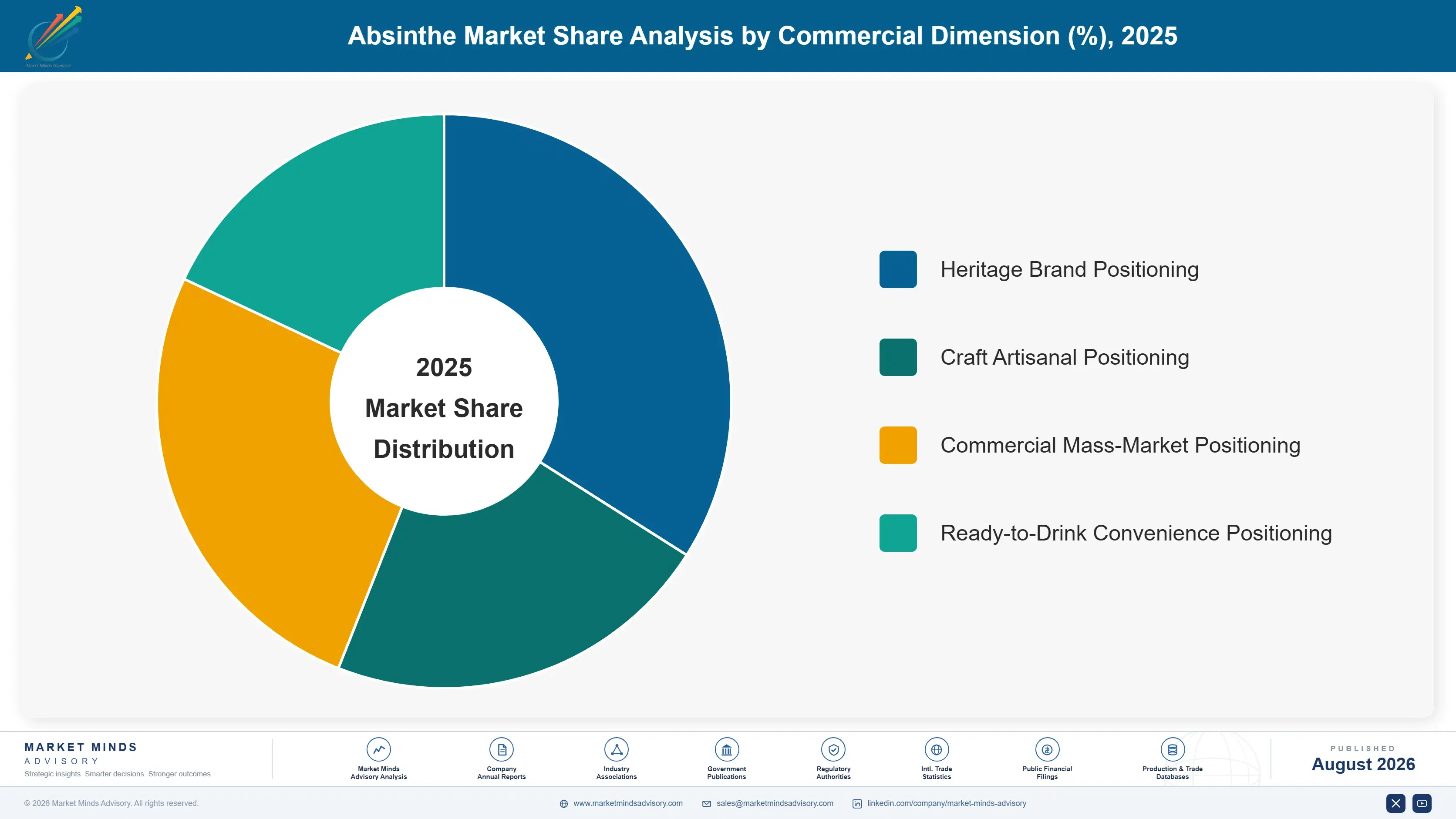
Segmentation follows product style, since verte, blanche, Bohemian-style, ready-to-drink, craft artisanal, and commercial mass-market formats each carry distinct production methods, price positioning, and distribution channels despite sharing the same underlying wormwood and anise botanical foundation across the category overall. Distribution channels and price positioning differ enough between these styles that cross-segment substitution remains limited in practice across most consuming markets.
absinthe-market-market-share-analysis-1787464232924

Ready-to-Drink Absinthe Cocktails

Ready-to-drink formats are growing fastest as mainstream retail distribution expands beyond the craft cocktail bars where absinthe cocktail culture originally developed, offering convenience-seeking consumers an accessible entry point that does not require owning a full bottle or mastering traditional louche preparation technique. This segment requires distinct production infrastructure from traditional bottling, including canning or bottling lines calibrated for pre-mixed cocktail formulations rather than standalone spirit, limiting fast entry to producers with either existing beverage manufacturing partnerships or dedicated capital for new production capability. Larger beverage alcohol companies are increasingly entering this segment through acquisition of craft absinthe brands rather than organic product development. Regulatory frameworks governing ready-to-drink spirits vary by jurisdiction, creating uneven category availability across otherwise similar markets.
CAGR 9.8%

Craft Artisanal Small-Batch Absinthe

Craft artisanal production is the second fastest growing segment, benefiting directly from younger drinker preference for documented provenance and authentic production storytelling over mass-market commodity positioning. Small-batch distillers typically command meaningfully higher per-bottle pricing than commercial mass-market equivalents, supported by limited production runs and direct relationships with specialty retail and on-premise accounts that value exclusivity alongside product quality. Growth here remains constrained by the labor-intensive, small-scale nature of traditional distillation methods most craft producers maintain as part of their brand positioning and authenticity claims relative to larger commercial competitors. Growth here is expected to continue outpacing commercial mass-market bottlings for the foreseeable future as provenance demand strengthens. Larger producers are increasingly evaluating acquisition of promising craft brands in this segment.
CAGR 8.5%
Full segment breakdown across 6 segments available in the complete report.

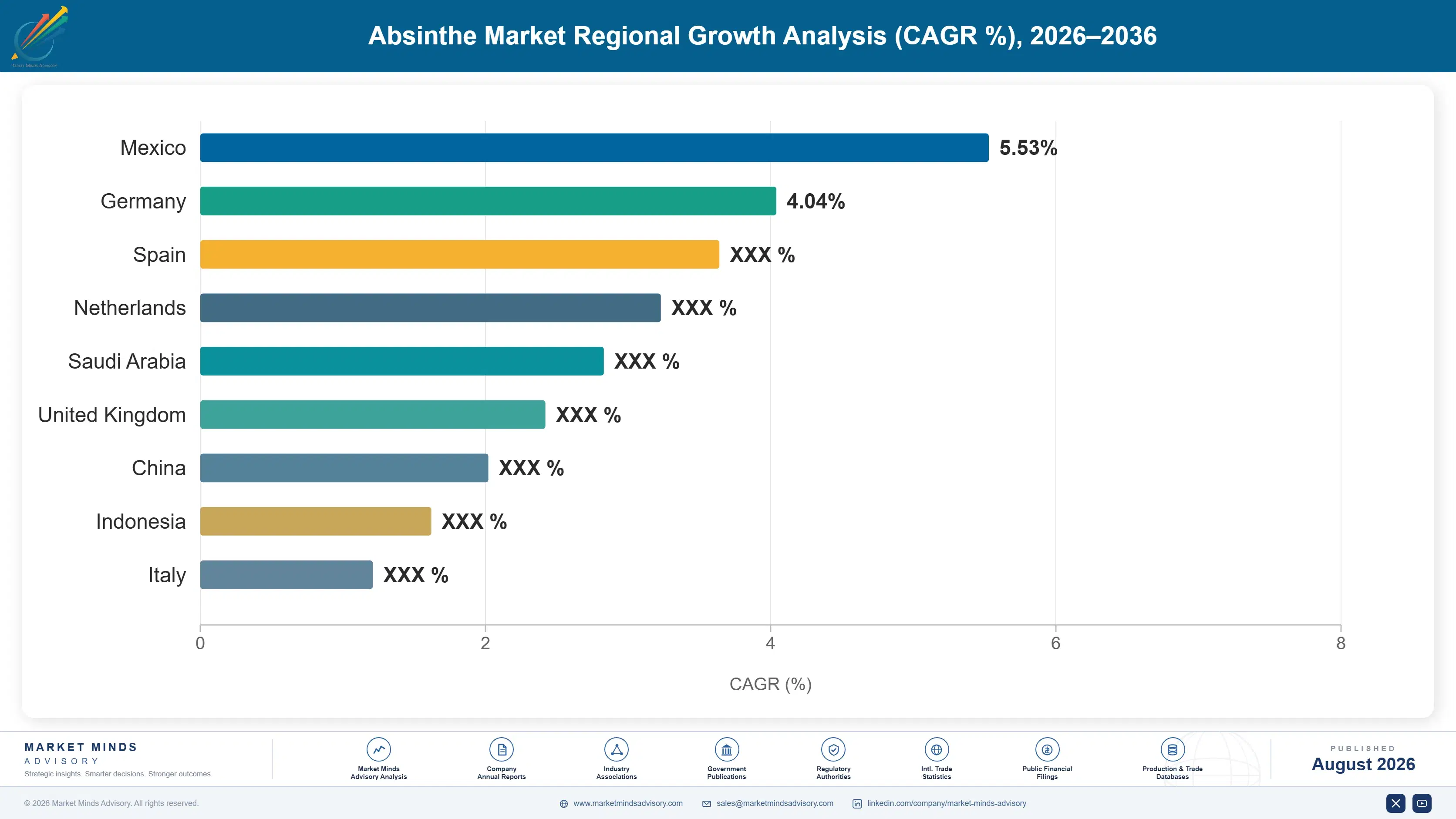
Regional Architecture and Country Demand Map

Western Europe leads on heritage production and consumption through France, Switzerland, and Czech Republic origins, North America follows on craft cocktail culture depth, while other regions remain considerably smaller niche import markets. South Asia and Pacific and Latin America scale steadily as craft culture spreads regionally.

North America

United States craft cocktail bar culture anchors regional consumption, concentrated in major metropolitan markets where bartenders feature absinthe in both classic and original cocktail preparations for increasingly curious younger drinkers. Ready-to-drink absinthe cocktail formats are scaling fastest here, aided by favorable regulatory frameworks in several states permitting broader retail distribution than traditional bottled spirits alone historically enjoyed. Canada follows similar consumption patterns at smaller scale, relying primarily on imported product rather than domestic distillation capacity. Domestic craft distillers are increasingly entering the category, competing against established European imports on provenance storytelling specific to American craft spirits culture. Distributors increasingly favor brands that can supply both traditional and ready-to-drink formats simultaneously.
Share: 28% | CAGR: 7.4% (2026 to 2036)

Western Europe

France, Switzerland, and the Czech Republic anchor the region's heritage production and consumption base, reflecting the category's historical origin and continued cultural association with these specific countries that no other producing region can currently replicate, placing this region's share above typical bands applied to other spirits categories. Legacy French and Swiss distillers maintain the strongest heritage brand equity globally, while Czech producers anchor the distinct Bohemian-style tradition that omits the traditional anise-driven louche effect. Germany and the United Kingdom show growing craft cocktail culture consumption patterns, importing predominantly from these established regional production origins rather than developing significant domestic distillation capacity independently. Retailers across the region increasingly stock heritage brands alongside newer ready-to-drink entrants within the same category sets.
Share: 34% | CAGR: 5.2% (2026 to 2036)
Regional intelligence for 5 additional markets available in the complete report: East Asia, South Asia and Pacific, Latin America, Middle East and Africa, Eastern Europe. Contact sales@marketmindsadvisory.com.
absinthe-market-country-cagr-analysis-1787464233449

Format Innovation and Heritage Defense Levers

Producers are pulling four commercial levers at once: ready-to-drink format development, botanical supply security, craft positioning defense, and consumer education investment, each addressing a distinct margin opportunity created by the category's dual heritage and convenience demand structure. These levers increasingly overlap, since producers pursuing format innovation often simultaneously expand botanical supply security and provenance positioning.

Ready-to-Drink Format Development and Retail Placement

Developing ready-to-drink absinthe cocktail formats and securing mainstream grocery and convenience retail placement allows producers to capture volume growth occurring outside traditional on-premise and specialty retail channels where most legacy brands historically concentrated distribution efforts exclusively. This investment requires meaningful formulation and packaging development cost but positions early movers to capture disproportionate share as the format continues scaling faster than traditional bottled consumption. Early movers report retail placement growth roughly 20 percent faster than competitors still focused solely on traditional bottled formats. This early advantage is expected to compound further as mainstream retailers continue expanding category shelf space.
Market Impact: Lifts retail placement growth by roughly 20 percent

Contracted Botanical Cultivation Supply Agreements Program

Securing long-term contracted cultivation agreements directly with wormwood and anise growers reduces exposure to the spot market price volatility that has periodically compressed margins for producers reliant on open market botanical sourcing. This investment requires patient, multi-year capital commitment given the establishment period specialty herb cultivation requires, but positions producers with secured feedstock access as ready-to-drink and craft segment demand continues outpacing current cultivation capacity across established growing regions. Producers without such agreements remain exposed to the next weather-driven shortfall regardless of current pricing conditions, a risk now shaping roughly 18 percent of new sourcing decisions.
Market Impact: Cuts botanical cost volatility by roughly 18 percent

Craft Provenance Storytelling and Brand Heritage Defense

Investing in documented production provenance, historical narrative content, and authentic brand heritage storytelling defends premium pricing power against both convenience-format competitors and lower-priced commercial mass-market bottlings competing primarily on price. This positioning requires ongoing marketing and brand content investment but has demonstrably supported premium pricing for producers with credible heritage narratives, particularly among younger drinkers who increasingly research brand history before purchase decisions. Brands with credible heritage narratives already report meaningfully stronger pricing power than commodity competitors lacking comparable authenticity credentials, an advantage estimated at roughly 14 percent. This advantage should strengthen as brands compete for younger drinkers.
Market Impact: Defends 14 percent price premium over commercial brands

Consumer Education and Bartender Training Programs

Investing in consumer education content and dedicated bartender training programs addresses lingering unfamiliarity and historical mystique that limits mainstream category trial beyond existing craft cocktail enthusiasts and spirits category adopters. This investment requires ongoing marketing resource commitment but has helped several producers expand trial among previously hesitant mainstream consumers, with participating brands reporting trial rate improvements of roughly 10 percent among targeted consumer segments following education campaign exposure. Programs reaching bartenders directly have proven especially effective at driving incremental trial among previously hesitant consumers. Several producers plan to expand these programs into additional metropolitan markets over the coming year.
Market Impact: Lifts mainstream trial rate by roughly 10 percent

Who Controls the Margin Pool

Concentration remains low, with the top five producers holding a combined 22 percent share on a revenue basis, reflecting a market where legacy French and Swiss heritage houses compete alongside a growing number of craft distillers and ready-to-drink beverage companies entering from adjacent spirits industry backgrounds rather than traditional absinthe production origins. This fragmentation persists even as consolidation among larger beverage companies continues accelerating steadily across the category.
Current competitive activity centers on three dimensions: ready-to-drink format development to capture mainstream retail volume, botanical supply security investment to manage input cost volatility, and craft provenance positioning to defend premium pricing against both convenience formats and commercial mass-market competitors. These three dimensions are increasingly pursued simultaneously by the largest producers competing for premium retail and on-premise placement.

Emerging pressure comes from larger beverage alcohol companies acquiring craft absinthe brands to enter the ready-to-drink segment quickly, and from new craft entrants building direct-to-consumer and specialty retail relationships that bypass traditional distributor intermediaries, threatening to redistribute share away from legacy heritage houses over the coming decade. Rankings among current leading producers could shift meaningfully as these dynamics continue playing out across the coming decade.
absinthe-market-company-positioning-matrix-1787464233986

Competitive Moat and Risk Dimensions

PERNOD RICARD

Moat: Global Distribution Scale

Pernod Ricard's extensive global spirits distribution network and existing retailer and on-premise relationships give its absinthe brands market access that smaller craft distillers cannot replicate, supporting broader geographic reach for both traditional and ready-to-drink format expansion. This distribution advantage is difficult for smaller craft competitors to replicate quickly given the capital required.
PERNOD RICARD

Risk: Limited Heritage Authenticity Positioning

Pernod Ricard's large diversified spirits portfolio positioning gives its absinthe brands less natural heritage authenticity credibility than smaller, family-owned craft producers whose entire brand identity centers specifically on absinthe production tradition and provenance storytelling. This risk grows as smaller, more focused competitors continue building comparable retailer relationships steadily.
LA FEE ABSINTHE

Moat: Early Revival-Era Brand Recognition

La Fee's position as one of the first commercially available absinthe brands following the category's early 2000s revival gives it brand recognition and retailer relationships that newer craft entrants must still build from an earlier stage of market development. This early positioning advantage is difficult for newer entrants to fully replicate despite growing brand awareness efforts.
LA FEE ABSINTHE

Risk: Newer Craft Entrant Exposure

La Fee's revival-era positioning increasingly competes against newer craft distillers with more contemporary branding and direct-to-consumer relationships better suited to reaching younger drinkers than La Fee's earlier-generation revival-era brand identity. This exposure could weigh on results if younger drinkers continue favoring newer, more contemporary craft narratives.

Players Tracked

Prominent Players

Pernod Ricard
La Fee Absinthe
Kubler Absinthe
Lucid Absinthe Superieure
Hill's Absinth

Other Key Players

Absinthe Verte de Fougerolles
Jade Liqueurs
St. George Spirits
Vieux Pontarlier
Pere Kermann's
Duplais Absinthe
Marteau Absinthe
Mansinthe
Tenneyson Absinthe
Absente
Doubs Mystique
La Clandestine Absinthe
Xenta Absinthe
Roquette 1797
Butterfly Absinthe

Recent Developments

APRIL 2026

Pernod Ricard Launches Ready-to-Drink Absinthe Cocktail Line

Pernod Ricard launched a new ready-to-drink absinthe cocktail line targeting mainstream grocery and convenience retail distribution across North America, extending its heritage brand positioning into the fastest-growing segment of the category as competitors accelerate similar convenience format development. Several additional retail partnerships are reportedly under evaluation for similar expansion.
Signal: Signals large beverage companies prioritizing ready-to-drink expansion across heritage portfolios as convenience formats reshape category distribution strategy
NOVEMBER 2025

St. George Spirits Signs Contracted Wormwood Cultivation Agreement

St. George Spirits signed a multi-year contracted cultivation agreement with a California wormwood grower, securing preferential feedstock access as botanical supply constraints continue affecting smaller craft distillers reliant on open market sourcing across the category. reflecting growing urgency around securing reliable feedstock access industry wide.
Signal: Confirms botanical supply security becoming a priority as ready-to-drink demand accelerates as smaller producers seek comparable supply security arrangements
JUNE 2025

Kubler Absinthe Expands Craft Cocktail Bar Training Program

Kubler Absinthe expanded its bartender training and consumer education program across major North American metropolitan markets, aiming to broaden mainstream category familiarity beyond existing craft cocktail enthusiasts as the brand competes for premium on-premise placement. Early feedback from participating venues has reportedly been favorable across most markets.
Signal: Demonstrates consumer education investment scaling as a competitive differentiation strategy as brands compete for premium on-premise placement nationwide

Wormwood and Anise Botanical Exposure

Wormwood and anise botanical inputs together represent roughly 29 percent of cost of goods sold for absinthe production, sourced primarily from French, Swiss, and Eastern European growing regions with climate conditions suited to high-thujone-content Artemisia absinthium cultivation, alongside smaller volumes of anise sourced from Mediterranean growing origins. with a smaller residual share of anise sourced from Turkish and Spanish growing regions.
Wormwood prices spiked sharply in 2023 following unfavorable growing season weather across key European cultivation regions, a volatility event documented in European Commission agricultural market reporting, compressing margins for smaller craft distillers lacking long-term grower contracts and forcing several to delay planned production expansion by two to three quarters. Several smaller distillers reported continued margin pressure into 2024 as botanical prices remained elevated longer than expected.

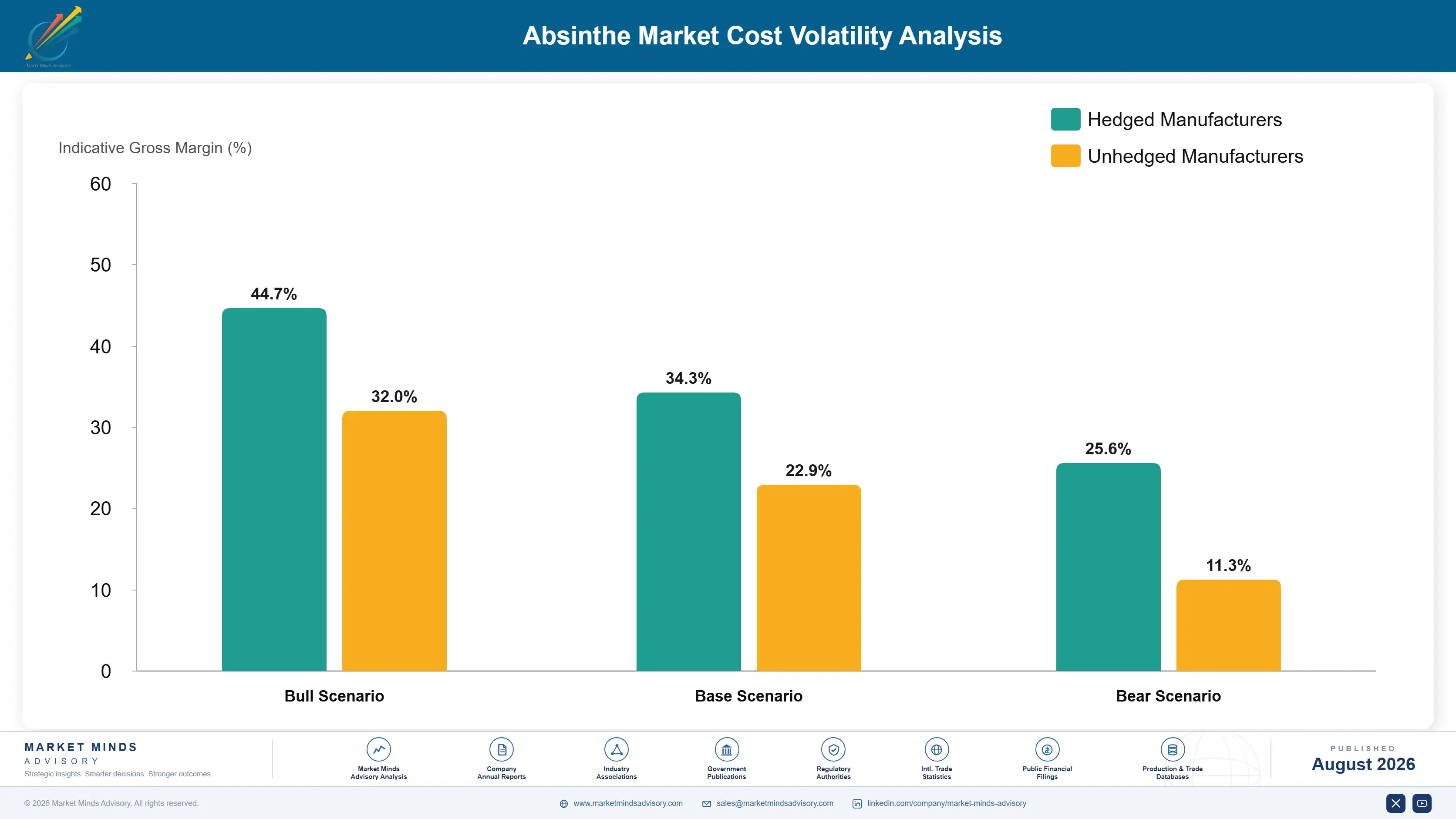
Exposure varies considerably by player type: larger producers with contracted cultivation agreements have absorbed volatility more easily than smaller craft distillers reliant on spot market botanical purchases, a disadvantage that is increasingly steering smaller producers toward cooperative purchasing arrangements or acquisition by larger competitors seeking secured input access. This consolidation trend is expected to continue as botanical price volatility persists across key growing regions.
absinthe-market-cost-volatility-analysis-1787464234200

Multi-Year Contracted Cultivation Agreements With Growers

Larger producers are locking in multi-year contracted cultivation agreements directly with wormwood and anise growers, securing preferential pricing and volume access ahead of spot market buyers during periods of tight supply, while sharing agronomic risk with established growing cooperatives rather than bearing sourcing risk entirely independently. Adoption has expanded since the 2023 shock. Adoption continues broadening across the category.

Cooperative Purchasing Arrangements Among Smaller Distillers

Smaller craft distillers pooling purchasing volume through cooperative arrangements can access more favorable pricing and supply priority than any individual small producer could negotiate independently, spreading botanical sourcing risk across multiple participating producers. Several regional cooperatives have already formed specifically to negotiate collective botanical purchasing agreements with growers. Participation continues growing as more independent producers recognize the collective bargaining benefit.

Geographic Sourcing Diversification Across Growing Regions

Diversifying botanical sourcing across French, Swiss, and Eastern European growing regions reduces exposure to any single region's weather disruption, though it requires established grower relationships and quality verification capability across multiple international sourcing origins that smaller producers often lack. Larger producers increasingly maintain relationships across all three growing regions simultaneously as standard practice. This remains most common among larger producers.

Portfolio Architecture for Margin Defence

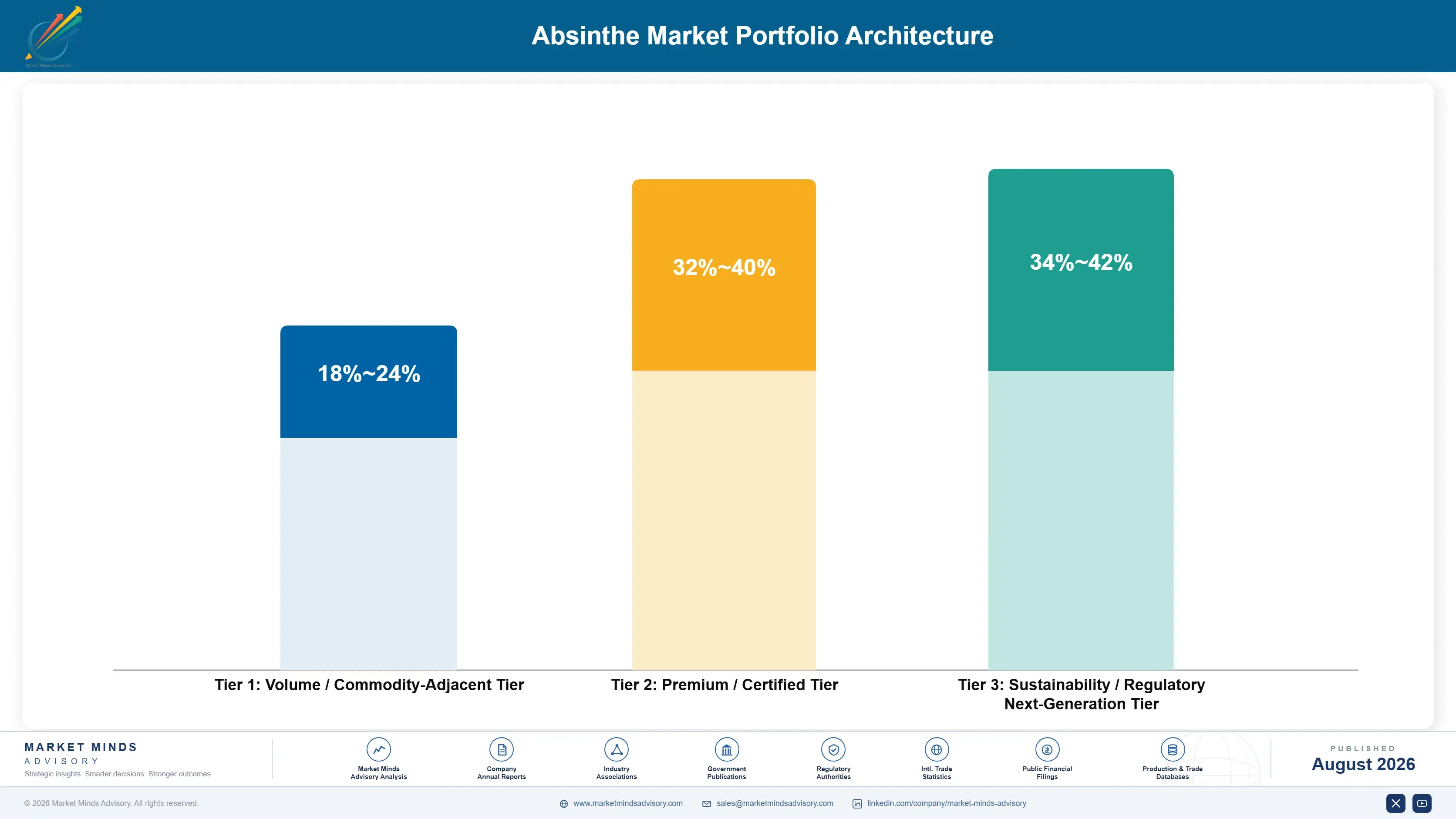
Portfolio economics split across three tiers: commercial mass-market bottlings competing largely on price and broad retail availability, craft artisanal and heritage verte bottlings commanding premium pricing tied to provenance and production authenticity, and ready-to-drink cocktail formats capturing growing margin as convenience-seeking consumers pay for accessibility alongside brand storytelling. Processors without clear tier positioning increasingly struggle to compete effectively in either direction across the category.
The tension between volume and premium positioning is sharpest at retail, where commercial mass-market bottlings compete on price against craft alternatives commanding meaningfully higher per-bottle pricing, pushing legacy producers to defend heritage positioning through provenance storytelling while newer entrants compete on both craft authenticity and ready-to-drink convenience simultaneously. Brands investing early in premium tier storytelling are increasingly better positioned than those defending commodity volume alone.

High value margin pools concentrate in craft artisanal bottlings and premium ready-to-drink formats sold through specialty retail and curated on-premise accounts, where documented provenance and brand storytelling limit competition to producers with established authentic heritage credentials. Competing producers continue widening this gap through sustained provenance and brand content investment. Buyers increasingly favor producers who can demonstrate this capability consistently across seasons.

Volume / Commodity-Adjacent Tier

Commercial mass-market bottlings competing primarily on price and broad retail availability across conventional spirits channels. Margins here depend heavily on distribution scale and price positioning rather than on differentiated provenance claims.
Gross Margin: 18-24%

Premium / Certified Tier

Craft artisanal and heritage verte bottlings commanding premium pricing from provenance-focused specialty retail and on-premise accounts. Buyers in this tier increasingly value documented production history and authentic brand narrative credentials.
Gross Margin: 32-40%

Sustainability / Regulatory / Next-Generation Tier

Ready-to-drink cocktail formats and innovative botanical blends serving convenience-seeking mainstream retail channels. Capacity here remains concentrated among a small number of producers, keeping margins durably elevated for now. Capacity here remains limited relative to accelerating mainstream retail demand.
Gross Margin: 34-42%
absinthe-market-portfolio-architecture-1787464234740

High-value Sub-segments and Strategic Watch-out

Premium Ready-to-Drink Cocktail Formats

Scaling fastest as mainstream retail distribution expands, this segment commands strong per-unit pricing but remains constrained by limited production infrastructure calibrated specifically for pre-mixed cocktail formulations across current producers. Producers investing early in dedicated production lines are best positioned to capture this accelerating demand. Demand keeps outpacing capacity.
Gross Margin: 36-42%

Heritage Verte and Craft Artisanal Bottlings

Documented provenance and production authenticity support durable pricing power here, though growth trails ready-to-drink formats given smaller addressable audience limited to existing craft spirits enthusiasts and collectors. Collectors and enthusiasts continue driving steady demand even as broader category growth concentrates elsewhere. This base provides a stable revenue floor.
Gross Margin: 32-38%

Commercial Mass-Market Bottled Absinthe

The largest volume segment by unit count, competing primarily on price and broad distribution across conventional retail channels, and increasingly exposed to craft and ready-to-drink share erosion over time. Brand loyalty here remains modest, leaving this segment most exposed to continued share erosion. Larger competitors keep capturing share on price.
Gross Margin: 16-22%

Unbranded Commodity Import Bottlings

Facing declining relevance as provenance and brand storytelling increasingly determine purchase decisions, this segment requires urgent repositioning investment or faces continued margin erosion across major consuming markets. Repositioning investment now offers the clearest path back into relevance for these bottlings. Producers investing now gain ground against faster-moving competitors.
Gross Margin: 12-18%

Occasion-Based Consumption Economics

Demand in this category increasingly splits between two distinct consumption occasions rather than operating as a single spirits purchase pattern: deliberate craft cocktail exploration occasions favoring heritage and artisanal bottlings, and convenience-driven casual occasions increasingly served by ready-to-drink formats requiring no preparation knowledge or specialized equipment. Producers who serve both occasions well are increasingly rare but capture disproportionate category value.
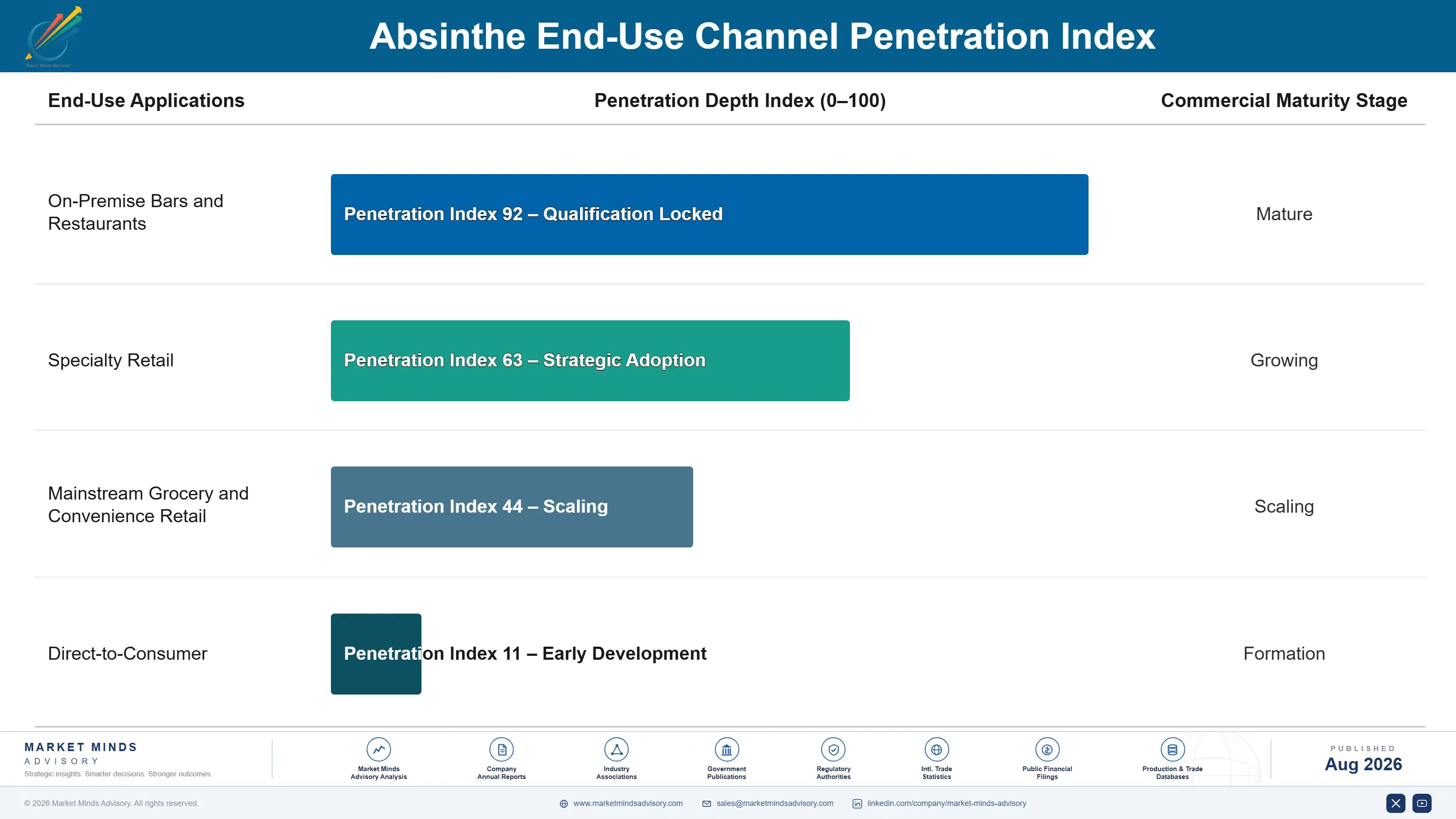
Adoption depth varies considerably by end use vertical: craft cocktail bars and specialty on-premise accounts show the deepest and most consistent adoption of heritage and artisanal bottlings, mainstream retail and grocery channels show growing but still emerging adoption of ready-to-drink formats, and conventional liquor retail remains the shallowest adopter of premium positioning, still prioritizing commercial mass-market bottlings sold primarily on price. Conventional liquor retailers are expected to gradually adopt more premium positioning as category awareness continues broadening.

Younger drinkers entering the spirits category increasingly expect both convenience and authentic provenance storytelling from the same brand simultaneously, a generational shift that is pushing producers toward hybrid strategies combining heritage credibility with modern accessible formats rather than choosing one positioning exclusively. Brands slow to adapt risk losing relevance with this increasingly dual-expectation younger cohort of drinkers.
absinthe-market-end-use-penetration-index-1787464235333

Where Absinthe Producer Capital Should Concentrate

These are among the four positions where our research anticipates prominent divergence between winners and laggards over the coming forecast period. Each is grounded in the demand model, the regulatory perimeter, and the announced capacity pipeline.
01 / READY-TO-DRINK FORMAT INVESTMENT

Build convenience formats before competitors capture mainstream retail shelf space

Mainstream retail and grocery distribution is increasingly favoring ready-to-drink formats over traditional bottled absinthe requiring preparation knowledge most casual consumers lack. Producers that developed ready-to-drink capability early are already reporting retail placement growth meaningfully faster than competitors focused solely on traditional bottled formats. This advantage compounds as mainstream retailers increasingly allocate shelf space based on demonstrated sales velocity, rewarding early movers with continued placement over slower-moving heritage-only competitors, a gap that widens with each shelf reset cycle since slower movers rarely catch up fully.
02 / BOTANICAL SUPPLY SECURITY

Secure contracted wormwood cultivation before the next weather-driven shortfall

Wormwood botanical supply has already demonstrated its volatility potential following the 2023 European weather-driven shortfall, and cultivation capacity additions continue to lag category demand growth in most years. Producers without contracted cultivation agreements remain exposed to the next disruption, a disadvantage increasingly steering craft distillers toward cooperative purchasing or acquisition by better-supplied competitors. Securing contracted agreements now, while cultivation capacity continues expanding, costs less than waiting for the next shortfall to force reformulation on far less favorable terms, since delay only compounds the eventual cost.
03 / HERITAGE PROVENANCE DEFENSE

Invest in provenance storytelling before commodity positioning erodes premium pricing

Younger drinkers increasingly research brand history and production authenticity before purchase, making documented provenance storytelling a more durable pricing advantage than competing purely on convenience or price against commercial mass-market bottlings. Producers with credible heritage narratives already command meaningfully higher pricing than commodity competitors lacking comparable authenticity credentials. Producers delaying this investment risk losing premium positioning to newer craft entrants building more contemporary provenance narratives from the outset, a gap that grows costlier to close over time, since early narrative investment pays off steadily.
04 / CONSUMER EDUCATION INVESTMENT

Fund mainstream education before lingering unfamiliarity caps category growth further

Lingering historical mystique and unfamiliarity continue limiting mainstream trial beyond existing craft cocktail enthusiasts and spirits category adopters, constraining the category's overall addressable market relative to comparable craft spirits categories that have achieved broader mainstream acceptance. Producers investing in consumer education and bartender training already report meaningful trial rate improvements among previously hesitant consumer segments. Producers slower to invest in education risk ceding this expanding addressable market to more proactive competitors already embedded with key retail accounts, meaning education budgets should scale accordingly.

Engagement Snapshot From the Field

A live engagement with an industry participant carrying material or product regulatory and market exposure ahead of a defining policy shift, showing how our research translates into a defensible multi-year portfolio strategy.
MARKET MINDS ADVISORY · CLIENT ENGAGEMENT SUMMARY
Absinthe Producer Strategic Portfolio Review and Transition Roadmap 2026·Investment Scenario on Absinthe Exposure Evaluation 2025-26
CLIENT PROFILE
The client is a mid-sized North American craft absinthe distillery generating approximately 12 million dollars in annual revenue (client-reported, unverified by MMA), historically selling traditional bottled verte absinthe through specialty retail and on-premise accounts without ready-to-drink product capability of its own. The distillery operates a single production facility in the Pacific Northwest region. Annual production volume runs roughly forty thousand nine-liter cases.
STRATEGIC CHALLENGE
Facing slowing bottled product growth as larger competitors launched ready-to-drink absinthe cocktail lines capturing mainstream retail shelf space, the client needed to evaluate whether to develop ready-to-drink capability internally or partner with an existing beverage manufacturer, without sufficient capital to build dedicated production infrastructure independently. Board approval was required before committing to either strategic path.
MMA APPROACH
MMA conducted a comparative feasibility assessment of internal ready-to-drink development versus co-packing partnership options, incorporating retail buyer interviews, capital cost modeling, and competitive benchmarking against established ready-to-drink entrants, then developed a phased eighteen month go-to-market roadmap sequenced to the client's available capital. Recommendations were validated against two prospective retail partnership requirements directly.
KEY FINDINGS
  1. Co-packing partnership offered a faster path to market than internal production capability given the client's limited available capital for new equipment. within the client's available capital constraints.
  2. Existing specialty retail and on-premise relationships could be used to secure initial ready-to-drink distribution commitments. reducing the time needed to reach initial market.
  3. Two regional grocery chains expressed preliminary interest contingent on the client completing initial ready-to-drink product formulation and packaging. subject to final formulation approval being completed.
  4. Internal production capability remained attractive as a longer-term investment once initial ready-to-drink revenue justified the required capital commitment. once initial revenue justified the required capital commitment.
CLIENT PROFILE
The client is a mid-sized North American craft absinthe distillery generating approximately 12 million dollars in annual revenue (client-reported, unverified by MMA), historically selling traditional bottled verte absinthe through specialty retail and on-premise accounts without ready-to-drink product capability of its own. The distillery operates a single production facility in the Pacific Northwest region. Annual production volume runs roughly forty thousand nine-liter cases.
STRATEGIC CHALLENGE
Facing slowing bottled product growth as larger competitors launched ready-to-drink absinthe cocktail lines capturing mainstream retail shelf space, the client needed to evaluate whether to develop ready-to-drink capability internally or partner with an existing beverage manufacturer, without sufficient capital to build dedicated production infrastructure independently. Board approval was required before committing to either strategic path.
MMA APPROACH
MMA conducted a comparative feasibility assessment of internal ready-to-drink development versus co-packing partnership options, incorporating retail buyer interviews, capital cost modeling, and competitive benchmarking against established ready-to-drink entrants, then developed a phased eighteen month go-to-market roadmap sequenced to the client's available capital. Recommendations were validated against two prospective retail partnership requirements directly.
KEY FINDINGS
  1. Co-packing partnership offered a faster path to market than internal production capability given the client's limited available capital for new equipment. within the client's available capital constraints.
  2. Existing specialty retail and on-premise relationships could be used to secure initial ready-to-drink distribution commitments. reducing the time needed to reach initial market.
  3. Two regional grocery chains expressed preliminary interest contingent on the client completing initial ready-to-drink product formulation and packaging. subject to final formulation approval being completed.
  4. Internal production capability remained attractive as a longer-term investment once initial ready-to-drink revenue justified the required capital commitment. once initial revenue justified the required capital commitment.
RECOMMENDED STRATEGY
Phase 1: Phase 1 (Months 1 to 6): Finalize co-packing partnership and complete ready-to-drink product formulation. with dedicated co-packer quality oversight established. Phase 2: Phase 2 (Months 7 to 12): Launch through existing specialty retail relationships and secure grocery chain commitments. while maintaining existing specialty retail volume. Phase 3: Phase 3 (Months 13 to 18): Evaluate internal production investment using established ready-to-drink revenue base. to diversify future production capability further.
OUTCOME
Within eighteen months of implementation, the client reported securing two regional grocery chain distribution agreements representing roughly 22 percent of total revenue and achieving a 19 percent increase in overall brand volume through combined bottled and ready-to-drink sales (client-reported, unverified by MMA). Brand awareness also improved measurably across targeted younger demographic segments.

Frequently Asked Questions

Foundational context covering the market sizes, CAGR, scope, country, region and competition that inform every finding below. This section is provided to cover basics and most often pre-purchase conversations, answered from the MMA Primary Research Dataset.

What is the current size of the Absinthe Market?

The Absinthe Market is valued at approximately 420 million dollars in 2025, spanning traditional bottled, craft artisanal, and ready-to-drink cocktail formats across global spirits retail and on-premise channels.

How large will the Absinthe Market be by 2036?

The market is projected to reach roughly 0.87 billion dollars by 2036, driven by expanding ready-to-drink distribution and continued craft cocktail culture growth. across all product formats combined globally.

What is the CAGR for the Absinthe Market 2026 to 2036?

The market is expected to grow at a compound annual growth rate of approximately 6.8 percent between 2026 and 2036, supported by format innovation and craft positioning.

Which segment is growing fastest?

Ready-to-drink absinthe cocktails are the fastest growing segment, expanding at roughly 1.4 times the overall market rate as mainstream retail distribution continues broadening. as mainstream retail distribution continues expanding.

Who are the major companies in the Absinthe Market?

Leading companies include Pernod Ricard, La Fee Absinthe, Kubler Absinthe, Lucid Absinthe Superieure, and Hill's Absinth, each competing across heritage and convenience formats. competing across heritage and convenience formats.

Which country is growing fastest?

The United States is the fastest growing single country, as its craft cocktail bar culture and ready-to-drink format adoption continue expanding distribution nationwide. ahead of most other major consuming nations.

Report Segmentation Architecture

The full report scope spans multiple orthogonal segmentation dimensions, with cross-tabulated demand data provided for each dimension pair. Coverage extends further to regional breakdowns, trend trajectories, and the competitive detail needed to support segment-level decision-making.

By Product Style

  • Traditional Verte
  • Blanche
  • Bohemian-Style Wormwood Spirits
  • Ready-to-Drink Cocktails
  • Craft Artisanal Small-Batch
  • Commercial Mass-Market

By End-Use Channel

  • On-Premise Bars and Restaurants
  • Specialty Retail
  • Mainstream Grocery and Convenience Retail
  • Direct-to-Consumer

By Commercial Dimension

  • Heritage Brand Positioning
  • Craft Artisanal Positioning
  • Commercial Mass-Market Positioning
  • Ready-to-Drink Convenience Positioning

By Region

  • North America
  • Western Europe
  • East Asia
  • South Asia and Pacific
  • Latin America
  • Middle East and Africa
  • Eastern Europe

Scope, Methodology, and Coverage

Every figure in this report is reproducible from documented input assumptions. The scope below maps the historical period, the forecast horizon, the segmentation dimensions, and the countries covered, alongside the underlying primary and qualitative methodology.
Historical Period
2020 to 2025
Forecast Period
2026 to 2036
Base Year
2025 (USD billions; MMA Primary Research Dataset, August 2026)
Market Definition
The absinthe market covers wormwood-based distilled spirits historically associated with Artemisia absinthium, sold as traditional verte and blanche bottlings, craft artisanal releases, and ready-to-drink cocktail formats through retail and on-premise channels. It excludes wormwood-flavored wines and vermouths, and excludes absinthe-branded merchandise or experiences sold independent of the distilled spirit itself.
Quantitative Units
USD millions (current prices); liters for select volume metrics
Segmentation Dimensions
By Product Style; By End-Use Channel; By Commercial Dimension; By Region
Regions Covered
North America, Western Europe, East Asia, South Asia and Pacific, Latin America, Middle East and Africa, Eastern Europe
Countries Covered
USA, China, Germany, France, UK, Japan, South Korea, India, Australia, Canada, Brazil, Mexico, Indonesia, Vietnam, Thailand, Malaysia, UAE, Saudi Arabia, South Africa, Nigeria, Turkey, Poland, Netherlands, Italy, Spain, Sweden, Switzerland, Argentina, Colombia, Singapore, and additional markets relevant to this sector
Key Companies Profiled
Pernod Ricard, La Fee Absinthe, Kubler Absinthe, Lucid Absinthe Superieure, Hill's Absinth, Absinthe Verte de Fougerolles, Jade Liqueurs, St. George Spirits, Vieux Pontarlier, Pere Kermann's, Duplais Absinthe, Marteau Absinthe, Mansinthe, Tenneyson Absinthe, Absente, Doubs Mystique, La Clandestine Absinthe, Xenta Absinthe, Roquette 1797, Butterfly Absinthe
Quantitative Methodology
Primary survey, n=3,800 respondents, Q4 2025, six countries; demand-side model with trade association cross-validation
Qualitative Methodology
47 expert interviews, Q4 2025; applied to validate demand model assumptions, identify emerging dynamics, and assess competitive positioning
Report Format
PDF and XLSX data workbook (Word format preview document)
Publisher
Market Minds Advisory
Report Code
MMA-2026-AGR-209
Published
August 2026
Contact
sales@marketmindsadvisory.com | www.marketmindsadvisory.com

Purchase the full Absinthe Market Report (2026 to 2036).

The full report delivers a complete quantitative and qualitative assessment of the absinthe market, including detailed segment level forecasts through 2036, regional analyses across all seven covered geographies, and profiles of twenty leading producers and brands. It incorporates primary survey data from 3,800 respondents and 47 expert interviews conducted in the fourth quarter of 2025. Buyers receive editable data tables, a customizable Excel forecast model, and access to MMA analysts for follow up questions during a defined post purchase support window. The report also includes detailed botanical input cost sensitivity analysis calibrated to current European cultivation benchmarks.
Detailed segment-level market forecasts through 2036
All seven regional market analyses included
Twenty profiled leading producers and brands
Editable Excel based forecast data model
Primary survey and expert interview data
Extended post-purchase analyst support access included

Built For The People Who Decide

From boardroom strategy to bench-side execution, this report is read cover-to-cover by leaders shaping the next decade of their industry, turning demand scenarios, market dynamics and valuation benchmarks into decisions.
CXOs/ Presidents/ VPs/ Managers
M&A and Corporate Development
Strategy Teams and R&D Heads
Procurement and Product Directors
Regulatory and Compliance Leaders
Investor Relations and Equity Analysts