
Market Minds Advisory
Above-the-Waist PPE Market

Above-the-Waist PPE Market: Compliance Meets Connected Safety Technology

Above-the-waist PPE demand is bifurcating between commodity hard hats and safety glasses squeezed on price and connected, sensor-equipped respiratory and hearing protection commanding premium industrial pricing under the same compliance category.

Lead Analyst

David Horsley

Published

September 2026

Make Smarter Decisions with Customized Research Insights

Request a free sample report and evaluate market opportunities, growth trends, and competitive dynamics relevant to your business needs.

2025 MARKET VALUE$18.4BMarket Size 2025
2036 FORECAST VALUE$36.4BBase Case , 2026 to 2036
CAGR 2026 TO 20366.4 %Bull 7.6% / Bear 5.2%
INCREMENTAL OPPORTUNITY$16.8BNet 10- year value creation
EXPANSION MULTIPLE1.86x2036 value over 2026 base
Strategic Levers
M&A Pipeline
Regional Outlook
Country Rankings
Competitive Intelligence
Segmental Deep-dive
Call-Us : 91 93563 13602

Executive Snapshot and Market Trajectory

Above-the-waist PPE covers head, eye, face, hearing, respiratory, and hand protection sold primarily on regulatory compliance rather than consumer preference. That compliance-driven purchasing pattern makes the category unusually resistant to economic cycles, since employers cannot simply skip safety equipment when budgets tighten without real legal and liability exposure.
East Asia holds the largest regional share, reflecting China's enormous manufacturing and construction workforce and steadily tightening domestic workplace safety enforcement. North America follows closely, driven by strict OSHA compliance requirements that push buyers toward higher-specification, more expensive protection than minimum-standard products sold elsewhere. Respiratory protection is growing fastest across every region, driven by heightened industrial hygiene awareness, wildfire smoke exposure concerns, and post-pandemic buyer sensitivity to airborne workplace hazards generally.
Competition is moderately concentrated, with the top five suppliers holding roughly a third of global volume through broad, multi-category product portfolios. 3M and Honeywell Safety Products lead on technology and brand recognition across nearly every product category, while regional manufacturers compete hardest on price for basic head and eye protection. Connected PPE, incorporating sensors that monitor fit, usage, and hazard exposure in real time, is emerging as the next real differentiator beyond simple compliance certification.
Market Definition
The above-the-waist personal protective equipment market covers head, eye, face, hearing, respiratory, and hand protection products sold for industrial, construction, and occupational safety compliance use. It excludes below-the-waist protective equipment such as safety footwear and leg protection, and excludes full-body protective clothing and coveralls sold as a distinct product category.
Base Year Value
$18.4B in 2025 (MMA Primary Research Dataset, August 2026)
Forecast Period
2026 to 2036, eleven discrete annual values
CAGR
6.4% base case. Bull 7.6%. Bear 5.2%.
Fastest Growth Segment
Respiratory Protection: 9.8% CAGR
Fastest Growth Country
China: 8.1% CAGR
Fastest Growth Region
South Asia and Pacific: 8.4% CAGR
Largest Region
East Asia: 29% of 2025 global value
Market Leaders
3M, Honeywell Safety Products, MSA Safety, DuPont, and Uvex Group lead global supply. Source: MMA Analysis based on company annual reports.
Primary Survey
n=3,800 procurement and R&D decision-makers, Q4 2025, six countries
Methodology
Demand-side build-up, cross-validated against public data, 47 expert interviews

Above-the-Waist PPE Market Forecast Scenarios

above-the-waist-ppe-market-trends-size-forecast-scenario-1787464093655
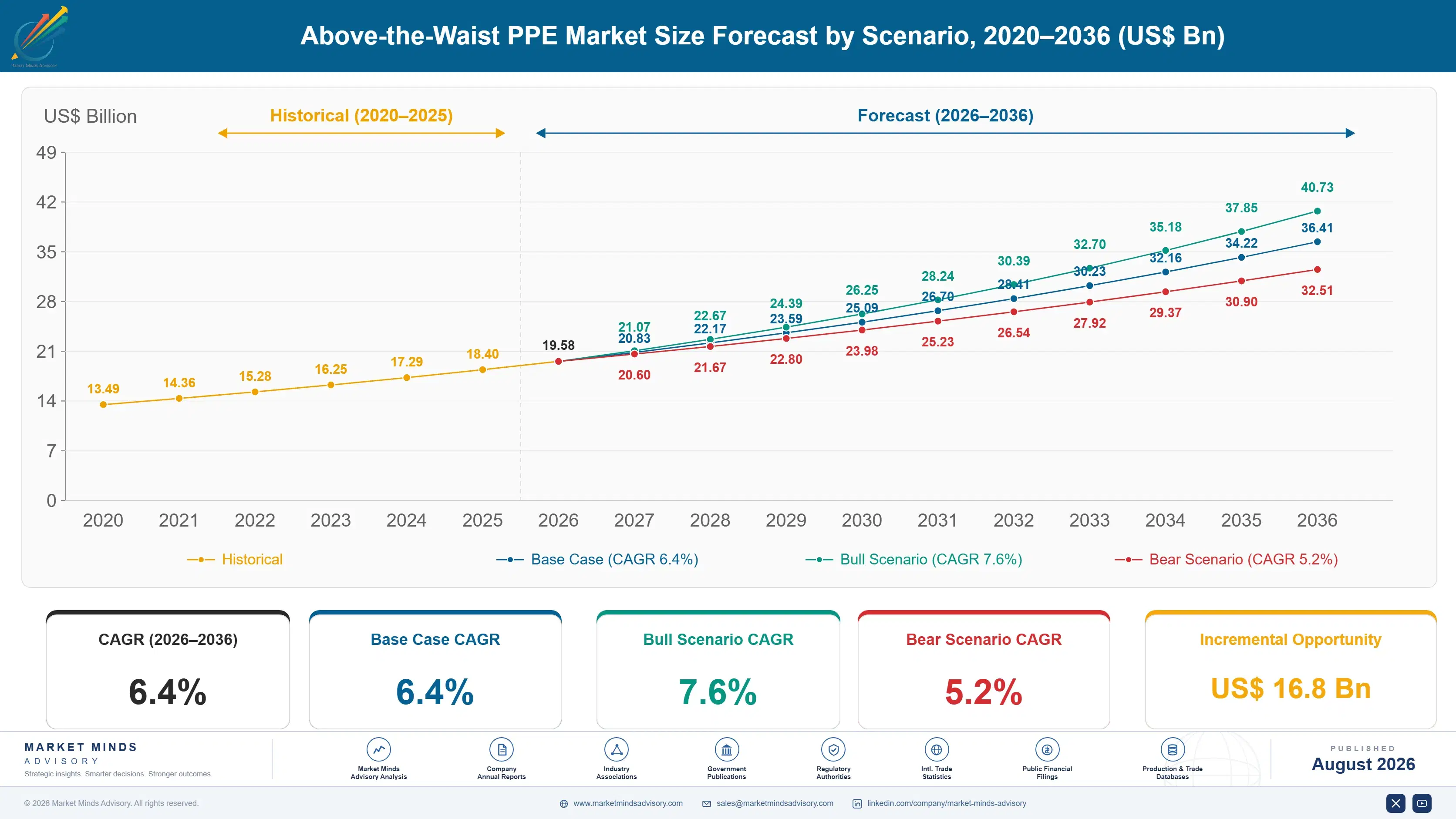
Between 2020 and 2025, above-the-waist PPE demand grew at an estimated 5.6% annually as pandemic-era respiratory protection demand surged before normalizing, while underlying industrial and construction employment growth sustained steady baseline demand for head, eye, and hearing protection throughout the period. 3M and Honeywell Safety Products both expanded respiratory protection manufacturing capacity early in the period to meet emergency demand.
MMA's base case projects 6.4% annual growth to 2036 on three mechanisms: global industrial and construction employment growth sustaining baseline demand for standard protection categories across expanding manufacturing regions, tightening workplace safety regulation in emerging manufacturing economies pushing minimum-standard buyers toward certified compliant products, and adoption of connected, sensor-equipped PPE among large industrial employers seeking real-time hazard monitoring and compliance documentation. Mining and oil and gas operators are adding a fourth, smaller growth channel through specialized high-hazard protection requirements.
A bull catalyst comes from major manufacturing economies tightening workplace safety enforcement meaningfully, which could pull millions of non-compliant workers into the certified PPE market within a few years. The bear risk is economic: a sustained global manufacturing and construction slowdown could compress baseline PPE replacement demand enough to slow the capacity expansion several suppliers have committed capital to.

Compliance-Driven Demand Meets Connected Safety Technology

Above-the-waist PPE sells on one core promise: keeping a worker's head, eyes, ears, lungs, or hands intact through a hazard that would otherwise cause real injury. That promise makes the category fundamentally compliance-driven rather than discretionary, since most jurisdictions legally require specific protection categories for specific hazard classes. Suppliers that treat this purely as a commodity manufacturing business are losing ground to those investing in genuine hazard-specific technology.
MARKET CONCENTRATION34%Top five suppliers hold roughly a third of total
AVERAGE SELLING PRICE$28.40/unitConnected, sensor-equipped protection commands the steepest price premium
TOP PRODUCING COUNTRYChinaLargest manufacturing workforce drives overall industrial PPE consumption
CAPACITY UTILIZATION76%Production lines scale seasonally with construction activity cycles
FEEDSTOCK COST SHARE34% of COGSPolymer and specialty filtration materials dominate input cost structure
TRADE INTENSITY41% exportedNearly half of finished product volume crosses international borders
Commercially, the category behaves like a specialty industrial manufacturing business layered onto a regulatory compliance framework. Polymer and specialty filtration material costs track broader petrochemical and nonwoven fabric commodity cycles, while finished product pricing increasingly tracks certification level, comfort engineering, and connected technology features rather than raw material cost alone. Suppliers that invest in comfort and connectivity are capturing share from pure commodity manufacturers.
Over the next decade, expect connected, sensor-equipped protection and real-time compliance documentation to matter more than unit price alone, particularly as large industrial employers seek liability protection through verifiable usage records. Suppliers investing in sensor technology and digital compliance platforms are positioned to capture enterprise accounts that basic commodity manufacturers increasingly cannot serve.
"Most buyers still think of PPE as a line item they have to check off. The employers actually reducing incident rates are the ones treating it as a technology investment with real data behind it."
Director, Industrial Safety and Protective Equipment Practice · MMA Industrial Safety and Protective Equipment Practice · August 2026

Market Trends

Connected Sensor-Equipped PPE Gains Enterprise Adoption

Large industrial employers are increasingly adopting connected PPE incorporating sensors that monitor fit, usage compliance, and hazard exposure in real time, moving beyond passive protective equipment toward active safety management systems that generate documented compliance records. Honeywell Safety Products and 3M have both expanded connected PPE product lines over the past two years specifically to serve large enterprise mining, construction, and manufacturing accounts. At least a handful of major industrial employers have piloted fleet-wide connected respiratory and hearing protection programs since 2023, and safety directors report these programs are measurably reducing recordable incident rates compared with conventional equipment.
Market Impact: Sustains demand across 5%+ growth
Emerging Market Safety Enforcement Tightens Rapidly

Manufacturing economies across Asia and Latin America are tightening workplace safety enforcement meaningfully, requiring certified compliant PPE where previously minimum-standard or uncertified equipment was common practice across smaller manufacturing operations. China's Ministry of Emergency Management has expanded workplace safety inspection frequency and enforcement penalties substantially over the past several years, driving certified product adoption among manufacturers previously operating with minimal compliance investment. More than three hundred thousand additional Chinese manufacturing facilities came under expanded safety inspection scope since 2023, and certified PPE suppliers report meaningful order growth directly tied to this regulatory tightening.
Market Impact: Adds seasonal spikes worth 15%+

Market Opportunities and Growth Drivers

Global Construction Employment Growth Sustains Demand

Global construction employment continues expanding steadily, particularly across Asian and Middle Eastern infrastructure development programs, sustaining underlying baseline demand for head, eye, and hearing protection regardless of broader economic cycle conditions. Middle Eastern infrastructure megaprojects have specifically driven substantial incremental construction workforce growth over the past several years, requiring certified PPE across the full range of protection categories for newly hired workers. Industry analysts report this underlying construction employment growth provides a stable volume floor for the category even as individual project cycles fluctuate considerably. This trend is expected to continue as infrastructure spending accelerates across multiple regions simultaneously.
Market Impact: Found failures in 20%+ of counterfeits

Wildfire and Air Quality Concerns Drive Respiratory Demand

Increasing wildfire frequency and broader air quality concerns across North America and other affected regions are driving respiratory protection demand well beyond traditional industrial workplace applications into outdoor construction and agricultural work settings. 3M reports respiratory protection sales tied specifically to air quality and wildfire smoke exposure concerns have grown considerably faster than its broader industrial respiratory protection segment over the past several years. Retailers and industrial distributors report seasonal demand spikes tied directly to wildfire events now represent a meaningful and recurring share of annual respiratory protection sales volume.
Market Impact: Cuts compliance usage by 25%+

Market Restraints and Challenges

Counterfeit and Non-Certified Products Undermine Trust

Counterfeit and non-certified PPE products, particularly respiratory and eye protection sold through online marketplaces without proper certification testing, are undermining trust in labeled safety claims, and the root cause is that marketplace verification of certification claims remains inconsistent and hard to confirm. Regulatory investigations have found counterfeit respiratory products failing to meet filtration standards in a share of tested units sold online. This erosion creates real safety and reputational exposure for legitimate manufacturers whose products get confused with counterfeit alternatives on price-focused listings. Legitimate manufacturers are mitigating this by investing in QR-code authentication systems buyers can verify directly.
Market Impact: Adds 5+ major enterprise pilots

Comfort Complaints Reduce Compliance Usage Rates

Worker discomfort with extended PPE wear remains a persistent restraint on compliance, and the root cause is that many certified products prioritize minimum testing standards over genuine wearer comfort during extended shift use in demanding environments. Safety directors report worker-reported discomfort is among the most cited reasons for inconsistent usage compliance, even when equipment is provided and available on site. This gap undermines the actual safety benefit equipment investment is meant to provide, regardless of how compliant the specification looks on paper. Manufacturers are mitigating this by investing in ergonomic redesign and lighter materials engineered for extended wear.
Market Impact: Adds 300K+ newly inspected facilities
3 additional market trends, 3 additional growth drivers, and 3 additional restraints and challenges are covered in the full report. Contact sales@marketmindsadvisory.com to access the complete intelligence.

Segment CAGR and Growth Architecture

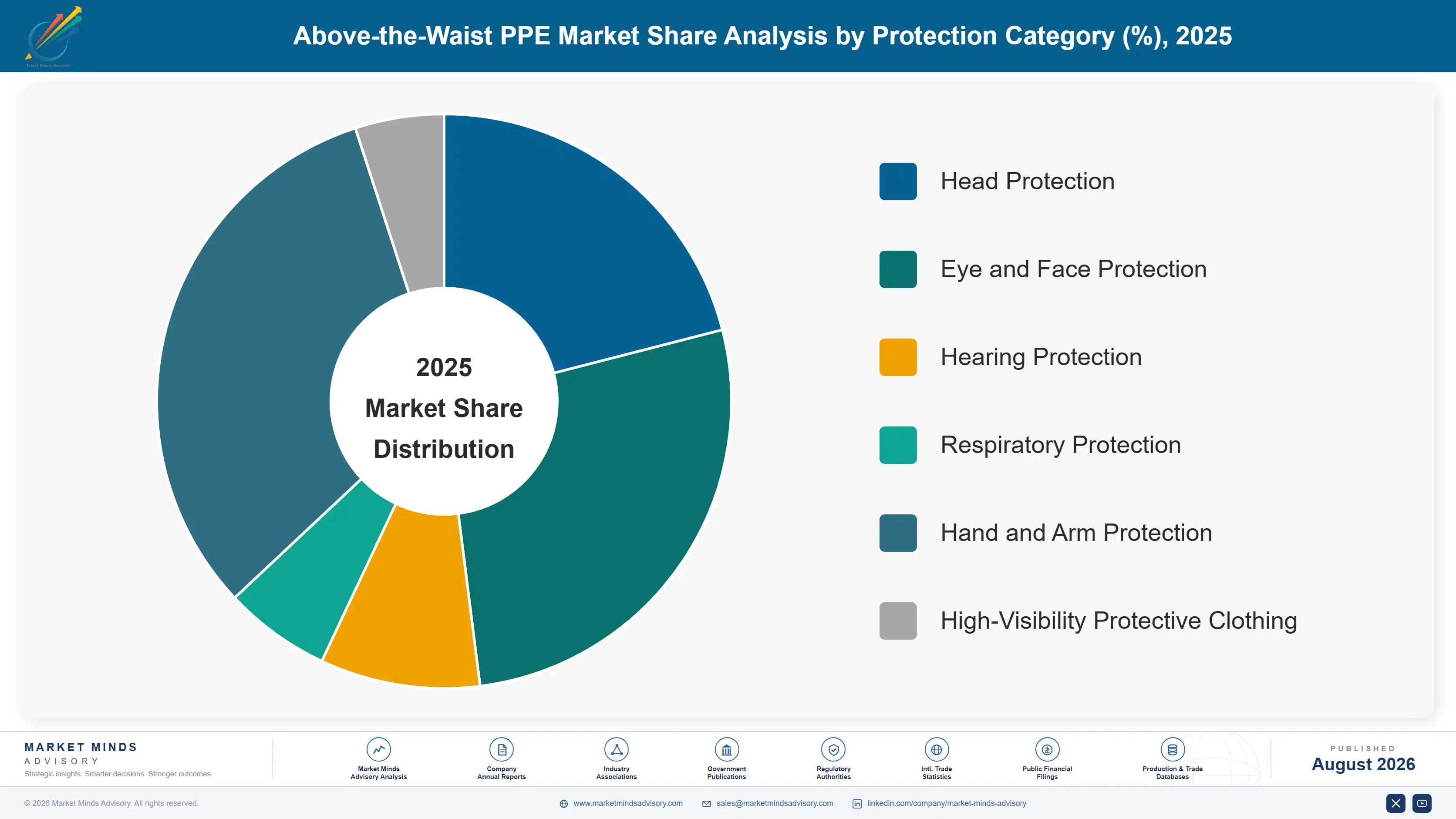
Above-the-waist PPE is segmented by protection category, the classification that determines hazard specification, certification standard, and target application: head, eye and face, hearing, respiratory, hand and arm, and high-visibility protective clothing each address distinct workplace hazards and serve different regulatory compliance requirements, avoiding the overlap an industry-vertical-based split would create, a distinction rarely revisited once qualified into a supply program.
above-the-waist-ppe-market-trends-market-share-analysis-1787464094192

Respiratory Protection

Respiratory protection is the fastest-growing segment as industrial hygiene awareness, wildfire smoke exposure, and post-pandemic buyer sensitivity to airborne hazards converge to expand the category well beyond its traditional industrial manufacturing base. 3M and Honeywell Safety Products both dominate this segment through established filtration technology and certification infrastructure that smaller regional manufacturers struggle to replicate at comparable quality and cost. Buyers increasingly specify respirator products by certification rating and filtration specification rather than accepting generic protection claims, reflecting growing sophistication among safety procurement professionals. Production costs for advanced filtration media remain meaningfully above basic products, but premium pricing for certified, high-specification respiratory protection more than compensates suppliers with genuine filtration technology capability.
CAGR 9.8%

High-Visibility Protective Clothing

High-visibility protective clothing, including reflective vests and jackets required across construction, roadwork, and warehouse operations, is scaling quickly as regulatory mandates expand into additional industry verticals and geographic markets that previously lacked formal high-visibility requirements. Radians Inc and several specialty manufacturers have expanded high-visibility production capacity specifically to serve this expanding regulatory mandate base. Fleet and logistics operators increasingly specify high-visibility clothing as a standard requirement even where not strictly legally mandated, reflecting broader corporate liability risk management practices beyond minimum compliance. Pricing remains relatively accessible compared with respiratory or connected protection categories, though branded, higher-durability products command a meaningful premium over basic reflective vests. Adoption is accelerating fastest in fleet and logistics operations seeking liability protection.
CAGR 8.4%
Full segment breakdown across 6 segments available in the complete report.

Regional Architecture and Country Demand Map

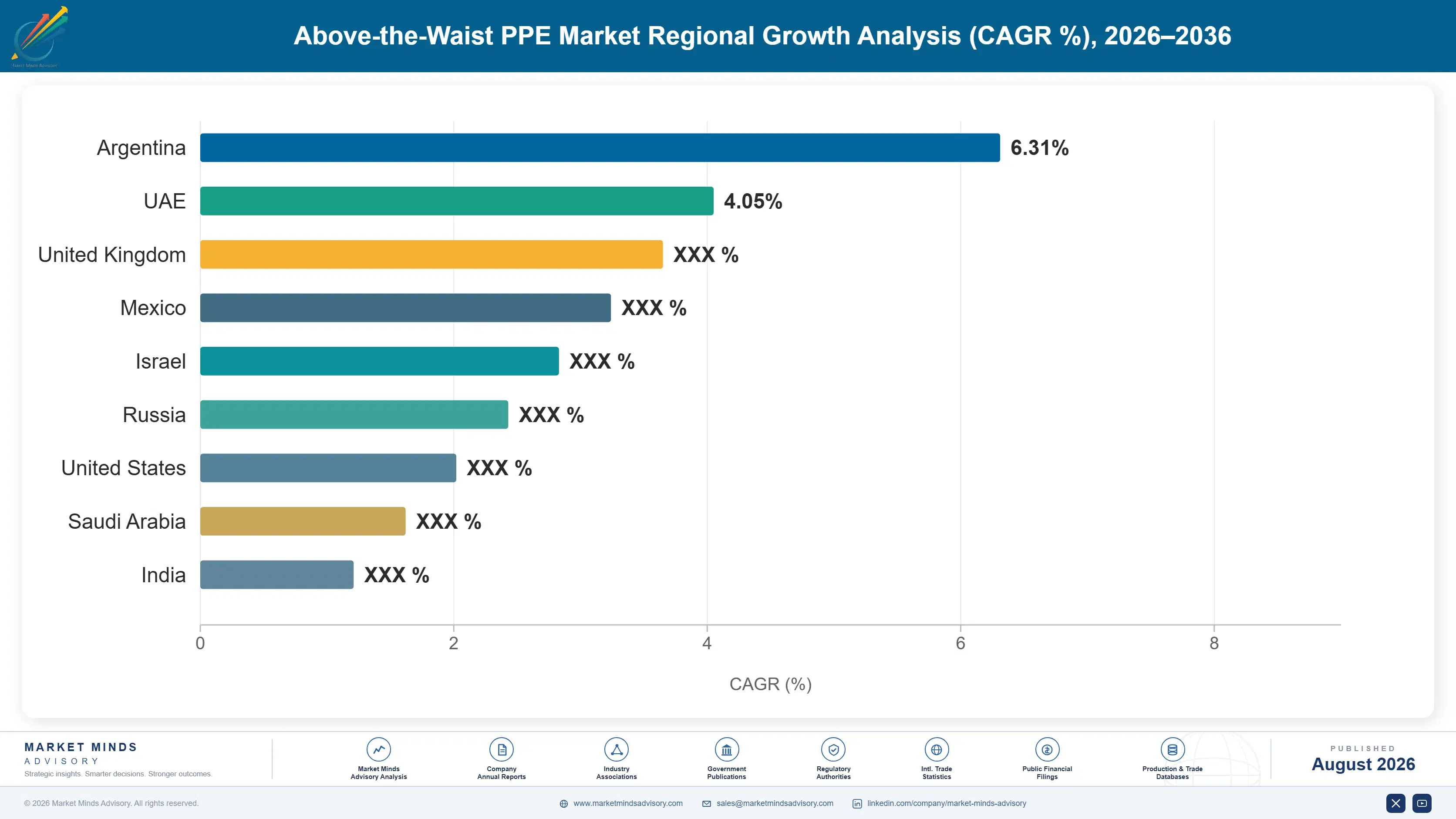
East Asia leads global above-the-waist PPE demand, reflecting China's enormous manufacturing and construction workforce and tightening domestic safety enforcement, while North America closely follows on the strength of strict OSHA compliance requirements driving higher-specification product adoption North America's stricter compliance standards support higher per-unit pricing across the category.

North America

The United States drives most of the region's demand through strict OSHA compliance requirements that push buyers toward higher-specification, certified protection rather than minimum-standard products common in less regulated markets. 3M and Honeywell Safety Products both maintain extensive domestic manufacturing and distribution networks supplying industrial, construction, and enterprise safety program customers across the country. Canadian workplace safety regulation closely mirrors US standards, generating a similar higher-specification demand profile. Wildfire and air quality-driven respiratory protection demand is most pronounced here, given the region's increasing exposure to seasonal wildfire smoke events across multiple states and provinces. Growing consumer and enterprise interest in connected compliance documentation is also expanding demand for higher-specification products across large distributed workforces.
Share: 27% | CAGR: 6.9% (2026 to 2036)

Western Europe

Germany and France anchor Western European demand through established industrial manufacturing bases and comprehensive European Union workplace safety directives that set minimum protection standards across member states. Uvex Group and Delta Plus Group both maintain significant regional manufacturing and distribution scale, benefiting from deep familiarity with EU certification requirements. The United Kingdom maintains regulatory alignment with EU-era safety standards despite Brexit, sustaining a similarly certification-focused demand profile. Growth here trails East Asia and North America because the region's industrial employment base is more mature and growing more slowly than faster-expanding manufacturing economies elsewhere. Scandinavian markets maintain some of the strictest per-worker safety standards globally, reflecting decades of proactive workplace injury prevention investment.
Share: 20% | CAGR: 4.9% (2026 to 2036)
Regional intelligence for 5 additional markets available in the complete report: East Asia, South Asia and Pacific, Latin America, Middle East and Africa, Eastern Europe. Contact sales@marketmindsadvisory.com.
above-the-waist-ppe-market-trends-country-cagr-analysis-1787464094720

Where PPE Suppliers Can Capture Margin

Margin capture in above-the-waist PPE increasingly depends on connected technology and certification credibility rather than raw commodity manufacturing volume. Suppliers that can deliver sensor-equipped protection, guarantee comfort-optimized ergonomic design, and provide verifiable compliance documentation are commanding meaningfully better pricing than those competing purely on cost per unit of basic protective equipment. That shift rewards technology-led suppliers over pure commodity manufacturers.

Connected Sensor-Equipped PPE for Enterprise Accounts

Suppliers that develop connected PPE incorporating usage, fit, and hazard exposure sensors are capturing premium enterprise pricing that basic commodity protective equipment cannot command. Honeywell Safety Products' connected PPE line, expanded in 2024, reportedly commands a 40 to 60 percent price premium over conventional equivalent equipment from comparable protection categories. Smaller regional manufacturers lacking dedicated sensor technology development capability are increasingly partnering with technology providers to offer comparable connected products, adding cost but preserving access to large enterprise accounts that now specify connected compliance documentation. This positioning increasingly determines large enterprise account wins beyond simple compliance certification.
Market Impact: Commands a 40 to 60 percent price premium

Certified Filtration Technology for Respiratory Protection

Suppliers that develop advanced certified filtration technology for respiratory protection are capturing premium pricing from buyers facing heightened wildfire, air quality, and industrial hygiene concerns. 3M's advanced filtration respiratory line reportedly commands a 25 to 35 percent price premium over basic certified equivalents from comparable manufacturing sources. Building this positioning requires sustained investment in filtration research and certification testing over multiple years, a barrier that has kept this higher-margin segment concentrated among established respiratory protection specialists Buyers increasingly specify certified filtration performance by name in procurement contracts rather than accepting generic protection claims, reflecting growing procurement sophistication.
Market Impact: Commands a 25 to 35 percent price premium

Ergonomic Comfort Redesign for Extended Wear

Suppliers that redesign protective equipment for genuine extended-wear comfort, rather than optimizing only for minimum certification testing standards, are capturing premium pricing from safety directors seeking to improve actual compliance usage rates rather than just equipment availability. Comfort-optimized protective equipment reportedly improves measured worker compliance usage rates by 20 to 30 percent compared with standard equivalent products in field studies. This ergonomic redesign requires meaningful product development investment, a barrier that has kept this higher-margin positioning concentrated among suppliers with dedicated human factors engineering capability. Safety directors increasingly prioritize this metric over raw acquisition cost when evaluating suppliers.
Market Impact: Improves compliance usage by 20 to 30 percent

Bundled Compliance Documentation and Training Support

Bundling compliance documentation, usage training, and regulatory support alongside the physical equipment sale helps smaller industrial employers that lack in-house safety program management capability meet tightening workplace safety enforcement requirements. Suppliers offering this bundled service report shortened customer compliance implementation timelines by several weeks on average, since employers avoid commissioning duplicate training programs the supplier has already developed. This service layer also raises effective per-unit pricing by an estimated 10 to 15 percent, since smaller employers otherwise face compliance consulting costs running into meaningful sums if sourced independently across most regional accounts.
Market Impact: Raises effective pricing by 10 to 15 percent

Who Controls the Margin Pool

Five suppliers hold roughly a third of global above-the-waist PPE volume on a production basis, leaving this market considerably more fragmented than several other mature industrial equipment categories. The gap between technology-focused global leaders and regional commodity manufacturers is wide on price and certification sophistication, even though both compete under the same broad PPE category label. That gap keeps competitive intensity elevated across both technology and price-focused segments simultaneously.
Current competitive activity centers on three fronts: connected sensor technology development to win enterprise accounts, advanced filtration technology investment to capture respiratory protection demand, and ergonomic comfort redesign to improve actual compliance usage rates. 3M and Honeywell Safety Products have both announced product development investment in the past two years specifically targeting these higher-margin, technically differentiated segments.

Emerging pressure is coming from Chinese domestic manufacturers improving both cost efficiency and certification quality, threatening the technology and price advantage established multinational suppliers have historically held in emerging manufacturing markets. Rankings could shift meaningfully over the next several years if Chinese manufacturers close the respiratory and connected technology gap that currently keeps Western suppliers dominant in premium enterprise accounts.
above-the-waist-ppe-market-trends-company-positioning-matrix-1787464095248

Competitive Moat and Risk Dimensions

3M

Moat: Broadest Certified Filtration Technology Portfolio

3M maintains the industry's broadest certified respiratory filtration technology portfolio, built over decades of research investment spanning industrial, medical, and consumer applications simultaneously. That breadth gives 3M cost and technology advantages in respiratory protection that smaller, more narrowly focused competitors cannot easily replicate across comparable certification categories.
3M

Risk: Litigation and Reputational Exposure

3M's scale and broad market presence has historically exposed the company to product liability litigation risk that smaller, more narrowly focused competitors face less frequently given lower overall market exposure. Any future litigation or reputational event affecting a major product category could disproportionately affect 3M's broader PPE business relative to more specialized competitors.
HONEYWELL SAFETY PRODUCTS

Moat: Integrated Connected Safety Technology Platform

Honeywell Safety Products has built an integrated connected safety technology platform spanning multiple protection categories, letting it offer enterprise customers a unified compliance monitoring system rather than disconnected individual products. That platform integration creates switching costs for large enterprise accounts that competitors offering only standalone connected products cannot easily replicate.
HONEYWELL SAFETY PRODUCTS

Risk: Higher Cost Limits Emerging Reach

Honeywell Safety Products' premium technology positioning carries a higher cost base than regional commodity manufacturers, limiting its ability to compete on price in fast-growing but price-sensitive emerging manufacturing markets. As Chinese and Indian manufacturers improve quality while retaining a cost advantage, Honeywell could face growing pressure on price-sensitive commodity accounts.

Players Tracked

Prominent Players

3M
Honeywell Safety Products
MSA Safety
DuPont
Uvex Group

Other Key Players

Delta Plus Group
Ansell
JSP Safety
Moldex-Metric
Radians Inc
Kimberly-Clark Professional
Lakeland Industries
Alpha Pro Tech
Bolle Safety
Pyramex Safety Products
ERB Safety
Bullard
Sundstrom Safety
Centurion Safety
Gateway Safety

Recent Developments

MARCH 2024

Honeywell Safety Products Expands Connected PPE Platform

Honeywell Safety Products expanded its connected PPE technology platform in March 2024, adding sensor-based fit, usage, and hazard exposure monitoring capability across additional protection categories, responding directly to large enterprise customer demand for unified, real-time compliance documentation across mining, construction, and manufacturing operations across all regions.
Signal: Signals established suppliers are investing in platform integration rather than treating connected features as standalone product add-ons.
SEPTEMBER 2023

3M Expands Advanced Filtration Respiratory Line

3M expanded its advanced filtration respiratory protection product line in September 2023, targeting rising demand tied to wildfire smoke exposure and industrial hygiene concerns beyond traditional manufacturing applications, and has since supported expanded distribution into outdoor construction and agricultural work settings previously underserved by certified respiratory protection.
Signal: Signals respiratory protection demand is broadening meaningfully beyond its traditional industrial manufacturing customer base and geography.
JANUARY 2025

China Expands Workplace Safety Inspection Enforcement

China's Ministry of Emergency Management expanded workplace safety inspection scope and enforcement penalties in January 2025, bringing additional manufacturing facilities under formal compliance inspection and driving certified PPE adoption among manufacturers previously operating with minimal safety equipment investment. Industry observers called this a milestone in regulatory maturity for Chinese manufacturing.
Signal: Signals China's regulatory enforcement trajectory is converging gradually with more mature Western compliance standards over time.

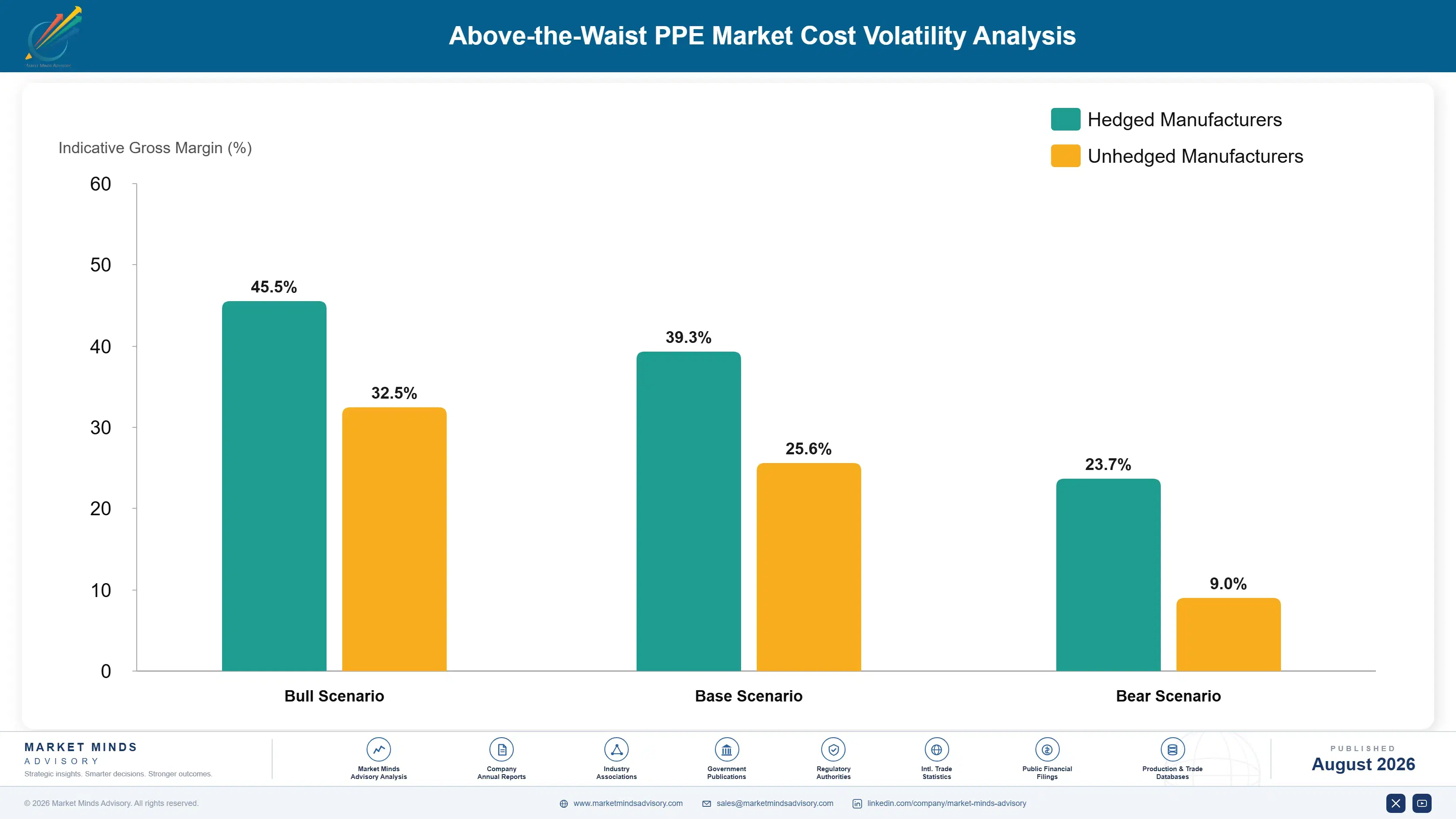
Polymer and Filtration Material Cost Exposure

Polymer resins and specialty filtration media, sourced predominantly from petrochemical and nonwoven fabric manufacturing supply chains, account for roughly thirty-four percent of total production cost across the industry. Sensor and electronic component costs for connected PPE products add a second significant and growing cost layer that varies considerably depending on the specific sensor technology and target protection category.
Petrochemical feedstock and nonwoven fabric costs rose meaningfully during 2022 and 2023 following broader energy market disruption, according to industry trade reporting and 3M's public disclosures, increasing polymer and filtration media costs across the PPE manufacturing industry. Manufacturers without long-term feedstock supply contracts faced the steepest cost increases, since alternative sourcing requires supplier qualification that takes considerable time to establish at meaningful production scale across the broader manufacturing base.

Smaller manufacturers sourcing feedstock from a single petrochemical supplier carry meaningfully more cost exposure than larger, vertically integrated suppliers like 3M or Honeywell Safety Products, which can shift sourcing across multiple feedstock suppliers when one underperforms. Connected PPE manufacturers face a distinct cost exposure profile tied to electronic component and semiconductor supply chains rather than petrochemical markets, introducing additional volatility beyond conventional protective equipment economics.
above-the-waist-ppe-market-trends-cost-volatility-analysis-1787464095448

Diversify Petrochemical Feedstock Sourcing

Larger manufacturers are qualifying feedstock supply from multiple petrochemical suppliers simultaneously rather than relying on a single source, reducing the odds that one supplier disruption cuts total feedstock availability. This diversification adds procurement complexity but has measurably reduced price volatility for manufacturers that implemented it before the 2022 to 2023 price increases across most major markets.

Negotiate Long-Term Sensor Component Supply

Connected PPE manufacturers are locking in multi-year supply agreements for sensor and electronic components, insulating production costs from the semiconductor supply volatility that has affected broader electronics manufacturing. This approach requires meaningful working capital commitment but has kept connected PPE production costs more stable for manufacturers that adopted it early. Manufacturers report this approach also reduces production planning uncertainty.

Invest in Domestic Filtration Media Manufacturing

Several larger manufacturers are investing in domestic filtration media production capacity, reducing dependence on imported nonwoven fabric supply chains that have proven vulnerable to disruption. This approach requires significant capital investment but provides meaningful supply certainty for manufacturers with sufficient scale to justify the investment. Grower and supplier partners report these investments also improve long-term production reliability considerably.

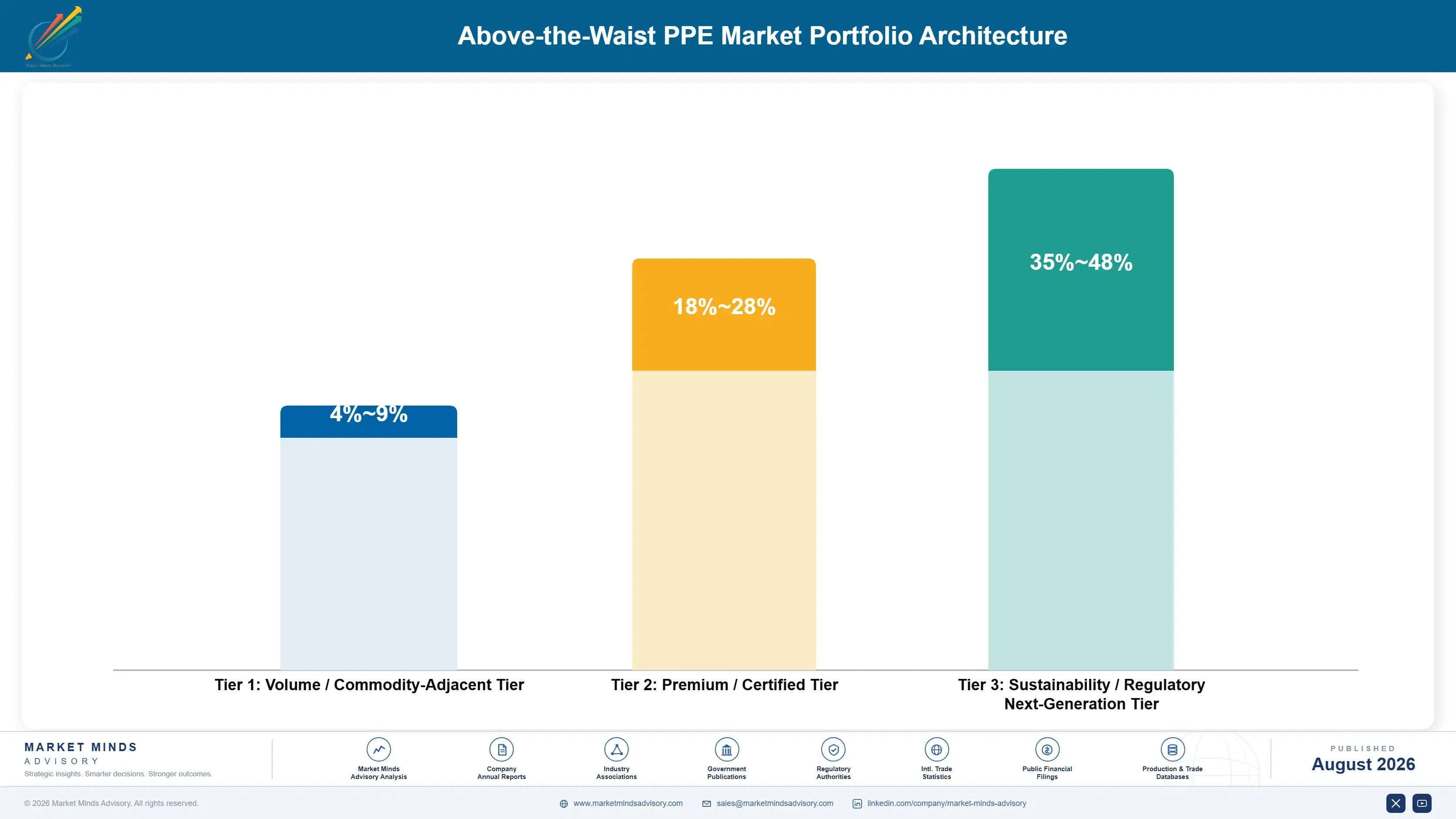
Portfolio Architecture for Margin Defence

Above-the-waist PPE suppliers operate a three-tier portfolio spanning commodity basic protection sold largely on cost per unit into price-sensitive regional markets, certified advanced-specification products commanding premium pricing from safety-conscious industrial and enterprise accounts, and connected sensor-equipped systems positioned for the highest-margin large enterprise and technology-forward accounts. Gross margins vary sharply across these tiers, from thin single digits on commodity basic protection to well above thirty-five percent on connected sensor-equipped systems.
The volume versus premium tension is intensifying as more suppliers chase connected and advanced-specification margins, but commodity basic protection still represents the majority of shipped volume and remains essential for covering fixed production costs across the industry's large price-sensitive regional customer base. Suppliers that abandon commodity volume too quickly in pursuit of premium accounts risk underutilizing capacity built for broader industrial scale.

High-value margin pools concentrate specifically in connected sensor-equipped systems sold to large enterprise accounts, and in advanced certified filtration products supplying respiratory protection demand driven by wildfire and industrial hygiene concerns. Commodity basic protection remains the volume anchor but carries the thinnest margins, squeezed further by regional manufacturers competing on price across nearly every commodity account.

Volume / Commodity-Adjacent Tier

Commodity basic head, eye, and hearing protection sold primarily on cost per unit into price-sensitive regional industrial markets, where price competition among global and regional manufacturers is intense and formulation differentiation is limited.
Gross Margin: 4-9%

Premium / Certified Tier

Certified advanced-specification protection, particularly respiratory and high-visibility products, sold into safety-conscious industrial and enterprise accounts facing tightening regulatory compliance requirements Pricing reflects certification testing investment and specification sophistication rather than raw material cost alone.
Gross Margin: 18-28%

Sustainability / Regulatory / Next-Generation Tier

Connected sensor-equipped protection systems positioned for large enterprise accounts paying the category's highest per-unit prices for real-time compliance monitoring and documentation capability Capital and technology development requirements keep this tier concentrated among larger suppliers.
Gross Margin: 35-48%
above-the-waist-ppe-market-trends-portfolio-architecture-1787464095953

High-value Sub-segments and Strategic Watch-out

Connected Enterprise Sensor Systems

Connected sensor-equipped PPE capturing usage, fit, and hazard exposure data is seeing the strongest margin expansion in the category, as large enterprise employers specify connected compliance documentation systems by name in supply contracts to reduce liability exposure and improve incident tracking. Established leaders continue expanding capability to defend this position.
Gross Margin: 35-48%

Advanced Filtration Respiratory Protection

Advanced certified filtration respiratory protection is gaining share as wildfire exposure and industrial hygiene concerns broaden the category beyond traditional manufacturing applications, though specialized filtration technology development remains concentrated among a smaller number of established suppliers. Adoption should broaden as more suppliers develop comparable filtration technology over time.
Gross Margin: 18-28%

Commodity Basic Industrial Protection

Standard head, eye, and hearing protection sold into mainstream industrial markets remains the category's volume core, anchored by established distributor relationships but facing intense price competition from regional manufacturers. Most incumbents defend this tier through distributor scale and price rather than product innovation investment across most regional markets.
Gross Margin: 4-9%

Uncertified Marketplace-Sourced Products

Counterfeit and uncertified protective products sold through online marketplaces face rising regulatory and buyer scrutiny following documented filtration failure findings, making this a segment legitimate suppliers and buyers should actively move away from. Several suppliers still selling on this basis have already lost major distributor relationships recently.
Gross Margin: 2-6%

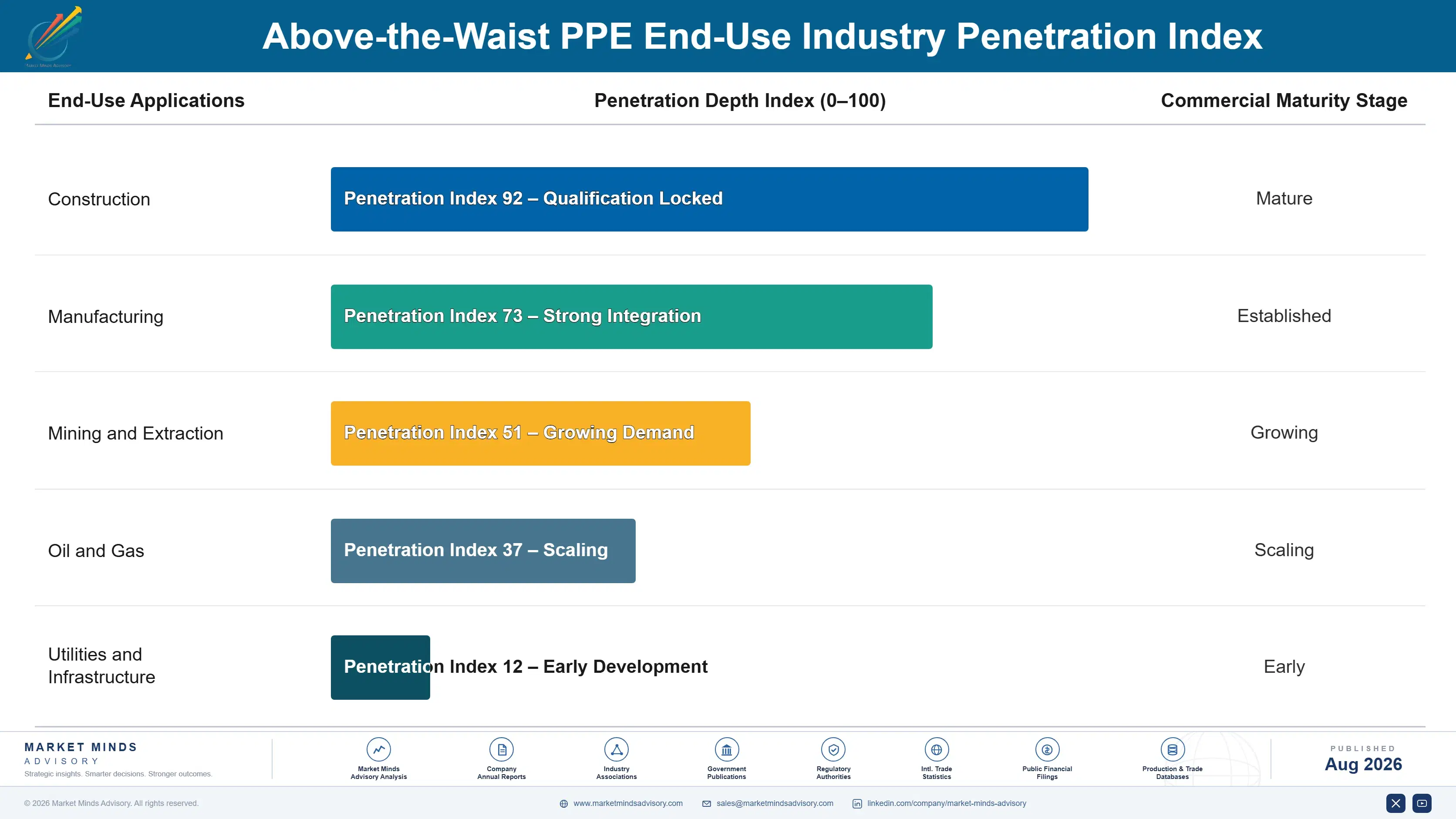
PPE's Compliance-Driven Procurement Lock-In

Above-the-waist PPE behaves like an annuity product once a large industrial employer qualifies a supplier into its safety program, because switching suppliers means requalifying certification documentation and retraining workers on different equipment across an entire distributed workforce. That inertia gives incumbent suppliers multi-year revenue visibility once qualified, particularly with large enterprise employers that standardize equipment across many facility locations simultaneously. That inertia can persist for years once a large employer standardizes equipment specifications across its entire distributed workforce and multiple facility locations simultaneously.
Adoption depth varies sharply by end-use vertical. Large enterprise employers with dedicated safety programs adopt new connected and advanced-specification protection relatively quickly when compliance or incident-reduction benefits are demonstrable, while smaller regional employers move more slowly, requiring extensive cost justification before shifting away from established basic commodity protection relationships. Suppliers serving both segments increasingly run separate technical and commercial teams to match each customer's evaluation pace and procurement cycle.

Generational buyer shifts are visible mainly in how younger safety professionals approach procurement, increasingly favoring connected, data-driven compliance systems specifically for their documentation and liability protection value, while legacy safety managers remain anchored to established commodity suppliers with decades-long, high-trust commercial relationships.
above-the-waist-ppe-market-trends-end-use-penetration-index-1787464096460

Where PPE Value Concentrates

These are among the four positions where our research anticipates prominent divergence between winners and laggards over the coming forecast period. Each is grounded in the demand model, the regulatory perimeter, and the announced capacity pipeline.
01 / CONNECTED TECHNOLOGY INVESTMENT

Invest in connected sensor technology ahead of enterprise mandates

Large enterprise employers increasingly specify connected, sensor-equipped PPE for real-time compliance monitoring and liability documentation, and that requirement is spreading fast across mining, construction, and manufacturing accounts. Suppliers without connected technology capability risk losing large enterprise accounts to competitors that can offer unified compliance platforms rather than standalone products. MMA recommends suppliers with sufficient resources invest in connected technology development now, before enterprise accounts standardize around already-established platform providers, since early movers are already building platform relationships that later entrants will find considerably harder to displace.
02 / RESPIRATORY FILTRATION TECHNOLOGY

Expand respiratory filtration capacity ahead of broadening demand

Respiratory protection demand is broadening well beyond traditional industrial manufacturing applications into wildfire-affected outdoor work and general industrial hygiene use, and suppliers with advanced filtration technology are capturing this expanding addressable market fastest. 3M's advanced filtration line has already demonstrated meaningful commercial traction beyond its historical customer base, confirming genuine demand exists. MMA recommends suppliers with filtration research capability invest in capacity expansion now, before demand growth outpaces available certified supply Buyers increasingly treat filtration certification as a baseline procurement requirement rather than an optional differentiator.
03 / ERGONOMIC COMFORT REDESIGN

Redesign for comfort to close the compliance usage gap

Worker discomfort remains among the most commonly cited reasons for inconsistent PPE compliance usage, undermining the actual safety benefit equipment investment is meant to deliver regardless of certification specification. Suppliers that redesign for genuine extended-wear comfort are capturing premium pricing from safety directors focused on real usage outcomes rather than equipment availability alone. MMA recommends manufacturers without dedicated human factors engineering capability invest in ergonomic redesign now, before comfort-focused competitors capture safety-conscious enterprise accounts, since later entrants attempting comparable redesign will find catching up considerably more expensive.
04 / EMERGING MARKET CERTIFICATION ACCESS

Expand certified capacity ahead of tightening emerging market rules

China and other manufacturing economies are tightening workplace safety enforcement meaningfully, pulling millions of previously non-compliant workers into the certified PPE market within a relatively short timeframe. Suppliers without established emerging market certification and distribution infrastructure risk losing first-mover positioning to domestic competitors building local manufacturing and compliance relationships. MMA recommends suppliers with sufficient resources evaluate emerging market expansion now, while certification and distribution relationships remain available to a still-developing competitive set, since waiting risks permanently ceding ground to competitors already embedded with local manufacturing partners.

Engagement Snapshot From the Field

A live engagement with an industry participant carrying material or product regulatory and market exposure ahead of a defining policy shift, showing how our research translates into a defensible multi-year portfolio strategy.
MARKET MINDS ADVISORY · CLIENT ENGAGEMENT SUMMARY
Above-the-Waist PPE Producer Strategic Portfolio Review and Transition Roadmap 2026·Investment Scenario on Above-the-Waist PPE Exposure Evaluation 2025-26
CLIENT PROFILE
The client is a large North American industrial manufacturing employer generating an estimated one point two billion dollars in annual revenue (client-reported, unverified by MMA), operating multiple production facilities across several states. The client had experienced a rising recordable incident rate despite providing standard certified PPE across its workforce and needed to identify the underlying cause before regulatory scrutiny intensified further.
STRATEGIC CHALLENGE
Internal safety audits revealed that actual PPE compliance usage rates were considerably lower than equipment availability records suggested, with workers reporting discomfort during extended shift use as the primary reason for inconsistent usage. The client needed a solution that improved actual compliance behavior rather than simply providing more equipment that workers would continue underusing.
MMA APPROACH
MMA conducted a structured evaluation of ergonomic, comfort-optimized PPE alternatives from three suppliers, benchmarking worker comfort feedback, compliance usage tracking data, and pricing against the client's existing standard-issue equipment and incident reduction goals. The engagement included pilot testing across two representative facilities to validate real-world compliance improvement before committing to a full-scale equipment transition.
KEY FINDINGS
  1. Worker-reported discomfort during extended shift use was the primary driver of inconsistent compliance, not lack of equipment availability or safety awareness training.
  2. Switching to ergonomic, comfort-optimized equipment added roughly twelve percent to per-unit cost but improved measured compliance usage rates meaningfully within the pilot period.
  3. Two of the three evaluated suppliers could not provide independent field data supporting claimed comfort and compliance improvement over standard equipment during the evaluation period.
  4. The client's facility-wide rollout following the successful pilot reduced recordable incident rates measurably across every production facility within two quarters (client-reported, unverified by MMA).
CLIENT PROFILE
The client is a large North American industrial manufacturing employer generating an estimated one point two billion dollars in annual revenue (client-reported, unverified by MMA), operating multiple production facilities across several states. The client had experienced a rising recordable incident rate despite providing standard certified PPE across its workforce and needed to identify the underlying cause before regulatory scrutiny intensified further.
STRATEGIC CHALLENGE
Internal safety audits revealed that actual PPE compliance usage rates were considerably lower than equipment availability records suggested, with workers reporting discomfort during extended shift use as the primary reason for inconsistent usage. The client needed a solution that improved actual compliance behavior rather than simply providing more equipment that workers would continue underusing.
MMA APPROACH
MMA conducted a structured evaluation of ergonomic, comfort-optimized PPE alternatives from three suppliers, benchmarking worker comfort feedback, compliance usage tracking data, and pricing against the client's existing standard-issue equipment and incident reduction goals. The engagement included pilot testing across two representative facilities to validate real-world compliance improvement before committing to a full-scale equipment transition.
KEY FINDINGS
  1. Worker-reported discomfort during extended shift use was the primary driver of inconsistent compliance, not lack of equipment availability or safety awareness training.
  2. Switching to ergonomic, comfort-optimized equipment added roughly twelve percent to per-unit cost but improved measured compliance usage rates meaningfully within the pilot period.
  3. Two of the three evaluated suppliers could not provide independent field data supporting claimed comfort and compliance improvement over standard equipment during the evaluation period.
  4. The client's facility-wide rollout following the successful pilot reduced recordable incident rates measurably across every production facility within two quarters (client-reported, unverified by MMA).
RECOMMENDED STRATEGY
Phase 1: Phase 1 (Weeks 1 to 3): Benchmark three ergonomic PPE suppliers against comfort feedback, compliance tracking, and pricing requirements ahead of rollout. Phase 2: Phase 2 (Weeks 4 to 8): Conduct pilot testing across two facilities to validate real-world compliance improvement outcomes before full rollout. Phase 3: Phase 3 (Weeks 9 to 14): Finalize supplier selection, execute facility-wide rollout, and monitor incident rate trends across all locations.
OUTCOME
The client successfully improved PPE compliance usage rates and reduced recordable incident rates within two quarters of the facility-wide rollout (client-reported, unverified by MMA). The engagement also positioned the client favorably ahead of an upcoming regulatory safety audit cycle. Safety leadership credited the redesigned equipment directly for the measurable improvement.

Frequently Asked Questions

Foundational context covering the market sizes, CAGR, scope, country, region and competition that inform every finding below. This section is provided to cover basics and most often pre-purchase conversations, answered from the MMA Primary Research Dataset.

What is the current size of the Above-the-Waist PPE Market?

The global above-the-waist PPE market is valued at approximately $18.40 billion in 2025. Growth is driven by tightening workplace safety enforcement alongside rising connected technology adoption.

How large will the Above-the-Waist PPE Market be by 2036?

MMA projects the market will reach approximately $36.41 billion by 2036, roughly 1.9 times its 2026 base value. Respiratory protection will account for a growing share of that expansion.

What is the CAGR for the Above-the-Waist PPE Market 2026 to 2036?

The market is expected to grow at a compound annual growth rate of 6.4% between 2026 and 2036. Bull and bear scenarios range from 5.2% to 7.6% depending on regulatory and economic conditions.

Which segment is growing fastest?

Respiratory protection is the fastest-growing segment, expanding at roughly 9.8% annually, about 1.5 times the overall market rate. Wildfire exposure and industrial hygiene concerns are the primary drivers.

Who are the major companies in the Above-the-Waist PPE Market?

3M, Honeywell Safety Products, MSA Safety, DuPont, and Uvex Group lead global supply. The top five suppliers together hold roughly a third of global volume.

Which country is growing fastest?

China is growing fastest, driven by its expanding manufacturing workforce and rapidly tightening domestic workplace safety enforcement. Capacity investment is reinforcing this growth across multiple provinces.

Report Segmentation Architecture

The full report scope spans multiple orthogonal segmentation dimensions, with cross-tabulated demand data provided for each dimension pair. Coverage extends further to regional breakdowns, trend trajectories, and the competitive detail needed to support segment-level decision-making.

By Protection Category

  • Head Protection
  • Eye and Face Protection
  • Hearing Protection
  • Respiratory Protection
  • Hand and Arm Protection
  • High-Visibility Protective Clothing

By End-Use Industry

  • Construction
  • Manufacturing
  • Mining and Extraction
  • Oil and Gas
  • Utilities and Infrastructure

By Commercial Dimension

  • Connected Enterprise Supply
  • Certified Advanced Supply
  • Commodity Standard Supply
  • Direct Enterprise Partnership

By Region

  • North America
  • Western Europe
  • East Asia
  • South Asia and Pacific
  • Latin America
  • Middle East and Africa
  • Eastern Europe

Scope, Methodology, and Coverage

Every figure in this report is reproducible from documented input assumptions. The scope below maps the historical period, the forecast horizon, the segmentation dimensions, and the countries covered, alongside the underlying primary and qualitative methodology.
Historical Period
2020 to 2025
Forecast Period
2026 to 2036
Base Year
2025 (USD billions; MMA Primary Research Dataset, August 2026)
Market Definition
The above-the-waist personal protective equipment market covers head, eye, face, hearing, respiratory, and hand protection products sold for industrial, construction, and occupational safety compliance use. It excludes below-the-waist protective equipment such as safety footwear and leg protection, and excludes full-body protective clothing and coveralls sold as a distinct product category.
Quantitative Units
USD billions (current prices); million units of finished protective equipment where applicable
Segmentation Dimensions
By Protection Category; By End-Use Industry; By Commercial Dimension; By Region
Regions Covered
North America, Western Europe, East Asia, South Asia and Pacific, Latin America, Middle East and Africa, Eastern Europe
Countries Covered
USA, China, Germany, France, UK, Japan, South Korea, India, Australia, Canada, Brazil, Mexico, Indonesia, Vietnam, Thailand, Malaysia, UAE, Saudi Arabia, South Africa, Nigeria, Turkey, Poland, Netherlands, Italy, Spain, Sweden, Switzerland, Argentina, Colombia, Singapore, and additional markets relevant to this sector
Key Companies Profiled
3M, Honeywell Safety Products, MSA Safety, DuPont, Uvex Group, Delta Plus Group, Ansell, JSP Safety, Moldex-Metric, Radians Inc, Kimberly-Clark Professional, Lakeland Industries, Alpha Pro Tech, Bolle Safety, Pyramex Safety Products, ERB Safety, Bullard, Sundstrom Safety, Centurion Safety, Gateway Safety
Quantitative Methodology
Primary survey, n=3,800 respondents, Q4 2025, six countries; demand-side model with trade association cross-validation
Qualitative Methodology
47 expert interviews, Q4 2025; applied to validate demand model assumptions, identify emerging dynamics, and assess competitive positioning
Report Format
PDF and XLSX data workbook (Word format preview document)
Publisher
Market Minds Advisory
Report Code
MMA-2026-CON-201
Published
August 2026
Contact
sales@marketmindsadvisory.com | www.marketmindsadvisory.com

Purchase the full Above-the-Waist PPE Market Report (2026 to 2036).

This report delivers a complete assessment of the global above-the-waist PPE market across all major protection categories, end-use industries, and geographic regions through 2036. It includes detailed competitive profiling of twenty companies, segmentation analysis distinguishing head, eye and face, hearing, respiratory, hand and arm, and high-visibility protection, and regional demand modeling across all seven MMA-covered geographies. Buyers will find quantified forecasts for market size, segment growth rates, and regional CAGR alongside qualitative analysis of connected technology trends, regulatory enforcement dynamics, and polymer input cost exposure. A dedicated revenue lever framework identifies four specific commercial actions suppliers can take to capture margin as connected technology adoption accelerates.
Twenty-company competitive profiling with moat and risk analysis
Seven-region demand model with justified share and CAGR bands
Protection-category segmentation across six MECE categories
Quantified revenue lever framework for margin capture strategies
Polymer and filtration material cost exposure analysis
Anonymized case study on ergonomic compliance improvement

Built For The People Who Decide

From boardroom strategy to bench-side execution, this report is read cover-to-cover by leaders shaping the next decade of their industry, turning demand scenarios, market dynamics and valuation benchmarks into decisions.
CXOs/ Presidents/ VPs/ Managers
M&A and Corporate Development
Strategy Teams and R&D Heads
Procurement and Product Directors
Regulatory and Compliance Leaders
Investor Relations and Equity Analysts