
Market Minds Advisory
A2 Lactose Free Milk Market

A2 Lactose Free Milk Market: Two Premium Dairy Claims Converge

A2 lactose-free milk is graduating from a niche digestive-comfort product into a mainstream premium dairy category, and brands that can prove both A2 protein purity and true lactose removal are pulling ahead of private-label imitators.

Lead Analyst

Lisa Gevelber

Published

September 2026

Make Smarter Decisions with Customized Research Insights

Request a free sample report and evaluate market opportunities, growth trends, and competitive dynamics relevant to your business needs.

2025 MARKET VALUE$0.7BMarket Size 2025
2036 FORECAST VALUE$2.5BBase Case , 2026 to 2036
CAGR 2026 TO 203612.6 %Bull 13.9% / Bear 11.3%
INCREMENTAL OPPORTUNITY$1.7BNet 10- year value creation
EXPANSION MULTIPLE3.28x2036 value over 2026 base
Strategic Levers
M&A Pipeline
Regional Outlook
Country Rankings
Competitive Intelligence
Segmental Deep-dive
Call-Us : 91 93563 13602

Executive Snapshot and Market Trajectory

A2 lactose-free milk sits at the intersection of two premium dairy trends: A2-only beta-casein protein for digestive comfort, and complete lactose removal for lactose-intolerant consumers. Combining both claims on one label commands a real price premium, but only when brands can document both attributes with testing.
North America is the largest single market, driven by Fairlife and Lactaid's dominant lactose-free retail presence combined with a2 Milk Company's expanding fresh milk distribution across major grocery chains. China represents the largest East Asian growth engine, where a2 branded infant formula and liquid milk have built substantial consumer trust in A2 protein positioning. Organic formulations are growing fastest as premium dairy buyers increasingly stack organic certification on top of A2 and lactose-free claims simultaneously.
Competition spans global branded players and regional dairy cooperatives, with the top five suppliers holding well under half of category volume. The a2 Milk Company built the category and leads on brand recognition, while Fairlife and Lactaid dominate the lactose-free shelf through Coca-Cola and HP Hood's retail distribution scale. Verification is becoming the differentiator: independent genetic and lactose testing separates credible A2 lactose-free claims from marketing-only positioning across the category.
Market Definition
The A2 lactose-free milk market covers dairy milk products verified to contain only A2 beta-casein protein and processed to remove lactose content, sold as fresh, UHT, powdered, and flavored formats for consumers seeking both digestive comfort and lactose intolerance management. It excludes conventional A1/A2 blend milk, standard lactose-free milk without A2 protein verification, and plant-based dairy alternatives.
Base Year Value
$0.7B in 2025 (MMA Primary Research Dataset, August 2026)
Forecast Period
2026 to 2036, eleven discrete annual values
CAGR
12.6% base case. Bull 13.9%. Bear 11.3%.
Fastest Growth Segment
Organic A2 Lactose-Free Milk: 16.2% CAGR
Fastest Growth Country
India: 15.9% CAGR
Fastest Growth Region
South Asia and Pacific: 14.6% CAGR
Largest Region
North America: 32% of 2025 global value
Market Leaders
a2 Milk Company, Fairlife, Lactaid, Green Valley Creamery, and Mother Dairy lead global supply. Source: MMA Analysis based on company annual reports.
Primary Survey
n=3,800 procurement and R&D decision-makers, Q4 2025, six countries
Methodology
Demand-side build-up, cross-validated against public data, 47 expert interviews

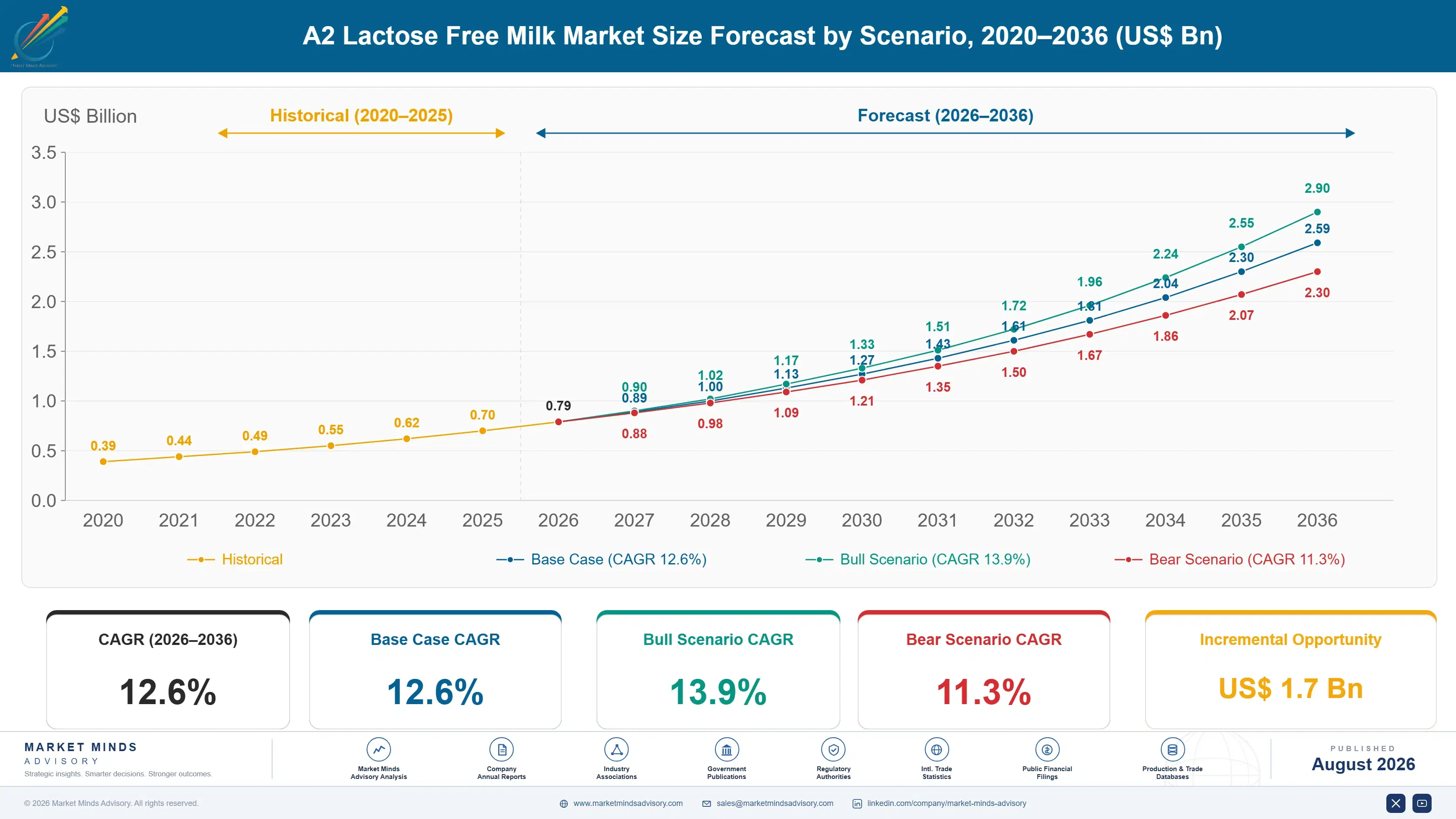
A2 Lactose Free Milk Market Forecast Scenarios

a2-lactose-free-milk-market-size-forecast-scenario-1787464074652
Between 2020 and 2025, A2 lactose-free milk demand grew at an estimated 11.4% annually as pandemic-era health consciousness accelerated interest in digestive-friendly dairy alternatives to plant-based milk. Fairlife and Lactaid expanded lactose-free production capacity through the period, while a2 Milk Company scaled fresh milk distribution beyond its original Australia and New Zealand base into North America and China.
MMA's base case projects 12.6% annual growth to 2036 on three mechanisms: retail expansion of verified A2 lactose-free products into mainstream grocery chains beyond specialty and natural food channels, Chinese consumer trust in A2 branded dairy products built through years of infant formula marketing investment, and demand for organic and flavored formulations among premium dairy buyers willing to pay for stacked health claims. Foodservice and coffee chains are adding a fourth growth channel through A2 lactose-free creamer options.
A bull catalyst comes from major grocery chains standardizing private-label A2 lactose-free lines across large store networks, which could pull the category into mainstream commodity distribution within a few years. The bear risk is verification credibility: a high-profile finding that branded products contain measurable A1 protein or residual lactose could trigger a consumer confidence pullback that slows growth across the entire category.

Two Premium Dairy Claims Converge on One Carton

A2 lactose-free milk asks dairy processors to solve two separate technical problems at once: sourcing milk exclusively from cows that produce only A2 beta-casein protein, and then removing virtually all lactose through enzymatic treatment or filtration. Either claim alone is now fairly commonplace across premium dairy categories. Combining both credibly, with testing to back it up, remains meaningfully harder and is where the real margin sits.
MARKET CONCENTRATION41%Top five suppliers hold well under half the total
AVERAGE SELLING PRICE$5.60/half-gallonVerified dual-claim products command the steepest retail premium
TOP PRODUCING COUNTRYUnited StatesLargest lactose-free retail category supports fastest category scaling
CAPACITY UTILIZATION72%Specialized processing lines run below conventional dairy capacity
FEEDSTOCK COST SHARE38% of COGSVerified herd milk commands a meaningful sourcing premium
TRADE INTENSITY19% exportedMost volume still serves domestic regional retail markets
Commercially, the category behaves like two supply chains stacked on top of each other. A2 herd sourcing requires genetic testing and dedicated herd management that conventional dairies do not maintain, while lactose removal requires separate processing infrastructure most conventional bottling lines were not built for. Processors that already run both capabilities are capturing share from competitors that can offer only one claim or the other.
Over the next decade, expect independent verification and testing documentation to matter more than shelf price alone, particularly as private-label retailers enter the category and consumers grow more skeptical of unverified claims. Suppliers investing in genetic herd testing and lactose-content verification are positioned to capture the premium segment that marketing-only competitors increasingly cannot defend.
"Half the cartons on shelf claiming A2 and lactose-free are really only doing one of those things well. The brands that can prove both with real testing are the ones building actual pricing power."
Director, Dairy and Premium Beverage Ingredients Practice · MMA Dairy and Premium Beverage Ingredients Practice · August 2026

Market Trends

Retailers Expand Verified Dual-Claim Private Label Lines

Major grocery retailers are launching private-label A2 lactose-free milk lines that require independent genetic and lactose-content verification before accepting supplier contracts, moving the category from a specialty niche into mainstream retail private-label territory. Green Valley Creamery and Mother Dairy have both expanded verified production capacity over the past two years specifically to supply these private-label programs. At least a handful of major North American and European grocery chains have launched dual-verified private-label A2 lactose-free lines since 2023, and category buyers report these products are outperforming branded competitors on unit velocity in several test markets.
Market Impact: Adds 200+ new US SKU launches
China's A2 Brand Trust Extends Beyond Infant Formula

Chinese consumer trust in A2 branded dairy products, built over more than a decade of infant formula marketing investment, is extending into adult liquid milk and lactose-free categories as domestic consumers seek familiar branded quality signals in adjacent product categories. a2 Milk Company and domestic Chinese dairy brands have both expanded adult A2 lactose-free product lines specifically to capture this brand trust transfer. At least a dozen new A2 lactose-free SKUs launched across major Chinese retail and e-commerce platforms in 2025 alone, and category executives report strong crossover purchase rates among existing infant formula customers.
Market Impact: Lifts willingness to pay by 20%+

Market Opportunities and Growth Drivers

Lactose Intolerance Awareness Drives Mainstream Demand

Growing consumer awareness of lactose intolerance prevalence, particularly among Asian, African, and Hispanic populations where intolerance rates run considerably higher than in populations of Northern European descent, is driving mainstream retail demand for lactose-free dairy options beyond the smaller population historically diagnosed with clinical lactose intolerance. Retailers report lactose-free dairy category growth has outpaced conventional dairy growth considerably for several consecutive years, reflecting broader consumer self-identification with digestive sensitivity regardless of formal diagnosis. More than two hundred new lactose-free dairy SKUs launched across major US retail chains in 2025 specifically citing expanded lactose-free positioning.
Market Impact: Adds $0.15+ testing cost per gallon

Premium Dairy Buyers Stack Multiple Health Claims

Premium dairy buyers increasingly seek products that stack multiple health and quality claims simultaneously, such as organic certification combined with A2 protein and lactose-free processing, rather than accepting single-claim products that once commanded adequate premium positioning alone. Category data shows multi-claim dairy products commanding meaningfully higher retail pricing and stronger repeat purchase rates than single-claim alternatives across comparable premium retail channels. Brand marketing teams report that stacking credible, testable claims measurably improves consumer willingness to pay premium pricing relative to marketing language without underlying verification support. This stacking behavior is spreading beyond dairy into adjacent premium food and beverage categories.
Market Impact: Lost 8%+ shelf share to plant-based

Market Restraints and Challenges

Verification Costs Squeeze Smaller Processor Margins

Independent genetic herd testing and lactose-content verification both require ongoing laboratory investment that smaller regional dairy processors often cannot absorb as easily as larger branded competitors, and the root cause is that neither testing protocol has been standardized industry-wide, forcing processors to fund verification programs individually. Smaller processors entering the category without adequate verification have faced retailer rejection after independent testing revealed inconsistent A2 or lactose-content claims. This burden is concentrating the credible segment of the category among larger, better-capitalized processors. Smaller processors are mitigating this by pooling testing costs through cooperative structures that spread investment across member processors.
Market Impact: Adds 5+ major retailer private-label launches

Plant-Based Alternatives Compete for Shelf Space

A2 lactose-free milk competes directly with plant-based dairy alternatives for the same lactose-free-seeking consumer segment, and the root cause is that plant-based alternatives require no dairy sourcing complexity and can claim lactose-free status inherently without additional processing investment. Category managers report shelf allocation favors whichever lactose-free category shows the strongest sales growth, creating pressure between almond, oat, and soy alternatives and A2 lactose-free milk for the same retail footprint. Several grocery chains have expanded plant-based shelf space faster than A2 lactose-free space recently. Suppliers are mitigating this by emphasizing dairy nutritional completeness plant-based alternatives cannot fully replicate.
Market Impact: Adds 12+ new Chinese SKU launches
3 additional market trends, 3 additional growth drivers, and 3 additional restraints and challenges are covered in the full report. Contact sales@marketmindsadvisory.com to access the complete intelligence.

Segment CAGR and Growth Architecture

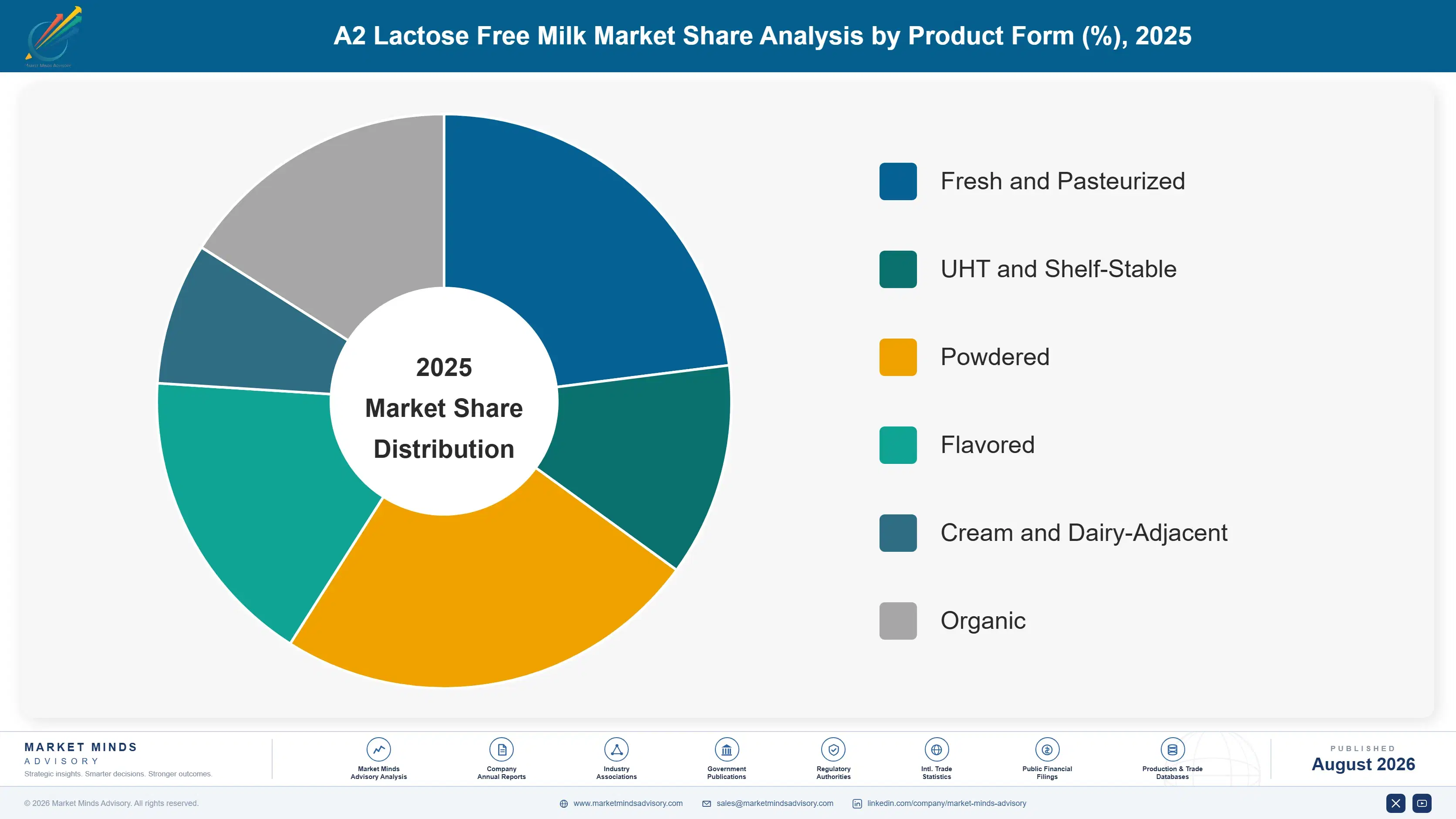
A2 lactose-free milk is segmented by product form, the classification that determines processing technology, shelf life, and target application: fresh and pasteurized, UHT and shelf-stable, powdered, flavored, cream and dairy-adjacent, and organic formulations each require distinct processing infrastructure and serve different retail and foodservice buyers, avoiding the overlap a distribution-channel-based split would create, a distinction rarely revisited once qualified.
a2-lactose-free-milk-market-market-share-analysis-1787464075192

Organic A2 Lactose-Free Milk

Organic A2 lactose-free milk is the fastest-growing segment as premium dairy buyers increasingly stack organic certification on top of A2 protein and lactose-free processing claims, seeking the most comprehensive health and quality positioning available in the category. This segment requires certified organic A2 herd sourcing in addition to standard genetic verification, a dual qualification requirement that has kept organic supply meaningfully constrained relative to demand growth. Organic Valley and several specialty regional dairies have expanded certified organic A2 herd programs specifically to serve this segment, though supply remains limited relative to the broader organic dairy market. Production costs remain substantially above conventional A2 lactose-free milk, but premium retail pricing more than compensates suppliers with genuine organic-certified A2 sourcing capability.
CAGR 16.2%

Flavored A2 Lactose-Free Milk

Flavored A2 lactose-free milk, including chocolate and vanilla formulations targeted primarily at children and younger consumers, is scaling quickly as parents seek digestive-friendly dairy options for lactose-sensitive children without sacrificing the flavor profiles kids actually prefer. Fairlife and a2 Milk Company both maintain flavored product lines specifically targeting family grocery purchasing, benefiting from broader brand recognition among parents already familiar with lactose-free positioning. Flavored formulations require additional sugar content management to maintain health positioning credibility, a formulation balance that has become a meaningful point of differentiation among competing brands. Retail data shows flavored variants driving meaningful trial and repeat purchase among families with at least one lactose-sensitive child in the household.
CAGR 14.8%
Full segment breakdown across 6 segments available in the complete report.

Regional Architecture and Country Demand Map

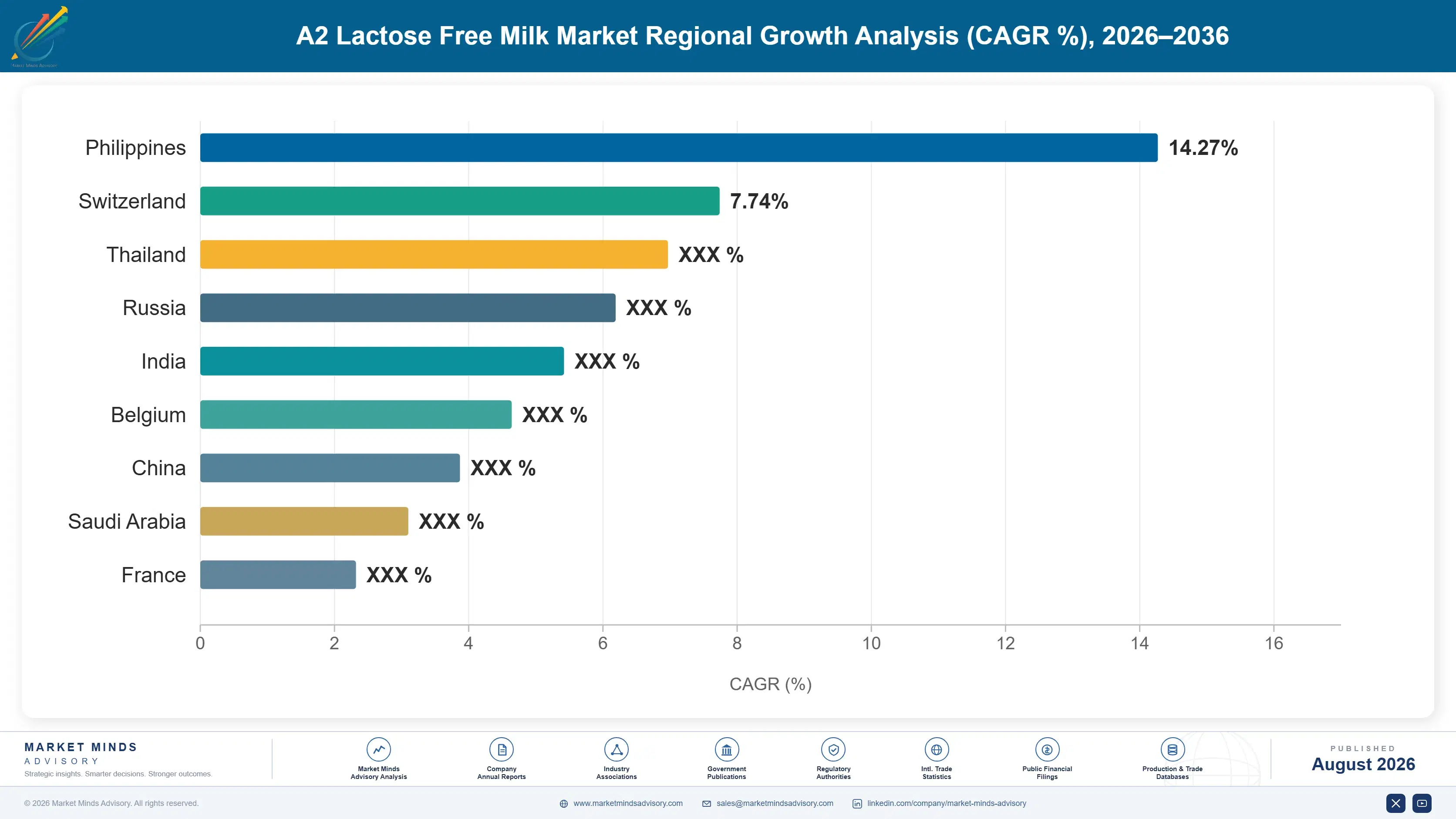
North America leads global A2 lactose-free milk demand, driven by Fairlife and Lactaid's dominant retail lactose-free presence, while South Asia and Pacific, anchored by a2 Milk Company's origin market and India's lactose-intolerant population, posts the category's fastest regional growth rate across both mature and emerging retail markets.

North America

The United States is the region's dominant market, anchored by Fairlife's Coca-Cola-backed retail distribution scale and Lactaid's decades-long lactose-free brand recognition, both of which now offer or compete alongside genuine A2-verified product lines. a2 Milk Company has expanded its fresh milk distribution across major US grocery chains significantly beyond its original West Coast entry point, building meaningful brand recognition among health-conscious dairy buyers. Canadian retailers have followed similar adoption patterns, generally importing branded product from US-based processors rather than developing domestic A2-verified supply chains. Verification scrutiny is most advanced here first, since major US retailers increasingly require documented genetic and lactose-content testing before accepting new supplier claims. Consumer trust in documented testing is becoming a real purchase driver here.
Share: 32% | CAGR: 13.4% (2026 to 2036)

Western Europe

The United Kingdom and Germany anchor Western European demand through well-established lactose-free dairy retail categories, though A2-specific verification remains less standardized than in North America. Arla Foods and other regional dairy cooperatives have begun piloting A2-verified product lines, though adoption trails North America given less consumer awareness of A2 protein positioning. France's dairy retail sector remains more conservative toward novel dairy positioning claims relative to plant-based alternative adoption. Growth here trails North America and Asia because European consumers have shown comparatively stronger preference for plant-based lactose-free alternatives over dairy-based A2 verification claims. Scandinavian markets are seeing early but steady interest in verified dual-claim products through premium organic retail channels specifically.
Share: 18% | CAGR: 11.1% (2026 to 2036)
Regional intelligence for 5 additional markets available in the complete report: East Asia, South Asia and Pacific, Latin America, Middle East and Africa, Eastern Europe. Contact sales@marketmindsadvisory.com.
a2-lactose-free-milk-market-country-cagr-analysis-1787464075713

Where A2 Lactose-Free Suppliers Can Capture Margin

Margin capture in A2 lactose-free milk increasingly depends on independent verification credibility rather than marketing claims alone. Suppliers that can document genetic A2 herd testing, guarantee measurable lactose content, and build organic or flavored line extensions are commanding meaningfully better retail pricing than those competing on unverified dual-claim positioning. That shift rewards verification-ready suppliers over marketing-only competitors.

Independent Genetic and Lactose Verification Certification

Suppliers that certify both A2 protein purity and lactose content through independent third-party testing, publishing verifiable documentation retailers and consumers can check directly, are capturing premium shelf placement as retailers tighten dual-claim acceptance standards. Green Valley Creamery's certified verification program, expanded in 2024, reportedly commands a 15 to 25 percent price premium over uncertified dual-claim competitors of comparable volume. Smaller regional processors lacking dedicated verification infrastructure are increasingly partnering with independent testing labs to offer comparable certification, adding cost but preserving access to premium retail accounts that now require documented dual-claim proof.
Market Impact: Commands a 15 to 25 percent price premium

Organic Certification Stacked on A2 Herd Sourcing

Suppliers that layer certified organic sourcing on top of verified A2 herd genetics are capturing the highest retail pricing tier in the category, since this combination requires the most extensive supply chain qualification of any product tier. Organic-certified A2 lactose-free milk typically commands a 30 to 45 percent price premium over conventional verified A2 lactose-free product, reflecting both organic certification costs and constrained supply relative to demand. Processors without established organic certification infrastructure face multi-year qualification timelines, a barrier that has kept this segment concentrated among suppliers with existing organic dairy supply chain relationships.
Market Impact: Commands a 30 to 45 percent price premium

Developing Flavored Family-Targeted Line Extension Products

Suppliers that develop flavored A2 lactose-free product lines targeting families with lactose-sensitive children are capturing incremental retail shelf space and household repeat purchase that unflavored products alone cannot access. Fairlife's flavored A2-adjacent line extensions reportedly drive 20 to 30 percent higher household purchase frequency compared with unflavored-only product offerings among the same customer base. This formulation approach requires additional sugar content management to preserve health positioning credibility, a balance that has become a meaningful competitive differentiator among flavored line suppliers. Suppliers investing early in flavored formulation are building household brand loyalty that later entrants will find harder to displace.
Market Impact: Lifts household purchase frequency by 20 to 30 percent

Bundled Retailer Verification Documentation Support Services

Bundling third-party verification documentation and retailer compliance support alongside the physical product sale helps smaller regional dairy brands that lack in-house testing and regulatory capability meet tightening retailer dual-claim acceptance standards. Suppliers offering this bundled service report shortened retailer onboarding timelines by several weeks on average, since retail buyers avoid commissioning duplicate verification testing the supplier has already conducted. This service layer also raises effective per-unit pricing by an estimated 8 to 12 percent, since smaller brands otherwise face independent testing costs running into meaningful sums if commissioned separately across most regional accounts.
Market Impact: Raises effective pricing by 8 to 12 percent

Who Controls the Margin Pool

Five suppliers hold well under half of global A2 lactose-free milk volume on a production basis, reflecting a market that spans both global branded players and numerous regional dairy cooperatives entering the category. The gap between verification-credible branded leaders and unverified regional entrants is wide on retailer trust and price, even though both compete under the same dual-claim category label. That trust gap keeps the competitive landscape more fragmented than most mature dairy categories.
Current competitive activity centers on three fronts: independent verification certification to defend premium positioning amid growing retailer scrutiny, organic and flavored line extension development to capture premium and family segments, and geographic expansion into China and India where brand trust and population scale offer substantial growth potential. a2 Milk Company and Fairlife have both continued investing in these areas specifically to defend category leadership.

Emerging pressure is coming from private-label retailers launching verified dual-claim lines directly, threatening the premium positioning branded suppliers have historically relied on to justify pricing. Rankings could shift meaningfully over the next several years if private-label verification quality closes the credibility gap that currently favors established branded suppliers among trust-conscious consumers.
a2-lactose-free-milk-market-company-positioning-matrix-1787464076249

Competitive Moat and Risk Dimensions

A2 MILK COMPANY

Moat: Category-Founding Brand Recognition

a2 Milk Company created the A2 dairy category and built deep institutional expertise in genetic herd testing and verification protocols over more than two decades of operation. That founder's advantage gives the company brand recognition and technical credibility that newer entrants attempting to build comparable trust from scratch cannot quickly replicate.
A2 MILK COMPANY

Risk: Limited Lactose-Free Processing Scale

a2 Milk Company's core expertise lies in A2 herd genetics rather than lactose-free processing technology, an area where Fairlife and Lactaid hold deeper manufacturing scale and infrastructure. As dual-claim products require both capabilities simultaneously, a2 Milk Company risks ceding ground to competitors that can integrate both processes more efficiently at scale.
FAIRLIFE

Moat: Coca-Cola Retail Distribution Scale

Fairlife benefits from Coca-Cola's extensive retail distribution network and marketing budget, giving it shelf placement and consumer reach that smaller specialized A2 dairy brands cannot match. That distribution scale lets Fairlife move new dual-claim product lines into mainstream retail faster than competitors relying on slower, more limited distribution channels.
FAIRLIFE

Risk: Weaker A2-Specific Brand Credibility

Fairlife's brand positioning has historically centered on ultra-filtration and protein content rather than A2-specific genetic verification, giving it less established credibility in A2 positioning compared with category originator a2 Milk Company. As verification scrutiny increases, Fairlife may need to invest further to establish comparable A2-specific trust among discerning consumers.

Players Tracked

Prominent Players

a2 Milk Company
Fairlife
Lactaid
Green Valley Creamery
Mother Dairy

Other Key Players

Vinamilk
TH True Milk
Nestle
Danone
Freedom Foods Group
Amul
Arla Foods
Saputo
DMK Group
Prairie Farms Dairy
Organic Valley
Dairy Farmers of America
Chobani
Borden Dairy
Schreiber Foods

Recent Developments

MARCH 2024

Green Valley Creamery Launches Certified Verification Program

Green Valley Creamery launched a certified independent verification program for its A2 lactose-free product line in March 2024, publishing genetic and lactose-content testing documentation directly accessible to retailers and consumers, responding to growing retailer scrutiny over unverified dual-claim products entering the category. Category buyers describe this as a pivotal shift.
Signal: Signals verification documentation is becoming a retail shelf-placement requirement rather than an optional marketing enhancement industry-wide.
AUGUST 2024

Major US Retailer Requires Dual-Claim Verification

A major US grocery retailer began requiring independent dual-claim verification documentation before accepting new A2 lactose-free supplier SKUs starting in August 2024, directly responding to consumer complaints and independent testing findings regarding inconsistent labeled claims across multiple smaller brands. Analysts expect other major retailers to adopt similar policies quickly.
Signal: Signals retailers are stepping into an enforcement role that formal food safety regulation has not yet established.
JANUARY 2025

a2 Milk Company Expands Chinese Adult Milk Line

a2 Milk Company expanded its adult liquid milk product line in the Chinese market in January 2025, building directly on consumer brand trust established through more than a decade of infant formula marketing investment, targeting adult consumers already familiar with the company's A2 positioning nationwide.
Signal: Signals established infant formula brands are successfully extending trust into adjacent adult dairy product categories elsewhere.

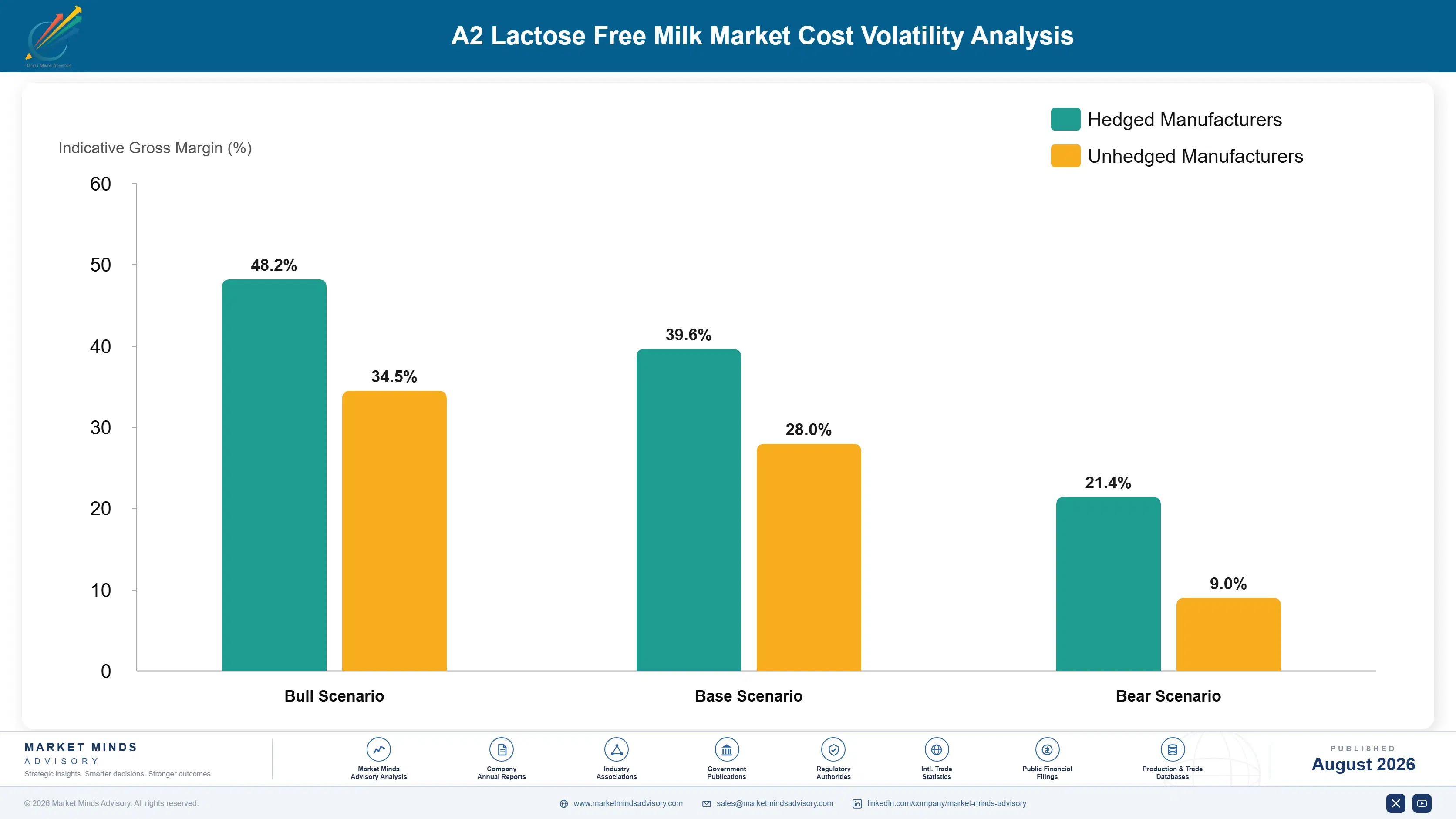
A2 Herd Sourcing and Processing Cost Exposure

Verified A2 herd milk, sourced from cattle genetically tested to produce only A2 beta-casein protein, accounts for roughly thirty-eight percent of total production cost across the industry given the premium ranchers command for maintaining dedicated A2-only herds. Lactose removal processing, whether through enzymatic treatment or ultra-filtration, adds a second significant cost layer that varies considerably depending on the specific technology and target lactose-content threshold.
Genetic testing costs for verifying A2-only herd status rose meaningfully as demand for verified supply outpaced available tested herd capacity, according to industry trade reporting and a2 Milk Company's public disclosures, tightening available premium milk supply for both branded and private-label formulators simultaneously. Processors without long-term dedicated herd supply contracts faced the steepest cost increases, since qualifying new A2-verified herds requires genetic testing and transition time that cannot be accelerated quickly.

Smaller processors relying on spot-market milk purchases carry meaningfully more cost and supply-consistency exposure than larger, vertically integrated suppliers like a2 Milk Company that maintain direct, long-term herd supply relationships. Processors that have already invested in lactose-free processing infrastructure face a distinct cost exposure profile tied to processing technology and yield efficiency rather than raw milk sourcing costs alone.
a2-lactose-free-milk-market-cost-volatility-analysis-1787464076447

Contract Directly With Verified A2 Herd Ranchers

Larger processors are shifting toward direct, multi-year contract relationships with genetically verified A2 herd ranchers, securing more predictable supply and pricing ahead of continued category demand growth. This approach requires upfront investment in rancher relationships but has measurably reduced supply volatility for processors that implemented it before recent demand acceleration across most established rancher partnerships.

Invest in In-House Genetic Testing Capability

Processors are building in-house genetic testing laboratories to verify A2 herd status directly rather than relying on third-party testing services, reducing per-test cost and turnaround time for ongoing herd verification. Early results suggest meaningful cost savings are achievable, though building this capability requires significant upfront investment most smaller processors cannot yet justify over time industry-wide.

Diversify Lactose Removal Processing Technology

Processors are evaluating both enzymatic treatment and ultra-filtration lactose removal technologies to identify the most cost-efficient approach for their specific production scale and target market. This flexibility helps processors avoid being locked into a single processing technology that may become less cost-competitive as the category matures further. Processors report this flexibility also improves negotiating leverage with equipment vendors.

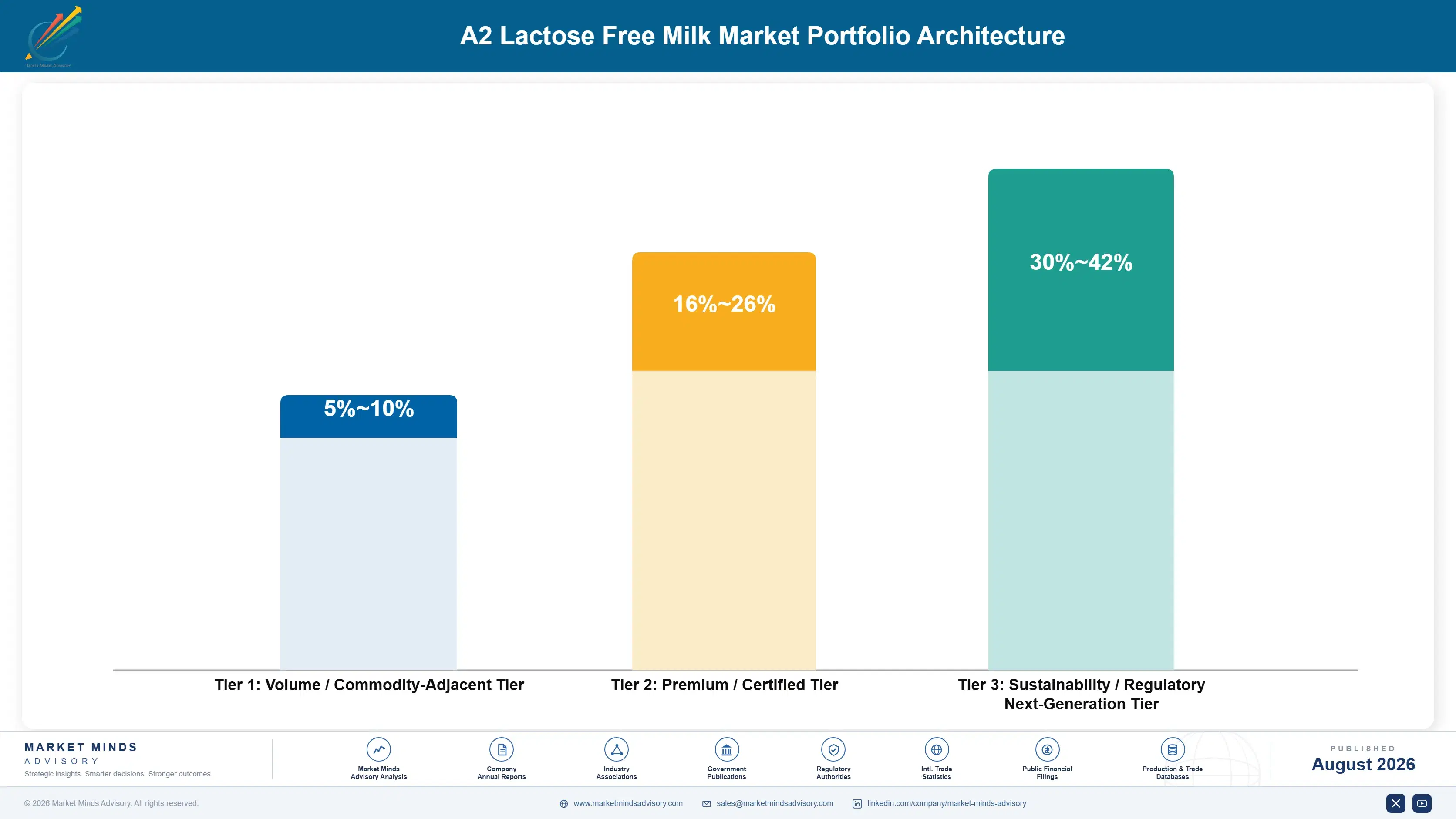
Portfolio Architecture for Margin Defence

A2 lactose-free milk suppliers operate a three-tier portfolio spanning standard verified dual-claim products sold largely on cost per unit into mainstream retail, flavored and family-targeted formulations commanding premium pricing from household repeat buyers, and organic-certified premium formulations positioned for the highest-margin health-conscious retail accounts. Gross margins vary sharply across these tiers, from modest single digits on standard verified product to well above thirty percent on organic-certified premium formulations.
The volume versus premium tension is intensifying as more suppliers chase organic and flavored margins, but standard verified dual-claim product still represents the majority of shipped retail volume and remains essential for covering fixed verification and processing costs across the industry's mainstream grocery customer base. Suppliers that abandon standard volume too quickly in pursuit of premium accounts risk underutilizing capacity built for retail scale.

High-value margin pools concentrate specifically in organic-certified formulations sold to health-conscious premium retail accounts, and in flavored family-targeted products capturing household repeat purchase from parents of lactose-sensitive children. Standard verified dual-claim product remains the volume anchor but carries the thinnest margins, squeezed further by private-label competition entering the category across nearly every mainstream retail account.

Volume / Commodity-Adjacent Tier

Standard verified dual-claim A2 lactose-free milk sold primarily on cost per unit into mainstream grocery retail, where price competition among branded and private-label suppliers is intense and formulation differentiation is limited.
Gross Margin: 5-10%

Premium / Certified Tier

Flavored and family-targeted A2 lactose-free formulations sold into mainstream retail households with lactose-sensitive children, commanding premium pricing through repeat purchase and brand loyalty positioning Pricing reflects repeat purchase value and household brand loyalty rather than raw ingredient cost.
Gross Margin: 16-26%

Sustainability / Regulatory / Next-Generation Tier

Organic-certified A2 lactose-free formulations positioned for premium natural food and specialty grocery accounts willing to pay the category's highest per-unit prices for stacked health credentials Capital and supply constraints keep this tier concentrated among a handful of specialty suppliers.
Gross Margin: 30-42%
a2-lactose-free-milk-market-portfolio-architecture-1787464076964

High-value Sub-segments and Strategic Watch-out

Organic Certified Premium Formulations

Organic-certified A2 lactose-free milk is capturing the highest margins in the category as premium dairy buyers stack organic certification atop existing A2 and lactose-free claims, and suppliers with established organic herd programs are positioned to capture this demand ahead of competitors still building certification infrastructure.
Gross Margin: 30-42%

Flavored Family-Targeted Retail Lines

Flavored A2 lactose-free formulations targeting families with lactose-sensitive children are gaining share in mainstream grocery retail as parents seek digestive-friendly options without sacrificing flavor preferences, though this segment remains smaller than standard unflavored product volume overall. Adoption should broaden as more brands develop comparable flavored formulations over time.
Gross Margin: 16-26%

Standard Verified Dual-Claim Retail

Standard verified A2 lactose-free milk sold into mainstream grocery retail remains the category's volume core, anchored by established brand relationships but facing intense price competition from private-label suppliers entering the category. Most incumbents defend this tier through brand recognition and distribution scale rather than reformulation investment.
Gross Margin: 5-10%

Unverified Dual-Claim Marketing-Only Products

Products marketed as A2 lactose-free without independent genetic or lactose-content verification face rising retailer and regulatory scrutiny following consumer complaints, making this a segment suppliers and retailers should actively move away from quickly. Several brands still selling on this basis have already faced retailer delisting recently.
Gross Margin: 3-8%

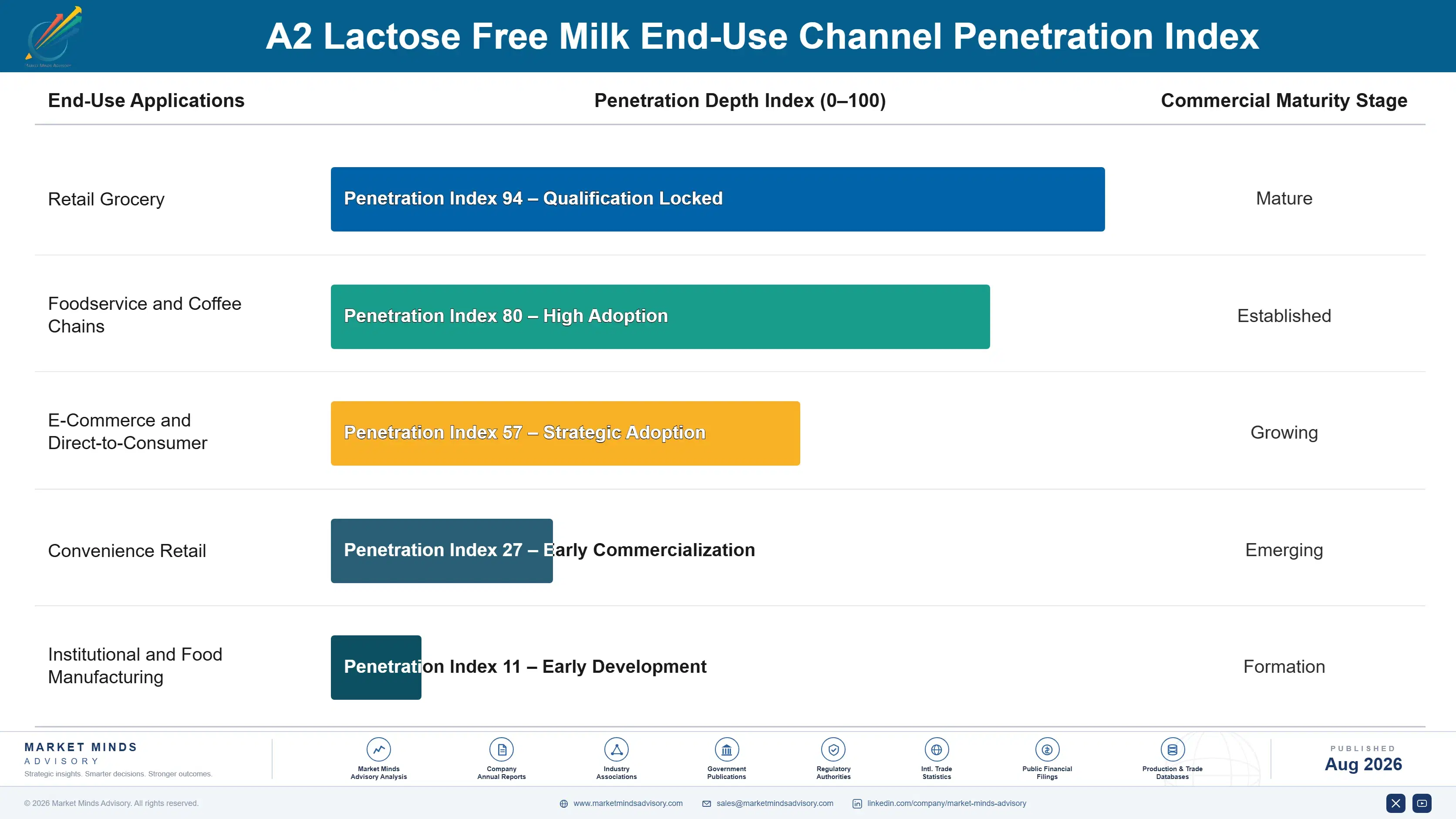
A2 Lactose-Free's Verification-Driven Lock-In

A2 lactose-free milk behaves like an annuity product once a retailer establishes a verified supplier relationship, because switching suppliers means requalifying both genetic herd testing and lactose-content verification from scratch, a costly and time-consuming process retailers generally prefer to avoid. That inertia gives incumbent verified suppliers multi-year revenue visibility once they clear a retailer's verification standard, particularly as more retailers formalize dual-claim acceptance requirements. That lock-in can persist for years once a retailer standardizes its private-label program around one verified supplier.
Adoption depth varies sharply by end-use vertical. Health-conscious specialty retail buyers adopted verified A2 lactose-free products relatively quickly given existing consumer awareness in that channel, while mainstream grocery retailers move more slowly, requiring extensive verification documentation and category performance data before committing meaningful shelf space to the category. Suppliers serving both channels increasingly run separate verification and sales teams to match each retailer's pace.

Generational buyer shifts are visible mainly in the premium and specialty retail channel, where younger parents and health-conscious consumers favor stacked, verified health claims specifically for their perceived comprehensiveness, while legacy conventional dairy buyers remain anchored to standard milk products that have not yet faced sufficient pressure to justify switching to premium verified alternatives.
a2-lactose-free-milk-market-end-use-penetration-index-1787464077455

Where A2 Lactose-Free Value Concentrates

These are among the four positions where our research anticipates prominent divergence between winners and laggards over the coming forecast period. Each is grounded in the demand model, the regulatory perimeter, and the announced capacity pipeline.
01 / VERIFICATION INVESTMENT PRIORITY

Invest in independent verification ahead of retailer mandates

Retailers are increasingly requiring independent genetic and lactose-content verification before accepting new A2 lactose-free supplier claims, and that requirement is unlikely to reverse given documented cases of inconsistent labeled claims across the category. Suppliers without verification capability risk losing shelf access to certified competitors regardless of how competitive their pricing looks today. MMA recommends suppliers without established verification infrastructure invest in it now, before documentation becomes a baseline market access requirement rather than a competitive differentiator worth paying for once industry-wide adoption makes it standard.
02 / ORGANIC LINE EXTENSION DEVELOPMENT

Develop organic-certified lines ahead of premium demand growth

Organic-certified A2 lactose-free milk commands the highest pricing tier in the category, and that premium is sustained by the dual qualification requirement of certified organic sourcing combined with A2 herd verification. Suppliers that have already invested in organic-certified A2 herd programs are capturing premium demand that competitors without this dual capability cannot access. MMA recommends suppliers with organic dairy supply chain relationships evaluate certified A2 line development now, before supply constraints ease and premium pricing compresses toward standard verified product levels.
03 / CHINESE AND INDIAN EXPANSION

Expand into China and India ahead of population-scale growth

China's substantial A2 brand trust, built through years of infant formula marketing, and India's enormous lactose-intolerant population together represent the category's largest untapped growth potential outside established Western markets. Suppliers without established distribution and brand relationships in these markets risk losing first-mover positioning to domestic competitors already building local trust and supply infrastructure. MMA recommends suppliers with sufficient resources evaluate market entry now, while brand-building relationships remain available to a still-developing competitive set and secure relationships before larger domestic competitors close the trust gap themselves.
04 / FLAVORED FAMILY SEGMENT DEVELOPMENT

Build flavored family lines ahead of mainstream category maturity

Flavored A2 lactose-free formulations targeting families with lactose-sensitive children are driving meaningful incremental household purchase frequency that unflavored products alone cannot capture. Suppliers that have already developed credible flavored line extensions are building household loyalty relationships that later entrants will find harder to displace. MMA recommends suppliers without flavored product lines evaluate development now, before mainstream retail category expectations shift further and unflavored-only positioning becomes a competitive liability Later entrants attempting to replicate this loyalty will find the effort considerably harder.

Engagement Snapshot From the Field

A live engagement with an industry participant carrying material or product regulatory and market exposure ahead of a defining policy shift, showing how our research translates into a defensible multi-year portfolio strategy.
MARKET MINDS ADVISORY · CLIENT ENGAGEMENT SUMMARY
A2 Lactose Free Milk Producer Strategic Portfolio Review and Transition Roadmap 2026·Investment Scenario on A2 Lactose Free Milk Exposure Evaluation 2025-26
CLIENT PROFILE
The client is a mid-sized North American regional grocery chain generating an estimated eight hundred million dollars in annual revenue (client-reported, unverified by MMA), operating stores across several states with a strong private-label dairy program. The client wanted to launch a private-label A2 lactose-free milk line but faced uncertainty about which suppliers could provide genuinely verified dual-claim product versus marketing-only positioning.
STRATEGIC CHALLENGE
Several potential private-label suppliers made A2 lactose-free claims without offering independent verification documentation, creating real risk that the client's private-label launch could face consumer complaints or reputational damage if claims proved inaccurate under scrutiny. The client needed to identify a supplier capable of genuine dual-claim verification within its planned launch timeline.
MMA APPROACH
MMA conducted a structured evaluation of four potential private-label suppliers, benchmarking independent genetic and lactose-content testing documentation, production capacity, and pricing against the client's planned launch volume and timeline. The engagement included direct facility assessments and independent third-party testing of sample product to validate supplier claims before finalizing a private-label supply agreement.
KEY FINDINGS
  1. Two of the four evaluated suppliers could not provide independent third-party verification documentation for either A2 protein content or lactose removal claims upon direct request.
  2. The recommended supplier's verified dual-claim product added roughly eighteen percent to per-unit cost compared with unverified alternatives but eliminated meaningful reputational risk.
  3. Independent testing confirmed the recommended supplier's product met both A2 protein purity and lactose-content thresholds consistently across multiple production batches tested over a three-month period.
  4. The client's private-label launch achieved unit velocity meaningfully above initial category sales projections across all participating stores within the first quarter (client-reported, unverified by MMA).
CLIENT PROFILE
The client is a mid-sized North American regional grocery chain generating an estimated eight hundred million dollars in annual revenue (client-reported, unverified by MMA), operating stores across several states with a strong private-label dairy program. The client wanted to launch a private-label A2 lactose-free milk line but faced uncertainty about which suppliers could provide genuinely verified dual-claim product versus marketing-only positioning.
STRATEGIC CHALLENGE
Several potential private-label suppliers made A2 lactose-free claims without offering independent verification documentation, creating real risk that the client's private-label launch could face consumer complaints or reputational damage if claims proved inaccurate under scrutiny. The client needed to identify a supplier capable of genuine dual-claim verification within its planned launch timeline.
MMA APPROACH
MMA conducted a structured evaluation of four potential private-label suppliers, benchmarking independent genetic and lactose-content testing documentation, production capacity, and pricing against the client's planned launch volume and timeline. The engagement included direct facility assessments and independent third-party testing of sample product to validate supplier claims before finalizing a private-label supply agreement.
KEY FINDINGS
  1. Two of the four evaluated suppliers could not provide independent third-party verification documentation for either A2 protein content or lactose removal claims upon direct request.
  2. The recommended supplier's verified dual-claim product added roughly eighteen percent to per-unit cost compared with unverified alternatives but eliminated meaningful reputational risk.
  3. Independent testing confirmed the recommended supplier's product met both A2 protein purity and lactose-content thresholds consistently across multiple production batches tested over a three-month period.
  4. The client's private-label launch achieved unit velocity meaningfully above initial category sales projections across all participating stores within the first quarter (client-reported, unverified by MMA).
RECOMMENDED STRATEGY
Phase 1: Phase 1 (Weeks 1 to 3): Benchmark four potential suppliers against verification documentation, capacity, and pricing requirements ahead of the launch timeline. Phase 2: Phase 2 (Weeks 4 to 6): Conduct independent third-party testing of sample product to validate supplier dual-claim accuracy before finalizing agreements. Phase 3: Phase 3 (Weeks 7 to 10): Finalize supply agreement, launch private-label product, and monitor initial sales performance across all store locations.
OUTCOME
The client successfully launched its private-label A2 lactose-free line with verified dual-claim documentation, achieving unit velocity above initial projections within the first quarter (client-reported, unverified by MMA). The launch also positioned the client favorably ahead of growing consumer scrutiny of unverified dairy health claims industry-wide.

Frequently Asked Questions

Foundational context covering the market sizes, CAGR, scope, country, region and competition that inform every finding below. This section is provided to cover basics and most often pre-purchase conversations, answered from the MMA Primary Research Dataset.

What is the current size of the A2 Lactose Free Milk Market?

The global A2 lactose-free milk market is valued at approximately $0.68 billion in 2025. Growth is driven by mainstream retail expansion alongside rising demand for stacked dairy health claims.

How large will the A2 Lactose Free Milk Market be by 2036?

MMA projects the market will reach approximately $2.51 billion by 2036, more than 3.2 times its 2026 base value. Organic formulations will account for a growing share of that expansion.

What is the CAGR for the A2 Lactose Free Milk Market 2026 to 2036?

The market is expected to grow at a compound annual growth rate of 12.6% between 2026 and 2036. Bull and bear scenarios range from 11.3% to 13.9% depending on verification and competitive conditions.

Which segment is growing fastest?

Organic A2 lactose-free milk is the fastest-growing segment, expanding at roughly 16.2% annually, about 1.3 times the overall market rate. Stacked premium health claims are the primary driver.

Who are the major companies in the A2 Lactose Free Milk Market?

a2 Milk Company, Fairlife, Lactaid, Green Valley Creamery, and Mother Dairy lead global supply. The top five suppliers together hold well under half of global volume.

Which country is growing fastest?

India is growing fastest, driven by its enormous lactose-intolerant population and strong cultural preference for indigenous A2 cow breeds. Domestic dairy cooperative investment is reinforcing this growth.

Report Segmentation Architecture

The full report scope spans multiple orthogonal segmentation dimensions, with cross-tabulated demand data provided for each dimension pair. Coverage extends further to regional breakdowns, trend trajectories, and the competitive detail needed to support segment-level decision-making.

By Product Form

  • Fresh and Pasteurized
  • UHT and Shelf-Stable
  • Powdered
  • Flavored
  • Cream and Dairy-Adjacent
  • Organic

By End-Use Channel

  • Retail Grocery
  • Foodservice and Coffee Chains
  • E-Commerce and Direct-to-Consumer
  • Convenience Retail
  • Institutional and Food Manufacturing

By Commercial Dimension

  • Independently Verified Supply
  • Standard Branded Supply
  • Private Label Contract Supply
  • Direct Retailer Partnership

By Region

  • North America
  • Western Europe
  • East Asia
  • South Asia and Pacific
  • Latin America
  • Middle East and Africa
  • Eastern Europe

Scope, Methodology, and Coverage

Every figure in this report is reproducible from documented input assumptions. The scope below maps the historical period, the forecast horizon, the segmentation dimensions, and the countries covered, alongside the underlying primary and qualitative methodology.
Historical Period
2020 to 2025
Forecast Period
2026 to 2036
Base Year
2025 (USD billions; MMA Primary Research Dataset, August 2026)
Market Definition
The A2 lactose-free milk market covers dairy milk products verified to contain only A2 beta-casein protein and processed to remove lactose content, sold as fresh, UHT, powdered, and flavored formats for consumers seeking both digestive comfort and lactose intolerance management. It excludes conventional A1/A2 blend milk, standard lactose-free milk without A2 protein verification, and plant-based dairy alternatives.
Quantitative Units
USD billions (current prices); million liters of finished product where applicable
Segmentation Dimensions
By Product Form; By End-Use Channel; By Commercial Dimension; By Region
Regions Covered
North America, Western Europe, East Asia, South Asia and Pacific, Latin America, Middle East and Africa, Eastern Europe
Countries Covered
USA, China, Germany, France, UK, Japan, South Korea, India, Australia, Canada, Brazil, Mexico, Indonesia, Vietnam, Thailand, Malaysia, UAE, Saudi Arabia, South Africa, Nigeria, Turkey, Poland, Netherlands, Italy, Spain, Sweden, Switzerland, Argentina, Colombia, Singapore, and additional markets relevant to this sector
Key Companies Profiled
a2 Milk Company, Fairlife, Lactaid, Green Valley Creamery, Mother Dairy, Vinamilk, TH True Milk, Nestle, Danone, Freedom Foods Group, Amul, Arla Foods, Saputo, DMK Group, Prairie Farms Dairy, Organic Valley, Dairy Farmers of America, Chobani, Borden Dairy, Schreiber Foods
Quantitative Methodology
Primary survey, n=3,800 respondents, Q4 2025, six countries; demand-side model with trade association cross-validation
Qualitative Methodology
47 expert interviews, Q4 2025; applied to validate demand model assumptions, identify emerging dynamics, and assess competitive positioning
Report Format
PDF and XLSX data workbook (Word format preview document)
Publisher
Market Minds Advisory
Report Code
MMA-2026-AGR-201
Published
August 2026
Contact
sales@marketmindsadvisory.com | www.marketmindsadvisory.com

Purchase the full A2 Lactose Free Milk Market Report (2026 to 2036).

This report delivers a complete assessment of the global A2 lactose-free milk market across all major product forms, end-use channels, and geographic regions through 2036. It includes detailed competitive profiling of twenty companies, segmentation analysis distinguishing fresh, UHT, powdered, flavored, cream, and organic formulations, and regional demand modeling across all seven MMA-covered geographies. Buyers will find quantified forecasts for market size, segment growth rates, and regional CAGR alongside qualitative analysis of verification trends, competitive dynamics with plant-based alternatives, and A2 herd sourcing cost exposure. A dedicated revenue lever framework identifies four specific commercial actions suppliers can take to capture margin as verification standards tighten.
Twenty-company competitive profiling with moat and risk analysis
Seven-region demand model with justified share and CAGR bands
Product-form segmentation across six MECE categories
Quantified revenue lever framework for margin capture strategies
A2 herd sourcing and processing cost exposure analysis
Anonymized case study on private-label verification sourcing

Built For The People Who Decide

From boardroom strategy to bench-side execution, this report is read cover-to-cover by leaders shaping the next decade of their industry, turning demand scenarios, market dynamics and valuation benchmarks into decisions.
CXOs/ Presidents/ VPs/ Managers
M&A and Corporate Development
Strategy Teams and R&D Heads
Procurement and Product Directors
Regulatory and Compliance Leaders
Investor Relations and Equity Analysts