
Market Minds Advisory
2-Nitrothiophene Market

2-Nitrothiophene Market: Pharmaceutical Intermediate Demand and the Organic Electronics Opportunity

Pharmaceutical API pipelines and emerging organic electronics research are pulling demand for this thiophene derivative in opposite technical directions, forcing fine chemical producers to defend purity grades against both markets simultaneously.

Lead Analyst

Bilal Shaikh

Published

September 2026

Make Smarter Decisions with Customized Research Insights

Request a free sample report and evaluate market opportunities, growth trends, and competitive dynamics relevant to your business needs.

2025 MARKET VALUE$0.3BMarket Size 2025
2036 FORECAST VALUE$0.6BBase Case , 2026 to 2036
CAGR 2026 TO 20366.4 %Bull 7.6% / Bear 5.3%
INCREMENTAL OPPORTUNITY$0.3BNet 10- year value creation
EXPANSION MULTIPLE1.87x2036 value over 2026 base
Strategic Levers
M&A Pipeline
Regional Outlook
Country Rankings
Competitive Intelligence
Segmental Deep-dive
Call-Us : 91 93563 13602

Executive Snapshot and Market Trajectory

2-Nitrothiophene remains a narrow specialty chemical intermediate, and purity-grade demand from pharmaceutical synthesis is now outpacing what established fine chemical producers can supply on short lead times, pushing buyers toward long-term contracts with certified manufacturers holding compliant nitro-aromatic handling infrastructure already in place across all their production sites.
Pharmaceutical intermediate applications still absorb the largest volume, but organic electronics and conducting polymer precursor demand is growing fastest as printed electronics researchers explore thiophene-based semiconductor materials for next-generation display and sensor applications. China now hosts the largest concentration of fine chemical production capacity, while Western buyers increasingly specify certified purity documentation that smaller unaudited suppliers struggle to provide consistently across successive production batches.
No single producer controls more than a modest share of global capacity, since fine chemical intermediates of this type are manufactured across dozens of specialized batch chemistry facilities worldwide rather than concentrated industrial-scale plants. Tightening nitro-aromatic handling regulations are forcing suppliers to invest more aggressively in safety infrastructure than in past cycles, squeezing margin for producers without existing compliant facilities and adding meaningful capital cost that smaller batch chemistry operators often cannot absorb.
Market Definition
This market comprises 2-nitrothiophene sold as a chemical intermediate for pharmaceutical, agrochemical, dye and pigment, and organic electronics synthesis applications. It excludes finished pharmaceutical, agrochemical, or electronic products containing 2-nitrothiophene-derived compounds as a formulated ingredient.
Base Year Value
$0.3B in 2025 (MMA Primary Research Dataset, August 2026)
Forecast Period
2026 to 2036, eleven discrete annual values
CAGR
6.4% base case. Bull 7.6%. Bear 5.3%.
Fastest Growth Segment
Organic Electronics and Conducting Polymer Precursor: 11.2% CAGR
Fastest Growth Country
India: 11.4% CAGR
Fastest Growth Region
South Asia and Pacific: 8.4% CAGR
Largest Region
East Asia: 30% of 2025 global value
Market Leaders
Merck KGaA (MilliporeSigma), Thermo Fisher Scientific, TCI Chemicals, Enamine, BLD Pharmatech. Source: MMA Analysis based on company annual reports.
Primary Survey
n=3,800 procurement and R&D decision-makers, Q4 2025, six countries
Methodology
Demand-side build-up, cross-validated against public data, 47 expert interviews

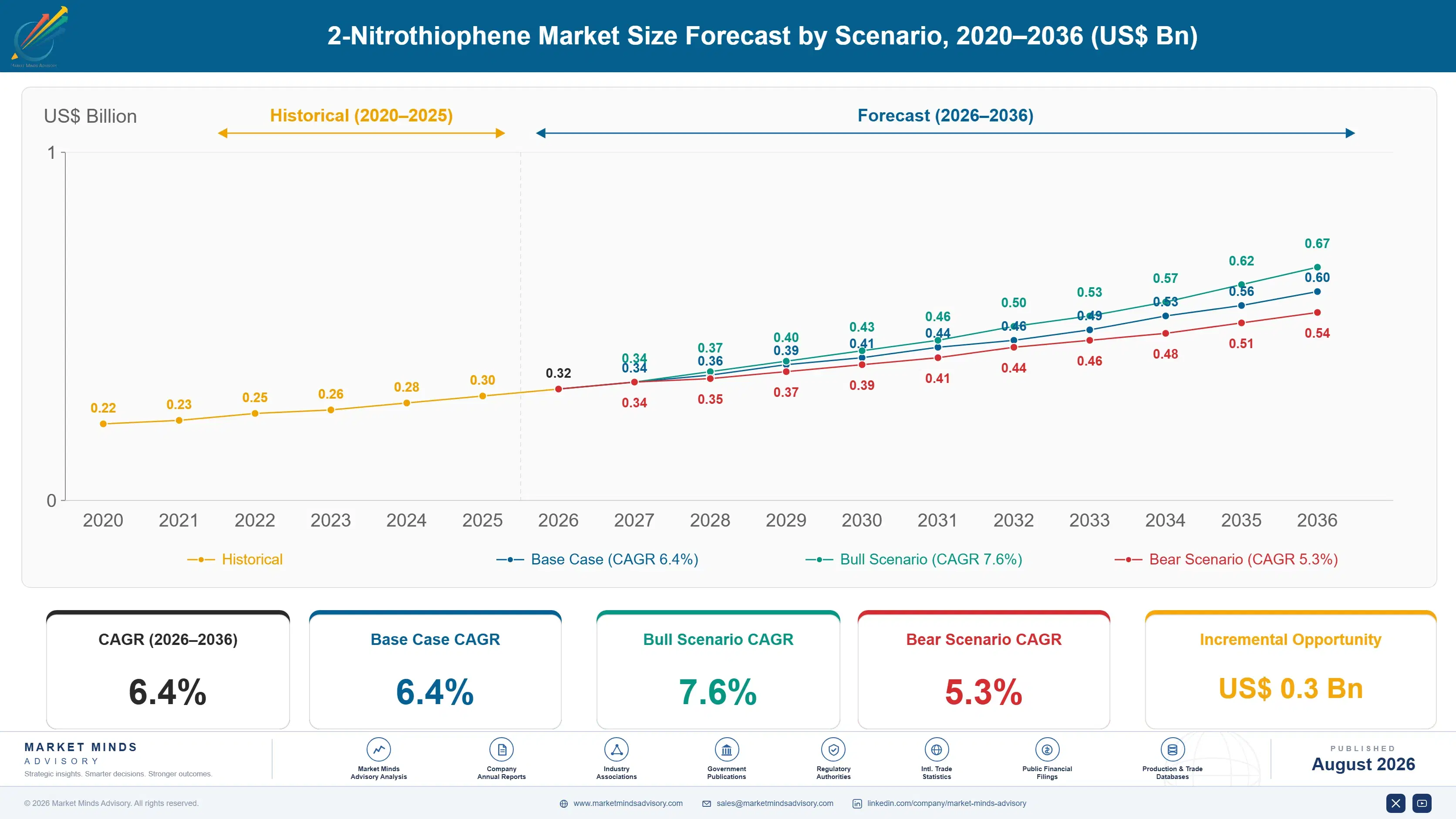
2-Nitrothiophene Market Forecast Scenarios

2-nitrothiophene-market-trends-size-forecast-scenario-1787464131674
Between 2020 and 2025 the market grew steadily as pharmaceutical API synthesis pipelines expanded and specialty chemical distributors built out inventory to serve smaller research and pilot-batch buyers across multiple continents. Regulatory scrutiny on nitro-aromatic handling intensified through the period, raising compliance costs for producers faster than volume growth alone could offset during that same five-year stretch.
The base case assumes pharmaceutical intermediate demand keeps growing while organic electronics researchers gradually scale thiophene-based semiconductor material trials into small commercial volumes across research partnerships. Three mechanisms drive the forecast: expanding pharmaceutical synthesis pipelines requiring certified purity-grade intermediate supply, Chinese fine chemical capacity absorbing volume previously sourced from smaller Western batch producers, and tightening nitro-aromatic safety regulation forcing consolidation among producers unable to fund compliant facility upgrades on their own working capital.
The bull case turns on organic electronics researchers scaling thiophene-based conducting polymer trials into meaningful commercial volume faster than expected, lifting demand well above trend across multiple end-use categories. The bear case centers on regulatory compliance costs outpacing what buyers will pay, pushing pharmaceutical synthesizers toward alternative intermediate chemistries that avoid nitro-aromatic handling requirements entirely going forward.

Where Purity Certification Meets Synthesis Demand

2-Nitrothiophene sits at the intersection of pharmaceutical synthesis chemistry and emerging organic electronics research. Buyers reformulate purity specifications constantly to hit narrow synthesis requirements, while producers absorb the batch-to-batch consistency challenges those specifications create across a genuinely fragmented global supplier base. Currency swings and thiophene feedstock pricing now move contract pricing almost as much as demand growth does.
MARKET CONCENTRATIONCR5 28%production stays fragmented across many specialized batch producers
AVERAGE SELLING PRICE$420/kgpharmaceutical-grade material commands significantly higher per-kilogram batch pricing
TOP PRODUCING COUNTRYChina, 34% sharesingle country supplies over a third of global volume
CAPACITY UTILISATION63%batch chemistry plants run below full operational capacity most quarters
TRADE INTENSITY48% cross-bordersignificant volume crosses borders before final pharmaceutical synthesis occurs
FEEDSTOCK COST SHARE39% of COGSthiophene feedstock input dominates total finished production cost base
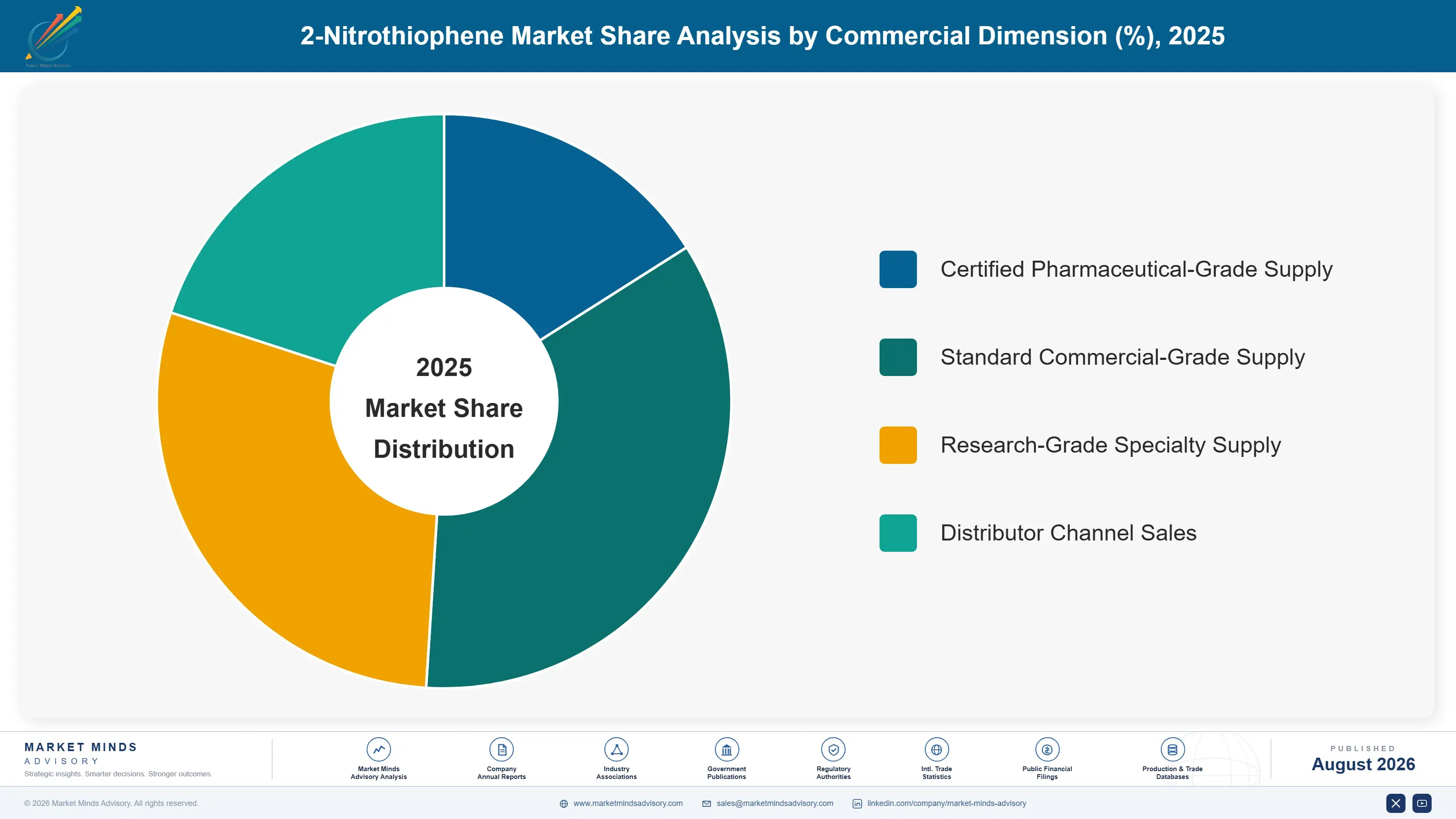
Commercial activity now concentrates around three demand pools: pharmaceutical API synthesis accounts requiring certified purity documentation, agrochemical and dye intermediate buyers purchasing standard commercial-grade material at larger volume, and research institutions purchasing small quantities for organic electronics and materials science trials. Each pool rewards a different producer capability, splitting the market into distinct commercial tiers rather than a single undifferentiated fine chemical business.
Over the next decade, purity certification and regulatory compliance will separate producers who can defend margin from those competing purely on price, particularly as pharmaceutical buyers tighten supplier qualification standards across their synthesis supply chains. Producers that invest early in compliant nitro-aromatic handling infrastructure should capture a growing share of premium pharmaceutical contracts, while smaller regional producers without that infrastructure increasingly get pushed toward the thinner-margin commodity dye and pigment intermediate segment.
"This is not a commodity chemical story. A pharmaceutical buyer will pay a real premium for a producer that can prove the same purity batch after batch, and that is where the actual margin sits."
Director, Specialty and Fine Chemicals Practice · MMA Specialty and Fine Chemicals Practice · August 2026

Market Trends

Thiophene-Based Organic Electronics Research Rapidly Accelerates

Materials science researchers are increasingly exploring thiophene derivatives, including nitro-substituted variants, as building blocks for conducting polymers used in printed electronics, flexible displays, and organic photovoltaic research. This research remains at pilot scale today, but several university and corporate laboratories have moved from single-gram synthesis to small commercial-quantity trials over the past two years. Specialty chemical suppliers with research-grade purity certification are positioning early to capture this demand before it scales into larger commercial volume, since switching suppliers mid-research-program creates meaningful reproducibility risk that researchers actively avoid whenever possible during active trial phases.
Market Impact: Lifts clinical pipeline demand 18%
Pharmaceutical Buyers Tighten Supplier Qualification Standards

Pharmaceutical companies synthesizing active ingredients that require 2-nitrothiophene as an intermediate are tightening supplier qualification standards, requiring documented purity consistency across multiple production batches before approving a producer for long-term contracts. This qualification process typically takes twelve to eighteen months and favors producers with existing regulatory audit experience over newer entrants without a documented compliance track record. Suppliers that clear qualification are winning multi-year contracts that lock in volume well beyond what spot-market sales previously delivered, creating durable revenue visibility for qualified producers specifically rather than every willing supplier that offers a competitive quote on paper.
Market Impact: Adds steady demand worth $22 million

Market Opportunities and Growth Drivers

Expanding Pharmaceutical API Synthesis Pipelines Worldwide

Growth in small-molecule pharmaceutical development, particularly compounds using thiophene-based scaffolds, is directly lifting demand for certified 2-nitrothiophene as a synthesis intermediate. Pharmaceutical companies report thiophene-containing drug candidates entering clinical trials at a meaningfully higher rate than five years ago, reflecting broader industry interest in this chemical scaffold's favorable pharmacological properties. Each successful clinical program that advances toward commercialization represents a durable multi-year demand commitment for qualified intermediate suppliers, since switching suppliers after regulatory filing risks reopening approval processes entirely and delaying market launch timelines that sponsors work hard to protect.
Market Impact: Raises compliance costs over 25%

Agrochemical Intermediate Demand Grows Steadily Worldwide

Crop protection chemical developers continue sourcing thiophene-based intermediates for herbicide and fungicide synthesis research, providing a steady secondary demand pool independent of pharmaceutical cycles. This channel tolerates somewhat lower purity specifications than pharmaceutical use, giving smaller regional producers an accessible entry point into commercial supply relationships without full pharmaceutical-grade certification investment. Agrochemical buyers value reliable large-volume supply over the narrowest purity tolerances, rewarding producers who can guarantee consistent delivery schedules across extended crop protection development programs spanning several years of field trials and regulatory registration work before a new active ingredient reaches commercial launch.
Market Impact: Raises feedstock costs over 30%

Market Restraints and Challenges

Nitro-Aromatic Handling Regulations Raise Compliance Cost

Nitro-aromatic compounds carry handling and storage regulations that exceed what standard organic intermediates require, given their reactivity and safety profile under certain processing conditions. The root cause is the chemical class's inherent risk properties, which regulators worldwide have tightened oversight around following several industry safety incidents unrelated to this specific compound but affecting the broader category. The commercial impact falls hardest on smaller producers without capital for compliant facility upgrades, who face rising insurance and compliance costs that larger competitors absorb more easily. Some producers are now outsourcing final synthesis steps to specialized compliant facilities rather than upgrading in-house capability.
Market Impact: Adds research-grade demand worth $15 million

Thiophene Feedstock Price Volatility Squeezes Margins

Thiophene feedstock, derived from petrochemical and coal-tar processing streams, experiences meaningful price volatility tied to broader energy market conditions rather than demand specific to this narrow intermediate market. The root cause is thiophene's status as a byproduct stream rather than a dedicated production target, leaving supply subject to upstream refining and coking decisions unrelated to downstream fine chemical demand. The commercial impact falls hardest on producers without long-term feedstock contracts, who buy on spot markets and pass volatility straight into buyer pricing. Some producers are exploring alternative synthesis routes that reduce dependence on petrochemical-derived thiophene specifically.
Market Impact: Extends qualified contracts to 3 years
4 additional market trends, 2 additional growth drivers, and 3 additional restraints and challenges are covered in the full report. Contact sales@marketmindsadvisory.com to access the complete intelligence.

Segment CAGR and Growth Architecture

Segmentation follows end-use application, the dimension buyers actually order against when specifying purity grade and documentation requirements each purchase cycle without exception. Six categories span the market, from commodity dye intermediate use to the organic electronics precursor applications driving the fastest incremental demand across research and early commercial channels worldwide today and into the coming decade.
2-nitrothiophene-market-trends-market-share-analysis-1787464132258

Organic Electronics and Conducting Polymer Precursor

Organic electronics and conducting polymer precursor applications cover research and early commercial quantities of 2-nitrothiophene used in thiophene-based semiconductor material synthesis for printed electronics, flexible displays, and organic photovoltaic research programs. This category demands research-grade purity specifications that standard commercial-grade material cannot satisfy, creating a real technical barrier that commodity dye intermediate suppliers cannot easily cross. Demand is expanding as university and corporate laboratories move from single-gram synthesis toward small commercial-quantity trials, each requiring documented reproducibility that protects supplier pricing power. Growth here runs well above the market average, making it the smallest but fastest-growing category as materials science research scales toward eventual commercial electronics manufacturing over the coming decade.
CAGR 11.2%

Pharmaceutical Intermediate

Pharmaceutical intermediate applications, covering certified purity-grade material sold into active pharmaceutical ingredient synthesis, represent the largest and second-fastest-growing category as small-molecule drug development pipelines increasingly explore thiophene-based chemical scaffolds. This segment requires the most rigorous supplier qualification process in the market, typically taking twelve to eighteen months before a producer wins long-term contract status with a pharmaceutical buyer. Qualified suppliers benefit from multi-year revenue visibility that spot-market dye and pigment customers cannot offer, since switching intermediate suppliers after regulatory filing risks reopening approval processes sponsors work hard to avoid disrupting. Pharmaceutical buyers also pay meaningfully higher per-kilogram pricing than commodity channels, reflecting both certification cost and the switching-cost protection qualified suppliers effectively hold.
CAGR 8.6%
Full segment breakdown across 6 segments available in the complete report.

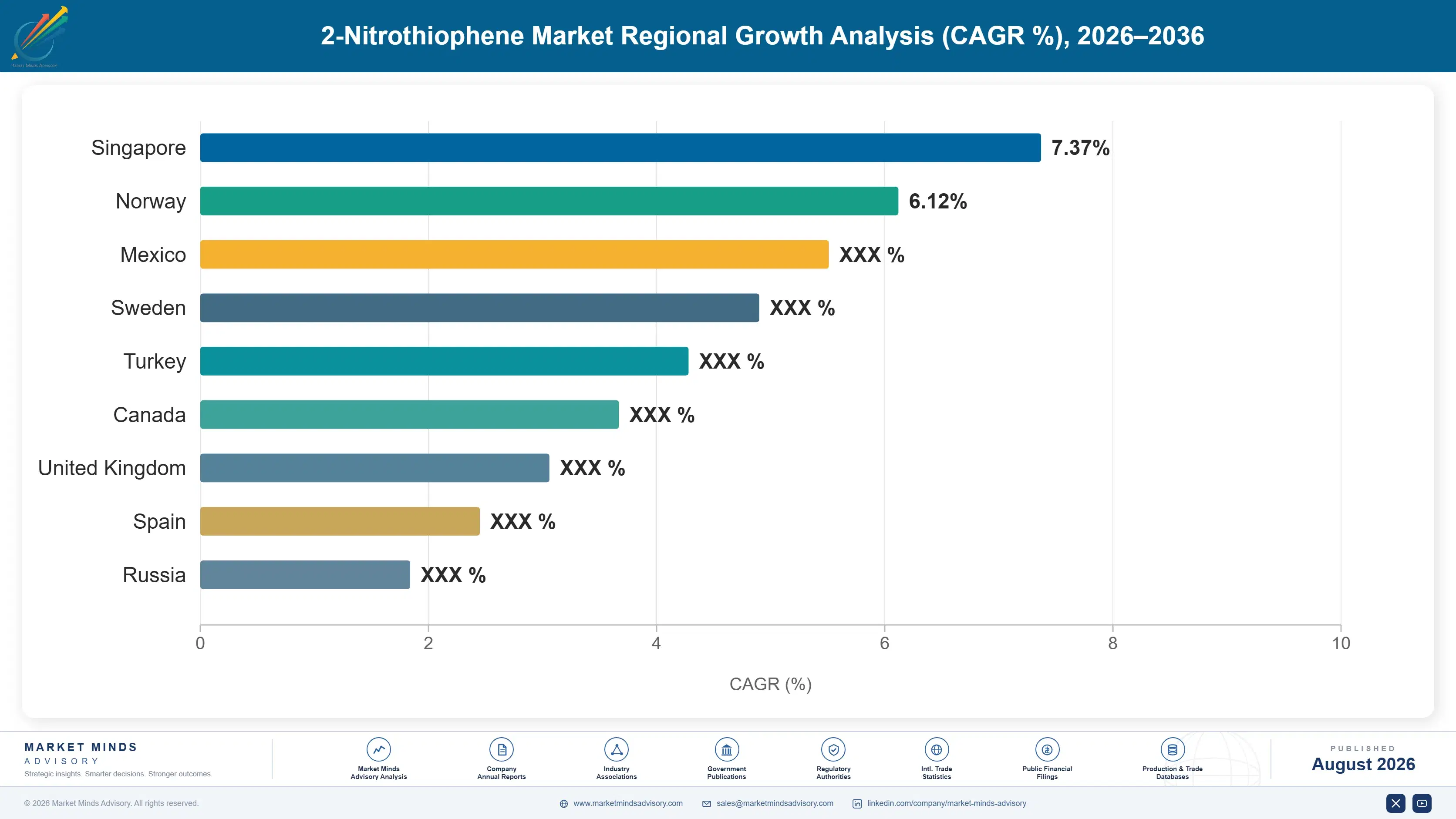
Regional Architecture and Country Demand Map

East Asia anchors the largest share of global 2-nitrothiophene production capacity, with North America and Western Europe holding substantial but slower-growing positions and South Asia and Pacific posting the fastest regional growth off a small base as new compliant capacity comes online each fiscal year.

North America

North America's demand concentrates around pharmaceutical API synthesis accounts requiring certified purity-grade material, with the United States hosting most regional consumption tied to active clinical and commercial drug manufacturing programs. Specialty chemical distributors maintain inventory to serve smaller research buyers who cannot commit to the minimum order volumes larger producers typically require. Nitro-aromatic handling regulations enforced by federal and state agencies add compliance cost that smaller domestic producers increasingly struggle to absorb, pushing some toward exiting production entirely in favor of distribution. Canada's smaller market follows similar sourcing patterns, relying on the same certified supplier base serving the United States. Growth here trails East Asia because domestic production capacity remains limited relative to demand and expands only gradually.
Share: 22% | CAGR: 5.6% (2026 to 2036)

Western Europe

Germany, Switzerland, and the United Kingdom drive Western Europe's demand, reflecting the region's concentration of pharmaceutical and specialty chemical manufacturing expertise built up over decades. EU REACH regulations impose registration and safety documentation requirements that add meaningful compliance cost for smaller producers entering the category for the first time. Switzerland's pharmaceutical industry concentration drives a disproportionate share of regional purchase volume relative to population, given the country's role as a global center for API synthesis and formulation. Overall regional growth lags the global average, reflecting a mature chemical manufacturing base and stricter regulatory costs that limit new capacity investment. Several producers are consolidating batch chemistry operations into fewer, larger compliant facilities.
Share: 18% | CAGR: 4.9% (2026 to 2036)
Regional intelligence for 5 additional markets available in the complete report: East Asia, South Asia and Pacific, Latin America, Middle East and Africa, Eastern Europe. Contact sales@marketmindsadvisory.com.
2-nitrothiophene-market-trends-country-cagr-analysis-1787464132773

Where Producers Can Defend Premium Pricing

Margin defense in this market depends almost entirely on certification and purity consistency, since volume alone cannot differentiate a genuinely fragmented batch chemistry supplier base. Four commercial moves stand out for producers seeking to protect pricing power as pharmaceutical buyers tighten qualification standards and Asian capacity expands aggressively across nearly every application segment worldwide.

Pharmaceutical Supplier Qualification Program Investment Initiatives

Producers completing pharmaceutical supplier qualification programs command significantly higher contract pricing than uncertified competitors selling comparable commercial-grade material into the same buyer channels. Building qualified status typically takes twelve to eighteen months and requires investment in documentation systems and batch consistency testing that smaller producers often cannot fund alone without external capital support. Certified suppliers report pricing premiums of 35 to 50 percent over uncertified material on comparable purity specifications sold into the same pharmaceutical channel, a gap that has widened rather than narrowed as qualification standards keep tightening further.
Market Impact: Adds 35 to 50 percent pharmaceutical pricing premium overall

Long-Term Thiophene Feedstock Contract Diversification Strategy

Producers with multi-year thiophene feedstock contracts across multiple petrochemical and coal-tar sourcing regions avoided roughly 40 percent of the cost spike that spot-market buyers absorbed during recent feedstock volatility affecting the broader industry. This lever requires patient capital and established supplier relationships that smaller batch chemistry operators often cannot fund independently without external financing support, but it increasingly separates producers who can hold pricing steady from those forced to pass volatility straight through to buyer contracts every single production season without exception, eroding trust with long-term pharmaceutical accounts over time.
Market Impact: Avoids 40 percent of feedstock cost spike overall

Direct Pharmaceutical Brand Relationship Building Programs

Producers who build direct multi-year supply relationships with pharmaceutical synthesis buyers, bypassing chemical distributor intermediaries entirely, capture more of the value chain margin than those selling into spot or distributor-brokered markets throughout the year. Direct relationships also give producers better forecasting visibility, letting them plan compliant facility capacity investment against confirmed forward demand rather than reacting to volatile spot orders that fluctuate seasonally throughout the year across most producing regions. Suppliers with direct pharmaceutical relationships report contract renewal rates roughly 30 percentage points higher than those selling primarily through distribution intermediaries.
Market Impact: Lifts contract renewal rate by 30 percentage points

Research-Grade Organic Electronics Channel Development Programs

Producers expanding research-grade purity capability to serve organic electronics and conducting polymer researchers are capturing new demand as materials science laboratories scale trials beyond single-gram synthesis toward small commercial-quantity production runs. This channel commands premium pricing well above standard commercial-grade material, given the reproducibility documentation researchers require for publishable results and downstream commercial development work moving forward toward eventual manufacturing. Early movers into this research channel report revenue per kilogram roughly 60 percent higher than standard commercial-grade sales into dye and pigment intermediate channels serving established long-term buyers across the wider industry.
Market Impact: Lifts revenue per kilogram by 60 percent overall

Who Controls the Margin Pool

The top five producers hold a combined share in the high twenties, reflecting how fragmented batch chemistry production remains even among the most established qualified suppliers. The gap between the leading pharmaceutical-qualified producers and the broader field of unqualified batch chemistry operators is wide, since qualification and certification concentrate volume among relatively few organized suppliers with the resources to pursue it.
Competitive activity currently centers on three dimensions: pharmaceutical qualification program completion to access premium contracts, thiophene feedstock diversification to reduce spot-market exposure, and research-grade purity development aimed at capturing organic electronics demand before competitors respond. Price competition on standard commercial-grade material remains intense among smaller regional producers without qualification credentials or export relationships, keeping that segment of the market considerably more fragmented than the certified pharmaceutical-grade channel.

Emerging pressure is coming from Chinese and Indian producers that have moved beyond commodity-grade production into full pharmaceutical qualification and direct buyer relationships, categories previously dominated by established Western and Japanese fine chemical houses. Rankings are most likely to shift as organic electronics demand matures, potentially favoring producers who diversified into research-grade capability over those concentrated purely in commodity commercial-grade supply.
2-nitrothiophene-market-trends-company-positioning-matrix-1787464133302

Competitive Moat and Risk Dimensions

MERCK KGAA (MILLIPORESIGMA)

Moat: Global Pharmaceutical Certification Depth

MilliporeSigma's decades of pharmaceutical-grade fine chemical certification give it qualification credentials across major synthesis buyers that smaller competitors cannot replicate quickly. This depth lets the company win premium multi-year contracts where buyers need proven regulatory compliance rather than unproven suppliers, supporting pricing power that uncertified producers simply cannot match.
MERCK KGAA (MILLIPORESIGMA)

Risk: Asian Producer Price Pressure

MilliporeSigma's scale and legacy cost base leave it exposed on standard commercial-grade material, where Chinese and Indian batch chemistry producers now underprice established suppliers significantly. Defending share in these commodity categories increasingly means accepting thinner margins or ceding volume, a trade-off the company has not fully resolved across its global business units.
THERMO FISHER SCIENTIFIC

Moat: Broad Fine Chemical Distribution Network

Thermo Fisher's global distribution network gives it reach across research, pharmaceutical, and industrial buyers that smaller specialized producers cannot match, supporting diversified demand that reduces dependence on any single application category. This scale also supports inventory positioning that lets smaller research buyers access material quickly without committing to large minimum orders.
THERMO FISHER SCIENTIFIC

Risk: Distributor Margin Compression Risk

As primarily a distributor rather than a captive producer for this specific intermediate, Thermo Fisher faces margin compression risk if upstream producers bypass distribution to sell directly into qualified pharmaceutical accounts. Direct producer relationships increasingly threaten the distribution margin the company has historically captured on this narrow specialty chemical category specifically.

Players Tracked

Prominent Players

Merck KGaA (MilliporeSigma)
Thermo Fisher Scientific
TCI Chemicals
Enamine
BLD Pharmatech

Other Key Players

Combi-Blocks
Matrix Fine Chemicals
Hangzhou Dayangchem
Jiangsu Yasheng Group
Parchem Fine and Specialty Chemicals
Apollo Scientific
Fluorochem
AstaTech
Oakwood Products
Biosynth Carbosynth
abcr GmbH
Angene International
Otto Chemie
Spectrum Chemical
Shandong Xinhua Pharmaceutical

Recent Developments

FEBRUARY 2025

BLD Pharmatech Completes Pharmaceutical Qualification Audit

BLD Pharmatech completed a comprehensive pharmaceutical supplier qualification audit for its 2-nitrothiophene production line, adding certified purity documentation ahead of anticipated demand growth from clinical-stage pharmaceutical buyers. The completion positions the company to compete directly for multi-year contracts previously accessible only to established Western suppliers.
Signal: Signals Chinese producers steadily closing the qualification gap with long-established Western pharmaceutical-grade fine chemical suppliers today
JULY 2024

Enamine Expands Research-Grade Production Capacity

Enamine expanded dedicated research-grade production capacity for specialty thiophene derivatives, responding to growing demand from organic electronics and materials science laboratories scaling trial quantities. The investment adds meaningful capacity ahead of anticipated growth in commercial-quantity research orders across multiple academic and corporate laboratory partnerships worldwide.
Signal: Signals suppliers positioning early to capture organic electronics demand before it reaches larger commercial manufacturing scale
JANUARY 2025

TCI Chemicals Signs Multi-Year Feedstock Supply Agreement

TCI Chemicals signed a multi-year thiophene feedstock supply agreement with a petrochemical processor, locking in volume and pricing terms ahead of anticipated feedstock market volatility. The agreement is structured to reduce exposure to spot market pricing swings that have repeatedly disrupted production cost planning across the industry.
Signal: Signals long-term feedstock contracts becoming standard risk management practice among leading fine chemical producers globally today

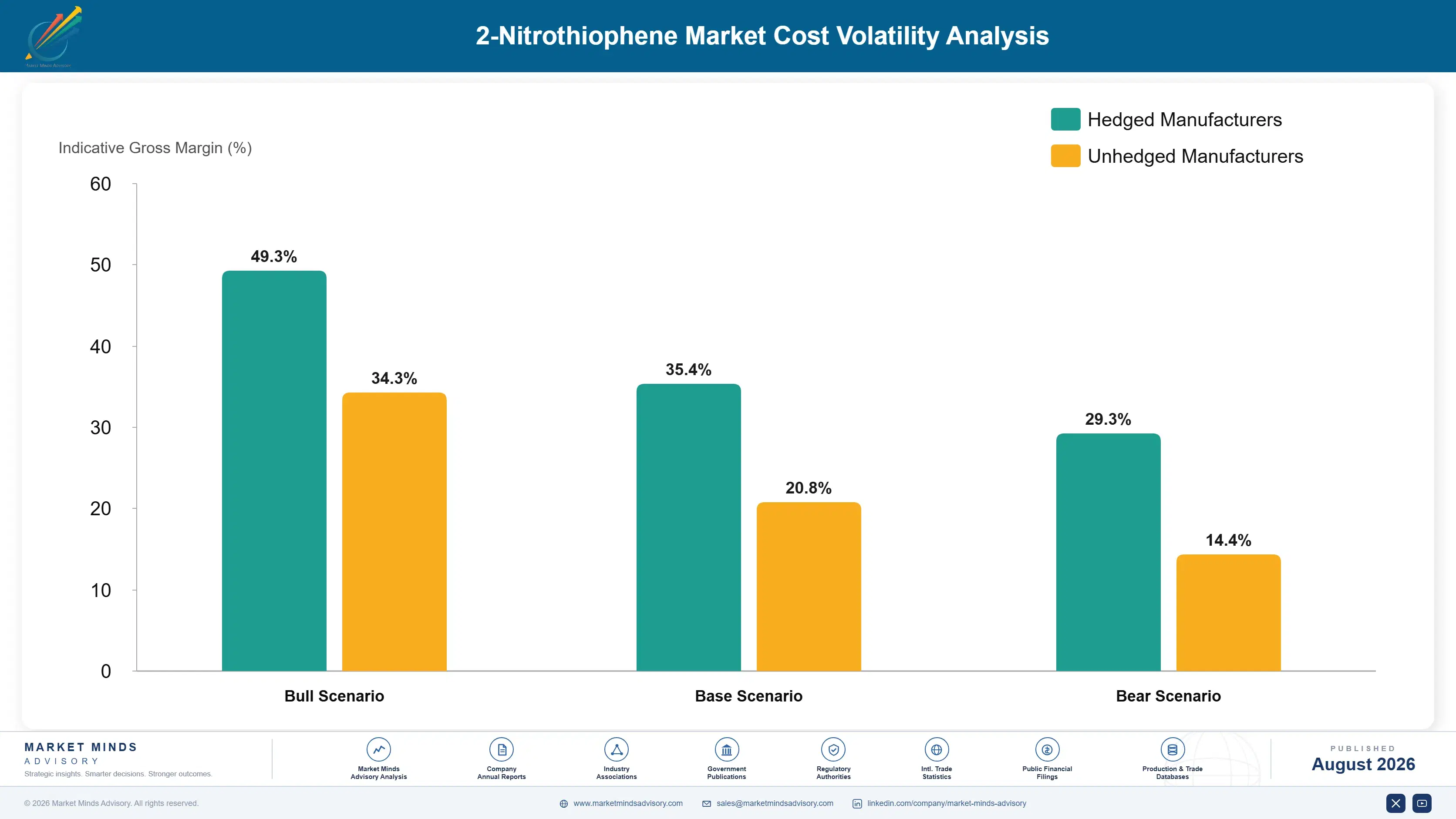
Thiophene Feedstock Cost Exposure

Thiophene feedstock accounts for roughly 39 percent of cost of goods sold for a typical fine chemical producer, sourced primarily as a byproduct stream from petrochemical and coal-tar processing operations in China, the United States, and Western Europe. Nitration reagents, solvents, and compliance testing make up most of the remaining cost base, since the synthesis process requires minimal additional raw material beyond these categories.
Petrochemical feedstock market disruption in 2024 pushed thiophene spot prices sharply higher within a single quarter according to IEA petrochemical market tracking and producer annual report disclosures. Producers without long-term feedstock contracts absorbed the spike directly, some passing over 20 percent of the increase straight into pharmaceutical and commercial buyer pricing within two quarters, a speed of pass-through rarely seen on less volatile fine chemical inputs.

The competitive disadvantage falls hardest on mid-sized producers that buy thiophene on spot markets rather than through multi-year supply agreements, since they cannot smooth cost volatility across a longer contract horizon the way larger integrated producers can. Exposure also varies by geography: producers concentrated in a single feedstock sourcing region carry materially more risk than those diversified across multiple petrochemical supply chains simultaneously.
2-nitrothiophene-market-trends-cost-volatility-analysis-1787464133502

Multi-Region Feedstock Contract Diversification

Spreading thiophene procurement across multiple petrochemical and coal-tar sourcing regions simultaneously reduces exposure to any single region's supply disruption or price shock. Producers that diversified sourcing ahead of the 2024 feedstock disruption held pricing steadier than spot-market buyers concentrated in one supply region, protecting contract margins through the worst months of the volatility and subsequent price recovery period.

Alternative Synthesis Route Research Investment

Investing in alternative synthesis routes that reduce dependence on petrochemical-derived thiophene offers a partial hedge against feedstock volatility, though it requires meaningful research investment and process validation before reaching commercial viability at scale. Several producers are exploring biosynthetic and alternative feedstock pathways to reduce exposure to petrochemical market cycles over the coming several years.

Multi-Year Fixed Price Contracts with Pharmaceutical Buyers

Locking pharmaceutical buyer contracts into multi-year fixed or collared pricing structures shifts some feedstock volatility risk away from the producer and onto the customer relationship itself. This requires strong customer trust and typically only works for producers with an established track record of reliable supply and consistent purity documentation across several prior contract cycles.

Portfolio Architecture for Margin Defence

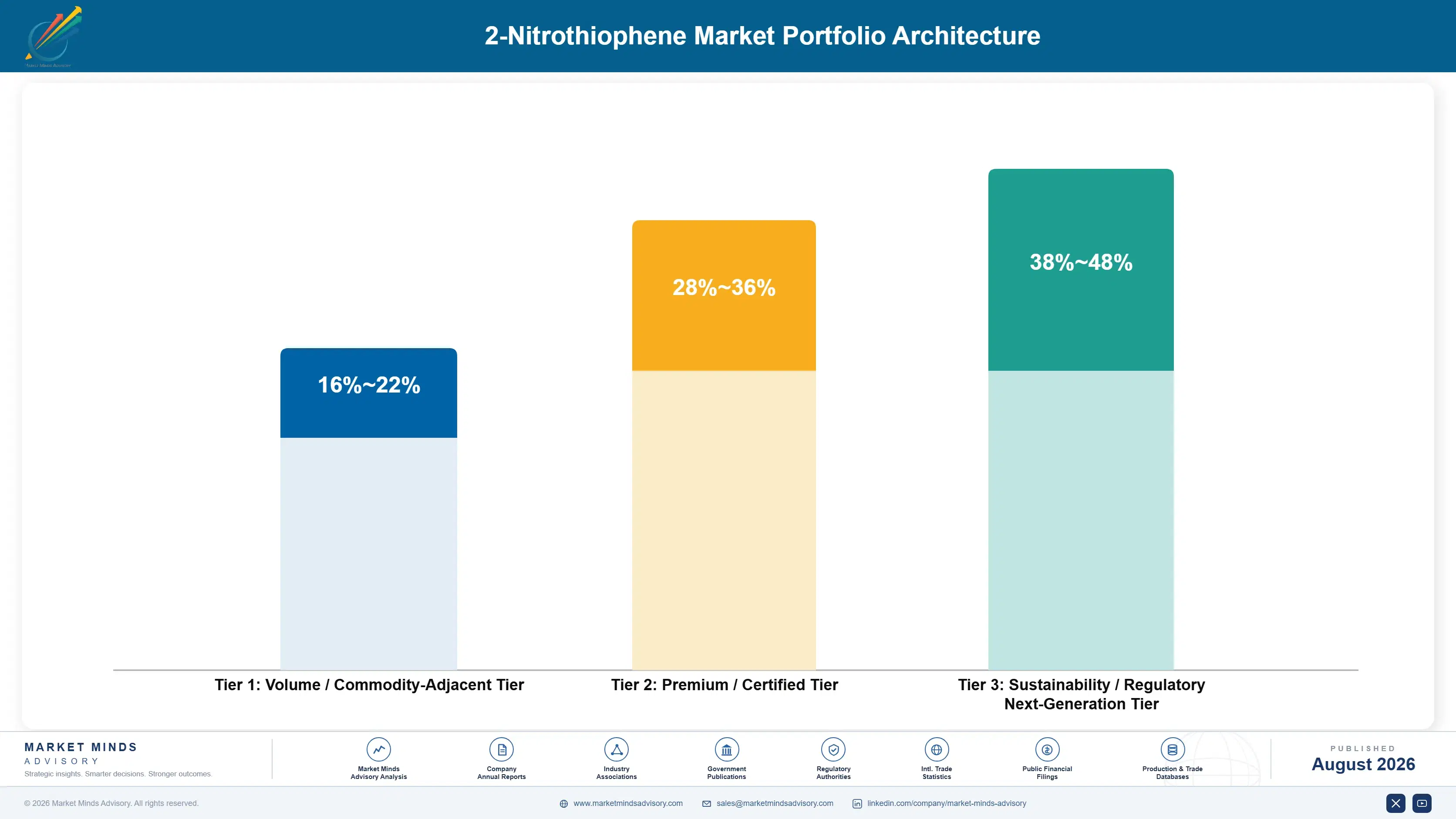
Three tiers structure the 2-nitrothiophene market, and margin economics separate them sharply given how differently each tier is certified and documented. Volume and commodity-adjacent product, covering standard commercial-grade material sold into dye, pigment, and general research channels, competes primarily on price and reliable batch supply. Premium and certified product carries pharmaceutical supplier qualification, commanding meaningfully higher margins than commodity material sold at comparable volume.
The sustainability and next-generation tier, covering research-grade organic electronics precursor material and alternative synthesis route production, generates the highest margins but requires the heaviest investment in purity documentation and process validation over multiple production cycles. Tension between volume and premium positioning defines strategy for most mid-sized producers, who cannot fully fund next-generation capability while still defending commodity volume against low-cost Chinese and Indian producers undercutting on price.

High-value margin pools concentrate overwhelmingly in pharmaceutical-qualified and research-grade supply, categories where documented purity and traceability genuinely protect pricing power against both uncertified competitors and buyers seeking to substitute alternative synthesis chemistries entirely. Producers anchored purely in the commodity tier face a much lower ceiling on achievable profitability regardless of production scale or feedstock sourcing efficiency.

Volume / Commodity-Adjacent Tier

Standard commercial-grade material sold into dye, pigment, and general research channels, competing primarily on price and reliable batch supply rather than certification or documentation depth across successive production runs each quarter.
Gross Margin: 16-22%

Premium / Certified Tier

Pharmaceutical-qualified material with documented purity testing and supplier audit compliance, commanding premium pricing from buyers requiring certified traceability before approving new contracts or renewing existing supply agreements each annual cycle.
Gross Margin: 28-36%

Sustainability / Regulatory / Next-Generation Tier

Research-grade organic electronics precursor material and alternative synthesis output, commanding the highest margins in the portfolio and requiring the deepest ongoing investment in validation testing and reproducibility documentation each season.
Gross Margin: 38-48%
2-nitrothiophene-market-trends-portfolio-architecture-1787464134005

High-value Sub-segments and Strategic Watch-out

Research-Grade Organic Electronics Precursor Material

High-value and high-growth, this segment commands the strongest margins in the market as materials science laboratories multiply thiophene-based semiconductor research programs, rewarding producers with documented reproducibility credentials that smaller uncertified producers cannot yet provide at comparable scale, documentation depth, or batch-to-batch consistency across successive orders.
Gross Margin: 38-48%

Pharmaceutical-Qualified Intermediate Supply

High-value with moderate growth, pharmaceutical-qualified material benefits from durable API synthesis demand even as volume growth trails the faster-expanding research segment, giving producers a stable, well-margined revenue base tied to multi-year clinical and commercial drug programs rather than volatile spot demand tied to broader economic cycles.
Gross Margin: 30-36%

Standard Commercial-Grade Dye Intermediate Volume

This volume core segment anchors most producers' revenue base even as margins compress under pricing pressure from Asian competitors, remaining commercially essential despite offering the weakest growth and thinnest margin trajectory across the entire market, since it funds working capital that supports investment in higher-margin qualified categories elsewhere.
Gross Margin: 14-20%

Unqualified Spot-Market Commodity Supply

A strategic watch-out segment, unqualified spot-market producers face shrinking competitiveness as pharmaceutical buyers tighten supplier qualification standards, leaving suppliers without certification exposed to accelerating volume loss unless they invest in compliance infrastructure soon before major contracts next come up for renewal across pharmaceutical buyer channels.
Gross Margin: 10-16%

Qualified Contracts, Recurring Synthesis Demand

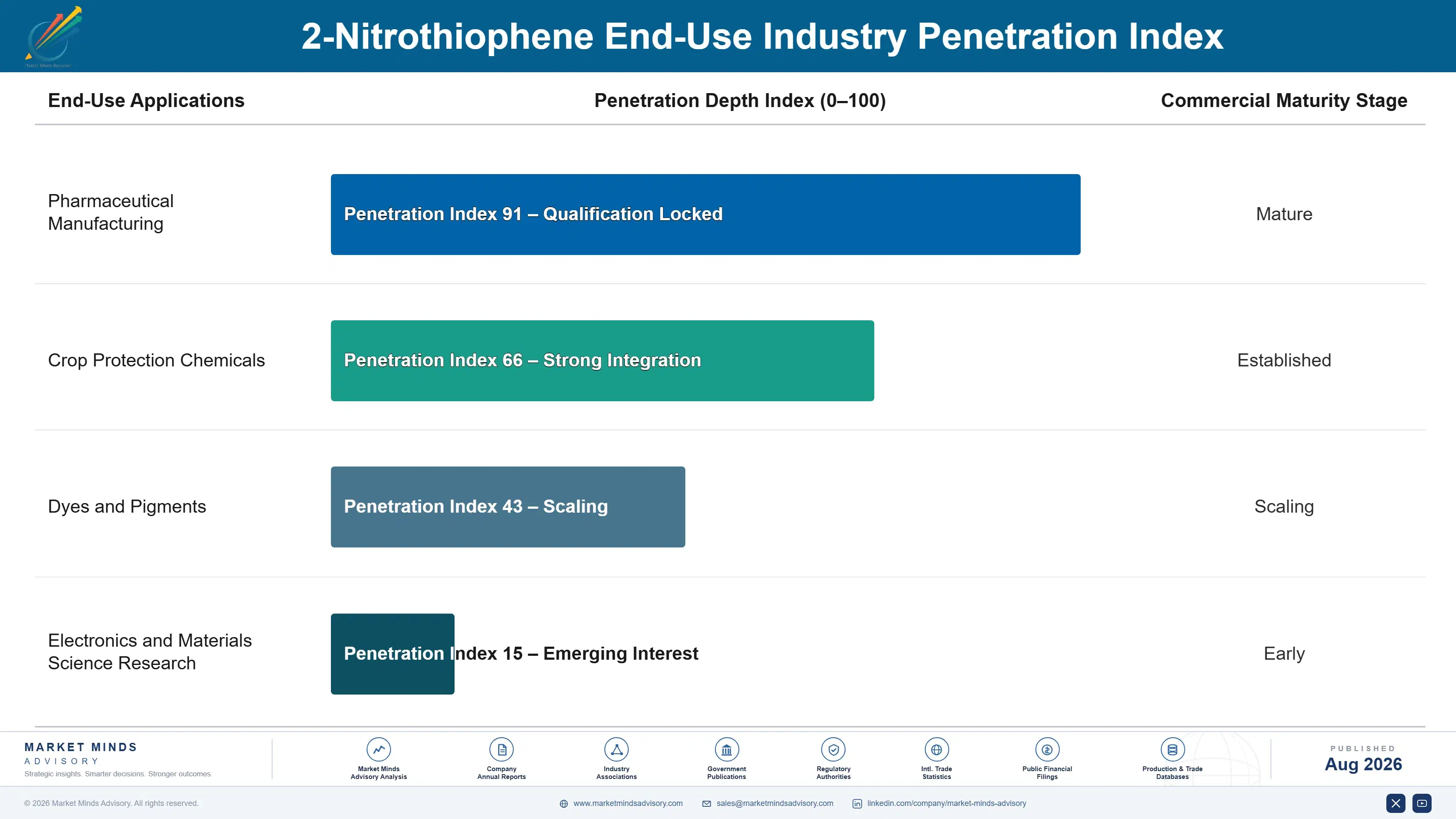
Pharmaceutical supply contracts function much like annuities once a qualified producer relationship is established, since switching suppliers mid-program risks reopening regulatory approval processes that took years to complete. This creates multi-year revenue visibility for incumbent qualified producers that new entrants struggle to displace without offering a clearly better price or purity credential, which is why producers invest heavily in defending existing buyer relationships.
Adoption stickiness varies sharply by end-use vertical. Pharmaceutical buyers rarely switch qualified suppliers once a synthesis route is locked into a regulatory filing, given the compliance risk of introducing an unvetted supplier mid-program, while dye and pigment buyers rebid contracts more frequently as they chase lower cost in a category with looser purity requirements. This split means producer retention economics differ meaningfully by customer type.

A generational shift in buyer profiles is underway as younger pharmaceutical procurement leads prioritize documented supply chain traceability over legacy supplier relationships built on personal trust alone, rewarding producers who can demonstrate qualification credentials quickly during vendor evaluations. This is gradually eroding the advantage that decades-old informal supplier relationships once provided incumbent fine chemical producers across most major producing regions.
2-nitrothiophene-market-trends-end-use-penetration-index-1787464134494

What Matters Most Through 2036

These are among the four positions where our research anticipates prominent divergence between winners and laggards over the coming forecast period. Each is grounded in the demand model, the regulatory perimeter, and the announced capacity pipeline.
01 / CERTIFICATION INVESTMENT PRIORITY

Complete pharmaceutical qualification now or lose premium contracts

Pharmaceutical buyers have moved supplier qualification from a nice-to-have credential into a contracting requirement across most major synthesis programs, and the shift has happened faster than many mid-sized producers anticipated. Producers still unqualified by the next major contract renewal cycle risk losing bids regardless of price competitiveness, since buyers now screen suppliers on qualification status before evaluating cost at all. The investment case is strongest for producers that still have a narrow window left to close the qualification gap before contracts renew.
02 / RESEARCH CHANNEL DIVERSIFICATION

Build organic electronics revenue as a hedge against cycles

Research-grade organic electronics precursor demand commands pricing premiums and a secondary revenue stream that traditional dye and pigment channels cannot match, and the technical barrier of reproducibility documentation is real rather than merely perceived by competitors evaluating entry. Producers building this research channel now are positioning themselves to capture disproportionate share of the fastest-growing segment in the entire market over the coming decade. Waiting risks leaving producers overexposed to commodity channels facing intensifying Asian price competition and steadily thinning margins.
03 / FEEDSTOCK RISK MANAGEMENT

Diversify feedstock sourcing ahead of the next volatility shock

Thiophene feedstock volatility has repeatedly punished producers buying on spot markets over the past several seasons, while diversified long-term supply contracts held pricing meaningfully steadier throughout the same period. This is not a hypothetical risk category, it has already materially affected margins across the industry more than once in recent memory. Producers that lock in multi-year, multi-region feedstock agreements now will be far better positioned than spot-market competitors when the next weather-driven or policy-driven disruption inevitably arrives somewhere in the supply chain.
04 / DIRECT BUYER RELATIONSHIP BUILDING

Move beyond distributors to capture more supply chain value

Producers selling primarily through chemical distribution intermediaries capture less of the value chain margin than those with direct multi-year pharmaceutical buyer relationships, and the gap in contract renewal rates between the two groups is substantial and well documented across the industry. Direct relationships also give producers better forecasting visibility, letting them plan compliant facility investment against confirmed demand rather than volatile spot orders. Producers that build direct buyer relationships now will command materially better economics than those remaining dependent on distribution intermediaries indefinitely.

Engagement Snapshot From the Field

A live engagement with an industry participant carrying material or product regulatory and market exposure ahead of a defining policy shift, showing how our research translates into a defensible multi-year portfolio strategy.
MARKET MINDS ADVISORY · CLIENT ENGAGEMENT SUMMARY
2-Nitrothiophene Producer Strategic Portfolio Review and Transition Roadmap 2026·Investment Scenario on 2-Nitrothiophene Exposure Evaluation 2025-26
CLIENT PROFILE
The client is a mid-sized North American pharmaceutical manufacturer synthesizing a thiophene-based active ingredient for a clinical-stage drug candidate advancing through late-stage development. Annual 2-nitrothiophene procurement spend was reported at approximately $4 million (client-reported, unverified by MMA), sourced entirely from a single legacy supplier facing capacity constraints as the client's clinical program advanced toward later-stage trials.
STRATEGIC CHALLENGE
Leadership needed to qualify a second supplier without disrupting an active regulatory filing that specified the incumbent supplier's synthesis route in detail. Prior attempts to evaluate alternative producers had stalled over documentation gaps, and the client lacked a structured framework for comparing supplier purity consistency before committing to a costly qualification process.
MMA APPROACH
MMA conducted structured interviews with qualified fine chemical producers and benchmarked their purity consistency against the client's existing supplier baseline using independent batch testing data. The engagement combined primary survey data with a supplier capability scoring framework covering certification status, feedstock diversification, and documented regulatory audit history across comparable pharmaceutical accounts.
KEY FINDINGS
  1. One alternative producer matched the incumbent's purity consistency within acceptable variance across three independent batch testing rounds conducted over two full months of evaluation.
  2. Diversified sourcing reduced the client's exposure to single-supplier capacity constraints during peak clinical trial material demand periods, improving supply reliability meaningfully across the program.
  3. Two candidate producers lacked sufficient regulatory audit history, disqualifying them entirely from consideration given the client's active clinical-stage regulatory filing documentation requirements.
  4. Feedstock-diversified sourcing across two producers reduced the client's exposure to single-region thiophene supply disruption compared with its prior single-supplier sourcing structure and contract terms.
CLIENT PROFILE
The client is a mid-sized North American pharmaceutical manufacturer synthesizing a thiophene-based active ingredient for a clinical-stage drug candidate advancing through late-stage development. Annual 2-nitrothiophene procurement spend was reported at approximately $4 million (client-reported, unverified by MMA), sourced entirely from a single legacy supplier facing capacity constraints as the client's clinical program advanced toward later-stage trials.
STRATEGIC CHALLENGE
Leadership needed to qualify a second supplier without disrupting an active regulatory filing that specified the incumbent supplier's synthesis route in detail. Prior attempts to evaluate alternative producers had stalled over documentation gaps, and the client lacked a structured framework for comparing supplier purity consistency before committing to a costly qualification process.
MMA APPROACH
MMA conducted structured interviews with qualified fine chemical producers and benchmarked their purity consistency against the client's existing supplier baseline using independent batch testing data. The engagement combined primary survey data with a supplier capability scoring framework covering certification status, feedstock diversification, and documented regulatory audit history across comparable pharmaceutical accounts.
KEY FINDINGS
  1. One alternative producer matched the incumbent's purity consistency within acceptable variance across three independent batch testing rounds conducted over two full months of evaluation.
  2. Diversified sourcing reduced the client's exposure to single-supplier capacity constraints during peak clinical trial material demand periods, improving supply reliability meaningfully across the program.
  3. Two candidate producers lacked sufficient regulatory audit history, disqualifying them entirely from consideration given the client's active clinical-stage regulatory filing documentation requirements.
  4. Feedstock-diversified sourcing across two producers reduced the client's exposure to single-region thiophene supply disruption compared with its prior single-supplier sourcing structure and contract terms.
RECOMMENDED STRATEGY
Phase 1: Phase 1 (Weeks 1 to 5): Benchmark alternative producers very carefully against the client's existing supplier baseline data in detail. Phase 2: Phase 2 (Weeks 6 to 10): Pilot the qualified second supplier on a limited batch with full purity validation testing protocols. Phase 3: Phase 3 (Weeks 11 to 16): Formalize dual-sourcing fully across both newly qualified producers for the entire remaining program duration.
OUTCOME
The client established dual-sourcing across two qualified producers within four months, reporting improved supply reliability alongside a blended cost reduction of roughly 8 percent (client-reported, unverified by MMA) across its full clinical trial material procurement budget for the entire remaining program duration through commercial launch.

Frequently Asked Questions

Foundational context covering the market sizes, CAGR, scope, country, region and competition that inform every finding below. This section is provided to cover basics and most often pre-purchase conversations, answered from the MMA Primary Research Dataset.

What is the current size of the 2-Nitrothiophene Market?

The market is valued at $0.28 billion in 2025, MMA's defined base year for this analysis. This reflects global demand for pharmaceutical, agrochemical, and electronics-grade intermediate applications.

How large will the 2-Nitrothiophene Market be by 2036?

MMA projects the market will reach $0.56 billion by 2036, nearly double the 2026 opening value. Growth is led by pharmaceutical qualification demand and organic electronics research scaling.

What is the CAGR for the 2-Nitrothiophene Market 2026 to 2036?

The base case CAGR is 6.4 percent across the 2026 to 2036 forecast period. Bull and bear scenarios range from 5.3 percent to 7.6 percent depending on regulatory compliance costs.

Which segment is growing fastest?

Organic electronics and conducting polymer precursor applications lead at an 11.2 percent CAGR, well above the market average. Pharmaceutical intermediate applications follow closely at 8.6 percent.

Who are the major companies in the 2-Nitrothiophene Market?

Merck KGaA, Thermo Fisher Scientific, TCI Chemicals, Enamine, and BLD Pharmatech lead the market today. Combined, the top five suppliers hold a CR5 of approximately 28 percent.

Which country is growing fastest?

India leads country-level growth as generic pharmaceutical manufacturers expand certified intermediate sourcing nationwide. Vietnam and Indonesia follow closely, both scaling fine chemical investment steadily higher.

Report Segmentation Architecture

The full report scope spans multiple orthogonal segmentation dimensions, with cross-tabulated demand data provided for each dimension pair. Coverage extends further to regional breakdowns, trend trajectories, and the competitive detail needed to support segment-level decision-making.

By End-Use Application

  • Pharmaceutical Intermediate
  • Agrochemical Intermediate
  • Dye and Pigment Intermediate
  • Organic Electronics and Conducting Polymer Precursor
  • Research and Laboratory Reagent
  • Specialty Coating Additive

By End-Use Industry

  • Pharmaceutical Manufacturing
  • Crop Protection Chemicals
  • Dyes and Pigments
  • Electronics and Materials Science Research

By Commercial Dimension

  • Certified Pharmaceutical-Grade Supply
  • Standard Commercial-Grade Supply
  • Research-Grade Specialty Supply
  • Distributor Channel Sales

By Region

  • North America
  • Western Europe
  • East Asia
  • South Asia and Pacific
  • Latin America
  • Middle East and Africa
  • Eastern Europe

Scope, Methodology, and Coverage

Every figure in this report is reproducible from documented input assumptions. The scope below maps the historical period, the forecast horizon, the segmentation dimensions, and the countries covered, alongside the underlying primary and qualitative methodology.
Historical Period
2020 to 2025
Forecast Period
2026 to 2036
Base Year
2025 (USD billions; MMA Primary Research Dataset, August 2026)
Market Definition
This report covers 2-nitrothiophene sold as a chemical intermediate for pharmaceutical, agrochemical, dye and pigment, and organic electronics synthesis applications. It excludes finished pharmaceutical, agrochemical, or electronic products containing 2-nitrothiophene-derived compounds as a formulated ingredient.
Quantitative Units
USD millions (current prices); metric tons where volume context applies
Segmentation Dimensions
By End-Use Application; By End-Use Industry; By Commercial Dimension; By Region
Regions Covered
North America, Western Europe, East Asia, South Asia and Pacific, Latin America, Middle East and Africa, Eastern Europe
Countries Covered
USA, China, Germany, France, UK, Japan, South Korea, India, Australia, Canada, Brazil, Mexico, Indonesia, Vietnam, Thailand, Malaysia, UAE, Saudi Arabia, South Africa, Nigeria, Turkey, Poland, Netherlands, Italy, Spain, Sweden, Switzerland, Argentina, Colombia, Singapore, and additional markets relevant to this sector
Key Companies Profiled
Merck KGaA (MilliporeSigma), Thermo Fisher Scientific, TCI Chemicals, Enamine, BLD Pharmatech, Combi-Blocks, Matrix Fine Chemicals, Hangzhou Dayangchem, Jiangsu Yasheng Group, Parchem Fine and Specialty Chemicals, Apollo Scientific, Fluorochem, AstaTech, Oakwood Products, Biosynth Carbosynth, abcr GmbH, Angene International, Otto Chemie, Spectrum Chemical, Shandong Xinhua Pharmaceutical
Quantitative Methodology
Primary survey, n=3,800 respondents, Q4 2025, six countries; demand-side model with trade association cross-validation
Qualitative Methodology
47 expert interviews, Q4 2025; applied to validate demand model assumptions, identify emerging dynamics, and assess competitive positioning
Report Format
PDF and XLSX data workbook (Word format preview document)
Publisher
Market Minds Advisory
Report Code
MMA-2026-CHM-202
Published
August 2026
Contact
sales@marketmindsadvisory.com | www.marketmindsadvisory.com

Purchase the full 2-Nitrothiophene Market Report (2026 to 2036).

The full report delivers a complete market model spanning 2020 through 2036, with segmentation by end-use application, end-use industry, and commercial dimension across all seven covered regions. It includes detailed competitive profiles of the twenty companies assessed in this summary, along with primary survey data from 3,800 respondents and 47 expert interviews conducted in the fourth quarter of 2025. Country-level detail covers thirty additional markets beyond the seven headline regions, supporting granular sourcing decisions. Analysts provide supplementary guidance on supplier qualification strategy, feedstock risk management, and research channel expansion relevant to procurement teams.
Full 2020-2036 historical and forecast data model
Segment-level CAGR and share breakdowns by application
Twenty-company competitive profiles and moat analysis
Regional demand analysis across all seven covered geographies
Feedstock cost and regulatory compliance risk assessment
Analyst briefing call included with report purchase

Built For The People Who Decide

From boardroom strategy to bench-side execution, this report is read cover-to-cover by leaders shaping the next decade of their industry, turning demand scenarios, market dynamics and valuation benchmarks into decisions.
CXOs/ Presidents/ VPs/ Managers
M&A and Corporate Development
Strategy Teams and R&D Heads
Procurement and Product Directors
Regulatory and Compliance Leaders
Investor Relations and Equity Analysts